The concentration of N in barley grain has largely been investigated (Grashoff and D’Antuono 1997, Sedlář et al. 2011), but little attention has been paid to concentrations of other elements, although they can also be important for evaluation of grain quality. For example an insufficient P concentra-tion in seeds can negatively affect germinaconcentra-tion of seeds and growth of seedlings and therefore following yield of different crops (Hejcman et al. 2012a, Nadeem et al. 2012, White and Veneklaas 2012). High P concentration in seeds is thus highly important particularly for seeds for seeding.
Elements such as Ca, Cu, Fe, Mg and Zn are frequently lacking in human diet, therefore there is a high demand for their sufficiently high bio-available concentrations in cereals (White and
Broadley 2009). Decrease in concentrations of Cu, Fe and Zn in the cereal grain occurred during the last 50 years due to introduction of short straw and high grain yielding varieties. Highly topical question is therefore biofortification – methods enabling to increase bio-available concentrations of Ca, Cu, Fe and Zn in edible crops.
The adverse effects of many risk-elements such as As, Cd and Pb on human health have led to evalu-ation of agricultural products not only according to basic quality parameters, but also according to concentrations of risk-elements (Dudka et al. 1996, Šrek et al. 2012).
Concentrations of macro-, micro- and risk-el-ements in the barley grain have been frequently investigated in highly polluted regions but little
Effect of long-term fertilizer application on yield
and concentrations of elements (N, P, K, Ca, Mg, As,
Cd, Cu, Cr, Fe, Mn, Ni, Pb, Zn) in grain of spring barley
M. Hejcman
1,2, M. Berková
1, E. Kunzová
21
Department of Ecology, Faculty of Environmental Sciences, Czech University of Life
Sciences Prague, Prague, Czech Republic
2
Department of Nutrition Management, Crop Research Institute, Prague, Czech Republic
ABSTRACT
Little attention has been paid to the effect of long-term fertilizer application on concentrations of elements in grain of barley produced on the metal non-contaminated agricultural soil. In 2010, we analyzed yield and concentrations of elements in grain of spring barley in unfertilized control, mineral fertilizer application (N4P2K2 – 70, 60 and 100 kg N, P and K per ha) and combinations of farmyard manure or poultry litter with mineral fertilizer (FMN4P2K2 and PLN4P2K2) treatments in the Ruzyně Fertilizer Experiment established on Luvisol in 1955 in Prague (Czech Republic). The yield of grain ranged from 4.03 to 9.74 t/ha in the control and FMN4P2K2 treatment. There was a positive effect of fertilizer application on concentrations of nitrogen, phosphorusand potassium, but no effect on concentrations of calcium and magnesium. With the exception of iron, concentrations of micro (copper and zinc) and risk elements (arsenic, cadmium, chromium, lead, manganese and nickel) were not significantly affected by the fertilizer treatments. Long-term use of organic and mineral fertilizers with appropriate application rates does not represent any risk for contamination of barley grain by risk elements on mineral rich and metal non-contaminated agricultural soils.
Keywords: arsenic; dilution effect; Hordeum vulgare; heavy metals; lead; nitrogen; zinc
attention has been paid to the effect of long-term fertilizer application on common agricultural soils. In addition, little attention has been paid to relationship between grain yield and concentration of elements. The aim of this study was therefore to investigate how the grain yield of spring barley and concentrations of elements (N, P, K, Ca, Mg, As, Cd, Cu, Cr, Fe, Mn, Ni, Pb, Zn) in the grain are affected by long-term fertilizer application.
MATERIAL AND METHODS
Experimental design. The Ruzyně Fertilizer Experiment (RFE) was established on a perma-nent arable field in 1955 on the western edge of Prague (50°05'15''N, 14°17'28''E). At the study site, the mean annual temperature was 8.2°C and the mean annual precipitation was 422 mm (Prague-Ruzyně Meteorological Station, 1955–2007). The soil type was classified as Luvisol and the parent material was loess mixed with chalk. The upper 30 cm (arable layer) contains 27% clay, increasing to 40% in the subsoil (soil layer 30–40 cm) and 49% at depths of 40–50 cm (Hejcman et al. 2012b).
Spring barley was only sampled from strip number II of the RFE, named the ‘Classical Crop Rotation’ (45% cereals, 33% root crops and 22% legumes). The crop sequence was alfalfa, alfalfa, winter wheat, sugar beet, spring barley, potatoes, winter wheat, sugar beet and spring barley with alfalfa under-sowing. Organic fertilizers, farmyard manure (FM) and poultry litter (PL), were ap-plied three times during the nine years long crop rotation in each autumn before planting of sugar beet or potatoes in particular treatments. The last application of FM and PL was performed before sugar beet planting one and half year before the seeding of spring barley investigated in this study
(FM and PL applied in October 2008). Calcium am-monium nitrate (27% N), superphosphate (8.3% P) and potassium chloride (49.8% K) were applied as mineral fertilizers.
We selected unfertilized control, mineral N, P and K fertilizer application (N4P2K2) and com-binations of organic fertilizers with mineral N, P and K fertilizers (FMN4P2K2 and PLN4P2K2). Each treatment was replicated four times (in de-tail Šrek et al. 2010). The individual plot size was 12 m × 12 m and only the central 5 m × 5 m plot was used for experimental purposes. Mean amounts of N, P and K over the crop rotation annually applied to the investigated treatments, basic soil chemical properties and concentrations of trace elements are given in Tables 1–3. Application of mineral fertilizers directly to spring barley was 70 kg N (N4 level), 60 kg P (P2 level) and 100 kg K (K2 level) per ha. Approximately 25% of N, P and K applied by organic fertilizers to sugar beet could be used by investigated spring barley in the following year. Amount of N, P and K applied by FM to sugar beet was 66, 15 and 159 kg/ha and amount of N, P and K applied by PL was 81, 117 and 354 kg/ha.
Grain sampling, chemical and statistical analysis. Half-late malting spring barley variety Sebastian was used in this study. The grain was gathered using a harvester and grain yield per ha was then determined. The samples of grain were collected from each plot during the harvest on 10th August 2010. The grain samples were washed
three times with distilled water and then dried at 105°C up to total desiccation.
The concentrations of elements in the grain were determined by wet ashing with increased pressure. Exactly 1 g of powdered grain was decomposed in a mixture of 8 mL of HNO3 and 2 mL of H2O2. The ash was then decomposed using a microwave
ash-Table 1. List of investigated fertilizer treatments and mean annual application rates of N, P, K, Cu and Zn over all crops in nine years long crop rotation. Approximate amount of applied Cu and Zn by fertilizer treatments follows calculations by Uprety et al. (2009)
Element Control N4P2K2 FMN4P2K2 PLN4P2K2
N (kg/ha) 0 91 113 118
P (kg/ha) 0 31 36 70
K (kg/ha) 0 146 199 264
Cu (g/ha) 0 4 10 27
Zn (g/ha) 0 43 156 175
[image:2.595.64.532.650.741.2]ing device (CEM 2000, Kamp, Lintfort, Germany) and diluted in 10 mL of aqua regia. As, Ca, Cd, Cr, Cu, K, Mg, Mn, Ni, P, Pb and Zn were measured by ICP-OES (Thermo Jarrell Ash, Trace Scan, Franklin, USA). To determine the N concentration, barley grain was mineralized in 98% H2SO4 in microwave; N concentrations in the solution were then meas-ured with a flow colorimeter (SAN plus SYSTEM, SKALAR, Breda, the Netherlands).
One way ANOVA followed by post-hoc compari-son using Tukey test was used to identify significant differences among treatments.
RESULTS AND DISCUSSION
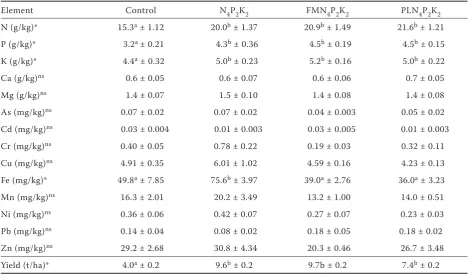
There was a clear positive effect of fertilizer treatment on grain yield and concentrations of N, P and K in the grain, but no effect on concentra-tions of Ca and Mg (Table 4). With the exception of Fe, concentrations of micro- and risk-elements in the grain were not significantly affected by ap-plied treatments (Table 4).
[image:3.595.64.531.114.257.2]The yield of grain in the control (4.03 t/ha) was almost the same as the mean grain yield (4.07 t/ha) recorded in the Czech Republic in 2010 and higher
Table 2. Mean values of basic soil chemical properties in arable layer in 2007. Plant available P and K concentra-tions were determined by Mehlich III extraction procedure
Chemical properties Control N4P2K2 FMN4P2K2 PLN4P2K2
pH (CaCl2) 6.0 6.3 5.8 5.4
C organic (%) 2.6 1.41 3.9 3.4
N total (%) 0.13 0.12 0.25 0.15
C/N ratio 20 11.8 15.6 22.6
P (mg/kg) 17 50 97 135
K (mg/kg) 112 235 360 309
Ca (mg/kg) 3100 3210 2840 2880
Mg (mg/kg) 145 132 167 148
N4 – ammonium nitrate; P2 – superphosphate; K2 – potassium chloride; FM – farmyard manure; PL – poultry litter
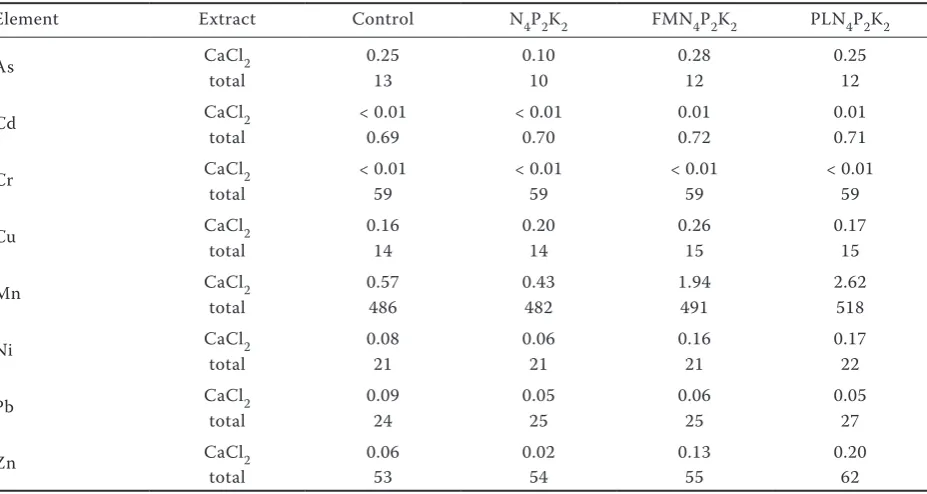
Table 3. Plant-available (extracted by CaCl2) and total (extracted by aqua regia) concentrations of trace elements (mg/kg) in arable layer (according to Uprety et al. 2009)
Element Extract Control N4P2K2 FMN4P2K2 PLN4P2K2
As CaCl2 0.25 0.10 0.28 0.25
total 13 10 12 12
Cd CaCl2 < 0.01 < 0.01 0.01 0.01
total 0.69 0.70 0.72 0.71
Cr CaCl2 < 0.01 < 0.01 < 0.01 < 0.01
total 59 59 59 59
Cu CaCl2 0.16 0.20 0.26 0.17
total 14 14 15 15
Mn CaCl2 0.57 0.43 1.94 2.62
total 486 482 491 518
Ni CaCl2 0.08 0.06 0.16 0.17
total 21 21 21 22
Pb CaCl2 0.09 0.05 0.06 0.05
total 24 25 25 27
Zn CaCl2 0.06 0.02 0.13 0.20
total 53 54 55 62
[image:3.595.67.531.492.739.2]than yields (1.9–3.3 t/ha) recorded over 12 years with no fertilizer input on different soil types in the Czech Republic (Černý et al. 2010). The relatively high yield in the control without any fertilizer input in 2010 was consistent with high yields in the controls of other field strips in the RFE in other years (5.0, 5.5 and 3.9 t/ha in 2008, 2009 and 2011, respectively), indicating the high suitability of the study site for barley production. The high suitability of the study site for barley production is also illustrated by grain yields over 9 t/ha recorded in the N4P2K2 and FMN4P2K2 treatments, which are very high in comparison with maximal grain yields from different experiments in the Czech Republic – 5.2 t/ha by Černý et al. (2010), 6.8 t/ha by Hřivna et al. (2009), 7.2 t/ha by Koutná et al. (2003) and 8.8 t/ha by Sedlář et al. (2011). The reduced grain yield in PLN4P2K2 compared to the N4P2K2 and FMN4P2K2 treatments was probably due to adverse effects on barley growth from the high nutrient application in this treatment.
The clear positive effect of N application on N concentration in the barley grain is in accordance with Pettersson and Eckersten (2007). The
opti-mal concentration of N for opti-malting (14–18 g/kg; Grashoff and D’Antuono 1997) was recorded only in the control. Application of 70 kg N/ha in the form of mineral fertilizer directly to barley was too high to achieve an acceptable compromise between the grain yield and suitable concentration of N in the grain for malting. We also recorded positive effects of P and K application on concen-trations of P and K in the grain. Although P and K concentrations in barley grain have rarely been studied, they are believed to be highly important for the seeds for sowing as low concentrations of P and K in seeds in general can negatively affect the rapidity of germination and development of seedlings (Hejcman et al. 2012a, Nadeem et al. 2012, White and Veneklaas 2012).
Although poultry litter supplied the soil with considerable amounts of Cu, Mn and Zn (Uprety et al. 2009), there was no effect of fertilizer treat-ment on concentrations of these eletreat-ments in the grain. This can be explained by a dilution effect and by the low ability of barley to accumulate Cu (Belyaeva et al. 2005). Concentrations of Cu in our study were lower to or comparable with
con-Table 4.Concentrations of elements in grain of spring barley and yield of spring barley grain (85% dry matter content) in 2010
Element Control N4P2K2 FMN4P2K2 PLN4P2K2
N (g/kg)* 15.3a ± 1.12 20.0b ± 1.37 20.9b ± 1.49 21.6b ± 1.21
P (g/kg)* 3.2a ± 0.21 4.3b ± 0.36 4.5b ± 0.19 4.5b ± 0.15
K (g/kg)* 4.4a ± 0.32 5.0b ± 0.23 5.2b ± 0.16 5.0b ± 0.22
Ca (g/kg)ns 0.6 ± 0.05 0.6 ± 0.07 0.6 ± 0.06 0.7 ± 0.05
Mg (g/kg)ns 1.4 ± 0.07 1.5 ± 0.10 1.4 ± 0.08 1.4 ± 0.08
As (mg/kg)ns 0.07 ± 0.02 0.07 ± 0.02 0.04 ± 0.003 0.05 ± 0.02
Cd (mg/kg)ns 0.03 ± 0.004 0.01 ± 0.003 0.03 ± 0.005 0.01 ± 0.003
Cr (mg/kg)ns 0.40 ± 0.05 0.78 ± 0.22 0.19 ± 0.03 0.32 ± 0.11
Cu (mg/kg)ns 4.91 ± 0.35 6.01 ± 1.02 4.59 ± 0.16 4.23 ± 0.13
Fe (mg/kg)* 49.8a ± 7.85 75.6b ± 3.97 39.0a ± 2.76 36.0a ± 3.23
Mn (mg/kg)ns 16.3 ± 2.01 20.2 ± 3.49 13.2 ± 1.00 14.0 ± 0.51
Ni (mg/kg)ns 0.36 ± 0.06 0.42 ± 0.07 0.27 ± 0.07 0.23 ± 0.03
Pb (mg/kg)ns 0.14 ± 0.04 0.08 ± 0.02 0.18 ± 0.05 0.18 ± 0.02
Zn (mg/kg)ns 29.2 ± 2.68 30.8 ± 4.34 20.3 ± 0.46 26.7 ± 3.48
Yield (t/ha)* 4.0a ± 0.2 9.6b ± 0.2 9.7b ± 0.2 7.4b ± 0.2
nsResult of one-way ANOVA was not significant; *result of ANOVA was significant at 0.05 probability level.
[image:4.595.63.533.114.391.2]centrations recorded by other authors in barley grain: 0.4–9.5 mg/kg by Belyaeva et al. (2005) 2.3–9 mg/kg by Smart et al. (1992) and 5.2–6.0 mg/kg by Cox et al. (2001). Concentrations of Mn re-corded by other authors were the same or higher than the concentrations in our study: 11–69 mg/kg by Smart et al. (1992) and 12–13 mg/kg by Cox et al. (2001). Concentrations of Zn in our study were comparable with other authors: 29–58 mg/kg by Dudka et al. (1996), 19–41 mg/kg by Smart et al. (1992) and 24–26 mg/kg by Cox et al. (2001).
Significantly higher concentrations of Fe re-corded in the N4P2K2 treatment than in the other treatments can be explained by the lowest organic matter content in the soil in this treatment, as the availability of metal is negatively related to the organic matter content in the soil (Singh et al. 2010). In our study, concentrations of Fe were substantially higher than concentrations of Fe, ranging from 7.4 to 9.1 mg/kg, in a study by Cox et al. (2001), or lower than the concentration of Fe 167 mg/kg recorded by Singh and Garg (2006). Different concentrations of Fe were probably caused by different soil pH, as the availability of Fe is high in acid soils (Hejcman et al. 2010).
Concentrations of Ni were similar to concen-trations recorded in barley grain by Cox et al. (2001), which ranged from 0.26 to 0.54 mg/kg. Concentrations of As were considered to be in normal range as the same As concentrations were recorded in barley monitoring in UK (Cox et al. 2001). In all treatments, concentrations of Cd were about one order below the EU limit, which is 0.12 mg/kg. In our study, Cd concentrations were substantially lower than concentrations re-corded by other authors on Cd contaminated soils: 0.12–0.7 mg/kg by Dudka et al. (1996), 0.24 mg/kg by Sękara et al. (2005) and 0.05–0.12 mg/kg by Kaniuczak et al. (2011). Low Cd concentrations in our experiment were because of the almost neutral soil reaction resulting in low Cd availability and low application rate of Cd by fertilizers (Uprety et al. 2009). We recorded low Cd concentrations in grain despite the total concentration of Cd in the soil exceeding the Czech limit. This indicates a lack of positive correlation between the total content of Cd in the soil and Cd concentration in the grain on neutral or slightly acid soils. No effect of fertilizer treatment on Cd concentration in the grain is in accordance with Singh and Myhr (1998).
A trend toward lower concentrations of Cr in treatments with application of organic fertilizers
was recorded despite total concentrations of Cr in the arable layer being the same in all treatments (Uprety et al. 2009). The increased availability of Fe due to the lower soil pH, together with the higher availability of P in the PLN4P2K2 and FMN4P2K2 treatments than in the control and N4P2K2 treat-ments, probably decreased Cr uptake, because Fe and P can act as Cr antagonists (Wallace et al. 1976). Concentrations of Pb were below the EU limit which is 0.24 mg/kg, and were the same or lower than concentrations recorded by other authors: 0.4–2.2 mg/kg by Dudka et al. (1996) in a Pb con-taminated area, 0.02–0.48 mg/kg by Zhao et al. (2004) during monitoring of grain quality in the UK and 1.84 mg/kg by Sękara et al. (2005) in a remediation experiment. Concentrations of Pb in our experiment approached the EU limit, although the total Pb concentrations in the soil and in the fertilizers used were far below the legislative limits (Uprety et al. 2009). Similarly, as in the case of high concentrations of Pb recorded in potato tubers in the study area in 2009 (Šrek et al. 2010), a possible explanation seems to be atmospheric deposition, since the study area is in close proximity to the airport. Although there was no significant effect of treatment on concentrations of Cr, Ni and Pb, mean concentrations between particular treatments were relatively different. The possible explana-tion of no significant results is high variability in concentrations within each treatment.
Finally we concluded that fertilizer application greatly increased grain yield and N, P and K concen-trations in the grain, but there was almost no effect on the concentrations of Ca and Mg, micro- and risk-elements. The long-term use of organic and mineral fertilizers at normal application rates on mineral rich soils does not appear to represent any risk for contamination of cereals by risk-elements.
REFERENCES
Belyaeva O.N., Haynes R.J., Birukova O.A. (2005): Barley yield and soil microbial and enzyme activities as affected by con-tamination of two soils with lead, zinc or copper. Biology and Fertility of Soils, 41: 85–94.
Černý J., Balík J., Kulhánek M., Časová K., Nedvěd V. (2010): Mineral and organic fertilization efficiency in long-term sta-tionary experiments. Plant, Soil and Environment, 56: 28–36. Cox D., Bezdicek D., Fauci M. (2001): Effects of compost, coal
Dudka S., Piotrowska M., Terelak H. (1996): Transfer of cadmium, lead and zinc from industrially contaminated soil to crops plants: A field study. Environmental Pollution, 94: 181–188. Grashoff C., D’Antuono L.F. (1997): Effect of shading and nitrogen
application on yield, grain size distribution and concentrations of nitrogen and water soluble carbohydrates in malting spring barley (Hordeum vulgare L.). European Journal of Agronomy,
6: 275–293.
Hejcman M., Křišťálová V., Červená K., Hrdličková J., Pavlů V. (2012a): Effect of nitrogen, phosphorus and potassium avail-ability on mother plant size, seed production and germination ability of Rumex crispus. Weed Research, 52: 260–268. Hejcman M., Kunzová E., Šrek P. (2012b): Sustainability of winter
wheat production over 50 years of crop rotation and N, P and K fertilizer application on illimerized luvisol in the Czech Republic. Field Crops Research, 139: 30–38.
Hejcman M., Száková J., Schellberg J., Tlustoš P. (2010): The Rengen Grassland Experiment: Relationship between soil and biomass chemical properties, the amount of applied elements and their uptake. Plant and Soil, 33: 163–179.
Hřivna L., Richter R., Ryant P., Příkopa M. (2009): The effect of the previous crop and differentiated fertilisation on yields and content of N-substances in spring barley grain. Acta Univer-sitatis Agriculturae et Silviculturae Mendelianae Brunensis,
57: 141–148.
Kaniuczak J., Hajduk E., Wlagniewski S. (2011): Effect of lim-ing and mineral fertilization on cadmium content in grain of spring barley (Hordeum vulgare L.) and winter wheat (Triticum aestivum L.) cultivared on loessial soil. Journal of Elementol-ogy, 16: 535–542.
Koutná K., Cerkal R., Zimolka J. (2003): Modification of crop management and its influence on the structure of yield and quality of spring barley grain. Plant, Soil and Environment,
49: 457–465.
Nadeem M., Mollier A., Morel C., Vives A., Prud’homme L., Pel-lerin S. (2012): Maize (Zea mays L.) endogenous seed phospho-rus remobilization is not influenced by exogenous phosphophospho-rus availability during germination and early growth stages. Plant and Soil, 357: 13–24.
Pettersson C.G., Eckersten H. (2007): Prediction of grain protein in spring malting barley grown in northern Europe. European Journal of Agronomy, 27: 205–214.
Sedlář O., Balík J., Kozlovský O., Peklová L., Kubešová K. (2011): Impact of nitrogen fertilizer injection on grain yieldand yield formation of spring barley (Hordeum vulgare L.). Plant, Soil and Environment, 57: 547–552.
Sękara A., Poniedziałek M., Ciura J., Jędrszczyk E. (2005): Cad-mium and lead accumulation and distribution in the organs of nine crops: Implications for phytoremediation. Polish Journal of Environmental Studies, 14: 509–516.
Singh A., Agrawal M., Marshall F.M. (2010): The role of organic vs. inorganic fertilizers in reducing phytoavailability of heavy metals in a wastewater-irrigated area. Ecological Engineering,
36: 1733–1740.
Singh B.R., Myhr K. (1998): Cadmium uptake by barley as affected by Cd sources and pH levels. Geoderma, 84: 185–194. Singh V., Garg A.N. (2006): Availability of essential trace
ele-ments in Indian cereals, vegetables and spices using INAA and the contribution of spices to daily dietary intake. Food Chemistry, 94: 81–89.
Smart M.E., Cymbaluk N.F., Christensen D.A. (1992): A review of copper status of cattle in Canada and recommendations for sup-plementation. The Canadian Veterinary Journal, 33: 163–170. Šrek P., Hejcman M., Kunzová E. (2010): Multivariate analysis
of relationship between potato (Solanum tuberosum L.) yield, amount of applied elements, their concentrations in tubers and uptake in a long-term fertilizer experiment. Field Crops Research, 118: 183–193.
Šrek P., Hejcman M., Kunzová E. (2012): Effect of long-term cattle slurry and mineral N, P and K application on concentra-tion of N, P, K, Ca, Mg, As, Cd, Cr, Cu, Mn, Ni, Pb and Zn in peeled potato tubers and peels. Plant, Soil and Environment,
58: 167–173.
Uprety D., Hejcman M., Száková J., Kunzová E., Tlustoš P. (2009): Concentration of trace elements in arable soil after long-term application of organic and inorganic fertilizers. Nutrient Cycling in Agroecosystems, 85: 241–252.
Wallace A., Soufi S.M., Cha J.W., Romney E.M. (1976): Some ef-fects of chromium toxicity on bush bean plants grown in soil. Plant and Soil, 44: 471–473.
White P.J., Veneklaas E.J. (2012): Nature and nurture: The im-portance of seed phosphorus content. Plant and Soil, 357: 1–8. White P.J., Broadley M.R. (2009): Biofortification of crops with seven mineral elements often lacking in human diets – iron, zinc, copper, calcium, magnesium, selenium and iodine. New Phytologist, 182: 49–84.
Zhao F.J., Adams M.L., Dumont C., McGrath S.P., Chaudri A.M., Nicholson F.A., Chambers B.J., Sinclair A.H. (2004): Factors affecting the concentrations of lead in British wheat and barley grain. Environmental Pollution, 131: 461–468.
Received on March 6, 2013 Accepted on May 17, 2013
Corresponding author:
Prof. RNDr. Michal Hejcman, Ph.D. et Ph.D., Česká zemědělská univerzita v Praze, Fakulta životního prostředí, Katedra ekologie, Kamýcká 129, 165 21 Praha 6-Suchdol, Česká republika