A reduction of pathogenic microorganisms in the digestive tract decreases the contamination of poultry products. It applies e.g. to strains of
Salmonella or Campylobacter, which are one of the main causes of diseases of alimentary origin. Epidemiological studies demonstrate that poultry and poultry products are frequent sources of patho-genic agents. Especially at present when feeding antibiotics is banned, other substances become increasingly important. Fatty acids (FA), above all medium-chain fatty acids (MCFA), also show the antibacterial activity (Bergsson et al., 1998; Van Immerseel et al., 2004). Caprylic acid (CA) is a natural MCFA with eight carbons and occurs in
human and bovine milk (Jensen, 2002) and in co-conut oil (Jensen et al., 1990; Sprong et al., 2001). The bacteriostatic and bactericidal effects of FA and their monoglycerides against a wide range of microorganisms have been known for a long time (Hassinen et al., 1951; Nieman, 1954; Kabara et al., 1972). Caprylic acidis active against coliform bacteria and may improve the resistance of weaned rabbits to enterocolitis (Skřivanová et al., 2008). The antimicrobial activity expressed as minimum inhibitory concentration (MIC) varied from 1 to 3 mg/ml (Skřivanová et al., 2006). Its bacterial ac-tivity is reduced at pH > 6 (Skřivanová et al., 2005). Both in vitro and fattening experiments
demon-Supported by the Ministry of Agriculture of the Czech Republic (Project No. Mze 0002701404).
Effects of different levels of dietary supplemental
caprylic acid and vitamin E on performance,
breast muscle vitamin E and A, and oxidative
stability in broilers
M. Skřivan, G. Dlouhá, M. Englmaierová, K. Červinková
Institute of Animal Science, Prague-Uhříněves, Czech Republic
ABSTRACT: The paper reports data from four experiments (EXP). Broiler cockerels Ross 308 were allocated to 3 or 5 (EXP 4) dietary treatments comprising 300 (3 replicated pens of 100 chicks per pen), 50, 50 or 100 chickens. The EXP lasted 42, 38, 42 and 38 days. All basal diets contained adequate ingredients. The inclusion of 0.5% caprylic acid (CA) in diets reduced (P < 0.05) body weight (EXP 1). The results of EXP 3 and 4 indicated that the diet supplemented with 0.25% CA and 30 mg vitamin E (total vitamin E concentration 50 mg) resulted in similar BW like the basal diet, but the increased supplemental vitamin E to 150 mg (EXP 3) or to 100 mg (EXP 4) decreased (P < 0.05 and P < 0.001) BW and increased mortality. No differences were found between the fat and crude protein contents in dry matter of breast meat. Higher vitamin E doses in feed mixture significantly (P < 0.001) increased the content of vitamins soluble in fats in breast meat – vita-min E (from 28.54 in the control to 80.28 mg/kg of dry matter) and vitavita-min A (from 0.34 to 0.44 mg/kg of dry matter). The addition of caprylic acid significantly decreased the speed of lipid oxidation measured after 3 (P < 0.02) and 5 (P < 0.05) days of storage in refrigerator at a temperature from 2.5 to 4°C. On the contrary, higher vitamin E doses and basal diet without CA supplement increased the oxidation of lipids.
strated that CA favourably influenced the digestive tract. Dierick et al. (2002) observed that MCFA (C6–C12) significantly suppressed the intestinal flora (total anaerobic count, lactobacilli, E. coli) and improve the mucosal health and growth per-formance of piglets. The addition of caprylic acid (5 g/kg) to a diet for piglets increased (P < 0.05) weight gain compared to basal diet (Marounek et al., 2004). The supplementation of CA (0.35, 0.525, 0.7 and 0.875%) to feed significantly (P < 0.05) re-duced the caecal Campylobacter jejuni colonization in young chickens. At higher doses, CA reduced feed consumption and body weight, but it did not affect feed conversion (Solis de los Santos et al., 2008). The supplementation of vitamin E tended to improve the growth and feed utilization of birds and it substantially improved the meat quality sta-bility against oxidative deterioration (Guo et al., 2001). Whereas Attia et al. (2001) noted statistical differences among treatments only for body weight at six weeks of age, which increased significantly (P < 0.05) by elevating vitamin E levels, while body weight gain, feed consumption and feed conversion were not influenced by dietary treatments.
The utilization of caprylic acid as antibiotics re-placement supposes to gather enough data on the influence of CA addition on poultry performance. These data for poultry have been missing until now. The aim of the present study was to determine CA dosage in feed mixture for broiler chickens and the effect of the combination of CA and vitamin E on performance, quality and oxidative stability of meat.
MATERiAl And METhodS
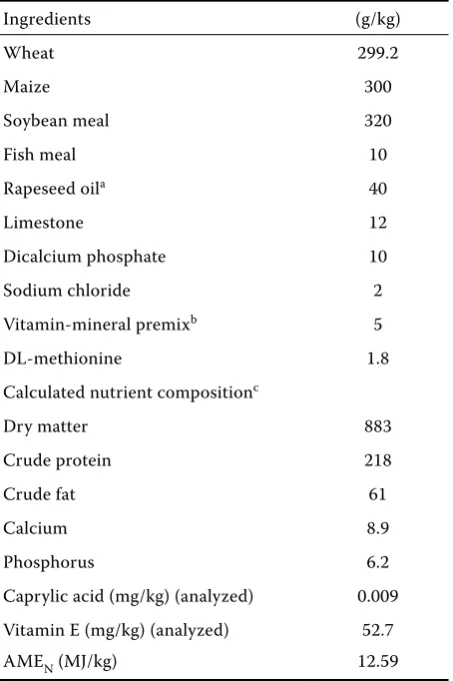
Four experiments (EXP) were performed with Ross 308 cockerels. Experiment 1: nine hundred chickens (0 day old) were randomly assigned to 9 pens containing 100 chicks each. Each pen was equipped with nipple drinkers and pan feeders. Three replications of 3 dietary treatments were used (Table 1). The basal diet supplemented with 30 mg of α-tocopherol acetate per kg of feed was a control (total analyzed vitamin E 52.7 mg/kg). Chicks in dietary treatments 2 and 3 were fed a basal diet supplemented with caprylic acid (Sigma) 5 g/kg until the 21st day or during the whole EXP. The chicks were kept under a 24-h constant lighting schedule and allowed ad libitum access to feed and water. Broiler chickens were slaughtered at 42 days
[image:2.595.306.533.287.628.2]of age. Compared to EXP 1, in EXP 2 50 cocke-rels were used in each treatment. Three treatments were used: basal diet, basal diet supplemented with 0.5% of caprylic acid or 130 mg of vitamin E (the total concentration of vitamin E was 150 mg/kg) and 0.5% of caprylic acid. The experiment was terminated at 38 days of age. EXP 3 was realized similarly like EXP 2 but with lower caprylic acid supplement (0.25%) and EXP 3 lasted for 42 days. In EXP 4, one hundred male broiler chicks were in each treatment. The basal diet with 50 mg of vita-min E without supplementation of caprylic acid was
Table 1. Composition of the basal diet
Ingredients (g/kg)
Wheat 299.2
Maize 300
Soybean meal 320
Fish meal 10
Rapeseed oila 40
Limestone 12
Dicalcium phosphate 10
Sodium chloride 2
Vitamin-mineral premixb 5
DL-methionine 1.8
Calculated nutrient compositionc
Dry matter 883
Crude protein 218
Crude fat 61
Calcium 8.9
Phosphorus 6.2
Caprylic acid (mg/kg) (analyzed) 0.009 Vitamin E (mg/kg) (analyzed) 52.7
AMEN (MJ/kg) 12.59
acaprylic acid was mixed with rapeseed oil
bpremix provided per kg of diet: retinyl acetate 3.6 mg;
cho-lecalciferol 13 μg; α-tocopherol acetate 30 mg; menadione 3 mg; thiamine 3 mg; riboflavin 5 mg; pyridoxine 4 mg; cyano-cobalamin 40 μg; calcium pantothenate 12 mg; biotin 0.15 mg; folic acid 1.5 mg; choline chloride 250 mg; ethoxyquin 100 g; copper 12 mg; iron 50 mg; iodine 1 mg; manganese 80 mg; zinc 60 mg; selenium 0.3 mg
a control treatment. Other treatments had 0.25% of caprylic acid and various total vitamin E contents (50, 100, 200 and 300 mg/kg) in diet. The experi-ment was terminated at 38 days of age and carcass analysis followed.
Analyses
The breast meat (EXP 4) for dry matter, fat and crude protein determination (n = 10 per treatment) was stored in plastic bags at –20°C and meat for MDA and vitamin determination was stored at –70°C. Fat content in basal diet and breast meat was determined by extraction with petroleum ether in a Soxtec 1045 apparatus (Tecator Comp., Sweden) and crude protein was analyzed using a Kjeltec Auto 1030 (Tecator Comp., Sweden). Lipid oxidation in breast meat samples (n = 8 per treat-ment) was measured by the method of Piette and
Raymond (1999), and results were expressed as thiobarbituric acid-reactive substances (TBARS) in mg of malondialdehyde (MDA) per kg of mus-cle. Before analysis, the breast meat was thawed and stored in a refrigerator at a temperature range from 2.5 to 4°C for 0, 3 or 5 days. Theα-tocopherol and retinol contents in breast meat (n = 10 per treatment) were determined in accordance with the EN 12822 European standard (2000), by HPLC (Shimadzu, VP series) equipped with a diode-array detector. Each method was used for determination of vitamin E in diet. The concentration of caprylic acid in basal diet was determined by gas chroma-tographic analysis using a Hewlett-Packard 5890 gas chromatograph equipped with a programmed HP-Innova capillary column (180°C to 240°C) and FI detector.
[image:3.595.67.532.390.459.2]Resultant values were statistically analyzed by analysis of variance (ANOVA) using the GLM pro-cedure of SAS (2003).
Table 2. Growth traits (EXP 1)
Caprylic acid (%) BW (g) F:G Mortality (%)
0 2 117.3 ± 399.12a 1.74 4
0.5 until 21st day 1 899.9 ± 408.95b 1.76 0
0.5 during whole fattening 1 871.5 ± 484.29b 1.57 1
[image:3.595.65.536.527.596.2]a,btreatment means (±SE) with different superscripts differ (P < 0.05)
Table 3. Growth traits (EXP 2)
Caprylic acid (%) Vitamin E (mg/kg) BW (g) F:G Mortality (%)
0 50 2 197.6 ± 316.28a 1.66 2
0.5 50 2 134.1 ± 254.61ab 1.71 2
0.5 150 2 028.4 ± 260.59b 1.84 0
a,btreatment means with different superscripts differ (P < 0.05)
Table 4. Growth traits (EXP 3)
Caprylic acid (%) Vitamin E (mg/kg) BW (g) F:G Mortality (%)
0 50 2 614.4 ± 247.96a 1.61 0
0.25 50 2 622.8 ± 261.77a 1.63 0
0.25 150 2 429.2 ± 323.18b 1.84 0
[image:3.595.67.539.663.732.2]RESulTS
As shown in Tables 2 and 3, the supplementation of higher doses of CA (0.5%) to the diet decreased (P < 0.05) body weight. The results of EXP 3 and 4 (Table 4 and 5) showed that the diet supplemented with 0.25% CA and 30 mg vitamin E (total vitamin E concentration 50 mg) resulted in similar BW like the control diet. At the higher dietary vitamin E con-centration of 150 mg (EXP 3, Table 4) and 100 mg
(EXP 4, Table 5), the BW significantly (P < 0.05 and
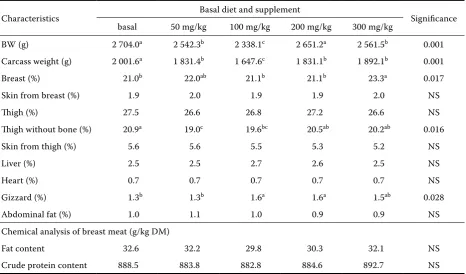
[image:4.595.63.536.103.223.2]P < 0.001) decreased. Raising the vitamin E concen-tration in diet caused an increase in mortality with the exception of 300 mg. The highest supplement of vitamin E (total dietary concentration 300 mg) increased (P < 0.02) the breast percentage share in carcass weight, but no effect of vitamin E on thigh was observed (EXP 4, Table 6). No effect of treat-ments on fat and protein contents was recorded. The increasing vitamin E level caused a significant
Table 5. Growth traits (EXP 4)
Caprylic acid (%)
Vitamin E (mg/kg)
BW (g)
F:G Mortality (%) 1st day 21st day 38th day
0 50 47 845.8 ± 149.71a 2 608.3 ± 2 74.49ab 1.61 1
0.25 50 47 807.2 ± 134.59b 2 555.9 ± 234.50bc 1.62 2
0.25 100 47 764.6 ± 117.84c 2 339.0 ± 211.95d 1.52 4
0.25 200 46 830.7 ± 145.55ab 2 633.2 ± 253.86a 1.51 7
0.25 300 46 759.9 ± 141.97c 2 538.1 ± 263.16c 1.67 2
a,b,c,dtreatment means with different superscripts differ (P < 0.001)
Table 6. Carcass analysis – percentage share in carcass weight (EXP 4)
Characteristics Basal diet and supplement Significance
basal 50 mg/kg 100 mg/kg 200 mg/kg 300 mg/kg
BW (g) 2 704.0a 2 542.3b 2 338.1c 2 651.2a 2 561.5b 0.001
Carcass weight (g) 2 001.6a 1 831.4b 1 647.6c 1 831.1b 1 892.1b 0.001
Breast (%) 21.0b 22.0ab 21.1b 21.1b 23.3a 0.017
Skin from breast (%) 1.9 2.0 1.9 1.9 2.0 NS
Thigh (%) 27.5 26.6 26.8 27.2 26.6 NS
Thigh without bone (%) 20.9a 19.0c 19.6bc 20.5ab 20.2ab 0.016
Skin from thigh (%) 5.6 5.6 5.5 5.3 5.2 NS
Liver (%) 2.5 2.5 2.7 2.6 2.5 NS
Heart (%) 0.7 0.7 0.7 0.7 0.7 NS
Gizzard (%) 1.3b 1.3b 1.6a 1.6a 1.5ab 0.028
Abdominal fat (%) 1.0 1.1 1.0 0.9 0.9 NS
Chemical analysis of breast meat (g/kg DM)
Fat content 32.6 32.2 29.8 30.3 32.1 NS
Crude protein content 888.5 883.8 882.8 884.6 892.7 NS
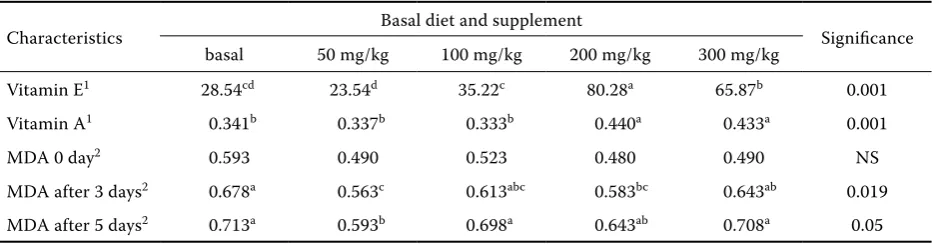
[image:4.595.66.533.442.716.2](P < 0.001) increase in the vitamin content in breast meat (Table 7). The highest values of both vitamins were recorded in the treatment with 0.25% of CA and 200 mg of vitamin E. The effect of CA and vita-min E supplementation on lipid oxidation in breast meat during storage is also shown in Table 7. The addition of CA significantly decreased the speed of lipid oxidation measured by MDA formation after 3 (P < 0.02) and 5 (P < 0.05) days of storage. The lower values were determined in chickens receiving 0.25% of CA and 50 mg of vitamin E in diet. However, the highest vitamin E concentration was found to be related to an increase in lipid oxidation.
diSCuSSion
Many in vitro experiments brought unambigu-ously effective results of CA application(Nair et al., 2005; Skřivanová et al., 2005, 2006; Vasudevan et al., 2005). Successful suppression of experimen-tal infection of rabbits followed (Skřivanová et al., 2008). With the exception of experiments on pigs (Dierick et al., 2002; Marounek et al., 2004) and rabbits (Skřivanová et al., 2008), no data on performance after CA addition to diet have been published yet. An additional test with 10 chickens/ treatment until the age of 10 days was published only (Solis de los Santos, 2008). The influence of polyunsaturated fatty acid (PUFA) on the produc-tion capability of chickens was studied (Zelenka et al., 2006, 2008 and others) as well as the effect of unsaturated FA and long-chain saturated FA (Skřivan et al., 2000). On the other hand, MCFA stays off in this course has not been mentioned up to the present.
[image:5.595.64.534.102.224.2]The addition of 0.5% CA was found successful in pigs and rabbits. In chickens, it was necessary to decrease the supplementation from original 0.5% in EXP 1 and 2 to 0.25%. A higher CA dose strongly reduced the average live weight of chickens at the end of fattening. It was also observed when the diet with CA was applied only in the first 3 weeks of experiment. On the contrary, mortality of chick-ens significantly declined from 4% to 0% or 1%. The negative effect of higher CA supplementation was found out also in the following experiment. Chickens had insignificantly lower live weight and worse feed conversion. The worse results in conse-quence of a higher dose of CA cannot be explained by CA toxicity according to literature. MCFA have a high degree of safety documented by oral, parenteral and dermal tests (Traul et al., 2000). Furthermore, CA is a food-grade chemical approved by the FDA as GRAS (FDA, 1981). A further important decrease in chicken live weights was recorded at the higher supplementation of vitamin E. Vitamin E concentration in the basal diet was at the level 50 mg/kg. Vitamin-mineral premix added 30 mg of vitamin E/kg and components another 23 mg. The analytically determined vitamin E content was 52.7 mg/kg. Increased supplementation of vitamin E together with CA was found to be unsuitable be-cause it either reduced the live weight of chickens or increased mortality. Similar findings were ascer-tained also with 0.25% CA addition. The cause is not known. CA is a saturated FA. The antioxidant ethoxyquin was added into the feed mixture by vita-min-mineral premix. The nutritious requirement of vitamin E was met by its content 53 mg. The effect of CA was also positive according to MDA pro-duction. Consequently, higher doses of vitamin E
Table 7. Vitamin E and A (mg/kg DM) and MDA (mg/kg) in breast meat (EXP 4)
Characteristics Basal diet and supplement Significance
basal 50 mg/kg 100 mg/kg 200 mg/kg 300 mg/kg
Vitamin E1 28.54cd 23.54d 35.22c 80.28a 65.87b 0.001
Vitamin A1 0.341b 0.337b 0.333b 0.440a 0.433a 0.001
MDA 0 day2 0.593 0.490 0.523 0.480 0.490 NS
MDA after 3 days2 0.678a 0.563c 0.613abc 0.583bc 0.643ab 0.019
MDA after 5 days2 0.713a 0.593b 0.698a 0.643ab 0.708a 0.05
were not only useless but also harmful in combina-tion with CA. In experiment 4, the depression of chicken growth was eliminated but mortality was the highest when 200 mg/kg of vitamin E were sup-plemented in total. Chicken mortality decreased at the level of treatment with 50 mg of vitamin E due to a further increase in vitamin E to the total content of 300 mg/kg feed mixture. However, the MDA concentration remained high. Caprylic acid can be fully safe but data on interactions with other substances are missing.
Solis de los Santos et al. (2008) evaluated the effect of CA (from 0.35% to 1.4%) on the caecal
Campylobacter jejuni colonization at experimental infection in 4 trials with 10 days old chicks. The dose of 0.35% CA, which is closer to our dose of 0.25% than to 0.5% CA, was more efficient com-pared with the spectrum of other five higher ad-ditions up to 1.4%. The authors simultaneously evaluated the live weight of chickens at 10 days, feed consumption and feed conversion which is less than orientation with 10 chicks/treatment. The lowest supplement (0.35%) did not decrease any of the three above-mentioned performance charac-teristics significantly in comparison with the basal diet. On the contrary, the highest doses were mark-edly worse, which is in accordance with the results presented by us.
Neither carcass analysis nor fat and crude protein content in meat brought any crucial knowledge in relation to CA. The negative effect of vitamin E up to 200 mg/kg on the weight of chickens did not pre-vent its higher deposition in breast meat. Moreover, the 2 highest additions of vitamin E significantly (P < 0.001) increased also vitamin A in meat. A comparison of the values of vitamin E and A con-tent in meat with MDA shows that the worst results were ascertained in the combination of 0.25% of CA and 300 mg of vitamin E in diet. The concen-tration of MDA is in principle consistent with the control treatment. The relatively high addition of vitamin E did not increase the oxidation stability of meat stored for 3 or 5 days. Very low TBARS were found out at 0.25% of CA and total content 53 mg of vitamin E. Because the same content of vitamin E was also used in the control, it is possible that the enhancement of breast meat oxidation stability is due to CA supplementation.
On the basis of the results from presented ex-periments with chickens CA dosage in the amount 0.25% of diet can be recommended. Performance will not decrease, mortality can be reduced and
antibacterial activity will stay sufficiently effective according to the last reports. The oxidation stability of breast meat stored for 3–5 days at a temperature from 2.5 to 4°C will increase at dietary content of 0.25% CA and 50 mg/kg of vitamin E. It is not rec-ommended to combine CA with a higher dose of vitamin E than 50 mg/kg.
REfEREnCES
Attia A.A., Abou-Zeid A.E., Mohamed F.F., Yakout H.M. (2001): Enhancement of broiler performance and im-mune response by α-tocopherol supplemented in diets. Pakistan Journal of Biological Sciences, 4, 1029–1035. Bergsson G., Arnfinnsson J., Karlsson S.M., Stein-grímsson Ó., Thormar H. (1998): In vitro Inactivation of Chlamydia trachomatis by fatty acids and monoglyc-erides. Antimicrobial Agents and Chemotherapy, 42, 2290–2294.
Dierick N., Decuypere J.A., Molly K., van Beek E., Van-derbeke E. (2002): Medium chain fatty acids as a nutri-tional alternative for in-feed antibiotics in piglet nutrition. Reproduction, Nutrition, Development, 42, 18 pp.
EN 12822 (2000): Foodstuffs – Determination of vitamin E by high performance liquid chromatography – meas-urement of α-, β-, γ- and δ-tocopherols. European Standard. European Commitee for Standardization, Brussels, Belgium.
FDA (Food and Drug Administration) (1981): Code of Federal Regulations 21 CFR 184.1025. The Office of the Federal Register National Archives and Records Ad-ministration. Washington, USA.
Guo Y., Tang Q., Yuan J., Jiang Z. (2001): Effects of sup-plementation with vitamin E on the performance and the tissue peroxidation of broiler chicks and the stabil-ity of thigh meat against oxidative deterioration. Ani-mal Feed Science and Technology, 89, 165–173. Hassinen J.B., Durbin G.T., Bernhart F.W. (1951): The
bacteriostatic effect of saturated fatty acids. Archives of Biochemistry and Biophysics, 31, 183–189.
Jensen R.G. (2002): The composition of bovine milk lip-ids: January 1995 to December 2000. Journal of Dairy Science, 85, 295–350.
Jensen R.G., Ferris A.M., Lammi-Keefe C.J., Henderson R.A. (1990):Lipids of bovine and human milks: A com-parison. Journal of Dairy Science, 73, 223–340. Kabara J.J., Swieczkowski D.M., Conley A.J., Truant J.P.
Marounek M., Skřivanová E., Skřivanová V. (2004): A note on the effect of caprylic acid and triacylglycerols of caprylic and capric acid on growth rate and shedding of coccidia oocysts in weaned piglets. Journal of Animal and Feed Sciences, 13, 269–275.
Nair M.K., Joy J., Vasudevan P., Hinckley L., Hoagland T.A., Venkitanarayanan K.S. (2005): Antibacterial ef-fect of caprylic acid and monocaprylin on major bac-terial mastitis pathogens. Journal of Dairy Science, 88, 3488–3495.
Nieman C. (1954): Influence of trace amounts of fatty acids on the growth of microorganisms. Bacteriologi-cal Reviews, 18, 147–163.
Piette G., Raymond Y. (1999): Vergleichende bewertung verschiedener methoden. Bestimmung der Ranzigkeit in Fleischprodukten. Fleischwitschaft, 7, 69–73. SAS (2003): The SAS System for Windows. Release 9.1.3.
SAS Institute Inc., USA.
Skřivan M., Skřivanová V., Marounek M., Tůmová E., Wolf J. (2000): Influence of dietary fat source and cop-per supplementation on broiler cop-performance, fatty acid profile of meat and depot fat, and on cholesterol con-tent in meat. British Poultry Science, 41, 608–614. Skřivanová E., Marounek M., Dlouhá G., Kaňka J. (2005):
Susceptibility of Clostridium perfringens to C2–C18 fatty acids. Letters in Applied Microbiology, 41, 77–81. Skřivanová E., Marounek M., Benda V., Březina P. (2006):
Susceptibility of Escherichia coli, Salmonella sp. and
Clostridium perfringens to organic acids. Veterinární medicína, 51, 81–88.
Skřivanová E., Molatová Z., Marounek M. (2008): Effects of caprylic acid experimentally infected with enter-opathogenic Escherichia coli O103. Veterinary Micro-biology, 126, 372–376.
Solis de los Santos F., Donoghue A.M., Venkitanarayanan K., Dirain M.L., Reyes-Herrera I., Blore P.J., Donoghue
D.J. (2008): Caprylic acid supplemented in feed reduces enteric Campylobacter jejuni colonization in ten-day-old broiler chickens. Poultry Science, 87, 800–804. Sprong R.C., Hulstein M.F.E., van der Meer R. (2001):
Bactericidal activities of milk lipids. Antimicrobial Agents and Chemotherapy, 45, 1298–1301.
Traul K.A., Driedger A., Ingle D.L., Nakhasi D. (2000): Re-view of the toxicologic properties of medium chain trig-lycerides. Food and Chemical Toxicology, 38, 79–98. Van Immerseel F., De Buck J., Boyen F., Bohez L., Pasmans
F., Volf J., Sevcik M., Rychlik I., Haesebrouck F., Duca-telle R. (2004): Medium-chain fatty acids decrease colonization and invasion through hilA suppression shortly after infection of chickens with Salmonella en-terica serovar Enteritidis. Applied and Environmental Microbiology, 70, 3582–3587.
Vasudevan P., Patrick M., Nair M., Annamalai T., Darre M., Khan M., Venkitanarayanan K. (2005): In vitro in-activation of Salmonella Enteritidis in chicken cecal contents by caprylic acid. Journal of Applied Poultry Research, 14, 122–125.
Zelenka J., Schneiderová D., Mrkvicová E. (2006): Linseed oils with different fatty acid patterns in the diet of broiler chickens. Czech Journal of Animal Science, 51, 117–121.
Zelenka J., Heger J., Zeman L. (2007): Nutrient require-ments and nutritive values of feeds for poultry. ČAZV, 78 pp. (in Czech)
Zelenka J., Jarošová A., Schneiderová D. (2008): Influence of n-3 and n-6 polyunsaturated fatty acids on sensory characteristics of chicken meat. Czech Journal of An-imal Science, 53, 299–305.
Received: 2009–08–03 Accepted after corrections: 2009–10–25
Corresponding Author