Bones quality indices in laying hens fed diets
with a high level of DDGS and supplemented
with selected feed additives
S. Świątkiewicz
1, A. Arczewska-Włosek
1, D. Józefiak
21Department of Animal Nutrition and Feed Science, National Research Institute of Animal
Production, Balice, Poland
2Department of Animal Nutrition and Feed Management, Poznań University of Life Sciences,
Poznań, Poland
ABSTRACT: An experiment with 192 caged ISA Brown laying hens, fed a diet containing a high level of corn distillers dried grains with solubles (DDGS), was conducted to determine the influence of selected feed additives on biomechanical and geometrical indices of tibia and femur bones. At 26 weeks of age hens were randomly assigned to 8 treatments with 12 replicates (cages of two hens). To week 55, hens were fed isocaloric and isonitrogenous experimental diets either containing or not containing a high level of DDGS (200 g/kg). The diet containing 200 g/kg of DDGS was supplemented or not supplemented with feed additives, i.e. enzymes (xylanase and phytase), sodium butyrate, probiotic bacteria (L. salivarius), herbal extract mixtures (Taraxaci siccum, Urticae siccum, and Salviae siccum), inulin or chitosan. At week 55, inclusion of DDGS in the diet had no effect on biomechemical (bone breaking strength, yielding load, and stiffness) or geometrical (cortex thick-ness, cross-section area, weight, and length) indices of tibia and femur bones (P > 0.05). Some of the supple-ments used had a beneficial effect on bone quality in hens fed the diet with a high level of DDGS. Thus, the addition of probiotic bacteria or herb extracts increased the breaking strength of femurs and breaking strength and yielding load of tibias (P < 0.05). The results of this study indicate that DDGS may be included to a level of 20% in the diet of laying hens without any negative influence on bone quality, while such feed additives as probiotic bacteria and herbal extracts may improve the selected biomechanical indices of bone quality of layers fed diets with a high level of DDGS.
Keywords: layers; distillers dried gains with solubles; feed supplements; femur and tibia measurements
Osteoporosis, which is a widespread skeletal problem in modern flocks of high-productive laying hens, can be defined as a severe loss in bone mineral structure when Ca is mobilized from bone in order to contribute to eggshell formation (Whitehead and Fleming, 2000; Whitehead, 2004). Osteopo-rosis, in conditions of high demand for calcium for eggshell formation, often leads to increased bone fragility and high incidence of bone fractures. The consequences of this syndrome are not only related to performance and economic issues of egg production, but also constitute a significant welfare problem, causing acute and chronic pain
one of the strategies for prevention of osteoporosis in highly-producing layers. The results of some studies indicate that egg formation increases Ca mobilization from bones and decreases bone quality in layers; thus a negative correlation between bone and eggshell quality can be observed (Kim et al., 2012). It is well known that the most important nutritional factor influencing bone quality is the supply of Ca in adequate amount and form through the diet. For example, as a source of Ca for hens, particulate limestone, as compared to fine particle CaCO3, can positively affect selected parameters of bone quality (Fleming et al., 1998; Koreleski and Swiatkiewicz, 2004; Saunders-Blades et al., 2009; Cufadar et al., 2011).
Distillers dried grains with solubles (DDGS) are a co-product of the ethanol industry created in the fermentation process of cereal grains, and can be defined as the feed material obtained after the removal of ethyl alcohol, through distillation, from the yeast fermentation of a grain by con-densing and drying at least 75% of the resultant whole stillage by methods employed in the grain distilling industry (AAFCO, 2002). The growth of fuel ethanol production in recent years has resulted in increased availability of DDGS for feed producers. The relatively high nutritional quality of DDGS obtained from modern ethanol technology enables the use of this feed material on a large scale in poultry nutrition, as the most effective and environmentally friendly way of us-ing DDGS (Swiatkiewicz and Koreleski, 2008). In many earlier studies, it was concluded that DDGS was a useful feed ingredient for laying hens (Swiat- kiewicz and Koreleski, 2006; Krawczyk et al., 2012; Niemiec et al., 2012, 2013). Some studies indicated, however, that the utilization of such macroelements as Ca and P decreased in poultry fed diets with high levels of DDGS (Swiatkiewicz and Koreleski, 2007; Thacker and Widyaratne, 2007; Leytem et al., 2008), which could negatively affect the mineralization and quality of bones of highly-performing laying hens. Therefore, the aim of this study was to investigate the effect of a high level of dietary DDGS and selected feed additives with potential positive effects on mineral utiliza-tion, i.e. enzymes (xylanase and phytase), sodium butyrate, probiotic bacteria (L. salivarius), a mix-ture of herbal extracts (Taraxaci siccum, Urticae siccum, and Salviae siccum), inulin or chitosan, on biomechanical and geometrical indices of tibia and femur bones in laying hens.
MATERIAL AND METHODS
The Local Ethics Committee for Experiments with Animals gave its approval to all the experi-mental procedures relating to the use of live ani-mals. A total of 192 18-week-old ISA Brown hens, obtained from a commercial source, were placed in a poultry house, in cages (two birds per cage), on a wire-mesh floor under controlled climate condi-tions. The cage dimensions were 30 × 120 × 50 cm, equating to 3600 cm2 of total floor space. During
the pre-experimental period, up to the week 26 of hens’ age, a commercial laying-hen diet (170 g/kg crude protein, 11.6 MJ/kg apparent metabolizable energy corrected for nitrogen retention (AMEN), 37.0 g/kg calcium, and 3.8 g/kg available phos-phorus) was offered ad libitum.
At week 26, the hens were randomly assigned to one of 8 treatments, each comprising 12 replicates (cages with 2 hens in each), and fed experimental diets until week 55. During the experiment, the hens were provided feed and water ad libitum, and were exposed to a 14 h light : 10 h dark lighting schedule, with a light intensity of 10 lux.
Prior to formulating the experimental diets it was determined (AOAC, 2000) that the corn DDGS to be used contained 269 g/kg crude protein, 110 g/kg crude fat, 55 g/kg crude fibre, 42 g/kg crude ash, 7.40 g/kg lysine, 6.20 g/kg methionine, 10.4 g/kg threonine, 2.95 g/kg tryptophan, 0.50 g/kg Ca, 8.26 g/kg P, and 2.43 g/kg Na, respectively.
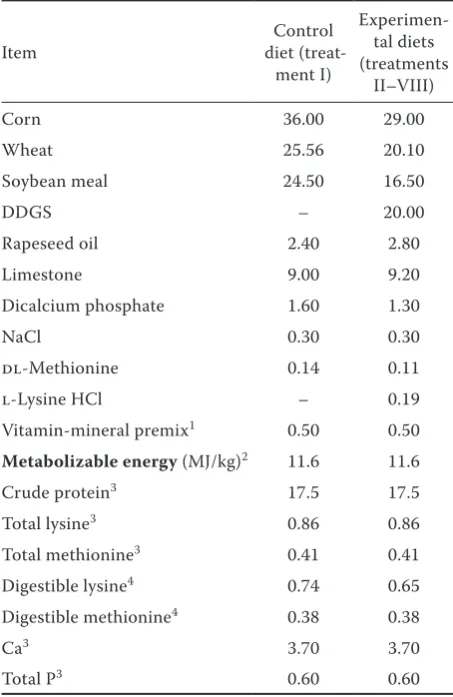
The composition of the basal diets used in the experiment is shown in Table 1. Both diets, without (control group I) or with corn DDGS (200 g/kg), were isocaloric and isonitrogenous, and were formu-lated to meet or exceed nutrient recommendations (National Research Council, 1994). The diet with DDGS was either not supplemented (group II) or supplemented with additives as follows (per kg of diet): feed enzymes (Ronozyme WX with endo-1,4-β-xylanase activity of 1000 FXU/g and Ronozyme NP with phytase activity of 10 000 FYT/g, both DSM Nutritional Products, Basel, Switzerland), each prepa-ration added to the diet in the amount of 200 mg/kg – group III; sodium butyrate (GUSTOR BP-70; Norel Animal Nutrition, Madrid, Spain) in the amount of 700 mg/kg – group IV; probiotic bacteria ( L. salivari-us; Institute of Agricultural and Food Biotechnology, Warsaw, Poland), 108 cfu/kg – group V; mixture of
herbal extracts (Taraxaci siccum, Urticae siccum,
Belgium), 5 g/kg – group VII; or chitosan (CHI-MET-PASZ, Gumitex Poli-Farm, Łowicz, Poland), 3 ml/kg – group VIII.
The experimental diets were fed to birds from 26 to 55 weeks of age. The nutrient content of the diets was calculated on the basis of the chemical composition of raw feedstuffs (AOAC, 2000), and
metabolizable energy value in line with equations from the European Table (Janssen, 1989).
At the end of the experiment all hens were sac-rificed through cervical dislocation. The tibia and femur from the right leg were collected, cleaned of soft tissues, weighed, and frozen (–20°C) pending the analysis. Measurement of the bones’ biome-chanical properties was done by means of the three-point bending test using an Instron 5542 testing machine (Instron Ltd., High Wycombe, UK) (constant speed of crosshead 10 mm/min; distance between supports 50 mm). Bone break-ing strength and yieldbreak-ing load were measured as a graphical record from post-deformation curves. Stiffness in elastic conditions was calculated as a yielding load/elastic deformation ratio.
The tibia length, cortex thickness, external and internal diameters (for cross-section area calcula-tions) were measured at the breaking place using an electronic slide caliper. The cross-section area was calculated as
3.14 (HB – hb)/4 where:
H = external vertical diameter B = external horizontal diameter h = internal vertical diameter b = internal horizontal diameter
The data were subjected to statistical analysis using a completely randomized design in accor-dance with the GLM procedure of STATISTICA software (Version 5.0, 1995). All data were ana-lyzed using One-Way ANOVA. When significant differences in treatment means were detected by ANOVA, Duncan’s Multiple Range Test was ap-plied to separate means. Statistical significance was considered at P ≤ 0.05.
RESULTS AND DISCUSSION
As presented also in our previous paper (Swiat-kiewicz et al., 2013), the incorporation of 200 g/kg DDGS to the diet did not affect laying performance parameters. The bone breaking strengths of tibias and femurs (Tables 2 and 4) of ISA Brown hens obtained in our study (175 and 159 N, averaged across all dietary treatments) were similar to the values observed in our earlier experiment with Bovans Brown layers (Swiatkiewicz et al., 2010a), but higher than in the experiment with Hy-Line Brown hens of a similar age (Koreleski and Swiat-Table 1. Composition and nutrient content of diets used
in the experiment (%)
Item diet (treat-Control ment I)
Experimen-tal diets (treatments
II–VIII)
Corn 36.00 29.00
Wheat 25.56 20.10
Soybean meal 24.50 16.50
DDGS – 20.00
Rapeseed oil 2.40 2.80
Limestone 9.00 9.20
Dicalcium phosphate 1.60 1.30
NaCl 0.30 0.30
dl-Methionine 0.14 0.11
l-Lysine HCl – 0.19
Vitamin-mineral premix1 0.50 0.50
Metabolizable energy (MJ/kg)2 11.6 11.6
Crude protein3 17.5 17.5
Total lysine3 0.86 0.86
Total methionine3 0.41 0.41
Digestible lysine4 0.74 0.65 Digestible methionine4 0.38 0.38
Ca3 3.70 3.70
Total P3 0.60 0.60
DDGS = distillers dried grains with solubles
1premix provided per 1 kg of diet: vitamin A 10 000 IU,
vita-min D3 3 000 IU, vitamin E 50 IU, vitamin K3 2 mg, vitamin B1 1 mg, vitamin B2 4 mg, vitamin B6 1.5 mg, vitamin B12 0.01 mg, Ca-pantothenate 8 mg, niacine 25 mg, folic acid 0.5 mg, choline chloride 250 mg, manganese 100 mg, zinc 50 mg, iron 50 mg, copper 8 mg, iodine 0.8 mg, selenium 0.2 mg, cobalt 0.2 mg
2calculated according to the European Table (Janssen, 1989) as a sum of metabolizable energy content of components 3calculated according to the chemical composition of feed components
[image:3.595.63.290.115.464.2]kiewicz, 2004). These differences may indicate the significant influence of genetic selection for egg production on bone quality.
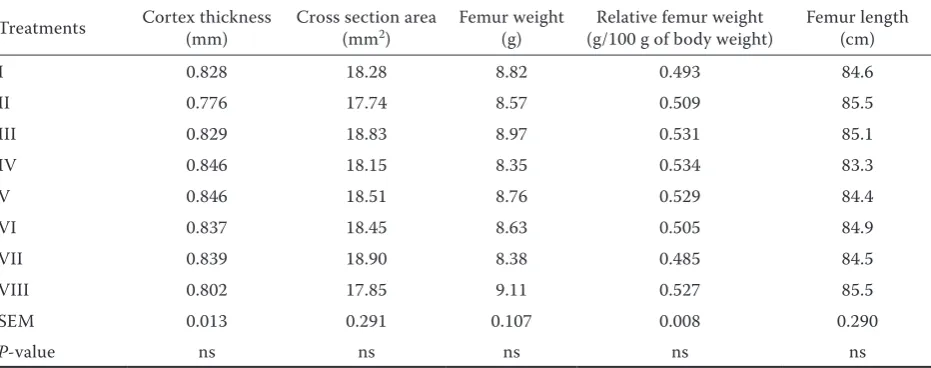
In the present experiment there were no statisti-cally significant differences in the biomechanical and geometrical parameters of tibia and femur bones between hens fed diets with or without a high level of DDGS (Tables 2–5). To date, the experimental data on the effect of dietary DDGS on bone quality in laying hens have been limited. Deniz et al. (2013), correspondingly to our findings, found no differences in tibia crude ash between hens fed diets without or with 100 g DDGS/kg. Some authors have indicated that mineral avail-ability may be decreased in poultry when birds are fed a diet containing DDGS (Swiatkiewicz and Koreleski, 2007; Thacker and Widyaratne, 2007; Leytem et al., 2008), which can potentially decrease the mineralization of bones and their resistance to fractures. However, other authors found no negative effect of DDGS on P retention (Masa’deh et al., 2011, 2012) and the lack of observed differ-ences in our study between bone quality in hens fed diets with or without DDGS may indirectly support the hypothesis that dietary DDGS does not affect mineral availability. The results of the broiler study of Lumpkins and Batal (2005) indi-cated that P bioavailability in corn DDGS is much higher even than in corn grain.
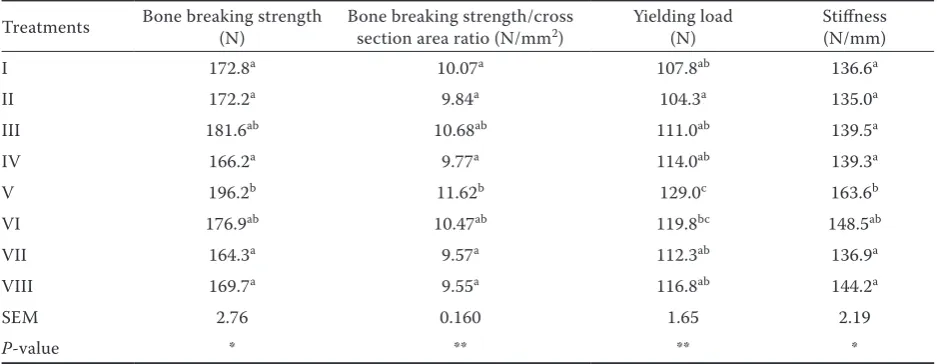
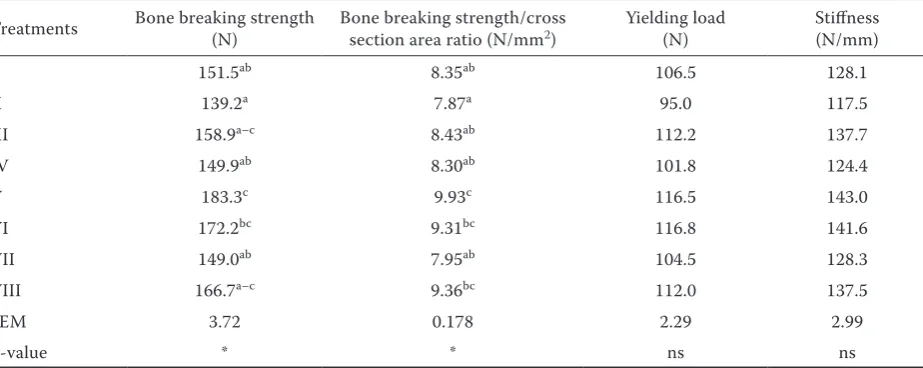
In our study there were no statistically signifi-cant differences between dietary treatments in geometrical indices of tibia and femurs (Tables 3 and 5); however, some of the additives used had a positive effect on the biomechanical charac-teristics of bones in birds fed diets with DDGS (Tables 2 and 4). Thus, layers fed the high DDGS diet supplemented with probiotic bacteria had a significantly higher (P < 0.05) breaking strength, yielding load, and stiffness of tibia (Table 2) and breaking strength of femur (Table 4) than those in the unsupplemented group. In the case of the herb extracts, significant positive effects were found for yielding load of tibia (Table 2) and breaking strength of femur (Table 4). Other additives used, i.e. feed enzymes, sodium butyrate, inulin, and chitosan did not affect any of the analyzed bone parameters.
[image:4.595.63.532.115.297.2]To date the number of published results from poultry experiments on the effect of probiotic bacteria or herb extracts on bone quality have been limited. The mechanism of the effect of pro-biotic bacteria observed in our study can probably be related to their positive influence on mineral utilization, which can be attributed in turn to increased solubility of minerals due to the bac-teria’s increased production of short-chain fatty acids, alteration of intestinal mucosa, and increase of the absorption surface through the beneficial Table 2. Effect of corn distillers dried grains with solubles (DDGS) and experimental additives on biomechanical indices of tibia bones
Treatments Bone breaking strength (N) Bone breaking strength/cross section area ratio (N/mm2) Yielding load (N) Stiffness (N/mm)
I 172.8a 10.07a 107.8ab 136.6a
II 172.2a 9.84a 104.3a 135.0a
III 181.6ab 10.68ab 111.0ab 139.5a
IV 166.2a 9.77a 114.0ab 139.3a
V 196.2b 11.62b 129.0c 163.6b
VI 176.9ab 10.47ab 119.8bc 148.5ab
VII 164.3a 9.57a 112.3ab 136.9a
VIII 169.7a 9.55a 116.8ab 144.2a
SEM 2.76 0.160 1.65 2.19
P-value * ** ** *
treatments: I = control diet, II–VIII = experimental diets containing 200 g/kg DDGS; supplementation: II = not supple-mented, III = feed enzymes (xylanase + phytase), IV = sodium butyrate, V = probiotic bacteria, VI = herb extracts mixture, VII = inulin, VIII = chitosan
effect of bacterial fermentation products on the proliferation of enterocytes, increased expression of Ca-binding proteins, release of bone modulat-ing factors, degradation of phytates by probiotic bacteria enzymes, and overall improvement of gut health (Scholz-Ahrens et al., 2007). Recently, posi-tive effects of probiotic bacteria (Bacillus subtilitis) on bone quality (i.e. tibia weight, density, and ash
[image:5.595.65.533.113.297.2]content) in laying hens have also been found by Abdelqader et al. (2013). Other authors reported that probiotic addition positively affected such eggshell indices like breaking strength, thickness, and weight (Xu et al., 2006; Yousefi and Karkoodi, 2007; Panda et al., 2008); this was probably related to better utilization of minerals. Nahashon et al. (1993) reported that probiotic bacteria added to a Table 3. Effect of corn distillers dried grains with solubles (DDGS) and experimental additives on geometrical indices of tibia bones
Treatments Cortex thickness (mm) Cross section area (mm2) Tibia weight (g) (g/100 g of body weight) Relative tibia weight Tibia length (cm)
I 0.844 17.2 11.2 0.628 117.5
II 0.834 17.7 11.4 0.668 121.0
III 0.834 17.1 11.1 0.671 119.9
IV 0.855 17.1 10.7 0.684 118.4
V 0.887 17.1 10.7 0.634 119.3
VI 0.883 17.1 10.9 0.639 120.7
VII 0.845 17.3 10.2 0.612 118.2
VIII 0.889 17.9 11.0 0.634 119.9
SEM 0.015 0.298 0.139 0.008 0.478
P-value ns ns ns ns ns
treatments: I = control diet, II–VIII = experimental diets containing 200 g/kg DDGS; supplementation: II = not supple-mented, III = feed enzymes (xylanase + phytase), IV = sodium butyrate, V = probiotic bacteria, VI = herb extracts mixture, VII = inulin, VIII = chitosan; ns = nonsignificant
Table 4. Effect of corn distillers dried grains with solubles (DDGS) and experimental additives on biomechanical indices of femur bones
Treatments Bone breaking strength (N) Bone breaking strength/cross section area ratio (N/mm2) Yielding load (N) Stiffness (N/mm)
I 151.5ab 8.35ab 106.5 128.1
II 139.2a 7.87a 95.0 117.5
III 158.9a–c 8.43ab 112.2 137.7
IV 149.9ab 8.30ab 101.8 124.4
V 183.3c 9.93c 116.5 143.0
VI 172.2bc 9.31bc 116.8 141.6
VII 149.0ab 7.95ab 104.5 128.3
VIII 166.7a–c 9.36bc 112.0 137.5
SEM 3.72 0.178 2.29 2.99
P-value * * ns ns
treatments: I = control diet, II–VIII = experimental diets containing 200 g/kg DDGS; supplementation: II = not supple-mented, III = feed enzymes (xylanase + phytase), IV = sodium butyrate, V = probiotic bacteria, VI = herb extracts mixture, VII = inulin, VIII = chitosan; ns = nonsignificant
a–cwithin a column, values not sharing a common superscript significantly differ (P ≤ 0.05)
[image:5.595.69.531.502.686.2]layers’ diet increased retention of Ca and P. Chen and Chen (2004) noted that diet supplementation with prebiotics (oligofructose or inulin), which are substrates for intestinal probiotic bacteria, increased the total ash, Ca, and P in the tibia of layers. Correspondingly, the positive effect of inu-lin on some eggshell quality parameters reported in the previous work (Swiatkiewicz et al., 2010b) may indicate that prebiotics, by modulating in-testinal microbiota, improve mineral utilization in laying hens.
Findings corresponding to our results were noted in broiler chickens by Mutus et al. (2006) who reported that diet supplementation with probiotic bacteria (Bacillus licheniformis and Bacillus sub-tilis) significantly increased the thickness of the medial and lateral wallsof the tibia, the tibiotarsal index, percentage ash, and P content, without any effect on tibia weight, length,weight/length index, robusticity index, diaphysis diameter,modulus of elasticity, yield stress parameters, or percentage Ca content. Angel et al. (2005) found that the incorporation of probiotics with low calcium and phosphorus levels into broilers’ diets significantly increased the retention of Ca and P along with tibia breaking strength and ash content. In a more recent experiment, feeding broilers with a diet containing a low level of Ca negatively affected performance and tibia characteristics, whereas the addition of probiotic bacteria had a positive effect
on these parameters and helped to overcome the problems related to a low-Ca diet (Houshmand et al., 2011). The beneficial influence of probiotic bacteria on tibia breaking strength and mineral-ization in broilers, attributed by the authors to higher assimilation of calcium in the bones, was also demonstrated when a diet with standard levels of Ca and P was used (Panda et al., 2008).
Similarly to the positive effect of herb extracts on certain bone quality indices observed in our experiment, Zhou et al. (2009) found that the dietary addition of a mixture of four traditional Chinese herbs (Herbal Epimedii, Rhizoma Dry-nariae, Rhizoma Atractylodis, and Radix Astragali) increased breaking strength of the tibia as well as bone weight, radiographic densities and bone indices of humerus, tibia, and femur in older ISA caged layers. They indicated that the mechanism of positive effect of herbs on bone quality was possibly associated with minimizing structural bone loss and stimulating bone mineral absorption in osteoporotic laying hens (Zhou et al., 2009). Correspondingly, it was demonstrated in a mod-el experiment with rats, that essential oils and monoterpenes of such herbs as sage, rosemary, and thyme are efficient inhibitors of bone resorption (Mühlbauer et al., 2003).
[image:6.595.65.531.116.300.2]In conclusion, the results of the present study show that a high dietary level of DDGS (200 g/kg) had no negative effect on bone quality; however, Table 5. Effect of corn distillers dried grains with solubles (DDGS) and experimental additives on geometrical indices of femur bones
Treatments Cortex thickness (mm) Cross section area (mm2) Femur weight (g) (g/100 g of body weight) Relative femur weight Femur length (cm)
I 0.828 18.28 8.82 0.493 84.6
II 0.776 17.74 8.57 0.509 85.5
III 0.829 18.83 8.97 0.531 85.1
IV 0.846 18.15 8.35 0.534 83.3
V 0.846 18.51 8.76 0.529 84.4
VI 0.837 18.45 8.63 0.505 84.9
VII 0.839 18.90 8.38 0.485 84.5
VIII 0.802 17.85 9.11 0.527 85.5
SEM 0.013 0.291 0.107 0.008 0.290
P-value ns ns ns ns ns
such feed additives as probiotic bacteria and herb extracts can positively affect selected mechanical properties of the tibia and femur bones in aged, high-producing laying hens.
REFERENCES
AAFCO (2002): Official Publication. Association of Ameri-can Feed Control Officials, Oxford, USA.
Abdelqader A., Irshaid R., Al-Fataftah A.R. (2013): Effects of dietary probiotic inclusion on performance, eggshell quality, cecal microflora composition, and tibia traits of laying hens in the late phase of production. Tropical Animal Health and Production, 45, 1017–1024.
Angel R., Dalloul R.A., Doerr J. (2005): Performance of broiler chickens fed diets supplemented with a direct-fed microbial. Poultry Science, 84, 1222–1231.
AOAC (2000): Official Methods of Analysis. 17th Ed. As-sociation of Official Analytical Chemists, Gaithersburg, USA.
Chen Y.C., Chen T.C. (2004): Mineral utilization in layers as influenced by dietary oligofructose and inulin. Inter-national Journal of Poultry Science, 3, 442–445.
Cufadar Y., Olgun O., Yildiz A.O. (2011): The effect of dietary calcium concentration and particle size on per-formance, eggshell quality, bone mechanical properties and tibia mineral contents in moulted laying hens. British Poultry Science, 52, 761–768.
Deniz G., Gezen S.S., Kara C., Gencoglu H., Meral Y., Baser E. (2103): Evaluation of nutrient equivalency of microbial phytase in hens in late lay given maize-soybean or dis-tiller’s dried grains with solubles (DDGS) diets. British Poultry Science, 54, 494–502.
Fleming R.H., McCormack H.A., Whitehead C.C. (1998): Bone structure and strength at different ages in laying hens and effects of dietary particulate limestone, vitamin K and ascorbic acid. British Poultry Science, 39, 434–440. Gregory N.G., Wilkins L.J. (1989): Broken bones in domestic
fowl: handling and processing damage in end-of-lay bat-tery hens. British Poultry Science, 30, 555–562. Houshmand M., Azhar K., Zulkifli I., Bejo M.H.,
Meiman-dipour A., Kamyab A. (2011): Effects of non-antibiotic feed additives on performance, tibial dyschondroplasia incidence and tibia characteristics of broilers fed low-calcium diets. Journal of Animal Physiology and Animal Nutrition, 95, 351–358.
Janssen W.M.M.A. (1989): European Table of Energy Values for Poultry Feedstuffs. 3rd Ed. World’s Poultry Science Association, Beekbergen, the Netherlands.
Jendral M.J., Korver D.R., Church J.S., Feddes J.J.R. (2008): Bone mineral density and breaking strength of White Leghorns housed in conventional, modified, and
com-mercially available colony battery cages. Poultry Science, 87, 828–837.
Kim W.K., Bloomfield S.A., Sugiyama T., Ricke S.C. (2012): Concepts and methods to understanding the bone me-tabolism in laying hens. World’s Poultry Science Journal, 68, 71–82.
Koreleski J., Swiatkiewicz S. (2004): Calcium from limestone meal and grit in laying hen diets – effect on performance, eggshell and bone quality. Journal of Animal and Feed Sciences, 13, 635–645.
Krawczyk J., Sokołowicz Z., Swiatkiewicz S., Koreleski J., Szefer M. (2012): Performance and egg quality of hens from conservation flocks fed a diet containing maize distillers dried grains with solubles (DDGS). Annals of Animal Science, 12, 247–260.
Lay Jr. D.C., Fulton R.M., Hester P.Y., Karcher D.M., Kjaer J.B., Mench J.A., Mulens B.A., Newberry R.C., Nicol C.J., O’Sullivan N.P., Porter R.E (2011): Hen welfare in different housing systems. Poultry Science, 90, 278–294.
Leytem A.B., Kwanyuen P., Thacker P. (2008): Nutrient excretion, phosphorus characterization, and phosphorus solubility in excreta from broiler chicks fed diets contain-ing graded levels of wheat distillers dried grains with solubles. Poultry Science, 87, 2505–2511.
Lumpkins B.S., Batal A.B. (2005): The bioavailability of lysine and phosphorus in distillers dried grains with solubles. Poultry Science, 84, 581–586.
Masa’deh M.K., Purdum S.E., Hanford K.J. (2011): Dried distillers grains with solubles in laying hen diets. Poultry Science, 90, 1960–1966.
Masa’deh M.K., Purdum S.E., Hanford K.J. (2012): Distillers dried grains with solubles in pullet diets. The Journal of Applied Poultry Research, 21, 531–539.
Mühlbauer R.C., Lozano A., Palacio S., Reinl A., Felix R. (2003): Common herbs, essential oils, and monoterpenes potently modulate bone metabolism. Bone, 32, 372–380. Mutus R., Kocabagli N., Alp M., Acar N., Eran M., Gezen S. (2006): The effect of dietary probiotic supplementation on tibial bone characteristics and strength in broilers. Poultry Science, 85, 1621–1625.
Nahashon S.N., Nakaue H.S., Mirosch L.W. (1993): Pro-duction variables and nutrient retention in single comb White Leghorn laying pullets fed diets supplemented with direct-fed microbials. Poultry Science, 73, 1699–1711. Niemiec J., Riedel J., Szulc T., Stępińska M. (2012): Feeding
wheat distillers dried grains with solubles (DDGS) to lay-ing hens and its effect on performance and egg quality. Annals of Animal Science, 12, 105–115.
National Research Council (1994): Nutrient Requirements of Poultry. 9th Ed. National Academies Press, Washing-ton, USA.
Panda A.K., Rama Rao S.V., Raju M.V.L.N., Sharma S.R. (2008): Effect of probiotic (Lactobacillus sporogenes) feeding on egg production and quality, yolk cholesterol and humoral immune response of White Leghorn layer breeders. Journal of the Science of Food and Agriculture, 88, 43–47.
Saunders-Blades J.L., MacIsaac J.L., Korver D.R., Anderson D.M. (2009): The effect of calcium source and particle size on the production performance and bone quality of laying hens. Poultry Science, 88, 338–353.
Scholz-Ahrens K.E., Ade P., Marten B., Weber P., Timm W., Asil Y., Gluer C.-C., Schrezenmeir J. (2007): Prebiotics, probiotics, and synbiotics affect mineral absorption, bone mineral content, and bone structure. Journal of Nutrition, 137, 838S–846S.
Swiatkiewicz S., Koreleski J. (2006): Effect of maize distillers dried grains with solubles and dietary enzyme supple-mentation on the performance of laying hens. Journal of Animal and Feed Sciences, 15, 253–260.
Swiatkiewicz S., Koreleski J. (2007): Effect of dietary level of maize- and rye distiller dried grains with solubles on nutrient utilization and digesta viscosity in laying hens. Journal of Animal and Feed Sciences, 15, 253–260. Swiatkiewicz S., Koreleski J. (2008): The use of distillers
dried grains with solubles (DDGS) in poultry nutrition. World’s Poultry Science Journal, 64, 257–265.
Swiatkiewicz S., Koreleski J., Arczewska A. (2010a): Effect of organic acids and prebiotics on bone quality in laying hens fed diets with two levels of calcium and phosphorus. Acta Veterinaria Brno, 79, 185–193.
Swiatkiewicz S., Koreleski J., Arczewska A. (2010b): Laying performance and eggshell quality in laying hens fed diets
supplemented with prebiotics and organic acids. Czech Journal of Animal Science, 55, 294–306.
Swiatkiewicz S., Arczewska-Włosek A., Krawczyk J., Pucha- ła M., Józefiak D. (2013): Effects of selected feed additives on the performance of laying hens given a diet rich in maize dried distiller’s grains with solubles. British Poultry Science, 54, 478–485.
Szczurek W. (2009): Standarized ileal digestibility of amino acids from several cereal grains and protein-rich feedstuffs in broiler chickens at age of days. Journal of Animal and Feed Sciences, 18, 662–676.
Thacker P.A., Widyaratne G.P. (2007): Nutritional value of diets containing graded levels of wheat distillers dried grains with solubles fed to broiler chicks. Journal of the Science of Food and Agriculture, 87, 1386–1390. Webster A.B. (2004): Welfare implications of avian
osteo-porosis. Poultry Science, 83, 184–192.
Whitehead C.C. (2004): Overview of bone biology in egg-laying hen. Poultry Science, 83, 193–199.
Whitehead C.C., Fleming R.H. (2000): Osteoporosis in lay-ing hens. Poultry Science, 79, 1033–1041.
Xu C.L., Ji C., Ma Q., Hao K., Ji Z.Y., Li K. (2006): Effects of dried Bacillus subtilitis culture on egg quality. Poultry Science, 85, 364–368.
Yousefi M., Karkoodi K. (2007): Effect of probiotic Thepax®
and Saccharomyces cerevisiae supplementation on per-formance and egg quality in laying hens. International Journal of Poultry Science, 6, 52–54.
Zhou Z.-L., Deng Y.-F., Tao Q.-S., Hu Y.-F., Hou J.-F. (2009): Effects of Gushukang, a Chinese herbal medicine, on bone characteristics and osteoporosis in laying hens. Poultry Science, 88, 2342–2345.
Received: 2013–06–13 Accepted after corrections: 2013–11–14
Corresponding Author
Prof. Dr. hab. Sylwester Świątkiewicz, National Research Institute of Animal Production, Department of Animal Nutrition and Feed Science, ul. Krakowska 1, 32-083 Balice, Poland