First-Principles Characterization of Atomic Structure
of Al
2O
3(0001)/Cu Nano-Hetero Interface
Shingo Tanaka
1, Rui Yang
1, Masanori Kohyama
1, Takeo Sasaki
2;*,
Katsuyuki Matsunaga
3and Yuichi Ikuhara
31Interface Science Research Group, Special Division for Green Life Technology,
National Institute of Advanced Industrial Science and Technology (AIST), Ikeda 563-8577, Japan
2School of Engineering, The University of Tokyo, Tokyo 113-8656, Japan
3Institute of Engineering Innovation, The University of Tokyo, Tokyo 113-8656, Japan
Atomic structures characterization of Al2O3(0001)/Cu nano-hetero interfaces has been performed by the first-principles pseudopotential
method and in cooperation with HRTEM observations. The physical properties of the interfaces depend strongly on the interface stoichiometry. Bonding nature of the O-rich (O-terminated) interface is explained as strong covalent and ionic interactions, whereas that of the stoichiometric (Al-terminated) interface is weak covalent and electrostatic image interactions. The O-terminated interface has quite larger adhesive energy than that of the stoichiometric one. Recent HRTEM observations of the Al2O3(0001)/Cu interface have confirmed the O-terminated interface.
However, the observedincoherentinterface is not the same as an idealcoherentinterface obtained by the first-principles. We explain the relationship between the presentcoherentinterface and the practicalincoherentone.
(Received January 16, 2004; Accepted March 25, 2004)
Keywords: first-principles pseudopotential method, atomic structure, interface, Al2O3, copper, electron microscopy observation
1. Introduction
Designing of structures and properties of interfaces between different materials such as ceramics-metal interfaces and semiconductor-metal interfaces is of great importance for development of nanoscience and nanotechnology. An alumina-copper interface is well known as a typical ceram-ics-metal system frequently used in mechanical and elec-tronic applications, such as thermal and corrosion barriers and heat sinks. Recently, several theoretical1–5) and
exper-imental6–9) studies have been performed for the
alumina-copper interfaces and the results indicate that the interface stoichiometry strongly affects the interfacial properties. Zhang and co-workers1)have investigated the interface free
energies depending on the stoichiometry as functions of the activity of Al and the oxygen partial pressure. The formed interface in O-rich atmosphere is predicted to be non-stoichiometric, O-rich, with large work of separation. In experiments, on the other hand, the stoichiometry of interface has still been discussed because of some differences for experimental conditions, though the surface of alumina is well defined as a stoichiometric one. Considering from the alumina surface structure, one would expect that the stoichiometric interface would be formed. However, atmos-phere such as chemical potentials and temperature in the formation process could form variously stoichiometric interfaces though dissociation or precipitation of alumina surface atoms to or from metals. The O-rich interface of the Al2O3(0001)/Cu system has been observed by
high-resolu-tion transmission electron microscopy (HRTEM) observa-tions6)as well as the stoichiometric interface.7)
Nevertheless, the atomic fine structures near the interface have not yet been determined. The major reason is that mutually complementary relationship between theoretical
calculation and experiment is not enough constructed, although each method is developed independently. For example, theoretical calculations usually deal withcoherent
interface model, although experimentally observed interfaces often contain misfit dislocations orincoherentconfigurations. First of all, we have to clarify details of the interfacial structures by active collaborating between theoretical calcu-lations and experiments.
In this paper, we have performed the first-principles calculations of Al2O3(0001)/Cu(111) interfaces and
ob-tained the stable atomic configurations near the interfaces. The results are compared with those of HRTEM observa-tions.6)In this interface, the interface stoichiometry should
have serious effects on the electronic and mechanical properties. And then we explain the relationship between the idealcoherentinterface dealt with by the first-principles calculation and the practicalincoherentinterface observed by HRTEM.
2. Theoretical Method
Present calculations use the first-principles pseudopoten-tial method and the first-principles molecular dynamics. The soft-type norm-conserved pseudopotentials developed by Troullier-Martins10)are used. The residual minimization and
direct inversion in the iterative subspace (RMM-DIIS)11,12)
method and the conjugate-gradient method13)are used for the
fast solution technique for the eigenstates in the ground states. Self-consistent charge densities are obtained from the efficient charge-mixing method.14,15) A plane-wave cutoff
energy of 70 Ry is selected based on the tests of total energy convergence. In self-consistent calculations, four sampling k-points in the irreducible Brillouine zone of the supercell explained below are used.
We deal with the Al2O3(0001)/Cu(111) interface with the
orientation relationship of [1-10]Cuk[1-100]Al2O3.
6)In order to
*Graduate Student, The University of Tokyo
Special Issue on Grain Boundaries, Interfaces, Defects and Localized Quantum Structures in Ceramics
examine the interface stoichiometry dependence, the two kinds of the interfaces, an Al-terminated (stoichiometric) interface, (Al2O3/Cu)Al, and an O-terminated
(non-stoichio-metric) interface, (Al2O3/Cu)O, are treated. The supercell of
a stoichiometric interface consists of an Al2O3(0001) slab of
four Al-O-Al layers and a Cu(111) slab of five Cu layers, where each O or Cu layer includes three atoms and each Al layer includes only one atom in each cell. O-terminated interfaces are constructed by removing top Al layers of both sides of an Al2O3slab. The stable atomic configurations were
obtained from the atomic relaxation process. As well known, the lattice mismatch between alpha-Al2O3(0001) and
fcc-Cu(111) planes is about 7%.1) To eliminate the lattice mismatch, we made acoherentinterface model, where the Cu region is expanded parallel to the interface. We deal with three high-symmetry models about the adhesive site of the interface Cu atom on the Al2O3(0001) surface. These sites
are on top of the Al atoms (Al-site model), on top of the outermost O atoms (O-site model), and on top of the second-layer O atoms (H-site model). These three models have different rigid-body translations (RBT) parallel to the inter-face. The relaxation is performed under preserving the unit-cell symmetry, namely the three-fold rotation along the principal rotation axis and the inversion (C3i). Because of the
symmetry condition, the interfacial Cu atoms at the O-site or H-site are planar, but they have degree of freedom for in-plane displacement away from the strict adhesive site, whereas the displacement of Cu atoms at the Al-site is fixed to be normal to the interface. The size of the supercell normal to the interface was determined by changing interface distances step by step and relaxing atoms to get the lowest energy for each supercell.
3. Results and Discussions
An adhesive energy, Wadh, of the interface has been
obtained from the energy difference between the interface and the two separated surface slabs with atomic relaxation, so that the larger Wadh means the more stable atomic
config-uration of the model. This is a discussion with respect to an internal energy. Exactly, it is necessary to discuss the stability using a free energy with an entropy term. However, the atomic configuration of the present interface is that at normal temperature, not at high temperature. In such a case,
Wadhis a good approximation as an index of the stability. In
this paper, we try to explain the observed atomic config-uration only using the theoretical internal energy.Wadhis also
very important for preliminary analysis of the interface toughness.
Present results are listed in Table 1. For the O-terminated
interfaces, theWadhof the H-site model is almost the same as,
but slightly larger than, that of the Al-site one in a preliminary test. This is because the atomic configurations between two models are similar to each other. Hence we only list the results of the H-site and O-site models. For Al-terminated interfaces, on the other hand, theWadh of the
O-site model is largest, and the other models are smaller, so that we only list the result of the O-site model. One can see that the most stable Cu adhesive site of the O-terminated interface is the H-site and absolute value ofWadh is five times larger
and more than that of the Al-terminated interface. This means that the former has extremely strong interface bonding than the latter. This tendency is in good agreement with previous theoretical calculations.1–5)
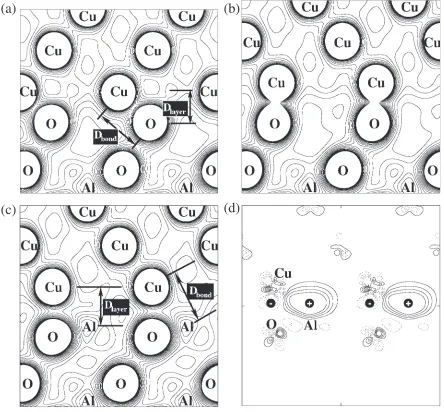
Figure 1 shows calculated stable atomic configurations and electron-density distributions of (a) the H-site model and (b) the site model of the terminated interfaces and (c) the O-site model of the Al-terminated interface. In the O-terminated interface, the charge overlap between the interfacial Cu and O is clearly shown in Figs. 1(a) and 1(b). This indicates the existence of strong p-d orbital hybridization as observed in the LDOS,16)similarly to the Ni/Al
2O3 system1)or the Nb/
Al2O3 system.17) There exists charge transfer from the
interface Cu atoms to the interface O-atoms.16) In the
Al-terminated one, on the other hand, the charge overlap between the interfacial Cu and O or Al is rather weak as shown in Fig. 1(c). However, the charge redistribution by the interface formation from the surfaces shows the peculiar redistribution in the interface Cu layer,18) the charge accumulation in the region near the center of the triangle of the interface Cu atoms and above the interface Al atom, and the charge depletion around the interface Cu atoms and above the interface O atom as shown in Fig. 1(d). Because Al and O atoms in Al2O3 are cation and anion, it is expected that the
accumulation and depletion regions play the roles of anionic and cationic characters as counterparts, respectively. This is consistent with the image interaction model.19–22) This
feature is also observed in MgO/metal interfaces.23,24)And
detailed analysis18)indicates the presence of orbital
hybrid-ization between the surface Al and the interface Cu atoms. In this way, the interface bonding of the O-terminated interface is formed by strong hybridization and charge transfer between Cu and O, namely strong covalent and ionic interactions. For the Al-terminated interface, the bonding is explained as weak covalent Cu-Al interactions plus image-like electrostatic interactions.
[image:2.595.53.553.732.786.2]This result is consistent with the analysis of the interfacial stoichiometry. In the bulk alumina, Al and O atom are as the cationic and anionic ions, respectively. The O-terminated interface is a non-stoichiometric one, the outermost Al atom
Table 1 Adhesive energies (Wadh) for the O-terminated and the Al-terminated interfaces with experimental data. (Al2O3/Cu)OH, (Al2O3/
Cu)OOand (Al2O3/Cu)AlOdenote the H-site and O-site model of the O-terminated interface and O-site model of the Al-terminated
interface, respectively. The unit is Jm2.
(Al2O3/Cu)OH (Al2O3/Cu)OO (Al2O3/Cu)AlO
Present work 6.96 5.85 1.27
Previous calculations 5.94,1Þ5.62,3Þ7.035Þ 0.58,1Þ0.90,2Þ0.944Þ
of the stoichiometric (0001) surface is removed, and hence some charge transfer will occur easily from the interfacial Cu atoms to the O atoms in order to compensate lost electrons distributed by removed Al. On the other hand, the Al-terminated interface is a stoichiometric interface, where the Al2O3 surface is chemically stable. Thus, the interfacial Cu
atoms cannot strongly interact with Al2O3, even though the O
layer comes sufficiently near to the interfacial Cu atoms. Even in this case, there exist substantial interactions between the surface Al atoms and the interface Cu atoms, which result in the slight movement of the surface Al atoms toward the Cu atoms as compared with strong in-ward relaxation of the surface Al in the free surface.
The interlayer distance (Dlayer) between interface layers
and the interatom distance (Dbond) between Cu and O atoms
in the O-terminated interface or between Cu and Al atoms in the Al-terminated one are important quantities for analyzing
the interface structure.DlayerandDbondfor each interface are
listed in Table 2. As mentioned in above section, the interface Cu layer of the H-site and O-site models is planer. Thus, each
Dlayer of the interface Cu atom is equivalent. On the other
hand, theDbondof the O-terminated interface is different each
other because the interface Cu and O atoms have degree of freedom for in-plane displacement, whereas that of the Al-terminated interface is unity. Thus, the listedDbondof the
O-terminated interface is estimated by taking the average of three different interatom distances between Cu and O atoms. For the O-terminated interface,Dlayer of the H-site model is
smaller than that of the O-site model, whileDbond is larger.
This is because in the H-site model the interfacial Cu atoms are able to sink deeply in hollow space of the Al2O3. For the
O-site model, the Dlayer is slightly different from the Dbond
because of small displacement of Cu atoms from the on-top site. This is consistent with the symmetry condition including
(a)
(b)
(c)
(d)
Fig. 1 Calculated stable atomic configurations and electron-density distributions of (a) the H-site model and (b) the site model of the O-terminated interfaces and (c) the O-site model of the Al-O-terminated interface. Contours of the valence-electron density are plotted from 0.01 a.u.3to 0.15 a.u.3with a spacing of 0.01 a.u.3.D
layerandDbonddenote an interlayer distance and interatom distance, respectively.
(d) the electron-density redistribution of the O-site model of the Al-terminated interface. The solid and dashed lines are accumulated and depletion regions, respectively. Contours of the valence-electron density are plotted from0:018a.u.3to 0.018 a.u.3with a spacing of
[image:3.595.77.521.79.491.2]the degree of freedom of the in-plane displacement. One can obtain the important notice that the H-site model with smaller Dlayer and larger Dbond, is more energetically
favorable than the O-site model with largerDlayerand smaller Dbond. This indicates that in the presentcoherentinterface the
coordination number is an important factor. The interfacial Cu atom seems to gain the energy benefit, in making contact with larger number of O atoms.
About the comparison with experiments, the most serious problem is that the actual interface is incoherent.6–9) The
lattice mismatch in the present interface is not small as mentioned above. It seems that the incoherent interface formation has energetically advantage rather than the dislocation formation with conserving thecoherentinterfaces locally. In the present study,coherentinterfaces are treated because of limitation of computational resources and because of our purpose of obtaining essential features of interfacial bonding. Thus, we have to clarify the relationship between the presentcoherentinterface model and the actual incoher-entinterface.
Sasaki and co-workers6) have observed the
alpha-Al2O3(0001)/Cu interface using HRTEM. As shown in
Fig. 3 in Ref. 6), the HRTEM observation has found that the interface is atomically sharp without amorphous-like phases and any strain field derived from the misfit dislocation. The obtained HRTEM image indicates the formation of the
incoherentinterface. Furthermore, the following orientation relationship (OR) exists; (111)Cuk(0001)Al2O3 and
[1-10]Cuk[1-100]Al2O3, which is the same with our models. On
the other hand, the preferred OR with geometrically high coherency across the interface25)is (111)Cuk(0001)Al2O3 and
[11-2]Cuk[1-100]Al2O3. This inconsistent result indicates that
interfacial practical bonding plays an important role to construct the actual OR. In order to clarify the interfacial bonding nature, they have performed the HRTEM image simulations and compared with the observed images, as shown in Fig. 7 and Fig. 8 in Ref. 6). Consequently, the authors concluded the most reasonable one for explaining the observed images is the O-terminated interface.
A very important point of notice is that theDlayerevaluated
by the HRTEM image simulations is 0.185 nm, which is extremely in good agreement with the presentDlayerof the
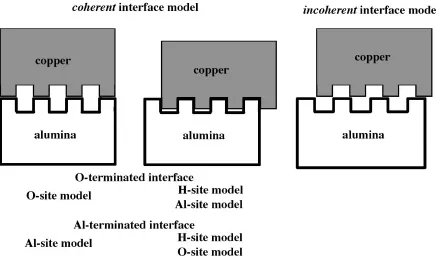
O-site model of the O-terminated interface. This model is energetically metastable one as listed in Table 1. Here we consider the relationship between the ideal ‘‘coherent’’ interface models obtained by the first-principles calculation and the actual ‘‘incoherent’’ interface. Figure 2 shows the concept of coherent-incoherent relationship. First, for the
coherentmodels where the Cu atoms are located on-top of the outermost atoms of an Al2O3slab such as (Al2O3/Cu)OO
and (Al2O3/Cu)AlAl, Dlayer is larger than the other models
where the Cu atoms can sink deeply in hollow space of an Al2O3surface. Second, the image simulation of the HRTEM
observation has shown that theincoherent interface can be regarded as a mixture of the three kinds ofcoherentinterface models with different RBT parallel to the interface, as shown in Fig. 9 in Ref. 6). In Fig. 9 of Ref. 6), it is clear that the interface with the lattice misfit reveals a moire´-like pattern consisting of locallycoherentinterface regions with different RBTs. Third, in this sense the largestDlayerof thecoherent
models should be dominant one for theincoherentinterface as a mixture of the coherent ones. In the O-terminated interface, the O-site model has the largestDlayeras explained
above. Thus, it is reasonable thatDlayerof the O-site model is
similar to the observed one of theincoherent interface. For the Al-terminated interface, on the other hand,Dlayerof the
O-site model is quite good agreement with the observed value of theincoherentinterface. However this is not the largestDlayer
within the terminated interfaces, which is that of the Al-site model. Therefore Dlayer of the incoherent interface
estimated from thecoherentAl-terminated interfaces seems to be too large if we supposed that the observed interface is Al-terminated one. In this way, the observed incoherent
interface can be explained quite reasonably by the ideal
coherent interface models of the O-terminated interfaces based on the first-principles calculations.
4. Conclusion
First-principles calculations of Al2O3(0001)/Cu interfaces
have been performed and revealed that the interface stoichiometry is of great importance for the interfacial properties.Wadhof the O-terminated interface is quite larger
than that of the Al-terminated one, and the H-site model is the most energetically stable within the O-terminated interfaces. All the results are consistent with previous calculations.Dlayer
of the O-site model of the O-terminated interface is in good agreement with that of the HRTEM observation. We have succeeded in explaining the observed incoherent interface using the ideal coherent interface models by the first-principles calculations.
Acknowledgements
We thank Dr. W. Zhang and Prof. J. R. Smith for fruitful discussions on calculations. This work was performed as a part of ‘‘Nanostructure Coating Project’’ carried out by New Energy and Industrial Technology Development Organiza-tion in Japan. The present calculaOrganiza-tion was supported by ‘‘Promoted Research Project for High Performance
Com-layer bond
the interlayer (interatom) distances between Cu and O atoms or between Cu and Al atoms at the interface.Dbondof (Al2O3/Cu)OHand
(Al2O3/Cu)OOare estimated by taking average of three different distance between interface Cu and O atoms. A value in parentheses
denotes theDlayerandDbondbetween Cu and O atoms at the Al-terminated interface.
(Al2O3/Cu)OH (Al2O3/Cu)OO (Al2O3/Cu)AlO experiment6Þ
Dlayer(nm) 0.136 0.183 0.183 (0.228) 0.185
[image:4.595.49.549.114.155.2]puting’’ in Tsukuba Advanced Computing Center (TACC) of the National Institute of Advanced Industrial Science and Technology (AIST) in Japan.
REFERENCES
1) W. Zhang, J. R. Smith and A. G. Evans: Acta Mater.50(2002) 3803– 3816.
2) G. L. Zhao, J. R. Smith, J. Raynolds and D. J. Srolovitz: Inter. Sci.3
(1996) 289–302.
3) I. G. Batyrev and L. Kleinman: Phys. Rev. B64(2001) 033410. 4) N. C. Herna´ndez and J. F. Sanz: J. Phys. Chem. B106(2002) 11495–
11500.
5) X.-G. Wang, J. R. Smith and M. Scheffler: Phys. Rev. B66(2002) 073411.
6) T. Sasaki, K. Matsunaga, H. Ohta, H. Hosono, T. Yamamoto and Y. Ikuhara: J. Soc. Mat. Sci. Japan52(2003) 555–559.
7) C. Scheu, M. Gao and M. Ru¨hle: J. Mater. Sci. Technol.18(2002) 117– 120.
8) J. G. Li, L. Coudurier and N. Eustathopoulos: J. Mater. Sci.24(1989) 1109–1116.
9) E. Saiz, A. P. Tomsia and R. M. Cannon:Ceramic Microstructure,
(Control at the Atomic Level, edited by A. P. Tomsia, A. Gla¨ser, Plenum Press, New York, 1998).
10) N. Troullier and J. L. Martins: Phys. Rev. B43(1991) 1993–4024. 11) P. Pulay: Chem. Phys. Lett.73(1980) 393–398.
12) G. Kresse and J. Furthmu¨ller: Phys. Rev. B54(1996) 11169–11186. 13) D. M. Bylander, L. Kleinman and S. Lee: Phys. Rev. B42(1990) 4021–
4024.
14) P. Pulay: J. Comp. Chem.3(1982) 556–560. 15) G. P. Kerker: Phys. Rev. B23(1981) 3082–3084. 16) S. Tanaka, R. Yang and M. Kohyama: to be submitted.
17) W. Zhang and J. R. Smith: Phys. Rev. B61(2000) 16883–16889. 18) R. Yang, S. Tanaka and M. Kohyama: to be submitted.
19) A. M. Stoneham: Appl. Surf. Sci.14(1983) 249–259.
20) P. W. Tasker and A. M. Stoneham: J. Chim. Phys.84(1987) 149–155. 21) D. M. Duffy, J. H. Harding and A. M. Stoneham: Phil. Mag. A67
(1993) 865–882.
22) M. W. Finnis: J. Phys.: Condens. Mater.8(1996) 5811–5836. 23) T. Hong, J. R. Smith and D. J. Srolovitz: J. Adhesion Sci. Tech.8
(1994) 837–851.
24) T. Hong, J. R. Smith and D. J. Srolovitz: Acta Metall. Mater.43(1995) 2721–2730.
25) Y. Ikuhara and P. Pirouz: Mater. Sci. Forum207–209(1996) 121–124. Fig. 2 Conceptual figures ofcoherent-incoherentrelationship. Left and center figures indicate presentcoherentinterface models and right
figure indicates a practicalincoherentinterface model. Top and bottom sides are Cu and Al2O3region, respectively. Bulges indicate the
[image:5.595.78.514.71.333.2]