Received 5 December 2016 Accepted 2 February 2017
Edited by M. Weil, Vienna University of Technology, Austria
Keywords:crystal structure; borate; sponta-neous nucleation; solid solution.
CCDC reference:1530747
Supporting information:this article has supporting information at journals.iucr.org/e
Crystal structure of the solid solution
Ba
8.35Pb
0.65(B
3O
6)
6Wenwu Zhao*
Department of Environmental and Chemical Engineering, Tangshan College, 38 North HuaYan Road, Tangshan 063000, Hebei, People’s Republic of China. *Correspondence e-mail: [email protected]
Single crystals of lead barium borate, Ba8.35Pb0.65(B3O6)6, octabarium lead(II)
hexakis(triborate), have been obtained by spontaneous nucleation from a high-temperature melt. Its three-dimensional structure is constructed on the basis of a BaO9 polyhedron, a (Pb/Ba)O6 octahedron (occupancy ratio Pb:Ba =
0.216:0.784) and a condensed B3O6ring anion. In the crystal, the planar B3O6
anions are stacked in an alternating fashion with Ba and (Pb/Ba) atoms along [001]. A comparison is made with the structures of related solid solutions in the system Ba/Pb/B/O.
1. Chemical context
The study of inorganic borates is motivated by their possible non-linear optical properties, transparency in a wide range of wavelengths, high laser-damage tolerance, piezoelectricity and luminescent and other useful properties for technical appli-cations of the respective compounds. For example,-BaB2O4
(Chenet al., 1985), LiB3O5(Chenet al., 1989), CsB3O5(Sasaki
et al., 2000), Sr2Be2B2O7 (Chenet al., 1995), K5Ba10(BO3)8F
(Liu et al., 2016), PbB4O7 (Bartwal et al., 2001), Pb2B5O9X
(X= Cl, Br, I) (Huanget al., 2010) or Ba3Sr4(BO3)3F5(Zhang
et al., 2009) have been studied because of their second-order
[image:1.610.189.446.469.681.2]ISSN 2056-9890
Figure 1
The principal building units in the crystal structure of the title compound. Displacement ellipsoids are drawn at the 50% probability level. [Symmetry codes: (i)x,y,z; (ii)y,xy,z; (iii)y,x+y,z; (iv)xy,x,z; (v)x+y,x,z; (vi)y+ 1,xy,z; (vii)x+y+ 1, x+ 1,z; (viii)y+2
3,x+y+ 1 3,z+
1
3; (ix)xy+ 2 3,x+
1 3,z+
1 3; (x)
x+2 3,y+
1 3,z+
1
non-linear optical behavior. Among inorganic borates synthesized and characterized over the past decades, some lead(II) borates show comprehensive applications. These features are associated with the highly asymmetric stereo-chemistry typical for a lead(II) atom due to the stereoactivity of the 6s2lone pair (Zhanget al., 2016; Mutailipuet al., 2016). Accordingly, numerous studies have been devoted to this family of compounds. Some lead borates are particularly attractive because of their high second-harmonic generation (SHG) response (Wuet al., 2012; Donget al., 2015; Jinget al., 2015) or large birefringence (Liuet al., 2015).
In this communication, we report on the synthesis and crystal structure of the solid solution Ba8.35Pb0.65(B3O6)6.
2. Structural commentary
The crystal structure of Ba8.35Pb0.65(B3O6)6 is based on a
Ba2O9 polyhedron, a (Pb/Ba1)O6 polyhedron and a
condensed B3O6 anion, as shown in Fig. 1. The planar B3O6
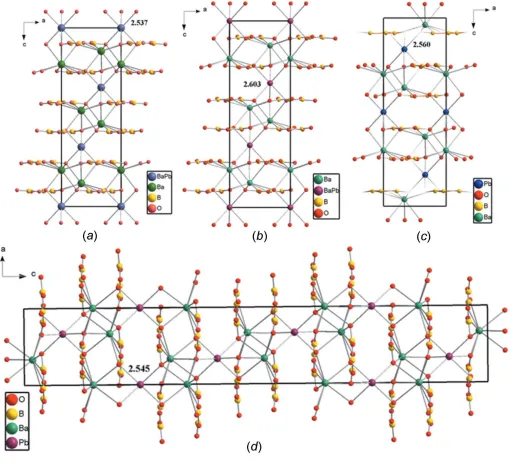
anions (point group symmetry 3.) are isolated from each other and distributed layer upon layer perpendicular to [001]. The occupationally disordered (Pb/Ba)1 site (occupancy ratio Pb:Ba = 0.216:0.784) and the Ba2 site are located alternately between the B3O6sheets in (Pb/Ba)1 and Ba2 layers, as shown
in Fig. 2a. The B atom is bound to one O1 atom and two O2 atoms to from a BO3 triangle. Three BO3 triangles are
[image:2.610.51.562.244.708.2]condensed through vertex-sharing to build a planar and cyclic B3O6 unit. The B—O bond lengths vary from 1.318 (5) to
Figure 2
The crystal structures of related solid solutions in the system Ba/Pb/B/O viewed down [010]: (a) Ba8.35Pb0.65(B3O6)6; (b) Ba7.87Pb1.13(B3O6)6(Wuet al.,
2012); (c) Ba2Pb(B3O6)2(Liet al., 2014); (d) Ba2Pb(B3O6)2(Tanget al., 2015). The numbers indicate the bond lengths (A˚ ) of the PbO6or (Ba/Pb)O6
1.406 (5) A˚ (Table 1), and the O—B—O angles are between 116.8 (4) and 122.6 (4).
The Ba2 atom (site symmetry 3.) is coordinated by nine O atoms. The Ba—O bond lengths of the Ba2O9 polyhedron
range from 2.766 (3) to 3.030 (3) A˚ , with a mean distance of 2.869 A˚ (Table 1). A similar environment for Ba is observed in the crystal structures of Na3Ba2(B3O6)2F (Zhanget al., 2015),
PbBa2(B3O6)2(Liet al., 2014) and-BBO (Wuet al., 2002).
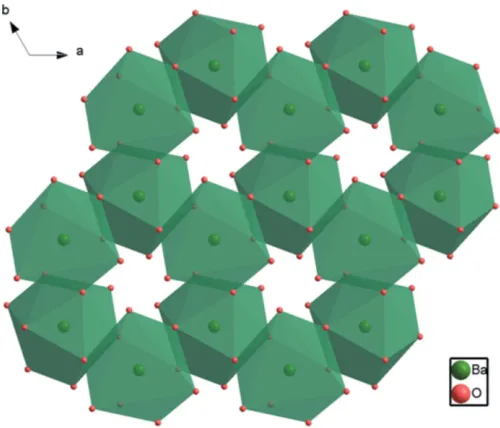
Each of the Ba2O9 polyhedra shares edges with adjacent
Ba2O9 polyhedra to form six-membered rings that are
arranged in corrugated layers extending parallel to (001) (Fig. 3). The (Pb/Ba)1 site (site symmetry 3.) is surrounded by six O atoms; the corresponding (Pb/Ba)1O6 octahedra are
[image:3.610.45.295.70.284.2]isolated from each other. The six (Pb/Ba1)—O bonds have an identical length of 2.537 (3) A˚ (Table 1, Fig. 2a). In compar-ison with the M2 site, the M1 site has a more narrow
Table 1
Selected geometric parameters (A˚ ,).
(Pb/Ba)1—O1 2.537 (3) B—O1 1.318 (5)
Ba2—O1 2.766 (3) B—O2 1.397 (5)
Ba2—O1i 2.810 (3) B—O2ii 1.406 (5)
Ba2—O2 3.030 (3)
O1—B—O2 120.6 (4) O2—B—O2ii 116.8 (4)
O1—B—O2ii 122.6 (4)
Symmetry codes: (i)xþ2 3;yþ
1 3;zþ
1
3; (ii)y;xy1;z.
Figure 3
The formation of a corrugated layer of Ba2O9polyhedra in the crystal
[image:3.610.90.522.388.723.2]structure of Ba8.35Pb0.65(B3O6)6viewed down [001].
Figure 4
The arrangement of B3O6groups along the [001] direction in the different solid solutions: (a) Ba8.35Pb0.65(B3O6)6; (b) Ba7.87Pb1.13(B3O6)6(Wuet al.,
coordination environment which seems to be the reason why Pb atoms exclusively substitute Ba atoms at the latter position due to their smaller ionic radius.
3. Comparison with the structures of related solid solutions
It is interesting to compare the structure of Ba8.35Pb0.65(B3O6)6
with those of the related solid solutions Ba7.87Pb1.13(B3O6)6
(Wuet al., 2012) and Ba2Pb(B3O6)2(Liet al., 2014; Tanget al.,
2015). Whereas the title compound Ba8.35Pb0.65(B3O6)6
crys-tallizes in space groupR3, Ba7.87Pb1.13(B3O6)6was solved and
refined in space groupR32 on the basis of single crystal X-ray diffraction data (Wu et al., 2012); the lattice parameters of both compounds are very similar. Ba2Pb(B3O6)2on the other
hand was reported to crystallize either in space groupR3 with lattice parameters in the same range as the previous two structures (single crystal X-ray diffraction data; Liet al., 2014) or in space groupR3cwith a doubledcaxis in comparison with the other structures (powder X-ray diffraction data using the Rietveld method; Tanget al., 2015). All four crystal structures are characterized by an alternating stacking of cationic and anionic (001) layers along [001], as shown in Fig. 2. In each case, the Ba site is coordinated by nine O atoms to form BaO9
polyhedra, and the Pb or the (Pb/Ba) site is coordinated by six O atoms to form distorted PbO6octahedra [in Ba2Pb(B3O6)2]
or (Pb/Ba)O6 octahedra [in Ba8.35Pb0.65(B3O6)6 and
Ba7.87Pb1.13(B3O6)6].
The arrangement of the planar B3O6 rings in the crystal
structures is a determining factor in whether a non-centro-symmetric or a centronon-centro-symmetric structure is obtained. In Ba7.87Pb1.13(B3O6)6(Wuet al., 2012), the rings are aligned in a
chiral arrangement (Fig. 4b), responsible for the SHG effect. In Ba2Pb(B3O6)2(Liet al., 2014), the B3O6rings are parallel to
each other, distributed layer upon layer along [001], and the B3O6 rings in neighbouring layers point in exactly opposite
directions (Fig. 4c), just like in the title compound (Fig. 4a). In the Ba2Pb(B3O6)2structure with doubled volume (Tanget al.,
2015), all of the B3O6rings are parallel to (001), and the B3O6
rings in two neighbouring layers are rotated slightly relative to each other (Fig. 4d).
4. Synthesis and crystallization
Suitable crystals of the solid solution Ba8.35Pb0.65(B3O6)6were
obtained by spontaneous nucleation from a high-temperature melt mixture originating from PbO, H3BO3and BaF2in molar
ratios of 4:5:1. The starting materials were weighed and melted in a platinum crucible in several batches. The crucible position was fixed at the centre of a resistance-heated furnace. The temperature of the furnace was controlled within 0.1–1 K by an Al-708P controller and a Pt/Pt–Rh thermocouple. The temperature was raised by about 50 K h1to 50 K above the melting point and held for 15 h to ensure a homogenous mixture of the solution. After cooling down the furnace to 1073 K, a slow cooling rate of 5 K d1, was applied, followed
by cooling to room temperature at 20 K h1. Colorless crystals in the millimetre range were obtained.
5. Refinement
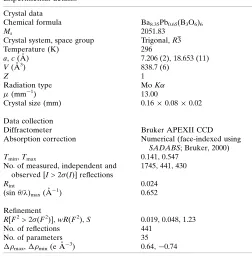
Crystal data, data collection and structure refinement details are summarized in Table 2. From the two large cation positions in the structure (Wyckoff positions 3aand 6c), only those of
M1 at 3aare occupationally disordered by Ba and Pb atoms. Refinement of the occupancy of Ba:Pb at this site under consideration of EXYZ and EADP commands (Sheldrick, 2008) resulted in a 21.6 (7)% occupancy of Pb. The highest peak and the deepest hole are located 0.98 and 2.06 A˚ from the Ba2 and B atoms, respectively.
Funding information
Funding for this research was provided by: Discipline Construction Foundation of Tangshan College (award No. tsbc2013003).
References
Bartwal, K. S., Bhatt, R., Kar, S. & Wadhawan, V. K. (2001).Mater. Sci. Eng. B,85, 76–79.
Brandenburg, K. (2006).DIAMOND. Crystal Impact GbR, Bonn, Germany.
Bruker (2000). APEX2, SAINT and SADABS. Bruker AXS Inc., Madison, Wisconsin, USA.
Chen, C., Wang, Y., Wu, B., Wu, K., Zeng, W. & Yu, L. (1995).Nature,
373, 322–324.
[image:4.610.311.563.87.344.2]Chen, C., Wu, Y., Jiang, A., Wu, B., You, G., Li, R. & Lin, S. (1989).J. Opt. Soc. Am. B,6, 616–621.
Table 2
Experimental details.
Crystal data
Chemical formula Ba8.35Pb0.65(B3O6)6
Mr 2051.83
Crystal system, space group Trigonal,R3
Temperature (K) 296
a,c(A˚ ) 7.206 (2), 18.653 (11)
V(A˚3) 838.7 (6)
Z 1
Radiation type MoK
(mm1) 13.00
Crystal size (mm) 0.160.080.02
Data collection
Diffractometer Bruker APEXII CCD Absorption correction Numerical (face-indexed using
SADABS; Bruker, 2000)
Tmin,Tmax 0.141, 0.547
No. of measured, independent and observed [I> 2(I)] reflections
1745, 441, 430
Rint 0.024
(sin/)max(A˚ 1
) 0.652
Refinement
R[F2> 2(F2)],wR(F2),S 0.019, 0.048, 1.23
No. of reflections 441
No. of parameters 35
max,min(e A˚
3) 0.64,0.74
Computer programs:APEX2andSAINT(Bruker, 2000),SHELXS97,SHELXL97and
Chen, C., Wu, B., Jiang, A. & You, G. (1985).Sci. Sin.B28, 235–241. Dong, X. Y., Jing, Q., Shi, Y. J., Yang, Z. H., Pan, S. L., Poeppelmeier, K. R., Young, J. & Rondinelli, J. M. (2015).J. Am. Chem. Soc.137, 9417–9422.
Huang, Y., Wu, L., Wu, X., Li, L., Chen, L. & Zhang, Y. (2010).J. Am. Chem. Soc.132, 12788–12789.
Jing, Q., Dong, X. Y., Yang, Z. H. & Pan, S. L. (2015).Dalton Trans.
44, 16818–16823.
Li, H. Y., Dong, L., Lu, Y., Pan, S. L., Lu, X., Yu, H. W., Wu, H. P., Su, X. & Yang, Z. H. (2014).J. Alloys Compd.615, 561–565. Liu, L. L., Yang, Y., Jing, Q., Dong, X. Y., Yang, Z. H., Pan, S. L. &
Wu, K. (2016).J. Phys. Chem. C,120, 18763–18770.
Liu, L., Zhang, B. B., Zhang, F. F., Pan, S. L., Zhang, F. Y., Zhang, X. W., Dong, X. Y. & Yang, Z. H. (2015).Dalton Trans.44, 7041– 7047.
Mutailipu, M., Hou, D. W., Zhang, M., Yang, Z. H. & Pan, S. L. (2016).
New J. Chem.40, 6120–6126.
Sasaki, T., Mori, Y., Yoshimura, M., Yap, Y. K. & Kamimura, T. (2000).Mater. Sci. Eng. Rep.30, 1–54.
Sheldrick, G. M. (2008).Acta Cryst.A64, 112–122.
Tang, X. L., Feng, D. X., Wan, S. M., Kang, L., Zhang, B. & Lin, Z. S. (2015).Mater. Chem. Phys.163, 501–506.
Wu, H. P., Pan, S. L., Jia, D. Z., Chen, Z. H. & Yu, H. W. (2012).Chem. Lett.41, 812–813.
Wu, S., Wang, G., Xie, J., Wu, X., Zhang, Y. & Lin, X. (2002).J. Cryst. Growth,245, 84–86.
Zhang, G., Liu, Z., Zhang, J., Fan, F., Liu, Y. & Fu, P. (2009).Cryst. Growth Des.9, 3137–3141.
Zhang, F. F., Zhang, F. Y., Lei, B. H., Yang, Z. H. & Pan, S. L. (2016).J. Phys. Chem. C,120, 12757–12764.
sup-1
Acta Cryst. (2017). E73, 349-353
supporting information
Acta Cryst. (2017). E73, 349-353 [https://doi.org/10.1107/S2056989017001864]
Crystal structure of the solid solution Ba
8.35Pb
0.65(B
3O
6)
6Wenwu Zhao
Computing details
Data collection: APEX2 (Bruker, 2000); cell refinement: SAINT (Bruker, 2000); data reduction: SAINT (Bruker, 2000);
program(s) used to solve structure: SHELXS97 (Sheldrick, 2008); program(s) used to refine structure: SHELXL97
(Sheldrick, 2008); molecular graphics: DIAMOND (Brandenburg, 2006); software used to prepare material for
publication: SHELXTL (Sheldrick, 2008).
Octabarium lead(II) hexakis(triborate)
Crystal data Ba8.35Pb0.65(B3O6)6 Mr = 2051.83 Trigonal, R3 Hall symbol: -R 3 a = 7.206 (2) Å c = 18.653 (11) Å V = 838.7 (6) Å3
Z = 1
F(000) = 899
Dx = 4.062 Mg m−3
Mo Kα radiation, λ = 0.71073 Å Cell parameters from 1161 reflections θ = 3.3–27.6°
µ = 13.00 mm−1 T = 296 K Plate, colourless 0.16 × 0.08 × 0.02 mm
Data collection Bruker APEXII CCD
diffractometer
Radiation source: fine-focus sealed tube Graphite monochromator
phi and ω scans
Absorption correction: numerical
(face-indexed using SADABS; Bruker, 2000) Tmin = 0.141, Tmax = 0.547
1745 measured reflections 441 independent reflections 430 reflections with I > 2σ(I) Rint = 0.024
θmax = 27.6°, θmin = 3.3° h = −8→9
k = −9→9 l = −14→23
Refinement Refinement on F2
Least-squares matrix: full R[F2 > 2σ(F2)] = 0.019 wR(F2) = 0.048 S = 1.23 441 reflections 35 parameters 0 restraints
Primary atom site location: structure-invariant direct methods
Secondary atom site location: difference Fourier map
w = 1/[σ2(F
o2) + (0.0178P)2 + 5.852P]
where P = (Fo2 + 2Fc2)/3
(Δ/σ)max < 0.001
Δρmax = 0.64 e Å−3
Δρmin = −0.74 e Å−3
Extinction correction: SHELXL97 (Sheldrick, 2008), Fc*=kFc[1+0.001xFc2λ3/sin(2θ)]-1/4
sup-2
Acta Cryst. (2017). E73, 349-353
Special details
Geometry. All esds (except the esd in the dihedral angle between two l.s. planes) are estimated using the full covariance matrix. The cell esds are taken into account individually in the estimation of esds in distances, angles and torsion angles; correlations between esds in cell parameters are only used when they are defined by crystal symmetry. An approximate (isotropic) treatment of cell esds is used for estimating esds involving l.s. planes.
Refinement. Refinement of F2 against ALL reflections. The weighted R-factor wR and goodness of fit S are based on F2,
conventional R-factors R are based on F, with F set to zero for negative F2. The threshold expression of F2 > 2sigma(F2) is
used only for calculating R-factors(gt) etc. and is not relevant to the choice of reflections for refinement. R-factors based on F2 are statistically about twice as large as those based on F, and R- factors based on ALL data will be even larger.
Fractional atomic coordinates and isotropic or equivalent isotropic displacement parameters (Å2)
x y z Uiso*/Ueq Occ. (<1)
Pb1 0.0000 0.0000 0.0000 0.0147 (2) 0.216 (7)
Ba1 0.0000 0.0000 0.0000 0.0147 (2) 0.784 (7)
Ba2 0.6667 0.3333 0.12947 (2) 0.01537 (18)
B 0.2953 (7) −0.1579 (7) 0.0864 (3) 0.0175 (9)
O1 0.2633 (5) 0.0063 (4) 0.09165 (18) 0.0218 (6)
O2 0.5029 (5) −0.1261 (5) 0.08345 (18) 0.0234 (7)
Atomic displacement parameters (Å2)
U11 U22 U33 U12 U13 U23
Pb1 0.0136 (2) 0.0136 (2) 0.0169 (3) 0.00680 (12) 0.000 0.000
Ba1 0.0136 (2) 0.0136 (2) 0.0169 (3) 0.00680 (12) 0.000 0.000
Ba2 0.01176 (19) 0.01176 (19) 0.0226 (3) 0.00588 (9) 0.000 0.000
B 0.019 (2) 0.017 (2) 0.018 (2) 0.0103 (18) −0.0009 (18) −0.0002 (17)
O1 0.0185 (14) 0.0159 (13) 0.0320 (17) 0.0093 (12) −0.0011 (12) −0.0022 (12)
O2 0.0162 (14) 0.0142 (13) 0.0384 (18) 0.0066 (11) 0.0012 (13) 0.0017 (13)
Geometric parameters (Å, º)
(Pb/Ba)1—O1i 2.537 (3) Ba2—O1vii 2.810 (3)
(Pb/Ba)1—O1ii 2.537 (3) Ba2—O2 3.030 (3)
(Pb/Ba)1—O1 2.537 (3) Ba2—O2viii 3.030 (3)
(Pb/Ba)1—O1iii 2.537 (3) Ba2—O2ix 3.030 (3)
(Pb/Ba)1—O1iv 2.537 (3) Ba2—Bviii 3.296 (5)
(Pb/Ba)1—O1v 2.537 (3) Ba2—Bix 3.296 (5)
Pb1—Ba2vi 3.803 (2) Ba2—Pb1xii 3.803 (2)
Pb1—Ba2vii 3.803 (2) B—O1 1.318 (5)
Ba2—O1viii 2.766 (3) B—O2 1.397 (5)
Ba2—O1 2.766 (3) B—O2xiii 1.406 (5)
Ba2—O1ix 2.766 (3) O1—Ba2vii 2.810 (3)
Ba2—O1x 2.810 (3) O2—Bxiv 1.406 (5)
Ba2—O1xi 2.810 (3)
O1i—Pb1—O1ii 100.43 (11) O1xi—Ba2—O2viii 67.48 (9)
O1i—Pb1—O1 180.00 (17) O1vii—Ba2—O2viii 135.55 (8)
sup-3
Acta Cryst. (2017). E73, 349-353
O1i—Pb1—O1iii 79.57 (11) O1viii—Ba2—O2ix 147.14 (9)
O1ii—Pb1—O1iii 180.00 (11) O1—Ba2—O2ix 67.39 (8)
O1—Pb1—O1iii 100.43 (11) O1ix—Ba2—O2ix 47.75 (8)
O1i—Pb1—O1iv 79.57 (11) O1x—Ba2—O2ix 135.55 (8)
O1ii—Pb1—O1iv 100.43 (11) O1xi—Ba2—O2ix 107.59 (8)
O1—Pb1—O1iv 100.43 (11) O1vii—Ba2—O2ix 67.48 (9)
O1iii—Pb1—O1iv 79.57 (11) O2—Ba2—O2ix 112.31 (6)
O1i—Pb1—O1v 100.43 (11) O2viii—Ba2—O2ix 112.31 (6)
O1ii—Pb1—O1v 79.57 (11) O1viii—Ba2—Bviii 23.05 (10)
O1—Pb1—O1v 79.57 (11) O1—Ba2—Bviii 134.00 (10)
O1iii—Pb1—O1v 100.43 (11) O1ix—Ba2—Bviii 92.24 (10)
O1iv—Pb1—O1v 180.00 (17) O1x—Ba2—Bviii 89.14 (10)
O1i—Pb1—Ba2vi 47.64 (7) O1xi—Ba2—Bviii 75.27 (10)
O1ii—Pb1—Ba2vi 132.36 (7) O1vii—Ba2—Bviii 144.45 (11)
O1—Pb1—Ba2vi 132.36 (7) O2—Ba2—Bviii 89.88 (9)
O1iii—Pb1—Ba2vi 47.64 (7) O2viii—Ba2—Bviii 25.06 (9)
O1iv—Pb1—Ba2vi 47.64 (7) O2ix—Ba2—Bviii 134.51 (10)
O1v—Pb1—Ba2vi 132.36 (7) O1viii—Ba2—Bix 134.00 (10)
O1i—Pb1—Ba2vii 132.36 (7) O1—Ba2—Bix 92.24 (10)
O1ii—Pb1—Ba2vii 47.64 (7) O1ix—Ba2—Bix 23.05 (10)
O1—Pb1—Ba2vii 47.64 (7) O1x—Ba2—Bix 144.45 (11)
O1iii—Pb1—Ba2vii 132.36 (7) O1xi—Ba2—Bix 89.14 (10)
O1iv—Pb1—Ba2vii 132.36 (7) O1vii—Ba2—Bix 75.27 (10)
O1v—Pb1—Ba2vii 47.64 (7) O2—Ba2—Bix 134.51 (10)
Ba2vi—Pb1—Ba2vii 180.0 O2viii—Ba2—Bix 89.88 (10)
O1viii—Ba2—O1 113.73 (6) O2ix—Ba2—Bix 25.06 (9)
O1viii—Ba2—O1ix 113.73 (6) Bviii—Ba2—Bix 114.27 (7)
O1—Ba2—O1ix 113.73 (6) O1viii—Ba2—Pb1xii 104.78 (7)
O1viii—Ba2—O1x 76.27 (10) O1—Ba2—Pb1xii 104.78 (7)
O1—Ba2—O1x 89.15 (12) O1ix—Ba2—Pb1xii 104.78 (7)
O1ix—Ba2—O1x 145.30 (7) O1x—Ba2—Pb1xii 41.85 (7)
O1viii—Ba2—O1xi 89.15 (12) O1xi—Ba2—Pb1xii 41.85 (7)
O1—Ba2—O1xi 145.30 (7) O1vii—Ba2—Pb1xii 41.85 (7)
O1ix—Ba2—O1xi 76.27 (10) O2—Ba2—Pb1xii 106.46 (7)
O1x—Ba2—O1xi 70.59 (10) O2viii—Ba2—Pb1xii 106.46 (7)
O1viii—Ba2—O1vii 145.31 (7) O2ix—Ba2—Pb1xii 106.46 (7)
O1—Ba2—O1vii 76.27 (10) Bviii—Ba2—Pb1xii 104.10 (8)
O1ix—Ba2—O1vii 89.15 (12) Bix—Ba2—Pb1xii 104.10 (8)
O1x—Ba2—O1vii 70.59 (10) O1—B—O2 120.6 (4)
O1xi—Ba2—O1vii 70.59 (10) O1—B—O2xiii 122.6 (4)
O1viii—Ba2—O2 67.39 (8) O2—B—O2xiii 116.8 (4)
O1—Ba2—O2 47.75 (8) B—O1—Pb1 113.5 (3)
O1ix—Ba2—O2 147.14 (9) B—O1—Ba2 101.7 (3)
O1x—Ba2—O2 67.48 (9) Pb1—O1—Ba2 130.17 (12)
O1xi—Ba2—O2 135.55 (8) B—O1—Ba2vii 117.4 (3)
O1vii—Ba2—O2 107.59 (8) Pb1—O1—Ba2vii 90.51 (10)
O1viii—Ba2—O2viii 47.75 (8) Ba2—O1—Ba2vii 103.73 (10)
sup-4
Acta Cryst. (2017). E73, 349-353
O1ix—Ba2—O2viii 67.39 (8) B—O2—Ba2 88.2 (2)
O1x—Ba2—O2viii 107.59 (8) Bxiv—O2—Ba2 143.4 (3)
![Figure 1The principal building units in the crystal structure of the title compound.�(iv)Displacement ellipsoids are drawn at the 50% probability level.[Symmetry codes: (i) �x, �y, �z; (ii) �y, x � y, z; (iii) y, �x + y, �z; x � y, x, �z; (v) �x + y, �x, z; (vi) �y + 1, x � y, z; (vii) �x + y + 1,x + 1, z; (viii) y + 23, �x + y + 13, �z + 13; (ix) x � y + 23, x + 13, �z + 13; (x)�x + 23, �y + 13, �z + 13; (xiii) �y, x � y � 1, z; (xiv) �x + y + 1, �x, z.]](https://thumb-us.123doks.com/thumbv2/123dok_us/411344.538669/1.610.189.446.469.681/principal-building-structure-compound-displacement-ellipsoids-probability-symmetry.webp)