University of Pennsylvania University of Pennsylvania
ScholarlyCommons
ScholarlyCommons
Joseph Wharton Scholars Wharton Undergraduate Research
5-2019
Assessing the Need for Online STEM Certifications in a
Assessing the Need for Online STEM Certifications in a
Developing Country
Developing Country
Suganth KannanUniversity of Pennsylvania
Follow this and additional works at: https://repository.upenn.edu/joseph_wharton_scholars
Part of the Business Commons Recommended Citation
Recommended Citation
Kannan, S. (2019). "Assessing the Need for Online STEM Certifications in a Developing Country," Joseph Wharton Scholars. Available at https://repository.upenn.edu/joseph_wharton_scholars/68
This paper is posted at ScholarlyCommons. https://repository.upenn.edu/joseph_wharton_scholars/68
Assessing the Need for Online STEM Certifications in a Developing Country
Assessing the Need for Online STEM Certifications in a Developing Country
Abstract Abstract
This research investigated the nascent, growing online Science, Technology, Engineering, and
Mathematics (STEM) certification and training industry. Developing countries faced a significant shortage in semi-skilled and skilled labor in STEM-related industries such as pharmaceuticals, light manufacturing, and technology. Despite the growth in the IT certification industry and the internet, the online STEM certification industry has yet to develop. The goal of this research was to evaluate the need for STEM certifications in developing countries. The hypothesis was that if online STEM certifications are marketed in a developing country, then there will be a significant need for these certifications. The methodology for this IRB-approved study involved administering online STEM certifications to individuals interesting in receiving a certificate to accrue one or more of the following benefits: increase salary, receive a
promotion, switch companies, and improve reputation. For individuals who received a passing score on the certification (75% or more), the researcher administered a survey with questions regarding reasons for taking certification and the expected benefits. Results from the study support the hypothesis and show that there is a need for certifications in developing countries. This research has major ramifications for governments of developing countries, NGOs, UNESCO, World Bank, investors, and other organizations looking to increase GDP growth and positively impact education and economy in developing countries while engaging in productive commerce. Further research is required across a broader range of certifications and in trainings.
Keywords Keywords STEM certifications Disciplines Disciplines Business
This thesis or dissertation is available at ScholarlyCommons: https://repository.upenn.edu/joseph_wharton_scholars/ 68
ASSESSING THE NEED FOR ONLINE STEM CERTIFICATIONS IN A
DEVELOPING COUNTRY
By Suganth Kannan
An Undergraduate Thesis submitted in partial fulfillment of the requirements for the JOSEPH WHARTON SCHOLARS program
Faculty Advisor: Dr. David Musto
Ronald O. Perelman Professor in Finance Chairman, Finance Department, The Wharton School
THE WHARTON SCHOOL, UNIVERSITY OF PENNSYLVANIA MAY 2019
1
Abstract
This research investigated the nascent, growing online Science, Technology,
Engineering, and Mathematics (STEM) certification and training industry. Developing countries faced a significant shortage in semi-skilled and skilled labor in STEM-related industries such as pharmaceuticals, light manufacturing, and technology. Despite the growth in the IT certification industry and the internet, the online STEM certification industry has yet to develop. The goal of this research was to evaluate the need for STEM certifications in developing countries. The hypothesis was that if online STEM certifications are marketed in a developing country, then there will be a significant need for these certifications. The methodology for this IRB-approved study involved administering online STEM certifications to individuals interesting in receiving a certificate to accrue one or more of the following benefits: increase salary, receive a promotion, switch companies, and improve reputation. For individuals who received a passing score on the certification (75% or more), the researcher administered a survey with questions regarding reasons for taking certification and the expected benefits. Results from the study support the hypothesis and show that there is a need for certifications in developing countries. This research has major ramifications for governments of developing countries, NGOs, UNESCO, World Bank, investors, and other organizations looking to increase GDP growth and positively impact education and economy in developing countries while engaging in productive commerce. Further research is required across a broader range of certifications and in trainings.
2
Introduction
Purpose
The goal of this research was to assess the need for online Science, Technology, Engineering, and Mathematics (STEM) certifications in a developing country. In the last two decades, the global economy has experienced significant growth in both STEM and online sectors. According to the Bureau of Labor Statistics, the STEM job market is expected to grow 18.7% from 2010 to 2020. In 2017, over 50% of the world population were users of the internet, indicating increased online access for people around the globe (Internet World Stats, 2019).
Much of this growth in internet usage is in emerging economies. Typically, when two industries grow in parallel, with the presence of the right entrepreneurs, synergies, researchers, and/or government support, a third industry integrating the two develops. In this situation, such an industry would be the STEM certification industry. Despite the growth in demand for STEM jobs and expanding internet access, the online STEM certification industry has yet to fully develop, providing an opportunity to conduct an analysis of the potential need for online STEM certifications and how they provide value to users and customers in developing countries. Based on this gap in the global economy and in the academic literature across a wide range of
disciplines such as organizational effectiveness, education, and national labor markets, this research investigated the need for online STEM certifications in a developing country. The research aimed to assess this need to provide guidance to policymakers, researchers, and government officials.
Literature Review
Employers have consistently confronted the issue of turnover and shortage of reliable, talented labor pools. For instance, the construction industry in the United States has faced
3
significant labor shortages with individuals gaining access to more comfortable, well-paying jobs over time (Chini, Brown, Drummond, 1999). Programs such as the H-1B visa, where U.S.
corporations hire skilled, educated talent from overseas at lower costs only has exacerbated the talent issues faced in developing countries (Gaillard, J., et al., 2015).
It can be deduced from the general research that firms in non-OECD countries find it challenging to hire individuals with a basic level of competency. For instance, in South Africa, there is ample supply of manpower; however, the country lacks skilled tradesmen, such as HVAC technicians, plumbers, welders, erectors, crane operators, etc. (Windapo, 2016).
Research has also demonstrated significant benefits to the firm when it retains important employees who drive success within the organization (Hinkin & Tracey, 2000). Turnover costs of the average employee can range from 50 to 150 percent of a year’s salary, which can be exacerbated in times of skill shortage (Mercer Human Resource Consulting, 2004).
Over the past decade, the Internet has led to the creation of the online education, training, and electronic employee management industries. A key development has been the creation of Massive Open Online Courses (MOOCs), which allow for widespread distribution of courses developed by instructors at universities.
The Internet Age led to the creation of the online certification industry. These online certifications were distributed to customers in two primary forms: software licenses and
websites. Larger companies purchased licenses for their entire employee base. Smaller firms and individuals favored the web-based certifications. The growth in certifications transformed the conducting of business due to its impact on hiring practices.
A certification is an official document by a third-party entity that states that an individual possesses sufficient competency in a field, discipline, product, or task. Individuals with
4
certifications could potentially receive more calls for job interviews, get paid higher salaries, progress faster through the ranks, and have greater decision-making authority in comparison with their non-certified peers. Employers use certifications to screen potential applicants and hire individuals.
The largest body of research on online certifications focuses on the IT industry. Research has shown that the HR departments in Fortune 1000 companies prefer applicants who have IT certifications (Cegielski, 2004). In fact, during the early 2000s, researchers observed that more companies required job applicants to possess IT certifications. This confirms that certifications are used as a screening tool (Johnston & Wierschem, 2007; Caldwell & Burger, 1998). Bartlett (2002) identified that technical managers, who typically conduct second-round interviews, valued the certifications much more than two-year and four-year accredited technology programs and degrees. These managers preferred the certifications’ emphasis on job-related competencies such as work experience and practicality over academic skills like rote memorization and test-taking strategies. Researchers have analyzed the deeper reason behind HR’s & IT’s preference for certifications and identified that companies hire certified professionals due to the ability to compare different applicants with standard measures (Randal & Zirkle, 2005). The requirement for standardization is greater in larger companies due to their requirement for scalability.
Research has shown that IT certifications not only impact hiring, but also play a key role in the employee experience within the firm. Companies who invest in certifications for
employees benefit from greater employee satisfaction, growth, and productivity (Niederman, Sumner, and Maertz, 2006). Also, proactive firms that emphasize training can attain and sometimes exceed their HR department’s objectives for employee retention (Enns, Ferratt, and
5
Prasad, 2006). Since the Department of Justice scrutinizes employer hiring practices, HR managers conduct initial interviews to reduce liability.
During the 2000s, the IT industry experienced rapid change in the form of growth in technologies like GPS, Wi-Fi, and high-storage USB flash drives. Therefore, many IT professionals looked to gain better access to knowledge. According to Benamati and Lederer (2001), customized IT certifications were a key predictor of success in comparison with general and/or practical learning. In addition, another study by Schambach and Blanton (2002), further suggests that IT employees looked to formal professional development as a tool for learning as well as a channel to leadership within their organizations.
In addition to the intangible benefits above, certifications in the IT industry have tangible benefits. For instance, research has shown that certification can boost salary by as much as 20%, increase probability of getting a job, and document an individual’s skills in an objective way (Mason, 2003).
Building on the initial body of information in the literature, researchers have delved into the specific attributes that are or should be relevant in the hiring decision of a recruiter or manager. For instance, Hunsinger and Smith (2009) used the theory of planned behavior (TPB) to analyze hiring personnel’s intentions in incorporating IT certification into the hiring decision.
There exist two key gaps in the current body of research on online certifications. Given the saturation of the IT industry, researchers need to shift their focus to other types of
certifications. In addition, research needs to expand to exam-only certifications.
Due to the growth in biotechnology and other scientific industries, more research needs to be conducted on certifications for STEM: Science, Technology, Engineering, and Mathematics. Since today’s corporate roles are collaborative rather than silo-driven, roles at companies are
6
blurred and require a working understanding of the operations of partnering departments. As an example, Enterprise Technology department needs to interface more with Shipping to understand how that department can create solutions that meet the Shipping Engineer’s specifications. Existing certifications require prior experience, educational degree, and on-site examination fees, which would not be suitable in the previous example.
Therefore, prior research skews towards the top-tier of potential employees. Research should focus on how certifications can deliver value to those who need it most: those without experience and connections to land a job in today’s competitive economy and those looking to increase their understanding of the operations of another department they work with extensively. Simpler certification processes reduce the cost and therefore barrier to entry to those who need it most.
As an illustrative case, as the economy has recovered post-financial crisis, firms have grown their corporate social responsibility efforts in the domain of sustainability. This is driven by a variety of trends, including preferences of today’s customers, regulation of the EPA, and increase in construction of LEED-certified buildings. According to Cleary and Kopicki (2009), this growth requires certification of workers. As noted above, these certifications need to cater towards those without skills, experience, and degrees. This benefits the job applicants, who gain access to new opportunities as well employers, who can hire at a more attractive wage, reducing long-term costs.
The East African region offers an interesting case study into the benefits of a uniformly educated workforce catered to the major economic activity in an area. East Africa (and the rest of the continent) is known for its mineral extraction operations. For instance, Burundi possesses nickel and vanadium, Kenya possess titanium, Rwanda has cassiterite, and Tanzania has
7
diamonds; these countries also have many other minerals that are critical inputs for various industries (East African Community 2019). Based on the regional needs, the East African Institute for Fundamental Research (EAIFR) was founded (located in Rwanda) by the International Centre for Theoretical Physics (located in Italy) to help develop postgraduate students gain knowledge and demonstrate capabilities as better physicists. As an example, the Institute builds on the standardized ICTP Postgraduate Diploma Programme by including an extra year to help create a uniform standard between the various East African countries. A group of researchers analyzing a similar, independent initiative, the African School for Electronic Structure Methods and Applications (ASESMA) refer to EAIFR as a successful endeavor due to its role in laying the foundation for physics on the continent and its contributions to industry (Amolo, Chetty, Hassanali, Joubert, Martin, and Scandolo, 2018). The research on the efficacy on EAIFR is relevant to STEM certifications because it demonstrates that standardization of labor force to cater to major regional economic needs is valuable to many stakeholders.
Hypothesis
Developing countries have traditionally faced shortages with respect to hiring skilled talent pool for the workforce (Kim, 2014). According to the Manpower Group (2013), 51% of Asia-Pacific employers and 61% of Indian employers had challenges filling jobs due to low availability of skilled talent. In India, 48% of companies face difficulty recruiting for
opportunities that require technical skills (Manpower Group, 2013). In developing countries, workers typically face mobility challenges due to existing political dynamics, social structures, financial situations, and educational barriers. According to a World Bank report, of the bottom 50 economies ranked by a mobilization index, 46 of them of them are developing countries
8
(World Bank, 2018). It was hypothesized that if STEM certifications were marketed in a developing country, there would be a significant need for those STEM certifications.
Methods
Materials
Certification System Examination Portal
Database Management System Secure Survey Software STEM Certifications Statistical SPSS Software
Data
The subjects for this research were identified with standard survey recruiting techniques like direct marketing, websites, and social media. These techniques were chosen due to their ability to reach large amount of people in a relatively short time at minimal cost. Other techniques such as working with employers and universities were not used due to the high possibility for sample selection bias and an interest in maintaining representation of the general population of individuals with an interest or minimal experience in STEM. The subjects who were recruited had to demonstrate an interest in STEM, be a student in a STEM discipline, or be working as an academic or professional. These were the criteria used to finally screen the subjects before beginning the study because that is the population of interest as noted in the introduction. In addition, because the focus of the research was on developing countries, subjects were recruited in India, a fast-growing country with a nascent STEM-related workforce. India is known for its strong IT labor pool as well as developing capabilities in light manufacturing (low
9
cost-basis), steel (ArcelorMittal), and pharmaceuticals (major suppliers to African countries), sectors that require significant STEM talent. Therefore, it was an excellent country to analyze. Once the individuals were recruited, they took a STEM certification, a database-randomized 50-question multiple choice test aimed at assessing competency. Only if they received a score of 75% or higher on their certification exam, they were administered a survey. The cutoff of 75% was chosen after comparison with cutoffs for other industry’s certifications, which were between 70 and 80 percent. The survey, which consisted of ten questions, helped acquire data on the anticipated benefits of the STEM certification for the individuals. The length of the survey was chosen to keep the total survey time under 15 minutes. The ten questions were written to provide a mix of qualitative and quantitative data, with a focus on the end benefit to the certification recipient. The certification and survey were administered in conjunction so that the survey results would provide higher quality data due to the subject’s clear understanding of what a certification entailed. The data was maintained in a de-identified format as this research focused on aggregate measures.
Procedure
1. The researcher created multiple STEM certifications. These certifications were catered
towards students and entry level workers who looked to improve their careers. These populations were chosen based on the literature review and the purpose of the study. For each certification, the certification exam database consisted of two-hundred fifty multiple choice questions, each with four answer choices. A common randomization algorithm was utilized to randomly pool fifty questions from the two-hundred fifty multiple choice question database. The answer choices themselves were also randomized to reduce potential bias.
10
2. The researcher created a site to provide information on the certifications, including the potential benefits in the context of the global economy, the nature of the questions in the certification, any potential study materials, and other related information. In addition, the researcher created a secure portal for the administration of the certifications. The certification portal allowed study participants 1 hour to complete 50 randomly selected questions from the 250-question database. To limit the ability for question transfer, right-click and copy-paste abilities were disabled. In addition, to reduce potential time bias, study participants were not allowed to go back to review a previously answered question.
3. The researcher created a survey to be administered after the STEM certifications (see Exhibit 1 in Appendix). The survey consisted of ten questions, which concerned a variety of topics relevant to assessing the need for certifications, including reason for taking the certification and the anticipated benefits. To provide an opportunity for multi-faceted analysis, some questions were on a Likert scale, others were qualitative, and some were quantitative.
4. The researcher marketed the certifications through the techniques noted in the Data section. The marketing materials detailed the potential benefits of the certifications to the individuals. Benefits included potentially helping people land more interviews, improving chances of an entry-level job, promotions, higher salary, switching careers, etc. Once the certifications were marketed, individuals participated in the study by taking the certification exam followed by the survey. Only individuals who received a score of 75% or higher were administered the survey.
Statistical Analysis
Since the survey consisted of different types of questions, the output from the surveys were different types of variables and therefore warranted different analyses. The qualitative variables were analyzed by assessing the proportions of various responses and drawing
11
conclusions by comparing different questions. The Likert scale and other quantitative percentage-based questions were analyzed using standard statistical methods to evaluate significance relative to the null hypothesis. As described in the Results section, these statistical and qualitative information were weighed to determine the strength of support for the hypothesis that there is a significant need for STEM certifications in a developing country.
Results
The collected, de-identified survey data were transferred to SPSS software for analysis. The database consisted of 300 cells with 30 subjects and 10 variables. The variables were either ordinal, scale, or nominal.
Section I. Descriptive Analysis Table 1. Descriptive Statistics
Descriptive Statistics
N Minimum Maximum Mean Std. Deviation InterviewPercent 30 .00 160.00 47.5000 51.07449 JobRespPercent 30 .00 80.00 32.8000 27.16032 CareerQuality 30 1.00 5.00 3.6333 1.15917 Growth 30 2.00 10.00 5.8333 2.24505 Valid N (listwise) 30
The table above provides descriptive statistics for the 4 quantitative variables in the survey. To the reasonable observer, the averages of the statistics indicate increases in interview call-backs, job responsibilities, career quality, and career growth. These statistics required further analysis to rigorously evaluate the hypothesis of this research.
12
Table 2.
HowHear
Frequency Percent Valid Percent Cumulative Percent
Valid
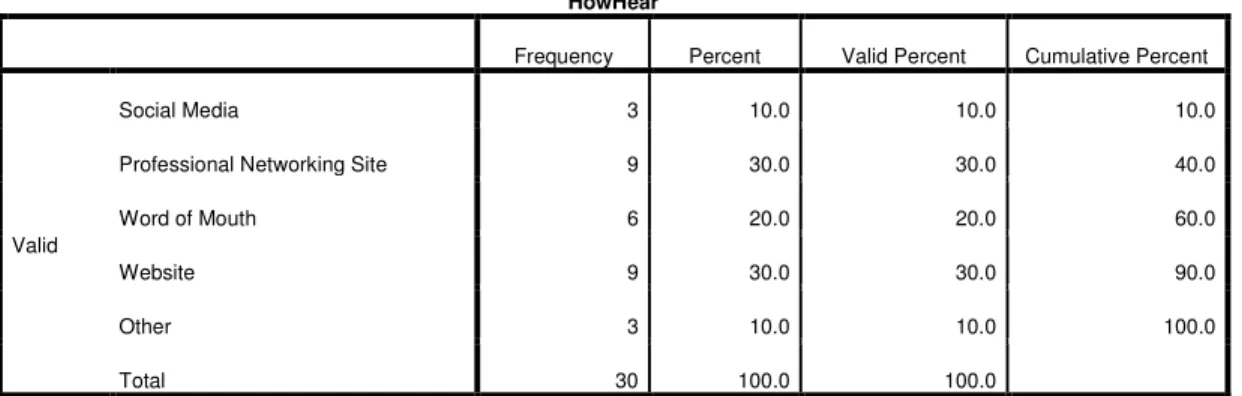
Social Media 3 10.0 10.0 10.0 Professional Networking Site 9 30.0 30.0 40.0 Word of Mouth 6 20.0 20.0 60.0 Website 9 30.0 30.0 90.0 Other 3 10.0 10.0 100.0 Total 30 100.0 100.0
Table 2 indicates that most study subjects heard about the certification opportunities through professional network site (LinkedIn) and the certification website. 20% of subjects heard about the study through the word of mouth, 10% through social media, and 10% through other means.
Figure 1. Reason for Taking the STEM Certifications
The above graph provides the information on the different reasons study subjects took the examination. The top three reasons why students decided to take the STEM certification
13
examination are getting a promotion, testing their skills, and switching jobs. The other two reasons were curiosity and friend’s engagement, which were 13% and 10% of the study population, respectively.
Figure 2. Benefits of the STEM Certifications
The above graph provides information on the relative proportions of the key anticipated benefits of individuals who received a sufficiently high score on the certification examination. The graph indicates that the predominant benefit of the STEM certifications is the increase in reputation in the workplace. The other two benefits, greater confidence on the job and higher salary are roughly equal in proportion. About 1 in 6 study participants expected to receive no clear benefits due to the certifications.
14
Table 3. Question on other current STEM Certifications
CurrentCerts
Frequency Percent Valid Percent Cumulative Percent
Valid
1.00 17 56.7 56.7 56.7
2.00 13 43.3 43.3 100.0
Total 30 100.0 100.0
Table 3 provides information on the responses to the survey question: Do you currently have any other certifications? In the table, the code “1” refers to the answer Yes and the code “2” refers to the answer No. 56.7% of individuals answered yes and 43.3% answered no.
Table 4. Question on Further Interest in STEM Certifications
FurtherCerts
Frequency Percent Valid Percent Cumulative Percent
Valid
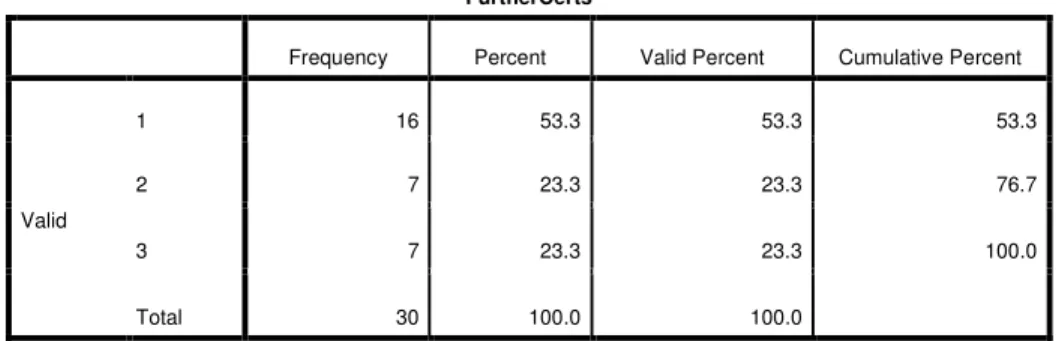
1 16 53.3 53.3 53.3 2 7 23.3 23.3 76.7 3 7 23.3 23.3 100.0 Total 30 100.0 100.0
Table 4 provides information on whether study participants were interested in taking more, related STEM certifications. The codes “1” stands for Yes, “2” stands for Uncertain, and “3” stands for No. Most participants were interested in taking further STEM certifications, with an even split between uncertain and reluctance to take more certifications at 23.3% each.
Table 5 (see Exhibit 2 in Appendix) depicts data on the answer to the question: “What other certifications are needed in your industry?” This question was asked with the purpose of assessing the need for different categories of certifications. While eight people did not suggest a certification, each of the other twenty-two participants provided unique suggestions for
15
for assessing the key discipline within STEM that requires certification. The Discussion section will consider this matter, as it involves categorization and interpretation of the results in Table 5.
Section II. Statistical Analysis
Following the descriptive analysis, which was conducted for purposes of overall evaluation of the data, the researcher proceeded to conduct statistical tests to evaluate whether anticipated benefits were statistically significant to the null expectancy under the status quo, no certifications. The statistical tests were conducted at a 95% confidence level, at a p-value threshold of .05.
The data collected was solely limited to the individuals who received certification. 42 individuals were administered the exam. Of these 42, 30 received certification and therefore, completed the survey. 12 individuals did not meet the 75% threshold.
T-Test on Interview Percentage Table 6. Variable Statistics
Table 7. Test Results
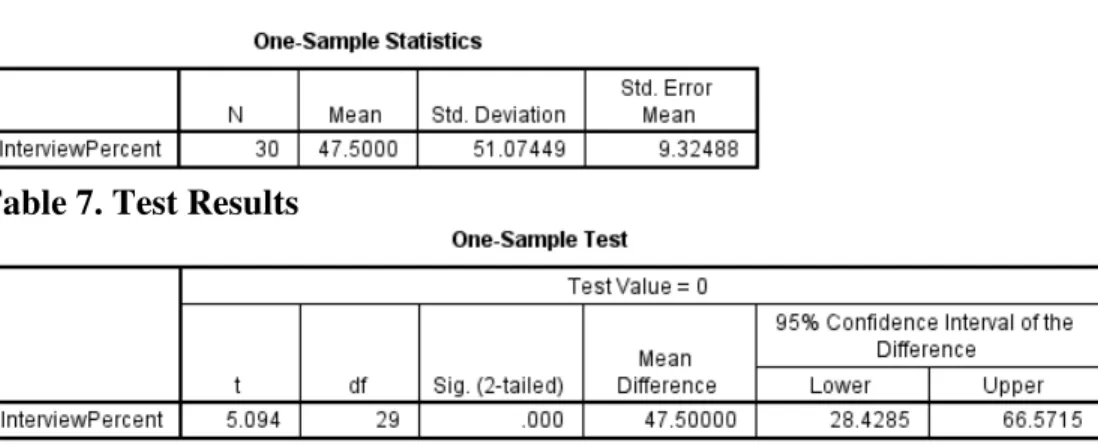
A one-sample t-test was conducted on the variable InterviewPercent to evaluate whether the certifications significantly increased expected percentage of interview call-backs relative to the expectation value of 0, no change in interviews. Mean InterviewPercent score (M = 47.5, SD = 51.07) was higher than the normal InterviewPercent score of 0.0, a statistically significant mean difference of 47.5, 95% CI [28.43 to 66.57], t(29) = 5.094, p =.000.
16
T-Test on Job Responsibility Percentage Table 8. Variable Statistics
Table 9. Test Results
A one-sample t-test was conducted on the variable JobRespPercent to evaluate whether the certifications significantly increased subject’s expectation of increased job responsibilities relative to the null value of 0, no expected change in job responsibility. Mean JobRespPercent score (M = 32.8, SD = 27.16) was higher than the normal JobRespPercent score of 0.0, a
statistically significant mean difference of 32.8, 95% CI [22.66 to 42.94], t(29) = 6.615, p =.000.
T-Test on Variable Career Quality Table 10. Variable Statistics
Table 11. Test Results
A one-sample t-test was conducted on the variable CareerQuality to evaluate whether the certifications significantly improved career quality relative to the expectation value of 3, no change in career quality. Mean CareerQuality score (M = 3.63, SD = 1.15) was higher than the
17
normal CareerQuality score of 3.0, a statistically significant mean difference of 0.63, 95% CI [0.21 to 1.07], t(29) = 2.993, p =.006.
T-Test on Variable Career Growth Table 11. Variable Statistics
Table 12. Test Results
A one-sample t-test was conducted on the variable Growth to evaluate whether the certifications significantly improved career quality relative to the expectation value of 5, no change in career growth. Mean Growth score (M = 5.83, SD = 2.24) was higher than the Growth score of 5.0, which was not a statistically significant mean difference of 0.83, 95% CI [-.005 to 1.67], t(29) = 2.033, p =.051.
Table 13. Correlations between Quantitative Variables
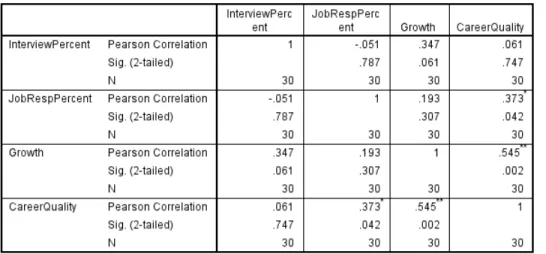
Table 13 depicts the results of a correlation analysis between the four quantitative variables in this study. Two of the six Pearson correlations were found to be significant at the
18
95% confidence level. The two correlations were Career Quality vs Job Responsibility Percentage and Career Quality vs Growth, both of which were moderately strong positive correlations. The graphs below are scatterplots of the 2 significant correlations.
Figure 3. Career Quality v Job Responsibility Percentage
Figure 3 depicts the significant correlation of 0.373 between career quality and job responsibility percentage.
19
Figure 4. Career Quality v Growth
Figure 4 depicts the significant correlation of 0.545 between career quality and career growth.
Figure 5. Score Distribution on Certifications
Figure 5 depicts the score distribution of the individuals who received certification (75% or more). The distribution is right-skewed with a mean of 85.7 and a standard deviation of 6.53.
20
Discussion
This research aimed to assess the need for STEM certifications in a developing country. The study hypothesized that if certification was marketed in a developing country, then there would be significant need for the certification. The experiment was based on the STEM certifications, since there is significant shortage of skilled STEM-related labor in that sector of the economy in the developing country, India.
The results indicate that the hypothesis of the research is supported since the data provide evidence that there is a significant employee need for certifications. The direct beneficiaries of STEM certifications are employees and therefore their views on certifications are critical to establish need.
The results indicate that individuals primarily hear about these certifications via career-related sites such as networking and certifications sites. This indicates that individuals who take the certifications are hearing about them in their career-related pursuits, whether that be
networking, looking for opportunities to improve resume, and/or interest in innovative certifications. This offers a key insight into the marketing of these certifications that entities offering certifications should market in career-related platforms rather than generic advertising such as word-of-mouth and/or social media.
The results also clearly demonstrate that most subjects took the certifications for career-related purposes. This aligns with the expectation that certifications are meant to be serious pursuits rather than impulsive, low-value offerings. Therefore, entities interested in investing in or developing STEM certifications must focus on ensuring high integrity and quality of the certifications as that is a key driving factor behind public reception.
21
The results also provide evidence that the primary motivation for taking the certification was improving reputation in the workplace. This indicates that certifications primarily serve as investments to provide intangible benefits in the workplace. Essentially, certifications are used to signal to other employees and the employer that the certified individual is committed to keeping up with the latest practical standards. Since the individual keeps up with latest standards and has domain-specific knowledge, the certification increases individual’s credibility on all related matters.
The study population was relatively split between those who already had certifications and those who did not, which served to mitigate any potential skewing of results. Most
participants were interested in taking more certifications on a related subject. This is a clear signal that indicates the need for STEM certifications in developing countries.
The certifications in related industries proposed by the subjects can be categorized as follows: Science, Technology, Engineering, and Mathematics (STEM) (see Table 14 in Exhibit 3 of the Appendix).
Table 14 clearly indicates that participants are primarily interested in being certified in technology. This affirms the general purpose of certifications as an efficient method to keep individuals up to speed with the latest in the industry. There was also significant interest in the science certifications, indicating that individuals see growing demand for employees who are relatively knowledgeable about critical scientific experiments. With respect to engineering and mathematics, study participants requested highly specialized certifications.
The statistical significance of three of the four t-tests indicates that individuals taking certifications expect significantly more interview call-backs, more job responsibilities, and higher career quality after taking the certification. While career growth is relatively close to
p-22
value of .05, the test does not indicate that the certification is expected to significantly accelerate career growth. Therefore, individuals who are interested in applying for jobs, expanding their scope of work, and/or improving the quality of the career need these certifications to achieve those objectives.
The results from the correlation matrix indicate that the four variables are correlated to an extent. Specifically, career growth is significantly correlated with both job responsibility
percentage and career quality. This data provides more opportunity for future researchers to investigate which factors drive the other within an organization.
The distribution of the individuals who passed certification could indicate that is proportionally much more difficult to get scores on the higher end of the 75-100 spectrum
compared to the lower end. The right-skewed shape could reveal that the individuals who receive certification have a strong grasp but are not necessarily perfectionists in that discipline. This could indicate 75% is the right trade-off for companies looking to hire for entry-level and then train for managerial positions.
The evidence from the results clearly support the hypothesis that there is a significant need for STEM certifications in developing countries. The following Applications section provides information on the ramifications of these findings.
Applications
This research will be of interest to investors, emerging market funds, governments, chief human resources officers, the United Nations, space exploration companies, C-suite executives, startup founders, recruiters, technical hiring managers, manpower agencies, education-oriented government agencies, and non-profit organizations. The individuals whom this research applies to can be subdivided into three key categories: the business community, human resource
23
consultants/agencies, and institutions with a general focus on education. The business
community can make actionable decisions on their hiring process based on the outcome of the research. The human resource consultants/agencies can assess how to best operate to deliver value to both the job seeker and the employer in the form of a better candidate-job-employer fit. The institutions can shift their policy and actions towards improving education and training in developing countries.
Individuals making investments in the education sector can apply the knowledge from the research in better selection of investments. They can also better understand the key fundamentals and allocate investments based on their risk-return profile. Emerging markets funds can gain valuable information on the nature of education in high-growth, high-risk, high-reward markets. By understanding the supply-demand dynamics for niche education products, emerging market funds can better position themselves for the long-term in volatile but lucrative regions of the world. Governments will be keen on applying the outcomes of this research as educational policy for a nation is fundamentally forward-looking. By assessing the needs of different types of individuals, governments can better allocate budgetary funding and make strategic decisions to continue to effectively educate the population. The United Nations and other large
developmental organizations will look to this research to shift their strategy on meeting goals related to education. For instance, the UN could utilize this report to understand whether online STEM certifications are a feasible way of meeting its Sustainable Development Goals related to education. Space exploration companies will be interested in understanding whether they can use these certifications to hire assembly-line and entry-level skilled technicians. By acting on the understanding that there is a need for certifications, they create opportunities to significantly cut down on labor cost for their expensive endeavors.
24
Limitations
A key limitation of this study is that study sample was relatively small given the
resources deployed to conduct this study. The reason for this limitation was that the study was an undergraduate thesis with data collection conducted within a few months of time. While the study did analyze 30 subjects, more are necessary to come to stronger conclusions regarding the hypotheses.
One limitation of this research is its relatively narrow scope of analysis. The study analyzed certifications in a developing country India. While the country was chosen for good reasons, there could be some skew in the data due to the nature of the Indian labor market. Another limitation of this research is that the individuals self-reported anticipated benefits from receiving the certifications. Individuals who take certifications could potentially believe in strong benefits for themselves.
Future Research
This research provides significant opportunity for future research, which would address the limitations above. The research can be expanded in size to increase the number of subjects and therefore data. In addition, the research can be conducted in multiple developing countries such as Thailand and Philippines. Research can be conducted into a wider range of certifications. In addition, research can be conducted into evaluating training. Future research can include a case study with companies in different industries. Researchers can look into leveraging the latest extraction and analysis tools as well as the greater availability of big data in the private domain by including de-identified employee history data such as previous salaries (forms such as W-2s), prior employment history (recruitment databases), intra-company career growth (HR database), connectivity in the organization (calendar data), team size (organization chart), and much more.
25
A study of such magnitude would likely provide opportunities for analyzing other hypotheses as well. Such a study would also address the self-reporting limitation because it would include a company or range of entities in the study to get final point data.
26
References
Amolo, Chetty, Hassanali, Joubert, Martin, and Scandolo (2018). Growing Materials Science in Africa – The Case of the African School for Electronic Structure Methods and
Applications (ASESMA). MRS Advances, 3(37), 2183-2201.
Bartlett: Bartlett, K., (2002). The Perceived Influence of Industry-Sponsored Credentials in the Information Technology Industry. St. Paul, MN: University of Minnesota, National Research Center for Career and Technical Education.
Benamati, J., & Lederer, A. L. (2001, August). Coping with rapid changes in IT. Communications of the ACM, 44(8), 83-88.
Bureau of Labor Statistics. What does the S&E job market look like for U.S. graduates? Retrieved from nsf.gov
Caldwell, D. F., & Burger, J. M. (1998). Personality characteristics of job applicants and success in screening interviews. Personnel Psychology, 51, 119-135.
Cegielski, C. (2004). Who values technology certification? Communications of the ACM, 47(10), 103-105.
Chini, A. R., Brown, B. H., & Drummond, E. G. (1999, April). Causes of the construction skilled labor shortage and proposed solutions. In ASC Proceedings of the 35th Annual
Conference (pp. 187-196).
Cleary, J., & Kopicki, A. (2009, February). Preparing the Workforce for a “Green Jobs” Economy.
East African Community (2019) Investment in Mining. Retrieved from
27
Enns, H. G., Ferratt, T. W., & Prasad, J. (2006, April). Beyond stereotypes of IT professionals: implications for IT HR practices. Communications of the ACM, 49(4), 105-109.
Gaillard, J., et al. (2015). Return from migration and circulation of highly educated people: the never-ending Brain Drain.
Hinkin, T. R., & Tracey, J. B. (2000). The cost of turnover: Putting a price on the learning curve. Cornell hotel and restaurant administration quarterly, 41(3), 14-21.
Hunsinger, D. S., & Smith, M. A. (2009). IT certification use by hiring personnel. Journal of Computer Information Systems, 50(2), 71-82.
Internet World Stats. (2019). Internet Growth Statistics. Retrieved from internetworldstats.com Johnston, C. R., & Wierschem D. C. (2007). Project management practices in the information
technology departments of various size institutions of higher education. Journal of International Technology and Information Management, 16(3), 59-76.
Kim, S. (2014). The challenge of filling the skills gap in emerging economies. Retrieved from theguardian.com
Manpower Group, (2013), 2013 Talent Shortage Survey: Research Results www.manpowergroup.com
Mason, J. (2003). Certifications--beat 'em, join 'em (or lose 'em)? Journal of Computing Sciences in College, 18(6), 36-45.
Mercer Human Resources Consulting, (2004), “Communication: the key to retaining your workforce” www.mercerhr.com
Niederman, F., Sumner, M., & Maertz, Jr., C. P. (2006). An analysis and synthesis of research related to turnover among IT personnel. Proceedings of the Association of Computing Machinery, SIGIMS-CPR’06, 130-136.
28
Randall, M. H., & Zirkle, C. J. (2005). Information technology student-based certification in formal education settings: who benefits and what is Needed. Journal of Information Technology Education, 4, 287-306.
Schambach, T., & Blanton, J. E. (2002, April). The professional development challenge for IT professionals. Communications of the ACM, 45(4), 83-87.
World Bank (2018). Fair Progress? Economic Mobility across Generations Around the World. Retrieved from worldbank.org
Windapo, A. O. (2016). Skilled labour supply in the South African construction industry: The nexus between certification, quality of work output and shortages. SA Journal of Human Resource Management, 14(1), 1-8.
29
Appendix Exhibit 1: Survey Questions
https://www.surveymonkey.com/r/WK7PZBV
1. How did you hear about this certification opportunity? Social Media
Professional Networking Site Word of Mouth
Website Other
2. Why did you take this test? Get a promotion
Switch jobs Test my skills Curiosity
Friend's encouragement
3. By what percentage do you expect your interview call-backs to increase by after you received this certificate?
0 to 200%
4. Which of the following benefits do you expect this certificate to provide you with? Greater confidence on the job
Higher salary
Better reputation in the workplace Do not expect much improvement
30 5. Do you currently have any other certifications? Yes
No
6. Are you interested in taking further certifications in a related subject? Yes
Uncertain No
7. By what percentage do you expect your job responsibilities to grow after you received this certificate?
0 to 100%
8. What other certifications are needed in your industry? ______________
9. How do you expect this certificate to improve your career quality? Not at all
Not very much No change Improved
Great improvement
10. On a scale of 1 to 10, with 1 being exceptionally low and 10 being exceptionally high, how do you see your career growth after receiving this certificate?
31
Exhibit 2: Table 5. Other Certifications of Interest
OtherIndustry
Frequency Percent Valid Percent Cumulative Percent
Valid
1 3.3 3.3 3.3 Artificial Intelligence 1 3.3 3.3 6.7 Astro Physics 1 3.3 3.3 10.0 Bio Lab Safety 1 3.3 3.3 13.3 CAD Design 1 3.3 3.3 16.7 Data Analytics 1 3.3 3.3 20.0 Differential equation 1 3.3 3.3 23.3 Discreet Mathematics 1 3.3 3.3 26.7 Do not know 1 3.3 3.3 30.0 Dont know 1 3.3 3.3 33.3 Environmental regulatory requirements 1 3.3 3.3 36.7
Health and stress management 1 3.3 3.3 40.0 Human diversity understanding skills 1 3.3 3.3 43.3 I dont know 1 3.3 3.3 46.7 IT Server management 1 3.3 3.3 50.0 Lab animal ethics 1 3.3 3.3 53.3 Managerial Economics 1 3.3 3.3 56.7 Molecular cloning 1 3.3 3.3 60.0
n/a 1 3.3 3.3 63.3
Not applicable 1 3.3 3.3 66.7 Not sure 3 10.0 10.0 76.7 Personal brand creation 1 3.3 3.3 80.0 Research review process 1 3.3 3.3 83.3 Retirement planning 1 3.3 3.3 86.7 Sales Executive 1 3.3 3.3 90.0 Virtual Reality Simulation 1 3.3 3.3 93.3 Work plate diversity management 1 3.3 3.3 96.7 Work relationship skill development 1 3.3 3.3 100.0 Total 30 100.0 100.0
32
Exhibit 3: Table 14. Categorization of Certifications Proposed by Study Participants
Area/Discipline Certifications
Science Astro Physics
Bio Lab Safety
Environmental regulatory requirements Health and stress management
Lab animal ethics Molecular cloning Research review process Technology Data Analytics
Human diversity understanding skills IT Server management
Managerial Economics Personal brand creation Sales Executive
Work pla[c]e diversity management Work relationship skill development Engineering Artificial Intelligence
33
Virtual Reality Simulation Mathematics Differential Equation
Discreet Mathematics Retirement planning