Title: Improving the Teaching of Reflective Practice for HR Professionals Stream: Creativity, Innovation and Sustainability
Vivienne Griggs, Leeds Business School, Leeds Metropolitan University Jan Rae, London South Bank University
Aileen Lawless, Liverpool Business School, Liverpool John Moores University Rick Holden Liverpool Business School, Liverpool John Moores University
Submission type: Working Paper
Abstract
Despite a strong discourse promulgating the individual benefits and organisational value of reflective activity within management education, there is a lack of empirical data to show that teaching managers reflective processes, in an academic context, has long term and definitive benefits to a majority of learners. Our recent research endeavours sought to engage key participants in a discourse about issues and engagement with reflective practice in order to better understand the different perspectives. As arguably the most influential stakeholder group in determining teaching strategy for reflective practice, our focus here is on ‘faculty’, namely those responsible for managing and teaching reflective practice on professional CIPD accredited HRM programmes. The aim is to generate an enhanced understanding of the tensions of teaching reflective practice to HRM students, in order to better support the transfer of this learning to the workplace and everyday practice.
The investigation involved 3 stages: an analysis of the approach of three institutions; a workshop with 48 participants at the CIPD Centres Conference 2013; and 25 explorative open-ended questionnaires. The findings raise questions about the requisite outcomes and expectations of different stakeholders in the teaching of reflective practice. One common theme throughout the analysis is an acknowledgement of the challenges involved in engaging and assessing a diverse range of students in an equitable and ethical way. Finally, the paper raises a number of important questions for future research in this area.
Introduction
Reflection and reflective practice are regarded by many as essential components of professional practice (see for example, Bradbury et al, 2010). It follows that reflective learning is seen as an essential underpinning of both initial and continuous professional development (cpd) (Francis and Cowan, 2008). A requirement to include some consideration of reflective practice has therefore become a feature of most professional programmes. In the HR arena the professional body, the Chartered Institute of Personnel and Development (CIPD) sees its promotion of reflective practice and reflective learning as being intricately bound up with its view of continuous professional development (cpd). The Institute’s web site highlights that CPD is a combination of approaches, ideas and techniques that “will help you manage your own learning and growth” (www.cipd.co.uk). The CIPD defines reflective learning as follows: “Reflective learning means thinking about what you learn, how you learn it and how you can apply it in the real world” (www.cipd.co.uk). Thus, reflective learning, as a feature of ‘professional’ HR teaching, is common-place and most accredited centres running CIPD programmes will have been seeking to engage their students in reflective learning for at least 20 years. This stance is not unique to the CIPD; other bodies responsible for promoting and influencing professional and management education (e.g. AMED, BAM, CMI, HEA) also identify the value of reflection and reflective practice as a fundamental part of both initial and continuing development of managers.
However, despite a strong discourse promulgating the individual benefits and organisational value of reflective activity within management education, we lack empirical data to show that teaching managers reflective processes, in an academic context, has long term and definitive benefits to a majority of learners. Equally, despite the rhetoric, reflective learning is not always perceived as relevant to the learner (Samkin and Francis, 2008) and professional bodies, or indeed workplaces, which require little more than a yearly update on courses attended, do not provide the context or encouragement for the transfer and sustainability of a more demanding and, potentially, more valuable form of reflective practice.
As a result, without an element of critical reflection, cpd becomes simply a record of training and development events and loses the full potential of enhancing practice. Simple
explanations of reflection may result in somewhat impoverished or even prescriptive
(Woodall, 2006) outcomes. Bradbury et al (2010) warn of the dangers of an overly technical or instrumental view of reflection, questioning the value of educational approaches which adopt checklists and other instrumental meansWhile Anderson (2003) argues that we need to talk of critical reflection, as a ‘hallmark’ of Masters level management education, authors such as Gray (2007) and Reynolds (1998) see a management curriculum embracing (critical) reflection as indicative of a more critical curriculum overall, one which challenges the traditional, functionalist orientation, with its emphasis on the transmission of knowledge. And indeed, Schön (1983) argued that a distinguishing feature of expert practitioners in a profession was their ability to reflect on their practice when dealing with unusual or
particularly complex cases. From our perspective in designing and teaching in this area, we see developing reflective practice skills as essential to developing HR professionals.
Thus, given, that the majority (if not all) accredited centres running CIPD programmes seek to engage their students in reflective learning, to what extent do our efforts to teach reflective practice create critically reflective HR practitioners? To a large extent, without consideration and understanding of the context of practice and the stakeholders’ requirements, even the most conscientious (and critically reflective) of faculty are running partially blind in terms of their decision making on the design and delivery of reflection within the business and
and it has been argued that the majority of mainstream management theory offers descriptive or prescriptive theories which fail to meet managers real needs (Grey, 2005). The extent to which this is adequately investigated is also questioned; in fact Sarrico et al (2010) found that the existence of stakeholders was often ignored in HE evaluation. If a key challenge for a post-graduate, professionally accredited course is the scope and complexity of stakeholders (Griggs et al, 2012), understanding their viewpoints is crucial to an informed critique of our teaching practice. Thomas et al (2013) in a study of key participants in the field of
management education found faculty, with a control over the governance and what gets taught in business schools, were perceived to be the most influential stakeholders. They classify this as a form of supply-driven management education. However, businesses and students were also perceived to have an influential role in management education,
particularly in executive and post-experience courses. For the teaching of reflective practice these different standpoints potentially introduce competing discourses of performance based reflection and critical management reflection.
As arguably the most influential stakeholder group in determining teaching strategy for reflective practice, our focus here is on ‘faculty’, namely those managing and teaching
reflective practice on professional CIPD accredited HRM programmes. This report explores issues relating to student engagement, measurement and transfer of reflective practice, from the view of this key stakeholder group. The aim is to generate a better understanding of the tensions of teaching reflective practice to HRM students.
Reflective Learning and Reflective Practice
At its simplest, reflective learning can be considered as a concept which says we learn through a process of reflection. Boud, Keogh & Walker (1985),for example, suggest that reflection in terms of learning “is a generic term for those intellectual and affective activities in which individuals engage to explore their experiences in order to lead to new
understandings and appreciations”.
Notions of reflective learning are well established in the literature. As early as 1933 Dewey defined reflective thought as “active, persistent, and careful consideration of any belief or supposed form of knowledge in the light of the grounds that support it and further
conclusions to which it tends” (Dewey, 1933 in Andrusyszyn & Davie, 1997, p.105). He believed that associating ideas was integral to thinking and that one had to search for deeper meanings through reflective thinking to capture and understand the core essence of
something, to transform doubt into understanding and understanding into further action. More recently Knowles (1975), Mezirow (1981), Argyris (1982), Schon (1983), and Kolb (1984) have all sought to develop ideas and thinking about reflective learning. Schon, for example, sought to position reflective learning firmly within professional practice. His notions of reflection in action and in particular reflective on action have been influential in curriculum development within professional education, cpd and lifelong learning, because of the
potential of an applied, deliberate process to consider aspects of professional practice with a view to change.
Of particular significance is the notion that there may be levels of reflective learning. Here the concepts of single and double loop learning (Argyris, 1982) are important implying that a deep, rather than superficial, level of reflective learning can lead to transformative change both within individuals and organisations (Brockbank et al, 2002). Bain et al (1999) suggest that depth is achieved by thinking differently rather than harder. They make an interesting
distinction between questions that interrogate personal experience and questions about how experience can be generalised and theorised.
Similarly, and with an emphasis upon reflective writing, Moon (2004) argues for four levels of reflection: descriptive writing; descriptive accounts with some reflection; reflective writing (1) and reflective writing (2).Importantly in both levels 3 and 4 there is an acknowledgement of the need for ‘self questioning’ and to be critical of one’s own actions or those of others. There is recognition that in the search for enhanced capability (e.g. in a managerial context) assumptions, values, beliefs etc may need to be questioned and frames of reference
challenged and changed.
As a basis therefore of both conceptual clarification and as a key underpinning in terms of the teaching on CIPD courses the following are, for us, the critical features of reflective learning:
It is an intentional, deliberate, process
it involves an individual re-visiting, examining and exploring an issue of concern, one rooted in personal experience
the process requires individuals to question, critically, aspects of their behaviour, their values, assumptions etc
the process (potentially) generates insight in terms of self-understanding
it provides (potentially) a basis for some change in behaviour in terms of professional practice.
It requires time and space
Problems of teaching reflective practice
Increasingly the teaching of reflection is recognised as problematic and challenging, both within the professions generally (Bradbury et al, 2010) and more specifically within the HR and management fields (e.g. Corley and Eades, 2004; Rae and Rowland, 2012). Despite the rhetoric, reflective learning is not always perceived as relevant (Samkin and Francis, 2008); it may take learners into uncomfortable areas (Halton, 2007) and, furthermore, professional bodies, or indeed workplaces, which require little more than a yearly update on courses attended are unlikely to provide a supportive environment for the application and transfer of a more demanding and, potentially, more valuable form of reflective practice. Thus, as Rigg and Trehan (2008) ask, is applying critical reflection within the workplace just too difficult. Whilst the focus of their research is teaching reflective practice in a corporate context, their findings are nonetheless important for highlighting such issues as organisational power relations and culture as significant constraints relating to the application and transfer of reflective practice.
In a similar vein Russell (2006) asks whether indeed reflective practice can be taught at all, concluding that “the results of explicit instruction seem far more productive than simply advocating reflective practice ....”. However the important word here is ‘seems’ as the evidence base is thin and anecdotal. Thus for example, from a heath care perspective Mann et al, (2007), note that the evidence to support and inform reflective practice curriculum interventions “remains largely theoretical”, whilst Cole (2010, p129) is emphatic in his identification of research failings:
At a time when the discourse of evidence based practice holds such sway there is very little in the way of research that robustly demonstrates its effectiveness.
Thus we face a difficult landscape for teaching reflective practice. The research seeks to explore these issues (areas such as: engagement, measurement and transfer) from the view of a key stakeholder group.
Methodology
As noted previously, the target population for data collection was those responsible for managing and teaching reflective practice on professional CIPD accredited HRM
programmes. The approach to collecting data from this stakeholder group was an action research strategy which is participative, inter-active and engaging. Whilst the goal of an action research enquiry is principally the pursuit of practical solutions to issues of concern, a key characteristic is that the researchers are not separate or independent from the problem. We see both participants and the researchers becoming ‘practitioners-as-researchers’
(Bensimon et al, 2004). The participative orientation intends to open ‘communicative spaces’ (Kemmis, 2006) which was considered a key requirement of the approach adopted.
The research was set within the professional education provision of ‘HR, ‘HRM’ and ‘HRD’ within the three universities. In our earlier work,we noted that the challenges of teaching reflective practice, whilst not peculiar to the HR profession, assume poignancy given the unique interest and stake in workplace learning held by HR in general and HRD in particular (Holden and Griggs (2011) . Thus, importantly, as both teachers and researchers we were not independent from the problem.
There were three stages of data collection for the tutor stakeholder group. Firstly we undertook an exploration of the concept of reflective practice from the researchers’ own perspective. This was of critical importance as the researchers are from three different universities and there needed to be some common understanding and identification of differences before we could explore the issues with a broader sample of participants. Following on from the exploration of the researchers’ (as tutors’) perspectives, a workshop was held at the CIPD Tutors Conference in order to engage with a larger number of this stakeholder group. CIPD conference participants (n=48) were all tutors on CIPD approved HRM and HRD programmes at Masters level or equivalent; while not all the participants taught on a skills development/portfolio based module, the majority of those present integrated reflective practice into other areas of teaching, including research methods, the management report / dissertation and most HRD modules. Following on from a brief input on the research, participants were asked in groups to define their own understanding of reflective practice and the reflective practitioner through the use of post-it notes. A round table exercise then took place where participants were asked to discuss and record the issues that arise in the transfer and measurement of reflective practice. These outputs were captured on flipcharts and presented back to the wider group. The final stage of data collection was an individual qualitative questionnaire. This was distributed to the CIPD participants, asking them to describe their own students’ engagement with reflective practice and the key issues relating to measurement and transfer.
Findings
The Researcher as Tutor
Whilst there were differences in any specific conceptual anchors, all three institutions shared a broadly common view of the reflective practitioner, key characteristics being identified as:
o someone who learns about themselves and develops an understanding of self (vis others);
o someone who is comfortable critiquing behaviour (self and others in relation to self);
o someone who identifies and questions assumptions;
o someone who does not look at events and experience in isolation but sees or tries to see the bigger picture;
o someone who has developed a level of criticality in relation to themselves and the world they live in;
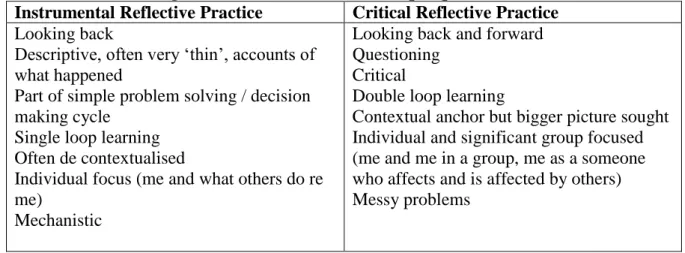
There is also agreement that reflective practice requires ‘conscious activity’ (c.f. Schon’s Reflection-in-Action, 1983). Hence reflective space is needed and a deliberate set of reflective learning activities pursued. However, differences exist as to the extent to which reflective practice needs to involve ‘writing’ or whether it can remain a largely cognitive exercise.; Thus it was initially possible to identify what might be termed simple or instrumental and more complex or critical constructs of reflective practice (Table 1).
Table 1 : Constructing Reflective Practice (the tutor perspective)
Instrumental Reflective Practice Critical Reflective Practice Looking back
Descriptive, often very ‘thin’, accounts of what happened
Part of simple problem solving / decision making cycle
Single loop learning Often de contextualised
Individual focus (me and what others do re me)
Mechanistic
Looking back and forward Questioning
Critical
Double loop learning
Contextual anchor but bigger picture sought Individual and significant group focused (me and me in a group, me as a someone who affects and is affected by others) Messy problems
All of the institutions aspire to develop depth in student’s reflective learning, aiming to move learners from simple, or instrumental reflecting to taking a more complex or critical
perspective, and utilising a variety of reflective frameworks to achieve this aim. For example, one course team utilise a framework with five levels (reporting, responding,
relating, reasoning and reconstruction) (Bain et al, 1999) whilst another use that developed by Reynolds (1998) distinguishing three levels: technical, consensual and critical reflection.
The CIPD Tutors Conference Workshop
Overall, reflective practice was seen by participants as a skill, involving a mixture of experience and practice with a particular emphasis on the ongoing process with the aim of improvement in specific areas. There was considerable emphasis on change, a term that cropped up most regularly, and actioning, implying that while this is a process, nevertheless, to have value there needs to be an end result. However, in spite of the emphasis on change and actions, there was limited reference to questioning or challenging assumptions.
Reflective practice tended to be perceived as an individual rather than group or collaborative activity. The wordle in figure 1 shows the most commonly occurring words in the
The Questionnaire
Turning to the data collected through the questionnaires, CIPD participants were asked to consider their students engagement with reflective practice, and here the data provides some interesting results, with potential implications for the teaching and development of reflective practice skills. In response to the question ‘How would you describe your students’
engagement with reflective practice?’ The responses fell into 5 broad categories: Poor; Difficult; Instrumental; Variable; Good.(see Figure 2)
The most common response from 10 out of the 25 questionnaires returned was that engagement was variable. Some elaborated on this, such as ‘Mixed- some understand and practice well – others regard it as unhelpful and wasteful of time’ and others suggested reasons for the variable engagement:
‘Mixed – some more mature students are highly confident and enjoy the process. Often younger or less confident students struggle’;
‘Those who are working or have worked tend to see the benefits’; ‘Cultural differences, personality’.
It should be noted that this data was limited to a couple of comments, but student variables potentially provides an additional area for future research.
Interestingly, one of the lecturers who responded ‘instrumental’ commented that further learning was required for the tutors, suggesting there was perhaps a link between the lack of student engagement and the way reflective learning was positioned and taught on the
programme, and indeed, support for the tutors themselves in the development of their own reflective practice. Another lecturer at a different institution commented that the students were very involved but that he himself was unsure of the value, again perhaps highlighting a tension in the teaching of reflective practice. This was also raised by other respondents in relation to issues of measurement (see below).
Two contrasting responses to the question perhaps highlight most of all the tensions within the approaches to reflective practice. Of the more positive responses one Programme Manager commented ‘I feel this is an evolutionary process across the programme that gets better’, and at the other end of the spectrum a tutor commented that students saw the activity as ‘a necessary evil’!
Turning to issues of measurement and transfer, the data supported the concerns previously raised about assessment, with a number of respondents raising questions about what what was being measured. This is succinctly expressed as:
What are we marking? Theory or technique? What is our accountability when control lies with individual /organisation?
A number of respondents also commented on the difficulty of moving from defining and understanding the concept to its actual application. There was an implicit reference to the importance of needing (workplace) experience to support reflection. Thus context was clearly seen as relevant to both measurement and transfer; consequently identifying appropriate criteria was a challenge as one respondent commented that reflections could only be marked on a pass/fail basis as the level of experience, which is not within the control of the student, impacted on the quality of the work.
Some tutors queried the value of assessing the output of reflective practice, noting the
subjectivity of the activity, with one respondent commenting that reflective practice had little academic value, and another querying the value and ethics of assessing reflective practice. The following examples demonstrate some of these tensions:
... ethical issues. Skills module ends up assessing reflection rather than skills. Jumping through the hoops. Cultural variance and is it simply ‘self-monitoring’? Lack of understanding of the purpose of reflection by both students and
tutors/assessors because it can be used in different ways.
Assessment is quite difficult as reflective accounts are by their nature very individual. Transfer was equally problematic, with a question raised whether this was within the
however, another respondent suggested this was perhaps worthy of further investigation as if ‘employers are saying students don’t have the skills they need …either the curriculum is not right or skills transfer not effective into industry’. Student experience was again noted as important here; for example, ‘transfer is perceived by full-time students to be difficult when they have limited work experience’. One respondent also commented on the difficulty of transfer when organisations have a ‘a short term focus and culture that do not appear to value CPD/reflection’. It was also acknowledged that transfer was difficult to assess without some means of measurement of learning back in the workplace.
Finally, as mentioned above, embedded within some of the responses was a questioning of abilities to teach reflective practice; there were comments about the need for further learning by the tutors, space for academics themselves to reflect, and that tutors themselves were unclear of its value and purpose.
Discussion
One common theme throughout the analysis is an acknowledgement of the challenges involved in engaging and assessing a diverse range of students in an equitable and ethical way. Our findings indicate the difficulty with which some participants and/or their students perceived reflection and the importance of the workplace dynamics. A number of tensions are acknowledged: engagement was a significant concern; moving from understanding reflective practice to demonstrating the skill was another difficulty; in common with previous research assessment and transfer were seen by some as problematic; and finally questions were raised about teaching capability in this area. Some of these difficulties could potentially be
addressed through alternative teaching and learning strategies, more investment in tutor development in this area, and greater sharing of successful approaches. Others, such as, organisational cultures which deny the value of reflection, or workplaces which exclude reflective opportunities, could be major constraints beyond control of ‘faculty’. We need to explore the extent to which our exhortations to develop reflective practice skills are doomed to fail because a level of routinised and highly prescriptive HR practice may remove the legitimacy of our teaching aspirations.
Whilst the tensions were commonly acknowledged interestingly, there was more disparity of of views expressed by tutors about the value and nature of reflective practive., Some were closely aligned with the researchers who had a strong belief in the value of reflective practice, others questioned the relevance and efficacy of teaching in this area. This divergence of opinion potentially illustrates differences in the philosophical approach of the tutors. Corley and Eades (2006) suggest the language of critical education challenges other discourses in management and management learning, and this could be an important factor here. The findings highlight competing discourses of performance based reflection and critical
management reflection and raise a number of interesting questions for further research in this area. Firstly, is the philosophical stance of the tutors aligned to the requirements and
expectations of the professional body, the students and their employer? Secondly, to what extent is the critical stance adopted by some tutors (and notably the researchers) appropriate on a business course with a largely functionalist managerial curriculum? Finally, as Rigg and Trehan (2008, p.375) assert ‘dissonance is commonly, if not inevitably, generated by critical reflection’ and if critical reflection is not supported or encouraged in the workplace to what extent is it appropriate for us to generate this dissonance?
Turning specifically to issues of transfer, our earlier assertion that HR and HRD have a significant role in reflective learning in the workplace is important here. If a central concern for critical HRD is the ‘struggle to reconcile the needs of the individual and the needs of the employing organisation, the tension between autonomy and community.’ (Elliott and Turnbull, 2003, p. 457), this may have implications for the way we develop and support learning to encourage transfer. If as tutors we uphold the need to challenge the performance and managerial standpoint we need to look for ways to facilitate the flow of learning and develop a common language with the workplace (see for example, Corley and Eades, 2006). Equally, we need to support ‘an emerging community of critically reflective practitioners by ensuring an open dialogue about values and practice.’ (Lawless and McQue, 2008, p.323). Crucially, transfer is not just about the application of learning to the workplace but also the maintenance of learned material over time. Critical reflection may offer greater sustainability for career development because arguably progression cannot be achieved without challenging existing performance norms.
Conclusion
Our research to date has surfaced a number of interesting issues concerning a key stakeholder group in the teaching of reflective practice skills. Data from the CIPD tutors conference presented a mixed set of findings. There was ambivalence in relation to the efficacy of teaching reflective practice and its value to students. Furthermore there were questions raised over the value of assessment, a theme which underpins a significant amount of previous research into reflective practice. From the findings we have identified some potentially important initial themes: how tutors construct the development of reflective practice; the potentially competing expectations of learners, tutors and professional bodies in relation to the outcomes; and the extent to which the factors impacting on transfer of learning are applicable when what is being transferred is open to different interpretations. All these areas require more depth of exploration. However, the outcomes do suggest that the CIPD require a review of their approach to cpd to provide greater clarity to both HR
professionals and their tutors as the current stance regarding reflective practice is equivocal.
It is recognised that a limitation of the research to date is the focus on current students, Further research, involving an exploration of reflection in practice is required. The next stage of our research seeks to understand the transfer and impact of reflective practitioner skills, post formal efforts to facilitate the practice of reflection, within a work setting, through engagement with HR practitioners post study. An understanding of the relationship between formal efforts to teach reflection and the transfer/impact within the workplace holds out a promise of valuable insight for ongoing curriculum development and gain a more
comprehensive analysis of the relevance, transferability and sustainability of reflective practice.
References
Anderson, L.M. 2003. “Critical reflection: the hallmark of masters education, Education in a Changing Environment”. Conference Proceedings, 17-18 September, 2003,
Available from: <www.ece.salford.ac.uk/proceedings/papers/int_03.rtf> [Accessed 30/04/2013]
Andrusyszyn, M. & Davie, L. (1997). Facilitating reflection through interactive journal writing in an online graduate course: A qualitative study. Journal of Distance Education, 12(1).
Argyris, C. (1982). Reasoning, Learning and Action. Individual and Organizational. San Francisco: Jossey-Bass
Bain, J., Ballantyne, R., Packer, J. & Mills, C. (1999). Using journal writing to enhance student teachers’ reflectivity during field experience placements. Teachers and Teaching: Theory and Practice, 5 (1), 51-74
Boud, D., Keogh,R. and Walker,D. (1985) Reflection: turning experience into learning. London, Kogan Page.
Bradbury. H., Frost, N., Kilminster, S. and Zukas, M. (eds) (2010) Beyond Reflective Practice: new approaches to professional lifelong learning, Abingdon, Routledge
Brockbank, A. and McGill, I. (2007) Facilitating Reflective Learning In Higher Education Maidenhead : Open University Press
CIPD, What is Reflective Learning, http://www.cipd.co.uk/cpd/about/reflective-learning.aspx (accessed December, 2013)
Cole, M. (2011), Rescuing reflection from reflective practice: defining the key skills in reflexivity for health care professionals, Paper presented to the Fourth Professional Lifelong Learning conference, 11 January, University of Leeds
Corley, A. and Eades, E., (2004), Becoming critically reflective practitioners: academics and students’ reflections on the issues involved, Human Resource Development International, 7(1), 137-144
Elliott, C and Turnbull, S. (2003), Reconciling autonomy and community: the paradoxical role of HRD. Human Resource Development International. 6 (4), 457-474
Francis, H. and Cowan, J. (2008) Fostering an action-reflection dynamic amongst student practitioners, Journal of European Industrial Training, 32 (5), 336-346
Gray, D.E. (2007) Facilitating Management Learning – Developing Critical Reflection through Reflective Tools, Management Learning, 38 (5), 495-517
Grey, C. (2005), Critical management studies: Towards a more mature politics, In D. Howcroft, E. Trauth (Eds.), Handbook of critical information systems research, Edward Elgar, Cheltenham, UK (2005), 174–194.
Griggs, V., Blackburn, M. and Smith, J.(2012) The Educational Scorecard: a More Appropriate Evaluation? Proceedings of the 11th European Conference on Research Methods, University of Bolton, UK 28-29 June 2012
Halton, C. Murphy, M. and Dempsey, M. (2007), Reflective learning in social work education: researching student experiences, Reflective Practice, 8 (4)
Holden, R. and Griggs, V. (2011), Not more learning logs! A research based perspective on teaching reflective learning within HR professional education, Human Resource
Development International, 14 (4)
Kemmis, S. (2006) ‘Exploring the relevance of critical theory for action research: emancipatory action research in the footsteps of Jurgen Habermas’, in Reason, P. and Bradbury, H. (eds) (2006), Handbook of Action Research: Concise Paperback Edition. London: Sage pp. 94-105.
Knowles, M. S. (1975). Self-directed learning: A guide for learners and teachers. Englewood Cliffs: Prentice Hall
Kolb, D. A. 1984. Experiential Learning: experience as the source of learning and development. New Jersey: Prentice-Hall
Lawless, A. and McQue, L. (2008), Becoming a community of critically reflective HR practitioners. Journal of European Industrial Training, 32 (5) 323-335
Mann, K., Gordon, J. and MacLeod, A., (2007), Reflection and reflective practice in health professions: a systematic review, Advances in Health Science Education, 14, 595 – 621
Moon, J. (2004), A Handbook of Reflective and Experiential Learning, Routledge Falmer, London.
Rae, J. and Rowland, H. 2012, Using the arts in teaching reflective practice: a case study, 13th International Conference on HRD Research and Practice Across Europe, Universidade Lusiada de Vila Nova de Familicao, May, 2012
Reynolds, M. (1998), Reflection and critical reflection in management learning, Management Learning, 29 (2), 183-100
Rigg, C., and Trehan, K., (2008), Critical reflection the workplace: is it just too difficult? Journal of European Industrial Training, 32 (5), 374-384
Russell, T., (2006) Can reflective practice be taught? Reflective Practice, 6 (2) 199-204
Samkin, G. and Francis, G., (2008), Introducing a learning portfolio in an undergraduate financial accounting course, Accounting Education, 17 (3)
Sarrico,C et al (2010) ‘ Assessing Quality and Evaluating Performance in Higher Education: Worlds Apart or Complementary Views?’ A Review of Science, Learning & Policy, March 2010, Vol. 48 Issue 1, p35-54
Schön D. The Reflective Practitioner. Temple Smith, London 1983
Howard Thomas, Lynne Thomas, Alex Wilson, (2013) The unfulfilled promise of
management education (ME): the role, value and purposes of ME. Journal of Management Development, 32(5), pp.460 - 476
Woodall, J. (2006), From individual learning to social learning – reframing HRD theory and practice, Human Resource Development International, 9 (2)