KNOWLEDGE MANAGEMENT USING MACHINE
LEARNING, NATURAL LANGUAGE PROCESSING
AND ONTOLOGY
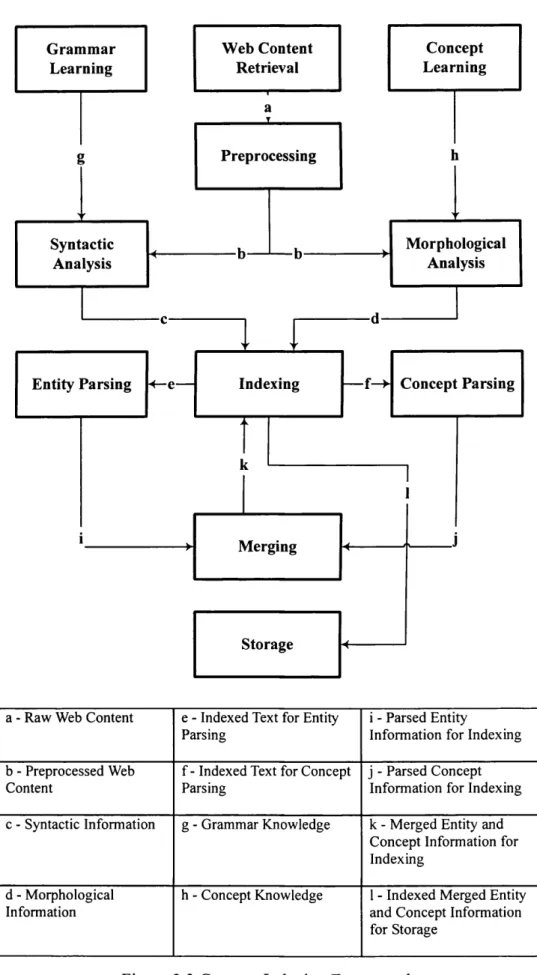
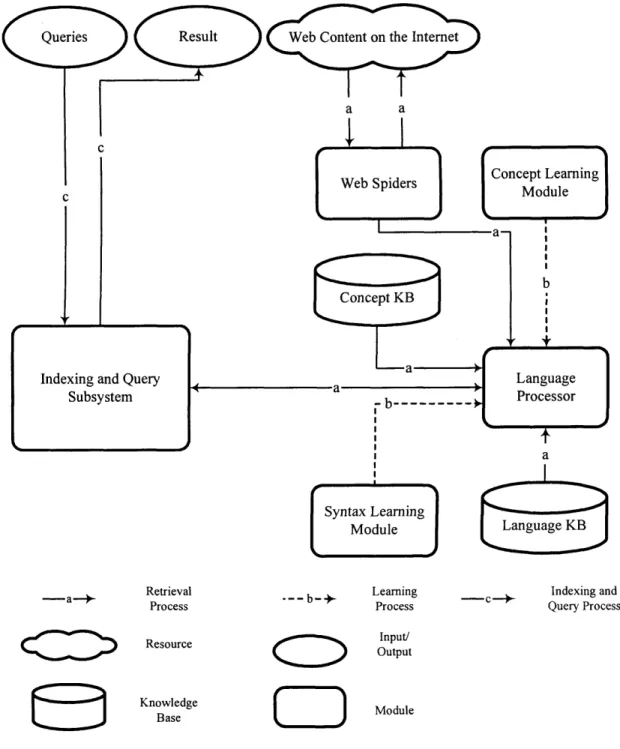
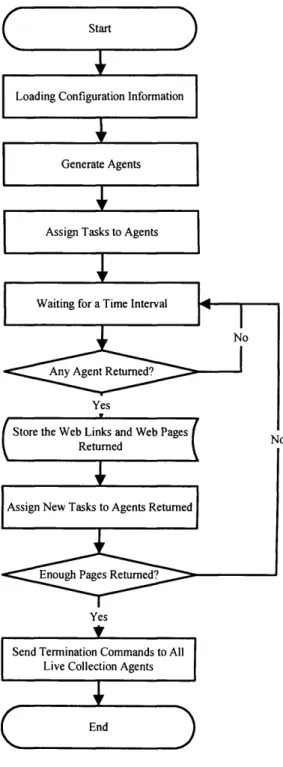
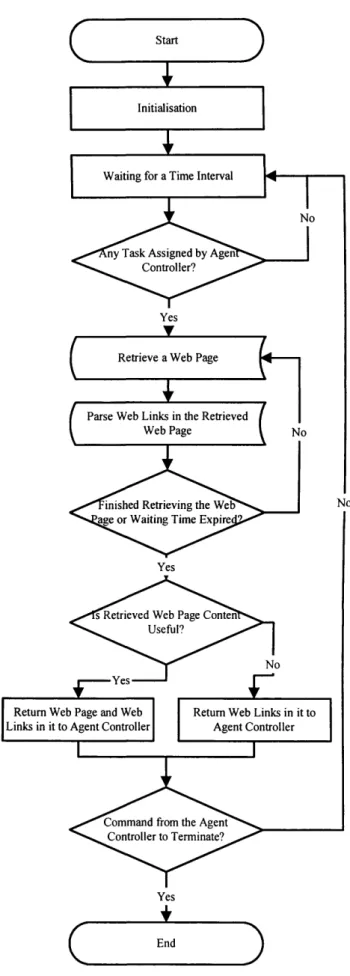
A thesis
submitted to the
University of Wales
for the degree of
Doctor of Philosophy by
Qiao Tang
Cardiff School of Engineering
University of Wales, Cardiff
UMI Number: U584821
All rights reserved
INFORMATION TO ALL USERS
The quality of this reproduction is dependent upon the quality of the copy submitted.
In the unlikely event that the author did not send a complete manuscript and there are missing pages, these will be noted. Also, if material had to be removed,
a note will indicate the deletion.
Dissertation Publishing
UMI U584821
Published by ProQuest LLC 2013. Copyright in the Dissertation held by the Author. Microform Edition © ProQuest LLC.
All rights reserved. This work is protected against unauthorized copying under Title 17, United States Code.
ProQuest LLC
789 East Eisenhower Parkway P.O. Box 1346
SUMMARY
This research developed a concept indexing framework which systematically
integrates machine learning, natural language processing and ontology technologies to
facilitate knowledge acquisition, extraction and organisation.
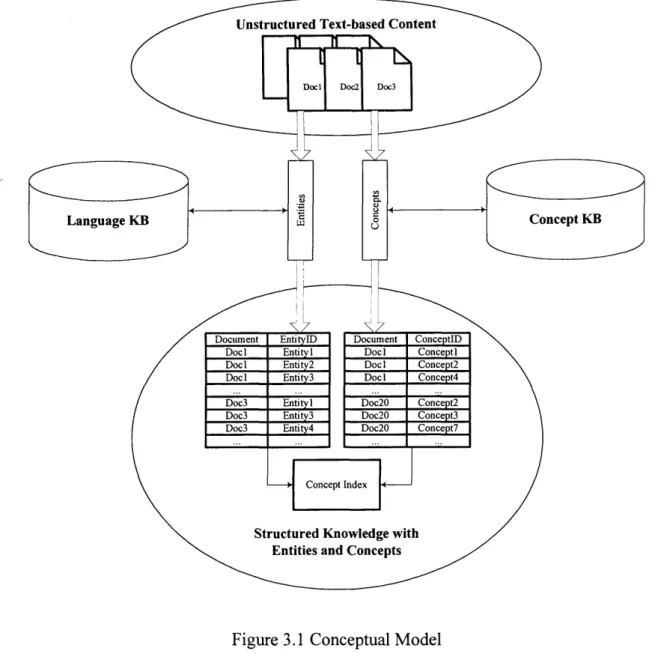
The research reported in this thesis focuses first on the conceptual model of concept
indexing, which represents knowledge as entities and concepts. Then the thesis
outlines its benefits and the system architecture using this conceptual model.
Next, the thesis presents a knowledge acquisition framework using machine learning
in focused crawling Web content to enable automatic knowledge acquisition.
Then, the thesis presents two language resources developed to enable ontology
tagging, which are: an ontology dictionary and an ontologically tagged corpus. The
ontologically tagged corpus is created using a heuristic algorithm developed in the
thesis.
Next, the ontology tagging algorithm is developed with the ontology dictionary and
the ontologically tagged corpus to enable ontology tagging.
Finally, the thesis presents the conceptual model, the system architecture, and the
prototype system using concept indexing developed to facilitate knowledge
acquisition, extraction and organisation.
The solutions proposed in the thesis are illustrated with examples based on a
prototype system developed in this thesis. This work was carried out in the Cardiff
ACKNOWLEDGEMENTS
I would like to thank the supervisors of my studies, Dr Rossi Setchi and Professor
Stefan Dimov, for their invaluable guidance and support throughout my work.
Without their support I could not reach this far.
All members o f the I2S group and Intelligent Systems Laboratory are thanked for
their friendships and help.
My deepest gratitude is to my family who has given continuous support and
DECLARATION AND STATEMENTS
Declaration
This work has not previously been accepted in substance for any degree and is not
being concurrently submitted in candidature for any degree.
S i g n e d ... (Q. Tang - Candidate)
Date... Statement 1
This thesis is the result of my own investigations, except where otherwise stated.
Other sources are acknowledged by giving explicit references. A list of references is
appended.
Signed .... (Q. Tang - Candidate)
Date....
Statement 2
I hereby give consent for my thesis, if accepted, to be available for photocopying and
for inter-library loan, and for the title and summary to be made available to outside
organisations.
Signed ...(Dr Rossi Setchi - Supervisor)
Date
!a |? .5 |.P .fe....
Signed ... (Q. Tang - Candidate)
TABLE OF CONTENTS
SUMMARY i
ACKNOWLEDGEMENTS ii
DECLARATION AND STATEMENTS iii
LIST OF FIGURES x
LIST OF TABLES xiii
ABBREVIATIONS xv
CHAPTER 1. INTRODUCTION 1
1.1 Motivation 1
1.2 Aims and Objectives 4
1.3 Outline 5
CHAPTER 2. REVIEW OF TECHNOLOGY APPROACHES TO 9
KNOWLEDGE MANAGEMENT
2.1 KNOWLEDGE MANAGEMENT 9
2.1.1 Knowledge 9
2.1.2 Knowledge Management 10
2.2 INFORMATION RETRIEVAL 11
2.2.1 Information Retrieval and Web Search 11
2.2.2 Crawling 13
2.2.3 Models for Information Retrieval 16
2.2.4 Indexing 19
2.2.5 Storage and Query 20
2.2.6 Applications of Information Retrieval 20
2.3 MACHINE LEARNING TECHNIQUES 21
2.3.1 Support Vector Machine 21
2.3.2 Rule-Based Learning 22
2.3.3 Memory-Based Learning 23
2.4 NATURAL LANGUAGE PROCESSING 24
2.4.1 Part of Speech Tagging 24
2.4.2 Word Sense Disambiguation 25
2.4.3 Concordance and Collocations 25
2.4.4 Concept Indexing 26
2.4.5 Information Extraction 27
2.5 THE SEMANTIC WEB AND ONTOLOGY 28
2.5.1 Ontology Engineering 2 8
2.5.2 Information Extraction for the Semantic Web 29
2.6 DISCUSSION 30
2.7 SUMMARY 32
CHAPTER 3. FORMAL REPRESENTATION OF CONTENT USING 33
CONCEPT INDEXING
3.1 CONCEPT INDEXING 33
3.1.1 Conventional Models for Knowledge Representation 3 3
3.1.2 Requirements for Knowledge Representation o f Explicit Knowledge 3 5
3.1.3 Definitions 39
3.1.4 Mathematical Model 42
3.1.5 Benefits o f Adopting Concept Indexing 45
3.2 A FRAMEWORK FOR CONCEPT INDEXING 48
3.3 ILLUSTRATIVE EXAMPLE 51
3.4 A SYSTEM FOR CONCEPT INDEXING 54
3.4.1 System Architecture 54
3.4.2 Main Processes 55
3.5 SUMMARY 57
CHAPTER 4. AUTOMATIC INFORMATION ACQUISITION USING 59
MACHINE LEARNING
4.1 FINDING INFORMATION ON THE WEB 59
4.2 AN INFORMATION ACQUISITION FRAMEWORK 60
4.2.1 Structure o f the Information Acquisition Framework 60
4.2.2 Information Acquisition Process 62
4.3 AN IMPROVED INFORMATION ACQUISITION FRAMEWORK 65
4.3.1 Using Support Vector Machine (SVM) for Information Retrieval 65
4.3.2 Machine Learning in the Improved Information Acquisition 67
Framework
4.3.3 Feature Selection for the Proposed Machine Learning Algorithm 70
4.3.4 Case Studies 73
General Approach 73
Case Study 1: Fishing 76
Case Study 2: Site Engineering 81
Discussion 84
4.4 SYSTEM DESIGN AND FUNCTION DESIGN 84
4.5 SUMMARY 88
CHAPTER 5. ONTOLOGY DICTIONARY AND CORPUS FOR 89
ONTOLOGY TAGGING
5.1 ONTOLOGY TAGGING 89
5.2 BUILDING AN ONTOLOGY DICTIONARY 92
5.2.1 Selecting Dictionaries 92
5.2.2 Dictionaries 93
WordNet 94
Roget’s Thesaurus 95
5.2.3 Comparisons between Roget’s Thesaurus and WordNet 97
5.2.4 Building an Ontology Dictionary from Roget’s Thesaurus 99
5.3 BUILDING AN ONTOLOGICALLY TAGGED CORPUS 103
5.3.1 Method o f Building an Ontologically Tagged Corpus 103
5.3.2 Building a Machine Readable Dictionary from WordNet 104
5.3.3 A Heuristic Approach for Semantic Mapping Between eWord and 107
OntoRo
General Approach 107
Testing o f the Semantic Mapping Algorithm 118
Discussion 120
5.3.4 Converting the Semcor Corpus into an Ontologically Tagged Corpus 121
5.4 SUMMARY 124
CHAPTER 6. FULL TEXT ONTOLOGY TAGGING BASED ON 125
MACHINE LEARNING
6.1 ONTOLOGY TAGGING ALGORITHM 125
6.1.1 Statistical and Context Information 125
6.1.2 Variables 129
6.1.3 Statistical Rules and Context Rules 132
Statistical Rules 132
Context Rules 133
6.1.4 Training and Tagging with the Ontology Tagging Algorithm 134
Training 134 Tagging 136 6.2 CASE STUDIES 137 6.2.1 General Approach 137 6.2.2 Case Study 1 140 6.2.3 Case Study 2 141 6.2.4 Case Study 3 143 6.2.5 Discussion 147 6.3 SUMMARY 148
CHAPTER 7 KNOWLEDGE MANAGEMENT SYSTEM BASED ON 149
ENTITY AND CONCEPT INDEXING
7.1 ENTITY AND CONCEPT INDEXING 149
7.1.1 Conceptual Model 149
7.1.2 Entity Tagging 152
7.1.3 Benefits 153
7.2 PROCESSING 154
7.3 IMPLEMENTATION AND TESTING 157
7.3.1 Indexing Tests 157
7.3.2 Testing of Entity and Concept Extraction 158
7.4 SEARCH SPEED COMPARISON WITH MYSQL 165
7.5 CASE STUDIES 168
7.5 DISCUSSIONS 188
7.6 SUMMARY 195
CHAPTER 8. CONTRIBUTIONS, CONCLUSIONS AND FUTURE 196
WORK
8.1 CONTRIBUTIONS 196
8.2 CONCLUSIONS 198
8.3 IMPLEMENTATION WORK 200
8.4 FUTURE WORK 204
APPENDIX A. MATERIALS AND RESULTS 206
A. 1 POSITIVE AND NEGATIVE EXAMPLES 206
A.2 TRAINING EXAMPLE 1: AN HTML WEB PAGE (FRAGMENT) 207
A.3 TRAINING EXAMPLE 1: AN HTML WEB PAGE STRIPPED TO 208
TEXT ONLY (FRAGMENT)
A.4 SMALL DICTIONARY 209
A.5 DATA FILE GENERATED BY SVM FROM THE TRAINING SET 211
(FRAGMENT)
A.6 TESTING RESULTS FOR CASE STUDY 1 212
A.7 TESTING RESULTS FOR CASE STUDY 2 214
APPENDIX B. SAMPLE SOURCE CODE FOR CHAPTER 4 216
APPENDIX C. SEMCOR, WORDNET AND ROGET’S 229
C. 1 TAGS USED IN SEMCOR 1.6 229
C.2 SEMCOR ANNOTATED TEXT SEMPLE 230
C.3 WORDNET AND ROGET’S ENTRY SAMPLES 231
APPENDIX D. SAMPLE SOURCE CODE FOR CHAPTER 5 232
D. 1 SAMPLE CODE FOR SEMANTIC MAPPPING 232
D.2 SAMPLE CODE FOR SEMCOR ANNOTATED CORPUS PARSER 234
APPENDIX E. SAMPLE SOURCE CODE FOR CHAPTER 6 238
APPENDIX F. SAMPLE SOURCE CODE FOR CHAPTER 7 241
APPENDIX G DATA OF TESTING RESULTS USED IN CHAPTER 7 248
G. 1 INDEXING TESTS 248
G2 TESTING OF ENTITY AND CONCEPT EXTRACTION 250
G.3 RETRIEVAL SPEED TESTS 252
REFERENCES 253
LIST OF FIGURES
Figure 1.1 The Organisation o f Chapters 4-7 6
Figure 2.1 Information Retrieval Procedures of a Search Engine 12
Figure 3.1 Conceptual Model 41
Figure 3.2 Notations Used in the Mathematical Model 43
Figure 3.3 Concept Indexing Framework 49
Figure 3.4 General Architecture and Main Processes 56
Figure. 4.1 Information Acquisition Framework 61
Figure 4.2 Flow Chart o f Agent Controller 63
Figure 4.3 Flow Chart o f a Collection Agent 64
Figure 4.4 Improved Information Acquisition Framework 68
Figure 4.5 An Example HMTL File Annotated 72
Figure 4.6 UML Class Diagram o f the Improved Information Acquisition 85
System
Figure 4.7 Screenshots of the Graphical User Interface 87
Figure 5.1 A Sample Entry in the Ontology Dictionary 102
Figure 5.2 The Entries Created in eWord from the Entry o f the Verb 106
“ABANDON” in WordNet 1.6
Figure 5.3 Mapping between eWord and OntoRo Entries 108
Figure 5.4 Illustration o f the Approach based on the “One Sense Per eWord 111
Entry” Hypothesis
Figure 5.5 An Algorithm for Mapping eWord and OntoRo Entries 114
Figure 5.6 Illustration of the Semantic Mapping Algorithm 117
Figure 5.7 A Converted Sentence with Ontology Tags 123
Figure 6.1 Zipf’s Law 131
Figure 6.2 Normalised Zipf’s Range 131
Figure 6.3 Flowcharts o f the Ontology Tagging Algorithm (Training and 135
Tagging)
Figure 7.1. Conceptual Model of the Knowledge Management System 151
Figure 7.2. Processing 155
Figure 7.3 Total Processing Time for Entity Indexing 159
Figure 7.4 Total Processing Time for Concept Indexing 159
Figure 7.5 Total Processing Time for Merged Indexing 160
Figure 7.6 Total Processing Time for Entity Extraction 160
Figure 7.7 CPU Processing Time for Entity Extraction 161
Figure 7.8 Memory Usage for Entity Extraction 161
Figure 7.9 Disk Usage for Entity Extraction 162
Figure 7.10 Total Processing Time for Concept Extraction 162
Figure 7.11 CPU Processing Time for Concept Extraction 163
Figure 7.12 Memory Usage for Concept Extraction 163
Figure 7.13 Disk Usage for Concept Extraction 164
Figure 7.14 Retrieving Time Comparison with MySQL Using Text after 167
Merging of Entity and Concept Index
Figure 7.15 The Composition of a Document Used in the Case Study 169
Figure 7.16 Result Output and Corresponding Original Documents for Task 1 172
Figure 7.17 Result Output and Corresponding Original Documents for Task 2 176
Figure 7.18 Result Output and Corresponding Original Documents for Task 3, 179
Step 3
Figure 7.19 Result Output and Corresponding Original Documents for Task 3, 184
Step 4
Figure 7.20 Result Output and Corresponding Original Documents for Task 4 186
Figure 7.21 Result Output and Corresponding Original Documents for Task 5 189
LIST OF TABLES
Table 3.1 Feature Comparisons of Knowledge Representation Languages And 38
Models
Table 3.2 A Simple Illustrative Example of Concept Indexing (a-k) 52
Table 4.1 Summary Results for Case Study 1 80
Table 4.2 Summary Results for Case Study 2 83
Table 5.1 Comparisons between Roget’s Thesaurus and WordNet 98
Table 6.1 Statistical and Context Information 127
Table 6.2 Summary of Tests Conducted 139
Table 6.3 Average Accuracy in Case Study 1: Experiments with Different Zipf’s 142
Table 6.4 Average Accuracy in Case Study 1: Experiments with Different 142
Window
Table 6.5 Average Accuracy in Case Study 2: Experiments with Different Ratio 144
Table 6.6 Average Accuracy in Case Study 2: Experiments with Different 144
Threshold Values
Table 6.7 Average Accuracy in Case Study 3: Experiments with Different Z ipfs 146
Ranges
Table 6.8 Average Accuracy in Case Study 3: Experiments with Different 146
Window Widths and Ratios S
Table 7.1 Information Types Used 156
ABBREVIATIONS
KM Knowledge management
KMS Knowledge management system
IR Information retrieval
ML Machine learning
NLP Natural language processing
DNS Domain name system
IP Internet protocol
ADNS Asynchronous DNS
LSI Latent semantic indexing
SVD Singular value decomposition
SVM Support vector machine
SRM Structural risk minimisation
NP Non-deterministic polynomial-time
NE Named entity
POS Part of speech
MT Machine translation
WSD Word sense disambiguation
IE Information extraction
OE Ontology engineering
RDFS RDF Schema
KR Knowledge representation
AI Artificial intelligence
SW the Semantic Web
ER Entity relationship
DL Description logics
UML Unified modeling language
OWL Web ontology language
KB Knowledge base
HTML Hyper text markup language
DTD Document type definition
SD Small dictionary
BD Big dictionary
OT Ontology tagging
MRD Machine-readable dictionary
JDK Java development kit
MI Mutual information
UC Untagged corpus
UBC Untagged Brown Corpus
SQL Structured query language
CHAPTER 1. INTRODUCTION
1.1 MOTIVATION
In recent years, it has been recognised that an organisation’s success is more dependent
on its intellectual assets than on the value o f its physical resources. Knowledge is now
the key battleground for competition [Davies, 2003]. As a result, the knowledge
management discipline has recently become a very active field of research. Knowledge
management (KM) is defined as the tools, techniques and processes for effective and
efficient management of an organisation’s intellectual assets [Davies, 2000]. KM is
concerned with the representation, organisation, acquisition, creation, use and
evolution of knowledge in its many forms [Jurisica et al., 2004]. The KM process is an
iterative process which has four stages, i.e., knowledge creation, acquisition,
knowledge organisation/storage, knowledge distribution and knowledge application
[Wiig, 1995]. Effective KM typically requires an appropriate combination of
organisational, social and managerial initiatives along with the deployment of
appropriate technologies [Marwick, 2001].
There are two forms of knowledge that are important for organisational effectiveness,
namely, tacit and explicit knowledge [Nonaka, 1994]. Tacit knowledge is rooted in
individual’s action, experience, commitment, ideals, values and emotions. Tacit
knowledge can be expressed using formal and systematic languages [Nonaka et al.,
2000]. Therefore, explicit knowledge can be transferred between humans without
human interaction. Explicit knowledge can be considered as information in the right
context, i.e. information which can lead to effective action [Davies, 2000]. These two
forms of knowledge are supported by technologies and tools such as collaborative
working environments, speech recognition techniques, and document management
systems [Marwick, 2001].
Although the concept of knowledge and knowledge management is not new,
knowledge management systems (KMSs), which involve the application of IT systems
and other organisational resources to manage knowledge strategically, are a relatively
recent phenomenon [Quaddus and Xu, 2005]. KMSs add value to KM by providing the
necessary infrastructure for organisations to implement the KM process [Dovey, 1997].
In the last two decades, advances have been made in various computing disciplines
such as information retrieval, machine learning, natural language processing and
ontology that set technology foundations for the further development of knowledge
management systems [Marwick, 2001; Kobayashi and Takeda, 2000; Sebastiani,
2002].
Current knowledge management systems, however, have weaknesses when dealing
with explicit knowledge contained in unstructured text documents, as the processes
involved are normally costly and lengthy [Broder and Ciccolo, 2004; Davies, 2003;
knowledge creation, acquisition, organisation, sharing and reuse. In particular:
1. Tools are needed to efficiently and automatically acquiring information from the
web to facilitate knowledge acquisition.
2. There is a need for methodologies and tools for representing knowledge in a way
that makes knowledge understandable by both humans and machines. The
availability of such methodologies and tools would facilitate knowledge
organisation, sharing and reuse.
3. Methodologies and tools are needed for extracting explicit knowledge from
unstructured text sources, especially when the information volume becomes very
large.
4. Tools for managing large volume of knowledge are also needed so that knowledge
can be utilised efficiently.
These weaknesses and needs have motivated research into providing KMSs with some
new capabilities. These capabilities include:
1. Automatic searching for information of interest which enables the acquisition of
new knowledge into the system;
2. Use of systematic schemes for knowledge representation so that both humans and
3. Automatic extraction of explicit knowledge from unstructured text information;
4. Efficient organisation o f the ever-growing knowledge within the system to
facilitate knowledge sharing and reuse.
Therefore, the next generation o f KMSs have to be automated and able to partially
/ understand natural languages. There are indications that information retrieval (IR),
machine learning (ML), natural language processing (NLP) and ontology techniques
can provide means for developing such enhanced capabilities.
1.2 AIMS AND OBJECTIVES
The scope of the research reported in this thesis is the management of explicit
knowledge from a technology perspective. The overall aim is to develop ML, NLP and
ontology-based techniques for knowledge management that can enable the automation
of knowledge acquisition, extraction and organisation. The individual objectives of this
research are:
1. To create form al models for content representation of unstructured text.
2. To develop a method for acquiring knowledge automatically from large collections
of Web documents.
3. To create necessary ontology-based resources to facilitate knowledge extraction.
4. To create a method for extracting knowledge from unstructured text.
5. To develop a conceptual model, a system architecture and a method for knowledge
management enabling efficient knowledge extraction and organisation.
1.3 OUTLINE
The main body of the thesis comprises Chapters 2 to 7. Chapter 2 is a review chapter.
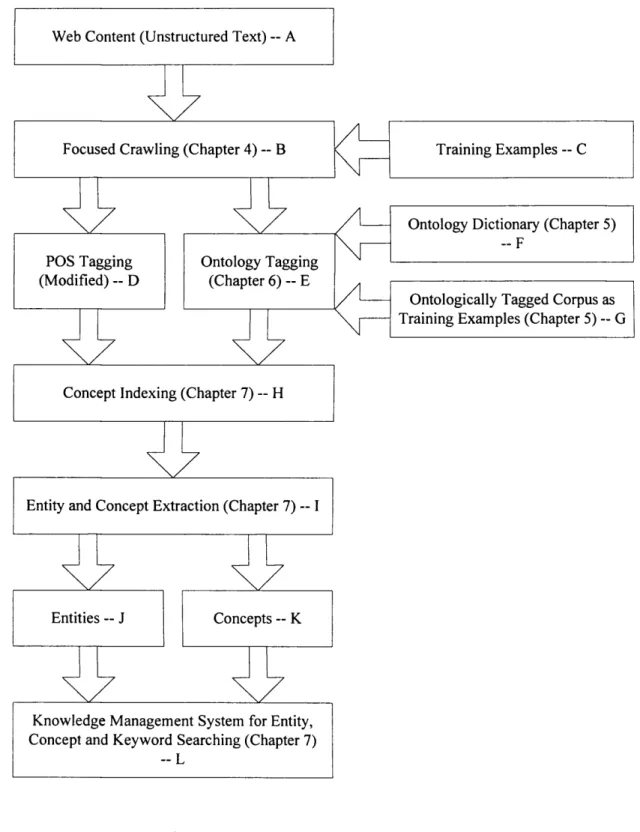
Chapters 3-7 address the objectives listed above. The organisation of Chapters 4-7 is
shown in Figure 1.1. The final chapter, Chapter 8, summarises the contributions and
conclusions of the work and makes suggestions for further research.
Chapter 2 reviews the state of the art in IR, ML, NLP and ontological engineering, and
the use of these four technologies in relevant domains.
Chapter 3 addresses research objective (1). It starts with analysis of knowledge
representation and its role in the knowledge management process. Then a conceptual
model for knowledge representation is presented. The conceptual model is further
developed into a formal mathematical model. Then, the benefits of adopting this model
are outlined. Next, a framework using this model is presented with an illustrative
example. Finally, a system architecture to implement this framework and the system
processes are described.
Web Content (Unstructured Text) — A
Focused Crawling (Chapter 4) -- B Training Examples — C
/
POS Tagging Ontology Tagging
(Modified) — D (Chapter 6) — E
Ontology Dictionary (Chapter 5) — F
Ontologically Tagged Corpus as Training Examples (Chapter 5) — G
Concept Indexing (Chapter 7) -- H
Entity and Concept Extraction (Chapter 7) — I
Entities — J Concepts — K
Knowledge Management System for Entity, Concept and Keyword Searching (Chapter 7)
- L
Figure 1.1 The Organisation of Chapters 4-7
knowledge acquisition methods and their weakness. This analysis shows the needs for
automatic knowledge acquisition. Then, a basic method is described. The detail
knowledge acquisition process is described along with detailed flow chart. Then the
limitations of this basic method are analysed to highlight the improvements needed.
Following that, an improved knowledge acquisition method using a supervised
machine learning algorithm is described using a flow chart. Three feature selection
alternatives are presented and analysed. Then the improved knowledge acquisition
method for automatic knowledge acquisition based on intelligent focused crawling
architecture is described. Two case studies are conducted to show the feasibility of this
method in two different domains, and to test the optimisation of the machine learning
algorithm to achieve better acquisition accuracy.
Chapter 5 addresses research objective (3). It starts with a discussion on ontology
tagging and its benefits. Then, the resources available and those needed to achieve
ontology tagging are analysed. Next, a general purpose ontology dictionary, and the
developed method for semantic mapping between a lexicon and the ontology dictionary
are described. Then the ontologically tagged corpus for supervised ontology tagging is
developed. Tests are conducted to show the accuracy of the ontologically tagged corpus
generated.
Chapter 6 focuses on research objective (4). An algorithm for full text ontology tagging
using machine learning is proposed. The training and tagging processes of this
are conducted and evaluated to choose the best design option. Finally, the
characteristics of the tagging algorithm and the factors affecting its accuracy are
analysed and discussed.
Chapter 7 focuses on research objective (5). It presents the conceptual model and the
system architecture for knowledge management, and the prototype system developed.
The system uses concept indexing, an existing part of speech tagging module, the
ontology tagging developed in this work to index and extract entity and concept
information, which are further used for entity, concept and keyword searching. Next,
two sets of tests are described. The first set of the tests is conducted on indexing of
entities and concepts. The purpose o f the first set o f tests is to examine how the
processing time, extraction time and the demand of computer resources change as the
volume of information/knowledge in the system grows. The second set of tests
examines the retrieval performance after the merging of the entity and concept indices.
The purpose of this set of tests is to evaluate the retrieving performance against an
existing state-of-the-art standard solution. Finally, five case studies are conducted to
illustrate the advantages of this knowledge management approach where traditional
searching fail to apply or has poor performance. All examples in Chapters 3-7 used to
illustrate the proposed solution are based on a prototype system developed for
knowledge management.
Chapter 8 summarises the contributions made and the conclusions reached, and
CHAPTER 2. REVIEW OF TECHNOLOGY
APPROACHES TO KNOWLEDGE MANAGEMENT
This chapter reviews technology approaches to knowledge management. First,
knowledge management is introduced. Then knowledge management models are
„ described. Next, four technologies for knowledge management are reviewed, which are:
information retrieval, machine learning, natural language processing, the Semantic
Web and ontology.
2.1 KNOWLEDGE MANAGEMENT
Knowledge now is seen at the centre of global economic transformation [Bell, 1978],
and it is the most powerful engine of production organisations which are increasingly
focused on management [Marsh, 1965]. Knowledge management (KM) is currently
receiving considerable attention, from both academics and practitioners, and is being
addressed by a broad range of academic literature and popular press.
2.1.1 Knowledge
There are many interpretations on the definition of “knowledge”. Plato [1953] first
defined knowledge as “justified true belief’, which is that people believe and value on
the meaningful and organised accumulation of information (messages) through
experience, communication or inference [Dretske, 1981; Lave, 1988; Blacker, 1995].
[Kakabadse et al., 2003], where processing is conducted through each stage to
transform data into wisdom.
2.1.2 Knowledge Management
There are many definitions about knowledge management. For example, in [O’Dell and
Jackson, 1998], KM is defined as “conscious strategy of getting the right knowledge to
the right people at the right time and helping people share and put information into
action in ways that strive to improve organisational performance”; in [Beckman, 1997]
KM is defined as “formalization of, and access to, experience, knowledge and expertise
that create new capabilities, enable superior performance, encourage innovation and
enhance customer value”. However, fundamentally, these working definitions relate to
four elements: business processes, information technologies, knowledge repositories
and individual behaviors [Eschenfelder et al., 1998]. These four elements enable an
organisation to methodically acquire, store, access, maintain, and reuse knowledge
from different sources [Eschenfelder et al., 1998]. There are generally five models of
KM, viewing KM from different perspectives, which result in different approaches to
KM. These models are: philosophy-based model, cognitive model, network model,
community model, and quantum model [Kakabadse et al., 2003]. Cognitive model, in
particular, is receiving considerable attention [Swan and Newell, 2000]. It treats
knowledge as objectively defined and codified concepts and facts. It focuses on
knowledge capture and storage [Kakabadse et al., 2003]. The primary aim of this model
is considered as an important integrative mechanism [Kakabadse et al., 2003].
The author of this thesis supports the approach of cognitive model for KM. As the
cognitive model concentrates on the use of technologies as important means to achieve
KM, relevant technologies are reviewed in the following sections, which are
information retrieval, machine learning, natural language processing, the Semantic
Web and ontology.
2.2 INFORMATION RETRIEVAL
2.2.1 Information Retrieval and Web Search
Information retrieval (IR) studies the retrieval of information (not data) from collection
of written documents. A typical IR system prepares a certain index for the given text
collection and responds to queries with a list of documents ranked according to certain
criteria [Chakrabarti, 2002].
A search engine is an IR system that searches Web documents for specified queries and
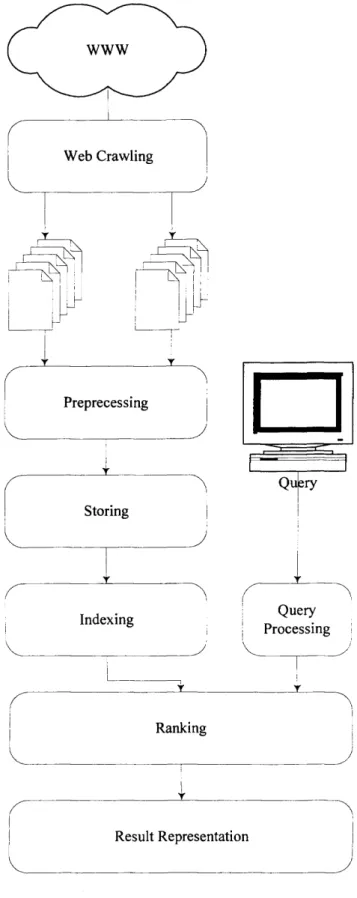
returns a list of documents to match the queries. Typical IR procedures of a search
engine are shown in Figure 2.1. During the crawling procedure, specialised agents,
which are called crawlers, spiders, Web robots, or bots retrieve large quantity of Web
pages simultaneously, and store them for further processing [Chakrabarti, 2002].
Preprocessing is to unify various Web pages retrieved so that they are appropriate for
WWW Web Crawling
£ r
Tv Preprecessing Storing Indexing Query Processing Ranking Result RepresentationFigure 2.1 Information Retrieval Procedures o f a Search Engine
stripping of stop words1, stemming, etc. When re-formatted Web content is passed
through the preprocessing procedure, the content is analysed to create an index. When a
query is input to a search engine, the query is evaluated according to defined certain
criteria, then the analysed query is calculated using the index and document
information to rank the result set. When the ranking result is generated, it is represented
to the user to answer the query.
There are several measurement metrics for IR systems, such as precision and recall,
F-measure [van Rijsbergen, 1979] and mean average precision [Baeza-Yates and
Ribeiro-Neto, 1999]. However, the most used measure is precision and recall
[Kobayashi and Takeda, 2000]. Precision is defined as the proportion of relevant
documents to all the documents retrieved:
P = (number of relevant documents retrieved) / (number of documents retrieved);
and recall is defined as the proportion of relevant documents that are retrieved, out of
all relevant documents available:
R = (number o f relevant documents retrieved) / (number of relevant documents)
2.2.2 Crawling
Effectively retrieving Web pages from the Web to a document collection is the first step
for a search engine. Crawlers start the retrieving process from some given Web pages
that have outbound links to other pages which have not been retrieved or refreshed.
1 Search engines normally filter extrem ely com m on words in order to save disk space or to speed up search results.
T hese filtered w ords are know n as “stop w ords”.
New links from retrieved pages are normalised and queued for further processing. [Brin
and Page, 1998] provided a first known in-depth description of a large-scale crawler as
a part of early Google, being capable to process more than 24 million Web pages. A
Java based large-scale crawler, Mercator, was reported in detail in [Heydon and Najork,
1999], which concentrated on the issues of scalability and the extensibility. Mercator
used a specially designed data structure to handle tens of millions of Web pages with a
limited size o f memory. The modular design of Mercator facilitates its extension of
functionalities when needed. Focused crawling was introduced in [Chakrabarti, 1999],
which means only those Web pages which are classified as relevant to given topics are
stored during crawling and the links in those pages are processed for future crawling.
This technique is useful in discovering Web resource o f interest, Web structure analysis
and building high-quality collections of Web documents on specific topics [Chakrabarti,
2002].
Four factors of performance and reliability are considered important to build a large
scale crawler.
1. Domain Name System (DNS) resolution issues
Domain name systems associate many types of information with domain names, but
most importantly, it associates the Internet Protocol address (IP address) with a given
domain name. Address resolution is one of the major bottlenecks in enabling high
performance crawlers. A multithreading DNS resolver was used in [Heydon and Najork,
1999] to improve the performance of DNS resolving, and reduced the percentage of
elapsed time of each thread from 87% to 25%. The asynchronous DNS (ADNS) client
library [Jackson, 2006] was used in [Chakrabarti, 2002] to accelerate the Web address
resolving speed.
2. Concurrent retrieving and multithreading
Multithreading, concurrent process, non-blocking sockets with event handlers are three
typical approaches to enable concurrent Web page retrieval [Chakrabarti, 2002].
Non-blocking sockets with event handlers have advantages over the other two
approaches, because mutual exclusion for shared data structures and random
input-output access to disk interruptions, which often happen in the other two
approaches, do not occur in non-blocking sockets [Nichols et al., 1996].
3. Link extraction requirements
When hyperlinks are extracted during crawling, duplicated hyperlinks should be
avoided. In addition, prohibited links by host servers should not be crawled by
following the specification of Robots Exclusion Protocol . Malicious spider traps often
occur in the crawling process, and sometimes cause crawlers to crash. Some traps also
cause the crawler retrieve indefinite number of dummy pages, or similar pages with
different depth in terms of forward slashes in hyperlinks [Heydon and Najork, 1999].
Due to this reason, crawlers need to be designed to prioritise Web links to crawl [Cho et
al., 1998].
4. Refreshing of crawled pages
To keep Web pages crawled up to date, some assumptions need to be made for
2 For more information refers to: http://www.robotstxt.org/wc/robots.htm l
estimating update intervals on different websites. Algorithms for refreshing crawled
Web pages newer than a specified crawling period were proposed in [Brewington and
Cybenko, 2000]. Incremental crawling was described in [Cho and Garcia-Molina, 2000]
to refresh Web pages retrieved in a timely manner.
2.2.3 Models for Information Retrieval
An IR system needs to present documents relevant to the user’s need and rank the
documents retrieved in the order o f predicated likelihood of relevance to the user.
Different IR models are proposed based on distinct sets of premises to achieve such
goals.
In general, an information retrieval model [Baeze-Yates and Riberiro-Neto, 1999] is
defined as a quadruple [D, Q, F, R(qi,dj)], where
D is a set composed o f logical views (representations) for the documents in the
collection;
Q is a set composed of logical views (representation) for the user’s information needs
(queries);
F is a method for modelling document representations, queries, and their relations;
R(qi,dj) is a ranking function which associates a real number with a query qi e Q and a
document representation dj £ D. Such ranking defines an order among the documents
with regard to the query qi.
In addition, a model could be extended to include multiple sources of evidence with
typical IR models are described as below:
1. Boolean Model
In Boolean model, documents are treated as a set of terms, and queries are expressed in
Boolean expressions. The relevance of query results is calculated using set theory and
Boolean algebra [Wartick, 1992]. Boolean model is the most common model in an IR
system, however, from the probability distribution point view, [Verhoeff et al., 1961]
proved that it is inefficient to for IR systems. Therefore, Boolean model was proposed
to be used in conjunction with other IR models. For example, relevance feedback was
introduced into a Boolean IR system to provide the precision of a Boolean search and
the advantages of a ranked output in [Radecki, 1982]. A Boolean model was also used
in an IR system to rank documents by exploiting term dependence information from a
thesaurus to achieve higher retrieval effectiveness than some of the previous methods
proposed [Lee et al., 1993].
2. Vector Model
Vector model was made popular by Salton and the SMART system [Salton and Lesk,
1968; Salton, 1971; Salton and Buckley, 1988]. Salton et al. [1982] introduced the
extended Boolean model to exploit benefits from both Boolean model and vector space
model, and tests indicated the system produced better results than either of the model
used alone. A sense-based vector space retrieval model was presented in [Stokoe et al.,
2003], which improved the precision by 45.9% relatively to traditional TF*IDF3 term
3 The tf-id f w eight (term freq uency-in verse docum ent frequency) is a w eight often used in inform ation retrieval
m odelling
weighting techniques. Latent Semantic Indexing (LSI) was proposed in [Furnas et al.,
1988] to reduce the dimensions of the vector space by using low-rank approximation
based on singular value decomposition (SVD). Karypis and Han [2000] proposed a fast
dimensionality reduction algorithm with lower computational requirements and the
ability in supervised learning, compared with LSI.
3. Probabilistic Model
Probabilistic model is an IR model based on a probabilistic interpretation of document
relevance to a given user query [Baeza-Yates and Ribeiro-Neto, 1999]. There are two
major types of probabilistic models: relevance models and logic inference models [Fuhr,
1992]. Generally, probabilistic models reveal better performance than Boolean models
[Crestani et al., 1998]. Cooper [1994] raised questions on using probabilistic ranking in
information retrieval, who stated that the cost of creating and trouble shooting
probabilistic IR theories is high.
4. Fuzzy Set Model
Radecki [1976] described using fuzzy set theory [Zadeh, 1965] in information retrieval
to enable different degrees of importance of particular terms in search patterns. In
[Miyamoto et al., 1983] fuzzy set theory was used to produce a pseudo-thesaurus for IR
to enable searching for different but related keywords in the documents. Wong and Yao
[Wong and Yao, 1995] proposed a unified framework of probability inference which
provided conceptual and mathematical basis for models such as fuzzy set.
5. Other Models
Neural network model was used in an IR system in [Wilkingson and Hingston, 1991],
and the test results showed that many standard search strategies are applicable in the
neural network model, such as cosine vector measure method. A probabilistic IR model
based on feed forward artificial neural network was implemented in [Kwok, 1995].
Turtle et. al. introduced inference networks for IR in [Turtle et al., 1990]. Belief
network model was introduced in [Ribeiro-Neto and Muntz, 1996] to generalise the
inference network model [Turtle et al., 1990] and other classical probability based
models to improve the retrieval performance.
2.2.4 Indexing
The purpose of indexing is to reduce the retrieval time in an IR system which contains
large document collections, and it is especially useful for large and slow growing text
collection [Baeze-Yates and Riberiro-Neto, 1999].
An inverted index is an index structure storing a mapping from words to their locations
in a document or a set o f documents [Harman et al., 1992]. To improve the search speed,
inverted files need to be appropriately compressed and encoded [Witten et al., 1999].
Eleven indexing compression models were described and compared in [Witten et al.,
1999]. There are performance trade-offs between these eleven models, such as
compression rate, hard drive usage, and memory usage. Therefore, the appropriate
model chosen depends on various factors such as the user requirements and hardware
availability [Witten et al., 1999]. A hybrid approach of indexing, called two-level
searching, was developed in Glimpse system [Manber and Wu, 1993]. This approach
combined a small index and sequential search techniques to reduce the size of the
inverted index and to support approximate matching [Araujo et al., 1997].
2.2.5 Storage and Query
Text compression and pattern matching are also important in IR systems. Text needs to
be compressed to significantly reduce the storage size and improve the retrieving speed.
Huffman coding was first presented in [Huffman, 1952], which is an entropy encoding
algorithm for lossless data compression. An efficient compression and decompression
scheme for word-based Huffman encoded text file was described in [Moura et al.,
1998]. Huffman encoding was used in MG system for text compression due to this
method’s relatively fast encoding and decoding speed and random access ability
[Witten et al., 1999].
Pattern matching is widely used during the process of indexing and query. An algorithm
using bit-parallelism to support extended patterns allowing errors was presented in [Wu
and Manber, 1992] and an online searching tool, Agrep, based on this algorithm was
developed in [Wu and Manber, 1992]. The fastest bit-parallel approximate pattern
matching algorithm implemented in [Baeza-Yates and Navarro, 1999], was based on
simulating non-deterministic finite-state automata [Hopcroft et al., 2000].
2.2.6 Applications of Information Retrieval
Various applications for IR were reported in literature. WebGlimpse, a tool combining
searching and browsing through a neighbourhood search, was described in [Manber et
al., 1997]. An IR system that included the addition of concepts to facilitate the
identification of the correct word sense was presented in [Henstock et al., 2001]. A
filtering system SIFTER, which was based on a model using multiple adaptation
techniques to cope with uncertainties, demonstrated a good performance in filtering
documents in a realistic setting [Mostafa et al., 1997]. An IR system using semantic
annotation and semantic relations in medical domain was presented in [Vintar et al.,
2003]. In this system, discovery of new relation instances improved the retrieval
performance.
2.3 MACHINE LEARNING TECHNIQUES
Machine learning (ML) techniques such as neural networks, genetic algorithm,
simulate annealing [Pham and Karaboga, 2000; Pham and Xing, 1995] and fuzzy logic
[Zadeh, 1994] in the soft computing paradigm have been used in clustering, filtering,
information extraction, information personalisation, knowledge discovery and other
natural language processing applications [Mooney, 2003]. Those techniques are mainly
used to investigate three types of Web information, which are content, usage, and link
structure [Baeza-Yates, 2003]. Most ML methods concern the task of categorising
examples described by a set of features [Mooney, 2003]. In particular, three machine
learning techniques relevant to the scope of this thesis are reviewed below, which are
support vector machine, rule-based learning and memory-based learning techniques.
2.3.1 Support Vector Machine
Support Vector Machine (SVM) is a statistical, supervised learning method based on
structural risk minimisation (SRM) and kernel functions [Boser et al., 1992]. One major
advantage of SVM is the high classification accuracy given few training examples and
vague distinctive margin between different groups of examples, which was
theoretically proven in [Vapnik, 1999; Scholkopf and Smola, 2002]. In practice,
[Joachims, 1998] discussed algorithmic and computational costs for managing large
training tasks in the SVMllght, an SVM implementation in C programming language.
LIBSVM [Chang and Lin, 2002] was provided as an SVM library package by Chang et
al.
In application, Joachims [2001] proposed a learning model for text classification based
on SVM. In [Li and Liu, 2001], a Chinese web page classifier using SVM and
unsupervised clustering was implemented, which mitigated the high training cost using
an unsupervised clustering method. A method which combines evidence from a
document and citing documents by using SVM and entropy based feature extraction
was presented in [Glover et al., 2002] to improve the web page classification accuracy.
In [Chen and Dumais, 2000], a user interface which automatically categorising search
results using SVM text classification shows 50% improvement in finding information
in search results.
2.3.2 Rule-Based Learning
The learned knowledge in rule based learning is represented in a declarative, symbolic
form of logical rules as opposed to a numerical model obtained by using SVM. One
advantage of this method over statistical ML methods is that the acquired knowledge is
represented in a symbolic form that can be more easily interpreted, modified and
maintained by humans. Rules are normally induced from a set of training examples
using a variety of algorithms [Mitchell 1997, Langley 1996]. Although the optimal goal
is to construct the smallest rule set to consistently represent the training data, but
normally this is a non-deterministic polynomial-time hard (NP hard) problem, which
may take unacceptable long time to solve. Therefore, heuristic approaches are often
/
used to create the approximately optimal rule set.
Rule-based learning algorithms have been applied to many areas, such as named entity
(NE) recognition [Isozaki, 2001], language engineering4 [Bontcheva et al., 2004], and
knowledge management [Davies et al., 2005].
2.3.3 Memory-Based Learning
Different from rule-based learning methods, memory-based learning (also called
case-based or instance-based methods) do not generate abstract models from given
examples, but rather compare the similarity of the new input examples with existing
correct examples using some similarity comparison metrics. Some typical metrics are
Hamming distance and Euclidian distance [Mooney, 2003]. The advantage of this
method applied in NLP is that it does not discard valuable low frequency information,
which often occurs in natural language. Benchmark tasks in areas from phonetics to
semantics in natural language processing were conducted using memory-based
4 Language engineering is the creation o f natural language processing system s w h ose cost and outputs are
measurable and predictable.
learning methods with good results obtained, compared with other ML methods used
[Daelemans, 2005]. Tilburg Memory-Based Learner (TiMBL), a memory-based
learning software package, was implemented for language engineering purpose in
[Daelemans, 2004].
2.4 NATURAL LANGUAGE PROCESSING
Natural language processing (NLP) is a field of information science to research how to
enable computers to process and understand human languages. It has tight relation with
information retrieval and knowledge management. Five areas in natural language
processing where are related to this thesis are reviewed.
2.4.1 Part of Speech Tagging
Part of speech (POS) tagging, which is also called word-class tagging, or grammatical
tagging, is to assign parts of speech (such as noun, verb, adverb, adjective) to words in
a text. POS tagging is used in many other NLP areas such as machine translation (MT),
word sense disambiguation (WSD) and information extraction (IE) [Voutilainen, 2003].
Current POS taggers have high tagging accuracy (about 97%). A rule-based POS tagger
developed by Brill, achieved 97% tagging accuracy [Brill, 1992]. Its compact structure
has an advantage over statistical POS taggers. Second-order hidden Markov model for
POS tagging with the tagging accuracy (96.9%) was developed in [Thede and Harper,
1999]. Both probabilistic and rule-based tagging modules were used in tagger
97% across the whole corpus.
2.4.2 Word Sense Disambiguation
Word sense disambiguation (WSD) is the process of identifying the meaning of words
in context [Stevenson and Wilks, 2003]. WSD can be applied to machine translation
(MT), information extraction (IE), information retrieval (IR) etc. Dictionary-based and
machine learning are two main approaches to WSD [Stevenson, 2003], where
machine-readable dictionary (MRD) (such as WordNet [Fellbaum, 1998]),
semantically tagged corpora (such as Semcor package in WordNet software) and
thesaurus (such as Roget’s Thesaurus [Roget, 2003]) are three main knowledge sources
used in both approaches [Yarowsky, 1992].
Studies show that IR systems may substantially benefit from using WSD techniques.
As reported in [Stokeo et al., 2003], a disambiguation rate above 60% can improve the
precision and recall of information retrieval. A, WordNet [Fellbaum, 1998], was used
with a WSD algorithm to improve the precision and recall o f a keyword-based IR
system [Mihalcea and Moldovan, 2000].
2.4.3 Concordance and Collocations
A concordance is a list showing all the occurrences and contexts of a given word or
phrase, which are found in a corpus; collocations are groups of words which frequently
appear in the same context. Concordance and collocations are useful tools for tasks
sense is usually consistent in one discourse and nearby words provide strong and
consistent clues to the sense of the target word, which is called “One Sense per
Discourse”. Yarowsky [1993] also claimed “One Sense per Collocation” which states
that with a high probability an ambiguous word has only one sense in a given
collocation. These two claims were used in an unsupervised learning algorithm for
WSD purpose, which achieved the accuracy between 90% and 96%.
2.4.4 Concept Indexing
There are different definitions of “concept indexing” in different research areas. For
example, a fast dimensionality reduction algorithm called “concept indexing” [Karypis
and Han, 2000] uses a clustering technique based on mathematics in a vector space
model. While in [Voss et al., 1999] concept indexing refers to the process of marking
interconnected concepts to their occurrences in the text collection using hyperlinks.
The process is produced by a team of people to manually mark concepts in documents.
Similar term “semantic indexing” in [Chang and Schatz, 1999] refers to a statistical
similarity method to capture relationships between concepts and form a concept space
to suggest alternative terms semantically related to query terms. This approach requires
the use of a cluster of high performance computers. In [Mihalcea and Moldovan, 2000],
“semantic indexing” refers to the usage of word senses in the process of document
indexing, where word-based and sense-based indexing are combined to improve the
precision and recall of an IR system. Holub in a recent work [Holub, 2003] introduced
significant topical concepts from clustered documents and the hierarchical
relationships between them, such that documents are organised in a hierarchy for
browsing purpose.
2.4.5 Information Extraction
Information extraction (IE) refers to the automatic identification of selected types of
entities, relations, or events in free text [Grishman, 2003]. There are many potential
application areas for IE: situations where information is being extracted manually, but
at a very high cost and low speed; situations where unstructured information needs to
be structured; situations where business, political, military events on particular subjects
need to be monitored etc. The general approach for IE is through machine learning
techniques to generate extraction rules or statistical models automatically from
annotated text corpora [Grishman, 2003].
A rule-based entity recognition system, MACE, was developed in [Maynard et al., 2003]
to extract named entities, which achieves comparative performance with other systems
based on statistics. ANNIE [The University of Sheffield, 2006] is an Information
Extraction system developed using GATE, and it can extract entities, such as person,
location, organization, date, and address from Web pages. A knowledge management
system using information extraction techniques for automobile manufacturing
intellectual properties was developed in [Hou et al., 2005] to save the labour cost of
knowledge engineers and domain experts.
The state-of-art entity recognition methods have achieved relatively good results, but
for tasks such as event extraction, relation extraction results are still far from
satisfaction [Stevenson, M., 2004]. Furthermore, it is time-consuming to produce rules
for rule-based systems and large volumes of annotated training text is still needed for
statistics-based IE systems [Maynard et al., 2003].
2.5 THE SEMANTIC WEB AND ONTOLOGY
The Semantic Web [Bemers-Lee et al., 2001] is an ongoing initiative to extend the
current Web structure, and standardise the descriptions of available resources on the
Web, so that the information is understandable by machines, which could make the
information processing more automated and less intervened by humans.
2.5.1 Ontology Engineering
Ontology engineering (OE) is a key enabling technology for the Semantic Web [Davies
et al., 2005], which allows explicitly specifying concepts and their relationships in a
domain in a formal way [Corcho and Gomez-Perez, 2000]. As there are many different
language specifications for OE, such as DAML+OIL [Horrocks et al., 2002], SHOE
[Luke et al., 1997], RDF Schema [Brickley and Guha, 2004], OE tools are needed to
allow users to concentrate on modelling at conceptual level while separating from
low-level syntax and specifications of different languages for the Semantic Web
[Corcho et al., 2003]. Protege is such a graphical tool commonly used for ontology
editing and knowledge acquisition [Noy et al., 2001].
difficulties in knowledge acquisition. Maedche et al. proposed a general OE framework
for semi-automatic acquisition of both taxonomy and non-taxonomy conceptual
relation discovery [Maedche and Staab, 2000]. In this framework, an algorithm based
on generalised association rule was used to detect relations and to determine the
appropriate level of abstraction to define relations. [Gottgtroy et al., 2003] described an
OE approach to discover knowledge from data in evolving domains such as biological
sciences, medical sciences, and social sciences.
2.5.2 Information Extraction for the Semantic Web
Stevenson et al. [Stevenson and Ciravegna, 2003] pointed out the existing gaps between
current Web and the Semantic Web, and practical adoption problems for the Semantic
Web. The extension from current Web to the Semantic Web requires high cost effort,
which hinders the likeness of this dramatic change in the real world in the immediate
future [Fensel, 2002; Avello et al., 2002]. By using information extraction, this gap
could be closed [Stevenson and Ciravegna, 2003].
A formal information extraction framework for today’s non-semantic web to extract
knowledge was presented in [Arjona et al., 2003]. It associates semantics with the
information extracted by developing knowledge channels. Information extraction has
been effectively applied in some restricted domains. Jacobs and Rau, developed
SCISOR, a prototype system that extracts information from financial news to find and
summarize corporate merger stories [Jacobs and Rau, 1990]. Amilcare, a system for
semi-automate the information annotation process was described in [Ciravegna and
Wilks, 2003]. KIM, a platform for semantic indexing, annotation and retrieval, was
developed towards information extraction for the Semantic Web [Popov et al., 2003].
This platform is built based on GATE, a general architecture for text language
engineering [Cunningham et al., 2002] and Semantic Web compliant knowledge
representation and management.
2.6 DISCUSSION
The review o f four technologies for knowledge management shows that the trend
moving from information-centred society towards knowledge-centred society is
emerging. These four technologies are now moving closer to support and complement
each other to facilitate process o f transforming data into knowledge in the chain o f
knowledge flow.
Section 2.2 has reviewed the area of IR. Despite of the progress made in IR research,
users are still unsatisfied with the performance of the current IR systems, due to the
reasons such as the slow retrieval speed, communication delays, and poor quality of
retrieved results [Kobayashi and Takeda, 2000]. On one hand, users are suffering from
information overload, and on the other hand, users still cannot efficiently find the
information they want. Researchers in IR field found that the ambiguity in natural
languages hinders the performance improvement in IR systems. This is one of the main
processing, such that by using NLP techniques could improve the current performance
of IR system [Stokeo et al., 2003]. Furthermore, due to the “knowledge acquisition
bottleneck” [Boicu, 2001], more efficient automated methods to acquire high quality
information are needed to assist knowledge management. In this case, the expertise
from IR field for exploring vast amount of online information can contribute to this
growing need, where new techniques such as focused crawling, concept indexing
emerge.
Section 2.3 has reviewed three ML techniques which could be potentially used in IR,
NLP and KM. The research field of IR has a long history using ML techniques. NLP
needs the assistance from ML to automate its processes due to vast text-based data
involved. ML is being adopted in IE for building the Semantic Web to reduce the high
building cost involved. Therefore, there is a trend towards combining ML into
improved formal models of IR, NLP and KM [Kobayashi and Takeda, 2000; Allan et al.,
2003; Baeza-Yates, 2003].
Section 2.4 has reviewed five aspects of natural language processing. Tagging
techniques and semantic analysis have received increasing attention in the KM, Web
mining and text mining research areas. However, there is no one system has addressed
the use of concept-based tagging techniques in KM in a systematical way. Therefore,
there is a potential opportunity for exploring the combination of these techniques
further into a KM system.
Section 2.5 has reviewed techniques and tools for ontology building, and the building
because of the vast Web content information involved. Also due to the fact that most
online information is based on natural languages, NLP is therefore a key technology to
enable the transformation from current Web structure to the Semantic Web.
Therefore, research opportunities are open to combine these four technologies in a
systematical way to streamline the knowledge flow for embracing the trend towards
knowledge-centred societies. In particular, techniques such as focused crawling,
machine learning, concept indexing and ontology are worth being exploited
systematically in Chapters 3-7 for knowledge management.
2.7 SUMMARY
This chapter has outlined the research that addresses knowledge management, and its
four enabling technologies, which are information retrieval, machine learning, natural
language processing, the Semantic Web and ontology. Important trends within the
scope of this work have been discussed and summarised to provide starting points for
the research presented in Chapters 3-7.
CHAPTER 3. FORMAL REPRESENTATION OF
CONTENT USING CONCEPT INDEXING
This chapter addresses the first objective of this research. It introduces the idea of
concept indexing and presents the two models developed: conceptual and mathematical.
A concept indexing framework is then introduced. The technical approach proposed is
clarified using an illustrative example. Finally, the chapter describes the system
architecture developed for this framework.
3.1 CONCEPT INDEXING
An analysis of the conventional approaches to knowledge representation is a starting
point in the development of a new knowledge representation scheme, which uses
concept indexing.
3.1.1 Conventional Models for Knowledge Representation
Knowledge representation (KR) is the study of how knowledge about the world can be
represented and how reasoning can be conducted based on this knowledge. In artificial
intelligence (AI), KR can play five roles: “a surrogate, a set of ontological commitment,
a fragmentary theory of intelligent reasoning, medium for efficient computation and
medium of human expression” [Davis et al., 1993]. In the management of explicit
knowledge, KR is tightly related to other processes in knowledge management as KR
number of modelling languages and formalisms for (KR) developed in different
domains, ranging from databases to the Semantic Web (SW). Examples of such include
semantic networks [Quillian, 1968], frame-based knowledge modelling [Minsky, 1975],
Entity-Relationship (ER) modelling [Chen, 1976], description logics (DL) [Brachman
and Schmolze, 1985], UML [Booch et al, 1998], RDF and RDFS [Klyne and Carroll,
2004], and OWL [McGuinness and van Harmelen, 2004].
1. Semantic networks. A semantic network is a model for representing knowledge in
patterns of interconnected nodes and arcs.
2. Frame-based knowledge modelling. In frame-based knowledge modelling,
collections of related frames are linked together into frame systems to represent
knowledge, where the frame is a data structure for representing stereotyped
situation knowledge.
3. Entity-relationship (ER) modelling. ER is a data model for multilevel
descriptions of views of data. ER is typically used to design the data organisation
within databases or information systems. An entity is an object or concept where
data is stored. A relationship is the connection through which data is shared between
entities.
4. Description logics. Description logics are knowledge representation languages
tailored for expressing knowledge about concepts and concept hierarchies, which
are sub-languages of predicate logic to provide reasoning support.
5. UML. Unified Modelling Language (UML) is a non-proprietary, third generation
modelling and specification language, which has been applied into different areas
such as software engineering, designing complex engineering systems, business
process, and organisational structures.
6. RDF and RDFS. Resource Description Framework (RDF) is a modelling language
to describe resources on the web in a domain-independent way. Users can define
their own terminology in a scheme language called RDF Schema (RDFS).
7. OWL. The Web Ontology Language (OWL), which is built to enhance RDF, is an
ontology language for writing explicit, formal conceptualisations of domain
models.
The existing KR languages and formalisms will be analysed using the requirements
defined below to decide whether these languages and formalisms are suitable for KM.
3.1.2 Requirements
for
Knowledge
Representation
of
Explicit Knowledge
The requirements for representing explicit knowledge for the needs of knowledge
management are summarised below.
1. Automatic extraction of knowledge from unstructured text. Automating