Former Insiders’ Trading
Erik Johannesson
Submitted in partial fulfillment of the requirements for the degree of
Doctor of Philosophy under the Executive Committee of the Graduate School of Arts and Sciences
COLUMBIA UNIVERSITY
© 2018 Erik Johannesson All rights reserved
ABSTRACT
Former Insiders’ Trading
Erik Johannesson
Using detailed and unique data from Sweden, I show that former insiders trade profitably in the shares of companies with which they used to be affiliated. A trading strategy mimicking former insiders’ trading behavior yields abnormal returns of 7.6% per year. These returns are primarily
driven by post-separation purchases rather than by sales. They do not reflect general stock-picking skills: former insiders earn significantly lower abnormal returns when trading in companies with which they have no affiliation. I show that former insiders’ informational advantage diminishes over time, but less so if they have ties to current insiders. The importance of such ties increases in the presence of value-relevant information. My results are consistent with former insiders benefiting from both a retained informational advantage and from inside information obtained post-separation when trading in inside stock.
i
Table of Contents
List of charts, graphs, and tables ... ii
Acknowledgements ... iii
1. Introduction ... 1
2. Institutional setting and data ... 5
2.1 The Swedish equity market and setting ... 5
2.2 Data overview ... 6
3. Abnormal returns to former insiders’ trading ... 11
3.1 Risk measurement and counterfactuals ... 11
3.2 Former insiders and inside stock: buy, sell, and hedge portfolios ... 11
3.3 Informational advantage or general stock-picking skills? ... 13
4. Retained or obtained informational advantage ... 16
4.1 The distinction between obtained and retained information ... 16
4.2 The time-series pattern of abnormal returns ... 17
4.3 Decoupling the mechanisms of retained and obtained informational advantages ... 20
4.4 Future value-relevant information and the probability of buying ... 25
5. Discussion of findings and conclusions ... 29
References ... 56
Appendix A1: Notable U.S. court cases regarding transmission of inside information ... 60
ii List of charts, graphs, and tables
Exhibit 1: Variable definitions ... 31
Table 1: Sample description... 32
Table 2: Quarterly returns for trading insiders (during and after tenure as insider) ... 34
Table 3: Descriptive statistics of former insiders, trades, and companies ... 36
Table 4: Raw and calendar-time abnormal returns for former insiders’ purchases and sales of inside stock... 39
Table 5: Former insiders’ purchases of outside stock ... 40
Table 6: Former insiders’ sales of outside stock ... 42
Table 7: Abnormal returns and time since declassification ... 45
Table 8: Correlations of main continuous variables ... 47
Table 9: Initial multivariate analyses of future abnormal returns ... 48
Table 10: Quintile analyses of Ties and AfterDays ... 49
Table 11: Multivariate analyses of the interaction effects of Ties and AfterDays on future abnormal returns ... 50
Table 12: Value-relevant information and the probability of a former insider buying inside stock ... 52
Table 13: Heatmaps of the association between Buy and future abnormal returns for 25 combinations of Ties and AfterDays quintiles... 54
Table A1: Abnormal returns and ties to current insiders ... 64
iii Acknowledgements
I would like to extend my deepest gratitude to my advisor Shivaram Rajgopal and my dissertation committee members Dan Amiram, Fabrizio Ferri, Urooj Khan, and Per Olsson, as well as to Alexander Ljungqvist, who has been truly instrumental to this project. I am grateful to Krister Modin at Euroclear; Anders Anderson, Erik Eklund, Carmine Palombo, and Paolo Sodini at the Swedish House of Finance for their help with the data on which this dissertation is based; and the Columbia Human Research Protection Office for their guidance on data handling. I owe special thanks to Seil Kim and April Klein for their help during this project’s inception, and to Jim Ohlson
for his comments and for everything he has taught me. I would also like to extend my deepest thanks to James Walsh and Linda Walsh for their help and support. Finally, I thank workshop participants at Baruch College, Columbia Business School, Euroclear Sweden, IESE Business School, Miami University, Pace University, the University of California-Irvine, the University of North Carolina at Chapel Hill, the University of Southern California, the University of Texas at Dallas, and Yale School of Management for constructive comments and suggestions. All remaining errors are my own.
1 1. Introduction
Insider trading laws—rules prohibiting corporate insiders from trading on material non-public information—aim to protect investors from “manipulative and deceptive practices […] in connection with the purchase or sale of any security” (Securities Exchange Act of 1934: 17 CFR 240.10B-5). Academic research argues that allowing insider trading may result in benefits such as improved managerial decisions (Bhide 1993), increased efficiency of allocations in the securities markets through signaling (Manne 1966, 2005), and the elimination of expenditures on search and verification of information (Carlton and Fischel 1983). The empirical evidence of benefits associated with allowing insider trading, however, is mixed. For example, Bhattacharya and Daouk (2002) show that initial enforcement of insider trading legislation is followed by a reduction in the cost of capital. Beny (2007) provides evidence that countries in which insider trading laws are more stringent have more liquid stock markets and more dispersed stock ownership. As discussed at length in Bainbridge (2014), the collective evidence of the academic literature on capital market effects of insider trading regulation seems to suggest that the proposed benefits outweigh the proposed costs.
In most countries, insider trading legislation is centered around current insiders; once they have left the firm with which they were associated, former insiders are generally free to trade in its shares without further restrictions. Similarly, in most countries, current—but not former— insiders are required to disclose their trades in inside stock.1 Previous literature shows that current insiders use their informational advantage to earn abnormal returns when trading in inside stock (e.g., Rozeff and Zaman 1998; Lakonishok and Lee 2001; Aboody, Hughes, and Liu 2005; Huddart and Ke 2007; Skaife, Veenman, and Wangerin 2013). Whether or not this extends to former
1 For example, current U.S. insiders are required to disclose any changes in holdings of inside stock within two days,
2
insiders has, to my knowledge, not been addressed in the literature thus far. Recently declassified insiders are likely more similar to current insiders than to typical retail investors, in terms of the information they possess or are able to obtain. It could therefore be argued that former insiders should be subject to similar monitoring and disclosure requirements as current insiders, following declassification, to ensure equal access to information in the capital markets.2
In this paper, I investigate whether former insiders continue to enjoy an informational advantage post-separation, a question which ought to be relevant to regulators, policymakers and authorities charged with enforcing insider trading laws. Specifically, I investigate the extent to which former insiders trade in what was previously considered inside stock and whether or not they earn abnormal returns on such trades. First, I document the prevalence and magnitude of abnormal returns that former insiders gain by trading in inside stock. Second, I try to distinguish between the mechanisms of having access to private information and possessing general stock-picking skills. Third, I attempt to establish the relative importance of retained and obtained
informational advantages for former insiders’ ability to earn abnormal returns on inside stock.3 Former insiders may depart with private information that is directly relevant to the value of the company with which they used to be affiliated. They may also continue to have ties to current insiders and may use these ties, in a tipper-tippee relationship, to obtain private information.4 Finally, former insiders may have developed firm-specific analytical abilities and/or
2 Many proposed benefits of allowing insider trading are unlikely to apply to insider trading by former insiders. By
contrast, the costs associated with insider trading, such as reduced investor confidence, are likely applicable to former-insider trading.
3 Under the current U.S. legal regime, the source of former insiders’ private information matters—trades based on
private information that insiders retain from the inside are easier for the SEC to prosecute than trades based on private information obtained after departure, all else equal. This provides additional motivation to investigate the time-series properties of any informational advantage that former insiders have.
4 For example, on January 23, 2017, Bloomberg News reported that the former CEO of the Swedish tech company
Fingerprint Cards had been arrested for insider trading after authorities had grown suspicious of large-scale sales of the company’s shares preceding a profit warning in December 2016. Fingerprint Cards’ stock plummeted 18% upon
3
depart with private information that is indirectly relevant to the value of the company, such as information that allows them to better interpret and contextualize future public information. It is by no means clear, ex ante, what the dominating mechanism is.
Using detailed and unique data from Sweden, where individual investors’ trades can be
systematically traced in a way that is not possible in the U.S., I show that former insiders earn abnormal returns when trading in inside stock.5 A calendar-time portfolio strategy leads to annualized four-factor alphas of 6.0% for purchases and 1.7% for sales. The former is significantly different from zero, in both a statistical and an economic sense, and motivates a focus on former insiders’ purchases. These results are consistent with the literature on current insiders, which
largely finds open-market transactions to yield abnormal returns only for purchases, not for sales (e.g., Lakonishok and Lee 2001; Jeng, Metrick, and Zeckhauser 2003; Ravina and Sapienza 2010). The lack of results for insiders’ sales is commonly attributed to sales driven by insiders’ need for liquidity and portfolio diversification.
The granularity of my dataset, which accounts for 100% of each included company’s ownership structure, allows me to compare former insiders’ trades in inside stock to trades in stock
of companies with which they were never affiliated (“outside stock”). I use these trades as person-specific counterfactuals to separate general stock-picking skills from other plausible mechanisms. Former insiders earn significantly larger abnormal returns on inside stock than on outside stock; in fact, they earn zero abnormal returns on outside stock. My results are hence more consistent with former insiders benefiting from a firm-specific informational advantage than with former insiders possessing superior stock-picking skills.
release of the profit warning. A current board member, suspected of having passed on inside information to the former CEO, was also arrested (Bloomberg News 2017).
5The disclosure requirement may, in fact, have a deterrent effect on former insiders, implying that my results may be understated relative to what they would have been in the U.S. setting, all else being equal.
4
To separate retained informational advantages from obtained informational advantages, I investigate the role of time since declassification and of having ties to current insiders. Results show that the magnitude of abnormal returns on inside stock that former insiders earn reduces with time since declassification and does so gradually rather than immediately. Former insiders purchasing inside stock during the first, second, and third year after declassification earn abnormal returns of 10.4%, 6.1%, and 0.4%, respectively. In light of the gradual attenuation, I cautiously interpret these results as consistent with former insiders benefiting not only from a retained
informational advantage, but also from obtained private information. This interpretation is reinforced by the positive association between abnormal returns and the number of remaining ties to current insiders that former insiders have at the time of trade. Specifically, the further away in time from the declassification date a trade takes place, the stronger the positive association between former insiders’ ability to earn abnormal returns and the number of ties to the inside they have.
My study contributes to the academic literature on insider trading in two main ways. First, to my knowledge, this paper is the first to focus on how former insiders trade in inside stock post-separation. My findings suggest that regulators ought to consider extending insider trading laws and/or disclosure requirements to cover former insiders, potentially for years after separation. Second, my results on the importance for former insiders of retaining ties to current insiders contributes to the literature on information transfers through social networks. Previous literature has shown social networks to be an important mechanism through which information is shared between interlocked boards, financial intermediaries, and other market participants (Cohen, Frazzini, and Malloy 2010,Larcker et al. 2005, Conyon and Muldoon 2006, Faccio 2006, Fisman et al.). I add to this stream of literature by providing evidence consistent with former insiders remaining part of current insiders’ networks for an extended period of time. The abnormal returns
5
I document can be viewed as a quantification of the value for former insiders of remaining in the same network as current insiders. Collectively, and more broadly, I contribute by emphasizing that being a corporate insider is significantly more binary than having access to inside information.6 2. Institutional setting and data
2.1 The Swedish equity market and setting
The Swedish stock market, dating back to the 18th century, is a fully developed and modern market catering to both domestic and international investors. The main stock exchange, Nasdaq Stockholm, is part of the Nasdaq Nordic group. At the end of 2016, there were
approximately 360 listed companies in Sweden with a total market value of SEK 6,479 billion, approximately USD 720 billion (Statistics Sweden). Of these, 67 were available to U.S. investors as ADRs, either via U.S. exchanges or U.S. OTC markets. Notable companies include Ericsson (telecommunications), Electrolux (domestic appliances), H&M (clothing), Skanska (construction and building materials), and Volvo (trucks and other vehicles). The Stockholm 30 index is among the top four most-traded blue chip indices in Europe (Nasdaq.com 2017).
Insider trading regulation in Sweden closely resembles that of the U.S. The Market Abuse Act of 2005 (“Lag (2005:377) om straff för marknadsmissbruk vid handel med finansiella
instrument,” MAA for brevity) states that certain corporate positions are automatically classified
as insiders. These include board members, certain high-ranking officers, auditors, and shareholders owning more than 10% of a class of a company’s equity, along with their immediate family members (SFS 2000:1087). Any trading activity in inside stock by these persons must be promptly reported to the authorities. The explicit intent of this transparency is to deter corporate insiders
6 Throughout the paper, I refrain from taking a stand on whether the trading activities documented are legal. To prove
culpa or dolus beyond reasonable doubt and show that a specific trade made by an individual former insider is unlawful is different from analyzing the trading behavior of former insiders in the aggregate.
6
from unlawful trading activities. In this regard, the Swedish regulatory environment is similar to its American counterpart (Securities Exchange Act of 1934).
As for former insiders, the MAA states that anybody who knowingly possesses inside information is legally considered an insider. If a current insider transmits inside information to an outsider, the latter automatically becomes an insider in the eyes of the law and is barred from trading on this information. There is no legal distinction between trading based on private information retained and private information obtained, which contrasts with the U.S. legal setting (discussed further in Section 4).
2.2 Data overview
My empirical analyses use Swedish stock-ownership data, obtained via Euroclear Sweden, which clears virtually all transactions in listed Swedish companies. My dataset comprises quarterly holding balances of every person and entity owning Swedish stock, regardless of insider classification and regardless of whether the stock is held directly or indirectly.7 It captures a quarterly snapshot of each listed company’s ownership structure, down to the level of individual
owners. This enables me to determine the net change in holdings for each shareholder of each listed company.
Ownership data from Euroclear have been used in previous studies in accounting and finance, due in part to the unique way in which they allow researchers to identify individual owners.8 Specifically, Swedish companies are mandated to maintain an up-to-date record of their complete ownership structure, no older than three months (Aktiebolagslag 2005:551). This record is referred to as the “Book of Equity Owners” and constitutes public information: anybody may
7 Indirect ownership via foreign brokerages is shown in aggregated form.
8 See, for example, Berkman, Koch, and Westerholm (2014), Kallunki, Nilsson, and Hellström (2009); Kallunki,
Mikkonen, Nilsson, and Setterberg (2016). See Grinblatt and Keloharju (2000) for a detailed description of the Euroclear database.
7
visit the headquarters of a Swedish company and ascertain the current ownership structure, down to the level of individual investors.9 Euroclear collects and aggregates these public data into one database. Nearly all listed Swedish companies use Euroclear’s services to comply with the mandated record-keeping. At their Stockholm headquarters, Euroclear provides dedicated computer terminals, which the public may use to determine whether a certain individual or entity owns a particular stock.
In contrast to its Swedish counterpart, the American setting provides little insight into companies’ ownership structure. Generally, data on stock ownership are not public information in
the U.S. There are a few notable exceptions in which stock-ownership information is public, primarily for persons or entities likely to possess or have access to private information. For example, corporate insiders—directors, officers, and investors owning more than 10% of a class of a company’s equity—are required to file a Form 3 the first time they acquire inside stock. Subsequent changes to their holdings are to be reported on Form 4 (Securities and Exchange Commission: Forms 3, 4, 5). This is public information. In addition, institutional investment managers with equity assets of at least $100 million are required to file a Form 13F every quarter to disclose any long equity positions they currently possess. However, apart from these and a few other exceptions, equity ownership is a private matter in the U.S.: not even the issuer knows who its owners are or what its ownership structure looks like. Researchers interested in individual-level ownership data are confined to corporate insiders or institutional investors, or data subsets of retail investors acquired from brokerages (see, for example, Barber and Odean 2000). In this regard, the Euroclear dataset holds a distinct advantage—it comprises 100% of the ownership structure due
8
to its completeness. An additional advantage is that it can be merged with other datasets via common identifiers.
One such dataset used in this paper comes from Sweden’s financial supervisory authority, Finansinspektionen (FI). FI maintains a registry of all corporate insiders in Sweden, dating back to the year 2000, and tracks their starting date, their ending date, and the name of the company for which they worked. The FI dataset also contains the position that each insider held, and in cases of multiple positions, their respective start date and end date. Most important, it also contains the same identifiers as the Euroclear dataset.
Reporting requirements for corporate insiders in Sweden and the U.S. are similar. In both countries, an insider must report any trading activity in insider stock to the authorities (FI and the SEC, respectively) within five days after the transaction took place (two days in the U.S) (SFS 2000:1087, Securities and Exchange Commission: Forms 3, 4, 5). Transparency is comparable for current insiders, but it differs once the individual ceases to be an insider: in the U.S., former insiders’ trades can no longer be observed, whereas in Sweden, former insiders’ net trading behavior is still observable, albeit only quarterly.10 This disclosure may have a deterrent effect on former insiders, implying that my results may be understated relative to what they would have been in a U.S. setting, all else being equal.
In addition to the data sources described above, I use daily stock price data from the Swedish database FinBas and the book value of equity data from Compustat Global. I obtain the risk-free rate from the Swedish central bank, Riksbanken. Lastly, I use IBES for analyst forecasts of quarterly earnings.
10 Section 16 filers—a term which is typically used interchangeably with “insiders”—must still file Section 16 reports
for transactions occurring within a period of less than six months of any opposite-way transaction that took place while they were still insiders (Eigenbrodt 2014).
9
Table 1 presents descriptive statistics for the final sample, which consists of the intersection of the Euroclear, FI, and FinBas datasets.11 As expected, the former insiders in my sample sell inside stock more often than they buy inside stock (with 5438 sales and 3470 purchases, respectively). The imbalance presumably derives from previous endowments. The time-series spans Q1 2006 through Q4 2015 and contains data on 4,673 former insiders from 361 unique companies. Table 2, Panel A presents descriptive statistics regarding the quarterly (raw) returns to the trades that former insiders make. It shows that raw returns following an increase in insiders’ holdings are significantly larger than zero, for both inside stock (i.e. stock of the company at which the person is/was an insider, depending on specification) and outside stock. By contrast, raw returns following a decrease in insiders’ holdings are positive for outside stock and negative for inside stock. As a point of reference, the average quarterly return on the Swedish stock market over the relevant period was 2.25%, which closely mimics the average raw returns on the two portfolios containing outside stock. Although preliminary, this result indicates that any trading advantage that insiders have regarding inside stock does not necessarily apply to outside stock. This issue will be revisited in Section 3 below.
Table 2, Panel B augments Panel A and presents quarterly market-adjusted buy-and-hold abnormal returns for the former insiders in my sample. On average, increases in former insiders’ stock holdings are followed by positive abnormal returns. This is true for both outside and inside stock. Table 2, Panel B also shows that former insiders’ abnormal returns are smaller than those of current insiders. This result is expected, given that current insiders have larger informational endowments and thus greater potential to time their trades well, either by making profitable trades or by avoiding unprofitable trades. It is also worth noting that the use of performance-based equity
10
awards may result in an endogenous relationship between holding increases during tenure and abnormal returns. This would be the case if performance-based stock were awarded in one quarter, and news of high performance were disclosed in the subsequent quarter.
Returning to former insiders, Table 2, Panel B shows that decreases in holdings are followed by significantly negative market-adjusted abnormal returns, consistent with insiders also timing their sales well. This result is slightly unexpected, given the lack of significant results in prior literature on current insiders’ selling (Jeng et al. 2003), but reinforces the conclusion drawn from the preliminary results regarding purchases: former insiders seem to time their trades in inside stock well.
Table 3, Panels A-D show additional descriptive statistics of former insiders, of their purchases and sales of inside and outside stock, and of the companies in which they trade. Average abnormal returns, in dollar terms, amount to 23,479 (inside purchases) and 5,930 (inside sales), compared to 565 for outside purchases and 737 for outside sales. Based on the descriptive statistics in Table 3, the distribution of dollar abnormal returns is flatter for outside stock than for inside stock. Furthermore, the distribution of dollar abnormal returns pertaining to purchases of inside stock appears to be skewed to the right. A preliminary interpretation consistent with these empirics is that former insiders not only know when to buy but also when not to buy inside stock.
With respect to trade size, Table 3 shows that inside trades are larger than outside trades, on average. This may reflect former insiders’ greater confidence in their trading decision, or, in
the case of sales, a heightened demand for liquidity and/or portfolio diversification, following declassification.
11 3. Abnormal returns to former insiders’ trading
3.1 Risk measurement and counterfactuals
My main tests are based on calendar-time portfolios, designed to mimic the trading behavior of former insiders with certain characteristics.12 I use daily return data and rebalance the portfolios quarterly. To control for known covariances of returns, the daily raw portfolio returns are regressed on a portfolio representing market returns minus the risk-free rate, the size and book-to-market factors SMB and HML (Fama and French 1993), and the momentum factor UMD (Carhart 1997). SMB, HML, and UMD are not publicly available for the Swedish equity market, prompting me to create these factors myself.13
To assess whether any abnormal returns derive from an informational advantage or from stock-picking skills, I compare the returns that former insiders earn on inside stock to the returns that former insiders earn on outside stock. I define outside stock as stock of companies at which the former insider has never been an insider between 2000 and 2016 (the boundaries derive from data limitations). The primary advantage of this counterfactual is that it holds the individual former insider constant. Hence, any difference in returns earned on inside and outside stock cannot be attributed to differential skill levels.
3.2 Former insiders and inside stock: buy, sell, and hedge portfolios
I proceed by devising a trading strategy that mimics former insiders’ observable change in ownership of inside stock from one quarter to another, separately for increases and decreases in holdings. This results in one Buy portfolio and one Sell portfolio. These portfolios are held for one quarter, after which the procedure is repeated and the portfolios are rebalanced.
12 See Fama (1998), Loughran and Ritter (2000), and Mitchell and Stafford (2000) for the merits and drawbacks of
the calendar-time portfolio approach to risk-adjustments relative to buy-and-hold abnormal returns.
13 Substituting the Fama-French European Factors, available on Kenneth French’s website, do not materially change
12
(1) Assuming an equal dollar investment in each stock, the portfolio return on date t, Rpt, is calculated as ∑n(xist × Rist)/∑n(xist), where Rist is the gross date t return on stock s for insider i, n is the number of stocks in the portfolio, and xist is the compounded daily return of stock s for insider
i from the day of portfolio formation through day t–1. The variable xist equals 1 for all stocks the day after portfolio formation. Abnormal returns are calculated as the intercept from the OLS regression:
Rpt – Rft = a + b1(Rmt – Rft) + b2SMBt + b3HMLt + b4UMDt + et
where Rp is the daily portfolio return, Rf is the risk-free rate, and Rm is the value-weighted market index return. The remaining covariates represent factor-mimicking portfolios capturing the effects of size, book-to-market, and momentum. SMB is the small minus big (market value of equity) portfolio return, HML is the high minus low (book-to-market value of equity) portfolio return, and UMD is the up minus down (past yearly stock price movement) portfolio return. The calendar-time portfolio approach closely follows that of Barber et al. (2006), Barber et al. (2007), and Ljungqvist, Malloy, and Marston (2009).
Table 4 presents the results. Raw returns for the Buy, Sell and for the long-short (Buy-Sell) portfolios are positive on average (Columns 1-3), and they are distinctly larger for the Buy portfolio compared to the Sell portfolio. The risk-adjusted abnormal returns for the Buy portfolio (Column 4) amount to 6.0% on an annualized basis, assuming 252 trading days per year. The results are strongly indicative of former insiders earning abnormal returns when buying inside stock after their tenure has ended.
Although not statistically significant, the annualized raw returns of 5.2% for the Sell portfolio in Column 2 are inconsistent with former insiders strategically selling before large stock price declines. Adjusting for risk results in negative abnormal returns (Column 5), but these are
13
statistically insignificant and small in magnitude. I hypothesize that this is due to noise stemming from liquidity and diversification trades, as discussed in Section 1: the signal I seek to isolate does not seem strong enough to dominate the noise.
Columns 3 and 6 show results for the long-short portfolio Buy-Sell. The annualized raw return is 8.4% and is strongly statistically significant (t = 4.63). Adjusting for common risk factors yields an alpha of 7.6% (t = 4.42). These abnormal returns are both statistically and economically significant and provide further evidence consistent with former insiders earning abnormal returns when trading in the stock of companies with which they used to be affiliated.
Collectively, the results in Table 4 show that the abnormal returns that former insiders earn on inside stock are concentrated to purchases rather than to sales, consistent with prior literature on insider trading (Lakonishok and Lee 2001, Jeng, Metrick, and Zeckhauser 2003, Ravina and Sapienza 2010). What Table 4 does not show, however, is the source behind the abnormal returns documented; this is addressed next.
3.3 Informational advantage or general stock-picking skills?
I attempt to discern the extent to which the abnormal returns former insiders earn by trading in inside stock can be attributed to the following mechanisms, which are not mutually exclusive:
i) general stock-picking skills
ii) an obtained informational advantage
iii) a retained informational advantage.
Point iii) above could be further decomposed into retained stock-specific analytical abilities and
retained stock-specific private information:former insiders may have greater abilities to interpret
the information received through public disclosure (e.g., Kim and Verrecchia 1991), or they may have access to private information prior to a value-relevant event (e.g., Glosten and Milgrom
14
1985). These two alternative mechanisms are inherently difficult to separate, and in this paper, I do not attempt to do so. I instead focus on the issue of whether former insiders obtain an informational advantage post-separation, which ought to be the more relevant issue for regulators and policymakers.
As a first step, I investigate the extent to which my data supports mechanism i) above,
general stock-picking skills.If the abnormal returns documented in Table 4 resulted from general
stock-picking skills, such skills would presumably manifest themselves not only for trades in inside stock but also for trades in outside stock. To test this, I create portfolios based on changes in holdings of former insiders’ outside stock.14 This introduces a tradeoff between sample size and proximity in time: the more closely in time I require outside trades to occur in relation to inside trades, the smaller the sample size. I analyze the following three (sub)samples separately: the first subsample contains purchases (sales) of outside stock that occur in the same quarter as a purchase (sale) of inside stock, for a given former insider. The second subsample consists of purchases (sales) of outside stock that occur in the period [q-4, q+4] relative to a purchase (sale) of inside stock in quarter q. These two subsamples are hence conditioned on the existence of more or less concurrent inside and outside trades for each included former insider, and I omit any inside trades for which there are no corresponding outside trade, and vice versa. The third subsample consists of the full set of former insiders’ outside trades, which I compare to the full set of former insiders’ inside trades, regardless of timing.
I construct hedge portfolios by going long the portfolio consisting of inside stocks and short the portfolio with outside stocks. The hedge portfolios, constructed as in Table 4, hence compare the returns to purchases and sales in holdings of inside stock to those of outside stock. Results are
15
presented in Table 5 (purchases) and Table 6 (sales). Each table is further divided into three panels, showing results corresponding to the three (sub)samples described above. The first column in Tables 5 and 6 presents the average annualized return for outside stock, and the second column shows returns for inside stock. For ease of comparison, in the third column I replicate the results of Column 1, Table 4, which shows returns for a portfolio consisting of all inside trades, regardless of whether there was a concurrent outside trade.
Table 5, Column 1 shows that former insiders earn raw returns of 7.4% (Panel A) to 9.2% (Panel C) when they buy outside stocks. Columns 4 through 7, however, make it clear that former insiders earn larger returns on their purchases of inside stock than on their purchases of outside stock. The difference ranges from 4.4% to 7.2% with significance levels better than 1% in all specifications. This lends strong support to the interpretation that former insiders do not possess general stock-picking skills.
The results for former insiders’ sales of inside and outside stock in Table 6 show that sales
of outside stock, on average, are followed by higher returns than sales of inside stock, but the risk-adjusted difference is only significant in one of six specifications (see Columns 6 and 7). This is consistent with former insiders being as likely to sell inside stock that experiences negative future returns as to sell outside stock that experiences negative future returns.15 Table 6 hence fails to provide compelling evidence that former insiders earn greater returns selling inside stock than selling outside stock. This result contradicts the preliminary market-adjusted results in Table 2, Panel B, but is in line with results for current insiders’ sales (Jeng et al. 2003, Johannesson and Kim 2018). To reiterate, I hypothesize that the lack of result for former insiders’ sales is due to noise stemming from liquidity and portfolio diversification trades.
15 Or, conversely, as likely to sell inside stock that experiences positive future returns as to sell outside stock that
16
Viewed collectively, the results in Tables 5 and 6 do not support the idea that former insiders are equally good at trading outside stock as they are at trading inside stock. Any superior stock-picking skills that former insiders possess do not seem to be general: the evidence presented is not consistent with former insiders earning abnormal returns on inside stock because they possess superior stock-picking skills that apply to the whole universe of stocks.
4. Retained or obtained informational advantage
4.1 The distinction between obtained and retained information
Additional motivation for exploring the mechanisms behind the abnormal returns that former insiders earn on inside stock derives from intricacies of the U.S. legal system. The purpose of this section is to show that trading based on transmitted private information is a contested area of the law, and that prosecution of former insiders seems to depend on the source and timing of the information transmitted, in the current U.S. legal regime.
In many countries, such as the U.K. and Sweden, trading on inside information is illegal, regardless of how the inside information was acquired. This is not the case in the U.S., where a breach of fiduciary trust is a prerequisite, a result of the seminal U.S. Supreme Court ruling in
Dirks v. SEC (1983). Dirks implicitly assumes that former insiders are still considered bound by
fiduciary trust regarding material private information they retain upon departure. Similar language is typically found in insiders’ contracts, explicitly prohibiting them from trading on any private information retained until it has entered the public domain or become redundant. By contrast, private information that former insiders obtain after declassification, through a tipper-tippee relationship, would not automatically lead to assumptions of fiduciary trust or duty on the part of the tippee. Without any breach of fiduciary trust on the part of the tipper, the tippee is unlikely to
17
be successfully prosecuted for insider trading under the current U.S. legal paradigm (Bainbridge 2014).
A number of famous U.S. court cases shed light on the ambiguity of conditioning prosecution of insider trading on the breaching of fiduciary trust. See Appendix A1 for a brief overview. Suffice to say here that, even if detected by the monitoring systems that the exchanges and the SEC already have in place, trading based on transmitted inside information may be difficult to successfully prosecute. In light of this additional motivation, the empirical analyses below should also be of interest to legal scholars debating the adequacy, relevance, and necessity of the breach of fiduciary trust requirement for successful prosecution of insider trading.
4.2 The time-series pattern of abnormal returns
I proceed to investigate whether the abnormal returns that former insiders earn on inside stock derive from a retained or obtained informational advantage by first exploring the time-series pattern of the abnormal returns documented above. I partition former insiders’ inside trades based on the time between declassification and the trade, the idea being that trades based on a retained
informational advantage likely come earlier than trades based on obtained value-relevant information. It is well to not that if abnormal returns earned on inside stock vary with time since declassification, this would be inconsistent with the mechanism of general stock-picking skills, discussed in the previous section. Such skills presumably exhibit low time variation.
Table 7 shows abnormal returns for calendar-time portfolio strategies which mimic former insiders’ trades in inside stock, grouped according to when they occur in relation to the quarter of
declassification. Panel A shows purchases, Panel B shows sales, and Panel C shows results for the long-short portfolio. The first partition contains trades made in quarters 1-4 after declassification,
18
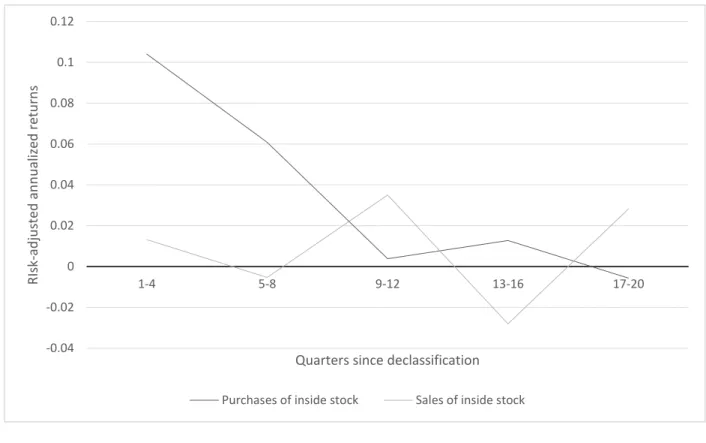
the second partition contains trades made in quarter 5-8, and so on.16 Figure 1 graphically depicts how the abnormal returns vary across partitions.
Table 7, Panel A shows that the abnormal returns documented in Table 4 likely are driven by purchases that occur relatively soon after declassification (10.4% and 6.1% annualized abnormal returns for purchases observed 1-4 and 5-8 quarters after declassification, respectively). The last three partitions, corresponding to purchases observed 9-20 quarters after declassification, fail to show significant abnormal returns. Since abnormal returns are not solely clustered in the immediate near-term after declassification, but rather exhibit a drift, I cautiously interpret the evidence as supportive of former insiders trading also on obtained value-relevant information. In a relative sense, it seems less plausible that undisclosed value-relevant information could be
retained by a departing insider and still be value-relevant and undisclosed four to eight quarters
later. This argument could be extended to three, two, and possibly even one quarter after declassification, but given the limited overall sample size, the resulting portfolios would be too small for such analyses. It is not clear to me whether this reasoning applies also to retained firm-specific abilities to contextualize public information. Concrete, alternative means through which former insiders could obtain private information would add further validity to the mechanism of
obtained private information. This will be further investigated in Section 4.3.
Turning next to the results for sales of inside stock in Panel B, there are no significant abnormal returns for any partition. Table 7, Panel B does show small negative abnormal returns for two of the partitions, consistent with well-timed sales, but they do not meet the hurdle of statistical significance. Again, this result is not surprising given the evidence in Jeng et al. (2003) and Johannesson and Kim (2018), which show that current insiders’ sales of inside stock are
16 Ideally, I would have created one calendar-time portfolio per quarter-since-declassification, but this would have
19
generally not followed by negative abnormal returns. Insiders’ portfolios tend to be over-concentrated in inside stock (Bitler, Moskowitz, and Vissing-Jørgensen 2005; Becker 2006).17 Newly declassified former insiders would thus be inclined to sell inside stock shortly after declassification, for diversification reasons. Selling for diversification and/or liquidity reasons would dilute any signal coming from informed trades. An explanation that is consistent with the (lack of) results for the Sell portfolios’ abnormal return pattern in Table 7 is that there are two offsetting forces, both of which deteriorate with time. If former insiders’ informational advantage (either retained or obtained) is largest shortly after declassification and deteriorates with time, any information-based trades may be drowned by noise trades from newly declassified former insiders rebalancing their portfolios or selling for liquidity reasons. This implies that, with the passage of time, both the informational advantage and the non-informational, dilutive trades would diminish, possibly continuing to negate each other. Based on this reasoning, I note that an abnormal returns pattern consistent with the general stock-picking skills mechanism would show low abnormal returns shortly after declassification (because of information dilution) and increase with the passage of time, as fewer and fewer former insiders divest excess inside stock. This pattern is not observable in Table 7, adding to the evidence in Section 3.
Applying the above reasoning to former insiders who buy inside stock may help explain the buy signal’s strength: a newly declassified former insider likely is more heavily concentrated in inside stock relative to a former insider declassified long ago. For diversification reasons, he or she may hence be less prone to invest in inside stock, ceteris paribus. This implies that purchases of inside stock made by newly declassified former insiders should be more informative of future abnormal returns than similar purchases made long after declassification.
20
Collectively, the evidence presented thus far is consistent with former insiders obtaining private value-relevant information after declassification, but I have not convincingly ruled out the alternative explanation of insiders retaining informational advantages, either due to retained private information or due to retained firm-specific analytical abilities. Evidence of potential alternative channels through which private information may be obtained would help disentangle the two mechanisms. This will be explored in Section 4.3. I conclude this subsection by summarizing my findings thus far: former insiders seem to earn abnormal returns, which are not only statistically but also economically significant, when trading in inside stock. Given the lack of results in Section 3 regarding general stock-picking skills, this points to former insiders benefiting from either firm-specific stock-picking skills or unequal access to information. My inability to rule out the latter ought to be of interest to regulators and policymakers.
4.3 Decoupling the mechanisms of retained and obtained informational advantages
The evidence of former insiders trading on an obtained informational advantage has thus far been indirect, in the sense that I have not been able to rule out this mechanism. For more direct support, I next investigate a plausible channel through which former insiders obtain private information, post-separation. In doing so, I also provide corroborating evidence on previous results using a different research design. Results in this section derive from quarterly market-adjusted buy-and-hold abnormal returns, which allow me to investigate cross-sectional variation in former insiders’ ability to earn abnormal returns in ways that would not be feasible using calendar-time
portfolios, due to the limited size of my sample.18
As a prelude to my multivariate tests, Table 8 shows correlation matrices for the subsamples containing former insiders’ purchases of inside stock (Panel A) and sales of inside
18 I refrain from taking a stand in the debate over which methodology is superior, buy-and-hold abnormal returns or
21
stock (Panel B). Pearson correlations are presented above the diagonal, and Spearman correlations below. The main continuous variables used in subsequent tests, defined in Exhibit 1, are included. My primary variables of interest are Ties (the number of persons, with whom the former insider concurrently served, who still remain insiders at the time of trade)and AfterDays (the number of days between declassification and the time at which I observe a change in holdings).
As expected, Ties is negatively correlated with AfterDays. AfterDays, per the analyses in Section 4.2, is in turn negatively correlated with abnormal returns. Intuitively, both the number of ties to remaining insiders and the ability to generate abnormal returns on inside stock—regardless of mechanism—likely deteriorates with time since declassification. The magnitude of the correlation, approximately 30%, indicates that the interaction effects between Ties and AfterDays
are worth investigating.
I first proceed to a multivariate setting without interactions and analyze the effects of all main variables on next-quarter market-adjusted buy-and-hold abnormal returns. I estimate the following regression (indices i, j, and t represent former insiders, firms, and time, respectively), with results shown in Table 9.
BHARi,j,t+1 = a + b1Tiesi,j,t + b2AfterDaysi,j,t + b3#Insidershipsi,j,t + b4HighPositioni,j,t +
b5TradeSizei,j,t + b6BMj,t + b7BHAR_lagj,t + b8MVj,t + ei,j,t
Regarding purchases of inside stock, Table 9 shows that the coefficient on Ties is significantly positive (t = 1.82), implying that a former insider who has more ties at the time of trade earns higher abnormal returns in the quarter following purchase, all else equal. As expected, the coefficient on AfterDays is significantly negative (t = 2.07). #Insiderships (defined as the number of companies at which a given former insider has had an inside position, in the sample period) is strongly negative and implies that well-connected former insiders are less likely to earn abnormal (2)
22
returns on inside stock. I speculate that this may be due to higher reputational costs and/or lower marginal utility of additional wealth. Omitting #Insiderships from Equation (2) renders
HighPosition (defined as a dichotomous variable, indicating whether the former insider was a
CEO, vice president, and/or board member at the company at which he or she was an insider) significantly negative, which lends further support in favor of this conjecture. Lastly, the strong positive effect of TradeSize (defined as the natural logarithm of the value of the trade, in Swedish krona) is consistent with insiders investing more if they are more confident in their private information and/or abilities.
Turning next to sales of inside stock, Table 9 shows that former insiders’ sales are generally not followed by significantly negative abnormal returns. The intercept, although negative, is not statistically significant. Furthermore, any ability to time sales of inside stock deteriorates with time, as evidenced by a positive and strongly significant coefficient on AfterDays (t = 4.81). One interpretation is that the further away from the declassification date a former insider moves, the less likely he or she is to avoid selling prior to future positive abnormal returns. The coefficient on
Ties is also significantly positive. This is inconsistent with former insiders receiving private information through these ties prior to a stock price decline, but consistent with former insiders selling stock soon after declassification, when the number of ties retained is presumably large. Finally, one can note the strong significance of the lagged BHAR variable (t = 8.83). Prior literature has shown that current insiders tend to sell after a stock-price run-up (Jeng et al. 2003). This explanation, coupled with residual returns momentum, would be consistent with the observed empirics. Together with the evidence in Section 4.2, the lack of support for negative abnormal returns following sales of inside stock suggests a future focus on purchases. The analysis of former
23
insiders’ sales of inside stock seems too fraught with confounding factors for any inferences to be
made.
As prefaced by the correlations in Table 8, investigating whether ties to the inside constitute a credible mechanism through which former insiders earn abnormal returns necessitates attention to the relationship between AfterDays and Ties. Before proceeding to a multivariate and interactive setting, I independently sort the sample of former insiders’ purchases of inside stock on AfterDays
and Ties into quintiles. Table 10 shows that average market-adjusted abnormal returns increase monotonically in Ties for the first three quintiles, but not for the last two. I interpret this as consistent with a decreasing marginal benefit of having ties to the inside for former insiders. The difference in average abnormal returns between the extreme quintiles is 3.0 percentage points (t = 3.57). The relation between average market-adjusted abnormal returns and the AfterDays quintiles exhibits strict monotonicity, with a difference in average abnormal returns between the extreme quintiles of -1.5 percentage points (t = 1.81).
I continue to investigate the effects of Ties and AfterDays on former insiders’ ability to generate abnormal returns by using the quintiles described above in a multivariate setting. Unlike Equation 2, Equation 3 takes into consideration the interactive effects of Ties and AfterDays. The variables in 3a are defined as before; AfterDays_Q and Ties_Q are discrete variables with values ranging from 0 through 4 to indicate which AfterDay and Tie quintile an observation belongs to;
AfterDays_Qi and Ties_Qi (i in {1, 2, 3, 4, 5}), are indicator variables for AfterDays and Ties
quintiles, respectively. In total, Table 11 shows results for six specifications nested in Equations 3a, 3b, 3c, and 3d.
BHARi,j,t+1 = a + b1AfterDaysi,j,t + b2Tiesi,j,t + b3AfterDaysi,j,t×Tiesi,j,t + b4BMj,t +
b5BHAR_lagj,t + b6MVj,t + ei,j,t
24
BHARi,j,t+1 = a + b1AfterDays_Qi,j,t + b2Ties_Qi,j,t + b3AfterDays_Qi,j,t×Ties_Qi,j,t +
b4BMj,t + b5BHAR_lagj,t + b6MVj,t + ei,j,t
BHARi,j,t+1 = a + b1Tiesi,j,t + b2AfterDays_Q2i,j,t + b3AfterDays_Q3i,j,t +
b4AfterDays_Q4i,j,t + b5AfterDays_Q5i,j,t + b6Tiesi,j,t×AfterDays_Q2i,j,t +
b7Tiesi,j,t×AfterDays_Q3i,j,t + b8Tiesi,j,t×AfterDays_Q4i,j,t + b9Tiesi,j,t×AfterDaysQ5i,j,t +
b10BMj,t + b11BHAR_ lagj,t + b12MVj,t + ei,j,t
BHARi,j,t+1 = a + b1Ties_Qi,j,t + b2AfterDays_Q2i,j,t + b3AfterDays_Q3i,j,t +
b4AfterDays_Q4i,j,t + b5AfterDays_Q5i,j,t + b6Ties_Qi,j,t×AfterDays_Q2i,j,t +
b7Ties_Qi,j,t×AfterDays_Q3i,j,t + b8Ties_Qi,j,t×AfterDays_Q4i,j,t +
b9Ties_Qi,j,t×AfterDays_Q5i,j,t + b10BMj,t + b11BHAR_ lagj,t + b12MVj,t + ei,j,t
Table 11 supports that former insiders’ ability to earn abnormal returns on inside stock is positively associated with the number of ties they retain and negatively associated with time passed since declassification. This result holds for specifications using the AfterDays and Ties quintiles as well as for specifications using the corresponding continuous variables. Furthermore, Columns 3-6 show evidence consistent with Ties becoming more important with the passage of time.19 The negative association between abnormal returns and AfterDays is positively modified by the number of ties to current insiders that the former insider has at the time of the trade. For example, Column 6 shows that in the lowest AfterDays quintile (i.e. the quintile with former insiders most recently declassified), the effect of having more ties to current insiders is close to zero. The consistently negative coefficients on the AfterDays quintile indicator variables show that having few ties becomes more and more “costly” with the passage of time. Finally, the interactions are consistently
positive and with increasing statistical significance, supporting that the importance of having ties to the inside increases with time since declassification.
19 Appendix A2 corroborates these findings using calendar-time portfolios.
(3c)
(3d) (3b)
25
Returning to the part of this paper’s motivation that derives from the intricacies of the U.S. legal system, the consistent evidence regarding Ties presented in Tables 9-11 lends more direct support for the alternative mechanism of information transmission, or tipping. If these trades had occurred in the U.S., the SEC would have had to establish a breach of fiduciary trust or misappropriation of private information on the part of the tipper, in order to successfully prosecute the tippee, which may be a non-trivial hurdle. Under the assumption that former insiders in the U.S. act similarly to former insiders in Sweden, removing the breach of fiduciary trust requirement established in Dirks would hence have real-world consequences. It is possible that removing the breach of fiduciary trust requirement may better align the legal regime with policy favored by the Supreme Court. As stated in Nagy (2008): “Taken together, Chiarella, Dirks, and O’Hagan
evidence a Supreme Court willing to stretch fiduciary principles to no small degree, when doing so facilitates a desirable policy outcome.”
4.4 Future value-relevant information and the probability of buying
To further corroborate my results, and to introduce a specific role for information, I next address how the existence of value-relevant information affects former insiders’ propensity to trade. This extends the analysis in the previous subsection insofar that it recognizes that keeping ties to current insiders is a necessary but not sufficient condition for profitable trading: there must exist value-relevant information for the kept ties to transmit. Stated differently, proximity to the inside, in terms of both time since declassification and ties retained, ought to benefit former insiders particularly when there is undisclosed information with high value-relevance.
Based on the evidence in Elliott, Morse, and Richardson (1984), which shows that trading by current insiders occurs most frequently near unanticipated changes in earnings, I choose to focus on future disclosure of quarterly earnings, and I explore how former insiders trade in relation
26
to this information event.20 A similar test design is employed in Brochet (2010), using current insiders. I hand-collect IBES identifiers for the companies in my sample, linking by ISIN codes, company name, and organization number. This results in a sample of approximately 250 out of the original 361 companies. For these, I construct a market-based measure of unexpected quarterly earnings, denoted AnnRet, which is defined as the market return in a three-day window surrounding the quarterly earnings announcement.21
Using the linear probability model outlined in Equation 4, I investigate the probability of observing an increase in insider holdings among former insiders, as a function of time since declassification, ties retained, and unexpected quarterly earnings. The focus is on the latter construct, and, in particular, how it modifies the relationship between the probability of buying
and AfterDays and Ties, respectively.
P(Buyi,j,t = 1) = a + b1AfterDaysi,j,t + b2Tiesi,j,t + b3AnnRetj,t+1 + ei,j,t
P(Buyi,j,t = 1) = a + b1AfterDaysi,j,t + b2Tiesi,j,t + b3AnnRetj,t+1 +
b4AfterDaysi,j,t×AnnRetj,t+1 + b5Tiesi,j,t×AnnReti,j,t+1 + ei,j,t
Table 12, Columns 1 and 2, show that, regardless of specification, AfterDays is strongly negatively associated and Ties is strongly positively associated with the probability of former insiders purchasing inside stock, consistent with prior results. Furthermore, before including the interaction terms, Column 1 shows that the announcement return variable AnnRet is significantly positively associated with the probability of buying (t = 2.09). This is perhaps expected given the previous
20 More recently, firm-specific policies restricting the timing of insider trades may prohibit such trading by current
insiders (Bettis, Coles and Lemmon, 2000; Roulstone, 2003).
21 Inspection of the underlying analyst forecasts shows that there are relatively few forecasts per company-quarter,
and that the forecasts that do exist, on average, are quite stale. This is why I focus on the stock market’s reaction to the earnings disclosure.
(4b) (4a)
27
(4c) results but seems to contradict the results in Brochet (2010) for current insiders.22 Interacting
AnnRet with AfterDays and Ties do not yield the hypothesized results:Table 12, Column 2 shows
that neither of the interactions are significant. This result is not consistent with former insiders using ties to obtain information about unexpected earnings. The association between having ties to the inside and the probability of purchasing inside stock does not seem to be affected by next-period earnings surprises.
I next extend the analysis of announcement returns to include any value-relevant news, without knowing exactly what they are, and relate them to the propensity of former insiders to buy inside stock. Specifically, I increase the return window from three days to one whole quarter, and investigate if the propensity to purchase inside stock is related to abnormal returns in the subsequent quarter.23 Concretely, I estimate the following equations:
P(Buyi,j,t = 1) = a + b1AfterDaysi,j,t + b2Tiesi,j,t + b3BHARj,t+1 + ei,j,t
P(Buyt = 1) = a + b1AfterDaysi,j,t + b2Tiesi,j,t + b3BHARj,t+1 +
b4AfterDaysi,j,t×BHARj,t+1 + b5Tiesi,j,t×BHARj,t+1 + ei,j,t
Results are presented in Table 12, Columns 3 and 4. As in the case of unexpected quarterly earnings in Columns 1-2, the effects of AfterDays and Ties continue to be significantly negative and positive, respectively, regardless of specification. Column 3 shows that next-quarter abnormal returns are positively associated with the probability that a former insider buys inside stock.
22 In Brochet (2010), Table 7, next-quarter earnings surprises pre-SOX is insignificantly positively associated with
current insiders’ purchases of inside stock. The marginal effect of shifting from pre- to post-SOX is negative and weakly significant. The net association between next-quarter earnings and insiders’ purchases, post-SOX, is slightly negative but the significance level is not shown. Given the modest significance level of the marginal effect and that the main effect and the marginal effect are of opposing signs, it is likely that the net effect is indistinguishable from zero in a statistical sense.
23 This test is akin to the perfect foresight measure in Francis and Schipper (1999) and to the tests concerning
insiders’ trading behavior prior to bad news in Ravina and Sapienza (2010).
28
Interestingly, Column 4 shows that this effect reduces to zero in the absence of ties to current insiders. The coefficient on Tiesi,j,t×BHARj,t+1is positive and strongly significant (t = 4.51), which
I interpret as evidence consistent with ties being more important in the presence of value-relevant information, or, conversely, that value-relevant information is more valuable in the presence of ties to the inside.
In a simplistic, final test of how Ties, AfterDays, and value-relevant information interact, I return to the quintiles created and described in Section 4.3. For each of the 25 permutations of the
Ties quintiles and the AfterDays quintiles, I calculate the Pearson correlation between next-quarter abnormal returns, BHARj,t+1, and the probability of buying in quarter t, with results presented in
Table 13, Panel A. Similarly, Table 13, Panel B shows estimates of the coefficient on BHARj,t+1 in
Equation 5, for each of the 25 quintile permutations.
P(Buyi,j,t = 1) = a + b1BHARj,t+1 + ei,j,t
Informally, both panels show that the association between future abnormal returns and the probability of purchase increases as one moves from left to right and down to up in the matrices. I cautiously interpret this as additional evidence consistent with future value-relevant information becoming increasingly more important to former insiders’ decision to buy inside stock as they have more ties to the inside.
The purpose of this section was to further shed light on potential mechanisms through which former insiders earn abnormal returns on inside stock. The indirect evidence of former insiders trading not only using an informational advantage retained, but also on private information obtained, presented in Section 3, has been complemented with more direct support. Evidence in this section is largely consistent with former insiders benefiting from keeping ties to
29
current insiders, and with the value of ties kept increasing in the presence of value-relevant information.
5. Discussion of findings and conclusions
This paper investigates the extent to which former insiders trade in the stock of companies with which they used to be affiliated. The inherent tension between the temptation to utilize any informational advantages and the prohibition to do so lends itself to interesting research. Using a comprehensive Swedish dataset, I show that former insiders, on average, earn abnormal returns which are both statistically and economically significant, when they trade in inside stock. A hedge portfolio of former insiders’ purchases and sales in inside stock results in annualized risk-adjusted abnormal returns of 7.6%. The effect is primarily driven by the long portfolio containing inside stock purchases. It is well to note that in the Swedish setting, former insiders’ trades are visible. This visibility may have a deterrent effect on former insiders, implying that my results may be understated relative to what they would have been in other settings, all else equal.
Using a multitude of counterfactuals, I try to discern the primary mechanisms behind the documented abnormal returns. A test in which I gauge former insiders’ returns on inside stock against the return on their outside stock reveals that former insiders, on average, do not possess any significant general stock-picking skills. The seemingly deteriorating ability to earn abnormal returns, with respect to time since declassification, helps reinforce this conclusion. The relative longevity of the ability to earn abnormal returns on inside stock, up to eight quarters after declassification, is consistent with former insiders not only benefiting from a retained
informational advantage, but also from an obtained informational advantage, when trading in inside stock after declassification. In the U.S., this distinction is important due to differences in assumptions regarding fiduciary trust vis-à-vis the issuer, the breach of which is required for
30
successful prosecution of illegal insider trading. I hope that the results in this paper may further the ongoing legal debate on this requirement.
Leaving the issue of retained versus obtained informational advantages aside, perhaps most important for regulators and policymakers is the fact that I manage to rule out the explanation of general stock-picking skills. Regardless of whether former insiders trade profitably in inside stock due to an informational advantage retained from the inside or obtained post-separation, this kind of trading belongs in a legal grey zone. The legalities of former insiders’ trades in inside stock and whether former insiders should be allowed to trade in inside stock only after a quarantine period—or at all—remains a largely unexplored area. The results and conclusions presented in this paper can hopefully serve as motivation for future such research.
31
Exhibit 1: Variable definitions
▪ TradeSize is the natural logarithm of the value of the trade, in Swedish krona.
▪ BM is the book value of common equity divided by the market value of common equity
at the beginning of the quarter.
▪ BHARt+1 represents next-quarter quarterly market-adjusted abnormal returns.
▪ MV denotes the market value of equity at the beginning of the quarter.
▪ AfterDays is the number of days between declassification and the time at which I
observe a change in holdings.
▪ Ties is the number of persons, with whom the former insider concurrently served, who
still remain insiders at the time of trade.
▪ #Insiderships is defined as the number of companies at which a given former insider
has had an inside position, in the sample period.
▪ HighPosition is a dichotomous variable, indicating whether the former insider was (is)
a CEO, vice president, and/or board member at the company at which he or she was (is) an insider.
32
Table 1: Sample description
Panel A. Former insiders and trades in inside stock
Unique insiders 4673 3344 2760 1719
Total number of trades NA 8908 5438 3470
Minimum observations/quarter 1037 166 87 49
Average observations/quarter 1231 234 143 91
Median observations/quarter 1254 227.5 138 92.5
Maximum observations/quarter 1345 356 234 131
Unique companies 361 337 327 292
Total number of quarters 39 38 38 38
Full sample of former insiders
Former insiders who trade in inside stock
Former insiders who sell inside stock
Former insiders who buy inside stock
Panel B. Former insiders and trades in outside stock
Unique insiders 2823 2692 2526
Total number of trades 126178 57349 68829
Minimum observations/quarter 1921 545 882
Average observations/quarter 3320 2504 1811
Median observations/quarter 3340.5 2823 1869
Maximum observations/quarter 4977 4977 2477
Unique companies 545 514 524
Total number of quarters 38 38 38
Outside trades by former insiders who trade in inside stock
Outside sales by former insiders who trade in inside stock
Outside buys by former insiders who trade in inside stock
Table 1 shows descriptive statistics for my sample of former insiders’ trades. Panel A shows statistics for former insiders who trade in stock of companies with which they were affiliated (“inside stock”), partitioned on negative net changes in holdings (“sales”) and positive net changes in