DOCUMENTOS DE ECONOMÍA Y
FINANZAS INTERNACIONALES
Working Papers on International
Economics and Finance
DEFI 10-07
October 2010
The link between immigration and trade
in developing countries
José Vicente Blanes Cristóbal
Asociación Española de Economía y Finanzas Internacionales www.aeefi.com
The link between immigration and trade in developing countries
José Vicente Blanes Cristóbal♣♣♣♣ (Universidad Pablo de Olavide)
Abstract
International trade can foster economic development. This paper examines the link between immigration from developing countries to OECD countries and their bilateral trade; it also explores some possible mechanism behind this link. It uses a gravity equation for trade augmented by an immigrant stock variable and a set of control variables. The immigrants’ variable enters the estimated equation in different ways depending on immigrants’ relevant characteristics both individual and non individual-specific. Results show that in developing countries there is a positive link between immigration and both exports and imports. We find evidence for the trade transaction cost channel but not for the preference one. We identify the social or ethnic network effect as the mechanism behind this link since immigrants related to business activities are the ones who have a positive effect on bilateral trade.
Key words: International Trade, Migration, Economic Development.
JEL Classification: F10, F22, O10
♣
Departamento de Economía, M. Cuantitativos e Hª Económica Universidad Pablo de Olavide
Ctra. Utrera Km. 1 41013-Sevilla, Spain e-mail: [email protected] Phone: +34 954 34 98 52 Fax: +34 954 34 93 53.
The link between immigration and trade in developing countries
1.
Introduction
The increase in immigrant flows and immigrant populations is one of the most challenging political and sociological issues in recent years. Although most economic studies have focused on the effects of immigration on host-country labour markets and welfare programs, the literature has recently begun to focus on another relevant aspect of immigration: the link between immigrant population and bilateral trade. However, literature is mostly focused on the analysis of the case of some developed countries and very few papers have studied the link between immigration and trade for developing countries. While migration can also increase international trade, development is also related with international trade. This study is an attempt to increase the amount of empirical evidence on the trade-migration link by analysing the case of developing countries.
The growth of international trade in developing countries can be considered, at least, as an accompanying factor to economic development. Since the middle of the XX century, international trade has increased steadily surpassing the increase in world output. In recent decades, many developing countries have opened to international trade as a part of a wider political economy program aiming to increase economic modernization and growth. At the same time, although to a lower step than in the pass, international migration flows has increase significantly in recent decades. Most of those migrations flows go from developing to developed countries. Although the traditional model of international trade (H-O-S) consider trade and international factor movement as substitutes (Mundel, 1957), since Markusen (1983) both can be seen as
complementary1. Most of the literature has focused on international capital movements but recently some papers have shown this complementarity in the case of labour. As long as international trade can foster economic development and migrations can help in increase international trade, migration can be seen as a factor that promotes economic growth.
There is a branch of the literature on immigration and trade that highlights the effect of migrants in reducing trade transaction costs as the mechanism leading to an increase in bilateral trade flows (Rauch, 1999). This paper relies on this literature to analyze empirically the link between emigration and trade in developing countries. Immigration can influence trade flows through two basic channels: first, immigrants bring with them a preference for home-country products and, second, immigration can reduce trading transaction costs. This reduction in transaction costs is twofold: first, immigration can create networks through knowledge of home-country markets and business contacts and, second, cultural ties, like common languages, historical colonial ties, common preferences, or knowledge of political and social institutions, can reduce trading transaction costs. The existing literature suggests that the relevance of these channels is different for different types of products and for different types of immigrants or source-countries. Those differences can allow us to identify the mechanisms behind the link between immigration and trade.
In this paper, we use bilateral trade and immigration data between 80 low and low-middle income countries and 22 OECD countries for the year 2000. The empirical model is an augmented gravity equation, which includes immigration stock data. In order to identify the mechanism behind the link between immigration and trade, and not
1
See Faini et al. (1999) for a review of the relationship between international trade and labour international movement in several trade models from the Ricardian model to the new trade models based on scale economies and product differentiation.
only the existence of an effect, immigrant data are classified by different individual and national characteristics and trade data by different flow types.
The following section reviews the literature that discusses how immigrant populations can influence trade between migrant’s home and host countries. We will view both the links between immigration and trade and the mechanisms explaining those links. Section three presents some facts about data on immigration used on this paper. The fourth section presents the gravity equation, the hypothesis to be tested and the empirical model implemented in this paper. Section five presents the econometric results and, finally, in the last section we summarize the main conclusions of the paper and suggest proposals for further research.
2. The links between immigration and trade
Theoretical literature about the effects of immigration on trade is scarce. The most relevant exception is the paper by Rauch (1999). Rauch argues that immigrants can reduce trade transaction costs by creating social networks with their countrymen in their home country, which can facilitate trade between the home and the host country. Social networks help to match international buyers and sellers and, hence, reduce transaction costs of trade. According to Rauch, this effect is greater for differentiated products than for products traded on organized exchanges (usually, homogeneous products).
This is one of the hypotheses that the existing empirical literature has tested. The pioneer study by Gould (1994) was followed by Head and Ries (1998) and Dunlevy and Hutchinson (1999), and more recently by Girma and Yu (2002), Wagner et al. (2002), Bryant et al. (2004), Blanes (2004, 2009) and Mundra (2005) and White (2007). Other
papers, such as Rauch and Trindade (2002), Dunlevy (2004), Combes et al. (2005) and Herander and Saavedra (2005) focused on the transaction cost reduction effect resulting from immigrant networks. White and Tadesse (2007 and 2008a) focus their analysis on the effect of immigration on reducing cultural distances and hence fostering trade. A more innovative approach is Jiang (2007) that measures how information, measured by immigration, affects the intensive and extensive margins of trade. All these papers have found empirical evidence of a positive effect of immigration on bilateral trade between immigrants’ host and home countries. All those papers, although some of them include developing countries among the partner countries in the sample, focus on the link between immigration in a developed country – mainly the USA but also Canada, the UK or Spain – and its foreign trade.
Departing from the existing literature, we can identify two channels through which immigrant populations can benefit bilateral trade between their home and the host countries. We can also identify a set of mechanisms through which these channels act. Furthermore, there is one channel through which immigration can reduce such trade.
Immigration can positively affect trade flows through two basic channels: first, immigrants bring with them a preference for home-country products (preference channel) and, second, immigration can reduce trading transaction costs (transaction cost reduction channel). This second channel is twofold. On the one hand, immigration can create (ethnic) networks - knowledge of home-country markets and business contacts. Immigrants can have an advantage in dealing with their countrymen who remain in the home country as a result of greater trust and/or a mutually understood culture (ethnic network mechanism). On the other hand, cultural ties, like common languages, historical colonial ties, common preferences, and knowledge of political and social institutions, can reduce trading transaction costs. Moreover, the immigrant
population may reduce trade transaction costs by using its knowledge about the products produced in both countries and their characteristics (information mechanism).
The existing literature suggests that the relevance of the two channels on bilateral trade is different depending on whether we are considering export or import trade flows. The effects of the second channel also differs depending on the type of products traded, the home country of the immigrants, and the individual characteristics of the immigrants, such as their level of education or their job or business activity in the host country. Those differences can help us identify the mechanism through which this link between immigration and trade acts.
So, while reduction of transaction trade costs affects both imports and exports in a similar way, immigrant preference for home country products would affect only export from the home countries to the host countries of immigrants. Hence, if we only find a positive effect of immigration on exports of immigrants’ home countries but not on its imports from immigrants’ host countries, it implies that immigration affects trade through immigrants’ preference for home country products. If both imports and exports are positively affected, but the effect is greater for exports, this preference mechanism would account for the difference. Moreover, this preference effect is likely to be larger for differentiated products than for homogeneous products, as pointed out by Head and Ries (1998). When goods are homogeneous there is little reason to prefer goods sourced from a specific country; however, when goods are differentiated, the ‘ideal’ variety may be unavailable locally and require importation.
With respect to transaction cost reduction, as Gould (1994) points out, the additional information brought by immigrants can be more relevant for consumer goods than for producer goods, since the former tend to be more differentiated across countries. Moreover, Dunlevy and Hutchinson (1999) argue that the purchase of
consumer goods and processed foodstuffs by immigrants would have a greater effect than that of crude or semi-manufactured goods, to the extent that they are imported to satisfy specific tastes. So, if the positive effect of immigrant stock is found to be stronger for consumer goods than for producer goods, it could be deduced that the mechanism behind the immigration-trade link is an increase in information about foreign products gained through immigrants.
Secondly, where the immigrants come from can also be important. Some home countries have social and political institutions similar to the ones in the host country. This is often the case of countries with colonial or cultural ties or countries like those in the European Union that are involved in the same economic integration agenda and which share common institutions. In such cases, immigrants from these countries bring with them less additional information than immigrants from other countries and they contribute less to reducing transaction costs. In other words, for this mechanism, the effect of immigration on bilateral trade depends on which country that immigrant comes from.
Immigrants can also reduce transaction costs through individual personal contacts with other immigrants or through connections with their home country. This effect is independent of the country of origin of the immigrant2. So, if we find a positive effect of immigration on trade with countries which present different social and political institutions but not with countries with similar ones, the mechanism through which immigration increases trade is the additional knowledge about these institutions brought by immigrants. If there is a positive effect for both groups, but the effect on trade is greater for the former group of countries than for the latter, this mechanism accounts for the difference. If there is no difference between the two groups of immigrants, personal
2
These two mechanisms are called non-individual-specific and individual-specific, respectively, by Girma and Yu (2002). In the former case, the effect of the immigrant-link would be universal and, in the latter, non-universal.
contacts or connections with immigrant’s home country explains the immigration-trade link.
Finally, different personal characteristics of immigrants can result in different effects of immigration on trade. Gould (1994) and Head and Ries (1998) argue that the more skilled the immigrants are, the greater the chance that they possess the knowledge and contacts necessary to increase trade flows. Thus, if the link works through immigrants’ knowledge about business in their home countries or by contacts with home-country residents, the effect of immigration is greater the more skilled or educated the immigrants are or the more involved they are in business activities.
Despite all the possible positive effects of immigration on bilateral trade, there can also be a negative effect. Dunlevy and Hutchinson (1999) point out a trade-substitution immigration effect when immigrants apply their knowledge about technology or production methods and about immigrants’ tastes to host-country production or transmit them to local producers in such a way that previously imported goods can be replaced by local production.
3. Data on immigration
Data on immigration are not available for all countries, especially data that report individual characteristics of immigrants. Comparability of data reporter by individual countries is also problematical. This is even worst for developing countries. The Database on Immigrants in OECD countries (DIOC) contains information on several demographic and labour market characteristics of the population of 28 OECD countries around the year 2000, by country of birth. In general, this data base is constructed from national census from years 1999 to 2001. We consider that a person
born in a country that is different to its country of residence is an immigrant. This allows us to identify immigrant population on OECD countries from each developing country and some of its characteristics. Although its limitations, the DIOC is to the best of our knowledge the best available multi-country database reporting immigration data with individual characteristics.
From the 28 OECD countries on the DIOC, we have dropped those than are a net source of migrants (Mexico, Turkey, Poland, Hungary, Czech Republic and Slovak Republic). This left 22 immigrants’ host countries. We have defined a developing country as a country that is a low-income or a lower-middle-income economy, according to World Bank country classification by income – 103 countries. We drop developing countries to which the DIOC does not report data and those to which data on trade or explanatory variables is not fully available as, for example, the two Koreas and newly created countries as the former USSR. This left a total of 80 immigrants’ home countries.
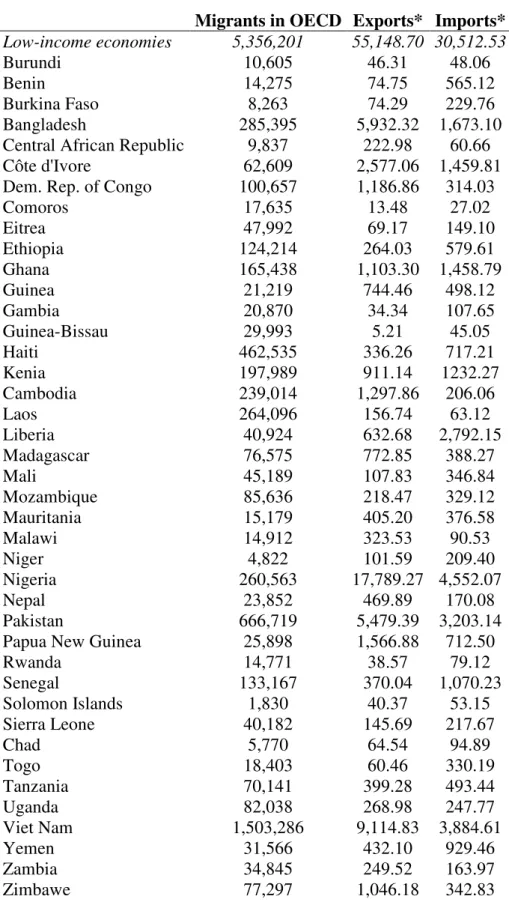
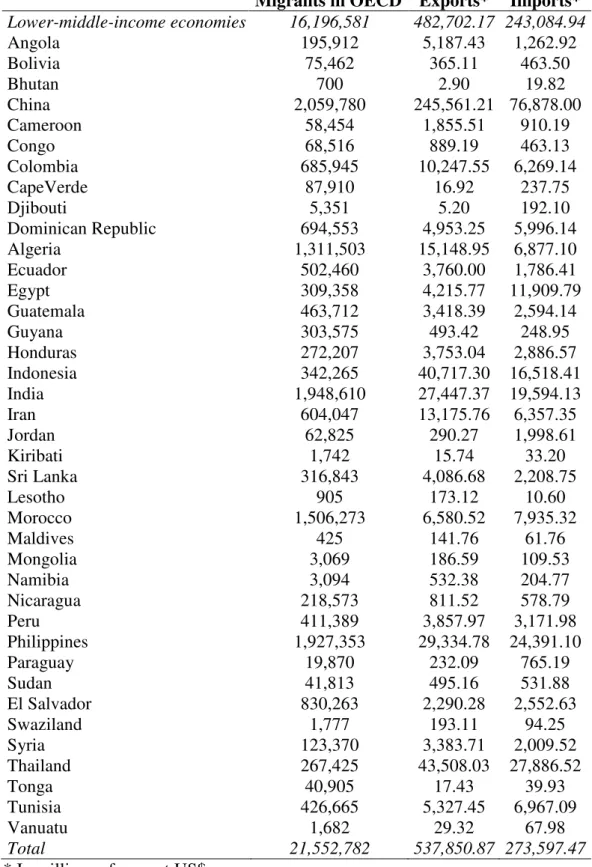
Table 1 summarizes immigration and trade data for our sample of developing and developed countries for year 2000. Our data account for little more than twenty one and a half million of people born in a developing country and living in an OECD country in year 2000. From those, sixteen millions came from low income economies and the rest for lower-middle income economies. China, Philippines, India and Morocco are the main soured countries of immigrants on OECD countries. The high number of immigrants from those countries makes the number of immigrants from lower-middle income economies higher than the figure for low income economies. Trade flows, both exports and imports are higher also for lower-middle income countries than for the other group of developing countries. For both groups of countries, exports are higher than imports.
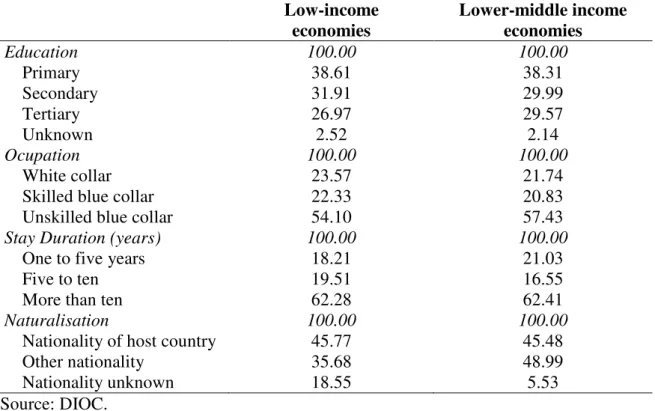
With respect to immigrants’ characteristics, table 2 shows that figures are similar whatever immigrants came, considering the averages for the two groups of counties. First, most immigrants have a primary level of education, although figures for tertiary level of education is over 25 %. Second, more than 50 % of employed immigrants have an unskilled blue-collar occupation. The average duration of stay of immigrant on host countries is high, since more than 60% of them have been staying for more than 10 years. Finally, immigrants born in a lower-middle income economy adopt the nationality of the host country in a higher percentage than those born in a low income economy.
4. The empirical model
In this study we first test for the existence and relevance of a positive effect of immigrants from developing countries living in developed countries on the bilateral trade with their home countries. Then, we try to identify some of the mechanisms through which this positive effect takes place, making use of information about national (non-individual-specific) and personal (individual-specific) characteristics of immigrants. In all the cases, we estimated a specification that includes all the variables that the previous literature suggests as relevant. Then, we tested for the robustness and sensitivity to specification of our results by estimating different combinations of explanatory variables, particularly a set of control variables in the form of dummy variables which take into account certain characteristics of partner countries.
Following the previous literature, we used an augmented gravity equation for trade to test the link between immigration and bilateral trade. The basic gravity equation
for trade relates the volume of trade positively to the mass of the two countries and negatively to the trade costs between them (variables reflecting trade impediments). We use the GDP of the exporting country and the one of the importing country to capture their capability to offer products to international markets and its demand size. Trade costs are usually proxied by the distance between partners. We measure it as the geodesic distance, in kilometres, between the geographic centres of each pair of partner countries. However, geographical distance may not been capturing all trade costs. For example, tariffs can negatively affect trade flows. We don’t have data on tariffs. However, we include a dummy variable that takes the value 1 if both countries are members of a regional trade agreement and 0 if not (rtaij). As long as trade agreements
facilitate trade, we expect a positive effect of this variable on trade flows. Cultural distances can also decrease trade flows between two countries since it increases communication and information trade costs. Sharing a common language could facilitate trade, independently of the immigration effect3. A dummy taken the value 1 for pairs of countries sharing a common language and 0 if they don’t (langij) tries to
inversely capture this kind of trade cost. We estimate the model including different sets of trade cost variables in order to test for the robustness and sensitivity to specification of our results. Finally, some authors have pointed out that the correct specification of the gravity equation for trade must control for a set of characteristics that are either specific to each trading country or specific to each pair of partner countries and that can also vary along time. Not all of these variables are included in the empirical specification because they can not being correctly measured or approach. The basic problem arises from the fact that in the trade specification of the gravity equation the gravitational constant of the physics’ force of gravity equation from which it is derived
3
For example, Hutchinson (2002) finds that the fact that a country has English as the first or second language of its population facilitates trade with the United States of America.
is not constant but it varies by trade partner and over time and can also be correlated with policy variables affecting trade. As a consequence, many estimates of the volume of trade are biased. Anderson and Van Wincoop (2003) correct this problem when data is a cross-section by including country fixed effects and country-pair fixed effect. So, we include individual effects for each exporting and importing country. Due to the dimensions of our database, we can not include country-pair fixed effect4. This would eliminate a part of the possible bias effect on estimated parameters due to the omission of relevant variables5.
In addition to this basic specification, we included a measure of the immigrant stock from each developing country i in each OECD member j (migij), which we
expected to positively affect both imports and exports between immigrants’ home and host countries, for the reasons explained above6.
Thus, our first specification is expressed as follows: (Specification 1) ij j j j i i i ij ij ij j i ij ij d d rta lang dist gdp gdp mig T µ β β β β β β β β β + + + + + + + + + + =
∑
∑
= = 22 2 122 2 6 5 4 3 2 1 0 ln ln ln ln lnwhere Tijstands for either imports (mit) or exports (xit) between countries i and j and
µ
ijis the i.i.d. error term. Note that all variables, except for dummy variables, enter the equation in natural logarithms.
4
We have observation only for 80 developing countries with 22 OECD members but not for 102 countries with 102 countries. Include country-pair fixed effects would imply the number of explanatory variables to be greater than the number of observations.
5
Baldwin and Taglioni (2006) and Baldwin at al.(2008) argue that this approach is not correct for panel data. As country fixed effects and country-pair fixed effects can vary along time, they advice to include also time effects and country-pair-specific-time-trends. However, as long as our data is a cross-section, we do not need to include these kind of fixed effects.
6
The estimation of this first specification separately for imports and exports allows us to test both for the existence of a link between immigration and trade and for the relevance of the two channels causing this link. If we obtain a positive effect of immigration on exports from but not on imports to country of birth of migrants, that will reveal that the only explanation for the link between immigration and trade is the preference effect. If we obtain a positive effect for both trade flows but impact on imports is greater, both channels will explain that link and the preference effect will account for the difference. If the relevant effect turns out to be bigger for exports than for imports, the negative substitution effect could be at work.
5. Results
5.1.
The link between immigration and trade, and the preference and transaction costs reduction channelsTable 3 shows the results from estimating specification 5 using different sets of trade cost variables and including – specification (a) to (d) – or not – specification (e) – country specific fixed effects. Testing for the impact of immigration stock from developing countries in OECD countries on developing countries bilateral trade, we find a positive effect both for exports and imports. These results hold whatever we include or not in the model other variables that affect trade costs as jointly regional trade agreement membership and common language and when we include different combination of them. They also hold when specification does not include country specific fixed effects. A 10% increase in OECD countries’ immigrants stocks from developing countries would increase exports of the later to the former in between a
3.3% and a 4.8% and imports in between 4.4% and a 5.4%, depending on the specification. Hence, to consider in our model the lang variable or the rta variable – alone o together - slightly decreases the coefficient for the immigrants variable, both in exports and imports equations, as expected. However, the estimated coefficients for the immigrant stock variable remain positive and significant at 99% percent. Sharing a common language facilitate exports for developed countries but, according to our results, does not in the case of imports. To belong to the same regional trade agreement than an OECD countries facilitate both exports and imports. These two variables have the expected positive coefficient in all cases. The rest of the variables included in our gravity equation present the expected signs. So, the mass of the two partner countries affects positively their trade relations and the distance between them (dist) negatively. Note that the economic size of the OECD countries has a higher positive impact on trade than the size of developing ones. Finally, comparing specification (a) and (e), we observe than the inclusion of country specific fixed effects on the estimated specification although decreasing the estimated coefficient for the immigrant variable, clearly increases the R2 of the estimated model.
Considering now the evidence for the two channels (preference and trade cost reduction) our results do not support the existence of a preference effect, since the coefficients are higher for immigrants’ source countries imports than for its exports. Although unexpected, this result is often found in the literature, early surveyed by Wagner et al. (2002). One possible explanation for this result could be that the imports-substitution effect outweighs the transaction cost reduction and preference for home-country products positive effects. If this was the reason, we should find an increase in OECD production of ‘foreigner’7 goods. However, we do not have data to measure the
7
relevance of this kind of activities. Another explanation could be the different good composition of exports and imports. Non-consumer goods, especially raw materials as oil, are more relevant in developing countries exports than in exports. The positive effect of immigration on trade would be lower for this kind of goods than for consumer goods, according to the literature discussed in the second section. As an example, Gould (1994) found evidence about a stronger effect of immigration on consumer goods US imports than on producer goods, which, in fact, was non significant. Blanes (2005) also point to these conclusions, since it finds a stronger effect from immigrant’s stock on intra-industry trade – mainly differentiated products- than in inter-industry trade – mainly homogeneous goods. However, trade data of countries like China do not agree with this explanation.
5.2. The mechanisms behind the link
We perform several tests to identify some of the mechanisms explaining the link between immigration and trade. In doing so, we use information about immigrants’ national and individual characteristics related to their capability to reduce such costs.
We first test the hypothesis of a lower positive effect of immigrants from home-countries with similar social and political institutions to the ones in the host country, since they bring with them less additional information. Girma and Yu (2002) tested this hypothesis for immigrants from Commonwealth and non-Commonwealth countries to the UK and found that immigrants from Commonwealth countries help less than immigrants from other countries to increase trade flows. Blanes (2008) found the same result in the case of Spain and its former colonies. However, usually former colonies have as its official or national language the one of the former metropolis. A dummy variable for pair of countries that share a past colonial relationship and another dummy
variable for countries that share a common language will be highly and positively correlated8. So, we test for this hypothesis using the common language variable. We define two dummy variables: we gave one of them the value 1 for pair of countries that had a common language and 0 if they had not (the already defined langit) and we gave
the other the value 1 for countries that had not share a common language and 0 if they had (nolangit). Then a multiplicative variable of these dummies and migitwas included
in the model instead of the immigrants’ stock variable. This allows the elasticity of immigration to vary across the different groups of countries9. Thus, we estimated the following specification: (Specification 2) ij j j j i i i ij ij ij j i ij ij ij d d rta lang dist gdp gdp mignolang miglang T µ β β β β β β β β β β + + + + + + + + + + + + =
∑
∑
= = 22 2 122 2 7 6 5 4 3 2 1 0 ln ln ln ln ln lnWe assume that immigrants coming from a country that share a common language with the host country colonies would benefit bilateral trade less. Results are shown in table 4. We do not find evidence of the immigration-trade link working through immigrants increasing available information about social and political institution. In the case of developing countries imports, results show a positive effect of immigration both from countries sharing and not sharing a common language. The small diference between both coefficients is not statisitically significant. The variable
lang is not significant in the imports equation. In the case of exports, we even found a negative and significant at 90 % level coefficient for the stock of immigrants when
8
For example, this is the case of Spain. All former Spanish colonies with the exception of The Philippines have Spanish as its official language and both variables have a correlation index equal to 0.9725 (Blanes, 2008).
9
reporter and partner countries share a common language. The effect is positive in the case they do not. In this case, the variable lang has a positive and significant effect. That is, controlling for all the trade advantages of sharing a common language, immigrants from those countries do not have a higher positive effect on bilateral trade than immigrants from other countries.
We now turn to immigrants’ individual characteristics. As argued in the second section, immigrants’ personal (individual-specific) characteristics can help on identify the mechanism behind the link between immigration and trade. In this part of the paper, the objective is to determine if the link works through immigrants’ knowledge about business in their home countries or by contacts with home country residents (network effect). The capability of immigrants to increase trade flows would depend on this individual characteristics since they contribute to decrease trade transaction costs. If this was the case, more skilled or educated immigrants would increase trade the most, since they are more able to bring and use information about home markets and social and political institutions and about products and their characteristics. Furthermore, the more related to business the immigrants were, the greater the chance that they would use the knowledge and contacts to increase trade flows.
From the DIOC we can compute two sets of variables that take into account both types of individual-specific characteristics. First, we placed immigrants into three groups by education level: primary level (migedu1it), secondary (migedu2it) and tertiary
(migedu3it). The second set of variables puts immigrants from each country into three occupational categories: white collar (managers, professionals, commercial and clericals); skilled blue collar and unskilled blue collar10.
10
This information by individual characteristics reduces the number of observations. First, some OECD countries do not report data on education levels or on workers occupations for all the countries they do to the total number of immigrants. Second occupation data is collected only for employed people. Finally, it has been not possible to build the occupation classification for the USA and Japan since they use
Thus, we have estimated the following two specifications: (Specification 3) ij j j j i i i ij ij ij j i ij ij ij ij d d rta lang dist gdp gdp migedu migedu migedu T µ β β β β β β β β β β β + + + + + + + + + + + + =
∑
∑
= = 22 2 122 2 8 7 6 5 4 3 2 1 0 ln 1 ln 2 ln 3 ln ln ln ln (Specification 4) ij j j j i i i ij ij ij j i ij ij ij ij d d rta lang dist gdp gdp migocu migocu migocu T µ β β β β β β β β β β β + + + + + + + + + + + + =∑
∑
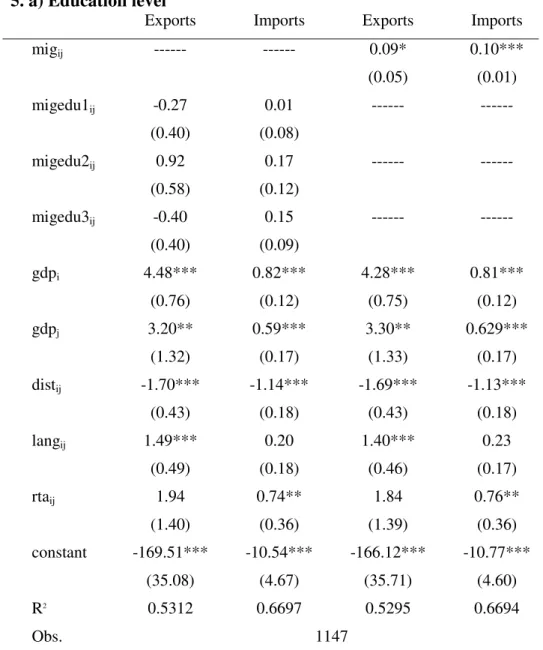
= = 22 2 122 2 8 7 6 5 4 3 2 1 0 ln 1 ln 2 ln 3 ln ln ln lnOur results show first (Table 5) that putting total immigrant into three education level categories do not yields to any significant effect on trade. However, the sample we have to use when identifying immigrants’ education levels is different (lower) than the one we use for estimated the effect on trade of total stock of immigrants. For comparative purposes, we estimate again specification 1 using the same sample than for specification 3. We observe than the positive effect of immigration in both developing countries’ exports and imports is smaller than in the case of the largest sample. Second, with respect to immigrant’s occupations, results in table 5 show that immigrants that are managers have a positive and highly significant effect on bilateral developing countries’ trade. They other groups of immigrants do not show any effect on trade. So, there is evidence that immigrants are taking advantage of their contacts at their birth’ countries and also of knowledge about their birth’ countries business activities increasing trade, especially exports to OECD countries. This network effect is also found by Combes et al. (2005) in the case of trade between French provinces, Dunlevy (2004) and Herander
occupation classification that are to different to the ISCO. For comparative purposes, we also report estimation results for specification 1 (a) using the sample than the corresponding specification for immigrants’ individual characteristics.
and Saavedra (2005) for the USA, Rauch and Trindade (2002) for countries with a relevant Chinese population and Blanes (2008) for Spain.
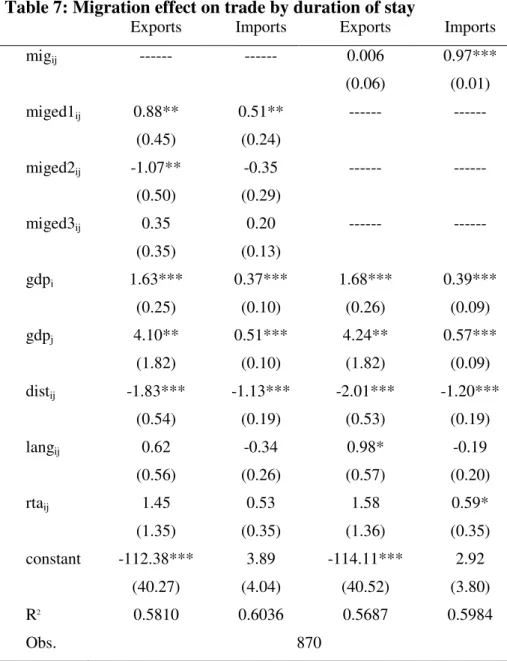
Finally, some authors as Gould (1994) have argued that immigrants would last some time before have an effect on trade flows. We test for this hypothesis in three ways. First, from the DIOC we construct three variables that place the number of immigrant born in each developing country and living on each OECD country into three groups depending on the duration of stay. The variables d1, d2 and d3 take the value 1 if the duration of stay is 5 years or less, more than 5 years and less than 10 years and more that 10 years, respectively, and 0 otherwise.
(Specification 5) ij j j j i i i ij ij ij j i ij ij ij ij d d rta lang dist gdp gdp migd migd migd T µ β β β β β β β β β β β + + + + + + + + + + + + =
∑
∑
= = 22 2 122 2 8 7 6 5 4 3 2 1 0 ln 1 ln 2 ln 3 ln ln ln lnA second approach considers naturalization. We test if immigrants that have adopted the nationality of the host country have a different effect on trade than immigrants that not. We split out immigrants for each pair of home and host countries into two groups, one for the number immigrants that have adopted the nationality of the host country (immnatij) and the other for those that have not (immnatij). We do not have
a clear hypothesis about the sign of the parameters of those two variables. In one side, immigrants that have adopted the nationality of the host country could more easily take advantage of their great knowledge that natives about their countries of origin but in the other side they could be more assimilated to native preferences and thus the preference effect would be lower than for other immigrants.
(Specification 6) ij j j j i i i ij ij ij j i ij ij ij d d rta lang dist gdp gdp mignonat mignat T µ β β β β β β β β β β + + + + + + + + + + + =
∑
∑
= = 22 2 122 2 7 6 5 4 3 2 1 0 ln ln ln ln ln lnFinally, we estimate the effect of immigration on trade flow levels not of the current year but on next years, from 2001 to 2006.
(Specification 7) ij j j j i i i ijt ij ij j i ij ijt d d rta lang dist gdp gdp mig T µ β β β β β β β β β + + + + + + + + + + =
∑
∑
= = 22 2 122 2 6 5 4 3 2 1 0 ln ln ln ln lnwhere the subscript t indicates that data is taken alternatively from the year 2001, 2002, 2003, 2004, 2005 or 2006.
Results are shown in tables 6 to 8. With respect to naturalisation, results do not indicate a different effect of immigrants depending on the fact that the have adopted o not host country’ nationality. Turning to duration of stay, results indicate that the effect of immigrant both on imports and on imports disappears when they have stayed for more than 5 years at eh host country. Finally, there is not a clear path for the effect of immigrants on following years’ trade flows. If any, it seams to slightly decrease after 5 years, in the case of exports, and it decreases sharply and before in the case of developing countries imports.
6. Concluding remarks
In this paper we have tested for the first time for the existence of a link between immigration and bilateral trade in the case of developing countries. We have used a gravity equation for trade augmented with an immigrant’s stock variable. In addition, we have tested for the robustness of our results by including or excluding some control variables. We have also explored some possible mechanisms through which the stock of immigrants in a country can contribute to its trade. The methodology used has been to estimate models for different trade flows and for different immigrant’s national and individual characteristics. Such characteristics can contribute in a different way to increase the volume of bilateral trade.
Immigration has a clear positive effect both on Developing countries exports and imports. A 10% increase on immigrants stock contributes to a 3.3 % - 4.8% increase on developing countries exports and to a 4.4 % - 5.4 % increase on developing countries imports, depending on the specification estimated. This significant and positive effect is robust to the different specifications estimated in this paper. So, al long as trade helps countries to increase is level of development, immigration is also helping, through international trade, to economic development.
Our results do not find evidence for the preference effect, since the impact on imports of immigrant country of birth is not greater than on their exports. One explanation could be that the import substitution effect due to immigration equals the trade transaction cost reduction effect. Another explanation that can contribute to this result is a different product composition of Spanish imports and exports. The relevance of raw materials could be greater on developing countries’ exports than in their imports. If we accept, according to the literature, that the effect of immigration on trade will be greater for consumer - or differentiated - products than for other kinds of products, we
should expect a bigger effect of immigration on developing countries imports than in their exports. However, the case of countries like China disagrees with that explanation. So, our results point out that immigrants may increase trade via trade transaction cost reduction.
We have, then, tested for some mechanism explaining the link between immigration and trade by focussing on immigrant’s characteristics. Beginning with national (non individual specific) ones, assuming that social and political institutions are more similar between countries that share a common language, we do not find evidence for the hypothesis that immigration stimulates trade because it reduces trade transaction costs by increasing the knowledge about social and political institutions.
Finally, we have turned to personal (individual specific) characteristics: level of education and situation at economic activity (occupation by skill level required). Results reveal that immigrants may be taking advantage of their business and personal contacts at home to increase bilateral trade flows (network effect). Immigrants that are managers are the ones that contribute to increase trade while blue-collars do not. This kind of immigrants are the ones supposed to be more able to establish and take advantage of social networks contributing the most to trade transaction cost reduction.
This paper increases international evidence about the link between immigration and trade, especially for the case of developing countries. However, more work can be made to improve and enhance this research in several directions. First, it would be interesting to introduce more control variables that capture country-pair characteristics that can affect trade. Second, it would be interesting to estimate for different groups of products. This would allow us, first to better ascertain the different effect of immigration on exports than in imports (identification of preference effect), and second to test if immigration contributes to increase trade in the type of goods that are more
sensible to trade transaction costs: consumer / differentiated goods. Finally, alternative estimation methods can help to test for the robustness of results. For example, a two steps Heckman method estimation type will deal with zero trade flows observations. This can be especially useful in the case of developing countries’ trade flows. Another alternative method of estimation is dynamic panel data, as in Mundra (2005). However, improvement in empirical research will depend on data availability both in cross-section and longitudinal dimensions.
REFERENCES
Anderson and Van Wincoop (2003): “Gravity with Gravitas: A Solution to the Border Puzzle”, American Economic Review, 93 (1), pp. 170-192.
Baldwin, R. and Taglioni, D. (2007): “Trade effects of the euro: a comparision of estimators”, Journal of Economic Integration, 22 (4).
Baldwin R. , DiNino, V., Fontagné, L., De Santis, R.A. and Taglioni, D. (2008): “Estudy of the impact of the Euro on Trade and Foreign Direct Investment”, European Economy-Economic Papers, 321.
Blanes, J. V. (2004): “El nexo entre la inmigración y el comercio en España”,
Información Comercial Española – Revista de Economía, 814, pp. 39-48.
Blanes, J. V. (2005): “Does Immigration Help to Explain Intra-Industry Trade? Evidence for Spain”, Review of World Economics – Weltwirtschftliches Archiv, 141 (2), pp. 244-270.
Blanes, J. V. (2008): “Immigrants’ Characteristics and Bilateral Trade”, Revista de Economía Aplicada, XVI (48), pp. 133-159.
Blanes, J. V. and Martín-Montaner, J. A. (2006): “Migration Flows and Intra-Industry Trade Adjustment”, Review of World Economics – Weltwirtschftliches Archiv, 142 (3), pp. 568-585.
Bryant, J., Genç, M. And Law, D. (2004): “Trade and Migration to New Zealand”, New Zealand Treasury, Working Paper 04/04.
Combes, P.P., Lafourcade, M. and Mayer, T. (2005): “The Trade Creating Effects of Business and Social networks: evidence from France”, Journal of International Economics, 66 (1), pp. 1-29.
Dunlevy, J. A. (2004): “Interpersonal Networks in International Trade: Evidence on the Role of Immigrants in Promoting Exports from the American States”, Working Paper, Departament of Economics (Miami University).
Dunlevy, J. A. (2006): “The influence of corruption and language on the protrude effect of immigrants: evidence from the American States”, The Review of Economics and Statistics, 88 (1), pp. 182-186.
Dunlevy, J.A. and Hutchinson, W. (1999): “The impact of immigration on American import trade in the late nineteenth and twentieth centuries”, Journal of Economic History, 59 (4), pp. 1043-62.
Girma, S. and Yu, Z (2002): “The link between immigration and trade: Evidence from the UK”, Weltwirtschaftliches Archiv, 138 (1), pp. 115-130.
Gould, D. (1994): “Immigrant links to the home-country: empirical implications for U.S. bilateral trade flows”, The Review of Economics and Statistics, 76 (2), pp. 302-316.
Head, K. and Ries, J. (1998): “Immigration and trade creation: Econometric evidence from Canada”, Canadian Journal of Economics, 31 (1), pp.47-62.
Helpman, E., Melitz, M. and Rubinstein, Y. (2008): “Estimating trade flows: trading partners and trading volumes“, The Quartely Journal of Economics, CXXIII (2), pp. 441-487.
Herander, M.G. and Saavedra, L.A. (2005): “Exports and the Structure of Immigrant-Based Networks: The Role of Geographic Proximity”, The Review of Economics and Statistics, 87 (2), pp. 323-335.
Hutchinson, W. K. (2002): “Does Ease of Communication Increase Trade? Commonality of Language and Bilateral Trade”, Scottish Journal of Political Economy, 49 (5), pp. 544-556.
Jiang, S. (2007): “Immigration, Information and Trade Margins”, Working Papers Department of Economics, University of Calgary, No. 2007-16.
Mundra, K. (2005): “Immigration and International Trade: A Semiparametric Empirical Investigation”, Journal of International Trade and Economic Development, 14 (1), pp. 65-91.
Rauch, J. (1999): “Networks versus markets in international trade”, Journal of International Economics, 48 (1), pp.7-35.
Rauch, J. (2001): “Business and social networks in international trade”, Journal of Economic Literature, 39 (4), pp. 1177-1203.
Rauch, J. E. and Trindade, V. (2002): “Ethnic Chinese Networks in International Trade”, The Review of Economics and Statistics, 84 (1), pp. 116-130.
Tadesse, B. and White B. (2008): “Do immigrants counter the effect of cultural distance on trade? Evidence from US state-level exports”, The Journal of Socio-Economics, 37, pp. 2304-2318.
Wagner, D. , Head, K. and Ries, J. (2002): “Immigration and Trade of Provinces”,
Scottish Journal of Political Economy, 49 (5), pp. 507-525.
White, R. (2007): “Immigrant-trade links, transplanted home bias and network effects”,
Applied Economics, 39 (7), pp. 839-852.
White, R. and Tadesse, B. (2007): “Immigration policy, cultural pluralism and trade: evidence from the white Australian policy”, Pacific Economic Review, 12 (4), pp. 489-509.
White, R. and Tadesse, B. (2008a): “Cultural Distance and the US Immigrant-Trade link”, The World Economy, 31 (8), pp. 1078-1096.
White, R. and Tadesse, B. (2008b): “Immigrants, cultural distance and U.S. state-level exports of cultural products”, North American Journal of Economics and Finance, 19 (3), pp. 331-348.
Table 1: Migrants and trade on OECD by developing country, 2000. Migrants in OECD Exports* Imports*
Low-income economies 5,356,201 55,148.70 30,512.53
Burundi 10,605 46.31 48.06
Benin 14,275 74.75 565.12
Burkina Faso 8,263 74.29 229.76
Bangladesh 285,395 5,932.32 1,673.10
Central African Republic 9,837 222.98 60.66
Côte d'Ivore 62,609 2,577.06 1,459.81
Dem. Rep. of Congo 100,657 1,186.86 314.03
Comoros 17,635 13.48 27.02 Eitrea 47,992 69.17 149.10 Ethiopia 124,214 264.03 579.61 Ghana 165,438 1,103.30 1,458.79 Guinea 21,219 744.46 498.12 Gambia 20,870 34.34 107.65 Guinea-Bissau 29,993 5.21 45.05 Haiti 462,535 336.26 717.21 Kenia 197,989 911.14 1232.27 Cambodia 239,014 1,297.86 206.06 Laos 264,096 156.74 63.12 Liberia 40,924 632.68 2,792.15 Madagascar 76,575 772.85 388.27 Mali 45,189 107.83 346.84 Mozambique 85,636 218.47 329.12 Mauritania 15,179 405.20 376.58 Malawi 14,912 323.53 90.53 Niger 4,822 101.59 209.40 Nigeria 260,563 17,789.27 4,552.07 Nepal 23,852 469.89 170.08 Pakistan 666,719 5,479.39 3,203.14
Papua New Guinea 25,898 1,566.88 712.50
Rwanda 14,771 38.57 79.12 Senegal 133,167 370.04 1,070.23 Solomon Islands 1,830 40.37 53.15 Sierra Leone 40,182 145.69 217.67 Chad 5,770 64.54 94.89 Togo 18,403 60.46 330.19 Tanzania 70,141 399.28 493.44 Uganda 82,038 268.98 247.77 Viet Nam 1,503,286 9,114.83 3,884.61 Yemen 31,566 432.10 929.46 Zambia 34,845 249.52 163.97 Zimbawe 77,297 1,046.18 342.83
Table 1: Migrants and trade on OECD by developing country, 2000. Continuation and end.
Migrants in OECD Exports* Imports*
Lower-middle-income economies 16,196,581 482,702.17 243,084.94 Angola 195,912 5,187.43 1,262.92 Bolivia 75,462 365.11 463.50 Bhutan 700 2.90 19.82 China 2,059,780 245,561.21 76,878.00 Cameroon 58,454 1,855.51 910.19 Congo 68,516 889.19 463.13 Colombia 685,945 10,247.55 6,269.14 CapeVerde 87,910 16.92 237.75 Djibouti 5,351 5.20 192.10 Dominican Republic 694,553 4,953.25 5,996.14 Algeria 1,311,503 15,148.95 6,877.10 Ecuador 502,460 3,760.00 1,786.41 Egypt 309,358 4,215.77 11,909.79 Guatemala 463,712 3,418.39 2,594.14 Guyana 303,575 493.42 248.95 Honduras 272,207 3,753.04 2,886.57 Indonesia 342,265 40,717.30 16,518.41 India 1,948,610 27,447.37 19,594.13 Iran 604,047 13,175.76 6,357.35 Jordan 62,825 290.27 1,998.61 Kiribati 1,742 15.74 33.20 Sri Lanka 316,843 4,086.68 2,208.75 Lesotho 905 173.12 10.60 Morocco 1,506,273 6,580.52 7,935.32 Maldives 425 141.76 61.76 Mongolia 3,069 186.59 109.53 Namibia 3,094 532.38 204.77 Nicaragua 218,573 811.52 578.79 Peru 411,389 3,857.97 3,171.98 Philippines 1,927,353 29,334.78 24,391.10 Paraguay 19,870 232.09 765.19 Sudan 41,813 495.16 531.88 El Salvador 830,263 2,290.28 2,552.63 Swaziland 1,777 193.11 94.25 Syria 123,370 3,383.71 2,009.52 Thailand 267,425 43,508.03 27,886.52 Tonga 40,905 17.43 39.93 Tunisia 426,665 5,327.45 6,967.09 Vanuatu 1,682 29.32 67.98 Total 21,552,782 537,850.87 273,597.47
* In millions of current US$.
Table 2: Individual characteristics for developing countries’ Immigrants. In % of total number. Average for all OECD countries.
Low-income economies Lower-middle income economies Education 100.00 100.00 Primary 38.61 38.31 Secondary 31.91 29.99 Tertiary 26.97 29.57 Unknown 2.52 2.14 Ocupation 100.00 100.00 White collar 23.57 21.74
Skilled blue collar 22.33 20.83
Unskilled blue collar 54.10 57.43
Stay Duration (years) 100.00 100.00
One to five years 18.21 21.03
Five to ten 19.51 16.55
More than ten 62.28 62.41
Naturalisation 100.00 100.00
Nationality of host country 45.77 45.48
Other nationality 35.68 48.99
Nationality unknown 18.55 5.53
Table 3: Migrants effects on trade a) Exports (a) (b) (c) (d) (e) migij 0.33** (0.14) 0.34*** (0.14) 0.47*** (0.13) 0.48*** (0.13) 0.37*** (0.13) gdpi 5.21*** (0.63) 5.27*** (0.64) 5.23*** (0.63) 5.30*** (0.64) 2.07*** (0.22) gdpj 3.92*** (0.95) 3.81*** (0.95) 3.73*** (0.97) 3.59*** (0.97) 2.13*** (0.17) distij -2.13*** (0.53) -2.88*** (0.50) -1.86*** (0.51) -2.34*** (0.55) -1.68*** (0.42) langij 1.65*** (0.53) 1.74*** (0.53) ---- ---- 2.28*** (0.42) rtaij 2.61* (1.50) ---- 3.01* (1.51) ---- 0.28 (0.81) constant -201.37*** (26.36) -196.45*** (26.29) -200.67*** (26.81) -194.89*** (26.71) -77.87*** (7.90) R2 0.5722 0.5714 0.5698 0.5687 0.3952 Obs. 1323
OLS estimations including country individual effects dummies variables (except specification e) ***, **, *, indicates significance at the 1%, 5% and 10% level respectively.
b) Imports (a) (b) (c) (d) (e) migij 0.50*** (0.08) 0.50*** (0.09) 0.51*** (0.09) 0.52*** (0.09) 0.44*** (0.07) gdpi 1.34*** (0.37) 1.37*** (0.37) 1.34*** (0.37) 1.37*** (0.37) 0.77*** (0.09) gdpj 0.54** (0.14) 0.49*** (0.14) 0.53*** (0.13) 0.47*** (0.14) 0.88*** (0.07) distij -1.26*** (0.29) -1.48*** (0.31) -1.24*** (0.30) -1.45*** (0.31) -1.47*** (0.23) langij 0.12 (0.26) 0.17 (0.26) ---- ---- 0.35* (0.19) rtaij 1.29** (0.62) ---- 1.32** (0.63) ---- 0.21 (0.34) constant -23.33*** (10.06) -20.89*** (10.04) -23.28*** (10.07) -20.74*** (10.06) -14.87*** (3.30) R2 0.4851 0.4844 0.4851 0.4843 0.3790 Obs. 1323
OLS estimations including country individual effects dummies variables. ***, **, *, indicates significance at the 1%, 5% and 10% level respectively. Robust standard errors are given in parentheses.
Table 4: Migration effect on trade by national migrants’ characteristics (common language) Exports Imports miglangij -0.34* (0.19) 0.46*** (0.08) mignolangij 0.58*** (0.16) 0.52*** (0.10) gdpi 4.76*** (0.64) 1.31*** (0.37) gdpj 3.97*** (0.89) 0.55*** (0.14) distij -1.81*** (0.52) -1.24*** (0.30) langij 8.44*** (1.67) 0.58 (0.69) rtaij 2.79* (1.50) 1.31** (0.63) constant -195.36*** (25.57) -22.92*** (10.10) R2 0.5798 0.4853 Obs 1323
OLS estimations including country individual effects dummies variables. ***, **, *, indicates significance at the 1%, 5% and 10% level respectively. Robust standard errors are given in parentheses.
Table 5: Migration effect on trade by individual migrants’ characteristics 5. a) Education level
Exports Imports Exports Imports migij --- --- 0.09* (0.05) 0.10*** (0.01) migedu1ij -0.27 (0.40) 0.01 (0.08) --- --- migedu2ij 0.92 (0.58) 0.17 (0.12) --- --- migedu3ij -0.40 (0.40) 0.15 (0.09) --- --- gdpi 4.48*** (0.76) 0.82*** (0.12) 4.28*** (0.75) 0.81*** (0.12) gdpj 3.20** (1.32) 0.59*** (0.17) 3.30** (1.33) 0.629*** (0.17) distij -1.70*** (0.43) -1.14*** (0.18) -1.69*** (0.43) -1.13*** (0.18) langij 1.49*** (0.49) 0.20 (0.18) 1.40*** (0.46) 0.23 (0.17) rtaij 1.94 (1.40) 0.74** (0.36) 1.84 (1.39) 0.76** (0.36) constant -169.51*** (35.08) -10.54*** (4.67) -166.12*** (35.71) -10.77*** (4.60) R2 0.5312 0.6697 0.5295 0.6694 Obs. 1147
OLS estimations including country individual effects dummies variables. ***, **, *, indicates significance at the 1%, 5% and 10% level respectively. Robust standard errors are given in parentheses.
5. b) Ocupation
Exports Imports Exports Imports migij --- --- 0.05 (0.05) 0.13*** (0.02) migocu1ij 0.96*** (0.33) 0.30** (0.14) --- --- migocu2ij -0.33 (0.40) 0.01 (0.13) --- --- migocu3ij -0.36 (0.28) 0.11 (0.13) --- --- gdpi 4.05*** (0.72) 1.10*** (0.29) 4.21*** (0.73) 1.14*** (0.30) gdpj 3.44 (2.33) 0.19 (0.19) 3.40 (2.40) 0.18 (0.20) distij -1.65*** (0.42) -1.12*** (0.26) -1.63*** (0.42) -1.11*** (0.25) langij 0.65 (0.43) -0.31 (0.25) 0.97* (0.42) -0.27 (0.25) rtaij 0.82 (0.76) 0.46 (0.48) 0.97 (0.75) 0.49 (0.47) constant -161.32*** (56.32) -9.06 (9.05) -165.06*** (57.87) -9.84 (9.20) R2 0.5443 0.5876 0.5396 0.5871 Obs 845
OLS estimations including country individual effects dummies variables. ***, **, *, indicates significance at the 1%, 5% and 10% level respectively. Robust standard errors are given in parentheses.
Table 6: Migration effect on trade by nationality (host country’s or another)
Exports Imports Exports Imports migij --- --- 0.16* (0.08) 0.22*** (0.04) mignat1ij 0.35* (0.20) 0.21 (0.13) --- --- mignat2ij -0.05 (0.27) 0.24 (0.16) --- --- gdpi 1.45*** (0.31) 0.36** (0.15) 1.32*** (0.26) 0.38*** (0.10) gdpj 3.12** (1.57) 0.63*** (0.24) 3.07* (1.57) 0.63*** (0.23) distij -1.96*** (0.55) -1.34*** (0.30) -1.90*** (0.54) -1.34*** (0.31) langij 1.17** (0.54) 0.12 (0.28) 1.17** (0.54) 0.12 (0.28) rtaij 3.13** (1.41) 1.07* (0.55) 3.07** (1.41) 1.07* (0.54) constant -84.10*** (36.01) 2.08 (7.85) -80.08*** (35.82) 1.77 (6.60) R2 0.5186 0.4865 0.51816 0.4865 Obs. 1071
OLS estimations including country individual effects dummies variables. ***, **, *, indicates significance at the 1%, 5% and 10% level respectively. Robust standard errors are given in parentheses.
Table 7: Migration effect on trade by duration of stay
Exports Imports Exports Imports migij --- --- 0.006 (0.06) 0.97*** (0.01) miged1ij 0.88** (0.45) 0.51** (0.24) --- --- miged2ij -1.07** (0.50) -0.35 (0.29) --- --- miged3ij 0.35 (0.35) 0.20 (0.13) --- --- gdpi 1.63*** (0.25) 0.37*** (0.10) 1.68*** (0.26) 0.39*** (0.09) gdpj 4.10** (1.82) 0.51*** (0.10) 4.24** (1.82) 0.57*** (0.09) distij -1.83*** (0.54) -1.13*** (0.19) -2.01*** (0.53) -1.20*** (0.19) langij 0.62 (0.56) -0.34 (0.26) 0.98* (0.57) -0.19 (0.20) rtaij 1.45 (1.35) 0.53 (0.35) 1.58 (1.36) 0.59* (0.35) constant -112.38*** (40.27) 3.89 (4.04) -114.11*** (40.52) 2.92 (3.80) R2 0.5810 0.6036 0.5687 0.5984 Obs. 870
OLS estimations including country individual effects dummies variables. ***, **, *, indicates significance at the 1%, 5% and 10% level respectively. Robust standard errors are given in parentheses.
Table 8: Lags effects of migration on trade*
year Exports Imports 2000 0.33** (0.14) 0.50*** (0.08) 2001 0.31** (0.15) 0.38*** (0.07) 2002 0.35** (0.15) 0.40*** (0.10) 2003 0.34** (0.15) 0.24*** (0.07) 2004 0.30** (0.15) 0.33*** (0.10) 2005 0.32** (0.15) 0.24*** (0.09) 2006 0.25* (0.14) 0.26*** (0.09) Obs 1323
*Only the coefficient for the variable that measures the total number of emigrants of each developing country in each OECD country is reported. Trade flows correspond to the year indicated in column 1 and migrant data are for 2000 year.
OLS estimations including country individual effects dummies variables. ***, **, *, indicates significance at the 1%, 5% and 10% level respectively. Robust standard errors are given in parentheses.
Table A1: Correlation matrix
lnexports lnimports lnmig lnmigedu1 lnmigedu2 lnmigedu3 lnmigocu1 lnexports 1.0000 lnimports 0.6088 1.0000 lnmig 0.4199 0.5437 1.0000 lnmigedu1 0.4155 0.5424 0.9717 1.0000 lnmigedu2 0.4128 0.5247 0.9857 0.9475 1.0000 lnmigedu3 0.4352 0.5266 0.9482 0.8666 0.9428 1.0000 lnmigocu1 0.4284 0.5271 0.9326 0.8619 0.9226 0.9632 1.0000 lnmigocu2 0.3837 0.4953 0.9560 0.9039 0.9542 0.9471 0.9511 lnmigocu3 0.3883 0.5110 0.9722 0.9668 0.9586 0.8802 0.8664 lnmigd1 0.4075 0.5447 0.9427 0.9103 0.9186 0.8927 0.8637 lnmigd2 0.3803 0.5064 0.9579 0.9387 0.9463 0.8952 0.8738 lnmigd3 0.3756 0.5215 0.9524 0.9327 0.9411 0.9025 0.8850 lnmignat 0.3962 0.4823 0.9351 0.8853 0.9459 0.9316 0.9092 lnmignonat 0.4241 0.5769 0.9634 0.9492 0.9346 0.8924 0.8759 lngdp OECD 0.3611 0.3281 0.4776 0.5483 0.4583 0.4511 0.4698 lngdp dping. 0.4299 0.5183 0.3767 0.3109 0.3823 0.4074 0.3928 lndist -0.0695 -0.1921 -0.0947 -0.1192 -0.0770 -0.0341 -0.0689 language 0.0062 -0.0555 0.2067 0.1424 0.1827 0.3127 0.3050 rta00 0.0722 0.1425 0.1178 0.1183 0.1114 0.1059 0.1225
lnmigocu2 lnmigocu3 lnmigd1 lnmigd2 lnmigd3 lnmignat lnmignonat ln migocu2 1.0000 ln migocu3 0.9169 1.0000 ln migd1 0.8820 0.9302 1.0000 ln migd2 0.9149 0.9492 0.9326 1.0000 ln migd3 0.9268 0.9274 0.8573 0.9208 1.0000 ln mignat 0.9391 0.8851 0.8182 0.8814 0.9375 1.0000 ln mignonat 0.8936 0.9501 0.9645 0.9429 0.8886 0.8278 1.0000 ln gdp OECD 0.4903 0.4276 0.3707 0.4642 0.5155 0.4860 0.4415 ln gdp dping. 0.3296 0.3603 0.4360 0.3581 0.3176 0.3245 0.4084 ln dist -0.0490 -0.1210 -0.1190 -0.0984 -0.0547 -0.0081 -0.1698 language 0.2657 0.1375 0.2154 0.1676 0.1803 0.2356 0.1748 rta00 0.0831 0.1120 0.1064 0.0908 0.1203 0.1161 0.1242
lngdp OECD lngdp dping. lndist language rta00 ln gdp OECD 1.0000
ln gdp dping. -0.1712 1.0000
ln dist 0.0482 0.0670 1.0000
language 0.1699 -0.2007 0.1337 1.0000
Table A2: Summary Statistics
Variable Obs Mean Std. Dev. Min Max
ln exports 1760 1.225376 1.057791 -2.302.585 2.540182 ln imports 1760 1.459429 6.737458 -2.302.585 2.413701 ln mig 1323 6.177749 2.777547 0 1.412055 ln migedu1 1216 5.191422 2.723222 0 1.343936 ln migedu2 1249 5.251785 2.611772 0 1.311427 ln migedu3 1247 5.010659 2.639987 0 .134032 ln migocu1 930 4.176085 2.420893 0 1.159976 ln migocu2 909 4.182286 2.398721 0 1.184034 ln migocu3 993 4.959285 2.605276 0 1.237127 ln migd1 1002 5.140262 2.522714 0 1.267424 ln migd2 927 4.833492 .258719 0 1.250306 ln migd3 981 5.508925 2.884958 0 1.374406 ln mignat 1108 5.292636 2.766791 0 1.369201 ln mignonat 1171 5.494252 2.671343 0 1.326322 ln gdp OECD 1760 2.660378 1.437188 2.373.236 2.990981 ln gdp dping. 1760 2.231718 1.936333 1.765.912 2.781207 ln dist 1760 8.872396 .5075355 6.322.565 9.852247