econ
stor
Der Open-Access-Publikationsserver der ZBW – Leibniz-Informationszentrum Wirtschaft
The Open Access Publication Server of the ZBW – Leibniz Information Centre for Economics
Nutzungsbedingungen:
Die ZBW räumt Ihnen als Nutzerin/Nutzer das unentgeltliche, räumlich unbeschränkte und zeitlich auf die Dauer des Schutzrechts beschränkte einfache Recht ein, das ausgewählte Werk im Rahmen der unter
→ http://www.econstor.eu/dspace/Nutzungsbedingungen nachzulesenden vollständigen Nutzungsbedingungen zu vervielfältigen, mit denen die Nutzerin/der Nutzer sich durch die erste Nutzung einverstanden erklärt.
Terms of use:
The ZBW grants you, the user, the non-exclusive right to use the selected work free of charge, territorially unrestricted and within the time limit of the term of the property rights according to the terms specified at
→ http://www.econstor.eu/dspace/Nutzungsbedingungen By the first use of the selected work the user agrees and declares to comply with these terms of use.
zbw
Leibniz-Informationszentrum Wirtschaft Leibniz Information Centre for EconomicsStreitberger, Werner; Eymann, Torsten
Working Paper
CATNETS final activity report
Bayreuth reports on information systems management, No. 29
Provided in cooperation with:
Universität Bayreuth
Suggested citation: Streitberger, Werner; Eymann, Torsten (2007) : CATNETS final activity report, Bayreuth reports on information systems management, No. 29, urn:nbn:de:bvb:703-opus-3756 , http://hdl.handle.net/10419/52627
Bayreuther Arbeitspapiere zur Wirtschaftsinformatik
Information Systems Management
Bayreuth Reports on Information Systems Management
2007
Werner Streitberger, Torsten Eymann (University of Bayreuth)
CATNETS Final Activity Report
vorläufiger Ergebnisse, die i. d. R. noch für spätere Veröffentlichungen überarbeitet werden. Die Autoren sind deshalb für kritische Hinweise dankbar.
which will usually be revised for subsequent publications. Critical comments would be appreciated by the authors.
Alle Rechte vorbehalten. Insbesondere die der Übersetzung, des Nachdruckes, des Vortrags, der Entnahme von Abbildungen und Tabellen – auch bei nur auszugsweiser Verwertung.
All rights reserved. No part of this report may be reproduced by any means, or translated.
Authors: Information Systems and Management
Working Paper Series Edited by:
Prof. Dr. Torsten Eymann
Managing Assistant and Contact:
Raimund Matros Universität Bayreuth
Lehrstuhl für Wirtschaftsinformatik (BWL VII) Prof. Dr. Torsten Eymann
Universitätsstrasse 30 95447 Bayreuth Germany
Email: [email protected] ISSN
Werner Streitberger, Torsten Eymann (University of Bayreuth)
D5.7b Final Activity Report
Contractual Date of Delivery to the CEC: 31 August 2007
Actual Date of Delivery to the CEC: 31 October 2007
Author(s): Werner Streitberger, Torsten Eymann
Work package: WP5
Security: public
Nature: final
Version: 1.0
Total number of pages: 43
Abstract: This report is the final Activity Report of the CATNETS project. It
summa-rizes the project objectives, the contractors involved, the work performed and the end results. A description of the dissemination activities concludes the report.
CATNETS Consortium
This document is part of a research project partially funded by the IST Programme of the Commission of the European Communities as project number IST-FP6-003769. The partners in this project are: LS Wirtschaftsinformatik (BWL VII) / University of Bayreuth (coordinator, Germany), Arquitectura de Computadors / Universitat Politec-nica de Catalunya (Spain), Information Management and Systems / University of Karlsruhe (TH) (Germany), Dipartimento di Economia / Università delle merche An-cona (Italy), School of Computer Science and the Welsh eScience Centre / University of Cardiff (United Kingdom), Automated Reasoning Systems Division / ITC-irst Trento (Italy) / Chair of Business Administration and Information Systems – E-Business and E-Government / University of Mannheim (Germany)
University of Bayreuth
LS Wirtschaftsinformatik (BWLVII) 95440 Bayreuth
Germany
Tel: +49 921 55-2807, Fax: +49 921 55-2816 Contactperson: Torsten Eymann
E-mail: [email protected]
Universitat Politecnica de Catalunya
Arquitectura de Computadors Jordi Girona, 1-3
08034 Barcelona Spain
Tel: +34 93 4016882, Fax: +34 93 4017055 Contactperson: Felix Freitag
E-mail: [email protected]
University of Karlsruhe
Institute for Information Management and Systems Englerstr. 14 76131 Karlsruhe Germany Tel: +49 721 608 8370, Fax: +49 721 608 8399
Contactperson: Christof Weinhardt E-mail: [email protected]
Università delle merche Ancona
Dipartimento di Economia Piazzale Martelli 8 60121 Ancona Italy Tel: 39-071- 220.7088 , Fax: +39-071- 220.7102
Contactperson: Mauro Gallegati E-mail: [email protected]
University of Cardiff
School of Computer Science and the Welsh eScience Centre
University of Caradiff, Wales Cardiff CF24 3AA, UK United Kingdom
Tel: +44 (0)2920 875542, Fax: +44 (0)2920 874598
Contactperson: Omer F. Rana E-mail: [email protected]
ITC-irst Trento
Automated Reasoning Systems Division Via Sommarive, 18
38050 Povo – Trento Italy
Tel: +39 0461 314 314, Fax: +39 0461 302 040
Contactperson: Floriano Zini E-mail: [email protected]
University of Mannheim
Chair of Business Administration and Infor-mation Systems – Business and E-Government L9, 1-2 68131 Mannheim Germany Tel: +49 621 181 3321, Fax +49 621 181 3310 Contactperson: Daniel Veit E-mail: [email protected]
Changes
Ver-sion Date Author Changes
0.1 08.10.2007 WS First version 0.2 15.10.2007 WS Small corrections 1.0 15.10.2007 WS Final release
1 Project Objectives ... 5
1.1 Background ... 5
1.2 Objectives ... 5
1.3 Approach ... 6
2 Activities performed and results achieved ... 7
2.1 Theoretical and Computational Basis ... 7
2.2 Simulator ... 9 2.3 Prototype ... 11 2.3.1 Architecture ...11 2.3.2 Catallactic-enabled applications ...15 2.3.3 Standards ...16 2.3.4 Implementation ...17
2.3.5 Evaluation of prototype performance ...17
2.3.6 Conclusions ...18
2.4 Metric evaluation ... 19
2.4.1 The metrics pyramid ...19
2.4.2 Technical and economical metrics ...21
2.4.3 Statements on applying the Catallaxy to Application Layer Networks ....24
2.5 Future Research on Properties of Catallaxy applied to Computer Networks 26 2.6 Conclusions ... 28
3 Publishable Exploitable Knowledge and its Use ...31
4 Dissemination and Use ...33
4.1 Dissemination to the Scientific Community ... 33
4.1.1 Organization of Scientific Meetings ...33
4.1.2 Refereed Journal Publications ...34
4.1.3 Publications & Attendance at Scientific Meetings ...35
4.1.4 Participation in Scientific Networks ...39
4.2 Dissemination to a General Audience ... 40
4.2.1 The Website ...41
4.3 Public deliverables ... 41
1 Project
Objectives
1.1 Background
Future Grid network technology will face the problem of the efficient provisioning of services to clients by a scalable and dynamic resource allocation (matching) mecha-nism. The objective of CATNETS is to determine the applicability of a decentralized economic self-organization mechanism for resource allocation in application layer networks (ALN), by
(1) producing a 'proof-of-concept' prototype in a real ALN and by
(2) evaluating its performance against existing resource brokerage approaches in a simulated ALN.
The term ALN integrates different Internet overlay network approaches, like Grid and P2P systems. The allocation of resources in these networks (e.g. matching of de-mand and supply, deployment of service instances, and service discovery) can prin-cipally be conducted in a centralized (e.g. using resource brokers) or in a decentral-ized fashion (e.g. using self-organizing mechanisms). Centraldecentral-ized approaches reach their limits with increasing network size and growing numbers of elements; self-organizing approaches thus gain attention, e.g. in IBM's Autonomic Computing initia-tive.
The CATNETS project investigates a 'free market' economic self-organization ap-proach, the 'Catallaxy' by Friedrich A. von Hayek, as the basis for self-organizing re-source allocation in ALNs. A preliminary evaluation of 'Catallactic' mechanisms in the FET assessment project CATNET (IST-2001-34030) by simulation has shown posi-tive results, upon which the CATNETS project builds. The performance measuments of the 'proof-of-concept' implementation are compared with the simulation re-sults, with the goal of being able to make a substantiated statement on the applicabil-ity of economic self-organization as a major component of ALN networks. A positive evaluation of the Catallactic approach would have a high potential impact, with new possibilities for resource brokering in future ALN, and maybe for self-organization in computing in general.
1.2 Objectives
Application-layer networks (ALN) are envisioned as large, complex computer net-works that allow the provisioning of services requiring a huge amount of resources. They connect large numbers of individual computers for information search, content download, parallel processing or data storage. Common concepts are Grid comput-ing (used for distributed processcomput-ing) and Peer-to-Peer-(P2P)-Computcomput-ing (used for distributed data storage and access). Allocating and scheduling the usage of comput-ing resources in ALNs is still an open and challengcomput-ing problem.
This project proposes an innovative research for realizing resource allocation in ALNs by applying the economic self-organization and decentralized paradigm, F.A. von Hayek’s „Catallaxy”, which goes well beyond the state-of-the-art of existing central-ized economic mechanisms in Grid or ordinal mechanisms in P2P networks.
This project is based on the preceding CATNET assessment project in the EU’s FET Open programme, which has shown promising results of using this „free market” mechanism in highly dynamic and large computer networks.
The main objective of the project is to provide a significant statement about using "free market" (catallactic) mechanisms in application layer networks.
Our conclusions concern their applicability and implementation possibilities in Grid/P2P middleware, providing a prototype, and performance results and further insight in their behaviour, both from a technical and economic point of view, using simulations.
1.3 Approach
This objective will be achieved through a twofold approach. On the one hand we will explore the feasibility of Catallaxy for real ALNs by developing a prototype. On the other hand we will investigate the potential and limitations of the Catallaxy in ALNs by means of simulations. This approach leads to the following tasks to advance in the knowledge of both the practical and theoretical aspects of Catallaxy in application networks:
x Proof of Concept: The project investigates how „Catallactic” mechanisms can
be implemented for resource allocation in real application layer networks. This requires a specification of the components that use „Catallactic” mechanisms and how these components can be integrated in the middleware of current Grid and P2P platforms. Their functionality covers resource brokerage, re-source discovery, and re-deployment of services. The prototype represents an important result to demonstrate the feasibility and applicability of the approach.
x Evaluation by simulation: The project extends the simulations used in the
assessment project, to compare the performance of real application layer net-works using „Catallactic” mechanisms with that of using other economic mechanisms by conducting simulation experiments. While the implementation of the components is the same for the „proof of concept” prototype and the simulation modules, the simulation allows investigating in more detail the as-pects of e.g. scalability, topology influence, or connection reliability. The ex-perience made during the implementation and the performance of the Catal-lactic enhanced simulation as well provides important feedback for the design of real systems.
x The challenge: To achieve our objective the project faces the challenge
com-bining contributions both from computer science and economics to address the features of coming Grid and P2P applications and infrastructures. Catal-laxy has been proposed as a model to describe the behaviour of complex and large scale real world economies. However, its results have not yet been transferred to coordinate large and dynamic computer networks. In the previ-ous assessment project CATNET we have conducted an initial study on the potential of the approach. CATNETS extends this initial step to evaluate this approach as an economic mechanism to regulate the dynamic and decentral-ized services required in the emergent connected society using the next gen-eration Grid and P2P systems.
2 Activities performed and results achieved
2.1 Theoretical and Computational Basis
What makes economics so attractive for computing environments is that its central research question lies in the efficient allocation of resources, provided by suppliers and in demand by customers. In computing environments like Grid Computing, the resources in question are processor time or storage space, while economic actors are represented by software agents or web services. It appears that, by just imple-menting markets in computing environments, the satisfying ability of economics might be viable for creating cost-effective computer architectures. However, between the mostly descriptive economic concept and the normative technical implementation lies a fundamental gap, requiring selective choice of how actors, resources, goods, and markets are modeled and embedded into a technical environment.
In Application Layer Networks, participants offer and request application services and computing resources of different complexity and value - creating interdependent mar-kets. In CATNETS, these complex interdependencies are broken down into two types of interrelated markets:
(1) a resource market - which involves trading of computational and data re-sources, such as processors, memory, etc, and
(2) a service market - which involves trading of application services.
This distinction between resource and service is necessary to allow different in-stances of the same service to be hosted on different resources. It also enables a given service to be priced based on the particular resource capabilities that are being made available by some hosting environment.
The scenario that is envisioned in CATNETS is, that there is a set of basic services (e.g. services to create a PDF or to convert a MP3 file), a set of complex services demanding these services for a specific job (e.g. an application wants to create a PDF file), and a set of resource services capable providing computational resources for executing these services (e.g. a processor, main memory, and a hard disk for creating the PDF file). However, an agent that is requesting a service is unaware of the resources the requested service requires to be carried out.
Service Consumer Resource Provider Service Provider
Service
Market
Resource
Market
Complex Service Complex Service Complex Service Resource Service Resource Service Resource Service Basic Service Basic Service Basic Service Resource ConsumerFigure 1: CATNETS Scenario – Service Market and Resource Market
Figure 1 illustrates the CATNETS scenario. A complex service is requesting a PDF creator service, which will be allocated to the agent. Furthermore, the required re-sources (CPU and hard disk) are allocated to the service. The service acts as a trad-ing intermediary, i.e. the service knows what the agents are demandtrad-ing and which resources are available for executing the services.
The core contribution of the CATNETS project is the quantitative comparison be-tween common centralized economic allocation mechanisms and decentralized ne-gotiation formats based on von Hayek’s Catallaxy. Therefore, several metrics have been defined in order to identify the quality of the economic allocations. The results show, that the applicability of allocation mechanisms highly depends on the parame-terization of the individual setup. Core issues along which the identification of the ap-propriate mechanism has to be aligned at are:
x the size of the allocation problem,
x the communication intensity,
x the distribution of the prices offered by the participants and
x the dynamics of the market.
All these parameters again depend upon the industry branch in which the individual application, for which the mechanism should be deployed, is located. The approach-es invapproach-estigated within the CATNETS project may be subsumed in the field of Grid Economics. In this field, currently strong efforts are bundled in order to identify me-thodologies that are applicable for dynamically allocating computational resources to applications. The vision of this field is to enable a seamless integration of distributed hardware for the computation of heterogeneous front-end applications. The idea is to allow for dynamic allocation of resources in order to determine the prices of computa-tional resources along the time. In order to lay the fundaments for such architecture, substantial efforts have to be carried out in the Grid middleware domain. Applying the results from CATNETS anticipates a fully functional Grid middleware, which is capa-ble of ex-ante determining the time specific jobs are running. This implies a compo-nent, which judges the runtime of jobs stemming from heterogeneous applications.
Having such a component in place will allow the application of market based alloca-tion schemes such as they have been proposed in this work.
The key ideas of our approaches have been presented in different communities. A large number of experts from the e-Infrastructure community, the Grid community as well as the SOA and the distributed systems communities see great potential in these approaches. Several in depth co-operations have been started here.
2.2 Simulator
The CATNETS simulation environment poses low requirements on simulation runs. Implemented in pure JAVA, the CATNETS simulator runs on all machines which are supported by the Java Runtime Environment. This enables small scale simulation on desktop machines and large scale simulation on multi-core 32 and 64 bit server ma-chines. The pure JAVA implementation gives the possibility of easy adoption of the current code to new simulation scenarios of application layer networks in utility com-puting or autonomic comcom-puting areas.
The high resource and service abstraction and the two-tiered market implementation support various areas of application. The introduction of resource bundles enables the modelling of not only a specific resource type like data resources, but complex resource products for future peer-to-peer enabled Grid applications. We assume, visualization techniques and local resource managers are in place and offer an ab-stract resource bundle to services. In CATNETS, we implemented two different allo-cation policies for these resource bundles, a centralized auctioneer using a multi-attributive combinatorial auction and the catallactic approach using bilateral bargain-ing.
A resource provider can select between two implemented resource models for his resource service, a shared and a dedicated resource model. Using the dedicated re-source model, super computing or autonomic computing can be simulated, whereas the shared resource model represents scenarios of the utility computing field. Both resource models allow co-allocation of resource bundles from different resource pro-viders. This allows the simulations of basic services with high resource demands like the execution of batch jobs in the super computing area. Not all possible co-allocation scenarios are supported by the current catallactic implementation because of its high complexity. In the catallactic approach, we assume the co-allocated resources have the same resource bundle size, capacity and product id. The central approach sup-ports all co-allocation combinations which allows allocation of bundles with different size and capacity.
The service market decouples the service requests from the resource market. A complex service doesn’t have to know how many resources there are and how many resources he needs for his service. The complex service can focus on creating value added services to the user. Currently, the complex services sequentially request a list of basic service. This could be enhanced in future releases of the CATNETS simula-tor with more sophisticated workflow engines. As on the resource market, a service allocation policy is applied to allocate services. In CATNETS, we implemented two allocation approaches, a continuous double auction and the catallactic bargaining.
Supporting both allocation mechanisms, the simulator provides proactive and reac-tive interfaces for software agents. Proacreac-tive agents act on their own. They periodi-cally check, if there is new demand or supply and send their bids to the auctioneer. In
the reactive agent model, the agents wait for new events like incoming messages before they act on new situations.
The simulator provides a rich messaging model including a large set of different mes-sage types, a P2P messaging layer with flooding, load-link dependent mesmes-sage de-lay, and a simple message failure model. This enables the simulation of real life influ-ences on the resource allocation approaches. Interfaces ease the implementation of an improved P2P layer or new message types.
Various tools were developed to support the configuration of the simulator. Scenario generators help to create new scenarios or configure the catallactic market. The simulator also supports plain text file based configuration. This allows fast reconfigu-ration of the scenarios between simulations runs.
A large set of metrics was implemented in the simulator. This set of metrics helps to debug and evaluate the simulation runs. Technical and economic metrics are written into text files which are evaluated with MATLAB scripts ex-post. Again, the use of text files gives the possibility to use any tool for analysis.
The simulation environment and all developed tools will be released under an open source licence. This will give other researchers the possibility to modify and extend the simulator for their own research.
The simulator allows carrying out experiments up to a few thousands of nodes. How-ever, very large-scale experiments with several thousands of nodes consume lots of main memory. The automated scenario generator is tested with a scenario up to 10000 nodes and 100000 agents. This requires a machine with 8GB of main memo-ry. The simulator is able to read a scenario of this size and to start the simulation with 1000000 requests. But, it takes up to weeks to finish such very large simulation runs. Accessorily, the memory management of the Java Virtual Machine has to be opti-mized by modifying heap size and memory consumption parameters, and the Linux file system parameters have to be changed to be able to handle such large simula-tion runs. Therefore, no very large scale experiments are evaluated because the computational resources are needed to simulate the smaller experiments for the sce-narios of this deliverable.
In the largest scale simulations, we could only apply the Catallactic mechanism, but not the centralized mechanism because components of the centralized auction im-plementation consume a large number of resources depending on the size of the scenario. We observe that the Catallactic mechanism could principally achieve very good service allocation. However, this mainly depends on configuring its parameters correctly.
The development of the simulator and the experiments show a high complexity of the agent strategy in catallactic system. Again, the performance depends on numerous parameters which are not easily configurable appropriately.
In the simulations, a number of advantages and disadvantages of the decentralized mechanism compared to the centralized catallactic mechanism have been identified:
x Number of messages: The centralized mechanism used a significantly
small-er numbsmall-er of messages for communication. The bargaining of the catallactic mechanism had a significantly higher cost in terms of messages exchanged. The number of messages in the implemented auctions remains always the same for one allocation, whereas the number of messages varies along the
iterative negotiation steps in the decentralized allocation approach. By limiting the number of negotiation rounds, a lower number of messages can be achieved.
x Negotiation attributes: In the catallactic mechanism, only single-attribute
ne-gotiations could take place, whereas the auctioneer mechanism of the centra-lized approach could handle multi-attribute negotiations. In our particular case, this limitation was imposed by the agents` strategy implementation. The learn-ing and decision algorithms were implemented to cover only slearn-ingle-attribute negotiations. An extension to multi-attribute, however, has several difficulties, like matchmaking of multi-attribute services in a decentralized search.
x Negotiations: The implementation of the agents was based on a model in
which each Catallactic agent could only be involved in one negotiation at a time. This model poses serious limitations on performance. A more efficient model with parallel negotiations isn’t implemented due to its additional com-plexity. The same limitation holds with the centralized allocation approach. Pa-rallel bidding is not supported.
2.3 Prototype
2.3.1 Architecture
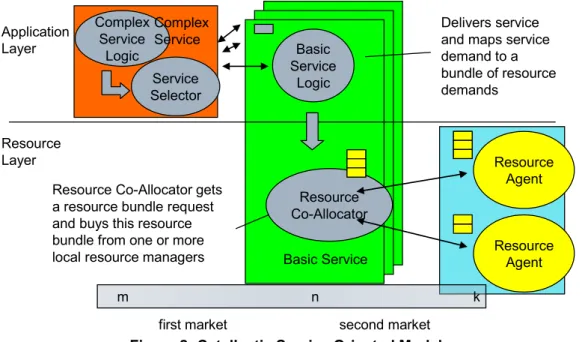
Current Grid Computing architectures exhibit fairly static resource infrastructure which are connected by physically stable links. The shift to a pervasive Grid, that could exist ubiquitously, demands for a more dynamic consideration of resources and connections. The market is understood to be a decentralized control mechanism for services and resources. Figure 2 shows this service oriented model.
A complex service could be represented by a proxy which needs (remote) basic ser-vice capabilities for execution – with support for a serser-vice selector instance. Complex services are therefore shielded from the details of the resource layer. A basic service is split into the basic service logic and a resource allocator. The logic is able to nego-tiate with the complex service and to translate the requirements for service execution on a resource instance (e.g. CPU, and storage, etc.). A resource allocator gets the resource specification and broadcasts the respective demand to the local resource managers. This comprises bundles and coallocative negotiations. Bundles are un-derstood as an n-tuple of resource types (e.g. a 3-tuple would be: CPU, storage, and bandwidth); co-allocation describes obtaining resources for one single service trans-action from various local resource managers simultaneously. Local resource/job scheduling is not the focus of the project. It is expected that a local resource manager hides all details of the allocation.
On the first market, complex service and basic service negotiate; an agent managing a complex service acts as a buyer, the basic service agent as a seller. The same market roles can be found at the resource layer, the resource allocator is the buyer agent, the local resource manager acts as a seller agent. Contemplating the second market, it is a “n” to “k” market: “n” basic service copies can bargain with “k” resource services. This takes dynamic resources into account. Resources are in our view
enti-ties that can fail like basic services, and which are subject to maintenance and in-spection procedures or link failures.
The Basic Service is a standardized service for query job execution. At the applica-tion layer, the Basic Service consists of:
x a seller entity on the service market;
x an entity to translate a query based on resource demands.
The main functionalities of the Resource Co-Allocator at the resource layer are:
x Representing the buyer entity on the resource market.
Entities of a seller on the resource market are able to provide a set of resources via the Local Resource Manager (LRM). The Resource Agents act on behalf of these LRMs, which hide the physical resources behind them.
Figure 2: Catallactic Service Oriented Model
We expect an ALN to be built from basic services that can be dynamically combined to form value-added complex services. These basic services require a set of re-sources, which need to be co-allocated to provide the necessary computing power.
Therefore, the introduction of new services into an ALN, due to the dynamic nature of the environment, precludes any manual or static configuration and demands a self-organization approach. One goal of self-managed network services is to move away from individual system configuration management to policy management. This ap-proach brings a higher level of abstraction to management, by introducing a policy from which the configuration is derived, allowing components of the infrastructure to apply these derived configurations to the individual systems across the environment.
In this context, the resources associated with self-managing services make use of Service Level Agreement-based (SLA) policies for services and resources, mapping required SLAs to resource needs, discovering resources that guarantee an adequate Quality of Service (QoS), allocating resources to ensure that allocation policies are
Complex Service Logic Resource Agent m n k Basic Service Logic Resource Co-Allocator Resource Agent
first market second market
Application Layer
Resource Layer
Basic Service Resource Co-Allocator gets
a resource bundle request and buys this resource bundle from one or more local resource managers
Delivers service and maps service demand to a bundle of resource demands Service Selector Complex Service
meet, and providing a management interface to monitor a control service life-cycle. Because of the dynamicity of the environment for which our approach is intended, the service allocation framework must address some specific issues:
x Situation: a service must be aware of its location and the availability of peer ser-vices within its “vicinity”, with which to collaborate;
x Dynamic (re)configuration: usage patters from service users are unpredictable, therefore neither the location nor the number of service instances could be known in advance. New instances must be created and located as needed;
x Topology neutrality: services deployed in the ALN could have very different inter-action topologies. Some will be structured in a hierarchical overlay, like content distribution networks, while others interact in a closely connected P2P overlay;
x Autonomy: a service and the resources it uses will span multiple administrative domains, so each resource provider should be allowed to take decisions autono-mously.
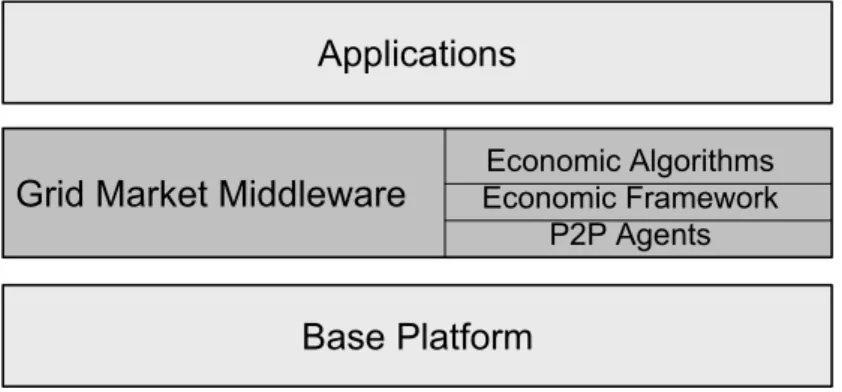
The economic-based resource allocation model has been implemented in the Grid Market Middleware (GMM), which provides the mechanisms to register, manage, lo-cate and negotiate for services and resources. It allows trading agents to interact with each other based on their requirements/demands and engage in negotiations. Fur-thermore, the middleware offers a set of generic negotiation mechanisms, on which specialized strategies and policies can be dynamically plugged in. The middleware – as shown in Figure 3 – has a layered architecture, which allows a clear separation of platform specific concerns from the economic mechanisms, to cope with highly het-erogeneous environments.
Figure 3: Layered middleware architecture
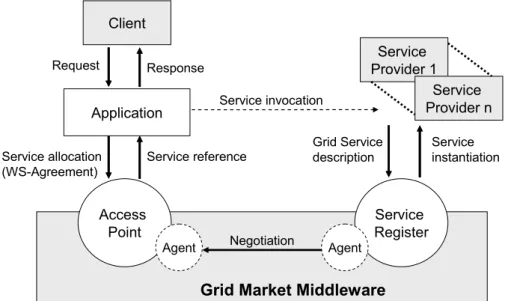
Figure 4 shows the interaction between the applications and the GMM, which is based on the WS-Agreement specification. The use is initiated from within the proto-type, at the application level; the interaction between the application and the middle-ware is as follows: a user issues an application request, which is interpreted by the prototype and converted into an application service request; then the application de-termines which Grid service(s) is (are) required to fulfil the specific application service request. These Grid services represent either software services (e.g. query services or data mining services) or computational resources. The application service
trans-Applications
Base Platform Grid Market Middleware
Economic Algorithms Economic Framework
lates these requirements into a WS-Agreement template, which is submitted to the GMM.
The GMM searches among the available Grid/Web Services, which have registered their particular service specifications, such as: contractual conditions, policies and QoS levels. When a suitable Grid service provider is found, the application require-ments are negotiated within the middleware by agents who act on behalf of the ser-vice providers as sellers and the application as buyers. Once an agreement has been reached between the trading agents, a Grid service instance is created and a refer-ence is returned to the application, which then can invoke it.
Figure 4: Interaction between the Application and the Grid Market Middleware
To take full advantage of these market mechanisms, it will be necessary to include some logic at the application level by specifying a maximum price for a “Web Service type” the application is interested in. This maximum price is like a budget for the buy-er sbuy-ervice agent that could be spent to buy basic sbuy-ervices and resources. The logic at the application level will include a policy document on which the decision is taken by the application to accept or reject the Web Service instance that has been found on the market. The policy document in this case will take the “price” as the characteristic to be taken into consideration, and this is achieved by checking that this is less than the budget proposed initially by the application.
The benefits of defining this architecture have been the following:
x Following this architecture, the different agent strategies could be imple-mented by substituting mainly only the components referring to the Economic-sAlgorithms layer.
x The communication between the application and the middleware has been re-duced to the communication to a Catallactic access point, which by means of the WS-Agreement specification transmits all required information to the mid-dleware.
Application
Grid Market Middleware
Service Register Service Provider 1 Request Service allocation (WS-Agreement) Grid Service description Client Service reference Service Provider n Response Access Point Negotiation Agent Agent Service invocation Service instantiation
2.3.2 Catallactic-enabled applications
The catallactic paradigm as introduced in predecessor Catnet project has been im-plemented in a concrete middleware and prototype applications in the scope of CAT-NETS project. The experience gained on such endeavor has resulted in both deceiv-ing and promisdeceiv-ing conclusions, shared in equal proportions.
In the deceiving side, important trouble during prototype calibration has come from the requirement of dealing with decentralized decision makers (the trading agents) in a real, networked, infrastructure. Such a development is pioneering, since state of the art approaches to fully decentralized markets based on bargaining agents have been based purely in simulations. In that sense, “touching the ground” of real deployment has proven hard due to the uncertainty and lack of control in such “engineering with complexity” tasks. Emergent engineering has been largely coveted by large distri-buted systems engineers, but to date just initial steps in form of proposals have been achieved. In our view, and summarizing our experience, more advances trough ex-tensive testing in both software lifecycle management and practical deployment tips need to be realized in other to reach maturity.
In the promising side, we have been indeed able to design, implement and deploy a fully decentralized prototype incorporating emergence and self-organization using state of the art tooling. The GMM implementation has been proven as useful in sev-eral applications. The use of the Catallactic middleware has been shown by two ap-plications: COVITE being available as Grid Service and Data Mining tools given as Web Services. Both of these applications have been Catallactic-enabled within the project. From the experience obtained, we have found that applications provided as services can be enhanced with reasonable effort to interact with the GMM. Addition-ally, the GMM is being useful as an infrastructure root for further development in Grid Markets research project, as in the case of SORMA. The open issue with the cata-llactic-enabled applications is to achieve improved system control, in the form of more predictable outcomes out of the emergent properties of the markets.
From the application point of view, the fact of having participants offer and request for application services and computing resources of different complexity and value in a distributed environment leads to the creation of interdependent markets. In such in-terrelated markets, allocating resources and services on one market inevitably influ-ences the outcome on the other markets. A common approach of many other Grid market concepts is to allocate resources and services by relying on the presence of centralized resource/service brokers. However, the complex reality could turn such approaches useless, as the underlying problem is computationally demanding and the number of participants in a worldwide distributed environment can be huge.
Different examples of application scenarios can be constructed which benefit from using the Catallactic markets in combination with different auction mechanisms in the Grid. This leads to an advantageous flexibility in terms of fulfilling the requirements and needs of services and resources within the applications and hides all the com-plexity to the users. Let us consider an application scenario that requires a highly specialized service such as medical simulation service or visualization service, while another application requires a specific mathematical service. The mathematical ser-vice is more or less standardized and there are several suppliers offering this serser-vice, and an instance of a catallactic market could be initiated and based, for example, on a normal double auction. The medical simulation service, however, does not have
many service suppliers; therefore the liquidity of the market trading such services may be low. In such cases, an instance of a market could be initiated and be based on English auction mechanism. Other types of applications enable creation of Virtual Organizations (VOs) for planning, scheduling, and coordination phases within specific projects or businesses, and allows the users of a VO to interact among them for the duration of VO. The ability of a free-market economy to adjudicate and satisfy the needs of VOs, in terms of services and resources, represent an important feature that markets, through the auction mechanisms, can provide too. Such VOs could require large amount of resources which can be obtained from computing systems con-nected over simple communication infrastructures such as Internet.
In conclusion, catallactic-enabled applications are well motivated and address a real need of current realistic Grid scenarios. We have developed the first prototype avail-able which is avail-able to deploy the complex catallactic behavior in real Grid applications. The experience gained is valuable as it is, but it can be also profited by engineers in the field of “engineering with complexity and emergence”, where prototype implemen-tations and deployments in real testbed applications are increasingly necessary to advance the state of the art.
2.3.3 Standards
Service Level Agreements (SLAs) provide a contract between an application user requiring services/resources, and application providers determining what should be made available for external use. To enable service/resource sharing/usage in appli-cation environments, SLAs may be used to define: (a) requirements that such an ap-plication would place on services (and resources) owned by a third party; (b) check whether these requirements have been met during use. An SLA may also specify the penalty that a service provider may incur if terms in the SLA are violated.
Currently, SLAs are defined in a static manner, i.e. the terms within an SLA must ad-here to strict constraints, and are monitored during application execution – such as in WS-Agreement. However, within many applications, it is often difficult to define such constraints very precisely, thereby leading to a large number of violations. There is a need to modify an agreement that had already been established, especially if the agreement is used at a time much later than when the agreement had been defined. These requirements relate to comparing the cost of re-establishing a new agreement vs. being able to adapt an agreement that is already in place. Secondly, there is a need to support flexibility in the agreement if an agreement initiator is not fully aware of the operating environment when the agreement is defined. In this case, the agreement initiator may not have enough information to determine what to ask for from a provider. This is likely to be the case when an agreement initiator or provider operates with imprecise knowledge about the other party involved in the agreement.
Specifications which have been applied for the development of the prototype have mainly used the concept of SLA using the WS-Agreement protocol. The specification allowed describing the services needed by the users’ application. The protocol for the exchange of WS-Agreement messages between the application and middleware needs to be developed for further negotiation interaction, which has been identified as a limitation.
2.3.4 Implementation
The implementation of the prototype took advantage of the functionalities already provided by available toolkits, like Diet agents, JXTA, GT4 (the middleware selection process as well as the GMMs’ early design with them is described in the first year deliverable of WP3 [Del05a]). When running initial experiments with the developed prototype, however, limitations in the practical use of these toolkits have been ob-served, like a limited number of messages which could be sent with Diet, and the dif-ficulty of JXTA to work correctly with a small number of nodes.
The observed limitations of the Diet toolkit affected the initial design of the perfor-mance measuring framework. Another design has been finally implemented which did not rely on the messaging mechanism of Diet, such that in the current prototype we do not have a limitation concerning this issue.
The limitation of JXTA affects the scope of deployment of the prototype in the sense that in small scale scenarios the delivery of messages by JXTA is not reliable. In the environment of the cluster where the prototype has been used, the identified limita-tion did not appear by making use of particular JXTA messaging services for this con-text. From the experience obtained, for complete decentralized scenarios, DHT im-plementations like Pastry could have been a better choice for the implementation of the communication and search.
2.3.5 Evaluation of prototype performance
The prototype has been deployed in a cluster of Linux machines. Several experi-ments have been made with different type of economic agents, and varying the dif-ferent parameters of the experiment configuration. The experiments showed the be-havior of the measured parameters for concrete experimental settings. The character of the experimental results is rather that of confirming the implementation feasibility in terms of a prototype. The comparison of different agent approaches by means of the developed prototype is difficult. A large number of parameters remain uncontrolled due to the use of a real environment. The difficulty in configuring the Catallactic agents in the sense of being able to chose the most appropriate values for the para-meters makes it appearing too early for stable quantitative studies.
The level of the prototype imposed certain constraints on the system compared with what could be a production-quality implementation. As a consequence, quantitative results are only achieved within the scope of the prototype. Our performance results are experiments taken at different stages of the prototype development. Although they revealed the behavior of the system in the current experimental configuration, they gave feedback on the implementation and hints on the complexity of applying Catallaxy in real systems.
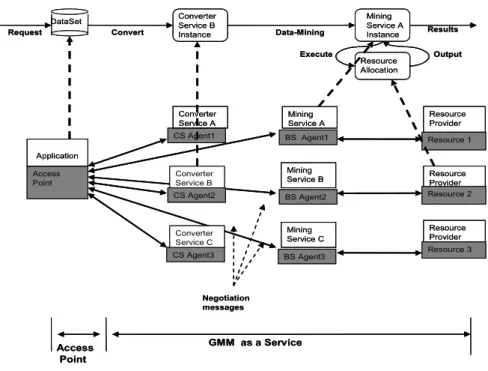
The flow of a typical prototype experiment is quite simple, if we consider the large number of automated steps from the original client request until the moment when the end point reference for service execution is returned back. An example of an ex-periment with 4 nodes is the following: Two nodes host a BS each and the Data Min-ing Web Service and other two nodes host the CSs, access points and clients. The Web Services are exposed in Tomcat servers. Access for execution of these Web Services on the resource node is what is traded between BSs and CSs. The
experi-ments consist of launching 2 clients concurrently, which use each one of the CS as broker. Each client makes 100 requests to the CS in intervals of 2 seconds. Whenev-er a CS wins a bid with a BS, it invokes the Data Mining SWhenev-ervice in the selected node, and the resource in the corresponding node gets locked for the duration of the ser-vice execution. We measure the selling prices of the BSs and observe the proportion of successful CFPs issued by the CSs. The development of the prototype has al-lowed assessing the feasibility of implementation, providing a flow of execution from the Client to the GMM access point, and from the Complex Services to the Basic Services, in the sequence depicted in Figure 5.
Resource Provider GMM as a Service Negotiation messages Mining Service A BS Agent1 BS Agent2 BS Agent3 Access Point Application Mining Service B Mining Service C Resource 1 Resource Provider Resource 2 Resource Provider Resource 3 Convert Data-Mining Converter Service B Instance CS Agent1 CS Agent2 CS Agent3 Converter Service B Converter Service C Converter Service A Mining Service A Instance Resource Allocation Results Request Execute Output DataSet Access Point Resource Provider GMM as a Service Negotiation messages Mining Service A BS Agent1 BS Agent2 BS Agent3 Access Point Application Mining Service B Mining Service C Resource 1 Resource Provider Resource 2 Resource Provider Resource 3 Convert Data-Mining Converter Service B Instance CS Agent1 CS Agent2 CS Agent3 Converter Service B Converter Service C Converter Service A Mining Service A Instance Resource Allocation Results Request Execute Output DataSet Access Point
Figure 5: Flow from Client request until Basic Service trading resources.
In general the performance results have been promising in the sense that they show coherent self-organizing behaviours in the bargaining agents. This includes coherent reaction to offer/demand variations, varying computational size of services to be ex-ecuted and the effect of background loads in the Grid. Improved control of such be-haviors could be achieved with further refinements of both multi-agent coordination protocols (i.e. the catallactic agents themselves and a measurement infrastructure incorporating latest advances in complexity management). Another interesting prop-erty which could not be assessed in the prototype (given the material limitations of the number of physical nodes available) is that of scalability. However, the results from the simulator on improved scalability of decentralized catallactic agents over centralized approaches offers a good insight on the “nice” scalability properties of the catallactic agents.
2.3.6 Conclusions
The implementation of two prototypes with a Catallactic based mechanism as well as generalisations of application with the GMM have raised interesting conclusions out-lined below:
x COVITE prototype supports the creation of Virtual Organisations (VOs) via a cen-tralised system. All resources and services are allocated by a central authority at the creation of the VO. A decentralized solution, as Cat-COVITE prototype pre-sented above, in which services and resources are to be allocated in peak/busy times to application users / processes is an straightforward way to deal with such demanding situations, while there is no other possibility of adding more resources or the availability of services is limited.
x A second solution, a Cat-Data Mining prototype, has been proposed and devel-oped. The main problem data mining services are addressing is of data that is typically too inconsistent and difficult to understand into such forms that are more compact, useful and understandable. This can be achieved via specific data-mining methods for pattern discovery and extraction. This process can be struc-tured into a discovery pipeline/workflow, involving access, integration and analysis of data from disparate sources, and to use data patterns and models generated through intermediate stages. The GMM addresses the need of such data mining services to be found just-in-time and used by the application services.
x The Catallactic markets are expected to provide members of VOs a fair price for services needed by the users’ application.
x The Catallactic markets are also expected to provide a fair welfare distribution among the participants, such as users’ application, and service and resource pro-viders.
x The Catallactic mechanism is expected to help systems in discovering and select-ing resources and services on demand and just in time, as application processes can make use of third parties services or can demand more and more resources.
x Relevant prototype metrics are proposed and a composite index - social utility factor, is being calculated as a single index, so that comparison and evaluation of different scenarios, as well as between prototypes and simulators can be realised.
2.4 Metric evaluation
2.4.1 The metrics pyramid
It is often useful to be able to compare two allocation methods using a single index or number. Such an index provides an aggregated behaviour of an allocation method with reference to a number of features. The application of statistics is necessary to achieve the index, but is useful only in conjunction with a detailed measurement framework. The results of the measurement are intended to allow providing feedback on system behaviour, improve chances of successful adaptation, improve implemen-tation, and increase accountability.
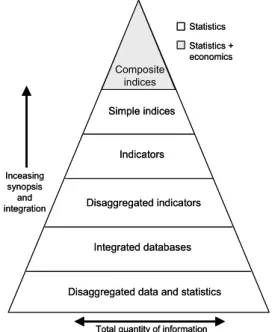
Figure 6 shows the logical structure of data and indices. It sums up the underlying methodology establishing the shape of a pyramid. Data are the basic units of infor-mation, collected through technical monitoring of the application layer network. Pa-rameters which are likely to be of significance within the application and the resource allocation mechanism have to be selected for measurement. These parameters de-fine the raw disaggregated data. To ease the analysis of the raw data, they are col-lected from different experiments (simulation runs) into plain text files. Disaggregated
indicators provide the first stage of evaluation, and comprise of a number of inde-pendently measured values. They help to improve the implementation of the resource allocation mechanisms.
For further evaluation, it is obligatory to take into account a set of characteristics that are not directly comparable because these characteristics correspond to variables of different dimensions and unit of measurement. Thus, they have to be made compa-rable, e.g. by normalization, and then grouped into indicators. An indicator is defined as a ratio (a value on a scale of measurement) derived from a series of observed facts, which can reveal relative changes as a function of time. They provide feedback on system behaviour and also allow the analysis of performance and predictions of future performance.
Disaggregated data and statistics Disaggregated indicators
Integrated databases Indicators Simple indices
Total quantity of information
Composite indices Inceasing synopsis and integration Statistics + economics Statistics
Disaggregated data and statistics Disaggregated indicators
Integrated databases Indicators Simple indices
Total quantity of information
Composite indices Inceasing synopsis and integration Statistics + economics Statistics
Figure 6: General method to obtain a composite index
Finally, the simple and composite indices are computed, which represent perform-ance benchmarks. They express information in ways that are directly relevant to the decision-making process. In general, indicators help the assessment, the evaluation, and most important, they help to improve accountability. Although highly aggregated indices are attractive because of their simplicity, they also carry risks. Most of all, ag-gregates tend to mask real-life complexity and detail for policy-making. Highly aggre-gated indices are important in giving a view of overall progress, but they should be readily disaggregated into its components that may help to specify reasons for the index going up or down and also answer questions of interest to decision-makers working on lower scales. The pyramid with its different layers supports this analysis progress, it enables both analysis at lower scales and decision-making on highly ag-gregated indices.
Social Utility Effort Benefit Infrastructure Costs On Demand Availability Average Distance bet w e e n Contr act Partners Risk Standard D evi ation Avg. Resource Access T ime #Messages
# Hops Message Size
Negotiation Time Discovery Time Average Allocati on Rate Average Serv ic e Usage Avgerag e J ob Exec ution Overhead T ime Ex-Post Whole System View
Average Negoti ation Ne tw o rk U sage
Service / Resource Usage and Idle Time Aggregated utility Average Agent ‘s Satisfaction
Service Provisioning Time
Average Resourc e Usage Only conceptual layer Avg. Service Access T ime Message Latency # Requests # Accepts Agent‘s Satisfaction
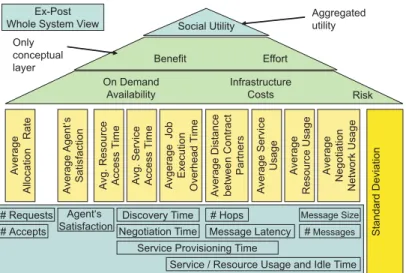
Figure 7: Metrics Pyramid
To support both technical and economic parameters, the evaluation process is di-vided into two layers. The first uses basic statistical concepts, while the second uses economic principles. The technical parameters, at the lower end of this pyramid, pro-vide the basis for economic parameters that lie higher up in the pyramid, as illus-trated in Figure 7. A prerequisite is, that the key parameters at the bottom layer can be technically measured in the system to be analysed.
Aggregated indices may be generated out of several of these low level parameters. The parameters at the higher layers of the pyramid have economic semantics and therefore a higher significance. At the top of the pyramid there is a composite index defined as (global) “social utility” – providing a single metric to specify the overall per-formance of the allocation strategy being used in a particular application.
The selection of the technical parameters, and their aggregation to simple and com-posite indicators, can vary, depending on the resource allocation method and/or the measurable technical metrics of the application domain. The framework gives the possibility to add and remove metrics to optimize the framework for a special applica-tion domain without changing the general concepts used to build up this pyramid.
2.4.2 Technical and economical metrics
This section defines and illustrates various layers and aggregation steps of the met-rics pyramid, as used in the project CATNETS to analyse centralized and decentral-ized economic resource allocation methods.
The approach to technical metrics focuses on providing generic, easy to measure parameters, which can subsequently be aggregated. Technical layer metrics can be classified into: (I) efficiency measures (e.g. number of requests, number of accep-tances); (II) utility measures (e.g. agent satisfaction); (III) time metrics (e.g. discovery time, negotiation time, service provisioning time) which are measures of the rate of change of market processes; and message-based metrics (IV) to measure the activ-ity of users to communicate to find resources and services. The technical metrics in-clude:
x Number of Requests: This metric measures demand, counted as the number of requests for services and resources.
x Number of Acceptance: The number of acceptance measures successfully re-quested (acknowledged) services and resources.
x Agent Satisfaction: The individual agent satisfaction measures the utility gain of a single transaction, which is the distance between his lowest price willing to pay in this transaction and the final price of the agreement. It is defined as the ratio between the subjective reservation value and transaction price.
x Discovery Time: This metric is used to measure the time to find a set of possi-ble negotiation partners.
x Negotiation Time: The negotiation time measures the time needed to finish the negotiation between one buyer and one or several sellers. The measurement of the negotiation time starts after service discovery has completed, and ends before service provisioning.
x Service Provisioning Time (Effective Job Execution Time): The evaluation framework defines the service provisioning time as the service usage time of one transaction. It optionally includes also setup times, etc.
x Hops: The number of hops describes the distance between a service con-sumer and a service provider, counting the number of hops a message needs to traverse between them (this may be averaged over all the messages ex-changed between a consumer and a provider).
x Message Latency: The message latency measures the time a message needs to arrive at the communication partner. Message latency is a parameter that indicates the performance of the physical network link and its message routing capabilities. It is expected that a large distance (cf. also number of hops) be-tween a service consumer and service provider should lead to higher message latency. Whether hops or latency is used to measure distance should be de-cided casually.
x Message Size: This metric is used to measure the message size (e.g. in kilo-bytes).
x Number of Messages: This value counts the number of messages needed for service allocation. The traffic on a physical network link could be computed by multiplying the message size with the number of messages sent.
These metrics are used in two aggregation steps.
Simple indicators (first aggregation)
The simple indicator layer defines a set of independent metrics which are normalized between 0.0 and 1.0. This makes it easier to find valid functions for the layers above, such as on demand availability and infrastructure cost. The technical metrics may be combined to obtain a framework that enables evaluation of different service oriented architectures. The aggregated metrics at the simple indicator layer are:
x Allocation Rate: This metric is a measure of the efficiency of the allocation process, which is computed using the number of requests and number of ac-cepts. A buyer can demand services, but there is no guarantee that the alloca-tion mechanism (centralized or decentralized exchange) performs a match be-tween demand and supply.
allocation_rate = accepts/requests
x Agent Satisfaction: This metric implicitly shows the average surplus of the ser-vice provider or user (agent) in the system (normalized to the interval 0.0 and 1.0). A low value means that an agent has not been able to complete its goals successfully during the negotiation process. A high value means that the agent can constitute good results satisfying its requirements.
x Access Time: This indicator evaluates the time needed from the starting point of discovery until the final delivery of the service.
access_time = discovery_time + negotiation_time + provisioning_time
x Job Execution Overhead: This is the additional time needed for negotiation. It refers to the overhead introduced during the service negotiation process. The overhead is the sum of the service access time and the resource access time.
job_execution_overhead = access_time_service + access_time_resource
x Distance between Contract Partners: Message latency is the messaging time incurred by agents, and it is proportional to the distance between the sending and receiving nodes. The latter would be the ratio between the actual distance and the maximum distance between agents.
x Service/Resource Usage: The network usage will be evaluated by the ratio be-tween provisioning time and the total simulation time. This evaluation would be conducted for both services and resources.
service_usage = provisioning_time / simulation_time resource_usage = provisioning_time / simulation_time
x Network Usage: This metric is used to measure the total number of messages exchanged between two agents.
Composite indicators (second aggregation)
Composite indicators are an aggregation of simple indicators, and are closer in scope to the application than to the infrastructure. Simple indicators are normalized between a [0; 1] interval in order to be comparable with each other. From the economics per-spective, composite indicators measure the benefit from exchange (on-demand availability), and costs incurred from activities in the market (infrastructure costs). An optimal allocation mechanism would have an on-demand availability value = 1, and infrastructure costs = 0. On DeMand availability (ODM) is a composite indicator ob-tained as mean of simple indicators, and may be derived as:
ODM = 1/3 (allocation_rate + agent_satisfaction + job_execution_overhead)
Infrastructure Cost (IC) is calculated in the same way. It is also a mean of multiple simple indicators, and may be derived as:
IC = 1/4 (distance + service_usage + resource_usage + network_usage)
It may be possible to model some of these metrics as stochastic variables, giving a mean and standard deviation over which the given metric varies. In economic appli-cations, variance would be a measure for the overall “risk” to achieve stability of a given metric development.
The social utility – A composite index
To be able to use economic concepts into the evaluation process, a virtual policy maker is introduced, who aims to optimize the allocation. The behaviour of the policy maker is described with a goal function which is to be minimized under some con-straints. The constraints are determined by the structure of the economy, i.e. the un-derlying laws of the economy. The policy maker does not have complete knowledge of the economy, but uses a model of the economy based on statistical cause-and-effect relations. The policy maker collects all the metrics from the previous layer, has some preferences about ODM and IC and is aware about the distribution of profits and costs.
In order to follow this approach for ALNs, a loss function is built using the composite indicators ODM and IC. ODM and IC are taken as stochastic variables and their dis-tribution across a population (the set of service users and providers). For the final evaluation of the scenarios, the first and second moments of ODM and IC have to be evaluated, whereas the first moment is the mean of ODM and IC, and second mo-ment the variance of ODM and IC. In fact, a policy maker has preference to minimize the inverse of ODM, thereby leading to the minimization of costs and the minimization of variability, i.e. the fair distribution of social utility between agents. Applying the de-picted metrics pyramid, a layered evaluation of different resource allocation methods is possible.
2.4.3 Statements on applying the Catallaxy to Application Layer Networks
The final statement “Catallaxy is more / less efficient than central mechanisms” could not be obtained from the experiments in general. However, there is a catallactic strategy configuration which achieves equal or better performance in terms of equal or better social utility values than the centralized allocation approach of the simulated scenarios. The following insights have been accomplished:x The Catallactic mechanism needs to be improved in terms of messages needed. The total number of messages could be reduced be increasing the price step value in the current strategy implementation.
x The configuration complexity in terms of the number of parameters compared with other economic mechanisms is very high in the Catallactic mechanism. On the one hand, this flexibility enables to find a good parameter configuration in all evaluated scenarios. On the other hand, there is no single configuration which can be applied in most scenarios.
x Comparison with centralized mechanisms is difficult since the performance does depend on each catallactic agents` strategy in the catallactic scenarios. In the centralized case, the auctioneer`s decisions only depend on the incom-ing supply / demand messages. Catallactic agents follow a heuristic strategy whereas the centralized auctioneer implements a mathematical algorithm with theoretical foundations (state-of-the-art matching mechanism).
x Advantages of the centralized mechanism originate in the significantly lower number of messages needed and the fact that the catallactic case supports only single-attribute negotiations can take place, whereas the auctioneer me-chanism can handle multi-attribute negotiations. This limitation was imposed by the agents` strategy implementation. The learning and decision algorithms were implemented to cover only single-attribute negotiations. For this project a model was used in which each agent could only be involved in one negotiation at a time. This model posed serious limitations on performance – for a more efficient system the option of parallel negotiations would have to be imple-mented. This model also results in a very restrictive blocking policy of the agents.
x Implementation aspects of the simulator were underestimated. More time was spent on testing of the simulator tools and the implemented agents. Therefore, the co-allocation implementation and the shared resource model have still ex-perimental status.
x Analyzing the trading agents in the decentralized strategy, two dominant trad-ing strategies lead to profit (positive fitness) in a bilateral negotiation. Either the agents make often concessions with small steps or the agents follow a strategy with a low concession rate together with a high step size. Weighting the last agreements with 60% seems a good value for the successful agents.
x No clear picture evidences the applied service and resource distributions in scenarios with the catallactic strategy. A placement of resource on good con-nected nodes results in better social utility values. This is an argument for or-ganizing computing centers in a centralized way. Uniformly distributed service and resources lead to good availability of the specific service and resource. But, higher deviations from the mean values could be observed than in other experiments. The competition for several service and resource increases the social utility index and the system’s loss.
x In absolute numbers, the decentralized allocation approach is able to achieve a social utility index value of around 0.4. This value is 20 % better then the measured value for the centralized allocation approach in the comparison scenario. Again, this indicates the strong influence of the configuration on the allocation performance of the catallactic approach.
x In the evaluated scenarios, the decentralized allocation approach shows high-er allocation rates than the centralized allocation approach. The centralized method sacrifices a higher allocation rate for the economic outcome of the auction.
x Varying discovery timeouts increase the availability of the sellers and point at successful refinement of the decentralized search strategy.
x The implemented decentralized bargaining protocol is error-prone which exhi-bits the failure experiments. At the time of development, the main focus was more at a sound and functional messaging structure and implementation than a failure-resistant bargaining protocol. More effort is needed for improving the bargaining protocol.
x The metric pyramid and the selected metrics enable the analysis of complex application layer networks. Changes in the measured metrics are mapped very well to the upper layers of the pyramid. The aggregation steps keep the cha-racteristics of the raw data and indicate different allocation performances in the evaluated scenarios. The general applicability of the metrics pyramid offers a broad evaluation of resource allocation approaches in future application layer networks. However, the metrics pyramid exposes limitiations. The num-ber of observations and the agent population should be evaluated in parallel to verify the expressiveness of the aggregated indexes.
x The decentralized allocation performance does not decrease in increasing network sizes. The hop count and discovery timeout parameters control the accessible area of the network for the decentralized allocation approach. Only a subset of (theoretically) available service and resources can be selected as trading partners. This helps achieving good social utility index values in large networks.
x Varying bandwidth decreases the system loss for the decentralized allocation algorithm. The bandwidth controls the set of available sellers. Not reachable seller can provide their service to another buyer which is located closer the re-questor. Also, the set of unique trading agents increase. A more distributed behavior is observed. However, too low bandwidth increases the system’s loss significantly.
x The hop count parameter which can be seen as a time-to-live parameter in P2P networks shows significant influence on the decentralized allocation ap-proach. The following rule is derived from the experiments: The higher the service density is, the lower the hop count parameter should be selected.
x Randomizing the initial genotype values lead to lower performance of the de-centralized allocation approach because the agents need time to adapt to the dominant strategies described above. Compared to simulations runs with one predefined genotype for all agents, a significant lower performance is meas-ured.
x A crucial part of the catallactic strategy is the adaptation of the negotiation in-tervals for the the next negotiation which depends on the market price estima-tion. The selected dynamic strategy exhibits good performance in all simula-tion scenarios. It is expected that an improved adaptasimula-tion strategy can lead to better performance in terms of a decreasing message number and better allo-cation times.
2.5 Future Research on Properties of Catallaxy applied to Computer
Networks
From a computational and engineering perspective, Hayek’s Catallaxy is successfully applied to computer networks in the CATNETS project. Explicit specifications of the Catallaxy for technical systems should encompass these agent features:
x Adaptivity: Agents learn from their own experience and from previous agree-ments, there is genetic recombination, mutation and selection, and agents are reactive and opportunistic being able to adapt their goals to local unpredictable and evolving environments. The current catallactic strategy implemented the first two adaptivity topics. The third issue gives further research prospects. More parameters could be taken into account for dynamic adaptation by the agent itself instead of being predefined at experiment start.
x Autonomy and initiative: The complex service handles the task to be executed. If it finds an opportunity (a seller which fits the requirements) – proactively