Compensating Disadvantageous Life Events
Social Origin Differences in the Effects of Family
and Sibling Characteristics on Educational
Outcomes
Michael Grätz
Thesis submitted for assessment with a view to
obtaining the degree of Doctor of Political and Social Sciences
of the European University Institute
European University Institute
Department of Political and Social Sciences
Compensating Disadvantageous Life Events
Social Origin Differences in the Effects of Family and Sibling
Characteristics on Educational Outcomes
Michael Grätz
Thesis submitted for assessment with a view to
obtaining the degree of Doctor of Political and Social Sciences
of the European University Institute
Examining Board
Prof. Fabrizio Bernardi, European University Institute (EUI Supervisor)
Prof. Hans-Peter Blossfeld, European University Institute
Prof. Dalton Conley, New York University
Prof. Jan O. Jonsson, Nuffield College, University of Oxford/ Swedish Institute for
Social Research (SOFI), Stockholm University
© Grätz, 2015
No part of this thesis may be copied, reproduced or transmitted without prior
permission of the author
T
ABLE OFC
ONTENTSChapter Title Page
Abstract ii
Acknowledgements iii
1 Introduction 1
2 Making Up for an Unlucky Month of Birth in School: Causal Evidence on the Compensatory Advantage of Family Background in England
35
3 When Growing Up Without a Parent Does Not Hurt: Parental Separation and the Compensatory Effect of Social Origin
59
4 The Causal Effect of Parental Separation on Child Education: A New Instrumental Variable Approach
83
5 Competition in the Family: Estimating and Explaining Educational Inequalities between Siblings
115
A
BSTRACTThis thesis is a collection of four empirical studies which analyze the effects of family and sibling characteristics on educational outcomes. The analysis in all empirical studies is guided by the compensatory effect of social origin hypothesis according to which higher social origin families can reduce the negative impact of disadvantageous characteristics and life events on their children’s educational outcomes. In detail, I study the effects of month of birth, parental separation, birth order, birth spacing, and maternal age. I use data on England, Germany, and Sweden. On a methodological level, I employ natural experiments, fixed effects methods, and instrumental variable (IV) estimation in order to control for the influence of unobserved confounding variables. Overall, I find support for the initial hypothesis with respect to the effects of month of birth, parental separation, and close birth spacing. Contrary to that, I find no systematic social origin differences in the effects of birth order and maternal age on educational outcomes. In the conclusion, I discuss the implications of these findings for theories of the intergenerational transmission of education, the differences in life chances of children from socio-economically advantaged and disadvantaged families, and the allocation of resources within families. I discuss how further research could possibly test in how far differences in parental involvement between social origin groups are underlying these relationships.
A
CKNOWLEDGEMENTSFirst of all, I have to thank Fabrizio Bernardi for the continuous support which he has provided during the four years of writing this thesis. Our conversations had a major influence on the direction of this thesis and it would have been a completely different thesis without them. Second, I would like to thank Juho Härkönen for having agreed on co-authoring a chapter of this thesis and, even more crucial, having provided me with a lot of helpful advice during the last years. Third, I would like to thank everyone at the Swedish Institute for Social Research (SOFI) and the Stockholm University Demography Unit (SUDA) where I spent four months in 2013, in particular, Erik Bihagen for making this possible. The spring term in 2014 I spent at the Department of Sociology at New York University and I would like to thank everyone whom I met there, in particular Florencia Torche and Dalton Conley who have both provided feedback on this thesis and engaged with me in some new research. Dalton Conley also agreed to serve on my thesis committee. In addition, I would like to thank Hans-Peter Blossfeld and Jan O. Jonsson who have also agreed on being part of the thesis committee and have contributed their perspectives on the content of this thesis.
Many other people have provided feedback on the thesis as a whole or on one of the four empirical chapters included in this thesis. I cannot mention them all but Kieron Barclay, Diederik Boertien, Andrés Cardona, Jani Erola, Anne-Christine Holtmann, Michael Gähler, and Berkay Özcan have provided particular critical and helpful suggestions. In addition, I would like to thank Yvonne Åberg and Helen Eriksson for sharing code which I used to construct the sample and variables used in the analysis reported in Chapter 4.
Writing this thesis would have been a lot more difficult and a lot less fun without the company and support of many people, in particular, the inequality working group at the EUI, the fishtank (Anna, Charlotte, Johan, and Raphael), the East Village neighbors (Anna, Vasyl) and our last year visitor (Zbig), the football players, and the Tuscan hills running expert (Lorenzo).
Back home, two wonderful families have been always very keen to hear the latest progress on this work from the start till the final, final submission. Thanks for having gone through this time together with me, in particular to the one who experienced this process the closest.
C
HAPTER1:
I
NTRODUCTIONThe Central Role of Educational Outcomes in Contemporary Societies
In developed societies education is an important predictor of positive life outcomes, not limited to but including high occupational outcomes, high levels of well-being, good health, and longevity. The importance of education in modern societies has been predicted by modernization theory. Its proponents argued that in modern societies occupational outcomes will be fully determined by innate abilities (Bell 1973; Kerr et al. 1960; Treiman 1970). Although in contemporary societies life chances are not completely determined by innate abilities, education remains an important predictor of life chances. Therefore, the study of determinants of educational success plays an important role not only in sociology but also in disciplines bordering on sociology such as demography and economics.
There are many factors, apart from innate abilities, which are known to affect educational outcomes, including social origin (Blau and Duncan 1967; Breen and Jonsson 2005; Coleman et al. 1966; Ermisch and Francesconi 2001a; Jencks et al. 1972; Pfeffer 2008; Shavit and Blossfeld 1993) and certain family characteristics (Steelman et al. 2002). However, research focusing on the way in which family characteristics and social origin influence each other with respect to children’s educational outcomes is rare. The aim of this thesis is to bring together these two strands of research by analyzing how the effects of family and sibling characteristics on educational outcomes vary by family socio-economic background. For this purpose, this thesis collects four empirical studies which analyze whether the effects of month of birth, parental separation, birth order, close birth spacing, and maternal age on child education differ with social origin.
The four separate studies test a common theoretical framework. I label this framework the compensatory effect of social origin hypothesis. The expectation derived from this framework is that the consequences of disadvantageous life events and family characteristics are less negative in higher than in lower social origin families (Bernardi 2014; Conley 2004, 2008). I expect this to be the case because higher class families have more resources available which can be mobilized in order to counteract disadvantageous life events which may negatively affect children’s educational outcomes.
In the introduction to this thesis I first discuss research on educational inequalities by social origin which is followed by a discussion of research on the effects of family characteristics on educational outcomes. After that I provide the main argument briniging
together these two strands of research: the compensatory effect of social origin hypothesis. It is this theoretical framework which underlies the four empirical studies collected in this thesis. Next, I discuss the methodological issues involved in identifying the compensatory effect of social origin. I finish this introduction by providing an overview of the four empirical studies collected in this thesis.
The Association between Social Origin and Educational Outcomes
An extensive literature in sociology deals with the association between social origin and educational outcomes (Breen and Jonsson 2005; DiPrete and Hout 2006). Shavit and Blossfeld (1993) argue that inequalities in educational outcomes by social origin have not been reduced in most industrial countries despite educational expansion. In recent years, more detailed research has shown that inequality in educational opportunity has actually decreased in many societies to some degree (Ballarino et al. 2009; Blossfeld et al. 2015; Breen et al. 2009; Breen et al. 2010; Jackson 2013; Tieben et al. 2010).
Independent of whether a decrease in educational inequalities can or cannot be observed, it is not contested that family socio-economic background is still considerably associated with educational outcomes. For instance, in Germany, which is one of the countries analyzed in this thesis, the probability to attend the upper track in secondary school (Gymnasium) at age 16 to 17 years is about 46 percentage points higher for children from families in which at least one parent successfully graduated from the upper track compared to children from families with a lower level of parental education (the figure is based on my own calculations based on the SOEP data employed in Chapter 3 and Chapter 5).
Whereas descriptive evidence on the association between different measures of social origin and educational outcomes is available in abundance, there is less research that tests the mechanisms underlying educational inequalities. There are many theories aimed at explaining how social origin influences educational outcomes but empirical tests of these mechanisms are rare, in particular against each other in the same study and employing a research design which controls for unobserved heterogeneity. For that reason, we still do not know much about why educational inequalities by social origin emerge and why they are so persistent across countries and cohorts.
Based on previous research, we can distinguish at least four mechanisms that are assumed to produce the effect of social origin on educational outcomes. First, a part of the association between family background and educational outcomes may be mediated by the
transmission of genes from parents to their children (Asbury and Plomin 2014). Research in behavioral genetics argues that large parts of education are heritable (Plomin et al. 2013). This high heritability of education is not only due to the heritability of intelligence but also to the heritability of many other psychological traits such as self-efficacy, personality, or behavioral problems which correlate with education (Kraphol et al. 2014). Outside of behavioral genetics it is, however, debated how reliable the estimates of heritability are as they are constructed comparing correlations in educational outcomes between identical and non-identical twins (Goldberger 1979; Jencks 1980; Manski 2013). For this reason the role genes play as a mechanism underlying educational inequalities is, to a large extent, unclear. Recent evidence based on genetic risk scores suggests that about 1/6 of the association between maternal and offspring education is genetically transmitted—although this may be a lower bound estimate which is likely to change upwards with improvements in the measurement of genetic risk scores of educational attainment (Conley et al. 2015; Rietveld et al. 2013).
Second, a popular approach among researchers in the field of social stratification argues that educational inequalities by social origin are a product of rational decision making (Becker 2003; Boudon 1974; Breen and Goldthorpe 1997; Breen et al. 2014; Davies et al. 2002; Erikson and Jonsson 1996; Gambetta 1987; Goldthorpe 2007; Morgan 2005). According to these theories, children and their families make educational decisions based on the perceived benefits, costs, and success probabilities of educational transitions. The Breen-Goldthorpe model assumes that parents make educational decisions so that their children achieve at least the same occupational position as they have (Breen and Goldthorpe 1997). This motive leads children from higher social origin families to pursue longer educational careers in order to minimize the risk of downward social mobility. The same motive leads children from lower social origin families to choose shorter educational pathways because they can achieve their parental class position by means of shorter educational pathways. Empirical evidence on the key mechanism underlying this model is mixed. The studies which arguably provide the most stringent test of the main underlying mechanism according to the Breen-Goldthorpe model, the motivation to avoid downward social mobility, fail to find empirical evidence in favor of it (Gabay-Egozi et al. 2010; Stocké 2007). What is more, I am not aware of any study testing the rational choice mechanisms employing a research design which controls for omitted variable bias.
Third, educational aspirations and motivations also play a central role in the Wisconsin model of status attainment (Sewell et al. 1969; Sewell and Hauser 1975, 1980). In this research tradition, educational aspirations are a result of peer influences and reactions to
previous academic performance. Since pupils are segregated into schools, educational inequalities persist through these peer influences. As a result of these peer influences children from higher social origin families have higher educational aspirations. With respect to other theoretical backgrounds, other authors have also pointed to the role of peers in influencing educational and occupational decisions (Akerlof 1997; Manzo 2013). Newer empirical research by Bozick et al. (2010) supports to some degree the view that academic performance shapes educational aspirations through the application of individual-fixed effects models but they also show that for a large proportion of students, especially those from higher social origin families, educational aspirations are stable throughout their school careers.
Fourth, the cultural capital hypothesis argues that educational positions are reproduced through the transmission of cultural practices and knowledge from one generation to another (Bourdieu 1984; Bourdieu and Passeron 1977; De Graaf et al. 2000; DiMaggio 1982; Jæger 2011; Lareau and Weininger 2003; Willis 1977). According to Bordieu (1984) a certain combination of cultural competences, called habitus, is transmitted from parents to their children, largely through processes of which they are not conscious. The habitus of the upper class makes educational success more likely. Complementary to what Bourdieu argues for the upper class, Willis (1977) describes in an ethnographic study of British adolescents a working-class culture which devalues educational success. DiMaggio (1982) argues that it is precisely for children from low social origin families that cultural capital matters most because high levels of cultural capital enhance upward mobility. The cultural capital hypothesis is still influential in contemporary sociological work, in particular in ethnographic studies, such as Lareau’s (2011) Unequal Childhoods. According to Lareau (2011), parents from different social classes raise their children using very distinctive parenting styles which are consequential for their children’s life chances. Using a combination of family- and individual-fixed effects models, Jæger (2011) provides quantitative evidence that cultural capital indeed affects children’s test scores.
This thesis does not test these four competing mechanisms against each other. Contrary to that, I argue that there is a fifth mechanism which can explain the high level of educational inequalities observed in contemporary industrialized societies. According to the compensatory effect of social origin hypothesis, higher social origin families can compensate for the negative consequences of disadvantageous life events or characteristics (Bernardi 2014; Conley 2004, 2008). The impact that disadvantageous life events and characteristics have on educational outcomes has probably become more important over time and many of these traits which negatively influence future life chances are concentrated in lower social origin families
(McLanahan 2004). Both these processes may contribute to educational inequalities by social origin. I will expand on this argument in the section on the compensatory effect of social origin.
According to the compensatory effect hypothesis, focusing on educational inequalities by social origin, without taking into account how family and sibling characteristics influence educational outcomes, does not present an adequate picture of how educational inequalities emerge. The effects of family characteristics and social origin manifest themselves simultaneously. These interactions should be taken into account in order to provide a complete picture of inequalities in educational outcomes and of the mechanisms that bring them about. But before discussing how these two research fields can be brought together via the compensatory effect of social origin hypothesis, I first introduce central results of research on the effects of family and sibling characteristics on educational outcomes.
Family and Sibling Characteristics and Inequalities in Educational Outcomes
A considerable amount of research has dealt with the associations between certain family and sibling characteristics and educational outcomes (Steelman et al. 2002). More recent research has applied causal identifications strategies in order to test whether the associations between family characteristics and child education are due to underlying causal effects or whether selection processes bring about the observed associations. This literature has led to new insights so that many of the conclusions reported in the review article by Steelman et al. (2002) have to be updated given the results of this newer research.
Most prominently, a huge number of studies has argued that a larger family size is associated with lower educational outcomes (Blau and Duncan 1967; Blake 1985, 1989; Downey 1995; Hanushek 1992). More recent research, however, suggests that family size has no causal effect on educational outcomes but that the effects of family size on child education are dominated by those of birth order (Black et al. 2005; Conley and Glauber 2006; Guo and VanWey 1999). An instrumental variable (IV) approach by Jaeger (2008) leads to different results. However, he uses birth spacing as an IV which is probably violating the exclusion restriction of having no direct effect on educational outcomes since other research argues that close birth spacing leads to lower educational outcomes (Buckles and Munnich 2012; Pettersson-Lidbom and Skogman Thoursie 2009).
Other sibling and family characteristics, however, probably have a causal impact on educational outcomes. Examples of such characteristics include month of birth, parental
separation, birth order, birth spacing, and parental age. This thesis focuses on analyzing the variation in the causal effects of these family and sibling characteristics on educational outcomes.
Previous research has shown that each of these characteristics affects child education. Month of birth affects educational outcomes via the school entry age in countries with strict school entry admission rules (Bedard and Dhuey 2006; Bernardi 2014). Parental separation has been shown to be negatively associated with educational outcomes (Amato 2010; Jonsson and Gähler 1997). More recent evidence suggests that part of this association is brought about through a causal effect (McLanahan et al. 2013). Recent research, mainly focusing on differences within families, has shown that higher birth order children achieve lower educational outcomes (Black et al. 2005; Härkönen 2014). Close birth spacing is negatively associated with educational outcomes (Powell and Steelman 1993). Causal identification strategies have been employed to estimate the effect of birth spacing on child education with the result that at least part of this association is causal (Buckles and Munnich 2012; Pettersson-Lidbom and Skogman Thoursie 2009). It has been shown that a higher parental age leads to improved educational outcomes, both in cross-sectional data (Mare and Tzeng 1989) and in a research design which use only variation within families (Kalmijn and Kraaykamp 2005).
Most of the research on the effects of family and sibling characteristics on educational outcomes did not analyze how the effects of these characteristics differ with social origin. If there is heterogeneity by social origin, these studies misrepresent the true effects of these characteristics on educational outcomes. There are good reasons to believe that this is the case as I will discuss in the next section which develops the compensatory effect of social origin hypothesis.
The Compensatory Effect of Social Origin
There are good theoretical reasons to expect effects of family and sibling characteristics on educational outcomes to differ with social origin. I summarize these theoretical expectations under the framework of the compensatory effect of social origin hypothesis because they predict that the consequences of disadvantageous characteristics are less negative for children from higher social origin families. Furthermore, there is already empirical evidence that the effects of some characteristics vary by family socio-economic background in the way predicted by this hypothesis.
On the one hand, for theoretical reasons a compensatory effect can be expected because advantaged families have more resources available to them in order to counteract the effects of disadvantageous life events and characteristics (Bernardi 2014). Conley (2004, 2008) develops the argument that siblings in higher social origin families are more similar in their educational and occupational outcomes than siblings in lower social origin families. This is because higher social origin families have more resources available in order to compensate for disadvantageous life events to ensure that their children are less affected by them.
This perspective also echoes the above-mentioned work by Lareau (2011) on different childrearing practices in lower and upper class families. These different styles of raising children may become particularly important in those cases in which children and families are confronted with disadvantageous life events which endanger the future educational and occupational outcomes of their children.
The compensatory effect of social origin hypothesis suggests that children from lower and higher social origin families follow “diverging destinies” (McLanahan 2004) not only with respect to the occurrence of disadvantageous life events but also that the negative consequences of disadvantageous life events are more pronounced in lower social origin families. If this hypothesis can be confirmed with respect to many influencing mechanisms, the compensatory effect may actually be a more important mechanism for the reproduction of educational inequalities than cumulative advantage (DiPrete and Eirich 2006).
On the other hand, there is empirical evidence already available that the effects of some life events vary in the direction expected by the compensatory social origin hypothesis, mainly through research on the consequences of early child health on later life outcomes (for an overview see Almond and Mazumder 2013). For instance, Almond et al. (2009) show that the negative effects of random exposure to higher radiation in utero due to the Chernobyl nuclear accident on child cognitive performance are concentrated in families in which the father has a low level of education. Similar results have been obtained for the effects of birth weight (Conley and Bennett 2001; Torche and Echevarría 2011). Bernardi (2014) adds to this literature by showing that the negative effects of school entry age, an event which is not connected to birth endowments, on grade retention in France are concentrated in low-SES families. Ermisch and Francesconi (2013) show that maternal employment during childhood has stronger negative effects on child education for children with low educated mothers than for children with highly educated mothers.
Certainly, these life events differ in their characteristics and they may also differ in the mechanisms which result in the observed compensatory effect. Parents may also respond
differently to different sorts of disadvantage (Almond and Mazumder 2013). Nevertheless, a compensatory effect of social origin has been observed for these diverse life events. Hence, it is interesting to analyze whether a compensatory effect can be observed in further instances. This will also help to develop the underlying theory of the compensatory effect.
In the previous section I argued that the compensatory effect of social origin can contribute to educational inequalities by social origin. This is the case for two reasons. First, lower class children are more often affected by these disadvantageous life events (McLanahan 2004). If these life events were indeed having negative causal effects, on educational outcomes, they imply lower levels of educational attainment simply because these life events happen more often in lower class families.
Second, the compensatory effect of social origin hypothesis argues that the consequences of these life events are more negative for children from lower class families. For that reason, the occurrence of a disadvantageous life event or characteristic may reduce the educational outcomes of a lower class child more than the educational outcomes of a upper class child. As a result, the average gap in educational outcomes between lower and upper class children is larger than in the counterfactual situation in which the life event would not exist, e.g. in a world in which there were no parental separations.
These implications are restricted to factors which influence educational outcomes independent of how families allocate their resources within families. In the case of birth order and differences in birth spacing this implication may not hold because lower class families may adapt their investment strategies and invest more in the child in the more advantageous position which may result in the end in an unchanged average educational attainment of the family. Hence, in the latter case within-family inequality does probably not change average class differences in educational attainment.
The central aim of this thesis is to test to which life events and family characteristics the compensatory effect framework can be fruitfully applied and to test in which instances a compensatory effect can be observed. It is against this theoretical background that I study how the effects of month of birth, parental separation, birth order, close birth spacing, and parental age on educational outcomes differ by family socio-economic background.
The compensatory effect of social origin hypothesis argues that the causal effect of family and sibling characteristics differs with social origin. Differences in associations between family characteristics and educational outcomes across social origin groups could be a result of differential selections into family characteristics by social origin. For this reason, research designs that do not help to support causal claims are insufficient as tools to study the
compensatory effect of social origin hypothesis. It is essential to test the theory by applying research designs that allow me to interpret effect estimates as representing causal effects. Therefore I discuss the issue of causal inference in the next part of this introduction.
Identification of Causal Effects
Each chapter of this thesis aims at estimating the causal effect of at least one life event or characteristic (month of birth, parental separation, birth order, birth spacing, and maternal age) on child education. I place particular emphasis on the question whether these effects vary with social origin. This aim of the thesis requires the application of research designs which allow me to interpret the obtained estimates of events and characteristics as the causal effects of these events and characteristics on children’s educational outcomes.
This thesis is concerned with what has been labelled “effects of causes” (Goldthorpe 2001, 2007, in press) or “forward causal questions” (Gelman and Imbens 2013). This follows the logic that first it has to be found out whether an effect does indeed underlie an association before the causes will be studied. In my conclusion I will discuss how future research may test mechanisms bringing about the causal effects and the additional challenges involved in such an enterprise.
Theory is important for the identification of causal effects, largely because theory is needed to explain why certain variables affect other variables (Esser 1996). Goldthorpe (2001, 2007, in press) argues that mechanisms which underlie the relation between these variables have to be proposed in order to identify causal effects. These mechanisms postulate possible ways in which actors may bring about a causal effect. In the context of the effects studied in this thesis, the actors are mostly children, their parents, and their siblings.
I agree that mechanisms and theory play a role in identifying a causal effect. With respect to the causal effects analyzed in this thesis, there are hypothesized mechanisms that bring about the effect of these characteristics on child education. In each chapter I discuss in detail the underlying mechanisms of the causal effects under study. With respect to the effects of month of birth on educational outcomes, the underlying mechanisms are the maturity effect, the relative age effect (Bedard and Dhuey 2006), and the differences in the length of time children spend in reception class. With respect to the effects of parental separation on child education, it has been argued that the underlying mechanisms are changes in parental involvement and in economic circumstances as a consequence of parental separation as well as stress experienced by the child during the separation process (Amato 2010; Jonsson and
Gähler 1997). Zajonc and Markus (1975) argue that birth order and birth spacing influence child cognitive development through changes in the intellectual family environment with each additional family member. A further mechanism could be that the time parents can spend with each child is decreasing with each new family member (Price 2008). Hence, each younger sibling spends less time with the parents as his siblings did at each age of childhood (if parents were distributing their time equally between their children). Close birth spacing may lead to additional time pressure on the parents (Powell and Steelman 1993). Maternal age may be influencing children’s educational outcomes because mothers develop more skills during the course of their lives and this may positively affect their parenting and, through parenting, their children’s educational outcomes (Kalmijn and Kraaykamp 2005).
While I agree that mechanisms play an important role and always should be hypothesized as underlying causal effects, I follow those researchers who argue that postulating mechanisms is not enough in order to identify causal effects since unobserved variables may lead to selection into the family and sibling characteristics under consideration and this may bias naive estimates (Almond and Mazumder 2013; Angrist and Pischke 2009, 2010; Firebaugh 2008; Moffit 2005; Morgan and Winship 2015; Winship and Morgan 1999). “Theory has to be anchored in reality. Sooner or later, invariance needs empirical demonstration, which is easier said than done.” (Freedman 2004: 277)
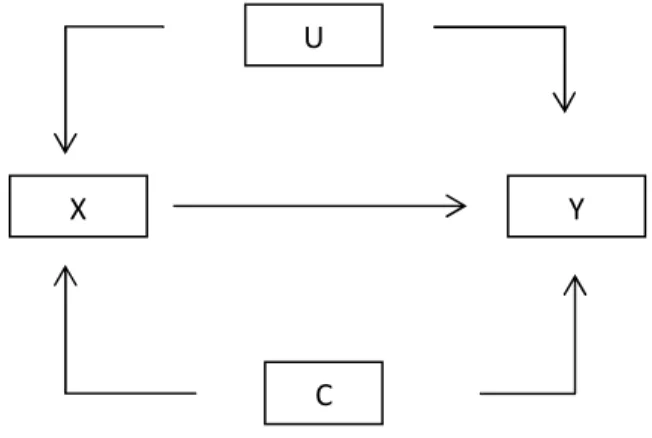
The challenge presented by selection on unobserved variables can be illustrated with a simple example. Figure 1.1 represents a graphical representation of the identification problem, that is of estimating the causal effect of a variable X on a variable Y when an unobserved variable U is influencing both X and Y (Freedman 2004).
C is observed and can therefore be controlled for. Hence, standard regression or matching methods, as they are usually applied in sociology, can take into account selection on these observed variables. However, the more important threat to identification of the causal effect of X on Y comes from the unobserved variable U. In order to identify the causal effect of X on Y, research has either to control for U by means of employing a research design which allows researchers to control for unobserved variables or to demonstrate that there is no unobserved variable U influencing the relation between X and Y (Moffit 2005).
It is nearly impossible to demonstrate that there is no unobserved variable U influencing the relation between X and Y. Therefore I apply in this thesis design-based approaches which control for selection into family characteristics on unobserved variables (Almond and Mazumder 2013; Angrist and Pischke 2009, 2010; Firebaugh 2008; Moffit 2005; Morgan and Winship 2015; Winship and Morgan 1999).
Figure 1.1 A graphical representation of the identification problem
This approach to causal analysis defines a causal effect based on the comparison of alternative states of X, the observed state of X and the one of an unobserved counterfactual situation (Morgan and Winship 2015). Since it is not possible to observe the counterfactual situation at the individual level, causal effects can only be estimated at the aggregated group but not at the individual level. The most general causal effect, the average treatment effect δ, is then the average of the difference between the expected value of one state Y1 and the expected value of a counterfactual state Y0 : E[δ] = E[Y1 – Y0] = E[Y1] – E[Y0] (Morgan and Winship 2015).
I put particular emphasis on clarifying the assumptions which allow researchers to interpret estimates as causal effects. Since the counterfactual outcome can never be observed all empirical analyses are based on assumptions in order to identify causal effects (Moffitt 2005). However, some assumptions are more likely to be met than others and scientific evidence based on weaker assumptions is less likely to be refuted by further research. If studies identifying causal effects under different assumptions reach similar conclusions, this should increase confidence in the results of the analyses.
It is important to note that the counterfactual approach is an important departure from “variable sociology” (Esser 1996) and the tradition of causal statements based on statistical regularities of “robust dependence” (Goldthorpe 2001). Design-based approaches do not disregard the importance of theory in the identification of causal effects. “Design-based studies are distinguished by their prima facie credibility and by the attention investigators devote to making both an institutional and a data-driven case for causality.” (Angrist and Pischke 2010: 5) Theory is needed to justify the assumptions underlying any research design. For that reason, missing theory is actually not a critique which should be raised against the research design-based approach to causal inference. To my mind, this approach is very much
C
X Y
in line with the following conclusion by Goldthorpe: “In sum, the argument is, again as with Freedman, that establishing causation cannot result from statistical procedures alone but must be dependent upon some subject-matter theoretical input relating to how the data under analysis are produced.” (Goldthorpe in press: 126)
The challenge, then, is to find research designs which allow researchers to interpret estimates as causal effects under the weakest possible assumptions (Manski 1995). All empirical chapters collected in this thesis are concerned with estimating causal effects in situations in which conditioning is ineffective because selection is on unobserved variables (Morgan and Winship 2015). I view this as a rather conservative approach given the fundamental nature of the problem of causal inference (Angrist and Pischke 2009).
Any conditioning approach such as matching or regression analyses requires the complete model to be specified in order to yield unbiased and consistent estimates of causal effects. This is a highly unrealistic assumption in most applications but, in particular, as I argue in each chapter, in the situations analyzed in this thesis. Without controlling for unobserved heterogeneity, the postulation of theoretical mechanisms alone does not allow researchers to argue that an effect is indeed causal because unobserved variables may always confound the relationship.
I employ natural experiments (Chapter 2), family-fixed effects models (Chapter 3 and 5), and Instrumental Variable (IV) estimation (Chapter 4). In each chapter I will discuss the method employed and the assumptions under which the estimates provided by these methods can be interpreted as causal effects. Therefore I will refrain from a discussion of these methods in this introduction. Previous research has employed all these methods, although, as I will show in the next section, they are not often employed in sociological research on educational inequalities.
Causal Analysis in Sociological Research on Educational Inequalities
Causal identification strategies do not seem to be widely employed in sociological research on educational inequalities. In order to analyze systematically whether this is the case, I conducted a short survey of leading journals publishing work on educational inequalities by sociologists. For this purpose I analyzed all papers dealing with educational inequalities which were published in American Journal of Sociology, American Sociological Review,
Sociology of Education, Social Forces, and Research in Social Stratification and Mobility
articles have employed a method which controls for the influence of unobserved confounding variables. Table 1.1 summarizes the main findings of this short survey.
Table 1.1 Articles on educational inequalities employing causal identification strategies which control for unobserved heterogeneity in major sociological journals (2010-2014)
Journal Number of Articles on Educational Inequalities Number of Articles on Educational Inequalities Using a Quantitative Method Articles on Educational Inequalities Employing a Causal Identification Strategy American Journal of Sociology
6 5 Lauen and Gaddis (2013)
American Sociological Review
13 9 Hasan and Bagde (2013) Legewie and DiPrete (2012)
Social Forces 20 20 Andrew (2014)
Bozick et al. (2010) Marteleto and de Souza (2013)
Sociology of Education 45 43 Bernardi (2014)
Burdick-Will (2013) Caudillo and Torche (2014)
Grigg (2012)
Hanselman et al. (2014) Jæger (2011)
Kurlaender and Grodsky (2013)
Research in Social
Stratification and Mobility
36 36 Karlson (2011)
Source: Own calculations.
One article applying an IV approach was published in Research in Social Stratification and Mobility between 2010 and 2014 (Karlson 2011). One article published in American Journal of Sociology used individual-fixed effects models (Lauen and Gaddis 2013). One article published in Social Forces employed family-fixed effects models (Andrew 2014), one used individual-fixed effects models (Bozick et al. 2010), and one used a natural experiment (Marteleto and de Souza 2013). Two papers published in American Sociological Review
employed a natural experiment (Hasan and Bagde 2013; Legewie and DiPrete 2012). With respect to Sociology of Education, seven articles published between 2010 and 2014 employed research designs which control for unobserved heterogeneity. Grigg (2012) employs individual-fixed effects models. Jæger (2011) combines family- and individual-fixed effects models to analyze the effect of parental cultural capital on educational outcomes. Kurlaender and Grodsky (2013) employ a natural experiment through a change in admission policy at the
University of California. Burdick-Will (2013) as well as Caudillo and Torche (2014) use several fixed effects methods, at the school and the local level, to isolate the causal effect of exposure to local violence on child education. Hanselman et al. (2014) employ a randomized field experiment. Finally, Bernardi (2014) employs the same natural experiment as Chapter 2 of this thesis.
To sum up this literature review, few studies in sociological research on educational inequalities employ causal identification strategies. One could argue that through the choice of analyzed journals I have somehow reduced the possibility of finding causal identification studies because sociologists may prefer to publish such studies in more interdisciplinary journals, such as Demography or Journal of Human Resources, where such studies are more commonly published. But if this were the case (which I have not tested but I believe it is), this only leads to the follow-up question why sociologists do not publish these studies in journals which are more sociologically oriented.
My survey results receive further support through a study conducted in Germany. In a survey of studies using panel data in the two leading German sociological journals, Giesselmann and Windzio (2014) show that only a minority of studies which use panel data employs individual-fixed effects models which would allow researchers a causal interpretation of effect estimates. Methods which do not control for unobserved heterogeneity are far more dominant in published research using panel data.
All in all it seems that the scarce use of design-based approaches to causal inference in sociology is something which requires an explanation. One argument could be that sociologists are more interested in description than in explanation. Many influential sociological studies focus mainly on description. For instance, research on social mobility is largely dominated by studies on social mobility trends over time. However, such a position is unsatisfactory since there is also an interest in explaining these trends. Indeed, sociologists have developed many theories which propose explanations of social phenomena, for example, the theories I mentioned above on how educational inequalities by social origin emerge. Putting these theories to critical tests requires, in my view, causal identification strategies because the mechanisms are supposed to be causal in nature. For that reason it is surprising that few sociological papers employ these techniques.
In this respect, it is also striking that there are many papers in the journals I analyzed that use causal language in the abstract or title of the paper. Although these papers talk about “effect”, “impact”, and “influence”, most of them do not employ a research design that would allow researchers to identify a causal effect.
In a review article, Gangl (2010) argues that the inevitable trade-off between internal and external validity is one of the reasons for the scarce employment of causal identification research designs in sociology. In contrast to other disciplines, such as psychology and political science, sociology may be particularly concerned with external validity. This focus on external validity may be the reason why few sociologists employ causal identification research designs. Although this objection is right, I would argue that the gains in internal validity outweigh the losses in external validity. Furthermore, one way to achieve external validity may be through several studies employing different causal identification strategies in different countries, cohorts, and contexts. The unity of these studies may then allow researchers to judge the external validity of causal claims.
Even more reason for the objection of sociologists to causal identification methods, according to Gangl (2010), is the fact that central sociological concepts such as class, gender, and race cannot be manipulated. With respect to this point, it is, however, important to note that in this thesis I do not aim at estimating the causal effect of family background but at estimating how the causal effects of certain chosen family and sibling characteristics vary by family background.
In a recent essay, Watts (2015) argues that much of sociological thinking is, without acknowledging it, heavily influenced by common sense and how results can be understood intuitively. One could then argue that one of the reasons for the slow adoption of causal inference methods in sociology may be that these methods possibly lead to results which may be less intuitively understandable. To give an example: when comparing results from a research design which controls for omitted variable bias to the naive estimates, the question emerges how the differences between the naive and the causal estimate can be explained. In other words, the question is what unobserved variables cause selection as to certain characteristics. This question cannot be answered empirically; one can only speculate about possible factors that play a role but the factors cannot be tested precisely because they are unobserved. I guess this is a feature of causal identification that seems unsatisfactory to many sociologists. However, to my mind therein lies precisely the beauty of these methods: that they do not require the variables for which they control to be measured or to be even known. This makes these methods universally applicable. In addition, measurement error is less likely to bias results in studies that use these research designs than in studies which rely on conditioning on observed variables.
Countries Included in the Analysis
The primary aim of the four empirical studies collected in this thesis is to provide estimates of the variation of causal effects of life events and characteristics by family socio-economic background. The primary rationale for the selection of cases was the availability of data which would allow me to conduct such an enterprise. In particular, the chosen research designs made it necessary to search for appropriate data that are not available for many countries. I will now explain my selection of countries used in the specific studies.
The first study of the thesis uses data on England because of the strict admission rules, based on month of birth, in the English education system. Furthermore, the rich data sources, provided in particular through the linkage of survey data with administrative data on school grades, allow us to measure educational performance at different ages. For these reasons, England is an ideal case to study the evolution of month of birth effects, and their variation with social origin, over the school career. I have chosen to conduct this study using specifically English data after searching data from many countries and analyzing their educational systems.
The second study uses data on Germany from the German Socio-Economic Panel Study (SOEP) because this is one of the longest-running and largest panel studies worldwide. Thanks to its structure as a household panel that collects information on all children growing up in the household, these data can be used to apply family-fixed effects models. A further advantage of the SOEP data is that it has different measures of important educational outcomes (see next section). The sample sizes of the family-fixed effects models is larger than the one of many previous studies which applied this approach to study the effects of parental separation in other countries (Ermisch and Francesconi 2001b; Sandefur and Wells 1999).
The third study applies an instrumental variable (IV) approach to Swedish registry data. This large administrative data source makes it possible to avoid the problem of the instrument being too weak to estimate the causal effect of parental separation.
The fourth study again uses data on a sample of siblings derived from the SOEP. This is one of the largest survey data sets allowing researchers to analyze within-family inequality in educational outcomes. The sample size of these models is large compared to other research using survey data (Conley and Glauber 2008; Conley et al. 2007).
Given that this thesis uses data on three different countries, it is legitimate to ask whether differences between countries influence the results of the specific studies. However, such a question cannot be answered without conducting similar analyses in different
countries. Given that, with the exception of the second and the third study, the studies analyze the impact of different characteristics on educational outcomes, the results of these studies cannot be compared.
With respect to parental separation, however, it seems that differences between countries only play a small role in influencing the effects of parental separation on educational outcomes. A negative association between parental separation and educational outcomes has been observed in such different countries as the United States (McLanahan and Sandefur 1994; Sandefur and Wells 1999), England (Ermisch and Francesconi 2001b), and Sweden (Jonsson and Gähler 1997). In line with these results of previous research I find little difference in parental separation effects and their variation with social origin between Germany (Chapter 3) and Sweden (Chapter 4).
The analysis of German data is a peculiarity because Germany was separated into two states until reunification in 1990. Kesler (2003) shows that these legacies have implications for social origin inequalities in educational outcomes. She finds that, for recent cohorts, such as the German data I use, educational inequalities by social origin are lower in East than in West Germany. There are also differences between East and West Germany in terms of demographic outcomes such as fertility (Buhr and Huinink 2015; Goldstein and Kreyenfeld 2011), in the intergenerational transmission of divorce (Engelhardt et al. 2002), and children’s experience of parental separation (see Chapter 3).
Given these important differences between East and West Germany, I have analyzed all German results on the full sample as well as on a sample without those children whose parents lived in the GDR in 1989. In addition, I also conducted all analyses on a sample restricted to the children from families with a GDR background. However, due to the low number of respondents these last models led to very imprecise estimates, which is why I do not report them. I base my conclusions on differences in the effects of family and sibling characteristics on educational outcomes on the comparison of the full sample and the sample which excludes children from families with a GDR background.
Given the objective of this thesis, it is not my aim to explain any cross-country differences in effects. I also do not see reasons to expect that the effects of the life events and characteristics under study, and their variation with social origin, vary between countries. Furthermore, the focus of the analysis, as will be detailed in the next section, is on measures of educational performance. Social origin inequalities in educational performance have been found to vary only little between countries (Jackson and Jonsson 2013). For these reasons, I do not expect the compensatory effect of social origin to vary between countries, although,
obviously, I cannot rule out that there are cross-country differences. The possible variation of the compensatory effect between different countries is an issue further research may focus on.
Children’s Educational Outcomes
This thesis analyzes the effects of month of birth, parental separation, birth order, birth spacing, and maternal age in England, Germany, and Sweden. The chapters differ in the educational outcomes they analyze. The outcomes under study in each chapter are chosen based on theoretical reasons and taking into account the particular characteristics of the educational systems under study. My main aim was to analyze in each country the most important educational outcomes for the further life chances of the children living in these countries.
Research has shown that socio-economic inequalities in cognitive abilities develop at an early age (Feinstein 2003). These early differences influence outcomes later in life, such as income (Almond and Currie 2011; Cunha and Heckman 2007; Heckman 2007). Furthermore, in most educational systems, performance is measured at different ages of the children’s school careers. These measures, school grades or test scores, are certainly influenced by family and sibling characteristics as well as by social origin and are therefore important measures of children’s educational outcomes. Test scores and school grades do differ in the way that school grades may be influenced by the subjective evaluation of performance of the teachers. This evaluation may differ between social classes. There is, however, no reason why the socio-economc hetereogeneity in the effects of the life events and characteristics under study in this thesis should differ because of teacher influences on grading.
In most countries transition to the next or to a higher track in the education system depends on children’s performance in school. In addition to their impact on educational performance, family and sibling characteristics and social origin may, however, also impact the range of educational options considered viable. The idea that social origin is associated with educational attainment even net of abilities has become popular in European educational sociology under the label “secondary effects” (Boudon 1974; Erikson et al. 2005; Jackson et al. 2007; Jackson 2013). These choices may depend on the education system; and, therefore, social origin inequalities in educational decision making may show greater cross-country variation than social origin inequalities in educational performance (Jackson and Jonsson 2013).
In this thesis, I mostly employ measures of educational performance because I expect the life events and characteristics I study to influence primarily educational performance. If they exercise effects on educational choices, this may largely be mediated through their influences on educational performance. However, because of the endogeneity of educational performance and educational choices to each other, the mediation hypothesis cannot be directly tested.
Instead, I assume that, when I use educational performance and educational attainment as separate outcome variables, mediation takes place if I find similar results of the effects of a characteristic on both types of educational outcomes. Consequently, I argue that the family and sibling characteristics under study have a different causal effect on educational performance and educational choices if the influence of these characteristics is different for measures of educational performance than for measures of educational transitions.
In the analysis on England and Germany I also employ measures of tracking. In the English case, I employ a measure of the decision to continue with an academic track after age 16. In Germany, I measure whether the respondents attend the highest track in the German education system when they are 16 to 17 years old (that is several years after which tracking took actually place).
Track attendance is a measure which is largely influenced by previous educational performance. However, it may also reflect choices in the range of educational options considered viable net of educational performance (Jackson 2013). Using an educational reform in one German state, Dollmann (2011) provides evidence that a system in which families can choose the track their children attend leads to higher educational inequalities than a system in which parents have to accept the recommendation of track attendance in secondary school made by the teachers of their children in primary school.
In general, I do not expect differences in the causal effects of life events under study on educational performance on school grades and on track attendance. But there is an exception; in the last empirical chapter in which I discuss that close birth spacing may have different effects on abilities and on choices. Contrary to that, the month of birth penalty is unlikely to influence educational decision making directly but more likely to have an impact on school grades which are, in the case of England, mostly based on centralized exams. Through its impact on school grades, month of birth does then also influence the decision to continue with academically oriented education at age 16 years. Parental separation may influence school grades if the child’s school performance drops following this event. And it may also influence track attendance, but in the latter case the effect could also be brought about by a drop in
performance. Alternatively, educational decision making could be different in families with a non-resident parent. Since, however, I obtain similar results for the effect of parental separation on track attendance as well as on school grades, I rather assume the former to be the case.
In the first empirical study, our interest was to use as many measures of school grades as possible so that we could follow the month of birth penalty and the variation of this penalty by family background during the school career. Based on this consideration we actually chose both the country under study as well as the data sets which we employed. One feature of the English education system is that the performance of students is tested at several stages in the school career, the Key Stage results. The month of birth penalty is likely to mainly influence educational performance. For that reason we concentrate on measures of educational performance but we show that month of birth also affects the decision to continue with academic education after age 16 years.
The second empirical study uses information on school grades in Germany as well as a measure of track attendance. I argue in this chapter that track attendance is the most important outcome in the German education system (Hillmert and Jacob 2010). Nevertheless, I think it is useful to include further educational outcomes in the analysis, if only as a sort of robustness check.
The third empirical study uses data on Sweden and employs meritvärde, a measure of grade point average (GPA) in ninth grade. I chose this outcome because previous research has shown that the huge majority of inequality in educational opportunity in Sweden is captured by GPA in ninth grade (Erikson and Rudolphi 2010; Rudolphi 2013). This is the point at which the first important transition in the Swedish education system takes place.
The fourth empirical study differs from the previous ones because it is of a more explorative nature, in particular in the first part of the paper which is descriptive. For that reason, I also included a measure of cognitive performance in this analysis. Surely there are other German data sets that have more complex measures of cognitive ability than the SOEP. However, these do not have information on siblings and are therefore not suited for the analysis of within-family inequality in education in Germany. The measure of cognitive performance that I use has been used in previous research on the intergenerational transmission of cognitive skills (Anger 2012).
Measurement error may always influence the results. In order to reduce the influence of measurement error I use some of the most high-quality and widely used data. If there is random measurement error in the data this should bias the estimates downwards, hence,
making estimates rather conservative. Nevertheless, I cannot rule out that non-random measurement error is present in the data and in the analyses conducted on the basis of these data.
The Measurement of Social Origin
Parents may provide many different resources to their children which influence their educational outcomes. The aim of the thesis is not to separate the different roles played by different resources; indeed I believe that such an enterprise would be difficult to undertake given the endogeneity of different types of resources to each other. Nor does this thesis aim to identify causal effects of parental class, education, income, or wealth on children’s outcomes but to investigate whether the causal effects of certain life events and family characteristics differ between lower and higher social origin families.
Given this aim, I could operationalize social origin in several different ways. The only important requirement is to use a measure of social origin which I expect to capture most of what may provide socio-economic advantage in education. I mainly rely on using parental education as the measure to define social origin (Blossfeld et al. 2015; Peffer 2008). I chose to measure social origin via parental education for the following six reasons.
First of all, research has shown that parental education is more positively associated with child education than other measures of social origin (Buis 2013; Bukodi and Goldthorpe 2012). Hence, this research argues that parental education is a better predictor of child education than parental class or income.
Second, parental education is arguably the most stable measure of parental resources throughout childhood. This is important to ensure that the measure of social origin employed is exogenous to the life event under study. For instance, parental income may change following parental separation whilst parental education is not likely to change after parents separate.
Third, parental education is, for most people, causally preceding other measures of parental resources such as class, income, and wealth.
Fourth, parental education is the variable with the least measurement error, I assume, and the variable that is least likely to have missing values in all data sets I employ in this thesis.
Fifth, parental education is a measure of social origin which is used in different academic disciplines such as economics and sociology. Therefore I hope that, by using such a measure, my work can contribute across disciplines.
Sixth, most of the empirical research I quote with respect to having shown that the effects of certain life events and family characteristics vary by social origin, uses parental education to define social origin.
Although I use parental education to measure social origin throughout this thesis I do not make any causal claim about the effect of parental education. For instance, my finding is that the parental separation penalty differs by social origin. But I do not argue that this difference is brought about by parental education. In fact, it could be brought about by parental class, income, wealth, or any other parental characteristics associated with parental education. Such an analysis of which parental resource drives the compensatory effect is left to future research. It is not going to be an easy enterprise, however, since it requires at least two causal identification strategies in one study: first, to identify the causal effect of a family or sibling characteristic and, second, to identify the causal effect of the parental resource of interest, e.g. parental education. In that case the interaction effect between the family or sibling characteristic and the measure of social origin could be interpreted as the causal modification of the causal effect of the characteristic under study on child education.
Most chapters in this thesis distinguish two levels of parental education. This is done for both theoretical and practical reasons. A theoretical consideration is that in the countries I study in this thesis it is easy to split the sample into two parental education groups based on a crucial transition in the education system. Hence, a two-group definition of parental education can be quite easily applied in different countries allowing me to make the results comparable between countries. In Germany, I base the distinction between low and high social origin on whether at least one parent received Abitur, in England whether at least one parent obtained A Level, and in Sweden whether at least one parent attends the longer track in Gymnasium.
If there is strong heterogeneity this will be reflected in the estimates of the lower and the higher social origin group. For instance, if the difference is strongest between the top 10% and the lower 10% of the education distribution this will influence the estimates since the top 10% are included in the high social origin and the lower 10% are included in the low social origin group. Empirically, I show this in a robustness check which uses three categories of parental education in Chapter 2. This robustness check produces similar results as the main specification used in this and the other chapters which splits the sample into two parental education groups.
An advantage of the comparison between two groups is that just using two groups makes the estimates as precise as possible. Given the small part of the variance used in the causal identification strategies applied in thesis this is a practical concern which cannot be neglected.
To sum up, using a two-level approach and parental education as a measure of social origin carries the advantage of distinguishing two groups of social origin based on a simple but powerful distinction which is also highly comparable across countries. Of course, there are many alternative ways to define social origin and in the robustness checks I explore some of them, for instance, by using parental class and parental ISEI as alternative measures of social origin in Chapter 5.
Overview of the Four Empirical Studies
The four empirical studies collected in this thesis share the theoretical framework of the compensatory effect of social origin hypothesis. In addition, they share the methodological approach of applying research designs which control for unobserved heterogeneity. In total, the effects of five different variables and their variation by family socio-economic background are analyzed. I end this introduction by giving a brief overview of each of these four studies.
CHAPTER 2: MAKING UP FOR AN UNLUCKY MONTH OF BIRTH IN SCHOOL: CAUSAL EVIDENCE ON THE COMPENSATORY ADVANTAGE OF FAMILY BACKGROUND IN ENGLAND
Previous research has shown that being born in the months immediately preceding the school entry cut-off date leads to lower educational outcomes in countries with a strict admission policy. In this chapter, we use the effect of age at school entry in England as an identification device to provide a causal estimate of the compensatory advantage enjoyed by children from high social origin families. We find that the negative effects of a young school entry age are stronger for children from low social origin families. We also investigate when social origin differences in school entry age effects emerge, and test possible mechanisms. We find that before starting school, a younger school entry age leads to lower test scores for children of both low and highly educated families. For children from highly educated families, the negative effect, however, progressively reduces over the school career and almost vanishes by age 16 years. With respect to the mechanisms underlying this compensatory effect, we find no