PUBLICATIONS OF THE HIGHER EDUCATION EVALUATION COUNCIL 14:2001
J. Fonselius, M.K. Hakala & K. Holm
Evaluation of
Mechanical Engineering
Education at Universities
© Korkeakoulujen arviointineuvosto Layout: Pikseri Julkaisupalvelut Helsinki 2001
Preface
The evaluation of the study programmes in Mechanical Engineering is the third project focusing on the programmes in technology implemented by the Finnish Higher Education Evaluation Council (FINHEEC). The two previous evalua-tions of the same type looked at the study programmes of Industrial Manage-ment and Engineering (in 1998) and Information Industry (in 2000). All study programmes will not be evaluated systematically, but the programmes are se-lected for specific reasons.
There were several reasons that influenced the decision of FINHEEC to initiate the evaluation of the study programmes in Mechanical Engineering. The mechanical engineering industry is important for the Finnish economy, being also one of the country’s leading employers. But will it remain the same in the future? The rapidly changing competition calls for close collaboration with higher education and research. The timeliness and quality should be cor-nerstones of state-of-the-art engineering education. In addition, the significant expansion of higher education has increased the need to evaluate the regional and national influence of the universities and polytechnics in general. Although this evaluation was not specifically directed to research, it includes aspects on the research conducted in collaboration with the industrial and economic life.
The evaluation consisted of three main phases, all performed in close co-operation with the Universities and Polytechnics involved. The starting seminar and the comprehensive self-assessment, based on instructions given by the Steering Committee, were common to all study programmes. Thereafter, the External Evaluation Committee visited half of the study programmes, again selected by the Steering Committee. The material in this report was mainly compiled during these visits. The final phase was the preparation of the report, and the respective feedback procedure. The chairman of the External Evalua-tion team and the Project Manager were mainly responsible for the report and feedback phases of the project.
The Steering Committee sincerely hopes that the evaluation performed is valuable to all study programmes involved, also to those who could not be included in the external evaluation. The evaluation will prove successful only if it will be really used to develop governance, teaching and learning opportuni-ties and the contents of the programmes. We are convinced that the findings and recommendations of the Evaluation team are helpful in further improving the quality of higher education in Mechanical Engineering and hope that the quality work will become part of the daily routine of the study programmes.
The Steering Committee would like to thank all who have participated and contributed to the success of the Evaluation Project. The Chairman of the Ex-ternal Evaluation Committee, Research Professor Matti Hakala, and all
Mem-bers of the Committee deserve special thanks for their professional and suc-cessful work. We also wish to thank Mr. Karl Holm, the Project Manager, for his valuable contribution during all phases of the evaluation. Finally, the co-opera-tion of all Study Programmes in Mechanical Engineering was greatly apprec-iated.
September 3, 2001
Professor Toivo Katila
Contents
1 Introduction _______________________________________________ 7 1.1 The premises of the project ____________________________________ 7 1.2 EU Mechanical engineering – a globally competitive industry __________ 8 1.3 Mechanical engineering in Finland – important domestic
industrial sector and international market leader ___________________ 8 1.4 Trends and challenges for the industry – poor image, ageing,
weak productivity development ________________________________ 11 1.5 Need for mechanical engineers ________________________________ 12 1.6 Universities and polytechnics in the Finnish education system ________ 12 1.7 Education in mechanical engineering in Finland ____________________ 14 2 Evaluation procedures ____________________________________ 15 2.1 The framework of the project _________________________________ 15 2.2 Project plan ________________________________________________ 16 2.3 Selecting the programmes for the external evaluation ______________ 18 2.4 Structure of the visit _________________________________________ 18 3 Common findings _________________________________________ 20 3.1 Challenges for the mechanical engineering education _______________ 20 3.2 Strategic and administrative issues ______________________________ 22 3.3 Roles of universities and polytechnics ___________________________ 24 3.4 Education versus research ____________________________________ 25 3.5 Learning and teaching ________________________________________ 26 3.6 Links to industry and national co-operation ______________________ 27 3.7 Mobility and the international dimension _________________________ 28 4 General recommendations ________________________________ 30 5 Programme-specific findings _______________________________ 35 5.1 Helsinki Polytechnic (Stadia) ___________________________________ 35 5.2 North Karelia Polytechnic ____________________________________ 40 5.3 Helsinki University of Technology_______________________________ 46 5.4 Turku Polytechnic ___________________________________________ 51 5.5 Swedish Polytechnic _________________________________________ 55 5.6 Vaasa Polytechnic ___________________________________________ 59 5.7 Lappeenranta University of Technology __________________________ 62 5.8 Tampere Polytechnic _________________________________________ 68 5.9 Tampere University of Technology ______________________________ 72 5.10 University of Oulu __________________________________________ 76 5.11 Oulu Polytechnic ____________________________________________ 82
Appendices
1 Viewpoint of the German Member _____________________________ 88 2 The view of MET Federation of Finnish Metal,
Engineering and Electrotechnical Industries _______________________ 92 3 The view of the industry _____________________________________ 94 4 Guidelines for the self-evaluation _______________________________ 95 5 Fields of specialisation99 _____________________________________ 97 6 Key figures of the programmes ________________________________ 98 7 Participants of the site visits ___________________________________ 99
1
Introduction
1.1 The premises of the project
In 1998, the Finnish Higher Education Evaluation Council (FINHEEC) organ-ised a preliminary enquiry to chart out the need of evaluation in the field of technical education. A questionnaire was sent to universities, polytechnics, var-ious federations of industry as well as to several companies. As a result, FIN-HEEC decided to launch evaluation processes and included them in its plan of action. The evaluations were to be performed, after the programme evaluation of Industrial Management and Engineering, in the following disciplines in the field of technology: Information Technology, Mechanical Engineering and Civil Engineering.
The evaluation project focusing on information technology was made in 2000 while the project to evaluate programmes in Mechanical Engineering has been mainly done in 2001. The Civil Engineering project will take place in 2002.
When the need of evaluation of Mechanical Engineering was discussed in 1998 the following considerations were raised by FINHEEC:
• highly important area from the economic point of view • the image of Mechanical Engineering is relatively poor • a need to develop the area of Mechanical Engineering • serious shortage of experts, quality in danger
• need for education is obvious; some of the educational units have already decided to increase the number of first-year students
• relatively low threshold to get into the degree programmes. Increasing the number of first-year students does not increase the quality of the students • students do not tend to stay in the Mechanical Engineering programmes. • varying quantity and quality of the education
• Mechanical Engineering includes a wide spectrum of different areas: pro-duction, materials, heating, transportation, energy, HVAC, strength of ma-terials, etc.
• some of the areas of Mechanical Engineering have received less attention • there is clearly less production technology than in the past, especially in the
1.2 EU Mechanical engineering –
a globally competitive industry
Mechanical engineering is one of the major branches of industry in the EU [EU Mechanical Engineering – A globally competitive industry, 2001. UDMA Pub-lications 2001]. The production value reached a figure of € 321 billion in 1998
and while the demand amounted to € 259 billion. The EU is a global leader in machinery production. There is much support for the view that the bulk of machinery manufacturers in the EU are more competitive today than they were at the beginning of the nineties.
Key industry for the whole EU economy
In the EU mechanical engineering is responsible for 8.2% of industrial produc-tion, 10.0% of industrial value added and 9.6% of all employees in industry.
Mechanical engineering is one of the major branches of industry in the EU. It is characterised by the following key data for 1998: more than 2.2 million persons were employed in approximately 20.400 companies, with production amounting to € 321 billion.
Strong differentiation by country
With a production share of 41%, Germany is the dominating machine supplier in the EU. Italy ranks second with 18%, followed by the United Kingdom with 11% and France with 10%. This shows that these four leading production coun-tries alone provide four-fifths of the entire EU production. At the other end of the scale Portugal, Ireland and Greece have only modest production shares. In the centre lie the remaining seven member states with percentage shares vary-ing between 2 and 4%. The correspondvary-ing figure for Finland is less than 3%.
OECD dimension
The mechanical engineering industry accounts for approximately 12% of the total production in OECD countries, and the corresponding figure for the Finn-ish mechanical engineering industry is about 0.5–0.6%.
1.3 Mechanical engineering in Finland –
important domestic industrial sector
and international market leader
In Finland mechanical engineering (machinery and metal products) is one of the three major industrial branches, along with the traditional forest industry and the very rapidly developed electronics and electrotechnics industry. Its pro-duction in 2000 rose to € 17 billion (gross value), and its share of the Finnish
export was 18%. With about 125,000 employees, mechanical engineering is still by far the single most important branch of industry or in terms of
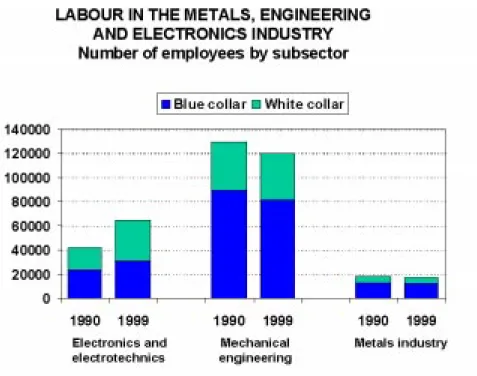
employ-ment. The metals, engineering and electronics industry together constitute the largest industrial sector in Finland, accounting for nearly 50% of the industrial output and almost half of the total labour force, see Table 1 and Figure 1.
World market leaders and domestic subcontractors
Approximately half of the production of the Finnish mechanical engineering industry is exported. In some products, the Finnish industry has a rather strong global market position, see Table 2. Quite a few Finnish companies rank among the top ten in the world market, while there are plenty of small manufacturers which concentrate on the domestic market, acting more or less as subcontrac-tors for the bigger companies.
The strong commitment to the future is evident, as reflected by the heavy expenditure on research and development: the metals, engineering and elec-tronics industry now account for 80% of all industrial R&D in Finland. Unfor-tunately, the traditional mechanical engineering does not excel in this respect, having R&D investments as low as about 2% of the total turnover. This figure is somewhat higher only in the case of some top companies.
Effective and flexible manufacturing, small but comprehensive manufac-turing series and custom-design products are further factors behind the success of the Finnish mechanical engineering industry. Over 90% of products are designed directly in accordance with customer wishes. In-depth understanding of customer production technology provides them with a competitive edge, and their products become leaders on both the domestic and the world market.
Table 1. The subsectors of the metal, engineering and electrotechnical industry in a nutshell in 2000 (MET Federation of Finnish Metal, Engineering and Electro-technical Industries)
1 2 3 4
Electronics Mechanical Metals Metals, and electro- engineering industry engineering technics industry and electronics
industry, total
PRODUCTION (in billions of FIM) 24 17 7 47 Gross value 8 6 1.3 15 Value-added 0.7 0.7 0.3 1.7 Investment 1.7 0.3 0.05 2 R&D, WORK FORCE
Number of employees (1,000) 70 125 17 212 - white collar, % of total 55 32 30 39 Total labour costs 2.5 4 0.7 7 EXPORTS
Exports 15 9 3.5 28
- % of total Finnish goods exports 31 18 7 56 Number of companies (with >5 employees) 600 2,400 80 3,100 Source: Statistics Finland, National Board of Customs
Figure 1. Labour in the metals, engineering an electronics industry. Number of employees by subsector
Table 2. Strong Finnish mechanical engineering products in the global market
Year 2000 Net sales Global market share
in billions of EUR percentage
Lifts and escalators 2.4 9% Pulp and paper machines 2.3 45% Diesel and gas engines 2.0 25% Cranes and hoists 1.6 20% Stone and mineral working equipment 1.2 15% Special vessels, special ships 1.0 25% Forestry machines 0.8 45% Agricultural tractors 0.6 9%
1.4 Trends and challenges for the industry –
poor image, ageing,
weak productivity development
The public image of the mechanical engineering industry is generally rather low. It is regarded as an old-fashioned sunset industry with dirty factories and a blue atmosphere, not very attractive to modern young people. A typical picture of a mechanical engineering worker is a welder in a smoky environment, or a dirty and sweating man in a burning hot foundry. It is a challenging task for the industry to try to do something about this image. To improve the situation, the Federation of Finnish Metal, Engineering and Electrotechnical Industries (MET) has launched some projects such as “Challenging workplace of the future” [Haastava tulevaisuuden työpaikka]. Of course, educational institutes should have also an important role in this PR activity.
However, machines are high-tech products, not only “iron”. For example, automation and information technology are increasingly important in the field of machinery, other equipment and vehicles. “Machines” are no longer merely pieces of iron, but very complicated multi-technical systems, the design of which requires the combination of skills in many disciplines. The business environ-ment is also changing: today, services or capacity is delivered instead of single machines or products, machine systems are assuming more intelligent features, they are operating in intelligent environment, etc. In mechanical engineering, this also calls for new and different kind of competencies and combinations of various skills.
The mechanical engineering industry is also facing an ageing problem. It is anticipated that about 40,000 employees will be retiring within the next dec-ade. The total number of employees needed in this sector is estimated to re-main unchanged or slightly increase. A common problem faced by the whole Finnish industry is the lack of young people interested in technology, and due to its poor image, this applies to mechanical engineering, in particular. That is why it is and will be increasingly difficult to replace the retired employees.
A major and specific concern of the mechanical engineering industry is the very modest productivity development compared to, e.g., that of the electronics industry. During the nineties, the Finnish average annual growth rate of pro-ductivity was 2.5%, while the corresponding figure in electronics and electro-technical industry was 13.4%. This seems to be a common problem in other countries, too. Today, the growth rate in the Finnish mechanical engineering industry seems to be slightly improved, reaching the level of 3–3.5% within the next ten years. The “new economy” way of thinking, e.g., the more effective exploitation of the Internet, networking as well as information and communica-tion technologies is one way, which is also strongly in the agenda of MET. Correspondingly, this is also an important aspect regarding the planning of fu-ture education in mechanical engineering.
1.5 Need for mechanical engineers
Currently there are about 9,500 polytechnic engineers and 4,500 university engineers working in the mechanical engineering industry. Mechanical engi-neering skills – design and manufacturing – are nowadays needed also outside the traditional metals industry. The electronic equipment contains a lot of me-chanical parts, and the respective manufacturing is one of the key competitive factors in the electronics industry. Therefore, the need for mechanical engi-neers does not stem only from the success of the metals industry but also from the rapidly developing electronics industry.
The need for education in mechanical engineering is by no means dimin-ishing. According to the scenarios of MET, the demand for mechanical engi-neers within the next ten years will slightly exceed the number of graduates from polytechnics and universities. [Metalli- ja elektroniikkateollisuuden osaajien
tarve vuosina 2000–2010. MET toukokuu 2000]
A common problem regarding the whole Finnish society is the lack of young people interested in the study of mathematics and physics in schools, or more generally the level or volume of teaching of these subjects in comprehensive and upper secondary schools. This is further reflected as a difficulty to get a sufficient number of qualified applicants for the higher level mechanical engi-neering education. These problems are particularly emphasised among girls, generally and traditionally not very attracted by these subjects or engineering professions.
1.6 Universities and polytechnics
in the Finnish education system
Traditionally, the long-term objectives of Finnish education policy have been to raise the general standard of education and to promote educational equality. Efforts have been made to provide all population groups and regions of the country with equal educational opportunities. The Finnish education system consists of the comprehensive school, the post-comprehensive general and vo-cational education, higher education and adult education. The government’s goal is to streamline the system and develop it in accordance with the principle of lifelong learning, as well as to make it internationally compatible.
The Finnish higher education system includes two sectors: universities and polytechnics. The polytechnics are more practically oriented, training profes-sionals for expert and development posts. The higher education system seen as a whole offers openings for 66% of the relevant age group (universities 29%, polytechnics 37%). Polytechnics also arrange programmes for adult students. (For additional information, see www.minedu.fi)
University education
There are a total of 20 universities in Finland: ten multi-faculty universities, three universities of technology, three schools of economics and business ad-ministration, and four art academies. The basic mission of the universities is to carry out research and provide education based on it. The underlying principle in university education is the freedom of research and university autonomy, which gives them extensive latitude for independent decisions. All Finnish uni-versities are state-run, with the government providing some 70% of their fund-ing. Each university and the Ministry of Education conclude a three-year agree-ment on target outcome to determine the operational principles.
Universities select their own students, and the competition for openings is tough. All fields apply numerus clausus, in which entrance examinations are a key element. Universities offer openings for about one third of the age group. The annual number of applications is nearly 66,000, and only 23,000 candi-dates are admitted. The annual number of degrees in Finland is 16,000, of which 11,000 are Master’s degrees and 1,000 doctorates. The average dura-tion of studies is 6.5 years.
Polytechnics
There are 29 polytechnics in Finland; most of them are multidisciplinary, re-gional institutions which give particular weight to contacts with the business and industry. Polytechnics are developed as a part of the national and interna-tional higher education community, with special emphasis on their expertise in working life and its development. The polytechnics also carry out R&D rele-vant to their teaching and to the practical working life.
The polytechnics were created gradually over the 1990s. The standard of former higher vocational education was raised and incorporated into multidis-ciplinary polytechnics. The national polytechnics network was completed by 1 August 2000. Since then, all the polytechnics have operated on a permanent basis.
The polytechnics award professionally oriented higher education degrees, which take 3.5 or 4 years to complete. The entry requirement is either an upper secondary school certificate or a vocational diploma. At present about 70% of all entrants are matriculated students and 30% vocational graduates. The Ministry of Education confirms the degree programmes. There is no tui-tion fee for degree studies.
The polytechnics have two categories of teachers: senior lecturers with a postgraduate (licentiate or doctorate) degree requirement, and lecturers who must have a Master’s degree. Both categories of teachers must have a mini-mum of three years of work experience.
Finnish polytechnics, which are either municipal or private, are co-financed by the government and the local authorities. The Ministry of Education and each polytechnic conclude a three-year agreement on target outcome to deter-mine the objectives, intakes, and project and performance-based funding.
1.7 Education in mechanical
engineering in Finland
There are 4 universities and 18 polytechnics giving mechanical engineering education in Finland. In the past, technicians and engineers were trained at the institutes of technology, integrated into the new polytechnics in the late nine-ties. This was part of the upper secondary and higher education reform in Finland. In that context, the training of technicians finished, and the require-ments of engineers were somewhat lowered.
* * *
All polytechnics and universities giving mechanical engineering education are listed in Appendix 5 together with a brief description of their specialisations. Key figures regarding students, staff, graduation times and intake are given in Appendix 6.
2
Evaluation procedures
2.1 The framework of the project
The evaluation of the degree programmes consists of self-evaluations undertak-en by the higher education institutions and an evaluation carried out by the external evaluation team. The degree programmes to be evaluated are deter-mined by the steering group.
In its self-evaluation, each higher education institution has evaluated its own degree programme and written a report for the use of the external team. The major evaluation objects are in general:
• aims and strategies of the degree programme • content and structure of the degree programme • teaching staff
• students
• teaching and learning processes • operational and economic resources
• international contacts and co-operation outcome • relations with business and industry
• internal quality schemes for developing the degree programme
The self-evaluation report, written in English, constitutes the most important source of information concerning the degree programme and the unit provid-ing it. The study guide for the programme and the relevant teachprovid-ing plan are attached to the report.
The external evaluation team made a site visit to the institutions in order to evaluate the degree programme in depth on the basis of the self-evaluation reports. During their one-day visits, the external team interviewed those in charge of the degree programme as well as the institution management, the teaching and other staff responsible for the degree programme, students, and representatives of local business and industry.
The team also examined the facilities, the teaching methods, the textbooks used, as well as students’ assignments and projects. An essential feature of the process was the fact that at the end of their visit, the external evaluators gave the staff and students verbal feedback concerning their observations and tenta-tive suggestions for development.
Reporting
Based on the self-evaluation material and the personal evaluation reports sub-mitted by the members of the external team, the project manager compiled a preliminary draft report of the outcome and conclusions of the project. This draft was sent for comments to the members of the evaluation team and later also to the representatives of the degree programmes which had been evaluat-ed. Comments were taken into account in the final report.
The evaluation report has been publicised at a seminar for the representa-tives of the higher education institutions involved in the project. The purpose of the seminar was to collect feedback on the degree programmes evaluated and raise points to be taken into account in future evaluations. (See Appendices 1, 2 & 3 for additional views of reporting.)
2.2 Project plan
The following four principle areas were taken into account when Mechanical En-gineering programmes were selected for the evaluation process: 1) Mechanical Engineering is one of the biggest and the most traditional degree programmes; 2) the competitiveness and attractiveness of the programme among the students has not been optimal; 3) general concern about the quality of Mechanical Engineering and insignificance of the research tradition; and 4) the significance of mechanical and electrotechnical industry for the export in Finland.
The project started in August 2000 and the steering group (see page 18) of the project assembled for the first meeting in November 2000.
On a general level, the steering group represents FINHEEC and it • determines and approves the aims and the timetable of the project;
• submits proposals to the Higher Education Evaluation Council (FINHEEC) concerning personnel and other resources, including the members of the ex-ternal evaluation team;
• is responsible for the supervision and practical implementation of the project; • approves the intermediate reports of the project; and
• makes a proposal concerning the termination of the project to the FINHEEC. The division of work between the steering group and the Finnish Higher Edu-cation Evaluation Council is as follows:
• FINHEEC selects the field of education to be evaluated and appoints a steering group for the purpose.
• FINHEEC appoints the external evaluation team on the proposal of the steering group.
• FINHEEC allocates resources at its disposal to the evaluation.
• The steering group, together with the FINHEEC secretariat, draws up the project plan.
• The Secretary General decides on the publication of the external evalua-tion team’s report in the FINHEEC publicaevalua-tion series.
The project manager is responsible for the project: practical arrangements, plan-ning, implementation, supervision and reporting. The project manager’s prima-ry tasks include the compilation a detailed project plan, the supervision, report-ing and practical implementation related to the project, as well as actreport-ing as the secretary to the external evaluation team.
The external evaluation team evaluates the degree programmes. In general its members write their own reports of the evaluations in which they take part and contribute to the drafting of the final report.
The primary aim of this particular project was to support higher education institutions in assuring and improving the quality of engineering degree pro-grammes as well as to encourage them to develop the evaluation of the educa-tion they provide and enhance its quality. To this end, the project aimed at: • providing an overall idea of the state of engineering education;
• producing tools for quality assessment and assurance for the degree pro-grammes;
• generating proposals for national and programme-specific development measures; and
• creating a culture of constant quality assessment.
In addition to this, the project had the following specific objectives:
• to appraise the present situation in engineering programmes as compared with the needs and demands of society, business life and the labour market; • to identify the similarities and differences in the content of education
pro-vided by the universities and polytechnics;
• to make qualitative and quantitative data available in view of international comparisons of engineering education;
• to measure the satisfaction of employers recruiting from the degree pro-grammes and other business and industry;
• to ensure student satisfaction;
• to ensure continuous quality assurance and updating in the degree pro-grammes.
The following criteria were used to select degree programmes for the external evaluation:
• the significance of the degree programmes as providers of engineering education;
• the diversity and extent of the degree programmes, with a special focus on a diverse selection of degree programmes of different ages;
• the language of instruction; and • geographical location.
Based on these criteria, the steering group selected 50% of the degree pro-grammes for the external evaluation.
2.3 Selecting the programmes
for the external evaluation
Covering most of the Finnish territory, there are 22 institutes (4 universities and 18 polytechnics) which provide education in the field of Mechanical Engi-neering, and all of them were included in the evaluation process. There are a total of about 6,000 students in the subject programmes within the degree programme of Mechanical Engineering. All 22 institutes were asked to write a self-assessment report, and based on the decision made by the steering group, half of the institutes (11) were evaluated by the external evaluation team dur-ing the period from 28 March 2001 to 20 April 2001.
Project organisation
In October 2000 the Finnish Higher Education Evaluation Council nominated a steering group for the project. Chaired by professor Toivo Katila, the mem-bers of the group were Mr Juha Ehrola Valmet Oy; professor Kenneth Holm-berg VTT (the Technical Research Centre of Finland; Mr Antti Huttunen SYL; and Mr Jorma Tuominen Vaasa Polytechnic. The secretary (project manager) of the project was planning officer Tapio Huttula until the end of the year 2000. Project manager Karl Holm continued as the secretary of the project from the beginning of the year 2001.
In February 2001 following persons were selected by the evaluation coun-cil for the external evaluation team: Professor Matti Hakala, VTT, chairman; senior lecturer Jaakko Fonselius, Jyväskylä Polytechnic; professor Christer Jo-hansson, University of Linköping; professor Klaus Hein, University of Stuttgart; professor Erwin Hasenjäger, Bingen Polytechnic; Ms Virpi Kuismin, SAMOK (the Union of Finnish Polytechnic Students); Mr Ville Laine, SYL (the National Union of Finnish Students); Mr Mikko Karvinen, Metso Oyj; Mr Erkki Kare, Plustech Oy; Mr Rainer Penttala, Wärtsilä Oy; Mr Ilkka Jokioinen, Metso Oyj; and Mr Jorma Nevaranta, Valtra Oy.
2.4 Structure of the visit
In line with the above mentioned criteria the steering group selected the fol-lowing institutes for the external evaluation: Helsinki Polytechnic Stadia 28 March, North Karelia Polytechnic 29 March, Helsinki University of Technology 30 March, Turku Polytechnic 2 April, Swedish Polytechnic 3 April, Vaasa technic 4 April, Lappeenranta University of Technology 5 April, Tampere Poly-technic 17April, Tampere University of Technology 18 April, University of Oulu 19 April, and Oulu Polytechnic 20 April.
The evaluation team regrets that due to the lack of time and funding it was impossible to visit in all of the 22 institutes in question.
The institutional deadline of the self-evaluation reports was 9 March 2001. Most of the reports came on time to FINHEEC. The Arcada Polytechnic (Ny-lands svenska yrkeshögskola) never sent their self-evaluation report.
The reports and different material concerning Finnish higher education system were sent as early as possible to the members of the team. Invited to the FINHEEC office on Tuesday 27 March 2001, the aims of the project were presented and more detailed information was given to the whole team.
The members of the evaluation team visited different institutes according to the following schedule:
Table 3. The programme of the evaluation day*
Time Programme Persons involved
09:00–9:30 Arrival at the Institution Evaluation team members Preparatory meeting of the
evaluation team
09:30–10:00 Initial welcome & Dept. representatives (max. 8 persons) introduction of the Institute
10:00–11.00 Meeting with the programme students Students (max. 6 people, 1–5th year students) 11:00–12:30 Meeting of the programme staff Staff members (max. 8 people, professors,
teachers, lectures, assistants) 12:30–13.30 Lunch with students and staff
13:30–14:45 Meeting with the representatives of Representatives of industry (max. 6 persons) commerce and industry
14:45–15:15 Time reserved for student exercises Display of materials, thesis work, project and thesis work papers, and course book
15:15–16.45 Visit to lecture halls, laboratories, Persons in charge of facilities and individual library and introduction of equipment, etc. teachers
16:45–17:15 Meeting of the evaluation team Evaluation team members 17:15–17:45 Feedback Students and staff of the Department * The programme of the one-day site visit in each institution followed a certain fixed timetable. The only exceptions were to do with reasons related to travel timetables but even then the real time spent for each interview and laboratory visit was the same.
3
Common findings
3.1 Challenges for
the mechanical engineering education
Mechanical engineering is a traditional field of engineering which is also re-flected in respective education. The progress made in the field has been rather stable without any bigger needs for rapid changes in the contents of the degree programmes, or in the number of students. The degree programmes have, of course, been under continuous evolution, but the trends in the modern infor-mation society, and in the rapidly changing industry and business, are continu-ously creating new challenges for mechanical engineering education, too.
In addition to the metal industry proper, mechanical engineering skills are needed also in other industrial sectors, such as the electronics industry. Moreo-ver, modern machines or metal products are nowadays very complicated mul-titechnological systems which require the combination of various engineering skills, although the thorough understanding of the underlying physical phe-nomena is today more important than ever. The product development and manufacturing of such systems requires new methodologies. The modern busi-ness networks and flat organisations relying more and more on team work make it also necessary for the mechanical engineers to possess “soft skills”, e.g., communication, negotiation, language, co-operation and other similar skills.
Mechanical Engineering has a somewhat poor image, and the respective education institutions have problems in attracting students. The drop-out rate is high, especially in some polytechnics. It seems that many students start at the institutions just to spend the time while looking for better places to study, or to refresh their basic mathematics and physics skills for university entrance ex-ams. Some students evidently find studying simply too demanding. In universi-ties there are also quite a few drop-outs, one major reason being that some students change to other, more attractive departments. A major challenge for universities is perhaps the long study times. This is basically an element of academic freedom, one underlying reason being the part-time jobs held by the students. Students, however, do not seem to complain about the situation. Part-time jobs are more common in the Helsinki region, for quite natural reasons, because more jobs are available, while they are quite rare, for example, in Lappeenranta.
Due to the rather stable situation in Mechanical Engineering, there have been rather little changes in the permanent teaching staff. The average age is generally rather high, and in many places there are quite a few people repre-senting the same age group. This may cause problems when these people start
to retire all at the same time. Continuous staff development and recruitment of young competent teachers is therefore one further challenge.
Research is an integral part of higher education, especially in universities. Unfortunately, Mechanical Engineering does not generally have a very long and good track record, especially as far as basic research is concerned. This is also part of the image problem, and is further shown by the fact that very talented students are not interested in Mechanical Engineering because they find that it does not offer sufficient challenge. During the past few years, the research activities have been developing rather rapidly, partly because univer-sities have been forced to seek for additional external funding.
The co-operation with industry has also been developing very well, but there is a danger that university research starts to become excessively industry-driven problem solving, at the expense of longer term basic research. Basic research that meets the best international standards is a prerequisite for gener-ating truly novel knowledge, and this is in turn reflected in high-level and up-to-date education. This further helps the Finnish industry to maintain its global market position.
The number of doctors in Mechanical Engineering has been traditionally rather low, although it is today increasing rapidly, thanks to the overall increase in research activities and the graduate school system, in particular. A further challenge in this context is the fact that the Finnish mechanical engineering industry is basically not willing to employ doctors, because “there is no need for doctors in industry”, as one of the representatives of industry expressed this attitude.
The basic government funding has been decreasing in the field of mechan-ical engineering education, at least relatively, since major investments have been directed to the IT sector. The shortage of basic funding has, to some extent, been compensated through the use of research funding in education, another factor that makes it increasingly difficult to carry out top-level research in uni-versities.
During the evaluation visits, there were some discussions on the need for technicians. This line of education ended through the higher vocational educa-tion reform in the 1990s. Some companies would still like to have technicians for foremen and similar positions because they find that the polytechnic engi-neers have too long a training for their purposes. Others clearly stated that team work is the way to work today, foremen are no longer needed, and thus there is no need for technicians, either.
In this situation, it seems that the contents and methods of mechanical engineering education both in the universities and polytechnics should be care-fully and critically analysed to meet the future challenges. Education should create a desire for personal development and an ability to acquire new knowl-edge. The image problem is one of the reason why Mechanical Engineering does not attract young people in general, and females in particular. Revising education and putting forward new topics and titles can change these attitudes, too.
3.2 Strategic and administrative issues
One of the major targets of the present kind of evaluation is to help educational institutes in establishing and enhancing their self-assessment and continuous improvement procedures. An integral part of this kind of development is strate-gic thinking, with clearly stated common missions, visions, objectives, etc. Gen-erally, it seems that there are considerable differences between institutes in the level and implementation of strategic planning, although the self-assessment reports suggest that each institute has made a strategic plan. The missions and visions presented in the reports were rather general, and only few institutes had a clear and separately stated vision or strategy for mechanical engineering. In universities, there is, of course, a built-in dilemma between academic freedom and strategic planning. The creation of a common strategy is therefore a very delicate and challenging task, requiring real co-operation and good mo-tivation among independent professors. The grand missions and visions formu-lated at the university central administration level are not necessarily easily adopted and implemented at the department or degree programme level. As regards the future challenges of mechanical engineering education, a dedicated strategy process within the department or degree programme becomes, howev-er, more and more important.
The organisational structures are traditionally not very flexible. In universi-ties the traditional institution of permanent professorships can have a slowing and impeding effect on changes. Typically, each professor may have his own fixed specialisation, which makes the degree programme very rigid. Many fields within Mechanical Engineering are so small that there are unique professor-ships, or only a couple of professors in the same field in Finland. Naturally, this normally results in a lack of resources, and it is difficult to create a critical mass, but it also means that there is practically no competition, which may slow down the development.
There seem to be clear differences in the level of strategies of the four universities providing mechanical engineering education. HUT tends to em-phasise the independence of individual chairs or laboratories, and there seem to be rather little co-operation among them. One evident explanation to this is the fact that there are quite many unique professorships with very little in com-mon. Alternatively, they may also have been acting rather isolated, in close co-operation with the corresponding specific industrial branch.
Perhaps TUT has taken the longest step in creating a real and concrete common strategy for mechanical engineering. They have defined their focus areas, and new professorships have been established to support this strategy. TUT has also developed a matrix organisation: the education is arranged like a matrix so that individual institutes may also contribute to several appropriate degree programmes of other departments. Each institute has, however, a home department, where the decisions regarding resources are made. The aim of this arrangement is to offer more flexibility in degree programmes as compared to the pure department based system.
LUT has also created an specific strategy for mechanical engineering with focus areas highlighting their special expertise areas. New professorships have also been established to support this strategy. However, both LUT and TUT tend to be a little bit closed or clannish; new professors are typically their own graduates.
Oulu University is somewhere in between HUT and TUT regarding strate-gic thinking. The Mechanical Engineering Department has a jointly developed module system of courses, or optional course packages, within the degree pro-gramme. This provides more guidance for the students, but also more flexibility compared to the situation where each chair has its own fixed specialisation. Vacant professorships are redefined according to anticipated needs.
Polytechnics constitute a quite new concept in Finland, but in many cases their mechanical engineering education stems from very long traditions of former Institutes of Technology. Correspondingly, their organisational structure is also rather rigid and lecturers have generally a long experience. There is, however, a lot of potential in exploiting the internal synergy and development within each polytechnic. Because the polytechnic system is rather new, the overall strategy planning is still at a rather general level, and many of the Me-chanical Engineering departments or degree programmes do not have their own clear strategy so far. The municipal administration is in some cases rather heavy, and local political interests can influence the contents and emphasis of different degree programmes.
There are also some interesting new approaches in the organisation of the polytechnics. For example, the Vasa Swedish Polytechnic has adopted a matrix organisation in which departments (supply of resources) and degree pro-grammes (demand of services ) are separated and they have independent re-sponsible heads. This system seemed to work well and makes the contents of degree programmes more flexible.
Most polytechnics have a working quality system, and some of them have also an ISO certificate. This is less common in universities, probably because they want to emphasise their academic freedom. Whilst a certified quality sys-tem alone does not guarantee good education, some sort of a syssys-tematic proc-ess in strategic planning and development of education and staff would, howev-er, be advisable. This can be accomplished also through the use of a self-evalu-ation procedure, e.g., the EFQM (European Foundself-evalu-ation for Quality Manage-ment) Excellence Model. Some institutes have already started to adopt this method.
There is a lot of variation between the institutions as concerns the students’ participation in the administration or planning of studies or strategies. In some institutes students have an essential role in administrative or planning bodies, bringing forward their own fresh ideas. In other places, the students have virtu-ally no formal role at all, which may be quite a waste of resources.
3.3 Roles of universities and polytechnics
A common feature in the strategies of mechanical engineering in universities is that the regional role or at least national role is still rather clearly put forward. For a university that claims to be top-level by international standards – an objective included in each and every vision statement – the only league is the international one. Naturally, competition is also harder than at the national level. This, again, emphasises the need for high-level basic research and suffi-cient volume in post graduate studies also in Mechanical Engineering. Some industrial companies stress the importance of starting university education in mechanical engineering in their home cities as an answer to their difficulties in hiring graduate engineers. This is rather contradictory to the above reasoning on the importance of international level research and ensuing education as such research and education will require sufficient resources and focusing of activities.
According to the Finnish education system, the polytechnics are more prac-tically oriented, training professionals for expert and development posts. They have also a clearly defined role in the Finnish regional policy, according to which the institutions of higher education and centres of excellence built around them should have a major role in regional development. On the basis of the strategies described in the self-evaluation reports, the polytechnics have gener-ally understood their role in the above manner. There are differences, howev-er, in formulating specific strategies for mechanical engineering. Some insti-tutes do not have a separate strategy for mechanical engineering, or the strate-gy work has only just started. This is quite understandable as the whole poly-technic system was permanently established as late as in 2000.
The local role of polytechnics was also quite well reflected in the opinions of industry. In some regions, the companies had even chosen their site on the basis of the vicinity of a polytechnic. One of the representatives of industry expressed it in this way: “Polytechnics should keep their local role and concen-trate on SMEs (Small and Medium size Enterprises), big companies take care of themselves”. In smaller cities, the local importance of polytechnics is clearly seen; the city management is very proud of them. In bigger cities, polytechnics do not have such a central regional role, and they tend to be lost in the city bureaucracy, which evidently causes some identity problems, especially for small Mechanical Engineering degree programmes.
Many of the polytechnics emphasise research or R&D work in their strate-gies. In practice, research means providing consulting services mainly for local companies through the use of existing (teaching) facilities. Most of the Mechan-ical Engineering degree programmes in polytechnics are rather small and re-sources are correspondingly limited. Focusing on one or two specific subjects is therefore reasonable. To meet all regional needs means co-operation and net-working with other institutes.
The roles of universities and polytechnics are not overlapping, and there should be no contradiction between them, either in education or in research. The strategies of universities and polytechnics are generally in line with this principle, although they could be more explicit in this respect, and state clearly the importance of networking also between universities and polytechnics. The possible continuation education in polytechnics is one issue which should be planned in co-operation with the universities.
3.4 Education versus research
The fundamental difference between universities and polytechnics is that re-search is the basic mission of a university, and education should be based on it to ensure the diffusion of the newest scientific knowledge, while polytechnics train professionals and the respective education is more practically oriented.
In principle, this seems to work also regarding mechanical engineering ed-ucation in universities; research staff is taking part in teaching and vice versa. Moreover, undergraduate and especially postgraduate students participate in research projects. Many theses are also quite naturally linked to research projects. In fact, research in universities is largely carried out using students, also undergraduate students. This is not always a good thing, considering the objective to carry out research that meets the highest international standards. Unfortunately, there are some Mechanical Engineering chairs which have rath-er scarce research traditions. Thrath-ere the combination of research and scientific education does not work.
Internationally relevant basic research in Mechanical Engineering is gener-ally still rather limited in Finland, and as such it does not offer enough chal-lenges for very talented young people. In Mechanical Engineering as elsewhere in the research community, it would be extremely important that universities (and other research institutes) be capable of creating genuinely new ideas and technical solutions enabling radical breakthroughs in industrial applications; they should not only concentrate on solving today’s technical problems but lead the development and create new potential/ knowledge. The prerequisite for this is that the volume and level of longer-term basic research is sufficient, and that this research is closely connected to education. This also requires suf-ficient volume in postgraduate studies.
As far as polytechnics are concerned, research means providing consulting services mainly for local companies through the use of existing (teaching) facil-ities. Some polytechnics have managed to invest in rather specific and expen-sive testing facilities which are more purely aimed at providing external servic-es for industry. This activity is, however, limited by the fact that they have no – and perhaps should not have any – special research service personnel; their normal teaching or laboratory staff is in charge of these functions. Polytechnic teachers engage in some academic research individually in the context of their
personal postgraduate studies, e.g., when developing their competence to meet the requirements set for principal lecturers.
It does not seem rational to increase the volume of research in polytechnics since teachers are already overloaded, and research would require additional special staff and investment in equipment. As a whole, it might be better to join forces with universities and research institutes, and create co-operation within research networks, making better use of each others’ facilities and special ex-pertise. There are some good examples in this respect, such as the FMS centre in Tampere, Technobothnia in Vaasa, or the IMTEC centre in Joensuu.
3.5 Learning and teaching
Mechanical engineering education has a long tradition, the permanent teaching staff tends to be ageing, and there is a shortage of basic funding. Moreover, teaching is not very highly regarded in universities. It is sometimes regarded as a “second rate activity” among top scientists, and there are no formal pedagog-ical requirements for professors. In polytechnics, the teaching duties of the lec-turers are rather heavy, which makes it difficult to develop teaching or person-al skills. At the same time, teaching is faced with a myriad of other chperson-allenges. In view of the development of education, the situation is therefore by no means easy.
Regarding the contents of mechanical engineering education, the basic en-gineering skills are still important. A competent engineer should know the un-derlying physical phenomena of a complicated machine, or see behind the fas-cinating user interface of a simulation program. This means that mathematics and physics, as well as mechanics including strength of materials, are as impor-tant as ever. However, it seems that the teaching of these subjects is in some cases too theoretical, and too far from mechanical engineering applications.
At the same time, the product development and manufacturing of modern machine systems and electronics products call for new skills. Automation, ma-terials and production technology, applications of ICT, combination of multidis-ciplinary skills, etc. are becoming increasingly important. Today’s business net-works and flat organisations emphasise the importance of social skills.
Teaching and learning are still mostly based on traditional lectures and exercises, which do not necessarily help in developing the necessary social skills. The adoption of these skills as well as team work skills could perhaps be inte-grated in normal education as an essential part of the learning process. Prob-lem-based learning and project-based studying is already very popular in most polytechnics. The Internet can be exploited also in international co-operation. Some institutes have already arranged joint exercise works with foreign insti-tutes via Internet.
There are some separate e-learning experiments, such as using the Internet in distant learning, or the recently launched Virtual University initiative. Clear-ly, the proper exploitation of modern ICT technology in mechanical
engineer-ing education is a challenge regardengineer-ing teachengineer-ing and learnengineer-ing methods. This no doubt calls for co-operation, at least on the national level.
The students’ involvement in the process of developing education varies quite a lot. In some institutes there is a specific study planning body with a student participation while in other places students have virtually no role at all. There are also rather big differences as concerns student feedback and its sys-tematic exploitation. Tutoring is arranged in every institute, but there are still some shortcomings.
In many institutes, especially in bigger municipal polytechnics, the heavy administration is reducing the resources of teaching and limiting the flexibility of the programme. At least partly, this is due to the fact that the new polytech-nic concept is only just taking its first steps in Finland.
In most institutes the premises and the laboratories are in rather a good condition for educational purposes. The biggest challenge is to maintain the present status, i.e., to ensure replacements and re-investments in equipment. The computer facilities could, of course, always be better.
3.6 Links to industry and national co-operation
Mechanical Engineering degree programmes have traditionally rather good contacts to the respective industry. Most theses are made for industry in practi-cal service in industry, especially in polytechnics. The co-operation between universities and the industry is generally quite good, and companies also con-tribute to the funding of research projects. This is a positive fact in principle, but it can also have some drawbacks in the sense that the time span of research may shorten: rather than create new knowledge, the universities start to serve today’s needs. However, external funding is extremely important, especially for universities, and in order to secure the necessary funding it is therefore a must to have good relations with industry.
One important way of linking industrial experience to education is the use external part-time teachers from industry. Generally this system is working quite well. The students like the up-to-date and practical knowledge of external teach-ers, although there might be some shortcomings in their pedagogical skills. For industry, this is a way to create contacts with students and identify competent future engineers. Some institutes have, however, had difficulties to recruit part-time teachers from industry; people working in practical are too busy and over-loaded.
A very good way to transfer knowledge and experience from education to industry and vice versa is the exchange of personnel. This arrangement is un-fortunately systematically used only in very few places, although all parties are in principle in favour of it.
Many of the industry representatives said that they would appreciate a more formal forum for discussions regarding educational and strategic issues with
universities and polytechnics. Some institutes have advisory boards for this pur-pose, while others rely on more informal discussions.
The alumni activity, which is just taking the very first steps in Finland, is one good possibility to create closer contacts between the working life and educational institutes. In addition, it may help in improving the low image of the mechanical engineering field.
Typically, the Finnish universities and polytechnics are used to standing on their own without any particular mutual co-operation. Some sort of clannish behaviour can still be found, although the situation has been improved, thanks also to graduate schools or projects funded by TEKES (the National Technolo-gy Agency). Both forms of activity require co-operation between institutes.
The Virtual University initiative is a good step towards developing joint education and reducing overlapping efforts, which in turn will release resourc-es for other purposresourc-es. Some polytechnics have jointly started similar efforts.
Universities still seem to have some prejudices against polytechnics; proba-bly they are afraid of some sort of competition of resources. In reality, it is quite evident that the two systems complement each other, and co-operation would be much more rational than competition. Similarly, research institutes, such as the VTT, could constitute good research network partners for both universities and polytechnics.
3.7 Mobility and the international dimension
For the past few years, the hot topic of higher education has been international activity. For some years now, educational institutes in virtually every part of the world have been looking for new methods to enhance their competence – universities and polytechnics are also part of the globalised world.
For universities and polytechnics it has been clear that the international dimension is one of the key factors to gain extra benefits for the organisation. Mobility of students and teachers is the main tool to enhance international activities.
In general, there are two major elements of mobility. The first one is mere-ly mobility in the name of science, associated with researchers. The second concept of mobility is wider and linked to students and teachers. Mobility in the field of research has been obvious for centuries and is also more attached to the tradition. In that respect the mobility of students and teachers is a rela-tively new phenomenon.
In Mechanical Engineering, the international co-operation between univer-sities is, however, still rather limited, even in research. One explanation to this is that currently it is quite easy to receive national funding for applied research, for example from institutions such as TEKES. Getting EU funding is for exam-ple, more laborious and much more uncertain.
For quite a few years now, international mobility within Europe has re-ceived organisational and financial support through different EU programmes. Universities and polytechnics have been advised to build up international net-works in the name of co-operation. They have numerous agreements with sis-ter organisations abroad, but all connections are not very active. Be it how it may, active students have outstanding possibilities to add study packages from foreign educational institutions to their personal curricula.
However, the quantity of student and teachers exchange has been gratify-ing only to a certain extent. Despite the financial support and good information packages students have not been extremely eager to travel – this has also been the case in Mechanical Engineering. In fact, among students of Mechanical Engineering, mobility linked to practical training has been much more popular than exchange studies.
One reason for scarce mobility is the attraction of the working life. It has been rather painless for the students to find appropriate jobs which are related to their studies. To spend one or two terms studying abroad means in most cases that the student will have no chance to work along with the studies. For teachers it is often rather difficult to free oneself from the daily routines. With no extra financial benefit involved, the teaching experience abroad is often not very attractive.
However, teachers should encourage the students in this respect, highlight-ing the benefits of international studies. Most teachers and researchers have good contacts to their colleagues around the world. These opportunities should be used more in order to convince students to be mobile. It is also important to guarantee a certain level of financial support – at least to cover travel and extra accommodation costs – for those who are going abroad for to study or to teach.
4
General recommendations
Based on the entire information collected during the process, the evaluation team would like to bring forward the following issues and present them as general recommendations relevant for all the degree programmes of Mechani-cal Engineering in universities and polytechnics.
Meeting future challenges
Mechanical Engineering is a very important industrial branch in Finland, and its products are assuming more and more complicated multi-technical and in-telligent features. Mechanical engineering skills are needed also in other indus-trial sectors, such as the electronics industry. High-level education and research in this field are of utmost importance for the future success of Finnish economy. Therefore,
• The contents and methods of Mechanical Engineering education both in the universities and polytechnics should be carefully and critically analysed to meet the future challenges;
• Improving the image of Mechanical Engineering calls for co-operation be-tween all the parties involved. As concerns the universities, the level of research is one of the decisive factors in this respect while the polytechnics should strengthen their regional role and make more efforts to develop their co-operation with the local industry and the universities;
• Allocation of government basic funding must be carefully considered bear-ing the importance of the industrial branch in mind;
• The universities and polytechnic must understand that they themselves bear the main responsibility for the development. This calls for, e.g., sys-tematic strategic planning, development of methods and contents of teach-ing, raising the level of research, staff development, co-operation and inter-nationalisation, etc.
Need for strategy process development
The challenges for the Mechanical Engineering education are so diverse that the strategy process both at universities and polytechnics should be enhanced. The development cannot rely solely on the general strategy of the institutions, nor on the separate activities of individual teachers or professors. Therefore,
• Mechanical Engineering degree programmes/departments need their own specific and focused strategies and visions, carefully formulating the objec-tives of the degree programmes, focus areas, and their own identity or role in the national and international framework. Clear common visions and objectives will help in directing the future development, release the admin-istrative burden, and make the communication with various interest groups easier;
• The roles of universities and polytechnics are not overlapping, and there should be no contradiction between them, either in education or in re-search. The strategies of universities and polytechnics are generally in line with this principle, although they could be more explicit in this respect, and state clearly the importance of networking also between universities and polytechnics;
• A working quality system can help in systematising the strategy process and in developing education and staff. A certified quality system is advisa-ble, but does not alone guarantee good education. It is more important to adopt a systematic self-assessment procedure, e.g., the EFQM (European Foundation for Quality Management) Excellence Model;
• Good examples of strategies and quality systems exist in some universities and polytechnics. It is recommended to use benchmarking and exploit the best practices also in this respect
Level of education and developing degree programmes
It is anticipated that the need for mechanical engineers is increasing in the future and their competence should meet the internationals standards. This calls for qualified and motivated students, and continuous development of the contents and structures of degree programmes. Therefore,
• Efforts should be made to develop student recruitment and motivation. More interest could be aroused among the potential students considering mechanical engineering studies by presenting the possibilities offered by the degree programmes in schools, in the press and through other chan-nels. The institutes need to take the Mechanical Engineering student moti-vation problems seriously, for example, by alternating the study of profes-sional skill subjects and theory subjects in an appropriate manner; • The level of students in Mechanical Engineering is not too high, and there
are quite a number of dropouts, especially in some polytechnics. The study entrance requirements should be tightened to ensure that students are well qualified and motivated. This will also contribute to improving the image of Mechanical Engineering;
• The structure of degree programmes should be harmonised with the Euro-pean tendencies and agreements. The possible continuation education in polytechnics is one issue which should be taken into account in this
con-text. Unfortunately, this issue was not touched upon in self-assessment re-ports, nor in the discussions.
• The universities and polytechnics need to develop flexible study entities which the students can utilise, if necessary, through the mobility between various institutes of study. There are several good attempts in this direc-tion, e.g., implementations of matrix organisations or so-called module sys-tems in some institutions. Again, benchmarking and adoption of best prac-tices are recommended;
• As regards the contents of education, the basic subjects, such as mathemat-ics, physmathemat-ics, mechanmathemat-ics, materials technology, etc., still constitute the basis of Mechanical Engineering skills, and should not be overlooked in teach-ing, although there are plenty of other more specialised subjects needed in modern mechanical engineering;
• In addition, management and economic capabilities and “soft skills”, e.g., communication, negotiation, language, co-operation and other similar skills are getting more and more important, and should be correspondingly in-corporated in education;
• Student involvement in planning and development of studies should be systematically organised, as well as gathering of feedback. This is not the case in all institutions. The same applies to tutoring.
Top-level research by international standards is a must for universities
Research is an integral part of higher education, especially in universities. Un-fortunately, Mechanical Engineering does not generally have a very long and good track record, especially as far as basic research is concerned. This is also part of the image problem. Therefore,
• Universities should strengthen their efforts in basic research that meets the best international standards. This is a prerequisite for generating truly nov-el knowledge, and this is in turn reflected in high-levnov-el and up-to-date edu-cation, eventually benefiting the respective industry. International bench-marking in research is a good way to ensure the sufficient level;
• The number of doctors in Mechanical Engineering is still rather low, and should be increased to raise the level of research and education. The Finn-ish mechanical engineering industry, for its part, should also understand the importance of employing doctors.
• Although research is the basic mission of a university, teaching should also be appreciated. No formal pedagogical requirements are set for university teachers, be they permanent or external part-time teachers, but universities should, however, arrange pedagogical training and support. All universities have individual good attempts into this direction, and they should join ef-forts in this respect.
Role and specialisation of polytechnics
The polytechnics system is quite new in Finland and there are quite many diverse expectations as regards their future role. Therefore,
• It would be advisable for the polytechnics to specialise in accordance with the local needs and requirements. However, specialisation calls for co-op-eration and networking with other universities and polytechnics. Both prac-tical business representatives and students should be involved in the spe-cialisation planning process;
• Focus the education; in Finland, the Mechanical Engineering education in polytechnics is geographically dispersed and the respective units are of many sizes – the Mechanical Engineering degree programmes of certain polytechnics are simply too small. For education purposes, it would be more rational to concentrate the resources allocated to teaching;
• The role of research or R&D work in polytechnics should be considered carefully. It does not seem rational to increase the volume of research in polytechnics since teachers are already overloaded, and research would require additional special staff and investment in equipment. As a whole, it might be better to join forces with universities and research institutes, and create co-operation within research networks, making better use of each others’ facilities and special expertise.
Need for new teaching methods
It is vital for any university or polytechnic to make full use of the new teaching methods. Such methods include learning by doing, e-learning, team work, project-based learning. In order to save the scarce resources available, the uni-versities should collaborate in developing the new teaching methods – e.g., the virtual university. Therefore,
• Universities and polytechnics should join the forces to accelerate the devel-opment of new teaching methods, especially those based on the ICT tech-nology and Internet;
• The virtual university initiative, for example, is a good start, and should be fully exploited also in Mechanical Engineering education.
Staff development is also necessary
Due to the rather stable situation in Mechanical Engineering, there have been rather little changes in the permanent teaching staff. The average age is gener-ally rather high, and in many places there are quite a few people representing the same age group. Therefore,
• Each institution should develop a systematic staff development program, as an essential part of the strategy process. This should include the planning of staff structure in line with the anticipated future needs, as well as person-al development p