Optimal PID Controller Design for AVR System
Ching-Chang Wong*, Shih-An Li and Hou-Yi WangDepartment of Electrical Engineering, Tamkang University, Tamsui, Taiwan 251, R.O.C.
Abstract
In this paper, a real-valued genetic algorithm (RGA) and a particle swarm optimization (PSO) algorithm with a new fitness function method are proposed to design a PID controller for the Automatic Voltage Regulator (AVR) system. The proposed fitness function can let the RGA and PSO algorithm search a high-quality solution effectively and improve the transient response of the controlled system. The proposed algorithms are applied in the PID controller design for the AVR system. Some simulation and comparison results are presented. We can see that the proposed RGA and PSO algorithm with this new fitness function can find a PID control parameter set effectively so that the controlled AVR system has a better control performance.
Key Words:PID Controller, Genetic Algorithms, Particle Swarm Optimization, Automatic Voltage Regulator (AVR)
1. Introduction
There are three coefficients: proportional coefficient, differential coefficient, and integral coefficient in the PID controller. By tuning these three parameters (coef-ficients), the PID controller can provide individualized control requirements. In recent years, many intelligence algorithms are proposed to tuning the PID parameters. Tuning PID parameters by the optimal algorithms such as the Simulated Annealing (SA), Genetic Algorithm (GA), and Particle Swarm Optimization (PSO) algo-rithm. Chent et al. proposed a method to tune PID para-meters by SA [1]. However, it is slow to search the best solution. Kwok and Sheng considered GA and SA for the optimal robot arm PID control [2]. Some simulation re-sults illustrate that not only the speed of operation but also the system response by GA is better than that by SA. Mitsukura et al. [3] and Krohling et al. [4] also used GA to search the optimal PID control parameters and they have nice performance in the simulation results. Genetic algorithms are methods to obtain an optimal solution by
applying a theory of biological evolution [5,6]. Genetic algorithms can be found in many applications in bio-genetics, computer science, engineering, economics, che-mistry, manufacturing, mathematics, physics, and other fields. For example, GAs can be applied to discuss the fuzzy modeling, data classification, and omni-directional robot design problems [7-9]. The PSO algorithm, pro-posed by Kennedy and Eberhart [10] in 1995, is an an-other popular optimal algorithm. It was developed th-rough a simulation of a simplified social system and some papers were proposed to improve the PSO algo-rithm [11-13]. The PSO technique can generate a high-quality solution within a shorter calculation time and have a stable convergence characteristic than other sto-chastic methods [14-16]. It has many applications in en-gineering fields. In the PID controller design, the PSO algorithm is applied to search a best PID control para-meters [17,18].
Many research papers provided many improvement methods to improve the search performance of the GA and PSO algorithms [19,20]. In this paper, a real-valued GA (RGA) and a PSO algorithm with a new fitness func-tion is proposed to find a PID control parameter set for *Corresponding author. E-mail: [email protected]
AVR system so that the controlled AVR system has a better control performance than other methods. The rest of this paper is organized as follows: The proposed RGA and PSO algorithm are described in Section II. The op-timal PID controller design by the proposed RGA and PSO algorithm for AVR system is described in Section III. Some MATLAB simulation results and some com-parison results are shown in Section IV. Finally, some conclusions are made in Section V.
2. Real-Valued GA and PSO Algorithm
In this paper, a revalued GA (RGA) and a PSO al-gorithm are proposed to choose an appropriate control parameter setK= (kp,kd,ki) of the PID controller. A de-fined fitness function will guide these two algorithms to find an appropriate control parameter set to meet the de-sired objective. They are described as follows:In the RGA, the control parameter setK= (kp,kd,ki) is viewed as an individual and each parameter value is coded by a real number [21,22]. If there areLindividuals in a generation, the procedure of the proposed RGA can be described by the following steps:
Step 1: Initialize RGA by setting the number of individ-uals (L), the number of generations (N), the crossover probability (Pc), and the mutation pro-bability (Pm). Thei-th individual of the popula-tion withLindividuals in theg-th generation is denoted by
(1) where the number of parameters in the parame-ter set is 3 andKj g
i
( ),iÎ{1, 2, …,L},jÎ{1, 2, 3},gÎ{1, 2, …,N} is thej-th parameter of the i-th individual in theg-th generation. Note that Kji g
( ) is a real number in the real-valued GA. Step 2: Setg= 1 for the first generation and randomly
generate the initial population withL individu-alspop(1) = {K1(1),K2(1), …,KL(1)} by
(2)
where the searching range of the parameterKjis [Kjmin
,Kjmax
] (i.e.,KjÎ[Kjmin,Kjmax]
) andrand( ) is an uniformly distributed random number in [0,1].
Step 3: Calculate the fitness value of each individual in theg-th generation by
(3) wherefit(.) is the fitness function.
Step 4: Find an indexqof the individual with the high-est fitness value by
(4) and determinefbestandKbestby
(5) and
(6) wherefbestis the highest fitness value in the cur-rent generation andKbestis the individual with the highest fitness value in the current genera-tion.
Step 5: Ifg>N, then go to Step 11. Otherwise, go to Step 6.
Step 6: Reproduce each individual in the reproduction process by
(7) whereniis the reproduced number of thei-th in-dividual,Lis the number of individuals in a po-pulation, andPiis the reproduce rate of thei-th individual and is determined by
wherefiis the fitness value ofi-th individual. Step 7: Choose two individualsKm(g) andKn(g) from
the current population (m,nÎ{1, 2, …,L}) to be the parents and generate two new individuals in the crossover process (the crossover proba-bilityPc) by
(9) where s1 is an uniformly distributed random number in [0,1].
Step 8: Generate a new individual in the mutation pro-cess (the mutation probabilityPm) for each indi-vidual by
(10) where sj =(Kjmax -Kjmin)
is a range value for the searching rangeKjÎ[Kj ,Kj ]
min max
of thej-th searching parameterKj.s2is an uniformly dis-tributed random number in [0,1].
Step 9: Bound each updated parameterKji
in its search-ing range by
(11)
Step 10: Letg=g+ 1 and go to Step 3.
Step 11: Determine the selected controller by the pro-posed method based on the obtained parameter setKbestwith the best fitnessfbest.
In the PSO algorithm, the control parameter setK= (kp,kd,ki) is viewed as a positionp= (p1,p2,p3) of a
par-ticle in a 3-dimensional searching space. If there areL particles in a generation, the procedure of the proposed
PSO algorithm can be described by the following steps: Step 1: Initialize the PSO algorithm by setting the
num-ber of particles (L), the number of iterations (N), the searching range (pjÎ[pjmin,pjmax]
), the ve-locity constraint (vjÎ[vj ,vj ]
min max
), f 1= f 2 = … = f L = 0, andc1=c2= 2. Thei-th particle of
the population withLparticles in theg-th itera-tion is denoted by
(12) where the number of parameters is 3, and p gji
( ), iÎ{1, 2, …,L},jÎ{1, 2, 3},gÎ{1, 2, …,N}, is the j-th parameter of thei-th particle in the g-th iteration.
Step 2: Set g =1 for the first generation and randomly generateLparticlespop(1) = {p1(1),p2(1), …, pL(1)} in the initial generation by
(13)
where the searching range of the parameterPjis [pminj ,pmaxj ](i.e., pjÎ[pj ,pj ]
min max
) andrand( ) is an uniformly distributed random number in [0,1].
Step 3: Calculate the fitness value of each particle in theg-th generation by
(14) wherefit(.) is the fitness function.
Step 4: Determinef iandpifor each particle by
(15)
and
where pi
is the position vector of thei-th par-ticle with the personal best fitness value f i
from the beginning to the current generation. Step 5: Find an indexqof the particle with the highest
fitness by
(17) and determinefbestandpgbestby
(18) and
(19) wherepgbestis the position vector of the particle with the global best fitness valuefbestfrom the beginning to the current generation.
Step 6: Ifg>N, then go to Step 12. Otherwise, go to Step 7.
Step 7: Update the velocity vector of each particle by
(20)
where v gi v g v g v gi i i
( )=( 1( ), 2( ), 3( )) is the cur-rent velocity vector of thei-th particle in theg -th generation. v gi( + =1) (v g1i( +1), v g
i
2( +1), v g3i( +1))is the next velocity vector of thei-th particle in theg+1-th generation.r1andr2are
two uniformly distributed random numbers in [0,1].wis a weight value and defined by
(21)
wherewmaxand wminare respectively a maxi-mum value and a minimaxi-mum value ofw.wmax= 0.9 andwmin= 0.2 are used in this paper.
Step 8: Check the velocity constraint by
wherevj
max andvj
min
are the maximum velocity and minimum velocity of thej-th parameter, re-spectively.
Step 9: Update the position vector of each particle by
(23)
where p gi( )=(p g1i( ),p g2i( ),p g3i( ))is the cur-rent position vector of thei-th particle in theg-th g e n e r a t i o n . p gi p gi p gi
( + =1) ( 1( +1), 2( +1), p gi
3( +1))is the next position vector of thei-th particle in the (g+ 1)-th generation.
Step 10: Bound the updated position vector of each par-ticle in the searching range by
where pjmax
and pjmin
are the maximum value and minimum value of thej-th parameter, re-spectively.
Step 11: Letg=g+ 1 and go to Step 3.
Step 12: Determine the selected controller based on the obtained parameter setpbestwith the best fitness fbest.
The RGA and PSO algorithm only require the infor-mation of the fitness function value of each parameter set. These two algorithms are applied to choose a good PID control parameter set for AVR system. They are de-scribed in the next section.
(22)
3. PID Controller Design for AVR System
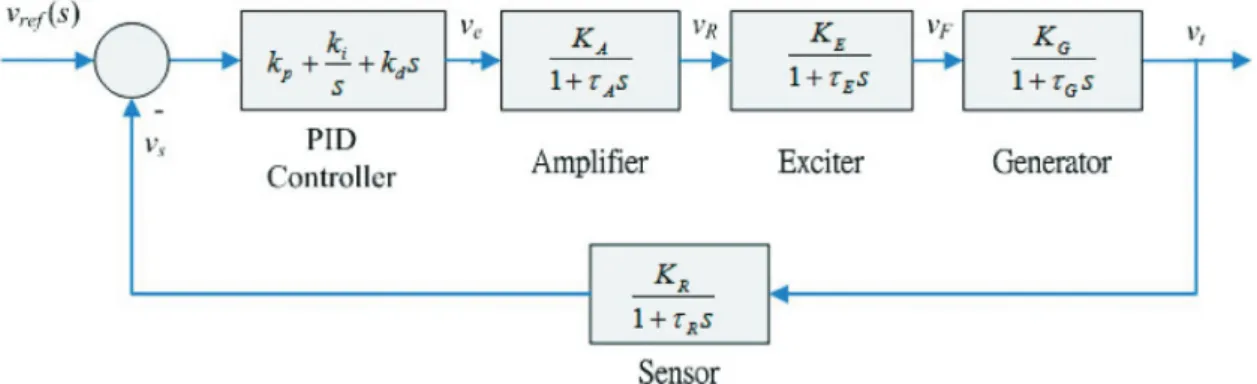
It is an important matter for the stable electrical power service to develop the automatic voltage regulator (AVR) of the synchronous generator with a high effi-ciency and a fast response. Until now, the analog PID controller is generally used for the AVR because of its simplicity and low cost. However, these parameters of PID controller are not easy to tune. Gaing [17] proposed a method to search these parameters by using a particle swarm optimization (PSO) algorithm. The AVR system model controlled by the PID controller can be expressed by Figure 1. where ns is the output voltage of sensor model,neis the error voltage between thensand refer-ence input voltagenref(S),nR is an amplify voltage by amplifier model,nFis a output voltage by exciter model, andnt is a output voltage by generator. There are five models: (a) PID Controller Model, (b) Amplifier Model, (c) Exciter Model, (d) Generator Model, and (e) Sensor Model. Their transfer functions are described as follows: (a) PID Controller ModelThe transfer function of PID controller is
(25)
wherekp,kd, andkiare the proportion coefficient, dif-ferential coefficient, and integral coefficient, respec-tively.
(b) Amplifier Model
The transfer function of amplifier model is
(26)
whereKAis a gain andtAis a time constant.
(c) Exciter Model
The transfer function of exciter model is
(27)
whereKEis a gain andtEis a time constant.
(d) Generator Model
The transfer function of generator model is
(28)
whereKGis a gain andtGis a time constant.
(e) Sensor Model
The transfer function of sensor model is
(29)
whereKRis a gain andtRis a time constant.
In this paper, the GA and PSO algorithm are applied to search a best PID parameters so that the controlled system has a good control performance. In [17], a
mance criterionW(K) is defined by
(30) whereK= (kp,kd,ki) is a parameter set of PID control-ler,b is a weighting factor, Mp, tr, ts, and ess are re-spectively the overshoot, rise time, settling time, and steady-state error of the performance criteria in the time domain.Mpandessare positive values. Moreover, the fitness function is proposed by Gaing [17] and de-scribed by
(31)
When this fitness functionfGis used in an
over-damp-ing system, as shown in Figure 2, the rise time will be too long and the settling time will approach the rise time. It will cause the value ofW(K) is too small and a wrong parameter set may be selected by the optimal al-gorithm. In order to overcome this defect, a modified
fitness function is defined by
(32)
whereW(K) is the performance criterion described by Equation (30) andITAEis an integral of time multiplied by absolute-error value and it is defined by
(33)
whereiÎ{0, 1, 2, …, end time} is an index,tiis thei-th sampling time, andeiis the absolute-error value in the
i-th sampling time. Equation (32) can increase the ef-ficiency and accuracy of the intelligent algorithm to search a high-quality solution.
4. Simulation Results
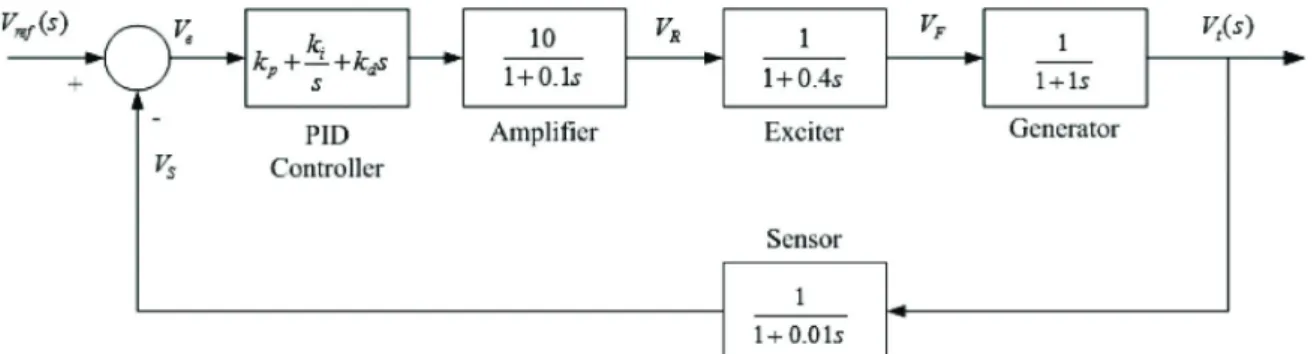
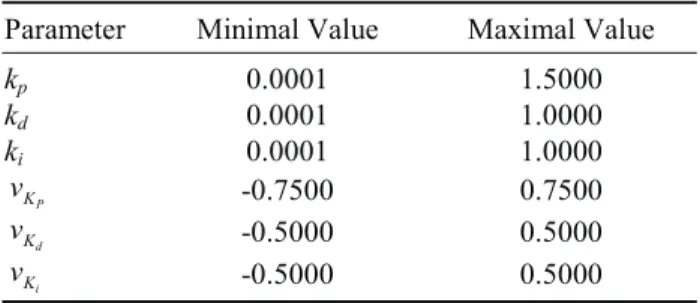
To verify the efficiency of the proposed fitness func-tion in the RGA and PSO algorithm, a practical high-order AVR system [17] as shown in Figure 3 is tested. The AVR system has the following parameters. The lower and upper bounds of the three control parameters are shown in Table 1.
The following parameters are used for the real-valued GA (RGA): the population sizeL= 50, the maxi-mum generation numberN= 100, the maximum iteration number is 50, crossover ratePc= 0.9, mutation ratePm= 0.01. The following parameters are used for the PSO al-gorithm: the particle swarm population sizeL= 50, max-imum generation numberN= 100, the maximum itera-tion number is 50,c1=c2= 2. Each parameter set
(indi-Figure 3. A practical high-order AVR system controlled by a PID controller. Figure 2. Time response of an over-damping system.
vidual) of the PID controller selected by the optimal al-gorithm isK= (kp,kd,ki). The RGA and PSO algorithm are used to search an optimal parameter set of the PID controller. The searching range of each parameter is de-scribed in Table 1. The simulation time is 2 second and the sampling time is 0.01 second. In the simulation step, one iteration has 100 generations. We run each algorithm
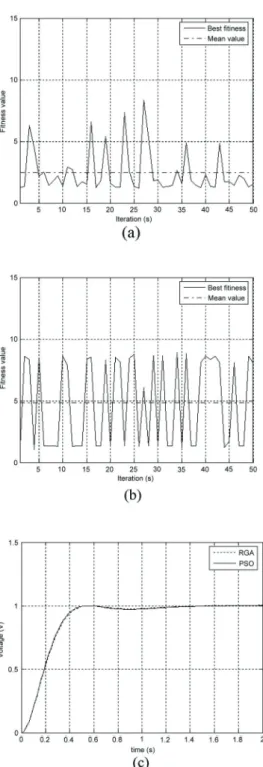
with 50 iterations and find the best fitness value, best control parameters that selected by these two algorithms in each iteration. The PID control parameter set selected by the RGA and PSO algorithm in 50 iterations for the AVR system based on the fitness function defined by Equation (31) and Equation (32) withb= 1 are respec-tively described in Table 2 and Table 3. Comparison of the control performance of the AVR system controlled by different controllers described in Table 2 (b= 1 and
f
W K
G =
1
( )) and Table 3 (b= 1 and f =W K ´ITAE 1
( ) )
are respectively described in Table 4 and Table 5. The best evaluation value in each iteration for the RGA and PSO algorithm (b= 1 and f
W K
G =
1
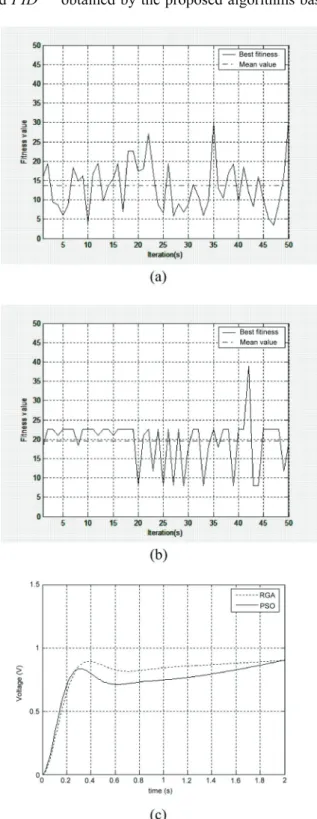
( )) and the best out-put response in 50 iteration are shown in Figure 4. In this paper, the performance evaluation criteria of two con-trollersPIDRGA andPIDPSOselected by RGA and PSO
Table 2.Best control parameters selected by two optimal algorithms in 50 iterations for the AVR system withb= 1 and 1 ( ) G f W K =
Selected Control Parameters Controller kp kd ki PIDGA[17] 0.7722 0.3196 0.7201 PIDPSO[17] 0.6751 0.2630 0.5980 PIDRGA 0.0222 0.2451 0.2913 PIDPSO 0.0001 0.4226 0.3965
Table 3.Best control parameters selected by two optimal algorithms in 50 iterations for the AVR system withb= 1 and 1 ( ) f W K ITAE = ´
Selected Control Parameters Controller
kp kd ki
PIDRGA 0.6311 0.2125 0.4615 PIDPSO 0.6443 0.2423 0.4700
Table 4.Comparison of the control performance of the AVR system controlled by different controllers described in Table 2 (b= 1 and 1 ( ) G f W K = )
Controller Number of Generation tr ts MP(%) ess W(K) fG
PIDGA[17] 100 0.2138 0.8645 4.54 0 0.9002 01.1109
PIDPSO[17] 100 0.2648 0.3795 1.71 0 0.6851 01.4596
PIDRGA 100 1.9200 2.0100 0 0 0.0331 30.2031
PIDPSO 100 1.9400 2.0100 0 0 0.0258 38.8326
Table 5.Comparison of the control performance of the AVR system controlled by different controllers described in Table 3 (b= 1 and ITAE K W f ´ = ) ( 1 )
Controller Number of Generation tr ts MP(%) ess ITAE W(K) f
PIDRGA 100 0.3100 0.4300 1.41 0 5.0159 0.0530 3.7583
PIDPSO 100 0.2800 0.4000 0 0 4.2040 0.0441 5.3882
Table 1.Searching range of each parameter
Parameter Minimal Value Maximal Value
kp 0.0001 1.5000 kd 0.0001 1.0000 ki 0.0001 1.0000 P K v -0.7500 0.7500 d K v -0.5000 0.5000 i K v -0.5000 0.5000
algorithm in the time domain are executed on a Pentium computer. We can find that the fitness values ofPIDRGA andPIDPSOobtained by the proposed algorithms based
on the fitness function defined by Equation (31) are better than that ofPIDGAandPIDPSOobtained in [17], but the control performance ofPIDRGA andPIDPSOare not
Figure 4. The best evaluation value in each iteration forb= 1 and f
W K G =
1
( ). (a) RGA, (b) PSO algorithm, (c) Best output response in 50 iterations of two algo-rithms.
Figure 5. The best evaluation value in each iteration forb= 1 and f
W K ITAE
= ´
1
( ) . (a) RGA, (b) PSO algo-rithm, (c) Best output response in 50 iterations of two algorithms.
better than that ofPIDGAandPIDPSO obtained in [17]. This is because the rise time is too large and closed to the settling time. Therefore, the fitness function defined by Equation (31) lets the RGA and PSO algorithm easy to search a bad parameter set withb= 1. The best evalua-tion value in each iteraevalua-tion for the RGA and PSO algo-rithm (b= 1 and f
W K ITAE
=
´
1
( ) ) and the best output response in 50 iteration are shown in Figure 5. From the simulation and comparison results, we can find that the new fitness function defined by Equation (32) helps the RGA and PSO algorithm to search a best solution more accurate than the fitness function defined by Equation (31). The PID control parameter set selected by the RGA and PSO algorithm in 50 iterations for the AVR system based on the fitness function defined by Equation (31) and Equation (32) withb= 1.5 are respectively described in Table 6 and Table 7. Comparison of the control perfor-mance of the AVR system controlled by different con-trollers described in Table 6 (b= 1.5 and f
W K
G =
1 ( )) and Table 7 (b= 1.5 and f
W K ITAE
=
´
1
( ) ) are respec-tively described in Table 8 and Table 9. The best evalua-tion value in each iteraevalua-tion for the RGA and PSO algo-rithm (b= 1.5 and f
W K
G =
1
( )) and the best output
re-sponse in 50 iteration are shown in Figure 6. The best evaluation value in each iteration for the RGA and PSO algorithm (b= 1.5 and f
W K ITAE
=
´
1
( ) ) and the best output response in 50 iteration are shown in Figure 7. From the simulation and comparison results, we can see
Table 9.Comparison of the control performance of the AVR system controlled by different controllers described in Table 7 (b= 1.5 and 1 ( ) f W K ITAE = ´ )
Controller Number of Generation tr ts MP(%) ess ITAE W(K) f
PIDRGA 100 0.3000 0.4300 0 0 4.1343 0.0290 8.3386
PIDPSO 100 0.3000 0.4200 0 0 4.1812 0.0268 8.9322
Table 8.Comparison of the control performance of the AVR system controlled by different controllers described in Table 6 (b= 1.5 and 1 ( ) G f W K = )
Controller Number of Generation tr ts MP(%) ess W(K) fG
PIDGA[17] 100 0.1859 0.9396 6.17 0 0.9930 01.0071
PIDPSO[17] 100 0.2860 0.4168 0.92 0 0.8132 01.2297
PIDRGA 100 0.2800 0.4000 0 0 0.0268 37.3474
PIDPSO 100 0.2800 0.4000 0 0 0.0268 37.3474
Table 6.Best control parameters selected by two optimal algorithms in 50 iterations for the AVR system withb= 1.5 and 1 ( ) G f W K =
Selected Control Parameters Controller kp kd ki PIDGA[17] 0.8372 0.3927 0.6973 PIDPSO[17] 0.6477 0.2375 0.5128 PIDRGA 0.6324 0.2464 0.5047 PIDPSO 0.6455 0.2458 0.4513
Table 7.Best control parameters selected by two optimal algorithms in 50 iterations for the AVR system withb= 1.5 and 1 ( ) f W K ITAE = ´
Selected Control Parameters Controller
kp kd ki
PIDRGA 0.6193 0.2228 0.4589 PIDPSO 0.6300 0.2276 0.4538
that the new fitness function can let the RGA and PSO al-gorithm find a high-quality PID control parameter set ef-fectively so that the controlled AVR system has a better control performance than the other methods.
5. Conclusion
In this paper, a RGA and a PSO algorithm with a new fitness function are proposed to find a better PID control
Figure 6. The best evaluation value in each iteration forb= 1.5 and f
W K G=
1
( ). (a) RGA, (b) PSO algorithm, (c) Best output response in 50 iterations of two al-gorithms.
Figure 7. The best evaluation value in each iteration forb= 1.5 and f
W K ITAE
= ´
1
( ) . (a) RGA, (b) PSO algo-rithm, (c) Best output response in 50 iterations of two algorithms.
parameter set for AVR system. From the simulation and comparison results, we can see that the proposed fitness function can let the RGA and PSO algorithm find a high-quality PID control parameter set effectively so that the controlled AVR system has a better control perfor-mance than the other methods. Moreover, some results illustrate that a good fitness function can help the opti-mal algorithms to find a high-quality solution effec-tively.
Acknowledgement
This research was supported in part by the National Science Council of the Republic of China under contract NSC 95-2221-E-032-057-MY3.
References
[1] Chent, S., Istepaniant, R. H., Whidbornet, J. F. and Wu, J., “Adaptive Simulated Annealing for Designing Finite-Precision PID Controller Structures,”IEE Col-loquium on Optimisation in Control: Methods and Ap-plications,pp. 1-3 (1998).
[2] Kwok, D. P. and Sheng, F., “Genetic Algorithm and Simulated Annealing for Optimal Robot Arm PID Control,”IEEE Conference on Evolutionary Compu-tation,pp. 707-712 (1994).
[3] Mitsukura, Y., Yamamoto, T. and Kaneda, M., “A Ge-netic Tuning Algorithm of PID Parameters,”Inference on Systems, Man, and Cybernetics,Vol. 1, pp. 923 -928 (1997).
[4] Krohling, R. A., Jaschek, H. and Rey, J. P., “Designing PI/PID Controller for a Motion Control System Based on Genetic Algorithm,”12th IEEE International Sym-posium on Intelligent Control,July, pp. 125-130 (1997). [5] Davis, L.,Handbook of Genetic Algorithms,Van
No-strand Reinhold, New York (1991).
[6] Goldberg, D. E.,Genetic Algorithms in Search, Op-timization, and Machine Learning,Addison-Wesley, Reading, Mass (1989).
[7] Wong, C. C. and Chen, C. C., “A GA-Based Method for Constructing Fuzzy Systems Directly from Numer-ical Data,” IEEE Transactions on Systems, Man and Cybernetics,Vol. 30, pp. 904-911 (2000).
[8] Wong, C.,C., Lin, B. C. and Chen, C. C., “Fuzzy Sys-tem Design by a GA-Based Method for Data Classifi-cation,” Cybernetics and Systems: An International Journal,Vol. 33, pp. 253-270 (2002).
[9] Wong, C. C., Lin, B. C., Lee, S. A. and Tsai, C. H., “GA-Based Fuzzy System Design in FPGA for an Omni-Directional Mobile Robot,”Journal of Intelli-gent & Robotic Systems,Vol. 44, pp. 327-347 (2005). [10] Kennedy, J. and Eberhart, R., “Particle Swarm Optimi-zation,” IEEE International Conference on Neural Networks,pp. 1942-1948 (1995).
[11] Shi, Y. and Eberhart, R., “A Modified Particle Swarm Optimizer,”IEEE Congress on Evolutionary Compu-tation,May, pp. 69-73 (1998).
[12] Angeline, P. J., “Using Selection to Improve Particle Swarm Optimization,”IEEE Congress on Evolution-ary Computation,May, pp. 84-89 (1998).
[13] Shi, Y. and Eberhart, R. C., “Empirical Study of Par-ticle Swarm Optimization,”IEEE Congress on Evo-lutionary Computation,July, pp. 1945-1950 (1999). [14] Clerc, M. and Kennedy, J., “The Particle Swarm-
Ex-plosion, Stability, and Convergence in a Multidimen-sional Complex Space,”IEEE Transactions on Evolu-tionary Computation,Vol. 6, pp. 58-73 (2002). [15] Parsopoulous, K. E. and Vrahatis, M. N., ”On the
Computation of All Global Minimizers through Par-ticle Swarm Optimization,” IEEE Transactions on Evolutionary Computation,Vol. 8, pp. 211-224 (2004). [16] Yoshida, H., Kawata, K., Fukuyama, Y. and Nakanishi, Y., “A Particle Swarm Optimization for Re-active Power and Voltage Control Considering Voltage Security Assessment,”IEEE Transactions on Power Systems,Vol. 15, pp. 1232-1239 (2000).
[17] Gaing, Z. L., “A Particle Swarm Optimization Ap-proach for Optimum Design of PID Controller in AVR System,”IEEE Transactions on Energy Conversion, Vol. 19, pp. 384-394 (2004).
[18] Liu, Y., Zhang, J. and Wang, S., “Optimization Design Based on PSO Algorithm for PID Controller,” 5th World Congress on Intelligent Control and Automa-tion,Vol. 3, pp. 2419-2422 (2004).
[19] Eberhart, R. C. and Shi, Y., “Comparison between Ge-netic Algorithms and Particle Swarm Optimization,” IEEE Congress on Evolutionary Computation, May,
pp. 611-616 (1998).
[20] Shi, X. H., Liang, Y. C., Lee, H. P., Lu, C. and Wang, L. M., “An Improved GA and a Novel PSO-GA-Based Hybrid Algorithm,” Information Processing Letters, Vol. 93, pp. 255-261 (2005).
[21] Kawabe, T. and Tagami, T., “A Real Coded Genetic Algorithm for Matrix Inequality Design Approach of Robust PID Controller with Two Degrees of Free-dom,”12th IEEE International Symposium on
Intelli-gent Control,July, pp. 119-124 (1997).
[22] Su, M. C. and Chang, H. T., “A Real-Valued GA-Based Approach to Extracting Fuzzy Rules for Sys-tem Identification,”International Joint Conference of CFSA/IFIS/SOFT’ 95 on Fuzzy Theory and Applica-tions,pp. 41-46 (1995).
Manuscript Received: Nov. 6, 2007 Accepted: Aug. 1, 2008