Decentralized load balancing for highly irregular search problems
Giuseppe Di Fatta a,*,
Michael R. Berthold
ba School of Systems Engilleering. The University of Readillg. Whiteknights. Reading. Berkshire. RG6 6A Y. UK
b Department of Computer alld Illformation Science. University of Konstaflz. Box M712. 78457 KOflstanz. Germany
Abstract
In this paper, we present a distributed computing framework for problems characterized by a highly irregular search tree, whereby no reliable workload prediction is available. The framework is based on a peer-to-peer computing environment and dynamic load balancing. The system allows for dynamic resource aggregation, does not depend on any specific meta-computing middleware and is suitable for large-scale, multi-domain, heterogeneous environments, such as computational Grids. Dynamic load balancing policies based on global statistics are known to provide optimal load balancing performance, while randomized techniques provide high scalability. The proposed method combines both advantages and adopts distributed job-pools and a randomized polling technique. The framework has been suc-cessfully adopted in a parallel search algorithm for subgraph mining and evaluated on a molecular compounds dataset. The parallel application has shown good scalability and close-to linear speedup in a distributed network of workstations.
© 2007 Elsevier B.V. All rights reserved.
Keywords: Distributed computing; Peer-to-peer-computing; Dynamic load balancing; Irregular search problems; Subgraph mining
1. Introduction
A large class of applications relies on implicitly defined search trees and are based on a Depth First Search (DFS) strategy, e.g. problems solved using the divide and conquer strategy. In order to reduce running times and to cope with larger problem instances, partitioning a DFS tree, i.e. parallel backtracking [I], has been widely and suc-cessfully adopted in many applications. It is quite straight-forward to partition the search tree to generate new independent jobs, which can be assigned to idle processors for asynchronous execution. In general, a static partition of the search space ean be effectively adopted when job run-ning times can be estimated. However, in many real-world problems the search space is highly irregular and no work load estimation is available. In the present work, we define the irregularity of a computational problem in terms of the empirical probability distribution of the task complexity, given a partitioning strategy. In particular, highly irregular
• Corresponding author.
E-llwi/ addresses: [email protected] (G. Di FaUa), Michael.
[email protected] (M.R. Berthold).
problems are characterized by a power-law distribution of the task running times in a wide range. For such irregular problems it is essential to provide a dynamic partitioning strategy along with a Dynamic Load Balancing (DLB) policy.
Many DLB algorithms for irregular problems have been proposed in the literature and their properties have been studied. However, most of them rely on assumptions that do not hold in general. Some DLB techniques for irregular problems are based either on the assumption of uniform or bounded task times, or on the availability of workload esti-mates. In [2], uniform time tasks are assumed. In [3], it is assumed that the smallest task time is comparable to or greater than network communication time for a task. In [4], the computation, is first evenly partitioned among pro-cessors and, subsequentially task migration is adopted to maintain load balance in the system. In [5], several DLB algorithms are analyzed and their scalability properties are provided in terms of the isoefficiency analysis. This study particularly addresses irregular problems where it is not possible to estimate the size of work at processors . Nevertheless, the assumptions in [5] require the guarantee that the computation cost of jobs is always greater than http://dx.doi.org/10.1016/j.micpro.2007.01.004
Konstanzer Online-Publikations-System (KOPS) URN: http://nbn-resolving.de/urn:nbn:de:bsz:352-opus-117872
the relative transmitting time. However, this is not the case in highly irregular problems where a poor work-splitting mechanism generates a high number of trivial tasks and makes the DLB policy inefficient. Moreover, such a prob-lem becomes more relevant in large computational environ -men ts, like Grids, with multi-domain and heterogeneous resollrces.
We present a distributed computing framework for highly irregular search problems, whereby no reliable workload prediction is available. The framework is based on a Peer-to-Peer (P2P) computing environment and a DLB policy. The DLB method employs a randomized tech-nique that is enhanced by global statistics to cope with highly irregular search problems. The adoption of heuris-tics based on global statisheuris-tics provides good load balancing performance, while the P2P approach and the randomized technique provide high scalability.
The proposed distributed computing framework has been developed in Java according to a multi-agent model.
It has been successfully adopted to deploy and test a paral-lel application of the subgraph mining problem for the dis-covery of relevant fragments in molecular compounds.
The rest of the paper is structured as follows. In the next section we introduce the test application, i.e. the frequent subgraph mining problem applied to molecular com-pounds, and discuss the irregular computation that charac-terizes it. In Section 3, we introduce the general architecture of the distributed computing framework and describe the dynamic load balancing policy. Section 4 pre-sents a performance evaluation of the parallel application. Finally, we provide conclusive remarks and future research directions.
2. Frcqucnt subgraph mining
Algorithms to find frequent subgraphs in a set of graphs have received increasing attention over the past years. E.g., in molecular biology it is often desirable to find common topological properties in large numbers of drug candidates. Existing methods attempt to implicitly organize the space of all possible subgraphs in a lattice, which models sub -graph relationships. The search then reduces to traversing this lattice and reporting all subgraphs that fulfill the desired criteria.
The Frequent Subgraph Mining (FSM) problem [6] is formulated in analogy to the Association Rule Mining (ARM) problem [7]. While in ARM the main structure of the data is a list of items (itemset) and the basic operation is the subset test, FSM relies on graph and subgraph isomorphism.
The subgraph isomorphism test is known to be an NP -complete problem [8]. Furthermore, there exists no known polynomial algorithm for isomorphism testing of general graphs, although the problem has not been shown to be NP-complete. In [9] the problem has been assigned to a special graph isomorphism complete complexity class, which falls between the P and NP-complete classes.
However, it is known that it can be solved in polynomial time for many restricted classes of graphs, such as bound -ed-degree graphs [iO].
Nevertheless, the combinatorial nature of the problem poses a great challenge. The computational complexity of the underlying problem and the large search space to be explored often render sequential algorithms useless. In such cases, distributed and parallel high performance computing becomes necessary for practical applications.
2.1. Molecular fragments discovery
The problem of selecting relevant molecular fragments in a set of molecules can be formulated in terms of frequent subgraph mining in a set of graphs. Molecules are repre-sented by attributed graphs, in which each vertex repre-sents an atom and each edge a bond between atoms. Each vertex carries attributes that indicate the atom type (i.e., the chemical element), a possible charge, and whether it is part of an aromatic ring. Each edge carries an attribute that indicates the bond type (single, double, triple, or aro -matic). Frequent molecular fragments are subgraphs that have a certain minimum support in a given set of graphs, i.e., are part of at least a certain percentage of the mole-cules. We assume that the molecular compounds in the dataset can be classified in two groups. We refer to the two classes of molecules as the focus set (active molecules) and its complement (non-active molecules). For example, during the high throughput screening of drug candidates, compounds are tested for a certain active behavior and a score associated to their activity level is determined. In this case, a threshold (thres) on the activity value allows the classification of the molecules in the two groups.
The aim of the data mining process is to provide a list of molecular fragments that are frequent in the active dataset and infrequent in the inactive dataset. These topological fragments carry important information and may be repre-sentative of those components in the compounds that are responsible for a positive behavior. In this case, two parameters are required: a minimum support (minSupp) for the focus subset and a maximum support (maxSupp)
for the complement.
Such discriminative fragments can be used to predict activity in other compounds and to guide the synthesis of new ones. For example, they can be adopted as features in a multidimensional space for molecular compounds clas -sification [II] and clustering [12].
Based on existing ARM algorithms for market basket analysis [7,13] proposed methods for subgraph mining con-duct depth-first [14,15] or breadth-first searches [16].
2.2. Irregular search space
An analysis of the sequential algorithm for molecular fragments discovery in [14] points out the irregular nature of the search tree. An irregular problem is characterized by a highly dynamic or unpredictable domain. In this
application, the complexity and the exploration time of the
search tree, and even of each single search tree node cannot
be estimated. The data mining nature of the problem makes the time required to visit a node unpredictable. In
our tests a single node exploration can take from few mil
-liseconds to several minutes. It is known that the pruning
techniques, which this kind of search algorithms heavily
rely on, make the estimation of the tree exploration time very difficult. Depth and fan of the search tree are also
unpredictable.
In order to provide evidence of the above consider
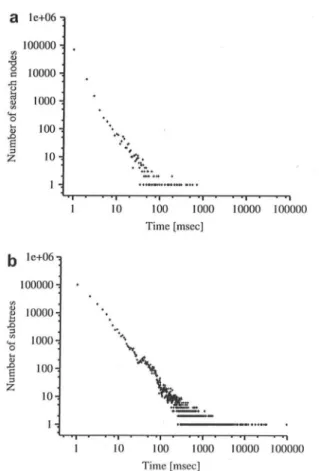
-ations, we collected statistics of the running time required by the sequential algorithm for the expansion of each search tree node (Fig. I(a)) and for the complete visit of
the associated subtree (Fig. I(b)). Both are characterized
by a power-law distribution. This may not come as a
sur-prise with regard to the subtree visiting time, since it is well known that this kind of distribution is typical for aggrega-tions of multi-scale hierarchies such as trees. However, it is
interesting that the node expansion time shows the same
type of distribution. This can be tentatively explained by the structure of the input data and the node expansion step
in the sequential algorithm. Each search tree node
repre-sents a molecular fragment and the expansion step consists of the extension of the fragment in all possible successors
by adding a bond and, eventually, an atom. Intuitively, this
a
le+06 100000 '".,
<tj 0 10000 c ..c u~
1000 ' -0 .... / ....'.,.
.~..
... 100.,
.0 E ;:J 10 Z 10 100 1000 10000 100000 Time [msec]b
le+06 100000 '".,
10000.,
b .0 ~ 1000 " ' -....
,
0 ....,
~, .0 100 E ;:J~
#
_.
Z 10 10 100 1000 10000 100000 Time [msec]Fig. I. Running time distribution in the search tree (lI1inSupp = 10% and
II1(1XSUPP = 1%), (a) Search-node expansion time, (b) Search subtree
visiting time.
produces a high number of fast fragment extensions due to the extension rules of the algorithm [14], and a smallnum
-ber of computationally long extensions. The irregularity of the search space implies that the work load of a task is not
known in advance and cannot be estimated. As a cons
e-quence, in a parallel approach a static load balancing pol
-icy cannot be adopted or it would produce very poor results. Moreover, no assumption can be made on the low
-er bound of subtask workloads. We cannot assume, for
example, that the subtask transmission time is less than the computation cost associated. This makes most dynamic load balancing policies unsuitable for this problem and others with similar characteristics.
In the next section, we describe the proposed distributed
computing framework for problems with a highly irregular
search space, which has been designed for heterogeneous
and distributed computing resources.
3. Distributed computing framework
The parallel application is mainly a work load distribu
-tion process based on dynamic parti-tioning of the search space, a dynamic load balancing policy and a peer-to-peer computing model. A P2P communication framework natu-rally fits with a receiver-initiated DLB approach and pro
-vides good scalability properties. Each peer registers at a centralized bootstrap node to join the system and to
con-tribute to the computation task. Peers can directly
exchange system information and computation subtasks,
since each process implements both client and server
func-tionality. The bootstrap node provides initial configuration
information and a dynamic peer directory service.
The model of each peer process is a multi-agent system
(Fig. 2), where each agent is an independent local entity
(Java thread) with a specific role. Agents exchange and react to asynchronous messages by taking proper actions.
Three main agent protocols have been designed for, respec
-tively, the peer-to-peer system management, the DLB pol
-icy and the job statistics maintenance. MPI-like methods have also been adopted for synchronous communication.
The Communication Manager (eM) provides an
inter-face to network communication and is responsible for the
peer-to-peer system management (the setup and mainte-nance of the distributed environment). The implementation
of our P2P computing framework allows the dynamic
:
I
~,
/
\·~·)~g
·~~;'it
,.!r
~·.·}: ___~:;~
_______ _joining of peers and provides a basic fault-tolerance mech
-anism in case of abrupt peer disconnection. eM also
imple-men ts some typical MPI methods, which are used to
implement higher level functionalities, such as agent
mes-sage delivery, synchronization barriers, reduction
opera-tions, etc.
The Data Manager (OM) provides an interface to access the input data in a distributed environment. Typically, the
OM at the boot node reads the data from a local file and
transfers them to the other OMs. OM also provides basic mechanisms to partition the data among the peers. In our
tests the entire dataset is simply sent to each peer. In the present work we tested a parallel application that adopts a task parallel approach and does not include any form
of data parallelism.
The Job Manager (JM) implements the OLB algorithm based on distributed job pool, as described more in details
in the Section 3.2.
The Worker executes assigned jobs by means of the algorithm (Miner) for a particular application. It provides
an interface to which a sequential algorithm must comply in order to be embedded in the system. Three methods have to be implemented to adapt the sequential code. The exe-cute method is used to invoke the execution of a sequential
task. This simply corresponds to a wrapper of the
sequen-tial algorithm to comply with the Worker interface. A
par-titioning method for work splitting (split) divides a
sequential task into two independent subtasks. The work
splitting mechanism depends on the particular data mining
applications. In applications based on a search tree, the
search nodes are typically stored in a stack and the work
splitting mechanism corresponds to the selection of one or more elements of the local stack to generate and donate
a subtask to an idle Worker. A third method (merge)
com-bines two partial results. In the particular data mining
application, this operation involves graph and subgraph
isomorphism tests to discard duplicates and to select only
the closed frequent fragments. The three 'methods will be
invoked asynchronously at each peer of the distributed
sys-tem according to the parallel algorithm and the dynamic load balancing policy.
The Worker must also provide mechanisms to convert
internal/external representations of jobs (e.g. search tree
nodes). Since we adopt a distributed memory model, inter
-nal representations of the algorithm data have to be con-verted to external ones, which do not depend on the
particular memory address space. This generates extra
computation that contributes to the overall parallel
over-head. The internal representation depends on the particular
application and the sequential algorithm [14]. e.g. In the
tested application, for the external representation we have
enhanced the SMILES syntax for molecular compounds
in order to embed partial state information from which
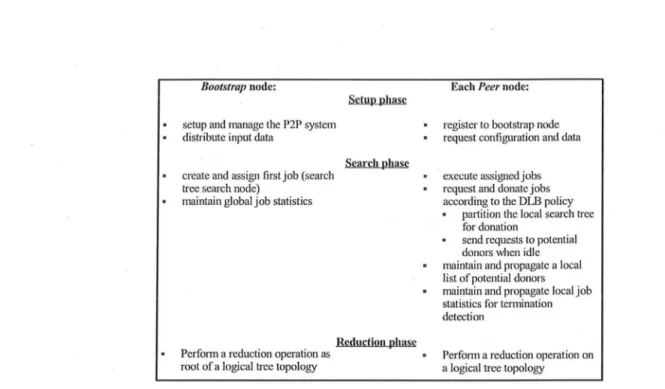
the computation can be restarted in a different machine. The parallel algorithm (Fig. 3) is composed by three
phases. In the first phase the P2P computing environment
is configured for the execution of the computational tasks.
The second phase is the exploration of the search space and corresponds to the computation in the sequential
algo-rithm. When the search is completed, in the third phase,
local lists of partial results have to be merged and collected at a single node to be reported to the user.
The search space partitioning, the OLB policy, the ter-mination detection of the search phase and the final reduc-tion of results are discussed in the next sections.
3.1. Search space partitioning
Partitioning a OFS tree, i.e. parallel backtracking [I], has been widely and successfully adopted in many parallel applications. In general, it is quite straightforward to par
-tition the search tree to generate new independent jobs,
which can be assigned to idle processors. In this case, no
synchronization is required among remote jobs.
. A job assignment contains the description of a node
removed from the search tree of the donor Worker, which
becomes the root node from which the receiving Worker
starts a new search. The job assignment must contain all
the information needed to continue the search from exactly
the same point in the search space.
Often the efficiency of search algorithms relies on advanced pruning techniques, which require specific state
information to be propagated in the nodes along the search
tree. Thus, a job description must include the search·node state necessary to rebuild the same conditions in the di
s-tributed search tree as in the sequential one (e.g. structural
pruning state in [14]). This requires an explicit
representa-tion of the relevant implicit state for the donated search
nodes.
During the parallel execution of subtasks, each Worker
maintains only a local and partial list of results that are found .
. The partitioning of the search space is carried out by the
Worker upon request of the local JM, according to the
OLB algorithm. .
3.2. Dynamic load balancing
In general, a OLB policy has to provide a mechanism to
fairly distribute the load among the processors using a
small number of generated subtasks to reduce the
commu-nication cost and the computational overhead. In particu
-lar, in applications based on irregular search-trees the OLB policy has to carefully select (I) a suitable subtask donor
among all the workers and (2) a non-trivial subtask among
the search nodes in the local stack of the donor. The qual
-ity of both the selection of donors and the generation of
new sub tasks is fundamental for an effective and efficient computational load distribution. These two tasks are ca
r-ried out, respectively, by the OLB policy and the work
splitting-mechanism.
In problems with uniform or bounded subtask times the
generation of either too small or too big jobs is not an
Bootstrap node: Each Peer node:
Setup Jlhase
setup and manage the P2P system distribute input data
register to bootstrap node request configuration and data
Search phase
create and assign first job (search U'ee search node)
maintain global job statistics
execute assigned jobs request and donate jobs
according to the DLB policy partition the local search tree
for donation
send requests to potential
donors when idle
maintain and propagate a local
list of potential donors maintain and propagate local job
statistics for termination detection
Reduction phase
Perform a reduction operation as Perform a reduction operation on a logical tree topology
root of a logical tree topology
Fig. 3. Pseudocode of the parallel application.
the efficiency and limit the maximum speedup tremendous-ly. While a coarse job granurarity may induce load imbal
-ance and a bound on the maximum speedup, a fine
granularity may decrease the efficiency of the distributed
system and more processing nodes would be required to reach the maximum speedup. Thus, it is important to pro-vide an adaptive mechanism to find a good trade-off between load balancing and job granularity.
]n order to accomplish this aim we introduce a mecha
-nism at the donor to reduce the probability of generating
trivial tasks and of inducing idle periods at the donor pro-cessor itself. A set of heuristic rules [17] filters out many potentially trivial nodes. Although the number of very
small subtasks has been significantly reduced, they cannot
be completely discarded by the use of the rules; the visiting
time of search tree nodes still has a power-law distribution.
A randomized OLB technique further restricts the possible
choices for new subtasks by selecting promising donors. This, once more, changes the distribution of the subtask visiting time. The final actual distribution is not available
because it is the result of a parallel execution where sub-tasks are dynamically generated; task donation alters the
task (subtree) at the donor itself.
Both components, the work splitting technique for· the subtask generation and the OLB policy for donor selection, contribute to the overall OLB efficiency, scalability and to its suitability to irregular problems and to heterogeneous
computing resources. The OLB approach we have
adopt-ed, the Ranked Random Polling (RRP), is a receiver-initiat-ed algorithm based on a decentralized job-pool system and a centralized server for job statistics, as described in the next sections.
3.2.1. Decentralized job pool system
Each 1M manages a local pool of available jobs, which
can be assigned to remote 1Ms upon request and to the
local Worker when idle. This simple communication proto -col is shown in Fig. 4. Requests are based on a soft state.
Each 1M also keeps a list of donated and not completed
jobs in order to support mechanisms for fault tolerance
and termination detection. The 1M also issues requests to the local Worker for the partitioning of the local search space Uob generation). These activities are regulated by two thresholds of the job pool. A job can be donated to
a remote 1M only if the current job pool size is above a
donation threshold Jd , which is constant and typically set to I (since there is only one local Worker). This way at
the completion of a local job, the request and reception of a new one can be overlapped to the execution of a job from the local pool. Overlapping computation with
com-munication of job request/assignment helps to avoid, or
at least to reduce, most of the communication overheads. Only the latency of the first job assignment and of the last job-completed message cannot be avoided at all.
The job generation activity is enabled when the job pool
size is below a spawning threshold Js. In a centralized job
Peer
Job Manager Worker/Miner
. Local Job Rcqucst
§
search8
job . Local Job Assignmcnt II stackpool Reject
. Remote Job Rcquest . Remote Job Assignment II Reject
Peel' ~
Job Manager Workcr/Mincr
. Local Job Request
~
searchU
job . Local Job Assignment II stackpool Reject
pool approach, is can be easily set to the number of partic-ipating nodes. All nodes send job requests to the
central-ized job pool manager. In a decentralized system the
threshold is must be independently set and adapted at each
peer.
The determination and dynamic adaptation of the
threshold is is critical for the effectiveness of the DLB in
the system. is adaptation depends on the donor selection
policy as described in the next section.
3.2.2. Donor selection
When the job pool size is below the threshold id , the JM
selects a donor among the other peers to request a new
sub-task. A job request sent to a peer has the effect that the remote JM will solicit its local Worker to remove a search
tree node from the local stack in order to distribute part of
the search tree. In general, not all workers are equally suit-able as donor. Workers that are running a mining task for
a longer time, have to be preferred. This choice can be
motivated by two reasons. The longest running jobs are
likely to be among the most complex ones. And this prob-ability increases over time. Secondly, a long job-execution
time may also depend on the heterogeneity of the
process-ing nodes and their loads. With such a choice we provide
support to the nodes that are likely overloaded either by
their current mining task assignment or by other unrelated
processes.
Each JM keeps a local directory of potential donors and
performs a random polling over them to get a new task.
The probability of selecting a donor from the list is not uni -form. In particular, we adopt a simple linearly decreasing
probability, where the donor list is ordered according to
the starting time of their current job. This way, long run
-ning jobs have a high probability of being further
parti-tioned, while most recently assigned tasks do not.
Similarly, if a peer has a high rank in its own list of donors, it can expect to receive many remote job requests. As a consequence, it will increase or decrease the local
threshold is accordingly.
The effectiveness of the donor selection and of the is
threshold regulation depends on the correctness of the local
statistics. In order to collect and propagate statistics of job executions, we adopted two mechanisms based on, respec-tively, a centralized statistics server (typically at the boot-strap node) and a decentralized P2P information
distribution. The centralized server provides initial
config-uration information and a dynamic peer directory service.
At the starting and at the completion of a job execution,
workers notify the server, which collects global job
statis-tics. Peers update their local donor list with information
exchanged with other peers and by an explicit update mes-sage from the server (Fig. 5). In general, the local list of
potential donors can be limited to contain only a subset
of all peers (the top elements) and does not need to be strictly updated and synchronized in the system. Namely,
for a very large system, the centralized server might become
a bottleneck and, thus, might send less frequent updates to
Peer (bootstrap node)
Job Manager DirectOlY Centralized
~
gdonor lobalEJ
of Peers and Job Statistics Se list Statistics rver 'U~.
0....
'11 ,:>-u . ~~ ,,/1f'~ "'<:. CZ o<?, I" /,>¢, ". ...• ~ J'<'lj>c,o
....
~ ~ 0." <7q ..... ~ . ... ~'1i".:§~. J' ~ ~'. c 1"0'...... O;,>,! ':$:)" ....0'
i:.ll1'1" •..•.• ~~ll:,,0
...
~o~ ". 1"0' Peer ~., Peer~ Job Manager. P2P donor list update Job Manager
~ local
..
..
~
localdonor donor
list list
Fig. 5. Hybrid centralized/decentralized communication system for donor
selection.
the peers (dashed line in the figure). However, the
central-ized server is not so critical in our approach since job
sta-tistics are also exchanged between peers.
The centralized server at the bootstrap node allows the
determination of suitable job donors from the complete
knowledge of the job statistics in the system. Approaches
based on global statistics are known to provide optimal
load balancing performance, while randomized techniques
provide high scalability. We expect that for a larger and
larger number of peers the performance of the DLB would
decrease in a graceful way to the lower bound given by a
simple random polling policy.
In some aspects, our approach is similar to the one described in [5] as a "modified" scheduler-based load bal -ancing. In the latter, donors directly assign subtasks to idle
workers, as in our case. However, in the approach
described in [5J, the poll is always generated by the central -ized server, which adopts a round robin donor selection among the workers. In our case, the generation of job
requests (polls) has also been decentralized. Moreover, in
our DLB approach the use of the ranked-random
tech-nique is fundamental for the selection of the most suitable
donors to avoid the generation of a high number of trivial
tasks. Then, in our case, polls are not uniformly distributed
among all workers, but they are still spread over several donors.
3.3. Search termination detection
Each JM keeps a list of assigned and not completed jobs
in order to support mechanisms for fault tolerance and
ter-mination detection. With the adoption of a global coll
ec-tion of job statistics is quite straightforward to detect the
termination of the entire search task. When all peers are
not executing a job, have an empty job pool and an empty
list of assigned jobs, then the search tree has been explored entirely.
When the search termination condition is detected, the
centralized server will issue a broadcast message to inform the peers in order to start the next phase, i.e. the reduction of all local lists of partial results.
In some cases it may not be convenient to adopt a
cen-tralized server for the termination detection. For a very
high number of peers it may become a bottleneck and
decrease the performance by simply delaying the start of the next phase. Also hierarchical systems, like multi-do
-main computational environments, may suffer from a
cen-tralized approach. In these cases a distributed algorithm
[18] for the termination detection can be adopted.
3.4. Reduction of final results
Each Worker maintains only a local and partial list of results found during the execution of subtasks. Therefore, at the end of the search process we perform a reduction
operation. Workers are organized in a communication tree
and the number of communication steps required is in the
order of O(logN), where N is the number of processes.
Generic collective operations, including the reduction, have
been implemented in the CM and can be specialized for the
specific application by the Worker.
This is more efficient than a star topology of a master -slave approach (e.g. [19]), which requires O(N) sequential
communication steps.
In the test application, partial local lists of frequent
frag-ments are merged and duplicate and non-discriminative
fragments are discarded. However, the determination and
selection of the discriminative fragments include expensive graph and subgraph isomorphism tests and may represent
a non-trivial computational cost for a single processor.
Moreover, the number of all frequent fragments may
become very large and the communication cost would be
too expensive. Therefore, the selection of the discriminative
fragments has to be distributed as well. This can be
per-formed during the reduction operation in parallel by
sever-al concurrent processes and not only by the single node
where the results will be finally collected.
The reduction operation based on a logical
communica-tion tree has the advantage of a minimum number of
com-munication steps. Moreover, it also has the advantage of
distributing the computational load associated to the costly
graph and subgraph isomorphism tests for the reduction of
the final list of the molecular fragments.
4. Performance evaluation
The distributed application has been tested for the anal-ysis of a set of real molecular compounds - a well-known,
publicly available dataset from the National Cancer
Insti-tute, the DTP AIDS Antiviral Screen dataset [20]. This
screen utilized a soluble formazan assay to measure protec
-tion of human CEM cells from HIV -I infection [21]. We
used a total of 37,169 compounds, of which 325 belong
to the class of active compounds and the remaining
36,844 to the class of inactive compounds.
Experimental tests have been carried out on a network of Linux workstations I located in different LANs of the
University of Konstanz; the software has been developed
in Java. The communication among processes has been
implemented using TCP socket API and XML data
format.
In our tests, we introduced a synchronization barrier to
wait for a number of processors to join the P2P system
before starting the mining task only in order to collect per -formance results. In general, this is not necessary, but in the following results we did not want to consider the
laten-cy that is required to simply start up the remote peers.
4.1. Dynamic load balancing pelformance
In order to evaluate our DLB algorithm (RRP), we also
implemented a random polling (RP) policy with distributed
job queues and a centralized job-pool approach, i.e. a mas-ter-slave (MS) architecture [19]. The three techniques use the same work-splitting mechanism described in [17].
We compare three performance figures, the running time, the Jain's fairness index [22] and the relative load
imbalance index. The running time gives an immediate
measure of the effectiveness of the DLB. The Jain's fairness
index is often adopted to measure the equality of the allo-cation of a shared resource to different contending entities.
In this case, we want to measure the quality of the load
bal-ancing, which aims at the equal allocation of the overall
computational load to processors. The Jain's fairness index
is defined as:
f( ) (L:IX;)2
J= XI,X2,,,,,XN = N 2'
N'L;=IX ;
(I)
where Xi is a measure of the work load at processor Pi' In particular, the quantity we consider is the running time
spent in useful work by each processor:
Xi
=
TP"work.The index of formula (I) is continuous and bounded in the range [0, I]. It is independent of the scale, the metric and
the total amount of the shared resource and of the number
of contending entities. An index closer to I means a better fairness in the allocation, hence better load balancing.
Another index that has often been adopted to measure
the DLB performance (e.g. in [23]), is the relative load imbalance index (LI), given by
LI
=
f( XI,X2, .. ·,XN )= -
I L~,_IX; NN· max;=lx; (2)
I Nodes have different hardware and software configurations. The group
of the eight highest performing machines is equipped with a CPU Intel
Xeon 2.40 GHz, 3GB RAM and run Linux 2.6.5-7.151 as well as Java SE
Table I
Dynamic load balancing performance (lI'IillSupp = 6%, lI'IaxSupp = 1% alld
NPWC5 = 24) Runtime (s) Jain's index Ll index MS 91 0.90 0.38 RP 114 0.99 0.10 RRP 76 0.99 0.13
The index is bounded in the range [0, I], but it does not have the other properties described above for the Jain's in-dex. The LI index is a measure of the load imbalance; a lower value means better load balancing.
Table I provides a comparison of typical values of these three performance figures for the different DLB algorithms.
In general, the two random approaches attain better load balancing because they distribute job requests to more donors than the centralized approach, which adopts a sin-gle job-pool at the manager and a single donor. However, the simple random polling is not able to reduce the running time because of the irregularity of the search space. A more accurate selection of donors (cf. Section 3.2) still allows for a better distribution of the work load, while it also attains a lower running time.
It should be noticed that both indexes are not sufficient to evaluate the quality of DLB policies; the running time must be taken into account. According to the LI index RP should perform slightly better than RRP, while it actu-ally shows longer running time. The reason is that the LI index puts in evidence small differences that are not rele-vant. On the contrary, the Jain's fairness index provides indications that are, at least, not in contradiction with the running times. It is saturated (almost 1.0) in both the randomized techniques and their slight difference is not in evidence.
4.2. Speedup
We complete the analysis of the distributed application with the ranked-random DLB technique by showing the running time and the speedup curve (Fig. 6) of the parallel over the serial algorithm. The performance of the sequen-tial algorithm that is used to determine the speedup, is obtained from an optimized version of the algorithm described in [14] in the highest performing single-proces-sor2 server that is available for our tests. Moreover, we car-ried out a series of preliminary tests to measure the performance of each available workstation for the specific mining algorithm. A cumulative performance index is shown in the figure and provides a speedup bound for the different configurations.
The speedup curves show that for lower minSupp values,
i.e. more complex mining tasks, the speedup improves, as expected. In particular, for the value minSupp = 6%, the speedup is linear and exactly follows' the speedup bound
~ Intel P4 30Hz 2 OB RAM.
a
24 / minSupp=6% ---+-20 minSupp=7% --x-- ...-8 minSupp= 12% -~ !If - -minSupp=18% .... E! ......-16 cum. perf. index - -
.
.
- . / ...-/ .-' 0.•
::J / ' '0.,
12.,
0. (I) 8 O+-~-r---'----.----r----r---,o
b
lOOO 800 0'.,
600 ~.,
E E= 400 200 0 0 4..
8 12 16 20 Number of processors minSupp=6% + -minSupp=7% - -><- -minSupp=12% - - .. - -minSupp= 18% -.. 'E!-..Gl·~·:
.
:m.:.:_,.;;'~~:
.
~;.,~~::;
.
~-:,-::,::;::;.:;.;;:
:
.:::
4 8 12 16 20 24 Number of processors 24Fig. 6. (a) Speedup and (b) running time (maxSupp = 1%).
in the first part of the chart. Then, it is evident that more resources cannot further decrease the running time; the amount of work is not enough and additional computa-tional resources cannot be effectively exploited. Neverthe-less, it is positive that the running time does not increase when unnecessary resources are used as one might expect because of the additional communication and computation overheads. This provides evidence of the good scalability properties of the system. Moreover, it shows that the deter
-mination of the optimal number of processors for a given task is not critical with respect to the running time.
5. Conclusions
In this paper we have presented a distributed computing framework for problems based on a search strategy. It
employs a decentralized dynamic load balancing technique that is enhanced by global statistics to cope with highly irregular problems. The proposed approach is particularly useful for parallel and distributed applications where no assumption of uniform or bounded task times can be made and no workload estimate is available. For these applica-tion simple DLB policies, like random polling and schedul
-er-based, do not provide' an efficient solution.
We adopted the distributed computing framework for a parallel formulation of the frequent subgraph mining
prob-lelll applied to the task of discriminative molecular frag-ment discovery.
Experimental tests on real molecular compounds in a distributed non-dedicated computing environment con-firmed its effectiveness in terms of running time perfor-mance, low parallel overhead and load balancing. In a 24-node system and in comparison to a Master/Slave approach, the improvement of the running time was up to 16% and the quality of the load distribution (Jain index) improved up to 10%. In larger computational environ-ments we expect that such improvements become more important.
Future research efforts will focus on a more accurate formalization of the model and its simulation on very large-scale systems. Experimental tests on large-scale sys-tems are needed to verify the scalability of the P2P approach. The centralized server for job statistics could potentially become a bottleneck and a completely decen-tralized solution should be adopted.
Other research directions include the adoption of the approach in other application domains to verify and extend its general applicability and the introduction of advanced and intelligent services, e.g. the dynamic and autonomous management of overlay networks of peers. Peers can dynamically organize themselves in clusters in order to aggregate computing resources for computing-intensive subtasks by exploiting physical connectivity. This would be particularly useful for those problems whose complexity is not known in advance or it is difficult to be estimated with sufficient precision. At run time further resoui'ces could be dynamically aggregated and allocated to particu-larly difficult subtasks.
Acknowledgements
This work was partly supported by the Deutsche Fors-chungsgemeinschaft (DFG) Research Training Group GK-I042 "Explorative Analysis and Visualization of large Information Spaces". We thank the Department of Com-puter and Information Science of the University of Kon-stanz for the use of their machines.
References
[I] R. Finkel, U. Manber, Dib - a distributed implementation of
backtracking, ACM Transactions on Programming Languages and
Systems 9 (2) (1987) 235-256.
[2] R. Karp, Y. Zhang, A randomized parallel branch-and-bound
procedure, in: Proceedings of the 20th Annual ACM Symposium
on Theory of Computing (STOC), 1988, pp. 290-300.
[3] S. Chakrabarti, A. Ranade, K. Yelick, Randomized load-balancing
for tree-structured computation, in: Proceedings of the Scalable High
Performance Computing Conference (SHPCC), 23-25 May 1994,
Knoxville, TN, 1994, pp. 666-673.
[4] Y. Chung, J. Park, S. Yoon, An asynchronous algorithm for
balancing unpredictable workload on distributed-memory machines,
ETRI Journal 20 (4) (1998) 346-360.
[5] V. Kumar, A. Grama, V.N. Rao, Scalable load balancing techniques
for parallel computer, Journal of Parallel and Distributed Computing 22 (I) (1994) 60-79.
[6] T. Washio, H. Motoda, State of the art of graph-based data mining,
ACM SIGKDD Explorations Newsletter 5 (I) (2003) 59-68.
[7] R. Agrawal, T. Imielinski, A.N. Swami, Mining association rules between sets of items in large databases, in: Proceedings of the 1993
ACM SIGMOD International Conference on Management of Data,
26-28 May 1993, Washington, DC, 1993, pp. 207-216.
[8] M.R. Garey, D.S. Johnson, Computers and intractability: a guide to
the theory of NP-completeness, W.H. Freeman, 1979.
[9] S. Skiena, Implementing Discrete Mathematics: Combinatorics and
Graph Theory with Mathematica, Addison-Wesley, 1990.
[10] E.M. Luks, Isomorphism of graphs of bounded valence can be tested
in polynomial time, Journal of Computer and System Sciences 25
(1982) 42-65.
[II] M. Deshpande, M. Kuramochi, G. Karypis, Frequent
sub-structure-based approaches for classifying chemical compounds, in: Proceed-ings of IEEE International Conference on Data Mining (ICDM), 19
-22 November 2003, Melbourne, Florida, USA, 2003.
[12] G. Di Fatta, A. Fiannaca, R. Rizzo, A. Urso, M.R. Berthold, S. Gaglio, Context-aware visual exploration of molecular databases, in:
Proceedings of the International Workshop on Data Mining in
Bioinformatics, 6th IEEE International Conference on Data Mining,
18-22 December 2006, Hong Kong, 2006.
[13] M. Zaki, S. Parthasarathy, ·M. Ogihara, W. Li, New algorithms for fast discovery of association rules, in: Proceedings of 3rd Interna-tional Conference on Knowledge Discovery and Data Mining (KDD), 1997, pp. 283-296.
[14] C. Borgelt, M.R. Berthold, Mining molecular fragments: Finding relevant substructures of molecules, in: IEEE International
Confer-ence on Data Mining (ICDM), 9-12 December 2002, Maebashi,
Japan, 2002, pp. 51-58.
[15] X. Van, J. Han, gSpan: graph-based substructure pattern mining,
IEEE International Conference on Data Mining (ICDM) (2002) 721.
[16] M. Deshpande, M. Kuramochi, G. Karypis, Automated approaches
for classifying structures, in: Proceedings of Workshop on Data
Mining in Bioinformatics (BioKDD), 2002, pp. 11-18.
[17] G. Di Fatta, M.R. Berthold, High performance subgraph mining in
molecular compounds, in: Springer's LNCS Proceedings of the International Conference on High Performance Computing and
Communications (HPCC), 21-24 September 2005, Sorrento, Italy,
2005.
[18] C. Sieb, G. Di Fatta, M.R. Berthold, A hierarchical distributed approach for mining molecular fragments, in: Proceedings of the
ECML/PKDD 2006 Workshop on Parallel Data Mining, 18-22
September 2006, Berlin, Germany, 2006.
[19] G. Di Fatta, M.R. Berthold, Distributed mining of molecular fragments, Proceedings of the Workshop on Data Mining and the
Grid (DM-Grid) of the IEEE International Conference on Data
Mining (ICDM), 1-4 November 2004, Brighton, UK, 2004.
[20] National Cancer Institute, DTP AIDS antiviral screen dataset.
<http://dtp.nci.nih.gov./docs/aids/aids_screen.html/> .
[21] O. Weislow, R. Kiser, D. Fine, J. Bader, R. Shoemaker, M.
Boyd, New soluble formazan assay for hiv-I cytopathic effects:
Application to high flux screening of synthetic and natural
products for aids antiviral activityJournal of the National Cancer Institute, 81, University Press, Oxford, United Kingdom, 1989, pp. 577-586.
[22] R. Jain, D. Chiu, W. Hawe, A quantitative measure oUairness and
discrimination for resource allocation in shared computer systems, Technical report, DEC Research Report TR-30 I (1984).
[23] R. Sakellariou, J.R. GlII'd, Compile-time minimisation of load imbalance in loop nests, in: Proceedings of the 11th ACM
International Conference on Supercomputing (ICS), July 1997, pp. 277-284.