.ies
6
lo
POLICY RESEARCH WORKING PAPER
1510
Hungary's Bankruptcy
Policymakers looking forpolicies and processes to spur
Experience, 1992-93
enterprise restructuring intransition economies should
Cheryl Gray study Hungary's experience
Sabinery hloGrke with bankruptcy reform since
Miklos Szanyi 1992. It is unique in the
post-socialist world.
The World Bank
Policy Research Department Transition Economics Division September 1995
Public Disclosure Authorized
Public Disclosure Authorized
Public Disclosure Authorized
r
1(Y
RESEARCH WORKING PAPER 1510Summary findings
Hungarv adopted a tough new bankruptcy law in late The first wave of reorganizations was handled 1 991 that took effect on January 1, 1992. It required surprisingly quickly, especially considering the sheer managers of firms with arrears over 90 days to any number of cases, the novelty of the process, and the creditor to file for either reorganization or liquidation shortage of trained judges. This quickness was possible within eight days (the so-called "automatic trigger") and largely because of the decentralized design of the provided a rather sympathetic framework in which to do process. Once the court approved a case, the court had so. The result: Since January 1992, more than 25,000 little role. (Amendments added in 1993 may have made cases have been filed - far beyond lawmakers' the process more bureaucratic and expensive.)
expectations. * In this sample, major delays occurred not in
Both positive and negative views about the law have reorganization but in liquidation. Creditors will do beeni expressed, hut details about how the process has almost anything to avoid filing for liquidation, and once actuallv worked have been scarce. Gray, Schlorke, and firms enter liquidation they are still likely to be kept alive Szanyi help fill this information gap by providing indefinitely. In the end, this lack of a viable creditor-led detailed data on a randomly selected stratified sample of ,exit" and debt collection mechanism harms firms by actual cases filed in 1992-93, supplemented by increasing the cost and reducing the flow of credit. information gained through interviews with judges, Although the bankruptcy process displays some liquidators, and firms involved in bankruptcy. They degree of economic logic, one should not assume that it
conclude, among other things, that: operates as a similar law would in a market economy. In
* The bankruptcy process appears to have had some particular, a likely source of private gain in HungarT degree of economic logic in 1992 and 1993. Better firms appears to be asset or other value diversion (or "value-were niore likely to enter and emerge "successfully" from stripping") before bankruptcy.
reorganization, while worse firms were more likely either * The main need is to strengthen the incentives of to fail in reorganization or to file directly for liquidation. creditors to monitor the process closely and to improve
* Judicial reorganization need not be slow and costly. their ability to do so.
This paper - a product of the Transition Economics Division, Policy Research Department - is part of a larger effort in the department to understand processes of enterprise restructuring in transition economies. Copies of the paper are available free from the World Bank, 1818 H Street NW, Washington, DC 20433. The study was funded by the Bank's Research Support Budget under
the research project "Bankruptcy Law and Enterprise Restructuring in Hungary" (RPO 678-75). Please contact Grace Evans, room
N l1-017, telephone 202-473-7013, fax 202-522-1151, Internet addressgevansrtjvworldbank.org. September1995. (51 pages)
The PoliLv Research Wiorking Paper Series disseminates the lindings of work in progress to encourage the exchange of ideas about development issues. An objective of the series is to get the findings out quickly, even if the presentations are less than fully polished. 7hue papers carry the names of the authors and should be used and cited accordingly. The findings, interpretations, and conclusions are the authors' own and should not be attributed to the World Bank, its Executive Board of Directors, or any of its mlember countries.
Hungary's Bankruptcy Experience, 1992-1993
by
Cheryl Gray
Sabine Schlorke
Miklos Szanyi
Policy Research Department
The World Bank
and
The Institute for World Economics
Hungarian Academy of Sciences
The authors would like to thank Stijn Claessens, Mihaly Kopanyi, S. Ramachandran, Richard Roulier, Mark Schaffer, Charles Woodruff, and llham Zurayk for helpful comments on earlier drafts.
Introduction
As policy makers in transition economies look for policies and processes to spur
enterprise restructuring, they should take a close look at Hungary's experience with bankruptcy1 reform since 1992. It is indeed unique in the post-socialist world. Hungary adopted a tough new bankruptcy law in late 1991 that took effect January 1, 1992. It required managers of all firms with arrears over 90 days to any creditor to file for either reorganization or liquidation within 8 days (the so-called "automatic trigger") and provided a rather sympathetic framework for them to do so. The law immediately resulted in a wave of filings, with some 3500 filings in April, 1992, alone (after the 90 day "grace" period covered by the law) and over 22,000 filings in 1992-1993. Since January 1992, over 25,000 cases have been filed under the law (Table 1), a level far beyond the expectations of policy makers when the law was adopted.
Although the level of activity has been enormous, detailed information on how the bankruptcy process has actually worked in Hungary has been scarce. Many views -- both positive and negative -- have been put forward regarding the impact of the law on enterprise restructuring in particular and economic growth more generally, but they have been supported by
' For purposes of this paper we use the term "bankruptcy" for the entire framework and "reorganization" and "liquidation" for the two specific procedures provided in the law. This differs from the specific Hungarian terminology, which uses the term "bankruptcy" to refer to the specific reorganization procedure rather than the broader overall framework.
-TABLE 1
Hungarian Reorganization and Liquidation Processes 1-92 through 12-93 Reorganization Liidatio FILINGS 5,156 17,133 Of these: SOEs 429 1,820 Cooperatives 965 2,768 Business Entities 3,762 12,545
(of these, limited
liability companies) (2,959) (8,927)
Of these, approximate %
with over 300 employees 6% *
51-300 employees 24% * 50 or fewer 70% * STATUS AS OF 12-31-93 Closed 4,627 (90%) ** - With Ageement 1,250 (27%) - Reversion to liquidation 1,377 (30%) - Administration completion 2,000 (43%) Pending 529 (10%)
* Data not available
** Over 10,000 liquidation cases were completed by the courts in 1992 and 1993, but these included cases filed in earlier years under the previous law. Furthermore, over three-fourths of those completed cases were "administrative completions", i.e. cases withdrawn or rejected on administrative grounds rather than completed on the merits. Only a very small number of the 17,133 cases filed in 1992 and 1993 have been completed to date.
very limited reliable data. This study helps to fill this information vacuum by providing detailed data on a randomly selected stratified sample of actual cases filed in the first two years after the enactment of the law. These data are supplemented with information obtained in numerous interviews with judges, liquidators, and firms involved in the bankruptcy process to give an overall picture of the process in practice in the first two years of its implementation.
Bankruptcy law plays at least three important roles in market economies. First, it
provides ailing frmns with an orderly means of exit. Second, it helps to reallocate assets to better uses through a combination of restructuring and liquidation. These two roles work together: The threat of exit spurs restructuring, and the impossibility of restructuring spurs exit. The
bankruptcy process should ideally be able to discriminate between unviable firms and potentially viable ones that can be saved through restructuring. For enterprises able to cover operating costs out of current revenues but unable to cover debt service, reorganization provides an avenue to restructure debt burdens and thus continue in operation. It may promote such restructuring formally, as in the Hungarian reorganization procedure, or through informal debtor-creditor workouts undertaken to avoid formal bankruptcy. Firms unable to cover even operating costs are clear candidates for exit unless fundamental operational restructuring can be achieved via reorganization.
-In their emphasis on preserving jobs and production, policy makers in many transitional countries focus on these first two roles for bankruptcy law. However, a third role is at least as important for economic growth: The bankruptcy regime should promote the flow of credit in an economy by protecting creditors and serving as a final stage of debt collection. A well-designed
bankruptcy process takes control over financially-distressed firms before all assets have been
misused or dissipated, and it gives creditors the information and power to direct the use of the remaining assets to maximize the potential for debt recovery (either by improving the firm's
performance via reorganization or by liquidating the firm and satisfying creditors' claims to the
extent possible out of sale proceeds). By thus giving creditors the confidence that debts can be
collected, bankruptcy processes (and collateral laws prior to bankruptcy) facilitate the role of
banks and other creditors in funding and monitoring investment in an economy and in exerting
influence over enterprise managers. Without the ability to collect debts, banks will either refuse to lend at all and thereby become peripheral players in both resource allocation and corporate governance, or they will turn to the state for support when loans turn bad. Thus, bankruptcy
legislation is an important complement to, not a substitute for, disciplined macroeconomic
policies and privatization (and the "hard budget constraints" and corporate governance
possibilities they create).
Considering these various roles, the major questions to be addressed below include the following:
-* What types of firms enter reorganization and/or liquidation in Hungary, and why? * How cumbersome are these processes in practice?
* What direct effects do these processes have:
* - on restructuring of problem firms? * - on exit of problem firms?
* - on privatization? * - on institution building?
* What are the roles of the various actors in these processes (i.e. debtor managers and owners,
creditors, judges, liquidators/trustees), and why?
* Does the process serve reasonably well as a debt collection mechanism for creditors? * Considering the answers to the above questions, what is the overall impact of the process on
the economy, and how can the process be improved?
The Legal Framework for Hungarian Bankruptcy
The Hungarian bankruptcy law of 1991 replaced earlier legislation adopted in 1986 and provided Hungary for the first tine with a modern legal framework, quite similar in structure to
the U.S. bankruptcy regime. Debtor finms could file for either reorganization or liquidation,
-while creditors could file for liquidation only. If debtors filed for reorganization, incumbent management could stay in place, and the firm received automatic relief from debt service and asset foreclosures for three months (further extendable by one month). During this three-month period, debtor management was supposed to develop a reorganization plan and present it to creditors. Unanimous approval by all creditors was required for the plan to be adopted;
otherwise the case reverted automatically to liquidation. A firm with a successful plan could not file again for bankruptcy for at least three years. Trustees' and creditors' committees were not required in reorganization cases but could be organized at the discretion of creditors.
The liquidation process provided in the 1991 law was also in line with international norms. It provided for a liquidator be appointed once the court reviewed and decided to proceed with a filed case. The liquidator was supposed to notify creditors, draw up a list of assets, sell the assets, and divide the proceeds among creditors in order or priority (with liquidation costs
2
first, followed by creditors secured by mortgage , other creditors, and equity holders, in that
order). The entire process was supposed to be completed within two years. The law set compensation levels for liquidation and trustees, and regulations adopted concurrently with the law provided an annual licensing procedure for liquidators, setting out minimum capital requirements and professional qualifications.
2 Liens other than mortgages on real property had no priority over unsecured credit.
-7-Numerous important changes were made to the law in September, 1993, drawing ostensibly from the first one and a half years of experience with the 1991 law. The unanimous creditor approval requirement was considered too tough, so it was replaced by a requirement of creditor approval by one-half in number and two-thirds in value of outstanding claims. The automatic three-month stay on debt service was considered too generous and easy to abuse, and it was replaced by a discretionary stay that required the same level of creditor approval within 15
3
days from the date of filing . Liquidators' compensation was considered too low and was increased. To stem the unanticipated flood of cases, both the "automatic trigger" and the automatic reversion of failed reorganizations to liquidation were eliminated. Finally, trustees were made mandatory in all reorganization cases.
Since the passage of the 1993 amendments, the number of reorganization cases has declined dramatically, to a level of only about five cases per month by end-1994. There are several likely reasons for this decline. First, the 1993 amendment removed both powerful
"carrots" (the automatic stay) and powerful "sticks" (the "automatic trigger"), and the trustee requirement increased the costs and introduced potentially undesired outside controls into the process.4 Furthermore, end-1993 also saw the introduction of a new out-of-court workout
3 This creditor approval requirement made it difficult if not impossible in most cases for debtors to obtain
such relief from debt service, because creditors would not be likely to approve such moratorium without seeing a viable reorganization plan.
Liquidators are licensed by the state and are not always considered by creditors to represent their best interests.
-process, called "debtor consolidation", into the Hungarian scene. While description of this
process is beyond the bounds of this paper,5 suffice it to say that debtor consolidation could well
have been seen by many debtors and creditors as a substitute for reorganization under the
bankruptcy law. Finally, the general economic conditions of Hungary improved in 1994, and many of the worst firms may well have already been included in the flood of cases in 1992-93.
The Bankruptcy Sample
Sampnle Selecion
To gain insight into many of the questions raised above, we undertook a survey of 117 bankruptcy cases filed between April 1992 and September 1993. All were covered by the
unamended 1991 law.6 They were filed in one of three courts -- Budapest (where approximately
one-third of all Hungarian cases were filed in 1992-93), Pest County, or Debrecen (a more rural
location). The sample was limited to manufacturing firms and was stratified both by process and
by size (see Figure 1). With regard to process, the sample was stratified to favor completed
reorganizations (63 cases) while still having a substantial number of liquidations, whether cases
For a short description, see Baer and Gray (1995).
6 Although it would have been nice to have been able to compare the results of the two regimes, this would have meant including cases filed much more recently (after September, 1993), making it even more difficult to draw conclusions regarding the outcome of the process.
-9-Figure 1
Bankruptcy Sample: 117 Cases
LiquidationFilings 10
12 ~~~~~~~~~~Transfers to
14 Lqidation
Transfers to 10 Large Firms
Liquidation
*
Small Completed Completed 36 Agreements Agreements 27 4 Withdrawalstransferred from reorganization (28) or cases filed as liquidations (22). (Four cases were filed as reorganizations but withdrawn before completion.) With regard to size, the sample was stratified to include both small and large firms on a roughly equal basis. Large firms were defined either
as firms taken from a list of Hungary's 603 largest loss-making firms in 19927, or as firms not on that list but with assets worth over 100 million forint (approximately US$1.25 million in
1992). It should be noted that because the sample of large firms was taken from the list of loss-makers, the large firms in our study are likely to have had worse average financial performance
than a random sample of large firms that filed for bankruptcy. Actual cases were chosen at random, subject to these stratification criteria and to the willingness and ability of firms to participate.8 Data for each firm were collected both from court files (on average about
one-quarter of all data) and from interviews with managers and/or liquidators.
Sector and Ownership
Figures 2 and 3 show the resulting breakdown in the sample by sector and by ownership, two variables not controlled in the stratification. The sectoral distribution is broad, with
somewhat heavy representation by firms in the machinery and equipment sector. Ownership patterns support the prior expectation that larger firms tended to be state-owned while smaller
We wanted to sample heavily from this list, which represented Hungary's biggest problem firms., in order to get a sense of how the process addressed Hungary's biggest problem firms. It we had not stratified the sample to favor large firms, a totally random sample would have contained overwhelmingly small firms.
8Approximately 40% of firms approached for the study agreed to participate.
-Figure 2
Sectoral Distribution of 117 Firm Sample
0 2 4 6 8 10 12 14 16 18 Food Products ... . ... .... . .... Teflile B .-. - X ~ ~~~~~~~~~~~~~~~~~~.... ... ... Tobacco Products W ar g App rel ~~~~~~~~~~~~~~~~~~~~~~~~~~~~~~~~~~~~~~~~~... ... .. ... v. .. Textiles Wearing Apparel Leather Products ... .. ... ... ...
Wood and Cork Producst ...
PrBodadstsMetals a ~~~~~~~~~. .. ... ... ...tiIF
Paper Products
Publishing and Printing Petroleum Products
Chemical Products ... reFim
Rubber and Plastcs
rj2
Nan-Metallic MInea Produicts
Basic Metals Fabricated Metal Products
MiAnchnry and Equlpment Office and Comutng
Machinery Electrical Equipment Radio, Televsion and
Communications Medical, Optical and Precisio Instruments Mctor Vehicles, Trailers
Other Transpor
Figure 3
Distribution of Sample by Type of Owner
Stat. Agency
State-owned Enterprise (SOE)
MUaority State or SOE, minority pr9tied
lority prhatmed, minority State of SOE
F ~~~~~Fully pnivatized
Orignally established by domestic prtMe parties
Originally established as a joint Large Fims
venture ~ | Small Firms
Originlly esabish by foreign
Otwr (describe)
firms tended to be private. Table 2 shows basic indicators for large and small firms at the time
of filing for bankruptcy.9 Large and small firms had on average 625 and 37 employees,
respectively. While their overall level of debt (both long- and short-term) as a share of the
reported book value of assets was similar and on average very high (146%),10 large firms tended
to have a much larger share of bank debt and a somewhat lower share of debt to suppliers and
government. Both had a large residual of unclassified debt.'1
Reasons for Financial Distress
Reported external reasons for pre-bankruptcy financial distress in small and large firms
are shown in Figure 4.12 While firms report a wide range of external reasons for financial distress, decline in domestic demand for the products produced by the firms appears to have been
9 All financial data cited in this study should be regarded as approximations. Data on assets, liabilities (particularly residual equity), and income are particularly unlikely to be accurate given the enormous deficiencies in accounting in the transition environment. However, because the extent of accounting deficiencies within individual firms is unlikely to be correlated with other independent variables used in this analysis, we believe that the overall findings of the study (which depend on relative comparisons among different categories of firms rather than absolute magnitudes) are unlikely to be seriously compromised by such accounting deficiencies.
10 That the firms in our sample are worse off financially than the average firm in bankruptcy is evident from a comparison of these numbers with data on bankruptcy cases collected by the Hungarian Central Statistical Office (CSO). According to the CSO data, the average debt/asset ratio of firms that filed for reorganization in 1992 was
.57, well below the average for firms in our sample. We are indebted to Prof. Mark Schaffer for providing us with the CSO data.
In addition to credit from other parties (for example, owners or affiliated firms), some of this unclassified debt could well be misclassified suppliers' credits -- for example, arrears to utilities. Little of it is likely to be bank credit.
12 The results shown in Figure 4 summarize both pre-bankruptcy numerical data and subjective judgments reported in the questionnaire.
-L . L-*O O=N (0) £9-L9=N (C) e9-S=N (Z)
(L66 s ses63 4sow ul)
5uigU
o ioud JS.A leosgIueoi
4SO4 (L)CM- OZS8- S - slasse IB0o1 Jo a6eluawad B se (ssol) tioijd xRj-Jqvy
... . .. ... . ._ . ... ... .... . ... . ... . _ .. ... ____... . ... ... .. _. ... _
Z f 6-8L £-6 SloSSB 1eBo0 joweluasSd B SB )qgp IUGWWOAOO
... ... .. .. ... ... ... . ... ... ... . ... ... . ..- ... ... . ....
t-t£ [-Z~L*9~t S-LSS 1810120 BZBpUSOJ@Bd 1 U B SB oue wapddn seq
.... __.... _.__. ..._...____._._..____.__ ... _.. __._ ...., * --_._ ... ... . ... _... ... ... ... _..._... ...
691' 6V9' 9fr-wL slasse eol lo a Beuuaaid a so wqap
Iue-.... . Iue-....Iue-....Iue-....Iue-... Iue-....Iue-... .. ... ... .... . .... . ... . .. . ..._,_
Z 9O9 S-L8 L q Lluuoj UOHIl!W U! (anIBA 0ooq) Sj9SSB 1810
... ... ... ... ... ... ... .. ... ... ... .... ... ... . ... .... ... ... .. (.-__...
*'"c 6-9£ t S9 seeaoitdwi Jo JaqwnN
('041O1 jlOsauedwoo tiews wzsaeuedwoo G6JBl :Jo UaW9
Figure 4
Reasons for Financial Distress
Rising Tax Burden
Fall in Exports to West
30 Large Firms
Fall in Exports to
S
MEA 1111|111 EI~~~~~~~~~ Small Firms
CMEA PM
Growing Debt Service Burden Unfavorable Change in Relative Prices of Inability to Collect Receivables Increasing Import Competition Decline in Domestic Demand -I I I I I Percent 0 100
more important for large firms, which is not surprising given that many were state-owned firms producing goods that were obsolete or uncompetitive in the transition environment. Unfavorable relative changes in output and input prices and high tax burdens appear to be somewhat more important for smaller (mostly private) firms. In contrast to a common impression in Hungary, decline in exports to the CMEA, while important for both groups, was by no means the primary reason for financial distress in this sample of firms. Of course, internal reasons for financial distress, such as weak management or poor accounting, are also likely to be very important in many cases but were not readily measurable in this survey.
The Bankruptcy Process in Action
What Type of Firms Enter Reorganization and/or Liquidation, and Why?
The enormous number of bankruptcy filings in April 1992 is a clear indication of the effect of the automatic trigger that was introduced in the 1991 law. The survey also highlights this effect, as over 95 percent of the firms in the sample noted the trigger as the immediate impetus for its filing.13 Under the trigger, a fimn could file for either reorganization or
13 Only six firms, all of them liquidation cases, d. not cite the automatic trigger as the impetus for filing.
The main other reason cited was an attempt or threat by creditors to foreclose on collateral or otherwise collect debt. A total of 16 firms cited this second reason (10 of which also cited the automatic trigger).
-liquidation, and one goal of the survey was to find out how firms taking these various routes (and those succeeding or failing at the first) differ.
Figures 5 and 6 show key financial indicators at time of filing for three categories of firms -- those who exited the reorganization process with successful agreements, those whose reorganization cases were transformed into liquidations, and those whose cases were filed initially as liquidations. These figures indicate that the outcomes of the bankruptcy regime appear to have had some degree of rationality even as early as 1992. The debtors in the transformed cases were in much greater debt to all types of creditors than the debtors with accepted reorganization plans. The former also had much greater losses than the latter. Furthermore, debtors in transformed cases not only had fewer assets overall, but a higher
percentage of their assets were inventories and receivables than in the case of firms with accepted reorganizations. The latter, in contrast, had more cash, real estate, and machinery and
equipment -- assets that are more likely to have a positive market value.
These data suggest that the reorganization process did have some success in separating viable from unviable firms. While undoubtedly an important conclusion, this interpretation
should nevertheless be tempered by impressions of the process gathered by the authors in outside interviews of managers and liquidators over the past two years. These impressions suggest two other possible reasons for the differences between accepted and rejected reorganizations -- both
-Figure 5
Extent of Financial Distress at Time of Filing:
Debt as a Percentage of Total Assets
In percent
350 Completed Transfers to Liquidation
Reorganizations Liquidation Filings
302 300 245 250-188 200-148 150-104 - 71
100
50Figure 6
Extent of Financial Distress at Time of Liquidation Filing:
After-tax Profit as a percentage of Total Assets
In percent 0 -10 -20 -30 -40 Completed Transfers to
Reorganizations Liquidatio Liquidation
Reorganizations Filings
-50
-60L
of which infer that the latter were perhaps never intended to succeed. First, the 1991 law
quickly and dramatically altered both the legal framework for bankruptcy and the responsibilities placed on managers of bankrupt firms. It is very likely that many managers did not immediately understand the new law and its requirements, and thus they filed for reorganization when they should have filed for liquidation. Second, it is widely believed in Hungary that some managers of state-owned firms have spun off or otherwise diverted valuable state-owned assets, whether
fixed assets, labor, or intangibles (such as contracts and goodwill), to subsidiaries or private firms. Furthermore, owners and/or managers of private firms can also direct valuable assets to other uses (or foreign bank accounts), leaving only "shell" firms to enter reorganization and/or liquidation. In an environment with poor information and underdeveloped "watchdog"
institutions, it is exceedingly difficult to prevent such activity. 14 The extent of asset diversion is
-unknown and impossible to measure'5, but that it has occurred on a significant scale in Hungary is generally accepted. 16 Many of these reorganization filings may have been undertaken by
managers who had previously diverted valuable assets and were biding their time before
14 'bis is not unique to Hungary. Similar value-stripping is widely reported to occur in Bulgaria, Ukraine, and other transitional economies that have been slow to privatize state assets. It can also be widespread in privatized firms if nonmanagerial shareholders have little ability to monitor managerial behavior (as in Russia).
The survey attempted to get at the question of pre-bankruptcy asset diversion by asking numerous and varied questions on the topic. Only a small number of frms reported major asset transfers in the three years prior to filing.
However, this is a variable that managers may choose to hide and that liquidators may not have information about, and thus significant underreporting is likely.
16 See, for example, Stark (1994).
-liquidation.'7 In sum, while some of the transformed cases may represent serious yet ultimately unsuccessful attempts to restructure, it is the authors' belief that many represent either cases of
managerial misunderstanding or cases of pre-bankruptcy "value-diversion".
Turning to liquidations, one can see from Figures 5 and 6 that firms in liquidation also had higher debt levels and greater losses than firms with accepted reorganization agreements, and their assets were also more concentrated in receivables and inventories. Again, the process appears to have pushed the worst firms into liquidation, although again pre-filing value diversion in both large and small -- i.e. public and private -- firms probably played some role in creating the financial distress in certain cases.
How Cumbersome are these Processes in Practice?
The flood of bankruptcy cases filed in 1992 and 1993 undoubtedly put a strain on Hungary's judicial institutions. There were only eight bankruptcy judges in the Budapest court in 1992, handling over 15,000 cases. It is perhaps somewhat surprising, therefore, to note that over 60% of the reorganization cases filed in 1992 were completed the same year, and that over 95% of the cases filed in 1992 and 1993 were completed by the end of 1993 (Table 1). Survey
1 These managers could have filed directly for liquidation, but filing for reorganization first resulted in an automatic three-month delay. Such delay might have been helpful, for example, in avoiding a subsequent
investigation of prior asset transfers by liquidators, who have the legal right to void transactions occurring within one year of liquidation filing.
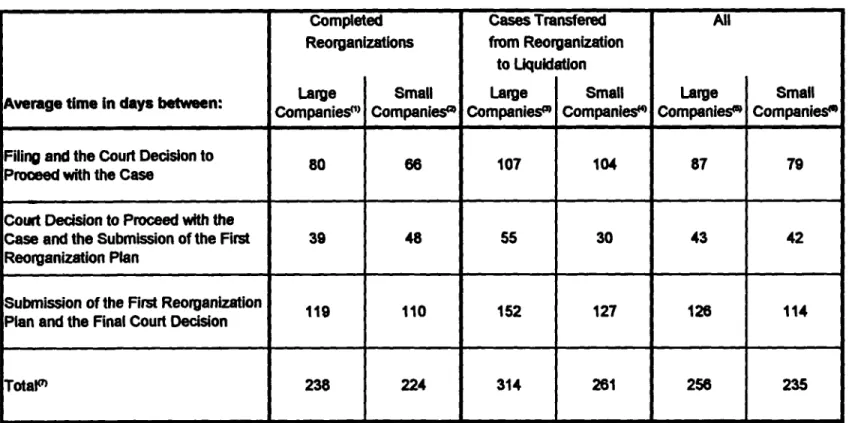
-date on the average time required for various stages of the reorganization process (Table 3) further support the conclusion that the process was not unduly slow. The average time required for an agreement to be finalized was approximately eight months for both large and small firms. On average the debtors presented their reorganization proposals about six weeks after the court's decision to proceed, or about 18 weeks after filing. The period of negotiation between the presentation of the first plan and the final resolution of the reorganization cases averaged another four months. Unsuccessful cases (particularly those involving large firms) took somewhat longer than successful ones, although virtually all cases were completed within one year of filing.
A major reason why reorganization cases could proceed quite quickly, despite their huge numbers, was the low level of substantive involvement by courts and trustees. Once a case was approved by a judge to proceed 8 (which took on average about three months, indicating the
degree of overload in the courts), the judge was no longer substantively involved. The process was managed by the debtor and its creditors and in this decentralized mode could proceed quite rapidly. It is interesting to note that in none of the 95 reorganization cases in the sample did the parties choose to involve a trustee in the process. This could be because of the extra expense
involved (i.e. the trustee fees), combined with the fact that trustees had to be selected from a preapproved list that might not have corresponded to the parties trusted by the creditors. It could
Such approval depended in most cases on the judge's finding that required information had been submitted with the filing.
-Table 3: Time Requlrements for Reoroanizatlon Cases
Completed Cases Transfered All
Reorganizations from Reorganization
to Liquidation
Average time In days between: Large Small Large Small Large Small
Companies!" Companies' Companies" Companies" Companies| Companies"
Filing and the Court Decsion to 80 66 107 104 87 79
Proceed with the Case
Court Decision to Proceed with the
Case and the Submission of the First 39 48 55 30 43 42
Reorganization Plan
Submission of the First Reorganization 119 110 152 127 126 114
Plan and the Final Court Decision
Totaim 238 224 314 261 256 235
(1) N=36 (2) N27 (3) N=9-14 (4) N-10-13 (5) NE-SO (S) N=37-43
also simply reflect the relative passivity of creditors during this period (see discussion below.)
This lack of demand for trustees brings into question the reasonableness of the 1993 amendment
to require a trustee in bankruptcy cases.
The quickness of the reorganization process was not, however, characteristic of the
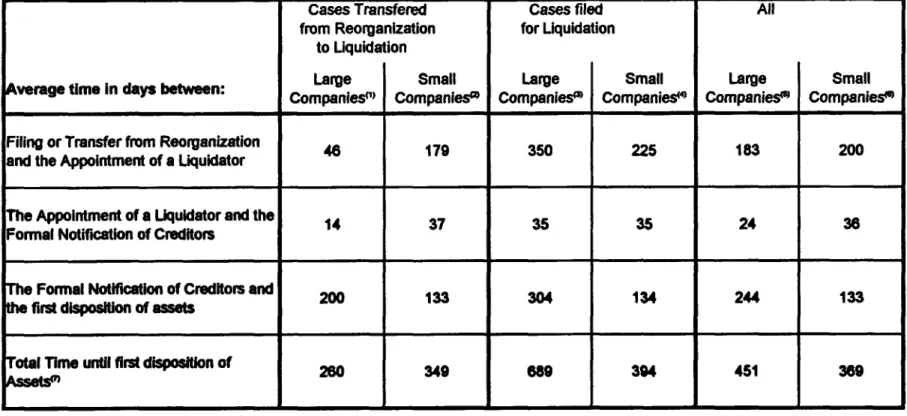
liquidation cases in the sample (see Table 4). Only one of the 50 liquidation cases in the sample had been completed by late 1994 (i.e. within the two years required by law). The average time between filing and the first disposition of assets was about 13 months, and even this is
significantly underestimated because only about one-half of the firms had sold any assets when
the survey was conducted.
A major cause for delay in the liquidation process, particularly in the case of cases originally filed as liquidations, was the court's slowness in appointing a liquidator. This step
alone took over seven months for small cases and almost a year for large cases19. While this
delay is perhaps not surprising, given the flood of over 10,000 liquidation cases in 1992 alone, it almost certainly had serious costs in some cases because of the vacuum of oversight and the opportunities for further asset diversion during that interim period.
9 This finding is probably somewhat biased by the large share of sample firms handled by the Budapest Court. This court is thought to be the most overloaded, and thus the slowest, in the country.
-Table 4: Time Requirements for Liquidation Cases
Cases Transfered Cases filed All
from Reorganization for Liquidation
to Uquidation
Averge time In days between: Large Small Large Small Large Small
Companies(') Companiesm Companiesm Companies'm Companies0 Companies"
Filing or Transfer from Reorganization 46 179 350 225 183 200
and the Appointment of a Liquidator
The Appointment of a Liquidator and the 14 37 35 35 24 36
Formal Notification of Creditors
The Formal Notification of Creditors and 200 133 304 134 244 133
the first disposition of assets
Total Time untlil fist dislonof 260 349 689 39 451 369
(1) N4-12 (2) N6-14 (3) Ne-10 (4) N-12 (5) N4- 22 () NEl-26
It is interesting to note that courts took far less time to appoint liquidators in cases
transformed from reorganization (particularly those with large firms) than in cases originally
filed as liquidations. This could be because the previous exposure to those firms in the
reorganization phase gave the courts (and the liquidators) the information and incentive to move
quickly once the reorganization failed. Indeed, in the case of large companies the total elapsed
time between initial filing (for reorganization ar liquidation) and the first disposition of assets in
a liquidation was no longer for those firms that went through reorganization than for those that
did not.
Who is in Control of These Processes?
A key to understanding the likely impact of bankruptcy in Hungary is to understand who
controls the two processes, reorganization and liquidation. The greater the control wielded by
one party (be it debtor or creditor) over a process, the more likely that process is to benefit that party. In advanced market economies, where information is relatively plentiful and open and
where judicial processes are relatively well-developed, bankruptcy is typically a fine balancing
act between numerous competing interests, all of them quite actively defending their own interests. In transition economies, however, the situation is quite different. Information is far more costly, and judicial processes (and even notions of "due process" and "fiduciary
responsibility") are far less developed. As a result, some parties may have neither the means nor the power to defend their interests effectively. Furthermore, some of the parties to bankruptcy
-proceedings may not have strong incentives to collect debts aggressively. For example,
state-owned firms or state-state-owned banks may be more inclined to turn to the state for compensation
than to pursue debt-collection through official legal means. (Tis is paricularly true if there is a
history of repeated bank recapitalizations, as in Hungary.)
Figure 7 presents indicators of the relative amount of participation of various parties in
the two processes, reorganization and liquidation. It is clear from this data that managers tended
to be most powerful in reorganization proceedings, generally controfling the process, and that
liquidators had virtually total control in liquidation cases (with managers still often in active
roles). Banks and other creditors were sometimes active, sometimes passive, but virtually never
in control of either process. Interestingly, banks do not appear to have been significantly more
active than other types of creditors, whether trade creditors or government creditors. Another
more general indicator of this relative lack of involvement of banks (partialy compared with
their very active role in bankruptcies in advanced market economies) is the very low percentage
of cases (approximately 3 percent) filed by banks through 1993 (Table 5).
The relative inactivity of creditors, particularly banks, is likely to be due to several reasons. First, creditors in Hungary, as in other transidon economies, may lack the information and expertise to understand what is at stake and actively oversee debtor management and/or liquidators. There is certain to be a "learning curve" in this as in other areas of commercial
-Figure 7
Who Controls the Bankruptcy Process
for Large Firms?
Trustee/Liquidator
.i . Top management of I debtor Owner of debtor Employees of debtor Leading bank creditorOther bank creditors
Trade creditors Tax authorities Customs authorities Social Insurance authorities 0 1 2
TABLE 5: Who Files Liquidation Cases in Hungarv? 1992 - 1993 Percentage of Petitions filed by: Bank Creditors 1.5% Govenmment Creditors
(Tax, Social Security, Customs) 13%
Other Trade Creditors, Liquidators,
Conversions from Bankruptcy 67.5 %
The Firm Itself 18%
development in these countries. Our cases, all of which were filed in 1992, were perhaps on the early end of that learning curve. Second, creditors may lack the incentive to be strong debt
collectors, particularly if they are state-owned (as all the large banks have been until 1995 in
Hungary) and perhaps expect future state assistance (as Hungarian banks have repeadly received since 1991). Third, creditors often express doubt to this day that they can recover anything in
the process. While this is understandable in the case of liquidation, given the power of
liquidators to prolong the process and the priority given to liquidation costs over creditors'
claims (see below), it is not clear why the bankruptcy process is seen as so unfavorable to
creditors. Indeed, under the legislation in place in 1992, any creditor had the power to force
firms into liquidation by refusing to agree to the reorganization plan (given the unanimous
agreement requirement and the automatic reversion to liquidation), and thus on paper the power of creditors was very strong. Thi strong formal power lends further credence to the importance of the first two explanatons noted above.
The fudam challenge of transition is enterprise restructuring, and the core question
in this research is what effect the Hungrian bankruptcy process has had on restructuring in
Hungarian firms. The effect on resurigw can be direct and/or indirect. Indirectly, the mere
fact that bankruptcy beame so widespad in 1992 probably spurred greater financial discipline
-in all firms. While evidence clearly po-ints to improvements -in f-inancial discipl-ine,2 0 perhaps for this as well as other reasons, this study did not attempt to assess these indirect effects. It did attempt to assess, however, the direct effects of the process on restructuring by studying the contents of reorganization plans and the changes in firm behavior and performance during and after bankruptcy (whether reorganization or liquidation).
Einancial Reorganlation Plans
The contents of the financial reorganization plans of the 91 cases of successful and unsuccessful (i.e. transformed) reorganizations in the sample are summarized in Figure F. The data point to the relatively unsophisticated nature of the final plans. The overwhehning majority
of accepted reorganization plans provided for either an extension of loan maturity (generally of one-half to two years) and/or a write-off of debt principle, including capitalized interest arrears (of on average about 13% in the case of bank debt and 20-30% in the case of debts to
government and suppliers). About one-third of accepted plans provided for some partial immediate debt repayment (of widely varying percentage amounts), while 21 % provided for a reduction in interest rates. Six of the 63 accepted agreements provided for debt-equity swaps by one or more types of creditors, although there is evidence that most were never implemented.
20 See, for example, Szanyi (1994).
-aqsp jo
VW wwAuwdaa Wsp ldtoM
sdums PsJoLuI U! WO !PDI I o jnWuw Wp
ANnbe AN lPJO MAN Ai!nb.-W. uoqpnp. owos ui su oNO l Jo qwM
W31~~~~~~~~~~~~~~~~~~~~~~~~~
%TL % oz % Oc =nqs utl >g ... ~~~~~~~~~~~~~~~~~. ... f i. ...i Z :'~~~~~~~~~~~~~~~~~~~~~~~~.:..'.E:::...'' .. %0 ; i X . f - tB<o: :g < ~~~~~~~~~~~~~~~% OL % 09 % 09 ~~~~~~~~~~~~~~~~~~~~~~~~~~~~~~~~~~~~~. . ' ,E m. .. . .. .. S -S. -. .. . . .. ... '-EA :s)u~ ~ .. ,,..s...8::':s:.: E E' E E E EESE E EEE E E E E ' EE>E s E ' E E: E 'E " '
< ' t '' ' -- " " ss E~~~~~~~~~~~~~~~~~~~~~~~~~~~~~~~...
E E sEEfE"E ES' - E S ,E, S ES Es:'.-.''' '- 'E- ' '' '' E E E ' ' - 9 $; ' S ; E...E.E... -E -Ei--: ,-Etg,, ,Ei--,,;-:7:i:,: #, ,E-. 'E: ' S'' 'E -' .E E E---X...E S [,EE
:~~~~~~~~~~~~~~~~~~~~~~~~~~~~~~~... ... %O
;''E,,E,, E E E XE, 'S ':'t'' '' ' :'' "'l''''''"''" ''' '"-';i't'0" '.'. '' ."'...
... ~ ~ ~ ...~ S0 ... . ... ... ... ... ...
.u!l ... ...n a
:sXuawaasSv uo!... . .. .. alo .. .... .. .. .. .... ... .. .
Only 3 of the 63 plans provided for new credit, and only one for new equity.2' Overall,
agreements for small firms contained fewer concessions than agreements for large firms, perhaps not surprising given their less onerous financial condition at the time of filing.
It is clear from Figure 8 that proposed plans in unsuccessful reorganizations (ie. those transformed into liquidations) contained fewer provisions overall than plans in successful cases. However, if a provision was included, its magnitude was often greater than in the case of successful agreements. The paucity of provisions further supports the conclusion discussed earlier that many of these cases were not filed with the intention to succeed in the first place. The relatively higher magnitudes when provisions were proposed may point to the likely absence of serious negotiations in many rejected cases.
Operational Reorganization
Most of the firms in the survey agreed or undertook steps to downsize during the reorganization period, as indicated in Figure 9. Whether or not formally included in the reorganization plan22, almost two-thirds of all firms with successful plans agreed or undertook
The absence of new credit is not surprising,, given that the Hungarian law gives no priority to such fmancing. In contrast, financing during reorganization is granted top priority under the U.S. Chapter 11 procedure. However, the situation may not be entirely analogous, as there are much tighter controls on asset disposition and cash flow under Chapter 11 than in the Hungarian case.
22 Although the operational changes were reported in the survey questionnaires to be part of the reorganization
plans, it is likely that in many cases they were undertaken simultaneously but were not formally included in the plan.
-Figure 9
Operational Restructuring during Reorganization
0 % 20 % 40 % 60 % 80 % 100 % Percentage of firms reporting: 59% Change in employment 29% 30_% Asset sales or spinoffs
11%
Purchase of new 4 %
equipment 3 %
Change in top 6 % management 0 %
Change in board of 3 % | Completed Agreements
steps to reduce employment (typically by one-quarter to one-third) and almost one-third agreed
23
or undertook steps to sell assets or parts of the.firm. Only 6% agreed or undertook steps to
change top management, and only 3 % (or 2 out of 63 firms) committed to new investments or
changes in the membership of the companies' oversight board of directors.
As in the case of financial plans, the operational restructuring plans were far less
ambitious in the cases of unsuccessful reorganization, with fewer than one-half as many firms
committing to or undertaking changes as in the group with successful outcomes. Again, this is
likely in part to reflect less commitment to real restructuring (and in some cases greater
pre-bankruptcy value-diversion) in this subset of finrns.
In sum, analysis of the reorganization plans of firms that successfully emerged from
Hungary's reorganization process indicate that they had significant, albeit rather unsophisticated,
content. They were primarily focussed on short-term debt relief and continued downsizing, and
generally did not envision new investment, new management or innovation.
23 The bankruptcy filing was not necessarily the primary reason for such downsizing in all cases. Many of the firms were already downsizing before bankruptcy and may well have continued in any case. At a minimum, however, it is clear that bankruptcy did not provide a 'safety valve" to stop downsizing, and it may well have provided an impetus to begin or continue the process in many cases.
-Outcomes of the Reorganizaktion Process to Date
What happened to the firms that emerged from the reorganization process with agreed
plans? Outcomes to mid-1994 are shown in Table 6. Over 90% of the firms -- 89% of the large
ones and 96% of the small ones -- were still in operation in mid-1994. The large firms have
made greater changes than the small ones since emergence from reorganization, which perhaps reflects their worse starting position. Over 70% of large finms report having significantly
reduced employment, 40% having sold major assets, and 34% having changed top management. Only about one in seven, however, report having made major changes in production profile, having made new investments, or having had access to new bank credits. About one-half report
improved financial performance, and about one-third expect to make a profit in 1994. However,
another third expect to have to file for reorganization or liquidation again in 1994 or 1995.24
If one looks at the reported reasons for improved performance in firms reporting overall improvement, the major reasons are higher sales and reduced input costs. Lower interest
payments are relatively unimportant despite the financial reorganization agreements. Perhaps
these finrs reduced debt liabilities but not necessarily actual debt service, if they were previously
unable to service all of their debt. Although relative magnitudes are similar for small firms, the
overall percentage of firms that report change is about one-half that of large firms. Yet their
24 Some Hungarian officials fear a second wave of bankruptcy filings as firms previously in reorganization (in 1992 and 1993) pass the two-year minimum period before refiling.
-TABLE 6
OUTCOMES
OF SUCCESSFUL
AGREEMENTS
TO DATE
In Percent
Large Small
89 96
Percentage of firms that are still in operation
Restructuing: Percentage of firms that have:
-made new investments 14 7
-soW major assets 40 11
-had access to new bank credit 17 11
-canged top management 34 26
-significantly reduced employment 71 48
-made major changes in production profile 14 7
Financial Performance: Percentage of firms that:
-have improved financial performance 49 63
-expect to make a profit in 1994 31 63
-anticipate having to file for bankruptcy or liquidation again in 31 11
1994 or 1995
Of frms that have improved their fiancial performance, percentage reporting:
-more favorable price structure for outputs and inputs 5 15
-higher sales volume 74 40
-lower interest payments 16 0
-improved repayment rate on receivables 37 35
-improved inventory management 74 55
-reduced material expenses 74 40
financial performance is somewhat stronger, probably reflecting their less serious financial distress pre-bankruptcy.
In sum, post-reorganization performance appears to be primarily a story of belt-tightening
combined in many cases with higher sales volume and better financial performance. Innovative restructuring appears rare, as indicated by the low percentage of firms that report major changes in production profile. Yet perhaps two-thirds of the firms that entered the process expect to survive, and one-third are reportedly already profitable. Taken together with the institutional
strengthening engendered by the process, this is arguably a story of real albeit perhaps modest
success.
What is the Direct Effect of the Liquidation Process on Enterprise Exit?
The original design of the bankruptcy law was envisioned as providing two avenues for
ailing firms: reorganization and liquidation. However, it is clear both from the results of this
study and from numerous discussions with liquidators and other involved parties that the
liquidation process does not necessarily result in exit. Of the 50 cases of liquidation in our
sample (including 22 originally filed as liquidations and 28 transfered from reorganization), only
one case (that of a small firm) had been completed by mid-1994. About 40 percent of the firms in our sample are still in operation as going concerns some two years after the original filing date
(Table 7), and the great majority of these have remained under the same management as existed
-TABLE 7
OUTCOMES OF LIQUIDATION TO DATE
Tansfers from liquidation
Reorganization JDings
._______________________________________ _ 0 Large Small Large
Small
Total number of firms 14' 14' 102 12
Percentage of firms operating as a going concern 57% 23% 40% 33%
during liquidation
Percentage of firms remaining under existing 44% 11% 30% 29%
management after liquidation filing
Percentage of claims expected to be recovered by:
Workers 100% 60% 62% 64%3
Secured creditors 4.6% 41% 23% 26%3
Unsecured creditors 17% 2% 9% 6%3
Percentage of workers maintaining jobs with 36% 11% 36% 33%
subsequent user of assets .
IN - 8-11 for most answers due to missing values.
2 N - 8-10
in the firm pre-filing. Larger firms (particularly those transferred from bankruptcy) are more likely to remain in operation than smaller firms. Furthermore, the overall percentage of workers
expected to maintain jobs with the subsequent users of assets is about one-third for larger firms
and slightly less for smaller ones.
In essence, there appear essentially to be three broad types of firms involved in the
liquidation process: "shell" companies, which have few if any assets when liquidation is filed; small firms (mostly private), which are quite easy to liquidate and thus are often closed quickly;
and larger firms (mostly state-owned) with significant assets, which are rarely closed completely
during a liquidation proceeding.
Why do so many firms continue in operation during the liquidation process, despite the fact that it was originally designed as an exit process? Data from the survey and from related
interviews support the view that liquidators in large part see their role as restructurers and
privatizers, rather than as simply liquidators. They work closely with the management of the debtor firm, and they try to find purchasers of the companies in whole or in part, while
preserving as many jobs as possible. One reason why this strategy is so common is the structure
of compensation for liquidators. As long as the firm continues in operation, the liquidator is
entitled to a fee of 2 percent of gross receipts; if assets are sold, liquidators are entitled to 5 percent of the sales price. Furthermore, the costs of liquidation include any costs incurred to
-keep debtor firms going during the liquidation process. The costs many include, for example, the fees of consultants hired to assist the liquidator. These costs have top priority, even above
secured mortgage liens. Clearly there are financial incentives for liquidators to keep some firms
in operation.
While it is perhaps good news for some Hungarian workers and some parts of the
Hungarian economy that the liquidation "wave" has not led to more forced exit of firms, it is not necessarily good news for creditors or for firms seeking credit. Creditors report that they have very little influence over the decisions of liquidators. Although the percentage of claims reportedly expected to be recovered by creditors (see Table 7) is not low by international
standards (although expectations are likely to overstate eventual recoveries in these cases), banks
generally claim in interviews that they expect in reality to recover very little, and that they expect any recoveries to be delayed by years while the liquidator negotiates as painless a restructuring and sale as possible.
It is interesting to note that, although the number of reorganization cases has dropped
dramatically since late 1993, "reorganizations" are indeed still occurring, but through the
liquidation process. This has indeed become a major route for the restructuring of problem
state-owned firms in Hungary. What the system lacks is an efficient and dependable exit process that
creditors can rely on as afinal stage in debt collection. The weakness of exit, together with the
-problems of foreclosure on collateral at earlier stages of the debt collection process, almost certainly raises the cost of credit in Hungary.
What is the Effect of Bankrupty on Privatiz2fion snd Institution Buildin?
privatization. Although bankruptcy may not be an efficient exit mechanism for firms in
their entirety, it is an important avenue for privatization and "recombination"2 5 of existing assets
in the economy, either as parts of firms as going concerns or merely as individual assets. Indeed, the bankruptcy law has probably been one of the main stimulants of privatization in the
Hungarian economy since 1992. Not only do the formal processes of reorganization and
liquidation involve significant sales of assets, but the mere existence of these processes creates incentives for managers to spin off valuable assets into new entities (often partially or wholly
26
privately owned) while leaving liabilities in problem firms to enter bankruptcy. Furthermore,
in the case of state-owned firms the liquidation process to date appears to be as much a
privatization process as an exit one, as liquidators put enormous efforts into finding private
buyers for viable parts of these firms.
25 This concept is taken from Stark (1994).
26 See Stark (1994) for in-depth discussion.
-Institution Buildinr. Perhaps most important of all has been the impact of the bankruptcy process on institutional development in Hungary. The process has stimulated the development of a cadre of professional trustees and liquidators with in-depth knowledge of techniques of
financial and organizational restructuring. Hungary has been willing to licence both foreign and domestic firms as liquidators, and the foreign participation has brought outside knowledge and expertise into the picture. It has also led to an increase in the number and commercial expertise of judges and in the sophistication of the banks' understanding and approach to debt collection. Such"learning by doing", even if it is fraught with problems and mistakes in the early stages, may be the only way to build these important institutions of a market economy.
Conclusion
Several broad conclusions can be drawn from the data and discussion presented above. First, the bankruptcy process appears to have had some degree of economic logic in 1992 and 1993. Better firms were more likely to enter and emerge "successfully" from the reorganization process, while worse firms were more likely to either fail in the reorganization process or file
straight for liquidation. Furthermore, although the reorganization plans and related negotiations between debtors and creditors were not anywhere near as sophisticated as one would find in
advanced market economies, they did appear to address the core issues of debt restructuring,
-debt relief, and operational downsizing. This was not a meaningless exercise with economically irrational or counterproductive results, nor did it result in the immediate forced closure of
potentially viable firms. Given that Hungary's bankruptcy experiment was the first of its kind in the transition world, one can perhaps interpret this as a modest success.
Second, the experiment also supports the view that judicial reorganization need not be
slow and costly. The first "wave" of reorganizations was handled surprisingly quickly,
particularly considering the sheer number of cases, the novelty of the process, and the shortage of trained judges. This relative quickness is largely attributable to the decentralized design of the process. Once a case was approved by the court to proceed, the court had little role. The strict
thne limits laid out in the law also probably helped in assuring a relatively speedy resolution of cases.
With regard to speed and cost, it is very possible that the amendments in 1993 took a turn in the wrong direction in requiring the appointment of a trustee (chosen from the list of licenced liquidators) in all bankruptcy cases. Such requirement makes the process more bureaucratic and expensive. If creditors believe a trustee will help represent their interests, they should be given the option of appointing one (as provided in the 1991 law), but this need not be a requirement. Indeed, if the creditors are not motivated to look after their interests, it is unlikely that a trustee will do it for them effectively.
-Third, the major delays in the process in our sample occured not in reorganization but rather in liquidation. Much of this delay is attributable to slowness in the appointment of liquidators to cases, and this leads to significant opportunities for asset diversion, as discussed below. However, some of the delay is also attributable to the fact that liquidation is to a large
extent perceived by all parties more as reorganization than as pure liquidation. This has
become even more true since late-1993, when the number of reorganization cases began a steep decline -- i.e. when liquidation appears in effect to have replaced reorganization as the primary restructuring process. Interviews with liquidators and firms confirm the view that many if not most liquidators see themselves as active restructurers, representing first of all the interests of employees or the public rather than the interests of creditors. Virtually all "real" firms (as opposed to "shells" or firms with minimal assets, of which there are plenty) stay alive during the liquidation process as the liquidator looks for ways to privatize their viable parts. While this may be good for restructuring and privatization, it is not necessarily good for creditors, who appear to feel powerless and unrepresented. It is no wonder that creditors will do almost anything to avoid filing for liquidation. In the end, this lack of a viable creditor-led "exit" and debt collection mechanism harms firms, because it increases the cost and reduces the flow of credit in the economy.
-It was noted earlier that one important reason that liquidators take their time is the structure of their fees. The Hungarian government should consider a change in the fee structure so that liquidators' fees consist only of a fixed percentage (whether 5 % or another figure) of proceeds from the final sale of assets. This rather simple change could have a major impact on the process, speeding it up without sacrificing the incentive to save viable going concerns, and better aligning the interests of the liquidators with those of the creditors.
Fourth, although the bankruptcy process does display economic logic, one should not
assume that it operates as a similar law would in a market economy. The incentives of creditors
to pursue debt collection aggressively are not yet as strong as in advanced market economies. In the case of banks, for example, these incentives have been compromised by success bank
recapitalizations, which have encouraged banks to turn to the state for assistance rather than 27
depending primarily on the pursuit of problem debtors. Not only are creditor incentives somewhat weak, but the "watchdog" institutions that one takes for granted in advanced market economies--such as accountants, lawyers, judges and other court personnel, credit rating services, bailiffs--are still in their infancy. Thus, creditors find it extremely difficult to gather the information with which to defend their interests even if they are motivated to do so. The result is that bankruptcy processes (and what happens immediately before them) appear to be
B
Baer and Gray (1995).
-controlled to a far greater extent by debtor management in Hungary than in advanced market economies.
What does such managerial control imply for the outcome of the bankruptcy process? In essence, it implies that these managers and to some extent the debtor firms they manage will gain more than they would if the process were better monitored and controlled by creditors. A likely
source of gain in Hungary appears to be asset or other value diversion (or "value-stripping ")
prior to bankruptcy. Valuable assets are transferred to separate firms prior to filing (and the
records disappear so the transfers are not later traceable by creditors, trustees, or liquidators), leaving the less valuable assets and the liabilities to enter the bankruptcy process. Interviews undertaken by the authors indicate that such asset diversion may be quite common, for both
state-owned and private fms, although the survey was unable to capture this phenomenon on a wide
scale (which is not surprising, given the secretive nature of such transfers). Creditors can also be involved in asset diversion, by colluding with the debtor firm to transfer assets and thus repay that particular creditor prior to bankruptcy at the expense of other creditors. In advanced market economies, such transfers in anticipation of bankruptcy are void or voidable by the trustee. They
are by law also voidable in Hungary, but liquidators report tremendous difficulty obtaining
necessary evidence, due in large part to the underdevelopment of the "watchdog" institutions.
-It is not easy to control asset diversion, but certain policy steps can certainly help. The
major need is to strengthen the incentives of creditors to monitor the process closely, and to improve their capacity to do so. These can be assisted in the short- to medium-run through:
* changes in collateral and bankruptcy laws to put secured creditors clearly first in priority of recovery (even above costs of the proceedings)2 8;
* streamlining of court and bailiffs' procedures to lower the costs of foreclosure on collateral;
* changes in the compensation of liquidators (as described above) to align their incentives clearly with those of the creditors;
* changes in bankruptcy regulations to require the appointment of a liquidator
immediately after a case is filed, to eliminate the long period between filing and approval during which incentives for value diversion are at their peak;
* stronger banking reforms and privatization to reduce bank ties to the state (and thus the expectation of state subsidies);
* stronger macroeconomic discipline and enterprise privatization to reinforce the incentives of trade creditors to actively pursue collection of their debts; and
28 A step in the wrong direction was Law No. 53, adopted in September 1994, that placed all government
liens ahead of secured credit in priority of recoveries in cases of asset foreclosure.
-* avoidance of any future "loan consolidation" programs, and elimination of the "debtor consolidation" program and any other informal workout processes that may be seen as back-door avenues for state subsidization of debtors or creditors.
Finally and more generally, one must recognize that developing the institutions of a market economy, particularly the "watchdog" institutions referred to earlier, is a massive task and necessarily takes time. It will be greatly facilitated, however, if tight macroeconomic discipline leads to "hard budget constraints", and thus firms and banks demand these institutions because they no longer view the state as their automatic safety net in times of financial distress. Hungary's early experiment with bankruptcy reform has made an impressive start at developing
the institutions. It should not be discarded but rather should be strengthened through strong and
broad complementary reforms toward a market economy.
-References
Baer, Herbert L and Cheryl W. Gray, "Debt as a Control Device in Transitional Economies: The Experiences of Hungary and Poland," in Frydman, Gray, and Rapaczynski, eds, Corporate Governance in Central Europe and Russia, Central European University Press, forthcoming, 1995.
Stark, David, "Recombinant Property in East European Capitalism," in Frydman, Gray, and Rapaczynski, eds, Corporate Governance in Central Europe and Russia, Central European University Press, forthcoming, 1995.
Szanyi, Miklos, "Attempts at Hardening Budget Constraints in Hungary: Conventional Exit Procedures and State Accommodation," paper presented at ACE Project Workshop, Stoke-on-Trent, U.K., March 1995.