Robin Mansell
Digital opportunities and the missing link
for developing countries
Article (Accepted version)
(Refereed)
Original citation:
Mansell, Robin (2001) Digital opportunities and the missing link for developing countries. Oxford review of economic policy, 17 (2). pp. 282-295. ISSN 0266-903X
DOI: 10.1093/oxrep/17.2.282
© 2001 Oxford University Press
This version available at: http://eprints.lse.ac.uk/19033/
Available in LSE Research Online: August 2013
LSE has developed LSE Research Online so that users may access research output of the School. Copyright © and Moral Rights for the papers on this site are retained by the individual authors and/or other copyright owners. Users may download and/or print one copy of any article(s) in LSE Research Online to facilitate their private study or for non-commercial research. You may not engage in further distribution of the material or use it for any profit-making activities or any commercial gain. You may freely distribute the URL (http://eprints.lse.ac.uk) of the LSE Research Online website.
This document is the author’s final accepted version of the journal article. There may be differences between this version and the published version. You are advised to consult the publisher’s version if you wish to cite from it.
DIGITAL OPPORTUNITIES AND THE MISSING LINK FOR DEVELOPING COUNTRIES
ROBIN MANSELL
London School of Economics and Political Science
I. INTRODUCTION 1
The Group of Eight (G-8) countries has emphasised that ‘IT empowers, benefits and links people the world over … access to the digital opportunities must, therefore, be open to all’ (G-8 Countries, 2000). The expectation is that the extension of global telecommunication networks and the use of the Internet can provide a new means for developing countries to benefit from their participation in the global economy. Deployment of advanced information and communication technologies (ICTs) is expected to provide a major stimulus for economic growth. Despite the very substantial gaps in the availability of the new technologies, firms in developing countries that do gain access are expected to benefit substantially.
The spread of global networks enables firms to implement electronic commerce as a means of facilitating their entry into international markets. Electronic commerce, especially using the Internet, is expected to enable firms to reduce the costs of setting up and completing transactions, a gain in their economic efficiency. Even the smallest firms are expected to benefit (Xie, 2000). Some observers argue that business-to-business – B2B – electronic commerce will strengthen the bargaining power of producer firms in developing countries so that they can reposition themselves within global value chains (Gereffi, 2000). Panagariya (2000: 5) even suggests that ‘given the cost savings offered by Internet technology and relative ease with which it can be provided, they [i.e. developing countries] can now skip several stages of technological development through which developed countries had to go. Stated differently,
developing countries are much farther inside the current technological frontier and, therefore, have larger potential benefits from moving to it’.
The claims about the impact of the transfer of advanced ICTs to developing countries are examined in this paper by considering the specific case of the impact of electronic commerce. Is there clear evidence that the deployment of these technologies is providing a strong basis for macro-economic growth? Is the transfer of these
technologies offering new opportunities for producer firms in developing countries? It is very difficult to provide unambiguous answers to such questions. Evidence in support of significant gains for developing countries at the macro-economic level is practically non-existent. At the micro-economic level, there are signs that some firms benefit from their access to advanced ICTs.
If the optimistic expectations about the impact of advanced ICTs on economic growth and development are to be met, the technological gaps between industrialised and
1
The author has benefited substantially from comments provided by Andrew Glyn, Andrew
Graham, and participants at a workshop where contributing authors to this issue of the Journal reviewed an earlier draft, and from discussions with W. E. Steinmueller. Any errors or omissions are the author’s responsibility.
developing countries (and between firms within developing countries), that is, the ‘digital divides’, need to be reduced. This will require a rapid process of
technological catch-up. At this early stage in the diffusion of advanced ICTs, the evidence shows that the ‘e-readiness’ of countries varies substantially. The capacity to gain from the availability of advanced ICTs involves far more than a reduction of the technological divide. Institutional arrangements that support commercial activity and international trade also need to be put in place if firms are to reap the potential
benefits of the new ‘digital opportunities’. The absence of these arrangements in many countries represents a major missing link in the capacity to generate sustained economic advantage from the use of advanced ICTs.
Section II examines the evidence in support of claims about the potential gains from the transfer of digital technologies to developing countries. Section III considers the extent of the so-called ‘digital divide’ and its relationship to the position of countries with respect to per capita income and educational attainment indicators. In section IV the opportunities created by the development of electronic commerce for firms in developing countries are examined, particularly with respect to whether the Internet offers a new means for firms to enter global markets on terms that are more
favourable than in the past. Section V illustrates the institutional conditions that must be in place if the new global electronic trading environment is to be open to many firms in developing countries. The final section draws some conclusions about the likely prospects for successful ICT-based technological leapfrogging strategies.
II. POTENTIAL GAINS FROM THE TRANSFER OF DIGITAL TECHNOLOGIES
Internet-based electronic commerce is regarded as an extremely positive development for developing countries. The United Nations (2000) High Level Panel on Information and Communication Technologies concluded, for instance, that when firms in
developing countries become connected to global networks, they should be able to compete on a more equitable basis in world markets. In the absence of any conclusive empirical evidence, this view rests mainly upon theoretical arguments about the economic outcomes that may be associated with the transfer of advanced ICTs. First, it is expected that the spread of advanced ICTs and their use to support applications like electronic commerce will lead to significant productivity
improvements. These improvements are necessary if developing countries are to achieve long term economic growth. Since capital and labour inputs grow relatively slowly, significant improvements in output growth require being able to accomplish more with the same (or only slightly more) inputs. Industrialised countries face the difficult problem of raising already high levels of productivity, but developing countries are expected to have the advantage that they can progress towards the frontier over ground that has already been covered. All of the components of global networks and software applications are available on the international market and they are easily transportable. This characteristic appears to imply that advanced ICTs have the potential to support ‘technological leapfrogging’ (Soete 1985). This is expected to enable developing countries to reduce gaps in productivity and output between
Unfortunately, this outcome is more difficult to achieve than it first appears
(Steinmueller 2001). If ‘technological leapfrogging’ is to be successful, it must be feasible to bypass stages of capability building or investment that the industrialised countries have had to pass through in the process of economic development. This theory implies a linear and highly predictable set of stages of development (Rostow 1962). This view has been largely rejected at the macro-economic level, but there is still an expectation that firms can develop successful leapfrogging strategies through their use of advanced ICTs. In order to do so, however, the absorptive capacity of firms must be strengthened. This generally involves an extended period of learning and adaptation of the new technology (Cohen and Levinthal 1991). When access to the technology remains prohibitively expensive, a large number of complementary technologies and capabilities are required for successful implementation, and the costs of acquiring and maintaining relationships with other participants in global supply chains are unfavourable, firms may not benefit in the manner that theory predicts. Compared to other technological innovations, advanced ICTs are exceptional in several respects. Their diffusion is accompanied by substantial amounts of instruction materials that may be used to speed up and augment the learning process
(Steinmueller 2001). The investment required to achieve global connectivity, while considerable for many firms in developing countries, is relatively modest as compared to other technologies. These technologies also are malleable in that certain
components such as software can be altered and adapted for experimentation in new settings. These features suggest that advanced ICTs may offer a basis for achieving major transformations in the way firms in developing countries conduct their business and engage in international trade.
Second, assuming that developing countries are able to access and use digital
technologies effectively to compete in international markets, their inclusion within the international trading environment may yield a factor price equalisation effect (Wood 1995). Economists argue that the long run equilibrium arising from international trade will result in equalising the wage rates between industrialised (high wage) and
developing (low wage) countries. As trade displaces low wage activities in the industrialised countries and increases employment in the developing countries, the wages in the developing countries will be bid up because of a strong demand for their services. Wages in industrialised countries need not fall if it is possible to move towards capital-intensive production as a consequence of gains from trade. Industrialised country workers may become more intensively involved in capital intensive work (tool making) and developing country may workers become more intensively involved in using output or ‘tools’ to provide output for the industrialised countries (this scenario is premised on the assumption that tool making is a capital intensive activity). If the prices of the tools made in industrialised countries fall, i.e. if the prices of digital equipment fall, this may further increase the demand in
developing countries for the digital tools, potentially accelerating the rate of wage equalisation. However, to achieve these effects, the tools must provide gains over current technique. In developing countries it is possible to use labour-intensive methods rather than digital tools and it is possible that the use of digital tools will not provide sufficient gain to create an incentive for their adoption (i.e. to support a higher
level and elasticity of demand). The elasticity of demand for advanced ICTs is therefore an important issue. The strength of factor price equalisation effects is a matter for empirical verification, but the implications for the economic prospects of developing countries are potentially substantial.
III. LEAPFROGGING AND CATCHING UP
The evidence in support of a strong relationship between investment in advanced ICTs by developing countries and economic growth, at least at the macro-economic level, has been found to be very weak (KPMG 2000). This is partly attributable to the fact that it is difficult to establish an empirical link between the diffusion of digital ICTs and economic development on the basis of available data. It may also be due to the fact that the positive effects of the global extension and consolidation of digital networks may take time to accumulate (Rodriguez and Wilson III, 2000). Evidence of a statistical association between investment in advanced ICTs and productivity improvements also has been elusive in the industrialised countries until very recently, even at the firm level (Brynjolfsson and Hitt, 2000). In fact, the United States is the only country where such an association has been clearly documented. This has required the application of constant quality price indexes to national income and product account data. With the relevant adjustments, Jorgenson (2001: 1) has shown that: ‘the relentless decline in the prices of information technology equipment has steadily enhanced the role of IT investment as a source of American economic growth. Productivity growth in IT-producing industries has gradually risen in importance and a productivity revival is now underway in the rest of the economy. Despite differences in methodology and data sources, a consensus is building that the remarkable behaviour of IT prices provides the key to the surge in economic growth’ Analysis focusing narrowly on investment in the telecommunication infrastructure and economic advantage is also beginning to show some benefits for developing countries. For example, Reynolds et al. (2001) examined the importance of investment in
telecommunications in decisions about the location of foreign direct investment. They found that when countries have one more telephone per 100 people than the average number of telephones expected at their given income level, they receive 0.3 cents per USD 100 of GDP more foreign investment than countries with an average number of telephones.
The firm-level data on the impact of advanced ICTs is not systematic enough to provide a basis for drawing robust conclusions about the economic impact of investment. Nevertheless, strategies aimed at transferring digital technologies to developing countries are yielding positive results in some countries. For instance, India is often taken as a country that has succeeded in enhancing its capacity to benefit from digital technologies based on heavy investment in a workforce with specialist skills in software development. India’s total information technology and software service revenues from exports reached USD 5.7 bn in 1999-2000 (Achar, 2000). Although India has a strategy to take advantage of the opportunities created by advanced ICTs, success in developing the export market for software may be accompanied by the growth of sophisticated digital enclaves that are surrounded by poverty. Singhal and Rogers (2001) have observed that ‘while the new
communication technologies … are impacting Indian society in dramatic ways, the subcontinent is still mainly a developing nation in which many citizens depend on the bullock cart [footnote omitted] for transportation and on human labor for making a daily living’ (Singhal and Rogers, 2001: 19). Heeks (1996) also suggests that India is promoting an enclave development process around highly skilled, low paid workers with few spin-offs to the rest of the economy.
There are numerous examples of cases where there appear to be benefits to firms as a result of the use of advanced ICTs to achieve improved access to international
markets. For instance, an Internet connection in a Peruvian village has helped the community to establish a partnership with a company in New York and to expand the market for its agricultural products.2 Many Internet-based companies are supporting
international trade and some claim to provide services for producers in developing countries. Unfortunately, there are few systematic studies of whether producers in developing countries are benefiting from the services (Maitland 2001). Barriers include the costs of network access, the firms’ existing business practices, and the absence of the necessary legislative arrangements to allow firms to trade online. One example of the new Internet intermediary firms is FoodTrader.com, a B2B e-marketplace for the agriculture industry which offers updated market prices, country profiles, logistics services, and related information. Members can buy, sell and bid for products on-line but there is no publicly available data on the geographical
distribution of users. Another is ClickTex.com, a service that allows companies to source, sample, sell and track textiles globally, but participation in this marketplace is restricted to sellers and buyers that have been pre-qualified for quality, integrity, capabilities and credit-worthiness.
Even where the ICT infrastructure is in place, there may be large differences in the levels of awareness of firms about the potential benefits. Moodley (2000: 49) found, for instance in South Africa, that only a very small proportion of the members of an automobile manufacturers’ club [17 respondents] had plans to integrate Internet use into their supply chains even though all had access to the Internet. Nevertheless, there is evidence that familiarity with ICTs is important for ensuring their effective use (Mansell and Steinmueller, 2000; Mansell and Wehn, 1998).
In these and the many other examples that could be provided, experience indicates that there are major challenges for policy makers who are seeking to reap the potential benefits of an ICT-based leapfrogging strategy. The evidence from the micro or firm level evidence is that the effects of investment in advanced ICTs in developing countries are enormously variable from one country to another. There also can be substantial variations within countries. Policy makers need to create mechanisms to ensure that the benefits of the digital enclaves in India, Malaysia and some other developing countries begin to spread beyond the enclave boundaries. This requires widespread and affordable access to advanced ICTs and an appropriately trained workforce. It also requires institutions that encourage the accumulation of capabilities for trading in international markets. The next section examines the barriers to
international trade associated with the technological or digital divide.
IV BARRIERS TO TRADE CREATED BY THE DIGITAL DIVIDE
Developing countries have a much smaller capacity overall to take advantage of the opportunities offered by advanced ICTs. Whether this smaller capacity has
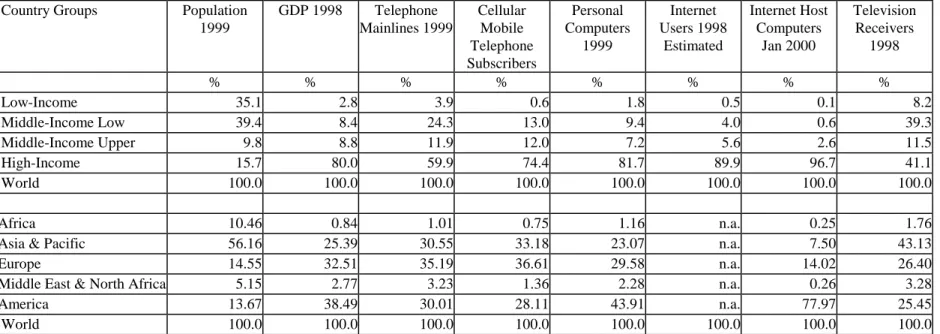
consequences for these countries’ development as ICTs are used more intensively and extensively in the global economy is an important issue for policy. Some of the standard indicators of the digital divide are shown in Table 1.
---
Insert Table 1 about here ---
Table 1 shows that the overall imbalances in access to the fixed and mobile telecommunication infrastructure, personal computers, the Internet and television receivers are substantial. The ratio of Internet users to the overall population in Africa is estimated to be 1:750 as compared to a world average of 1:30. The former ratio hides disparities within countries where Internet access is confined largely to major cities and is virtually unavailable to the 60 per cent of the population living in rural areas (Souter and Girardet, 2000).
Distinctions between countries in their relative intensity of use of ICTs arise from historical circumstances. Figure 1 illustrates the pattern of ICT related developments for three developing countries (in terms of per capita income). The ‘reference’ indicators are per capita income and combined enrolment in primary, secondary and tertiary education. These are reported as a percentage of the world average values. The indicators of ICT development are fixed mainlines (ML), television receivers (TV), Internet hosts (IHC), personal computers (PC), and mobile telephone lines (MOB). These are based on per capita measures and are displayed in relation to the respective world average.
In Figure 1, the world average appears just inside the outer perimeter of the graph. The figure compares China, with a per capita income of one half of the world average, with two countries with even lower levels of per capita income, Pakistan and Ethiopia. All these countries are making major investments in education. Despite having a per capita income of less than one half the world average, China has boosted education enrolment above the world average. Pakistan and Ethiopia’s achievements are also striking in relation to their modest per capita incomes. Pakistan has achieved an enrolment of 70 per cent of the world average with only 25 per cent of the world average per capita income. Ethiopia has achieved 40 per cent of the world average enrolment although its per capita income is only 10 per cent of the world average. China has achieved the most impressive results on the ICT indicators, exceeding the world average in television receivers per capita and achieving 60 per cent of the world average in fixed mainlines (although China per capita income is only 50 per cent of the world average). In PCs, China has achieved 20 per cent of the world average of
PCs per capita. Pakistan’s achievement of 40 per cent of the world average of
television receivers is notable in the light of its per capita income of 25 per cent of the world average. On all of the other measures, however, these countries lag far behind the world average. In Internet hosts, for example, China has 2 per cent of the world average, with even smaller numbers in Pakistan (0.29%) and Ethiopia (0.01%). Pakistan and Ethiopia have 6 per cent and 2 per cent of the world average in PCs per capita, respectively, and 2 per cent and 0.13 per cent of the world average in mobile telephones.
These countries are all poorer than the world average in terms of per capita income, and their capacity to develop the use of ICTs is even more constrained. Except for China’s achievement in television receivers and fixed mainlines, the extent of use of more advanced technologies in these countries is dramatically smaller than other countries of the world, even after taking account of their relative incomes. Despite the fact that the costs of ICTs are declining, the task of extending access still remains enormous. Affordable access is out of reach of many people in developing countries. This is especially so for those in the lower income countries. For example, the
monthly charges for Internet access vary substantially in developing countries. In Uganda these monthly charges amount to about 107 per cent of annual GDP per capita and the figures for Guinea, Sierra Leone, Ethiopia, Mozambique and Senegal are 45, 118, 77, 70 and 18 per cent respectively (Commonwealth Working Group on
Electronic Commerce 2000).
Despite the substantial barriers to using advanced ICTs to support an economic ‘catch-up’ strategy, where access to the telecommunication infrastructure does exist, there are opportunities for firms to take advantage of computing power and software
applications to develop electronic commerce. This is so, despite the fact that many fear that the digital divide will continue to widen. Some insights into the prospects for Internet-based electronic commerce can be achieved by examining experience with Electronic Data Interchange systems.
V. NEW ELECTRONIC COMMERCE OPPORTUNITIES
For several decades, firms in many industrial sectors have been encouraged to use ICTs to support Electronic Data Interchange (EDI) systems. These systems employ standardised descriptors to enable buyers and sellers to exchange information
electronically about the characteristics of their products. EDI has been implemented in sectors ranging from automobiles to electronics and horticulture. EDI systems are often developed using sector or buyer-specific proprietary software platforms. They are often connected using point-to-point leased line telecommunication circuits. This creates closed networks for buyers and their supplier members. The configuration of EDI systems has either excluded firms in developing countries or enabled their inclusion in world markets on terms established largely by dominant buyers in the industrialised countries.
Studies tend to show that EDI implementations encourage the formation of hierarchical commercial structures. These often revolve primarily around the
requirements of dominant suppliers and/or customers in a given supply chain (Mansell 1996). The future of EDI is the subject of debate as innovations in ICTs proceed very
rapidly, but implementation world-wide is growing steadily. In this sense, the use of ICTs to support business-to-business commercial activity is not new. EDI does not appear, so far, to have enabled firms in developing countries to improve their bargaining power substantially within global supply chains.
Why should electronic commerce based on the latest generation of ICTs be expected to strengthen the position of these firms? Policy discussions about the potential of advanced ICTs often presume that access to digital technologies will provide a foundation for electronic commerce and that this will embrace firms in developing countries in a favourable way (Primo Braga et al., 2000; World Bank, 1998). Electronic commerce extends the capability of software-based information and transaction systems to support the sale or purchase of goods or services between businesses, consumers, public or private organisations, using electronic networks. It enables goods and services to be ordered over these networks although payment and delivery may be conducted on- or off-line. Electronic commerce may support
transaction preparation, completion and support. It may or may not be integrated with EDI systems (Hawkins et al. 1999).
The value of electronic commerce is estimated at approximately USD 650 billion world-wide and ten-fold increases are expected over the next few years (OECD, 1999). Applications of electronic commerce may be based on proprietary or open software platforms and the data associated with these systems may flow mainly through private networks or through public networks. Most forecasts for the spread of electronic commerce are not based on clear definitions of what distinguishes this form of electronic exchange from EDI. Internet-based electronic commerce transactions are a subset of the development of electronic commerce. With the rapid spread of the Internet, it has been assumed that there are major new opportunities for firms in developing countries. This is because, in principle, the Internet offers an alternative to the closed proprietary EDI systems. Problems faced by firms in developing countries such as relatively high investment, configuration and co-ordination costs and the lack of entry and exit flexibility due to proprietary EDI systems, may be overcome by the open architecture of the Internet and by standardised messaging architectures like the Extensible Markup Language (XML).
Open Internet-based trading systems are expected to present lower barriers to entry for firms in developing countries. Lucking-Reiley and Spulber (2001) argue that B2B electronic commerce provides a means of substituting data processing and Internet-based communication for labour services that enable economic transactions. High expectations for productivity gains are associated with efficiencies stemming from the automation of business transactions, the economic benefits offered by new
intermediaries, the consolidation of demand and supply through open market exchanges, and the loosening of the links between vertically integrated companies. These authors assume that firms will implement electronic commerce in an open Internet environment, and they acknowledge that there are major hurdles that must be overcome before the economic impact of electronic commerce can be measured adequately.
Firms can adopt the flexibility of the Internet protocols in a closed extranet/intranet environment that is supported using dedicated point-to-point communication links.
Firms may find that this is a more cost-effective solution as compared to the use of the Internet based on the public switched telecommunication network. The closed form of electronic commerce may protect their interests in controlling certain types of sensitive market-related information. Some firms are exploring the possibility of operating EDI systems and electronic commerce on Internet platforms (Threlkel and Kavan 1999; Senn 1998). However, they are also developing ways of setting up electronic commerce on the Internet so that the exclusivity and security features of EDI systems are emulated (Mansell and Nioras 2001). There is also some evidence that closed business networks are being replicated when trading migrates to Internet platforms (Kraut et al., 1998). Firms appear to continue to value some kinds of exclusive business to business relationships. Although, the Internet appears to widen the scale and scope of firm interaction, in practice, firms can select closed proprietary systems in some circumstances and open Internet solutions in others. In the former case, developing country producers may continue to be locked into closed networks of traders (Mathieson, 2000).
Thus, it is not necessarily the case that the new technological opportunities offered by the Internet, will lead to new business opportunities for firms in developing countries. Initial studies suggest that the full range of electronic commerce applications have yet to be implemented, even by firms based in industrialised countries (Mansell and Nioras 2001). Most firms, at least in the agriculture and textiles sectors, are using electronic commerce based on the Internet to provide a web site to support, but not to replace, their primary business activity. The web sites serve mainly to support the firm’s information and communication strategies and as marketing or awareness building tools. 3
The use of intranets and extranets and the development of hybrid sites that retain exclusivity for some commercial purposes mean that there is the potential for the re-establishment of buyer dominance and vertical buyer controlled supply chains even in the new digital environment. Intermediary firms (independent of and integrated with buyer firms) are developing electronic commerce Internet-based portals that aggregate the supply of information about goods or services from many suppliers (Goldstein and O’Connor, 2000). 4 Electronic commerce may provide a means of reducing
transaction costs, but it is difficult to assess the overall potential savings for firms in developing countries. Some costs may increase because producer firms are required to meet new quality, time-to-delivery, or other standards introduced by buyers in the industrialised countries. Increased costs may also be associated with system
development and maintenance, staff training, and organisational changes. There are high profile examples of the growth of electronic marketplaces such as Covisint for automobiles and e-Steel, but there are also many failures. In addition, even when
3 Based on research undertaken by J. Humphrey, R. Mansell, D Paré, and H. Schmitz for a
project funded by the Department for International Development jointly undertaken by the London School of Economics and Political Science and the Institute of Development Studies, University of Sussex, May 2001.
4 A portal is a world wide web ‘super-site’ that provides a variety of services. The term was used initially to refer to general purpose sites, but is increasingly being used to refer to vertical market sites that offer services to a particular industry; other terms are corporate portal, business intelligence portal and web hub, see
electronic commerce is in place, firms in developing countries will continue to face barriers to international trade such as poor transport and distribution networks,
inefficient customs procedures or barriers to market access in export markets (Nielson and Morris, 2001).
If the optimistic forecasts for improved access for firms in developing countries to international markets are to be met, higher levels of network access and reliability will be needed. The institutional foundations for building the capabilities that will enable firms to absorb the new technological systems will also need to be in place. At present, while the list of industrial sectors and firms that are implementing advanced ICTs to support electronic commerce is growing, it is impossible to draw clear conclusions about the significance of closed, open or hybrid implementations for macro-economic growth.
Nevertheless, digital technologies do pose substantial challenges for policy makers who are seeking to encourage firms in developing countries to enter global markets. The emergence of an open electronic commerce environment based on the Internet has the potential to enable firms to gain access to international markets. Whether that potential can be realised will depend on the institutional framework that emerges to complement the technological implementations.
VI. INSTITUTIONAL CONDITIONS FOR LEAPFROGGING STRATEGIES
Countries throughout the world are in different states of ‘e-readiness’ for developing electronic commerce. Institutional arrangements are very important for acquiring and absorbing these advanced technologies. Key institutional arrangements include arrangements for network access, forging trusted commercial relationships, and modifying international ‘rules of the game’ that influence whether firms from developing countries can compete on the basis of design capabilities, production efficiency, logistics management, and/or marketing. These areas of institutional evolution are essential for developing countries that are seeking to implement technological leapfrogging strategies to support their entry into the global marketplace.
Accessing networks
If advanced ICT applications are to spread rapidly and to include firms in developing countries on terms that are beneficial to them, there will need to be substantial investment in the ICT infrastructure. Greater opportunities for investment seem to occur when the policy and regulatory environment favours effective competition between telecommunication operators. Publicly accessible Internet-based electronic commerce also requires investment in Internet servers and software. In the
industrialised countries, the availability of high-speed telecommunication links is closely linked with the speed of migration of firms to Internet-based electronic commerce.
However, the institutional conditions that will favour the extension of affordable access to networks in unserved areas in developing countries are not necessarily the
ones that have succeeded in the industrialised countries. Experimentation with
community access to the Internet through telecentres and cybercafes offers one means of departing from a ‘one PC per household or per worker’ model. Telecentres can serve as hubs for training and capacity development and offer a platform for
developing applications such as electronic commerce. They can also provide business support services for small and medium-sized firms and micro-credit entrepreneurs (Marcelle, 2000). These measures offer means of addressing within country digital divides.
Resolving issues of access to networks can be addressed from a number of different perspectives depending on the primary digital divides that policy makers are seeking to reduce. There are two main options for investment strategies: one is to achieve extensive growth (i.e. a broadening of participation within an economy); the other is to encourage intensive development (i.e. deepening capabilities of those who are likely to have other complementary capabilities for international participation). These strategies for policy can be considered in the light of four outcomes as a result of improved network access: 1) intensive development in firms that already have international capabilities for their further participation in international markets; 2) extensive development to raise the number of candidate firms for international participation (but requiring substantial investment in complementary capabilities); 3) intensive development of domestic opportunities (to mobilise domestic markets for participation) with lower requirements for pre-existing capabilities or capabilities investment; and 4) extensive development of domestic opportunities. Since the latter is likely to be unaffordable in many developing country contexts, this suggests that the third strategy with the policy implication of targeting to achieve sustainable outcomes is a viable strategy.
The implementation of electronic commerce also encourages the growth of data traffic. This means that existing networks in developing countries must be adapted to accommodate changing network usage patterns. Although the costs of digital
technologies are declining, institutional arrangements are essential to encourage price reductions for the services offered to firms. High prices for switched network access and Internet service provision are major barriers to the development of open electronic commerce in many developing countries (Souter and Girardet, 2000).
The institutional conditions for enabling firms in developing countries to access open networks must be linked to those which promote the evolution of skills and
capabilities of the workforce to ensure that workers are able to absorb the new technological opportunities. This is especially important for firms whose employees must make a transition from a skill base that has enabled them to maintain their current position in global supply chains to that which is required for operating in the changing international market. The international market is being restructured as a result of changes in the structure and linkages between firms and in the bargaining power of firms that are associated with the adoption of electronic commerce.
Trusting in commerce
A key feature of the institutional conditions for electronic commerce is the extent to which trading can be conducted in a trusted environment. Confidence in the conduct
of electronic commerce can be strengthened by ensuring that local business practices are consistent with those of distant buyers. Emerging institutions in this area are concerned with privacy protection and confidentiality, secure infrastructures, and the authentication and certification of firms. Conventional business transactions raise issues with respect to contracts when disputes or misunderstandings arise between geographically dispersed buyers and producers in developing countries. Electronic commerce raises new issues, for instance, concerning the design and functionality of automated trading sites, the identity of traders, and verification of quality and time to market agreements. Some forms of B2B electronic commerce may benefit from online alternative dispute resolution mechanisms. These services are being offered in cases where rapid, low cost redress of disputed transactions is required. By the end of 2000, there were more than forty such on-line mechanisms. However, these sites are based in the United States and Europe (OECD, 2000), and little progress has been made to put these kinds of arrangements in place to support firms in developing countries. The use of sophisticated software for tracking and auditing transactions creates the potential for the compilation of detailed profiles of inter-firm transactions. Proving the origin, receipt and integrity of information and identifying trading partners are
essential for electronic trading. In conventional commerce, relationships between buyers in the industrialised countries, export organisations and producers in developing countries are often subject to stringent monitoring and auditing of procedures for production and processing systems (Dolan and Humphrey, 2000). If electronic commerce systems result in a reduction of face-to-face contact, then the data generated by electronic monitoring and auditing of performance will become an increasingly valuable resource. Firms in developing countries will be disadvantaged if they do not have access to such information.
Trust services must be interoperable if an open international trading environment is to develop. In the industrialised countries, financial service firms, information
technology firms, and government organisations such as national post offices are offering these services (Mansell et al., 2000). However, there is ongoing debate about whether these services should be based on proprietary or open standards. The
emergence of new institutions in this area has implications for costs of participation of developing country firms if a number of incompatible trust infrastructures emerge.
Rules of International Trade
For governments and firms in developing countries, the spread of electronic commerce implies an increasingly tight interlocking of national and international institutions. The terms of these institutional arrangements play an essential role in establishing the conditions of entry into international markets for firms in developing countries. The World Trade Organization’s (WTO) promotion of trade and investment liberalisation is aimed at facilitating access to the network infrastructures. The WTO Agreement on Basic Telecommunications is encouraging developing countries to liberalise their markets and the Information Technology Agreement (ITA) is encouraging a move towards low tariffs on computer equipment in signatory
countries.. The General Agreement on Trade in Services (GATS) provides for binding liberalisation commitments on market access that affects the supply of services that underpin electronic commerce. In principle, the liberalisation of markets should make
it easier for developing countries to benefit from the transfer of advanced ICTs. In practice, major barriers to imports continue to exist for many countries.
The rules for international trade involving electronic commerce also involve the treatment of digital content. WTO deliberations are influencing whether
downloadable digital information products are treated as goods or services. The outcomes of institutional developments in this area affect the terms and conditions under which firms in developing countries are able to access digital information services. Many content creators are seeking stronger enforcement of intellectual property rights. Issues such as posting copyrighted material on public web sites, the protection of technical designs and other materials, and licensing arrangements for the use of copyrighted information are being addressed by the World Intellectual Property Organization and by the WTO.
The Trade Related Aspects of Intellectual Property (TRIPS) Agreement, which is administered by the WTO, obliges mutually reciprocal intellectual property rights protection, but the costs of enforcement are high for developing countries. This is not only because of the direct costs of creating the institutional means of enforcement, but because of the costs associated with accessing protected information that is needed to support economic and social development. In B2B electronic commerce, the evolution of intellectual property institutions is essential to achieve a balance between ensuring that intellectual property protection promotes access to new sources of information while protecting the rights of information producers within and outside developing countries. Given the importance of encouraging access to local and global information services, the evolution of institutions in this area needs to be assessed carefully to determine whether new rules are in line with developing country requirements. Another area of institutional development that influences the success of technological leapfrogging strategies is the tax revenue collection regime. Most industrialised country authorities argue that existing arrangements for taxation should be applied to electronic commerce. However, the workability of any taxation regime depends on a global consensus about how to apply the tax rules. For developing countries that are already struggling to introduce enforceable tax rules, the need to adapt existing rules for electronic commerce presents further challenges and means that more costs will be incurred.
In summary, institutional evolution is the essential underpinning for strategies aimed at using advanced ICTs to stimulate economic growth. Localised versions of key institutions are necessary if producer firms in developing countries are to take advantage of the opportunities presented by digital technologies. Mobilising co-operation to develop nascent institutions is a major challenge because of the large number of public and private sector actors with an interest in the economic outcomes associated with available alternatives. There also are major deficits in the skill base needed to promote the evolution of appropriate local institutions and to tailor electronic systems to the specific needs of each industrial sector and firm.
There is an urgent need to devote resources to ensuring that skilled individuals are available to foster evolving forms of electronic commerce that are responsive to the social and economic goals of developing countries. It seems that too much attention is now being focused on reducing digital divides that stem from differences in ICT investments. It is imperative that measures to develop electronic commerce and to devise broader ICT-related leapfrogging strategies are embedded within the
framework of appropriate institutions and development goals.
The empirical evidence does not yet provide a basis for concluding that the new digital opportunities, and specifically the adoption of electronic commerce, offer a basis for long term economic gains for most developing countries. The availability of the Internet will not reduce barriers to international trade if electronic commerce
implementation replicates the distribution of market power that characterises supply chains that currently rely on EDI systems. There are many interesting examples of firms in developing countries that are benefiting from the new electronic modes of trade. But the prospects for the majority of firms depend on how the nascent institutions evolve to support electronic commerce.
The development of ICT-related skills and management capabilities is essential for developing countries if they are to improve their capacity to absorb advanced ICTs. The Internet offers a potentially open platform for trading, but policies are needed to promote access to networks, to develop trust in the electronic trading environment, and to ensure that the rules for international trade do not disadvantage (or exclude) firms in developing countries. In the case of electronic commerce, there are signs that dominant buyer firms are using the new technologies to achieve a degree of enclosure that may disadvantage firms in developing countries.
The development of partnerships between governments and the private sector to mobilise investment in education and skills, to build institutions to support the use of advanced ICTs, and to promote the absorption of advanced hardware and software is crucial for the success of technological leapfrogging strategies. Identifying and measuring the different pathways for success will become more important as international trade relies more intensively on these technologies.
Patterns of ICT diffusion in relation to country wealth and education attainment suggest that catch-up strategies may be successful in stimulating the entry of developing country firms into international markets. But without appropriate institutions to promote the spread of the gains from such strategies, enclaves of development will persist. Governments and firms are mobilising resources to
establish the necessary institutions, but a major challenge is to secure the continuity of financing for new initiatives. Another is to achieve consistency in setting out priorities for investment that favour either intensive or extensive development strategies for ICTs.
The likelihood of the favourable outcomes that are predicted by theories of the determinants of productivity improvement and gains from factor price equalisation dynamics cannot be assessed because of the absence of an evidence base that is adequate to the task. Economic policy must therefore continue to be guided by
evidence of the successes and failures of digital opportunity initiatives at the firm level.
Table 1 Digital Divide Indicators by Income Level and by Region
Country Groups Population
1999 GDP 1998 Telephone Mainlines 1999 Cellular Mobile Telephone Subscribers Personal Computers 1999 Internet Users 1998 Estimated Internet Host Computers Jan 2000 Television Receivers 1998 % % % % % % % % Low-Income 35.1 2.8 3.9 0.6 1.8 0.5 0.1 8.2 Middle-Income Low 39.4 8.4 24.3 13.0 9.4 4.0 0.6 39.3 Middle-Income Upper 9.8 8.8 11.9 12.0 7.2 5.6 2.6 11.5 High-Income 15.7 80.0 59.9 74.4 81.7 89.9 96.7 41.1 World 100.0 100.0 100.0 100.0 100.0 100.0 100.0 100.0 Africa 10.46 0.84 1.01 0.75 1.16 n.a. 0.25 1.76
Asia & Pacific 56.16 25.39 30.55 33.18 23.07 n.a. 7.50 43.13
Europe 14.55 32.51 35.19 36.61 29.58 n.a. 14.02 26.40
Middle East & North Africa 5.15 2.77 3.23 1.36 2.28 n.a. 0.26 3.28
America 13.67 38.49 30.01 28.11 43.91 n.a. 77.97 25.45
World 100.0 100.0 100.0 100.0 100.0 100.0 100.0 100.0
Note: Data are for the nearest year available and are rounded up.
Figure 1. Economic and ICT Developmet - China, Pakistan and Ethiopia 0 20 40 60 80 100 120 ML MOB PC IHC TV Education Income China World Pakistan Ethiopia
BIBLIOGRAPHY
Achar, A. (2000) ‘Telecoms software top of India’s earnings’, Computing, 23 October p. 8.
Brynjolfsson, E. and Hitt, L. M. (2000) ‘Computing Productivity: Firm Level Evidence’. Cambridge MA: MIT Working Paper, April.
Cohen, M. D. and Levinthal, D. A. (1991) 'Absorptive Capacity: A New Perspective on Leaning and Innovation', Administrative Science Quarterly, Vol. 35, pp. 128-152.
Commonwealth Working Group on Electronic Commerce (2000), 'Draft Strategy Paper - E-Commerce in Commonwealth Countries 'Making IT Happen', December.
Dolan, C. and Humphrey, J. (2000) ‘Governance and Trade in Fresh Vegetables: The Impact of UK Supermarkets on the African Horticulture Industry’, Journal of Development Studies, 37(2), 147-76.
G-8 Countries (2000) ‘G-8 Communique Okinawa 2000, Preamble and Annex 2’. Okinawa: G8 Countries, 23 July.
Gereffi, G. (2000) ‘Beyond the Producer-Driven/Buyer-Driven Dichotomy: An Expanding Typology of Global Value Chains, with Special Reference to the Internet’. Brighton: Unpublished paper, 14 September,
http://www.ids.ac.uk/ids/global/bella.html last accessed 18 March 2001. Goldstein, A. and O’Connor, D. (2000) ‘E-Commerce for Development: Prospects
and Policy Issues’. Paris: OECD Development Centre, http://www.oecd.org/dev last accessed 10 January 2001.
Hawkins, R. W., Mansell, R., and Steinmueller, W. E. (1999) ‘Toward Digital Intermediation in the Information Society’, Journal of Economic Issues,
XXXIII(2), 383-91.
Heeks, R. (1996) India’s Software Industry: State Policy, Liberalisation and
Industrial Development. New Delhi: Sage Publications.
Jorgenson, D. W. (2001) ‘Information Technology and the US Economy’ The American Economic Review, Vol. 91, No. 1, pp. 1-32.
KPMG (2000) ‘The Impact of the New Economy on Poor People and Developing Countries: Draft Final Report’. London: KPMG report prepared for the Department for International Development, 12 July.
Kraut, R., Steinfield, C., Chan, A., Butler, B., and Hoag, A. (1998) ‘Coordination and Virtualization: The Role of Electronic Networks and Personal Relationships’,
http://www.ascusc.org/jcmc/vol3/issue4/kraut.htm last accessed 1 September 2000.
Lucking-Reiley, D. and Spulber, D. F. (2001) ‘Business-to-Business Electronic Commerce’, Journal of Economic Perspectives, Vol. 15, No. 1, pp. 55-68.
Maitland, C. (2001) ‘Institutional Assets: Shaping the Potential for Electronic
Commerce in Developing Countries', Delft University of Technology, Faculty of Technology, Policy and Management, June.
Mansell, R. (1996) 'Designing Electronic Commerce', in R. Mansell and R.
Silverstone (eds.) Communication by Design: The Politics of Information and Communication Technologies. Oxford: Oxford University Press, pp.103-128. Mansell, R. and Nioras, A. (2001) ‘E-Commerce Web Site Attributes: Differentiating
Hype from Reality’, Communications & Strategies, Vol. 41, No. 1, pp. 79-106.
Mansell, R., Schenk, I., and Steinmueller, W. E. (2000) ‘Net Compatible: The Economic and Social Dynamics of E-commerce’, Communications & Strategies, 38(2), 241-76.
Mansell, R. and Steinmueller, W. E. (2000) Mobilizing the Information Society: Strategies for Growth and Opportunity. Oxford: Oxford University Press. Mansell, R. and Wehn, U. (Eds.) (1998) Knowledge Societies: Information
Technology for Sustainable Development. Oxford: Published for the United Nations Commission on Science and Technology for Development by Oxford University Press.
Marcelle, G. M. (2000) ‘Getting Gender into African ICT Policy: A Strategic View’, in E. M. Rathgeber and E. O. Adera (Eds.) Gender and the Information Revolution in Africa, Ottawa: IDRC, Chapter 3
http://www.idrc.ca/acb/showdetl.cfm?&DID=6&Product_ID=471&CATID=1 5 last accessed 6 November 2000.
Mathieson, S. (2000) ‘E-tailers told: keep your promises’, Computing, 16 November, p. 8.
Moodley, S. (2000) ‘E-Business and Supply Chain Integration in the Automotive Industry: Preliminary Findings from the Eastern Cape and KwaZulu-Natal Benchmarking Club Pilot Surveys’. Durban: Industrial Restructuring Project, School of Development Studies, University of Natal, December, Second Draft. Nielson, J. and Morris, R. (2001) ‘E-commerce and Trade: Resolving Dilemmas’,
OECD Observer, No. 224, 37-9.
OECD (1999) The Economic and Social Impacts of Electronic Commerce: Preliminary Findings and Research Agenda. Paris: OECD.
OECD (2000) ‘Building Trust in the Online Environment: Business to Consumer Dispute Resolution, Orientation Document prepared for the Joint Conference
of the OECD, HCOPIL, ICC, 11-12 December, The Hague’. Paris: OECD DSTI/ICCP/REG/CP(2001)1 and the Hague Conference on Private
International Law (HCOPIL), and the International Chamber of Commerce (ICC).
Panagariya, A. (2000) ‘E-Commerce, WTO and Developing Countries’, The World Economy, 23(8), 959-78.
Primo Braga, C. A., Kenny, C., Qiang, C., Crisafulli, D., Di Martino, D., Eskinazi, R., Schware, R., and Kerr-Smith, W. (2000) ‘The Networking Revolution:
Opportunities and Challenges for Developing Countries’. Washington DC: Global Information and Communication Technologies Department, The World Bank Group, infoDev Working Paper, June.
Reynolds, T., Kenny, C. and Qiang, C. (2001) 'Networking and FDI', mimeo, World Bank.
Rodriguez, F. and Wilson III, E. J. (2000) ‘Are Poor countries Losing the Information Revolution?’. Washington DC: Global Information and Communication Technologies Department, The World Bank Group, infoDev, infoDev Working Paper, May.
Rostow, W. W. (ed) (1962) The Stages of Economic Growth. Cambridge: Cambridge University Press
Senn, J. A. (1998) ‘Expanding the reach of electronic commerce - The Internet EDI alternative,’ Information Systems Management, Vol. 15, No. 3, Summer, pp. 7-15.
Singhal, A. and Rogers, E. M. (2001) India’s Communication Revolution: From
Bullock Carts to Cyber Marts. New Delhi: Sage Publications.
Soete, L (1985) ‘International Diffusion of Technology, Industrial Development and Technological Leapfrogging’, World Development, Vol. 13, No. 3, pp. 409-422.
Souter, D. and Girardet, G. (2000) ‘Imfundo Project Knowledge Bank Question 13: Regulatory Frameworks’. London: Commonwealth Telecommunications Organisation, report prepared for the UK Imfundo Project.
Steinmueller, W. E. (2001) 'Possibilities of Leapfrogging to Higher Value-Added Production for Developing Countries as a Result of New Information and Communication Technologies', paper prepared for the International Labour Organisation, mimeo.
Threlkel, M. S. and Kavan, C. B. (1999) ‘From traditional EDI to Internet-based EDI: Managerial considerations, Journal of Information Technology, Vol. 14, No. 4, December, pp. 347-360.
United Nations (2000) ‘Report of the High-level Panel on Information and Communication Technology’. New York: United Nations, 17-20 April. Wood, A. (1995) North-South Trade, Employment & Inequality. Oxford Clarendon
Press.
World Bank (1998) ‘World Development Report 1998/99: Knowledge for Development’. Washington DC: The World Bank.
Xie, A. (2000) ‘The Internet could also give a boost to growth in emerging economies - Internet Economics: A thinker’s guide’, The Economist, 1 April.