Revenue Forecasting Practices: Differences across Countries and
Consequences for Forecasting Performance
Thiess Buettner
(Ifo Institute and Ludwig Maximilian University, Munich)† ‡
Bjoern Kauder
(Ifo Institute)
Revised Version, April 2010
Abstract:
This paper reviews the practice and performance of revenue forecasting in selected OECD countries. What turns out is that the cross-country differences in the performance of revenue forecasting are first of all associated with the uncertainty about the macroeconomic fundamentals. To some extent they are also driven by country characteristics such as the importance of corporate and (personal) income taxes. Also differences in the timing of the forecasts prove important. However, controlling for these differences, we find that the independence of revenue forecasting from possible government manipulation exerts a robust, significantly positive effect on the accuracy of revenue forecasts.
Keywords: Revenue Forecasting, International Comparison, OECD countries, Forecast Error
JEL Classification: H68, H11
†
The authors are grateful to Samuel Berlinski and two anonymous referees for helpful comments on an earlier draft. Many people also helped to collect information about revenue forecasting in different countries, in particular Sabatino Alimenti, Frits Bos, John Conlon, Carl Emmerson, Martin Keene, Maria Rosaria Marino, Toru Oe, Tim Pike, Anton Rainer, Mark Rider, Ken Shinohara, Christian Valenduc, and David Wildasin. However, the authors are fully responsible for any remaining errors.
‡
Address: Ifo Institute for Economic Research Poschingerstr. 5
Phone: Fax:
+49 89 9224 1319 +49 89 907795 1319
1
Introduction
When the financial crisis hit the economy of OECD countries in 2008 the fiscal outlook for most OECD countries deteriorated substantially. On the revenue side, tax receipts turned out to be much lower than officially predicted. In the US, for instance, the 2008 federal government revenues turned out to be 7.8 and 5.5 % below official revenue forecasts by the Congressional Budget Office from January 2007 and the Office of Management and Budget from February 2007. For Ireland, the 2008 revenue figure issued by the Department of Finance in June 2007 turned out be 15.4 % lower than was predicted a year earlier. It seems straightforward to relate these forecast errors to the severe recession that hardly anyone predicted in the first half of 2007 when these forecasts had been made. However, given that these forecasts play an important role in setting up the budget, it seems interesting to compare the forecasting performance across countries and to discuss its relationship with different forecasting practices.
Since revenue forecasting is an essential part of budgeting in the public sector, all countries make efforts to obtain reliable figures for the expected revenues – which is a difficult task. Preparing revenue forecasts involves not only predictions about the macroeconomic development but also predictions about the functioning of the tax law and its enforcement. Furthermore, there are changes in tax laws and structural changes in the economy that make forecasting even more difficult. Another possible uncertainty lies in repercussions of the revenue developments on public spending and the associated macroeconomic consequences. While these challenges are faced by forecasters in all countries, there are significant differences in the practice of revenue forecasting.
branch of the government is directly in charge, other countries delegate the forecasting task to independent research institutes and emphasize the independence of forecasting. This raises the question of whether the forecasting performance is affected by the different practices involved. Given the efforts that some countries devote to ensuring independence from possible government manipulation, it is particularly interesting to explore whether this independence has a noticeable impact on the quality of the forecasts.
The performance of revenue forecasting and possible determinants including institutional aspects have been explored in the literature in different directions (for a recent survey see Leal, Perez, Tujula, and Vidal, 2008). Revenue forecasting has received most attention in the context of US states’ revenue forecasts. Feenberg, Gentry, Gilroy, and Rosen (1989), for instance, provide evidence that state revenue forecasts are biased downwards. More recently, Boylan (2008) finds evidence for biases associated with the electoral cycle. Bretschneider, Gorr, Grizzle, and Klay (1989) focus on the accuracy of revenue forecasts and find that accuracy is higher in US states with competing forecasts from executive and legislative branches. Moreover, Krause, Lewis, and Douglas (2006) provide some evidence that the accuracy of states’ revenue fund estimates depend systematically on the staffing of the revenue forecasting teams. As Bretschneider et al. (1989) note, the design of US state governments has specific features such as balanced–budget rules and a rivalry between executive and legislative branches of government which may explain some of these results.
International comparisons have mainly centered around forecasts of the budget balance. Recently, the relative performance of deficit forecasts among the European countries has been examined in the context of the European Union’s Stability and Growth Pact. Strauchet al. (2004) consider forecast
Larch (2006) discuss political biases of the output forecasts, Pina and Vedes (2007) are concerned with institutional and political determinants of forecast errors of budget balance. With regard to the more narrow issue of revenue forecasting, international comparisons of the practice and performance are mainly concerned with developing countries (e.g., Kyobe and Danninger, 2005), where institutions relevant for revenue forecasting are underdeveloped (Danninger, 2005).
Against this background this paper provides an analysis of the performance of official revenue fore-casts and its determinants among twelve OECD countries. The selection of countries aims at cap-turing the seven largest OECD economies (United States, Japan, Germany, Italy, UK, France, and Canada). Some further countries were added where detailed information about revenue forecast-ing was available. This includes selected countries in Western Europe (Austria, Belgium, Ireland, Netherlands) and New Zealand.
What turns out is that the cross-country differences in the performance of revenue forecasting are first of all associated with the uncertainty about the macroeconomic fundamentals. To some extent they are also driven by country characteristics such as the importance of corporate and (personal) income taxes. Also differences in the timing of the forecasts prove important. However, controlling for these differences we find that the accuracy of revenue forecasting increases with the independence of forecasts from possible government manipulation.
The following section presents descriptive statistics on the performance of revenue forecasting among our sample of OECD countries. Section 3 provides an overview on the different conditions that forecasters face in these countries. Section 4 discusses institutional aspects of the forecasting task among the selected OECD countries and sets up a simple indicator of the independence of revenue
forecasting from possible government manipulation. Section 5 presents empirical evidence on the determinants of forecasting performance. Section 6 provides a short summary.
2
Forecasting Performance
A common way to assess the quality of revenue forecasts is to consider the forecast error defined as the percentage difference between forecasted and realized revenues. A smaller forecast error is then usually regarded as a better forecast quality. However, it should be noted that official revenue forecasts are basically used to indicate the revenue constraint that needs to be taken into account in the preparation of the public budget. Often, the budget will include expenditures that have a direct or indirect effect on tax revenues. While foreseeing these effects might result in a smaller forecast error, it is not clear whether this constitutes an improvement of a forecast that basically aims at providing the policy maker with information about the revenue constraint before actions are taken. In the discussion of the revisions of US revenue forecasts, therefore, policy changes are distinguished from (macro-)economic and so-called technical sources (Auerbach, 1999) of forecast errors, where the latter may refer to tax administration or evasion, for instance. However, for most countries a decomposition is not available. Therefore, the quantitative analysis presented below is based on the overall forecast error associated with the revenue forecast.
We focus on the official tax-revenue forecasts used for setting up the budgets, i.e. we deal with revenue forecasts for the next fiscal year. In most cases this implies that we consider a one-year-ahead forecast error for tax revenues. In some cases, in particular, if the fiscal year differs from the calendar year, the forecast is sometimes issued in the same year where the fiscal year begins.
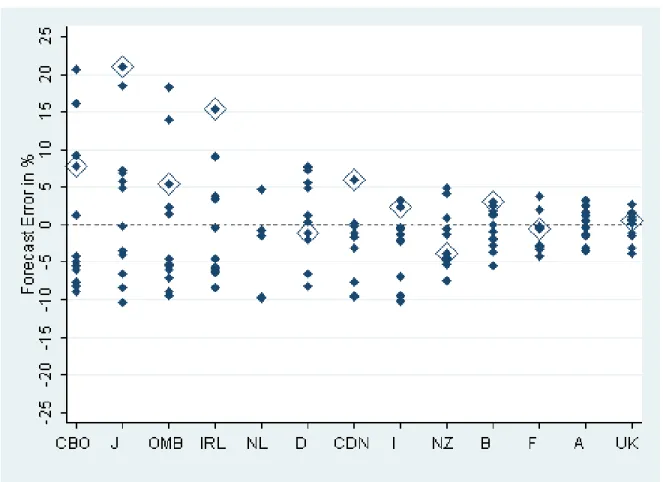
Figure 1: Forecast Errors by Country/Institution
CBO: US Congressional Budget Office, J: Japan, OMB: US Office of Management and Budget, IRL: Ireland, NL: Netherlands, D: Germany, CDN: Canada, I: Italy, NZ: New Zealand, B: Belgium, F: France, A: Austria, UK: United Kingdom.
The figure displays the forecast errors for total tax revenues in percentage for up to thirteen years in each country, each point representing one forecast. Forecast errors for 2008 are highlighted. A positive (negative) value denotes overestimation (underestimation). The forecasts are arranged in descending order of the standard deviation of the respective forecast errors. The two US forecasts only refer to federal taxes.
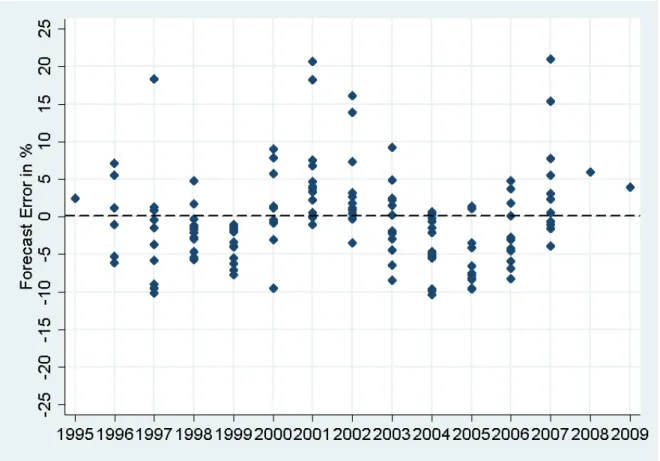
Figure 2: Forecast Errors by Year
The figure displays the forecast errors for total tax revenues in percentage for 13 forecasts for revenues in 12 countries. A positive (negative) value denotes overestimation (underestimation). The year at the horizontal axis refers to the year where the forecast has been issued.
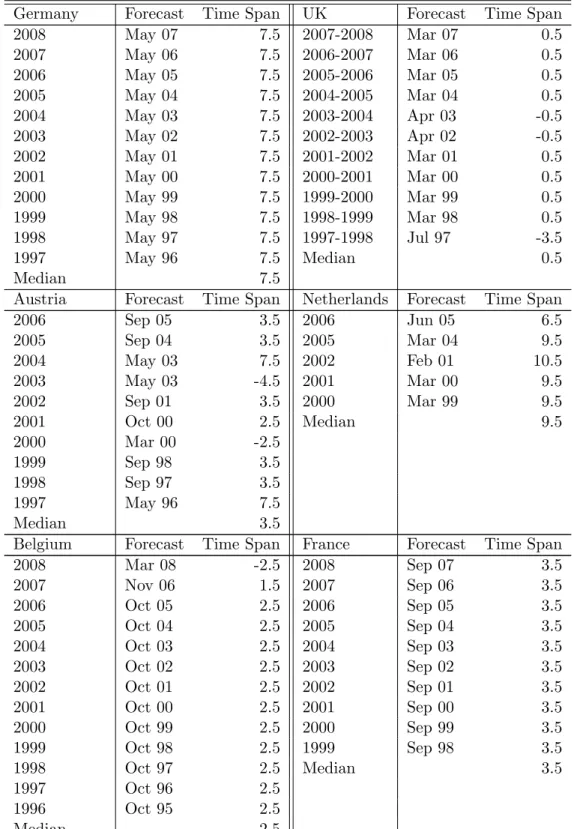
Since, ultimately, the forecast should indicate the revenue constraint to the current budget, we define forecast errors as the deviation of the forecasts from the final revenues reported for the corresponding fiscal year.1 With regard to the time period covered, note that we include forecasts issued from 1995 until 2009 (see Table A.1 for an overview of the actual forecasts used), but for several countries revenue forecasts were not available for some years and most forecasts have been issued in the period from 1996 until 2007.2 The forecast errors are depicted in Figures 1 and 2, where each point represents a single forecast error. Note that in Figure 1 the forecast errors are arranged in descending order of the respective standard deviation; in Figure 2 they are arranged according to the year in which the forecasts have been issued.
At first sight, Figure 1 seems to suggest that in most cases there is some underestimation going on. But there are also instances of large overestimations. For instance, the US Congressional Budget Office issued a revenue forecast in January 2001 for the 2001-2002 fiscal year, which started October 1, 2001, amounting to USD 2,236 Billion. Two years later revenues turned out to be only USD 1,853 Billion. Hence the forecast has been about 20.6% higher than realized revenues. A revenue forecast by the Japanese Ministry of Finance from December 2007 for the fiscal year 2008-2009 turned out to overestimate actual revenues by as much as 21.0%. While also several other forecasts associated with 2008 (marked with a rhomb) turned out to be overoptimistic, errors of this magnitude are rare. According to Figure 2, the forecast errors show a marked cyclical pattern.
Table 1 provides figures for the mean forecast error. A positive sign indicates an overestimation of revenues, a negative sign an underestimation. In all cases, except for Germany, Japan, and
1
Only for the most recent Canadian forecast, final revenues were not available. 2In the case of the Netherlands due to structural breaks just five years are considered.
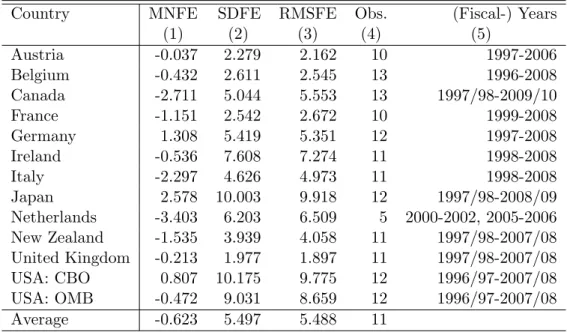
Table 1: Descriptive Statistics of Forecast Errors
Country MNFE SDFE RMSFE Obs. (Fiscal-) Years
(1) (2) (3) (4) (5) Austria -0.037 2.279 2.162 10 1997-2006 Belgium -0.432 2.611 2.545 13 1996-2008 Canada -2.711 5.044 5.553 13 1997/98-2009/10 France -1.151 2.542 2.672 10 1999-2008 Germany 1.308 5.419 5.351 12 1997-2008 Ireland -0.536 7.608 7.274 11 1998-2008 Italy -2.297 4.626 4.973 11 1998-2008 Japan 2.578 10.003 9.918 12 1997/98-2008/09 Netherlands -3.403 6.203 6.509 5 2000-2002, 2005-2006 New Zealand -1.535 3.939 4.058 11 1997/98-2007/08 United Kingdom -0.213 1.977 1.897 11 1997/98-2007/08 USA: CBO 0.807 10.175 9.775 12 1996/97-2007/08 USA: OMB -0.472 9.031 8.659 12 1996/97-2007/08 Average -0.623 5.497 5.488 11
The first column shows the mean (MNFE) of the one-year-ahead forecast error for total revenues in percentage. A positive (negative) value denotes overestimation (underestimation). The second column depicts the standard deviation of the forecast error (SDFE) and the third column reports the root mean squared forecast error (RMSFE). The fourth column reports the number of observations and the last column depicts the time period considered.
the CBO forecast in the United States, there is a slight underestimation of revenues. The largest difference from zero is found for the Netherlands which shows an underestimation of 3.4 % on average. However, given the large standard deviations, statistically, the means are not significantly different from zero.
The large differences in the standard deviation of the forecast errors (SDFE) point at substantial differences in the precision of forecasts. As can be seen in Column (2) of Table 1 the highest precision is achieved in the United Kingdom and Austria, while we find the lowest precision in the United States and Japan.
Table 1 also reports the root mean squared forecast error (RMSFE) which is a common summary measure of forecasting accuracy, based on a quadratic loss function regarding forecast errors (e.g., Clements and Hendry, 2002, and Wallis, 2008). Note that the RMSFE is equivalent to a combi-nation of the standard deviation of the forecast error and the mean forecast error.3 However, as documented by Table 1, the standard deviation of the forecast error and the RMSFE of revenue forecasts do not show large differences.
3
Conditions Faced by Forecasters
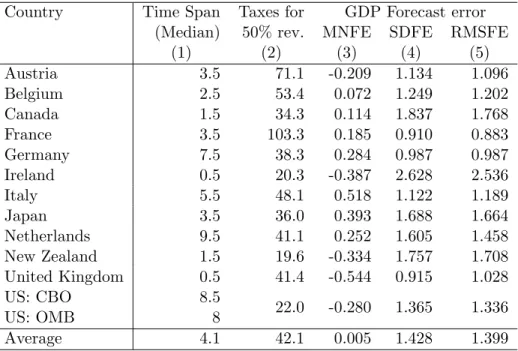
An assessment of the considerable differences in the accuracy of forecasts needs to take account of the different conditions faced by the forecaster. First of all this is an issue of the point of time when the forecast is made. Across countries there are important differences in the time span between the official forecast and the beginning of the forecasted period,i.e. the beginning of the forecasted fiscal year (see Column (1) of Table 2). Actually, the median varies between less than one and 9.5 months.
An important source of differences lies in the tax structure of the countries. In particular, the degree of differentiation of the tax system might matter. Rather than relying on few large taxes a country might employ a variety of smaller tax instruments. Provided that the different tax instruments
3
The mean squared forecast error (MSFE) can be decomposed into the squared mean of the forecast error (MNFE) and the squared standard deviation of the forecast error (SDFE) (e.g., Clements and Hendry, 1998). Formally, ignoring adjustments for the degrees of freedom, we have
\
M SF E'M N F E\ 2+SDF E\ 2.
Table 2: Forecasting Conditions
Country Time Span Taxes for GDP Forecast error (Median) 50% rev. MNFE SDFE RMSFE
(1) (2) (3) (4) (5) Austria 3.5 71.1 -0.209 1.134 1.096 Belgium 2.5 53.4 0.072 1.249 1.202 Canada 1.5 34.3 0.114 1.837 1.768 France 3.5 103.3 0.185 0.910 0.883 Germany 7.5 38.3 0.284 0.987 0.987 Ireland 0.5 20.3 -0.387 2.628 2.536 Italy 5.5 48.1 0.518 1.122 1.189 Japan 3.5 36.0 0.393 1.688 1.664 Netherlands 9.5 41.1 0.252 1.605 1.458 New Zealand 1.5 19.6 -0.334 1.757 1.708 United Kingdom 0.5 41.4 -0.544 0.915 1.028 US: CBO 8.5 22.0 -0.280 1.365 1.336 US: OMB 8 Average 4.1 42.1 0.005 1.428 1.399
The time span in the first column measures the median time-period between the forecast and the beginning of the forecasted period in months. It is taken from the various national sources listed in the appendix. In the second column the number of taxes needed to account for 50% of revenues in the respective country is shown based on the OECD Revenue Statistics.
relate to tax bases that are not closely correlated, this might reduce the revenue risks associated with the tax system. Therefore, forecasting the revenues of a large variety of small taxes might be easier than predicting the revenues in a system that relies on a small number of large taxes. To capture the differentiation of the tax structure we use an indicator of the number of taxes based on the OECD Revenue Statistics. More specifically, we employ the most detailed classification of taxes and, starting with the smallest taxes, count the number of taxes needed to account for 50% of all tax revenues.4 Of course this measure is only informative if the individual taxes are really different in the above sense. Moreover, comparing the number of taxes across countries raises difficult problems of classifying taxes and the OECD classification meets the various tax systems to a different extent. Nevertheless, relying on this classification, Column (2) indicates that there are large differences across countries.
Some types of taxes might be more difficult to predict than others. For instance, we might expect that there are significant differences in the forecast accuracy when forecasting corporation or per-sonal income taxes as compared to sales and value added taxes. This calls for a separate analysis of forecast errors according to the type of tax. The empirical analysis below, therefore, distinguishes four groups of taxes: personal income, corporation, value added and sales, as well as other taxes. This decomposition is also useful since the revenue forecasts are usually prepared for aggregates of individual taxes especially if these taxes share the same source or tax payer. This partly reflects the need to employ up-to-date information on current revenues, which is available usually on a source basis.
4While this measure is concerned with the 50% percentile, note that the results are found to be robust against choosing different percentiles.
Another potentially important reason for differences in the forecast errors is related to the un-certainty about the business cycle and the macroeconomic development. This unun-certainty is of particular importance not only because almost all taxes are affected by the macroeconomic en-vironment. A typical feature of revenue forecasting is that taxes which are strongly driven by macroeconomic developments such as corporation taxes or wage and income taxes are forecasted with indirect methods. Predominantly, the elasticity method is employed where some previously estimated elasticity is used to predict revenue growth based on the predicted development of the GDP or its components.5
Columns (3) to (5) of Table 2 provide some statistics for the macroeconomic uncertainty for each of the different countries. Note that as with the revenue forecast we are relying on the relative forecast error in percentage points. For instance, the mean forecast error of -0.544 for the UK indicates that on average predicted GDP was about half percentage point lower than actual GDP.6 Note that the GDP forecasts are not taken from the same source as the above official revenue forecasts. This is important since in some cases the macroeconomic predictions used by the forecasters are based on their own assessment, in other cases the macroeconomic forecasts of the government are used (see below). Conditioning on these predictions would not allow us to capture the impact of possible government manipulation. Therefore, we resort to the German council of economic experts, an independent body which annually issues forecasts of the macroeconomic developments including GDP for a large group of countries.7
5
For an overview of methods of revenue forecasting, see King (1993). 6
As in the case of revenue forecasts, the forecast error is computed relative to final figures.
7An advantage of these forecasts is that the one-year ahead forecasts are issued every year in November such that there are no timing differences across countries and time.
Uncertainty about revenues also stems from changes in the tax law. Already the immediate “me-chanical” effects of tax law changes are often difficult to estimate. In addition, changes in the tax law exert all sorts of behavioral effects with revenue consequences that are hard to quantify.8 This implies that revenue forecasts tend to be much more difficult in the presence of tax-law changes. While this may suggest to somehow capture revenue effects of major tax reforms, we have not been able to collect data on revenue estimates for tax reforms. But, we should note that there is also uncertainty about which tax law changes will actually be implemented. In some countries, it is common practice not only to include in the revenue forecasts those tax law changes that are already enacted but also to include changes that are agreed within the government (Austria, Netherlands) or noted in the budget plan (Ireland). If these changes are postponed, amended, or withdrawn, large forecast errors may occur even if the revenue estimate of the reform which was initially intended was correct.
4
Institutions and Independence
A basic institutional aspect of revenue forecasting is the assignment of the forecasting task to specific institutions. Interestingly, forecasting is not always assigned to a department of the gov-ernment or, more precisely, to the executive branch of the govgov-ernment. Only in about half of the thirteen forecasts surveyed in this paper it is the Ministry of Finance (Belgium, France, Italy, Ireland, Japan) or the Treasury (United Kingdom, New Zealand) that is responsible.9 In most other cases forecasting is assigned to a group representing different institutions, not only from the
8For a discussion of “dynamic scoring” in revenue estimation see Adam and Bozio (2009) and Auerbach (2005). 9For a detailed list of sources for the various forecasts covered see Appendix.
executive branch. Some countries even assign the primary responsibility for revenue forecasting to independent research institutes (Netherlands) and limit the influence of the executive branch to merely consult forecasters. In the other countries, even if the Ministry of Finance or another part of the executive is responsible, often external experts from academia or forecasting agencies are included in the forecasting group.
The efforts to involve institutions that are not part of the government or external experts are usually justified as a means to raise the independence of revenue forecasting from possible manip-ulation and strategic influences by the government. Several countries explicitly produceconsensus forecasts, where all institutions and experts involved have to agree on the forecast (e.g., Germany and Austria). However, the extent to which forecasting is independent from government manipula-tion is not only depending on the assignment of the forecasting responsibility but also on whether revenue forecasting is based on government predictions for the macroeconomic development, as is the case with the official German forecast.
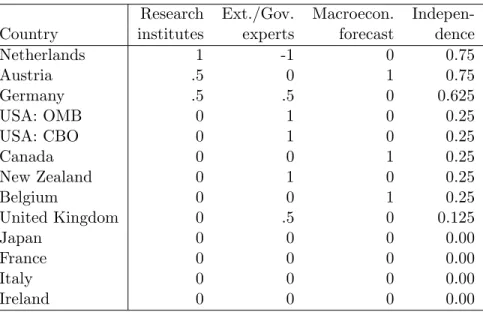
Table 3 presents information about how revenue forecasting differs with respect to these issues. The first column indicates whether the government (=0), research institutes (=1) or both jointly (=0.5) are responsible for the forecast. In some cases there are no research institutes involved, but in order to preserve a certain degree of independence there are external experts consulted (see Column (2)). This is the case for the US forecasts of the Congressional Budget Office (CBO) and the Office of Management and Budget (OMB). In the case of the United Kingdom a value of 0.5 is entered, in order to take account of the reported partial consultation of experts. Also for Germany a figure of 0.5 is entered in order to account for the additional participation of the German central bank.
ministry of finance that may tend to reduce independence. The third column provides information about the source of the macroeconomic forecast. A value of one indicates that an external forecast is used.
By summing across the first three columns we obtain a simple indicator of the independence of revenue forecasting. The first column is weighted with unity, the second and the third columns are weighted with 0.25. The rationale behind this weighting is the following: a revenue forecast that is conducted by a research institute without any government experts involved would display the maximum level of independence (=1). A government forecast that includes external experts and employs an external macroeconomic forecast would obtain a medium level of independence (=0.5). A government forecast without any external experts and without an external macroeconomic fore-cast would be assigned the lowest level of independence (=0).
While the indicator varies from zero (=no independence) to unity (=full independence), in our sample of countries the highest degree of independence is 0.75. As can be seen, the indicator is highest for the Netherlands and Austria, followed by Germany. A small, but positive level of independence can be found in Canada, New Zealand, Belgium and the United Kingdom. The United States case is somewhat special since here two separate forecasts exist. One is conducted by the Office of Management and Budget (OMB) that assists the executive branch, the other is conducted by the Congressional Budget Office (CBO) that is assigned to the legislative branch. While their incentives to manipulate forecasts strategically might differ, our indicator of independence, which is simply assessing the institutional conditions, assigns a low value of independence to both of them.10
10
Bretschneideret al. (1989) argue that the existence of two separate forecasts by the legislative and the executive branch exerts a positive effect on forecasting accuracy, in particular, when both forecasts are forced into a consensus. This is, however, not the case with the OMB and CBO.
Table 3: Institutional Characteristics and Independence Research Ext./Gov. Macroecon. Indepen-Country institutes experts forecast dence
Netherlands 1 -1 0 0.75 Austria .5 0 1 0.75 Germany .5 .5 0 0.625 USA: OMB 0 1 0 0.25 USA: CBO 0 1 0 0.25 Canada 0 0 1 0.25 New Zealand 0 1 0 0.25 Belgium 0 0 1 0.25 United Kingdom 0 .5 0 0.125 Japan 0 0 0 0.00 France 0 0 0 0.00 Italy 0 0 0 0.00 Ireland 0 0 0 0.00
First column indicates whether the government (= 0), research institutes (= 1) or both jointly are responsi-ble for the forecast (= 0.5). Second column indicates whether external (= 1) or government experts (=−1) are involved. For the United Kingdom a value of 0.5 is entered, in order to take account of the reported partial consultation of experts. In Germany a figure 0.5 is entered in order to account for the participation of the central bank. Third column provides information about whether an external macroeconomic forecast is used (the appendix provides a list of various national sources providing this information). The degree of independence in the last column is obtained as a weighted sum of the first three columns. The first column is weighted with unity, the second and the third columns are weighted with 0.25 (see text).
The general composition of the index with its emphasis on research institutes, external experts, and the source of the macroeconomic forecast reflects key institutional characteristics of revenue forecasting. Yet the weights, used to aggregate the information about these institutional aspects, are somewhat arbitrary. Therefore, we conducted some robustness checks where the weights for external experts and external macroeconomic forecasts were increased or lowered. With regard to the ranking, however, only minor changes were found. We will come back to this issue below, where we explore whether the index of independence has sufficient informational content in order to help explaining the observed forecasting performance.
Though we include several European countries, the index does not take account of the fiscal surveil-lance by the European Union institutions. Since 1999 due to the Stability and Growth Pact (SGP), EU member states are required to submit budgetary projections including revenue forecasts every year to the European Commission and the Ecofin Council. The forecasts also play a role in the Excessive Deficit Procedure, which defines sanctions for member states that continuously violate the agreed fiscal rules. It should be noted, however, that the purpose of corresponding revenue forecasts is different: they are not issued to set up and justify the budget plan. Rather these pro-jections provide the European Commission and the Ecofin Council with necessary information for purposes of surveillance of budgetary positions and economic policies. Nevertheless, the existence of a supra-national body discussing and standardizing revenue forecasts of the member states might well have implications for the national governments’ revenue forecasts. By including indicators for EU countries in the time period starting in 1999, the empirical analysis below tests for a possible impact on the performance of revenue forecasts.
5
Determinants of Forecasting Performance
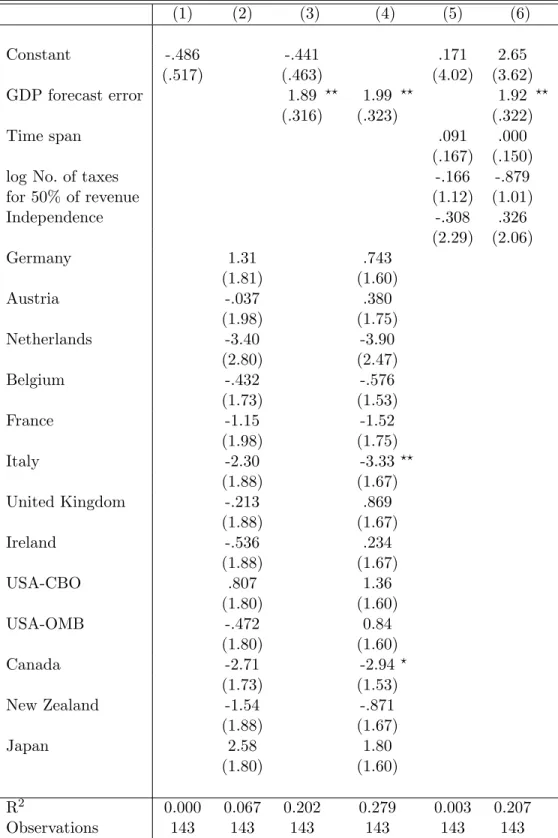
Having outlined differences in the forecasting conditions and practices let us finally turn to the question as to what extent these are associated with the large differences in forecasting performance noted above. In a first step we consider the level of the revenue forecast error and test for the presence of forecast biases. Table 4 provides the results.
Column (1) indicates that the overall mean or average forecast error is not significantly different from zero. The specification in Column (2) takes account of the panel structure of the data and
Table 4: Determinants of Forecast Error (1) (2) (3) (4) (5) (6) Constant -.486 -.441 .171 2.65 (.517) (.463) (4.02) (3.62) GDP forecast error 1.89 ?? 1.99 ?? 1.92 ?? (.316) (.323) (.322) Time span .091 .000 (.167) (.150)
log No. of taxes -.166 -.879
for 50% of revenue (1.12) (1.01) Independence -.308 .326 (2.29) (2.06) Germany 1.31 .743 (1.81) (1.60) Austria -.037 .380 (1.98) (1.75) Netherlands -3.40 -3.90 (2.80) (2.47) Belgium -.432 -.576 (1.73) (1.53) France -1.15 -1.52 (1.98) (1.75) Italy -2.30 -3.33?? (1.88) (1.67) United Kingdom -.213 .869 (1.88) (1.67) Ireland -.536 .234 (1.88) (1.67) USA-CBO .807 1.36 (1.80) (1.60) USA-OMB -.472 0.84 (1.80) (1.60) Canada -2.71 -2.94? (1.73) (1.53) New Zealand -1.54 -.871 (1.88) (1.67) Japan 2.58 1.80 (1.80) (1.60) R2 0.000 0.067 0.202 0.279 0.003 0.207 Observations 143 143 143 143 143 143
allows for institution specific differences in a potential bias, which prove insignificant, however. To take account of the difficulties in predicting the macroeconomic environment, Columns (3) and (4) condition on the one-year ahead GDP forecast error for each country. It shows a strongly significant impact indicating that an unpredicted increase in GDP by 1% results in an increase of revenues by almost 2%. According to Column (3) the average conditional forecast is not significantly different from zero. When we allow the average forecast error to differ between forecasting institutions (see Column (4)), we find that only the forecasts for Italy and Canada show significant biases. In both cases, conditional on the forecast error associated with the GDP forecast, the estimation indicates that, on average, forecasts have been too pessimistic.
In order to explore whether differences in the forecast errors can be assigned to the forecasting institutions, in Columns (5) and (6) we replace the dummies with a set of institution specific indicators most of which are time-invariant. The set of indicators includes the time-span between the forecast and the forecasted period, the indicator of the differentiation of the tax structure, as well as the indicator of the independence of forecasting institutions. However, all these indicators are not significant. While not shown, note that we also tested for some specific effect for European countries, which are required from 1999 onwards to report revenue forecasts to European institutions. Even if we allow the coefficients for the European countries to differ in the time period from 1999 onwards, no significant differences are found.
The failure to find significant effects of institutional characteristics and country characteristics on the mean forecast error does not necessarily indicate that they do not exert any effect on revenue forecasts. Certainly, in the process of setting up the budget, a government or parliament is tempted to manipulate revenue forecast, and to underestimate or overestimate revenues. Yet a sustained
manipulation in one direction, which would show up in a significant bias of the forecasts, hardly affects rational agents’ beliefs and merely undermines the credibility of the official forecast.11
In a second step of the analysis, we explore the differences in the forecasting performance using measures of forecast precision and accuracy. More precisely we consider the standard deviation of the forecast error (SDFE) which is an indicator of the precision of forecasts as well as the root mean squared forecast error (RMSFE) which is a common summary statistic of forecast accuracy. The first two specifications in Table 5 explore whether differences in forecasting conditions show some significant effects on the precision of the forecasts, measured by the standard deviation of the forecast error for total tax revenues. Column (1) just includes indicators of the macroeconomic uncertainty and of the time span between the forecast and the beginning of the forecasted period. The results confirm a strong impact of the macroeconomic uncertainty measured by the standard deviation of the GDP forecast error. They also indicate that the precision decreases considerably with the time span: every additional month increases the standard deviation by three quarters of a percentage point. In Column (2) we include the above indicator for the differentiation of the tax system into single taxes. The negative sign indicates that forecasting is more precise in countries where the number of taxes is large. However, the effect is not significant.
Columns (3) and (4) show the same specifications augmented with the indicator of the independence of revenue forecasting. While the results from Columns (1) and (2) are confirmed, we find that the precision of the forecast is positively associated with the independence from possible government manipulation. The specification in Column (3) indicates that about 80% of the variation in the
11
Consistent with this view, the literature developing models ofrational forecast bias relies on settings not with one but with multiple forecasting agents, where individual forecasters have incentives to differentiate their forecasts
T able 5: Determinan ts of F orecasting Precision and Accuracy , T otal Rev en ues Dep enden t v ariable SDFE RMSFE (1) (2) (3) (4) (5) (6) (7) (8) (9) (10) Constan t -.669 7.04 .892 7.16 .665 .905 2.74 3.66 2.22 -.372 (1.78) (7.47) (1.67) (6.38) (1.56) (1.81) (1.68) (6.22) (1.53) (5.72) Time span .734 ?? .635 ?? .861 ?? .773 ?? .887 ?? .830 ?? .772 ?? .762 ?? .755 ?? .785 ?? (.190) (.210) (.171) (.192) (.167) (.177) (.152) (.175) (.130) (.151) log No. of taxes -1.63 -1.34 -.216 .584 for 50% of rev en ue (1.54) (1.32) (1.39) (1.24) Indep endence a -4.40 ? -4.19 ? -4.88 ?? -3.61 ? -3.89 ? -3.88 ? -3.44 ?? -3.42 ? (2.00) (2.01) (2.00) (1.94) (1.72) (1.84) (1.47) (1.55) EU-SGP -2.15 ? -2.05 -2.13 ?? -2.39 ? (1.03) (1.27) (.873) (1.07) SDFE for GDP 4.36 ?? 3.08 4.03 ?? 3.00 ? 4.08 ?? 4.02 ?? 3.34 ?? 3.21 ?? (1.20) (1.69) (1.03) (1.44) (.984) (1.09) (.937) (1.32) RMSFE for GDP 3.66 ?? 4.10 ?? (.878) (1.30) R 2 0.677 0.713 0.790 0.814 0.805 0. 767 0.864 0.864 0.894 0.897 R 2 adjusted 0.612 0.617 0.720 0.721 0.741 0. 689 0.796 0.767 0.841 0.824 Observ ations 13 13 13 13 13 13 13 13 13 13 en den t v ari able in Columns (1)-(8) is the standard deviation of one-y ear-ahead forecast error (SDFE) for total tax rev en ues. Colu mns (9) and (1 0) cus on the ro ot-mean-squared forecast error (RMSFE). W eigh ted least squares estimates taking accoun t of the n um b er of forecasts considered in the of the standard deviation. Robust standard errors in paren th eses. One star denotes significance at the 10 % lev el, tw o stars at 5% lev el. a) (5) pro vides results from a sp ecification where the index of indep endence uses a higher w eigh t for external macro economic forecasts and external erts . Column (6) refers to a sp ecifi cation where the index uses a smaller w eigh t for external macro economic forecasts and external exp erts.
precision of the forecasts can be associated with the time span, the macroeconomic uncertainty and the degree of independence.
Since the indicator of independence rests on a weighted sum of three institutional characteristics we conducted some robustness tests using different weights. However, the results do not indicate major differences. If the weights for external experts or external macroeconomic forecasts are increased or lowered by 0.1, for instance, all effects are confirmed (see Columns (5) and (6)).
To capture separate fiscal forecasting requirements according to the Stability and Growth Pact, Columns (7) and (8) include an indicator for EU countries (EU-SGP). It captures the share of forecasts for European countries that were issued in the time period from 1999 onwards, when regular reports have to be filed for European institutions. Interestingly, it shows a significantly negative effect, suggesting that the precision of revenue forecasting has generally been increased in the presence of budgetary surveillance by the European Union. Yet a causal interpretation seems problematic, since the formation of the European monetary union might have exerted separate effects on the forecasting task.
Columns (9) and (10) report results of specifications where we replace the standard deviation of the forecast error with the root mean squared forecast error - a common summary statistic for forecast accuracy. While the set of explanatory variables is the same as above, for reasons of consistency, macroeconomic uncertainty is also captured by the root mean squared error of the GDP forecast. It turns out that the results are very similar to the results in Columns (7) and (8). Since the root mean squared forecast error combines the standard deviation and the mean of the forecast error (see above), this similarity reflects the above finding that differences in the standard deviation of
the forecast error are much more pronounced than differences in the means.12
Table 6 provides results for the precision of forecasts decomposed into four different types of taxes: (personal) income taxes, corporation taxes, sales taxes, and other taxes. Thus, for each group of taxes we compute separate indicators of forecast precision and forecast accuracy.13 A first specification uses a similar set of variables as Column (3) of Table 5. In addition, it includes dummy variables for each group of taxes. The coefficients of these variables indicate that corporation taxes show a much larger standard deviation of the forecast error. As documented by the coefficient of determination in Column (1) about 86% of the differences in the precision of the forecasts can be assigned to tax structure, timing, and independence. In Column (2) the number of taxes needed to account for 50% of revenues is included. While it is insignificant, note that in the specifications reported in Table 6 this indicator refers to the corresponding group of taxes.
To test whether the time-span has different effects across types of taxes, in Columns (3) and (4) we allow for possible differences in the effect of the timing among the different groups of taxes. As can be seen, the time span is relevant, particularly for corporation taxes, but also for income taxes.
All specifications support a negative significant effect for the independence of revenue forecasts. Columns (5) and (6) include indicators for the share of forecasts where reporting requirements to EU institutions existed (EU-SGP). Again, we find significantly negative effects, suggesting that the quality of revenue forecasts is increased as a result. The final two columns report results of specifications that focus on the root mean squared forecast error. As above, the results are very similar, qualitatively.
12Note that also an analysis based on the mean absolute error yields qualitatively similar results. 13
T able 6: Determinan ts of F orecasting Precision and Accuracy , Disaggregated Rev en ues Dep enden t v ariable SDFE RMSFE (1) (2) (3) (4) (5) (6) (7) (8) Time span .985 ?? 1.08 ?? -.014 .055 -.153 .015 -.172 .035 (.130) (.243) (.284) (.351) (.345) (.382) (.338) (.367) Time span × T ax typ e 1 1.54 ?? 1.45 ?? 1.54 ?? 1.28 ?? 1.51 ?? 1.21 ?? (.484) (.555) (.491) (.522) (.441) (.473) Time span × T ax typ e 2 1.95 ?? 1.88 ?? 1.95 ?? 1.75 ?? 1.83 ?? 1.59 ?? (.730) (.765) (.742) (.729) (.733) (.707) Time span × T ax typ e 3 .512 .469 .512 .391 .604 ? .462 (.339) (.360) (.344) (.360) (.335) (.336) SDFE for G DP 3.68 ?? 5.38 ?? 3.68 ?? 4.02 ?? 3.01 ?? 3.84 ?? (1.06) (1.82) (1.10) (1.25) (.610) (1.32) RMSFE for G D P 3.09 ?? 4.23 ?? (.484) (1.31) log No. of taxes 2.09 .419 1.18 1.39 for 50% of rev en ue (1.41) (.950) (1.10) (1.06) Indep endence -4.87 ?? -4.89 ? -4.87 ? -4.87 ? -3.57 ?? -3.33 ? -2.82 ?? -2.46 ? (2.15) (2.60) (2.23) (2.32) (1.48) (1.58) (1.34) (1.34) EU-SGP -2.65 ?? -3.17 ?? -2.68 ?? -3.25 ?? (.641) (.958) (.509) (.812) T ax typ e 1 (Income taxes) 2.45 -2.66 2.44 1.42 4. 21 ?? 1.67 4.00 ?? .763 (2.15) (3.87) (2.16) (2.63) (1.38) (3.38) (1.12) (3.24) T ax typ e 2 (Corp oration taxes) 11.0 ?? 6.13 11.0 ?? 10.0 ?? 12.7 ?? 10.3 ?? 12.5 ?? 9.38 ?? (2.68) (3.43) (2.61) (2.50) (2.04) (3.19) (1.85) (3.11) T ax typ e 3 (Sales taxes) .782 -8.21 .788 -1.01 2.56 ? -2.18 2.50 ?? -3.32 (2.07) (6.59) (2.08) (3.99) (1.20) (5.13) (.939) (5.04) T ax typ e 4 (Others) .868 -6.04 .880 -.504 2.65 ?? -.911 2.41 ?? -2.02 (2.41) (5.50) (2.25) (3.30) (1.07) (3.98) (.933) (3.94) R 2 0.862 0.874 0.916 0.916 0.925 0.928 0.928 0.932 Observ ations 48 48 48 48 48 48 48 48 end en t v ariable in Columns (1)-(6) is the standard deviation of one-y ear-ahead forecast error (SDFE) for tax rev en ues group ed in to four typ es of Columns (7) and (8) fo cus on the ro ot-m ean-squared forecast error (RMSFE). Robust standard errors in paren theses tak e accoun t of p ossible b et w een the forecasts for differen t groups of taxes. One star denotes significance at the 10 % lev el, tw o stars at 5% lev el.
6
Summary
In this paper we have compared revenue forecasting practice and performance across selected OECD countries. While the mean forecast error is small in most countries, the standard deviation of the forecast error and also summary statistics of forecast accuracy such as the root mean squared forecast error point at substantial differences in the forecasting performance across countries. This raises the question of whether differences in the performance are associated with differences in the conditions and practices of revenue forecasting in these countries.
First of all, it seems likely that important conditions for revenue forecasting are different. This refers to the uncertainty about the macroeconomic fundamentals as well as to country characteristics such as the tax structure both in terms of the differentiation into different taxes as well as with regard to the importance of corporate and (personal) income taxes. But also institutional arrangements vary between countries. This refers not only to the timing of revenue forecasts. While in some countries the ministry of finance or the treasury is responsible, other countries delegate the forecasting task to research institutes. Further differences arise with regard to the inclusion of external experts and with regard to the source of macroeconomic forecasts. To summarize these differences we come up with an index of the independence from possible government manipulation. According to this index the revenue forecasts are most independent in the Netherlands and in Austria.
The quantitative analysis shows that the cross-country differences in the performance of revenue forecasting are first of all related to the uncertainty about the macroeconomic development: the GDP forecast error exerts a strong effect on the error of revenue forecasts and also the precision of the revenue forecasts, measured by the standard deviation of the forecast error, is found to be
driven by macroeconomic uncertainty. Controlling also for differences in the timing of the forecasts, we find that the precision of revenue forecasts increases with the independence of forecasts from possible government manipulation. About 80% of the differences in forecasting precision concerning the total revenues can be explained by differences in macroeconomic uncertainty, in the timing, and in the degree of independence. For the European countries we find some evidence that forecasting precision has increased with the establishment of fiscal surveillance by the European institutions. But, it seems difficult to interpret this finding as a causal effect, since the creation of the monetary union might also have exerted direct effects on the difficulties of the forecasting task.
The results are confirmed when distinguishing between four groups of taxes,i.e. (personal) income taxes, corporation taxes, sales taxes, and a residual category. This analysis further shows that the forecasting precision is particularly low for income and corporation taxes. For these taxes we find that the precision depends strongly on the time-span between the forecast and the beginning of the forecasted period.
Our finding of a significant impact of institutional conditions on forecasting performance proves robust against alternative measures of the forecasting accuracy. Employing the root mean squared forecast error as a summary measure of forecasting accuracy we obtain very similar results.
While we have provided robust evidence for a beneficial effect of independence on forecast accuracy, an analysis of the incentives of governments to exert an influence on forecasts and the consequences of this influence is beyond the scope of the current paper and is left for future research. However, given the weak evidence for significant biases, our analysis suggests that government influence tends to show up in temporary deviations of forecasts from the expected values.
Appendix: Sources of Information
A.1 Austria
The official revenue forecast for Austria is documented/discussed in:
• Bundesministerium f¨ur Finanzen (2007): Budget 2007-2008, Zahlen – Hintergr¨unde – Zusam-menh¨ange. Online: www.bmf.gv.at
• Homepage of the Ministry of Finance: www.bmf.gv.at
• Homepage of the Wifo ( ¨Osterreichisches Institut f¨ur Wirtschaftsforschung): www.wifo.ac.at
• Leibrecht (2004)
A.2 Belgium
The revenue forecast of the federal government is documented/discussed in:
• Chambre des repr´esentants de Belgique: Budgets des Recettes et des D´epenses pour l’ann´ee budg´etaire 1996, ... pour l’ann´ee budg´etaire 2007, Brussels
• Hertveldt, Bart et al. (2003)
• Lenoir, Thierry and Valenduc, Christian (2006): R´evision de la m´ethode macro-´economique d’estimation des recettes fiscales. Service Public F´ed´eral Finances, Brussels
A.3 Canada
The spring revenue forecast of the Canadian Department of Finance is documented/discussed in:
• M¨uhleisen et al. (2005)
• O’Neill, Tim (2005): Review of Canadian Federal Fiscal Forecasting: Processes and Systems. O’Neill Strategic Economics. Online: www.fin.gc.ca/toce/2005/oneil e.html
A.4 France
The revenue forecast of the French government is documented/discussed in:
• Homepage of the Juridictions financi`eres: www.ccomptes.fr
• Homepage of the Minist`ere des Finances: www.minefi.gouv.fr
• Homepage of the Minist`ere du Budget, des Comptes Publics et de la fonction publique: www.budget.gouv.fr
• Les d´eterminants des ressources de l’ ´Etat: www.vie-publique.fr
A.5 Germany
The official, centralized forecast of the consensus forecasting group is documented/discussed in:
• Bundesministerium der Finanzen: Finanzbericht 1997-2008
• Bundesministerium der Finanzen (2005): 50 Jahre Arbeitskreis “ Steuersch¨atzung”
• Gebhardt (2001)
• Homepage of the Ministry of Finance: www.bundesfinanzministerium.de
A.6 Ireland
The revenue forecast of the Irish Government is documented/discussed in:
• Budgets of the Department of Finance: www.budget.gov.ie
• Homepage of the Ministry of Finance: www.finance.gov.ie
• Homepage of the Revenue Commissioners: www.revenue.ie
• Minutes of the “Committee of Public Accounts” of the Irish Parliament on 23. January 2003: www.irlgov.ie/committees-29/c-publicaccounts/20030123/Page1.htm
• Report of the Tax Forecasting Methodology Review Group, 2008: www.finance.gov.ie.
A.7 Italy
The revenue forecast of the Italian government is documented/discussed in:
• Ministero dell’Economia e delle Finanze, Rome: Documento di Programmazione Economico e Finanziaria per gli anni 1998-2000, ... per gli anni 2006-2009
• Istituto Nazionale di Statistica (2007), Rome: Conti e aggregati economici delle Amminis-trazioni pubbliche. Statistiche in breve, anni 1980-2006
A.8 Japan
The revenue forecast of the Japanese government is documented/discussed in:
• Adachi (2006), (in Japanese), PRI Discussion Paper Series, No. 06A-07
• Homepage of the Cabinett Office: www.cao.go.jp
• Homepage of the Ministry of Finance: www.mof.go.jp
A.9 Netherlands
The official revenue forecast of the CPB is documented/discussed in:
• Bos (2007).
• CPB Netherlands Bureau for Economic Policy Analysis (2005): Forecasting Tax Revenue. CPB Presentation
• European Commission (2006): European Economy No 3 / 2006, Public finances in EMU – 2006
• Homepage of the CPB Netherlands Bureau for Economic Policy Analysis: www.cpb.nl
• Ministry of Finance (2007): Stability Programme of the Netherlands, November 2007 Update: http://ec.europa.eu/economy finance/about/activities/sgp/
country/countryfiles/dec 2007/nl 2007 en.pdf
• Teulings, Coen (2006): Forecasting, Policy Evaluation and the Budgetary Process. Lessons from the Netherlands. CPB Presentation
A.10 New Zealand
The revenue forecast of the Treasury is documented/discussed in:
• Homepage of the Treasury: www.treasury.govt.nz
• Keene and Thomson (2007)
• New Zealand Treasury (2002): Treasury’s Forecasting Process. Presentation Online: www.treasury.govt.nz
• New Zealand Treasury (2007): Budget Economic and Fiscal Update 2007. Online: www.treasury.govt.nz
A.11 United Kingdom
The revenue forecast of the Treasury is documented/discussed in:
• HM Treasury (2007a): Budget 2007,HM Treasury, London
• HM Treasury (2007b): Meeting the aspirations of the British people: 2007 Pre-Budget Report and Comprehensive Spending Review,HM Treasury, London
• Homepage of the Treasury: www.hm-treasury.gov.uk
• Pike, Tim and Savage, David (1998): Forecasting the Public Finances in the Treasury. Fiscal Studies 19(1), 49–62
A.12 USA
The forecasts for federal revenues by the Congressional Budget Office and the Office of Management and Budget are documented/discussed in:
• Auerbach (1999).
• Congressional Budget Office (1995): Budget Estimates: Current Practices and Alternative Approaches. CBO Papers Series, Washington D.C.
• Congressional Budget Office (1998): Projecting Federal Tax Revenues and the Effect of Changes in Tax Law Memorandum, Washington D.C.
• Congressional Budget Office (2006): CBO’s Policies for Preparing and Distributing Its Esti-mates and Analyses, Washington D.C.
• Congressional Budget Office (2007): The Uncertainty of Budget Projections: A Discussion of Data and Methods. Memorandum, Washington D.C.
• Homepage of the Congressional Budget Office (CBO): www.cbo.gov
• Homepage of the Office of Management and Budget (OMB): www.whitehouse.gov/omb
• Joint Committee on Taxation (JCT) (1992): Discussion of Revenue Estimation Methodology and Process. US Government Printing Office, Washington D.C.
A.13 Other Sources
• GDP forecast errors for all countries are based on the reports of the German council of eco-nomic experts, an independent body that issues annual reports including GDP forecasts for a
large group of developed countries, see: http://www.sachverstaendigenrat-wirtschaft.de/en/index.php
• OECD Revenue Statistics, varies issues.
References
Auerbach, A.J., 1999, On the Performance and Use of Government Revenue Forecasts, National Tax Journal, 52 (4), 765–782.
Auerbach, A.J., 2005, Dynamic Scoring: An Introduction to the Issues, American Economic Review, 95 (2), 421–425.
Adam, S., and A. Bozio, 2009, Dynamic Scoring, OECD Journal on Budgeting, 9(2), 99–124. Bos, F., 2007, The Dutch fiscal framework. History, current practice and the role of the CPB.
Online: www.cpb.nl/nl/pub/cpbreeksen/document/150/doc150.pdf.
Bretschneider, S. I., W. L. Gorr, G. Grizzle, and E. Klay, 1989, Political and organizational influences on the accuracy of forecasting state government revenues,International Journal of Forecasting 5 (1989), 307–319.
Boylan, R. T., 2008, Political Distortions in State Forecasts, Public Choice 136, 411–427. Clements, M. P. and D. F. Hendry, 1998, Forecasting Economic Time Series, Cambridge.
Clements, M. P. and D. F. Hendry, 2002, An overview of economic forecasting, in Clements, M. P. and D. F. Hendry (eds.),A Companion to Economic Forecasting, Oxford, 1–18.
Danninger, S., 2005, Revenue Forecasts as Performance Targets, IMF Working Papers 05/14. Feenberg, D. R., W. Gentry, D. Gilroy, and H. S. Rosen, 1989, Testing the Rationality of State
Gebhardt, H., 2001, Methoden, Probleme und Ergebnisse der Steuersch¨atzung,RWI-Mitteilungen 2001, 127–147.
Hertveldt, B. et al., 2003, Tout savoir sur la confection du budget ´economique. Federal Planning Bureau Working Paper, Brussels.
Jonung, L., and M. Larch, 2006, Improving fiscal policy in the EU: the case for independent forecasts, Economic Policy 21, 491–534.
Keene, M. and P. Thomson, 2007, An Analysis of Tax Revenue Forecast Errors, Working Paper 07/02, New Zealand Treasury,Wellington.
King, J. R., 1993, Alternative Methods of Revenue Forecasting and Estimating in P. Shome (ed.), Tax Policy Handbook International Monetary Fund, 254–257.
Krause, G. A., D. E. Lewis, and J. W. Douglas, 2006, Political Appointments, Civil Service Systems, and Bureaucratic Competence: Organizational Balancing and Executive Branch Revenue Forecasts in the American States, American Journal of Political Science 50, 770– 787.
Kyobe, A., and S. Danninger, 2005. Revenue Forecasting–How is it done? Results from a Survey of Low-Income Countries. IMF Working Papers 05/24.
Laster, D., P. Bennett, and I. S. Geoum, 1999, Rational Bias in Macroeconomic Forecasts, Quar-terly Journal of Economics 114 (1999), 1, 293–318.
Leal, T., J.J. Perez, M. Tujula, and J. Vidal, 2008, Fiscal Forecasting: Lessons from the Literature and Challenges Fiscal Studies 29 (3), 347–386.
Leibrecht, M., 2004, Steuersch¨atzung in ¨Osterreich: Ablauf, Methoden und Pr¨azision der Prog-nose,Deutscher Universit¨atsverlag, Wiesbaden.
Lenoir, T., and C. Valenduc, 2006, R´evision de la m´ethode macro-´economique d’estimation des recettes fiscales, Brussels.
M¨uhleisen, M., S. Danninger, D. Hauner, K. Krajny´ak, B. Sutton, 2005, How Do Canadian Budget Forecasts Compare with Those of Other Industrial Countries? IMF Working Paper, WP/05/66.
Pike, T., and D. Savage, 1998, Forecasting the Public Finances in the Treasury. Fiscal Studies 19(1), 49–62.
Pina, A. M., and N. Venes, 2007, The political economy of EDP fiscal forecasts: an empirical assessment,Working Paper ISEG, # 023, Lisbon.
Strauch, R., M. Hallerberg, and J. v. Hagen, 2004, Budgetary forecasts in Europe: the track record of stability and convergence programmes, Working Paper European Central Bank, # 307, Frankfurt.
Wallis, K. F., 2008, Forecast uncertainty, its representation and evaluation, in R.S. Mariano and Y.K. Tse, (eds.), In Econometric Forecasting and High-Frequency Data Analysis, National
Table A.1: Timing of Forecasts and Time Span
Germany Forecast Time Span UK Forecast Time Span
2008 May 07 7.5 2007-2008 Mar 07 0.5 2007 May 06 7.5 2006-2007 Mar 06 0.5 2006 May 05 7.5 2005-2006 Mar 05 0.5 2005 May 04 7.5 2004-2005 Mar 04 0.5 2004 May 03 7.5 2003-2004 Apr 03 -0.5 2003 May 02 7.5 2002-2003 Apr 02 -0.5 2002 May 01 7.5 2001-2002 Mar 01 0.5 2001 May 00 7.5 2000-2001 Mar 00 0.5 2000 May 99 7.5 1999-2000 Mar 99 0.5 1999 May 98 7.5 1998-1999 Mar 98 0.5 1998 May 97 7.5 1997-1998 Jul 97 -3.5 1997 May 96 7.5 Median 0.5 Median 7.5
Austria Forecast Time Span Netherlands Forecast Time Span
2006 Sep 05 3.5 2006 Jun 05 6.5 2005 Sep 04 3.5 2005 Mar 04 9.5 2004 May 03 7.5 2002 Feb 01 10.5 2003 May 03 -4.5 2001 Mar 00 9.5 2002 Sep 01 3.5 2000 Mar 99 9.5 2001 Oct 00 2.5 Median 9.5 2000 Mar 00 -2.5 1999 Sep 98 3.5 1998 Sep 97 3.5 1997 May 96 7.5 Median 3.5
Belgium Forecast Time Span France Forecast Time Span
2008 Mar 08 -2.5 2008 Sep 07 3.5 2007 Nov 06 1.5 2007 Sep 06 3.5 2006 Oct 05 2.5 2006 Sep 05 3.5 2005 Oct 04 2.5 2005 Sep 04 3.5 2004 Oct 03 2.5 2004 Sep 03 3.5 2003 Oct 02 2.5 2003 Sep 02 3.5 2002 Oct 01 2.5 2002 Sep 01 3.5 2001 Oct 00 2.5 2001 Sep 00 3.5 2000 Oct 99 2.5 2000 Sep 99 3.5 1999 Oct 98 2.5 1999 Sep 98 3.5 1998 Oct 97 2.5 Median 3.5 1997 Oct 96 2.5 1996 Oct 95 2.5 Median 2.5
Timing and Time Span, continued
Italy Forecast Time Span Japan Forecast Time Span
2008 Jun 07 6.5 2008-2009 Dec 07 3.5 2007 Jul 06 5.5 2007-2008 Dec 06 3.5 2006 Jul 05 5.5 2006-2007 Dec 05 3.5 2005 Jul 04 5.5 2005-2006 Dec 04 3.5 2004 Jul 03 5.5 2004-2005 Dec 03 3.5 2003 Jul 02 5.5 2003-2004 Dec 02 3.5 2002 Jul 01 5.5 2002-2003 Dec 01 3.5 2001 Jun 00 6.5 2001-2002 Dec 00 3.5 2000 Jun 99 6.5 2000-2001 Dec 99 3.5 1999 Apr 98 8.5 1999-2000 Dec 98 3.5 1998 May 97 7.5 1998-1999 Dec 97 3.5 Median 5.5 1997-1998 Dec 96 3.5 Median 3.5
Ireland Forecast Time Span USA-OMB Forecast Time Span
2008 Dec 07 0.5 2007-2008 Feb 07 8 2007 Dec 06 0.5 2006-2007 Feb 06 8 2006 Dec 05 0.5 2005-2006 Feb 05 8 2005 Dec 04 0.5 2004-2005 Feb 04 8 2004 Dec 03 0.5 2003-2004 Feb 03 8 2003 Dec 02 0.5 2002-2003 Feb 02 8 2002 Dec 01 0.5 2001-2002 Feb 01 8 2001 Dec 00 0.5 2000-2001 Feb 00 8 2000 Dec 99 0.5 1999-2000 Feb 99 8 1999 Dec 98 0.5 1998-1999 Feb 98 8 1998 Dec 97 0.5 1997-1998 Feb 97 8 Median 0.5 1996-1997 Feb 96 8 Median 8
USA-CBO Forecast Time Span Canada Forecast Time Span
2007-2008 Jan 07 8.5 2009-2010 Jan 09 2.5 2006-2007 Jan 06 8.5 2008-2009 Feb 08 1.5 2005-2006 Jan 05 8.5 2007-2008 Mar 07 0.5 2004-2005 Jan 04 8.5 2006-2007 May 06 -1.5 2003-2004 Jan 03 8.5 2005-2006 Feb 05 1.5 2002-2003 Jan 02 8.5 2004-2005 Mar 04 0.5 2001-2002 Jan 01 8.5 2003-2004 Feb 03 1.5 2000-2001 Jan 00 8.5 2002-2003 Dec 01 3.5 1999-2000 Jan 99 8.5 2001-2002 Feb 00 13.5 1998-1999 Jan 98 8.5 2000-2001 Feb 00 1.5 1997-1998 Jan 97 8.5 1999-2000 Feb 99 1.5 1996-1997 Jan 96 8.5 1998-1999 Feb 98 1.5 Median 8.5 1997-1998 Feb 97 1.5
Timing and Time Span, continued New Zealand Forecast Time Span
2007-2008 May 07 1.5 2006-2007 May 06 1.5 2005-2006 May 05 1.5 2004-2005 May 04 1.5 2003-2004 May 03 1.5 2002-2003 May 02 1.5 2001-2002 May 01 1.5 2000-2001 May 00 1.5 1999-2000 Apr 99 2.5 1998-1999 Apr 98 2.5 1997-1998 May 97 1.5 Median 1.5