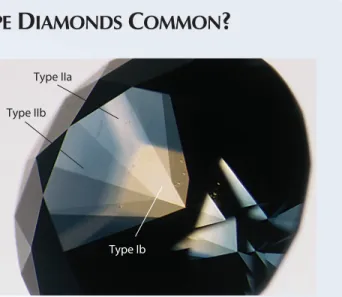
critical to evaluating the relationships between dia-mond growth, color (e.g., figure 1), and response to laboratory treatments. With the increasing availabili-ty of treated and synthetic diamonds in the market-place, gemologists will benefit from a more complete understanding of diamond type and of the value this information holds for diamond identification.
Considerable scientific work has been done on this topic, although citing every reference is beyond the scope of this article (see, e.g., Robertson et al., 1934, 1936; and Kaiser and Bond, 1959). Brief gemo-logical discussions of diamond types appeared in Shigley et al. (1986), Fritsch and Scarratt (1992), and Smith et al. (2000), and more-detailed descriptions were given in Wilks and Wilks (1991) and Collins (2001). Nevertheless, repeated inquiries received at GIA indicate that many practicing gemologists do not have a clear understanding of the basics of dia-mond type. This article offers a readily accessible, gemology-specific guide to diamond type and related
T
HE
“T
YPE
” C
LASSIFICATION
S
YSTEM OF
D
IAMONDS AND
I
TS
I
MPORTANCE IN
G
EMOLOGY
Christopher M. Breeding and James E. Shigley
See end of article for About the Authors and Acknowledgments. GEMS& GEMOLOGY, Vol. 45, No. 2, pp. 96–111.
© 2009 Gemological Institute of America
Diamond “type” is a concept that is frequently mentioned in the gemological literature, but its rel-evance to the practicing gemologist is rarely discussed. Diamonds are broadly divided into two types (I and II) based on the presence or absence of nitrogen impurities, and further subdivided according to the arrangement of nitrogen atoms (isolated or aggregated) and the occurrence of boron impurities. Diamond type is directly related to color and the lattice defects that are modi-fied by treatments to change color. Knowledge of type allows gemologists to better evaluate if a diamond might be treated or synthetic, and whether it should be sent to a laboratory for testing. Scientists determine type using expensive FTIR instruments, but many simple gemological tools (e.g., a microscope, spectroscope, UV lamp) can give strong indications of diamond type.
emologists have dedicated much time and attention to separating natural from syn-thetic diamonds, and natural-color from treated-color diamonds. Initially, these determina-tions were based on systematic observadetermina-tions made using standard gemological tools such as a micro-scope, desk-model (or handheld) spectromicro-scope, and ultraviolet (UV) lamps. While these tools remain valuable to the trained gemologist, recent advances in synthetic diamond growth, as well as irradiation and high-pressure, high-temperature (HPHT) treat-ment techniques, have rendered them less defini-tive in identifying synthetic and color-treated dia-monds. Thus, most gemological laboratories now use more-sophisticated scientific techniques such as absorption and photoluminescence spectroscopy to detect treatments and synthetics.
These developments in gem diamond identifica-tion have introduced many scientific terms and con-cepts into the gemological literature. One of the most important of these concepts is diamond “type.” The diamond type classification system is widely used in diamond research, because it provides a convenient way to categorize diamonds based on their chemical and physical properties. Understanding this system is
G
trace-element impurities, including how impurities are measured, why type is important, and how type can be determined using simple gemological tools. With this foundation, it then explains the applica-tion of diamond type concepts to the detecapplica-tion of diamond color treatments and synthetic diamonds.
BACKGROUND
Having grouped diamonds in the past on the basis of their color, fluorescence, visible absorption spectra, and other properties, scientists eventually sought to organize these groupings into a formal classification system. Robertson et al. (1934, 1936) were the first to do so, dividing “colorless” diamonds into two cate-gories on the basis of differences in their transparency to both UV (10 nm to ~400 nm) and infrared (IR; ~700 nm to 1000 µm) wavelengths. The larger group con-sisted of type I diamonds, which were opaque to UV radiation below ~300 nm and absorbed strongly in parts of the IR region (specifically the range 7000–20000 nm). The smaller group was composed of type II diamonds, which transmitted UV wave-lengths and displayed little or no anomalous birefrin-gence when viewed between crossed polarizers. Robertson and his colleagues thus concluded that type II diamonds were nearly “perfect” in terms of their crystal structure. Two decades later, Sutherland et al. (1954) suggested that the “less perfect” charac-ter of type I diamonds resulted from carbon atoms in the diamond structure being in an “abnormal state” and from the presence of “chemical impurities.” Their assertions proved correct when it was later determined that the differences between diamonds in these two categories were due to the presence (type I)
and apparent absence (type II) of nitrogen in the dia-mond structure (Kaiser and Bond, 1959).
Other researchers began to note systematic rela-tionships between the optical properties of diamonds. UV fluorescence reactions were correlated with dia-mond color and absorption bands seen with the prism spectroscope (Nayar, 1941a,b; Anderson, 1943a,b,c, 1962, 1963; Mitchell, 1964). Color, transparency, and luminescence properties of more than 300 diamonds were also documented by the famous scientist, Sir C. V. Raman (1944). This pioneering work on dia-mond color and luminescence was expanded by stud-ies of the different IR absorption spectra produced by type I and type II diamonds (see Sutherland and Willis, 1945; Blackwell and Sutherland, 1949). These studies became the foundation for today’s use of IR spec-troscopy to determine diamond type.
Kaiser and Bond (1959) were the first to corre-late certain characteristics (i.e., yellow coloration, blue fluorescence, and a particular IR absorption spectrum) with the presence of nitrogen impurities in type I diamonds. Other studies confirmed their findings (Anderson, 1961; Lightowlers and Dean, 1964). Shortly thereafter, Dyer et al. (1965) used IR spectroscopy to distinguish between diamonds with aggregated (type Ia) and isolated (type Ib) nitro-gen atoms. The vast majority (>95%) of natural dia-monds turned out to be type Ia, and only a rare few were found to be type Ib (Davies, 1977). Some of those rare type Ib diamonds showed extraordinary yellow color and corresponded to those termed canaryin the gem trade (Anderson, 1962; Collins, 1980). Custers (1952, 1954) found that type II diamonds also occur very rarely in nature and pro-posed splitting them into two groups, IIa and IIb.
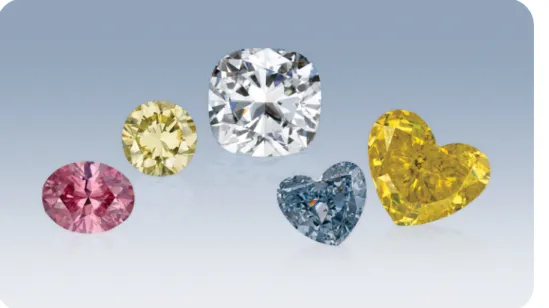
Figure 1. Gem diamonds such as these are prime examples of their respec-tive diamond types (from left): 0.47 ct type Ia pink, 0.38 ct type Ia “cape” yellow, 1.04 ct type IIa colorless, 0.56 ct type IIb blue, and 1.01 ct type Ib “canary” yellow. All the colored diamonds are part of the Aurora Butterfly of Peace collection. Composite photo by Robert Weldon and Kevin Schumacher.
The latter diamonds were blue (sometimes grayish blue, gray, or brown) and exhibited electrical con-ductivity (Custers, 1955; Anderson, 1960, 1962). Further work demonstrated that boron was the impurity that gave rise to the unique properties of type IIb diamonds (Wentorf and Bovenkirk, 1962; Chrenko, 1973).
HOW ARE DIAMOND TYPES CLASSIFIED AND WHY ARE THEY IMPORTANT IN GEMOLOGY?
Pure diamond is made of only one element: carbon. The atoms are arranged in a regular repeating pat-tern (the diamond lattice) that is unique among gems. However, atoms of elements such as nitrogen (N) and boron can replace some of the carbon atoms in the lattice. While other impurities can also be incorporated, the diamond type classification sys-tem divides diamonds into categories based solely on the presence or absence of certain nitrogen and boron impurities and the ways in which they are arranged in the lattice (figure 2).
Diamond Type Classification. The foundation of the
type classification system is the presence or absence of nitrogen, the most common impurity in diamond. Type I diamonds are defined as containing sufficient N to be measurable by IR absorption spectroscopy, whereas type II diamonds do not contain enough N to be detected by the IR spectrometer. These general categories are then subdivided based on the nature of the impurities that are present.
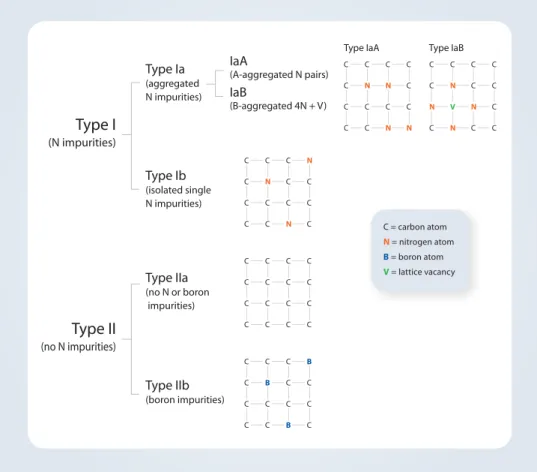
As noted above, type I diamonds are divided into type Ia and type Ib. Both subgroups contain nitrogen, but the nitrogen atoms in each are arranged differ-ently (again, see figure 2). In type Ib diamonds, single nitrogen atoms that have replaced carbon atoms in the lattice are isolated from one another; that is, they generally do not occur in adjacent lattice posi-tions. These N impurities are called by several names in the scientific literature, including isolated N, single substitutional N, and C centers. In con-trast, type Ia diamonds contain N atoms that are in close proximity to one another in one of two spectroscopically detectable configurations. The most common configuration for type Ia diamonds
Figure 2. Diamond type classification is based on the presence or absence of nitro-gen and boron impurities and their configurations in the diamond lattice. These sche-matic diagrams illustrate the manner in which N and boron atoms replace C atoms in the diamond lattice. The diagrams are simplified two-dimensional representations of the tetrahedrally bonded C atoms (four bonds per C atom) that form the three-dimensional diamond crystal structure. Type Ia diamonds contain aggregated N impuri-ties—including A-aggregates (IaA), which consist of pairs of N atoms, and B-aggregates (IaB), which are made up of four N atoms around a vacancy (V). Type Ib dia-monds have isolated N atoms. Type IIa stones con-tain no measurable impuri-ties, and type IIb diamonds have boron impurities.
involves two N atoms adjacent to each other in the lattice. Although these two atoms occupy neighbor-ing sites, each pair is isolated from other N atoms in the lattice. These N impurities are commonly referred to as A aggregates (or A centers), and the dia-monds that contain them are termed type IaA. The other configuration involves four N atoms that sym-metrically surround a vacancy. (A vacancy is a lat-tice site normally occupied by a carbon atom that is not occupied by any atom.) This complex grouping is formed when two A centers combine. These N impurity groupings are called B aggregates (or B cen-ters), and the associated diamonds are type IaB. Other arrangements of N atoms (see box A) do occur, but they are not included in the diamond type classification system (Collins, 1982, 2001).
Type II diamonds are divided into types IIa and IIb (again, see figure 2). Type IIa diamonds contain no easily measurable N or boron impurities. Natural type IIb diamonds likewise contain no IR-measur-able N impurities. Instead, type IIb diamonds con-tain boron impurities that are thought to be isolated single atoms that replace carbon in the diamond lat-tice. Characteristic properties of type IIb diamonds, such as electrical conductivity, are a direct result of the boron impurities.
What Can a Gemologist Learn from Diamond Type?
In many cases, the geologic conditions to which
nat-ural diamonds have been exposed during their extended period in the earth and the conditions imposed in a laboratory during treatment or synthet-ic growth are quite different, yet the resulting struc-tural lattice defects can yield nastruc-tural, treated, and synthetic diamonds with very similar colors. (See box A for information about non–type related defects that also influence color.) Diamond impurities control the nature of the lattice defects that occur naturally and their evolution during lab growth or treatment. Therefore, a diamond’s type reflects its history, whether in nature or in the laboratory, or both—and an adequate understanding of diamond type is critical for identification purposes. Since the detection of many modern treatments and synthetics requires the facilities of a well-equipped gemological laboratory, it is important to know when to send a diamond for advanced testing. With a better understanding of how diamond type relates to natural color, treated color, and synthetic growth processes, a gemologist should be able to make that decision more easily.
Relationship of Type to Diamond Color and Treatments. Natural diamonds often show colors
that correlate to their diamond type (figure 3). For example, type Ia colorless, brown, pink, and violet diamonds are unlikely to have been color-treated, whereas treated-color type Ia yellow, orange, red, blue, and green stones are relatively common.
Figure 3. Color is strongly influenced by the impurities/defects in the diamond lattice. Consequently, diamond type plays an important role in the potential colors of natural, synthetic, and treated stones. Although much experience is necessary to even attempt an assessment of diamond type using color observations, these images show some of the representative colors for each category. Photos by various GIA staff.
Type
Ia
Ib
IIa
IIb
Natural type Ib diamonds are almost always brown, yellow, or orange, whereas their artificially irradiated and annealed counterparts are usually pink to red. HPHT treatment can produce yellow in an off-color type Ib diamond. HPHT processes may enhance type IIa brownish diamonds to appear colorless or pink,
and may produce blue in some type IIb diamonds. However, HPHT treatment cannot alter a type Ia dia-mond to colorless (except rare pure IaB), so if a gemol-ogist determines that a colorless diamond is type Ia, it is usually not necessary to send it to a gemological laboratory for further testing (the few colorless
syn-Several lattice defects contribute to the color of dia-mond even though they are not involved in the assignment of diamond type. Most of these features selectively absorb light in the visible range of the electromagnetic spectrum to produce color, and they can be seen with a gemological spectroscope or a UV-Vis-NIR absorption spectrometer. These defects are commonly mentioned in the scientific and gemological literature. A brief description of each is given below (from Clark et al., 1979; Collins, 1982, 2001; Zaitsev, 2001; and GIA staff observations).
N3 (415 nm):This defect consists of three nitrogen atoms surrounding a vacancy. In addition to con-tributing to yellow color in “cape” diamonds, it can also produce blue luminescence in response to long-wave UV radiation.
N2 (478 nm): This broad absorption is associated with N3 and is part of the well-known “cape” spec-trum in many yellow diamonds. It is also related to nitrogen impurities.
480 nm: This broad band is a defect of unknown ori-gin that commonly produces yellow or orange color in type Ia diamonds. Strong yellow fluorescence is typical of diamonds colored by this mechanism.
H4 (496 nm): This defect consists of four nitrogen atoms separated by two vacancies. It is created when a vacancy migrates through the diamond lattice and combines with a B-aggregated nitrogen impurity. H4 produces yellow color in diamond.
H3 (503.2 nm): This is an uncharged defect consisting of two nitrogen atoms separated by a vacancy [i.e., (N-V-N)0]. H3 absorption alone creates yellow color,
while the defect can also produce green lumines-cence in response to illumination.
3H (503.5 nm): This defect is thought to be related to an interstitial carbon atom in the diamond lattice. It is created by radiation damage and often occurs with the
GR1. On rare occasions, 3H absorbs strongly enough to enhance the green color caused by GR1 absorption.
550 nm:This broad band is poorly understood and thought to be associated with plastic deformation of the diamond lattice. This is the most common defect that produces pink-to-red color in natural diamonds, but it is also common in brown stones.
NV0(575 nm):This defect consists of a nitrogen
atom adjacent to a vacancy; it is in a neutral charge state. In combination with the 637 nm defect, the NV0center produces pink color in most treated pink
diamonds as well as in a few natural pink stones.
595 nm:This band is a nitrogen-related defect of uncertain structure. It is commonly associated with laboratory irradiation and annealing of diamond to produce green, yellow, or pink colors, but it is also present as a weak feature in many natural-color green or yellow diamonds.
NV−(637 nm): This defect consists of a nitrogen atom
adjacent to a vacancy. This defect is in a negative charge state. In combination with the 575 nm defect, the NV-center produces pink color in most treated
pink diamonds as well as a few natural stones.
GR1 (741 nm): This defect is a single, uncharged vacancy in the diamond lattice. It is common in most natural and artificially irradiated type Ia and IIa blue or green diamonds. Although outside the visible spectral range (~400–700 nm), strong absorption by GR1 produces related bands at the red end of the spectrum that result in green or blue color.
H2 (986 nm): This is a negatively charged defect that consists of two nitrogen atoms separated by a vacancy [i.e., (N-V-N)−]. It is closely related to H3 and is
com-monly cited as evidence for HPHT treatment in type Ia diamonds. Occasionally, H2 (and related broad band absorptions) can be so intense that the combination of H3 and H2 produces a strong green bodycolor.
B
OX
A: S
UMMARY OF
C
OLOR
-P
RODUCING
D
IAMOND
thetic diamonds currently on the market are type IIa). Most permanent (i.e., not related to surface coat-ings) diamond treatments add, change, or remove color by reorganizing defects in the diamond lattice. Diamond type may determine whether or not the necessary color-causing defects can be produced or destroyed during the treatment process to achieve the desired result. Irradiation is routinely performed on all types of diamonds to produce green or blue col-ors, so type is not very useful in that case. However, if irradiation is followed by heating to temperatures of 800–1000°C to produce a yellow or pink color, then the diamond type of the starting material is crit-ical. Type I diamonds will often change to intense yellow, orange, pink, or red with irradiation followed by annealing, whereas type II diamonds rarely devel-op intense colors in these hues due to the lack of
impurities (primarily N) needed to create complex, color-producing defects. Therefore, it is useful for a gemologist to understand that type II diamonds are not likely to have been subjected to treatments involving irradiation followed by annealing.
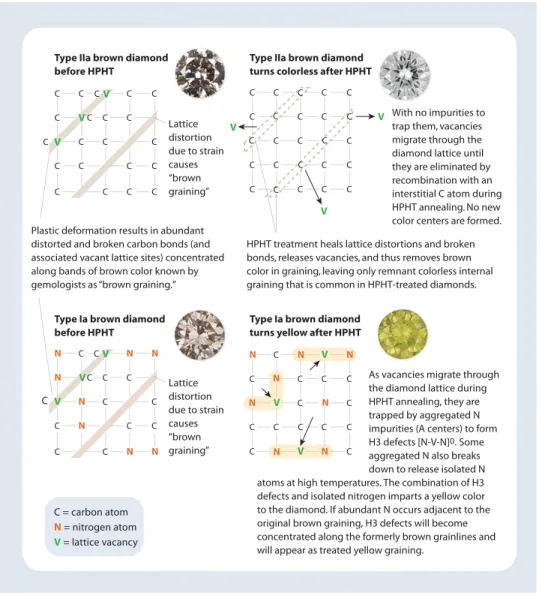
The detection of HPHT treatment requires an even better knowledge of diamond type (Fisher and Spits, 2000; Smith et al., 2000). In most cases, HPHT treatment will only decolorize a type IIa diamond (see figure 4). The HPHT conditions cause changes in the brown, deformed regions in these stones, allowing them to become colorless to near-colorless. Occasionally, HPHT treatment can change type II diamonds to pink or blue. When a type I brown stone is subjected to similar treatment conditions, the presence of N impurities causes it to change to various shades of yellow (again, see figure 4). Thus, a
Figure 4. The effects of HPHT treatment are strongly dependent on the diamond type of the starting material. Type IIa brown diamonds can be decolorized because the brown color associ-ated with plastic defor-mation is sensitive to the effect of high tem-peratures and pressures; usually, no new color centers are formed due to the absence of signifi-cant N impurities. Conversely, type Ia brown diamonds con-tain abundant aggregat-ed N impurities that trap vacancies during treatment to create complex H3 defects and also break down aggre-gates to release isolated nitrogen; both of these processes contribute to the newly formed yel-low bodycolor.
gemologist working with colorless diamonds can quickly determine which ones should be sent to a gemological laboratory simply by checking to see if they are type II or not. Recently, a combination of HPHT treatment and irradiation with low-pressure annealing has been used to create more intense pink, red, or orange hues in both type Ia and IIa diamonds (Wang et al., 2005).
Relationship of Type to Synthetic Diamonds. Over
the last several years, the production of HPHT-grown synthetic diamonds has increased dramatical-ly, and chemical vapor deposition (CVD) synthetic diamonds have started to enter the gem market (Wang et al., 2007). Therefore, gemologists are under even greater pressure to identify these laboratory-grown products. Diamond type can provide a few clues in this regard. HPHT-grown synthetic dia-monds are almost all type Ib, a type that is rare in natural diamonds. Those few natural diamonds that are type Ib usually contain abundant inclusions of natural minerals and exhibit colorful strain patterns (discussed below). In contrast, type Ib HPHT-grown synthetic diamonds contain only metallic flux inclu-sions (when any incluinclu-sions at all are present), and they typically show a very weak strain pattern or none at all (Shigley et al., 2004). CVD synthetic dia-monds are most commonly type IIa and are typically
near-colorless or light brown. These synthetics can usually be distinguished from their natural- and treated-color counterparts by the absence of cross-hatched “tatami” strain patterns (see also below). Occasionally, both HPHT and CVD growth tech-niques will produce attractive blue type IIb synthetic diamonds. The absence of “tatami” strain, com-bined with the presence of electrical conductivity, can be used to identify these synthetics.
Most synthetic (type Ib) diamonds currently in the market have intense yellow to orange colors. Because they respond to treatment in essentially the same way that natural type Ib diamonds do, the col-ors of treated-color natural and synthetic diamonds may be very similar. With the recent advances in CVD synthetic diamond growth techniques, color-less type IIa diamonds must also be considered as possibly synthetic.
Is There a Link Between Diamond Type and Geographic Origin? In some cases, certain diamond
types have become associated with specific geo-graphic occurrences. However, we rarely know the geographic origin of a cut diamond, and this cannot be reliably determined from diamond type. Nonetheless, this topic deserves brief mention because of the historical importance associated with several well-known diamond-producing localities.
Figure 5. GIA uses an FTIR spectrometer such as this Thermo Nicolet 6700 (top left; 1 cm−1
res-olution, KBr beam split-ter, mid-IR range) to determine diamond type. A faceted diamond like the one shown here (top right) is placed table-down on a special-ly designed beam con-denser stage to focus the IR beam through the gir-dle of the stone (bottom right). The result is an absorption spectrum from which diamond type can be determined (bottom left). Photos by C. M. Breeding and Robison McMurtry.
Type Ia stones occur in all major diamond deposits, but they are perhaps best known from the mines of South Africa. As a result, yellow type Ia diamonds are often termed “cape” diamonds (King et al., 2005). Pink type Ia diamonds are typically a product of the Argyle mine in Australia (King et al., 2002). Type Ib diamonds can occur in all major deposits, but they are well known from mines in India, Brazil, and South Africa (King et al., 2005). Type IIa diamonds likewise occur in all deposits, but the Golconda region of India has historically been known as one important source. Many type IIa pink diamonds are thought to originate from Brazil, Africa, and India (King et al., 2002). Type IIb dia-monds are less widely distributed; most come from India and the Cullinan (formerly Premier) mine in South Africa (King et al., 1998).
HOW DO SCIENTISTS DETERMINE DIAMOND TYPE?
To determine a diamond’s type, scientists must be able to detect and measure the impurities involved. The most common method is Fourier-transform infrared spectroscopy (FTIR, as illustrated in figure 5; Clark et al., 1979). Several other techniques, such as EPR/ESR (electron paramagnetic resonance/electron spin resonance spectroscopy) and SIMS (secondary ion mass spectrometry) chemical analysis, offer some ability to measure impurities in diamond. However, these techniques are complicated, destructive, expen-sive, and limited in the amount of information they provide about the configuration of specific nitrogen and boron impurities. By contrast, FTIR analysis is nondestructive and relatively inexpensive (for a spec-trometer), and it provides a tremendous amount of information about diamond lattice impurities.
In simple terms, FTIR analysis involves sending a beam of infrared radiation through a diamond and measuring how much of it is absorbed (and at what wavelengths). Interactions between nitrogen and boron impurity configurations and the surrounding carbon atoms cause distinctive features in the IR region of the electromagnetic spectrum; that is, each kind of type-related N and boron impurity causes a specific and unique absorption band or bands. The diamond lattice itself also produces characteristic absorption features, so that FTIR spectroscopy can both identify a sample as diamond and reveal the types and amounts of impurities present.
To discuss the detection of impurities using FTIR, we must first describe the details of a
dia-mond’s FTIR spectrum (figure 6). Whereas nanome-ters (nm) are often given as units of wavelength in the UV and visible range of the electromagnetic spectrum, the IR range is usually described in terms of wavenumbers (cm−1; to convert between units:
107/ [wavelength in nm] = [wavenumber in cm−1]).
Diamonds show important absorption features in the mid-IR range (~4000–400 cm−1). For diamond,
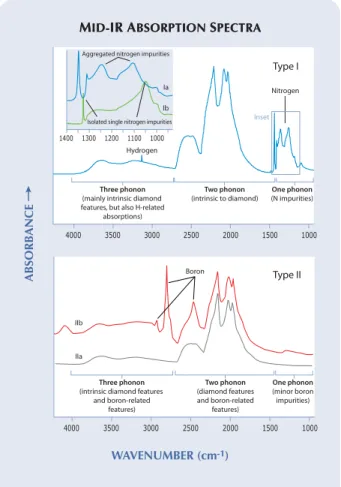
this range is divided into three zones—known as the one-, two-, and three-phonon regions—based on how the chemical bonds between carbon atoms (and any impurities) within the diamond lattice vibrate when exposed to IR energy (Zaitsev, 2001). Figure 6 shows these regions for both type I and type II diamonds.
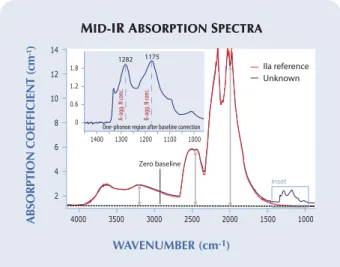
Figure 6. An FTIR absorption spectrum of diamond consists of one-, two-, and three-phonon regions where absorptions related to nitrogen and boron impurities can be identified to determine diamond type. Type I features (top) occur mostly in the one-phonon region, whereas type IIb boron-related absorptions occur more prominently in the two- and three-phonon regions (bottom). The expanded spec-trum of the one-phonon region (top, inset) illustrates the differences between aggregated (type Ia) and iso-lated (type Ib) N impurities.
The one-phonon region (~1332 to ~400 cm−1) is
where type I–related N impurities produce charac-teristic absorptions. Equally important is the fact that type II diamonds show few features in this region.
The two-phonon (2665 to ~1332 cm−1) and
three-phonon (~4000 to 2665 cm−1) regions contain
fea-tures that are intrinsic to diamond; that is, they occur in all diamond types. These features are caused by vibration of carbon-carbon bonds of the diamond lattice when exposed to infrared energy (e.g., Zaitsev, 2001, and references therein). These two regions are also the part of the IR spectrum where boron impurities can be detected most easily. While the features caused by boron impurities are usually weak in the one-phonon region, relatively sharp and stronger absorption peaks are present at ~2458 cm−1in the two-phonon region, and at ~2930
and ~2803 cm−1in the three-phonon region; these
result from electronic effects of boron on the dia-mond lattice. In some type I diadia-monds, other impu-rities that do not affect type determination (e.g., hydrogen) can also display features in the three-phonon region.
The one-phonon region for type I diamonds illus-trates the distinctive spectral features resulting from different configurations of N impurities in type Ia and Ib stones (see expanded area in figure 6 and figure 7, top). Figure 7 shows a series of FTIR spectra that reveal the progression of N impurities from isolated, single N (detected at 1344 and ~1130 cm−1) to
A-aggregated N (detected at ~1282 cm−1) to B-aggregated
N (detected at ~1175 cm−1). Variable concentrations
of A and B aggregates along with single substitutional N create a continuum of peak intensities in this region (an idea first proposed by Custers, 1952). It should be emphasized that the classification system is based on gradational transitions between types, so there are actually few “pure” examples of diamond type. Box B discusses several factors that commonly result in “mixed-type” IR spectra.
In addition to indicating the presence and arrangement of nitrogen and boron impurities that are used to determine type, FTIR analysis can pro-vide information about the concentration of the impurities. Both type I and type II diamonds may show a range of impurity concentrations, which often have important effects on their optical proper-ties. The intensity of an absorption peak in a dia-mond’s FTIR spectrum is related to two factors: the concentration of the impurity causing the peak, and the thickness of the diamond through which the beam of IR radiation passes. When the thickness (i.e., path length) can be directly measured, the intensity of the FTIR spectral peak can be calculat-ed to produce an “absorption coefficient,” which eliminates the thickness factor, leaving only the intensity related to the impurity concentration. The peak height can then be compared to the peak heights in diamonds of known concentration to cal-culate the amount of impurity present (see refer-ences below for calculation equations). However, the fact that most gem diamonds are faceted makes accurate measurement of the path length difficult, if not impossible (again, see box B).
Fortunately, it is widely accepted that the absorption coefficient of diamond in most parts of the two- and three-phonon regions is constant. At 2000 cm−1, for example, the absorption coefficient is
12.3 cm−1(Tang et al., 2005). Thus, IR absorbance at
Figure 7. Nitrogen and boron impurities in diamond occur in varying abundances. FTIR spectra not only can identify the impurities present, but they also can establish the configuration in which N atoms occur in the diamond lattice (isolated or aggregated; top). Several boron-related absorptions become visible with increasing concentration (bottom).
2000 cm−1is proportional to the thickness of the
sample, allowing any IR spectrum to be normalized to remove the effects of variation in thickness or path length (i.e., it does not matter how much the
light bounces around inside the diamond; figure 8). After normalization, the intrinsic two- and three-phonon region diamond peaks are removed by sub-tracting a pure type IIa spectrum from the unknown Most diamonds contain characteristic features of
more than one diamond type, and many factors con-tribute to the prevalence of mixed-type diamond spectra. The first factor is the process of nitrogen aggregation. When diamonds crystallize, all N impu-rities are thought to occur as single atoms in the lat-tice (Collins et al., 2005). As the diamonds reside at high temperatures and pressures at great depths in the earth for very long periods of time, the N atoms move around in the lattice and aggregate into groups. When two N atoms combine, an A-aggregate forms, and when two A-aggregates combine (with a vacancy between them), a B-aggregate forms. This tendency for nitrogen aggregation helps explain the rarity of type Ib versus type Ia natural diamonds.
This progression of N impurity aggregation goes nearly to completion for some natural diamonds (Collins et al., 2005), which results in almost “pure” type IaB, but in many cases multiple configurations of nitrogen impurities coexist in a single crystal due to incomplete aggregation (Hainschwang et al., 2006).
Another factor causing mixed-type spectra is that most type I diamonds contain zones with different amounts or configurations of nitrogen in the same crystal (e.g., Breeding, 2005; Chadwick, 2008). This fact, combined with the way in which IR spectra are collected from a faceted diamond, makes it nearly impossible to avoid mixed-type spectra. To obtain a spectrum, the technician must orient the diamond so that the IR beam can pass through it to a detector on the opposite side. Faceted diamonds force light to bounce around inside and not pass directly through, making the task of recording FTIR spectra difficult. Typically, diamonds are placed table-down on a spe-cially designed stage in the FTIR instrument (again, see figure 5) to allow the beam to pass through oppo-site sides of the girdle region, where minimum inter-nal reflection should occur. Absorption occurs across
the entire distance (or path length) through which the IR beam passes. Thus, if any variations in N impurities occur in a diamond along this path, they are automatically added together to produce a mixed-type IR spectrum.
The mixture of diamond types is not unique to natural diamonds. Most (HPHT) synthetic diamonds grow as type Ib. If they are subjected to high tempera-tures, either during or after laboratory growth, the N atoms tend to aggregate to produce type Ia synthetics with remnant concentrations of isolated N atoms. Similarly, if boron is introduced into the growth chamber (N is also present because it is difficult to exclude from the growth environment), a mixed-type diamond is formed. When visible color zones occur, such as in some mixed-type (Ib + IIa + IIb) synthetic diamonds such as that seen in figure B-1 (Shigley et al., 2004), distinguishing between zones of different type can be done on the basis of color. This is because different impurities produce different colors and are well known to be enriched in particular dia-mond growth sectors (Welbourn et al., 1996).
B
OX
B: W
HY
A
RE
M
IXED
-T
YPE
D
IAMONDS
C
OMMON
?
Figure B-1. This HPHT-grown synthetic diamond, seen immersed in water, shows growth zones with different diamond types. The yellow zone is type Ib, the colorless zones are type IIa, and the blue zones are type IIb. Only synthetic diamonds commonly show mixtures of nitrogen and boron impurities in the same crystal. Photo from Shigley et al. (2004); magnified 20×.
Type IIa Type IIb
diamond spectrum, leaving a baseline-referenced spectrum showing only those absorption peaks caused by impurities. These peak intensities can be measured and impurity concentrations calculated from them using equations derived from diamonds with known impurity concentrations (Kiflawi et al., 1994; Boyd et al., 1994, 1995). The end result is a measurement of the absolute concentration of impurities of various configurations in a diamond. Most of the nitrogen impurity concentrations reported in the literature are calculated in this way.
HOW CAN A GEMOLOGIST INFER DIAMOND TYPE?
Unlike scientists in universities and gemological laboratories, most gemologists do not have expen-sive analytical instruments available to them for everyday use. Fortunately, some common gemolog-ical tools can provide insights into the impurities present in a diamond and, correspondingly, its type.
Absorption Spectrum: Desk-model/Handheld Spectroscope. The spectroscope has long been used
to detect color treatments in diamond (Crowning-shield, 1957), but it also provides some information
about diamond type. It can be especially useful for identifying most type I diamonds. Type II (as well as some pure type IaA and Ib) diamonds rarely show absorption lines in the spectroscope. The presence of a 415 nm line (N3 defect; see box A) and its accompanying “cape” lines at 435, 452, 465, and 478 nm indicate that a diamond is type Ia (fig-ure 9A) because, in order for these lines to appear, the diamond must contain aggregated nitrogen impurities. For similar reasons, the presence of a line at ~503 nm (H3 defect; again, see box A) is also a good indication that a diamond is type I. Very strong general absorption up to ~450 nm may sug-gest the presence of abundant isolated, single N in type Ib diamonds, but plastic deformation in some other types of diamonds can produce a similar absorption pattern.
Inclusions and Strain Patterns: Gemological Microscope. While most diamonds contain crystals
that were trapped during growth, a few inclusions are considered characteristic of certain diamond types (see Crowningshield, 1994). Type Ib natural diamonds commonly contain clusters of small nee-dle-like inclusions that are usually associated with yellow color zoning and rarely occur in other dia-mond types (GIA staff observations; figure 9B). Fine-grained, patterned clouds that form cross-like shapes are common in type Ia diamonds that con-tain high concentrations of hydrogen impurities (known as “asteriated” diamonds; see Wang and Mayerson, 2002; Rondeau et al., 2004, and refer-ences therein). Synthetic type Ib diamonds often show distinctive color zoning or metallic flux inclu-sions under magnification (Shigley et al., 2004).
Strain-free diamond is optically isotropic, mean-ing that it appears dark in all directions between crossed polarizers. However, almost all natural dia-monds exhibit some degree of lattice distortion formed during crystallization or caused by post-growth plastic deformation. As a result, a variety of strain patterns and interference colors can be seen with crossed polarizers in a gemological micro-scope. One pattern of cross-hatched lines, known as “tatami” strain, is considered characteristic of type II natural and treated-color diamonds (Smith et al., 2000; figure 9C). The tatami pattern has also been observed in some pure type IaB and type Ib dia-monds with very low nitrogen concentration (Chalain, 2003; GIA staff observations). To our knowledge, this pattern has never been observed in synthetic diamonds of any type.
Figure 8. The concentration of N impurities in a dia-mond can be determined from the FTIR absorption spectrum. The concentration of each form of nitrogen is calculated from its absorption coefficient at a spe-cific wavelength. The spectrum of a “pure” type IIa diamond is subtracted to eliminate the absorption coefficients in the diamond-intrinsic region (i.e., those related only to carbon). When several forms of nitro-gen are present in the sample—here, A and B aggre-gates—a deconvolution of the bands is necessary because they overlap.
Electrical Conductivity: Conductometer/Ohm-meter. Another property that is easily tested is
electrical conductivity. In the 1960s, GIA produced a tool for this purpose called a gemological conduc-tometer. This device is no longer manufactured, but a sensitive ohm-meter can adequately deter-mine if a diamond is electrically conductive (ohm-meters measure resistivity, which inversely corre-lates with conductivity). Boron impurities in the diamond lattice cause both natural and synthetic type IIb diamonds to be electrically conductive (Collins, 1982; King et al., 1998). No other diamond type shows this property. Occasionally, type IIb diamonds will also emit flashes or sparks of blue light (known as electroluminescence; Gumlich et al., 1998) when tested with a conductometer in a dark room.
Short-wave UV Transparency: Various Commercial/ Custom-Made Testers. As mentioned earlier, type
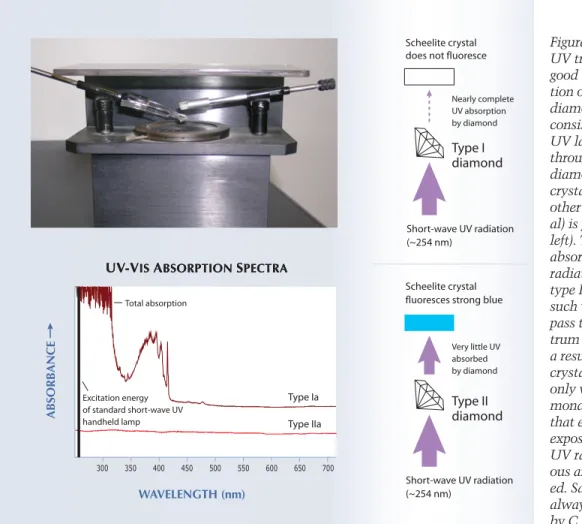
II diamonds were originally distinguished from type I using the property of short-wave UV trans-parency. A simple, easily constructed gemological testing device consists of a short-wave (~254 nm) UV lamp that emits light upward through an open-ing, above which a diamond can be positioned (fig-ure 10). A material with a strong fluorescence reac-tion to short-wave UV radiareac-tion, such as scheelite,
is placed above the diamond. If the diamond trans-mits short-wave UV radiation, the material will fluoresce. If the diamond absorbs short-wave UV radiation, it will not. This simple test is very effec-tive at separating type I and II diamonds, because N impurities strongly absorb light in the UV range of the spectrum (~225–320 nm in figure 10). Very rare type I diamonds with only B-aggregated N impurities (i.e., pure type IaB diamonds) also some-times transmit short-wave UV radiation (Chalain, 2003). Commercial diamond screening devices based on ultraviolet transparency are also available (Chalain et al., 2000).
UV-Visible Absorption/Luminescence: DiamondSure/ DiamondView. Although not inexpensive, two
gemological instruments that are useful for evaluat-ing diamond type are the DiamondSure and DiamondView. They were designed and built by the De Beers Diamond Trading Co. (DTC) for the pur-pose of separating natural from synthetic diamonds (see Welbourn et al., 1996, for detailed descriptions). When tested with the DiamondSure, colorless type II and type IaB diamonds will be reported as such and referred for more testing. All other diamonds are given a “Pass” response. The DiamondView pro-vides ultra short-wave UV fluorescence images of diamonds that may reveal distinctive growth sector
Figure 9. Several com-mon gemological tests can be used to infer dia-mond type in natural diamonds. (A) Type Ia diamonds often show only a 415 nm line with or without additional “cape” lines in a desk-model or handheld spec-troscope. (B) Type Ib dia-monds often contain characteristic arrays of needle-like inclusions (magnified 50×). (C) Natural type II diamonds almost always show a cross-hatched “tatami” strain pattern between crossed polarizers in a microscope (magnified 40×). Photomicrographs by Wuyi Wang.
arrangements characteristic of synthetic diamonds. Several natural diamond types also show character-istic fluorescence patterns in the DiamondView (GIA staff observations; figure 11). Type Ia dia-monds usually show blue fluorescence with irregu-lar natural growth patterns. Natural type Ib dia-monds often show an array of green luminescence lines on a background of orange fluorescence, whereas their synthetic counterparts often show greenish yellow and blue fluorescent growth zones in cross-like patterns (Shigley et al., 2004). Type IIa and IIb diamonds usually show a network of criss-crossing features that are thought to be due to dis-locations in the diamond lattice. In addition, type IIb diamonds nearly always show blue or red phos-phorescence in the DiamondView. Blue phospho-rescence alone should not be used as evidence for diamond origin, because boron impurities in type II HPHT-grown synthetic diamonds will also produce blue phosphorescence.
Indirect Visual Evidence: Color, Fluorescence, Rough Diamond Morphology. Color can provide a
hint about diamond type, but much experience is required to see the slight differences that might correlate with type. A representative range of col-ors for natural, treated-color, and synthetic dia-monds of all four types is shown in figure 3. “Canary” yellow and orange colors are very com-mon in type Ib diacom-monds, whereas lighter “straw” yellow-colored “cape” diamonds are usually type Ia. Very pale pink natural-color diamonds are often type IIa, whereas more saturated natural pink col-ors are often type Ia. Blue and gray diamonds are usually type IIb.
Fluorescence reactions observed using a hand-held gemological UV lamp can also provide a clue to diamond type. Many type Ia diamonds exhibit blue fluorescence due to nitrogen impurities. Type Ib diamonds often are inert or fluoresce weak orange to both long- and short-wave UV radiation (Hainschwang et al., 2006). Usually synthetic type Ib diamonds display uneven fluorescence patterns that help in their identification (see Shigley et al., 2004). Type IIb diamonds are often inert to long-wave UV and show weak blue fluorescence to
Figure 10. Short-wave UV transparency is a good test for the separa-tion of type II from type I diamonds. This tester consists of a short-wave UV lamp that passes through a slit into the diamond, above which a crystal of scheelite (or other fluorescent materi-al) is positioned (top left). Type I diamonds absorb short-wave UV radiation (~254 nm), but type II diamonds allow such wavelengths to pass through (see spec-trum at bottom left). As a result, the scheelite crystal fluoresces blue only when a type II dia-mond is tested. Note that eye and/or skin exposure to short-wave UV radiation is danger-ous and should be avoid-ed. Safety glasses should always be worn. Photo by C. M. Breeding.
short-wave UV, in addition to occasional blue or red phosphorescence (King et al., 1998). Unlike the DiamondView, gemological UV lamps emit lower-energy UV radiation and the phosphorescence of type IIb diamonds is not always visible.
A few aspects of rough diamond shape and sur-face texture are strongly indicative of type as well. For example, sorters have recognized that, unlike type I stones, type II diamond crystals typically occur in irregular or flattened shapes and do not exhibit crystallographic faces (Wilks and Wilks, 1991). Sunagawa (2001) suggested that this is due to the latter experiencing greater degrees of fractur-ing and breakage in their ascent to the earth’s sur-face during eruptions of kimberlitic or lamproitic magmas, whereas type I diamonds tend to retain their original crystal morphology during magma transport.
Multiple Tests are Optimal When Investigating Diamond Type. Each of the properties and
gemo-logical tools mentioned above provides some indi-cation of diamond type without the use of an FTIR spectrometer. They are most powerful, however, when used in combination. For example, type II diamonds can easily be distinguished from type I
on the basis of short-wave UV transparency and strain patterns. Types IIa and IIb can easily be sepa-rated on the basis of electrical conductivity. The largest group of natural diamonds, type I, is a bit harder to subdivide, but with practice it is still usu-ally possible. Type Ia diamonds commonly show 415 nm or “cape” lines in the spectroscope, where-as type Ib diamonds often show strong general absorption from <400 to ~450 nm. The presence of needle-like inclusions in type Ib diamond helps reinforce the diamond type evaluation. Table 1 pro-vides a summary of the technical and gemological information discussed in this article for representa-tive natural diamonds of each type. Shigley et al. (2004) provide an excellent reference chart for HPHT-grown synthetic diamonds, and Wang et al. (2007) gives information for CVD synthetics.
CONCLUSIONS
Recent advances in diamond growth and treatment have led to a greater dependence on sophisticated analytical instrumentation to distinguish natural from synthetic and natural-color from treated-color diamonds. However, we have shown that many of the standard tools used by gemologists in the trade
Figure 11. Natural dia-monds of each type show distinctive fluorescence colors and patterns when examined with the DTC DiamondView ultra-short-wave UV unit. Type Ia diamonds com-monly show blue fluores-cence with straight-to-wavy growth patterns (A), whereas type Ib dia-monds often fluoresce orange with green lines caused by the H3 defect (B). Both type IIa and IIb diamonds usually show blue-fluorescent web-like dislocation networks (C, D). Type IIb diamonds almost always show dis-tinctive phosphorescence (either blue or red) in the DiamondView (inset). Photos by C. M. Breeding and Andy Shen.
are effective for identifying characteristic combina-tions of diamond properties, which help infer dia-mond type and possibly identify treatments and synthetics.
For example, simple observations such as a cross-hatched strain pattern in a colorless diamond that is transparent to short-wave UV radiation indi-cate that the stone is likely type IIa and should be sent to a laboratory to be tested for HPHT treat-ment. Similarly, a blue diamond exhibiting electri-cal conductivity is type IIb and also needs lab test-ing. If the type IIb blue diamond shows no strain pattern when viewed with cross-polarized light and magnification, then it might be a synthetic. And a strongly colored yellow diamond that does not pro-duce “cape” lines in the spectroscope may be type Ib. If no color zoning characteristic of synthetic ori-gin is present and needles similar to those shown in figure 9B are observed, it is probably a natural type Ib diamond. These are just a few situations where gemological tests can provide clues to diamond type
and its possible implications for identification. Information about type helps gemologists assess the possibility that a diamond is treated or synthetic and, conversely, provides some measure of confidence that it is natural and naturally colored. With the con-stantly evolving world of treatments and synthetics, however, we strongly encourage gemologists to exer-cise caution and send their diamonds to a gemological laboratory for testing if there is any doubt.
TABLE 1.Characteristics of natural diamonds according to diamond type.
Type Impurity FTIR indicators Inclusions Helpful gemological clues
Ia Nitrogen Colorless, brown, Aggregated N Common; Inert, blue, Inert, blue, 415 nm or “cape” spectrum; (aggregated) yellow, pink, orange, (1282, 1175 cm−1) all sorts yellow, orange yellow, orange opaque to short-wave UV
green, violet
Ib Nitrogen Yellow, orange, Isolated single N Common; Inert to Inert to Strong general absorption (isolated) brown (1344, 1130 cm−1) clouds, weak orange weak orange up to 450 nm; distinctive
needles needle-like inclusions
IIa None Colorless, brown, No detectable Rare; Inert, blue, Inert, blue, Cross-hatched “tatami” pink, green impurities crystals or orange or orange strain pattern; transparent to
short-wave UV IIb Boron Blue, gray Boron (2803, Rare; Inert to Inert to weak Cross-hatched “tatami”
2458 cm−1) crystals weak blue blue or yellow strain pattern; transparent to short-wave UV;
electrically conductive; blue or red phosphorescence Most common
colors
UV fluorescence Long-wave Short-wave
ABOUT THE AUTHORS
Dr. Breeding is research scientist, and Dr. Shigley is dis-tinguished research fellow, at the GIA Laboratory in Carlsbad, California.
ACKNOWLEDGMENTS
The authors thank Dr. Wuyi Wang, Shane McClure, Dr. Andy Shen, Matt Hall, and Tom Moses of the GIA Laboratory for providing helpful suggestions in the revision of the manuscript.
REFERENCES
Anderson B.W. (1943a) Absorption and luminescence in diamond I. The Gemmologist, Vol. 12, No. 138, pp. 21–22.
——— (1943b) Absorption and luminescence in diamond II. The
Gemmologist, Vol. 12, No. 139, pp. 25–27.
——— (1943c) Absorption and luminescence in diamond III. The
Gemmologist, Vol. 12, No. 141, pp. 33–35.
——— (1960) Luminescence of a large pink diamond. Journal of
Gemmology, Vol. 7, No. 6, pp. 216–220.
——— (1961) Some notes on an important discovery: Nitrogen in diamond. The Gemmologist, Vol. 30, No. 225, pp. 21–22. ——— (1962) Lines and line systems in the fluorescence
spectra of diamonds. Journal of Gemmology, Vol. 8,
No. 5, pp. 193–202.
——— (1963) The classification of diamonds on the basis of their absorption and emission of light. Journal of Gemmology, Vol. 9, No. 2, pp. 44–54.
Boyd S.R., Kiflawi I., Woods G.S. (1994) The relationship between infrared absorption and the A defect concentration in diamond. Philosophical Magazine B, Vol. 69, No. 6, pp. 1149–1153.
——— (1995) Infrared absorption by the B nitrogen aggregation in diamond. Philosophical Magazine B, Vol. 72, No. 3, pp. 351–361.
Blackwell D.E., Sutherland G.B.B.M. (1949) The vibrational spec-trum of diamond. Journal de Chimie Physique et de
Physico-Chimie Biologique, Vol. 46, No. 1, pp. 9–15.
Breeding C.M. (2005) Lab Notes: Light blue diamond, with type IIb and IIa zones. G&G, Vol. 41, No. 2, pp. 167–168.
Chadwick K.M. (2008) Lab Notes: Fancy dark brown-yellow zoned type IIa/IIb diamond. G&G, Vol. 44, No. 4, pp. 364–365. Chalain J.-P. (2003) A type IaB diamond showing a “tatami”
strain pattern. G&G, Vol. 39, No. 1, pp. 59–60.
Chalain J.-P., Fritsch E., Hänni H.A. (2000) Identification of GE POL diamonds: A second step. Journal of Gemmology, Vol. 27, No. 2, pp. 73–78.
Chrenko R.M. (1973) Boron, the dominant acceptor in semicon-ducting diamond. Physical Review B, Vol. 7, No. 10, pp. 4560–4567.
Clark C.D., Mitchell E.W.J., Parsons B.J. (1979) Colour centres and optical properties. In J.E. Field, Ed., The Properties of
Diamond, Academic Press, London, pp. 23–77.
Collins A.T. (1980) Spectroscopic investigation of a canary yellow diamond. Journal of Gemmology, Vol. 17, No. 4, pp. 213–222. ——— (1982) Colour centres in diamond. Journal of Gemmology,
Vol. 18, No. 1, pp. 37–75.
——— (2001) The colour of diamond and how it may be changed.
Journal of Gemmology, Vol. 27, No. 6, pp. 341–359.
Collins A.T., Connor A., Ly C., Shareef A., Spear P.M. (2005) High-temperature annealing of optical centers in type-I dia-mond. Journal of Applied Physics, Vol. 97, No. 8, pp. 083517-1 to 083517-10.
Crowningshield G.R. (1957) Spectroscopic recognition of yellow bombarded diamonds and bibliography of diamond treatment.
G&G, Vol. 9, No. 4, pp. 99–104, 117.
Crowningshield G.R. (1994) Gem Trade Lab Notes: Charac-teristic inclusions in fancy-color diamonds. G&G, Vol. 30, No. 1, pp. 41–42.
Custers J.F.H. (1952) Unusual phosphorescence of a diamond.
Physica, Vol. 18, No. 8/9, pp. 489–493.
——— (1954) Letter to the Editor: Type IIb diamonds. Physica, Vol. 20, No. 4, pp. 183–184.
——— (1955) Semiconductivity of a type IIb diamond. Nature, Vol. 176, No. 4473, pp. 173–174.
Davies G. (1977) The optical properties of diamond. In P.L. Walker Jr. and P.A. Thrower, Eds., Chemistry and Physics of
Carbon, Vol. 13, Marcel Dekker Inc., New York, pp. 1–143. Dyer H.B., Raal F.A., Du Preez L., Loubser J.H.N. (1965) Optical
absorption features associated with paramagnetic nitrogen in diamond. Philosophical Magazine, Vol. 11, No. 8, pp. 763–774. Fisher D., Spits R.A. (2000) Spectroscopic evidence of GE POL HPHT-treated natural type IIa diamonds. G&G, Vol. 36, No. 1, pp. 42–49.
Fritsch E., Scarratt K. (1992) Natural-color nonconductive gray-to-blue diamonds. G&G, Vol. 28, No. 1, pp. 35–42.
Gumlich H.E., Zeinert A., Mauch R. (1998) Electroluminescence. In D.R. Vij, Ed., Luminescence of Solids, Plenum Press, New York, pp. 221–270.
Hainschwang T., Notari F., Fritsch E., Massi L. (2006) Natural, untreated diamonds showing the A, B and C infrared absorp-tions (“ABC diamonds”), and the H2 absorption. Diamond
and Related Materials, Vol. 15, No. 10, pp. 1555–1564. Kaiser W., Bond W.L. (1959) Nitrogen, a major impurity in
com-mon type I diacom-mond. Physical Review, Vol. 115, No. 4, pp. 857–863.
Kiflawi I., Mayer A.E., Spear P.M., Van Wyk J.A., Woods G.S. (1994) Infrared absorption by the single nitrogen and A defect centres in diamond. Philosophical Magazine B, Vol. 69, No. 6, pp. 1141–1147.
King J.M., Moses T.M., Shigley J.E., Welbourn C.M., Lawson S.C., Cooper M. (1998) Characterizing natural-color type IIb blue diamonds. G&G, Vol. 34, No. 4, pp. 246–268.
King J.M., Shigley J.E., Gelb T.H., Guhin S.S., Hall M., Wang W. (2005) Characterization and grading of natural-color yellow diamonds. G&G, Vol. 41, No. 2, pp. 88–115.
King J.M., Shigley J.E., Guhin S.S., Gelb T.H., Hall M. (2002) Characterization and grading of natural-color pink diamonds.
G&G, Vol. 38, No. 2, pp. 128–147.
Lightowlers E.C., Dean P.J. (1964) Measurement of nitrogen con-centrations in diamond by photon activation analysis and optical absorption. Diamond Research, pp. 21–25.
Mitchell E.W.J. (1964) Optical properties of diamond. Diamond
Research, pp. 13–16.
Nayar P.G.N. (1941a) Luminescence, absorption and scattering of light in diamonds: Part I. Fluorescence. Proceedings of the
Indian Academy of Science, Series A, Vol. 13, pp. 483–497. ——— (1941b) Luminescence, absorption and scattering of light
in diamonds: Part III. Absorption. Proceedings of the Indian
Academy of Science, Series A, Vol. 14, pp. 1–17.
Raman C.V. (1944) The nature and origin of the luminescence of diamond. Proceedings of the Indian Academy of Science, Series A, Vol. 19, pp. 199–215.
Robertson R., Fox J.J., Martin A.E. (1934) Two types of diamond.
Philosophical Transactions of the Royal Society A, Vol. 232, No. 1, pp. 463–535.
——— (1936) Further work on two types of diamond.
Proceedings of the Royal Society A, Vol. 157, No. 892, pp. 579–593.
Rondeau B., Fritsch E., Guiraud M., Chalain J-P., Notari F. (2004) Three historical “asteriated” hydrogen-rich diamonds: Growth history and sector-dependent impurity incorporation.
Diamond and Related Materials, Vol. 13, No. 9, pp.
1658–1673.
Shigley J.E., Breeding C.M., Shen A.H. (2004) An updated chart on the characteristics of HPHT-grown synthetic diamonds.
G&G, Vol. 40, No. 4, pp. 303–313.
Shigley J.E., Fritsch E., Stockton C.M., Koivula J.I., Fryer C.W., Kane R.E. (1986) The gemological properties of the Sumitomo gem-quality synthetic yellow diamonds. G&G, Vol. 22, No. 4, pp. 192–208.
Smith C.P., Bosshart G., Ponahlo J., Hammer V.M.F., Klapper H., Schmetzer K. (2000) GE POL diamonds: Before and after.
G&G, Vol. 36, No. 3, pp. 192–215.
Sutherland G.B.B.M., Willis H.A. (1945) Some new peculiarities in the infra-red spectrum of diamond. Transactions of the
Faraday Society, Vol. 41, No. 1, pp. 289–293.
Sutherland G.B.B.M., Blackwell D.E., Simeral W.G. (1954) The problem of two types of diamond. Nature, Vol. 174, No. 4437, pp. 901–904.
Sunagawa I. (2001) A discussion on the origin of irregular shapes of type II diamonds. Journal of Gemmology, Vol. 27, No. 7, pp. 417–425.
Tang C.J., Neves A.J., Carmo M.C. (2005) On the two-phonon absorption of CVD diamond films. Diamond and Related
Materials, Vol. 14, No. 11/12, pp. 1943–1949.
Wang W., Mayerson W. (2002) Symmetrical clouds in diamond: The hydrogen connection. Journal of Gemmology, Vol. 28, No. 3, pp. 143–152.
Wang W., Smith C.P., Hall M.S., Breeding C.M., Moses T.M. (2005) Treated-color pink-to-red diamonds from Lucent Diamonds Inc. G&G, Vol. 41, No. 1, pp. 6–19.
Wang W., Hall M.S., Moe K.S., Tower J., Moses T.M. (2007) Latest-generation CVD-grown synthetic diamonds from Apollo Diamond Inc. G&G, Vol. 43, No. 4, pp. 294–312. Welbourn C.M., Cooper M., Spear P.M. (1996) De Beers natural
versus synthetic diamond verification instruments. G&G, Vol. 32, No. 3, pp. 156–169.
Wentorf R.H. Jr., Bovenkirk H.P. (1962) Preparation of semicon-ducting diamond. Journal of Chemical Physics, Vol. 36, No. 8, pp. 1987–1990.
Wilks E., Wilks J. (1991) Properties and Applications of
Diamond. Butterworth-Heinemann Ltd., Oxford, UK. Zaitsev A.M. (2001) Optical Properties of Diamond: A Data