The moderating effect commitment to service quality
On the relationship between Attitudes and Organizational Performance:
Evidence from the Saudi Arabia
Yaser Salman Asharari1 andAlwan Saleh Alshmrani2
1Director of General Maiqua hospital, Al-Jawf, Ministry of Health Kingdom of Saudi Arabia
2
Deputy of General Director of nursing affairs, Director of Training & Continuous Education, Ministry of Health, Kingdom of Saudi Arabia
Abstract: The study aim to examine moderating effect of commitment to service quality on the relationship between attitudes and organizational performance in the staff of KSA public hospitals. The data were collected by cross sectional collection method from the staff of KSA public hospitals. The analysis and results were drawn by applying PLS-SEM techniques. The result of current study concluded that there is no direct relationship between attitudes and organizational performance. By applying moderating effect of commitment service quality, results proven that there is significant effect on the relationship between attitude and organizational performance. This findings of current study will help policy maker and strategist to give priority and importance towards commitment to service quality which enhancing the relationship between attitude and organizational performance of staff of public hospital in KSA. In the last, the study establish several limitations and recommendations for future avenue.
Keywords. Commitment to service quality, attitudes, organizational performance and communication.
Introduction
Past two decades have seen growing interest and focus towards service quality amongst business researcher’s world. The focus of research has been towards measurement of service quality (Bitner 1990, Bolton and Drew 1991a; Parasuraman et al., 1994). The prior studies highlighted issues related towards poor performance, low quality and trust of public hospitals, especially in the developing and emerging economies, comparing with private hospitals. A study (Young & Sullivan, 2005), conducted on government hospitals concluded that performance of the government hospitals is discouraging, which is ultimately influenced by factors of low performance and service quality. Additionally, these factors have drawn same results and pointed out that disappointing performance of hospitals with insufficient resources at the hospital (Farid, 2008). In comparison, other researchers declared possibility of low level performance despite limited resources. In Jamaica, a cross -sectional study argued that the process of services
is the key to provide high quality of health services. Another research on hospitals in Indonesia held defective processes to be accountable for the 60 percent deaths in hospitals, in comparison with only 37 percent in the government funded health centers (Supratiko et al., 2002).
In the context of Middle East, The Saudi government has been keen in accelerating efforts and resources towards reforming public hospitals in the Kingdom of Saudi Arabia (KSA), and it has achieved considerable success in its objectives (Alkhamis, 2011). The study conducted by Almalki, Fitzgerald & Clark (2011) validated the advancements made by the government of Saudi Arabia in the public health sector. However, the public hospitals in the country are still far from satisfactory state. Even though, the government has been spending a huge sum of GDP (around 5 percent) on health (Health Statistics Book, 2008) and has been investing tremendous resources in the health sector. The perception of common people in the country remains negative towards the public hospitals. They see public hospitals to be of below par and remain unsatisfied with their performance. As a result, Saudis tend to vis it hospitals abroad such as in the US, Europe, Egypt and Jordan, for KSA is known to be one of the wealthiest countries in the region (Algarousha, 2006). To date, the causes behind the unsatisfactory performance have not been fully explored. The unknown causes are due to lack of attention of researchers towards the poor performances of public health centres in KSA (Alharbi, 2014).
This study aims to establish relationship between a hypothesised factor, namely commitment to service quality, which is believed to contribute to the performance of the organizations and, the performance of public hospitals. The construct used has been validated by various researchers in the past as a positive influencer to attain effective performance of the organizations around the world especially the servicebased organizations (Santos -Vijande & Alvarez-Gonzalez, 2007).
Literature review
The Service quality is the perception or attitude one has towards the services offered. Generally, Service quality is found to be a predeces sor to customer satisfaction (Zeithaml & Bitner, 1996). It has also been defined as the competence of organizations to match or exceed customer expectations (Parasuraman et al., 1988). Customer’s expectations must not be associated with perceived service quality (Zeithaml et al., 1990). Perceived service quality originates from the judgement of expected quality customers form based on their experiences with various providers (Zeithaml et al., 1990). When the customer’s expectations are not matched by the provider, the perceived service quality is rated unsatisfactory, rendering customer dissatisfaction (Parasuraman et al., 1985; Lewis & Mitchell, 1990).
Moderating effect of commitment to service quality
It is a common practice in organizations to have a group of employees who regularly communicate and deal with customers. The same group of employees is held responsible for effective delivery of promised services to attain customer satisfaction (Parasuraman, Zeithaml, & Berry, 1985; Hartline, Wooldridge, & Jones, 2003). It has been established by various researchers (Hartline & Ferrell, 1996; Hartline, 2000; Maxham & McKee, 2000; Bowen & Schneider, 1985) that front line employees with high level of commitment to their jobs, are more customer-oriented; they deliver higher quality of services and exhibit low level of stress and which effects the performance of the organization.
Additionally, empirical evidences from the literature point out how significant is service quality in delivering outstanding services (Babakus, Yavas, Karatepe, & Avci, 2003; Hartline, Maxham, & McKee, 2000; Elmadag, Ellinger, & Franke, 2008; Clark & Hartline, 2009). However, the past studies related to commitment in fulfilling the promise of high quality services have only focused on the management aspects when measuring and analysing the service sector of businesses (Reeves & Hoy, 1993; Hartline & Ferell, 1996;; Babakus et al., 2003; Hartline et al., 2000; Malhorta & Mukherjee, 2004; Subramony,Beehr, & Johnson, 2004; Ashill, Carruthers, & Krisjanous, 2006; Little & Dean, 2006; Kim, Tavitiyaman, & Kim,2009). These studies have presented the management commitment to deliver service quality as the main influencer towards establishing positive
analysed that the insufficient attention towards employees’ customer service quality (CSQ), especially when major concern is non-stop enhancement in meeting customer expectations. Supporting and attaining high level of employees CSQ is a matter of great s ignificance towards organizations involved in service-based businesses (Asgari, 2014). Previously, it was determined that customer service employees lacked the initiative to make customers feel important (Irfan & Ijaz, 2011; Natasha & Sbroto, 2003). The studies suggested service organizations to pay attention to attitude of front line employees and customer relationship management (CRM) to raise commitment level of the employees and organization. Review of the literature shows that high degree of commitmen t balances employees in exerting energies to meet customer’s expectations. It is also learned from the literature that building the right attitude and employing CRM helps broadening employee’s vision to serve customers to CSQ and perfronce of organizations (Waldman, 1993; Jabnoun, 2002; Natasha & Subroto, 2003; Hartline et al., 2000; Clark et al., 2009; Hashim & Mahmood, 2012).
Hypothesis 1: Commitment to service quality moderates the relationship between organizational performance and attitude in the health sector of KSA.
Attitude and Organizational performance
Initial discussions to develop and measure attitudes were followed by contradictory evaluations regarding the degree of predictability attitude provides towards behavior (Wallace et al., 2005). However, recent studies could gather consensus over the positive relationship between attitude and behavior. These findings mean a person with a positive attitude towards a certain behavior, is very likely to perform that behavior. This leads to a simple conclusion that positive relationship between attitude and behavior will eventually influence the outcome or human actions. Since performance is also an action, attitude determines the probability of the action. In the context of public sector health centers in KSA, employees who have the right attitude towards their jobs will enhance the service quality of hospitals. Theory of Planned Behavior (TPB) also recommends it. Attitude is one of the main influencing factors to behavior as per the TPB. Thus, it leads to the argument that if employees in the public hospitals of KSA adopt sound belief in the significance of their jobs towards attaining higher service quality, their performance, in other words, actions will mostly likely to match their inner belief. Based on
this, the study puts this proposition of attitude to the second hypothesis.
Hypothesis 2: Attitude has a positive significant relationship with organizational performance in health sector of KSA
1.1 Theoretical framework Methodol ogy
This study used the quantitative research technique by floating a questionnaire to collect primary data from the respondents. In the recent studies on KSA, Balance Score Card (BSC) has been utilized. Bin Omira (2014) measured 31 items in KSA to examine the effect on organizational performance through various ministries in the country. Target population of the study are the public-sector hospitals of KSA. The attitude scale was developed in the light of Schneider’s (1998) study which consists of two sub factors: evaluative and affective. The scale was based on 8 items to quantify attitude of the managers towards healthcare quality in healthcare units. In order to measure the commitment towards quality of service, a revamped scale of CSQ (Clark et al., 2009) was utilized for the study. The construct had 9 items, which was originally developed by Mowday, Steers, and Porter (1979). As suggested by Sekaran (2003), the sample size of 154 is considered sufficient if the target population size is above 259. Based on this, the study collected data from 154 directors of public sector hospitals in KSA.
Results
4.1 Demographic Profile
As shown in the Table 5.5, from 151 respondents, the region of residence were as followed: (17.9 percent), Mecca (12.6 percent), Madina (7.3
percent), Eastern (12.6 percent), Qassim (7.3 percent), Hail (4 percent) Aljouf (4.6 percent), Northern (3.3 percent), Tabouk (6 percent), Aseer (9.9 percent) Jazan (7.3 percent), Najran (4 percent), and Baha (3.3 percent). Keeping in view the age groups of the respondents, respondents below the age of 30 years were 2 percent and between 36- 40 years 7.9%. Further, respondents whose aged is between 41 and 45 were 35.8 percent. Similarly, 46-50, 27.2 percent; 51-55, 16.6 percent and lastly 56-60 were 9.3 percent.
The percentage of the hospitals that were selected for the study were; maternity were 67.5 percent, pediatric, 9.3 percent; psychiatric, 9.3 percent; referral center, 7.3 percent, and specialized hospitals contributed 6.6 percent to the total sample size. The hospitals which were established between 1 and 5 years ago were 17.9 percent; between 6 and 10 years, 19.2 percent and 10 years and above were 62.9 percent. The experience of the administration of hospitals were as follows: 1-5 years, 28.5 percent; 6-10 years, 30.5 percent and above 10 years were 41.1 percent.
Measurement Model
To establish empirical validity of the model, the authors performed a two - step Structural Equations Modeling technique (SEM) (Anderson and Gerbing, 1988). As per the recommendation of these authors, first internal reliability of the constructs and second the discriminants validity of constructs was established, shown in the Table and Table 2.
Attitude Organizational
performance Commitment
1.1 Table of Factors Loadings, Validity and Reliability
Latent Variable
Items
Loadings
Average
Composite
Reliability
Organization Performance
0P11
0.5760
0.5785
0.9008
0P18
0.5517
0P19
0.5729
0P20
0.5740
0P21
0.6407
0P22
0.6702
0P23
0.6702
0P24
0.6759
0P25
0.6519
0P26
0.6719
0P27
0.6648
0P28
0.5739
0P29
0.5858
0P30
0.5477
Attitude
AT1
0.6949
0.5272
0.8981
AT2
0.7001
AT3
0.7827
AT4
0.8299
AT5
0.8299
AT6
0.6411
AT7
0.6921
AT8
0.6037
Commitment to Service Quality
CS1
0.7306
0.5607
0.8829
CS2
0.7800
CS3
0.6264
CS4
0.6548
CS5
0.6548
CS6
0.7709
CS7
0.7691
CS8
0.5742
CS9
0.4885
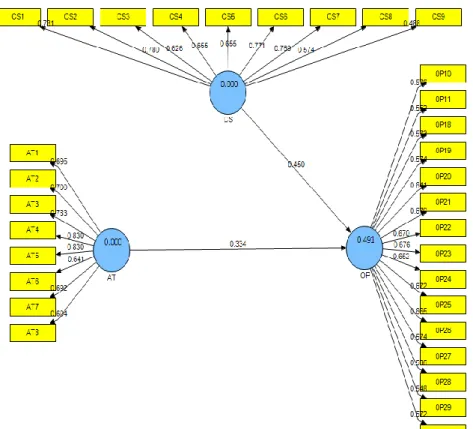
The value that determines the satisfactory cross loading and composite reliability has been recommended by researchers is ≤ 0.70. The average variable extract (AVE) is recommended to be ≤ 0.50 (Bagozzi et al., 1991). Moreover, to establish the recommended discriminate validity of construct, AVE between each construct and its measures should not be below the variance between the constructs and other constructs of the instrument (Fornell & Larcker, 1981). The validity and measurement values have been presented in the Table 1. The threshold of 0.50 was ascertained for AVE as recommended by the past researchers (Bagozzi et al., 1991; Chi, 1998).
Figure 1.1 Measurement Model
1.2 Results of Analysis Sample Mean (M) Standard Deviation (STDEV) P VALUE T Statistics (|O/STERR|) Decision AT -> OP 0.605633 0.607613 *0.403 0.047802 Not Supported AT * CS -> OP 0.877881 0.732992 *0.000 0.286228 Supported Structure Model
After satisfying the validity threshold of the constructs, the data was run for SEM. Table 3 shows the causal relationship between organizational performance and attitude. The direct relationship between the attitude and organizational performance were not significant (b=0.6053; 0.00). However, the moderating effect of CSQ between organizational performance and attitude loaded (b=0.0.8778; 0.00). It indicates a significant positive effect of commitment to service quality on the relationship of attitude and organizational performance. The value of R-Square appeared 0.481 = 48.1 percent, explained the variance of organizational performance explained by the independent variables.
Discussion
The study aimed to focus on how attitude of medical staff towards commitment to service quality played a key role in determining organizational performance of hospitals in KSA. Referring to Cognitive Dissonance Theory by Festinger’s (1975), influence of attitude and CRM to the commitment to service quality hav e been identified in healthcare centers in KSA. Healthcare centers that tend to operate as attitudinal, enjoy the maximum degree of commitment of employees to service quality (Clark et al., 2009; Hashim & Mahmood, 2011). The results of this study denotes significant moderating effect of service quality between CRM organization and attitude in KSA. These findings are consistent with the past studies (Hashim & Mahmood, 2011, 2012). These findings supported by the past studies results who claimed commitment of employees towards organizations performance and attitudes of employees (Odle-Dusseau, Hammer, Crain, & Bodner, 2016). This concluded that if management of the organization applying appropriate strategies and techniques to enhance commitment of employees towards employees to produce efficient and effective work.
In the same vein, this would effect on the quality of series being enjoyed by the customer stakeholders and it will ultimately affect the performance of the organization. Moreover, findings concluded that relationship between attitude of employees and organizational performance can be enhanced by the effective intervention of commitment to service quality by the employees and management (Xerri, Nelson, & Brunetto, 2014; Oh, Guay, Kim, Harold, Lee, Heo, & Shin, 2014).
Conclusion and Recommendati on
This study has been conducted to determine the underlying causes of lower performance level in public hospitals in KSA. The findings of the study helped to determine the positive significant influence of attitude over commitment to service quality of the hospital employees directly responsible to deliver medical services. These findings will be useful for owners, medical staff, managers and policymakers of healthcare centers. The findings highlight the significance of commitment to service quality and how it plays an important role in shaping the performance of healthcare providing organizations. This will help to inspire the medical staff to tap their potential, encourage them to collaborate and build and retain positive attitude to commitment to service quality. Moreover, the study contains some areas which may have some limitations. First, the sample was drawn only from the medical staff in KSA which makes it impossible to generalize the findings to other sectors and parts of the world. Second, data was collected in a short span of time. A longitudinal research may be undertaken to verify the findings. Third, the data has a fair chance of social desirability since the measurements are self-reported. Lastly, R Square value of this study explains 48.1% variance of organizational performance. Future studies may test other variables, such as laissez-fair, transactional leadership styles, role clarity and can find higher R Square values.
References
Bitner, M.J., Booms, B.H. and Tetreault, M.S. (1990), “The service encounter: diagnosing favorable and unfavorable incidents”, Journal of Marketing, Vol. 54, January, pp. 71-84.
Bolton, R. N. a. D., James H. (1991).A Multistage Model of Customers' Assessments of Service Quality and Value.Journal of Consumer Research., 17(4), 375-384.
Parasuraman A., Zeithaml, V.A. & Berry, l. l., (1991),"Refinement and Reassessment of the SERVQUAL Scale", Journal of Retailing, Vol. 67, No. 4, pp.420-450.
Farid, I. M. F. (2008). Development of a Model for Healthcare Service Quality: An Application to the Private Healthcare Sector in Egypt. DBA Dissertation, Maastricht School of Management.
Supratiko, G., M. E. Wirth, E. Achadi, S. Cohen, and C. Ronsmans.(2002). A District-Based Audit of the Causes and Circumstances of Maternal Death in South Kalimantan, Indonesia. Bulletin of the World Health Organization, 228-234
Almalki, M., Fitzgerald, G., & Clark, M. (2011). Health care system in Saudi Arabia: an overview. EMHJ , 17(10).
Alharbi, M. N. (2014). Identifying the Factors That Influence the Quality of Health Care Services in the Public Hospitals in Saudi Arabia. Unpublished Thesis, UUM, Malaysia
Santos-Vijande, M. L. and Álvarez-González, L. I. (2007). Innovativeness and organizational innovation in total quality oriented firms: The moderating role of market turbulence. Technovation, Vol 27, No. 9, pp.514-532
Zeithaml, V. and Bitner, M. (2003) Service Marketing: Integrating Customer Focus across the Firm, McGraw-Hill, New York
Hartline, M. D., Wooldridge, B. R., & Jones, K. C. (2003). Guest Perceptions of Hotel Quality Determining Which Employee Groups Count Most. Cornell Hospitality Quarterly, 44(1), 43-52.
Abdullah, M. T., & Shaw, J. (2007). A review of the experienc e of hospital autonomy in Pakistan.
TheInternational journal of health planning and management, 22(1), 45-62. http://dx.doi.org/10.1002/hpm.855
Afzal, U., & Yusuf, A. (2013). The State of Health in Pak istan: An Overview.Ahmed, I., & Parasuraman, A. (1994). Environmental and positional antecedents of management commitment toservice quality: A conceptual framework. In T. A. Swartz, D. E. Bowen, & S. W. Brown (Eds.), Advances inservices mark eting and management (Vol. 3, pp. 69-93).
Akbari, A. H., Rankaduwa, W., & Kiani, A. K. (2009). Demand for public health care in Pakistan. The Pak istanDevelopment Review, 141-153.
Ali A. (2009). The Role of Leadership in Human Resource Management a Comparative Study of Specific Public and Private Sectors in Pakistan. Journal of Management and Social Sciences, 5(2), 180-194. Anderson, J. C., & Gerbing, D. W. (1988). Structural equation modeling in practice: A review and
recommendedtwo-step approach. Psychological bulletin, 103(3), 411.
Antonakis, J., Avolio, B. J., & Sivasubramaniam, N. (2003). Context and leadership: An examination of thenine-factor full-range leadership theory using the Multifactor Leadership Questionnaire. The leadershipquarterly, 14(3), 261-295.
Asgari, M. R. (2014). The effect of leadership styles on emp loyees commitment to services quality in bank mellibranches of isfahan. Kuwait chapter of the Arabian journal of business and management review,
3(12), 113.
Ashill, N. J., Carruthers, J., & Krisjanous, J. (2006). The effect of management commitment to serv ice quality on frontline employees' affective and performance outcomes: An empirical investigation of New Zealandpublic healthcare sector. Int. j. Nonprofit volunt. sect. Mark . wiley interscience, 11, 271-287. Babakus, E., Yavas, U., Karatepe, O. M., & Avci, T. (2003). The effect of management commitment to service
quality on employees' affective and performance outcomes. Journal of the Academy of Mark eting Science,
31, 272-286. http://dx.doi.org/10.1002/nvsm.281
Bagozzi, R. P., Yi, Y., & Phillips, L. W. (1991). Assessing construct validity in organizational research.
Administrative science quarterly, 421-458.
Barling, J., Slater, F., & Kevin Kelloway, E. (2000). Transformational leadership and emotional intelligence: An exploratory study. Leadership & Organization Development Journal, 21(3), 157-161.
Barnett Kirn, Hi., Tavitiyaman, P., & Kim, W. G. (2009). The effect of management to service on employee service behaviors : The mediation effect of job satisfaction. Journal of Hospitality & Tourism Research, 33,369-390.
Barnett, K., McCormick, J., & Conners, R. (2001). Transformational leadership in schools: Panacea, placebo orproblem? Journal of Education Administration, 39, 24-46.
Bass, B. M. (1998). Transformational leadership: industry, military, and edu cational impact. NEW Jersey:Erlbaaum.
Boehnke, K., Bontis, N., DiStefano, J. J., & DiStefano, A. C. (2003). Transformational leadership: An examinantion of cross differences and similarities. Leadership & Organization Development Journal, 24,5-15.
Bowen, D. E., & Schneider, B. (1985). Boundarys panning role employees and the service encounter: Some guidelines for management and research. In J. A. Czepiel, M. R. Solomon, & F. Carol (Eds.) The serviceencounter: Managing employee/customer interaction i n service businesses (pp. 127-147). Lexington, MA:
Chaudhry, A. Q., & Husnain, J. (2012). Impact of transactional and laissez faire leadership style on motivation.
International Journal of Business and Social Science, 3(7), 258-264.
Chen, L. Y. (2004). Examining the effect of organization culture and leadership behaviours on organizational commitment, job satisfaction, and job performance at small and middle -sized firms of Taiwan. The Journalof American Academy of Business, Cambridge, 5, 232-438.
Chin, W. W. (1998). The partial least squares approach to structural equation modeling. Modern methods forbusiness research, 295(2), 295-336.
Clark, R. A., Hartline, M. D., & Jones, K. C. (2009). The effects of leadership style on hotel employees' commitment to service quality. Cornell Hospitality Quarterly, 1-23.
Elmadag, A. B., Effinger, A. E., & Franke, G. R. (2008). Antecedents and consequences of frontline service employee commitment to service quality. Journal of Mark eting Theory and Practice, 16, 95-110. Emery, C. R., & Barker, K. J. (2007). The effect of transactional and transformational leadership styles on the
organisational commitment and job satisfaction on customer contact personnel. Journal of OrganisationalCulture, Communication and Conflict, 11, 77-90.
Erkutlu, H. (2006). The impact of transformational leadership on organisational and leadership effectiveness.
Journal of Management Development, 27, 708-726.
Festinger, L. (1957). A Theory of Cognitive Dissonance. Stanford, CA: University of Stanford Press.
Fornell, C., & Larcker, D. F. (1981). Structural equation models with unobservable variables and measurementerror: Algebra and statistics. Journal of mark eting research, 382-388. Gefen, D., Straub, D., & Boudreau, M. C. (2000). Structural equation modeling and regression: Guidelines forresearch practice. Communications of the association for information systems, 4(1), 7.
Hair, J. F., Black, W. C., Babin, B. J., & Anderson, R. E. (2010). Multivariate data analysis (7th ed.). Prenticehall, Upper Saddle River, New Jersey.
Hartline, M. D., Wooldridge, B. R., & Jones, K. C. (2003). Guest Perceptions of Hotel Quality Determining Which Employee Groups Count Most. Cornell Hospitality Quarterly, 44(1), 43-52
Hartline, M. D., Maxham III, G., & McKee, D. O. (2000). Corridors of influence in the dissemination of customer-oriented strategy to customer contact service employees. Journal of Mark eting, 64, 35-50. Hartline, M. D., & Ferrell, O. C. (1996). The management of customer-contact service employees: An empirical
investigation. Journal of Mark eting, 60, 52-70.
Hashim, R. A., & Mahmood, R. (2012). How do our Malaysian academic staff perceive their leader’s
leadershipwww.ccsenet.org/ass Asian Social Science Vol. 11, No. 26; 2015 189styles in relation to their commitment to service quality?
Hashim, R. A., & Mahmood, R. (2011). Transformational Leadership Style and Academic Staffs’ Commitment
toService Quality at Malaysian Universities.
Hulland, J. (1999). Use of partial least squares (PLS) in strategic manageme nt research: A review of four recentstudies. Strategic management journal, 20(2), 195-204.
Irfan, S. M., & Ijaz, A. (2011). Comparison of service quality between private and public hospitals: Empiricalevidences from Pakistan. Journal of Quality and Technology Management, 7(1), 1-22. Jabnoun, N. (2002). Leadership styles for quality assurance and TQM. In Proceedings of the 7th international
Conference on ISO 9000 and TQM (pp. 588-593). RMIT University.
Khan, A. A., Shaikh, S., Ahmed, Z., Zafar, M., Anjum, M. U., Tahir, A., & Shaikh, F. (2014). Quality of postgraduate medical training in public and private tertiary care hospitals of Karachi. Journal of PostgraduateMedical Institute (Peshawar-Pak istan), 28(1), 245-273.
Khan, A. H., Ahmad, I., Aleem, M., & Hamed , W. (2011). Impact of Job Satisfaction on Employee Performance:An Empirical Study of Autonomous Medical Institutions of Pakistan. International
Khowaja, K. (2009). Healthcare systems and care delivery in Pakistan. Journal of Nursing Administration, 39(6),263-265.
Krejcie, R. V., & Morgan, D. W. (1970). Determining sample size for research activities. Educational and psychological measurement, 30(3), 607-610.
Liao, H., & Chuang, A. (2007). Transforming - service employees and climate: A multilevel, multisourceexamination of transformational leadership in building long -term service relationship.
Journal of Applied Psychology, 92, 1006-1019.
Little, M. M., & Dean, A. M. (2006). Links between service climate, employee commitment and employees' service quality capability. Managing Service Quality, 16, 460-476.
Malhorta., & Mukherjee. (2004). The relative influence of organizational commitment and job satisfaction onservice quality of customer contact employees in banking call centers. Journal of Services Mark eting, 18,162-174. http://dx.doi.org/10.1108/08876040410536477
Malik, A. K., Chaudhry, A., Karamat, A., Arif, N., Cheema, M. A., & Rauf, A. (2010). Cigarette smoking andhealth care professionals at Mayo Hospital, Lahore, Pakistan. J Pak Med Assoc, 60(6), 509-512. McGuire, E., & Kennerly, S. M. (2006). Nurse managers as transformational and transactional leaders. Nursing
Economics, 24, 179-185.
Meyer, J. P., & Allen, C. A. (1991). A three component conceptualization of organizational commitment. Human Resources Management Review, 1, 61.
Mowday, R., Steers, R., & Porter, L. (1979). The measurement of organisational commitment. Journal of Vocational Behaviour, 14, 224-227.
Mukhtar, H., Saeed, A., & Ata, G. (2013). Measuring service quality in Public Sector using SERVQUAL: A caseof Punjab Dental Hospital, Lahore. Research on Humanities and Social Sciences, 3(22), 65-70. Narimawati, U. S. E. (2007). The influence of work satis faction, organizational commitment and
turnoverintention towards the performance of lecturers at West Java private higher institution institution. Journal ofApplied Sciences Research, 3, 549-557.
Natasha, D., & Subroto, B. (2003). Effects of management commitment on service quality to increase customersatisfaction of domestic airlines in Indonesia. Singapore Management Review, 25, 85-102. Nguni, S., Sleegers, P., & Denessen, E. (2006). Transformational and transactional leadership effects on
teachers'job satisfaction, organizational commitment, and organizational citizenship behaviour in primary schools: The Tanzanian case. School Effectiveness and School Improvement, 17, 145-177. Nisa, M., Sadaf, R., & Zahid, M. (2012). Patient satisfaction survey in an obstetric and action survey in an
obstetrics and gynecology ward of a tertiary care hospital and of a tertiary care hospital and of a tertiary care hospital.
Odle-Dusseau, H. N., Hammer, L. B., Crain, T. L., & Bodner, T. E. (2016). The influence of family -supportive supervisor training on employee job performance and attitudes: An organizational work–family intervention. Journal of occupational health psychology, 21(3), 296.
Oh, I. S., Guay, R. P., Kim, K., Harold, C. M., Lee, J. H., Heo, C. G., & Shin, K. H. (2014). Fit happens globally: A meta‐analytic comparison of the relationships of person –environment fit dimensions with work attitudes and performance across East Asia, Europe, and North America. Personnel Psychology,
67(1), 99-152
Parasuraman, A., Zeithaml, V. A., & Berry, L. L. (1985). A Conceptual Model of Service Quality and itsImplications for Future Research. Journal of Mark eting, 49, 41- 50. http://dx.doi.org/10.2307/1251430
Peccei, R., & Rosenthal, P. (1997). The antecedents of employee commitme nt to customer service: Evidencefrom a UK service context. The International Journal of Human Resource Management, 8, 66.
Rabbani, F., Jafri, S. M. W., Abbas, F., Jahan, F., Syed, N. A., Pappas, G., & Tomson, G. (2009). Culture andquality care perceptions in a Pakistani hospital. International Journal of Health Care Quality Assurance,22(5), 498-513.
Rabbani, F., Lalji, S. N., Abbas, F., Jafri, S. W., Razzak, J. A., Nabi, N., & Tomson, G. (2011). Understanding thecontext of balanced scorecard implementation : a hospital-based case study in Pakistan. Implement Sci, 6(31),1-14
Rayton, B. A. (2006). Examining the interconnection of job satisfaction and organizational commitment: Anapplication of the bivariate probit model. The International Journal of Human Reso urce Management, 17(1),139-154.
Razzak, J. A., Ahmed, A., Saleem, A. F., & Nasrullah, M. (2009). Perceived need for emergency medicine training in Pakistan: a survey of medical education leadership. Emergency Medicine Australasia, 21(2),143-146.
Reeves, C., & Hoy, F. (1993). Employee perceptions of management commitment and customer evaluations of quality service in independent firms. Journal of Small Business Management, 31(4), 52.
Riaz, Q., Ayaz, K., Wain, A. M., & Sajid, M. (2012). Impact of HR Practices on Perceived Performance of Hospital Employees in Pakistan. Journal of Economics and Sustainable Development, 3(11), 10-15. Ringle, C. M., Wende, S., & Will, S. (2005). Smartpls 2.0 beta. University of hamburger. Hamburger, Germany. Saeed, R., Ghafoor, M. O., Srwar, b., Lodhi, N., Arshad, H. M., & Ahmad, M. (2013). Factor affecting custome
satisfication in health care services Pak istan, 3(5), 947-952.
Saeed, A., & Ibrahim, H. (2005). Reasons for the Problems faced by Patients in Government Hospitals: res ults ofa survey in a government hospital in Karachi, Pakistan. Journal of Pak istan Medical Association, 55(45).
Singh, J. (2000). Performance productivity and quality of frontline employees in service organisations.
Journalof Mark eting, 64(2), 15‐34.
Subramony, M., Beehr, T. A., & Johnson, C. M. (2004). Employee and customer perceptions of service quality inan Indian firm. International Association for Applied Psychology, 53, 311-327.
Ullah, S. (2012). Behavioral Troubles for the Newcomer Doctors in the Public Sector Hospitals of Pakistan.Asian Journal of Health, 2(1). http://dx.doi.org/10.7828/ajoh.v2i1.115
Worsfold, P. (1999). HRM, performance, commitment and service quality in the hotel industry. International Journal of Contemporary Hospitality Management, 11, 340-348.
Xerri, M. J., Nelson, S., & Brunetto, Y. (2014). Importance of workplace relationships and attitudes toward organizational change in engineering asset-management organizations. Journal of Management in Engineering, 31(5), 04014074.
Zaidi, S., Mayhew, S. H., Cleland, J., & Green, A. T. (2012). Context matters in NGO–government contractingfor health service delivery: a case study from Pakistan. Health policy and planning, czr08.