EPFL Technical Report 167782
Formal Analysis of Secure Neighbor Discovery in
Wireless Networks
Marcin Poturalski, Panos Papadimitratos, and Jean-Pierre Hubaux
Abstract—We develop a formal framework for the analysis of security protocols in wireless networks. The framework captures characteristics necessary to reason about neighbor discovery protocols, such as the neighbor relation, device location, and message propagation time. We use this framework to establish general results about the possibility of neighbor discovery. In particular, we show that time-based protocols cannot in general provide secure neighbor discovery. Given this insight, we also use the framework to prove the security of four concrete neighbor discovery protocols, including two novel time-and-location based protocols. We mechanize the model and some proofs in the theorem prover Isabelle.
Index Terms—neighbor discovery, relay attack, formal verification, distance bounding
F
1
Introduction
W
ireless communications are flexible: a device with a wireless interface can start communicat-ing with another device, an access point, or a base station, almost instantly, without setting up a ca-ble connection. As a consequence, wireless connections are frequently established, making discovering devices available for direct communication an indispensable element of wireless networks. However, due to the open nature of wireless communication, neighbor discovery (ND) is easy to abuse: An adversary can convince a device into falsely believing that another device is its neighbor. The adversary can then use these false neighbor links to disrupt the applications and services that use ND as a building block.The canonical example of such an attack comes from routing in wireless ad hoc networks, such as sensor networks, or multi-hop smart phone networks [1]. An adversary can abuse ND by mounting a relay attack
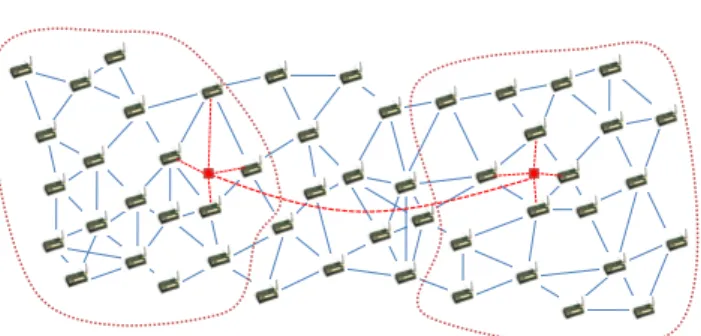
(also known as awormhole attack [15], [21]): Equipped with two devices connected by a fast out-of-band link, the adversary relays (without modification) any mes-sage overheard by one device to the other side of the wormhole (Fig. 1). This can create shortcuts across the network the routing protocols are attracted to, with a significant portion of the traffic routed through the wormhole. The adversary can then eavesdrop, modify, or simply suddenly start dropping messages, causing a denial-of-service.
Securing ND is clearly of utter importance. It has therefore attracted considerable attention from the re-search community and a number of secure ND protocols • M. Poturalski and J.-P. Hubaux are with EPFL, Lausanne,
Switzerland.
• P.Papadimitratos is with KTH, Stockholm, Sweden.
Fig. 1. Wormhole attack in a wireless sensor network: The adversary relays packets between two adversarial devices (squares), creating false neighbor links. As a result, traffic between the left and the right parts of the network (circled) traverses the wormhole (thick dashed curve).
have been proposed. However, in the vast majority of cases, such protocols have been only argued secure in an informal manner. History provides many examples of flaws in security protocols that can be overlooked by such arguments. It is hence only natural to strive for the strong security guarantees offered by formal methods. This is the main goal of this paper: formal analysis of secure neighbor discovery.
To this end, we develop a formal framework modeling wireless communications. Our framework captures wire-less communication aspects necessary to reason about ND protocols, notably the neighbor relation, the de-vice location, and the message propagation time. Such aspects were abstracted away by “traditional” formal approaches designed for verification of security protocol in Internet-like environments.
Our framework allows us to obtain two types of results. First, under what assumptions a given class of protocols can or cannot provide secure ND? In
particular, we prove that a general class of time-based protocols cannot provide ND if the adversary can relay messages with a delay below a threshold determined by the desired communication range of the ND protocol. Second, which concrete protocols can be proven secure? With our framework, we prove the security of four such protocols, two time-based ones and two in a different general class oftime-and-location-based protocols. Such proofs greatly increase the confidence in the protocols and they serve as secure ND possibility results for the respective classes of protocols. Finally, we mechanize our framework and a number of protocol security proofs in the theorem prover Isabelle [19]. This provides an additional level of assurance.
Paper Outline.In Sec. 2 we define the framework and the ND specification. In Sec. 3 we sketch the time-based protocol impossibility. In Sec. 4, we define the protocols a refined ND specification, and present the security analysis results. We also give an overview of the Isabelle/HOL mechanization. We discuss the assumptions and compare the protocols in Sec. 5. In Sec. 6 we discuss the related work and open problems, before concluding in Sec. 7.
2
System Model
The basic wireless network entities,nodes, are processes running on computational platforms equipped with transceivers communicating over a wireless channel. We assume that nodes have synchronized clocks (although not all protocols we consider in this paper make use of this assumption) and are static (not mobile). Nodes either follow the implemented system functionality, in which case we denote them ascorrect orhonest, or they are under the control of an adversary, in which case we denote them as adversarial nodes. Adversarial nodes can behave in an arbitrary fashion, also acting as correct nodes or lying dormant for any period of time.
To capture the inherent characteristics of ND in wire-less networks, we model communication at the physical layer rather than at higher layers (data link, network, or application). For simplicity, correct nodes are assumed to use a single wireless channel, but we do not require them to have equal transmission power and receiver sensitivity. Adversarial nodes can communicate across the wireless channel used by correct nodes, but they can also communicate across a dedicated adversarial channel imperceptible to correct nodes.
Our system model comprises: (i) a setting S that describes the type (correct or adversarial) of nodes, their location and the state of the wireless channel; (ii) aprotocol model Pthat determines the behavior of cor-rect nodes; (iii) anadversary model Athat establishes the capabilities of adversarial nodes.
We assume that looking at the system at any point in time reveals one or more phenomena. We are interested in those relevant to the wireless communication and the system at hand and thus to our analysis. We de-note these phenomena, associated with nodes, asevents
(Def. 3). Then, we model the system evolution over time using the notion oftrace, i.e., a set of events (Def. 4), in particular feasible traces that satisfy constraints specified byS(correspondence between wireless sending and receiving of messages),P (correct nodes follow the protocol), andA(adversarial nodes behave according to their capabilities). The constraints are defined by logical formulas we callrules.
The model presented in the rest of this section is used in Sec. 3 for the impossibility result. To reason about the security of concrete protocols, we extend the model in Sec. 4. In Sec. 5.1 we explain and justify all simplifying modeling assumptions, made to keep the model tractable.
2.1 System Parameters
The technologies used by correct and adversarial nodes determine our model parameters:
• v∈R>0, thesignal propagation speed, defining how fast messages propagate across the wireless chan-nel, determined by the communication technology,
• vadv ≥v, the information propagation speed over theadversarial channel; asvadv≥vthis is also the maximum speed at which information can propa-gate,
• ∆relay∈R, theminimum relaying delayintroduced
by a node when relaying a message; this delay is due to processing exclusively, it does not include propagation time or any other delay.
• M, the message space; we keep the message space unspecified for the impossibility result in Sec. 3; we provide a concrete message space when we talk about specific protocols in Sec. 4.
• |.|:M→R>0, themessage duration function. Further,Vdenotes the set of uniquenode identifiers, which for simplicity we will consider equivalent with the nodes themselves.1
2.2 Settings
A setting describes the type and location of nodes, and how the state of the wireless channel changes over time.
Definition 1. A setting S is a tuple
hV,loc,type,link,nlosi, where:
• V ⊂ V is a finite set of nodes. An ordered pair
(A, B)∈V2 is called a link.
• loc:V →R3 is the nodelocation function. As we
assume nodes are not mobile, this function does not depend on time. We definedist :V2→
R≥0 as
dist(A, B) =d(loc(A),loc(B)), where dis the Eu-clidean distance inR3. We require thelocfunction
to be injective, so that no two nodes share the same location. Thus,dist(A, B)>0 forA6=B.
1. Although this implies that every node is assigned a single identifier, it does not prevent an adversarial node from using (in the messages in sends) any identifier.
S1 ∀A∈V, t∈R≥0, m∈M. Receive(A;t;m)∈θ =⇒ ∃B∈V. link(B→A,[t, t+|m|]) ∧(Bcast(B;t−(dist(A, B) +nlos(A, B))v−1;m)∈θ)
S2 ∀A, B∈V, t∈R≥0, m∈M. Bcast(B;t−(dist(A, B) +nlos(A, B))v−1;m)∈θ ∧link(B→A,[t, t+|m|])) =⇒ Receive(A;t;m)∈θ
S3 ∀A∈V, t∈R≥0, m∈M. (Receive(A;t;m)∈θ ∨ Bcast(A;t;m)∈θ =⇒ A∈V)
P1 ∀A∈Vcor, t∈R≥0, m∈M. Bcast(A;t;m)∈θ =⇒ Bcast(m)∈ P(θ||A,t)
P2 ∀A∈Vcor, t, t0∈R≥0, B, C ∈V. Neighbor(A;t;B, C, t0)∈θ =⇒ Neighbor(B, C, t0)∈ P(θ||A,t)
P3 ∀A∈Vcor. ∀t∈EA. ∈ P(θ||A,t) whereEA=R≥0\start(θ|A∩I)
andI={Bcast(t;m)|m∈M, t∈R≥0} ∪ {Neighbor(t;B, C, t0)|B, C ∈V, t, t0∈R≥0}
A1 ∀A∈Vadv, t∈R≥0, m∈M. Bcast(A;t;m)∈θ =⇒
∃B∈Vadv, δ≥∆relay+dist(B, A)vadv−1. Receive(B;t−δ;m)∈θ
Fig. 2. Setting-feasibility rules, protocol-feasibility rules for protocol modelPand adversary-feasibility rule for adversary modelA∆relay.
• type : V → {correct,adversarial} is the type
function; it defines which nodes are correct and which are adversarial. This function does not de-pend on time, as we assume that the adversary does not corrupt new nodes during the system execution. We denoteVcor=type−1({correct}) and Vadv=type−1({adversarial}).
• link : V2×R≥0 → {up,down} is the link state function. Accordingly, we say that at a given time t ≥ 0, a link (A, B) ∈ V2 is up (denoted
link(A→B, t)) or down (denoted link(A9B, t)). We use abbreviations link(A↔B, t) =def
link(A→B, t) ∧ link(B→A, t) and
link(A=B, t) =deflink(A9B, t) ∧ link(B9A, t).
We extend the “link(A→B, t)” notation from single time points to sets as follows:
link(A→B, T) =def ∀t ∈ T. link(A→B, t). We establish the convention link(A9A,R≥0).
• nlos : V2 → R≥0 is the non-line-of-sight delay
(NLOS)function. If two nodes AandB can com-municate over a line of sight, thennlos(A, B) = 0. Otherwise,nlos(A, B) specifies the additional dis-tance that the signal has to propagate compared to line-of-sight propagationdist(A, B). We assume this function is symmetric, because of reciprocity of wireless links.
We denote the set of all settings byS.
We model the ability to communicate directly, with-out the intervention or ’assistance’ of relays, by a link being up, thus the following definition:
Definition 2. Node A is a neighbor of node B in setting S at time t, if link(A→B, t). If link(A↔B, t), nodesA andB are neighbors at timet.
For simplicity in presentation, we use “link(A→B, t)” to denote the neighbor relation and the link relation.
2.3 Events and Traces
Events relate to the wireless communication and the ND protocol operation. Each event is primarily associated
with (essentially, takes place at) a node we call the
active node.
Definition 3. Anevent is one of the following terms:
• Receive(A;t;m) • Bcast(A;t;m) • Neighbor(A;t;B, C, t0) • Fresh(A;t;n) • NDstart(A;t) • NDstart(A;t;B)
where A ∈ V is the active node, t ∈ R≥0 is the event
start time, denoted by start(.), and m ∈ M is the
transmitted/received message, n ∈ Nonces is a nonce,
B, C∈Vare nodes, andt0∈R≥0 is a time instant. The first two events are related to communication on the physical layer:Receiverepresents message reception, andBcastrepresents message transmission.
Neighborcan be thought of as an internal outcome of a ND protocol (possibly reported to some higher layer): NodeA declares that B is a neighbor of C at time t0. Having t0 a single point in time is for simplicity only, and we could easily generalize to arbitrary sets.
Fresh is used to declare that nonce n is (freshly) generated by A at time t or, in other words, that it was not sent before t. With NDstart, node A declares that an instance of a ND protocol has been initialized: either with a specific nodeB or with all neighbors.
We use the notion oftrace to model an execution of the system.
Definition 4. A trace θ is a set of events.
We denote the set of all traces by Θ. Given a setting
S, a protocolP and an adversaryA, we denote the set of traces feasible with respect to S by ΘS, the set of
those feasible with respect to S and P by ΘS,P, and
with respect toS,P andA by ΘS,P,A.
2.4 Setting-Feasible Traces
The feasibility of a trace θ with respect to a setting
S =hV,loc,type,link,nlosi ensures a causal and strict time relation between send and receive events; it is for-mally defined by rulesS1– S3(Fig. 2). RuleS1 ensures that every message that is received was previously sent.
θ|A,t={Bcast(t1;m)|t1< t ∧ Bcast(A;t1;m)∈θ} ∪
{Receive(t1;m) |t1+|m|< t ∧ Receive(A;t1;m)∈θ} ∪
{Neighbor(t1;B, C, t0)|t1< t ∧ Neighbor(A;t1;B, C, t0)∈θ}
Fig. 3. Local trace (Def. 6).
ND1 ∀S ∈S, θ∈ΘS,P,A. ∀A, B, C ∈Vcor, t, t0 ∈R≥0. Neighbor(A;t;B, C, t0)∈θ =⇒
(C=A ∧ link(B→A, t0)) ∨ (B =A ∧ link(A→C, t0+ (dist(A, C) +nlos(A, C))v−1))
ND2 ∀d∈(0,R]. ∀A, B∈V, A6=B. ∃S ∈S. V =Vcor={A, B} ∧ dist(A, B) =d
∧ link(A↔B,R≥0) ∧ ∃θ∈ΘS,P,A. Neighbor(A;t;B, A, t0)∈θ Fig. 4. Basic ND properties.
Dually, rule S2 ensures that a transmitted message is received by all nodes enabled to do so by the link rela-tion. In other words, communication is causal (a receive is always preceded by a sent), and reliable as long as the link is up. Unreliability, expected and common in wireless communications, is modeled by the state of the link beingdown. Furthermore, these rules introduce a strict time relation between events, reflecting the propagation delay from A to B, across the channel, with speedv: (dist(A, B)+nlos(A, B))v−1. RuleS3is a technical one: It ensures that no communication events are performed by nodes not present in settingS.
2.5 Protocol-Feasible Traces
Intuitively, a trace is feasible with respect to protocol
P if correct nodes behave according to a particular protocolP. To formalize this, we first define the notion of a local view.
A trace is essentially a global view of the system execution. To describe what a node observes during a system execution, we use the notion of local view, primarily comprising a local trace composed of local events. We define these next. For simplicity, we ignore theNDstart and Fresh events, as they are of no conse-quence for the impossibility result.
Definition 5. Alocal event is one of the terms:
• Bcast(t;m)
• Receive(t;m)
• Neighbor(t;B, C, t0)
where B, C ∈V, m∈M,t, t0 ∈R≥0. For a local event e,start(e) is defined as in Def. 3.
Definition 6. A local trace is a set of local events. Given a node identifier A ∈ V, time t ≥ 0 and trace
θ ∈ Θ, we calculate the local trace of node A at time t in trace θ, denoted θ|A,t as shown in Fig. 3. We call θ|A,∞ a complete local trace of A in θ and denote it
shortly θ|A.
We identify two variants of the local view notion: a
T-local view, as the basis for defining the class of time-based protocols, and aTL-local view, used to define the class of time- and location-based protocols.
Definition 7. Given a traceθ, aT-local view of nodeA at timet inθis a tuplehA, t, θ|A,ti; we denote itθ||A,t.
Definition 8. Given a trace θ and a setting S, a
TL-local view of node A at time t in θ is a tuple
hA, t,loc(A), θ|A,ti; we denote itθ||S,A,t, orθ||A,tas the settingS is clear from the context.
Note thatSis part of Def. 8 as the location of nodeA
is defined only within a specific setting. With the notion of the local view in hand, we can proceed with the definition of a protocol model. This definition captures the property of protocols essential to our investigation: the fact that protocol behavior dependsexclusively on the local view of the node executing the protocol.
Definition 9. A T(TL)-protocol model P is a func-tion which given a T(TL)-local viewθ||A,t, determines a finite, non-empty set of actions; an action is one of the terms: , Bcast(m) or Neighbor(B, C, t0), where
m∈M, B, C∈V, t0 ∈R≥0.
The interpretation ofBcast and Neighbor actions is natural. The action means that the node does not execute an event, with the exception of possibleReceive
event(s). Note that modeling the protocol output (i.e., the protocol model co-domain) as a family of sets of actions allows for non-deterministic protocols.
The feasibility of a traceθwith respect to a protocol model P ensures that all correct nodes follow the protocol; it is formally defined by rulesP1–P3(Fig. 2). Rules P1 and P2 ensure that the Bcast and Neighbor
actions taken by a node are allowed by the protocol. RuleP3, withEAthe set of all time instances inθwhen no event other thanReceivehappens at nodeA, ensures that the protocol allows for a node perform no action.
Note that our definition of a protocol model only requires that the behavior of the protocol is determined by the local view. This is much broader than a possible alternative approach, in which a protocol is modeled by a Turing machine. But as our definition is an over-approximation, the impossibility result remains valid for more realistic protocol models.
2.6 Adversary-Feasible Traces
For the purpose of the impossibility result, we consider first a relatively limited adversary, that is only capable of relaying messages. Note that a weak adversary model strengthens the impossibility result. We denote this model as A∆relay, with the ∆relay > 0 parameter the
minimum relaying delay introduced by an adversarial node; this delay is due to processing exclusively, and it does not include propagation or transmission time.
Formally, the feasibility of trace θ with respect to
A∆relay is defined by rule A1 in Fig. 2: Every message
sent by an adversarial node is necessarily a replay of a messagemthat either this or another adversarial node received. In addition, the delay between receivingmand re-sending it, or more precisely the difference between the start times of the corresponding events, needs to be at least ∆relay, plus the propagation delay across the adversary channel (in case another adversarial node received the relayed message). This condition reflects the structure of the adversarial channel: Any two ad-versarial nodes can establish direct communication.
2.7 ND Specification
We consider two types of properties that ND protocols should satisfy. The first one pertains to correctness, expressed through propertyND1(Fig. 4): If two correct nodes2 are declared neighbors at some time, then they must indeed be neighbors at that time. More precisely, there are two cases: (i) Node A can declare thatB is its neighbor (i.e., A can receive messages from B) or (ii)Acan declare that it is a neighbor ofC(i.e.,Ccan receive messages from A). In the latter case, property
ND1requires link (C, A) to be up at not exactly timet0, but rather (dist(A, C) +nlos(A, C))v−1 (propagation delay) after t0. As our model mandates that the link state is determined at the receiving end (node), if A
declares that it is a neighbor ofCat timet0, a message sent byAattwould be indeed received byC. In other words,Ais not forced to estimate the propagation delay to make a correct neighbor statement.
The second type of property pertains toavailability, expressed through propertyND2(Fig. 4), tailored to T-protocols. An additional notion needs to be introduced to formulate satisfiable availability properties:neighbor discovery (ND) range,R∈R>0. Typically,Ris equal to the nominal communication range for a given wireless medium and transceiver technology. However, we use
R more freely as the communication range3 for which ND inferences are drawn. In other words, nodes at a communication range larger thanRwill not be required to declare each other neighbors.
Property ND2 requires that for every distance d in the desired ND rangeR, there should be at least some setting in which the protocol is able to conclude that a node is a neighbor (in some, not all executions); 2. The requirement thatB and C be correct is explained in Sec. 5.
A
B
A
B
D
C
(a)Sa (c) Sb
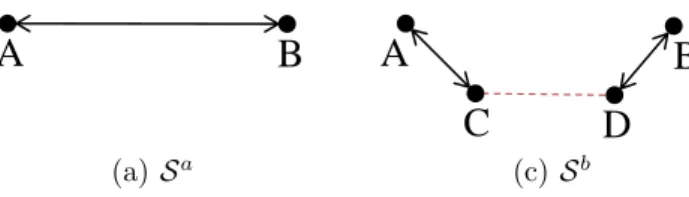
Fig. 5. Settings used in the impossibility result proof. Settings Sa = h{A, B},loca,typea,linka,nlosa
i and
Sb = h{A, B, C},locb,typeb,linkb,nlosb
i. In both set-tings, nodes A and B are correct, nodes C and D are adversarial. The location functions are such thatdistb(A, C) +distb(D, B) +vvadv−1distb(C, D) +
v∆relay ≤dista(A, B). The state of links does not change
over time and is shown in the figure (lack of arrow means that the link is down). For all links and settings,nlos= 0. The dashed arrow in (b) denotes the adversarial channel.
this setting should contain exactly two nodes, both
correct and at distance d, being neighbors. The “two-nodes setting” requirement clarifies why we call this
two-partyND. TheND2property is the least that can be required from a usable two-party ND protocol: Indeed, a protocol not satisfying this property would be unable to conclude, for some distance(s) in the ND range, that nodes are neighbors. This makes the impossibility result in Sec. 3 more meaningful: impossibility with respect to a weak property implies impossibility for any stronger property.
3
Impossibility for T-protocols
We show in this section that no time-based protocol can solve the two-party neighbor discovery problem as specified by propertiesND1and ND2in Fig. 4. We base the proof on the fact that it is impossible for a correct node to distinguish between different settings based on a T-local view. This is captured by Lemma 1 below Our impossibility result, Theorem 1 below, stems from showing two settings that are indistinguishable by a correct node, one with two nodes being neighbors and one where they are not (Fig. 5). We elaborate on the assumptions and implications of this result in Sec. 5.
We emphasize that the non-restricted form of the message space M encompasses all possible messages
including, for example, time-stamps and any type of cryptography, thus contributing to the generality of the impossibility result.
Lemma 1. Let P be a T-protocol model, S and S0
be settings such that Vcor = Vcor0 , and θ ∈ ΘS,P and
θ0 ∈ ΘS0 be traces such that local traces θ|A = θ0|A for all A∈Vcor. Then θ0 is feasible with respect to T-protocol modelP.
Proof:We need to prove thatP1,P2, andP3(Fig. 2) hold forθ0.
3. By “communication range” we understand the actual dis-tance plus NLOS effects.
P1 Take any event Bcast(A;t;m) ∈ θ0. Based on Def. 6, we have that Bcast(t;m) ∈ θ0|A = θ|A. Using Def. 6 again, we get thatBcast(A;t;m)∈θ. Sinceθis feasible with respect to T-protocol model
P, P1 gives us Bcast(m) ∈ P(θ|A,t). Using again the assumption θ0|A = θ|A we get the desired
Bcast(m)∈ P(θ0|A,t).
P2 The proof is almost identical as forP1.
P3 As θ satisfies P3, we have ∀t ∈EA. ∈ P(θ|A,t). Since θ0|A = θ|A, we have EA0 = EA and
P(θ0|A,t) =P(θ|A,t), which proves that θ0 satisfies
P3.
Theorem 1. If ∆relay ≤ Rv then there exists no T-protocol model which satisfiesND1 andND2(Fig. 4) for the adversary model A∆relay.
Proof:To prove that under the assumptions of the theorem no T-protocol model can satisfy bothND1 and
ND2, we show that any T-protocol model that satisfies
ND2 cannot satisfyND1.
Take any T-protocol model P satisfying ND2. Pick some distance d≥ v∆relay in the ND range (d≤ R). PropertyND2guarantees the existence of a setting such as the one shown in Fig. 5(a) (we denote it Sa) and the existence of a trace θ ∈ ΘSa,P,A
∆relay such that
Neighbor(A;t;B, t0) ∈ θ. As θ is feasible with respect to settingSa, this trace has to be of the form shown in Fig. 6.
In setting Sb, shown in Fig. 5(b), we have
link(B=A,R≥0). Consider the trace θ0 (Fig. 6), which is is essentially the same as θ, but for nodes C and D
relaying all the communication between nodes A and
B. It is simple to check that this trace is feasible with respect to settingSb. It is also feasible with respect to T-protocol model P: This follows from Lemma 1, as
θ|A,t = θ0|A,t and θ|B,t = θ0|B,t. Finally, θ0 is feasible with respect to the adversary model A∆relay, because
δ2−δ1=δ4−δ3≥∆relay+dist(C, D)v−adv1. Thereforeθ
0
belongs to ΘSb,P,A
∆relay and together withS
b forms the counterexample that we were looking for:AconcludesB
is a neighbor whereas it is not. Thus, T-protocol model
P does not satisfy ND1. As P was chosen arbitrarily, this concludes the proof.
4
ND Protocols
We consider here four types of ND protocols, with one representative protocol per type. We distinguish be-tween (i) beacon-based protocols (B-protocols), repre-sented byPB/TandPB/TL, which require the
transmis-sion of one message by one of the protocol participants and synchronized clocks, and (ii) challenge-response protocols (CR-protocols), represented by PCR/T and
PCR/TL, which require a transmission of messages by
both participants but no synchronized clocks. Within and across these categories, we distinguish protocols
according to their capability to perform time measure-ments (T-protocols) or time measuremeasure-ments and location awareness (TL-protocols).
Fundamentally, beyond authentication mechanisms, all the ND protocols we consider measure the signal time-of-flight (ToF) between two nodes: B-protocols, with tightly synchronized clocks, are able to estimate ToF by transmitting a single beacon message, whereas CR-protocols require two messages, a challenge and a response, for the same purpose. T-protocols accept neighbor relations as valid if the ToF distance is below a threshold, whereas TL-protocols require this distance to be equal to the geographical distance calculated based on nodes locations.
4.1 Message Space
We define next the message space M (unlike the
un-specified one for the impossibility result). Any of the following is a message:
• an identifierA∈V, • a timestampt∈R≥0,
• a locationl∈R3, • a noncen∈Nonces.
Moreover, two messagesm1, m2 can beconcatenated to form a messagehm1, m2i. Furthermore, an
asymmet-ric authenticator authA(m) and asymmetric
authenti-cator authAB(m) where A, B∈Vandm∈M, are also
messages.4 For symmetric authenticators we assume that authAB(m) = authBA(m). Essentially, messages are terms, with the subterm relation is denoted byv.
Every messagem has a duration |m| ∈ R≥0, which determines the transmission delay (not including the propagation delay), reflecting the bit-rate of the un-derlying communication technology. We assume that message duration is preserved by concatenation, but not by an authenticator. Form=hm1, m2, . . . , mki, the duration is|m|=|m1|+|m2|+. . .+|mk|and theposition ofmi in mispos(mivm) =|m1|+. . .+|mi−1|, with
pos(m1 vm) = 0; in the case of multiple occurrences of m0 v m, pos(m0 v m) gives the position of the first occurrence. When we use the duration function for any concatenated message, we omit the brackets:
|m1, m2, . . . , mk|. Finally, we assume that the duration of identifiers, timestamps, locations, nonces and authen-ticators inMis upper-bounded by some constant.
Notation:Assuming that m1vm2, we use:
Bcast(A;t;m1vm2) to denote the event:
Bcast(A;t−pos(m1vm2);m2) Likewise forReceive.
4. Examples of asymmetric authenticators, digital signatures; of symmetric authenticators, message authentication codes (MACs).
θ=Bcast(A;ti;mi) |i∈IA ∪ Receive(B;ti+ ∆;mi)| i∈IA ∪ Bcast(B;ti;mi)| i∈IB ∪ Receive(A;ti+ ∆;mi)|i∈IB ∪ Neighbor(A;ti;A, B, t0i)|i∈J A A ∪ Neighbor(A;ti;B, A, t0i)|i∈J B A ∪ Neighbor(B;ti;A, B, t0i)|i∈J A B ∪ Neighbor(B;ti;B, A, t0i)|i∈J B B θ0= Bcast(A;ti;mi) |i∈IA ∪ Receive(C;ti+δ1;mi)|i∈IA ∪ Bcast(D;ti+δ2;mi)|i∈IA ∪ Receive(B;ti+ ∆;mi)| i∈IA ∪ Bcast(B;ti;mi)| i∈IB ∪ Receive(D;ti+δ3;mi)| i∈IB ∪ Bcast(C;ti+δ4;mi)|i∈IB ∪ Receive(A;ti+ ∆;B, mi)|i∈IB ∪ Neighbor(A;ti;A, B, t0i)|i∈J A A ∪ Neighbor(A;ti;B, A, t0i)|i∈J B A ∪ Neighbor(B;ti;A, B, t0i)|i∈J A B ∪ Neighbor(B;ti;B, A, t0i)|i∈J B B
Fig. 6. Traces used in the proof of Theorem 1; ∆ = dista(A, B)v−1, t
i, t0i ∈ R≥0 and IA, IB, JAA, JAB, JBA, JBB
are pairwise disjoint index sets with JB
A 6= ∅ (all the other index sets can be empty); δ1 = distb(A, C)v−1, δ2 = ∆−distb(D, B)v−1,δ
3=distb(B, D)v−1δ4= ∆−distb(C, A)v−1
F1 ∀A, B∈Vcor, t1, t2∈R≥0, n∈Nonces, m1∈M. nvm1 ∧ Fresh(A;t1;n)∈θ
∧Bcast(B;t2;nvm1)∈θ =⇒ (A=B ∧ t2≥t1) ∨ (A6=B ∧ ∃δ≥∆relay, m2∈M.
nvm2 ∧ Receive(B;t2−δ;nvm2)∈θ)
A1 ∀A∈Vcor, B∈Vadv, t1, t2∈R≥0, n∈Nonces, m1∈M. nvm1 ∧ Fresh(A;t1;n)∈θ
∧Bcast(B;t2;nvm1)∈θ =⇒ ∃C∈Vadv, δ≥∆relay+dist(C, B)vadv−1, m2∈M. nvm2
∧Receive(C;t2−δ;nvm2)∈θ
A2 ∀A∈Vadv, B∈V, t∈R≥0, m, m0, m1∈M. m=authB(m0)vm1
∧Bcast(A;t;mvm1)∈θ =⇒ (B∈Vadv)
∨(∃C∈Vadv, δ≥∆relay+dist(C, A)v−adv1, m2∈M. mvm2 ∧ Receive(C;t−δ;mvm2)∈θ)
A3 ∀A∈Vadv, B, C∈V, t∈R≥0, m, m0, m1∈M. m=authBC(m0)vm1
∧Bcast(A;t;mvm1)∈θ =⇒ (B∈Vadv) ∨ (C∈Vadv)
∨(∃D∈Vadv, δ≥∆relay+dist(D, A)v−adv1, m2∈M. mvm2 ∧ Receive(D;t−δ;mvm2)∈θ)
Fig. 7. Adversary- and common protocol-feasibility rules. ND2B/T ∀S ∈
S, θ∈ΘS,P,A. ∀A, B∈Vcor, t∈R≥0. NDstart(A;t)∈θ ∧ link(A→B,[t, t+TP])
∧dist(A, B) +nlos(A, B)≤R =⇒ ∃t0 ∈[t,∞), t00∈[t, t+TP]. Neighbor(B;t0;A, B, t00)∈θ ND2B/TL ∀S ∈
S, θ∈ΘS,P,A. ∀A, B∈Vcor, t∈R≥0. NDstart(A;t;B)∈θ ∧ link(A→B,[t, t+TP])
∧nlos(A, B) = 0 =⇒ ∃t0 ∈[t,∞), t00∈[t, t+TP]. Neighbor(B;t0;A, B, t00)∈θ ND2CR/T ∀S ∈
S, θ∈ΘS,P,A. ∀A, B∈Vcor, t∈R≥0. NDstart(A;t;B)∈θ ∧ link(A↔B,[t, t+TP])
∧dist(A, B) +nlos(A, B)≤R =⇒
∃t1, t2∈[t,∞), t0, t00∈[t, t+TP]. Neighbor(A;t1;A, B, t0)∈θ ∧ Neighbor(A;t2;B, A, t00)∈θ
ND2CR/TL ∀S ∈
S, θ∈ΘS,P,A. ∀A, B∈Vcor, t∈R≥0. NDstart(A;t;B)∈θ ∧ link(A↔B,[t, t+TP])
∧nlos(A, B) = 0 =⇒ ∃t1, t2∈[t,∞), t0, t00∈[t, t+TP]. Neighbor(A;t1;A, B, t0)∈θ
∧Neighbor(A;t2;B, A, t00)∈θ
Fig. 8. ND availability properties.
4.2 Protocol-Feasible Traces
In Sec. 2.5 we have defined feasibility rules for arbitrary protocols. However, for reasoning about specific proto-cols, it is more convenient to define protocols with rules, rather than specifying a protocol model function and applying the general rules in Fig. 2.
The rules that specify this type of feasibility are protocol-dependent and are defined in Sec. 4.5. How-ever, there is one general rule that dictates the behavior of correct nodes with respect to nonces. RuleF1(Fig. 7) guarantees that if a nonce n is freshly generated at
time t then (i) the node that generated n will not broadcast it before t, and (ii) any other correct node who broadcasts a message containing nonce n must have received it (possibly in a different message) at least ∆relay before broadcasting; this time difference is measured with respect to the positions of the nonce in the respective messages.
4.3 Adversary-Feasible Traces
To reason about the security of specific protocols, we consider an adversary model, AP
1: onNDstart(A;t1)
2: Bcast(A;t1;hA, t1,authA(t1)i) 3: onReceive(B;t2;hA, t1,authA(t1)i) 4: if t2−t1≤Rv−1
5: Neighbor(B;t2+|A, t1,authA(t1)|;A, B, t2)
Fig. 9. Pseudo-code for protocolPB/T.
that defined in Sec. 2.6. Intuitively, adversarial nodes are allowed to send arbitrary messages, except for mes-sages which would violate properties of authenticators or freshness; these have to be relayed with the relaying delay at least ∆relay.
A traceθis feasible with respect toAP
∆relay if rulesA1
- A3 (Fig. 7) are satisfied. Rules A2 and A3 deal with authenticators: An adversarial node is allowed to send a message containing arbitrary authenticators, as long as these authenticators can be generated by itself or another adversarial node. This implies that adversarial nodes can share cryptographic keys or any material used for authentication. Furthermore, rules A2 and A3
reflect that the adversary cannot forge authenticated messages: Any message sent by an adversarial node that contains a correct node authenticator must be relayed. In other words, some (possibly the same) adversarial node must have received a message containing this authenticator earlier, at least ∆relay plus the propaga-tion delay between the two nodes over the adversarial channel. This condition reflects the structure of the adversarial channel: Any two adversarial nodes can establish direct communication. RuleA1is similar toA2, but it is responsible for freshness: An adversary sending a message with a nonce generated by a correct node can only be relaying the message (nonce). In this sense ruleA1is an adversarial equivalent of rule F1.
4.4 ND Specification
To reason about the security of specific protocols, we use the correctness propertyND1as introduced in Fig. 4, but we provide strongerprotocol-type specific availabil-ity properties. Informally, we require that if nodes are neighbors for a long enough protocol-specific time TP,
the protocol must declare them neighbors.
Fig. 8 displaysND2properties for all types of protocols we consider. These properties differ in four aspects, one depending on whether the protocol is T or TL, whereas the other three aspects depending on the protocol is beacon or challenge-response. The first aspect is the
NDstartevent: For CR-protocols, a particular neighbor
B with which ND is started is specified, whereas no such specification is necessary for B-protocols. Second, it may be required that link (A, B) be up only in one di-rection (B-protocols) or both didi-rections (CR-protocols). Third, for T-protocols, an upper-bound on propagation distance in enforced (dist(A, B) +nlos(A, B) ≤ R), whereas for TL-protocols line-of-sight propagation is required (nlos(A, B) = 0). Forth, different forms of
neighbor declaration are possible. The node making the declaration might be the same as (CR-protocols) or dif-ferent (B-protocols) from the one initiating the ND pro-tocol. Moreover the declaration might be uni-directional (B-protocols) or bi-directional (CR-protocols).
4.5 Protocol Definitions
The protocols are formally defined by rules as the ones in Fig. 10. To make the presentation more approach-able, we first present the protocols informally in the form of pseudo-code, and then we describe how the rules model the behavior of the protocol. The pseudo-code is divided intoblocks, each starting with atriggeringevent (onclause). Upon a triggering event, the block body is executed, i.e., other events take place.
We start with a simple B/T-protocol we denotePB/T,
which is essentially the temporal packet leash proto-col proposed by Hu, Perrig and Johnson in [15]. The pseudo-code is shown in Fig. 9, the rules defining the protocol are presented in Fig. 10. Block 1-2 describes the behavior after the ND protocol is started at node
A (e.g., by a higher layer protocol); P1 and P2 are the two rules that correspond to this block. Block 3-5 describes the behavior of a node after it receives a beacon message, and it is modeled by rulesP3 and P4. Rule P1 is straightforward: if ensures that if the trig-gering event of block 1-2,NDstart(A;t1), occurs in the trace, the event in the body of the block also occurs. In the same fashion, ruleP3is defined for block 3-5, with an additional condition coming from theif clause.
These two rules are already sufficient to prove the
ND2property, but they only define half of aspects of the protocol functionality. Indeed, nothing prevents a node running this protocol from making arbitrary neighbor declarations. Rule P4 addresses this, stating that if a node makes a neighbor declaration, this has to be done according to block 3-5, i.e., the node had to receive a “fresh enough” beacon message. Only one aspect re-mains: Correct nodes are still allowed to broadcast arbi-trary messages, including bogus beacon messages. This is addressed by ruleP2. To motivate the definition of P2, let us consider an alternative rule would still be coherent with the pseudo-code: If a correct node broadcasts a message at time t1, this message is hA, t1,authA(t1)i. We can prove that such a protocol satisfies the ND specification. However, this would be a weak result, precisely because that rule states that correct nodes cannot send any other messages than beacons. If the ND protocol were used along with or by any other protocol, obviously using other forms of messages, the result would no longer apply. To circumvent this undesired composability restriction, ruleP2only requires that if a correct node broadcasts att1 a messagem of a
partic-ular form, i.e., containingauthB(t) as a subterm, then m=hA, t1,authA(t1)i. Hence, ruleP2gives a much less restrictive condition on protocols that can be securely composed with PB/T: basically, it mandates that any
P1 ∀A∈Vcor, t1∈R≥0. NDstart(A;t1)∈θ =⇒ Bcast(A;t1;hA, t1,authA(t1)i)∈θ
P2 ∀A∈Vcor, B∈V, t1, t∈R≥0, m∈M. authB(t)vm ∧ Bcast(A;t1;m)∈θ =⇒ m=hA, t1,authA(t1)i
P3 ∀B∈Vcor, A∈V, t1, t2∈R≥0. Receive(B;t2;hA, t1,authA(t1)i)∈θ ∧ t2−t1≤Rv−1 =⇒ Neighbor(B;t2+|A, t1,authA(t1)|;A, B, t2)∈θ
P4 ∀B∈Vcor, A, C∈V, t2, t∈R≥0. Neighbor(B;t;A, C, t2)∈θ =⇒ C=B
∧ ∃t1∈R≥0. Receive(B;t2;hA, t1,authA(t1)i)∈θ ∧ t2−t1≤Rv−1
∧t=t2+|A, t1,authA(t1)|
Fig. 10. Rules defining protocolPB/T.
01: onNDstart(A;t1;B) 02: Fresh(A;t1+|B|;n1) 03: Bcast(A;t1;hB, n1i) 04: onReceive(B;t;hB, n1i) 05: Fresh(B;t+ ∆;n2) 06: Bcast(B;t+ ∆;hn2i) 07: let τ >∆
08: Bcast(B;t+τ;hloc(B),authB(n1, n2,loc(B))i) 09: onReceive(A;t;hl,authB(n1, n2, l)i) 10: if occurred Fresh(A;t1+|B|;n1) 11: if occurred Bcast(A;t1;hB, n1i) 12: if occurred Receive(A;t2;hn2i) 13: if v(t2−t1−∆) = 2d(loc(A), l) 14: Neighbor(A;t+|l,authB(n1, n2, l)|;A, B, t1) 15: Neighbor(A;t+|l,authB(n1, n2, l)|;B, A, t2)
Fig. 11. Pseudo-code for protocolPCR/TL.
other protocol does not use authenticated timestamps of this form.5RuleP4, in terms of composability, implies that the node cannot run any other ND protocol (i.e., a protocol making neighbor declarations), but we do not see this as a real restriction.
Next, we describe PCR/TL, a CR/TL-protocol
(pseudo-code Fig. 11, rules Fig. 12). This protocol has a practical design twist: As authentication of a message can be a time-consuming process, in this protocol we remove it from the time-critical ToF estimation phase. Otherwise, if the response needs too much time to be calculated, the clock of the challenging node can drift beyond an acceptable accuracy level. A protocol parameter ∆∈R≥0 determines exactly how long after the challenge reception a node replies.
We assume that a node keeps track of all the events it observes, and it can always refer to this ’history,’ as in 10-12. There is no explicit block responsible for receiving the hn2i response sent by B in 06; node A does not take any action other than recording the event occurrence, for later reference in line 11.
Considering again that “triggering event implies block body events,” rule P1 is defined for block 01-03, P2 for block 04-08, and P4 for block 09-15. We do not define rules that restrict the occurrence of Fresh events (in 5. If this would pose a problem, the protocol can be modified, e.g., by authenticating a timestamp concatenated with some constant rather than just a timestamp.
Correctness Availability
T-protocols
B-based ∆relay>Rv dist(A, B)≤R
CR-based ∆relay>2Rv dist(A, B)≤R
TL-protocols
B-based ∆relay>0,v=vadv nlos(A, B) = 0 CR-based ∆relay>0,v=vadv nlos(A, B) = 0
TABLE 1
Summary of assumptions for different ND protocol classes in Theorem 2.
lines 02 and 05) or the form of broadcasted messages (in lines 03 and 06), so that there is no obstacle for composability. For line 08, ruleP3 is defined: If a node broadcasts a message m containing an authenticator of the form authB(n1, n2, l), then m is precisely the message defined in line 08, and all the other events from block 04-08 occur. Finally, ruleP5is defined based on block 09-15. There is only one rule, despite two
Neighborevents in lines 14 and 15, because both events match the universally quantified Neighbor event in P5; The rule uses a disjunction, as there are (small) timing differences in the node behavior depending on which of these two event is considered.
The pesudo-code for protocols PB/TL and PCR/T is
shown in Fig. 13 and Fig. 15. The rules defining these protocols are shown in Fig. 14 and Fig. 16. We note, however, that opposite to the other protocols, PB/TL
relies on symmetric authenticators. The purpose of this is to demonstrate that the protocols can be modified to work with symmetric cryptography. There is no specific reason why we chosePB/TL for this demonstration.
4.6 Results and Isabelle/HOL Mechanization
We prove that the protocols presented in Sec. 4.5 pro-vide secure ND, which is summarized by the following theorem:
Theorem 2. The protocolsPB/T,PCR/TL,PCR/T and
PB/TL satisfy ND1 and ND2 (the appropriate variant,
Fig. 8) for the adversary model AP
∆relay under the
assumptions summarized in Tab. 4.6.
P1 ∀A∈Vcor, B∈V, t1∈R≥0. NDstart(A;t1;B)∈θ =⇒ ∃n1∈Nonces.
Fresh(A;t1+|B|;n1)∈θ ∧ Bcast(A;t1;hB, n1i)∈θ
P2 ∀B∈Vcor, t∈R≥0, n1∈Nonces. Receive(B;t;hB, n1i)∈θ =⇒ ∃n2∈Nonces, τ >∆.
Fresh(B;t+ ∆;n2)∈θ ∧ Bcast(B;t+ ∆;hn2i)∈θ
∧Bcast(B;t+τ;hloc(B),authB(n1, n2,loc(B))i)∈θ
P3 ∀B∈Vcor, C∈V, t∈R≥0, n1, n2∈Nonces, l∈R3, m∈M. authC(n1, n2, l)vm
∧Bcast(B;t;m)∈θ =⇒ ∃τ >0. m=hloc(B),authB(n1, n2,loc(B))i
∧Receive(B;t−τ−∆;hB, n1i)∈θ ∧ Fresh(B;t−τ;n2)∈θ ∧ Bcast(B;t−τ;hn2i)∈θ
P4 ∀A∈Vcor, B∈V, n1, n2∈Nonces, t1, t2, t∈R≥0, l∈R3.
Receive(A;t;hl,authB(n1, n2, l)i)∈θ ∧ Fresh(A;t1+|B|;n1)∈θ
∧Bcast(A;t1;hB, n1i)∈θ ∧ Receive(A;t2;hn2i)∈θ ∧ v(t2−t1−∆) = 2d(loc(A), l) =⇒
Neighbor(A;t+|l,authB(n1, n2, l)|;A, B, t1)∈θ ∧ Neighbor(A;t+|l,authB(n1, n2, l)|;B, A, t2)∈θ
P5 ∀A∈Vcor, B, C∈V, t, t0∈R≥0. Neighbor(A;t;B, C, t0)∈θ =⇒ (C=A ∧ ∃n1, n2∈Nonces, t1∈R≥0, l∈R3. Fresh(A;t1+|B|;n1)∈θ
∧Bcast(A;t1;hB, n1i)∈θ ∧ Receive(A;t0;hn2i)∈θ
∧Receive(A;t− |l,authB(n1, n2, l)|;hl,authB(n1, n2, l)i)∈θ ∧ v(t0−t1−∆) = 2d(loc(A), l))
∨
(B=A ∧ ∃n1, n2∈Nonces, t2∈R≥0, l∈R3. Fresh(A;t0+|C|;n1)∈θ
∧Bcast(A;t0;hC, n1i)∈θ ∧ Receive(A;t2;hn2i)∈θ
∧Receive(A;t− |l,authC(n1, n2, l)|;hl,authC(n1, n2, l)i)∈θ ∧ v(t2−t0−∆) = 2d(loc(A), l))
Fig. 12. Rules defining protocolPCR/TL
formalize our framework, with a few minor modifica-tions, in the theorem prover Isabelle [19] with higher-order logic (HOL). This allows us to mechanically verify the proofs, greatly increasing the confidence in the results. The pen-and-paper proofs for Theorem 2 and the source code for the mechanized proofs are available in App. A and [27], respectively. We use an extension of HOL, the HOL-Complex logic that defines complex and real numbers, because our model requires the latter.
In the Isabelle formalization process, we make one noteworthy modification compared to our pen-and-paper proofs: we model concatenated messages as lists of simple messages (identifiers, time-stamps, locations, nonces, authenticators). With this representation, we have a one-to-one mapping between the messages in the model, and world” messages. Whereas one “real-world” message concatenated from more than 2 simple messages has multiple term representation, depending on the order of concatenation.
We mechanized the most essential proofs: two cru-cial lemmas, availability and correctness of the PB/T
protocol and correctness of the (most involved)PCR/TL
protocol. The proofs follow the pen-and-paper proofs very closely. Each step of the pen-and-paper proof (i.e., each application of a feasibility rule) translates into an application of a number of Isabelle methods. The Isabelle source code for the model and proofs is roughly 2500 lines long.
5
Discussion
5.1 Abstractions and Simplifications
Mobility and NLOS Delay. We assume nodes are static and non-line-of-sight (NLOS) delay is constant
1: onNDstart(A;t1;B)
2: Bcast(A;t1;hA, t1,loc(A),authAB(t1,loc(A))i) 3: onReceive(B;t2;hA, t1, l,authAB(t1, l)i) 4: if t2−t1=d(loc(B), l)v−1
5: Neighbor(B;t2+|A, t1, l,authAB(t1, l)|;A, B, t2)
Fig. 13. Pseudo-code for protocolPB/TL.
01: onNDstart(A;t1;B) 02: Fresh(A;t1+|B|;n1) 03: Bcast(A;t1;hB, n1i) 04: onReceive(B;t;hB, n1i) 05: Bcast(B;t+ ∆;hauthB(n1)i) 06: onReceive(A;t2;hauthB(n1)i) 07: if occurred Fresh(A;t1+|B|;n1) 08: if occurred Bcast(A;t1;hB, n1i) 09: if v(t2−t1−∆)≤2R 10: Neighbor(A;t2+|authB(n1)|;A, B, t1) 11: Neighbor(A;t2+|authB(n1)|;B, A, t2)
Fig. 15. Pseudo-code for protocolPCR/T.
over time. This simplifies the model significantly; oth-erwise, propagation delay would vary during the trans-mission of a message. This is a reasonable assumption, because mobility and NLOS delay changes are very minor at the ND protocol execution time scale. For example, during 100µs, nodes moving at 100kmph tra-verse 2.7mm, which is below the accuracy of most RF ranging systems. However, in general, mobility can have security implications. To see why, consider thePCR/TL
protocol. If nodes move during the protocol execution, it is importantwhenthey estimate their location. At the very least,A should estimate its location once when it sends the challenge, and again when it receives the
re-P1 ∀A∈Vcor, t1∈R≥0. NDstart(A;t1;B)∈θ =⇒
Bcast(A;t1;hA, t1,loc(A),authAB(t1,loc(A))i)∈θ
P2 ∀A∈Vcor, B, C∈V, t1, t∈R≥0, l∈R3, m∈M. authCB(t, l)vm ∧ Bcast(A;t1;m)∈θ =⇒ m=hA, t1,loc(A),authAB(t1,loc(A))i
P3 ∀B∈Vcor, A∈V, t1, t2∈R≥0, l∈R3. Receive(B;t2;hA, t1, l,authAB(t1, l)i)∈θ
∧t2−t1=d(loc(B), l)v−1 =⇒ Neighbor(B;t2+|A, t1, l,authA(t1, l)|;A, B, t2)∈θ
P4 ∀B∈Vcor, A, C∈V, t2, t∈R≥0. Neighbor(B;t;A, C, t2)∈θ =⇒ C=B
∧ ∃t1∈R≥0, l∈R3. Receive(B;t2;hA, t1, l,authAB(t1, l)i)∈θ ∧ t2−t1=d(loc(B), l)v−1
∧t=t2+|A, t1, l,authAB(t1, l)|
Fig. 14. Rules defining protocolPB/TL
P1 ∀A∈Vcor, B∈V, t1∈R≥0. NDstart(A;t1;B)∈θ =⇒
∃n1∈Nonces. Fresh(A;t1+|B|;n1)∈θ ∧ Bcast(A;t1;hB, n1i)∈θ
P2 ∀A∈Vcor, B∈V, t1∈R≥0, n1∈Nonces. Bcast(A;t1;hB, n1i)∈θ =⇒
Fresh(A;t1+|B|;n1)∈θ
P3 ∀B∈Vcor, A∈V, t∈R≥0, n1∈Nonces. Receive(B;t;hB, n1i)∈θ =⇒
Bcast(B;t+ ∆;hauthB(n1)i)∈θ
P4 ∀B∈Vcor, C∈V, t∈R≥0, n1∈Nonces, m∈M. authC(n1)vm
∧Bcast(B;t;m)∈θ =⇒ m=hauthB(n1)i ∧ Receive(B;t−∆;hB, n1i)∈θ
P5 ∀A∈Vcor, B∈V, n1∈Nonces, t1, t2∈R≥0.
Receive(A;t2;hauthB(n1)i)∈θ ∧ Fresh(A;t1+|B|;n1)∈θ ∧ Bcast(A;t1;hB, n1i)∈θ
∧v(t2−t1−∆)≤2R =⇒
Neighbor(A;t2+|authB(n1)|;A, B, t1)∈θ ∧ Neighbor(A;t2+|authB(n1)|;B, A, t2)∈θ
P6 ∀A∈Vcor, B, C∈V, t, t0∈R≥0. Neighbor(A;t;B, C, t0)∈θ =⇒
(C=A ∧ ∃n1∈Nonces, t1∈R≥0. Fresh(A;t1+|B|;n1)∈θ ∧ Bcast(A;t1;hB, n1i)∈θ
∧Receive(A;t0;hauthB(n1)i)∈θ ∧ v(t0−t1−∆)≤2R)
∨
(B=A ∧ ∃n1∈Nonces, t2∈R≥0. Fresh(A;t0+|C|;n1)∈θ ∧ Bcast(A;t0;hC, n1i)∈θ
∧Receive(A;t2;hauthC(n1)i)∈θ ∧ v(t2−t0−∆)≤2R)
Fig. 16. Rules defining protocolPCR/T
sponse; whereas the responding nodeBshould estimate its location when it sends the response. But even this might be insufficient under high mobility: IfAmeasures its location at the beginning of the message, while B
measures the ToF at the end of the message, there may be space for a stealthy relay attack. Introducing mobility and a dynamically changing NLOS delay in our model is a possible direction for future work.
Medium Access Control, Jamming, Direc-tional Antennas.For simplicity, we do not introduce any MAC restrictions into the model. Hence, a node is able to simultaneously receive any finite number of messages, even though in reality it is limited (to one message, or more for CDMA-like technologies). We could introduce additional rules that model radio inter-ference, e.g., set links down if two (or more, depend-ing on the node transceiver capabilities) simultaneous transmissions take place. However, this wouldnotaffect any of our results. Notably, the availability properties require links to be up, but they are agnostic as to why links are up or down. Similarly, jamming would not affect our results either: we capture jamming with links beingdown, thus availability implies, among other things, no jamming. An adversary using directional antennas can also be modeled by links beingdown.
Inaccuracies. We assume correct nodes have accu-rate time and location information. However, in reality, inaccuracies are inevitable. Regarding time, clocks may be coarse-grained and they can drift. Furthermore, there is always some error in estimating the message reception time (time-of-arrival) over a noisy channel. Regarding location, infrastructure (e.g., the Global Po-sitioning System (GPS), or base stations) providing lo-cation information may be temporarily unavailable, and the location provided also includes some measurement error. Some of the inaccuracies can be decreased: For example, the error in message time-of-arrival can be decreased by averaging over many messages or introduc-ing long physical-communication-layer preambles. But some inaccuracy in time and location is unavoidable.
Inaccuracies do not diminish the impossibility result; Rather, they make it stronger. Indeed, we prove the impossibility result holds even in an idealized envi-ronment, in which nodes have access to information more accurate than in reality. In contrast, as secure ND protocols rely on distance estimates, their effec-tiveness can be negatively affected by such inaccu-racies. For T-protocols, and even more so for TL-protocols, inaccuracies hinder availability: they can lead to ToF estimates seemingly above the threshold for
T-protocols, and make the two distance estimates diverge for TL-protocols. The only way to cope with these is to introduce some tolerance margins for measurements. Nonetheless, this affects correctness: The higher the tolerance margin, the more space is left for fast relay at-tacks. This manifests the unsurprising tension between correctness and availability. Introducing inaccuracies explicitly into the framework is a possible direction for future work.
Physical Layer Attacks. The messages consid-ered in our framework, albeit at the physical layer, are composed of “atomic” components, such as nonces and identifiers, typically assumed in formal security frameworks. In [6], Clulow et al. pointed out a number of physical layer attacks, working at the symbol (or bit) level, that can decrease the perceived message reception time. With external adversaries, as per our ND specification, these attacks [6] can result in a (per-ceivably) negative ∆relay. This can be expressed in our model. Furthermore, the external malicious interference attack introduced in [25] can be modeled with minor extensions, e.g., making the nlos function depend on time and allow negative values. Hence, our framework (notably the “atomicity” assumptions) is not limited with respect to those attacks. But it is so for physical-communication-layer attacks introduced byinternal ad-versaries, as discuss in Sec. 6.
Fingerprinting. The framework proposed in this paper does not capture the capabilities of wireless re-ceivers to performdevice fingerprinting, i.e., to identify a transmitter based on the characteristics of the signal it transmits [28]. This potential receiver capability has implications, notably for the impossibility result. If the model were to include some form of fingerprinting, then the indistinguishability of local views would not hold, and the impossibility result would be lifted. It is not clear how such capabilities could be introduced into a formal framework, especially because these techniques are relatively recent, and we have only limited under-standing of the hardness of fingerprint spoofing [8]. Integrating these into a formal framework is a possible direction of future work.
5.2 ND Protocol Comparison
T-protocols versus TL-protocols. On one hand, TL-protocols provide stronger security than T-protocols in term of correctness (Tab. 4.6). First, they do not need the notion of ND range, R, that T-protocols do. More important, they are secure as long as ∆relay>0. In contrast, T-protocols require that ∆relay ≥Rv−1. On the other hand, TL-protocols suffer in terms of availability: (i) they require location-aware nodes with secure and precise location information, a far-from-trivial requirement, and (ii) they do not work for links with substantial NLOS delay. In addition, TL-protocols require v = vadv for correctness, which limits them to speed-of-light channels such as RF.
In light of these shortcomings, notably (i), T-protocols can be a viable solution to provide com-munication ND, depending on the environment, the communication technology, and the sophistication of the adversary. First, T-protocols provide a good ap-proximation of communication ND in environments without obstacles, although these are not very common in reality. Second, if the ND range R is low, than the adversary needs to be able to relay with a small ∆relay. For example, if we consider relatively short-range IEEE 802.11 radios, withR in the order of 100 meters, ∆relay ≈100mc−1≈333ns. This is significantly below the 15−20µs achievable by the relay constructed by Hancke in [12]. Simple store-and-forward relays are also thwarted easily. In contrast, for WiMAX, with a range up to 50km, the lower-bound on ∆relay is around 166µsleaving much more space for attacks. In fact, as
R→ ∞, T-protocols become useless for securing ND. In [10], Francillon et al construct an analog relay with ∆relay≈20ns. A ND rangeRsecure against such a relay is only a few meters. Furthermore, for many wireless technologies, 20ns falls below the accuracy of the message time-of-arrival estimation. This implies that for practical purposes this relay could be assumed to achieve ∆relay ≈ 0, which would defeat not only T-protocols but nearly TL-protocols too. Furthermore, physical-communication-layer attacks [6] that construct a relay with a (seemingly) negative ∆relay, would also defeat both classes of protocols.
Hence, it might appear that for a sophisticated enough adversary, communication ND is impossible not only for T-protocols, but also for TL-protocols. However, there is a significant difference between these two “impossibility results.” For TL-protocols, the diffi-culty stems from the inaccuracy of time- and location-measurements. These can be decreased by, e.g., in-creasing the signal-to-noise ratio through making the message preambles (on which the time-of-arrival is esti-mated) longer. Furthermore, physical-communication-layer attacks can be mitigated with appropriate coun-termeasures [13], [26]. In contrast, the T-protocol im-possibility is fundamental, and holds even in an ideal-ized model with no inaccuracies and no physical layer attacks.
B-protocols versus CR-protocols. B-protocols require (secure) clock synchronization, which limits their applicability, but they are more efficient. B-protocols involve fewer messages per protocol session; a group ofn fully connected nodes only needsO(n) pro-tocol sessions versusO(n2) necessary for CR-protocols. Furthermore, B-protocols have less stringent availabil-ity requirements: links need be up for shorter periods than those needed by CR-protocols. Finally, in terms of correct (secure) operation, CR/T-protocols require ∆relay, the minimum relaying delay, to be twice as large as that required by B/T-protocols (for the sameR).
Symmetric Authenticators. Contrary to other protocols, thePB/TLprotocol uses a symmetric
authen-ticator. For this reason, this protocol might seem at the first glance susceptible to a reflection attack: an adversarial node could receive a beacon message from node A and relay it back to A. The PB/TL protocol
is actually secure. Furthermore, we could modify all the other protocols by simply replacing asymmetric authenticators with symmetric ones, and they would still be secure under the same assumptions as their asymmetric counterparts. However, if we would remove the time and location information from the symmetric versions of the protocols, in an attempt to use them as regular authentication protocols, they would be all be vulnerable to the reflection attack. This demonstrates and interesting interplay between authentication and time/location features of ND protocols.
5.3 Beyond ND
In this paper, we focus on formal analysis of ND. However, our framework can be easily used to reason about other protocols, e.g., for time synchronization or distance bounding (DB). The latter, allowing one device to estimate a secure upper-bound on its distance to another device, have attracted considerable attention from the research community, especially their formal verification (see Sec. 6). However, there is a crucial rea-son why we refrain from rearea-soning about DB protocols. In ND protocols, traditionally, it is assumed that both participating nodes are honest. Under this assumption, our model is an adequate representation of the wire-less communication reality. In contrast, DB protocols assume that they can be executed with an adversarial node. If this is the case, an internal adversary is able to mount probabilistic bit-level attacks [6] that cannot be captured by our model and, in fact, by the majority of formal models developed for DB. There requires a new type of model that is probabilistic and models messages at the bit-level.
6
Related Work
A number of ND protocols can be found in the lit-erature, but such schemes require the assistance of infrastructure or other nodes, and are hence not as generally applicable as the two-party ND we investigate in this paper. Among two-party ND, there are time-based approaches, notably the temporal packet-leashes [15], and the TrueLink challenge-response protocol [9]; location-based approaches such as the geographical packet-leashes [15]; an approach based on using di-rectional antenna [14], which provides relatively weak security guarantees in its basic two-part form; and a scheme based on device fingerprinting [28]. For a more comprehensive overview of ND schemes we refer the reader to [20].
Impossibility Results.In [5] the problem of secure clock synchronization under relay attacks turns out to be closely related to communication ND. Compared to our model, the model in [5] includes clock skews and
an adversary model with the distinction of half-duplex, full-duplex and double full-duplex transceivers, rather than the relaying delay. The authors obtain impossibil-ity and possibilimpossibil-ity results for the considered transceiver types, which are complementary to the results obtained here. In contrast to our work, the authors abstract away the cryptographic aspect of the protocols – hence their framework cannot be directly use to prove the correctness of concrete protocols in the same way as our framework. This work is further extended in [29] to protocols for network-wide clock synchronization and topology discovery, but again cryptographic aspects are abstracting away.
Formal Verification of Protocols. A number of formal frameworks designed for verification of time-(and-location)-based protocols have been proposed. Contrary to our work, they tend to focus on distance bounding (DB) rather than communication ND. DB protocols allow a node to establish a secure upper-bound on the distance to another node. The two most prominent protocols of this type are the (original DB) Brands-Chaum [3] and the Hancke-Kuhn [11] protocols. The first work where DB has been treated formally is [17] by Meadows et al. The authors extend exist-ing formal approaches [4], [23] tailored to “classical” security protocols, and augments it with a notion of distance based on time-stamps. It is not clear how communication neighborhood would be defined in this framework, nor how to model a protocol that uses location information.
In [30], Schaller et al propose a framework based on the inductive active approach of Paulson [22]. The framework is formalized in the theorem prover Isabelle using Higher Order Logic. The authors use their frame-work to verify two DB protocols, as well as a delayed key disclosure protocol. They extend this approach in [2], proposing an elegant way of dealing with message spaces based on equational term theories. This, in par-ticular, allows them to model the exclusive or (XOR) operation used in the Brands-Chaum protocols.
In [16], the authors extend the stand space model with timing information. The approach is automatized using the constrained solving techniques proposed in [18] for bounded-process analysis. The authors analyze 4 distance bounding protocols, including a simplified version of the Brands-Chaum protocol, and a protocols proposed in [17]. They replace the XOR operation with symmetric encryption, and remove the commitment used in this protocol. The authors report that the constraint solver can efficiently find attacks in flawed versions of the protocols.
The authors of [32] extend the strand space formalism [31] with notions of message propagation time and device location to be able to reason about the security of simple DB and related protocols. No mechanization of the security proofs is provided.
Interestingly, in none of the above frameworks is it possible to prove the correctness of the (non-simplified)
Brands-Chaum protocol or the Hancke-Kuhn protocol [11]. One reason for this is the ability to model necessary “cryptographic” primitives: the combination of the XOR operation with the commitment in the Brands-Chaum protocol and the look-up operation in the Hancke-Kuhn protocol. More important, none of these frameworks models messages on the bit-level, and hence they miss the attack mentioned in Sec. 5.3. We believe these types of attacks should be possible to capture in any framework to prove the security of ND or DB proto-cols against internal adversaries. This would require a shift from non-deterministic, message-based models to a probabilistic bit-based models.
One formal approach takes this leap: the framework of Pavlovic and Meadows introduced in [24]. It includes probabilistic derivation based on the notion of guards, it models messages on the bit level, and it incorpo-rates the Hancke-Kuhn look-up operation. In fact, [24] provides the first formal analysis of the Hancke-Kuhn protocol. However, the analysis and the paper has some limitations. The most important is that it is limited to two specific guessing attack scenarios (one distance fraud and one mafia fraud); nothing is mentioned about the terrorist fraud, to which the Hancke-Kuhn protocol is vulnerable. Such approaches, iterating over a list of high-level attack scenarios, offer limited security, because they ignore possibly undiscovered attack sce-narios. An example of this limitation is the recently discovered distance hijacking attack scenario [7], which is different from the traditional distance fraud, mafia fraud, and terrorist fraud. In contrast, the strength of most formal approaches lies in considering a much broader scope of adversarial actions, and only restrict-ing the adversary from violatrestrict-ing causality, physical time and location constraints, and the security of crypto-graphic primitives. In [16], such an approach allowed the authors to detect a distance hijacking attack.
Compared to our framework, all the above-mentioned formal approaches focus on verification of concrete pro-tocols. In some cases (e.g., [17], [30]) the authors move beyond the security of concrete protocols and show that all protocols of a particular form provide DB. However, there are no formal proofs of impossibility. Furthermore, our framework has another advantage (stemming from its impossibility-driven design). For example, in [30], the set of all “feasible traces” is the minimum set of traces in which correct nodes follow the protocol. This, strictly speaking, means that the protocol is proven correct under the assumption that nodes do not execute any other protocol. In our approach, we consider the
maximum set of traces in which correct nodes do not violate the protocol. Although this makes the protocol specification slightly more involved, it allows us to formalize a protocol in a way that can lead to stronger results, e.g., we prove that a protocolPB/Tcan be safely
composed with any other protocol that does not use messages of a particular form.
7
Conclusions
We propose a formal framework for reasoning about the security of time-and-location-based protocols in wireless networks. The framework models aspects of wireless communications (neighbor relation, device locations, message propagation time). It is applicable to protocols such as distance bounding, time synchronization, and most notably neighbor discovery, which is the focus of this work.
We use the proposed framework to obtain two types of results. First, we show that the general class of time-based protocols can provide ND if and only if the adversary can only relay messages with a delay above a certain threshold (related to the desired communication range). We also show that time-and-location based protocols offer superior security, as they can provide ND as soon as adversarial relaying delay is strictly positive. However, these protocols only work for speed-of-light channels and if there is no non-line-of-sight propagation delay. Second, we use the framework to prove the secu-rity of concrete ND protocols, including two novel time-and-location based protocols. We mechanize the model and proofs in the theorem prover Isabelle, for a high level of guarantee on the security of these protocols.
We argue that the proposed framework is adequate for reasoning about ND (and related protocols) un-der the assumption that both participating nodes are honest. However, if one of the nodes is allowed to be adversarial – a common assumption for distance bounding protocols – then this opens a whole new range of probabilistic bit-level attacks, as well as attacks on the physical-communication-layer. This mandates, in our opinion, a shift from (non-)deterministic message-oriented models to probabilistic models that explic-itly consider bits or even symbols at the physical-communication-layer. We believe this to be an inter-esting direction for future work.
References
[1] Nokia Instant Community project,
http://research.nokia.com/news/9391.
[2] D. Basin, S. ˇCapkun, P. Schaller, and B. Schmidt. Let’s Get Physical: Models and Methods for Real-world Security Pro-tocols. InProceedings of the 22nd International Conference on Theorem Proving in Higher Order Logics (TPHols), 2009. [3] S. Brands and D. Chaum. Distance-bounding protocols. InAdvances in Cryptology - Workshop on the Theory and Application of Cryptographic Techniques (EUROCRYPT), volume 765 ofLecture Notes in Computer Science, 1994. [4] I. Cervesato, C. Meadows, and D. Pavlovic. An Encapsulated
Authentication Logic for Reasoning about Key Distribution Protocols. Proceedings of the 18th IEEE Workshop on Computer Security Foundations, 2005.
[5] J. Chiang, J. Haas, Y.-C. Hu, P. Kumar, and J. Choi. Fundamental Limits on Secure Clock Synchronization and Man-In-The-Middle Detection in Fixed Wireless Networks. InProceedings of the 28th IEEE International Conference on Computer Communications (INFOCOM), 2009.
[6] J. Clulow, G. P. Hancke, M. G. Kuhn, and T. Moore. So Near and Yet So Far: Distance-Bounding Attacks in Wireless Networks. In Proceedings of the 3rd European Workshop on Security and Privacy in Ad hoc and Sensor Networks (ESAS), 2006.