OF
N
ETWORK
-
ON
-C
HIP
P
LATFORMS
FOR
M
ULTI
-
STREAM
V
IDEO
P
ROCESSING
Hashan Roshantha Mendis
Doctor of Engineering
University of York
Computer Science
This thesis considers resource management in the context of parallel multiple video stream de-coding, on multicore/many-core platforms. Such platforms have tens or hundreds of on-chip processing elements which are connected via a Network-on-Chip (NoC). Inefficient task allo-cation configurations can negatively affect the communiallo-cation cost and resource contention in the platform, leading to predictability and performance issues. Efficient resource management for large-scale complex workloads is considered a challenging research problem; especially when applications such as video streaming and decoding have dynamic and unpredictable workload characteristics. For these type of applications, runtime heuristic-based task mapping techniques are required. As the application and platform size increase, decentralised resource management techniques are more desirable to overcome the reliability and performance bot-tlenecks in centralised management.
In this work, several heuristic-based runtime resource management techniques, targeting real-time video decoding workloads are proposed. Firstly, two admission control approaches are proposed; one fully deterministic and highly predictable; the other is heuristic-based, which balances predictability and performance. Secondly, a pair of runtime task mapping schemes are presented, which make use of limited known application properties, communication cost and blocking-aware heuristics. Combined with the proposed deterministic admission con-troller, these techniques can provide strict timing guarantees for hard real-time streams whilst improving resource usage. The third contribution in this thesis is a distributed, bio-inspired, low-overhead, task re-allocation technique, which is used to further improve the timeliness and workload distribution of admitted soft real-time streams.
Finally, this thesis explores parallelisation and resource management issues, surrounding soft real-time video streams that have been encoded using complex encoding tools and mod-ern codecs such as High Efficiency Video Coding (HEVC). Properties of real streams and decod-ing trace data are analysed, to statistically model and generate synthetic HEVC video decoddecod-ing workloads. These workloads are shown to have complex and varying task dependency struc-tures and resource requirements. To address these challenges, two novel runtime task clustering and mapping techniques for Tile-parallel HEVC decoding are proposed. These strategies con-sider the workload communication to computation ratio and stream-specific characteristics to balance predictability improvement and communication energy reduction. Lastly, several task to memory controller port assignment schemes are explored to alleviate performance bottle-necks, resulting from memory traffic contention.
Abstract 3 Contents 5 List of Tables 9 List of Figures 10 Acknowledgements 12 Declaration 13 1 Introduction 14
1.1 Background and motivation . . . 14
1.1.1 Use-cases for predictable real-time multi-stream video decoding . . . 15
1.2 Research problems . . . 16
1.2.1 The problem of shared-memory based parallel video decoding . . . 17
1.2.2 The problem of resource management for unpredictable workloads . . . . 17
1.2.3 The problem of scalable management . . . 18
1.2.4 The problem of resource sharing . . . 18
1.3 Research hypothesis . . . 19
1.4 Thesis contributions . . . 19
1.5 Thesis outline . . . 20
2 Literature Survey 22 2.1 Video decoding applications . . . 22
2.1.1 Video stream decoding overview . . . 22
2.1.2 Features of the H.265 (HEVC) coding standard . . . 24
2.1.3 Complexities of video decoding . . . 26
2.1.4 Parallel video decoding . . . 27
2.1.5 Challenges in characterisation of video decoding workload . . . 28
2.2 Many-core platforms . . . 31
2.2.1 Network-on-chip interconnects . . . 32
2.2.2 Predictability in NoCs . . . 34
2.2.3 Many-core memory challenges . . . 35
2.2.4 Communication models . . . 35
2.2.5 Modelling many-core systems . . . 36
2.3 Resource management in multicore platforms . . . 37
2.3.1 Multiprocessor real-time systems . . . 38
2.3.2 Resource management organisation . . . 44
3 Eval. platform, metrics and problem statement 64 3.1 System model . . . 64 3.1.1 Application model . . . 64 3.1.2 Platform model . . . 68 3.2 Metrics . . . 70 3.2.1 Predictability metrics . . . 71
3.2.2 Utilisation-based performance metrics . . . 72
3.2.3 Resource management energy-efficiency . . . 74
3.2.4 Resource management overhead . . . 74
3.3 Simulation-based evaluation . . . 75
3.4 Problem statement . . . 76
4 Admission control strategies to balance predictability and utilisation 78 4.1 Runtime task mapping and priority assignment . . . 79
4.1.1 Runtime task mapping table . . . 79
4.2 Admission control tests . . . 80
4.2.1 Deterministic admission controller . . . 80
4.2.2 Heuristic-based admission controler . . . 83
4.3 Evaluation . . . 85
4.3.1 Experimental design . . . 85
4.3.2 Results discussion . . . 86
4.4 Summary and novel contributions . . . 90
5 Dynamic task mapping for hard real-time video streams 91 5.1 System model . . . 92
5.1.1 Application model refinements . . . 92
5.1.2 Platform model refinements . . . 94
5.1.3 Memory-specific response time analysis refinements . . . 96
5.2 Least worst-case remaining slack heuristic . . . 96
5.3 LWCRS-aware runtime mapping . . . 96
5.3.1 LWCRS mapping complexity analysis . . . 99
5.4 Clustered I and P frames mapping . . . 99
5.4.1 IPC mapping complexity analysis . . . 100
5.5 Baseline static task mapping . . . 100
5.6 Evaluation . . . 103
5.6.1 Experimental design . . . 103
5.6.2 Results discussion . . . 105
5.7 Summary and novel contributions . . . 110
6 Distributed task remapping 112 6.1 System model refinement . . . 113
6.1.1 Omitting the memory transaction model . . . 113
6.1.2 Disabled admission control . . . 113
6.2.1 Overview of the PS distributed load-balancing algorithm . . . 114
6.2.2 Extensions to the PS algorithm . . . 115
6.2.3 PSRM parameter selection . . . 118
6.2.4 Complexity and overhead analysis of PSRM . . . 119
6.2.5 Challenges of PSRM . . . 120
6.2.6 Application of PSRM . . . 120
6.3 Cluster-based distributed task remapping . . . 121
6.3.1 Improvements to CCPRMV1 . . . 122
6.3.2 CCPRMV2parameter selection . . . 122
6.3.3 Complexity and overhead analysis of CCPRMV2 . . . 122
6.4 Evaluation . . . 123
6.4.1 Experimental design . . . 123
6.4.2 Results discussion . . . 124
6.5 Summary and novel contributions . . . 128
7 Extending the application model to support HEVC encoded video streams 130 7.1 Application model refinements . . . 131
7.2 HEVC stream analysis and synthetic workload generation methodology . . . 131
7.3 Video sequences and codec tools under investigation . . . 132
7.3.1 Encoder and decoder settings . . . 133
7.4 Adaptive GoP characteristics . . . 134
7.4.1 Distribution of different frame types . . . 135
7.4.2 Contiguous B-frames and reference frame distances . . . 136
7.5 HEVC coding unit characteristics . . . 136
7.5.1 CU sizes and types . . . 137
7.5.2 CU decoding time . . . 137
7.6 Workload communication volume characteristics . . . 139
7.6.1 Reference data . . . 139
7.6.2 Encoded frame sizes . . . 140
7.7 CPU and memory usage breakdown . . . 141
7.8 Synthetic HEVC stream decoding workload generation . . . 143
7.8.1 Synthetic dynamic GoP structure generation . . . 143
7.8.2 Synthetic HEVC frame generation . . . 143
7.8.3 Limitations of the proposed workload generator . . . 145
7.9 Evaluation . . . 146
7.9.1 Results discussion . . . 146
7.10 Summary and novel contributions . . . 148
8 Task mapping for parallel HEVC tile decoding 149 8.1 System model refinement . . . 150
8.1.1 Application model refinements . . . 150
8.2 Problem statement . . . 152
8.2.1 Balancing predictability and energy consumption . . . 152
8.3 Tile mapping schemes for HEVC stream decoding . . . 156
8.3.1 Generic longest-path aware tile task mapping (CL) . . . 157
8.3.2 B-frame grouping-aware tile task mapping (CL-BG) . . . 161
8.4 Smart memory controller selection . . . 163
8.5 Evaluation . . . 166
8.5.1 Experimental design . . . 167
8.5.2 Results discussion . . . 168
8.5.3 ExpA - Investigating cluster mappers under different workload CCRs . . . 168
8.5.4 ExpB - Investigating different MMCP selection schemes . . . 172
8.5.5 Results summary . . . 175
8.6 Summary and novel contributions . . . 175
9 Conclusions and future work 178 9.1 Review of contributions in this thesis . . . 178
9.1.1 A data-parallel multiple video stream decoding application model . . . 178
9.1.2 Deterministic and heuristic-based admission control strategies . . . 179
9.1.3 Runtime task mapping for hard real-time video stream decoding . . . 180
9.1.4 Bio-inspired, distributed task remapping for NoCs . . . 180
9.1.5 Workload characterisation of HEVC video stream decoding . . . 181
9.1.6 Runtime task clustering and mapping for Tile-parallel HEVC decoding . . 182
9.2 Future research directions . . . 183
Appendices 185 A Heu-AC parameter combination evaluation 186 B PSAlgo algorithm supplementary information 187 B.1 PSAlgo algorithm events . . . 187
B.2 PSRM parameter tuning results . . . 187
C HEVC workload model - supplementary information 190 C.1 Encoder and decoder settings . . . 190
C.2 Distribution fitting parameters . . . 190
C.3 Parameters used for evaluation . . . 190
D HEVC tile mapping - supplementary information 194 D.1 Synthetic HEVC stream comp. and comm. requirements . . . 194
D.2 CL-BG tile mapperNHGT hop parameter tuning results . . . 195
Abbreviations 197
2.1 Comparison of MPEG-2, H.265/AVC and HEVC [13, 47] . . . 25
2.2 Relationship between macroblocks and 8 blocks types (taken from [70]) . . . 31
2.3 Summary of reviewed many-core dynamic task mapping/remapping techniques 59 5.1 Summary of LWCRS and IPC experimental evaluation design parameters . . . 103
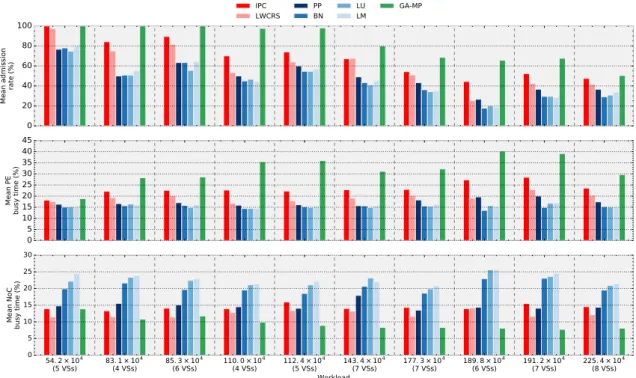
5.2 Number of total GA evaluations for different workloads . . . 107
5.3 GA-MP runtime performance for different workload levels . . . 108
6.1 PSRM algorithm parameters - for a10×10NoC . . . 119
6.2 CCPRMV2algorithm parameters - for a10×10NoC . . . 122
6.3 Experimental design summary of evaluating remapping techniques . . . 124
6.4 Video stream schedulability results for different remapping types . . . 125
6.5 PE busy time distribution results . . . 127
7.1 Scene change rate for all analysed videos . . . 135
8.1 CL: Hop count based on CCR . . . 158
8.2 CL-BG: Hop count based on CCR . . . 163
8.3 Summary of tile mapping experimental evaluation design parameters . . . 168
8.4 Communication cost breakdown for all tile mappers . . . 172
8.5 Number of late jobs per MMCP and mapping type . . . 173
C.1 I/P/B-CU decoding time distribution, exp-Weibull fit shape parameters . . . 191
C.2 Skip-CU decoding time distribution, polynomial fit coefficients . . . 191
C.3 Encoded frame size distributions, exp-Weibull fit shape parameters. . . 192
C.4 CU-decoding time scale factors . . . 192
1.1 Overview of multi-stream video decoding using many-core platform . . . 17
2.1 Y-chart methodology of reviewing the literature (taken from [40]) . . . 22
2.2 Hierarchical video stream structure . . . 24
2.3 High-level block diagrams of MPEG-2 and HEVC decoder . . . 24
2.4 HEVC - CTU partitioning and Tile/WPP parallel processing . . . 26
2.5 Video decoding parallel partitioning approaches . . . 27
2.6 HEVC decoder performance - parallelisation techniques vs. scalability . . . 29
2.7 High-level architecture of a 2D, 4x4, mesh NoC . . . 33
2.8 Tilera Gx72 high level schematic . . . 34
2.9 Abstraction levels of evaluation platforms (taken from [40]) . . . 37
2.10 Basic notions concerning timing analysis of systems (taken from [124]) . . . 40
2.11 Direct and indirect interference on NoC message flows (taken from [128]) . . . 41
2.12 Illustration of resource management organisation types . . . 45
2.13 Cluster-based resource management protocol . . . 47
2.14 Illustration of the pheromone-signalling algorithm . . . 49
2.15 Illustration of task to PE mapping . . . 50
3.1 System overview diagram . . . 65
3.2 MPEG GoP data precedence and task communication graph . . . 65
3.3 Frame decoding time distribution of synthetic MPEG decoding workload . . . 67
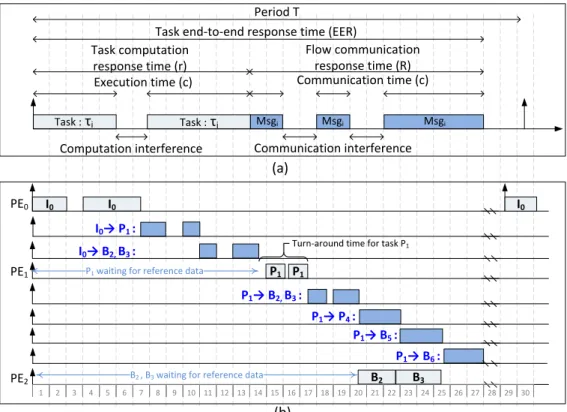
3.4 Example timeline of task and flow execution . . . 70
4.1 Deterministic admission control (D-AC) process . . . 80
4.2 High-level execution sequence of abstract simulator . . . 86
4.3 Admission control evaluation results - predictability vs. utilisation) . . . 87
4.4 Effect of scaling down the task and flow WCRT . . . 89
4.5 Admission rates of D-AC(original) vs. D-AC(tasks only) . . . 89
5.1 MPEG GoP decoding task model with memory transactions . . . 92
5.2 Refined system model (with memory controllers and open-loop RM) . . . 94
5.3 Refined system model (with memory controllers and open-loop RM) . . . 95
5.4 Illustration of LWCRS and IPC mapping . . . 98
5.5 Illustration of the GA pipeline and experimental design flow . . . 101
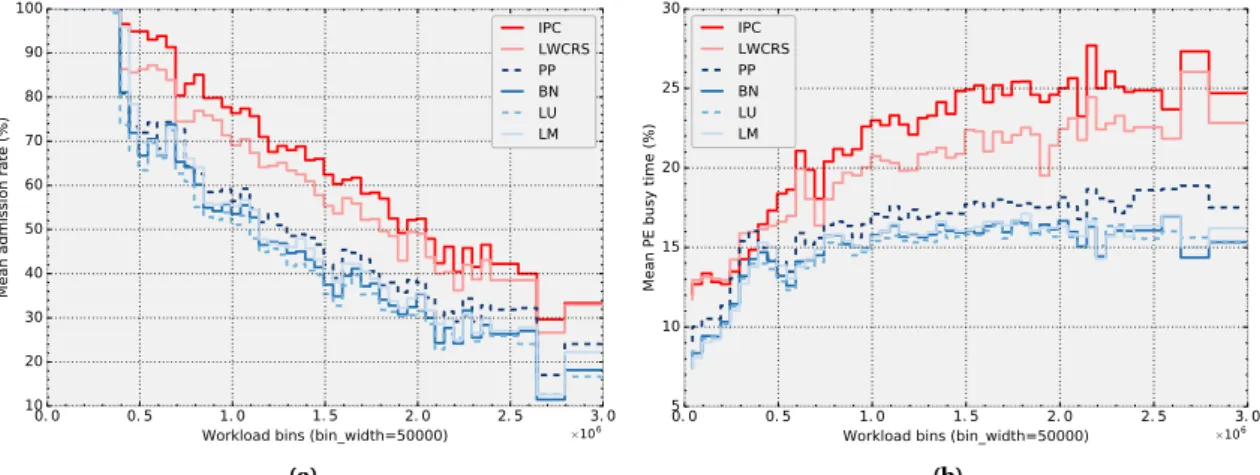
5.6 Performance of the runtime mappers vs. workload levels . . . 106
5.7 Results of the dynamic mappers vs. static mapper . . . 107
5.8 GA-MP points-based score convergence over generations . . . 108
5.9 Distribution ofWCRT(JCPi )for all runtime mappers . . . 109
6.1 Video stream task remapping illustration . . . 114
6.5 PSRM vs. baselines evaluation - job lateness improvement % . . . 125
6.6 PSRM vs. baselines evaluation - RM communication overhead factors . . . 126
6.7 PSRM vs. baselines evaluation - PE busy time . . . 127
6.8 PSRM job lateness evaluation with memory transaction modelling . . . 128
7.1 Illustration of DAG-based HEVC workload characterisation . . . 132
7.2 Video sequence snapshots . . . 133
7.3 Ratio of P:B frames within a GoP . . . 134
7.4 Examples of video stream GoP structures . . . 134
7.5 Distribution of P and B frames within a GoP . . . 135
7.6 B-frame grouping size and reference distances . . . 136
7.7 HEVC coding unit size and type distributions . . . 137
7.8 HEVC coding unit decoding time distributions, for all videos . . . 138
7.9 Frame-level decoding time for each video sequence . . . 139
7.10 Distribution of reference frame data volume . . . 140
7.11 Distribution of frame-level compression ratio of all video streams . . . 141
7.12 Decoding time breakdown according to the platform subsystems . . . 142
7.13 Evaluation results of the synthetic HEVC workload generation . . . 147
8.1 Illustration of generic frame-level task graph tile partitioning . . . 151
8.2 Example of tile partitioning of a GoP with hierarchical B-frames . . . 154
8.3 Varying CCR per job (CCR(Ji)) for different video stream resolutions . . . 154
8.4 Example showing NoC link congestion . . . 156
8.5 Illustration of CL clustered mapper hop parameters . . . 158
8.6 Clustered tile mapping example on 4x4 NoC . . . 159
8.7 Illustration of hierarchical B-frame grouping-aware task clustering . . . 162
8.8 Evaluation results of the tile mapping schemes - (CCR NORMAL) . . . 169
8.9 Evaluation results of the tile mapping schemes - (CCR HIGH) . . . 171
8.10 Distribution of PE busy times for different mapping types . . . 172
8.11 Evaluation results of the MMCP selection schemes . . . 174
A.1 Heu-AC ratio parameter combinations . . . 186
B.1 Results of random search based parameter tuning of PSRM . . . 189
D.1 Synthetic HEVC B-frame computation cost for different video streams . . . 195
D.2 Reference data payloads per synthetically generated HEVC streams . . . 195
D.3 Number of edges in synthetically generated GoPs . . . 195
First and foremost I would like to express my deepest and sincere gratitude to my supervisor Dr. Leandro Soares Indrusiak, for his patience and support throughout my EngD programme. I thank him for taking time to read my thesis and providing valuable feedback. He was always available for discussion and was always a great source of technical knowledge. Without his guid-ance this thesis would not have been achievable.
I would also like to thank Prof. Neil Audsley for his advice during the early stages of my research. I would like to thank my internal examiner, Dr. Christopher Crispin-Bailey for taking interest in my work, reading my thesis and providing useful comments at each milestone.
I thank my parents and my sister for their endless support and encouragement, for being in my life and caring for me. I want to thank my lovely, dear wife Shu-Chi Liu for her love and patience, for motivating me everyday and for constantly being by my side throughout the highs and especially the lows of this journey. I am blessed to have her in my life.
I would like to thank The Engineering and Physical Sciences Research Council (EPSRC) for funding this research through the UKs Large-Scale Complex IT Systems (LSCITS) programme (grant number EP/F501374/1). I would also like to thank my industrial supervisor Raj Patel, for providing use-cases and providing his insightful thoughts on my research.
My deepest gratitude goes to Dr. Ipek Caliskanelli for her advice and support, especially taking time to discuss the Pheromone Signalling algorithm in detail. A special thanks goes to Dr. Amit Kumar Singh, who took time to provide technical advice on runtime mapping techniques, especially the pre-processing baseline algorithm used in this Thesis. My thanks also to Dr. M. Norazizi Sham Mohd Sayuti for sharing his Genetic Algorithm framework which was extended in this work to act as a static mapping baseline. I also want to thank Dr. James Harbin, Dr. Andrew Burkimsher and Dr. Hashem Ghazzawi for discussing and providing technical guidance on my work on numerous occasions.
Lastly, I would like to thank my dear friends in and outside of York and at home, who have continuously supported me. I thank them for their companionship and wonderful memories.
I declare that this thesis is a presentation of original work and I am the sole author. This work has not previously been presented for an award at this, or any other, University. All sources are acknowledged as References. Except where stated, all the work contained within this thesis represents the original contribution of the author. Some parts of this thesis have previously been submitted or published in the following conference/journal papers:
• Chapter 4:
H.R. Mendis, L.S. Indrusiak, N.C. Audsley. “Predictability and utilisation trade-off in the dynamic management of multiple video stream decoding on network-on-chip based ho-mogeneous embedded multi-cores”,International Conference on Real-Time Networks and Systems (RTNS). ACM, 2014.
• Chapter 5:
H.R. Mendis, L.S. Indrusiak, N.C. Audsley. “Task Allocation for Decoding Multiple Hard Real-time Video Streams on Homogeneous NoCs”,International Conference on Industrial Informatics (INDIN). IEEE, 2015.
H.R. Mendis, L.S. Indrusiak, N.C. Audsley. “Dynamic and Static Task Allocation for Hard Real-time Video Stream Decoding on NoCs”,Leibniz Transactions on Embedded Systems (LITES), vol. 4, no. 2, pp 1-25.
• Chapter 6:
H.R. Mendis, L.S. Indrusiak, N.C. Audsley. “Bio-inspired Distributed Task Remapping for Multiple Video Stream Decoding on Homogeneous NoCs”,IEEE Symposium on Embedded Systems for Real-Time Multimedia (ESTIMedia), IEEE, 2015.
• Chapter 7:
H.R. Mendis, L.S. Indrusiak. “Synthetic Workload Generation of Broadcast related HEVC Stream Decoding for Resource Constrained Systems”,International Conference on Signal Processing and Multimedia Applications (SIGMAP), 2016.
• Chapter 8:
H.R. Mendis, L.S. Indrusiak. “Low Communication Overhead Dynamic Mapping of Mul-tiple HEVC Video Stream Decoding on NoCs”, Workshop on Parallel Programming and Run-Time Management Techniques for Many-core Architectures and Design Tools and Ar-chitectures for Multicore Embedded Computing Platforms (PARAM-DITAM), ACM, 2016.
Introduction
1.1
Background and motivation
Traditionally, the computation power of a single core processor was improved by increasing the operating frequency. Power dissipation in clocked digital devices is proportional to the clock frequency; therefore, due to on-chip energy density constraints, increasing the processor fre-quency was no longer feasible. In order to keep Moore’s law [1] alive, hardware manufacturers exploited a high number of slower logic gates, leading to parallel devices with duplicated on-chip elements such as general purpose processors, reconfigurable logic, memory and caches, working at lower clock speeds. Thus leading to massively multi-core (commonly referred to asmany-core) chips with hundreds or thousands of low-frequency, low complexity cores [2]. Today, commercial many-core chips such as the Kalray-MPPA (256 cores) [3] or the Tilera TILE-Gx8036 chip (72 cores) [4] have been integrated into high data throughput applications such as data centre networking equipment, storage devices or broadcast video server products. Many-cores are not only seen in high performance or server devices but also in the consumer electron-ics domain. Mobile phones with 8-core multiprocessor system-on-chips (MPSoCs) are already in mass production [5], and the release of 10-core MPSoCs have been announced [6]. The In-ternational Roadmap for Semiconductors in 2012 [7], have predicted that the number of cores on-chip will double every 26 months. Hence, one of the greatest challenges is in providing the interconnection networks that allow these cores to communicate efficiently. Traditional hier-archical bus or crossbar based interconnects approach saturation as the on-chip data traffic scales up. To effectively tackle this interconnect complexity, a communication-centric design approach,Network-on-chips (NoCs), has become the default choice of scalable, power-efficient, interconnect design paradigm for many-cores [8]. NoCs are inherently shared communication mediums; hence operations such as flow-control, arbitration and routing need to be efficient and fast, where performance is of concern and predictable/analysable where real-time guaran-tees are required.
The field of embedded multimedia electronics has evolved and grown technological ma-turity, driven by the ever increasing demand in application and user requirements. Multime-dia, and more specifically in the context of this work,video decoding has been one of the first applications to embrace the massive parallel processing capability offered by multiprocessing platforms. Video playback and streaming services have become pervasive and an integral part of our life. With recent content delivery infrastructure and hardware advances consumers are now experiencing richer, more immersive content with every new generation of multimedia de-vice. Merely ten years ago portable dedicated video players were becoming popular in the con-sumer electronic market [9]; now, a 4K-Ultra high definition (UHD) video (i.e. 3840×2160
consumer electronics shows a great demand for computation power with a large constraint on power consumption and device size. After high-definition television (HD-TV) was introduced, video decoding alone now requires an average of 50 giga-instructions per second (GIPS) [11]. Video decoding has always been a computationally expensive process [12]. However, recent dramatic improvements in video compression [13, 14] has made video coding algorithms in-creasingly complex, making it necessary to utilise the parallelism offered by many-cores.
In Section 1.1.1 of this introductory chapter, the reader will be provided with several use-cases for real-time multi-stream video decoding especially indicating why strict predictability guarantees are required. Section 1.2 will then introduce the scientific research challenges ad-dressed in this thesis and outline the approaches taken by existing work and where less work has been done previously. The thesis hypothesis will be clearly presented in Section 1.3 and Sec-tion 1.4 will explicitly outline the novel contribuSec-tions made in this thesis to address the stated research problems. Section 1.5 will lastly end the chapter with the structure of this thesis.
1.1.1
Use-cases for predictable real-time multi-stream video decoding
Video streams have specific frame-rates, measured in frames per second (fps), which introduce timing requirements for video decoding and playback. The required fps will vary based on the application (e.g. higher fps for HD-TV than low bitrate video communications). Violating these timing constraints can lead to degraded quality of experience (QoE) [15], but the video decoding system can still continue to operate. Due to this reason, conventional video processing systems are considered to besoft real-time. However, there are several use-cases withhard real-time
requirements on video decoding. Furthermore, as multimedia applications become more com-plex, there starts to exist the need for decoding ofmultiplevideo streams simultaneously.
The work presented in this thesis (particularly the first two technical chapters) places an em-phasis on the management of multiple video streams with hard real-time timing requirements. The latter technical chapters focus on managing video streams with soft real-time timing re-quirements with complex characteristics. Managingmultiplevideo streams withhard real-time
requirements has not received much attention previously. This section will introduce several use-case scenarios where both hard and soft real-time video decoding of multiple simultane-ous video streams are required.
1.1.1.1 Hard real-time decoding of multiple video streams
Hard real-time multiple video stream decoding has direct applicability in applications such as remote tele-surgery, autonomous vehicles and video surveillance. These application scenarios will be described briefly in this section.
Tele-surgery, is where a surgeon performs surgical operations with robotic tools to gain more control over traditional open surgery. Remote tele-surgery, is the same as tele-surgery, but the surgeon and patient are separated by significant distances (e.g. [16] [17]). In these systems, the surgeon controls the robotic tools whilst closely monitoring multiple video monitors which display the patient and the robot movement. Therefore, it is crucial that remote tele-surgery requires systems which can decode and playback multiple video streams within the hard timing requirement. Missing any frame decoding deadlines can result in unsafe surgical operations.
Invision-based autonomous vehicle safety-critical systems, multiple cameras are connected to the vehicle and the captured video streams are used to identify and actuate emergency mea-sures [18]. These systems can guide and warn the driver of collisions and keep the passengers
safe during emergency situations. In such vision-based vehicle safety systems, the accuracy and functionality of the feedback controls depends on processing video frames with tight timing re-strictions. Missing decoding deadlines can introduce latencies into the system, thus reducing its safety.
Next generationautomated video surveillance systems(e.g. [19]) contain motion-tracking al-gorithms that make use of the multiple hard real-time video streams. These systems are used to ensure the safety and security of people by tracking hundreds of objects in real-time. For ex-ample in [19], the automated video surveillance system is used to notify healthcare services of fallen or injured elderly people living alone. If frames are dropped or their decoding deadlines missed, the motion detection algorithms may not operate correctly, which can result in delayed or failed response to threats/accidents.
1.1.1.2 Soft real-time decoding of multiple video streams
Several soft-real time video streaming applications now require decoding and playback of mul-tiple videos in parallel due to increased user requirements. Unlike in the previously described hard real-time video streams, if soft timing requirements are not met, the system can continue to operate but with reduced QoE and negatively impacting the video service/business.
Multiple soft real-time video stream decoding can be seen in modern multi-view TVs [20], where the TV can stack and display more than one video at the same time. Users can isolate and view a specific video using special polarized glasses, thereby allowing multiple users to watch different videos on the same TV simultaneously. Also, in the digital television (DTV) industry, certain advanced graphical user interfaces (GUIs) now allow multiple video channel playback and video scaling, to aid TV users in selecting a program [21]. These features make use of avail-able system resources to provide a rich and improved user-experience.
Multi-stream decoding is also a common requirement in the live broadcasting (e.g. BBC/Sky) where a wall of multiple videos is displayed and monitored for stream analysis and video er-rors [22]. In multipoint video conferencing systems [23] several video streams from different client devices need to be decoded and merged into a single frame; thus requiring considerable processing power and incurring delay. Another example is in high-end vehicles, where multi-ple audio-visual applications with varying quality of service (QoS) and priority/criticality levels need to be decoded and played-back simultaneously. These videos could be from high priority road-surveillance videos from vehicle mounted cameras for the driver, or low-priority enter-tainment videos for the passengers [24].
1.2
Research problems
This section will provide an overview of the primary scientific research problems addressed in this thesis, as well as highlight existing research work related to these problems. Note that a comprehensive survey of existing related work can be found in Chapter 2, therefore only a gen-eral overview of existing research will be given in this chapter.
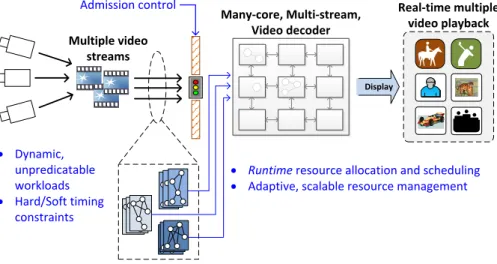
Figure 1.1 shows a high-level illustration of the research problem investigated in this work, formed from the multi-stream real-time video decoding use-cases described in the Section 1.1.1. The figure shows multiple live video sources which need to be decoded by the many-core de-coder and displayed in real-time. In this work, the multi-stream video decoding workload will
Multiple video streams Many-core, Multi-stream, Video decoder Display Real-time multiple video playback Admission control
· Runtime resource allocation and scheduling · Adaptive, scalable resource management · Dynamic,
unpredicatable workloads · Hard/Soft timing
constraints
Figure 1.1:Overview of multi-stream video decoding using many-core platform
be modelled as real-time task-sets. This research will primarily look into how dynamic and un-predictable workloads with hard/soft real-time constraints can be allocated and scheduled in an adaptive and scalable manner. In the case where streams have hard timing requirements, an admission controller must provide guarantees before admission. Once admitted, the streams must be allocated efficiently to achieve the required performance and throughput constraint (i.e. fps).
1.2.1
The problem of shared-memory based parallel video decoding
There exists an evident gap between the parallel video decoding research community and the embedded multimedia design research community. Many work in the state-of-the-art in paral-lel video decoding assume a multi-threaded shared-memory many-core architecture (e.g. [25], [26]). In these architectures, performance improvement saturates as the number of cores and threads increase, due to resource contention. On the other hand, the state-of-the-art NoC-based many-core embedded multimedia systems design assumes a task-level parallel video de-coder model (e.g. [27], [28]) which has limited parallelism and flexibility compared with data-level parallel video decoders [29]. These designs also often assume a communication-centric, message-passing based NoC architecture, which are more difficult to program but alleviates the performance bottlenecks of a shared memory, multi-threaded design. In order to improve modern multi-core multimedia systems designs to deliver increased throughput, this separa-tion needs to be reduced.
1.2.2
The problem of resource management for unpredictable workloads
Unpredictable workloads are those which characteristics (e.g. arrival patterns, computation, communication and memory requirements) are only known at runtime and not at design time. Many live video streams fall into this category as they have characteristics that are difficult to determine and predict beforehand. In such scenarios, hard predictability guarantees are diffi-cult to provide and resource management has to be performed at runtime, instead of pruning the allocation search space at design time [30]. As modern video codecs become more sophis-ticated and include content-adaptive algorithms their dynamicity also increases.
Existing work in resource allocation fordynamic workloads focus onruntime task alloca-tion/re-allocation(e.g. [30], [31]). Many of these techniques rely heavily on monitoring platform resource usage at runtime in a feedback-loop to adapt to the dynamic workload. However, mon-itoring system resources in a feedback-loop can in turn lead to higher communication network use. Resource managers that do not employ such feedback monitoring (i.e. open-loop man-agement) have received significantly much less attention in the existing literature. Some of the existing techniques assume exact computation/communication requirements of the workloads are known beforehand (e.g. [32], [33]), which is not the case with live video streams. On the other hand, some assume worst-case workload properties (e.g. [34]) to provide hard real-time guar-antees, which can lead to resource over-provisioning and underutilisation. In a multi-stream video decoding context this could mean the rejection of potentially serviceable video streams. Very few existing work have combined end-to-end worst-case response time analysis in runtime resource management schemes (e.g. admission control) for predictable NoC architectures.
1.2.3
The problem of scalable management
Scalability is another challenge addressed in this work to support the continuous increase in the number of processing cores in a platform and the scale of the workload. Existingcentralised
resource management has been successful in the past in smaller systems, but has proven to quickly become a bottleneck as the platform size and workload grows. Existing state-of-the-art
hierarchicalandfully distributedtechniques also can have complex andhigh management over-headin terms of their communication protocols (e.g. [35–37]). Low overhead fully distributed resource management protocols are required for future large-scale NoCs.
Many existing work consider relatively small applications (e.g. [33]) in their evaluations. However, resource management should also take into account thescale of the workload, as the number of tasksets and their rate of arrival can increase as applications become more sophis-ticated and complex. Runtime task admission and allocation algorithms should therefore still maintain an acceptable execution overhead when faced with large-scale workloads.
1.2.4
The problem of resource sharing
An important aspect of NoC-based many-cores is the sharing of on/off-chip resources (process-ing elements, communication channels, shared memory, input/output ports etc.) by concur-rently running processes or applications. On one hand, many-cores offer increased parallelism to meet the expectations of the embedded and high-performance computing market. On the other hand, the complexity of the software deployed on these systems grow exponentially re-quiring more shared resources and computation power. Resource sharing leads to higher sys-tem utilisation and increases average performance resulting in low-cost design alternatives.
However, resource sharing also leads toresource contentioncausing individual applications to become blocked and wait until a resource is free to use, resulting in unpredictability and de-lays to execution. The trade-off between the conflicting goals,predictability andperformance
is a challenging yet key design decision, driven by use-case requirements. With the emergence of many-core systems, blocking scenarios will effectively become a critical issue in the design of real-time systems. Resource contention due to sharing of resources amongst tasks (i.e. sub-partitions of applications) over multiple cores can easily leave cores in idle states, thereby de-grading system performance, impacting schedulability of real-time systems and wasting the
benefits provided by many-cores.
Different task to processing core allocations can result in varying resource contention pat-terns on the platform [30]. Thus, efficient task allocation (also referred to astask mapping) and scheduling policies, combined with applicationdomain knowledge, need to be designed to alle-viate the causes of resource contention. Many of the existing runtime task allocation techniques consider metrics such as communication cost, utilisation and execution time in their mapping heuristics (e.g. [38], [39], [37]). However, very few runtime mapping heuristics take into account resource contention and even less consider improving predictability metrics (such as reducing
lateness).
1.3
Research hypothesis
Section 1.2 introduced scientific research challenges and existing research work related to the use cases presented in Section 1.1.1. The main objective of this research is to explore and design predictable and efficient, scalable, low overhead NoC resource management (admission con-trol, allocation/re-allocation) techniques for unpredictable multi-stream video decoding appli-cations. Therefore, the following thesis hypothesis determined the central focus of this research. The thesis hypothesis is divided into two domains with respect toclassicalandmoderncoding tools:
• For videos encoded using classical video codecs: Application and blocking-aware run-time mapping heuristics combined with a deterministic admission controller can be used to guarantee timing requirements and improve system utilisation for hard real-time video streams; a low-overhead, distributed, remapping technique, can be further used to reduce the lateness, of soft real-time video streams.
• For videos encoded using modern video codecs: Application-specific task clustering and mapping combined with better memory controller selection heuristics, can be used to bal-ance communication cost and lateness reduction of soft real-time decoding of complex video streams.
1.4
Thesis contributions
The following explicitly outlines the novel contributions made in this thesis to address those research problems identified in Section 1.2 and to achieve the thesis hypothesis set above in Section 1.3:
• A communication-centric data-parallel video decoding application model: This model suits modern message-passing NoC architectures with distributed local memory. Its hier-archical structure enables modelling characteristics of multiple simultaneous video streams. The initial proposed application model targetsclassical video codecs (e.g. MPEG-2) with certain stream constraints. Latter technical chapters present a more flexible and expres-sive application model, which both captures the content-adaptive nature ofmodernvideo codecs (e.g. H.264/High Efficiency Video Coding - HEVC) and block-level characteris-tics, not been analysed before. Novel, workload generation algorithms are also presented which make use of real stream analysis, to synthetically produce abstract workloads.
• Deterministic and heuristic-based admission controllers: This thesis presents a novel deterministic admission controller, which uses end-to-end NoC schedulability analysis to provide hard timing guarantees, for multi-stream video stream decoding workloads. Also, proposed is a soft real-time heuristic-based admission controller which uses task lateness as a metric to balance predictability and utilisation in the system.
• Application and blocking-aware runtime task mapping techniques: These two alloca-tion techniques are used to improve the low-utilisaalloca-tion of deterministic admission contr-ollers. Unlike existing mapping techniques, the first proposed approach takes into ac-count task contention and attempts to pack tasks tightly onto a PE whilst trying to reduce deadline misses. The second mapping heuristic adapts the first approach and exploits the limited knowledge of the video stream structure to further improve the system utilisation. • A distributed, bio-inspired, task re-allocation technique for NoCs: This proposed task remapper has low communication overhead and can adapt to varying workloads auton-omously, without centralised/cluster-based management. Thus, it is suited for large-scale NoC architectures handling soft real-time workloads. This proposed runtime re-allocation technique is used to load-balance the system as well as further reduce the lateness of ac-cepted video streams.
• Task clustering/mapping and memory traffic management for HEVC video streams:Two runtime task clustering and mapping techniques are proposed to improve predictabil-ity and reduce NoC communication cost, targeting highly dynamic, soft real-time HEVC video streams with tile-level data parallelism. The first approach attempts to cluster and map the tasks in the longest path of the task-set in close proximity, in order to reduce the NoC usage. The second approach exploits stream-specific video frame relationships to derive a novel clustering technique to balance both the aforementioned objectives. Lastly, several main memory controller port to task allocation heuristics are explored. These heuristics attempt to balance the memory traffic load and also to mitigate memory con-troller contention.
1.5
Thesis outline
The remaining chapters of this thesis are organised in the following structure:
Chapter 2 surveys the existing literature in three strands: 1)the video decoding application domain and its complexities;2)components and design challenges in predictable many-cores and NoC interconnects; 3)compare and contrast the state-of-the-art in dynamic resource management techniques and methodologies for NoC-based many-cores.
Chapter 3 firstly present the preliminary system models (application and platform), which form the basis of the evaluation infrastructure in this thesis. Later chapters will refine and lift certain assumptions in these models. Secondly, the evaluation metrics focused in this the-sis (related to predictability, performance, energy and efficiency) are defined. This chapter ends with an outline of the overall research problems this thesis is attempting to address. Chapter 4 provides the first technical contribution in the form of two admission control
deterministic admission controller is proposed for hard real-time video streams and a heuristic-based admission controller is proposed to trading-off/balance predictability and utilisation for soft real-time streams.
Chapter 5 extends the work in Chapter 4, by presenting two novel hard real-time task allocation heuristics to improve the low-utilisation of deterministic admission controllers. These heuristics consider task blocking and incorporate limited application-awareness to re-duce the video streams’ end-to-end worst-case response time. They are evaluated against existing NoC task mapping techniques, as well as a design-time task mapper. Extended evaluations related to platform scalability and communication loads are also included. Chapter 6 explores the feasibility of using a low-overhead, distributed and biologically-inspired
task re-allocation protocol, to improve the response-time of video stream decoding with soft timing requirements. This technique is compared against a state-of-the-art hierarchi-cal many-core resource management technique and a centralised manager.
Chapter 7 extends the video decoding application model to consider the complexity of modern codecs, specifically the H.265/HEVC standard. Statistical properties of real video streams such as frame dependency patterns and decoding execution profiles are characterised. A novel bottom-up HEVC video decoding synthetic workload generation framework is in-troduced.
Chapter 8 utilises the workload model generated in the previous chapter to address challenges in multi-stream HEVC video decoding, with tile-level parallelism and soft timing con-straints. Novel, application-aware, runtime task clustering and mapping heuristics are used to balance the overall NoC communication, predictability and mapping overhead. Memory controller to task mapping heuristics are explored to reduce memory traffic con-gestion in the NoC.
Literature Survey
This chapter provides an overview and discussion of previous research in fields related to par-allel video decoding, network-on-chip and many-core resource management. The sections in this chapter are structured in a top-down approach using a Y-chart methodology as presented in Figure 2.1. Kienhuis et al. [40] introduce this Y-chart approach to prune the embedded sys-tems design space, where the application and architectural models are decoupled and improved iteratively. Similarly, this chapter first introduces parallel video decoding applications in Sec-tion 2.1, followed by a discussion of network-on-chip based many-core architectures and their challenges in Section 2.2. Section 2.3 discusses many-core resource management in terms of mapping, scheduling and runtime adaptation mainly for multimedia workloads.
Resource management
Mapping, scheduling, runtime adaptation etc. Design space exploration Performance analysis Application modelling
Video decoding applications
Architecture modelling
Many-core NoC system
Design flow Refinement/ improvements
Figure 2.1:Y-chart methodology of reviewing the literature (taken from [40])
2.1
Video decoding applications
An overview of video decoding is presented in this section. The challenges and bottlenecks of these algorithms are analysed and steps taken to parallelise video decoding are discussed.
2.1.1
Video stream decoding overview
Media files are extremely large in their original form (e.g. a 1 minute duration, 4K (3840×2160), 8 bits per pixel (bps) video file, is approximately 33GB large). Therefore, they must be encoded (compressed) before they can be stored or transmitted. Video compression is typically per-formed by exploiting spatial and temporal redundancies. There exists multiple video compres-sion standards such as MPEG-2, MPEG-4 Part 10 (H.264), H.264/AVC (Advanced video codec) and the latest H.265/HEVC (High Efficiency Video Codec). With each new version of video codec
new coding techniques are used, resulting in increased complexity and requiring more compu-tational resources.
A video stream is a sequence of compressed (encoded) frames (also referred to as pictures). A video sequence can be hierarchically broken down into groups of pictures (GoPs), frames, slices, macroblocks and finally blocks as shown in Figure 2.2a [41]. Frames can be an intra-predicted (I-frames) or inter-predicted (PorBframes). I-frames are reconstructed (decoded) using infor-mation within itself. P-frames are forward predicted and require reference data from a recently reconstructed I or P frame. B-frames use bi-directional prediction and can reference past and future I, P or generalised B-frames. For example, in Figure 2.2b,B2obtains reference data from I0andP3. Generalised B-framesas shown in Figure 2.2d can be referenced by other B-frames, in a hierarchical B-frame coding structure as used by advanced codecs such as H.264/AVC and HEVC [13, 42].
Encoders predict the current P/B frame by using the reference frames and only transmits the residual (difference) and the motion vectors (if any) to the decoder. At the decoder, the residual values are added with the reference frame(s) macroblocks and shifted using the motion vectors (MVs) to decode the frame. As illustrated in Figure 2.2c, a frame’s blocks can refer to other blocks inmultiple reference frames(H.264/AVC onwards). Multiple reference frames improves compression at the expense of higher encoder complexity. The decoded picture buffer (DPB), located in memory stores all decoded frames until they are no longer required by any of the future frames in the encoded video stream. Frames are decoded and displayed in thedisplay order, which is different to thedecoding orderat the encoder output, to facilitate bi-directional decoding. Hence, the decoded frames need to bere-orderedbefore displaying.
Figure 2.2b shows an example of a closed GoP with 12 frames. Closed GoPs do not have dependencies with other GoPs in the video stream and they reduce error propagation, but pro-vide slightly less compression than open GoPs. Generally, all the GoPs in the pro-video stream have a fixed number of frames and the number of P or B frames within the GoP may change depending on video content variation. According to the MPEG-2 specification, the 12 frame GoP structure given in Figure 2.2b, is recommended to balance compression, facilitate stream random-access and to manage error propagation [43]. Fixed GoP structures are also simpler to implement. They enable a certain level of performance analysis of the decoder beforehand but is poor in coding efficiency as temporal variations in the video are not accounted for. Therefore, adaptive GoP algorithms have been presented to detect valid scene-changes, reduce cumulative encod-ing errors and improve compression [44, 45]. These techniques vary the GoP length and struc-ture depending on detected scene-change events and temporal variations.
2.1.1.1 Functional blocks of a video decoder
A videoencoderanddecoderare complementary pairs of systems, containing coding tools (i.e. algorithms and models) to exploit temporal and spatial redundancies. This thesis focuses solely on decoder resource management, hence the decoder characteristics are inspected closely. A block diagram of a generic MPEG-2 decoder is given in Figure 2.3a. A variable length coder/de-coder (VLC/VLD) is used to reduce the codeword length of image data leading to lossless, bit-rate reductions. Quantisation performs lossy compression to reduce a range of values to a single value. 2D inverse discrete cosine transform (IDCT) is frequency to spatial domain transforma-tion technique. Motransforma-tion compensatransforma-tion is used to decode the inter-predicted frames using the frame data in the DPB. Typically, macroblocks/blocks run through this decoder pipeline, one
Group of Pictures Video sequence slice Frame macroblock block (a) Display order #
I B B P B B P B B
0 1 2 3 4 5 6 7 8B B
9 10P
11 Decoding order #I P B B P B B P B B B B
0 3 1 2 6 4 5 11 7 8 9 10Group of Pictures (GoP)
Reference data dependencies
(b)
(c) (d)
Figure 2.2:(a) Hierarchical structure of a video sequence (b) Frame ordering and reference frame dependency pattern
in an open-GoP (c) Multi-frame motion compensation (∆=reference picture index in the reference picture buffer), taken
from [42] (d) Example of using generalised B-frames in a hierarchical B-frame, open GoP structure (taken from [46])
VLC decoder IQ IDCT
+
Decoded Picture Buffer MC predictor/ interpolator Reconstructed images Coding decisions (intra/inter pred.)Display Video Bitstream Motion vectors (a) Entropy decoder (CABAC) IQ IDCT/IDST
+
Decoded Picture Buffer MC predictor/ interpolator Display Video Bitstream Motion vectorsCoding decisions (intra/inter pred.)
Inloop filtering Deblocking and SAO filters Reconstructed images (b)
Figure 2.3:High-level block diagrams of: (a) Generic MPEG-2 decoder (adapted from [42]) (b) Generic HEVC decoder
(adapted from [47]). (VLC=variable length coding; IQ=inverse quantisation; IDCT/IDST=Inverse discrete cosine/sine transform; MC=motion compensation; CABAC=context-adaptive binary arithmetic coding; SAO=sample adaptive off-set)
after the other.
The HEVC decoder (Figure 2.3b) contains a similar set of high-level functions; however, each significantly more complex than MPEG-2. Two main differences in HEVC decoding is the use of a context-adaptive binary arithmetic coder (CABAC) entropy coder, and in-loop filtering. CABAC uses statistical properties to perform lossless compression, and in-loop filtering is used to improve the quality of the image and reduce the visual artefacts introduced during compres-sion [47].
2.1.2
Features of the H.265 (HEVC) coding standard
The preliminary technical chapters in this thesis assume the video stream decoding workloads are MPEG-2 encoded with simple coding tools. MPEG-2 is still in use in industry, specifically in the digital TV domain to encode standard definition (SD) broadcast streams to support legacy
devices and MPEG-4 or H.264/AVC is used for HD streams. H.265(HEVC) has generated huge optimism given the broadcast industry’s struggle with lack of bandwidth and the need to de-liver HD/UHD content to multiple platforms. HEVC offers many features which make resource management challenging, hence the last two technical chapters of this thesis focus on resource allocation issues surrounding HEVC encoded video streams. This section therefore aims to pro-vide the reader with a brief overview of the key components of the HEVC standard related to this research.
The HEVC coding standard was primarily developed to address compression problems with very high video resolutions (beyond 1920×1080) and promoting the use of parallel architectures. HEVC is able to offer over 50% bit-rate savings than H.264/AVC with approximately similar sub-jective quality and Peak Signal to Noise Ratio (PSNR) levels [48]. At the time of writing, the third version of the HEVC standard and its extensions have been released [14]. HEVC aims to improve the compression (coding efficiency) by using several improved coding tools (e.g. transform sizes, intra-prediction modes, in-loop filtering changes given in Table 2.1). The mac-roblock structure in previous codecs have been replaced in HEVC by coding tree units (CTUs). The CTU logical structure can be of the size 64×64, 32×32 or 16×16 depending on the stream parameters. Compared to previous standards (Table 2.1), larger CTU sizes provides better com-pression for higher resolution videos [48]. CTUs are recursively partitioned using a quadtree structure into smaller coding units (CUs) as shown in Figure 2.4a. I-frames only contain intra-coded CUs, P-frames can contain intra/inter(forward) intra-coded CUs and B-frames can contain intra/inter(forward)/inter(bi-directional) coded CUs. CUs are flagged as Skip if they do not have a residual or motion vector, hence a reference-CU is copied directly. Details of other new coding tools such as merge mode for MVs, asymmetric prediction units, motion interpolation filtering etc. can be found in [47].
Table 2.1:Comparison of MPEG-2, H.265/AVC and HEVC [13, 47]
Features MPEG-2 H.265/AVC HEVC
Macroblock size 16×16 16×16 64×64, 32×32, 16×16 Block size 8×8 16×16, 16×8, 8×16,8×8, 8×4,4×4 64×64 to 4×4 (symmetric/asymmetric) Transform DCT (8×8) DCT (8×8, 4×4) DCT (32×32, 16×16, 8×8, 4×4), optional DST for 4×4 Intra-prediction modes 1 9 35
Reference frames One Up to 16 frames Up to 16 frames
Native parallelisation None slice level slice level, WPP, Tiles
In-loop filtering None De-blocking filter De-blocking and SAO
filtering
In addition to the slice-level parallelisation offered in H.264/AVC, HEVC contains several na-tive mechanisms to make the codec better parallelizable [29]. An HEVC frame can optionally be partitioned intoTiles(Figure 2.4b), where Tiles are approximately equal rectangular picture regions which can be independently decoded in parallel. Whenwavefront parallel processing
(WPP) is enabled in HEVC, each CTU row of a frame can be decoded in parallel. However, each decoding thread can only begin decoding each CTU row with a 2 CTU delay relative to the previous row (Figure 2.4b), due to the entropy decoding synchronisation requirements [47]. A detailed discussion regarding decoder parallelisation is given in Section 2.1.4.
64x64
32x32
16x16
8x8 64x64 CTU partitioning Respective quadtree structure
(a)
Tile partitioning Wavefront parallel processing
Thread 1 Thread 2 Thread 3
(b)
Figure 2.4: (a) HEVC CTU partitioning and respective quadtree structure (taken from [47]) (b) Tiles and Wavefront
parallel processing in HEVC (taken from [13])
2.1.3
Complexities of video decoding
New coding tools in each generation of video codec comes at the expense of increased imple-mentation cost. Early work on memory usage and computation complexity analysis of MPEG-2 and H.264 decoding have been carried out by Holliman et al. [49]. They show that total MPEG-2 decoding execution costs are about 8 times slower than H.MPEG-264 for a video sequence with the same resolution and bitrate. The MPEG-2 decoder spends more time in motion compensation (MC) for low-bitrate videos, but spends more time performing IDCT, VLD and IQ for higher-bitrate videos. Similarly, for H.264, VLD becomes the bottleneck as the higher-bitrate is increased. Motion compensation in MPEG-2 is memory intensive and memory architecture details such as L1/L2 cache size, cache line size, memory bandwidth etc. can impact decoding time. How-ever, in H.264 and H.264/AVC unlike in MPEG-2, MC is mainly computation-bound for low bi-trate videos and the peak memory usage highly depends on the number of reference frames per intra-predicted frame [49, 50]. Furthermore, the decoding time of H.264/AVC is also depen-dent on the quantisation parameter (QP) (i.e. level of quality loss) of the encoded video; where higher QP values decreases the decoding time. In-loop deblocking filtering in H.264/AVC in-creases memory accesses by 6% and overall processing time increase by 10% [50]. The use of B-frames increases the decoder execution time by 20-40%, hence generally not used by low-latency applications (e.g. video conferencing).
Preliminary decoder performance analysis of the HEVC reference software decoder is per-formed by Bossen et al. [51]. Their results show that, when performing intra-only HEVC decod-ing (no P/B frames), the IDCT and in-loop filterdecod-ing components takes the most amount of time. However, when decoding random-access streams (i.e. P and B-frames are used), the motion-compensation process takes 50% of decoding time, which matches the same trend in results as H.264/AVC decoding [50]. Random-access stream decoding has a higher decoding time due to memory subsystem issues, such as bandwidth saturation and cache misses when fetching reference frame data. Depending on the type of video content and bit-rate required, certain
advanced coding tools can be disabled without sacrificing significant quality loss. Using less complex coding tools would greatly decrease the computation complexity and memory usage of modern codecs [50].
2.1.4
Parallel video decoding
The state-of-the-art in parallel video decoding techniques can be categorised intotask-level,
data-level decomposition or a hybrid of the two partitioning approaches [29]. The two ap-proaches are illustrated in Figure 2.5. In task-level decomposition (e.g. [52–54]) the functional components of the decoding algorithm (e.g. IDCT, VLC, IQ etc.) are assigned to different pro-cessing elements in the platform. Some of these tasks are pipelined and/or done in parallel. Task synchronisation and a significant amount of communication is required between the tasks to perform the decoding in this technique [54]. Task dependencies and varying task pipeline execution times can also lead to load imbalance. Scalability is difficult to achieve in this parallel approach as decoding higher resolution video streams would require the tasks to be partitioned differently to achieve high throughput demands. Furthermore, each processor/task would need to implement specific hardware/software optimisations to obtain better performance, hence more suited for platforms with heterogeneous processing units [53] or with dedicated hardware units [52].
PE
0PE
2PE
3PE
1PE
0PE
1PE
2PE
3 Data-level partitioning(illustrates Tile-level parallelisation) Task-level partitioning
Figure 2.5:Video decoding parallel partitioning approaches: data-level (left) and task-level (right) partitioning
Figure 2.5 illustrates the data-level parallel video decoding approach which is commonly used by the video processing research community (e.g. [25, 26, 29]). In this approach, the data (encoded video stream) is divided into small parts and each assigned to a different processor or processing thread. Partitioning of the video stream data could be coarse-grain (e.g. GoP-s/frames/HEVC Tiles) or fine-grain (e.g. macroblocks/CTUs). Meenderinck et al. [29] compare data-level parallelisation techniques at different levels of granularity. GoP-levelparallelism is simple to implement, but requires a large amount of memory. Frame-level parallelism is a generic approach, applicable to different video coding standards and do not require special signalling or instrumentation in the video bitstream. However, the scalability of frame-level
parallelism is limited by the number of parallel B-frames in the GoP and has high commu-nication overhead due to inter-frame data dependencies. Figure 2.6(b) shows the results ob-tained by Bross et al. [55], when evaluating the scalability of random-access (i.e. P/B frames enabled) vs. intra-only video profiles. Random-access profiles offer superior compression over intra-only videos; however, due to the inter-frame dependencies they scale poorly. The scala-bility issues with frame-level parallelism is however not a concern when attempting to decode multiple video streams, as idle processors can be utilised to decode frames from an alternate video stream. Slice-levelparallelism has less dependency issues, but is affected by in-loop fil-tering; furthermore, increasing the slices in a frame can increase the bitrate. Parallelism at the
macroblock-level offers a high degree of scalability and lower memory usage, but stream in-strumentation and additional delays will be incurred to parse and determine the macroblock start/end locations in the bitstream [29].
2.1.4.1 Parallel HEVC stream decoding
As described in Section 2.1.2, HEVC contains two native data-parallel techniques: Tiles and
WPP. Both Tiles and WPP require explicit video bit-stream signalling, to indicate where tiles/CTU rows start and end. The scalability of WPP decreases as the number of CTU rows increase, due to synchronisation issues. Tiles start to incur coding losses as the number of Tiles in a frame is increased [56]. Georgakarakos et al. [25] experimentally show that Tile-level parallelisation of-fer better speed-ups when compared with native WPP as the decoder thread count is increased. Chi et al. [26] improve the WPP technique to mitigate the synchronisation issues and combine it with frame-level parallelism. Their approach, termed overlapped wavefront processing (OWF) show better scalability than Tiles or WPP and the results are given in Figure 2.6(c). Further re-sults from their same work [26], given in Figure 2.6(a) show, parallel decoding of multiple lower resolution videos scale better than a lower number of very high resolution videos. A common trend in all data-parallel approaches shown in Figure 2.6 is that, performance improvement sat-urates as the number of cores/simultaneous threads are increased. This behaviour is due to the heavy contention on the shared memory sub-system (e.g. memory bandwidth, main memory controllers).
Hybrid decomposition techniques (e.g. [57, 58]) attempt to combine different task-level and data-level parallelisation strategies. In [57], CTU-level wavefront data-parallel processing is em-ployed to decode CTU pixels, but task-level parallelism is used for entropy decoding. They use explicit barrier synchronisation to manage the decoding pipelines. Many hybrid approaches speed-up compute intensive functions of the decoder using architecture specific optimisations such as Single Instruction Multiple Data (SIMD). However, SIMD optimisations are orthogonal to data-level/task-level parallelism as SIMD can be used to improve the performance of each in-dividual core/thread [29]. In [59], SIMD optimisations are used at each decoder stage to obtain a 2.8x-5x speed-up improvement over a combined WPP and frame-level parallel approach.
2.1.5
Challenges in characterisation of video decoding workload
In order to balance complexity and compression performance, most modern video codecs (such as HEVC) are highly content-adaptive [13]. Therefore, different video sequences under certain encoder settings can produce highly dynamic and unpredictable workload characteristics. For example:
(a) (b) (c)
Figure 2.6:HEVC decoder performance results: (a) Using combined OWF and frame-level parallelism (for multiple
stream decoding on a Tilera TILE-Gx8036 processor) (taken from [26]) (b) Scalability of intra-only vs. random-access (inter-prediction enabled) videos; speed-ups compared to a sequential decoder (taken from [55]) (c) Scalability com-parison between OWF vs. Tiles vs. WPP (taken from [56])
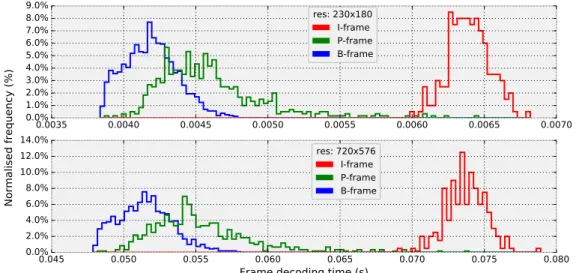
• Decoding time: Frame decoding execution cost can vary 2-3 times between consecutive frames in the same stream; however, variation between frames of the same type are small [11]. Decoding time is also generally proportional to resolution. Intra-prediction generally takes more computation time than inter-prediction; higher number of I-macroblocks in a frame can cause the decoding time to increase. I-frame decoding time varies least due to less coding options, and B-frames vary the most [60]. The execution time of certain functional components in the decoder (e.g. interpolation, entropy decoding, de-blocking filtering) can also vary significantly, depending on the type and size of macroblocks in a frame. Hence, the computation cost of video decoding cannot be known a priori.
• Timeliness:Timing requirements of a video decoding task is determined by the required
frame rate(i.e. how many frames need to be displayed per second). For example, a video decoder which has to perform at 25 frames per second (fps) has to decode and display a single frame within 0.04s (1/fps). For video streams that use bi-directional prediction (i.e. B-frames), a framere-orderingdelay is introduced to put the frames in the right order for displaying. The re-ordering process complicates real-time analysis of a video decoder as it becomes difficult to determine the decoding deadline of individual frames [60]. Using frame display deadlines implicitly to calculate the decoding deadlines as in [61], can lead to optimistic timing analysis.
• Arrival rate:The arrival rate of streaming video depends mainly on the video bitrate and delivery networks. If a video is encoded at a variable bit rate (VBR), the encoder would allow higher bitrates for more complex segments of the video stream and vice versa. VBR means the video stream data will be arriving at the input of the system at a variable rate. In practice the input could be more bursty in nature due to the variability in the transmission medium (e.g. the Internet). However, it is possible to set a maximum allowed bit rate when using VBR to offer a minimum inter-arrival time for packets [62]. Video traffic models which takes into account the non-deterministic behaviour of the transmission mediums and content delivery networks can be found in [63]; however an in-depth analysis is out of scope of this research.
• GoP-structure:Video encoders attempt to adapt the GoP structure and length to improve the coding efficiency based on the video sequence motion and scene change [44, 45]. B-frames are used to improve compression by taking advantage of temporal redundancy,
![Figure 2.7: High-level architecture of a 2D, 4x4, mesh NoC. Router architecture using virtual channels and priority based arbitration (adapted from [80])](https://thumb-us.123doks.com/thumbv2/123dok_us/1373146.2683865/33.892.180.788.140.435/figure-architecture-router-architecture-virtual-channels-priority-arbitration.webp)
![Figure 2.8: 72-core, Tilera Gx72 high level schematic showing memory hierarchy (taken from [4])](https://thumb-us.123doks.com/thumbv2/123dok_us/1373146.2683865/34.892.135.671.127.402/figure-tilera-level-schematic-showing-memory-hierarchy-taken.webp)

![Figure 5.5: Illustration of the GA pipeline from [172] adapted and integrated to the experimental design flow](https://thumb-us.123doks.com/thumbv2/123dok_us/1373146.2683865/101.892.211.770.416.701/figure-illustration-pipeline-adapted-integrated-experimental-design-flow.webp)