Incremental
Parallel and Distributed Systems
Thesis for obtaining the title of Doctor of Engineering Science of the
Faculty of Natural Science and Technology I of Saarland University
From
Pramod Kumar Bhatotia
Saarbrücken
Date of Colloquium: 07/04/2015
Dean of Faculty: Univ.-Prof. Dr. Markus Bläser Chair of the Committee: Prof. Dr. Matteo Maffei
Reporters
First Reviewer: Prof. Dr. Rodrigo Rodrigues Second Reviewer: Prof. Dr. Peter Druschel
Third Reviewer: Dr. Rebecca Isaacs
©2015
Pramod K. Bhatotia ALL RIGHTS RESERVED
ABSTRACT
Incremental computation strives for efficient successive runs of applications by re-executing only those parts of the computation that are affected by a given input change instead of recomputing everything from scratch. To realize the benefits of incremental computation, researchers and practitioners are developing new sys-tems where the application programmer can provide an efficient update mecha-nism for changing application data. Unfortunately, most of the existing solutions are limiting because they not only depart from existing programming models, but also require programmers to devise an incremental update mechanism (or a dy-namic algorithm) on a per-application basis.
In this thesis, we present incremental parallel and distributed systems that enable existing real-world applications to automatically benefit from efficient in-cremental updates. Our approach neither requires departure from current models of programming, nor the design and implementation of dynamic algorithms.
To achieve these goals, we have designed and built the following incremen-tal systems: (i) Incoop — a system for incremental MapReduce computation; (ii)
Shredder — a GPU-accelerated system for incremental storage; (iii) Slider — a
stream processing platform for incremental sliding window analytics; and(iv)iThreads — a threading library for parallel incremental computation. Our experience with
these systems shows that significant performance can be achieved for existing ap-plications without requiring any additional effort from programmers.
KURZDARSTELLUNG
Inkrementelle Berechnungen ermöglichen die effizientere Ausführung aufeinan-derfolgender Anwendungsaufrufe, indem nur die Teilbereiche der Anwendung erneut ausgefürt werden, die von den Änderungen der Eingabedaten betroffen sind. Dieses Berechnungsverfahren steht dem konventionellen und vollständig neu berechnenden Verfahren gegenüber. Um den Vorteil inkrementeller Berech-nungen auszunutzen, entwickeln sowohl Wissenschaft als auch Industrie neue Sys-teme, bei denen der Anwendungsprogrammierer den effizienten Aktualisierungsmech-anismus für die Änderung der Anwendungsdaten bereitstellt. Bedauerlicherweise lassen sich existierende Lösungen meist nur eingeschränkt anwenden, da sie das konventionelle Programmierungsmodel beibehalten und dadurch die erneute En-twicklung vom Programmierer des inkrementellen Aktualisierungsmechanismus (oder einen dynamischen Algorithmus) für jede Anwendung verlangen.
Diese Doktorarbeit stellt inkrementelle Parallele- und Verteiltesysteme vor, die es existierenden Real-World-Anwendungen ermöglichen vom Vorteil der inkre-mentellen Berechnung automatisch zu profitieren. Unser Ansatz erfordert weder eine Abkehr von gegenwärtigen Programmiermodellen, noch Design und Imple-mentierung von anwendungsspezifischen dynamischen Algorithmen.
Um dieses Ziel zu erreichen, haben wir die folgenden Systeme zur inkrementellen parallelen und verteilten Berechnung entworfen und implementiert: (i) Incoop — ein System für inkrementelle Map-Reduce-Programme; (ii) Shredder — ein GPU-beschleunigtes System zur inkrementellen Speicherung; (iii) Slider — eine Plat-tform zur Batch-basierten Streamverarbeitung via inkrementeller Sliding-Window-Berechnung; und (iv) iThreads — eine Threading-Bibliothek zur parallelen inkre-mentellen Berechnung. Unsere Erfahrungen mit diesen Systemen zeigen, dass unsere Methoden sehr gute Performanz liefern können, und dies ohne weiteren Aufwand des Programmierers.
PUBLICATIONS
Parts of the thesis have appeared in the following publications.
• "iThreads: A Threading Library for Parallel Incremental Computation". Pramod Bhatotia, Pedro Fonseca, Umut A. Acar, Bjoern Brandenburg, and Rodrigo Rodrigues. In proceedings of the 20th International Conference on Architectural Support for Programming Languages and Operating Systems (ASPLOS), 2015. • "Slider: Incremental Sliding Window Analytics". Pramod Bhatotia, Umut
A. Acar, Flavio Junqueira, and Rodrigo Rodrigues. Inproceedings of the 15th Annual ACM/IFIP/USENIX Middleware conference (Middleware), 2014.Best stu-dent paper award.
• "MapReduce for Incremental Computation". Pramod Bhatotia, Alexander Wieder, Umut A. Acar, and Rodrigo Rodrigues.Invited book chapter: Advances in data processing techniques in the era of Big Data, CRC Press, 2014.
• "Shredder: GPU-Accelerated Incremental Storage and Computation". Pramod Bhatotia, Rodrigo Rodrigues and Akshat Verma. In proceedings of the 10th USENIX conference on File and Storage Technologies (FAST), 2012.
• "Incoop: MapReduce for Incremental Computations". Pramod Bhatotia, Alexan-der WieAlexan-der, Rafael Pasquini, Rodrigo Rodrigues and Umut A. Acar. In pro-ceedings of the 2nd ACM Symposium on Cloud Computing (SoCC),2011.
• "Large Scale Incremental Data Processing with Change Propagation". Pramod Bhatotia, Alexander Wieder, Istemi Ekin Akkus, Rodrigo Rodrigues and Umut A. Acar. In USENIX Workshop on Hot Topics in Cloud Computing (HotCloud),
Additional publications published while at MPI-SWS.
• "Orchestrating the Deployment of Computations in the Cloud with Conduc-tor." Alexander Wieder, Pramod Bhatotia, Ansley Post and Rodrigo Rodrigues. Inproceedings of the 9th USENIX conference on Networked Systems Design and Implementation (NSDI),2012.
• "Performance Evaluation and Optimization of Random Memory Access on Multicores with High Productivity." Vaibhav Saxena, Yogish Sabharwal, Pramod Bhatotia. In proceedings of ACM/IEEE International Conference on High Perfor-mance Computing (HiPC),2010. Best paper award.
• "Reliable Data-Center Scale Computations." Pramod Bhatotia, Alexander Wieder, Rodrigo Rodrigues, Flavio Junqueira, and Benjamin Reed. In proceedings of the 4th International Workshop on Large Scale Distributed Systems and Middleware (LADIS),2010.
• "Conductor: Orchestrating the Clouds." Alexander Wieder, Pramod Bhato-tia, Ansley Post, and Rodrigo Rodrigues. proceedings of the 4th International Workshop on Large Scale Distributed Systems and Middleware (LADIS),2010. • "Brief Announcement: Modelling MapReduce for Optimal Execution in the
Cloud." Alexander Wieder, Pramod Bhatotia, Ansley Post, and Rodrigo Ro-drigues. Inproceedings of the 29th ACM SIGACT-SIGOPS symposium on Princi-ples of Distributed Computing (PODC),2010.
TABLE OF CONTENTS
LIST OF TABLES . . . xiv
LIST OF FIGURES . . . xv
1 Introduction . . . 1
1.1 The Promise of Incremental Computation. . . 1
1.2 The Inevitability of Parallel & Distributed Systems . . . 2
1.3 Thesis Research: Incremental Systems . . . 3
1.4 Self-Adjusting Computation. . . 4
1.5 Thesis Contributions . . . 5
1.6 Organization. . . 8
2 Incoop: Incremental Batch Processing . . . 9
2.1 Motivation . . . 9
2.2 Contributions . . . 10
2.3 Background . . . 12
2.3.1 MapReduce Programming Model . . . 12
2.3.2 Hadoop Architecture. . . 13
2.3.2.1 Hadoop Distributed File System . . . 13
2.3.2.2 Hadoop MapReduce Engine . . . 14
2.4 Overview . . . 14
2.4.1 Basic design . . . 15
2.4.2 Challenge: Transparency . . . 17
2.5 Incremental HDFS . . . 20
2.6 Incremental MapReduce. . . 22
2.7 Memoization Aware Scheduler . . . 26
2.8 Implementation. . . 28
2.9 Evaluation . . . 29
2.9.1 Applications and Data Generation . . . 29
2.9.2 Measurements . . . 30
2.9.3 Performance Gains . . . 32
2.9.4 Effectiveness of Optimizations . . . 33
2.9.5 Overheads. . . 35
2.10 Case Studies . . . 37
2.10.1 Incremental Log Processing . . . 37
2.10.2 Incremental Query Processing . . . 38
2.11 Related Work . . . 39
2.12 Limitations and Future Work . . . 42
2.13 Summary . . . 42
3 Shredder: Incremental Storage . . . 44
3.1 Motivation . . . 45
3.2 Contributions . . . 46
3.3 Background . . . 47
3.3.1 Content-based Chunking . . . 48
3.3.2 General-Purpose Computing on GPUs . . . 50
3.3.3 SDRAM Access Model . . . 51
3.4 Overview . . . 52
3.4.1 Basic GPU-Accelerated Framework. . . 53
3.5 Optimizations . . . 56
3.5.1 Device Memory Bottlenecks . . . 56
3.5.1.1 Concurrent Copy and Execution . . . 56
3.5.1.2 Circular Ring Pinned Memory Buffers . . . 59
3.5.2 Host Bottleneck . . . 61
3.5.3 Device Memory Conflicts . . . 63
3.6 Implementation. . . 66
3.6.1 Host-Only Chunking using pthreads . . . 66
3.6.2 Shredder Implementation . . . 67 3.6.2.1 Host Driver . . . 67 3.6.2.2 GPU Kernel. . . 68 3.7 Evaluation . . . 69 3.8 Case Studies . . . 70 3.8.1 GPU-accelerated Incremental HDFS . . . 70
3.8.2 GPU-accelerated Incremental Cloud Backup . . . 72
3.9 Related Work . . . 75
3.10 Limitations and Future Work . . . 78
3.11 Summary . . . 78
4 Slider: Incremental Stream Processing . . . 79
4.1 Motivation . . . 79
4.2 Contributions . . . 81
4.3 Overview . . . 82
4.3.1 Strawman Design . . . 83
4.3.2 Adding the Contraction Phase . . . 84
4.3.3 Efficiency of the Contraction Tree . . . 86
4.4.1 Folding Contraction Tree. . . 87
4.4.2 Randomized Folding Tree. . . 89
4.5 Split Processing Algorithms . . . 91
4.5.1 Rotating Contraction Trees . . . 92
4.5.2 Coalescing Contraction Trees . . . 94
4.6 Query Processing: Multi-Level Trees . . . 96
4.7 Implementation. . . 97 4.8 Evaluation . . . 98 4.8.1 Experimental Setup . . . 99 4.8.2 Performance Gains . . . 100 4.8.3 Effectiveness of Optimizations . . . 103 4.8.4 Overheads. . . 108
4.8.5 Analytical Comparison with memoization based ap-proach and batch-based stream processing . . . 109
4.9 Case Studies . . . 110
4.9.1 Information Propagation in Twitter . . . 111
4.9.2 Monitoring of a Networked System . . . 112
4.9.3 Accountability in Hybrid CDNs . . . 113
4.10 Related Work . . . 115
4.11 Limitations and Future Work . . . 117
4.12 Summary . . . 119
5 iThreads: Incremental Multithreading . . . 120
5.1 Motivation . . . 120
5.2 Contributions . . . 122
5.3 Overview . . . 123
5.3.1 iThreads Overview . . . 123
5.3.3 Example . . . 125
5.4 System Model . . . 127
5.5 Algorithms . . . 129
5.5.1 Concurrent Dynamic Dependence Graph (CDDG) . . . 129
5.5.2 Algorithm for the Initial Run . . . 131
5.5.3 Algorithm for the Incremental Run . . . 133
5.6 Implementation. . . 137
5.6.1 iThreads Library: Memory Subsystem . . . 138
5.6.2 iThreads Library: Recorder and Replayer . . . 140
5.6.3 iThreads Library: OS Support . . . 141
5.6.4 iThreads Memoizer . . . 142 5.7 Evaluation . . . 143 5.7.1 Performance Gains . . . 145 5.7.2 iThreads Scalability . . . 147 5.7.3 Overheads. . . 149 5.8 Case Studies . . . 152 5.9 Related Work . . . 152
5.10 Limitations and Future Work . . . 154
5.11 Summary . . . 155
6 Conclusions . . . 156
LIST OF TABLES
2.1 Applications used in the performance evaluation of Incoop . . . 30
2.2 Results for incremental query processing . . . 39
3.1 Performance characteristics of the GPU (NVidia Tesla C2050) . . . 54
3.2 Host spare cycles per core due to asynchronous data-transfer and kernel launch. . . 61
4.1 Read time reduction with memory caching . . . 107
4.2 Summary of the Twitter data analysis . . . 112
4.3 Summary of the Glasnost network monitoring data analysis . . . 112
4.4 Akamai NetSession data analysis summary. . . 114
LIST OF FIGURES
2.1 Basic design of Incoop. . . 16
2.2 Chunking strategies in HDFS and Inc-HDFS . . . 20
2.3 Incremental Map tasks . . . 22
2.4 Stability of the Contraction phase . . . 25
2.5 Co-Matrix: Time versus input size . . . 33
2.6 Performance gains comparison between Contraction and task variants . . . 34
2.7 Effectiveness of scheduler optimizations. . . 35
2.8 Overheads imposed by Incoop in comparison to Hadoop . . . 36
2.9 Speedup for incremental log processing. . . 38
3.1 A simplified view of the GPU architecture. . . 51
3.2 Basic workflow of Shredder . . . 52
3.3 Bandwidth test between host and device. . . 56
3.4 Concurrent copy and execution. . . 57
3.5 Normalized overlap time of communication with computa-tion with varied buffer sizes for 1GB data. . . 58
3.6 Comparison of allocation overhead of pageable with pinned memory region. . . 59
3.7 Ring buffer for the pinned memory region. . . 60
3.8 Multi-staged streaming pipeline. . . 62
3.9 Speedup for streaming pipelined execution. . . 63
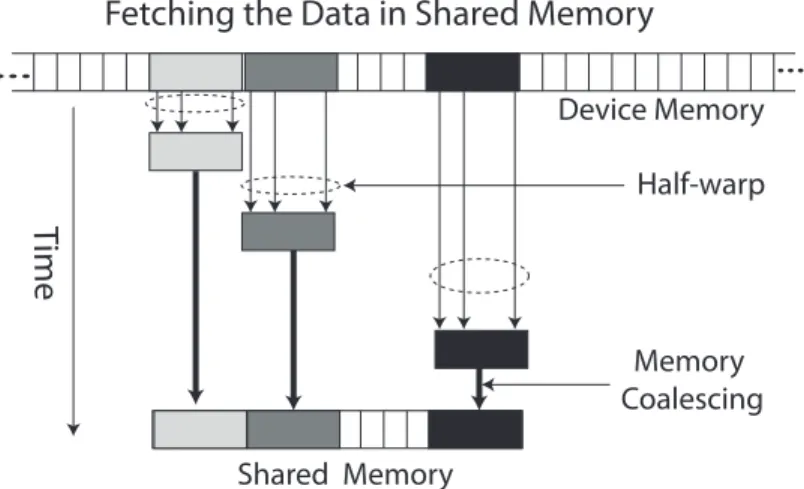
3.10 Memory coalescing to fetch data from global device memory to the shared memory. . . 64
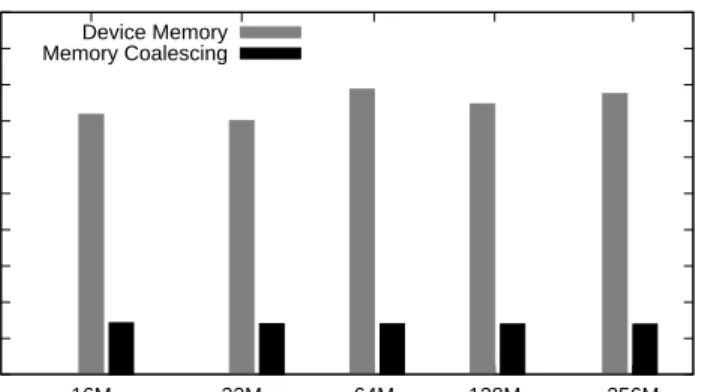
3.11 Normalized chunking kernel time with varied buffer-sizes for 1 GB data. . . 65
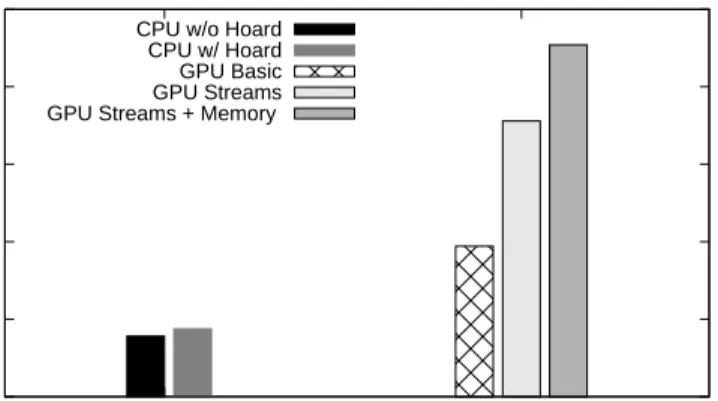
3.12 Throughput comparison of content-based chunking between CPU and GPU versions. . . 69
3.13 Incremental computation using Shredder. . . 71
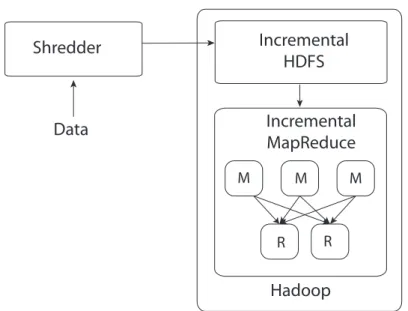
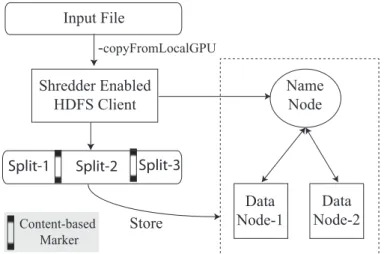
3.14 Shredder enabled chunking in Inc-HDFS. . . 72
3.15 A typical cloud backup architecture . . . 73
3.16 GPU-accelerated consolidated backup setup . . . 74
3.17 Backup bandwidth improvement due to Shredder with vary-ing image similarity ratios . . . 76
4.1 Strawman design and contraction phase . . . 83
4.2 Example of folding contraction tree . . . 88
4.3 Example of randomized folding tree . . . 91
4.4 Example of rotating contraction trees . . . 93
4.5 Example of coalescing contraction trees . . . 95
4.6 Slider architecture . . . 97
4.7 Performance gains of Slider compared to recomputing from scratch for the append-only windowing mode . . . 100
4.8 Performance gains of Slider compared to recomputing from scratch for the fixed-width windowing mode . . . 101
4.9 Performance gains of Slider compared to recomputing from scratch for the variable-width windowing mode . . . 101
4.10 Performance breakdown for work . . . 102
4.11 Performance gains of Slider compared to the memoization based approach (the strawman design) for the append-only windowing mode . . . 104
4.12 Performance gains of Slider compared to the memoization based approach (the strawman design) for the fixed-width windowing mode . . . 104
4.13 Performance gains of Slider compared to the memoization based approach (the strawman design) for the variable-width windowing mode . . . 105
4.14 Effectiveness of Split processing . . . 105
4.16 Randomized folding tree . . . 107
4.17 Performance overheads of Slider for the initial run . . . 108
4.18 Space overheads of Slider . . . 109
4.19 Analytical comparison of Slider with batch-based stream pro-cessing, memoization-based approach, and re-computation from scratch . . . 111
5.1 How to run an executable using iThreads . . . 124
5.2 A simple example of shared-memory multithreading . . . 125
5.3 For the incremental run, some cases with changed input or thread schedule (changes are marked with *) . . . 125
5.4 State transition for thunks during incremental run. . . 135
5.5 iThreads architecture (components are in grey) . . . 138
5.6 Overview of the recorder . . . 139
5.7 Performance gains of iThreads with respect to pthreads for the incremental run . . . 143
5.8 Performance gains of iThreads with respect to Dthreads for the incremental run . . . 144
5.9 Scalability with data (work and time speedups) . . . 145
5.10 Scalability with work . . . 146
5.11 Scalability with input change compared to pthreads for 64 threads. . . . 147
5.12 Performance overheads of iThreads with respect to pthreads for the initial run . . . 148
5.13 Performance overheads of iThreads with respect to Dthreads for the initial run . . . 149
5.14 Work overheads breakdown w.r.t. Dthreads . . . 150
CHAPTER 1
Introduction
1.1
The Promise of Incremental Computation
Many real-world applications are inherently used in an incremental workflow, that is, they are invoked repeatedly with only small changes in input. Common exam-ples span a wide spectrum of applications including scientific simulations, large-scale data analytics, reactive systems, robots, traffic control systems, scheduling systems, etc. All these applications naturally arise in a number of domains, in-cluding software systems, graphics, robotics, databases, and networked systems. These applications interact with the physical world observing their input data con-tinuously evolving over time, causing incremental and continuous modifications to the property being computed. Therefore, these applications must respond to such incremental modifications correctly and efficiently.
Such applications, when confronted with localized modifications to the input, often require only small modifications to the output. Therefore, if we have tech-niques for quickly identifying the parts of the output that are affected by the mod-ifications and updating them while reusing the rest of the output, we will be able to incrementally update the output in a significantly more efficient (and thus faster and cheaper) way than recomputing the entire output from scratch [130].
To realize the benefits of incremental computation, researchers and practition-ers are developing new systems where programmpractition-ers can provide efficient update
mechanism for changing application data. These systems for incremental compu-tation can be significantly more efficient than recomputing from scratch. How-ever, most of the existing approaches have two major limitations: first, these sys-tems depart from existing programming models, which prevents existing, non-incremental programs from taking advantage of these techniques. Second, and more importantly, these systems require programmers to develop efficient incre-mental update mechanisms (or adynamic algorithm) on a per-application basis.
While dynamic algorithms can be asymptotically more efficient than their con-ventional non-dynamic versions, they can be difficult to design, implement, and adapt even for simple problems because of their highly specialized nature [55, 60, 70, 71, 78, 83, 118]. Furthermore, dynamic algorithms are overwhelmingly de-signed for the uniprocessor computing model, and thus cannot take advantage of the parallelism offered in parallel and distributed platforms, which are increas-ingly important in today’s computing world, as motivated next.
1.2
The Inevitability of Parallel & Distributed Systems
Parallel and distributed computing is the most prominent way of computing in the modern environment. Clusters of multicore nodes have become ubiquitous, powering not only some of the most popular consumer applications — Internet services such as web search and social networks — but also a growing number of scientific and enterprise workloads. This computing model is a departure from the uniprocessor computing model where programs run on a single core machine. This shift towards adopting parallel and distributed computing frameworks is driven mainly by a continuous increase in the demand for computing cycles and I/O bandwidth to support these modern applications. The uniprocessor comput-ing model is unable to meet these requirements mainly because increascomput-ing a
pro-cessor’s speed to get a boost in performance leads to the heat dissipation problem. Also, the I/O bandwidth is limited by available disk and network bandwidth per machine.
To overcome these limitations, the computing platforms are being designed to increase the parallelism byscaling-them-upas well as byscaling-them-out. In the scaled-up architecture each node consists of a diverse mix of 100s of cores com-prising of CPUs and GPUs. These cores operate at a lower frequency to minimize the heat dissipation problem. The scaled-out architecture consists of tens of thou-sands of those nodes with their corresponding networking and storage subsystems to facilitate I/O parallelization. Thus, the combination of parallel and distributed computing platform provides even more compute cycles and also mitigating the I/O bottlenecks.
The parallel and distributed computing platforms comes with several chal-lenges requiring programmers to manage parallelization, synchronization, load-balancing, fault-tolerance, distributing the data, and communication. To reduce these complexity, programming models such as MapReduce [67], andpthread[15]. Due to the growing importance of these computing frameworks, in this work, we focus on building systems to support incremental computation in parallel and dis-tributed systems.
1.3
Thesis Research: Incremental Systems
Thesis statement Incremental systems enable practical, automatic, and efficient in-cremental computation in real-world parallel and distributed computing.
To this end, our work targets building incremental systems that require neither a radical departure from current models of programming nor complex,
application-specific dynamic algorithms (which, to reiterate, are challenging to design and implement).
The focus of our work is on two common computing paradigms, namely par-allel and distributed computing. In particular, we focus on large-scale data pro-cessing for distributed incremental computation, and multithreaded programs for parallel incremental computation. To establish the practicality and benefit of the envisioned incremental parallel and distributed frameworks, a crucial aspect of this work is to design and implement incremental systems, and then evaluate the solution with widely applicable case studies to demonstrate the benefits.
1.4
Self-Adjusting Computation
Our approach is to shift the burden of reasoning about how to efficiently process incremental updates from the programmer to the system itself by building on the principles that were developed in the field of self-adjusting computation [24, 25, 27, 59, 87, 88, 103, 104] (a sub-field of programming languages research). The key idea behind self-adjusting computation is to divide a computation into sub-computations, and maintain a dependence graph between sub-computations. Given changes in the input data, a change-propagation algorithm is used to update the output by identifying the parts of the computation that are affected by the changes and rebuilding only those parts. More precisely, self-adjusting computation com-bines the following three techniques to incrementally update the output: dynamic dependence graph, change propagation, and memoization.
Thedynamic dependence graphor DDG can be viewed as a representation of the data and control dependences in a computation. The DDG of a program is built as the program is executed by tracking the control and data flow operations, and using it to update the computation and the output when the inputs are modified.
Memoizationcaches the output of the sub-computations to avoid re-execution.
Fi-nally, thechange propagation mimics a complete re-execution of the program with
the modified data, but only re-executes parts of the computation that depend on the modification. Conceptually similar to cell updates in spreadsheets, the change propagation algorithm takes full advantage of previously computed results rather than re-executing everything from scratch on each input change.
Although the work on self-adjusting computation offers a general-purpose framework for developing computations that can perform incremental updates efficiently, it has not been applied to parallel and distributed systems. In this the-sis, we extend the work on self-adjusting computation to support parallel and dis-tributed computing.
1.5
Thesis Contributions
In this thesis, we present the design and implementation of the following incremen-tal systems to enable practical, transparent, and efficient incremenincremen-tal computation for real-world parallel and distributed computing.
Incoop is a system for incremental MapReduce computation [51, 53, 52]. Incoop
transparently detects changes between two files that are used as inputs to con-secutive MapReduce jobs, and efficiently propagates those changes until the new output is produced. The design of Incoop is based on memoizing the results of previously run tasks, and reusing these results whenever possible. Doing this efficiently introduces several technical challenges that are overcome with novel techniques, such as a large-scale storage system called Inc-HDFS that efficiently computes deltas between two inputs, a contraction phase for fine-grained updates, and a memorization-aware scheduling algorithm.
Shredder is a GPU-accelerated system for incremental storage [50]. Shredder was
initially designed to improve Inc-HDFS, which has high computational require-ments for detecting duplicate content using content-based chunking [114]. To ad-dress the computational bottleneck, we designed Shredder, a high performance content-based chunking framework for identifying deltas between two inputs in Inc-HDFS. Shredder exploits the massively parallel processing power of GPUs to overcome the CPU bottlenecks of content-based chunking in a cost-effective man-ner. Shredder provides several novel optimizations aimed at reducing the cost of transferring data between host (CPU) and GPU, fully utilizing the multicore architecture at the host, and reducing GPU memory access latencies. We used shredder to implement a GPU-accelerated Inc-HDFS for incremental MapReduce computation. In addition, we show that Shredder is a generic system to accelerate incremental storage based on data deduplication
Slider is a batched stream processing platform for incremental sliding window
computation [47, 48]. Slider does not require programmers to explicitly manage the intermediate state for overlapping windows, allowing the existing single-pass applications to incrementally update the output every time the computation win-dow slides. The design of Slider incorporates self-adjusting contraction trees, a set of data structures and algorithms for transparently updating the output of data-parallel sliding window computations as the window moves, while reusing, to the extent possible, results from prior computations. Self-adjusting contraction trees organize sub-computations into self balancing trees, with a structure that is better suited to each type of sliding window computation (append-only, fixed-width, or variable-width slides). Furthermore, they enable a split processing mode, where a background processing leverages the predictability of input changes to pave the way for a more efficient foreground processing when the window slides. We
also provide an extension of self-adjusting contraction trees to handle multiple-job workflows such as query processing.
iThreads is a threading library to support parallel incremental computation tar-geting unmodified C/C++ pthread-based multithreaded programs [49]. iThreads supports shared-memory multithreaded programs: it can be used as a replace-ment for pthreads by a simple exchange of dynamically linked libraries, with-out even recompiling the application code. To enable such an interface, we de-signed algorithms and an implementation to operate at the compiled binary code level by leveraging operating system mechanisms encapsulated in a dynamically linkable shared library. iThreads makes use of parallelalgorithms for incremental multithreading. The parallel algorithms record the intra- and inter-thread control and data dependencies using a concurrent dynamic data dependency graph, and
use the graph to incrementally update the output as well as the graph on input changes.
The newly proposed systems for incremental computation are limiting be-cause they not only require substantial programming effort, but also lose backwards-compatibility with widely deployed systems. Thus, there is still room for an im-provement that can ignite the widespread adoption of these newly proposed sys-tems. Our incremental systems push the limits of the state-of-the-art by applying the principles and lessons learned in prior algorithms- and programming-language-centric work to parallel and distributed systems, with the goal of buildingpractical
incremental frameworks that enable existing real-world applications to automati-cally benefit from efficient incremental updates. Our approach neither requires de-parture from current models of programming, nor the invention and implementa-tion of applicaimplementa-tion-specific dynamic algorithms for incremental computaimplementa-tion. Our experience with these systems shows that our techniques can yield very good
per-formance, both in theory and practice, without requiring programmers to write any special-purpose algorithms for incremental computation.
1.6
Organization
The remainder of the thesis is organized as follows.
In Chapter 2, we present the design and implementation of Incoop. In Chapter 3, we present the design and implementation of Shredder. In Chapter 4, we present the design and implementation of Slider. In Chapter 5, we present the design and implementation of iThreads. Finally, in Chapter 6, we conclude.
CHAPTER 2
Incoop: Incremental Batch Processing
In this chapter, we describe the design, implementation, and evaluation of Incoop, a MapReduce framework for incremental computation. Incoop detects changes to the input and automatically updates the output by employing an effi-cient, fine-grained result reuse mechanism.
This chapter is organized as follows. We first motivate the design of Incoop in Section 2.1. We next briefly highlight the contributions of Incoop in Section 2.2. Thereafter, we present a brief background MapReduce in Section 2.3. We next present an overview of Incoop in Section 2.4. The system design is detailed in Sections 2.5, 2.6, and 2.7. We present an experimental evaluation of Incoop in Section 2.9, and case-studies in Section 2.10. We present the related work in Sec-tion 2.11. LimitaSec-tions and conclusion are discussed in SecSec-tion 2.12 and SecSec-tion 2.13, respectively.
2.1
Motivation
Distributed processing of large data sets has become an important task in the life of various companies and organizations, for whom data analysis is an important vehicle to improve the way they operate. This area has attracted a lot of attention from both researchers and practitioners over the last few years, particularly after
the introduction of the MapReduce paradigm for large-scale parallel data process-ing [67].
A usual characteristic of the data sets that are provided as inputs to large-scale data processing jobs is that they do not vary dramatically over time. Instead, the same job is often invoked consecutively with small changes in this input from one run to the next. For instance, researchers have reported that the ratio between old and new data when processing consecutive web crawls may range from 10 to 1000X [110].
Motivated by this observation, there have been several proposals for large-scale incremental data processing systems, such as Percolator [121] or CBP [110],
to name a few early and prominent examples. In these systems, the programmer is able to devise an incremental update handler (or a dynamic algorithm), which can store state across successive runs, and contains the logic to update the output as the program is notified about input changes. While this approach allows for significant improvements when compared to the “single shot” approach, i.e., re-processing all the data each time that part of the input changes or that inputs are added and deleted, it also has the downside of requiring programmers to adopt a new programming model and API. This has two negative implications. First, there is the programming effort to port a large set of existing applications to the new programming model. Second, it is often difficult to devise a dynamic algorithm for incrementally updating the output as the input changes.
2.2
Contributions
In this chapter, we present the design and implementation of Incoop, a system for large-scale incremental MapReduce computation [53]. Incoop extends the Hadoop
open source implementation of the MapReduce paradigm to run unmodified MapRe-duce programs in an incremental way.
The idea behind Incoop is to enable the programmer to automatically incre-mentalize existing MapReduce programs without the need to make any modifica-tions to the code. To this end, Incoop records information about executed MapRe-duce tasks so that they can be reused in future MapReMapRe-duce computations when possible.
The basic approach taken by Incoop consists of (1) splitting the computation into sub-computations, where the natural candidate for a sub-computation is a MapReduce task; (2) memoizing the inputs and outputs of each sub-computation; (3) in an incremental run, checking the inputs to a sub-computation and using the memoized output without rerunning the task when the input remains unchanged. Despite being a good starting point, this basic approach has several shortcomings that motivated us to introduce several technical innovations in Incoop, namely:
• Incremental HDFS. We introduce a file system called Inc-HDFS that pro-vides a scalable way of identifying the deltas in the inputs of two consecutive job runs. This reuses an idea from the LBFS local file system [114], which is to avoid splitting the input into fixed-size chunks, and instead split it based on the contents such that small changes to the input keep most chunk bound-aries. The new file system is able to achieve a large reuse of input chunks while maintaining compatibility with HDFS, which is the most common in-terface to provide the input to a job in Hadoop.
• Contraction phase. To avoid rerunning a large Reduce task when only a small subset of its input changes, we introduce a new phase in the MapRe-duce framework called the Contraction phase. This consists of breaking up the Reduce task into smaller sub-computations that form an inverted tree,
such that, when a small portion of the input changes, only the path from the corresponding leaf to the root needs to be recomputed.
• Memoization-aware scheduler. We modified the scheduler of Hadoop to
take advantage of the locality of memoized results. The new scheduler uses a work stealing strategy to decrease the amount of data movement across ma-chines when reusing memoized outputs, while still allowing tasks to execute on machines that are available.
We implemented Incoop by extending Hadoop and evaluated it using five MapReduce applications. We also employed Incoop to demonstrate two important use cases of incremental processing:incremental log processing, where we use Incoop to build a framework to incrementally process logs as more entries are added to them; andincremental query processing, where we layer the Pig framework on top
of Incoop to enable relational query processing on continuously arriving data.
2.3
Background
We first present a brief background on MapReduce programming model and the associated run-time system.
2.3.1
MapReduce Programming Model
The MapReduce programming model, and a framework that implements it, was first presented by Google [67] to simplify the development and deployment of large-scale data-parallel applications. The framework provides two basic program-ming constructs: MapandReduce. TheMapfunction takes a set of input values and maps each value to a set of key-value tuples. TheReducefunction takes a key and
de-scribe Hadoop1, an open-source implementation of the MapReduce programming framework, that forms the basis of our system.
2.3.2
Hadoop Architecture
Hadoop provides a programming and runtime environment for developing and deploying MapReduce programs on large clusters. The framework consists of two main components: theHadoop distributed file system(HDFS) and theHadoop MapRe-duce engine, which we describe next.
2.3.2.1 Hadoop Distributed File System
Large-scale data-parallel applications often process and generate tremendous amounts of data, and managing data storage at that scale raises its own challenges. To ad-dress these, the Hadoop storage component provides the Hadoop Distributed File System(HDFS) that is specifically engineered to handle huge amounts of data, such as the data that is used as input, or produced as the output of MapReduce jobs.
In HDFS, the data is distributed across multiple Data-nodes, which are typ-ically the same nodes that also execute the MapReduce jobs. To cope with the failure of an individualData-node, data is replicated among a configurable number
of different nodes. Files in HDFS are split into smaller chunks of fixed size (e.g.,
64MB). To locate data blocks in HDFS, a centralized directory service running on theName-nodeenables clients to look up and access data. To cut the overhead for maintaining data consistency, HDFS does not allow for modifying data once writ-ten and provides only append-only interface. This design decision is driven by the fact that MapReduce jobs only write data once and do not modify it afterwards, since intermediate and final results of the jobs are written into new files.
2.3.2.2 Hadoop MapReduce Engine
TheHadoop MapReduce engineimplements the logic to coordinate the execution of a MapReduce job on a cluster and distributes tasks to nodes. Users submit jobs to theJob Trackerthat splits the job into multipleTasks, which can either consist of ap-plying theMapfunction to a specific partition of the input, or applying theReduce
function to a key and the associated values generated by the allMapfunctions. The
job execution is divided into the Map phasewhere all the Map tasks are executed,
and theReduce phase, which starts upon completion of the Map phase, and where the output of all the Map tasks is processed by theReducetasks.
TheJob Trackeris responsible for keeping track of cluster utilization and progress of the job, and performs all the scheduling decisions that determine where each task is run. The granularity ofMap tasks is determined by the fact that eachTask
processes a file split(one or more chunk of the input file). On the other hand, the granularity of Reducetasks depends only on the input to the computation, given
that eachReducetask processes a single key and all corresponding values that were
emitted by the union of all Map tasks.
2.4
Overview
We present first a basic design that we use as a starting point, highlight the limita-tions of this basic design, the challenges in overcoming them, and briefly overview the main ideas behind Incoop, which addresses the limitations of the basic design. Our basic strategy is to adapt the principles of self-adjusting computation to the MapReduce paradigm, and in particular to Hadoop.
2.4.1
Basic design
Our goal is to design a system for large-scale incremental data processing that is able to leverage the performance benefits of incremental computation, while also being transparent, meaning that it does not require changes to existing programs.
To achieve this goal, we apply the principles of self-adjusting computation to the MapReduce paradigm. To remind the reader, self-adjusting computation [24, 26, 25, 87, 59] offers a solution to the incremental computation problem by enabling any computation to respond to changes in its data by efficiently recomputing only the subcomputations that are affected by the changes. To this end, a self-adjusting computation tracks dependencies between the inputs and outputs of subcompu-tations, and, in incremental runs, only rebuilds subcomputations affected (transi-tively) by modified inputs. To identify the affected subcomputations, the approach represents a computation as a dependency graph of subcomputations, where two sub-computations are data-dependent if one of them uses the output of the other as input and control-dependent if one takes place within the dynamic scope of another. Subcomputations are also memoized based on their inputs to enable reuse even if they are control-dependent on some affected subcomputation. Given the “delta”, the modifications to the input, a change-propagation algorithm pushes the modifications through the dependency graph, rebuilding affected subcompu-tations, which it identifies based on both data and control dependencies. Before rebuilding a subcomputation, change propagation recovers subcomputations that can be re-used, even partially, by using a computation memoization technique that remembers (and re-uses) not just input-output relationships but also the depen-dency graphs of memoized subcomputations [25].
In order to apply self-adjusting computation techniques to the Map-Reduce paradigm, we first need to decide what forms a sub-computation. The natural
MEMOIZATION SERVER
Chunk-1 Chunk-2 Chunk-3
INCREMENTAL HDFS
Map-1 Map-2 Map-3
Reduce-1 Reduce-2
Query location of sub-computations
Figure 2.1: Basic design of Incoop.
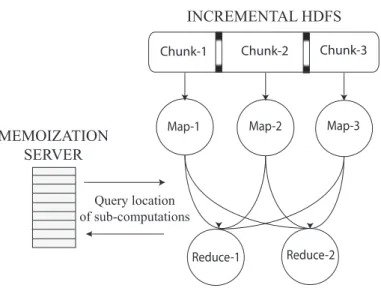
candidate is to use Map and Reduce tasks as sub-computations; this makes it pos-sible to view the data-flow graph of the MapReduce job as the dependency graph. Since the MapReduce framework implicitly keep track of this graph when imple-menting the data movement and synchronization between the various tasks, the dependency graph also captures the control dependencies.
This decision leads to our basic design, which is shown in Figure 2.1. In this design, the MapReduce scheduler orchestrates the execution of every MapReduce job normally, by spawning and synchronizing tasks and performing data move-ment as in a normal MapReduce execution. To record and update the dependency graph implicitly, our design includes a memoization server that stores a mapping from the input of a previously run task to the location of the corresponding mem-oized output. When a task completes, its output is memmem-oized persistently, and a mapping from the input to the location of the output is stored in the memoization server. Then, during an incremental run, when a task is instantiated, the memoiza-tion server is queried to check if the inputs to the task match those of a previous run. If so, the system reuses the outputs from the previous run. Otherwise, the
task runs normally and the mapping from its input to the location of the newly produced output is stored in the memoization server.
This basic design raises a series of challenges, which we describe next. In subsequent sections, we describe our key technical contributions that we propose to address these challenges.
2.4.2
Challenge: Transparency
Self-adjusting computation requires knowing the modifications to the input in or-der to update the output. To this end, it requires a new interface for making changes to the input, so that the edits, which are clearly identified by the inter-face, can be used to trigger an incremental update. We wish to achieve the effi-ciency benefits of self-adjusting computation transparently without requiring the
programmer to change the way they run MapReduce computations. This goal seems to conflict with the fact that HDFS (the system employed to store inputs to MapReduce computations in Hadoop) is an append-only file system, making it im-possible to convey input deltas (other than appends). To overcome this challenge, we store the inputs and outputs of consecutive runs in separate HDFS files and compute a delta between two HDFS files in a way that is scalable and performs well.
2.4.3
Challenge: Efficiency
To achieve efficient incremental updates, we must ensure that MapReduce compu-tations remain stable under small changes to their input, meaning that, when exe-cuted with similar inputs, many tasks are repeated and their results can be reused. To define stability more precisely, consider performing MapReduce computations with inputs I and I′ and consider the respective set of tasks that are executed, de-notedTandT′. We say that a taskt∈ T′is notmatchedift6∈ T, i.e., the task that is
performed with input I′ is not performed with the input I. We say that a
MapRe-duce computation is stable if the time required to execute the unmatched tasks is
small, where small can be more precisely defined as sub-linear in the size of the input.
In the case of MapReduce, stability can be affected by several factors, which we can group into the following two categories: (a) making a small change to the in-put can change the inin-put to many tasks, causing these tasks to become unmatched; (b) even if a small number of tasks is unmatched, these tasks can take a long time to execute. To address these issues, we introduce techniques for (1) performing a stable input partitioning; (2) controlling the granularity and stability of both Map and Reduce tasks; and (3) finding efficient scheduling mechanisms to avoid unnec-essary movement of memoized data.
Stable input partitioning. To see why using HDFS as an input to MapReduce
jobs leads to unstable computations, consider inserting a single data item in the middle of an input file. Since HDFS files are partitioned into fixed-sized chunks, this small change will shift each partition point following the input change by a fixed amount. If this amount is not a multiple of the chunk size, all subsequent Map tasks will be unmatched. (On average, a single insert will affect half of all Map tasks.) The problem gets even more challenging when we consider more complex changes, like the order of records being permuted; such changes can be common, for instance, if a crawler uses a depth-first strategy to crawl the web, and a single link change can move the position of an entire subtree in the input file. In this case, using standard algorithms to compute the differences between the two input files is not viable, since this would require running a polynomial-time algorithm (e.g., an edit-distance algorithm). We explain how our new file system called Inc-HDFS leads to stable input partitioning without compromising efficiency in Section 2.5.
Granularity control. A stable partitioning leads directly to the stability of Map
tasks. The input to the Reduce tasks, however, is determined only by the outputs of the Map tasks, since each Reduce task processes all values produced in the Map phase and associated with a given key. Consider, for instance, the case when a single key-value pair is added to a Reduce task that processes a large number of values (e.g., linear in the size of the input). This is problematic since it causes the entire task to be re-computed. Furthermore, even if we found a way of dividing large Reduce tasks into multiple smaller tasks, this per se would not solve the problem, since we would still need to aggregate the results of the smaller tasks in a way that avoids a large recomputation. Thus, we need a way to (i) split the Reduce task into smaller tasks and (ii) eliminate potentially long (namely linear-size) dependencies between these smaller tasks. We solve this problem with a new Contraction phase, where Reduce tasks are broken into sub-tasks organized in a tree. This breaks up the Reduce task while ensuring that long dependencies between tasks are not formed, since all paths in the tree will be of logarithmic length. Section 2.6 describes our proposed approach.
Scheduling. To avoid a large movement of memoized data, it is important to schedule a task on the machine that stores the memoized results that are being reused. To ensure this, we introduce a modification to the scheduler used by Hadoop, in order to incorporate a notion ofaffinity. The new scheduler takes into
account affinities between machines and tasks by keeping a record of which nodes have executed which tasks in previous runs. This allows for scheduling tasks in a way that decreases the movement of memoized results, but at the cost of a poten-tial degradation of job performance due to stragglers [150]. This is because a strict affinity of tasks results in deterministic scheduling, which prevents a lightly loaded node from performing work when the predetermined node is heavily loaded. Our
chunk-1 chunk-2 chunk-3
Fixed-size Chunking HDFS
Input File
(a) Fixed-size chunking in HDFS
Content-based Chunking Input File Inc-HDFS Content-based Marker
chunk-1 chunk-2 chunk-3
(b) Content-based chunking in Inc-HDFS
Data-Modification in chunk-2
Inc-HDFS
New chunk
chunk-1 chunk-2 chunk-3
chunk-1 chunk-4 chunk-3
(c) Example of stable partitioning
Figure 2.2: Chunking strategies in HDFS and Inc-HDFS
scheduler therefore needs to strike a balance between work stealing and affinity of memoized results. Section 2.7 describes our modified scheduler.
2.5
Incremental HDFS
In this section we present Incremental HDFS (Inc-HDFS), a distributed file system that enables stable incremental computations in Incoop, while keeping the inter-face provided by HDFS. Inc-HDFS builds on HDFS, but modifies the way that files are partitioned into chunks to use content-based chunking, a technique that was introduced in LBFS [114] for data deduplication. At a high-level, content-based chunking defines chunk boundaries based on finding certain patterns in the input, instead of using fixed-size chunks. As such, insertions and deletions cause small changes to the set of chunks. In the context of MapReduce, this ensures that the input to Map tasks remains mostly unchanged, which translates into a stable re-computation. Figure 2.2 illustrates the differences in the strategies for determining chunk boundaries in HDFS and Inc-HDFS. To perform content-based chunking, we scan the entire file, examining the contents of a fixed-width window whose
ini-tial position is incremented one byte at a time. For each window, we compute its Rabin fingerprint, and if the fingerprint matches a certain pattern (called amarker)
we place a chunk boundary at that position. (We explain how the marker is se-lected in § 3.3.) In addition, this approach is extended to avoid creating chunks that are too small or too large, which could affect the overheads and load balanc-ing properties of MapReduce. (Note that all the system designer can tune is the likelihood of finding a marker, but the actual spacing depends on the input.) This is achieved by setting minimum and maximum chunk sizes: after we find a marker
mi at position pi, we skip a fixed offset Oand continue to scan the input after po-sition pi+O. In addition, we bound the chunk length by setting a marker after
M content bytes even if no marker is found. Despite the possibility of affecting stability in rare cases, e.g., when skipping the offset leads to skipping disjoint sets of markers in two consecutive runs, we found this to be a very limited problem in practice.
An important design decision is whether to perform chunking during the cre-ation of the input or when the input is read by the Map task. We chose the former because the cost of chunking can be amortized when chunking and producing the input data are done in parallel. This is relevant in cases where the generation of input data is not limited by the storage throughput.
In order to parallelize the chunking process on multicore machines, our imple-mentation uses multiple threads, each of which starts the search for the marker at a different position. The markers that each thread finds cannot be used immedi-ately to define the chunk boundaries, since some of them might have to be skipped due to the minimum chunk size. Therefore, we collect the markers in a centralized list, and scan the list to determine which markers are skipped; the remaining ones form the chunk boundaries. We next describe, how the MapReduce framework uses these chunks to control the granularity of the Map phase.
Job Tracker
Execute Job
Map-1 Map-2 Map-3
chunk-1 chunk-2 chunk-3
chunk-1 chunk-2 chunk-3
(a) Initial run
Execute Job
Map-1 Map-2
Job Tracker
Map-3 chunk-1 chunk-4 chunk-3
chunk-1 chunk-4 chunk-3
(b) Incremental run Figure 2.3: Incremental Map tasks
2.6
Incremental MapReduce
This section presents our design for incremental MapReduce computations. We split the presentation by describing the Map and Reduce phases separately.
Incremental Map. For the Map phase, the main challenges have already been ad-dressed by Inc-HDFS, which partitions data in such a way that the input to Map tasks ensures stability and also allows for controlling the average granularity of the input that is provided to these tasks. In particular, this granularity can be adjusted by changing how likely it is to find a marker, and it should be set in a way that strikes a good balance between the following two characteristics: incurring the overhead associated with scheduling many Map tasks when the average chunk size is low, and having to recompute a large Map task if a small subset of its input changes when the average chunk size is large.
Therefore, the main job of Map tasks in Incoop is to implement task-level mem-oization. To do this, after a Map task runs, we store its results persistently (instead of discarding them after the job execution) and insert a corresponding reference to the result in the memoization server.
During incremental runs, Map tasks query the memoization server to deter-mine if their output has already been computed. If so, they output the location of the memoized result, and conclude. Figure 2.3 illustrates this process: part (a) describes the initial run and part (b) describes the incremental run where chunk 2 is modified (and replaced by chunk 4) and the Map tasks for chunks 1 and 3 can reuse the memoized results.
Incremental Reduce. The Reduce task processes the output of the Map phase:
each Reduce task has an associated keyk, collects all the key-value pairs generated by all Map tasks for k, and applies the Reduce function. For efficiency, we apply two levels of memoization in this case. First, we memoize the inputs and outputs of the entire Reduce task to try to reuse these results in a single step. Second, we break down the Reduce phase into a Contraction phase followed by a smaller in-vocation of the Reduce function to address the stability issues we discussed.
The first level of memoization is very similar to that of Map tasks: the memo-ization server maintains a mapping from a hash of the input to the location of the result of the Reduce task. A minor difference is that a Reduce task receives input from several Map tasks, and as such the key of that mapping is the concatenation of the collision-resistant hashes all these outputs. For the Reduce task to compute this key, instead of immediately copying the output from all Map tasks, it fetches the hashes only to determine if the Reduce task can be skipped entirely. Only if this is not the case the data is transferred from Map to Reduce tasks.
As we mentioned, this first level has the limitation that small changes in the input cause the entire Reduce task to be re-executed, which can result in work that is linear in the size of the original input, even if the delta in the input is small. In fact it may be argued that the larger the Reduce task the more likely it is that a part of its input may change. To prevent this stability problem, we need to find a way to control the granularity of the sub-computations in the Reduce phase, and
orga-nize these sub-computations in way that avoids creating a long dependence chain between sub-computations, otherwise a single newly computed sub-computation could also trigger a large amount of recomputation.
To reduce the granularity of Reduce tasks, we propose a newContraction Phase, which is run by Reduce tasks. This new phase takes advantage ofCombiners, a fea-ture of the MapReduce frameworks [67], also implemented by Hadoop, which orig-inally aims at saving bandwidth by offloading part of the computation performed by the Reduce task to the Map task. To this end, the programmer specifies a Com-biner function, which is invoked by the Map task, and pre-processes a part of the Map output, i.e., a set of hkey,valuei pairs, merging them into a smaller number of pairs. The signature of the combiner function uses the same input and output type in order to be interposed between the Map and Reduce phase, its inputs and output arguments are a sequence of hkey,valuei pairs. In all the MapReduce ap-plications we analyzed so far, the Combiners and the Reduce functions perform similar work.
The Contraction phase uses Combiners to break up Reduce tasks into several applications of the Combine function. In particular, we start by splitting the Re-duce input into chunks, and apply the Combine function to each chunk. Then we recursively form chunks from the aggregate result of all the Combine invocations and apply the Combine function to these new chunks. The data size gets smaller in each level, and, in the last level, we apply the Reduce function to the output of all the Combiners from the second to last level.
Given the signature of Combiner functions we described before, it is syntacti-cally correct to interpose any number of Combiner invocations between the Map and Reduce functions. However, semantically, Combiners are invoked by the MapReduce or Hadoop frameworks at most once per key/value pair that is output by a Map task, and therefore MapReduce programs are only required to ensure the
1 3 8-10-13-14 6-7-8-10-13-14 Reduce 5 6 7 8 10 13 14 19 23 Content-based Marker Mapper Output Combiner Reducer 1-3-5 6-7 19-23 6-7-8-10-13-14-19-23
(a) First run
3 1 2 8-10-13-14 6-7-8-10-13-14 Reduce New Map Output 5 6 7 8 10 13 14 19 23 1-2-3-5 6-7 19-23 6-7-8-10-13-14-19-23 (b) Incremental run Figure 2.4: Stability of the Contraction phase
correctness of the MapReduce computation for a single Combiner invocation, that is:
R◦C◦M= R◦M
whereR,C, andMrepresent the Reduce, Combiner and Map function, respectively.
Our new use of Combiner functions introduces a different requirement, namely:
R◦Cn◦M= R◦M,∀n >0
It is conceivable to write a Combiner that meets the original requirement but not the new one. However, we found that, in practice, all of the Combiner func-tions we have seen obey the new requirement.
Stability of the Contraction phase. When deciding how to partition the input to
the Contraction phase, the same issue that was faced by the Map phase arises: if a part of the input to the Contraction phase is removed or a new part is added, then a fixed-size partitioning of the input would not ensure the stability of the dependence graph. This problem is illustrated in Figure 2.4, which shows two con-secutive runs of a Reduce task, where a Map task (#2) produces in the second but not in the first run a value associated with the key being processed by this Reduce task. In this case, a partitioning of the input into groups with a fixed number of
input files would cause all groups of files to become different from one run to the next.
To solve this, we again employ content-based chunking, which is applied to every level of the tree of combiners that forms the Contraction phase. The way we perform content-based chunking in the Contraction phase differs slightly from the approach we took in Inc-HDFS, for both efficiency and simplicity reasons. In par-ticular, given that the Hadoop framework splits the input to the Contraction phase into multiple files coming from different Mappers, we require chunk boundaries to be at file boundaries (in other words, the unit of chunking is a sequence of Map-per output files). This way we leverage the existing input partitioning, which not only simplifies the implementation, but also avoids reprocessing this input. This is because we can use the hash of each input file to determine if a marker is present, namely by testing if the hash modulo a pre-determined integer M is equal to a constantk< M.
Figure 2.4 also illustrates the importance of content-based chunking. In this example, the marker that delimits the boundaries between groups of input files form a chunk is present only in outputs #5, 7, and 14. Therefore, inserting a new map output will change the first group of inputs but none of the remaining ones. This figure also illustrates how this change propagates to the output: it leads to a new Combiner invocation (labelled 1-2-3-5) and the final Reduce invocation. For all the remaining Combiners we can reuse their memoized outputs without re-executing them.
2.7
Memoization Aware Scheduler
The Hadoop scheduler assigns Map and Reduce tasks to nodes for efficient exe-cution, taking into account machine availability, cluster topology, and the locality
of input data. The Hadoop scheduler, however, is not well-suited for incremental computations because it does not consider the locality of memoized results.
To enable efficient reuse of previously computed intermediate results, Reduce tasks should preferentially be scheduled on the node where some or all of the memoized results they use are stored. This is important in case the Contraction phase needs to run using a combination of newly computed and memoized results, which happens when only a part of its inputs has changed. In addition to this de-sign goal, the scheduler also has to provide some flexibility by allowing tasks to be scheduled on nodes that do not store memoized results, otherwise it can lead to the presence of stragglers, i.e., individual poorly performing nodes that can drastically delay the overall job completion [150].
Based on these requirements, Incoop includes a new memoizationaware sched-uler that strikes a balance between exploiting the locality of memoized results and incorporating some flexibility to minimize the straggler effect. The scheduler tries to implement a location-aware policy that prevents the unnecessary movement of data, but at the same time it implements a simple work-stealing algorithm to adapt to varying resource availability. The scheduler works by maintaining a sep-arate task queue for each node in the cluster (instead of a single task queue for all nodes), where each queue contains the tasks that should run on that node in order to maximally exploit the location of memoized results. Whenever a node requests more work, the scheduler dequeues the first task from the corresponding queue and assigns the task to the node for execution. In case the corresponding queue for the requesting node is empty, the scheduler tries tostealwork from other task
queues. The scheduling algorithm searches the task queues of other nodes, and steals a pending task from the task queue with maximum length. If there are mul-tiple queues of maximum length, the scheduler steals the task that has the least amount of memoized intermediate results. Our scheduler thus takes the location
of the memoized results into account, but falls back to a work stealing approach to avoid stragglers and nodes running idle. Our experimental evaluation (Section 2.9.4) shows the effectiveness of this approach.
2.8
Implementation
We built our prototype of Incoop based on Hadoop-0.20.2. We implemented Inc-HDFS by extending Inc-HDFS with stable input partitioning, and incremental MapRe-duce by extending Hadoop with a finer granuality control mechanism and the memoization-aware scheduler.
The Inc-HDFS file system provides the same semantics and interface for ac-cessing all native HDFS calls. It employs a content-based chunking scheme which is computationally more expensive than the fixed-size chunking used by HDFS. As described in §2.5, the implementation minimizes the overhead using two opti-mizations: (i) we skip parts of the file contents when searching for chunk markers, in order to reduce the number of fingerprint computations and enforce a minimum chunk size; and (ii) we parallelize the search for markers across multiple cores. To implement these optimizations, the data uploader client skips a fixed number of bytes after the last marker is found, and then spawns multiple threads that each compute the Rabin fingerprints over a sliding window on different parts of the content. For our experiments, we set the number of bytes skipped to 40MB unless otherwise stated.
We implemented the memoization server using a wrapper around Memcached v1.4.5, which provides an in-memory key-value store. Memcached runs as a dae-mon process on the name node machine that acts as a directory server in Hadoop. Intermediate results memoized across runs are stored on Inc-HDFS with the repli-cation factor set to 1, and, in case of data loss, the intermediate results are
recom-puted. A major issue with any implementation of memoization is determining which intermediate results to remember and which intermediate results to purge. As in self-adjusting computation approaches, our approach is to cache thefresh re-sults from the “last run”, i.e., those rere-sults that were generated or used by the last execution, and purge all the other obsolete results. This suffices to obtain the effi-ciency improvements shown in §2.9.5. We implement this strategy using a simple garbage collector that visits all cache entries and purges the obsolete results.
2.9
Evaluation
We evaluate the effectiveness of Incoop for a variety of applications implemented in the traditional MapReduce programming model. In particular, we will answer the following questions:
• What performance benefits does Incoop provide for incremental workloads compared to the unmodified Hadoop implementation? (§2.9.3)
• How effective are the optimizations we propose in improving the overall per-formance of Incoop? (§2.9.4)
• What overheads does the memoization in Incoop impose when tasks are ex-ecuted for the first time? (§2.9.5)
2.9.1
Applications and Data Generation
For the experimental evaluation, we use a set of applications in the fields of ma-chine learning, natural language processing, pattern recognition, and document analysis. Table 2.1 lists these applications. We chose these applications to
Application Description
K-Means
K-means clustering is a method of cluster analysis for
partition-ing n data points into k clusters, in which each observation be-longs to the cluster with the nearest mean.
Word-Count Word count determines the frequency of words in a document. KNN K-nearest neighbors classifies objects based on the closest
train-ing examples in a feature space. CoMatrix
Co-occurrence matrix generates anN×Nmatrix, whereNis the
number of unique words in the corpus. A cell mij contains the number of times wordwi co-occurs with wordwj.
BiCount Bigram count measures the prevalence of each subsequence of
two items within a given sequence.
Table 2.1: Applications used in the performance evaluation of Incoop
BiCount), and computation-intensive (KNN and K-Means) jobs. For the data-intensive applications, the computational work done by the Map and the Reduce phases is roughly the same. Whereas, for compute-intensive applications the com-putational work is mostly done in the Map phase only.
The three data-intensive applications take as input documents written in a natural language. In our benchmarks, we use a publicly available dataset with the contents of Wikipedia.2 The computation-intensive applications take as input a set of points in a d-dimensional space. We generate this data synthetically by
uniformly randomly selecting points from a 50-dimensional unit cube. To ensure reasonable running times, we chose all the input sizes such that the running time of each job would be around one hour. We note that we did not make any changes to the original code for all applications,.
2.9.2
Measurements
Metrics: work and time. For comparing different runs, we consider two types of measures, work and time, which are standard measures for comparing efficiency
in parallel applications. Workrefers to the total amount of computation performed
by all tasks and measured as the total running time of all tasks. Timerefers to the
amount of (end-to-end) time that it takes to complete a parallel computation. Im-provements in total work often directly lead to imIm-provements in time but also in the consumption of other resources, e.g., processors, power, etc. As we describe in our experiments, our approach reduces work by avoiding unnecessary computa-tions, which translates to improvements in time (and use of other resources).
Initial run and dynamic update. The most important measurements we perform
involve the comparison of the execution of a MapReduce job with Hadoop vs. with Incoop. For the Incoop measurements, we consider two different runs. Theinitial runrefers to a run starting with an empty memoization server that has no memo-ized results. Such a run executes all tasks and populates the memoization server by storing the performed computations and the location of their results. Thedynamic updaterefers to a run of the same job with a modified input, but that happens
af-ter the initial run, avoiding re-computation when possible. It also memoizes the intermediate results for newly executed tasks for the next incremental run.
Speedup. To assess the effectiveness of dynamic updates, we measure the work
and time after modifying varying percentages of the input data and comparing them to those for performing the same computation with Hadoop. We refer to the ratio of the Hadoop run to the incremental run (Incoop dynamic update) asspeedup
(in work and in time). When modifying p% of the input data, we randomly chose
p% of the input chunks and replaced them with new chunks of equal size and newly generated content.
Hardware. Our measurements were gathered using a cluster of 20 machines,
run-ning Linux with kernel 2.6.32 in 64-bit mode, connected with gigabit ethernet. The name node and the job tracker ran on a master machine which was equipped with