Review Article
Authentication Protocols for Internet of Things:
A Comprehensive Survey
Mohamed Amine Ferrag,
1,2Leandros A. Maglaras,
3Helge Janicke,
3Jianmin Jiang,
4and Lei Shu
5,61Department of Computer Science, Guelma University, BP 401, 24000 Guelma, Algeria 2Networks and Systems Laboratory, Badji Mokhtar University, BP 12, 23000 Annaba, Algeria
3School of Computer Science and Informatics, Cyber Security Centre, De Montfort University, Leicester, UK 4Research Institute for Future Media Computing, Shenzhen University, Shenzhen, China
5Guangdong University of Petrochemical Technology, Guangdong, China 6School of Engineering, University of Lincoln, Lincoln, UK
Correspondence should be addressed to Leandros A. Maglaras; [email protected]
Received 27 April 2017; Accepted 28 September 2017; Published 6 November 2017
Academic Editor: Mahmoud Ghorbel
Copyright © 2017 Mohamed Amine Ferrag et al. This is an open access article distributed under the Creative Commons Attribution License, which permits unrestricted use, distribution, and reproduction in any medium, provided the original work is properly cited.
In this paper, a comprehensive survey of authentication protocols for Internet of Things (IoT) is presented. Specifically more than forty authentication protocols developed for or applied in the context of the IoT are selected and examined in detail. These protocols are categorized based on the target environment: (1) Machine to Machine Communications (M2M), (2) Internet of Vehicles (IoV), (3) Internet of Energy (IoE), and (4) Internet of Sensors (IoS). Threat models, countermeasures, and formal security verification techniques used in authentication protocols for the IoT are presented. In addition a taxonomy and comparison of authentication protocols that are developed for the IoT in terms of network model, specific security goals, main processes, computation complexity, and communication overhead are provided. Based on the current survey, open issues are identified and future research directions are proposed.
1. Introduction
The forecasters believe that the Internet of Things (IoT) holds great promise for many life-improving applications. According to forecasts from Cisco Systems [1], by 2020, the Internet will consist of over 50 billion connected things, including sensors, actuators, GPS devices, mobile devices, and all smart things that can be envisioned in the future. Currently, IBM has decided to combine several products and services into a product called IoT Solutions Practice [2] to allow the customers to find all IBM IoT offers at the same location. For example, IBM offers the Watson IoT platform [3], which combines scanning, security, and blockchain technology for authentication with a set of APIs such as IBM’s SoftLayer cloud infrastructure [4]. The IoT can be realized under three scopes, namely, Internet-oriented (mid-dleware), things-oriented (sensors), and semantic-oriented (knowledge) [5]. According to Atzori et al. [6], IoT can be
represented as a three-layered architectural model, which consists of the application layer, the network layer, and the sensing layer.
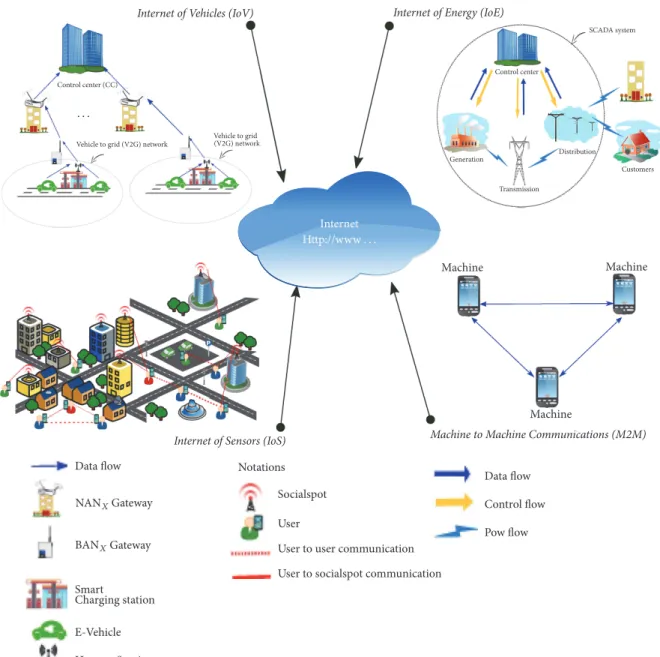
As shown in Figure 1, IoT has made its entrance in four fields, including (1) Machine to Machine Communications (M2M), (2) Internet of Vehicles (IoV), (3) Internet of Energy (IoE), and (4) Internet of Sensors (IoS). M2M is a technology crucial for the realization of IoT, which is based on different protocols such as the protocol Stack [7]. The IoV is based on the concept of Vehicular Cloud, which offers access to the Internet, and is temporarily created by interconnecting resources available on the vehicles along with Road Side Units (RSUs) [8–10]. According to ARTEMIS-project [11], the IoE is the connection of smart grids with the Internet in order to enable intelligent control of energy production, storage, and distribution. The IoS refers to the possibility of connecting sensors with the Internet using ZigBee and other
Volume 2017, Article ID 6562953, 41 pages https://doi.org/10.1155/2017/6562953
Data flow Data flow Pow flow Smart E-Vehicle Hotspot Service Charging station Control center (CC) Control center Control flow Vehicle to grid (V2G) network
Vehicle to grid Notations (V2G) network Generation Transmission Distribution Customers Machine Machine SCADA system Socialspot User
User to user communication User to socialspot communication Gateway
Gateway
Internet Http://www. . .
Internet of Vehicles (IoV)
Internet of Sensors (IoS)
Machine
Machine to Machine Communications (M2M) Internet of Energy (IoE)
· · ·
.!.X
"!.X
Figure 1: Internet of Things (IoT) in four environments, including: (1) Internet of Vehicles (IoV), (2) Internet of Energy (IoE), (3) Internet of Sensors (IoS), and (4) Machine to Machine Communications (M2M).
IEEE 802.15.4 based protocols [12]. The list of acronyms used in this paper is listed in Acronyms Section.
The vision of the IoT will advance based on many new features and will cope with new challenges, as shown in Figure 2, including cloud computing, M2M, IoS, IoE, IoV, social networks, software defined optical networks (SDONs), and fifth generation (5G) cellular networks. The IoT data which will be produced from billions of interactions between devices and people is going to be not only massive, but also complex and it will suffer from many security and privacy problems, especially regarding the authentication among devices. To resolve these security issues, researchers in the field of computer security have developed many authentica-tion protocols applied in the context of the IoT. The aim of the current survey paper is to provide a comprehensive and
systematic review of recent studies on published authentica-tion protocols for the IoT in four environments, including, M2M, IoV, IoE, and IoS. More precisely more than forty authentication protocols are selected and examined in detail. The original set of papers was formed from the searchers run on SCOPUS and Web of Science from the period between 2010 and 2016. The search started on 15/10/2016 and continued until the submission date of this paper. See Table 1 for a breakdown of publication dates. The main contributions of this paper are as follows:
(i) Previous survey articles published in recent years that deal with the IoT are briefly presented.
(ii) Authentication protocols in M2M, IoV, IoE, and IoS that were evaluated under thirty-five attacks are
Internet today
Internet of Things (IoT)
Cloud computing
Machine to Machine Communications (M2M) Internet of Vehicles (IoV)
Internet of Energy (IoE)
Internet of Sensors (IoS)
Social networks
Software Defined Optical Networks (SDONs) Fifth generation (5G) cellular networks
Figure 2: Vision of the IoT with main features and challenges.
Table 1: Publication date breakdown-surveyed papers (authentica-tion protocols). Papers Year [17–24] 2010 [25–31] 2011 [32–36] 2012 [37–45] 2013 [46–51] 2014 [52–60] 2015 [61–77] 2016
discussed. Main focus is given on five attacks, which are mostly studied in earlier works, namely, man-in-the-middle attack, impersonation attack, forging attack, replay attack, and Sybil attack.
(iii) Various countermeasures and formal security verifi-cation techniques used by authentiverifi-cation protocols for the IoT are presented.
(iv) A side-by-side comparison in a tabular form of the current state-of-the-art of authentication protocols which are proposed for the IoT viewed from five different aspects, namely, network model, specific security goals, main processes, computation complex-ity, and communication overhead, is given.
(v) Open issues for M2M, IoV, IoE, and IoS are discussed. The rest of this paper is organized as follows. Section 2 summarizes the existing survey works on different aspects of the IoT idea. In Section 3, an overview of threat models in the IoT is presented. Section 4 presents various countermeasures and formal security verification techniques. In Section 5, a taxonomy and comparison of authentication protocols for the IoT is presented. Finally, open issues and recommendations for further research are discussed in Section 6 and main conclusions are drawn in Section 7.
2. Surveys Articles for the IoT
There exist many survey articles published during recent years that deal with Internet of Things, focusing on different aspects of the IoT idea, for example, networking, applications,
standardization, social interactions, security, and many more. These survey articles are categorized in terms of field of research as shown in Table 2. Internet of Things concepts attracts more and more attention as the years pass by and although a lot of different areas related to IoT are covered from previous review works, no survey article exists that thoroughly investigates authentication protocols that are especially developed for this new technology or better say this blend of technologies and systems. In this section we will briefly present all these survey articles grouped as shown in Table 2 and will discuss in more depth previous works that deal with security and privacy issues of the IoT.
The first survey article in the literature that was dealing with the IoT concept was published back in 2009 by Cooper and James [14] and focused on the challenges for database management in the IoT. Seeing the IoT from that point of view they found that the technical priorities that needed to be addressed in order to support the interconnection of every device were proper indexing, archiving, development of smart agents, the use of XML for achieving Interoperability, and novel systems that will be able to offer efficient and secure transaction management. In a later survey article that was published in 2010, Atzori et al. [6] discussed the vision of “anytime, anywhere, any media, anything” communications that the IoT would bring in our everyday lives. Based on their research author spotted two important technologies that needed to be applied in order to bring IoT into life, Internet Protocol version 6 (IPv6) and Web 2.0. The same year, the first survey article that dealt with security and privacy issues related to IoT was published [15]. In this article, Weber discussed the different measures that were needed in order to ensure the architecture’s resilience to attacks, data authentication, access control, and client privacy. The article dealt with security and privacy issues from the legislation perspective mostly due to the fact that the IoT was more an idea back in 2010 than a concrete system yet. Another article dealing with security and privacy was published in 2010 from Medaglia and Serbanati [16]. The article tried to present a short term and a long-term vision of the IoT along with the security issues and solutions that would be needed.
In 2011 several published survey articles focused on the IoT [83, 87, 89, 93, 104, 126]. In [87] authors conducted a thorough analysis of the different publicly available testbeds. Bandyopadhyay and Sen [93] published an interesting survey
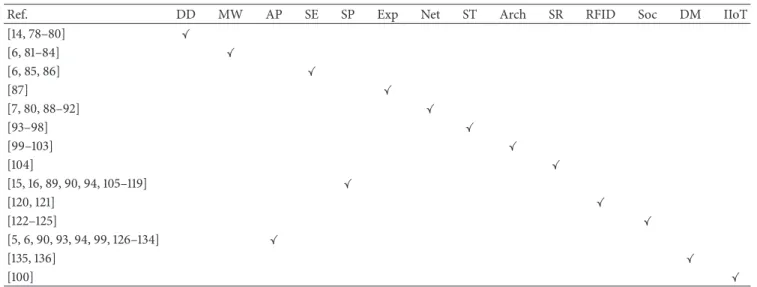
Table 2: Areas of research of each survey article for the IoT.
Ref. DD MW AP SE SP Exp Net ST Arch SR RFID Soc DM IIoT
[14, 78–80] ✓ [6, 81–84] ✓ [6, 85, 86] ✓ [87] ✓ [7, 80, 88–92] ✓ [93–98] ✓ [99–103] ✓ [104] ✓ [15, 16, 89, 90, 94, 105–119] ✓ [120, 121] ✓ [122–125] ✓ [5, 6, 90, 93, 94, 99, 126–134] ✓ [135, 136] ✓ [100] ✓
DD: Data quality and database management, MW: middleware, AP: applications, SE: smart environments, SP: security and privacy, Exp: experimentation, Net: networking, ST: standardization, Arch: architecture, SR: searching, RFID: RFID technology, Soc: Social Internet of Things, DM: data mining, and IIoT: industrial Internet of Things.
article about the current developments related to IoT and the open issues back in 2011. The article managed to spot most of the challenges that IoT had and still has to face nowadays, for example, managing large amount of information and mining large volume of data, managing heterogeneity, and ensuring security privacy and trust, among others. Feasible solutions for the problem of establishing a session key between a client and a server in the context of the Internet of Things were surveyed in [89], where the authors considered the scenario where at least one peer was a sensor node. They especially focused on different cryptography solutions and how these could be applied to server and client nodes. Ma in [126] gave an overview of the objectives of the IoT and the challenges involved in IoT development while in [104] Zhang et al. covered the topic of how to build an appropriate search engine for IoT, a topic that was spotted from Cooper and James in [14] back in 2009 as a challenge to be addressed in the future. During 2012 and 2013 the following survey articles were published [5, 82, 94–97, 99, 105, 106, 122, 123] dealing with standardization, applications, architecture, security, and privacy issues of the IoT. Articles [95–97] surveyed stan-dardization issues and how the IETF Constrained RESTful Environments (CoRE) working group focuses on facilitating the integration of constrained devices with the Internet at the service level. These articles pointed out that all the standardized protocols are only a starting point for exploring additional open issues like resource representation, security and privacy, energy efficiency, and so on. Authors in [5, 94] gave a general overview of the current vision, applications, architectural elements, and future challenges and directions of the IoT. Miorandi et al. in [94] discussed the potential impact of the IoT on smart home automation, smart cities, environmental monitoring, health care, smart businesses, and security and surveillance making very clear, maybe for the first time, that the IoT concept involves every current or future technology that is going to be introduced in
order to make our life better. Domingo in [99] performed a more narrow but extensive survey of the IoT for people with disabilities. Authors spotted the relevant application scenarios and main benefits along with the key research challenges, like customization, self-management, and secu-rity and privacy issues. They argued that as brain–computer interfaces (BCIs) are becoming commercial, they will also be a part of the IoT world. Articles [105, 106] focused on security and privacy issues as they were identified back in 2012 and 2013, respectively. Both articles agree that key management needs strong legislation, while authors in [106] take one step further and propose that grouping of the IoT devices and creating the so called intranet of things could help impose security mechanisms more effectively. Finally articles [122, 123] survey for the first time the social concept of the IoT, the so called Social Internet of Things, a concept that later will raise a lot of attraction and research works.
During 2014 and 2015 more than twenty new survey articles about IoT were published [7, 85, 98, 100, 102, 107, 108, 110, 112–116, 121, 124, 128–130, 135, 136, 212, 213]. Except articles that discussed general issues regarding IoT [98, 129, 130, 212], for example, applications, challenges, trends, and open issues, other papers focused on specific applications or research areas that are connected to the IoT idea. Authors in all three articles agree that IoT thus brings new opportunities by enabling enriched context-aware services, but it also raises new challenges that need to be addressed. Zanella et al. [85] focused specifically to an urban IoT system which is another term to describe the smart city environment. In contrast to the previous years during 2014 and 2015 a big proportion of the survey articles focus on security and privacy issues related to the IoT [107, 108, 110, 112–116], revealing the significance that security was beginning to have for cyber-physical systems. Cyber-Physical systems need to rely on IoT enabled technologies which can be effectively and efficiently supported and assisted by cloud computing infrastructures
Classification of attacks in the IoT
(i) Passive attacks (ii) Active attacks
(i) Identity-based attacks (ii) Location-based attacks (iii) Eavesdropping-based attacks (iv) Manipulation-based attacks (v) Service-based attacks
(i) Internal attacks (ii) External attacks
(i) Key-based attacks (ii) Data-based attacks
(iii) Impersonation-based attacks (iv) Physical-based attacks
Figure 3: Classification of attacks in the IoT.
and platforms. The integration of IoT and cloud computing was thoroughly surveyed from Botta et al. [128] where also the possibility of exploiting fog computing capabilities for supporting the IoT concept was discussed. Data mining in the IoT context was surveyed by Tsai et al. [135] and Chen et al. [136]. Authors in [135] presented a good summary of the potentials that applying data mining technologies to the IoT could have to people, the system itself, and other interconnected systems. Authors in [136] took a step further and based on their survey and analysis proposed a big data mining system for IoT. Ortiz et al. [124] surveyed the Social Internet of Things and compared to the earlier survey articles [122, 123] proposed a generic SIoT architecture which consists of actors, a central intelligent system, an interface, and the Internet. Two articles focused on IoT-based health care technologies [121, 213], covering new platforms, applications, and security and privacy issues that arise. Authors in [100] conducted an extensive literature review about the current status and future research opportunities regarding the use of IoT in industries, the so called Industrial Internet of Things (IIoT), while in [102] authors tried to identify the impact of the Internet of Things (IoT) on Enterprise Systems in modern manufacturing.
During 2016 over fifteen new survey articles that focused on the IoT concept were published [78–80, 84, 86, 91, 103, 111, 117–119, 125, 131, 132, 134, 214]. Following the technology development three of the articles published this year focused on the integration of the cloud and the IoT, the applications, the requirements, and the security issues that arise from it [117, 131, 134]. Security was also one aspect that was covered from a number of survey articles [117–119]. Authors in [118] covered several aspects of IoT security, for example, general devices security, communication security, network security, and application, while in [119] mechanisms that reassure secure routing were investigated. In contrast to previous years, surveys published during 2016 covered new areas, such as SDN and virtualization [91], economic and pricing theory in IoT [80], social Internet of vehicles [125], and data quality [78]. Other topics covered from the survey articles were middleware [84], data models [79], mobile crowd sensing strategies [132], the deployment of IoT in smart environments [86], and the main proposed architectures for IoT [103]. Xie et al. [111] surveyed the security of the Web of Things (WoT)
which is aimed to provide any electronic item (smart cards, sensors, etc.) with a URL.
Among the aforementioned surveys, the security and privacy issues that are related to the IoT were thoroughly covered and analyzed [15, 16, 89, 90, 94, 105–119]. As it is shown in Table 3 data authentication and integrity were only covered partially from He and Zeadally [121] while the rest of the articles did not cover this major security aspect. In this article we tend to survey authentication protocols for the IoT in four environments, including (1) Machine to Machine communications (M2M), (2) Internet of Vehicles (IoV), (3) Internet of Energy (IoE), and (4) Internet of Sensors (IoS). Based on this thorough analysis open issues and future directions are identified that combine both innovative research along with the application, through appropriate adaptation, of existing solutions from other fields. We believe that this study will help researchers focus on the important aspects of authentication issues in the IoT area and will guide them towards their future research.
3. Threat Models
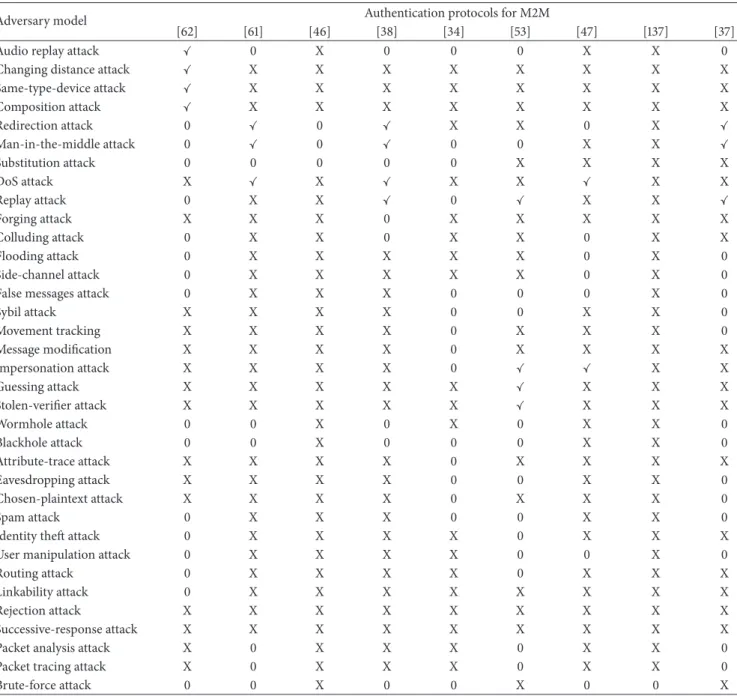
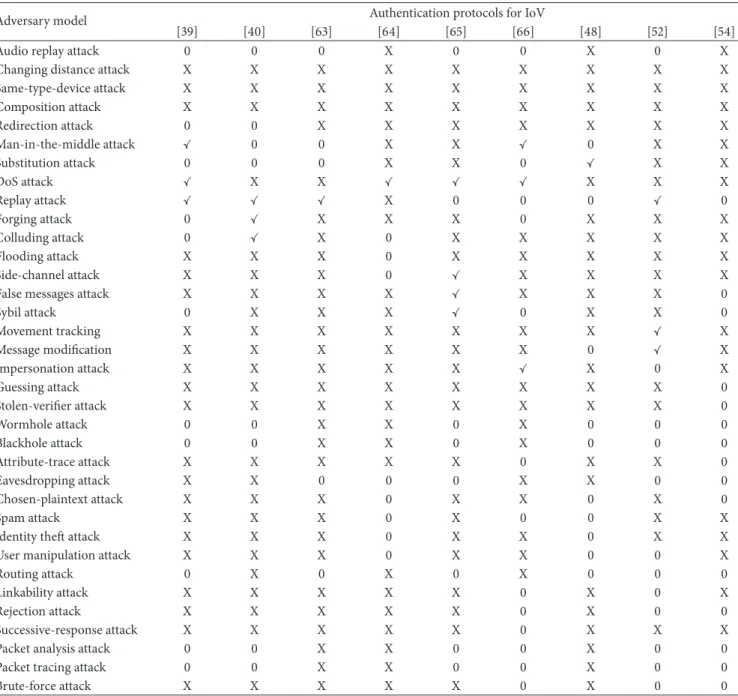
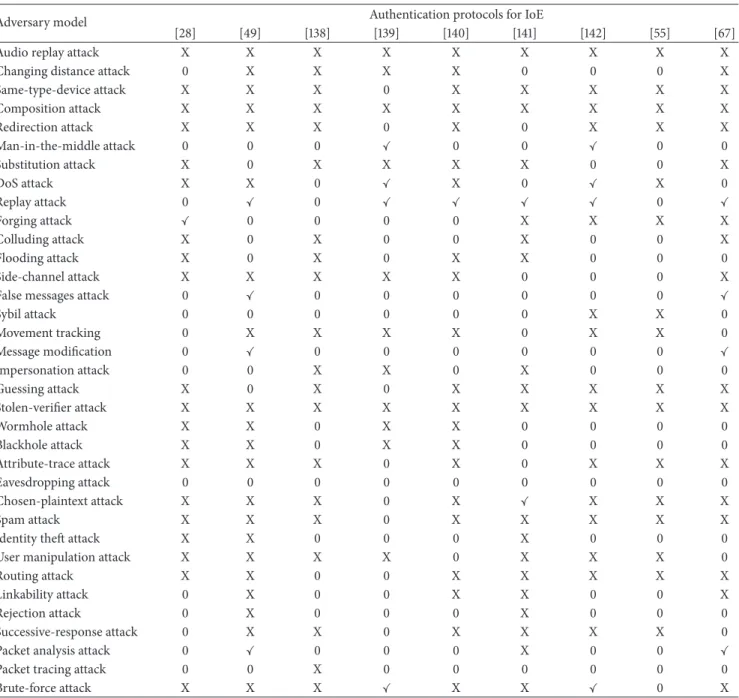
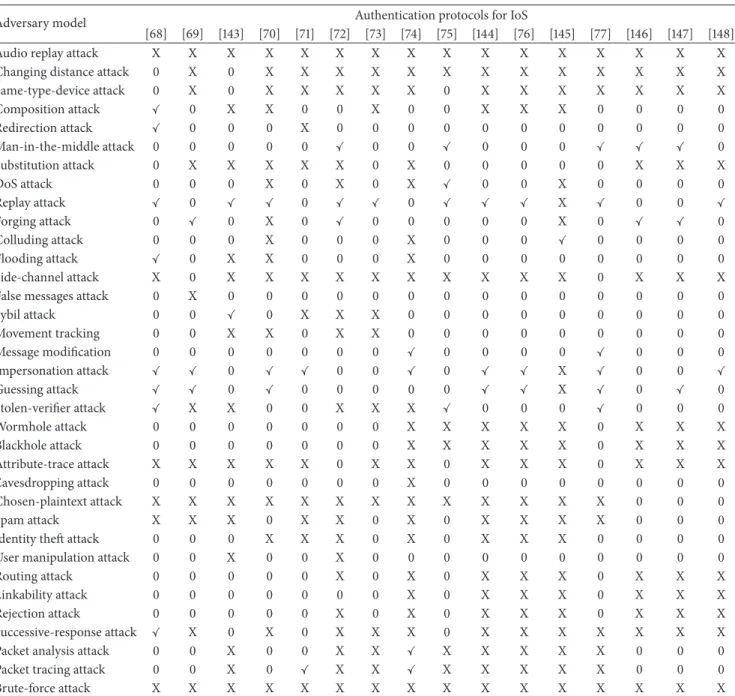
In this section various threat models in the IoT are discussed. The summary of thirty-five attacks in M2M, IoV, IoE, and IoS and defense protocols are given in Tables 4, 5, 6, and 7, respectively. We focus on five attacks, which are mostly used by authors that propose new authentications protocols for evaluating their methods, namely, man-in-the-middle attack, impersonation attack, forging attack, replay attack, and Sybil attack. Generally, the classification of attacks [215– 218] frequently mentioned in the literature is done using the following four types, as shown in Figure 3:
(1) Type A: Passive or active; (2) Type B: Internal or external;
(3) Type C [219]: Key-based attacks, data-based attacks, impersonation-based attacks, and physical-based attacks;
(4) Type D [220]: Identity-based attacks, location-based attacks, eavesdropping-based attacks, manipulation-based attack, and service-manipulation-based attacks.
3.1. Man-in-the-Middle Attack. The man-in-the-middle (MITM)
Table 3: A comparison of related surveys in the literature (surveys on security and privacy for the IoT).
Survey on security and privacy for the IoT
Privacy preserving
schemes
Authentication
protocols Comments
Weber (2010) [15] 0 X Presented milestones of an adequate legal framework
for IoT privacy Medaglia and Serbanati
(2010) [16] 0 X
Presented a Short-Term and Long-Term vision for IoT privacy
Roman et al. (2011) [89] X X
Analyzed some key management systems for sensor networks in the context of the IoT (public key cryptography and preshared keys)
Miorandi et al. (2012) [94] 0 X Presented some security challenges in IoT, including
Data confidentiality, Privacy, and Trust
Suo et al. (2012) [105] X X
Discussed the security requirements in each level for IoT (four key levels, i.e., recognition layer, network layer, support layer, and application layer)
Aggarwal et al. (2013) [90] 0 X Discussed the privacy in data collection, and during
data transmission and sharing
Roman et al. (2013) [106] X X Presented the security issues in distributed IoT systems
Yan et al. (2014) [107] ✓ X
Surveyed the privacy-preserving schemes IoT, including database query, scientific computations, intrusion detection, and data mining
Jing et al. (2014) [108] X X Discussed the security issues and technical solutions in
WSNs Chabridon et al. (2014)
[109] ✓ X
Surveyed the state of the art of privacy technology from the perspective of the IoT
Ziegeldorf et al. [110] ✓ X Surveyed the privacy threats and challenges in the IoT
Keoh et al. (2014) [112] X X Presented an overview of the efforts in the IETF to
standardize security solutions for the IoT ecosystem
Sicari et al. (2015) [113] 0 X Discussed the privacy, trust, enforcement, secure
middleware, and mobile security in the IoT
Granjal et al. (2015) [114] X 0 Discussed IoT communications and security at the
physical and MAC layers
Sadeghi et al. (2015) [115] X X Discussed an introduction to Industrial IoT systems
with the related security and privacy challenges
Nguyen et al. (2015) [116] 0 X
Surveyed the secure communication protocols for the IoT, including asymmetric key schemes and symmetric key predistribution schemes
He and Zeadally (2015)
[121] X 0
Analyzed only the RFID authentication schemes for the IoT in healthcare environment using elliptic curve cryptography
Xie et al. (2016) [111] X X Reviewed the security issues for Web of Things
Singh et al. (2016) [117] X X Analyzed the state of cloud-supported IoT to makeexplicit the security considerations
Li et al. (2016) [118] X X Analyzed the security requirements and potentialthreats in a four-layer architecture for the IoT
Airehrour et al. (2016) [119] X X Analyzed the security of routing protocols for the IoT
Our work 0 ✓
Surveyed the authentication protocols for the IoT in
four environments, including(1)Machine to Machine
Communications (M2M),(2)Internet of Vehicles
(IoV),(3)Internet of Energy (IoE), and(4)Internet of Sensors (IoS)
Table 4: Summary of attacks in Machine to Machine Communications (M2M) and defense protocols.
Adversary model Authentication protocols for M2M
[62] [61] [46] [38] [34] [53] [47] [137] [37]
Audio replay attack ✓ 0 X 0 0 0 X X 0
Changing distance attack ✓ X X X X X X X X
Same-type-device attack ✓ X X X X X X X X Composition attack ✓ X X X X X X X X Redirection attack 0 ✓ 0 ✓ X X 0 X ✓ Man-in-the-middle attack 0 ✓ 0 ✓ 0 0 X X ✓ Substitution attack 0 0 0 0 0 X X X X DoS attack X ✓ X ✓ X X ✓ X X Replay attack 0 X X ✓ 0 ✓ X X ✓ Forging attack X X X 0 X X X X X Colluding attack 0 X X 0 X X 0 X X Flooding attack 0 X X X X X 0 X 0 Side-channel attack 0 X X X X X 0 X 0
False messages attack 0 X X X 0 0 0 X 0
Sybil attack X X X X 0 0 X X 0 Movement tracking X X X X 0 X X X 0 Message modification X X X X 0 X X X X Impersonation attack X X X X 0 ✓ ✓ X X Guessing attack X X X X X ✓ X X X Stolen-verifier attack X X X X X ✓ X X X Wormhole attack 0 0 X 0 X 0 X X 0 Blackhole attack 0 0 X 0 0 0 X X 0 Attribute-trace attack X X X X 0 X X X X Eavesdropping attack X X X X 0 0 X X 0 Chosen-plaintext attack X X X X 0 X X X 0 Spam attack 0 X X X 0 0 X X 0
Identity theft attack 0 X X X X 0 X X X
User manipulation attack 0 X X X X 0 0 X 0
Routing attack 0 X X X X 0 X X X
Linkability attack 0 X X X X X X X X
Rejection attack X X X X X X X X X
Successive-response attack X X X X X X X X X
Packet analysis attack X 0 X X X 0 X X 0
Packet tracing attack X 0 X X X 0 X X 0
Brute-force attack 0 0 X 0 0 X 0 0 X
✓indicates fully supported; X indicates not supported; 0 indicates partially supported.
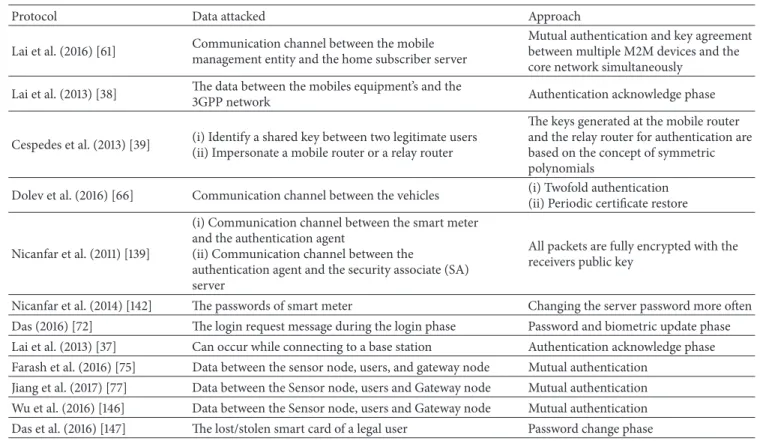
MITM attack, an adversary can spoof the identities of two honest nodes (N1 andN2) involved in a network exchange and pass N1 forN2 and vice versa, that is, taking control of the communication channel betweenN1 andN2. Under this control, an adversary can intercept, modify, change, or replace target victims’ communication traffic. However, we note here that there is a good survey article published in 2016 by Conti et al. in [13], which presents a comprehensive survey on MITM attacks. Specifically, authors in [13] classify MITM attacks in three different categories, namely, (1) MITM based on impersonation techniques, (2) MITM based on the communication channel, and (3) MITM based on the location of an adversary. As presented in Figure 4, at any
moment an adversary can set up a connection between False BTS and Legitimate MS, where False MS impersonates the victim’s MS to the real network by resending the identity information. Moreover, as presented in Table 8, there are twelve authentication protocols for the IoT, which can detect and avoid the MITM attack. The four authentication proto-cols in [61, 75, 77, 146] use the idea of mutual authentication. The two authentication protocols [37, 38] use the idea of authentication acknowledgement phase. With the protocol [139], all packets are fully encrypted with the receiver’s public key, which can prevent the MITM attack. On the other hand, with the protocol [39], when the keys generated at the mobile router and the relay router for authentication are based on
Table 5: Summary of attacks in Internet of Vehicles (IoV) and defense protocols.
Adversary model Authentication protocols for IoV
[39] [40] [63] [64] [65] [66] [48] [52] [54]
Audio replay attack 0 0 0 X 0 0 X 0 X
Changing distance attack X X X X X X X X X
Same-type-device attack X X X X X X X X X Composition attack X X X X X X X X X Redirection attack 0 0 X X X X X X X Man-in-the-middle attack ✓ 0 0 X X ✓ 0 X X Substitution attack 0 0 0 X X 0 ✓ X X DoS attack ✓ X X ✓ ✓ ✓ X X X Replay attack ✓ ✓ ✓ X 0 0 0 ✓ 0 Forging attack 0 ✓ X X X 0 X X X Colluding attack 0 ✓ X 0 X X X X X Flooding attack X X X 0 X X X X X Side-channel attack X X X 0 ✓ X X X X
False messages attack X X X X ✓ X X X 0
Sybil attack 0 X X X ✓ 0 X X 0 Movement tracking X X X X X X X ✓ X Message modification X X X X X X 0 ✓ X Impersonation attack X X X X X ✓ X 0 X Guessing attack X X X X X X X X 0 Stolen-verifier attack X X X X X X X X 0 Wormhole attack 0 0 X X 0 X 0 0 0 Blackhole attack 0 0 X X 0 X 0 0 0 Attribute-trace attack X X X X X 0 X X 0 Eavesdropping attack X X 0 0 0 X X 0 0 Chosen-plaintext attack X X X 0 X X 0 X 0 Spam attack X X X 0 X 0 0 X X
Identity theft attack X X X 0 X X 0 X X
User manipulation attack X X X 0 X X 0 0 X
Routing attack 0 X 0 X 0 X 0 0 0
Linkability attack X X X X X 0 X 0 X
Rejection attack X X X X X 0 X 0 0
Successive-response attack X X X X X 0 X X X
Packet analysis attack 0 0 X X 0 0 X 0 0
Packet tracing attack 0 0 X X 0 0 X 0 0
Brute-force attack X X X X X 0 X 0 0
✓indicates fully supported; X: indicates not supported; 0: indicates partially supported.
the concept of symmetric polynomials, an adversary can not identify a shared key between two legitimate users making it impossible for him to impersonate a mobile router or a relay router. In addition, both protocols [72, 142] are based on a password and biometric update phase in order to prevent an adversary from impersonating the passwords of a smart meter.
3.2. Impersonation and Forging Attack. Under the
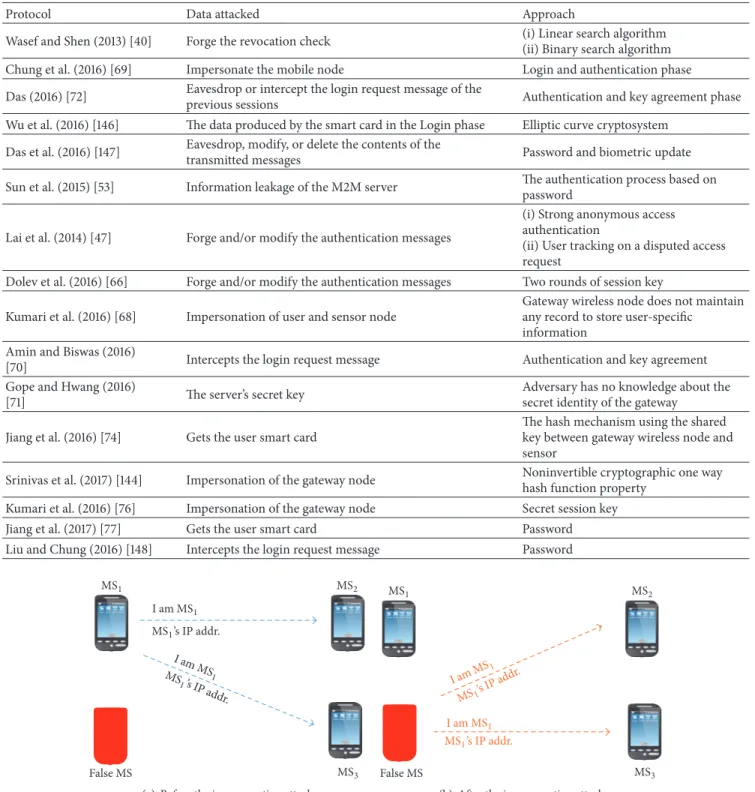
imper-sonation and forging attack in the IoS, an adversary can eavesdrop or intercept the login request message of previous sessions over the public/open channel during authentication protocol execution. After that, he can modify and retransmit
the message to the user in order to impersonate as a valid user, as defined by Amin and Biswas [70] and shown in the Figure 5. We note that this attack is analyzed more in authentication protocols that are produced for the IoS. More-over, as presented in Table 9 there are sixteen authentication protocols for the IoT, which can detect the impersonation and forging attack. The protocol [40] uses two ideas, namely, (1) linear search algorithm and (2) binary search algorithm. The protocol [47] uses strong anonymous access authentication and user tracking on a disputed access request, to prevent the impersonation and forging attack. Besides, the idea of using a password for detecting the impersonation of the gateway node is presented by four authentication protocols
Table 6: Summary of attacks in Internet of Energy (IoE) and defense protocols.
Adversary model Authentication protocols for IoE
[28] [49] [138] [139] [140] [141] [142] [55] [67]
Audio replay attack X X X X X X X X X
Changing distance attack 0 X X X X 0 0 0 X
Same-type-device attack X X X 0 X X X X X Composition attack X X X X X X X X X Redirection attack X X X 0 X 0 X X X Man-in-the-middle attack 0 0 0 ✓ 0 0 ✓ 0 0 Substitution attack X 0 X X X X 0 0 X DoS attack X X 0 ✓ X 0 ✓ X 0 Replay attack 0 ✓ 0 ✓ ✓ ✓ ✓ 0 ✓ Forging attack ✓ 0 0 0 0 X X X X Colluding attack X 0 X 0 0 X 0 0 X Flooding attack X 0 X 0 X X 0 0 0 Side-channel attack X X X X X 0 0 0 X
False messages attack 0 ✓ 0 0 0 0 0 0 ✓
Sybil attack 0 0 0 0 0 0 X X 0 Movement tracking 0 X X X X 0 X X 0 Message modification 0 ✓ 0 0 0 0 0 0 ✓ Impersonation attack 0 0 X X 0 X 0 0 0 Guessing attack X 0 X 0 X X X X X Stolen-verifier attack X X X X X X X X X Wormhole attack X X 0 X X 0 0 0 0 Blackhole attack X X 0 X X 0 0 0 0 Attribute-trace attack X X X 0 X 0 X X X Eavesdropping attack 0 0 0 0 0 0 0 0 0 Chosen-plaintext attack X X X 0 X ✓ X X X Spam attack X X X 0 X X X X X
Identity theft attack X X 0 0 0 X 0 0 0
User manipulation attack X X X X 0 X X X 0
Routing attack X X 0 0 X X X X X
Linkability attack 0 X 0 0 X X 0 0 X
Rejection attack 0 X 0 0 0 X 0 0 0
Successive-response attack 0 X X 0 X X X X 0
Packet analysis attack 0 ✓ 0 0 0 X 0 0 ✓
Packet tracing attack 0 0 X 0 0 0 0 0 0
Brute-force attack X X X ✓ X X ✓ 0 X
✓indicates fully supported; X indicates not supported; 0 indicates partially supported.
[53, 77, 147, 148]. In addition, the hash mechanism which is applied on the shared key between gateway wireless node and sensors can prevent the impersonation of a sensor.
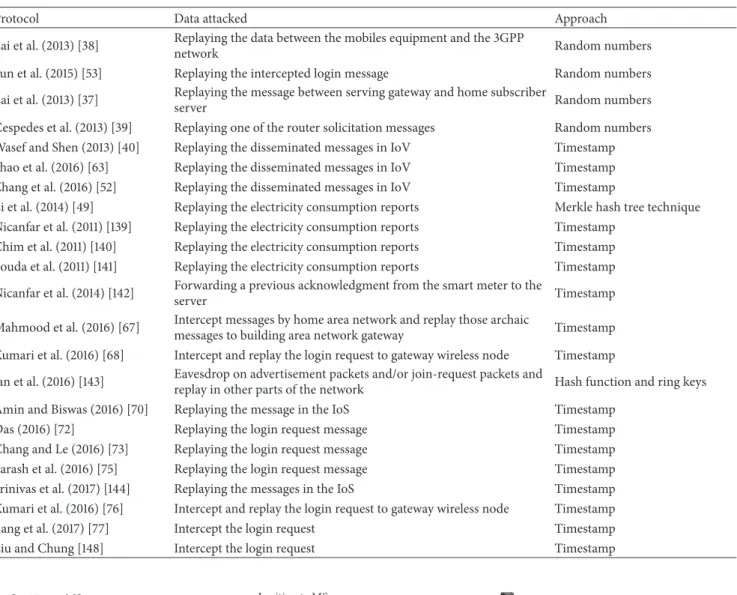
3.3. Replay Attack. The replay attacks are MITM attacks,
which consist of intercepting data packets and retransmitting them as is (without any decryption) to the destination server, as shown in Figure 6 (interceptingD3 and retransmitting it). Under this attack, an adversary can obtain the same rights as the user. A wormhole attack can be launched through the replay attack as shown in Figure 7. However, there are twenty-four authentication protocols for the IoT, which can detect and avoid the replay attack, as presented in Table 10. These
authentication protocols use three ideas, namely, Timestamp, Hash function, and random numbers. The idea of random numbers is used by [37–39, 53]. The idea of hash function is used by protocols [49, 143], such as the IPSec protocol which implements an antireplay mechanism based on message authentication code (MAC) [221]. In addition, the idea of Timestamp in the encrypted messages is used by [40, 49, 52, 63, 67, 68, 70, 72, 73, 75–77, 139–144, 148].
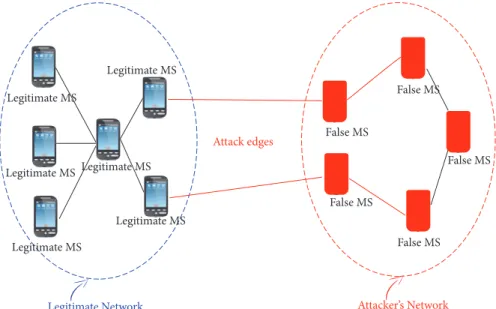
3.4. Sybil Attack. With the Sybil attack, a malicious node
can claim different identities in order to gain an advantage over legitimate nodes, as shown in Figure 8. Based on the member secrets generation stage, Zhang et al. [65] proposed
Table 7: Summary of attacks in Internet of Sensors (IoS) and defense protocols.
Adversary model Authentication protocols for IoS
[68] [69] [143] [70] [71] [72] [73] [74] [75] [144] [76] [145] [77] [146] [147] [148]
Audio replay attack X X X X X X X X X X X X X X X X
Changing distance attack 0 X 0 X X X X X X X X X X X X X
Same-type-device attack 0 X 0 X X X X X 0 X X X X X X X Composition attack ✓ 0 X X 0 0 X 0 0 X X X 0 0 0 0 Redirection attack ✓ 0 0 0 X 0 0 0 0 0 0 0 0 0 0 0 Man-in-the-middle attack 0 0 0 0 0 ✓ 0 0 ✓ 0 0 0 ✓ ✓ ✓ 0 Substitution attack 0 X X X X X 0 X 0 0 0 0 0 X X X DoS attack 0 0 0 X 0 X 0 X ✓ 0 0 X 0 0 0 0 Replay attack ✓ 0 ✓ ✓ 0 ✓ ✓ 0 ✓ ✓ ✓ X ✓ 0 0 ✓ Forging attack 0 ✓ 0 X 0 ✓ 0 0 0 0 0 X 0 ✓ ✓ 0 Colluding attack 0 0 0 X 0 0 0 X 0 0 0 ✓ 0 0 0 0 Flooding attack ✓ 0 X X 0 0 0 X 0 0 0 0 0 0 0 0 Side-channel attack X 0 X X X X X X X X X X 0 X X X
False messages attack 0 X 0 0 0 0 0 0 0 0 0 0 0 0 0 0
Sybil attack 0 0 ✓ 0 X X X 0 0 0 0 0 0 0 0 0 Movement tracking 0 0 X X 0 X X 0 0 0 0 0 0 0 0 0 Message modification 0 0 0 0 0 0 0 ✓ 0 0 0 0 ✓ 0 0 0 Impersonation attack ✓ ✓ 0 ✓ ✓ 0 0 ✓ 0 ✓ ✓ X ✓ 0 0 ✓ Guessing attack ✓ ✓ 0 ✓ 0 0 0 0 0 ✓ ✓ X ✓ 0 ✓ 0 Stolen-verifier attack ✓ X X 0 0 X X X ✓ 0 0 0 ✓ 0 0 0 Wormhole attack 0 0 0 0 0 0 0 X X X X X 0 X X X Blackhole attack 0 0 0 0 0 0 0 X X X X X 0 X X X Attribute-trace attack X X X X X 0 X X 0 X X X 0 X X X Eavesdropping attack 0 0 0 0 0 0 0 X 0 0 0 0 0 0 0 0 Chosen-plaintext attack X X X X X X X X X X X X X 0 0 0 Spam attack X X X 0 X X 0 X 0 X X X X 0 0 0
Identity theft attack 0 0 0 X X X 0 X 0 X X X 0 0 0 0
User manipulation attack 0 0 X 0 0 X 0 0 0 0 0 0 0 0 0 0
Routing attack 0 0 0 0 0 X 0 X 0 X X X 0 X X X
Linkability attack 0 0 0 0 0 0 0 X 0 X X X 0 X X X
Rejection attack 0 0 0 0 0 X 0 X 0 X X X 0 X X X
Successive-response attack ✓ X 0 X 0 X X X 0 X X X X X X X
Packet analysis attack 0 0 X 0 0 X X ✓ X X X X X 0 0 0
Packet tracing attack 0 0 X 0 ✓ X X ✓ X X X X X 0 0 0
Brute-force attack X X X X X X X X X X X X X X X X
✓indicates fully supported; X indicates not supported; 0 indicates partially supported.
a distributed aggregate privacy-preserving authentication protocol, called DAPPA, which is robust and resilient to the Sybil attacks in the IoV environment. Using a token-based authentication approach, Jan et al. [143] proposed a payload-based mutual authentication protocol, called PAWN in the IoS environment. PAWN can detect the Sybil attacks based on the cluster formation between neighboring nodes and their nearest cluster head.
4. Countermeasures and Formal Security
Verification Techniques
In order to satisfy the authentication model to secure IoT, namely, mutual authentication, perfect forward secrecy,
anonymity, and untraceability, the authentication protocols use both cryptosystems and non-cryptosystems countermea-sures. Tables 11, 12, 13, and 14 present the cryptosystems and countermeasures used in authentication protocols for M2M, IoV, IoE, and IoS, respectively. In this section, we will discuss the countermeasures and present the formal security verification techniques used in these authentication protocols for the IoT.
4.1. Countermeasures. Based on the cryptosystems, the
exist-ing authentication protocols for the IoT can mainly be clas-sified into three categories: symmetric-cryptosystem based, asymmetric-cryptosystem-based, and hybrid protocols, as shown in Figure 9. As presented in the following (Tables 11,
Table 8: Approaches for detecting and avoiding the man-in-the-middle attack.
Protocol Data attacked Approach
Lai et al. (2016) [61] Communication channel between the mobile
management entity and the home subscriber server
Mutual authentication and key agreement between multiple M2M devices and the core network simultaneously
Lai et al. (2013) [38] The data between the mobiles equipment’s and the
3GPP network Authentication acknowledge phase
Cespedes et al. (2013) [39] (i) Identify a shared key between two legitimate users
(ii) Impersonate a mobile router or a relay router
The keys generated at the mobile router and the relay router for authentication are based on the concept of symmetric polynomials
Dolev et al. (2016) [66] Communication channel between the vehicles (i) Twofold authentication(ii) Periodic certificate restore
Nicanfar et al. (2011) [139]
(i) Communication channel between the smart meter and the authentication agent
(ii) Communication channel between the
authentication agent and the security associate (SA) server
All packets are fully encrypted with the receivers public key
Nicanfar et al. (2014) [142] The passwords of smart meter Changing the server password more often
Das (2016) [72] The login request message during the login phase Password and biometric update phase
Lai et al. (2013) [37] Can occur while connecting to a base station Authentication acknowledge phase
Farash et al. (2016) [75] Data between the sensor node, users, and gateway node Mutual authentication
Jiang et al. (2017) [77] Data between the Sensor node, users and Gateway node Mutual authentication
Wu et al. (2016) [146] Data between the Sensor node, users and Gateway node Mutual authentication
Das et al. (2016) [147] The lost/stolen smart card of a legal user Password change phase
Attacker’s Network False BTS False MS False MS Legitimate MS Legitimate BTS Legitimate Network
Figure 4: MITM attack on GSM as defined by Conti et al. in [13], BTS: Base Transceiver Station; MS: Mobile Station.
12, 13, and 14), most authentication protocols use a secure cryptographic hash function [149].
As presented in Table 11, the protocol [137] uses three cryptosystems, namely, original data acquisition, spatial-domain transformation, and time-spatial-domain transformation. The protocol [62] use two matching algorithms, namely, correlation coefficient-based matching algorithm (C-MA) and deviation ratio-based matching algorithm (D-MA). The aggregate message authentication codes (AMACs) [150] are used by both schemes [37, 61]. The AMAC tool is a tuple of the following probabilistic polynomial time algorithms:
Authen-tication algorithm, Aggregation algorithm, and Verification
algorithm. The authentication algorithm outputs a𝑡𝑎𝑔tag,
where the aggregate of tags can be simply computing the XOR of all the tag values; that is,𝑡𝑎𝑔 = 𝑡𝑎𝑔1⊕𝑡𝑎𝑔2⊕⋅ ⋅ ⋅⊕𝑡𝑎𝑔𝑙, where
1, . . . , 𝑙are identifiers. The protocol [46] uses certificateless
aggregate signature [151], which enables an algorithm to aggregate𝑛signatures of𝑛distinct messages from𝑛users into a single short signature. In addition, the certificateless aggre-gate signature scheme is secure against existential forgery in the chosen aggregate model. The aggregate signature genera-tor computes𝑉 = ∑𝑛𝑖=1𝑉𝑖and outputs𝜎𝑛 = (𝑈1, . . . , 𝑈𝑛, 𝑉) as an aggregate signature. The protocol [38] uses Elliptic Curve Diffie-Hellman (ECDH) [152], which is an anonymous key agreement protocol. The protocol [34] uses ID-based signature scheme [153] that consists of four algorithms,Setup,
Extract, Sign, and Verify. With Setup algorithm, the trust
authority chooses efficiently computable monomorphisms. The trust authority performs theExtractalgorithm when a signer requests the secret key corresponding to their identity. The𝑆𝑖𝑔𝑛algorithm produces a signature from the user with identity𝐼𝐷on the message𝑚. Therefore, the protocol [53] uses advanced encryption standard (AES) [154], which is a symmetric encryption standard intended to replace the Data Encryption Standard (DES) [222] that has become too weak in view of current attacks. The protocol [47] uses the Linear Combination Encryption (LCE) [155], which is an extension of ElGamal encryption [223] that is secure in groups where the Decision Diffie-Hellman (DDH) problem is easy but the Computational Diffie-Hellman (CDH) problem is hard. With the LCE scheme [155], a user’s public and secret keys are defined as𝑝𝑘 = (𝑢,V, 𝑤1 = 𝑢𝑥, 𝑤2 = V𝑦)and𝑠𝑘 = (𝑥, 𝑦),
Table 9: Approaches for detecting and avoiding the impersonation and forging attack.
Protocol Data attacked Approach
Wasef and Shen (2013) [40] Forge the revocation check (i) Linear search algorithm(ii) Binary search algorithm
Chung et al. (2016) [69] Impersonate the mobile node Login and authentication phase
Das (2016) [72] Eavesdrop or intercept the login request message of the
previous sessions Authentication and key agreement phase
Wu et al. (2016) [146] The data produced by the smart card in the Login phase Elliptic curve cryptosystem
Das et al. (2016) [147] Eavesdrop, modify, or delete the contents of the
transmitted messages Password and biometric update
Sun et al. (2015) [53] Information leakage of the M2M server The authentication process based on
password
Lai et al. (2014) [47] Forge and/or modify the authentication messages
(i) Strong anonymous access authentication
(ii) User tracking on a disputed access request
Dolev et al. (2016) [66] Forge and/or modify the authentication messages Two rounds of session key
Kumari et al. (2016) [68] Impersonation of user and sensor node
Gateway wireless node does not maintain any record to store user-specific
information Amin and Biswas (2016)
[70] Intercepts the login request message Authentication and key agreement
Gope and Hwang (2016)
[71] The server’s secret key
Adversary has no knowledge about the secret identity of the gateway
Jiang et al. (2016) [74] Gets the user smart card
The hash mechanism using the shared key between gateway wireless node and sensor
Srinivas et al. (2017) [144] Impersonation of the gateway node Noninvertible cryptographic one wayhash function property
Kumari et al. (2016) [76] Impersonation of the gateway node Secret session key
Jiang et al. (2017) [77] Gets the user smart card Password
Liu and Chung (2016) [148] Intercepts the login request message Password
False MS -31 -32 -33 I am-31 I am-3 1 -31’s IP addr. -3 1’s IP addr .
(a) Before the impersonation attack
False MS -31 -32 -33 I am-3 1 I am-31 -31’s IP addr. -31’s IP addr .
(b) After the impersonation attack
Figure 5: Impersonation attack, MS: Mobile Station.
where𝑢,V← 𝐺1and𝑥, 𝑦 ← 𝑍∗𝑝. The message𝑀is encrypted
to (𝐷1 = 𝑢𝑎,𝐷2 =V𝑏,𝐷3 = 𝑀 ⋅ 𝑤𝑎1𝑤𝑏2) where𝑎, 𝑏 ∈ 𝑍∗𝑝are
random. Then, the original message𝑀is decrypted from the ciphertext(𝐷1, 𝐷2, 𝐷3)by𝐷3⋅ (𝐷𝑥1⋅ 𝐷𝑦2)−1.
As presented in Table 12, the protocol [39] uses both countermeasures, namely, Proxy Mobile IP (PMIP) [156]
and Symmetric Polynomials [157]. The PMIP is a localized network based IP mobility protocol (RFC 5213 [224]) that defines two entities: the Mobile Access Gateway (MAG) and the Local Mobility Anchor (LMA). The symmetric polynomial is defined as any polynomial of two or more variables that achieves the interchangeability property, that
Table 10: Approaches for detecting and avoiding the replay attack.
Protocol Data attacked Approach
Lai et al. (2013) [38] Replaying the data between the mobiles equipment and the 3GPPnetwork Random numbers
Sun et al. (2015) [53] Replaying the intercepted login message Random numbers
Lai et al. (2013) [37] Replaying the message between serving gateway and home subscriber
server Random numbers
Cespedes et al. (2013) [39] Replaying one of the router solicitation messages Random numbers
Wasef and Shen (2013) [40] Replaying the disseminated messages in IoV Timestamp
Shao et al. (2016) [63] Replaying the disseminated messages in IoV Timestamp
Zhang et al. (2016) [52] Replaying the disseminated messages in IoV Timestamp
Li et al. (2014) [49] Replaying the electricity consumption reports Merkle hash tree technique
Nicanfar et al. (2011) [139] Replaying the electricity consumption reports Timestamp
Chim et al. (2011) [140] Replaying the electricity consumption reports Timestamp
Fouda et al. (2011) [141] Replaying the electricity consumption reports Timestamp
Nicanfar et al. (2014) [142] Forwarding a previous acknowledgment from the smart meter to the
server Timestamp
Mahmood et al. (2016) [67] Intercept messages by home area network and replay those archaicmessages to building area network gateway Timestamp
Kumari et al. (2016) [68] Intercept and replay the login request to gateway wireless node Timestamp
Jan et al. (2016) [143] Eavesdrop on advertisement packets and/or join-request packets and
replay in other parts of the network Hash function and ring keys
Amin and Biswas (2016) [70] Replaying the message in the IoS Timestamp
Das (2016) [72] Replaying the login request message Timestamp
Chang and Le (2016) [73] Replaying the login request message Timestamp
Farash et al. (2016) [75] Replaying the login request message Timestamp
Srinivas et al. (2017) [144] Replaying the messages in the IoS Timestamp
Kumari et al. (2016) [76] Intercept and replay the login request to gateway wireless node Timestamp
Jiang et al. (2017) [77] Intercept the login request Timestamp
Liu and Chung [148] Intercept the login request Timestamp
False MS
Legitimate MS Legitimate MS
D1 D2 D3
D3
Figure 6: Replay attack, MS: Mobile Station.
and 2, and the symmetric polynomial𝑓(𝑥, 𝑦) = 𝑥2𝑦2+𝑥𝑦+10, the resultant evaluation functions are𝑓(1, 𝑦) = 𝑦2+𝑦+10and
𝑓(2, 𝑦) = 4𝑦2+ 2𝑦 + 10, respectively. Then, if user 1 evaluates
its function𝑓(1, 𝑦)for user 2, it obtains𝑓(1, 2) = 16. In the same way,𝑓(2, 𝑦)for user 1, user 2 obtains𝑓(1, 2) = 16. As a result, both users share a secret key, 16, without transmitting
False MS MS Normal link Wormhole tunnel
Figure 7: Wormhole attack.
any additional messages to each other. Contrary to this idea of symmetric polynomials, the protocol [40] uses the idea of search algorithms [158], which include nonoptimized search algorithms, such as linear search algorithm, and optimized search algorithms such as binary search algorithm, and lookup hash tables. In another work [159] Chaum and van Heyst introduce the idea of group signatures in order to
False MS False MS Attacker’s Network Legitimate Network False MS Legitimate MS Legitimate MS Legitimate MS Legitimate MS Legitimate MS Legitimate MS False MS False MS Attack edges
Figure 8: Sybil attack, MS: Mobile Station.
provide anonymity for signers. The protocol [63] uses this idea based on the Strong Diffie-Hellman assumption and the Decision Linear assumption. The protocol [64] uses three countermeasures, namely, (1) Merkle Hash Tree (MHT) [161], (2) TESLA scheme [162], and (3) Elliptic Curve Digital Signature Algorithm (ECDSA) [163]. The MHT is a binary tree structure where each leaf is assigned a hash value and an inner node is assigned the hash value of its children. To achieve source authentication, the TESLA scheme uses one-way hash chains with the delayed disclosure of keys based on symmetric cryptography. The protocol [65] uses multi-plicative secret sharing technique [164] where the user can generate one-time pseudonym private key pairs and leakage-resilient locally. Similar to the protocol [63], the protocol [66] uses the idea of digital signatures [167]. The protocol [48] uses keyed-hashing for message authentication (HMAC) [169] to instantiate the pseudorandom function in the prototype implementation of electric vehicle ecosystem. The protocol [52] uses two similar ideas, namely, identity-based public key cryptosystem [165] and identity-based aggregate signature [166]. For providing a flexible attribute management, the protocol [54] uses an anonymous attribute-based group setup scheme [168] that incorporates the policy-based data access control in the ciphertext.
As presented in Table 13, the protocol [28] uses two types of verification, namely, Heavy signing light verifica-tion (HSLV) and Light signing heavy verificaverifica-tion (LSHV), which is based on the HORS scheme [170]. The HSLV uses the following three algorithms: Key Generation,Signing,
andVerification. TheKey Generationalgorithm outputs the
public key 𝑃𝐾 = (𝑘,V1,V2, . . . ,V𝑡) and the secret key
𝑆𝐾 = (𝑘, 𝑠1, 𝑠2, . . . , 𝑠𝑡) where the trusted authority
gen-erates 𝑡 random 𝑙-bit strings 𝑠1, 𝑠2, . . . , 𝑠𝑡. The signature is
(𝑐, (𝑠𝑖1, 𝑠𝑖2, . . . , 𝑠𝑘)) generated by the Signing algorithm. To
verify a signature(𝑐, (𝑠𝑖1, 𝑠𝑖2, . . . , 𝑠𝑘))over message𝑚, the user check if the output integers 𝑖1 > 𝑖2 > 𝑖𝑘 and
𝑓(𝑠𝑗) =V𝑖𝑗hold. On the other hand, with LSHV, the signature verification process verifies the𝑘elements of a signature by applying the one-way function for a distinct number of times over each element. Similar to the protocol [64], the protocol [49] uses the same idea of Merkle Hash tree technique [171]. In order to increase the level of security, the protocol [138] uses three cryptosystems, namely, short signatures (BLS) [172], batch verification [173], and signature aggregation [174]. The BLS is introduced by Boneh-Lynn-Shacham [172], which is based on Gap Diffie-Hellman groups. Specifically, the BLS scheme uses the following three algorithms: (1)Key
generationalgorithm to output the public keyV ∈ 𝐺2 and
the private key𝑥, where𝑥 ← 𝑍𝑝andV ← 𝑔2𝑥; (2)Signing
algorithm to generate a signature𝜎 ∈ 𝐺1, where𝜎 ← ℎ𝑥and
ℎ ← 𝐻(𝑀) ∈ 𝐺1; and (3)Verificationalgorithm to verify that
(𝑔2,V, ℎ, 𝜎)is a valid co-Diffie-Hellman tuple. The author of
short signatures (BLS) [172], that is, Boneh et al., proposes the idea of signature aggregation [174], where an aggregate signature is valid only if it is an aggregation of signatures on distinct messages. Similar to the protocol [39], the protocol [139] uses the same cryptosystem, that is, identity-based public key cryptosystem [165]. Therefore, both protocols [55, 140] use the two same cryptosystems, namely, (1) the public key encryption, such as RSA [175], and (2) HMAC, such as SHA-1 [176] and MD5 [177]. The protocol [141] uses the Diffie-Hellman key establishment protocol [178] in order to provide forward secrecy in Transport Layer Security’s ephemeral modes. The protocol [142] uses the EIBC mechanism [179], which is based on the original model developed by Boneh and Franklin. In addition, the protocol [55] uses the Homomor-phic Encryption [181] and the Bloom Filter [182]. The protocol [67] uses two cryptosystems, (1) HMAC, such as SHA-1 [176] and MD5 [177], and (2) a symmetric encryption/decryption algorithm [178]. As presented in Table 14, the protocol [68] uses two countermeasures, namely, Chebyshev Chaotic Maps [183] and Semigroup Property of Chebyshev Polynomials
Table 11: Cryptosystems and Countermeasures used in authentication protocols for Machine to Machine Communications (M2M).
Cryptosystems and countermeasures Authentication protocols for M2M
[62] [61] [46] [38] [34] [53] [47] [137] [37]
Secure cryptographic hash function [149] ✓ ✓ ✓ ✓ ✓ ✓ ✓
Original data acquisition ✓
Spatial-Domain transformation ✓
Time-domain transformation ✓
Correlation coefficient-based matching algorithm (C-MA) ✓
Deviation ratio-based matching algorithm (D-MA) ✓
Aggregate message authentication codes (AMACs) [150] ✓ ✓
Certificateless aggregate signature [151] ✓
Elliptic Curve Diffie-Hellman (ECDH) [152] ✓
ID-based signature scheme [153] ✓
Advanced encryption standard (AES) [154] ✓
Hybrid Linear Combination Encryption [155] ✓
Table 12: Cryptosystems and countermeasures used in Authentication protocols for Internet of Vehicles (IoV).
Cryptosystems and countermeasures Authentication protocols for IoV
[39] [40] [63] [64] [65] [66] [48] [52] [54]
Secure cryptographic hash function [149] ✓ ✓ ✓ ✓ ✓ ✓ ✓
Proxy Mobile IP (PMIP) [156] ✓
Symmetric polynomials [157] ✓
Search algorithms [158] ✓
Group signature [159, 160] ✓
Merkle hash tree (MHT) [161] ✓
TESLA scheme [162] ✓
ECDSA signature [163] ✓
Multiplicative secret sharing technique [164] ✓
Identity-based public key cryptosystem [165] ✓
Identity-based aggregate signature [166] ✓
Digital signatures [167] ✓
Anonymous attribute-based group setup scheme [168] ✓
Keyed-hashing for message authentication (HMAC) [169] ✓
Table 13: Cryptosystems and countermeasures used in authentication protocols for Internet of Energy (IoE).
Cryptosystems and countermeasures Authentication protocols for IoE
[28] [49] [138] [139] [140] [141] [142] [55] [67]
Secure cryptographic hash function [149] ✓ ✓ ✓ ✓
HORS scheme [170] ✓
Heavy signing light verification (HSLV) [170] ✓
Light signing heavy verification (LSHV) [170] ✓
Merkle Hash tree technique [171] ✓
Short signatures (BLS) [172] ✓
Batch verification [173] ✓
Signature aggregation [174] ✓
Identity-based public key cryptosystem [165] ✓
Public-key encryption, such as RSA [175] ✓ ✓
HMAC, such as SHA-1 [176] and MD5 [177] ✓ ✓ ✓
Diffie-Hellman key establishment protocol [178] ✓
EIBC mechanism [179] ✓
ID-based cryptography (IBC) [180] ✓
Digital signatures [167] ✓
Homomorphic encryption [181] ✓
Bloom filter [182] ✓
Commitment scheme ✓
Table 14: Cryptosystems and countermeasures used in authentication protocols for Internet of Sensors (IoS).
Cryptosystems and countermeasures Authentication protocols for IoS
[68] [69] [143] [70] [71] [72] [73] [74] [75] [144] [76] [145] [77] [146]
Secure cryptographic hash function [149] ✓ ✓ ✓ ✓ ✓ ✓ ✓ ✓ ✓ ✓ ✓ ✓ ✓
Chebyshev chaotic maps [183] ✓
Chebyshev polynomials [184] ✓
ID-based cryptography (IBC) [180] ✓ ✓ ✓
Advanced encryption standard (AES) [185] ✓
Biometric ✓
Password ✓ ✓ ✓
Smart card ✓ ✓ ✓ ✓ ✓ ✓
Fuzzy extractor technique [186] ✓ ✓
Elliptic Curve Diffie-Hellman (ECDH) [152] ✓ ✓
Key agreement ✓ ✓ ✓
Biohashing [187] ✓
Access polynomial [188] ✓
Elliptic curve cryptography [189] ✓ ✓
Authentication protocols for the IoT
M2M, IoV, IoE, IoS
Symmetric-cryptosystem-
cryptosystem-based protocols based protocols
Authentication protocols that use
Authentication protocols that use Authentication protocols that use
Twofish, Serpent, AES (Rijndael), Blowfish, CAST5, Kuznyechik, RC4, 3DES, Skipjack, Asymmetric-
Diffie-Hellman key exchange protocol,
DSS (Digital Signature Standard), ElGamal, agreement techniques, Paillier cryptosystem, RSA encryption algorithm (PKCS#1), Cramer–Shoup cryptosystem,
YAK authenticated key agreement protocol, Hybrid protocols Biometric, Password, Smart card, Fuzzy extractor technique, Biohashing, Access polynomial,
Secure cryptographic hash function, Various elliptic curve techniques,
Various password-authenticated key
and so on
and so on
and so on
Figure 9: Classification of the existing authentication protocols for the IoT based on the cryptosystems.
[184]. The Chebyshev Polynomial of degree𝑝is defined by Mason and Handscomb [183] as𝑇𝑝(𝑥) = cos(𝑝𝑋acrcos𝑥) where the domain is the interval 𝑥 ∈ [−1, 1] with two properties [225]. However, three protocols, that is, [69–71], use the ID-based cryptography (IBC) [180]. On the other hand, the protocol [143] uses the Advanced Encryption Standard (AES) [185] such as the protocol [53]. The smart card-based authentication protocols are a very promising and practical solution to remote authentication [226], as presented in Table 15. There are five [72–75, 144] smart card-based authentication protocols where each protocol integrates a method with the smart card. For example, the protocol [72] uses the fuzzy extractor technique [186], where
a fuzzy extractor is a pair of randomized procedures, “gener-ate” (Gen) and “reproduce” (Rep), and is efficient if Gen and Rep run in expected polynomial time. For more details about the fuzzy extractor technique, we refer the reader to the paper [186]. In addition, the elliptic curve cryptography [189] is used by both protocols [77, 146].
4.2. Formal Security Verification Techniques. In order to
prove the performance of an authentication protocol in terms of security, researchers use formal security verifica-tion techniques. As presented in Figure 10, there are five formal security verification techniques, namely, BAN-logic, analysis by process (Spi calculus), Game Theory, Automated
Table 15: The smart card-based authentication protocols.
Protocol Type Design goal
Das (2016) [72] Remote authentication Providing a user authentication to resolve the security
weaknesses of the scheme [190]
Chang and Le (2016) [73] Remote authentication Providing mutual authentication and perfect forward secrecy
Jiang et al. (2016) [74] Remote authentication Providing mutual authentication, anonymity, and untraceability
Farash et al. (2016) [75] Remote authentication Providing the user authentication with traceability protection
and sensor node anonymity
Srinivas et al. (2017) [144] Remote authentication Providing the mutual authentication with anonymity and
unlinkability BAN-logic Analysis by process (Spi calculus) Game Theory Formal security verification technique Automated Automated reasoning (ProVerif) Validation (AVISPA)
Figure 10: Formal security verification techniques used by the surveyed protocols.
reasoning (ProVerif), and Automated Validation (AVISPA). In addition, Table 16 presents the formal security verification techniques used in authentication protocols for the IoT.
The Burrows-Abadi-Needham Logic (BAN-logic) [195] is used by nine authentication protocols [68–70, 74–77, 144, 147]. A typical BAN-logic sequence includes three steps, (1) verification of message origin; (2) verification of message freshness; and (3) verification of the origin’s trustworthiness. Therefore, the protocol [68] uses the BAN-logic to prove that the proposed protocol can establish a session key between user and sensor node. Both protocols [69, 77] use the BAN-logic in order to prove that the protocol has achieved mutual authentication and session key agreement securely. The pro-tocol [144] uses the BAN-logic to prove that the propro-tocol can resist numerous security attacks, which include the attacks, found in the Amin and Biswas’s scheme [70]. There are seven authentication protocols [70, 72, 75, 142, 144, 147, 197] that use the Automated Validation of Internet Security Protocols and Application (AVISPA) security analyzer [194]. The AVISPA tool provides a modular and expressive formal language for specifying security protocols and properties. The protocol [197] uses the AVISPA tool in order to prove
that the proposed protocol is free from man-in-the-middle and replay attacks. The protocol [75] uses the AVISPA tool to prove that the protocol allows a user to establish a session key with a sensor node of his choice near the end of the authentication process. In addition, there are four authentication protocols [37, 38, 67, 146] that use the ProVerif tool [191], which is an automatic cryptographic protocol verifier, in the formal model, called Dolev-Yao model [196]. The protocol [38] uses the ProVerif tool in order to proof the mutual authentication between the mobile equipment and its serving network. The protocol [37] uses the ProVerif tool to prove that the proposed protocol can implement mutual authentication and key agreement between multiple devices and the core network simultaneously. The protocol [146] uses the ProVerif tool to prove that the proposed protocol can pass the verifications according to the Dolev-Yao model [196]. Finally, the protocol [73] uses a sequence of games under the decisional Diffie-Hellman (ECDDH) problem in order to proof that the protocol provides secure and perfect forward secrecy authentication. For more details about the game-theoretic approaches, we refer the reader to the survey [227].
5. Taxonomy and Comparison of
Authentication Protocols for the IoT
In this section, we examine, in detail, authentication proto-cols developed for or applied in the context of IoT. As shown in Figure 11, the realization processes of an authentication protocol for IoT are based on the following processes:
(1) Definition of network model (e.g., M2M, IoV, IoE, and IoS).
(2) Definition of authentication model (e.g., mutual authentication, perfect forward secrecy, anonymity, and untraceability).
(3) Definition of attacks model (e.g., replay attack, stolen smart card attack, privileged-insider attack, offline password guessing attack, impersonation attack, and sensor node capture attack).
(4) Selection of countermeasures (e.g., cryptographic methods, Bloom Filter, biometric, Smart card, access polynomial, and Chebyshev Chaotic Maps).
(5) Proposition of main phases of the protocol (e.g., initial setup; registration process).
Table 16: Formal security verification techniques used in authentication protocols for the IoT.
Protocol Approach Main results
Lai et al. (2013) [38] The security of the protocol is analyzed
using the ProVerif tool [191]
Proof the mutual authentication between mobile equipment and its serving network
Shao et al. (2016) [63]
(i) Decisional Diffie-Hellman (DDH) Assumption;
(ii) Decision Linear (DLIN) Assumption; (iii) Extended Computational
Diffie-Hellman (eCDH) Assumption (iv) Computational Inverse
Diffie-Hellman (ciCDH) Assumption
(i) The proposed group signature scheme satisfies unforgeability
(ii) The proposed group signature scheme satisfies anonymity
(iii) The proposed theorem satisfies the traceability
Zhang et al. (2016) [65] Based on the size of the beacon intervaland the network bandwidth Broadcasting the MAC of a message’s prediction outcomeis secure
Zhang et al. (2016) [52]
Bilinear Diffie-Hellman and the computational Diffie- Hellman assumptions
The protocol satisfies individual authentication, non-repudiation, vehicle privacy and traceability
Dolev et al. (2016) [66] Spi calculus [192] The proposed session key establishment protocol respects
the authenticity property and the secrecy property Chan and Zhou (2014)
[48] NXP-ATOP platform [193]
Demonstrate the two-factor cyber-physical device authentication
Lai et al. (2013) [37] The security of the protocol is analyzed
using the ProVerif tool [191]
The scheme can implement mutual authentication and key agreement between multiple devices and the core network simultaneously
Li and Cao (2011) [28] Prove the existence of a pivot rank by
contradiction The total signing cost does not increase
Li et al. (2012) [138] Diagnose tools Detect failure points and to minimize the whole fault time
Nicanfar et al. (2014) [142]
Automated Validation of Internet Security Protocols and Application (AVISPA) security analyzer [194]
Providing mutual authentication and key management mechanisms
Mahmood et al. (2016) [67]
The security of the protocol is analyzed using the ProVerif tool [191]
Verifies mutual authentication and session key secrecy properties of the proposed scheme
Kumari et al. (2016) [68] Burrows-Abadi-Needham Logic
(BAN-logic) [195]
Prove that the proposed scheme establishes a session key between user and sensor node
Chung et al. (2016) [69] Burrows-Abadi-Needham Logic
(BAN-logic) [195]
Prove the validity of authentication and key agreement protocol
Amin and Biswas (2016) [70]
(i) Burrows-Abadi-Needham Logic (BAN-logic) [195].
(ii) Automated Validation of Internet Security Protocols and Application (AVISPA) security analyzer [194]
Prove that the protocol has achieved mutual authentication and session key agreement securely
Das (2016) [72]
Automated Validation of Internet Security Protocols and Application (AVISPA) security analyzer [194]
The scheme is secure against the replay and man-in-the-middle attacks against an adversary
Chang and Le (2016) [73] Sequence of games under the decisional
Diffie-Hellman (ECDDH) problem
The scheme provides secure and perfect forward secrecy authentication
Jiang et al. (2016) [74] Burrows-Abadi-Needham Logic
(BAN-logic) [195]
The improved scheme accomplishes mutual authentication and key agreement between the user and sensor, the user, and the gateway node
Farash et al. (2016) [75]
(i) Burrows-Abadi-Needham Logic (BAN-logic) [195]
(ii) Automated Validation of Internet Security Protocols and Application (AVISPA) security analyzer [194]
Prove that the scheme allows a user to establish a session key with a sensor node of his choice near the end of the authentication process
Srinivas et al. (2017) [144]
(i) Burrows-Abadi-Needham Logic (BAN-logic) [195]
(ii) Automated Validation of Internet Security Protocols and Application (AVISPA) security analyzer [194]
The scheme can resist numerous security attacks, which include the attacks, found in Amin and Biswas’s scheme [70]
Table 16: Continued.
Protocol Approach Main results
Kumari et al. (2016) [76] Burrows-Abadi-Needham Logic
(BAN-logic) [195]
The scheme provides secure mutual authentication between a legal user and an accessed sensor node inside WSN or not
Jiang et al. (2017) [77] Burrows-Abadi-Needham Logic
(BAN-logic) [195]
Prove that an identity and a session key is agreed between the user and the sensor
Wu et al. (2016) [146] The security of the protocol is analyzed
using the ProVerif tool [191]
The scheme passes the verifications according to the Dolev-Yao model [196]
Das et al. (2016) [147]
(i) Burrows-Abadi-Needham Logic (BAN-logic) [195]
(ii) Random oracle model
(iii) Automated Validation of Internet Security Protocols and Application (AVISPA) security analyzer [194]
Prove secure mutual authentication between a legal user and an accessed sensor node
Das et al. (2016) [197]
Automated Validation of Internet Security Protocols and Application (AVISPA) security analyzer [194]
The scheme is free from man-in-the-middle and replay attacks
(i) Machine to Machine Communications (M2M) (ii) Internet of Vehicles (IoV) (iii) Internet of Energy (IoE) (iv) Internet of Sensors (IoS)
Definition of Definition of authentication model (i) Mutual authentication (ii) Perfect forward
secrecy (iii) Anonymity
Definition of attacks model
(i) Replay attack, stolen smart card attack (ii) Privileged-insider
attack (iii) Offline password
guessing attack (iv) Impersonation attack (v) Sensor node capture Selection of countermeasures (i) Cryptographic methods (ii) Bloom Filter (iii) Biometric (iv) Smart card (v) Fuzzy extractor
technique (vi) Access polynomial (vii) Chebyshev Chaotic
Maps Proposition of main phases of the protocol (i) Initialization (ii) Authentication (iii) Message transmission Security analyses using formal security verification (i) ProVerif, (ii) BAN-logic (iii) AVISPA (iv) Resistance to attacks Performance evaluation (i) Communication overhead (ii) Storage cost (iii) Computation
complexity (iv) Lower error rates network model
(iv) and so on
(v) and so on
attack and so on (iv) Untraceability
Figure 11: The realization processes of an authentication protocol for the IoT.
(6) Security analyses using formal security verification (e.g., ProVerif, BAN-logic, and AVISPA).
(7) Performance evaluation (e.g., in terms of storage cost, computation complexity, communication overhead, and lower error rates).
Figure 12 presents the categorization of authentication models for the IoT. We note that some of the papers may be classified into multiple authentication models. We circum-vented this ambiguity by classifying the papers according to the IoT environment, as presented in Figure 13, that is, (1) authentication protocols for M2M, (2) authentication protocols for IoV, (3) authentication protocols for IoE, and (4) authentication protocols for IoS.
5.1. Authentication Protocols for M2M. The surveyed papers
of authentication protocols for Machine to Machine com-munications (M2M) as shown in Table 17 are published between 2012 and 2016. In order to speed up the process of authentication and avoid authentication signaling overload, Lai et al. [61] focused on the problem of group authenti-cation and key agreement for resource-constrained M2M devices in 3GPP networks. Specifically, the authors proposed
a novel group-based lightweight authentication scheme for resource constrained M2M, called GLARM. The network model used in [61] is based on 3GPP standard with three domains, including access networks, evolved packet core, and non-3GPP domain, for example, Internet. To guarantee the entity mutual authentication and secure key agreement, the GLARM scheme uses two main phases, namely, (1) Initializa-tion phase and (2) Group authenticaInitializa-tion and key agreement phase. In addition, the GLARM scheme can ensure QoS for machine-type communications devices, but the computation complexity is much less than schemes [32, 38, 46]. In order to distinguish between different physical devices running the same software and detecting mimic attacks, Chen et al. [62] proposed an authentication protocol for the IoT, named S2M. The S2M protocol uses tree main phases, namely, (1) audio-handshake phase, (2) mixed-signal generation phase, and (3) feature extraction and storage phase. S2M can achieve variable distance authentication and active attack detection using acoustic hardware (Speaker/Microphone) fingerprints. In addition, S2M is efficient in terms of lower error rates compared with DISWN [198], LDTLS [199], PLTEA [200], and SeArray [201], but the performance of the methods in