Intermediate Report on the implementation
of the Italy's Country Specific
Recommendations
SUMMARY
NATIONAL STRATEGY AND EUROPEAN COUNCIL
RECOMMENDATIONS
STRATEGY AND TIME SCHEDULE FOR THE REFORMS
With only months since the presentation of the National Reform Plan, the
government remains firmly committed to moving ahead with its reform plan, on a
basis consistent with the policy-scenario objectives set out in April and bearing in
mind the new challenges that the European Commission indicated in the Country
Specific Recommendations (CSR) addressed to Italy at the end of the European
Semester.
All the actions undertaken are extremely important at present, since their
implementation is a fundamental part of the medium-term strategy for fiscal
consolidation and reduction of public debt. Consistent with European objectives,
this strategy is based on structural reforms and support to investment.
From this perspective, the policy-scenario measures - and those recently
approved - are directed at impacting the nation's economy over the long term,
and include initiatives in relation to taxation, the public administration, the
justice system, the education system, competition, and infrastructures. These are
actions that reinforce one another, whose short-term effects are essential for
correcting the macroeconomic imbalances affecting the country. However, in the
long term, these actions will serve for guaranteeing sustainable and continuing
growth.
Much has been done in these months. The institutional reforms that the
government inaugurated when taking office have been partially completed with
the approval of the legislative bill for electoral reform, a necessary condition for
ensuring a certain and stable regulatory framework that is essential for attracting
foreign investment and therefore, for sustaining growth. As an integral part of the
changes to the institutional framework that the government is striving to make in
order to modernise the country, the constitutional reform is to be concluded in
2016, with the confirming referendum. These are two basic steps for running the
state in a proper and competent manner, which, in turn, is needed for the
effectiveness of public decisions and the efficiency of public spending, both of
which are essential for maintaining control over public finance.
The approval, on schedule, of the law to reform the public administration is a
decisive issue in this regard, as it will impact the public at large (by simplifying
administrative procedures and ensuring the certainty of the rules and response
times), businesses (by supporting productive investment) and public services (by
eliminating inefficiencies and waste). With the completion of the reform, the
government aims to restore the public's confidence, through more transparent
procedures and simplification of the relationships with the public administration.
The emphasis also goes to improving the confidence of businesses that have not
only had to deal with the economic crisis, but also administrative barriers and
uncertainties that have slowed investment. In line with the European Commission,
the reform of the public administration has prioritised the establishing of
efficiency principles and the streamlining of state owned enterprises as well as
companies that supply local public services, with the objective of steadily
introducing criteria for competition and efficiency coherent with the EU dictates.
The government's long-term strategy is aimed at improving public welfare and
the environment in which businesses operate, and it also envisions significant
reform of the taxation system, including for the purpose of reducing fiscal
pressure. With the completion of the implementation of the enabling law for fiscal
reform, the government has committed to establishing a more equitable,
transparent, simplified and growth-oriented system.
In recent months three delegated decrees were approved concerning
electronic invoicing, abuse of the law, and international expansion of businesses.
Five more decrees have been added through which the Government has completed
the implementation of the tax reform. They focus on: reorganization of the fiscal
agencies; monitoring of tax evasion and revision of tax expenditures; revision of
the sanctions system; revision of the discipline of rulings and tax litigation;
simplification and rationalization of tax collection rules.
Provided that it is compatible with public finance objectives, the government
will focus its action on a gradual and permanent reduction of taxation, continuing
to pursue the three-year strategy initiated with the €80 payroll bonus and the
cutting of the regional tax on productive activity (IRAP) on the cost of labour.
Such measures have contributed to increasing disposable income and to triggering
a virtuous circle with respect to consumer confidence, and they also tend to
suggest that the reforms have started to produce concrete effects.
From 2016 the Government will revise the property tax on residential and
productive immovable property, with a twofold objective: alleviating the tax
burden on households and, indirectly, supporting the recovery of employment in
the building sector (which has been very hard hit by the economic crisis). Parallel
to the improvement in GDP, the acceleration of the tax cuts will also include a
reduction of corporate income tax planned for 2017.
Budgeting tools and structural reforms function much better if they are
employed at the same time. In confirming this approach, the government has
structured the labour market reform according to a format in which the
introduction of new types of contracts is flanked by the cut of the tax wedge and
by fiscal relief measures that provide an incentive for businesses to adopt the
contracts. Significant efforts undertaken in this regard led to the completion of
the implementation of the Jobs Act in mid-2015, and the structural revision of the
Italian labour market. This will ensure a robust growth of the activity and
employment rates. The reduction of the taxes on labour (in line with
recommendations of all international institutions, and in particular, the European
Commission) has made it possible to improve Italy's competitiveness, has provided
a hiring incentive, and is part of taxation cuts that are sustainable and consistent
with budget measures.
In any event, additional measures are needed both to accommodate and to
support the signs of a turnaround of the economic cycle that emerged in early
2015; such measures will thus provide continuity to the policies inaugurated in
2014 that placed a new, concrete emphasis on businesses, and particularly, small-
and medium-sized enterprises (SMEs). The policies focused on the relaunching of
productive investment (especially, investments in innovation), those concentrating
on the modernisation of corporate finance, and those directed toward reinforcing
the international protection of the productive fabric have turned out to be
fundamental drivers of economic growth and the growth of employment.
NATIONAL STRATEGY AND EUROPEAN COUNCIL RECOMMENDATIONS
The government is currently committed to delineating a regulatory
framework to resolve the issue of non-performing loans. This effort will be
accompanied by other measures designed to reinforce the Guarantee Fund and to
support research and investment. The government has amended the rules for the
deductibility (for the purpose of corporate income taxes and regional tax on
productive activity) of the writedowns in the values of loans and loan losses for
banks, financial institutions and insurance companies. These measures provide an
essential incentive to lenders to dispose non-performing credits, and thus to
increase the lenders' margins for granting new credit.
Solving the problem of businesses' limited access to credit is a critical issue
that involves various players and requires initiatives on various fronts. In this
regard, the government has considered it essential to focus on the bankruptcy
law, with reform measures that address the difficulties that businesses
experienced in the years of the crisis, facilitating the access to credit in the event
of pre-bankruptcy settlements with creditors (
concordato preventivo
), reviewing
the agreements for debt restructuring and bankruptcy proceedings. The reform
decree allows for limiting economic losses due to business crises, and where
possible, to restore business activity, with benefits at employment level as well.
The new framework for the governance of cooperative banks and banking
foundations will be outlined by the end of 2015. This initiative is part of an
overall reform of the banking sector designed to make investment in Italian banks
more attractive, to facilitate business combinations and sector consolidation, and
to stimulate efficiency and the competitiveness, with measures that will also
affect the competitive environment.
The measures approved in recent months have a common denominator: they
are aimed at encouraging investment, creating the conditions for improvement in
the confidence of Italian and foreign businesses and for new resources to be used
in productive investments in the country. The government has already taken
action to support private investment, with the financial and regulatory measures
contained in the ‘Finance for Growth’ initiative. However, the private sector
commitment must be flanked by the public sector's active participation in the
country's development, both with additional resources and the administrative
capacity to complete infrastructure projects and enhance the value thereof. In
this regard, financial resources have been recovered and earmarked for specific
initiatives to build and develop the network of physical and digital infrastructures
that is essential to Italy's future. The Ultra Broad Band operational programme will
be a direct beneficiary of these resources, with an appropriation of €2.2 billion
that will allow for getting started with implementation immediately.
The effectiveness of the measures to support investments will be more visible
if those measures are included within a broader based strategy for the recovery of
the Italian economy's competitiveness. The Strategic Plans for Ports and Airports
play a fundamental role in this regard; the government approved these plans
based on its conviction that efficiency recovery constitutes a crucial step in
creating value for the entire national productive system, while also providing an
active contribution to the development and cohesion of the Southern Regions.
Other conditions are nonetheless indispensable for sustaining the
entrepreneurial environment, and in this regard, the measures referring to the
justice system, the fight against corruption, and administration simplification, will
play a key role. The completion of the reform of the civil and criminal justice
system is an essential step in closing the efficiency gap that has adversely
impacted both the public at large and businesses. Important strides have been
made in this direction in recent years. Greater productivity of the judicial system
has been pursued through changes in laws and regulations that have led to the
gradual reduction of the civil case backlog, and the full operability of the business
courts. These developments, along with a reduction in tax disputes, will
undoubtedly have a positive impact on an essential aspect of running a business. A
significant contribution in this regard has come from the introduction of the
digital civil trial which results in estimated savings for €48 million per year, and 50
per cent reduction in the timing for issuance of injunctions.
Over the past year, the efforts to reduce administrative charges have gained
further momentum. As evidence thereof, as of 31 August 2015, some 90 per cent
of the deadlines provided for the Agenda for Simplification and the related
detailed plans had been met. From the measures provided by the Agenda, it will
be possible to start by (i) significantly reducing the number of unnecessary
procedures that represent a burden to the public at large and to businesses, and
(ii) concretely implementing Italy's Digital Agenda. Noteworthy in this regard is
the definition of the measures soon to be adopted with respect to the healthcare
file. The file, consisting of health and social health digital data and documents
related to the citizen, is a useful tool to facilitate patient care and the integration
of different professionals, as well as to provide a consistent information base,
with the aim of contributing to the improvement of all health care activities. The
recently approved reform of the public administration represents a continuation
and reinforcement of the simplification actions outlined in the Agenda.
The government's strategy for fiscal consolidation is also based on an
extraordinary plan for the value enhancement and sale of real estate, which,
together with the sale of shareholdings, is aimed at securing additional resources
for reducing the public debt and financing investment.
Since taking office, the government has made debt sustainability the point of
reference for the adoption of policies that will be credible and effective over
time. The spending review is an essential part of this action, and in this regard, it
is part of the government's effort to achieve continuous improvement in spending
from the perspective of (i) greater efficiency and (ii) better allocation of the
resources to initiatives consistent with economic policy over the long term. The
forthcoming Stability Law will continue in this direction, with measures for the
containment of public expenditures.
NATIONAL STRATEGY AND EUROPEAN COUNCIL RECOMMENDATIONS
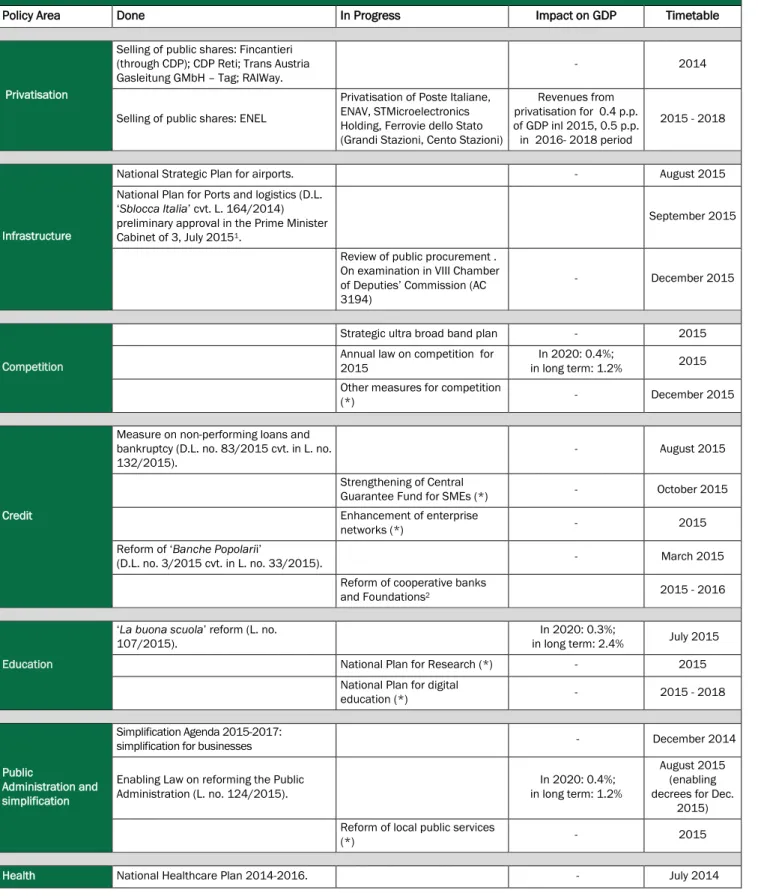
TABLE. 1: REFORM TIMETABLE
Policy Area Done In progress Impact on GDP Timetable
Institutions
Electoral Law Chamber of Deputies (L. no.
52/2015). - May 2015
Reform of the Constitution - 2016
Labour market and social policies
Enabling Law on market reform (L. 183/2014)
In 2020: 0.6%; in long term: 1.3%
December 2014 Enabling legislative decrees on: standard
open-ended contract (Lgs. D. 23/2015); new unemployment benefit scheme (Lgs. D. 22/2015)
March 2015 Enabling Legislative Decree on: work-life
balance (Lgs. D. 80/2015); Code of
labour contracts (Lgs. D. 81/2015) June 2015
Enabling Legislative Decree on: wage supplementation scheme (D.Lgs. 148/2015); simplification of procedures and equal opportunities (D.Lgs. 151/2015); National Agency for Safety and Health at Work (D.Lgs.149/2015); National Employment Agency and active labour market policies(D.Lgs. 150/2015)
September 2015
Justice
Reform of civil justice (D.L. no.
132/2014, cvt. in L. no. 162/2014) . in long term: 0.9%- In 2020: 0.1%; November 2014 Reform of criminal justice (D.L. no.
92/2014 cvt. L. no. 117/2014). August 2014
Enabling bill on: strengthening special courts for companies and special courts for human rights and family related issues; rationalisation of civil trial; revision of proceedings stages
March 2016
Bill on revision of penal code, penal proceedings, and certainty in the
length of proceedings December 2015 Bill against organised crime - March 2016
Taxation
Enabling Law on tax reform (L. no.
23/2014) - March 2014
IVA and taxation on capital gains (D.L. no.
66/2014 cvt. in L. no. 89/2014). in long term: -0.2% In 2020: -0.2%; June 2014 Permanent reduction of tax wedge (2015
Stability Law – L. no. 190/2014) . in long term: 0.4% In 2020: 0.4%; December 2014 Enabling legislative decrees on: Fiscal
simplification (Lgs.D. no. 175/2014). (For fiscal simplification, estimates are included in administrative simplification) November 2014
Enabling legislative decrees on: Tobacco products (Lgs. D. no. 188/2014); Cadastral committee (Lgs. D. no.
198/2014) -
December 2014
Enabling legislative decrees on: certainty of taxation (Lgs.D. no 128/2015); VAT electronic invoicing (Lgs.D. no 127/2015).
- August 2015 Enabling legislative decree on:
simplifying taxation for international
businesses (Lgs.D. no. 147/2015) - September 2015 Enabling legislative decree on: monitoring
of tax evasion; sanction system; litigation procedures; collecting system; reorganisation of fiscal agencies.
- September 2015 Local tax and cadastral reform
TASI-IMU (2016), IRES-IRAP (2017),
TABLE 1 (CONTINUED): REFORM TIMETABLE
Policy Area Done In Progress Impact on GDP Timetable
Privatisation
Selling of public shares: Fincantieri (through CDP); CDP Reti; Trans Austria Gasleitung GMbH – Tag; RAIWay.
- 2014
Selling of public shares: ENEL
Privatisation of Poste Italiane, ENAV, STMicroelectronics Holding, Ferrovie dello Stato (Grandi Stazioni, Cento Stazioni)
Revenues from privatisation for 0.4 p.p. of GDP inl 2015, 0.5 p.p. in 2016- 2018 period 2015 - 2018 Infrastructure
National Strategic Plan for airports. - August 2015 National Plan for Ports and logistics (D.L.
‘Sblocca Italia’ cvt. L. 164/2014) preliminary approval in the Prime Minister Cabinet of 3, July 20151.
September 2015 Review of public procurement .
On examination in VIII Chamber of Deputies’ Commission (AC 3194)
- December 2015
Competition
Strategic ultra broad band plan - 2015 Annual law on competition for
2015
In 2020: 0.4%;
in long term: 1.2% 2015 Other measures for competition
(*) - December 2015
Credit
Measure on non-performing loans and bankruptcy (D.L. no. 83/2015 cvt. in L. no. 132/2015).
- August 2015 Strengthening of Central
Guarantee Fund for SMEs (*) - October 2015 Enhancement of enterprise
networks (*) - 2015
Reform of ‘Banche Popolarii’
(D.L. no. 3/2015 cvt. in L. no. 33/2015). - March 2015 Reform of cooperative banks
and Foundations2 2015 - 2016
Education
‘La buona scuola’ reform (L. no. 107/2015).
In 2020: 0.3%;
in long term: 2.4% July 2015 National Plan for Research (*) - 2015 National Plan for digital
education (*) - 2015 - 2018
Public
Administration and simplification
Simplification Agenda 2015-2017:
simplification for businesses - December 2014
Enabling Law on reforming the Public Administration (L. no. 124/2015).
In 2020: 0.4%; in long term: 1.2%
August 2015 (enabling decrees for Dec.
2015) Reform of local public services
(*) - 2015
Health National Healthcare Plan 2014-2016. - July 2014
1 The Prime Minister Decree of 26th August 2015 was endorsed by the control body no. 2104/2015 of 2nd
September 2015.
NATIONAL STRATEGY AND EUROPEAN COUNCIL RECOMMENDATIONS
TABLE 1 (CONTINUED): REFORM TIMETABLE
Policy Area Done In Progress Impact on GDP Timetable
colture
Measures for the milk and diary industry
(D.L. no. 51/2015 cvt.L. no. 91/2015). - July 2015 Implementation of the Common
Agricultural Policy . - March 2015
Environment Green Act - October 2015
Environmental taxation (*) - 2015 - 2016
Spending Review and tax expenditures
Enhancing PA efficiency and revision of the tax expenditures
In 2020: -0.2%; in long term: 0.0% Structural savings planned up to 2019 . Impact of measures in 2020: 1.8% Impact of measures in 2025: 3.0% Impact of reforms in long term: 7.2%
Note: Reforms are split according to their state of advancement in two categories: i) reforms presented in Parliament for approval (in progress) and ii) reforms who have already completed the process of approval and have been published in the Official Journal (done). The reforms that have not been discussed by the Government are marked with the symbol (*).
The reforms implementation is a priority for the government
3. For this
reason, the monitoring of the legislative implementation has been strengthened
both in terms of frequency and extension of the survey, also considering the
commitment shown by ministries to enact the measures.
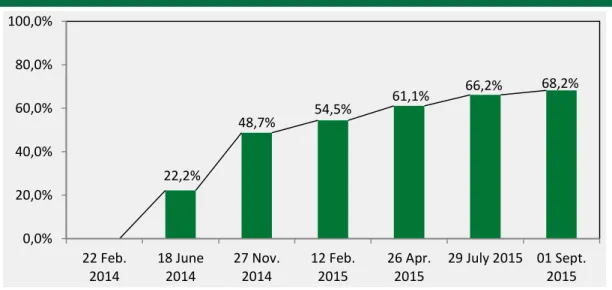
The rate implementation of the reforms of the government in office as of
September 1, 2015 reached 68.2 per cent (see Figure 1)
4.
FIGURE 1: RENZI GOVERNMENT: IMPLEMENTATION RATE
Note: Implementation rate calculated on the base of the terms set Source: Prime Minister Cabinet – Ufficio per il programma di Governo..
3 For further information see http://www.programmagoverno.gov.it/
4 As for the Government in office, since February 22, 2014 to September 1, 2015, the approved laws
amount to 212, 40 percent of which are legislative decrees, 43 percent bills and 17 percent decree laws. In the Italian official gazette 118 legislative acts published so far, 47 percent of which does not require any implementation act, while 53 percent needs 532 implementing acts.
22,2%
48,7%
54,5%
61,1%
66,2%
68,2%
0,0%
20,0%
40,0%
60,0%
80,0%
100,0%
22 Feb.
2014
18 June
2014
27 Nov.
2014
12 Feb.
2015
26 Apr.
2015
29 July 2015 01 Sept.
2015
The stock of the decrees inherited from previous governments (Letta and
Monti), which amounted to 889 measures, fell to 261, with an implementation
rate of 74.9 percent.
Concerning the progress in the web based information system for monitoring
the implementation of the measures, it should be noted that the system has been
put in place in line with the time schedule and after a trial phase, it is now in use
by all ministries.
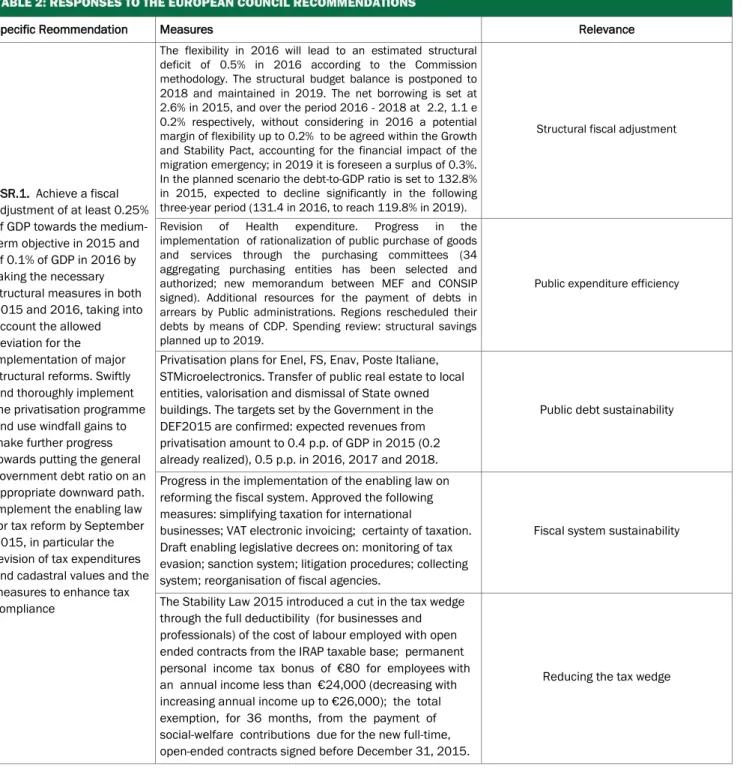
A summary of the main measures adopted by the government in order to give
effective implementation to the European Council Recommendations is in table 2.
TABLE 2: RESPONSES TO THE EUROPEAN COUNCIL RECOMMENDATIONSSpecific Reommendation Measures Relevance
CSR.1. Achieve a fiscal adjustment of at least 0.25% of GDP towards the medium-term objective in 2015 and of 0.1% of GDP in 2016 by taking the necessary structural measures in both 2015 and 2016, taking into account the allowed deviation for the implementation of major structural reforms. Swiftly and thoroughly implement the privatisation programme and use windfall gains to make further progress towards putting the general government debt ratio on an appropriate downward path. Implement the enabling law for tax reform by September 2015, in particular the revision of tax expenditures and cadastral values and the measures to enhance tax compliance
The flexibility in 2016 will lead to an estimated structural deficit of 0.5% in 2016 according to the Commission methodology. The structural budget balance is postponed to 2018 and maintained in 2019. The net borrowing is set at 2.6% in 2015, and over the period 2016 - 2018 at 2.2, 1.1 e 0.2% respectively, without considering in 2016 a potential margin of flexibility up to 0.2% to be agreed within the Growth and Stability Pact, accounting for the financial impact of the migration emergency; in 2019 it is foreseen a surplus of 0.3%. In the planned scenario the debt-to-GDP ratio is set to 132.8% in 2015, expected to decline significantly in the following three-year period (131.4 in 2016, to reach 119.8% in 2019).
Structural fiscal adjustment
Revision of Health expenditure. Progress in the implementation of rationalization of public purchase of goods and services through the purchasing committees (34 aggregating purchasing entities has been selected and authorized; new memorandum between MEF and CONSIP signed). Additional resources for the payment of debts in arrears by Public administrations. Regions rescheduled their debts by means of CDP. Spending review: structural savings planned up to 2019.
Public expenditure efficiency
Privatisation plans for Enel, FS, Enav, Poste Italiane, STMicroelectronics. Transfer of public real estate to local entities, valorisation and dismissal of State owned buildings. The targets set by the Government in the DEF2015 are confirmed: expected revenues from privatisation amount to 0.4 p.p. of GDP in 2015 (0.2 already realized), 0.5 p.p. in 2016, 2017 and 2018.
Public debt sustainability
Progress in the implementation of the enabling law on reforming the fiscal system. Approved the following measures: simplifying taxation for international
businesses; VAT electronic invoicing; certainty of taxation. Draft enabling legislative decrees on: monitoring of tax evasion; sanction system; litigation procedures; collecting system; reorganisation of fiscal agencies.
Fiscal system sustainability
The Stability Law 2015 introduced a cut in the tax wedge through the full deductibility (for businesses and professionals) of the cost of labour employed with open ended contracts from the IRAP taxable base; permanent personal income tax bonus of €80 for employees with an annual income less than €24,000 (decreasing with increasing annual income up to €26,000); the total exemption, for 36 months, from the payment of social-welfare contributions due for the new full-time, open-ended contracts signed before December 31, 2015.
NATIONAL STRATEGY AND EUROPEAN COUNCIL RECOMMENDATIONS
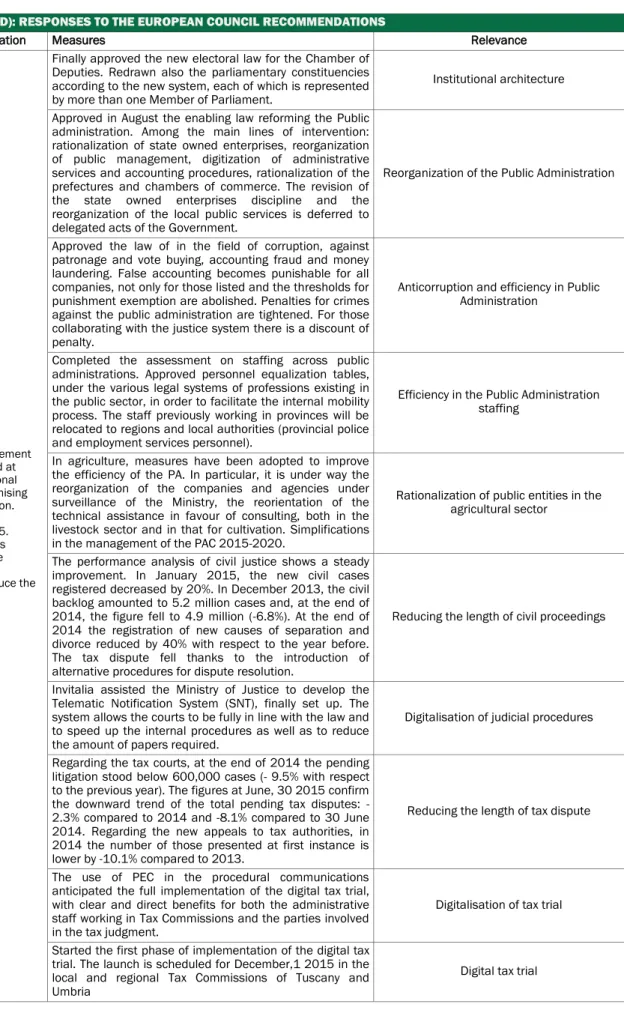
TABLE 2 (CONTINUED): RESPONSES TO THE EUROPEAN COUNCIL RECOMMENDATIONS
Specific Recommendation Measures Relevance
CSR.2. Adopt the planned national strategic plan for ports and logistics, particularly to help promote intermodal transport through better connections. Ensure that the Agency for Territorial Cohesion is made fully operational so that the management of EU funds markedly improves.
Approved the National Strategic Plan for harbour and logistics, with the aim of relaunching the competitiveness of the national shipping network; boosting the transportation of goods and passengers, easing the intermodal freight transportation. The Plan includes measures for: simplifying and reducing administrative burdens; boosting competitiveness and transparency; increasing the accessibility of land to sea networks; further integrating the logistic system; improving infrastructures; spurring innovation and sustainability; ameliorating resources management; promoting national coordination by reforming the governance of the sector.
Developing the harbour and logistics system
Increased the coordination between the Customs and Monopolies Agencies for the simplification of the import/export procedures in the port system. With the Italian Coast Guard, simplified the pre-clearing procedures to present custom declarations on a pre-arrival basis in several Italian ports.
Administrative simplification
The enabling law on reforming of Public administration orders the rationalisation of port authorities and their governance.
Rationalisation of port authorities The national plan for airports selected 38 airports of
national strategic interest, as they are essential for the exclusive competences of the State. Among them, there are 12 airports of strategic relevance as part of the Trans-European Networks.
Developing the airport sector
The Cohesion Agency is becoming fully operational thanks to the setup of the Board of Directors (in May) and the Board of Auditors (in June).
Efficency in the management of EU Funds In June 2015, the expenditure certified to the European
Commission by Italy in implementing the programs financed by EU funds has reached 79.8% of the total budget. The increase in spending compared to December, 31 2014 was of 3.1 billion (+6.5 p.p. of the total resources programmed).
Monitoring of the EU Funds management
Started in July 2015, the Governance and Institutional Capacity building National Operational Programme 2014-2020, supported by Italy and the Commission to address the main problems and challenges arising from specific recommendations for the country regarding the administrative capacity and efficiency, the reform of justice system, the better management of the Funds SIE and the strengthening of the Administration in implementing the public policies of investment.
TABLE 2 (CONTINUED): RESPONSES TO THE EUROPEAN COUNCIL RECOMMENDATIONS
Specific Recommendation Measures Relevance
CSR.3. Adopt and implement the pending lawsaimed at improving the institutional framework and modernising the public administration. Revise the statute of limitations by mid-2015. Ensure that the reforms adopted to improve the efficiency
of civil justice help reduce the length of proceedings.
Finally approved the new electoral law for the Chamber of Deputies. Redrawn also the parliamentary constituencies according to the new system, each of which is represented by more than one Member of Parliament.
Institutional architecture Approved in August the enabling law reforming the Public
administration. Among the main lines of intervention: rationalization of state owned enterprises, reorganization of public management, digitization of administrative services and accounting procedures, rationalization of the prefectures and chambers of commerce. The revision of the state owned enterprises discipline and the reorganization of the local public services is deferred to delegated acts of the Government.
Reorganization of the Public Administration
Approved the law of in the field of corruption, against patronage and vote buying, accounting fraud and money laundering. False accounting becomes punishable for all companies, not only for those listed and the thresholds for punishment exemption are abolished. Penalties for crimes against the public administration are tightened. For those collaborating with the justice system there is a discount of penalty.
Anticorruption and efficiency in Public Administration
Completed the assessment on staffing across public administrations. Approved personnel equalization tables, under the various legal systems of professions existing in the public sector, in order to facilitate the internal mobility process. The staff previously working in provinces will be relocated to regions and local authorities (provincial police and employment services personnel).
Efficiency in the Public Administration staffing
In agriculture, measures have been adopted to improve the efficiency of the PA. In particular, it is under way the reorganization of the companies and agencies under surveillance of the Ministry, the reorientation of the technical assistance in favour of consulting, both in the livestock sector and in that for cultivation. Simplifications in the management of the PAC 2015-2020.
Rationalization of public entities in the agricultural sector
The performance analysis of civil justice shows a steady improvement. In January 2015, the new civil cases registered decreased by 20%. In December 2013, the civil backlog amounted to 5.2 million cases and, at the end of 2014, the figure fell to 4.9 million (-6.8%). At the end of 2014 the registration of new causes of separation and divorce reduced by 40% with respect to the year before. The tax dispute fell thanks to the introduction of alternative procedures for dispute resolution.
Reducing the length of civil proceedings
Invitalia assisted the Ministry of Justice to develop the Telematic Notification System (SNT), finally set up. The system allows the courts to be fully in line with the law and to speed up the internal procedures as well as to reduce the amount of papers required.
Digitalisation of judicial procedures Regarding the tax courts, at the end of 2014 the pending
litigation stood below 600,000 cases (- 9.5% with respect to the previous year). The figures at June, 30 2015 confirm the downward trend of the total pending tax disputes: -2.3% compared to 2014 and -8.1% compared to 30 June 2014. Regarding the new appeals to tax authorities, in 2014 the number of those presented at first instance is lower by -10.1% compared to 2013.
Reducing the length of tax dispute
The use of PEC in the procedural communications anticipated the full implementation of the digital tax trial, with clear and direct benefits for both the administrative staff working in Tax Commissions and the parties involved in the tax judgment.
Digitalisation of tax trial Started the first phase of implementation of the digital tax
trial. The launch is scheduled for December,1 2015 in the local and regional Tax Commissions of Tuscany and Umbria
NATIONAL STRATEGY AND EUROPEAN COUNCIL RECOMMENDATIONS
TABLE 2 (CONTINUED): RESPONSES TO THE EUROPEAN COUNCIL RECOMMENDATIONS
Specific Recommendation Measures Relevance
CSR.4. Introduce binding measures by end-2015 to tackle remaining
weaknesses in the corporate governance of banks, particularly the role of foundations, and take measures to accelerate the broad-based reduction of non-performing loans.
In April 2015 a protocol between ACRI and MEF was signed, in order to reform the regulation of Banking Foundations. It responds to the need that Banking Foundations be the main stakeholder while respecting the autonomy of participated banks, as well as diversify their investment.
Implement the agreed reform of foundations
The secondary legislation required to implement the reform of cooperative banks (decree law no.3/2015) have been adopted. Starting from the day this legislation entered into force, the cooperative banks having assets higher than €8 billion have 18-month to modify their status in a limited company.
Tackle remaining weaknesses in the corporate governance of banks
Legislative Decree no.72/2015 has been approved. It implements the Directive 2013/36/UE and reforms the regulation on managers and shareholders. Bank of Italy supervisory powers have been enlarged, adding the possibility of removing one or more members of the board and managers of the bank. The administrative sanctions has been totally reviewed, by adopting a system in which the company is sanctioned the first.
Tackle remaining weaknesses in the corporate governance of banks
European Enabling Law 2014 also implements the Directive 2014/59/EU (so called Directive BRRD) which draws a new framework for the recovery and bankruptcy procedure for banks and investment companies. National law will discipline a new resolution mechanism, alternative to the forced administrative liquidation. A bail-in process will be applied, a resolution mechanism to be activated when the capital writing off is not sufficient to cover the losses. Public supporting measures will be strongly limited. In September, the government approved in a preliminary examination two legislative decrees concerning the recovery and resolution of banks and investment company, thus implementing the European Enabling Law.
Tackle remaining weaknesses in the corporate governance of banks
Decree Law n. 83/2015 changed the previous system of loss deduction in five annual instalments, providing for the total deductibility in the year of allocation of write-downs and credit losses for credit and financial institutions and insurance companies.
Accelerate the reduction of non-performing loans
With the Decree Law no.83/2015, the government intervened to solve the difficulties in accessing credit by firms: a new restructuring agreement has been introduced involving financial creditors (i.e. banks and intermediaries) with the possibility of credit's deferment.
Accelerate the reduction of non-performing loans
TABLE 2 (CONTINUED): RESPONSES TO THE EUROPEAN COUNCIL RECOMMENDATIONS
Specific Recommendation Measures Relevance
CSR.5. Adopt the legislative decrees on the use of wage supplementation schemes, the revision of contractual arrangements, work-life balance and the strengthening of active labour market policies. Establish, in consultation withthe social partners and in accordance with national practices, aneffective framework for second-level contractual bargaining. As partof efforts to tackle youth unemployment, adopt and implement the planned school reform and expand vocationally-oriented tertiary education.
Implementation of the enabling law reforming the labour market. Approved the following measures: i) the standard open-ended contract with increasing protection according to tenure; ii) the universal unemployment benefit scheme associated to stronger active labour market measures; iii) work-life balance measures; iv) simplification of contractual models and administrative procedures; v) reorganisation of the active labour market policy; vi) simplification of inspection activity and creation of a National Inspectorate.
Flexibility and job protection
Implementation of Youth Guarantee. Measures to support young self-entrepreneurs. Strengthen the link between school and work. Revision of the apprenticeship discipline.
Support to youth employment
Agreements on representativeness signed between CGIL-CISL-UIL and Confindustria and between CGIL-CGIL-CISL-UIL and Alleanza delle Cooperative Italiane. Implementing procedures are currently being undertaken in order to verify representativeness data (based on registered membership and polls results at firm level).
Strengthen the second-level contractual bargaining
Digitalisation of the social security compliance certificate
(DURC) Simplification of administrative procedures Approval of the 'La buona scuola' reform: greater
autonomy in school governance; increasing the teaching staff in a permanent way (thanks to an extraordinary recruiting), developing teachers’ competencies through formation; new evaluation system for teachers with careers linked to performances.
Investment in human capital
Closed the first self-evaluation report of schools. Strengthen the National Agency for the evaluation of the tertiary system and research (ANVUR).
Evaluation of the school system and research
More resources to the school system; fiscal incentives to taxpayers with the ‘school bonus’. School building interventions with upgrading in terms of architecture and technology and improvements in energy efficiency.
NATIONAL STRATEGY AND EUROPEAN COUNCIL RECOMMENDATIONS
TABLE 2 (CONTINUED): RESPONSES TO THE EUROPEAN COUNCIL RECOMMENDATIONS
Specific Recommendation Measures Relevance
CSR.6. Implement the simplification agenda for 2015-2017 to ease the administrative and regulatory burden. Adopt competition-enhancing measures in all the sectors covered by the competition law, and take decisiveaction to remove remaining barriers. Ensure that local public services contracts not complying withthe requirements on in-house awards are rectified by no later than end-2015.
Published the second monitoring report on the
implementation of the Simplification Agenda. As of August 31, 36 out of 40 deadlines of the Agenda were met (90% of the total), with detailed programming.
Simplification Agenda for 2015-2017: Monitoring Report
As of August 31 2015 the implementation of the Simplification Agenda shows the first results: all the ordinary Regions adopted the standardised and simplified models for the construction sector, which are the most used by citizens (namely CIL and CILA); full adoption of the pre-filled tax return for permanent employees and pensioners; activation of a tax tutoring reservation service and strengthening of e-channel for tax assistance.
Simplification Agenda for 2015-2017: Implementation
The enabling law reforming Public Administration set
simplification measures immediately applicable. Administrative procedure simplification In April 2015, the government presented before
Parliament the draft of the first annual law on competition. The draft was approved by the Chamber of Deputies and is now before the Senate. The draft law sets provisions of immediate application as well as some enabling acts to government. The law intervenes in several sectors: insurance so as to contain costs and counteract frauds; communications so as to favour mobility in the pay-tv market; post, banks, pharmacies, professional services and energy sector so as to further enhance competition. In addition, the draft law pursue the goals of cost reduction for citizens and firms, as well as modernisation and ease of investments in the sectors under consideration.