Polymer Communication
A Model study for Diels–Alder reaction of biscyclopentadienyl monomer
with bismaleimides. Benzylcyclopentadiene: synthesis, characterization
and Diels–Alder reaction with N-(4-benzoyl)-phenylmaleimide
H. Ben Romdhane
a, M.R. Chaaˆbouni
a, M.F. Grenier-Loustalot
b, F. Delolme
b, P. Mison
b,
B. Sillion
b,*
a
Laboratoire de Synthe`se et Analyse de Mate´riaux, Ecole Nationale d’Inge´nieur de Tunis, De´partement de Ge´nie Industriel, BP 37, Le Belve´de`re 1002 Tunis, Tunisia
b
Service Central d’Analyses, CNRS, BP 22, 69390 Vernaison, France
Received 22 February 1999; received in revised form 27 May 1999; accepted 4 June 1999
Abstract
Reaction between benzylbromide and sodium cyclopentadienide leads to a mixture of dienes. These can be identified by several techniques such as size exclusion chromatography, mass spectroscopy (MS) and high performance liquid chromatography/MS coupling. Their structure is confirmed by analysis of adducts obtained after reaction of N-(4-benzoyl)-phenylmaleimide with these dienes.q1999 Elsevier Science Ltd. All rights reserved.
Keywords: Diels–Alder; Cyclopentadiene; Maleimide
1. Introduction
The Diels–Alder cycloaddition, a very interesting approach for the synthesis of linear polyimides has been previously used [1]. The reaction proceeds smoothly when the diene is electron rich and the dienophile is electron deficient [2]. This theore-tical aspect and also the low cost of the bismaleimides make them good candidates for Diels–Alder polyadditions with different bisdienes. Furanes [3], isobenzofuranes [4],
cyclo-hexadienes [5], cyclopentadienones [6] and a-pyrones [7]
have been used as dienes and in most cases the thermally unstable cycloadduct can lead up to a thermally stable aromatic system after extrusion of a small molecule (water, carbon monoxide or carbon dioxide when furanes, cyclopen-tadienones or pyrones are, respectively, implied).
However, the reverse reaction of a polyadduct could also be a source of technical interest. The chemistry and reverse Diels–Alder of the nadimide—a bicyclo compound— obtained by the reaction of a maleimide with cyclopenta-diene is well documented [8]. For example, the reverse reaction is the first step taking place during the thermal polymerization of bismaleimide thermosetting resins [8]. The synthesis of two types of polynadimide have been
previously published. Stille and Blummer [9] used conden-sation of bismaleimides with unsubstituted bis
cyclopenta-diene. These authors described
biscyclopentadienyl-(hexane, nonane and p-xylene) as waxy materials containing mono substituted derivatives and oligomers. Kiselev et al. [10,11] compared the reactivities of different cyclopenta-dienes with and without a methyl substituent, and they pointed out that polymethyl cyclopentadiene would be more reactive than the unsubstituted one.
However, in these articles, the formation of alkyl or benzylcyclopentadiene by reaction of an unsubstituted cyclopentadienyl carbanion with the corresponding alkyl or benzylbromide was not clearly demonstrated.
This work is a model study to reinvestigate the synthesis of the benzylcyclopentadiene, by using the described reac-tion of benzylbromide with sodium cyclopentadienide. The reaction products were analyzed by size exclusion chroma-tography (SEC), high performance chromachroma-tography and mass spectroscopy (MS) and then reacted with N-(4-benzoyl)-phenylmaleimide.
2. Experimental
Sodium cyclopentadienide solution in tetrahydrofuran (THF, 2.0 mol), benzylbromide, 4-amino-benzophenone, 0032-3861/00/$ - see front matterq1999 Elsevier Science Ltd. All rights reserved.
PII: S 0 0 3 2 - 3 8 6 1 ( 9 9 ) 0 0 3 9 1 - 2
* Corresponding author. Tel.:133-7802-2222; fax:133-7802-7187.
maleic anhydride and anhydrous THF were purchased from Aldrich and were used as received.
2.1. Attempt to synthesize benzylcyclopentadiene
10 ml of sodium cyclopentadienide solution (20 mmol of
Cp2) is added with a syringe and septum to 3.104 g
(18.1 mmol) of benzylbromide in 15 ml of anhydrous THF, stirred under nitrogen atmosphere. Temperatures and reaction time are given in Table 1. The immediate formation of a white precipitate is observed. At the end of the reaction, the latter is filtered and then washed with 3× 10 ml of diethylether. The extracts are added to the filtrate which is washed in turn several times with 15 ml of distilled water until neutral pH. Following this, the organic layer is dried over sodium sulfate. Finally, the solvent is stripped off, and a brown viscous oil is obtained. The latter is stored at cold temperature (less then 08C). Sodium bromide is dried in vacuum and isolated in quantitative yield (<100%). 2.2. Preparation of N-(4-benzoyl) phenylmaleimide 2.2.1. N-(4-benzoyl)phenylmaleamic acid
In a three necked flask provided with a reflux condenser, maleic anhydride (8.66 g, 0.088 mol) is dissolved in diethyl-ether (100 ml). Under mechanical stirring, a solution of 4-aminobenzophenone (17.35 g, 0.088 mol) in ether (40 ml) is added dropwise through a dropping funnel. After the addi-tion, the thick suspension is stirred at room temperature for 1 h and then cooled in an ice bath. The product is obtained by filtration. The yellow colored powder (m.p. 1788C) is used in the next step without purification (21.8 g, 0.086 mol, 98%).
2.2.2. N-(4-benzoyl)phenylmaleimide
In a three necked flash equipped with a reflux condenser are added acetic anhydride (120 ml, 1.152 mol), anhydrous potassium acetate (12.6 g, 0.091 mol) and N-(4-benzoyl)-phenylmaleamic acid (22.01 g, 0.087 mol). The reaction mixture is heated at 1008C for 30 min under stirring. After cooling at room temperature, the reaction mixture is poured into ice cold water (100 ml). The precipitate is obtained by suction filtration, washed with cold water (3×60 ml) and then with petroleum ether (50 ml). After drying the crude
product (19.4 g, 0.082 mol, 95%), recrystallization from cyclohexane–chloroform (45/55) gave yellow needles
(m.p. 156–1588C) of pure product (6.9 g, 0.03 mol, 34%;
see Fig. 7). H NMR: (solvent: CDCl3); 6.90(s, 2H, H1); 7.82(d, 2H, H4); 7.92(d, 2H, H5); 7.55 (d, 2H, H9); 7.50 (t, 2H, H10); 7.61 (t, 1H, H11); JH4H58:4 Hz; JH9H108:3 Hz, JH10H117:3 Hz. C-13-NMR: (solvent: CDCl3); 125.11(C4); 1289(C10); 130.05(C9); 130.97(C5); 132.63(C11); 134.42(C1); 134.89(C3); 136.46(C6); 137.20(C8); 169.08(C2); 195.60(C7).
2.3. Condensation of the run 1 product with N-(4-benzoyl)-phenylmaleimide
To a solution of the run 1 product (0.30 g, 1.82 mmol of the supposed benzylcyclopentadiene) in 2 ml of THF, a
solution of N-(4-benzoyl)phenylmaleimide (0.55 g,
2.0 mmol), in 7 ml of THF is added under stirring and nitro-gen atmosphere. The mixture is left at 608C for 22 h and
H. Ben Romdhane et al. / Polymer 41 (2000) 1633–1639
1634 Table 1
Temperature and time used in the synthesis of cyclopentadiene
Run 1 Run 2 Run 3
Temperature (8C) 0 25 65
Time (min) 60 180 60
Fig. 2. The different isomers of monosubstituted cyclopentadiene.
Fig. 1. Synthesis scheme of benzylcyclopentadiene (runs 1–3).
then poured into excess of petroleum ether. The product is filtered off, washed with petroleum ether and dried in a vacuum dessicator.
2.4. Steric exclusion chromatography
A Waters SEC apparatus, fitted with UV and refractive index detectors is used (only the latter is used for this work). This is equipped with a series of three columns (mStyragel HR 0:51mStyragelHT31mStyragel103a) able to sepa-rate masses in the range of 10–10,000. The operating solvent is THF (1 ml/min).
A sample of 0.1 ml, removed from product (I), is diluted
in 1 ml of THF, and 20ml from this solution is injected
through a Millipore filter. 2.5. HPLC–MS analyses
Analyses were conducted with a Hewlett Packard 1100
equipped with MS and UV (l260^10 nm) detectors.
The mobile phase A (water1trifluoroacetic acid
pH2:45), B acetonitrile was used with an elution gradient A/B from 30/70 at 0/100 in 30 min and a flow rate of 0.5 ml/ min
The columns were Chrompack Inertsil ODS-mm– 150×
3mm and precolumn
The MS conditions used for the identification of the peaks detected by UV are:
• Ionization: atmospheric pressure chemical ionization (positive mode).
• Gas: dry nitrogen (3508C, 4 l/min).
• Nebulizer pressure: 60 psig. • Capillary voltage: 2000 V. • Vaporizer temperature: 4008C.
• Corona current: 8mA. 2.6. Mass spectrometry analyses
All the mass spectrometric experiments were carried out with a Micromass ZAB 2-SEQ using an electron ionization (EI) source. The ion source was operated with an accelerat-ing voltage of 8 kV, ionizaccelerat-ing electron energy of 70 eV and ion source temperature of 2008C.
3. Discussion
3.1. Attempt to synthesize benzylcyclopentadiene
The condensation of the sodium cyclopentadienide with the benzylbromide (Fig. 1) in THF was carried out at differ-ent temperatures (Table 1).
Sodium bromide precipitation took place immediately, and the final weight showed a transformation with about 100% yield.
Working with methylcyclopentadiene, Fritz et al. [12] pointed out the presence of three isomers (Fig. 2).
Unfortunately with the benzyl group, the complex
mixture obtained did not allow a correct NMR 1H
attribution. Fig. 4. MS–EI spectrum of run 1.
3.2. Size exclusion chromatography analysis
The detection was performed by refractometry, and the traces were identical for runs 1, 2 and 3. Fig. 3 shows the chromatogram obtained with run 1.
The signal located at 28.5 min can be unequivocally attributed to the cyclopentadiene dimer (CPD) and the formation of products (a)–(d) was observed.
3.3. Mass spectroscopy characterization
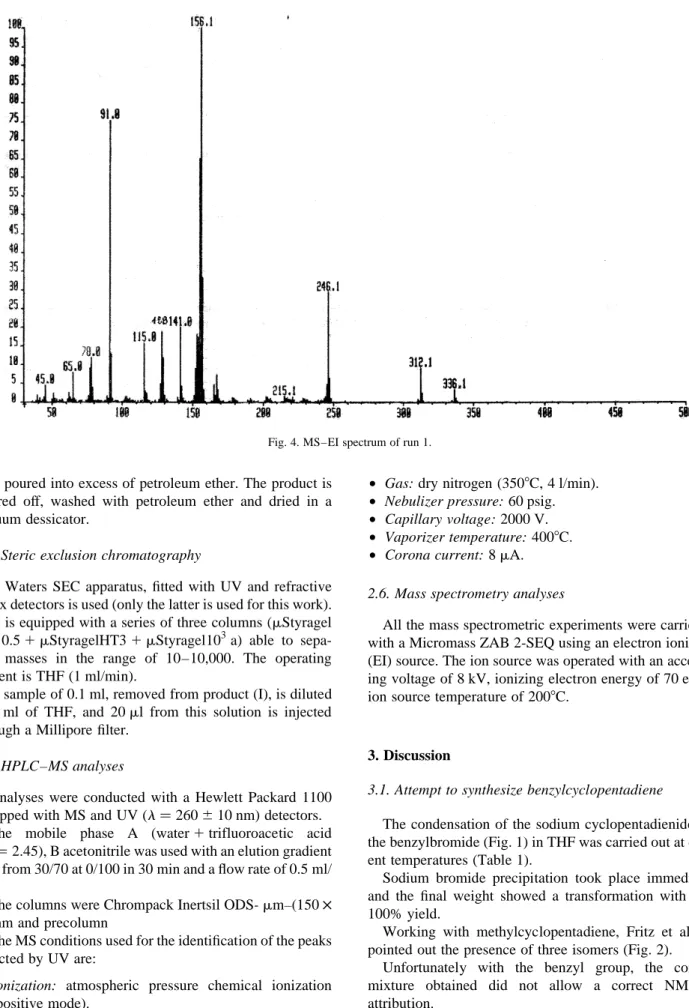
The products obtained in run 1 were identified by MS–EI (electron impact ionization; Fig. 4).
The expected benzylcyclopentadiene was identified by
the peak, M=Z156, and the presence of three other
products observed by SEC was confirmed by three peaks M=Z246, 312, 336.
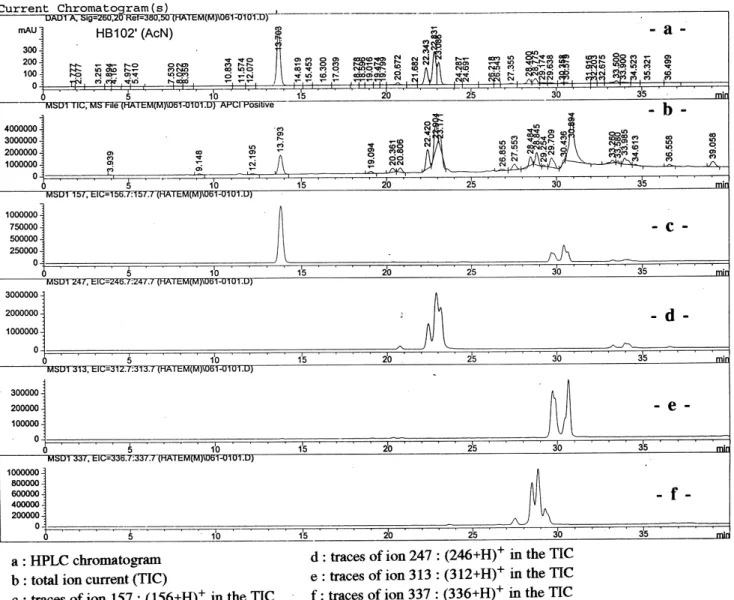
HPLC/MS coupling (using atmospheric pressure chemi-cal ionization, positive mode) allowed a more precise
identification of each product after separation. Fig. 5 shows the HPLC trace of the run 1 mixture.
HPLC shows the presence of several peaks which can be assigned to several isomers for each compound M=Z 156, 246, 312, 336.
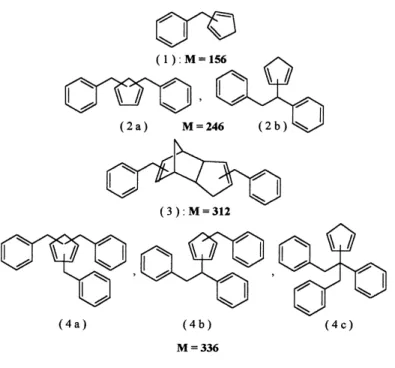
From these data the general formula (including isomers) of the four products obtained by condensation of sodium cyclopentadienide with benzylbromide are given in Fig. 6. 3.4. Condensation of the run 1 product with N-(4-benzoyl)-phenylmaleimide (Fig. 7)
The reaction was performed at 608C in THF, and after
work up, the product was analyzed by MS–EI; the spectrum is shown in Fig. 8. Three expected adducts I1from (1), I2
from (2) and I4from (4) are observed M=Z433, 513, 613
(Table 2).
Compound (3) M=Z 312 cannot react as a diene, but at
608C an equilibrium between (1) and (3) probably took
H. Ben Romdhane et al. / Polymer 41 (2000) 1633–1639
1636
Fig. 6. Probable structures of products present in run 1.
Table 2
Structures of examples of adducts formed by condensation of run 1 with N-(4-bnezoyl)-phenylmaleimide Ion Observed mass Calculated mass Proposed structure
I1 433 1561277433 I2 523 2461277523 a I3 613 3361277613 a a
place and this equilibrium was displaced by the reaction of (1) with the maleimide.
During MS analysis, the reverse Diels–Alder reaction of the three nadimides occurred, and the peaks corresponding
to maleimide M=Z 277 and to the three dienes were
observed.
These results confirm the structures suggested (Fig. 6) which are in agreement with all the analytical data. A mechanism for the reaction of the benzylbromide with sodium cyclopentadienide is presented in Fig. 9.
The expected formation of benzylcyclopentadiene
(probably a mixture of isomers according to Fig. 9) resulted from the nucleophilic substitution of the benzylbromide (Fig. 9(a-1)). However, the acidic hydrogen belonging to the benzylcyclopentadiene should allow a proton transfer
to cyclopentadienide with an equilibrium (Fig. 9(a-2)). The new carbanions were able to react with the benzylbro-mide with the formation of the isomer mixture (2). A similar reaction with (2) would give the mixture (4).
Higher molecular weight products coming from (4) were not detected, one reason would be either steric hindrance or higher conjugation decreasing the reactivity of the corre-sponding carbanion.
The formation of dimer (3) is easily explained by Diels– Alder dimerization of benzylcyclopentadiene (Fig. 9(b)).
4. Conclusion
The formation of benzylcyclopentadiene by reaction of the benzylbromide with sodium cyclopentadienide is not a one way reaction.
Two side reactions take place: the first is due to the formation of benzylcyclopentadienide carbanion by proton transfer with sodium cyclopentadienide. The second is a classical Diels–Alder dimerization of the expected product. For each species, liquid chromatography shows the presence of different isomers. All the dienic products in the medium can react with a maleimide giving a nadic adduct.
H. Ben Romdhane et al. / Polymer 41 (2000) 1633–1639
1638
Fig. 7. N-(4-benzoyl)-phenylmaleimide.
References
[1] Stenzenberger HD. In: Abadie MJM, Silion B, editors. Polyimides and other high-temperature polymers, New York: Elsevier, 1991. p. 215.
[2] March J. Advanced organic chemistry reactions, mechanisms and structures, 3, 1984. p. 749.
[3] Hawthorne DG, Hodkin JH, Jakson MB, Mortoncisro TC. High Perf Polym 1994;6:249.
[4] Watson KA, Bass RG. Polym Prepr (Am Chem Soc, Div Polym Chem) 1979;38(2):237.
[5] Turpin F, Mison P, Sillion B. In: Feger C, Khojastech MM, Molis SE, Hopewell Jct, editors. Polyimides: trends in materials and
applications, New York: Soc Plast Engng Mid Hudson Sect, 1996. p. 169.
[6] Harris FW, Norris SO. J Polym Sci Chem Ed 1973;11:2143. [7] Kottner N, Klemm E. Angew Makromol Chem 1998;254:39. [8] Mison P, Sillion B. In: Kicheldorf HR, editor. Thermosetting
oligo-mers containing maleimides and nadimides end groups in; advances in polymer science, Berlin: Springer, 1999. p. 137.
[9] Stille JK, Plummer. J Org Chem 1961;26:4026.
[10] Kiselev VD, Sakhabutdinov AG, Sharikov IM, Zverv VV, Konovalov AI. Org Chem USSR 1991;27:1437.
[11] Kiselev VD, Sakhabutdinov AG, Sharikov IM, Zverv VV, Konovalov AI. Org Chem USSR 1992;28:1806.
[12] Fritz HP, Kreitner CG. J Organometallic Chem 1965;4:313. Fig. 9. Proposition for reaction mechanism of benzylbromide with sodium cyclopentadienide.