Copyright © 2018 Zulkifli Md Yusof et al. This is an open access article distributed under the Creative Commons Attribution License, which permits unrestricted use, distribution, and reproduction in any medium, provided the original work is properly cited.
International Journal of Engineering & Technology
Website: www.sciencepubco.com/index.php/IJET Research paper
Distance Evaluated Simulated Kalman Filter with State
Encoding for Combinatorial Optimization Problems
Zulkifli Md Yusof
1*, Zuwairie Ibrahim
2, Asrul Adam
3, Kamil Zakwan Mohd Azmi
4, Tasiransurini Ab Rahman
5,
Badaruddin Muhammad
6, Nor Azlina Ab Aziz
7, Nor Hidayati Abd Aziz
8, Norrima Mokhtar
9, Mohd Ibrahim
Shapiai
10, Mohd Saberi Muhammad
11 1Faculty of Manufacturing, Universiti Malaysia Pahang, Malaysia.
2
Faculty of Electrical and Electronics Engineering, Universiti Malaysia Pahang, Malaysia.
3
Faculty of Engineering and Technology, Multimedia University, Malaysia
4
Faculty of Engineering, University Malaya, Malaysia
5
Malaysia-Japan International Institute of Technology, Universiti Teknologi Malaysia, Malaysia.
6
Institute for Artificial Intelligence and Big Data, Faculty of Bioengineering and Technology, Universiti Malaysia Kelantan, Malaysia. *Corresponding author E-mail: [email protected]
Abstract
Simulated Kalman Filter (SKF) is a population-based optimization algorithm which exploits the estimation capability of Kalman filter to search for a solution in a continuous search space. The SKF algorithm only capable to solve numerical optimization problems which involve continuous search space. Some problems, such as routing and scheduling, involve binary or discrete search space. At present, there are three modifications to the original SKF algorithm in solving combinatorial optimization problems. Those modified algorithms are binary SKF (BSKF), angle modulated SKF (AMSKF), and distance evaluated SKF (DESKF). These three combinatorial SKF algo-rithms use binary encoding to represent the solution to a combinatorial optimization problem. This paper introduces the latest version of distance evaluated SKF which uses state encoding, instead of binary encoding, to represent the solution to a combinatorial problem. The algorithm proposed in this paper is called state-encoded distance evaluated SKF (SEDESKF) algorithm. Since the original SKF algo-rithm tends to converge prematurely, the distance is handled differently in this study. To control and exploration and exploitation of the SEDESKF algorithm, the distance is normalized. The performance of the SEDESKF algorithm is compared against the existing combi-natorial SKF algorithm based on a set of Traveling Salesman Problem (TSP).
Keywords: combinatorial optimization; distance evaluated; simulated Kalman filter; state encoding; travelling salesman problem
1.
Introduction
Most optimization problems in their original form can be catego-rized as numerical optimization or combinatorial optimization problems. The numerical optimization problems involve finding the best possible numerical values to a set of parameters. Exam-ples of numerical optimization problems are Proportional-Integral-Derivative (PID) tuning in control applications [1], training of a neural network [2], adaptive beamforming [3], and engineering design problems [4]. On the other hand, combinatorial optimiza-tion or discrete problems concern with the best combinaoptimiza-tion of a set of variables such as in traveling salesman problems [5], as-sembly sequence planning [6], scheduling for airport [7] and class-room [8], routing in integrated circuits [9], and feature selection [10].
In solving discrete and combinatorial optimization problems, metaheuristic algorithms such genetic algorithm (GA) [11] and ant colony optimization (ACO) [12] have been developed to operate in binary search space. However, not all optimization algorithms are originally developed to operate in binary search space. An example of this algorithm is simulated Kalman filter (SKF) [13-14].
The SKF algorithm is inspired by the estimation capability of Kalman filtering [15]. In SKF algorithm, every agent is regarded
as a Kalman filter. Based on the mechanism of Kalman filtering and measurement process, every agent estimates the global mini-mum/maximum in a search space. Measurement, which is required in Kalman filtering, is mathematically modelled and simulated. Agents communicate among them to update and improve the solu-tion during the search process.
To date, the SKF algorithm has been applied to solve several en-gineering problems. In signal processing, Adam et al. has em-ployed angle-modulated SKF as feature selection in peak classification of EEG signal [16-17]. In telecommunication engi-neering, the SKF algorithm has been used as adaptive beamforming algorithm [18-21]. In industrial engineering, the SKF has been used to solve printed circuit board drill path optimi-zation problem [22-23] and assembly sequence planning problem [24]. In scheduling application, the SKF has been employed in solving airport gate allocation problem [25-26]. In image pro-cessing, the SKF has been used as a template matching algorithm in distance measurement [27-28]. In system identification, the SKF algorithm has been used to estimate the model order and parameter value of an ARX model [29-30]. The SKF algorithm also has been introduced as a tuning method for proportional-integral-derivative (PID) controller [31].
Fundamentally, studies of the SKF algorithm have been reported [32-33]. Furthermore, modifications of the SKF [34-35] and
hy-bridization with other algorithms [36-40] have been done to fur-ther improve the performance of the SKF algorithm.
The original SKF algorithm only capable to solve numerical opti-mization problems which involves continuous search space. Com-binatorial optimization problem, on the other hand, is also an im-portant study in optimization. Normally, the combinatorial optimi-zation problem requires the search space to be in discrete form, which is either 0 or 1. To enable the SKF to operate in discrete search space, binary SKF (BSKF) [41], distance evaluated SKF (DESKF) [42-43], and angle modulated SKF (AMSKF) [44] have been proposed, previously.
In this paper, state-encoded distance evaluated SKF (SEDESKF) algorithm is proposed which search the solutions of a combinato-rial optimization problem in state, instead of in binary number. The concept of state encoding in solving combinatorial optimiza-tions is not totally new. This concept has been used in particle swarm optimization (PSO) [45-47] and gravitational search algo-rithm (GSA) [48-53], which used the velocity variable in PSO and GSA in updating the states. In this study, the distance variable is derived from the SKF algorithm in updating the states since the SKF algorithm operates without a velocity variable. Similar to the previous combinatorial algorithms using state encoding, the pro-posed SEDESKF requires less number of dimensions and conse-quently, less computations compared to the combinatorial optimi-zation algorithms using binary encoding.
2.
The Simulated Kalman Filter
Every agent in SKF is regarded as a Kalman filter. Based on the mechanism of Kalman filtering and measurement process, every agent estimates the global minimum/maximum. Measurement, which is required in Kalman filtering, is mathematically modelled and such simulated. Agents communicate among them to update and improve the solution during the search process. The simulated Kalman filter (SKF) algorithm is illustrated in Figure 1.
Consider n number of agents, SKF algorithm begins with initiali-zation of n agents, in which the states of each agent are given ran-domly. The maximum number of iterations, tmax, is defined. The
initial value of error covariance estimate, P(0) , the process noise covariance value, Q , and the measurement noise covariance value, R , which are required in Kalman filter-ing, are also defined during initialization stage.
Then, every agent is subjected to fitness evaluation to produce initial solutions {X1(0),X2(0), X3(0), …,Xn-2(0), Xn-1(0), Xn(0)}.
The fitness values are compared and the agent having the best fitness value at every iteration, t, is registered as .
The-best-so-far solution in SKF is named as . The is
updated only if the is better than the ( < for function minimization problem, or > for
maximization problem). The subsequent calculations are similar to the predict-measure-estimate steps in Kalman filtering. In the prediction step, the following time-update equations are computed.
(1) (2) where and denote the current state and current transition/predicted state, respectively, while the and denote the current error covariant estimate and current transition error covariant estimate, respectively. Note that the error covariant estimate is influenced by the process noise, .
The next step is measurement, which is a feedback to estimation process. Measurement is modelled such that its output may take any value from the predicted state estimate, , to the true value, . Measurement, , of each individual agent is
simulated based on the following equation:
Table 1: Dimension number and dimension value for an instance of
Dimension number Dimension value 1 0 2 0 3 1 4 1 5 1 6 0 7 0 8 1 9 1 (3)
The term provides the stochastic aspect of SKF algo-rithm and is a uniformly distributed random number. The final step is estimate. During this step, Kalman gain, is computed as follows:
(4) Then, the estimation of next state, , and the updated error covariant, , are computed based on (5) and (6), respectively.
(5) (6) Finally, the next iteration is executed until the maximum number of iterations, tmax, is reached.
3.
The Existing Combinatorial Simulated
Kalman Filter Algorithms
Previously, three extensions of SKF algorithm for combinatorial optimization problems have been introduced in literature. These extensions enable agent i in SKF to update a bit string , which is used to represent solutions to a combinatorial optimization problem. For example, a 9-bit solution, 0-0-1-1-1-0-0-1-1 can be stored by the agent 8th as . Each bit in the bit string is associated to a dimension as shown in Table 1. The length of the bit string is problem dependent and subjected to the size of the problem.
3.1. The Binary Simulated Kalman Filter
The first extension is called binary SKF (BSKF) [41]. In BSKF, modifications are needed only during initialization and generation of solution to combinatorial optimization problem. During the initialization of agents, a random bit string, , is generated for each agent. During the generation of solution, the term in (5) is mapped into a probabilistic value in the range of [0,1] using a mapping function, , as follows:
(7) where . Then, the probabil-istic value is compared to a random number, rand , to up-date the solution If the random number is smaller than the probabilistic value, the binary number at that particular dimension is complemented. For example, let . If the binary bit in dimension 3 and 7 are subjected to complement, then the solution is updated to .
Fig. 1: The original simulated Kalman filter algorithm [13-14].
Fig. 2: Illustration of position of agents at the beginning of a search pro-cess [42-43].
Hence, the following rule can be used to update a bit value in the solution, , for a particular dimension d:
if
then complement
else
end
3.2. The Distance Evaluated Simulated Kalman Filter
In population-based search algorithm, generally, agents are ran-domly positioned in the search space. Then, the agents move in the search space to find global minimum or maximum. During the beginning of the search, exploration is preferred to make sure the search covers almost all regions in the search space. In this stage of search process, the position between agents is normally far with each other. As the search process continues, during the end of the search, exploration is no longer preferred because fine-tuning or exploitation is more preferred. During exploitation, agents be-comes closer to each other and hence, the distance among them decreases.Fig. 3: Illustration of position of agents during the middle of a search process [42-43].
Fig. 4: Illustration of position of agents at the end of a search process [42-43].
The position of agents in a search space during a typical search process is illustrated in Figure 2, Figure 3, and Figure 4. Normally, as the iteration continues, the distance between agents and the best-so-far solution decreases. This distance plays an important role in the distance evaluated simulated Kalman filter algorithm (DESKF) [42-43]. A distance for a dimension d can be calculated as follows:
(8)
The DESKF follows the same procedures as the BSKF. Instead of using the term, the distance, , is mapped into a probabilistic value in the range of [0,1] as fol-lows:
(9) Then, the probabilistic value is compared to a random number,
rand , to update the solution For a particular dimen-sion d, a bit value in the solution, is updated according to the same rule used in BSKF.
3.3. The Angle Modulated Simulated Kalman Filter
The angle modulated approach has been initially introduced for PSO [54]. The angle modulated simulated Kalman filter (AMSKF) combines the same approach with SKF to solve combinatorial optimization problems. This algorithm is called angle modulated SKF (AMSKF) [44] and its flowchart is shown in Figure 5. The main idea of the angle modulated approach in solving combinato-rial optimization problem is to use a function, g(x), to create a continuous signal. The shape of signal g(x) is determined by 4 variables, namely, a, b, c, and d, using (10).(10) where A = .
Fig. 5: The angle modulated simulated Kalman filter algorithm [44].
Fig. 6: An example of g(x) plot [44].
Figure 6 shows an example of g(x) plot for the case of a = 0, b = 1,
c = 1, and d = 0. The region g(x) > 0 is called binary 1 region and region g(x) < 0 is called binary 0 region. After that sampling based on sampling time, T, is executed to generate a bit string of length n. The main advantage of angle modulated approach is that complex calculation in producing high dimensional bit string can be avoid-ed. The search process in solving a combinatorial optimization problem can be done by tuning the values of a, b, c, and d only. In this work, the tuning is done by the SKF algorithm.
4.
The Proposed State-Encoded Distance
Evaluated Simulated Kalman Filter
Based on the state-encoded representation, a solution to a combi-natorial optimization problem can be represented using state en-coding. For example, let a solution 8-5-3-1-6-9-2-4-7 which is stored by the agent 4th as . Each state, from left to right, is associated to a dimension as shown in Table 2. The length of the bit string is problem dependent and subjected to the size of the problem.
The proposed state-encoded distance evaluated simulated Kalman filter (SEDESKF) requires the calculation of distance but unlike the existing DESKF, after all the distances are calculated, the dis-tance is normalized as follows:
Table 2: Dimension number and state associate to the state for an instance of Dimension number State 1 8 2 5 3 3 4 1 5 6 6 9 7 2 8 4 9 7 Fig. 7: The
plot. The grey area indicates the values lie between
and 1.
(11)
where denotes the maximum distance value in
dimension d at iteration t. Since the distance is normalized, the distance values are always in between 0 and 1, regardless of the iteration number. Hence, the impact of premature convergence of the SKF algorithm can be diminished. This normalized distance, , is used to update the solution in using the fol-lowing rule:
if
then random state
else
end
Using this rule, the next state depends on the variables and . If the value is greater than the value, the cur-rent state is assigned as the next state. On the other hand, if the
value is greater than the value, a random state is as-signed as the next state. The
is a random number
and its value is taken between
(the lower limit) to 1 (the upper
limit). The value is formulated to control the search behav-iour in SEDESKF (to promote exploration during the early search process and to promote exploitation towards the end of the search process) and can be calculated as follows:
(12)
where r is a random number.
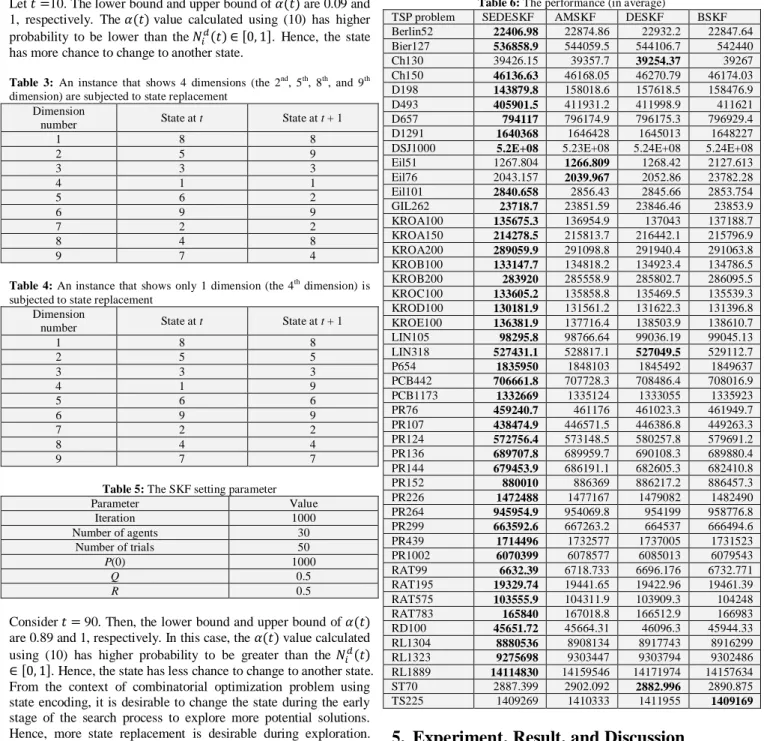
To explain how the exploration and exploitation can be controlled during a search process, a linear graph
is plotted and shown in
Figure 7. The x-axis is and = 100. The grey area indicates
Let 10. The lower bound and upper bound of are 0.09 and 1, respectively. The value calculated using (10) has higher probability to be lower than the . Hence, the state has more chance to change to another state.
Table 3: An instance that shows 4 dimensions (the 2nd, 5th, 8th, and 9th
dimension) are subjected to state replacement Dimension
number State at t State at t + 1
1 8 8 2 5 9 3 3 3 4 1 1 5 6 2 6 9 9 7 2 2 8 4 8 9 7 4
Table 4: An instance that shows only 1 dimension (the 4th dimension) is
subjected to state replacement Dimension
number State at t State at t + 1
1 8 8 2 5 5 3 3 3 4 1 9 5 6 6 6 9 9 7 2 2 8 4 4 9 7 7
Table 5: The SKF setting parameter
Parameter Value Iteration 1000 Number of agents 30 Number of trials 50 P(0) 1000 Q 0.5 R 0.5
Consider 90. Then, the lower bound and upper bound of are 0.89 and 1, respectively. In this case, the value calculated using (10) has higher probability to be greater than the . Hence, the state has less chance to change to another state. From the context of combinatorial optimization problem using state encoding, it is desirable to change the state during the early stage of the search process to explore more potential solutions. Hence, more state replacement is desirable during exploration. Following the example in Table 2, in which the solution stored by the agent 4th is . When more states are expected to change, the updated solution could be , as shown in Table 3. In this example, 4 di-mensions are subjected to state changes. Specifically, the states at dimension 2, 5, 8, and 9 are replaced with new states.
As oppose to exploration, less state replacement is desired during exploitation phase. Using the same ,
as an example, as shown in Table 4,
since only one dimension is sub-jected to state replacement.
In this study, the performance of the proposed SEDESKF algo-rithm is evaluated by solving a set of travelling salesman problems (TSP). The objective of the TSP is to find the shortest distance from a start city to an end city while visiting every city not more than once. During the generation of TSP solution, repetition of states might exist which make a solution invalid. In this work, the same procedure to repair an invalid solution, which has been used in [45, 47, 49, 50], was employed. Figure 8 shows the flowchart of the proposed SEDESKF algorithm.
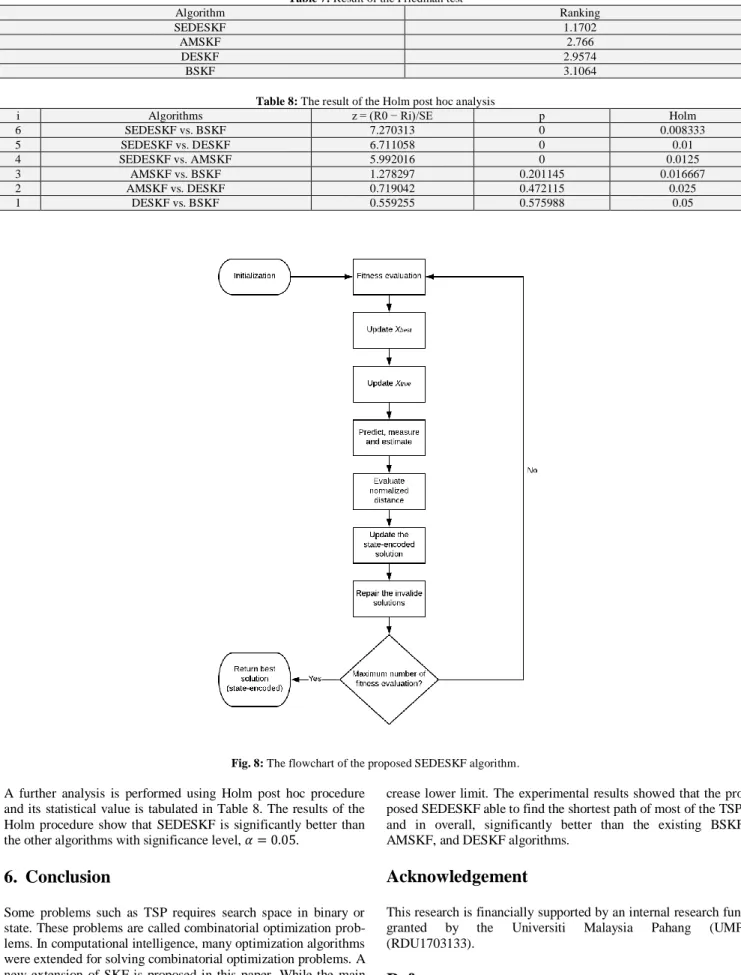
Table 6: The performance (in average)
TSP problem SEDESKF AMSKF DESKF BSKF Berlin52 22406.98 22874.86 22932.2 22847.64 Bier127 536858.9 544059.5 544106.7 542440 Ch130 39426.15 39357.7 39254.37 39267 Ch150 46136.63 46168.05 46270.79 46174.03 D198 143879.8 158018.6 157618.5 158476.9 D493 405901.5 411931.2 411998.9 411621 D657 794117 796174.9 796175.3 796929.4 D1291 1640368 1646428 1645013 1648227 DSJ1000 5.2E+08 5.23E+08 5.24E+08 5.24E+08 Eil51 1267.804 1266.809 1268.42 2127.613 Eil76 2043.157 2039.967 2052.86 23782.28 Eil101 2840.658 2856.43 2845.66 2853.754 GIL262 23718.7 23851.59 23846.46 23853.9 KROA100 135675.3 136954.9 137043 137188.7 KROA150 214278.5 215813.7 216442.1 215796.9 KROA200 289059.9 291098.8 291940.4 291063.8 KROB100 133147.7 134818.2 134923.4 134786.5 KROB200 283920 285558.9 285802.7 286095.5 KROC100 133605.2 135858.8 135469.5 135539.3 KROD100 130181.9 131561.2 131622.3 131396.8 KROE100 136381.9 137716.4 138503.9 138610.7 LIN105 98295.8 98766.64 99036.19 99045.13 LIN318 527431.1 528817.1 527049.5 529112.7 P654 1835950 1848103 1845492 1849637 PCB442 706661.8 707728.3 708486.4 708016.9 PCB1173 1332669 1335124 1333055 1335923 PR76 459240.7 461176 461023.3 461949.7 PR107 438474.9 446571.5 446386.8 449263.3 PR124 572756.4 573148.5 580257.8 579691.2 PR136 689707.8 689959.7 690108.3 689880.4 PR144 679453.9 686191.1 682605.3 682410.8 PR152 880010 886369 886217.2 886457.3 PR226 1472488 1477167 1479082 1482490 PR264 945954.9 954069.8 954199 958776.8 PR299 663592.6 667263.2 664537 666494.6 PR439 1714496 1732577 1737005 1731523 PR1002 6070399 6078577 6085013 6079543 RAT99 6632.39 6718.733 6696.176 6732.771 RAT195 19329.74 19441.65 19422.96 19461.39 RAT575 103555.9 104311.9 103909.3 104248 RAT783 165840 167018.8 166512.9 166983 RD100 45651.72 45664.31 46096.3 45944.33 RL1304 8880536 8908134 8917743 8916299 RL1323 9275698 9303447 9303794 9302486 RL1889 14114830 14159546 14171974 14157634 ST70 2887.399 2902.092 2882.996 2890.875 TS225 1409269 1410333 1411955 1409169
5.
Experiment, Result, and Discussion
Experimental setting parameters for SKF are shown in Table 5. The P, Q, and R values were chosen based on the previously pub-lished work on SKF [14]. In this paper, 47 instances of TSP are considered, from the size of 51 cities to 1400 cities. These prob-lems were taken from TSPLib [55]. The averaged results are shown in Table 6. The values written in bold indicate the best result found for every case study.
The results shown in Table 6 indicate that the proposed SEDESKF outperforms the AMSKF, BSKF, and DESKF in 41 out of 47 case studies. At the first glance, it can be observed that SEDESKF exhibits a far superior performance in comparison to DESKF, AMSKF, and BSKF. The DESKF found three lowest distances, another two by AMSKF and one by BSKF.
A Friedman test was performed using the results in Table 6. As shown in Table 7, SEDESKF is ranked the best followed by AMSKF, DESKF, and BSKF. The Friedman statistic which is distributed according to chi-square with 3 degrees of freedom is equivalent to 68.131915. This shows significant different exist between SEDESKF and the benchmark algorithms.
Table 7: Result of the Friedman test Algorithm Ranking SEDESKF 1.1702 AMSKF 2.766 DESKF 2.9574 BSKF 3.1064
Table 8: The result of the Holm post hoc analysis
i Algorithms z = (R0 − Ri)/SE p Holm
6 SEDESKF vs. BSKF 7.270313 0 0.008333 5 SEDESKF vs. DESKF 6.711058 0 0.01 4 SEDESKF vs. AMSKF 5.992016 0 0.0125 3 AMSKF vs. BSKF 1.278297 0.201145 0.016667 2 AMSKF vs. DESKF 0.719042 0.472115 0.025 1 DESKF vs. BSKF 0.559255 0.575988 0.05
Fig. 8: The flowchart of the proposed SEDESKF algorithm.
A further analysis is performed using Holm post hoc procedure and its statistical value is tabulated in Table 8. The results of the Holm procedure show that SEDESKF is significantly better than the other algorithms with significance level, .
6.
Conclusion
Some problems such as TSP requires search space in binary or state. These problems are called combinatorial optimization prob-lems. In computational intelligence, many optimization algorithms were extended for solving combinatorial optimization problems. A new extension of SKF is proposed in this paper. While the main concept of DESKF, which uses the calculated distance value, is adapted, the proposed SEDESKF employed the normalized dis-tance value to control the exploitation and exploitation of the search. Specifically, the normalized distance is compared with a random number which has unity upper limit and dynamically
in-crease lower limit. The experimental results showed that the pro-posed SEDESKF able to find the shortest path of most of the TSPs and in overall, significantly better than the existing BSKF, AMSKF, and DESKF algorithms.
Acknowledgement
This research is financially supported by an internal research fund granted by the Universiti Malaysia Pahang (UMP) (RDU1703133).
References
[1] Rani MR, Selamat H, Zamzuri H & Ibrahim Z (2012), Multi-objective Optimization for PID Controller Tuning using the Global Ranking Genetic Algorithm, International Journal of Innovative Computing, Information and Control, Vol. 8, Issue 1, pp. 269-284.
[2] Leung FHF, Lam HK, Ling SH & Tam PKS (2003), Tuning of the Structure and Parameters of a Neural Network using an Improved Genetic Algorithm, IEEE Transaction on Neural Networks, Vol. 14, Issue 1, pp. 79-88.
[3] Roshanaei M, Lucas C & Mehrabian AR (2009), Adaptive Beamforming using a Novel Numerical Optimisation Algorithm,
IET Microwaves, Antennas & Propagation, Vol. 3, Issue 5, pp. 765-773.
[4] Li YL, Shao W, You L & Wang BZ (2013), An Improved PSO Al-gorithm and Its Application to UWB Antenna Design, IEEE Anten-nas and Wireless Propagation Letters, Vol. 12, pp. 1236-1239. [5] Valenzuela CL & Jones AJ (1993), Evolutionary Divide and
Con-quer (I): A Novel Genetic Approach to the TSP, Evolutionary Computation, Vol. 1, Issue 4, pp. 313-333.
[6] Pedraza G, Diaz M & Lombera H (2016), An Approach for Assem-bly Sequence Planning by Genetic Algorithms, IEEE Latin America Transactions, Vol. 14, Issue 5, pp. 2066-2071.
[7] Montoya, J, Rathinam S & Wood Z (2014), Multiobjective Depar-ture Runway Scheduling using Dynamic Programming, IEEE Transactions on Intelligent Transportation Systems, Vol. 15, Issue 1, pp. 399-413.
[8] Mooney E & Dargen R (1996), Large-scale classroom scheduling,
IIE Transactions, Vol. 28, No. 5, pp. 369-378.
[9] Uttraphan C, Shaikh-Husin N & Khalil Hani M, An Optimization Algorithm for Simultaneous Routing and Buffer Insertion with De-lay-power Constraints in VLSI Layout Design, Fifteenth Interna-tional Symposium on Quality Electronics Design, (2014), pp. 357-364.
[10]Jaffel Z & Farah M, A Symbiotic Organisms Search Algorithm for Feature Selection in Satellite Image Classification, 2018 4th
Interna-tional Conference on Advanced Technologies for Signal and Image Processing, (2018), pp. 1-5.
[11]Goldberg DE & Holland JH (1988), Genetic Algorithms and Ma-chine Learning, Machine Learning, Vol. 3, Issue 2-3, pp. 95-99. [12]Dorigo M, Maniezzo V & Colorni A (1996), Ant System:
Optimi-zation by a Colony of Cooperating Agents, IEEE Transactions on Systems, Man, and Cybernetics, Part B (Cybernetics), Vol. 26, Is-sue 1, pp. 29-41.
[13]Ibrahim Z, Abdul Aziz NH, Ab. Aziz NA, Razali S, Shapiai MI, Nawawi SW & Mohamad MS (2015), A Kalman Filter Approach for Solving Unimodal Optimization Problems, ICIC Express Letters,
Vol. 9, Issue 12, pp. 3415-3422.
[14]Ibrahim Z, Abdul Aziz NH, Ab. Aziz NA, Razali R, Mohamad MS (2016), Simulated Kalman Filter: A Novel Estimation-Based Metaheuristic Optimization Algorithm, Advance Science Letters, Vol. 22, pp. 2941-2946.
[15]Kalman RE (2011), A New Approach to Linear Filtering and Pre-diction Problems, ASME Journal of Basic Engineering, Vol. 82, No. 1, pp. 35-45.
[16]Muhammad B, Mat Jusof MF, Shapiai MI, Adam A, Md Yusof Z, Mohd Azmi KZ, Abdul Aziz NH, Ibrahim Z & Mokhtar N, Feature Selection using Binary Simulated Kalman Filter for Peak Classifi-cation of EEG Signals, 2018 8th International Conference on Intel-ligent Systems, Modelling and Simulation, (2018), pp. 1-6. [17]Adam A, Ibrahim Z, Mokhtar N, Shapiai MI, Mubin M & Saad I
(2016), Feature Selection using Angle Modulated Simulated Kalman Filter for Peak Classification of EEG Signals, SpringerPlus, Vol. 5, No. 1580.
[18]Lazarus K, Noordin NH, Mat Jusof MF, Ibrahim Z, & Abas KH (2017), Adaptive Beamforming Algorithm Based on a Simulated Kalman Filter, International Journal of Simulation: Systems, Sci-ence and Technology, Vol. 18, No. 4, pp. 10.1-10.5.
[19]Lazarus K, Noordin NH, Mohd Azmi KZ, Abd Aziz NH & Ibrahim Z, Adaptive Beamforming Algorithm based on Generalized Oppo-sition-based Simulated Kalman Filter, The National Conference for Postgraduate Research, Pekan, Pahang, (2016), pp. 1-9.
[20]Lazarus K, Noordin NH, Ibrahim Z, Mat Jusof MF, Mohd Faudzi MA, Subari N, and Mohd Azmi KZ, An Opposition-Based Simu-lated Kalman Filter Algorithm for Adaptive Beamforming, IEEE International Conference on Applied System Innovation, (2017), pp. 91-94.
[21]Lazarus K, Noordin NH, Ibrahim Z & Abas KH, Adaptive Beamforming Algorithm based on Simulated Kalman Filter, Asia Multi Conference on Modelling and Simulation, (2016), pp. 19-23. [22]Abd Aziz NH, Ab. Aziz NA, Ibrahim Z, Razali S, Abas KH,
Mohamad MS, A Kalman Filter Approach to PCB Drill Path Opti-mization Problem, IEEE Conference on Systems, Process and Con-trol, (2016), pp. 33-36.
[23] Abdul Aziz NH, Ibrahim Z, Ab. Aziz NA, Md Yusof Z & Mohamad MS (2018), Single-Solution Simulated Kalman Filter Algorithm for Routing in Printed Circuit Board Drilling Process,
Intelligent Manufacturing and Mechatronics, pp. 649-655. [24] Mustapa A, Md Yusof Z, Adam A, Muhammad B & Ibrahim Z
(2018), Solving Assembly Sequence Planning using Angle Modu-lated SimuModu-lated Kalman Filter, IOP Conference Series: Materials, Science, and Engineering, Vol. 319, No. 012044.
[25] Md Yusof Z, Satiman SN, Mohd Azmi KZ Badaruddin Muhammad, Saifudin Razali, Zuwairie Ibrahim, Zulfakar Aspar, and Suraya Is-mail, Solving Airport Gate Allocation Problem using Simulated Kalman Filter, International Conference on Knowledge Transfer, (2015), pp. 121-127.
[26] Mohd Azmi KZ, Md Yusof Z, Satiman SN, Muhammad B, Razali S, Ibrahim Z, Ab. Aziz NA & Abd Aziz NH, Solving Airport Gate Allocation Problem Using Angle Modulated Simulated Kalman Fil-ter, The National Conference for Postgraduate Research, Pekan, Pahang, Malaysia, (2016), pp. 875-885.
[27] Ann NQ, Pebrianti D, Bayuaji L, Daud MR, Samad R, Ibrahim Z, Hamid R & Syafrullah M (2018), SKF-Based Image Template Matching for Distance Measurement by using Stereo Vision, Intel-ligent Manufacturing and Mechatronics, pp. 439-447.
[28] Ann NQ, Pebrianti D, Ibrahim Z, Mat Jusof MF, Bayuaji L, and Abdullah NRH (2018), Illumination-Invariant Image Matching Based on Simulated Kalman Filter (SKF), Journal of Telecommu-nication, Electronics and Computer Engineering, Vol. 10, No. 1-3, pp. 31-36.
[29] Muhammad B, Mohd Azmi KZ, Ibrahim Z, Mohd Faudzi AA & Pebrianti D, Simultaneous Computation of Model Order and Pa-rameter Estimation for System Identification Based on Opposition-Based Simulated Kalman Filter, SICE International Symposium on Control Systems 2018, March 9-11, Tokyo, Japan, (2018), pp. 105-112.
[30] Mohd Azmi KZ, Ibrahim Z, Pebrianti D & Mohamad MS (2017), Simultaneous Computation of Model Order and Parameter Estima-tion for ARX Model Based on Single and Multi Swarm Simulated Kalman Filter, Journal of Telecommunication, Electronic, and Computer Engineering, Vol. 9, No. 1-3, pp. 151-155.
[31] Muhammad B, Pebrianti D, Abdul Ghani N, Abdul Aziz NH, Ab. Aziz NA, Mohamad MS, Shapiai MI & Ibrahim Z, An Application of Simulated Kalman Filter Optimization Algorithm for Parameter Tuning in Proportional-Integral-Derivative Controllers for Auto-matic Voltage Regulator System, SICE International Symposium on Control Systems 2018, March 9-11, Tokyo, Japan, (2018), pp. 113-120.
[32] Abd Aziz NH, Ibrahim Z, Razali S, Bakare TA & Ab. Aziz NA, How Important the Error Covariance in Simulated Kalman Filter?,
The National Conference for Postgraduate Research, Pekan, Pa-hang, (2016), pp. 315-320.
[33] Abdul Aziz NH, Ab. Aziz NA, Mat Jusof MF, Razali S, Ibrahim Z, Adam A & Shapiai MI, An analysis on the Number of Agents To-wards the Performance of the Simulated Kalman Filter Optimizer,
2018 8th International Conference on Intelligent Systems, Modelling and Simulation, (2018), pp. 16-21.
[34] Abdul Aziz NH, Ibrahim Z, Ab. Aziz NA & Razali S (2017), Pa-rameter-less Simulated Kalman Filter, International Journal of Software Engineering and Computer Systems, Vol. 3, pp. 129-137. [35] Abd Aziz NH, Ab. Aziz NA, Ibrahim Z, Razali S, Mat Jusof MF,
Abas KH, Mohamad MS & Mokhtar N, Simulated Kalman Filter with Randomized Q and R Parameters, International Conference on Artificial Life and Robotics, (2017) pp. 711-714.
[36] Badaruddin Muhammad, Zuwairie Ibrahim, Mohd Falfazli Mat Jusof, Nor Azlina Ab Aziz, Nor Hidayati Abd Aziz, and Norrima Mokhtar, A Hybrid Simulated Kalman Filter - Gravitational Search Algorithm (SKF-GSA), International Conference on Artificial Life and Robotics, (2017), pp. 707-710.
[37] Muhammad B, Ibrahim I, Mohd Azmi KZ, Abas KH, Ab. Aziz NA, Abd Aziz NH & Mohamad MS, Performance Evaluation of Hybrid SKF Algorithms: Hybrid SKF-PSO and Hybrid SKF-GSA, The Na-tional Conference for Postgraduate Research, Pekan, Pahang, Ma-laysia, (2016), pp. 865-874.
[38] Muhammad B, Ibrahim Z, Mohd Azmi KZ, Abas KH, Ab. Aziz NA, Abd Aziz NH & Mohamad MS, Four Different Methods to Hybrid Simulated Kalman Filter (SKF) with Particle Swarm Optimization (PSO), The National Conference for Postgraduate Research, Pekan, Pahang, Malaysia, (2016), pp. 843-853.
[39] Muhammad B, Ibrahim Z, Mohd Azmi KZ, Abas KH, Ab Aziz NA, Abd Aziz NH & Mohamad MS, Four Different Methods to Hybrid
Simulated Kalman Filter (SKF) with Gravitational Search Algo-rithm (GSA), The National Conference for Postgraduate Research, Pekan, Pahang, Malaysia, (2016), pp. 854-864.
[40]Muhammad B, Ibrahim Z, Ghazali KH, Mohd Azmi KZ, Ab. Aziz NA, Abd Aziz NH & Mohamad MS (2015), A New Hybrid Simu-lated Kalman Filter and Particle Swarm Optimization for Continu-ous Numerical Optimization Problems, ARPN Journal of Engineer-ing and Applied Sciences, Vol. 10, No. 22, pp. 17171-17176. [41]Md Yusof Z, Ibrahim I, Satiman SN, Ibrahim Z, Abd Aziz NH, &
Ab Aziz NA, BSKF: Binary Simulated Kalman Filter, Third Inter-national Conference on Artificial Intelligence, Modelling and Simu-lation, (2015), pp. 77-81.
[42]Md Yusof Z, Ibrahim I, Ibrahim Z, Abas KH, Ab Aziz NA, Abd Aziz NH & Mohamad MS, Local Optimum Distance Evaluated Simulated Kalman Filter for Combinatorial Optimization Problems,
The National Conference for Postgraduate Research, Pekan, Pa-hang, Malaysia, (2016), pp. 892-901.
[43]Md Yusof Z, Ibrahim Z, Ibrahim I, Mohd Azmi KZ, Ab. Aziz NA, Abd Aziz NH & Mohamad MS (2016), Distance Evaluated Simu-lated Kalman Filter for Combinatorial Optimization Problems,
ARPN Journal of Engineering and Applied Sciences, Vol. 11, No. 7, pp. 4904-4910.
[44]Md Yusof Z, Ibrahim Z, Ibrahim I, Mohd Azmi KZ, Ab. Aziz NA, Abd Aziz NH & Mohamad MS (2016), Angle Modulated Simulat-ed Kalman Filter Algorithm for Combinatorial Optimization Prob-lems, ARPN Journal of Engineering and Applied Sciences, Vol. 11, No. 7, pp. 4854-4859.
[45]Ibrahim I, Md Yusof Z, Nawawi SW, Rahim, MAA, Khalil K, Ah-mad H & Ibrahim Z, A Novel Multi-state Particle Swarm Optimiza-tion for Discrete Combinatorial OptimizaOptimiza-tion Problems, Fourth In-ternational Conference on Computational Intelligence, Modelling and Simulation, (2012), pp. 18-23.
[46]Ibrahim I, Ahmad H, Ibrahim Z, & Md Yusof Z (2015), An Im-proved Multi-State Particle Swarm Optimization for Discrete Com-binatorial Optimization Problems, International Journal of Simula-tion - Systems, Science and Technology, Vol. 16, No. 6, pp. 14.1-14.8.
[47]Ibrahim I, Ahmad H, Ibrahim Z, Mat Jusoh MF, Zulkifli Md. Yusof, Nawawi SW, Khalil K & Abdul Rahim MA (2014), Multi-State Particle Swarm Optimization for Discrete Combinatorial Optimiza-tion Problem, International Journal of Simulation - Systems, Sci-ence and Technology, Vol. 15, No. 1, pp. 15-25.
[48]Ibrahim I, Ibrahim Z, Ahmad H & Md Yusof Z, An Improved Mul-ti-State Particle Swarm Optimization for Discrete Optimization Problems, The 7th International Conference on Computational In-telligence, Communication Systems, and Networks, (2015), pp. 3-8. [49]Ibrahim I, Ibrahim Z, Ahmad H & Md. Yusof Z, A Multi-State
Gravitational Search Algorithm for Combinatorial Optimization Problems, The 7th International Conference on Computational In-telligence, Communication Systems, and Networks, (2015), pp. 9-14. [50]Ibrahim I, Ahmad H, Ibrahim Z & Md Yusof Z (2015), A Novel
Multi-State Gravitational Search Algorithm for Discrete Optimiza-tion Problems, International Journal of Simulation - Systems, Sci-ence and Technology, Vol. 16, No. 6, pp. 15.1-15.8.
[51]Ismail Ibrahim, Zuwairie Ibrahim, Hamzah Ahmad, and Zulkifli Md Yusof (2015), An Assembly Sequence Planning Approach with a Multi-State Gravitational Search Algorithm, ARPN Journal of Engineering and Applied Sciences, Vol. 10, No. 22, pp. 10709-10715.
[52]Ibrahim I, Ibrahim Z, Ahmad H, Mat Jusof MF, Md. Yusof Z, Nawawi SW & Marizan Mubin M (2015), An Assembly Sequence Planning Approach with a Rule-based Multi-State Gravitational Search Algorithm, The International Journal of Advanced Manu-facturing Technology, Vol. 79, Issue 5, pp. 1363-1376.
[53]Ibrahim I, Ibrahim Z, Ahmad H & Md Yusof Z, Rule-Based Multi-State Gravitational Search Algorithm for Discrete Optimization Problem, The 4th International Conference on Software Engineer-ing and Computer Systems (ICSECS2015), Kuantan, Pahang, (2015).
[54]Leonard BJ & Engelbrecht AP (2014), Angle Modulated Particle Variants, Lecture Notes on Computer Science, Vol. 8667, pp. 38-49. [55]http://www.iwr.uni-heidelberg.de/groups/comopt/software
![Fig. 2: Illustration of position of agents at the beginning of a search pro- pro-cess [42-43]](https://thumb-us.123doks.com/thumbv2/123dok_us/1366825.2683014/3.893.107.786.69.1091/fig-illustration-position-agents-beginning-search-pro-cess.webp)
![Fig. 6: An example of g(x) plot [44].](https://thumb-us.123doks.com/thumbv2/123dok_us/1366825.2683014/4.893.459.839.106.578/fig-example-g-x-plot.webp)