Submission date: July 30th 2009
Number of words: 5,857 + 3 tables × (250) + 6 figures × (250) = 8,107
First and corresponding author: Floridea Di Ciommo
Affiliation: Senior Research Associate, Transport Research Center, Universidad Politecnica de Madrid.
Address: TRANSyT- Transport Research Center Calle Profesor Aranguren s/n
28040 Madrid, Spain. Phone: 34 91 336 52 33 Fax: 34 91 336 53 62
e-mail: [email protected]
Second author: Andrés Monzón
Affiliation: Professor, Transport Department, Universidad Politecnica de Madrid. Escuela de Ingenieros de Caminos, Canales y Puertos
28040 Madrid, Spain. Phone: 34 91 336 53 73 Fax: 34 91 336 53 62
e-mail: [email protected]
Third author: Alvaro Fernandez
Affiliation: PhD Candidate, Transport Research Center, Universidad Politecnica de Madrid
Address: TRANSyT- Transport Research Center Calle Profesor Aranguren s/n,
28040 Madrid, Spain. Phone: 34 91 336 67 95 Fax: 34 91 336 53 62
Abstract
The European Commission is seeking ways to promote both the harmonization of transport policies among its constituent members and the homogenization of transport market conditions. The main goal is to insure that each transport mode pays for the true social and economic costs produced by it: transport taxes and prices should vary according to infrastructure damage, degree of congestion, risk of accidents and the expenses they cause, and environmental nuisances and damage. However, it is difficult to modify the present national systems in favor of a European-wide one, because every country has different perceptions of the need and reasons to implement such a European-wide system. Spain, like other EU countries, is considering the European transport policy and the related regulations which are intended to homogenize the present fragmented road pricing schemes. In Spain, different groups of road stakeholders (road freight and passengers’ operators, highway concessionaires, and associations of private car users) have experience with toll roads dating back to the 1960s. But a recent study of transport pricing, the Spanish Road Pricing Model (META), had as one of its aims the capture of different degrees of acceptance of a generalized road pricing system, and demonstrated that these stakeholders are still not willing to fully pay for the external costs (environmental and road safety costs) of the road network. The low approval rates raises questions about the most effective way for Spanish governmental bodies, those that are administratively responsible, to introduce a generalized tolling scheme.
INTRODUCTION: PRICING AND TRANSPORT POLICY IN THE EU
The European Commission has advocated the reform of transport pricing, so as to harmonize transport policies and make more efficient the transport system by making the market conditions more similar in the member countries. Since 1970, the EU has been trying to establish a pricing policy that is fair and acceptable for all countries (1).
The European Commission’s Green Paper “Towards Fair and Efficient Pricing in
5
Transport” (2) launched a discussion on pricing transport according to the marginal cost and the recovery of fixed investment costs. The White Paper “Fair Payment for Infrastructure Use” (3) took this approach a step further, and presented a gradual path for implementing all transport modes, which was then adopted in the White Paper “European Transport Policy 2010: Time to decide” (4). The main goal was to ensure
10
that each transport mode pays for the costs its operation produces. Transport taxes and prices should vary according to infrastructure damage, degree of congestion, risk of accident, and environmental nuisances.
In parallel, more regulation of transport pricing has been developed by EU
15
directives. The 1999/62 EU directive (5) allows member countries to introduce a distance related charge for using European highways to cover construction, maintenance, and exploitation costs. This earlier directive was modified in 2006 by Directive 2006/38/EC (6) on the charging of HGVs for the use of certain kinds of infrastructure. This more recent Directive paved the way for the introduction of charges
20
on vehicles and especially HGVs in the EU countries, based on the distances they travel and the estimated resultant pollution. A new objective of this charge is to cover the costs of both pollution and congestion. But the necessary legal criteria to define how, and when, to collect the pollution charge have still not been formulated. As a consequence, the EU countries possess neither the necessary incentives, nor explicit
25
conditions made clear, for implementing such a charge. Only the new directive project of 2008/0147 (7) tries to define reliable methods for estimating pollution and congestion costs and to calculate the appropriate road charge for each kind of vehicle. In any case, the EU directives are guidelines which have to be implemented by each country in the way they prefer, following the “subsidiarity principle” (8).
30
Some countries have already adopted a charge for highway use. For instance, according to a 1999/62 EU directive, Austria and Germany moved a few years ago to a distance-based charging approach for HGVs over 12 tons (9). Recently, the Czech Republic also adopted an approach similar to that of Austria and Germany 10).
35
Switzerland, even though it is not a member of the EU, has been charging HGVs above 3.5 tons for use of Swiss roads on all their roads since 2001 (11).
The introduction of road pricing, experience shows, is a highly controversial topic, and the European Commission has offered a path to gradual implementation of
40
charges introduced to encourage efficiency and at the same time to charge for ecological damage caused by road transport. In this regard, some European studies have dealt with the acceptability of road pricing schemes for passenger and freight transport (8) (9)(12) (13) (14) as well as with systematic studies of the prevailing trends in public opinion concerning tolling and pricing, based on polls taken before, and then after, the
implementation of such measures, and this polling includes various American states California, Texas and Minnesota (15).
Spain has 13,156 Km of interurban highways network (16), of which only 2,814 km of those highways are tolled sections. Like other EU countries, Spain is obliged to
50
consider the European Union’s transport policy and regulations designed to define, and promote, a fair and homogeneous generalized road pricing scheme. An initial study of interurban transport pricing has been carried out at the national level, where the major debate is about the relative efficiency of different road pricing instruments and what the appropriate price levels should be in different interurban road contexts (17). A survey of
55
public opinion in various countries revealed differing attitudes toward country-specific pricing measures in nine European Countries (18), but no survey has covered the acceptance rate for the pre-implementation road pricing schemes in a southern European country such as Spain.
60
In the context of the research project META, aimed at defining a Spanish Road Pricing Model (17), an Internet-based survey was conducted between November 2008 and March 2009. The target population consisted of the various groups of road stakeholders: operators of Spanish roads for both freight and passengers; highway concessionaires; associations of users of private cars; and even some of those who make
65
transport policy. The aim was to capture different dimensions of acceptability vis-à-vis the potential implementation of a generalized road pricing system in Spain.
The objective of this paper is to analyze the data collected by the Internet-based survey on public acceptability of a road pricing system, in the pre-implementation
70
period, based on both external and infrastructural costs. Despite the general agreement that environmental problems due to road passengers and freight transport are serious threats to people’s welfare, proposed solutions such as the implementation of a road pricing system based on the external cost requiring changes in behavior (use of vehicles, for example) are not easily accepted.
75
The paper is divided into five sections. The first section—after the introduction—provides an overview of the current state of research on acceptability which is necessary for understanding the possible determinants of stakeholders’ behavior; to identify the barriers to public acceptance and the potential supporters and
80
opponents of pricing and tolling proposals. The second section presents the characteristics of the actual Spanish road pricing scheme now in use. The third section describes the scope and the methodology used for the survey. The fourth section presents a descriptive and statistical analysis of the results. The fifth section draws conclusions about implications for road pricing policy as a result of the acceptability
85
survey.
STATE OF RESEARCH ON ACCEPTABILITY
90
Three kinds of research can be undertaken to analyze transport policy measures in general and road pricing policies in particular. First, predictions about acceptability derived from theoretical models that rest on assumptions about individual behavior can be tested against the results of a user road survey (12). Second, analysis of the individual attitudes can be furthered means of an empirical survey approach
(questionnaire, interview, etc.) (9). Third, ex-post study allows for investigation of individual behavioral changes in response to a specific policy measure (19). This means that the first approach derives from the assumptions about the individual behavior in a theoretical model that has to be tested a posteriori, while the second one derives from the direct observations employed to construct the hypothesis of an empirical model.
100
Several European studies confirm that the acceptance of road pricing by users is closely linked to the perception of freedom, fairness and efficiency in the pricing of road use
(12) (20)(21) (22).
In particular, the debate is focused mainly on the following subjects related to the perception by users of fairness (1-3) and of the toll system efficiency (4-6):
105
1. Method used to calculate the road price; 2. Vehicles affected by the road charge;
3. Compensation measures to account for the fact that the road charge is imposed on the existing taxes (on fuel, costs of registration and licensing, etc.);
110
4. Time-savings achieved and congestion problems avoided;
5. Use of toll revenues and trust in government and other agencies involved as a like as toll revenues managers;
6. Toll collection system.
115
Therefore, the analysis of the degree of perceived fairness, and hence of acceptability, in toll-road pricing effects is a complex matter that can be approached in a number of ways (23) (24). Generally, it is complicated to arrive at a compromise in a road pricing scheme when there are desired and competing objectives in efficiency, fairness, and acceptability (25). The perception by some social groups, or transport
120
sectors, that the road pricing measures are unfair has been one of the major obstacles to the implementation of a toll scheme (26). A majority of the effects linked to the fairness of a road pricing policy relate to the ultimate use of the revenues collected by the toll and to the existing level of trust in government and other agencies involved (8) (27). For the same reason, the management and use of the revenues is a key factor in guaranteeing
125
acceptance of the road pricing policy that is adopted. (28).
ROAD PRICING POLICY IN SPAIN. META: A ROAD PRICING MODEL
130
PROPOSAL
The present pricing system for Spanish highways is quite fragmented. Some highway construction is financed by tolls on users through concession contracts, other highway construction is financed by shadow tolls, that is tolls paid not by the immediate user, but
135
paid to the concessionaire by the government as part of its general expenditures. The regions of Madrid and Murcia have been the first ones where the public administrations have applied shadow toll schemes as a way to remunerate the highway concessionaires. Previously, the Central Administration did not employ the device of the shadow toll, fearing a possible risk of increase in its general budget spending (29). But new laws on
140
the concessionaire system introduce the possibility of using the shadow toll to finance road infrastructures (30). Related to this new regulatory perspective, more than 1,500 km of new regional and national highways will be financed by a shadow toll scheme.
The Central Government is using this shadow toll scheme at present to finance the concessions contracts for the maintenance, renovation, and operations of the national
145
highway network. At present, the highways where the direct toll is used amount to 2,814 km, while those that employ the shadow toll method of compensating concessionaires amount to 872 km. There is a plan to increase the highways relying on the shadow toll method to 2,275.15 km, possibly by the year 2010, according to the plans of the Department of Spanish Infrastructures (31). The highways with a direct toll
150
will then account for 60% of the total kilometers under concession and shadow toll schemes will be 40% (14). The direct toll range is between 0.06€/vkm and 0.16€/vkm and the shadow toll range between 0.05€/vkm and 0.09€/vkm (31).
The analysis of the degree of acceptance is evaluated in the context of the
155
Spanish road pricing model project (META), which proposes a vehicles tolling scheme aimed at recovering the cost for highway maintenance and operations as well as external costs. The META road pricing scheme proposed for the Spanish interurban road network is based on average costs calculated for each vehicle type (Car HGV, LGV and bus) following the interurban road characteristics (AADT, capacity and traffic
160
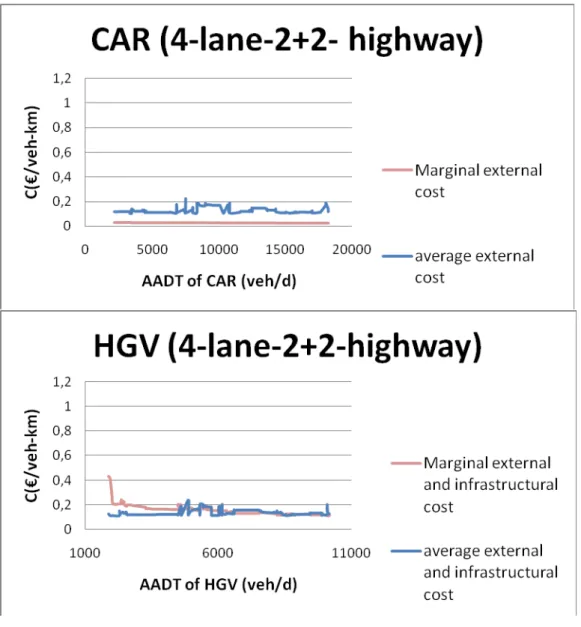
composition for each section). As showed in Figure 1, for the Spanish interurban highways, mostly characterized as 4-lane - 2 plus 2- highways, congestion is not a current problem. Therefore the marginal external cost is equal to the average external costs or even stays below the average external costs. In other words, the Spanish interurban roads, outside of the major metropolitan areas, are underused. That means
165
that the road system is operating with increasing economies of scale (the system will be more efficient if more cars use the Spanish road network) To cover the external costs produced by a car user it is necessary to fix the toll so that it equals the average external costs. The case is slightly different when there is a comparison between marginal external and infrastructural cost and average external and infrastructural cost for the
170
HGV, and where both costs are the same. This means that in the case of the HGV, the road system is operating with economies of scale that remain constant, the social optimal is financially viable, while the correct solution to determining tolls for private cars will be imperfect because the condition of economic efficiency -- with a toll equal to the marginal external cost is not attainable In fact, the system is unable to finance
175
itself: somebody has to pay to cover the difference between average external costs and marginal external costs. Two alternatives: the private car users pay a toll equal to the average external costs or the society as a whole decides to pay a part of the external costs. (32) (33).
180
FIGURE 1. Marginal and average external road transport costs comparison in a 4-lane -2 plus 2- highway
190
Following this empirical model for costs, the proposal for a toll scheme should include a price range for roads (2+2 - highways) of 0.09€ per car-km to 0.14€ per
HGV-195
km. Introducing road pricing measures is a highly controversial topic. Spanish freight operators have highlighted their opposition to the introduction of a generalized road pricing scheme unless there is a revision of the fuel national charge equal to 54% of fuel price (33). As a consequence, it will be useful here to offer an analysis of acceptability by stakeholders, before introducing the subject of a generalized road pricing scheme.
SCOPE AND METHODOLOGY OF RESEARCH ON PRICING ACCEPTABILITY
205
Data collection
Data were collected through a self-administered Internet-based survey of transporters of both Spanish road freight and passengers, highway concessionaires and associations of private car users. They are the most representative road users groups. At the beginning of the META project, these stakeholder groups were encouraged to collaborate in
210
managing the survey on road pricing acceptability and to communicate with the freight and passenger operators, highways concessionaires, and users of private vehicles. In Spain, for example, the freight transport sector is quite fragmented, even if 2/3 of the freight traffic, calculated by tonnage, is transported and managed directly or indirectly by the biggest transportation companies (34). As a consequence, we used the transport
215
operators organizations to reach both the small and large operators in the business of freight transport. The survey was conducted between October 2008 and March 2009. The aim was to capture different degrees of acceptability concerning the theoretical introduction of a generalized road pricing system in Spain.
220
The starting point for developing the survey content were the acceptance factors identified by Shlag and Teubel (35) in their model of road pricing acceptability:
- Perception of the transport problems (infrastructure damage, congestion, external and accidental costs) ;
225
- Design charges (levels of charges and their variation depending on traffic congestions, type of vehicles, road type, and road quality)
- Effect on public approval of the institutional framework
- Use of revenues in combination with different options for the institutional framework (who collects the toll charge and who is entitled to decide on their
230
use)
- Perceived utility of road-user charges in solving transport-related problems. - Relationship between the social responsibility of users as to climate change,
enhanced safety, and greater acceptability
235
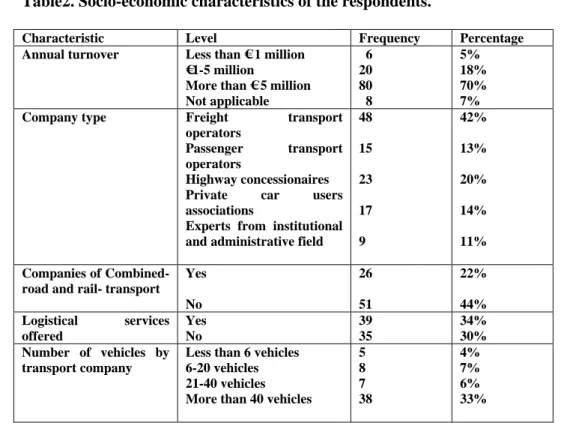
The sample was randomly selected by the operator associations from its databases, including companies of all sizes, with the biggest companies (more than 5.000.000€ of financial turnover) having the largest representation. In particular, 70% of the sample population is characterized by an annual turnover higher than 5,000,000€, 18% by an annual turnover between 1,000,000 and 5,000,000€ and only 5% by an
240
annual turnover of less than 1,000,000€. 7% of those targeted for the survey are experts from the institutional and administrative fields. In particular, the freight transport operator associations sent the survey to 250 associated enterprises, yielding 48 answers. The organization of passenger transport operators sent the survey to 30 transport operators, which resulted in 15 answers. About the highways, the concessionaire
245
organizations sent the survey to 25 technical directors of road maintenance and construction which resulted in 23 answers being returned. The association of private car users sent the survey to its 20 regional offices with an answer rate of 90% (17 technical directors answered).
At the very beginning of the questionnaire its main purpose was stated clearly: identify the key determinants (9) of what makes a particular level of road pricing acceptable.
These determinants include:
255
- expectations of users about the introduction of a road pricing system extended to all Spanish interurban highways network
- social responsibility concerning the environment and road safety
- the evaluation of the efficiencies resulting from the introduction of road pricing measures.
260
Respondents were guaranteed that their responses were anonymous.
They were also told how long (estimated at 7-10 minutes) filling out the questionnaire would take. No incentives were offered for responding. The questionnaire
265
consisted of three modules: the first with questions regarding the company characteristics; the second took the form of an attitude questionnaire; the third offered various options which one could rank in terms of stated preferences.
The survey of attitudes focused on the following sets of attitudinal questions:
270
perception of road transport problems (six questions), institutional frameworks and the use of revenue (three questions), resulting beliefs and adaptation strategies of freight operators (three questions); design of charges and perceived usefulness of road-user charges to solve transport related problem (six questions); the effect on acceptability of the charging technology (two open-ended questions). The section on how to best design
275
a regime of toll-charges contained questions regarding the types of vehicles that should be charged and the road network that has to be taxed (urban and interurban road network). This touches upon considerations of fairness (and whether to apply road pricing measures to all vehicles types and to all road networks). Responses to each question were collected using a four-point agreement scale (from “disagree” to
280
“strongly agree”).
In order to define the relationship between different price levels and revenue spending options, a simplified stated-preference exercise was included as part of the survey. In this exercise, respondents were asked to choose among different packages involving
285
combinations of pricing and spending measures.
In particular, three different toll levels were presented to the respondents, an average toll of 0.05€/km, an average toll of 0.10€km and a final one of 0€/km. The toll level of 0.05€/km corresponds to the minimum price value estimated by the META
290
empirical model of costs, the amount necessary to cover the external costs for a car without road maintenance costs. The toll of 0.10€/km is calculated as summarizing external and maintenance costs for HGV for a 2 plus 2- lanes highway section of the road. In all cases, the toll charge doesn’t include the cost of road construction costs. All toll levels were linked with the following three revenue-spending options:
295
- New road construction - Road safety
- Climate change policy measures.
Each respondent had to choose between three different alternatives characterized by toll variations with an increasing investment in infrastructures, road safety and climate change policy measures. The Stated Preference (SP) experiment showed that the attitudes of individuals and their behavior reflected in the SP exercise are quite divergent. This divergence can be explained by the psychological theory affirming that
305
the behaviors are influenced not only by the attitudes but even by other factors, including subjective norms and deliberate behavior control so that internalized social behavior, including being long accustomed not to pay for the road use, can influence behavior (36).
310
SURVEY RESULTS
315
The survey yielded responses from 114 road stakeholder groups, road transport companies and their collective organizations. A breakdown reveals that 42% of the sample population is constituted of freight transport operators, 13% are operators of passenger transport, 20% are technical people from highway concessionaires, 14% are mostly members of private car and road associations, 11% are experts from the
320
institutional and administrative field. Among freight operators, 22% offered combined – road and rail – transport, while 34% offered logistical services. In general, a sample size of 114 stakeholders could be considered quite small to make any conclusively determinations about public acceptance in Spain, but not about acceptance specifically by road stakeholders. The survey results on the attitude statements are quite similar for
325
different kind of stakeholders. This result means that the heterogeneity of the sample is not reflected in the heterogeneity of general attitudes as regards the road tolls. A breakdown of specific stakeholder groups will be presented only when their statement attitudes are significantly different. Concerning the SP experiment, a sample size of 114 stakeholders can be considered an adjusted size, where the real total of the observations
330
can be calculated as 114 multiplied by the number of choice tasks presented (37) (38).
To correctly interpret the results we have to keep in mind that the distribution of company size, represented by the financial turnover, is characterized by a bias towards large companies (freight, passenger and road operators). This bias is due to the decision
335
to use the stakeholder associations to send the Internet-based survey where the large transport and road companies are over-represented (70% of the sample operate with an annual turnover of over € 5 million). Another bias is intrinsic to the heterogeneity of the target population: different kinds of stakeholders are sent the same general questionnaire. This choice was prompted by the principal goal of the survey: to explore
340
levels of the acceptance of different stakeholders groups regarding the implementation of a generalized road pricing scheme following the EU directives.
The responses of many different kinds of stakeholders revealed their attitudes different dimensions of road pricing acceptability. The lower the value, the greater the disagreement, while the assigning of high values signifies agreement with the
345
corresponding attitude statement. The following figures (2-6) show the mean and median agreement scores of the questions about attitude.
Transport problems perception
The condition of the Spanish road network is good (59% of respondents agree or strongly agree and only 6% disagree). But 50% of the stakeholders believe that in the
355
future the government will not have enough revenues to keep roads in such good condition. Some differences in the attitude statements emerge once one performs an analysis stakeholder by stakeholder. The majority of transport freight and passenger operators consider that congestion problems will increase their operation costs and decrease the quality of the services they can offer clients, while the highways
360
concessionaires (more than 50%) do not completely agree with the statement that congestion problems will decrease the services that the transport operators can offer clients. More than 50% of respondents think that road safety problems should be a priority for the government. When it comes to the need for measures to ameliorate climate change the percentage is lower: 46%. In fact, more than 50% of the members of
365
two stakeholder groups -- the passenger bus operators and the highway concessionaires -- answer that they neither agree nor disagree, while the other stakeholder groups, by a majority, agree with the statement that the government should, in its handling of the transport problem, give priority to limiting environmental damage.
370
The condition of Spanish highways network
0 1 2 3 4
6.Limitingt environmental damage (climate change and an increasing population affected by pollution and traffic noise), should be a government priority in its handling of the transport
problem
5. Road safety and costs of accidents are major problems which require greater government investment, but this will result in a
reduction in other investments
4. Congestion decreases the quality of the service we offer clients 3. Congestion is an additional cost for our company
2.In the future, the government will find it increasingly expensive and therefore difficult to maintain roads in good condition
1.The condition of Spanish highways network are good
MEAN MEDIAN 1: Disagree; 2: Neither agree nor disagree; 3: Agree; 4: Strongly agree FIGURE 2. Survey of stakeholders in Spanish roads: Conditions of highway networks
Management of road tolling system 375
The highest support (77% agree or strongly agree) was expressed for the proposal that the “roads and highways” agency both collect the revenues and invest those revenues in the maintenance of existing, or construction of new, roads. This percentage of
agreement decreases to 26% if the institutional framework chosen to collect and use the
380
revenues is an independent agency and to 12% if the road pricing revenues go to help fund the general budget and the government decides on their use. The stakeholders disagree with the establishment of a toll agency that will decide how to use the revenues collected, even if it is independent of the government (51% disagree). Clearly, they do not trust the government to act properly as a manager (that is, a collector and dispenser)
385
of road revenues. Some stakeholder groups such as the operators of passenger buses, private car associations, and highway concessionaires show less opposition to the establishment of an independent agency (50% neither agree nor disagree) and the other 50% agree with the need for a road and highways agency to collect the revenues and invest them in the maintenance of existing, or construction of new, roads.
390
Institutional
framework:
who
should
manage
road
pricing
revenues?
0 1 2 3 4
3.Road revenues should be collected by a highway agency
that invests in road maintenance and construction
2.The revenues collected from toll roads should be managed by an independent agency that will decide how to use them
1. The road charges should go to the government’s general treasury. Public administrators
will decide on its use
MEAN1: Disagree;MEDIAN 2: Neither agree nor disagree; 3: Agree; 4: Strongly agree
FIGURE 3. Spanish road stakeholders survey: Management of road tolling system
395
Resulting beliefs and adaptation strategies of freight transport operators
The majority of stakeholders, especially the freight operators, consider that the implementation of a road pricing system will have some minor effects on the
400
effectiveness of road transport (fewer empty trips, for example). A minority 42%, particularly the passenger bus operators and the associations of private car users think that a road pricing system can be useful for the development of better freight and passenger rail systems. Furthermore, the great majority, 73%, are skeptical that the introduction of a road pricing system could create advantages for air transport (by
405
means of modal transfer for both freight and passengers). Therefore, the highways concessionaires and the associations of private car users are confident that the implementation of a road pricing system will have an important effect on the air
transport (more than 50% agree or strongly agree with the fact that the road pricing can have some effect on the development of air transport).
410
Road
Pricing
and
alternative
transport
0 1 2 3 4
3.Road pricing would help increase air transport, both of
passengers and freight 2. Road pricing would help develop railway transport for
both passengers and freight
1. Road pricing will lead to a reduction of empty trips and a
resturctuing of routes and services as well as location of
warehouses, due to increased costs
MEAN1: Disagree;MEDIAN 2: Neither agree nor disagree; 3: Agree; 4: Strongly agree
FIGURE 4. Spanish road stakeholders survey: Road pricing and alternative transport
Charging technology and acceptability (two open questions) 415
The open-ended responses about the means by which revenues are collected, converge on two main solutions. First, 60% indicated that the GPS or TAG and similar tolling systems are the best technological solution, due to the compatibility with continuous free flow, while reducing the need for vehicles to line up for payment. Second, 40% of
420
respondents took this occasion to emphasize their belief that road transport is already too heavily taxed and that a generalized road pricing system would not be justified without a simultaneous reduction in the overall fiscal burden. Clearly, present users of the roads, especially freight operators, don’t want to pay to use the highways that are currently free.
425
Tolling scheme design
In application of the Directive 2006/38/EC on the charging of HGVs for the use of certain infrastructure, including the regulation of future road pricing based on the
430
external costs (EC Directive 2008/0147), we estimated the social costs of the use of the roads and we proposed the following road price scheme to the target population of our survey. For cars we chose a range between 0.06 and 0.09 €/vkm and for HGV a range between 0.11€/vkm and 0.13€/vkm. The range variability is related to the type of vehicle, road characteristics, and traffic conditions. Despite the results of the survey of
435
German freight operators, who rejected the suggestion of an additional toll to pay for congestion (8), the Spanish freight operators (75%) seem to support a real-time
congestion price and with a charge related to road quality more than the other groups of stakeholders (62%). The highways concessionaires are less in favor of a toll related to road quality (50% disagree). In general, all stakeholder groups rejected the suggestion
440
of a pricing system for the urban roads (55% disagree). 66% of the respondents agreed that all road users should have to pay the toll and 64%, knowing that freight operators represent 43% of the sample, disagreed with a road charge applied only to HGV. A majority (59 %) agreed that road prices should be harmonized throughout the E.U.
445
Presentation
of
road
tolling
scheme
design
0 1 2 3 4
6. Calculation of road charges should be the same throughout the EU
5. Passenger cars should also have to pay for road use
4. Road charges should apply only to heavy vehicles: trucks and buses weighing more than 3.5 T
3. Road charges should apply to the entire network of roads, including roads in the city
2.The road charge should vary depending on the quality of the road
1. For the same section of road, charges can vary in accordance with peak and off‐peak hours (with rush hour more expensive)
MEAN MEDIAN 1: Disagree; 2: Neither agree nor disagree; 3: Agree; 4: Strongly agree
FIGURE 5. Spanish road stakeholders survey: Tolling Schemes Design
450
Stated preferences experiment
The literature (39) identified six key questions that need to be addressed prior to designing a charging scheme. These are: who should be charged; where should they be charged; when should they be charged; how should they be charged; for what should they be charged, and how much should be charged. The previous part of the
455
questionnaire yields answers the first four key questions, while the Stated Preferences experiment tries to identify the answers to the two last questions. Stated Preferences is a methodology allowing the display quantitatively of relationships explaining variations in the acceptability of road tolling in the absence of opportunities to express actual voting preferences (8).
460
Two types of analysis were performed with the data collected using stated preferences. First, there is a simple descriptive analysis of stated preferences about each combination of toll levels and the possible uses of revenues so obtained. This simplified data analysis is effective for highlighting gross differences and similarities between different
stakeholders groups, but it has two important problems: the simple descriptive analysis does not tell us what factors significantly influence the stakeholders’ intentional behavior and in what way; this kind of analysis does not help to understand how to predict and modify the willingness of stakeholders to accept a road pricing scheme.
470
In light of these problems, it was decided to develop a second instrument, a discrete-choice model with binary choice (“accept” or “not accept” to pay for using highways). It is important to evaluate the sensitivity of the stakeholders to variations in the price. This analysis enabled us to distinguish among those respondents who had chosen among different revenue-spending combinations. In this kind of model, the main
475
assumption is that each decision-maker seeks to maximize his personal utility and chooses the alternative with the highest utility only for himself.
As shown in Table1, a total of three levels of toll and uses of the revenues were presented in the SP experiment.
480
Table 1.Variables of road pricing scheme
Variable Attributes
Toll (€/km) 0.05, 0.10, 0 €/km
Use of the revenues Road Maintenance and one of the following:
1. New road construction
2. Road safety
3. Climate change measures
Table 2 details the socio-demographic characteristics of the respondents and
485
highlights the fact that the biggest companies (more than 5,000,000€ of financial turnover annually) are the ones mainly represented. The freight transport operators constitute that group of road stakeholder groups most heavily represented.
Table2. Socio-economic characteristics of the respondents.
490
Characteristic Level Frequency Percentage
Annual turnover Less than € 1 million
€1-5 million
More than € 5 million Not applicable 6 20 80 8 5% 18% 70% 7%
Company type Freight transport
operators
Passenger transport operators
Highway concessionaires Private car users associations
Experts from institutional and administrative field
48 15 23 17 9 42% 13% 20% 14% 11% Companies of
Combined-road and rail- transport Yes No 26 51 22% 44% Logistical services offered Yes No 39 35 34% 30% Number of vehicles by transport company
Less than 6 vehicles 6-20 vehicles 21-40 vehicles More than 40 vehicles
5 8 7 38 4% 7% 6% 33%
In this context, the discrete-choice model analysis is applied to analyze the behavior of the road stakeholders: private car users associations, freight operators, passenger bus operators, and highway concessionaires. The following figures and tables
495
highlight a deep difference between the general preferences scores and the preferences scores of each stakeholder. An adjusted majority of all stakeholders seems to be in favor of a road pricing scheme (more than 52%). But they are very sensitive to the toll levels. 37% were in favor of €0.05/vkm versus 15% in favor of €0.10/vkm toll level. However, analyzing the results of individual stakeholders, strong differences among the various
500
kinds of stakeholders appears, as shown in Figure 6 and Table 3.
FIGURE6. Willingness to pay stakeholder by stakeholder at different toll levels and different uses of revenue
505
Table3. Stated preference exercise: Discrete-Choice Model (Binary Logit) Results
515
The associations of private car users appear to be that group of stakeholders most willing to accept the implementation of a road-pricing scheme (up to 70% of respondents agreed) as well as a higher level for the toll price (up to 43%, provided that the revenue collected is used for road safety and climate change measures) (Figure 6).
520
This result is confirmed by the implementation of a discrete-choice model with binary choice where the associations of private car users chose a high level of toll charge
Stakeholders Variable Coefficient Standard
Error
Mean of X
PRIVATE CAR USE ASSOCIATIONS Toll -3.76568694 (-4.382) .85930524 1.50000000 Climate change sensitiviness 1.17805096 (2.139) .55071328 .50980392 Improvement of road safety .90853969 (1.665) .54583335 .50000000
Low annual turnover
(<1,000,000 €) - - - Intermediate annual turnover (1,000,000-5,000,000 €) 2.99871615 (3.116) .96250569 .17647059
High annual turnover (>5,000,000 €) 3.65008843 (4.268) .85524238 .82352941 FREIGHT OPE RATORS Toll -1.50331317 (-10.291) .14607699 1.50000000
Low annual turnover (<1,000,000 €) 3.04507919 (4,01) .69187377 .04081633 Intermediate annual turnover (1,000,000-5,000,000 €) - - -
High annual turnover
(>5,000,000 €) - - -
PASSENGER BUS OPERATORS
Toll -3.18151156 (-5.088) .62528662 1.50000000
Low annual turnover (<1,000,000 €) 6.50266053 (4.629) 1.40475562 .13333333 Intermediate annual turnover (1,000,000-5,000,000 €) - - -
High annual turnover (>5,000,000 €) 4.18447161 (4.752) .88048591 .80000000 HIGHWAY CONCESSIONAIRES Toll -4.22697272 (-4.980) .84878768 1.50000000
Low annual turnover (<1,000,000 €) 6.34045907 (4.020) 1.57717463 .08333333 Intermediate annual turnover (1,000,000-5,000,000 €) 6.34045907 (3.462) 1.83138430 .04166667
High annual turnover (>5,000,000 €)
8.31943808 (4.997)
associated with the climate-change measures option for the use of the revenues obtained. This result is supported by the result for the road safety option for use of resulting revenues. But as for the other road stakeholders, the annual turnover and the
525
toll level are the most important explanatory variables (Table 3).
The freight operators do not, by a wide margin, accept the introduction of a road pricing scheme. Depending on the options about revenue spending, the percentage of those who do not agree with road pricing varies between 83%, when revenues will go
530
for road construction, and 67% when revenues from road charges would go for climate change measures. We can argue that a variable that mainly explains the willingness to modify opposition to road charges comes mainly from the support for doing something about “climate change.” But a first important result of the application of the binary logit model is that even if for freight operators the willingness to accept (or less willingness
535
to oppose) increases when the option for the use of the revenue has to do with “climate change” (67% versus 83%), this variable does not explain the varying rates for the freight operators’ response as to the acceptability of road tolls. The only significant variables that help explain rates of acceptance seem to be the annual turnover and the size of the road-use charge level. Smaller operators, characterized by a lower annual
540
turnover, seem to be less hostile to accept the introduction of a road pricing scheme (Figure 6 and Table 3).
In the case of the operators of passenger transport the willingness to accept seems to increase if the revenue generated by tolls is used for safety road measures
545
(72%) (figure 6). But analyzing the data by the binary logit model, concern for road safety appears to diminish as an explanation for the greater acceptance of a road charge by the operators of passenger transport. In fact, the target population that is readiest to pay for road safety also accepts the use of revenues to pay for other possibilities, such as, for example, new road construction. Once more, the size of a respondent bus
550
company’s annual turnover seems to be a useful explanatory variable for the respondents who operate passenger busses. Like the freight operators, they are still sensible to the toll level (Table3).
The highway concessionaires seem to strongly agree with the introduction of a
555
road pricing scheme (only 6% chose a toll, level of €0/vkm) (Figure 6). Like the freight and passenger operators, the annual turnover is an explanatory variable for the acceptance of highway concessionaires. But these operators are price-sensitive, and react negatively to rises in the proposed toll levels. Even if the descriptive analysis seems to show a strong sensitiveness to the climate change measures, the binary logit
560
model does not regard this as an explanatory variable. In fact, the highway concessionaires never chose climate-change measures alone as the object of revenue spending, but always for climate change measures and another option – road construction and/or road safety, for the use of revenues derived from road tolls. (Table3).
565
Even if this Stated Preference data derived from our survey are not representative of the general attitude of the public in Spain, they represent a new attempt to gather the opinion of the road stakeholder groups (private car users associations, freight operators, passenger bus operators and highway concessionaires)
570
about tolling scheme. The conclusions can help suggest ways to make more consistent the current tolling system.
CONCLUSION: PRICING POLICY IMPLICATIONS
This research shows that pricing policy for European road networks has notable
575
problems as to acceptability by the relevant stakeholders groups. The EU wants to create a common European pricing system, based on environmental damage caused by roads and their users, which would apply to all trunk road networks in Europe. However, it is difficult to modify the present national systems and to create a homogeneous European one, because every country has a different perception of the
580
reasons to implement it, and the urgency of the need. Northern and Central European countries are more willing to pay for environmental and equity reasons (13), while southern ones perceive pricing more as a new tax instrument.
Groups of road stakeholders in Spain have experience with toll roads dating
585
back to the 1960s. The results of the survey show that they think that environmental and safety problems are relevant (46% and 51%, respectively) to road use and road revenues, but they are not eager to pay for alleviation of such problems. In other words, social responsibility is not an important factor in the acceptance of a road pricing scheme by a Spanish stakeholder (35). At the same time, these stakeholders groups in
590
Spain do not believe that pricing could have an impact on demand for road use: reducing the number of trips, transferring road trips to rail or air, or changing current logistics practice.
They perceive that the highway network in Spain is currently of good quality,
595
but they also perceive increasing congestion as a real problem. Many different kinds of stakeholders think that government should not be in charge of spending the revenues collected from tolls; they prefer an independent agency. They think that the European pricing scheme should be homogeneous through the E.U. road network and be applied to all kinds of cars and trucks. However, respondents prefer to keep urban roads free of
600
charge.
Finally, different groups of stakeholders supply different answers. Private car users associations agree on paying tolls to improve road safety and reducing GHG emissions, as emerged from the logit model fashioned from the data in the Stated
605
Preferences survey (table 3). Bus operators are willing to pay only for reducing accidents, while freight operators are unwilling to pay whatever the reason. None of them would pay to cover infrastructure costs. Highway concessionaires are the only group that clearly supports the charging system, but they prefer moderate to high level of fees. The logit models based on the SP survey indicate that the level of charge is
610
relevant for the acceptability of pricing schemes in the four groups of stakeholders. The income level of the company also influences the views on acceptability but not homogeneously.
In conclusion, it can be said that pricing policy still is far from being accepted
615
by the different groups of road stakeholders. The general perception is that of considering tolls as a way to collect taxes, rather than as a way to improve the system for construction, and maintenance, and hence for the use, of road networks (40).
ACKNOWLEDGEMENTS
620
The authors acknowledge the Infrastructure and Transport Ministry Institute (CEDEX) for its support to formulate the Spanish road-pricing Model (META).
We thank Julio Comendador, TRANSyT research assistant, for making the data available and for his valuable comments. We thank Julia dell’Asin, TRANSyT PhD candidate, for helping us with the final revision of the tables and figures.
625
REFERENCES
(1) Commision of the European Communities (CEC). Regulation No. 1108/70. Brussels, 1970.
630
(2) Commision of the European Communities (CEC). Towards Fair and Efficient Pricing in Transport. Brussels, 1996.
(3) Commision of the European Communities (CEC). White Paper Fair Payment for Infrastructure Use. Brussels, 1998.
(4) Commision of the European Communities (CEC). White Paper European Transport 635
Policy 2010: Time to decide. Brussels, 2001.
(5) Commision of the European Communities (CEC). Directive 1999/62. Brussels, 1999.
(6) Commision of the European Communities (CEC). Directive 2006/38. Brussels, 2006.
640
(7) Commision of the European Communities (CEC). Proposal 2008/0147for a directive of the Heavy goods vehicles for the use of certain infrastructures. Brussels, 2008.
(8) Jaensirisak S. , M. Wardman, and A.D, May “Explaining Variations in Public Acceptability of Road Pricing Schemes”, Journal of Transport Economics and Policy,
645
Vol. 39, part 2, 2005, pp. 127-153.
(9) Link, H. “Acceptability of the German Charging Scheme for Heavy Goods Vehicles: Empirical Evidence From Freight Company Survey.” Transport Reviews, Vol. 28, No. 2, 2007, pp. 141-158.
(10) Chlan, A. “Development of the transport infrastructure in the Czech Republic.”
650
Proceedings of the 3rd Conference on Finance Transport Infrastructure. Paris, 19th – 20th July 2008.
(11) Balmer, U. “The window of opportunity. How the obstacles to the introduction of the Swiss heavy goods vehicle fee (HVF) have been overcome.” International Conference Managing Transport Demand. Experiences to date. European Conference
655
of Ministers of Transport, London, 2004.
(12) Jakobsson, C. et al. “Determinants of private car users’ acceptance of road pricing.” Transport Policy. No. 7, 2000, pp. 153-158.
(13) Link, H. & J. Polak. “Acceptability of Transport Pricing Measures Among Public and Professionals in Europe.” Transportation Research Record: Journal of the 660
Transportation Research Board. No. 1839, TRB, National Research Council, Washington. D.C., 2003, pp. 34-44.
(14) Vrtic M., N.Schuessler, A. Erath and K.W.Axhausen “Design elements of road pricing schemes and their acceptability”, Transportation Research Board 86th Congress.
Washington. D.C., 2007.
665
(15) Ungemah, D. & T. Collier. “I’ll Tell you What I Think.” Transportation Research Record: Journal of the Transportation Research Board. No. 1996, TRB, National Research Council, Washington. D.C., 2007, pp. 66-73.
(16) MIFO. Anuario Estadístico 2006. Ministerio de Fomento, 2007.
(17) META. Modelo Español de Tarifación de carreteras. Informe final: Resultados y 670
Recomendaciones, CEDEX-Ministerio de Fomento, 2009, 115p.
(18) Pricing Acceptability in the Transport Sector (PATS) Consortium. Recommendations on Transport Pricing Strategies. Final Report of the PATS Project, European Commission, Brussels, Belgium, 2001.
(19) Swicher & Ungemah, 2006. “So do you want to make a HOT Lane? The project
675
Manager’s Guide for an HOV-to-HoT Conversion.” Transportation Research Board 85th Congress. Washington. D.C., 2006.
(20) Schade, J. & B. Schlag. “Accepatability of urban transport policy strategies.”
Transportation Research Part F, vol 6, 2006, pp. 45-61.
(21) Verhoef, E. T., P. Nijkamp, and P. Rietveld “The social Feasibility of road pricing:
680
a case study for the Randstad Area”, Journal of Transport Economics and Policy, Vol. 31, pp. 255-76.
(22) Ubbels, B. & E. Verhoef. “Behavioural Responses to Road Pricing. Empirical Results from a survey of Dutch car owners.” Transportation Research Record: Journal of the Transportation research Board. No 1960, TRB, National Research Council,
685
Washington. D.C., 2006, pp. 159-166.
(23) Litman, T. “Using Road Pricing Revenue: Economic Efficiency and Equity Considerations.” Transportation Research Record: Journal of the Transportation Research Board. No. 1558, TRB, National Research Council. Washington. D.C., 1996.
(241) Fridstrøm, L., H. Minken, P. Moilanen, S. P. Shepherd, and A. Vold. “Economic
690
and Equity Effects of Marginal Cost Pricing in Transportation.” VATT Research Report 71, Helsinki, Finland, 2000.
(25) Mayeres, I., Proost, S. “Reforming transport pricing: an economist's perspective on equity, efficiency and acceptability.” Energy, Transport and Environment. Working Papers Series ete 0212, Katholieke Universiteit Leuven, Centrum voor Economische
695
Studiën, Energy, Transport and Environment, 2002.
(26) Teubel, U.“The Welfare Effects and Distributional Impacts of Road User Charges on Commuters - An Empirical Analysis of Dresden”. International Journal of Transport Economics, 27, 2000, pp. 231-255.
(27) Frey, B. S. “Why are efficient Transport Policy Instruments so Seldom Used”, in J.
700
Schade and B. Sclag (Eds.): Acceptability of Transport Pricing Strategies, Oxford: Elsevier, pp. 63-76.
(28) Rienstra, S.A., Rietveld, P. and Verhoef, E.T. “The Social support for policy measures in passenger transport. A statistical analysis for the Netherlands.”
Transportation Research Part D, 4, 1999, pp. 181-200.
(29) Vassallo, J. M. & R. Izquierdo. “Modelling Road Maintenance Management and Financing.” Journal of Transportation Engineering, Vol. 128, Issue 6, 2002, pp. 559 - 567.
(30) Vassallo, J. M. & A. “Sánchez-Soliño. Subordinated Public Participation Loans for Financing Toll Highway Concessions in Spain.” Transportation Research Record: 710
Journal of the Transportation Research Board. No. 1996, TRB, National Research Council, Washington. D.C., 2007, pp. 1-8.
(31) Delegación del Gobierno en las Sociedades Concesionarias de Autopistas Nacionales de Peaje. Informe 2007 sobre el sector de autopistas de peaje en España. Ministerio de Fomento, 2007, pp.35-37.
715
(32) Jara-Diaz S., Transport Economic Theory, Elsevier, 140 p.
(33) Fang J., Di Ciommo F., Monzón A. et al. “The internalization of external Costs of motorway: the case of Spain”, International Conference on Transportation Engineering 2009, ASCE 2009, pp. 2725-2730.
(34) Vassallo, J.M., Solís, C., Pérez-Martínez, P.J., Pérez de Villar, P. (2008) Balance
720
económico: fiscal, social y medioambiental del transporte de mercancías en España, Fundación Corell, Madrid.
(35) Schlag, B. and Teubel, U. “Public acceptability of transport pricing.” IATSS Research, 21, 1997, pp.134-142.
(36) Azjen, I. “The theory of Planned Behavior.” Organizational Behavior and Human 725
Decision Process, No. 50, 1991, pp. 179-211.
(37) Ben-Akiva M., M. Bierlaire D. Bolduc J. Walker, Discrete Choice Analysis, MIT Press, 2009, pp. 338-378.
(38) Xu, H., “Stated Preference Tcehnique for analysis of Container Port Competition”,
Transportation Research Board 86th Congress. Washington. D.C., 2007.
730
(39) Jones, P. “Urban Road Pricing: Public Acceptability and Barriers to Implementation”, In K. J. Button and E.T. Verhoef (eds): Road Pricing, Traffic Congestion and Environment, Edward Elgar, USA, 1998..
(40) Nash, C. “Road Pricing in Britain.” Journal of Transport Economics and Policy, vol. 41, n. 1, 2007, pp. 135-147.