Many-Objective Optimisation
A thesis submitted for the degree of Doctor of Philosophy
W. R. M. U. K. Wickramasinghe B.Sc. (Hons.), M.Sc. School of Computer Science and Information Technology,
College of Science, Engineering and Health, RMIT University,
Melbourne, Victoria, Australia.
I certify that except where due acknowledgement has been made, the work is that of the author alone; the work has not been submitted previously, in whole or in part, to qualify for any other academic award; the content of the thesis is the result of work which has been carried out since the official commencement date of the approved research program; and, any editorial work, paid or unpaid, carried out by a third party is acknowledged.
W. R. M. U. K. Wickramasinghe
School of Computer Science and Information Technology RMIT University
The compilation of this dissertation could not have been possible without the help and support of the following. I thank all of them with my deepest gratitude.
• First and foremost, I would like to thank my senior supervisor Dr. Xiaodong Li, School of Computer Science and I.T.; for his guidance and support given to me throughout the research. I thank him for the time and effort spent in conducting this research and providing valuable guidance all the way.
• I would like to thank my second supervisor Assoc. Prof. Vic Ciesielski, School of
Computer Science and I.T.; for his invaluable input and guidance during this research.
• I would like to thank Mr. Robert Carrese, School of Aerospace Mechanical and
Manu-facturing Engineering; for helping me a lot during aerofoil design phase of this research and also providing valuable input, which was immensely useful for the successful com-pletion of this thesis.
• I would like to thank Mr. Steven Burrows, School of Computer Science and I.T.; for
being mythesis buddy. The feedback and discussions we had by exchanging chapters
were very valuable for a successful compilation of this thesis.
• I would have not been able to do anything if it was not for the encouragement and
support of my wonderful wife, Jayani. I thank her for proof reading this thesis and being my moral support throughout my academic career.
• I would like to give a special thank to Optical Research Associates for providing an academic license for the CODE V design tool.
• Last but not least I would like to thank all my fellow colleagues who helped me during this research and I’m deeply grateful for all the support to make this research a success. I was in receipt of the International Postgraduate Research Scholarship (IPRS) and the RMIT University International Scholarship (RUIS) during the research period.
Portions of the material in this thesis have previously appeared in the following publications:
• Upali K Wickramasinghe and Xiaodong Li. Integrating User Preferences with Particle
Swarms for Multi-objective Optimization. In Proceedings of the ACM Genetic and
Evolutionary Computation Conference (GECCO), Atlanta, July 2008.
• Upali K Wickramasinghe and Xiaodong Li. Choosing leaders for multi-objective PSO
algorithms using Differential Evolution. InProceedings of the Simulated Evolution And Learning Conference (SEAL), Melbourne, December 2008.
• Upali K Wickramasinghe and Xiaodong Li. Using a Distance Metric to Guide PSO
Algorithms for Many-Objective Optimization. InProceedings of the ACM Genetic and
Evolutionary Computation Conference (GECCO), Montreal, July 2009.
• Upali K Wickramasinghe and Xiaodong Li. A Distance Metric for Evolutionary
Many-Objective Optimization Algorithms using User-Preferences. InProceedings of the Aus-tralasian Joint Conference on Artificial Intelligence (AI), Melbourne, December 2009.
• Upali K Wickramasinghe, Robert Carrese and Xiaodong Li. Designing Airfoils using
a Reference Point based Evolutionary Many-objective Particle Swarm Optimization
Algorithm. InProceedings of the IEEE Congress on Evolutionary Computation (CEC),
Barcelona, July 2010.
• Robert Carrese, Upali K Wickramasinghe, Hadi Winarto, and Jon Watmuff.
Preference-Based Optimization for Transonic Airfoil Shape Design over a Multi-Operational
Spec-trum. Journal of Aircraft from American Institute of Aeronautics and Astronautics
(AIAA), 2011.
• Upali K Wickramasinghe and Xiaodong Li. Optical Lens Design using a Reference
Point Many-objective Particle Swarm Algorithm. In Proceedings of the ACM Genetic
and Evolutionary Computation Conference (GECCO), Dublin, July 2011 (under re-view).
• Upali K Wickramasinghe, Xiaodong Li and Robert Carrese. A Distance Metric based
on User-Preferences for Evolutionary Many-Objective Optimisation Algorithms. In
Unless otherwise stated, all fractional results have been rounded to the displayed number of decimal figures.
Abstract 1 1 Introduction 3 1.1 Motivation . . . 5 1.2 Research questions . . . 7 1.3 Methodology . . . 8 1.4 Original contributions . . . 9
1.5 Outline of the thesis . . . 10
2 Literature review 12 2.1 Multi-objective optimisation . . . 13
2.1.1 Variable boundaries . . . 13
2.1.2 Constraints . . . 13
2.1.3 The mapping from decision-space to objective-space . . . 14
2.1.4 The dominance relation . . . 15
2.1.5 Many-objective optimisation . . . 15
2.2 Multi-objective optimisation test problems . . . 16
2.2.1 ZDT test suite . . . 16
2.2.2 DTLZ test suite . . . 17
2.2.3 WFG test suite . . . 17
2.3 Traditional approach in solving multi-objective problems . . . 19
2.4 Evolutionary algorithms . . . 19
2.4.1 General framework of an EA . . . 19
2.5 Evolutionary multi-objective optimisation algorithms . . . 28
2.5.1 Non-dominated sorting . . . 30
2.5.2 Non-dominated sorting in many-objective problems . . . 35
2.5.3 Modifying the dominance relation . . . 36
2.6 Integrating preferences into EMO algorithms . . . 38
2.6.1 Guidance for EMO algorithms using a priori methods . . . 39
2.6.2 Reference point method . . . 41
2.6.3 Light beam search method . . . 42
2.6.4 Using MCDM user-preferences in EMO algorithms . . . 43
2.7 Performance metrics for EMO algorithms . . . 45
2.7.1 Metrics to measure the convergence and distribution of solutions . . . 45
2.7.2 Metrics to measure dominance between solution fronts . . . 49
2.8 Summary . . . 49
3 A framework for integrating user-preferences 51 3.1 The distance metric . . . 52
3.1.1 Defining the distance metric . . . 52
3.1.2 Controlling the spread of solutions . . . 54
3.1.3 A distance metric based EMO algorithm: d–EMO . . . 56
3.1.4 Providing more than one preferred region . . . 59
3.1.5 Computational complexity ofd–EMO . . . 60
3.2 Experimental results . . . 60
3.2.1 Behaviour of the exploration and exploitation phases . . . 61
3.2.2 Varying spread in reference point approaches . . . 63
3.2.3 Introducing bias in reference point approaches . . . 66
3.2.4 Selected results for multi-objective problems using reference points . . 66
3.2.5 Varying spreads in light beam search approaches . . . 70
3.2.6 Selected results for multi-objective problems using light beams . . . . 73
3.3 d–EMO on many-objective problems . . . 75
3.3.1 Visualising a many-objective solution-space . . . 75
3.3.2 Using reference points . . . 78
3.3.3 Using light beams . . . 84
4 Designing a suitable performance metric 91
4.1 The need for a better performance metric . . . 92
4.2 The Hyper-Volume metric . . . 92
4.2.1 Calculating HV values . . . 92
4.2.2 Using the HV metric in EMO algorithms . . . 94
4.3 Redesigning the HV metric for user-preference EMO algorithms . . . 95
4.3.1 Visualising convergence using the HV metric . . . 97
4.3.2 Comparison ofd–EMO and other user-preference EMO algorithms . . 103
4.4 Summary . . . 107
5 A robust and efficient many-objective PSO algorithm 110 5.1 PSO algorithms in EMO . . . 111
5.1.1 Leader selection schemes . . . 111
5.1.2 Single-objective hybrid DE and PSO algorithms . . . 113
5.2 The hybrid multi-objective DE and PSO algorithm: MDEPSO . . . 113
5.2.1 Advantage of generating leaders using DE . . . 116
5.2.2 Experimental results . . . 117
5.3 Integrating the distance metric into MDEPSO . . . 123
5.3.1 MDEPSO with reference points . . . 124
5.3.2 MDEPSO with light beams . . . 127
5.4 Summary . . . 130
6 Real-world application: Aerofoil design 132 6.1 Aerofoil designs for unmanned aircraft . . . 133
6.1.1 Aerofoil design . . . 134
6.1.2 Aerofoil optimisation . . . 136
6.2 Aerofoil shape parameterisation . . . 138
6.2.1 The PARSEC Method . . . 138
6.2.2 Variable boundaries . . . 139
6.3 Objective functions . . . 140
6.4 The computational flow solver . . . 142
6.6 Experiments . . . 146
6.6.1 Convergence and spread of solutions . . . 146
6.6.2 Optimised aerofoil designs . . . 147
6.7 Summary . . . 153
7 Real-world application: Lens design 156 7.1 Lens designs for still photography . . . 157
7.1.1 Lens design . . . 158
7.1.2 Lens optimisation . . . 159
7.2 Ray-tracing tool . . . 163
7.3 Decision variables . . . 165
7.4 Objective functions . . . 166
7.5 Reference point MDEPSO framework for optimising lenses . . . 169
7.6 Experiments . . . 173
7.6.1 Results for convergence . . . 174
7.6.2 Analysis of the optimised designs . . . 176
7.7 Summary . . . 187
8 Conclusions and future work 189 8.1 Research questions . . . 190
8.2 Additional findings . . . 193
8.3 Future work . . . 195
8.4 Summary . . . 196
A Multi-objective test problem suites 198 A.1 ZDT test problem suite . . . 198
A.2 DTLZ test problem suite . . . 201
A.3 WFG test problem suite . . . 206
2.1 The mapping of solutions from the decision-space to the objective-space . . . 14
2.2 Crossover and mutation in GA . . . 21
2.3 Crossover and mutation in GP . . . 23
2.4 Updating a particle’s position in PSO . . . 24
2.5 Generating an offspring in DE . . . 26
2.6 Percentages of non-dominant solutions in some many-objective problems . . . 36
2.7 The classical reference point method . . . 41
2.8 The classical light beam search method . . . 42
3.1 Search directions on an EMO algorithm with user-preferences . . . 54
3.2 Defining a spread of solutions using user-preferences . . . 55
3.3 Obtaining the next generation using the distance metric . . . 58
3.4 Execution of d–EMO on ZDT1 . . . 62
3.5 ZDT1 with varying spread values . . . 64
3.6 DTLZ1 with varying spread values . . . 65
3.7 ZDT2 with varying bias . . . 67
3.8 Two-objective results using reference points . . . 68
3.9 Three-objective results using reference points . . . 69
3.10 WFG2 with varying spread values . . . 71
3.11 DTLZ2 with varying spread values . . . 72
3.12 Two-objective results using light beams . . . 73
3.13 Three-objective results using light beams . . . 74
3.14 DTLZ3 on a Cartesian coordinate plot and a Parallel axis plot . . . 76
3.15 Some solutions on DTLZ3 with and without using user-preferences . . . 77
3.17 Five-objective DTLZ1 usingd–EMO and NSGA-II in one parallel axis plot . 80
3.18 Five-objective DTLZ3 usingd–EMO and NSGA-II . . . 81
3.19 Ten-objective DTLZ1 usingd–EMO and NSGA-II . . . 82
3.20 Ten-objective DTLZ3 usingd–EMO and NSGA-II . . . 83
3.21 Five-objective WFG1 usingd–EMO and NSGA-II . . . 85
3.22 Ten-objective WFG1 usingd–EMO and NSGA-II . . . 87
4.1 HV calculation in a two-objective problem instance . . . 93
4.2 Defining a volume around the solution closest to the ideal point . . . 96
4.3 Visualising the execution of d–EMO and NSGA-II on three-objective DTLZ1 98 4.4 Visualising the execution of d–EMO and NSGA-II on three-objective DTLZ2 99 4.5 Visualising the execution of d–EMO and NSGA-II on five-objective DTLZ1 . 100 4.6 Visualising the execution of d–EMO and NSGA-II on five-objective DTLZ2 . 100 4.7 Hypothetical scenario where solution point lie outside the defined volume . . 101
4.8 Visualising the execution of d–EMO and NSGA-II on ten-objective DTLZ1 . 102 4.9 Visualising the execution of d–EMO and NSGA-II on ten-objective DTLZ2 . 102 5.1 Generating a leader and moving a particle in MDEPSO . . . 115
5.2 Positions of leaders for ZDT4 within an iteration for MDEPSO and NSPSO . 117 5.3 Solution fronts obtained by MDEPSO on some multi-modal problems . . . . 122
5.4 Many-objective DTLZ1 with one reference point on MDEPSO . . . 125
5.5 ZDT4, ZDT6, two-objective WFG4 and three-objective DTLZ1 on MDEPSO 126 5.6 Many-objective DTLZ3 with one light beam on MDEPSO . . . 128
5.7 Two-objective WFG2 and WFG4 and three-objective DTLZ3 on MDEPSO . 129 6.1 Forces acting on an aerodynamic body . . . 134
6.2 Components of an aerofoil . . . 135
6.3 PARSEC method for aerofoil parameterisation . . . 138
6.4 NLF0416 in the XFOIL environment . . . 143
6.5 The evaluation process of aerofoils . . . 144
6.6 HV values at each iteration for the aerofoil application . . . 146
6.7 Final solutions obtained on MDEPSO for the aerofoil application . . . 148
6.8 Comparison of the preferred aerofoil with the NLF0416 aerofoil . . . 149
6.9 Pressure curves of the preferred aerofoil and the NLF0416 aerofoil for f1 . . . 150
6.11 Drag to lift ratio polar of the preferred aerofoil and the NLF0416 aerofoil . . 151
6.12 Lift coefficient curve of the preferred aerofoil and the NLF0416 aerofoil . . . . 151
6.13 Best aerofoil obtained for each objective . . . 154
7.1 Positive and negative lenses . . . 158
7.2 Chromatic aberrations and achromatic lenses . . . 160
7.3 Petzval lens: A simple compound lens . . . 160
7.4 The five Seidel aberrations . . . 162
7.5 Petzval lens in the CODE V environment . . . 164
7.6 Decision variables for an example lens design . . . 165
7.7 Lens evaluation framework . . . 169
7.8 A candidate lens design indicating the decision variables . . . 172
7.9 HV values at each iteration for the lens application . . . 173
7.10 Final solutions obtained on MDEPSO for the lens application . . . 175
7.11 The preferred lens design . . . 176
7.12 Spot diagrams comparing the reference and the preferred lens designs. . . 177
7.13 Image to test the sharpness of the lens designs . . . 178
7.14 Sharpness image crops on the preferred and reference lens designs . . . 179
7.15 Image used to test the sharpness and distortion . . . 180
7.16 Sharpness and distortion image crops on the preferred and reference lens designs181 7.17 Distortion of the preferred and reference lens designs . . . 183
7.18 Colour reproduction of the preferred and reference lens designs . . . 184
7.19 The lens diagrams for the best designs obtained for each objective . . . 186
A.1 Pareto fronts of the ZDT test problems . . . 200
A.2 Pareto fronts of the DTLZ test problems . . . 205
2.1 Properties of the ZDT test problems . . . 16
2.2 Properties of the DTLZ test problems . . . 17
2.3 Properties of the WFG test problems . . . 18
3.1 Parameter values for d–EMO . . . 60
3.2 The distance variables of d–EMO and NSGA-II for five-objective WFG1 . . . 86
3.3 The distance variables of d–EMO and NSGA-II for ten-objective WFG1 . . . 88
4.1 HV values for some reference point EMO algorithms on three-objective problems105 4.2 HV values for some reference point EMO algorithms on five-objective problems 106 4.3 HV values for some reference point EMO algorithms on three-objective problems108 5.1 HV values for MDEPSO, NSPSO, maximinPSO and OMOPSO on ZDT . . . 119
5.2 HV values for MDEPSO, NSPSO, maximinPSO and OMOPSO on DTLZ . . 120
5.3 HV values for MDEPSO, NSPSO, maximinPSO and OMOPSO on WFG . . 121
6.1 PARSEC decision variable ranges . . . 139
6.2 Aspiration values for the NLF0416 aerofoil . . . 142
6.3 The objective values for the best operating conditions . . . 152
6.4 Improvement over NLF0416 for the respective objectives . . . 152
7.1 Decision variables and ranges for the lens design application . . . 171
7.2 Aspiration values for the reference lens design . . . 172
7.3 A summary of the best lens designs for each objective . . . 185
1 Pseudocode of an EA . . . 20
2 Velocity clamping . . . 25
3 Brick wall penalty . . . 27
4 Random re-initialisation . . . 27
5 Bounce-Back . . . 28
6 Pseudocode of an EMO algorithm . . . 29
7 Fast non-dominated sorting of a population P . . . 30
8 The NSGA-II algorithm . . . 32
9 The SBX operator for decision variables . . . 33
10 The Polynomial mutation for decision variables . . . 33
11 The d–EMO framework . . . 56
12 The MDEPSO algorithm . . . 114
13 MDEPSO using the distance metric . . . 123
d–EMO distance metric based EMO algorithm
AP Aspiration Point
DE Differential Evolution
DM Decision Maker
DST Distortion
DTLZ Deb, Thiele, Laumanns and Zitzler test suite
EA Evolutionary Algorithm
EFL Effective Focal Length
EMO Evolutionary Multi-objective Optimisation
ES Evolution Strategies FNO F-Number GA Genetic Algorithm GP Genetic Programming HV Hyper-Volume LB Lower Bound
MCDM Multi-Criteria Decision Making
MDEPSO The hybrid multi-objective DE and PSO al-gorithm
MOPSO Multi-Objective Particle Swarm Optimisation
NLF Natural Laminar Flow
NSGA-II Non-dominated Sorting Genetic Algorithm II
NSPSO Non-dominated Sorting Particle Swarm
Opti-misation
OAL Overall Length
PSO Particle Swarm Optimisation
RP Reservation Point
SA Spherical Aberration
SBX Simulated Binary Crossover
UAV Unmanned Aerial Vehicles
UB Upper Bound
WFG Walking Fish Group test suite
αT E PARSEC aerofoil parameter for trailing edge direction
βT E PARSEC aerofoil parameter for wedge angle
χ Constriction factor in Constriction Type 1′′ PSO
δ′ Value to define a volume in a preferred region for HV calculation
δ Spread value for the distance metric
∆T E PARSEC aerofoil parameter for trailing edge thickness
Λ Lebesgue measure
ϕ Random numbers in PSO functions
≺ Dominance relation
≼ Weakly dominance relation
ρ Augmentation coefficient in light beam search
φ Constant used in the Constriction Type 1′′ PSO
⃗λ Weight vector in light beam search
⃗z Reference point
⃗
pg Global best of a particle’s neighbourhood
⃗
pi Personal best of a particle
⃗
x Solution vector/Position of a particle
⃗
xnad Nadir point in the objective-space
⃗
zc Middle point in light beam search
⃗
zr Aspiration point in light beam search
⃗
zv Reservation point in light beam search
Cd Drag coefficient of an aerofoil
Cl Lift coefficient of an aerofoil
Cm Moment coefficient of an aerofoil
CR Crossover ratio in DE/rand/1/bin scheme
CU YSi Curvature of the ith surface of a lens
dist() distance metric
F Scaling factor in DE/rand/1/bin scheme
f Objective function
fmax
i Maximum ofith objective
fimin Minimum ofith objective
hv(B) HV metric of the solution frontB
k Number of position variables in the WFG test suite
l Number of distance variables in the WFG test suite
M Number of objectives
M a Mach number
N Number of decision variables
Q Offspring population
rLE PARSEC aerofoil parameter for the leading edge radius
rand(0,1) Random number generator between [0, 1]
Re Reynolds number
S Outranking relation
t Generation/Iteration number
tM AX Maximum nmber of generations/iterations
T HISi Thickness of theith surface of a lens
w Weight for an objective
xLO, zLO PARSEC aerofoil parameters for lower crest locations
xU P, zU P PARSEC aerofoil parameters for upper crest locations
xxLO PARSEC aerofoil parameter for lower crest curvature
xxU P PARSEC aerofoil parameter for upper crest curvature
zT E PARSEC aerofoil parameter for trailing edge coordinate
AX Axial colour aberration of a lens
IMGDIST Distance from the last surface of a compound lens to the focal plane
LAT Lateral colour aberration of a lens
PTB Third order Petzval blur aberration of a lens
PTZ Petzval surface curvature of a lens
SAS Third order sagittal astigmatic aberration of a lens
TAS Third order tangential astigmatic blur aberration of a lens
Evolutionary Algorithms (EA) have enjoyed great success in finding solutions for multi-objective problems that have two or three-multi-objectives in the past decade. The majority of these Evolutionary Multi-objective Optimisation (EMO) algorithms explored the decision-space using the selection pressure governed by dominance ranking methods. These ranking methods were based on the dominance relation, which was used to compare solutions in multi-objective problem instances. These EMO algorithms are effective in locating the entire Pareto front of solutions in one execution run. However, they have not been very successful for problem instances having more than three objectives, usually named asmany-objective problems. The main reason behind this shortcoming is the fact that the dominance comparison becomes ineffective as the number of objectives increases. Therefore, these EMO algorithms can no longer provide the required selection pressure, stagnating the optimisation process.
In this thesis, we present some user-preference methods that were originally developed in multi-criteria decision making. We incorporate these preference methods into EMO algo-rithms to enhance their ability to handle many-objective problems. To this end, we introduce a distance metric derived from user-preference schemes such as the reference point method and light beam search. This distance metric is used to guide the population of an EMO algo-rithm to locate solutions within certain areas of the objective-space. These areas indicated by the Decision Maker (DM) are known as preferred regions. In our distance metric approach, the DM is allowed to specify the amount of spread of solutions along the front as well. We
name this distance metric based EMO algorithm as d–EMO, which is a generalised
frame-work that can be constructed using any EA. We illustrate using empirical results that EMO algorithms based on d–EMO are effective in locating solutions in these preferred regions on various many-objective problems. This distance metric approach is also computationally less expensive as it does not rely on dominance ranking methods.
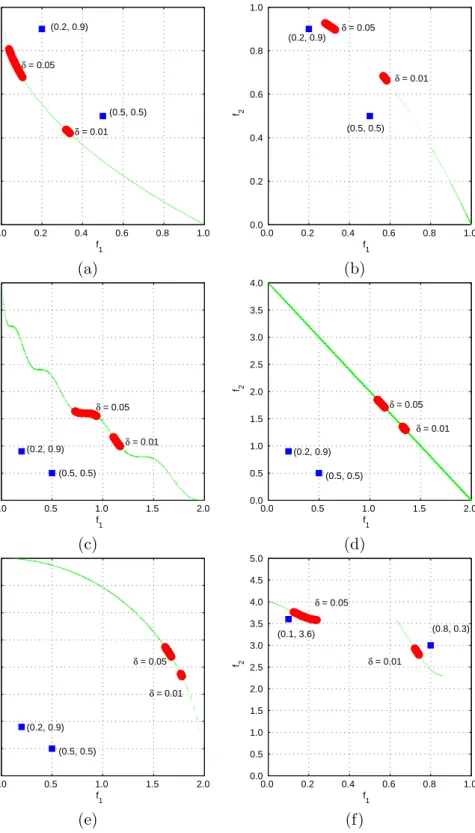
remains to be resolved is that there are no suitable metrics for comparing the performance of these user-preference EMO algorithms. Therefore, we introduce a variation of the normalised Hyper-Volume (HV) metric that is suitable for comparing user-preference EMO algorithms. The key feature in our HV calculation process is to consider only the solutions within each preferred region. This methodology favours user-preference EMO algorithms that have con-verged closely to the Pareto front within a preferred region. We also demonstrate how this HV calculation process can be used to visualise the progress of the algorithms in converging onto the preferred regions.
Particle Swarm Optimisation (PSO) has been a popular search-strategy employed in EMO algorithms because of their fast convergence property. In this thesis, we introduce a multi-objective PSO algorithm named MDEPSO. This PSO algorithm is less prone to getting stuck in local optimal fronts and still retains its fast convergence ability. In MDEPSO, this feature is achieved by generating leader particles using a differential evolution rule rather than picking particles directly from the population or an external archive. We also extend MDEPSO to include the distance metric to handle some real-world many-objective problem instances.
We have identified two real-world engineering design problems in optimising aerofoil and lens designs, and formulated them as many-objective problems. The optimisation process of these many-objective problems is computationally expensive. Hence, we use a reference point MDEPSO algorithm to locate solutions effectively in fewer function evaluations. The main feature of the optimisation process of these aerofoil and lens design problems is the derivation of reference points based on existing designs. We illustrate how these existing designs can be used to either obtain better or new design solutions that correspond to various requirements. This process of deriving reference points based on existing design models, and integrating them into a user-preference EMO framework is a novel approach in the optimisation process of such computationally expensive engineering design problems.
Introduction
Optimisation is regarded as a branch of numerical mathematics, operational research or
systems engineering design [Wilde, 1964]. In numerical optimisation, the task is to find the optimal value (or values) for a given problem instance that reflects a desired output [Schwefel, 1993]. The process of optimisation may involve finding the maximum or minimum values for a mathematical function or the best values for the decision variables that are used to define a problem. The traditional methods used to finding the optimal values for mathematical functions involve solving a set of equations [Schwefel, 1993]. However, the problems found in disciplines like engineering design, economics and operational research has the need to find the decision variable values so that the desired outcome is optimal. We refer to these outcomes asobjectives in this thesis. Therefore, the function that maps the decision variables to an objective is called an objective function.
The traditional mathematical process of optimising an objective function involves select-ing some approximate values for the decision variables and computselect-ing values for the objec-tives [Boyd and Vandenberghe, 2004]. This process is applied for many iterations changing the decision variable values. The aim is to minimise the deviations of the variables so that the output is optimal. There exist several mathematical algorithms like theNewton-Raphson iteration that make this process simpler to some extent [Schwefel, 1993]. However, Evolution-ary Algorithms (EAs) have recently become a popular approach in the optimisation process of such parameter-based problems [Eiben and Smith, 2003].
In an EA, a population of individuals is used to represent candidate solutions each en-coding some variable values. EAs are built on the theory of evolution by Darwin [2003 (first published in 1859], which follows thesurvival of the fittest individual principle. These
individ-uals are thenevolved in an optimisation process which spans severaliterations [Michalewicz, 1994]. In an EA, the individuals which represent the best solutions are used to influence the population to produce better solutions in subsequent iterations. The individuals of a population will generate new candidate solutions at each iteration based on rules that in-fluence the creation of fitter individuals than before. Therefore, the population gets fitter over the successive iterations, which corresponds to achieving better solutions. The use of a population based approach like EAs makes the optimisation process more effective, because within a single execution of the algorithm, a large area of the search-space can be explored in parallel. Problem instances where only one objective function is being optimised are usually referred to as single-objective problems.
Many examples in the EA literature can be found where single-objective problems have been solved using algorithms mimicking the evolutionary process [Eiben and Smith, 2003; Michalewicz, 1994]. However, there are many problems that can be perceived to have more than one objective function to be optimised; often these objectives are conflicting with each
other. These problems are named as multi-objective problems [Sawaragi et al., 1985]. In
multi-objective optimisation, all the objective functions are optimised simultaneously. This is more challenging than single-objective problems because the optimisation process has to consider trade-offs between the objectives in order to obtainoptimised solutions. There exist many traditional mathematical methods for optimising multi-objective problems, which are developed in Multiple Criteria Optimisation (MCO) [Ehrgott, 2000; Steuer, 1989]. However, in this thesis we are interested in exploring EAs in multi-objective optimisation. These EA-based approaches are termed Evolutionary Multi-objective Optimisation (EMO) [Deb, 2008].
EMO algorithms have enjoyed great popularity in the last decade where many publi-cations concentrated on two and three-objective problems [Coello Coello et al., 2007; Deb, 2001]. However, there have been relatively little research work in problem instances with more than three objectives because the most popular EMO algorithms perform poorly on such problems. Therefore, in this thesis, we explore optimisation methods suitable for problem instances having more than three objectives, which are usually referred to as many-objective
problems [Hughes, 2005]. We explore the possibilities of integrating new optimisation pro-cedures into EMO algorithms such that they can find solutions on many-objective problems more effectively than the current state-of-the-art EMO algorithms.
1.1 Motivation
The state-of-the-art EMO algorithms operate based on thedominance relationship, which is used to compare candidate solutions to advance the evolutionary process [Deb, 2001]. In the dominance relation, an individual is said to be fitter than another, if its objective values are equal or better than the latter for all objective functions. However, if the individual has better values on some objectives and worst values on the other objectives, then the two individuals are said to have an equal fitness. In many-objective problem instances the probability of the entire population being equally fit to each other becomes very high, deeming the dominance relation ineffective to be used in the optimisation process [Wagner et al., 2007]. Therefore, we are motivated to explore methods that can be used within the optimisation process that are still effective in comparing the individuals in many-objective problem instances.
Another issue in many-objective problems is that, as the number of objectives increases, the size of the objective-space also increases dramatically. EMO algorithms would have to spend a considerably large amount of resources to locate all the possible solutions in this vast area. This can be a waste of resources if all the solutions are not useful for a given application. To address these issues, many methods are proposed in the EMO literature that approach the optimisation process in different forms. One approach is to use dimensionality reduction techniques to reduce the number of objectives [Brockhoff and Zitzler, 2006; Zhang and Li, 2007]. These problems with reduced number of objectives can be solved successfully with an EMO algorithm that uses dominance comparisons. However, there exist some instances where such an approach to reduce the number of objectives itself becomes an optimisation problem. Therefore, we are more interested in EMO algorithms that can handle many-objective problems directly rather than using dimensionality reduction methods.
Some of examples of real-world problems having many conflicting objectives are found in land planning [Stewart et al., 2004], construction engineering [Nakayama et al., 1995], aerospace engineering [Hughes, 2006; Takagi, 2001], optical engineering [Joseph, 2005] and water engineering [di Pierro, 2010]. These applications were another motivation factor for us to explore methods to make EMO algorithms better suited to handle many-objective problems. In this thesis, we also present two many-objective engineering design problems for which we use an EMO process to obtain useful solutions efficiently.
There exist few EMO algorithms in the literature that are able to handle some
many-objective problem instances. However, they still depend on dominance ranking [Kukkonen
These dominance ranking and modified dominance relation methods are computationally expensive and ineffective as the number of objectives increases. Therefore, we are interested in applying methods that do not depend on any dominance based relations. One of the recent approaches that has been gaining popularity in handling many-objective problems is to use preference mechanisms found in the Multi-Criteria Decision Making (MCDM) [Ehrgott and Gandibleux, 2002] literature within an EMO algorithm. We are motivated to integrate some of these user-preference methods into EMO algorithms, so that they provide additional guidance to the algorithms to locate solutions in many-objective problems. This guidance will allow the EMO algorithms to concentrate the search effort into preferred regions of the objective-space to locate solutions. To this end, we propose a distance metric derived from user-preferences that is used to guide the EMO algorithms. This distance metric based approach is simpler, yet more efficient than the current user-preference algorithms that rely on dominance relations.
Another open issue is that there are no performance metrics, which have been universally agreed upon to compare user-preference EMO algorithms meaningfully. Existing performance metrics for EMO algorithms cannot be directly applied to user-preference EMO algorithms. These metrics measure the effectiveness of the algorithms in locating all solutions on the Pareto front but not the targeted areas as indicated by the user. In the research presented in this thesis, we propose a performance metric more suitable for user-preference EMO al-gorithms. The proposed metric is a result of the background study of current metrics and their shortcomings with relation to the characteristics of user-preference EMO algorithms.
Among the many EAs in the literature, Particle Swarm Optimisation (PSO) [Kennedy and Eberhart, 2001] algorithms have been very popular due to their simple functionality, re-quiring only a few execution parameters. EMO algorithms that use PSOs as the search strat-egy are usually named as Multi-Objective Particle Swarm Optimisation (MOPSO) [Coello Coello and Lechuga, 2002] algorithms. We are interested in coupling user-preferences with MOPSO algorithms for many-objective problems. MOPSO algorithms are also very fast in finding solutions compared with other EMO algorithms. Therefore, we are interested in using a MOPSO algorithm, which is guided by our user-preference based distance metric to find solutions in some real-world engineering design applications. The applications we are inter-ested in, are in the domains of aerodynamic optimisation and optical lens design. Another motivation factor for real-world applications is the exploration of methods to integrate the refined knowledge of the designers to guide the optimisation process.
These motivation factors are the main driving forces of the research presented in this thesis. Next, we outline our research work guided by some research questions and the research methodology.
1.2 Research questions
The research described in this thesis is based on the following questions:
1. How can we integrate user-preference methods from the MCDM literature to design ef-ficient EMO algorithms that can find solutions for many-objective problems?
We use some existing preference methods found in the MCDM literature to build a framework to aid the functionality of EMO algorithms in solving many-objective prob-lems. The proposed distance metric will be an integral part of this framework. The key merits of this framework are its simplicity and the absence of a dominance rank-ing search method. Not havrank-ing a dominance rankrank-ing method is essential to make this framework computationally less expensive than the state-of-the-art EMO algorithms. 2. How can we measure the performance of a user-preference EMO algorithm using a
suitable performance metric?
In the current literature of user-preference EMO algorithms, there is an absence of a suitable performance metric. We explore possible metrics and adapt them in a manner meaningful for user-preference EMO algorithms.
3. How can we develop a robust PSO algorithm which can be used in many-objective prob-lems?
The current PSO algorithms are very fast in converging onto solutions in multi-objective problem instances. However, they can also get stuck in local optimal solutions. We ex-plore methods to retain the fast convergence of PSO algorithms even on many-objective problem instances by improving the guidance with a new leader selection mechanism and user-preferences.
4. How can real-world problems benefit from user-preference EMO algorithms in the opti-misation process of engineering designs?
Practitioners of real-world domains have a very refined knowledge about the problem instances. We harness this knowledge to provide guidance to EMO algorithms so that they can be used in the optimisation process of engineering design problems. These
problems often can be formulated to have a large number of objectives. We explore methods to integrate the guidance from practitioners into a framework based on user-preference EMO algorithms.
Each of these research questions is described in detail and examined in the upcoming
chapters. In the following section we present several techniques adopted to address the
above research questions.
1.3 Methodology
To answer the research questions we first need to have a good understanding of the
state-of-the-art EMO algorithms. This is achieved by a comprehensive literature review that
describes the current EMO algorithms and their weaknesses in handling problems with a large number of objectives. In particular, we explore existing preference mechanisms in the MCDM literature that have been applied to EMO algorithms. Based on these approaches, we present a framework for EMO algorithms that is more efficient and effective than the state-of-the-art EMO algorithms for solving many-objective problems.
We use some existing test problem suites found in the EMO literature to evaluate the algorithms that we propose in this thesis. These test problem suites include multi-objective problems having a wide range of characteristics. Initially we compare our preference-based algorithms against standard dominance ranking-based algorithms like NSGA-II [Deb et al., 2002] on these problems. We assess the capability of these algorithms to find the global optimal solutions using visual representation of the solutions and analyse them against known properties of the problems.
To analyse our based algorithms more effectively against other preference-based algorithms suitable performance metrics are required. The existing performance met-rics are developed to measure how well an EMO algorithm locates solutions on the entire Pareto front. However, in user-preference EMO algorithms the goal is to locate solutions on certain regions of the Pareto front. Therefore, the performance metric has to take this infor-mation into account in the measurement process to obtain meaningful results. Most of the existing performance metrics measure the deviation of the solutions against known Pareto optimal values for each problem instance. This feature makes the existing metrics unsuitable because there exists many problems where the global optimal solutions are not known. We explore methods to use a hyper-volume metric [Knowles and Corne, 2002] in a suitable man-ner for preference-based EMO algorithms. The hyper-volume metric is suitable because it
does not require the knowledge of a known Pareto front. However, the current hyper-volume metric is used to measure how well an EMO algorithm locates the entire Pareto front. There-fore, it has to be modified to better suit the performance measure of user-preference EMO algorithms.
In EMO algorithms, performance metrics are presented as averages to mitigate the ran-dom chance in the stochastic process. Therefore, we have to evaluate these average hyper-volume values using some statistical tests. We use the Student’st-test to test the significance of the results because we execute different algorithms on the same test problems to observe which one is better in locating solutions. The null hypothesis is defined as;the observed mean of each population is different. The null hypothesis is rejected if the t-test yields ap-value greater than 0.05.
To explore the possibility to use a user-preference EMO algorithm in engineering design problems, we use a robust MOPSO algorithm to take advantage of its fast convergence behaviour. However, the current MOPSO algorithms have to be enhanced to be able to handle many-objective problems with a large number of local optimal solutions. Therefore, we first explore the possibilities of obtaining a PSO algorithm, which is robust in handling difficult multi-objective problems, and then extend it to handle many-objective problems with the use of user-preferences.
We apply this preference-based MOPSO algorithm to two engineering design problems. The problems we present in this thesis are; aerofoil designs for unmanned aircraft and lens designs for still photography. We use existing knowledge of these problem domains to develop some preferences that will be used within the MOPSO algorithms. Finally, we present the optimised designs for each problem instance and evaluate them against existing solutions and other preferred characteristics of the designs. These real-world applications are important for the completeness of this thesis because it demonstrates the practical relevance of the pro-posed user-preference EMO algorithms and provides insights on utilising the refined domain knowledge of the engineers to guide EMO algorithms.
1.4 Original contributions
This thesis makes a number of novel contributions to the field of EMO, in particular many-objective optimisation. The core of these contributions is on employing user-preference meth-ods to aid EMO algorithms to solve problems having a large number of objectives. The following are the key contributions of this thesis.
• A simple yet effective framework to aid EMO algorithms to function in many-objective problems with the use of user-preferences. This framework is based on adistance metric
derived from the user-preference, which can be embedded into any EMO algorithm. This distance metric is a scalar value that can be used successfully to compare solutions in many-objective problems to provide the necessary selection pressure for the EMO algorithms to work effectively. This is advantageous over EMO algorithms based on dominance ranking methods because of the ineffectiveness of the dominance relation in many-objective problems.
• A performance metric based on the hyper-volume measurement that is suitable for
comparing user-preference EMO algorithms. We also present a discussion of the short-comings of the current performance metrics if used for user-preference EMO algorithms.
• A robust and effective MOPSO algorithm that can handle difficult multi-objective
problems. This MOPSO algorithm is integrated with the distance metric to obtain an effective MOPSO algorithm which is more efficient than the state-of-the-art.
• Applications of this MOPSO algorithm to aerofoil designs for unmanned aircraft and
lens designs for still photography. Having user-preferences in such engineering design problems can provide guidance to the EMO algorithm to locate useful solutions re-ducing valuable computational expenses. Current aerospace engineering or lens design applications do not use user-preference EMO algorithms in their design processes. The real-world engineering applications presented in this thesis are a first attempt of using such optimisation methods.
These contributions are aligned with the research questions and are described within the next chapters.
1.5 Outline of the thesis
This thesis has seven chapters and an Appendix. The chapters are organised as follows:
• A literature review of the state-of-the-art EMO algorithms is given in Chapter 2. Here the basics for multi-objective optimisation are described with example problem in-stances. Next, we present a review of EAs and how they are used in solving multi-objective problems. We also review preference mechanisms in MCDM and recent work using them in EAs in this chapter.
• We describe the use of user-preferences to derive the distance metric in Chapter 3. This distance metric is used to guide evolutionary algorithms to find solutions in many-objective problem instances, hence remove the need of dominance-ranking methods. We present results of applying this distance metric on many problem instances having a large number of objectives and compare them with algorithms that use dominance-ranking methods. We answer the first research question in this chapter.
• We answer the second research question in Chapter 4 by proposing a better performance metric for user-preference algorithms. We first discuss some existing performance met-rics and their shortcomings, and then introduce a modification to the hyper-volume metric as a suitable performance metric for user-preference algorithms.
• In Chapter 5, we present a new MOPSO algorithm that is capable of exploring the
search-spaces of many-objective problems without getting stuck in local optimal solu-tions. We use preferences to guide the algorithm to find solutions efficiently in these problem domains by harnessing the fast converging property of PSO. We present some results of this MOPSO algorithm in various test problem instances in comparison with some other MOPSO algorithms found in the literature. We present answers to the third research question in this chapter.
• In Chapters 6 and 7 we present the two engineering design problems. Within these
chapters we aim to answer the fourth research question. The engineering problems are in aerofoil designs for unmanned aircraft and lens designs for still photography. The MOPSO algorithm described in the previous chapter is used in a manner where an engineer can guide the algorithm using their refined knowledge about the problem domain. The preferences will guide the algorithms to find solutions adhering to the design criterion.
• Finally in Chapter 8 we summarise the outcomes of this thesis with conclusions and dis-cussions for future work. We revisit the research questions and summarise the answers with respect to the results in Chapters 3–7.
The Appendix describes the many-objective test problems used in this thesis in detail, followed by the Bibliography of cited publications and other references.
Literature review
There exist many problems in engineering design, which can be formulated to have several conflicting objectives. Finding good designs satisfying all these objectives is challenging, and many algorithms have been developed to find such design solutions. In this thesis, we propose some EAs that are able to find solutions for such problems. However, before we get into the details of the algorithms it is important to describe the background material related to the research presented in this thesis.
In this chapter we provide a literature review of all the building blocks used for the re-search. This review illustrates the limitations of the state-of-the-art algorithms and provides motivation for this research. First, in Section 2.1, we introduce multi-objective problems us-ing the standard definitions. We also present the definition of many-objective optimisation, which is the crux of this research. Next, in Section 2.2, some existing multi-objective test problems are described. These test problems are used in the literature as means of comparing the effectiveness of multi-objective algorithms. Section 2.3 shows the traditional approach in solving multi-objective problems. We then describe the shortcomings of this mathematical approach and the justification for the use of an EA approach.
We briefly describe the concept of EAs in Section 2.4, with some examples. Next, we describe in detail how EAs have been used to develop EMO algorithms in Section 2.5. This section illustrates the issues in current EMO algorithms when faced with many-objective problems. We also provide some techniques found in the literature that are used to overcome these issues. One such approach is to integratepreferences into EMO algorithms. Section 2.6 details these preference methods and integration into EMO algorithms. This chapter also describes some of the existing performance metric for EMO algorithms in Section 2.7.
2.1 Multi-objective optimisation
In multi-objective optimisation, the main aim is to find solutions which have some trade-offs between multiple conflicting objectives. These objectives have to be optimised simultane-ously. We can formally define such an optimisation as; there is a set of objective functions which need to be maximised or minimised [Deb, 2001]. Without loss of generality we assume that the objectives are to be minimised. This can be generally defined as a set of functions described by:
minimisefi(⃗x) wherei= 1,2, . . . , M (2.1)
Here, fi(⃗x) is an objective function and M is the number of objectives. The solution
⃗
x = [x1, . . . , xN] is a vector having N number of decision variables. For example, assume
the problem of designing of beams that are used to build a structure. Here, the decision variables can be the dimensions of the beam (x1 = height,x2 = width andx3 = depth). We are interested in finding an optimal design for a beam which gives the most strength with the least amount of material. Here, our objectives can bef1 = strength andf2 = weight. It is also interesting to note that these two objectives are conflicting with each other.
2.1.1 Variable boundaries
The decision variables can be defined to be valid between some extreme values. In the beam design problem, these extreme values can be the maximum and minimum values allowed for each dimension. We define these extreme values as the Upper Bound (UB) and Lower Bounds (LB) of the decision variables. These boundaries can be expressed as:
x(iLB)≤xi≤x(iU B) orxi ∈ [ x(iLB), x(iU B) ] fori= 1,2, . . . , N (2.2) 2.1.2 Constraints
Each optimisation problem can have a certain number of constraints. These are to be satisfied in the design process. In the beam design problem, a constraint could be the stress amount of a beam. A constraint is defined as either an inequality function or an equality function. Generally these constraints are written as:
x1 2 x f1 2 f Mapping from decision−space to objective−space Feasible decision−space Feasible objective−space
Pareto optimal front Infeasible decision−space
Pareto optimal solutions
Infeasible objective−space
Decision−space Objective−space
Figure 2.1: Solutions in the decision-space or search-space are mapped to the objective-space using the one-way objective functions.
gj(⃗x)≤0 where j= 1,2, . . . , J
hl(⃗x) = 0 wherel= 1,2, . . . , L (2.3)
2.1.3 The mapping from decision-space to objective-space
The decision vectors can be illustrated as points on a coordinate axis plot. The axes represent the decision variables. This plot is then called the decision-space (or search-space). The objective functions map each point in this decision-space to a point on a coordinate axis plot called the objective-space. The objective-space represents each objective on its axes. Figure 2.1 illustrates this mapping between a dimensional decision-space and a two-dimensional objective-space.
Here, solutions within the variable boundaries and adhering to the constraints are referred as the feasible solutions. These feasible solutions will be mapped to the feasible objective-space. It is useful to note that in multi-objective problems, the objective functions provide a mapping of the decision variables from the decision-space to the objective-space only. The main task of multi-objective algorithms is to find solutions having suitable values for the decision variables such that they provide the best (or optimal) values for the objective functions. These algorithms function by observing the behaviour of the objective-space, because optimising the objective-space is the main task.
2.1.4 The dominance relation
The dominance relation is used to compare two solutions mapped on the objective-space in a multi-objective optimisation problem [Deb, 2001]. For two decision vectors⃗aand⃗bon the objective-space, the dominance relation⃗adominates⃗b(denoted by⃗a≺⃗b) is defined as:
⃗a≺⃗b⇔ ∀i fi(⃗a)≤fi(⃗b)∧ ∃j fj(⃗a)< fj(⃗b) (2.4)
The decision vector⃗ais said to dominate⃗bif and only if,⃗ais as good as⃗bin all objectives and⃗ais strictly better than⃗bin at least one objective. If⃗aor⃗bdo not dominate each other, then these vectors are said to benon-dominant to each other. The relation: ⃗ais as good as⃗b in all objectives, is a weaker form of the dominance relation. Thisweakly dominated relation (denoted by ≼) is given as:
⃗a≼⃗b⇔ ∀i fi(⃗a)≤fi(⃗b) (2.5)
The set of solutions which are non-dominant to each other is called thenon-dominated set
in the decision-space, and thenon-dominated front in the objective-space. A decision vector is said to bePareto optimal if and only if there is no other vector in the objective-space that dominates it. This set of Pareto optimal solutions is called the Pareto optimal set in the decision-space and the Pareto optimal front in the objective-space. Figure 2.1 also illustrates these collections.
2.1.5 Many-objective optimisation
Traditionally, most of the multi-objective optimisation problems found in the literature usu-ally have two or three objectives. Problems having more than three objectives are referred to as many-objective problems [Fleming et al., 2005; Hughes, 2005]. We provide special at-tention to these many-objective problems in this thesis, although two or three objectives are used in diagrams for the ease of visualisation.
In the literature, the objective-space of a multi-objective problem is of high interest because the main task of the algorithm is to find solutions that can be mapped onto the Pareto optimal front, which is in the objective-space. In other words, researchers in
multi-Table 2.1: Properties of the ZDT test problems and the characteristics of their Pareto fronts. The number of decision variables N, is constant for each problem.
Problem N Shape of the Pareto front
ZDT1 30 Convex
ZDT2 30 Concave
ZDT3 30 Convex with disconnected surface
ZDT4 10 Convex
ZDT6 10 Concave
objective optimisation are interested in developing algorithms that can converge onto the Pareto optimal front. Patterns emerging on the Pareto front depict various features of a multi-objective problem. These features can also represent the difficulty levels of a problem. A multi-objective algorithm will strive to converge onto a solution front which conforms to those expected features. However, it is difficult to judge if this solution front an algorithm converged to, is Pareto optimal or not without some extra information. To this end, researchers in multi-objective optimisation have developed several multi-objective test problems, where the Pareto fronts are known. These test problems are used to determine if a multi-objective algorithm is capable of converging to the Pareto front or not.
2.2 Multi-objective optimisation test problems
These test problems with known Pareto fronts show various different characteristics on the objective-space for each problem instance. Using these test problems, researchers in multi-objective optimisation are able to develop algorithms that can be used to find solutions to various types of problems, without having the need to modify the algorithm for each problem instance. Here, we present a brief overview of three widely used multi-objective test problem sets. Detailed descriptions of the objective functions are given in Appendix A (page 198).
2.2.1 ZDT test suite
Zitzler et al. [2000] proposed six two-objective test problems. In each of these problems, the objectives are to minimise the given functions. The characteristics of the test problems are given in Table 2.1. The detailed descriptions of the ZDT test problems are given in Appendix A.1 (page 198).
In the ZDT test suite, xi ∈ [0,1] for all the decision variables. However, in ZDT4,
Table 2.2: Properties of the DTLZ test problems and the characteristics of their Pareto fronts. The number of decision variablesN, depend on the number of objectivesM for each problem.
Problem N Shape of the Pareto front
DTLZ1 M + 4 Linear DTLZ2 M + 9 Convex DTLZ3 M + 9 Convex DTLZ4 M + 9 Convex DTLZ5 M + 9 Convex DTLZ6 M + 9 Convex DTLZ7 M + 19 Disconnected regions
each having one global optimal front. ZDT4 has 219 local optimal fronts. ZDT4 is designed to test an algorithm’s ability to avoid local optimal fronts and locate the global optimal front. Problems with many local optimal and one global optimal front are calledmulti-modal
problems. Therefore ZDT4 is a multi-modal multi-objective problem. We have omitted ZDT5 because it is a binary encoded problem, whereas the scope of this thesis is on real-valued problems.
2.2.2 DTLZ test suite
This test problem suite was proposed by Deb et al. [2005b] as an extension to the ZDT problems. The problems in this suite can be scaled to produce any number of objectives. The objectives are to minimise the given functions. Table 2.2 illustrates the properties of the DTLZ problems. The detailed descriptions of the DTLZ test problems are given in Appendix A.2 (page 201).
In the DTLZ test suite, xi ∈[0,1] for all the decision variables. DTLZ1 is multi-modal
having 115 −1 local optimal fronts. DTLZ3 is multi-modal having 310−1 local optimal
fronts. The Pareto fronts of DTLZ5 and DTLZ6 are an area spanning M −1 dimensions
in an M ≥ 3 objective-space. In a three-objective space the Pareto front is a line. In a
two-objective space the Pareto front is a line similar to ZDT2. We have omitted DTLZ8 and DTLZ9 because they are constrained problems, which are not in the scope of this thesis.
2.2.3 WFG test suite
This test problem suite was proposed by Huband et al. [2006] addressing some of the limita-tions found in the ZDT and DTLZ suites. Among these limitalimita-tions, the notion ofseparability
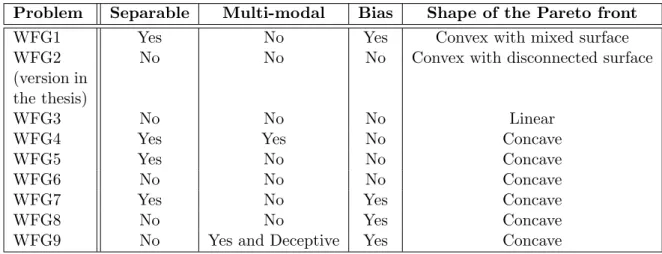
Table 2.3: Properties of the WFG test problems and the characteristics of their Pareto fronts.
Problem Separable Multi-modal Bias Shape of the Pareto front
WFG1 Yes No Yes Convex with mixed surface
WFG2 (version in the thesis)
No No No Convex with disconnected surface
WFG3 No No No Linear
WFG4 Yes Yes No Concave
WFG5 Yes No No Concave
WFG6 No No No Concave
WFG7 Yes No Yes Concave
WFG8 No No Yes Concave
WFG9 No Yes and Deceptive Yes Concave
variable is optimised separately. Another issue was bias. Bias indicates if a problem has a natural favouritism in aiding the search process. If we are to randomly assign values to a large number (about 50,000) of decision vectors and observe that some of them belong to the Pareto set, then this problem is considered to be biased. Another issue identified by Huband et al. [2006] was that the existing multi-objective test problems were notdeceptive. Basically a deceptive problem is multi-modal and the search-space spans mostly on the local optimal fronts. Such a problem is difficult for multi-objective algorithms because the optimisation process tends to locate a local optimal front. In this thesis, we refer to problems which are
non-separable, biased and non-deceptive as simple problems. In the ZDT test suite only
the ZDT5 problem was a deceptive problem. In our initial experiments, we identified that ZDT1–3 were simple problems because of bias. ZDT4 was not a simple problem, because it was not biased and was multi-modal. In the DTLZ problems, none were deceptive but DTLZ1 and DTLZ3 were multi-modal. We also found that DTLZ2 was biased. Both ZDT and DTLZ test suites did not contain any separable problems [Huband et al., 2006].
The WFG test problem suite addressing these issues is very comprehensive and complex. Here also all objectives are to be minimised. A solution vector⃗xconsists of k position vari-ables and l distance variables such that k+l = N. All xi ∈ [0,1]. In this thesis, we used
M −1 position variables and 2(M−1) distance variables giving N = 3(M−1) number of
decision variables, for M ≥ 3 objectives. For two-objectives we used k = 2 and l = 4. A
brief overview of the test problems are given in Table 2.3. The detailed descriptions of the WFG test problems are given in Appendix A.3 (page 206).
The implementations of the ZDT, DTLZ and WFG test problem suites and the sample Pareto fronts used in this thesis were obtained from the jMetal framework1 [Durillo et al., 2006].
2.3 Traditional approach in solving multi-objective problems
The traditional mathematical approach to finding solutions in multi-objective problems is to convert the problem into a single objective problem [Miettinen, 2008]. All the objective functions are combined with some weights (wi >0) to create a single objective function (T)
as: T = M ∑ i=1 wifi(⃗x), where M ∑ i=1 wi = 1 (2.6)
Using some algorithm this single objective T function can be optimised. Optimising T
will give a single solution. If a user or Decision Maker (DM) is interested in obtaining a set of optimal solutions, which gives the Pareto optimal set, they have to re-run the algorithm with various values for the weights. The main issue in this approach is that finding an optimal set of weight values itself is an optimisation problem. A better method to find solutions for multi-objective problems is to use a population based approach like an EA.
2.4 Evolutionary algorithms
EAs have been used very successfully to find solutions in multi-objective optimisation prob-lems because they use a population of individuals to represent candidate solutions [Deb, 2001]. Before we illustrate some of these algorithms as examples, it is useful to describe the basic functionality of an EA.
2.4.1 General framework of an EA
The basic form of an EA is represented in a cycle, which is shown as in Algorithm 1 [Eiben and Smith, 2003].
1
The jMetal framework is available at: http://jmetal.sourceforge.net/. This framework also contained the codes for the state-of-the-art evolutionary multi-objective algorithms used in this thesis for comparison. E.g. NSGA-II.
Algorithm 1 Pseudocode of an EA
1: INITIALISE a population with random candidate solutions
2: EVALUATE each candidate
3: repeat
4: SELECT parents
5: RECOMBINE pairs of parents
6: MUTATE the resulting offspring
7: EVALUATE new candidates
8: SELECT individuals for the next generation
9: untilTERMINATION is satisfied
The key steps of an EA are initialise, evaluate, select, recombine, mutate and termina-tion [Eiben and Smith, 2003]. In the initialisation stage, candidate solutions are assigned to the individuals by randomly generating values within the variable bounds. These individuals make up the population. A data structure called thegenome inside an individual represents a candidate solution. The fitness value of an individual is the quality of its genome. In an algorithmic sense this fitness shows how close an individual is to an optimal solution. These candidate solutions may not be the desired solution or the optimal solution, but using recom-bination (crossover) and mutation the fitness values may be improved so that the individuals may reach the desired solution after many iterations.
In recombination, parent individuals create a new individual with a combination of their information. A recombination actually refers to the combination process of these genomes of each parent to generate a new individual (offspring). After the recombination, certain
decision variables are changed using an operator referred to as mutation. This mutates
(changes) the resulting genome. Mutation is an important step in the EA cycle since this increases the possibility of jumping out of locally optimal solutions. Whereas crossover is a binary operator, mutation is a unary operator.
Within the evaluation stage an individual is assessed (evaluated) and assigned a fitness value. This is an important step, since, to select individuals to be parents or to survive, the fitness value is considered. This stage of evaluating an individual’s fitness value and selecting the fitter ones is referred to as selection.
As seen in Algorithm 1, these stages are performed on a population in a cyclic manner until a termination criterion is reached. Usually the termination criteria are when a solution is found to the problem, or when a maximum number of evolution cycles (generations) are
Offspring 2 1 0 1 1 0 0 1 1 1 0 0 0 0 1 1 1 1 1 0 0 1 1 0 1 1 0 0 1 1 1 1 1 0 0 1 1 1 0 0 0 1 1 Individual 2 Individual 1 Offspring 1 Offspring 2 1 0 1 1 0 0 1 1 1 0 0 0 0 1 1 1 1 1 0 0 1 1 0 1 1 0 0 1 1 1 1 1 0 0 1 1 1 0 0 0 1 1 Individual 2 Individual 1 Offspring 1 (a) (b)
Figure 2.2: Simple crossover and mutation mechanisms of a binary GA: (a) Single point crossover; (b) Single point mutation.
performed. For an EA to function properly several parameters have to be set. These are crossover probability (Pxor), mutation probability (Pmut) and population size (n), which are
problem dependent.
2.4.2 Types of evolutionary algorithms
The literature describes many different types of EAs. We briefly describe some of them illustrating the various crossover and mutation operators.
Genetic Algorithms
The simplest form of EA is in Genetic Algorithms (GA). Holland [1992] described the idea of Darwin’s theory of evolution implemented as a form of algorithm, which was later known as GA. In the simplest form of GA, each individual’s genome is a binary string comprising of 1sand 0s.
As seen in Figure 2.2, in the crossover operation two individuals (parents) exchange their
genome with each other at a common intersection point. This is known as a single point
crossover. This operation creates two offspring. Depending on a probability, two parents will produce offspring using some crossover mechanism. If the parents are below the probability for crossover, the offspring will simply be a copy of the parents. In mutation, a single binary bit is flipped to mimic a change in the genome. The bit to be flipped is chosen randomly. This is known as a single point mutation. As for crossover, a probability is used to decide if an individual is to perform a mutation or not. Other than these simple operations, there