Cloud X Conventional
file back up system
Clouds, PCs, Smart Phones Proposed file back up system
Data File Leased Circuits Region #A Region #B Region #C Enterprise #1 Region #A Enterprise #3(Ent.#3) Region #B Region #C Data Center Copy of
Data #1 Copy ofData #1 Leased Circuits Data #1 Cloud I Cloud I Cloud I Data #1 Data Center Data #2 Data #3 HS-DRT engine Enterprise #2 (Ent.#2)
Enterprise #1 (Ent.#1) Ent.#1 Ent.#2 Ent.#3
Metadata Metadata Metadata The Internet / NGN / VPN Supervisory Servers
Fig. 1 Comparison with a conventional backup system
Study of a Backup Service Concept
Using Secure Distributed Networks
Noriharu Miyaho, Shuichi Suzuki, and Yoichiro Ueno
Tokyo Denki University
1. Introduction
In the present advanced information society, most social activities are supported by the electronic data infrastructure. However, at this time, there is no technology to back up institutes’ important file data in the event of an unexpected disaster. Given these circumstances, highly secure technology to address this issue needs to be developed at an affordable development and operational cost.
This paper presents a state-of-the-art backup service concept using high-speed strong cipher technologies to realize efficient and economical distributed network services by means of a threshold secret-sharing scheme. We have developed and partially commercialized a disaster recovery system and evaluated the feasibility of the distributed engines [1-2]. In order to provide the proposed backup service, a combination of the following technologies including spatial random scrambling of file data, subsequent random fragmentation of the file, encryption and duplication of each fragmented file at each encryption stage, and a corresponding encryption key code sequence (encryption metadata) can effectively realize a secure and prompt file backup service. In the event a disaster impacts a data backup center, prompt data recovery can be easily and securely achieved by making use of a very large number of widely distributed wired PCs and mobile phones in addition to cloud computing environments [3-5]. Finally, we also propose future technologies for preventing an insider attack in order to guarantee a safe backup service.
2. Related work and Comparison with Our Concept
In the field of file recovery services, there have been numerous research reports and many commercial products have been released onto the market. Most file recovery systems include data replication functions using stand-by servers in remote locations. In contrast, the proposed file recovery system using High Security-Disaster Recovery Technology (HS-DRT) uses a secure distributed data backup scheme. By making use of the HS-DRT mechanism to achieve a reliable backup scheme, we have been able to provide a system product at a reasonable price to both individual users and companies. In the field of secure data backup systems, other related studies have included the
concept of a distributed file backup system [6-7]. However, in these studies, a practical network service system is not clearly described.
In the field of intrusion tolerance, a file server should introduce such functions as encryption, fragmentation, replication, and scattering [8]. The core technologies of HS-DRT resemble those of a persistent file server, except for the spatial scrambling and random dispatching technology. By effectively combining these technologies, deciphering the encrypted message by a third party becomes almost impossible.
In contrast, the proposed HS-DRT is applicable to other communication service fields including secure video streaming services and secure real-time delivery confirmation services. By making use of HS-DRT to achieve a reliable backup service, we have been able to provide a system product at a reasonable price to both individual users and companies. Fig.1 shows the concept of the proposed network service compared with a conventional backup system using leased lines.
3. Basic Configuration of the HS-DRT Engine
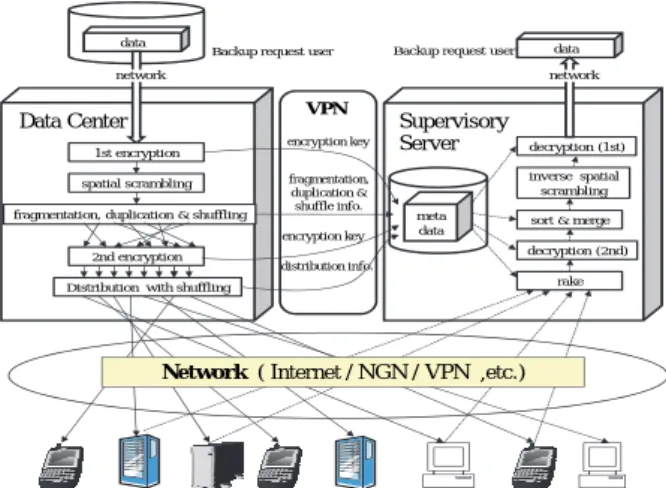
The HS-DRT file backup mechanism has three principal components, as shown in Fig.2.
The main functions of the proposed network components, namely, data center, supervisory server and various client nodes, can be specified as follows. The client nodes at the bottom of Fig.2 are PCs, smartphones, network attached storage (NAS) devices, digital signage and cloud-based storage services.
They are connected to a supervisory server in addition to the data center via a secure network. The supervisory server (on the right in Fig.2) acquires the history data, which includes the encryption key code
sequence (metadata) from the data center (on the left in Fig.2) via a network. The basic procedure in the proposed network system is described in the following paragraph.
It is appropriate for the data center to incorporate a secret sharing scheme for sending encryption metadata to the supervisory servers deployed in several different locations for deciphering the original file data. To enhance security, it is preferable to send the metadata using a virtual private network (VPN). This mechanism makes it quite difficult to discover any sequence in the encryption metadata itself. From a disaster recovery perspective, a secret sharing scheme with some appropriate “thresholds” should be introduced into the proposed system. If the system adopts a (3, 5)-threshold scheme, the system will use five supervisory servers, and can tolerate the simultaneous failure of two servers. On the other hand, from a cyber-terrorism viewpoint, if the system uses a (3, 5)-threshold scheme, a cracker has to gain access to at least three encryption metadata servers and one live/valid information server at the same time [11].
3.1 Backup Sequence
When the data center receives the data to be backed up, it encrypts the data, scrambles it, and divides it into fragments, and thereafter replicates the data to the extent necessary to satisfy the required recovery rate according to the pre-determined service level. The data center encrypts the fragments again in the second stage and distributes them to the client nodes in a random order. At the same time, the data center sends the metadata to be used for deciphering the series of fragments to the supervisory servers. The metadata comprises encryption keys (for both the first and second stages), and several items of information related to fragmentation, replication, and distribution. When a block cipher is used for encrypting a data file, the required processor and memory costs increase in an exponential manner with increasing data volume. However, with a stream cipher, the input data is simply operated on a bit-by-bit basis, using a simple arithmetic operation, and high-speed processing becomes feasible. We propose a simple, high-speed message encryption
algorithm called spatial random scrambling as follows. Fig.3 shows the algorithm for spatial random scrambling introduced in the HS-DRT engine. This scrambling procedure can be realized by executing the algorithm using a C language description. Here,
operator "" indicates a reversible operation, such as
exclusive-or, binary addition, or binary subtraction. It is strongly recommended to repeat this process several times. De-scrambling can be achieved simply by performing the same operation in reverse order. By introducing this spatial random scrambling, deciphering original data becomes almost impossible because of the random distribution of fragments in several unpredictable locations. An effective approach is to combine the use of several technologies, specifically, the spatial scrambling of all data files, the random fragmentation of the data files, and the corresponding encryption/replication, in addition the distribution of each file fragment.
The security level of HS-DRT depends not just on the cryptographic technology but also on the method by which the three specified factors are combined, that is, spatial scrambling, fragmentation/replication, and a shuffling algorithm such as Fisher-Yates shuffle [9]. Because of these three factors, nobody is able to decrypt the data without collecting all relevant fragments and sorting the fragments into the correct order. Even if some fragments are intercepted, nobody is able to decrypt any part of the original data from such fragments.
3.2 Recovery Sequence
When a disaster occurs, the supervisory server initiates the recovery sequence. The supervisory server collects the encrypted fragments from the relevant clients in a manner similar to a rake reception procedure. When the supervisory server has collected a sufficient number of encrypted fragments, these are decrypted, merged, and descrambled in the reverse order of that performed during the second stage of encryption, and the decryption is then complete. Through these processes, the supervisory server can recover the original backed-up data.
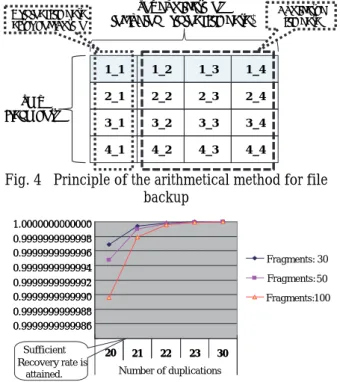
Let us consider the probability of successful recovery, which can be estimated from the following equation. Fig.4 describes the principle of the arithmetical method
Storage Service b data Data Center 1st encryption spatial scrambling fragmentation, duplication & shuffling
2nd encryption Distribution with shuffling
Smart phone Smart phone
Smart phone Storage
Service NAS PC PC Supervisory Server meta data encryption key fragmentation, duplication & shuffle info. distribution info. encryption key rake decryption (2nd)
sort & merge decryption (1st) inverse spatial scrambling data network network
Network ( Internet / NGN / VPN ,etc.) Backup request user
VPN
Backup request user
Fig. 2 Basic mechanism of HS-DRT
start
input encrypted file data to word array(x[0…n-1]) i=0 i<n-1? x[i+1]=x[i+1]x[i] i=i+1 x[0]=x[0]x[n-1] end yes no
output word array(x[0…n-1]) as spatial random scrambled data
for file backup.
Probability of recovery Probability of recovery failure
Here, P is the failure rate of each client node, m is the number of fragments, and n is the number of duplicates of each fragment.
Fig.5 shows the calculated file recovery rate on the condition that each file fragment's failure rate, P, is assumed to be 0.2, and the original file is divided into 30/50/100 fragments, and at most 30 replications are made of each fragment. In this example, the probability of recovery failure becomes less than 10-19, which is
commercially accepted standard for high reliability. The above case applies to the use of smartphones, cellular phones, or PCs. The failure rate of such devices can be estimated to be 0.2 by considering their connectivity and reliability, however, the number of duplications can be drastically decreased when cloud computing resources are used, for which unavailability is usually less than 0.005. Here, the size of users’ important data is roughly classified into two types, called Type1 and Type2. The data size of Type1 is at most around several tens of gigabytes, while that for Type2 is up to several terabytes. Considering a smartphone’s memory capacity to be 32 Gbytes, these are used for Type1 based on the assumption that less than 1% of the vacant memory resource in the terminals available would be used to support the backup service. This percentage can usually be measured by the user’s self-check monitoring and the monitored result can be transmitted to the remote supervisory center. The value of 1% is an example of the conditions to be temporarily assigned to encourage people to participate. Several cloud storage resources can be effectively utilized for
Type2 data. When cloud storage is used, then a much higher level of reliability will be commercially available.
3.3 User-friendly Service Level Assurance
It is very important to respond promptly to the various service level demands from users, which tend to change frequently, to ensure reliable and economical backup services. It is desirable for the backup services have the flexibility needed in order to accommodate the frequent changes in service level requirements, such as security strength and/or guaranteed recovery rate, by effectively utilizing the available network resources. In this case it is necessary to provide a user-friendly Web interface to realize the above-mentioned requirements [10]. We can establish appropriate network architecture that can deliver the necessary service levels and will incorporate both the security strength level and recovery rate parameters shown in Fig.6.
3.4 Computational Safety
The main purpose of encryption is to prevent a third party from deciphering encrypted data, thereby ensuring computational safety. However, if the computing power available for deciphering becomes higher, the safety of the encryption process will be threatened. For example, the present encryption technologies, such as RSA cryptography, elliptic curve cryptography, and ElGamal cryptography cannot be assumed to be ‘forever safe’ because they are based on computational difficulty such as integer factorization and the discrete logarithm problem. In addition, since conventional encryptions are applied to communications between one fixed site and another. This means that it is generally quite easy to identify the locations in which data are stored.
One of the innovative ideas of the proposed backup mechanism is that it requires a unique correct combination of all the required fragments from all the local sites to recompose the essential sequence of fragments. If the number of fragments is N, then hackers would need to capture all the fragment packets and try to recompose them about
N
!
/
2
times to take even the first step towards deciphering the information. Therefore, it is impossible to discover any clues about meanings or even the relations among the fragments. Let us consider a case requiring 100 fragments to be recomposed. It would be necessary to calculate for146
10
s (
3
10
138years) even if each deciphering step required just 1ps using a quantum computer.For example, if Grover’s algorithm [14] is run on a quantum computer, a search that would require time
1_1 1_2 1_3 1_4 2_4 2_3 2_2 2_1 3_4 4_4 3_3 4_3 3_2 4_2 3_1 4_1 “m” fragments “n” duplications
(including original file data) Duplicatedfile data Original file data
after encryption
Fig. 4 Principle of the arithmetical method for file backup 0.9999999999986 0.9999999999988 0.9999999999990 0.9999999999992 0.9999999999994 0.9999999999996 0.9999999999998 1.0000000000000 20 21 22 23 30 Fragments:30 50 100 Fragments: Fragments: Sufficient Recovery rate is attained. 0.9999999999986 0.9999999999988 0.9999999999990 0.9999999999992 0.9999999999994 0.9999999999996 0.9999999999998 1.0000000000000 20 21 22 23 30 Fragments: 30 50 100 Fragments: Fragments: Number of duplications
Fig. 5 File recovery rate characteristics
(Number of fragments ) (when p=1/5) (when p=1/5) (when p=1/5) ×(Degree of duplication ) Low level Medium level High level 20×10 40×20 40×30 Service level
Encryption Strength:more than 260 Recovery rate:more than 1 - 105
Security strength and recovery rate
Encryption Strength: more than 2160
Recovery rate:more than 1 -2× 10-Encryption strength: more than 2160
Rate of file data recovery
Failure rate of each client node: p Number of fragmented files: m Degree of duplication for each fragment: n
1-= mpn
-Recovery rate:more than 1 -3×10
-(Number of fragments ) (when p=1/5) (when p=1/5) (when p=1/5) ×(Degree of duplication ) Low level Medium level High level 20×10 40×20 80×30 Service level
Encryption Strength:more than 260
Recovery rate:more than 1 -2 106
Security strength and recovery rate
Encryption Strength: more than 2160
Recovery rate:more than 1 -4×10-13
Encryption strength: more than 2400
Rate of file data recovery
Failure rate of each client node: p Number of fragmented files: m Degree of duplication for each fragment: n
1-= mpn
-Recovery rate:more than 1 -8×10-20 ×
Fig. 6 Disaster recovery service levels
n m n mP P (1 ) 1 n mP
) (N
O on a classical computer can be completed in just
)
( N
O . Grover's algorithm can be used to examine
multiple fragments of a message simultaneously by adjusting the phases of various operations to form an extremely large array of data in which the fragments are randomly deployed, with no known relationship among them.
Let us consider a case in which the number of deciphering steps N is certain to be quite safe in the current computational environment. If the hacker attacks the encrypted distributed data using Grover’s algorithm, then the required calculation will be decreased to O( N), making it possible to decipher the
file in a short time. However, by making use of the proposed technology we only need to increase the number of fragments from N to 2N to increase the required deciphering steps to O( 2N).
Here, after 2N divisions of the data, the computational complexity can guarantee a sufficiently high difficulty barrier even for a quantum computer. This is because the following formula is easily proved.
(n N) : n! (2n)!
This fact leads to the safe application of the proposed system to a future encrypted backup service even when quantum computers become common. We believe that our proposed disaster recovery system is NP-complete [13], and that kind of system is expected to be safe against attacks launched from quantum computers. 4. Practical and Innovative Application Services
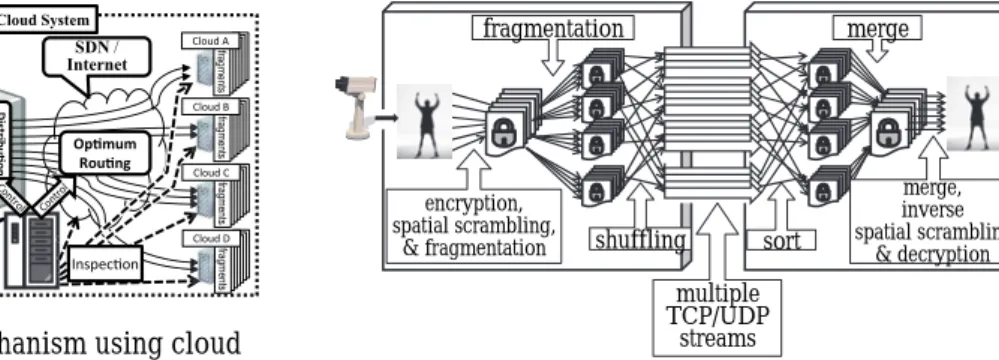
This section describes practical experimental systems that could be realized by making use of the proposed HS-DRT in cloud computing environments [12]. It is preferable to use the web applications in a SaaS environment. The client user terminal can make use of the application services, which are provided through a web applications server. For example, when a user wants to utilize one of the web application functions for storing individual specific data automatically, the user selects the applicable function such as “store”, or “store automatically” as shown in Fig.7. The HS-DRT engine, which also has a web application function, executes the encryption, spatial scrambling, and division of the corresponding files. In succession, it sends and stores the corresponding encrypted fragmented data to a public or private storage cloud. As to whether it should use a private or public cloud, it
acts in accordance with a pre-determined criterion depending on the type of web application. It is very important to note that an HS-DRT processor can easily improve its processing efficiency by increasing its web cache memory. We should consider the scalability of the engine, since it may become a bottleneck in a very large system owing to the number of clients and the amount of storage required. In such cases, the HS-DRT processor may use a key/value database. The secrecy of the system is maintained because there is no plain raw data stream anywhere in the entire data processing procedure.
HS-DRT can be applied to a variety of network services, including secure video streaming services. Fig.8 shows a sample implementation of a secure camera monitoring system using HS-DRT. In the streaming sender (on the left hand side of Fig. 8), the picture frames or GOP of the MPEG video from the camera are encrypted, scrambled, and divided into "m" pieces. Thereafter, each of the "m" pieces is further divided into "n" fragments. These
(
m
n
)
fragments are sent via(
m
n
)
TCP/UDP streams. At the time of sending, each fragment is assigned the appropriate destination TCP/UDP flow port number by using the shuffle table. In the streaming receiver (on the right of Fig.8), the "m" pieces are assembled by sorting and merging(
m
n
)
fragments. The receiver merges and descrambles them in the reverse order, and decrypts "m" pieces to recover the original captured data. This implementation is considered to be a special case, because the cloud storage resources and the supervisory server were integrated in the streaming receiver on the right. In this implementation the sending and the receiving side have to share the secret keys. These shared secret keys consist of the encryption key, the information regarding fragmentation, and the shuffle tables.5. Insider Attack on Block Ciphers 5.1 Background
We need to consider the case of an insider attack, in which a malicious vendor of a security system attacks his clients by using his cipher program, which is generally a block cipher. It can be shown that the Initial Vector (IV) mode [11][12] of the block cipher is vulnerable to an insider attack. However, we will propose a countermeasure to this attack.
Fig. 7 File backup service mechanism using cloud environments encryption, spatial scrambling, & fragmentation fragmentation shuffling multiple TCP/UDP streams sort merge, inverse spatial scrambling, & decryption merge
While we are planning to provide a safe and secure system for data backup, a client may be uneasy because the data might be stolen through an unexpected insider attack. To prevent this situation, we need to introduce the original block cipher mode, solely for this purpose.
In an attack on the block cipher based on the IV mode, the vendor, as the supplier of the cipher program, is assumed not to have any malicious intentions towards clients. The safety of block ciphers like the Advanced Encryption Standard (AES) has been discussed under such assumptions.
The cipher-block chaining (CBC) mode or counter mode are recommended as safe methods to take the place of the electronic code book (ECB) mode. Since the AES actually exhibits steady performance and reliability, it has been adopted as a world standard. However, if an insider were motivated to conduct an attack, one would usually be unaware of the fact. What sort of program could an ill-intentioned vendor produce to yield a successful insider attack? This is a serious concern in a disaster recovery service environment that makes full use of cloud computing systems. We need to resolve this kind of problem when we offer disaster recovery services.
First of all, let us define a model of an insider attack on a block cipher.
1) The vendor of a cipher program attacks a user of that program.
2) The cipher program outputs only the cipher text through the client user’s input of key and message data. However, the cipher program itself is inaccessible to the network.
3) The user can preserve the cipher text, and he can always confirm its content by decoding according to the publicized coding method.
4) The attacker can obtain only the cipher text.
But the initialization vector (IV) mode of the block
cipher is not safe, as follows.
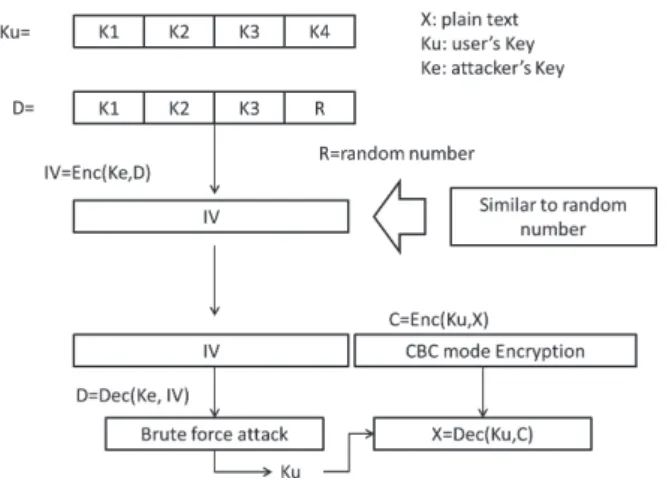
Here, we show an example of an insider attack in
Fig.9. Let Ku be a user's 128-bit Key and Ke be the
attacker's secret key. The attacker writes the encryption program, and the user executes this program as follows.
1.The program is passed the plaintext X and Ku.
2.The program factors Ku into K1, K2, K3 and 4
K , where Ki(i1,2,3,4) are each 32 bits long.
3.The program generates 32-bit random number R,
and replaces K4 with R . Let D be
) , 3 , 2 , 1 (K K K R .
4.The program calculates IVEnc(Ke,D), where
()
Enc should be the block cipher, and uses this
IV as the initial vector in the CBC(Cipher
Block Chaining) mode encryption of X. Let Y
be (IV,CEnc(Ku,X)). IV appears to be a
random number.
5.The attacker gets Y from the network.
6.The attacker can get Ku by a brute-force attack on R within an hour.
When this method is implemented with hardware, it is especially difficult to detect such an attack. This type
of attack is not addressed by protocol analyzers such as AVISPA or Scyther since in their treatment of cryptographic primitives they adopt the so-called black box approach. Even if we could detect the insider attack by using a protocol analyzer and reverse engineering a cryptographic primitive, it would be extremely difficult to identify the same attack for another primitive. However, we propose an integration mode for block ciphers, as described below, which can prevent all insider attacks.
5.2 Innovative Model of an Insider Attack on Block Ciphers
Now, we propose an encryption mode that is not vulnerable to an insider attack. This encryption mode does not have redundancy, and has the specific characteristic of not being vulnerable to an insider attack. Moreover, it has greater security than the block cipher that was originally used.
We can provide a proof for this using a non-trivial
one-to-one correspondence f:M f(M) (integration
transform).
Let Enc(Ku,M) and Dec(Ku,C) be the encryption
and decryption, respectively, of the ECB mode of a safe block cipher. In Enc(Ku,M) we adjust the length of M by zero padding. At this time, the encryption and decryption are defined by CEnc(Ku,f(M0)) and,
)) , ( ( 1 C Ku Dec
f , respectively, where M0 denotes the
zero padding of M. In what follows, let Length(M) be
the number of bits of any message M.
Theorem 1. If the block cipher Enc(Ku,M0) is safe then Enc(Ku,f(M0)) is also safe.
(For the proof, see [12].)
Theorem 2. Enc(Ku,f(M0)) is safe against an insider attack.(For the proof, see [12].)
As mentioned above, client users of the disaster recovery system are generally vulnerable to a potential insider attack by the system vendor.
However, use of the method proposed here can avoid this kind of vulnerability by using the AES or ECB integration mode.
6. Conclusion
In this paper, we clarified the widely distributed innovative file backup service concept by combining a series of technologies such as the spatial scrambling of a file, fragmentation, random distribution of a fragmented file, and secure supervisory servers deployment using a threshold scheme. By making use of cloud storage, widely distributed PCs and smartphones, a secure file backup service can be realized economically. Using the proposed mechanism makes illegal data restoration by third-party tapping impossible, and very secure and cost-effective data backup services can be realized.
We also proposed a network architecture that can realize user-friendly service level control, and clarified what the situation will be when quantum computers become available. We introduced practical network service applications not only for a disaster recovery service, but also for a secret video streaming service. Finally, we proposed future technologies that can prevent an insider attack and guarantee a safe backup service.
7. Acknowledgements
This work has been partially supported by the study (Issue number: 151) of the National Institute of Information and Communications Technology (NICT) of Japan.
8. Reference
[1] N. Miyaho, Y. Ueno, S. Suzuki, K. Mori, and K. Ichihara, "Study on a Disaster Recovery Network Mechanism by Using Widely Distributed Client Nodes," Proceedings of the ICSNC 2009, pp. 217-223, Sep., 2009.
[2] Y. Ueno, N. Miyaho, S. Suzuki, and K. Ichihara, "Performance Evaluation of a Disaster Recovery System and Practical Network System Applications," Proceedings of the ICSNC 2010, pp. 195-200, Aug., 2010.
[3] Suzuki, "Additive cryptosystem and World Wide Master Key," IEICE technical report ISEC 101(403), pp. 39-46, Nov., 2001
[4] N. Miyaho, S. Suzuki, Y. Ueno, A. Takubo, Y. Wada, and R. Shibata, "Disaster recovery equipment, programs, and system," Patent. publication, 2007/3/6 (Japan), PCT Patent :No.4296304, Apr. 2009.
[5] N. Miyaho, “The Impact of Disaster Recovery Technology on the Internet Society (in Japanese),” IPEJ Journal, vol.514, pp.8-11, Dec., 2009. [6] S. Tezuka, R. Uda, A. Inoue, and Y. Matsushita,
"A Secure Virtual File Server with P2P Connection to a Large-Scale Network," IASTED International Conference NCS2006, pp. 310-315, Jan., 2006.
[7] R. Uda, A. Inoue, M. Ito, S. Ichimura, K. Tago, and T. Hoshi, "Development of file distributed
backup system," Tokyo University of Technology, Technical Report, No.3, pp. 31-38, Mar., 2008. [8] Y. Deswarte, L. Blain, and J. C. Fabre, “Intrusion
tolerance in distributed computing systems," Research in Security and Privacy, Proceedings, 1991 IEEE Computer Society Symposium, pp.110-121, May, 1991.
[9] R.A. Fisher, and F. Yates, Statistical tables for biological, agricultural and medical research (3rd edition), London, Oliver & Boyd, pp. 26-27, 1948. [10] N. Miyaho, Y. Ueno, S. Suzuki, A. Takubo, Y.
Wada, and K. Mori, “Security level network control system,” Japan Patent No.4385111(Registered), Oct., 2009.
[11] S. Suzuki, “Set theoretical secret sharing scheme in relocation cipher,” Far East Journal of Applied Mathematics, vol.47, no.2, pp.105–109, 2010. [12] K. Ichihara, N. Nojima, Y. Ueno, S. Suzuki, and N.
Miyaho, “Commercialized practical network service applications from the integration of network distribution and high-speed cipher technologies in cloud environments,” Proceedings of the ICSNC 2013, Oct., 2013.
[13] S. Suzuki, “NP completeness of relocation cipher,” Far East Journal of Applied Mathematics, vol.33, no.2, pp.219–236, 2008.
[14] L.K. Grover, “A fast quantum mechanical algorithm for database search,” Proceedings of the 28 Annual ACM Symposium on Theory of Computing, pp.212-219, STOC ’96, ACM, 1996.