Archive University of Zurich Main Library Strickhofstrasse 39 CH-8057 Zurich www.zora.uzh.ch Year: 2019
OpenML: An R Package to Connect to the Networked Machine Learning
Platform OpenML
Casalicchio, Giuseppe ; Bossek, Jakob ; Lang, Michel ; Kirchhoff, Dominik ; Kerschke, Pascal ; Hofner, Benjamin ; Seibold, Heidi ; Vanschoren, Joaquin ; Bischl, Bernd
DOI: https://doi.org/10.1007/s00180-017-0742-2
Posted at the Zurich Open Repository and Archive, University of Zurich ZORA URL: https://doi.org/10.5167/uzh-130579
Journal Article Accepted Version Originally published at:
Casalicchio, Giuseppe; Bossek, Jakob; Lang, Michel; Kirchhoff, Dominik; Kerschke, Pascal; Hofner, Benjamin; Seibold, Heidi; Vanschoren, Joaquin; Bischl, Bernd (2019). OpenML: An R Package to Connect to the Networked Machine Learning Platform OpenML. Computational Statistics, 34(3):977-991.
(will be inserted by the editor)
OpenML: An R Package to Connect to the Networked
Machine Learning Platform OpenML
Giuseppe Casalicchio · Jakob Bossek · Michel Lang · Dominik Kirchhoff · Pascal Kerschke · Benjamin Hofner · Heidi Seibold · Joaquin Vanschoren · Bernd Bischl
Received: date / Accepted: date
Abstract OpenML is an online machine learning platform where researchers can easily share data, machine learning tasks and experiments as well as or-ganize them online to work and collaborate more efficiently. In this paper, we present anRpackage to interface with the OpenML platform and illustrate its usage in combination with the machine learningR packagemlr(Bischl et al, 2016). We show how theOpenMLpackage allowsRusers to easily search, down-load and updown-load data sets and machine learning tasks. Furthermore, we also show how to upload results of experiments, share them with others and down-load results from other users. Beyond ensuring reproducibility of results, the OpenML platform automates much of the drudge work, speeds up research, facilitates collaboration and increases the users’ visibility online.
Keywords Databases·Machine Learning ·R·Reproducible Research
Giuseppe Casalicchio, Bernd Bischl
Department of Statistics, Ludwig-Maximilians-University Munich, 80539 Munich, Germany
E-mail: [email protected] Jakob Bossek, Pascal Kerschke
Information Systems and Statistics, University of M¨unster, 48149 M¨unster, Germany
Michel Lang
Department of Statistics, TU Dortmund University, 44227 Dortmund, Germany Dominik Kirchhoff
Dortmund University of Applied Sciences and Arts, 44227 Dortmund, Germany Benjamin Hofner
Section of Biostatistics, Paul-Ehrlich-Institut, 63225 Langen, Germany Heidi Seibold
Epidemiology, Biostatistics and Prevention Institute, University of Zurich, 8001 Zurich, Switzerland
Joaquin Vanschoren
Eindhoven University of Technology, 5600 MB Eindhoven, Netherlands
1 Introduction
OpenML is an online machine learning platform for sharing and organizing data, machine learning algorithms and experiments (Vanschoren et al, 2013). It is designed to create a frictionless, networked ecosystem (Nielsen, 2012), allowing people all over the world to collaborate and build directly on each other’s latest ideas, data and results. Key elements of OpenML are data sets, tasks, flows and runs:
– Data sets can be shared (under a licence) by uploading them or simply linking to existing data repositories (e.g., mldata.org, figshare.com). For known data formats (e.g., ARFF for tabular data), OpenML will automat-ically analyze and annotate the data sets with measurable characteristics to support detailed search and further analysis. Data sets can be repeatedly updated or changed and are then automatically versioned.
– Taskscan be viewed as containers including a data set and additional in-formation defining what is to be learned. They define which input data are given and which output data should be obtained. For instance, classifica-tion tasks will provide the target feature, the evaluaclassifica-tion measure (e.g., the area under the curve) and the estimation procedure (e.g., cross-validation splits) as inputs. As output they expect a description of the machine learn-ing algorithm or workflow that was used and, if available, its predictions. – Flowsare implementations of single machine learning algorithms or whole
workflows that solve a specific task, e.g., a random forest implementation is a flow that can be used to solve a classification or regression task. Ideally, flows are already implemented (or custom) algorithms in existing software that take OpenML tasks as inputs and can automatically read and solve them. They also contain a list (and description) of possible hyperparame-ters that are available for the algorithm.
– Runs are the result of executing flows, optionally with preset hyperpa-rameter values, on tasks and contain all expected outputs and evaluations of these outputs (e.g., the accuracy of predictions). Runs are fully repro-ducible because they are automatically linked to specific data sets, tasks, flows and hyperparameter settings. They also include the authors of the run and any additional information provided by them, such as runtimes. Similar to data mining challenge platforms (e.g., Kaggle; Carpenter, 2011), OpenML evaluates all submitted results (using a range of evaluation mea-sures) and compares them online. The difference, however, is that OpenML is designed for collaboration rather than competition: anyone can browse, immediately build on and extend all shared results.
As an open science platform, OpenML provides important benefits for the science community and beyond.
Benefits for Science Many sciences have made significant breakthroughs by adopting online tools that help organizing, structuring and analyzing scientific data online (Nielsen, 2012). Indeed, any shared idea, question, observation or
tool may be noticed by someone who has just the right expertise to spark new ideas, answer open questions, reinterpret observations or reuse data and tools in unexpected new ways. Therefore, sharing research results and collaborating online as a (possibly cross-disciplinary) team enables scientists to quickly build on and extend the results of others, fostering new discoveries.
Moreover, ever larger studies become feasible as a lot of data are already available. Questions such as “Which hyperparameter is important to tune?”, “Which is the best known workflow for analyzing this data set?” or “Which data sets are similar in structure to my own?” can be answered in minutes by reusing prior experiments, instead of spending days setting up and running new experiments (Vanschoren et al, 2012).
Benefits for Scientists Scientists can also benefit personally from using Open-ML. For example, they cansave time, because OpenML assists in many routine and tedious duties: finding data sets, tasks, flows and prior results, setting up experiments and organizing all experiments for further analysis. Moreover, new experiments are immediately compared to the state of the art without always having to rerun other people’s experiments.
Another benefit is that linking one’s results to those of others has a large potential for new discoveries, leading to more publications and more collab-oration with other scientists all over the world. Finally, OpenML can help scientists to reinforce their reputation by making their work (published or not) visible to a wide group of people and by showing how often one’s data, code and experiments are downloaded or reused in the experiments of others.
Benefits for Society OpenML also provides a useful learning and working envi-ronment for students, citizen scientists and practitioners. Students and citizen scientist can easily explore the state of the art and work together with top minds by contributing their own algorithms and experiments. Teachers can challenge their students by letting them compete on OpenML tasks or by reusing OpenML data in assignments. Finally, machine learning practitioners can explore and reuse the best solutions for specific analysis problems, interact with the scientific community or efficiently try out many possible approaches. The remainder of this paper is structured as follows. First, we discuss the web services offered by the OpenML server and the website on OpenML.org that allows web access to all shared data and several tools for data orga-nization and sharing. Second, we briefly introduce the mlr package (Bischl et al, 2016; Schiffner et al, 2016), which is a machine learning toolbox for R
(R Core Team, 2016) and offers a unified interface to many machine learning algorithms. Third, we discuss and illustrate some important functions of the
OpenML Rpackage. After that, we illustrate its usage in combination with the
mlr Rpackage by conducting a short case study. Finally, we conclude with a discussion and an outlook to future developments.
2 The OpenML Platform
The OpenML platform consists of several layers of software:
Web API Any application (or web application), can communicate with the OpenML server through the extensive Web API1
. Data sets, tasks, flows and runs can be created, read, updated, deleted, searched and tagged through simple HTTP calls. An overview of calls is available onhttp://www.openml. org/api_docs.
Website OpenML.org is a website offering easy browsing, organization and sharing of all data, code and experiments. It allows users to easily search and browse all shared data sets, tasks, flows and runs, as well as to compare and visualize all combined results. It provides an easy way to check and manage your experiments anywhere, anytime and discuss them with others online. See Figure 1 for a few screenshots of the OpenML website.
Programming APIs OpenML also offers interfaces in multiple programming languages, such as theRinterface presented here, which hides the API calls and allow scientists to interact with the server using language-specific functions. As we demonstrate below, theOpenML Rpackage allowsRusers to search and download data sets and upload the results of machine learning experiments in just a few lines of code. Other interfaces exist for Python, Java and C# (.NET). For tools that usually operate through a graphical interface, such as WEKA (Hall et al, 2009), MOA (Bifet et al, 2010) and RapidMiner (van Rijn et al, 2013), plug-ins exist that integrate OpenML sharing facilities.
OpenML is organized as an open source project, hosted on GitHub2 and is free to use under the CC-BY licence. When uploading new data sets and code, users can select under which licence they wish to share the data, OpenML will then state licences and citation requests online and in descriptions downloaded from the Web API.
OpenML has an active developer community and everyone is welcome to help extend it or post new suggestions through the website or through GitHub. Currently, there are close to 1 700 000 runs on about 20 000 data sets and 3 500 unique flows available on the OpenML platform. While still in beta development, it has over 1 400 registered users, over 1 800 frequent visitors and the website is visited by around 200 unique visitors every day, from all over the world. It currently has server-side support for classification, regression, clustering, data stream classification, learning curve analysis, survival analysis and machine learning challenges for classroom use.
1
This is an application programming interface (API) that offers a set of calls (e.g., to download/upload data) using representational state transfer (REST): a simple, lightweight communication mechanism based on standard HTTP requests.
2
Fig. 1 Screenshots of the OpenML website. The top part shows the data set ’autos’, with wiki description and descriptive overview of the data features. The bottom part shows a classification task, with an overview of the best submitted flows with respect to the predictive accuracy as performance measure. Every dot here is a single run (further to the right is better).
3 The mlr R Package
Themlrpackage (Bischl et al, 2016; Schiffner et al, 2016) offers a clean, easy-to-use and flexible domain-specific language for machine learning experiments in
R. An object-orientated interface is adopted to unify the definition of machine learning tasks, setup of learning algorithms, training of models, predicting and evaluating the algorithm’s performance. This unified interface hides the actual implementations of the underlying learning algorithms. Replacing one learning algorithm with another becomes as easy as changing a string. Currently, mlr
has built-in support for classification, regression, multilabel classification, clus-tering and survival analysis and includes in total 160 modelling techniques3
. A plethora of further functionality is implemented inmlr, e.g., assessment of generalization performance, comparison of different algorithms in a scientifi-cally rigorous way, feature selection and algorithms for hyperparameter tuning (Lang et al, 2015). On top of that, mlr offers a wrapper mechanism, which allows to extend learners through pre-train, train, pre-predict and post-predict hooks. A wrapper extends the current learner with added functionality and expands the hyperparameter set of the learner with additional hyperpa-rameters provided by the wrapper. Currently, many wrappers are available, e.g., missing value imputation, class imbalance correction, feature selection, tuning, bagging and stacking, as well as a wrapper for user-defined data pre-processing. Wrappers can be nested in other wrappers, which can be used to create even more complex workflows. The package also supports parallelization on different levels based on different parallelization backends (local multicore, socket, MPI computation modes or on managed high-performance systems via the package BatchJobs (Bischl et al, 2015)) and sophisticated visualization methods for research and teaching.
The OpenML package makes use of mlras a supporting package. It offers methods to automatically run mlr learners (flows) on OpenML tasks while hiding all of the necessary structural transformations (see Section 4.4).
4 The OpenML R Package
The OpenML R package is an interface to interact with the OpenML server directly from within R. Users can retrieve data sets, tasks, flows and runs from the server and also create and upload their own. This section details how to install and configure the package and demonstrates its most important functionalities.
3
A complete list of the integrated learners and how to integrate own learners, as well as further information on themlrpackage can be found in the corresponding tutorial (http: //mlr-org.github.io/mlr-tutorial/).
4.1 Installation and Configuration
To interact with the OpenML server, users need to authenticate using an
API key, a secret string of characters that uniquely identifies the user. It is generated and shown on users’ profile page after they register on the website
http://www.openml.org. For demonstration purposes, we will use a public read-only API key that only allows to retrieve information from the server and should be replaced with the user’s personal API key to be able to use all features. TheRpackage can be easily installed and configured as follows: install.packages("OpenML")
library("OpenML")
saveOMLConfig(apikey = "c1994bdb7ecb3c6f3c8f3b35f4b47f1f")
The saveOMLConfig function creates a config file, which is always lo-cated in a folder called .openml within the user’s home directory. This file stores the user’s API key and other configuration settings, which can always be changed manually or through thesaveOMLConfig function. Alternatively, the setOMLConfig function allows to set the API key and the other entries
temporarily, i.e., only for the currentRsession.
4.2 Listing Information
In this section, we show how to list the available OpenML data sets, tasks, flows and runs using listing functions that always return a data.framecontaining the queried information. Each data set, task, flow and run has a unique ID, which can be used to access it directly.
Listing Data Sets and Tasks A list of all data sets and tasks that are avail-able on the OpenML server can be obtained using thelistOMLDataSetsand
listOMLTasksfunction, respectively. Each entry provides information such as the ID, the name and basic characteristics (e.g., number of features, num-ber of observations, classes, missing values) of the corresponding data set. In addition, the list of tasks contains information about the task type (e.g.,
"Supervised Classification"), the evaluation measure (e.g.,"Predictive Accuracy") and the estimation procedure (e.g.,"10-fold Crossvalidation") used to estimate model performance. Note that multiple tasks can be defined for a specific data set, for example, the same data set can be used for multiple task types (e.g. classification and regression tasks) as well as for tasks differing in their estimation procedure, evaluation measure or target value.
To find data sets or tasks that meet specific requirements, one can supply arguments to the listing functions. In the example below, we list all supervised classification tasks based on data sets having two classes for the target feature, between 500 and 999 instances, at most 100 features and no missing values: tasks = listOMLTasks(task.type = "Supervised Classification",
number.of.classes = 2, number.of.instances = c(500, 999), number.of.features = c(1, 100), number.of.missing.values = 0)
tasks[1:2, c("task.id", "name", "number.of.instances", "number.of.features")] ## task.id name number.of.instances number.of.features
## 1 37 diabetes 768 9
## 2 49 tic-tac-toe 958 10
Listing Flows and Runs When using themlrpackage, flows are basically learn-ers frommlr, which, as stated previously, can also be a more complex workflow when differentmlrwrappers are nested. Custom flows can be created by inte-grating custom machine learning algorithms and wrappers into mlr. The list of all available flows on OpenML can be downloaded using thelistOMLFlows
function. Each entry contains information such as its ID, its name, its version and the user who first uploaded the flow to the server. Note that the list of flows will not only contain flows created withR, but also flows from other ma-chine learning toolkits, such as WEKA (Hall et al, 2009), MOA (Bifet et al, 2010) and scikit-learn (Pedregosa et al, 2011), which can be recognized by the name of the flow.
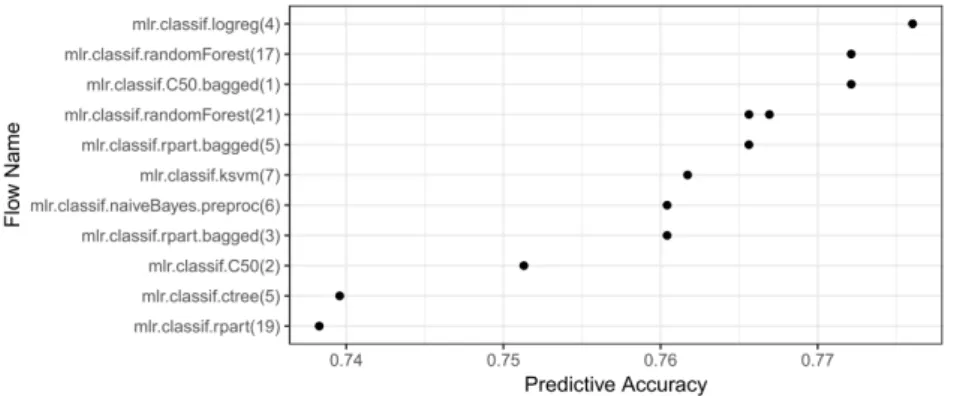
When a flow, along with a specific setup (e.g., specific hyperparameter values), is applied to a task, it creates a run. ThelistOMLRuns function lists all runs that, for example, refer to a specific task.id or flow.id. To list these evaluations as well, thelistOMLRunEvaluationsfunction can be used. In Figure 2, we used ggplot2 (Wickham, 2009) to visualize the predictive accuracy of runs, for which only flows created with mlrwere applied to the task with ID37:
res = listOMLRunEvaluations(task.id = 37) res = res[grep("mlr.", res$flow.name), ] res = res[order(res$predictive.accuracy),]
res$flow.name = factor(res$flow.name, unique(res$flow.name)) library("ggplot2")
ggplot(res, aes(x = predictive.accuracy, y = flow.name)) + geom_point() + xlab("Predictive Accuracy") + ylab("Flow Name")
Fig. 2 The predictive accuracy of allmlrflows on task 37. The numbers in brackets refer to the version of the flow. Multiple dots for the same flow refer to runs with different hyperparameter values for that flow.
4.3 Downloading OpenML Objects
Most of the listing functions described in the previous section will list entities by their OpenML IDs, e.g., thetask.idfor tasks, theflow.idfor flows and the run.id for runs. In this section, we show how these IDs can be used to download a certain data set, task, flow or run from the OpenML server. All downloaded data sets, tasks, flows and runs will be stored in the cachedir
directory, which will be in the.openmlfolder by default but can also be speci-fied in the configuration file (see Section 4.1). Before downloading an OpenML object, the cache directory will be checked if that object is already available in the cache. If so, no internet connection is necessary and the requested object is retrieved from the cache.
Downloading Data Sets and Tasks The getOMLDataSet function returns an
S3-object of classOMLDataSetthat contains the data set as a data.frame in a$data slot, in addition to some pieces of meta-information:
ds = getOMLDataSet(data.id = 15) ds
##
## Data Set "breast-w" :: (Version = 1, OpenML ID = 15) ## Default Target Attribute: Class
To retrieve tasks, the getOMLTask function can be used with their corre-sponding task ID. Note that the ID of a downloaded task is not equal to the ID of the data set. Each task is returned as anS3-object of classOMLTaskand contains the OMLDataSet object as well as the predefined estimation proce-dure, evaluation measure and the target feature in an additional$input slot. Further technical information can be found in the package’s help page.
Downloading Flows and Runs ThegetOMLFlow function downloads all infor-mation of the flow, such as the name, all necessary dependencies and all avail-able hyperparameters that can be set. If the flow was created inR, it can be converted into anmlrlearner using theconvertOMLFlowToMlrfunction: mlr.lrn = convertOMLFlowToMlr(getOMLFlow(4782))
mlr.lrn
## Learner classif.randomForest from package randomForest ## Type: classif
## Name: Random Forest; Short name: rf ## Class: classif.randomForest
## Properties: twoclass,multiclass,numerics,factors,ordered,prob,class.weights ## Predict-Type: response
## Hyperparameters:
This allows users to apply the downloaded learner to other tasks or to modify the learner using functions frommlrand produce new runs.
The getOMLRun function downloads a single run and returns an OMLRun
object containing all information that are connected to this run, such as the ID of the task and the ID of the flow:
run = getOMLRun(run.id = 1816245) run
##
## OpenML Run 1816245 :: (Task ID = 42, Flow ID = 4782) ## User ID : 348
## Tags : study_30
## Learner : mlr.classif.randomForest(17) ## Task type: Supervised Classification
The most important information for reproducibility, next to the exact data set and flow version, are the hyperparameter and seed settings that were used to create this run. This information is contained in the OMLRun object and can be extracted viagetOMLRunParList(run)andgetOMLSeedParList(run), respectively.
If the run solves a supervised regression or classification task, the corre-sponding predictions can be accessed viarun$predictionsand the evaluation measures computed by the server viarun$output.data$evaluations.
4.4 Creating Runs
The easiest way to create a run is to define a learner, optionally with a preset hyperparameter value, using the mlrpackage. Each mlrlearner can then be applied to a specificOMLTaskobject using the functionrunTaskMlr. This will create an OMLMlrRun object, for which the results can be uploaded to the OpenML server as described in the next section. For example, a random forest from therandomForest Rpackage (Liaw and Wiener, 2002) can be instantiated using themakeLearnerfunction frommlrand can be applied to a classification task via:
lrn = makeLearner("classif.randomForest", mtry = 2) task = getOMLTask(task.id = 37)
run.mlr = runTaskMlr(task, lrn)
To run a previously downloaded OpenML flow, one can use therunTaskFlow
function, optionally with a list of hyperparameters: flow = getOMLFlow(4782)
run.flow = runTaskFlow(task, flow, par.list = list(mtry = 2))
To display benchmarking results, one can use theconvertOMLMlrRunToBMR
function to convert one or moreOMLMlrRunobjects to a singleBenchmarkResult
object from themlrpackage so that several powerful plotting functions4 from
mlrcan be applied to that object (see Figure 3 for an example).
4.5 Uploading and Tagging
Uploading OpenML Objects It is also possible to upload data sets, flows and runs to the OpenML server to share and organize experiments and results
on-4
See http://mlr-org.github.io/mlr-tutorial/release/html/benchmark_experiments
line. Data sets, for example, are uploaded with theuploadOMLDataSet func-tion. OpenML willactivate the data set if it passes all checks, meaning that it will be returned in listing calls. Creating tasks from data sets is currently only possible through the website, seehttp://www.openml.org/new/task.
OMLFlow objects can be uploaded to the server with the uploadOMLFlow
function and are automatically versioned by the server: when a learner is uploaded carrying a differentRor package version, a new version number and
flow.idis assigned. If the same flow has already been uploaded to the server, a message that the flow already exists is displayed and the associatedflow.id
is returned. Otherwise, the flow is uploaded and a newflow.idis assigned to it:
lrn = makeLearner("classif.randomForest") flow.id = uploadOMLFlow(lrn)
A run created with therunTaskMlror therunTaskFlowfunction can be up-loaded to the OpenML server using theuploadOMLRunfunction. The server will then automatically compute several evaluation measures for this run, which can be retrieved using thelistOMLRunEvaluationsfunction as described pre-viously.
Tagging and Untagging OpenML Objects ThetagOMLObject function is able to tag data sets, tasks, flows and runs with a user-defined string, so that finding OpenML objects with a specific tag becomes easier. For example, the task with ID 1 can be tagged as follows:
tagOMLObject(id = 1, object = "task", tags = "test-tagging")
To retrieve a list of objects with a given tag, the tag argument of the listing functions can be used (e.g.,listOMLTasks(tag = "test-tagging")). The listing functions for data sets, tasks, flows and runs also show the tags that were already assigned, for example, we already tagged data sets from UCI (Asuncion and Newman, 2007) with the string "uci" so that they can be queried usinglistOMLDataSets(tag = "uci"). In order to remove one or more tags from anOpenMLobject, theuntagOMLObjectfunction can be used, however, only self-created tags can be removed, e.g.:
untagOMLObject(id = 1, object = "task", tags = "test-tagging")
4.6 Further Features
Besides the aforementioned functionalities, the OpenMLpackage allows to fill up the cache directory by downloading multiple objects at once (using the
populateOMLCache function), to remove all files from the cache directory (using clearOMLCache), to get the current status of cached data sets (us-inggetCachedOMLDataSetStatus), to delete OpenML objects created by the uploader (using deleteOMLObject), to list all estimation procedures (using
(using listOMLEvaluationMeasures) and to get more detailed information on data sets (usinggetOMLDataSetQualities).
5 Case Study
In this section, we illustrate the usage of OpenML by performing a small com-parison study between a random forest, bagged trees and single classification trees. We first create the respective binary classification learners using mlr, then query OpenML for suitable tasks, apply the learners to the tasks and finally evaluate the results.
5.1 Creating Learners
We choose three implementations of different tree algorithms, namely the
CART algorithm implemented in the rpartpackage (Therneau et al, 2015), the C5.0 algorithm from the package C50 (Kuhn et al, 2015) and the con-ditional inference trees implemented in the ctreefunction from the package
party(Hothorn et al, 2006). For therandom forest, we use the implementation from the packagerandomForest (Liaw and Wiener, 2002). The bagged trees can conveniently be created usingmlr’s bagging wrapper. For the random for-est and all bagged tree learners, the number of trees is set to 50. We create a list that contains the random forest, the two bagged trees and the three tree algorithms5 : lrn.list = list( makeLearner("classif.randomForest", ntree = 50), makeBaggingWrapper(makeLearner("classif.rpart"), bw.iters = 50), makeBaggingWrapper(makeLearner("classif.C50"), bw.iters = 50), makeLearner("classif.rpart"), makeLearner("classif.C50"), makeLearner("classif.ctree") ) 5.2 Querying OpenML
For this study, we consider only binary classification tasks that use smaller data sets from UCI (Asuncion and Newman, 2007), e.g., between 100 and 999 observations, have no missing values and use 10-fold cross-validation for validation:
tasks = listOMLTasks(data.tag = "uci",
task.type = "Supervised Classification", number.of.classes = 2, number.of.missing.values = 0, number.of.instances = c(100, 999), estimation.procedure = "10-fold Crossvalidation")
Table 1 shows the resulting tasks of the query, which will be used for the further analysis.
5
task.id name number.of.instances number.of.features 37 diabetes 768 9 39 sonar 208 61 42 haberman 306 4 49 tic-tac-toe 958 10 52 heart-statlog 270 14 57 ionosphere 351 35
Table 1 Overview of OpenML tasks that will be used in the study.
5.3 Evaluating Results
We now apply all learners from lrn.list to the selected tasks using the
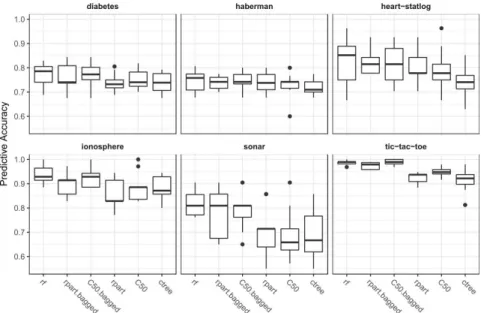
runTaskMlr function and use the convertOMLMlrRunToBMR function to cre-ate a singleBenchmarkResultobject containing the results of all experiments. This allows using, for example, the plotBMRBoxplots function from mlr to visualize the experiment results (see Figure 3):
grid = expand.grid(task.id = tasks$task.id, lrn.ind = seq_along(lrn.list)) runs = lapply(seq_row(grid), function(i) {
task = getOMLTask(grid$task.id[i]) ind = grid$lrn.ind[i] runTaskMlr(task, lrn.list[[ind]]) }) bmr = do.call(convertOMLMlrRunToBMR, runs) plotBMRBoxplots(bmr)
Fig. 3 Cross-validated predictive accuracy per learner and task. Each boxplot contains 10 values for one complete cross-validation.
We can upload and tag the runs, e.g., with the string"study 30"to facil-itate finding and listing the results of the runs using this tag:
lapply(runs, uploadOMLRun, tags = "study_30")
The server will then compute all possible measures, which takes some time depending on the number of runs. The results can then be listed using the
listOMLRunEvaluations function and can be visualized using the ggplot2
package:
evals = listOMLRunEvaluations(tag = "study_30")
evals$flow.name = factor(evals$flow.name, unique(evals$flow.name)) evals$task.id = as.factor(evals$task.id)
library("ggplot2")
ggplot(evals, aes(x = task.id, y = predictive.accuracy, colour = flow.name, group = flow.name)) +
geom_point() + geom_line() + ylab("Predictive Accuracy") + xlab("Task ID")
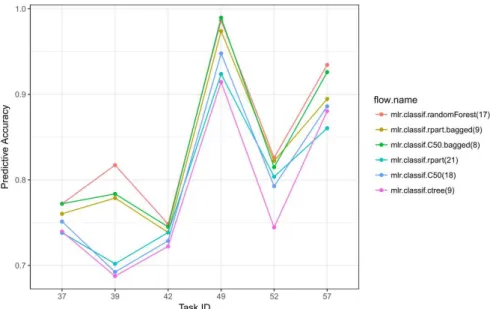
Fig. 4 Results of the produced runs. Each point represents the averaged predictive accuracy over all cross-validation iterations generated by running a particular learner on the respective task.
Figure 4 shows the cross-validated predictive accuracies of our six learners on the considered tasks. Here, the random forest produced the best predictions, except on task 49, where the bagged C50 trees achieved a slightly better result. In general, the two bagged trees performed marginally worse than the random forest and better than the single tree learners.
6 Conclusion and Outlook
OpenML is an online platform for open machine learning that is aimed at con-necting researchers who deal with any part of the machine learning workflow. The OpenML platform automates the sharing of machine learning tasks and experiments through the tools that scientists are already using, such asR. The
OpenMLpackage introduced in this paper makes it easy to share and reuse data sets, tasks, flows and runs directly from the currentRsession without the need of using other programming environments or the web interface.
Current work is being done on implementing the possibility to connect to OpenML via browser notebooks6
and running analysis directly on online servers without the need of havingRor any other software installed locally. In the future, it will also be possible that users can specify with whom they want to share, e.g., data sets.
References
Asuncion A, Newman D (2007) UCI Machine Learning Repository. University of California, School of Information and Computer Science
Bifet A, Holmes G, Kirkby R, Pfahringer B (2010) MOA: Massive Online Analysis. Journal of Machine Learning Research 11:1601–1604
Bischl B, Lang M, Mersmann O, Rahnenf¨uhrer J, Weihs C (2015) BatchJobs and BatchExperiments: Abstraction mechanisms for using R in batch en-vironments. Journal of Statistical Software 64(11):1–25, URLhttp://www. jstatsoft.org/v64/i11/
Bischl B, Lang M, Kotthoff L, Schiffner J, Richter J, Studerus E, Casalicchio G, Jones ZM (2016) mlr: Machine Learning in R. Journal of Machine Learning Research 17(170):1–5
Carpenter J (2011) May the Best Analyst Win. Science 331(6018):698–699 Hall M, Frank E, Holmes G, Pfahringer B, Reutemann P, Witten I (2009) The
WEKA Data Mining Software: An Update. SIGKDD Explorations 11(1):10– 18
Hothorn T, Hornik K, Zeileis A (2006) Unbiased Recursive Partitioning: A Conditional Inference Framework. Journal of Computational and Graphical Statistics 15(3):651–674
Kuhn M, Weston S, Coulter N, code for C50 by R Quinlan MCC (2015) C50: C5.0 Decision Trees and Rule-Based Models. URL https://CRAN.R-project.org/package=C50, R package version 0.1.0-24
Lang M, Kotthaus H, Marwedel P, Weihs C, Rahnenf¨uhrer J, Bischl B (2015) Automatic Model Selection for High-dimensional Survival Analysis. Journal of Statistical Computation and Simulation 85(1):62–76
Liaw A, Wiener M (2002) Classification and Regression by randomForest. R News 2(3):18–22, URLhttp://CRAN.R-project.org/doc/Rnews/
6
Nielsen M (2012) Reinventing Discovery: The New Era of Networked Science. Princeton University Press
Pedregosa F, Varoquaux G, Gramfort A, Michel V, Thirion B, Grisel O, Blon-del M, Prettenhofer P, Weiss R, Dubourg V, Vanderplas J, Passos A, Cour-napeau D, Brucher M, Perrot M, Duchesnay E (2011) Scikit-learn: Machine learning in Python. Journal of Machine Learning Research 12:2825–2830 R Core Team (2016) R: A Language and Environment for Statistical
Com-puting. R Foundation for Statistical Computing, Vienna, Austria, URL
https://www.R-project.org/
van Rijn JN, Umaashankar V, Fischer S, Bischl B, Torgo L, Gao B, Winter P, Wiswedel B, Berthold MR, Vanschoren J (2013) A RapidMiner Exten-sion for Open Machine Learning. In: RapidMiner Community Meeting and Conference 2013, pp 59–70
Schiffner J, Bischl B, Lang M, Richter J, Jones ZM, Probst P, Pfisterer F, Gallo M, Kirchhoff D, K¨uhn T, et al (2016) mlr Tutorial. arXiv preprint arXiv:160906146
Therneau T, Atkinson B, Ripley B (2015) rpart: Recursive Partitioning and Regression Trees. URL http://CRAN.R-project.org/package=rpart, R package version 4.1-10
Vanschoren J, Blockeel H, Pfahringer B, Holmes G (2012) Experiment Databases. A New Way to Share, Organize and Learn from Experiments. Machine Learning 87(2):127–158
Vanschoren J, van Rijn JN, Bischl B, Torgo L (2013) OpenML: Networked Science in Machine Learning. SIGKDD Explorations 15(2):49–60
Wickham H (2009) ggplot2: Elegant Graphics for Data Analysis. Springer-Verlag New York, URLhttp://ggplot2.org