Fast and sensitive mapping of nanopore sequencing
reads with GraphMap
Ivan Sovic´
1,2,
*, Mile S
ˇikic´
3,4,
*, Andreas Wilm
1
, Shannon Nicole Fenlon
1,5
, Swaine Chen
1,6
& Niranjan Nagarajan
1
Realizing the democratic promise of nanopore sequencing requires the development of new
bioinformatics approaches to deal with its specific error characteristics. Here we present
GraphMap, a mapping algorithm designed to analyse nanopore sequencing reads, which
progressively refines candidate alignments to robustly handle potentially high-error rates and
a fast graph traversal to align long reads with speed and high precision (
4
95%). Evaluation
on MinION sequencing data sets against short- and long-read mappers indicates that
GraphMap increases mapping sensitivity by 10–80% and maps
4
95% of bases. GraphMap
alignments enabled single-nucleotide variant calling on the human genome with increased
sensitivity (15%) over the next best mapper, precise detection of structural variants
from length 100 bp to 4 kbp, and species and strain-specific identification of pathogens
using MinION reads. GraphMap is available open source under the MIT license at
https://github.com/isovic/graphmap.
1Computational & Systems Biology, Genome Institute of Singapore, 60 Biopolis Street, #02-01 Genome, Singapore 138672, Singapore.2Centre for Informatics and Computing, RuXer Bosˇkovic´ Institute, Bijenicˇka 54, 10000 Zagreb, Croatia.3Faculty of Electrical Engineering and Computing, Department of Electronic Systems and Information Processing, University of Zagreb, Unska 3, 10000 Zagreb, Croatia.4Bioinformatics Institute, Singapore 138671, Singapore.5Faculty of Medicine and Institute for Life Sciences, University of Southampton, Southampton SO16 6YD, UK.6Division of Infectious Diseases, Department of Medicine, Yong Loo Lin School of Medicine, National University of Singapore, Singapore 119074, Singapore. * These authors contributed equally to this work. Correspondence and requests for materials should be addressed to N.N. (email: [email protected]).
T
he release of Oxford Nanopore Technologies (ONT)
MinION sequencers in 2014 ushered in a new era of
cheap and portable long-read sequencers. Nanopore
sequencers have transformative potential for research, diagnostic
and low-resource applications. While some initial nanopore
sequencing based applications have been reported (for example,
scaffolding and resolution of repeats in genomes
1and variant
detection in clonal haploid samples
2), many others remain to be
explored. In particular, diploid and rare-variant calling
3,
de novo
genome
assembly
4,
metagenome
assembly
and
pathogen
identification are all promising applications that will likely
require new development of
in silico
techniques.
Read mapping and alignment tools are critical building blocks
for many such applications. For mapping, reads from nanopore
sequencing are particularly challenging due to their higher and
non-uniform error profiles
5. For example, one-demensional (1D)
reads from the MinION sequencer have raw base accuracy
o
65–75%; higher quality two-dimensional (2D) reads (80–88%
accuracy) comprise a fraction of all 2D reads and the total data
set, with overall median accuracy being between 70 and 85%
(refs 1,6–9). Reads from other short read (for example, Illumina;
o
1%) and long read (for example, PacBio;
B10%) sequencing
technologies have lower overall and mismatch (
o
1%) error rates.
The increased read lengths in nanopore sequencing should
facilitate mapping, reducing the ambiguity in location that is the
major challenge for short read mappers. However, with current
mappers, high-error rates result in a large fraction of reads and
bases (10–30%) remaining unmapped or unused (for example, 1D
reads)
for
downstream
applications
1,6,7.
This
is
further
compounded when comparing two error-prone reads to each
other or mapping to an imperfect or distant reference. Thus,
retaining sensitivity while accommodating high error or
divergence rates is the key difficulty for current mapping
methods. MinION error rates and profiles (that is, ratio of
insertions,
deletions
and
substitutions)
can
vary
across
chemistries, sequencing runs, read types and even within a
read.
Furthermore,
other
nanopore
and
single-molecule
sequencing technologies may present a different distribution of
error rates and profiles. Therefore, a general solution to mapping
that is applicable to different error characteristics would have
high utility for both current and future applications.
While alignment algorithms have been widely studied,
gold-standard solutions such as dynamic programming (or even
fast approximations such as BLAST) are too slow in practice for
aligning high-throughput sequencing reads. To address this need,
a range of read mapping tools have been developed that exploit
the characteristics of second-generation sequencing reads
(relatively short and accurate) by trading-off a bit of sensitivity
for dramatic gains in speed
10,11. The design decisions employed
in these mappers are often tuned for specific error characteristics
of a sequencing technology, potentially limiting their utility across
technologies and error profiles. The less than ideal results
reported in early studies using MinION data
12could therefore
be in part due to the use of mappers (for example, BWA-MEM
(ref. 6), BLASR (ref. 13) or LAST (ref. 14)) that are not suited to
its error characteristics.
In this work, we present GraphMap, the first mapping
algorithm designed for high sensitivity with current nanopore
sequencing data. In solving the mapping problem for the
potentially variable error profile of ONT MinION sequencers,
GraphMap furthermore generally accommodates variable error
characteristics, without the need for parameter tuning, while
retaining high sensitivity and precision. Therefore, GraphMap
allows uniform mapping of sequencing reads from disparate
technologies (for example, Illumina, PacBio or ONT) with
BLAST-like sensitivity and improved runtime. Experiments with
several real and synthetic data sets demonstrate that GraphMap is
a more sensitive mapper than BWA-MEM, DALIGNER, BLASR
and LAST, while reporting accurate alignments with nanopore
sequencing data. This benefits all downstream applications of
mapping, as highlighted here with a few natural proof-of-concept
applications for a low cost, long read, portable sequencer, that is,
single-nucleotide polymorphism calling in complex regions
of the human genome, structural variants (SVs; insertions and
deletions) detection and real-time pathogen identification.
Results
Overview of the GraphMap algorithm
. The GraphMap
algorithm is structured to achieve high-sensitivity and speed
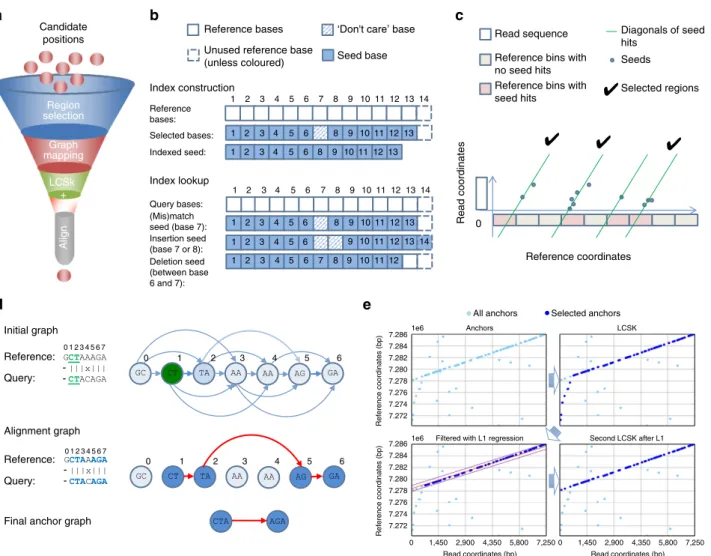
using a five-stage ‘read-funneling’ approach as depicted in Fig. 1a.
The underlying design principle is to have efficiently computable
stages that conservatively reduce the set of candidate locations
based on progressively defined forms of the read-to-reference
alignment. For example, in stage I, GraphMap uses a novel
adaptation of gapped spaced seeds
15to efficiently reduce the
search space (Fig. 1b) and then clusters seed hits as a form of
coarse alignment (Fig. 1c). These are then refined in stage II using
graph-based vertex-centric processing of seeds to efficiently
(allowing seed-level parallelism) construct alignment anchors
(Fig. 1d). GraphMap then chains anchors using a kmer version of
longest common subsequence construction (stage III; Fig. 1e),
refines alignments with a form of L
1linear regression (stage IV;
Fig. 1e) and finally evaluates the remaining candidates to select
the best location to construct a final alignment (stage V).
GraphMap computes a BLAST-like
E
-value as well as a mapping
quality for its alignments. Further details about each of these
stages, the design choices and how they impact GraphMap’s
performance can be found in the Methods section.
GraphMap maps reads accurately across error profiles
.
GraphMap was designed to be efficient while being largely
agnostic of error profiles and rates. To evaluate this feature a wide
range of synthetic data sets were generated that capture the
diversity of sequencing technologies (Illumina, PacBio, ONT 2D,
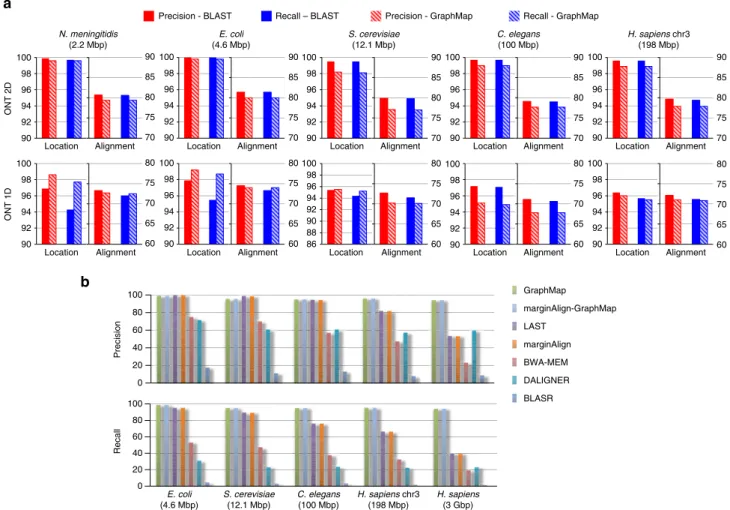
ONT 1D) and the complexity of different genomes (Fig. 2,
Supplementary Fig. 1a). GraphMap’s precision and recall was
then measured in terms of identifying the correct read location
and in reconstructing the correct alignment to the reference
(Methods section). These were evaluated separately as, in
principle, a mapper can identify the correct location but compute
an incorrect alignment of the read to the reference. To provide for
a gold-standard to compare against, BLAST (ref. 16) was used as
a representative of a highly sensitive but slow aligner which is
sequencing technology agnostic. On synthetic Illumina and
PacBio data, GraphMap’s results were found to be comparable
to BLAST (Supplementary Note 1) as well as other mappers
(Supplementary Data 1). On synthetic ONT data, we noted slight
differences (
o
3%) between BLAST and GraphMap, but notably,
GraphMap improved over BLAST in finding the right mapping
location in some cases (for example, for
N. meningitidis
ONT 1D
data; Fig. 2a). GraphMap’s precision and recall in selecting the
correct mapping location were consistently
4
94%, even with
high-error rates in the simulated data. Unlike other mappers,
GraphMap’s results were obtained without tuning parameters to
the specifics of the sequencing technology.
Constructing the correct alignment was more challenging for
synthetic ONT data sets and correspondingly the percentage of
correctly aligned bases with GraphMap (B70%) is similar to the
number of correct bases in the input data. The use of alternate
alignment algorithms and parameters did not alter results
significantly (Supplementary Table 1), though the use of a
maximum-likelihood based realigner (marginAlign
2) improved
both alignment precision and recall (Supplementary Data 1). The
use of marginAlign as a realigner did not improve on
GraphMap’s ability to identify the correct genomic location
(Supplementary Data 1). These results highlight GraphMap’s
ability to identify precise genomic locations based on robust
alignments without the need for customizing and tuning
alignment parameters to the unknown error characteristics of
the data.
For read-to-reference alignment, programs such as BLAST
provide high sensitivity and can be feasible for small genomes, but
can quickly become infeasible for larger genomes (for example,
runtime for
C. elegans
or the human genome; Supplementary
Data 1). Read mappers such as BWA-MEM and BLASR provide
a different tradeoff, scaling well to large genomes but with
low sensitivity and precision for high-error rates (Fig. 2b,
Supplementary Data 1). This could partly be due to specific
parameter settings as is the case for BLASR, which was designed
for PacBio data. Mappers such as BWA-MEM on the other hand,
have different settings optimized for different sequencing
technologies (Supplementary Fig. 1b). Despite this, BWA-MEM’s
performance degrades rapidly even in the ONT setting (Fig. 2b),
providing precision and recall
o
25% for mapping to the human
genome (Supplementary Data 1). DALIGNER (ref. 17), a highly
sensitive overlapper which additionally supports read mapping,
also provided precision and recall that degraded quickly with read
error rate and genome size (Fig. 2b, Supplementary Data 1).
LAST, originally designed for aligning genomes, fared better in
these settings, but still exhibits lower recall for large genomes
(30% reduction compared with GraphMap; Fig. 2b) and precision
o
54% for mapping to the human genome (Supplementary
Data 1). The use of a realigner (marginAlign) generally improved
alignment precision and recall but results for finding the correct
genomic location were similar to that of the original mapper
(marginAlign uses LAST by default). GraphMap was the only
programme that uniformly provided high sensitivity and recall
(Fig. 2b), even for mapping to the human genome, while scaling
linearly with genome size (Supplementary Fig. 1c, Supplementary
Region selection Graph mapping Align Candidate positions LCSk + L1 Reference bases Seed base Unused reference base(unless coloured)
‘Don't care’ base
Reference bases: Selected bases: Indexed seed: 1 2 3 4 5 6 7 8 9 10 11 12 13 14 Index construction Query bases: Insertion seed (base 7 or 8): Deletion seed (between base 6 and 7): 1 2 3 4 5 6 7 8 9 10 11 12 13 14 Index lookup 0 Read coordinates Reference coordinates Read sequence
Reference bins with no seed hits Reference bins with seed hits Seeds Diagonals of seed hits Alignment graph 0 1 2 3 4 5 6 -Reference: Query: 0 1 2 3 4 5 6 7 0 1 2 3 4 5 6 7 -Reference: Query: Initial graph 0 1 2 3 4 5 6 Selected regions 1 2 3 4 5 6 8 9 10 11 12 13 1 2 3 4 5 6 8 9 10 11 12 13 1 2 3 4 5 6 8 9 10 11 12 13 1 2 3 4 5 6 9 11 12 13 1 2 3 4 5 6 8 9 10 11 12
Final anchor graph
All anchors
Anchors LCSK
Filtered with L1 regression 1e6 7.286 7.284 7.282 7.280 7.278 7.276 7.274 7.272 7.286 7.284 7.282 7.280 7.278 Reference coordinates (bp) Reference coordinates (bp) 7.276 7.274 7.272
1e6 Second LCSK after L1
Selected anchors 10 14 7 (Mis)match seed (base 7): GC CT TA AA AA AG GA G A |||x||| C CTA AGA CTA AGA G AAAGACT CT|||x|||ACAGA GC CT TA AA AA AG GA CTA AGA
Read coordinates (bp) Read coordinates (bp) 0 1,450 2,900 4,350 5,800 7,250 0 1,450 2,900 4,350 5,800 7,250
a
b
c
d
e
Figure 1 | A schematic representation of stages in GraphMap.(a) Order of stages in the ‘read-funneling’ approach used in GraphMap to refine
alignments and reduce the number of candidate locations to one. (b) Structure of spaced seeds used for index construction and index look-up. For each
position in the reference one seed is inserted into the index and for each position in the query, three seeds are looked up corresponding to the different
error scenarios (c) Region selection by clustering of candidate seeds on the reference. Diagonals with sufficient number of seed hits are used to identify
regions for further processing. (d) Generation of alignment anchors through a fast graph based ordering of seeds (Graph Mapping). After construction of the
initial graph based on the reference, seeds from the query (2mers here; starting from the green seed) are looked up, and information in the graph
propagated, to construct a maximal walk that serves as an anchor. (e) Filtering of seed matches using LCSk search and L1 regression. Anchors are chained
into a monotonically increasing sequence, with outliers trimmed using L1 regression, to get an approximate alignment that helps select the correct mapping location.
Data 1). Experiments with a range of read lengths and error
rates also demonstrate that GraphMap scales well across these
dimensions (runtime and memory usage; Supplementary
Table 2), though mapping to large genomes currently requires
the use of large memory systems (B100 GB for human genome).
Extrapolating this, mapping data from a MinION run of 100,000
reads to the human genome should take
o
5 h and
o
$7 on an
Amazon EC2 instance (r3.4
large) using GraphMap.
Sensitivity and mapping accuracy on nanopore sequencing data
.
GraphMap was further benchmarked on several published
ONT data sets against mappers and aligners that have previously
been used for this task (LAST, BWA-MEM and BLASR; Methods
section), as well as a highly sensitive overlapper for which we
tuned settings (DALIGNER; Methods section). In the absence of
ground truth for these data sets, mappers were compared on the
total number of reads mapped (sensitivity), and their ability to
provide accurate (to measure precision of mapping and
align-ment) as well as complete consensus sequences (as a measure of
recall). Overall, as seen in the simulated data sets, LAST was the
closest in terms of mapping sensitivity compared with
Graph-Map, though GraphMap showed notable improvements. The
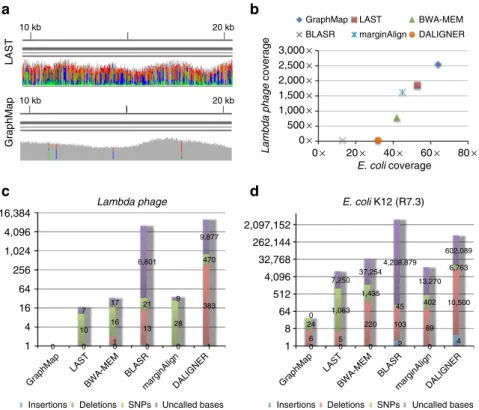
differences between GraphMap and LAST were apparent even
when comparing their results visually, with LAST alignments
having low consensus quality even in a high coverage setting
(Fig. 3a). Across data sets, GraphMap mapped the most reads and
aligned the most bases, improving sensitivity by 10–80% over
LAST and even more compared with other tools (Fig. 3b;
Supplementary Fig. 2; Supplementary Note 2). This led to fewer
uncalled bases compared with LAST, BWA-MEM, BLASR,
DALIGNER and marginAlign even in an otherwise high-coverage
data set (Fig. 3c,d). In addition, GraphMap analysis resulted in
4
10-fold reduction in errors on the lambda phage and
E. coli
genome (Fig. 3c) and reported
o
40 errors on the
E. coli
genome compared with more than a 1,000 errors for LAST and
BWA-MEM (Fig. 3d). With
B80
coverage of the
E. coli
genome, GraphMap mapped
B90% of the reads and called
consensus bases for the whole genome with
o
1 error in 100,000
bases (Q50 quality). The next best aligner, that is, LAST did not
have sufficient coverage (20
) on
4
7,000 bases and reported
consensus with a quality of
BQ36. BWA-MEM aligned
o
60% of
the reads and resulted in the calling of
4
200 deletion errors in
the consensus genome. Similar results were replicated in other
genomes and data sets as well (Supplementary Fig. 2).
As another assessment of mapping and alignment accuracy,
error profiles of 1D and 2D ONT reads were computed for
GraphMap and compared with those for LAST and marginAlign.
As observed before
2, substantial variability in the shape and
modes of error rate distributions were seen across different
a
b
70 75 80 85 90 Alignment 90 92 94 96 98 100 Location 70 75 80 85 90 Alignment 90 92 94 96 98 100 Location 70 75 80 85 90 Alignment 90 92 94 96 98 100 Location 70 75 80 85 90 Alignment 90 92 94 96 98 100 Location 70 75 80 85 90 Alignment 90 92 94 96 98 100 Location 60 65 70 75 80 Alignment 90 92 94 96 98 100 Location 60 65 70 75 80 Alignment 90 92 94 96 98 100 Location 60 65 70 75 80 Alignment 86 88 90 92 94 96 98 100 Location 90 92 94 96 98 100 Location 60 65 70 75 80 Alignment 60 65 70 75 80 Alignment 90 92 94 96 98 100 Location 0 20 40 60 80 100 GraphMap marginAlign-GraphMap LAST marginAlign BWA-MEM DALIGNER BLASR Precision 0 20 40 60 80 100 Recall ONT 2D ONT 1D E. coli (4.6 Mbp) S. cerevisiae (12.1 Mbp) C. elegans (100 Mbp) H. sapiens chr3 (198 Mbp) N. meningitidis (2.2 Mbp)Precision - BLAST Recall – BLAST Precision - GraphMap Recall - GraphMap
H. sapiens (3 Gbp) H. sapiens chr3 (198 Mbp) C. elegans (100 Mbp) S. cerevisiae (12.1 Mbp) E. coli (4.6 Mbp)
Figure 2 | Evaluating GraphMap’s precision and recall on synthetic ONT data.(a) GraphMap (shaded bars) performance in comparison to BLAST (solid bars) on ONT 2D and 1D reads. Genomes are ordered horizontally by genome size from smallest to largest. For each data set, the graph on the left shows
performance for determining the correct mapping location (within 50 bp;yaxis on the left) and the one on the right shows performance for the correct
alignment of bases (yaxis on the right; Methods section). (b) Precision and recall for determining the correct mapping location (within 50 bp) for various
mappers, though GraphMap’s alignments resulted in lower
mismatch rate estimates compared with LAST (Supplementary
Fig. 3). GraphMap’s distributions were also more similar to those
of marginAlign (used as a reference standard), indicating that
GraphMap mapping and alignments are at least as accurate as
those from LAST. Overall, deletion and mismatch rates for ONT
data were observed to be higher than insertion rates, a pattern
distinct from the low mismatch rates seen in PacBio data
18and
explaining why mappers tailored for PacBio data may not work
well for ONT data (Supplementary Fig. 3).
Note that the consensus calling results reported here are not
comparable to those for programs such as Nanopolish
4and
PoreSeq
19, which solve the harder problem of correcting the
consensus in the presence of assembly and sequencing errors.
To account for a ‘reference bias’, where an error-free reference
may preferentially enable some programs to report alignments
that give an accurate consensus, consensus calling was repeated
on a mutated reference (Methods section). Overall, GraphMap
was observed to have similar behaviour as other mappers in terms
of reference bias, with comparable number of errors
(single-nucleotide polymorphisms (SNPs), insertions and deletions) in
mutated and non-mutated positions (Supplementary Table 3).
These results further confirm that GraphMap’s high sensitivity
does not come at the expense of mapping or alignment accuracy.
In terms of runtime requirements, GraphMap was typically more
efficient than BWA-MEM and slower than LAST on these data
sets (Supplementary Table 4). Memory requirements were
typically
o
5 GB, with GraphMap and BWA-MEM being
inter-mediate between LAST/BLASR (least usage) and marginAlign/
DALIGNER (most usage; Supplementary Data 2).
Analysis of reads that were only mapped by GraphMap when
compared with those that were mapped by both GraphMap and
LAST revealed characteristics of reads that are more amenable to
GraphMap analysis. In particular, these reads were found to be
slightly shorter on average (3.4 versus 5.7 kbp), more likely to
have windows with higher than average error rate (27 versus
14%), and have a greater proportion of 1D reads (90 versus 76%;
E. coli
R7.3 data set). Overall, GraphMap provided improved
sensitivity of mapping on all ONT data sets (Supplementary
Note 2), without sacrificing alignment accuracy, and this was
further confirmed in the applications discussed below.
SNV calling in the human genome with high precision
. Diploid
variant calling using ONT data has multiple potential hurdles
including the lack of a dedicated read mapper or diploid variant
caller for it
19. Not surprisingly, a recent report for calling
single-nucleotide variants (SNVs) from high-coverage targeted
sequencing of the diploid human genome reported that
existing variant callers were unable to call any variants and a
naive approach requiring 1/3 of the reads to support an allele
could lead to many false-positive variants
20. To evaluate if
improved read mappings from GraphMap could increase
sensitivity and precision, data reported in Ammar
et al.
20was
reanalysed using a rare-variant caller (LoFreq (ref. 3)) that is
robust to high-error rates, and compared against a set of
gold-standard calls
21for this sample (NA12878). Targeted nanopore
sequencing reads were mapped by GraphMap to the correct
location on the human genome with high specificity, despite the
presence of very similar decoy locations (94% identity between
CYP2D6
and
CYP2D7
(ref. 20; Supplementary Fig. 4). GraphMap
provided the most on-target reads, aligning 15–20% more reads
than the next best mapper (BWA-MEM) for the three amplified
genes (
CYP2D6
,
HLA-A
and
HLA-B
; Supplementary Fig. 4).
LAST GraphMap 0 0 1 0 0 1 13 0 383 10 16 21 28 470 7 17 6,801 9 9,877 1 4 16 64 256 1,024 4,096 16,384
Insertions Deletions SNPs Uncalled bases
0 0 0 2 0 4 6 5 220 103 89 10,500 24 1,063 1,435 45 402 6,763 0 7,250 37,254 4,208,879 13,270 602,089 1 8 64 512 4,096 32,768 262,144 2,097,152 Insertions Deletions GraphMap LAST BWA-MEM BLASR marginAlignDALIGNER GraphMap LAST BWA-MEM BLASR marginAlignDALIGNER SNPs Uncalled bases 0× 500× 1,000× 1,500× 2,000× 2,500× 3,000× 0× 20× 40× 60× 80×
GraphMap LAST BWA-MEM BLASR 10 kb 20 kb 20 kb 10 kb marginAlign DALIGNER Lambda phage coverage E. coli coverage E. coli K12 (R7.3) Lambda phage
a
b
d
c
Figure 3 | Sensitivity and mapping accuracy on nanopore sequencing data.(a) Visualization of GraphMap and LAST alignments for a lambda phage
MinION sequencing data set12(using integrative genomics viewer (IGV) (ref. 36)). Grey columns represent confident consensus calls while coloured
columns indicate lower quality calls. (b) Mapped coverage of the lambda phage12and theE. coliK-12 genome31(R7.3 data) using MinION sequencing data
and different mappers. (c) Consensus calling errors and uncalled bases using a MinION lambda phage data set12and different mappers. (d) Consensus
These were then used to call heterozygous variants in these
challenging regions of the human genome with high precision
(96% with GraphMap; Table 1). GraphMap alignments identified
many more true-positive SNVs than other mappers, with
comparable or higher precision (76% improvement compared
with BWA-MEM and LAST) and a 15% increase in
sensiti-vity over DALIGNER, which has slightly lower precision
(93%; Table 1). While the use of a custom variant caller for
marginAlign (marginCaller) improved its results in terms of
sensitivity, it came at the expense of low precision (36%; Table 1).
Subsampling GraphMap mappings to the same coverage
as BWA-MEM provided comparable results (42 versus 47 true
positives and 2 versus 2 false positives) indicating that
Graph-Map’s improved mapping sensitivity (2
compared with other
mappers) played a role in these results. The ability to sensitively
and precisely call SNVs with GraphMap, provides the foundation
for reconstructing haplotypes with long reads, and opens up the
investigation of complex and clinically important regions of the
human genome using nanopore sequencing.
GraphMap enables sensitive and accurate SV calling
. Long
reads from the MinION sequencer are, in principle, ideal for the
identification of large SVs in the genome
22, but existing mappers
have not been systematically evaluated for this application
1. Read
alignments produced by mappers are a critical input for SV
callers. To compare the utility of various mappers, their ability to
produce spanning alignments or split alignments indicative of a
structural variation (insertions or deletions) was evaluated using
real
E. coli
data mapped to a mutated reference (Methods
section). As shown in Table 2, mappers showed variable
performance in their ability to detect SVs through spanning
alignments. In comparison, GraphMap’s spanning alignments
readily detected insertions and deletions over a range of event
sizes (100 bp–4 kbp), providing perfect precision and a 35%
improvement in recall over the next best mapper (BLASR;
Table 2). LAST alignments were unable to detect any events
under a range of parameter settings but post-processing with
marginAlign improved recall slightly (5%; Table 2). BWA-MEM
alignments natively provided 10% recall at 67% precision.
Post-processing BWA-MEM alignments with LUMPY improved recall
to 45%, using information from split reads to predict events.
GraphMap
produced
spanning
alignments
natively
that
accurately demarcated the alignment event and did this without
reporting any false positives (Fig. 4a,b and Table 2).
Sensitive and specific pathogen identification with ONT data
.
Due to its form factor and real-time nature, an application of
MinION sequencing that has garnered interest in the community
is in the identification of pathogens in clinical samples.
Sequen-cing errors (particularly in 1D data) and the choice of read
mapper could significantly influence results in such an
applica-tion and lead to misdiagnosis. GraphMap’s high specificity in
read mapping as seen in the results for Ammar
et al.
(Supplementary Fig. 4) suggested that it could be useful in this
setting. Clonal sequencing data on the MinION and a database of
microbial genomes was used to create several synthetic
bench-marks to evaluate the performance of various mappers for this
application (Methods section). For species level identification, all
mappers reported high precision (typically
4
95%) but recall
varied over a wide range from 20 to 90% (Table 3). GraphMap
had the highest recall and F
1score in all data sets, providing an
improvement of 2–18% over other mappers. The improvement
was more marked when a perfect reference was not part of the
database (for example,
S. enterica
Typhi, Table 3) For this
application, BWA-MEM was the next best mapper while LAST
and BLASR exhibited
4
25% reduced recall compared with
GraphMap (Table 3). Not surprisingly, strain-level identification
using MinION data appears to be much more difficult and in
some cases a closely related strain can attract more reads than the
correct strain (Fig. 4c). However, in the data sets tested,
Graph-Map assigned most reads to a handful of strains that were very
similar to the correct strain (Fig. 4c–e; 99.99% identity for
E. coli
K-12 and BW2952). Moreover, the use of strain-specific
sequences was able to unambiguously identify the correct strain
from this subset (for example, there were no reads mapping to
NC_012759.1:4.13–4.17 Mbp, a region unique to BW2952),
indicating that this approach could be used to systematically
identify pathogens at the strain level.
Discussion
The design choices in GraphMap, including the use of new
algorithmic ideas such as gapped spaced seeds, graph mapping
and longest common subsequence in k Length substrings (LCAk),
provide a new tradeoff between mapping speed and sensitivity
that is well-suited to long nanopore reads. For mapping
error-prone synthetic long reads to the human genome, GraphMap was
the only mapper that exhibited BLAST-like sensitivity, while
being orders of magnitude faster than BLAST. On nanopore
sequencing data from the MinION system, GraphMap was
unmatched in terms of sensitivity, mapping
4
90% of reads and
Table 1 | Comparison of various mappers for SNV calling.
LAST marginAlign BWA-MEM BLASR DALIGNER GraphMap
Precision (%) 94 100 (36) 96 100 93 96
True positives 49 1 (107) 47 43 75 86
Results are based on amplicon sequencing data for a human cell line (NA12878) for the genesCYP2D6,HLA-AandHLA-B. Precision values are likely to be an underestimate of what can be expected genome-wide due to the repetitive nature of the regions studied and the incompleteness of the gold-standard set. Results for marginAlign using marginCaller are shown in parentheses.
Table 2 | Comparison of various mappers for structural variant calling.
LAST marginAlign BWA-MEM BLASR DALIGNER GraphMap
Precision (%) 0 50 67 (90) 94 0 100
Recall (%) 0 5 10 (45) 75 0 100
F1score (%) 0 9 17 (60) 83 0 100
Results are based on mapping a MinION data set forE. coliK-12 (R7.3) on a mutated reference containing insertion and deletions in a range of sizes ((100 bp, 300 bp, 500 bp, 1 kbp, 1.5 kbp, 2 kbp, 2.5 kbp, 3 kbp, 3.5 kbp and 4 kbp); 20 events in total). Bold values indicate the best results for each metric. The F1score is given by a weighted average of precision and recall. Values in parentheses for BWA-MEM show the results using LUMPY.
95% of bases on average. Compared with other mappers, this lead
to a 10–80% increase in mapped bases (for example, 18% increase
on a recent MinION MkI data set; Supplementary Note 2). This is
a significant improvement—typically mapping programs are
highly optimized and increase in sensitivity of even a few
percentage points can be hard to achieve. Additionally, sensitivity
is a key requirement for mapping tools and mapping-based
analysis, as reads that cannot be mapped are unavailable for use
in downstream applications. A drawback of the current
implementation of GraphMap is the requirement of
large-memory machines for mapping to large genomes (B100 GB for
the human genome). The use of more memory-efficient index
a
b
c
d
e
200 bp deletion 0 2,000 4,000 6,000 8,000 10,000 12,000 14,000 0 1,000 2,000 3,000 4,000 5,000 6,000 7,000 8,000 9,000 10,000GraphMap BWA-MEM LAST BLASR DALIGNER
0 500 1,000 1,500 2,000 2,500 3,000 E. coli str. K-12 E. coli BW2952 E. coli ATCC 8739 E. coli BL21(DE3) E. coli B str. REL606 E. coli HS E. coli UMN026 E. coli E24377A E. coli SE11 E. coli O130:H2 str. 12009 S. enterica Paratyphi A str. ATCC 9150 S. enterica Typhi str. CT18 S. enterica Paratyphi A str. AKU_12601 S. enterica Typhi str. Ty2 S. enterica str. CT18 plasmid pHCM2 S. enterica Heidelberg str. SL476 S. enterica
Paratyphi C strain RKS4594S. enterica
Agona str. SL483 S. enterica Paratyphi B str. SPB7S. typhimurium LT2 E. coli UTI89 E. coli APEC O1E. coli S88 E. coli BL21(DE3)E. coli 536 E. coli CFT073 E. coli ED1a E. coli O127:H6 str. E2348/69 E. coli BW2952 E. coli
UTI89 plasmid pUTI89
3,876,400 bp 3,876,600 bp 3,876,800 bp 3,877,000 bp 110 kb 112 kb 114 kb
S. enterica Typhi E. coli UTI89 E. coli K-12
4 kbp deletion detected by GraphMap
Figure 4 | Variant calling and species identification using nanopore sequencing data and GraphMap.(a) An IGV view of GraphMap alignments that
enabled the direct detection of a 200-bp deletion (delineated by red lines). (b) GraphMap alignments spanning aB4-kbp deletion (delineated by red
lines). Number of reads mapping to various genomes in a database (sorted by GraphMap counts and showing top 10 genomes) using different mappers
(GraphMap, BWA-MEM, LAST, DALIGNER and BLASR) and three MinION sequencing data sets for (c)E. coliK-12 (R7.3) (d)S. entericaTyphi and (e)E. coli
UTI89. Note that GraphMap typically maps the most reads to the right reference genome (at the strain level) and theS. entericaTyphi data set is a mixture
of sequencing data for two different strains for which we do not have reference genomes in the database. Results for marginAlign were nearly identical to that of LAST (within 1%) and have therefore been omitted.
Table 3 | Precision and recall for species identification using MinION reads.
E. coliK-12 (R7.3) S. entericaTyphi E. coliUTI89
Prec. Rec. F1 Prec. Rec. F1 Prec. Rec. F1
BLASR 93 22 36 99 28 44 98 55 70
LAST 94 37 53 97 34 51 95 65 78
DALIGNER 80 10 17 99 28 43 98 55 71
BWA-MEM 94 47 63 98 45 61 98 85 91
GraphMap 95 51 67 97 56 72 99 88 93
structures (for example, FM-index) can significantly reduce this
requirement (for a modest increase in runtime) and this option is
currently under implementation.
GraphMap’s speed and sensitivity do not come at the expense
of location and alignment precision, as demonstrated by extensive
experiments with synthetic and real data sets. For determining the
correct genomic location, GraphMap’s precision is typically
4
98% and it is able to distinguish between candidate locations
that are
4
94% identical on the human genome. For alignment
precision, GraphMap’s performance scales according to
sequen-cing error rate, is comparable to BLAST and other mappers
(BWA-MEM, LAST, BLASR and DALIGNER), and was observed
to be robust to the choice of alignment algorithms and
parameters. GraphMap mappings provided a better starting
point for the realigner marginAlign
2and should do so for
consensus calling algorithms such as Nanopolish
4and PoreSeq
19as well.
In general, GraphMap’s improved sensitivity should benefit a
range of applications for nanopore data and a few of these were
explored in this study. In particular, variant calling and species
identification with error-prone data can be affected by errors in
mapping and alignment. Despite the lack of custom variant
callers, read mappings from GraphMap were shown to provide
sensitive and precise SNV calls on complex regions of the human
genome. In addition, GraphMap alignments readily spanned
insertions and deletions over a wide range of sizes (100 bp–4 kbp)
allowing for the direct detection of such events, without assembly
or split read analysis. With the development of new
nanopore-specific variant calling tools, GraphMap’s improved sensitivity
should continue to provide a useful starting point for these
applications. Furthermore, GraphMap alignments were used to
identify the species-level origin of reads with high precision and
recall. The sensitivity of mapping with GraphMap can be
a key advantage in applications where MinION sequencing
reads are used in real-time to identify pathogens
23, particularly
in combination with rapid protocols for generating 1D reads on
the MinION. With further downstream processing, these read
mappings could be used for strain-level typing and
chara-cterization of antibiotic resistance profiles
23, meeting a critical
clinical need.
In principle, the approach used in GraphMap could be adapted
for the problem of computing overlaps and alignments between
reads. As was recently shown, nanopore sequencing reads can be
used to construct high-quality assemblies
de novo
4and sensitive
hashing techniques have been used for the assembly of large
genomes
24. GraphMap’s sensitivity and specificity as a mapper
could thus serve as the basis for fast computation of overlap
alignments and
de novo
assemblies in the future.
Methods
Description of the GraphMap algorithm
.
Region selection. GraphMap starts by roughly determining regions on the reference genome where a read could be aligned. This step is performed to reduce the search space for the next step of the algorithm, while still providing high sensitivity. As a first step, region selection relies on finding seeds between the query sequence and the reference, before clustering them into candidate regions. For seed finding, commonly used approaches such as maximal exact matches (MEMs; as used in BWA-MEM (ref. 10)) or Hamming distance based spaced seeds24,25(as used in LAST (ref. 14)) were found to be either not sensitive enough or not specific enough in the presence of error rates as high as is feasible in nanopore data (for example, see ‘Fixed seedk¼13’ for ONT 1D data in Supplementary Data 3). Instead, a form of gapped spaced seeds was employed, similar to gapped q-gram filters for Levenshtein distance15. Specifically, the approach proposed in Burkhardt and Ka¨rkka¨inen15was extended to use both one- and two-gapped q-grams (Fig. 1b) as detailed below.
Gapped q-grams are a seeding strategy that allow for fast and very sensitive lookup of inexact matches, with variations allowed in predefined ‘do not care’ (DC) positions of the seed. Consistent with existing terminology, the concrete layout of the inclusive and DC bases is referred to here as a shape and the number of used
positions its weight. Gapped q-grams allow for DC positions within a shape to also contain insertions and deletions (indels). The approach in GraphMap for implementing Levenshtein gapped q-grams is based on constructing a hash index of the reference sequence, where the q-gram positions are hashed by the keys constructed from the shape’s layout—only inclusive bases are taken for constructing the key, while the DC bases are simply skipped (Fig. 1b). During the lookup step, multiple keys are constructed for each shape and used for retrieval. For each DC base, three look-up keys are constructed:
(1) A key constructed in the same manner as during the indexing process, which captures all seed positions and with a DC base being a match or a mismatch (for example, ‘1110111’; see ‘(Mis)match seed’ in Fig. 1b),
(2) A key where the DC base is not skipped. This key captures up to one deletion (as indels are frequently 1 bp long) at the specified position (for example, ‘111111’; see ‘Deletion seed’ in Fig. 1b), and
(3) A key where the DC base as well as the following base is skipped. This key allows for at most one insertion and one match/mismatch (for example, ‘11100111’; see ‘Insertion seed’ in Fig. 1b).
In total, for each shaped3keys are constructed, wheredis the number of DC bases. GraphMap uses two complementary shapes for the region selection process: ‘1111110111111’ (or the 6-1-6 shape) and ‘11110111101111’ (or the 4-1-4-1-4 shape), where 1 marks the inclusive bases and 0 the DC positions. This shape combination was selected based on empirical evaluation of a range of combinations, due to the computational intractability of computing the optimal shape for the Levenshtein distance25,26(see Supplementary Data 3 for results for each shape and the combination). For each shape, a separate index is used in GraphMap. At every seed position, both shapes are looked up, and all hits are used in the next step for binning.
To derive a general approach for binning seed hits, we draw on the concept of a Hough transform (HT), a method commonly used in image processing for detection of shapes such as lines, circles and ellipses. The HT defines a mapping from image points into an accumulator space, called the Hough space. In the case of line detection, if a given set of points in Cartesian space are collinear, then their relation can be expressed with a linear equation with common slopemand interceptc:
y¼mxþc; ð1Þ
where (x,y) are the coordinates of a point in 2D space. HT attempts to determine parametersmandcof a line that describes the given set of points. Note that the system is generally over-determined and thus the problem can be solved using linear regression techniques. However, the HT uses an evidence-gathering approach, which can be used to detect an arbitrary number of lines in the image instead of only one best (Fig. 1c). Equation (1) can be converted into its dual in parameter space:
c¼ mxþy: ð2Þ
The intuition is as follows: given a point (x,y) in Cartesian space, its parameter space representation defines a line. If multiple Cartesian space points are given, each transforms into a different line in the parameter space. Their intersections specify potential lines in the original, Cartesian space. HT defines an accumulator space, in whichmandcare rasterized so as to take only a finite range of values. HT then simply counts all the potential solutions in the accumulator space by tracing all the dual lines for each point in the Cartesian space, and increasing the vote count for each (m,c) coordinate. All HT space coordinates with count above a defined threshold can then be considered as candidate lines in the original Cartesian space.
A single-seed hit can be represented with a ‘k-point’ (q,t) in 2D space, where qis the seed’s position on the read, andtis the position of the seed hit on the reference. In the case a read is completely error-free and extracted from the exact reference, its set ofk-points would be perfectly collinear in such defined space. Moreover, under these ideal conditions, they would all lie on a line tilted at a 45°
angle (slopem¼1). This collinearity also corresponds to the main diagonal in the dynamic programming alignment matrix. Sincemis known, only the intercept parametercneeds to be determined to find the accurate mapping position. Asccorresponds to the (already discrete) coordinates on the reference sequence, a simple integer array of the length of the reference can be used for counting votes (Fig. 1c). For each k-point, itscparameter value is determined with a simple expression:
c¼tq: ð3Þ
The index of the accumulator array with the highest count is the exact mapping position of the read on the reference. In this simple form, this approach mirrors the techniques used in other aligners (for example, FASTA). However, the concept of the HT allows us to extend and generalize this notion.
We account for substitution and indel errors in this framework as follows: substitution errors cause only the reduction in the maximum vote count for the correctcvalue and induce noise votes in other locations on the reference. Such type of errors can be addressed using appropriate thresholding on the hit count (see below). On the other hand, indels are of special interest because they shift the alignment diagonal and cause more substantial reduction of votes for the correct
location. Additionally, using an accumulator array that is of size equal to the size of the reference sequence can cause high memory consumption, especially in the case of processing large sequences in multithreaded environments.
To address both the error-rate and memory consumption issues, GraphMap rasterizes the reference sequence into partitions of lengthL/3 (whereLis the read length), so that at least one partition is fully covered by the read. For each seed hit to a bin, it increments the value of the bin corresponding to itscparameter value determined using equation (3). Bins are then sorted in descending order of the number of hits. To limit the search to the most likely bins, only bins with count 475% of the max count are selected for further processing. A region is then defined as a portion of the reference that expands the corresponding bin’s start and end location by an additional read length, to compensate for potential indel errors and ensure that the entire alignment area enters the next step of mapping. In the case that the reference genome is specified as being circular by the user, GraphMap allows the region to be constructed by concatenating the beginning and the end of the reference. Regions are then processed separately until the last step of the method, when the highest scoring region is selected for alignment.
Graph-based vertex-centric construction of anchors. In this stage, candidate regions from stage I are refined by constructing alignment chains or anchors from short seeds matches. To do this, GraphMap uses the notion of a ‘kmer mapping graph’. Given a pair of sequences (target and query), it starts by constructing a kmer mapping graph from the target sequence. In the current implementation, the read was chosen to be the target sequence to reduce memory consumption. The vertices of the kmer mapping graph are the kmers of the target sequence of length T(Fig. 1d). Unlike in a de Bruijn graph, identical kmers are not truncated into the same vertex of the graph but are kept as separate individual vertices (Fig. 1d). For every vertexvið8i2ð0. . .TkÞÞ,ldirected outbound edges are added which connectvito verticesviþ1,viþ2,y,viþl(Fig. 1d). The rationale for such a design is as follows: in casel¼1 and if the query is a subset of the target with no differences or errors, the target’s mapping graph would contain the same kmers in the exact same order as in the query sequence. Thus, an exact walk exists in both sequences. However, in realistic conditions, variations and sequencing errors exist in reads. Although the majority of kmers might still be in the same order, a simple exact linear walk through the reference’s and read’s mapping graphs cannot be found due to the differing kmers present. Instead, the walk is fragmented into several smaller ones and this is particularly severe when the error rate is high, as seen in nanopore sequencing. To address this issue, the additional (l1) edges act as a bridge between vertices in the mapping graph. Thus GraphMap allows a linear walk to be found not only by following consecutive kmers in the graph, but to jump-over those that produce poorer solutions. Figure 1d depicts such an example. GraphMap usesl¼9 by default as it was empirically found to enable anchor construction for most ONT reads.
For graph construction, GraphMap uses an index constructed from the target on the fly, using a smaller continuous seed for sensitivity (defaultk¼6, similar to the kmer used for MinION base-calling). In principle, any indexing method can be used and for runtime efficiency GraphMap uses perfect kmer hashing whenko10 and suffix arrays otherwise. To do graph traversal, for each consecutive kmer in the query, a list of hits on the target sequence is obtained from the index. The vertex-centric walk then works as follows: for a chosen vertex, collect information from input edges, choose the ‘best’ edge and update the information it contains, and transmit this information to all outbound edges simultaneously. The ‘best’ edge is defined here to be the one belonging to the longest walk. The information that is transmitted through the edges contains the walk length, the position of the starting kmer in both the target and the read, and the number of covered bases and kmers in both sequences. Thus the runtime complexity of the vertex-update operation is O(1).
After all kmers from the query have been processed, a list of walks in the graph is collected. Walks that are too short (defaulto12 bases, that is, smaller than the seeds from stage I) are excluded to avoid a large search space. Vertex-centric walks allow GraphMap to quickly construct longer alignments in the presence of higher substitution error rates, as seen in nanopore sequencing data. In the presence of low-substitution error rates (o2%, as is the case for Illumina as well as PacBio reads), a single walk can cover most of, if not the entire read. For ONT reads we observed shorter walks that we refer to here as anchors (Fig. 1d).
Extending anchors into alignments using LCSk. Each anchor reported by GraphMap in stage II represents a shared segment (or subsequence) between the target and the query sequence with known start and end positions in both sequences. Due to the presence of repeats, the set of anchors obtained is not necessarily monotonically increasing in both the target and query coordinates. For this reason, a subset of anchors that satisfy the monotonicity condition needs to be selected. The problem of identifying such a subset can be expressed as finding the Longest Common Subsequence in k Length Substrings27(LCSk). Note that this is distinct from just finding the longest common subsequence as that ignores the information determined in the anchors and can favour alignments that have many more indels. Recently, an efficient and simple algorithm for solving a variant of the LCSk problem has been proposed28. In our implementation we follow this paradigm and instead of using substrings of fixed sizek, we allow for variable length substrings. Concretely, the size of each substring is equal to the length of the corresponding anchor in both sequences. As a result, the reconstruction of LCSk is obtained in the form of a list of consecutive anchors in the target and the query sequence. The LCSk stage was observed to be key to GraphMap’s ability to
construct approximate alignments that help identify the correct mapping location. Removing this stage reduced GraphMap’s precision and recall by 10–30% without significantly affecting its runtime or memory usage (Supplementary Data 3).
Refining alignments using L1linear regression. The alignments obtained using LCSk tend to be largely accurate but since its definition lacks constraints on the distance between substrings, the alignments obtained may include outlier matches and incorrect estimation of overall alignment length (Fig. 1e). These outliers are caused by repeats or sequencing errors, but they still satisfy the monotony condition. Similar to the observation presented for region selection, the LCSk list of anchors should ideally be collinear in the 2D query-target coordinate space, with a slope of 45°. All deviations from this line are caused by indel errors, and can be viewed as noise. The filtering of outlier anchors begins by fitting a 2D line with a 45°slope in the query-target space under the least absolute deviation criteria (L1).
Next, a subset of anchors which are located withindL1¼eT
ffiffiffi 2
p
=2 from either side of the L1line is selected, whereeis the expected error rate (by default,
conservatively set to 45%),Tis the target (read) length and the factorpffiffiffi2=2 is used to convert the distance from target coordinate space to a distance perpendicular to the L1line. A confidence intervalc¼3PNi¼1di=Nis calculated, wherediis the distance from a selected anchorito the L1line (the constant 3 was chosen to mimic
a 3srule). LCSk is then repeated once again but only on the anchors which are located within the distance±cfrom the L1line to compensate for possible gaps
caused by anchor filtering (Fig. 1e). The use of L1filtering was observed to improve
the precision of alignment start and end coordinates for many reads, though the overall impact on performance was less significant in comparison to the LCSk stage (Supplementary Data 3).
After filtering, five empirically derived scores that describe the quality of the region are calculated. They include: the number of exact kmers covered by the anchorsnkmers, the s.d.sof anchors around the L1line, the length of the query
sequence which matched the target (distance from the first to the last anchor)mlen,
the number of bases covered by anchors (includes only exact matching bases)ncb
and the read length. The last four scores are normalized to the range [0,1] with the following equations (4–7): fs¼max 0;1 s eTffiffi 2 p ! ; ð4Þ fmlen¼ mlen N ; ð5Þ fcb¼min ncb mlenð1eÞ ;1 ; ð6Þ fT¼min lnT lnQ;1 ; ð7Þ
whereQis the length of the reference sequence (query in our previous definition). The overall quality of the alignment in a region is then calculated as the product of the normalized scores:
f¼fsfmlenfcbfT: ð8Þ Construction of final alignment. After all selected regions have been processed they are sorted by thefvalue. The region with the highest valuefmaxis selected for
the final alignment. The default settings for GraphMap use an implementation of Myers’ bit-vector algorithm for fast alignment29. GraphMap also allows users a choice of aligners, including an implementation of Gotoh’s semi-global alignment algorithm30, as well as an option to construct anchored alignments. Specifically, in the anchored approach, anchors from the LCSk step are clustered and alignments within and between cluster end points computed using Myers’ bit-vector alignment (extensions to read ends are done without gap penalty). Clustering is done by collecting neighbouring anchors where the ratio of distances in the read and reference coordinates isoe/2 (as before,eis the expected error rate in the data, and the factor of 2 allows for more stringent clustering). Clusters with very few bases (o30 or 2% of read length) were discarded for this purpose as they were found to reduce alignment accuracy.
GraphMap allows users to output all equally or similarly good secondary alignments by specifying an ambiguity factorFin the range [0,1] and using that to select regions which havenkmersZ(1F)nkmers,best, wherenkmers,bestis the
number of kmers of the region with the maximumfvalue. We denote the count of regions withnkmersabove the ambiguity threshold asNa.
Mapping quality. Since the region filtering process in GraphMap maintains a large collection of possible mapping positions on the given reference, it enables meaningful calculation of the mapping quality directly from its definition:
Q¼ 10logp; ð9Þ
wherepis the probability of the read being mapped to the wrong position. We calculatepsimply asp¼maxð104;11
NaÞ, that is, maxQ¼40, and report quality values according to the sequence alignment/map (SAM) format specification.
E-value. For each reported alignment, GraphMap calculates theE-value which is given as a custom ‘ZE’ parameter in the output SAM file. Following the approach used in BLAST, we rescore alignments and use pre-calculated Gumbel parameters to computeE-values in the same way as in BLAST (default parameters from BLAST: match¼5, mismatch¼ 4, gapopen¼ 8 and gapextend¼ 6).
Data sets
.
For evaluating GraphMap and other tools, we used eight publicly available MinION sequencing data sets, 49 synthetic data sets and MinION sequencing reads for anE. coliUTI89 sample as detailed below.MinION library preparation. Genomic DNA was extracted fromEscherichia coli UTI89 using the QIAamp DNA mini kit (Qiagen). Extracted DNA (1mg) was then sheared in a total volume of 80ml using a Covaris g-TUBE according to the manufacturer’s instructions with centrifugation for 1 min at 6,000 r.p.m. Sheared DNA was end repaired and A-tailed using the GeneRead DNA Library Prep I Kit from Qiagen according to the manufacturer’s protocol. The reaction was purified using 1volume of Agencourt Ampure XP beads and eluted in 30ml nuclease-free water. Subsequent steps of DNA sequencing library preparation were carried out using Oxford Nanopore’s MinION Genomic DNA Sequencing Kit (SQK-MAP003) according to the manufacturer’s recommended protocol, including the addition of purified BSA (NEB) to Agencourt Ampure XP beads and Elution buffer.
MinION sequencing of E. coli UTI89. Immediately before sequencing, 12ml of the DNA library was combined with 134ml EP buffer and 4ml Fuel Mix and mixed by inversion 10 times. The flow cell was primed by washing with two aliquots of 150ml of EP buffer, with 10 min in between washes. Prepared DNA Library (150ml) was then loaded onto the flow cell and the Genomic DNA 48 h sequencing run programme was selected. Fresh sample was loaded onto the flow cell at 12 h intervals throughout the run.
Publicly available sequencing data sets. Eight publicly available MinION sequencing data sets were used for evaluation. These include a lambda phage data set, threeE. colidata sets (each produced with a different version of MinION chemistry), reads forS. entericaTyphi,A. bayalyiADP1 andB. fragilis BE1, and a data set consisting of three amplicons from the human genome, as detailed below:
(1) Lambda phage burn-in data set12. The data set consists of 40,552 reads in total (211 Mbp of data), generated using an early R6 chemistry. The reference genome (NC_001416) is 49-kbp-long giving an expected coverage of 44,300.
(2) E. coliK-12 MG1655 R7 data set31. The data set has 111,128 reads (668 Mbp) providing 144 coverage of a 4.6-Mbp genome (U00096.2).
(3) E. coliK-12 MG1655 R7.3 data set31. The data set has 70,531 reads (311 Mbp) providing 67coverage of the genome (U00096.2).
(4) E. coliK-12 MG1655 SQK-MAP006-1 data set. The data set consists of 116,635 reads (1.06 Gbp) providing 228 coverage of the genome (U00096.2). Sequencing was performed in four runs: two with natural DNA, and two with a low-input library that includes a PCR step. The data set used in this paper consists of the first natural DNA run (MAP006-1; http://lab.loman.net/ 2015/09/24/first-sqk-map-006-experiment/).
(5) S. entericaTyphi data set1. The data set is composed of two runs of strain H125160566 (16,401 and 6,178 reads, respectively) and one run of strain 08-04776 (10,235 reads). When combined, this data set consists of 32,814 reads (169 Mbp) which amounts to 35 coverage of a closely related reference sequence,S. entericaTyphi Ty2 (NC_004631.1; 4.8 Mbp genome).
(6) A. baylyiADP1 data set8. The data set consists of 66,492 reads (205 Mbp) providing 57coverage of a 3.6-Mbp genome (NC_005966.1).
(7) B. fragilis BE1 data set7. The data set consists of 21,900 reads (141 Mbp) providing 27 coverage of a 5.2-Mbp genome (LN877293.1 assembly scaffold).
(8) Amplicon sequencing of humanHLA-A,HLA-BandCYP2D6 genes20. The data set contains 36,779 reads in total. As a reference, chromosomes 6 and 22 from hg19 GRCh37H. sapiensreference were used20.
Synthetic data sets. Synthetic Illumina reads were generated using the ART simulator32(150 bp single-end) and PacBio continuous long reads (CLR) reads using the PBSIM simulator18(with default settings). For synthetic MinION data we adopted PBSIM (as no custom ONT simulators exist currently) and used parameters learnt from LAST alignments (to avoid bias towards GraphMap) with E. coliK-12 R7.3 data (Supplementary Table 5). Reads were simulated (n¼1,000) for six reference sequences:N. meningitidisserogroup A strain Z2491
(1 chromosome, 2.2 Mbp, NC_003116.1),E. coliK-12 MG1655 (1 chromosome, 4.6 Mbp, U00096.2),S. cerevisiaeS288C (16 chromosomes, 12 Mbp),C. elegans (6 chromosomes, 100 Mbp),H. sapiensChr3 (198 Mbp, GRCh38, CM000665.2) and the entireH. sapiensgenome (3.1 Gbp, GRCh38).
To estimate GraphMap’s scalability with respect to error rate and read length, 25 additional data sets were simulated from theS. cerevisiaeS288C reference, q has been added each pair (e,L) of error rateeA{5, 10, 15, 20 and 25}% and read
lengthsLA{1, 2, 3, 4 and 5} kbp (n¼10,000).
Evaluation methods
.
Performance on synthetic data. Mappers were evaluated for precision and recall in meeting two goals:(1) Finding the correct mapping location—a read was considered correctly mapped if its mapping position was within±50 bp of the correct location. In
case an alignment contained soft- or hard-clipped bases, the number of clipped
bases was subtracted from the reported alignment position to compensate for the shift.
(2) Reporting the correct alignment at a per-base-pair level—a base was considered correctly aligned if it was placed in exactly the same position as it was simulated from. Unaligned reads and soft- or hard-clipped portions of aligned reads were not taken into account for precision calculation. Recall was calculated with respect to all simulated bases in reads.
Parameter settings for mappers. BWA-MEM was evaluated with the nanopore setting (-ont2d) unless otherwise stated (version:bwa-0.7.12-r1034, commit: 1e29bcc). BLASR was evaluated with the options ‘-sam -bestn 1’ (version: 1.3.1, commit: f7bf1e5) and in addition for the database search we set more stringent parameters (‘-minMatch 7 -nCandidates 1’). LAST was run with a commonly used nanopore setting31(‘-q 1 -r 1 -a 1 -b 1’; version: 475). BLAST (version: ncbi-blast-2.2.30þ-64-linux) was run with default settings for Illumina data and a more suitable nanopore setting33‘-reward 5 -penalty -4 -gapopen 8 -gapextend 6 -dust no’ for ONT and PacBio data. GraphMap (version: v0.21, commit: 0bd0503) was run with default settings. In addition, for circular genomes we used the -C option, anchored alignments for calling structural variations (‘-a anchor’) andE-value filtering (‘-z 1e0’) for database search and variant calling. marginAlign was run with the ‘—em’ option on each data set to estimate the correct parameters since data quality varied across data sets (commit: 10a7a41). In the case of simulations, the model parameters were first calculated for every simulated data type using a sample data set, and then marginAlign was run using corresponding models. Furthermore, since marginAlign is a realigner and uses a mapper for seeding the alignment position, we forked and expanded marginAlign to create a version that uses GraphMap instead of LAST as its seed mapper. Our modified version of marginAlign is available on GitHub: https://github.com/isovic/marginAlign (commit: d69264d). The modified version of marginAlign was also used with the ‘—em’ option, with the additional parameter ‘—graphmap’ to use GraphMap. We also compared against DALIGNER (commit: d4aa487). For synthetic data, DALIGNER was tested using three combinations of parameters: default, ‘-e.7 -k10’ and ‘-e.7 -k9’. As ‘-e.7 -k10’ was found to have the best results for synthetic ONT data (Supplementary Data 1), it was used for all tests on real nanopore data.
Consensus calling using MinION data. Consensus was called using a simple majority vote of aligned bases, insertion and deletion events (insertion sequences were taken into account while counting events) and positions witho20
coverage were not called. Our consensus caller is implemented in a script ‘consensus.py’ that is freely available at https://github.com/isovic/samscripts. All reads were mapped to just the corresponding reference and analysed to determine consensus sequences. TheE. coliK-12 reference was mutated using Mutatrix (https://github.com/ekg/mutatrix) with parameters ‘—snp-rate 0.0006— population-size 1—microsat-min-len 0—mnp-ratio 0—indel-rate 0.0067—indel-max 10’ to emulate the draft nanopore-only assembly reported by Lomanet al.4 (B3,750 SNPs andB42,500 indels). Real nanopore reads were mapped to the mutated reference, and consensus variants (from ‘consensus.py’) were used to construct a consensus sequence with GATK’s FastaAlternateReferenceMaker tool (GATK version 3.4–46). Consensus sequences were compared with the original reference using nucmer and dnadiff34(MUMmer 3.0). Positions±2 bp from the
mutated position were also considered in calculating consensus errors in mutated positions to account for alignment uncertainty in homopolymer sequences.
Benchmarking mappers for pathogen identification. Bacterial genomes related to a list of water-borne pathogens were selected from NCBI’s bacterial database to construct a database of 259 genomes (550 Mbp; Supplementary Data 4). MinION sequencing data sets from cultured isolates were used as proxy for sequencing of pathogen-enriched clinical samples (using data forE. coliK-12 R7.3,S. enterica Typhi andE. coliUTI89, as specified earlier). This is a simple test case as real samples are likely to have contamination from other sources as well (for example, human DNA). We mapped these three read data sets to the database of bacterial genomes using each of the mappers to find unique alignments and test if these could help identify the correct species and strain. For BWA-MEM, LAST, marginAlign and DALIGNER, we chose the best alignment based on alignment score (AS; as long as AS and mapping quality were40) and for GraphMap and BLASR we used the unique reported alignment (mapping quality40). Since marginAlign and DALIGNER do not report the AS in their output, we rescored their alignments (parameters match¼1, mismatch¼ 1, gapopen¼ 1 and gapextend¼ 1) to make them comparable.
Single-nucleotide variant calling. All 2D reads from Ammaret al.20were mapped to the human genome (GRCh37.p13; chr 6 and 22) and for each read only the alignment with the highest AS was kept. To avoid chimeric reads as reported in the original study only reads that fully spanned the amplicon regions were used for this analysis. Variants were called using LoFreq (ref. 3; version: 2.1.2) with the parameters ‘-a 0.01 -q 0 -Q 0—no-default-filter’. A custom caller for marginAlign (marginCaller) was also used to call SNVs. The detected SNVs were then compared with known variants from dbSNP and a high-confidence set for NA12878 (ref. 21; the sequenced sample; ftp://ftp.ncbi.nlm.nih.gov/snp/organisms/human_ 9606_b141_GRCh37p13/VCF/All.vcf.gz; ftp-trace.ncbi.nih.gov/giab/ftp/data/ NA12878/variant_calls/NIST/NISTIntegratedCalls_14datasets_131103_allcall_ UGHapMerge_HetHomVarPASS_VQSRv2.18_all.primitives.vcf.gz) to identify true positives and false positives.
Structural variation detection. We modified theE. coliK-12 MG1655 reference by inducing 20 SV events (10 insertions and 10 deletions) of different sizes: 100, 300, 500, 1,000, 1,500, 2,000, 2,500, 3,000, 3,500 and 4,000 bp. All 2D reads from bothE. coliK-12 data sets (R7 and R7.3) were combined and mapped. SVs were detected by simple consensus vote of indel events reported in spanning alignments (Z20 bases to avoid sequencing errors). In the absence of a sophisticated SV caller for nanopore data we used a simple rule that identifies windows where415% of the reads at each position report an insertion (or deletion) event (at least five reads). To avoid fragmented events due to a local drop in allele frequency, windows which were less than window-length apart (max of the two windows) were merged. A detected event was considered a true positive if its size was within a 25% margin of the true size and its start and end locations wereo25% of event size away from the true locations. LUMPY (ref. 35; version: 0.2.11) was used for testing the use of split read alignments. The script ‘extractSplitReads_BwaMem’ provided with LUMPY was used to extract split reads from BWA-MEM alignments. As the default setting (‘minNonOverlap¼20’) did not report any results, the script was run with the setting ‘minNonOverlap¼0’ to allow split alignments to be adjacent on the read.
Code availability
.
GraphMap is available open source under the MIT license at https://github.com/isovic/graphmap. Scripts to reproduce all results in this study can be found at https://github.com/isovic/graphmap-reproduce.References
1. Ashton, P. M.et al.MinION nanopore sequencing identifies the position and structure of a bacterial antibiotic resistance island.Nat. Biotechnol.33,296–300 (2015).
2. Jain, M.et al.Improved data analysis for the MinION nanopore sequencer. Nat. Methods12,351–356 (2015).
3. Wilm, A.et al.LoFreq: a sequence-quality aware, ultra-sensitive variant caller for uncovering cell-population heterogeneity from high-throughput sequencing datasets.Nucleic Acids Res.40,11189–11201 (2012).
4. Loman, N. J., Quick, J. & Simpson, J. T. A complete bacterial genome assembledde novousing only nanopore sequencing data.Nat. Methods12,
733–735 (2015).
5. Wang, Y., Yang, Q. & Wang, Z. The evolution of nanopore sequencing.Front. Genet.5,449 (2014).
6. Laver, T.et al.Assessing the performance of the Oxford Nanopore Technologies MinION.Biomol. Detect. Quantif.3,1–8 (2015). 7. Risse, J.et al.A single chromosome assembly of Bacteroides fragilis strain
BE1 from Illumina and MinION nanopore sequencing data.Gigascience4,60 (2015).
8. Madoui, M.-A.et al.Genome assembly using Nanopore-guided long and error-free DNA reads.BMC Genomics16,327 (2015).
9. Ip, C. L. C.et al.MinION Analysis and Reference Consortium: Phase 1 data release and analysis.F1000Research4,1075 (2015).
10. Li, H. & Durbin, R. Fast and accurate short read alignment with Burrows-Wheeler transform.Bioinformatics25,1754–1760 (2009).
11. Langmead, B. & Salzberg, S. L. Fast gapped-read alignment with Bowtie 2.Nat. Methods9,357–359 (2012).
12. Mikheyev, A. S. & Tin, M. M. Y. A first look at the Oxford Nanopore MinION sequencer.Mol. Ecol. Res.14,1097–1102 (2014).
13. Chaisson, M. J. & Tesler, G. Mapping single molecule sequencing reads using basic local alignment with successive refinement (BLASR): application and theory.BMC Bioinformatics13,238 (2012).
14. Kielbasa, S. M., Wan, R., Sato, K., Horton, P. & Frith, M. C.
Adaptive seeds tame genomic sequence comparison.Genome Res.21,487–493 (2011).
15. Burkhardt, S. & Ka¨rkka¨inen, J. inCombinatorial Pattern MatchingVol. 2373 (eds Apostolico, A. & Takeda, M.) 225–234 (Springer, 2002).
16. Altschul, S. F., Gish, W., Miller, W., Myers, E. W. & Lipman, D. J. Basic local alignment search tool.J. Mol. Biol.215,403–410 (1990).
17. Myers, G. inAlgorithms in BioinformaticsVol. 8701 (eds Brown, D. & Morgenstern, B.) 52–67 (Springer, 2014).
18. Ono, Y., Asai, K. & Hamada, M. PBSIM: PacBio reads simulator—toward accurate genome assembly.Bioinformatics29,119–121 (2013).
19. Szalay, T. & Golovchenko, J. A.De novosequencing and variant calling with nanopores using PoreSeq.Nat. Biotechnol.33,1087–1091 (2015).
20. Ammar, R., Paton, T. A., Torti, D., Shlien, A. & Bader, G. D. Long read nanopore sequencing for detection of HLA and CYP2D6 variants and haplotypes.F1000Research4,17 (2015).
21. Zook, J. M.et al.Integrating human sequence data sets provides a resource of benchmark SNP and indel genotype calls.Nat. Biotechnol.32,
246–251 (2014).
22. Patel, A., Schwab, R., Liu, Y. T. & Bafna, V. Amplification and thrifty single-molecule sequencing of recurrent somatic structural variations.Genome Res.
24,318–328 (2014).
23. Cao, M. D.et al.Real-time strain typing and analysis of antibiotic resistance potential using Nanopore MinION sequencing. doi: http://dx.doi.org/10.1101/ 019356 (2015).
24. Berl