HEAT AND MASS TRANSFER IN BOUNDARY LAYER
FLOWS
ATHESIS SUBMITTED TO THEUNIVERSITY OF KWAZULU-NATAL FOR THE DEGREE OFDOCTOR OF PHILOSOPHY
IN THECOLLEGE OFAGRICULTURE, ENGINEERING & SCIENCE
By
Mohammed Hassan Mohammed Almakki School of Mathematics, Statistics & Computer Science
Contents
Abstract iii Declaration v Acknowledgments vii List of Publications ix 1 Introduction 11.1 Heat and mass transfer . . . 3
1.2 Nanofluids . . . 5
1.3 Thermal radiation . . . 7
1.4 Entropy generation . . . 8
1.5 Unsteady flows . . . 9
1.6 Methods of solution . . . 10
1.6.1 The spectral relaxation method . . . 12
1.8 Thesis structure . . . 16
2 On unsteady three-dimensional axisymmetric MHD nanofluid flow with entropy
generation and thermo-diffusion effects 18
3 Entropy generation in unsteady MHD micropolar nanofluid flow with viscous
dis-sipation and thermal radiation 46
4 Entropy generation in viscoelastic nanofluids with homogeneous-heterogeneous
re-action, partial slip and nonlinear thermal radiation 67
5 Entropy generation in Casson nanofluid flow with a binary chemical reaction and
nonlinear thermal radiation 98
6 A model for entropy generation at stagnation point flow of non-Newtonian Jeffrey,
Maxwell and Oldroyd-B nanofluids 118
7 Conclusion 137
Abstract
This study lies at the interface between mathematical modelling of fluid flows and numerical meth-ods for differential equations. It is an investigation, through modelling techniques, of entropy gen-eration in Newtonian and non-Newtonian fluid flows with special focus on nanofluids. We seek to enhance our current understanding of entropy generation mechanisms in fluid flows by investigat-ing the impact of a range of physical and chemical parameters on entropy generation in fluid flows under different geometrical settings and various boundary conditions. We therefore seek to analyse and quantify the contribution of each source of irreversibilities on the total entropy generation.
Nanofluids have gained increasing academic and practical importance with uses in many indus-trial and engineering applications. Entropy generation is also a key factor responsible for energy losses in thermal and engineering systems. Thus minimizing entropy generation is important in optimizing the thermodynamic performance of engineering systems.
The entropy generation is analysed through modelling the flow of the fluids of interest using sys-tems of differential equations with high nonlinearity. These equations provide an accurate mathe-matical description of the fluid flows with various boundary conditions and in different geometries. Due to the complexity of the systems, closed form solutions are not available, and so recent spec-tral schemes are used to solve the equations. The methods of interest are the specspec-tral relaxation method, spectral quasilinearization method, spectral local linearization method and the bivariate spectral quasilinearization method. In using these methods, we also check and confirm various aspects such as the accuracy, convergence, computational burden and the ease of deployment of the method. The numerical solutions provide useful insights about the physical and chemical char-acteristics of nanofluids. Additionally, the numerical solutions give insights into the sources of
loss and thermodynamic imperfection. In Chapters 2and 3we investigate entropy generation in unsteady fluid flows described by partial differential equations. The partial differential equations are reduced to ordinary differential equations and solved numerically using the spectral quasilin-earization method and the bivariate spectral quasilinquasilin-earization method. In the subsequent chapters we study entropy generation in steady fluid flows that are described using ordinary differential equations. The differential equations are solved numerically using the spectral quasilinearization and the spectral local linearization methods.
Declaration
The work presented in this dissertation is my original work under the su-pervision of Prof. P. Sibanda in the School of Mathematics, Statistics, & Computer Science, University of KwaZulu-Natal, Pietermaritzburg campus, from March 2016 to November 2018.
No portion of this work has been submitted in any form to any university or institution of learning for any degree or qualification. Where use has been made of the work of others it is duly acknowledged.
Signature:... ...
Mohammed H. M. Alamkki Date
Signature:... ...
Acknowledgments
I give deep and huge glory to God, He made my dream to study for a PhD degree come to pass.
I would like to express my deepest gratitude to my supervisor Precious Sibanda, for his incredible support, continuous encouragement, and patience throughout my PhD journey. He provided me with an excellent atmosphere for doing research. His valuable comments substantially contributed to my academic growth in all aspects, including writing skills and future career plans. I have learned so much from him and I truly cannot thank him enough.
Grateful thanks go to Prof. S.S Motsa for his insightful comments, invaluable help, and guidance on spectral methods and computation.
I am grateful to my mentor Dr. Sabyasachi Mondal for his great assistance and support, particu-larly in the early stages of my PhD, which helped me to understand the difficult concepts in fluid dynamics.
I am grateful to Dr. Hiranmoy Mondal for his wonderful assistance, interesting discussions and comments during the second project of my PhD.
My sincere thanks to my best friend Ahamed Hassan for his lovely character that made the office an enjoyable atmosphere; hence assisting in overcoming the stress of PhD research life. I would like to thank the administrative and academic staff in the School of Mathematics, Statistics, & Computer Science, University of KwaZulu-Natal, Pietermaritzburg Campus.
I am grateful to the Center of Excellence–Mathematical and Statistical Sciences (CoE-MaSS) for their generous financial support.
Finally, I would like to say a special thank you to my soulmate, partner and wife Rihab Abdel-rahman who always provides me with unconditional love and endless support. Her caring and encouragement are the reasons for every single success.
List of Publications
M. Almakki, S. Dey, S. Mondal and P. Sibanda. On Unsteady Three-Dimensional Axisym-metric MHD Nanofluid Flow with Entropy Generation and Thermo-Diffusion Effects on a Non-Linear Stretching Sheet.Entropy, vol. 19, no. 7, p. 168, 2017.
I provided the numerical solution of the flow equations using the spectral quasilinearization method, analysed the results and drafted the paper.
M. Almakki, S. K. Nandy, S. Mondal, P. Sibanda, and D. Sibanda. A model for entropy gen-eration in stagnationpoint flow of non-Newtonian Jeffrey, Maxwell, and Oldroyd-B nanoflu-ids. Heat Transfer-Asian Research, 48:24-41; 2019.
I modified an existing fluid model and solved the equations, interpreted the results and drafted the paper.
M. Almakki, H. Mondal, P. Sibanda, and N. Haroun. Entropy generation in MHD flow of viscoelastic nanofluids with homogeneous-heterogeneous reaction, partial slip and nonlinear thermal radiation.Journal of Thermal Engineering, accepted February-2018.
I developed the model, used the spectral quasilinearization method to solve the system of equations and drafted the paper.
Signature: ... ...
Chapter 1
Introduction
Over the last few decades, there has been a growing interest and need to study the flow charac-teristics and behaviour of non-Newtonian nanofluids. These fluids play a key role in many indus-trial, biomedical and transportation applications [1]. Despite having a broad range of applications, the physics of non-Newtonian nanofluids is not as well understood as that of Newtonian flows, because it is considerably more complex. To elaborate, neither the Navier-Stokes equation nor any single constitutive relationship provides an adequate comprehensive description of nanofluids [2]. In this study, we investigate theoretically the flow of a number of non-Newtonian nanofluids; namely viscoelastic nanofluid, Casson nanofluid, Jeffery nanofluids, Maxwell nanofluids, Oldroyd-B nanofluids and micropolar nanofluids. The viscoelastic nanofluid has an elastic-like behaviour with a certain yield stress indicating that it behaves as a solid when the applied shear stress is less than the yield stress and behaves as a liquid when the applied shear stress is higher than the yield stress.
The primary concern in this study is the mathematical modelling and study of entropy genera-tion in the chosen non-Newtonian nanofluids under various condigenera-tions and in different geometries. Entropy generation affects the thermal performance of thermodynamic systems such as found in refrigeration, thermal power conversion, and heat transfer and storage [3]. In this regard, minimiz-ing entropy generation is a desirable outcome because high entropy is an intrinsic cause of thermal performance degradation. Thus, the analysis of entropy generation is undertaken in an attempt to optimize the thermodynamic performance of engineering systems and devices [4]. This optimiza-tion is typically realized by achieving a dynamic balance or trade–off among different competing
In the literature, there are numerous studies of entropy generation, heat and mass transfer in New-tonian fluids, including [5–8]. These studies have investigated the impact of entropy generation, heat and mass transfer in Newtonian fluids in different geometries and with various boundary conditions using different fluid models and solution methods to solve the underlying equations. Recently, there have been rapid developments in the study of entropy generation in non-Newtonian fluids using the second law of thermodynamics, which captures many mechanisms that account for irreversibility in thermodynamic systems. In particular we note [2], who investigated entropy generation, heat and mass transfer in a Jeffrey nanofluid over a linearly stretching sheet, using the Keller-box method was used to solve the system of equations. Magnetohydrodynamic (MHD) flow over a stretching sheet was studied by Butta et al. [9], who analysed the effect of entropy generation in viscoelasticity MHD flow over a stretching plate immersed in a permeable medium. Abolbashari et al. [10] investigated entropy generation in a Casson nanofluid flow induced by a stretching surface. Qing et al. [11] also studied entropy generation in a Casson nanofluid, but theirs was subject to chemical reaction and nonlinear thermal radiation.
The aim of this study is to investigate entropy generation in both Newtonian and non-Newtonian nanofluids for different geometrical settings and subject to various boundary conditions. The chem-ical and physchem-ical behaviours of the nanofluids are examined by carefully analysing the influence and impact of various physical and chemical parameters. Due to the high complexity of the fluid models presented in this study, recent, robust and rapidly converging methods are used to provide reliable approximate solutions. In particular, the systems of highly nonlinear, coupled, differential equations describing the nanofluid flows are solved numerically using linearization and spectral methods.
The heat and mass transfer in various fluid flows is investigated in this thesis. A crucial aspect of modern engineering designs is considering heat transfer. In power production and chemical pro-cessing, size of equipment is determined primarily by the heat-transfer rates that can be attainable. For instance, the design and operation of devices such as air-conditioners and refrigeration systems must take into account efficiencies in the heat exchanges. In many types of equipment a success-ful design makes provision for maintaining reasonable temperatures through adequate transfer of heat away from the heat source to the ambient fluid. Sophisticated modems devices which depend on adequate heat transfer include large equipment such as high-speed aircraft, and atmosphere re-entry vehicles, as well as compact electronic components and rocket nozzles. The study of heat transfer entails understanding the physical processes whereby thermal energy is transferred as a re-sult of a temperature gradient. There are three different processes by which energy is transported; conduction, convection and radiation.
Conduction is the mechanism of heat transfer that takes place between particles immediately ad-jacent to one another or through molecular action, supplemented by free flow of electrons from a high temperature region to a low temperature region [12]. The rate of heat transfer via conduction is a function of the temperature difference, the material involved and its thickness [12]. Through-out a layer, the rate of heat conduction is proportionally related to the heat transfer area and the temperature differences, and is inversely related to the thickness of the layer. In mathematical notation this is stated as
Q·
cond=−kAdTdy. (1.1)
Equation (1.1) represents Fourier’s law of heat conduction, wherekandAare the thermal conduc-tivity of the material and heat transfer area, respectively, and dT/dy represents the temperature gradient in the y−direction. Equation (1.1) appears in the energy equations that are used in this study.
convention is proportionally related to the temperature difference, which is expressed by Newton’s law of cooling, Q· conv=hconvAs Ts−T∞ , (1.2)
where hconv and As are the heat transfer coefficient and surface area, respectively, and Ts−T∞ represents the temperature difference across the layer. Equation (1.2) appears in the energy and the mass transport equations shown in this thesis.
Solid bodies as well as liquids and gases emit thermal energy in the form of electromagnetic waves and absorb similar energy from neighboring bodies [12]. This type of heat transfer is known as thermal radiation. It is explained further in Section1.3.
Many fluid flows involve mass transfer. The transport of one constituent chemical species from a region of higher concentration to that of a lower concentration constitutes mass transfer [13]. As an everyday example, a lump of sugar added to a cup of black coffee eventually dissolves and then the sugar molecules diffuse uniformly throughout the coffee. Mass transfer has a central role in almost all industrial processes [13]. Typical examples include the removal of pollutants from plant discharge streams by absorption, the stripping of gases from waste water, or neutron diffusion within nuclear reactors. When a system contains two or more components whose concentrations vary from point to point, there is a natural tendency for mass to be transferred, so as to minimize concentration differences within the system [12]. Mass transfer occurs both through the bulk fluid motion (mass convection) and through diffusion [12].
The rate of mass diffusion of species b is proportionally related to the concentration gradient in the specific direction [12].
mdi f f =−DabbdCdyb, (1.3) whereDab andCbare the mass diffusion coefficient and mass concentration of species b,
respec-Fick’s law. Equation (1.3) appears in the energy and the mass transport equations.
The rate of mass convection is obtained as
mconv=hmassBs
Cs−C∞
, (1.4)
whereAs andhmass are the surface area and mass transfer coefficients, respectively, andCs−C∞ is concentration difference. Equation (1.4) is a component of the energy and the mass transport equations. Heat and mass transfer share many similarities; thus, for a particular geometry, they are expressed in a similar mathematical form [14].
1.2 Nanofluids
This study pays special attention to nanofluid flows over various surfaces. A nonfluid contains solid nanometer–sized particles [15]. The study of nanofluids has attracted considerable interest due to their novel properties, which make them potentially useful in a number of industrial applications including power generation, micromanufacturing, ventilation and air-conditioning, as well as med-ical applications in cancer treatment [16]. Yu and Xie [17] reported significant progress in methods of preparation and evaluation of the stability of nanofluids. In addition, they reported a wide va-riety of present and possible future applications of nanofluids. Some applications of nanofluids in transportation, residential and commercial sectors were investigated by Ghadimi et al. [18]. The behaviour and rheological characteristics of nanofluids is important in determining their suitability for various industrial applications. One characteristic is that the suspension of nanoparticles in base fluids, such as oil, water or ethylene, gives rise to higher convective heat transfer and thermal con-ductivity coefficients than for the base fluids alone,. The convective heat transfer enhancement can be attributed, in part, to the Brownian motion of nanoparticles. Buongiorno [15] proposed a model to investigate the effect of Brownian diffusion, fluid drainage, thermophoresis, inertia, Magnus ef-fect and gravity on the thermal conductivity and viscosity of a nanofluid flow without turbulence. That study showed that Brownian motion and thermophoresis are the most significant mechanisms
Pohlhausen-Kuiken-Bejan problem using the Buongiorno model [15]. They presented an analytic solution for a model of the convective flow of a nanofluid over a vertical plate, in which they had incorporated particle Brownian motion and thermophoresis. The results showed that the solution depended on Brownian motion, the Prandtl number and thermophoresis. An unsteady flow over a shrinking sheet with wall suction was studied by Rohni et al. [20]. The study used a water based nanofluid with different types of nanoparticles. They found that the wall mass has significant im-pact on the fluid flow and heat transfer. Gireesha and Rudraswamy [21] presented an analysis of heat transfer near the stagnation point of an MHD fluid flow over a porous stretching sheet. The flow was subject to particle Brownian motion, a non-uniform source/sink and thermophoresis, and the effects of a chemical reaction was also taken into account. They concluded that a chemical reaction has substantial impact on the fluid flow.
The convective boundary condition is derived from the Fourier law of heat conduction applied to a solid boundary, together with Newton’s law of cooling. Heat transfer associated with convective boundary conditions is important in thermal energy storage, the transpiration cooling process, ma-terial drying, gas turbines, etc. Heat transfer in magnetohydrodynamic (MHD) nanofluid flow past a linear stretching sheet with thermal radiation was considered by Makinde and Aziz [22]. Their analysis showed that the Prandtl number, Brownian motion, magnetic field, thermophoresis and the thermal radiation parameters have a significant effect on the transport of heat and solutes in bound-ary layers. The convective flow of a nanofluid was investigated by, among others, [23–25]. In some earlier studies, for instance, [26–28], it was assumed that the nanoparticle distribution was uniform across the nanofluid. In reality, however, there are slip velocities between the nanoparticles and the fluid molecules owing to, among other factors, particle Brownian motion, thermophoresis, and migration of nanoparticles from hotter to colder regions. Noghrehabadi et al. [29] considered the influence of the slip velocity on heat and mass transfer in a nanofluid flow over a continuously stretching sheet. They found that the slip velocity and theromphoresis have a positive contribution to the Nusselt number. A model of heat transfer and boundary layer flow of an MHD nanofluid flow over a porous stretching surface was given by Ibrahim and Shankar [30], who used it to investigate
The focus of most earlier studies concerned idealized nanofluids, with constant properties. How-ever, recently there has been a growing trend to study nanofluids with variable properties that de-pend on the temperature and the nanoparticle volume fraction. Noghrehabadi and Behseresht [31] studied the influence of nanoparticle concentration on the mixed convective nanofluid flow over a vertical cone in a permeable medium. The model considered nanoparticle slip, thermophoresis and Brownian motion. The thermal conductivity and the viscosity of a nanofluid are a function of the volume fraction of nanoparticles. The results showed that the heat transfer coefficient increased with the viscosity parameter, while the opposite behaviour was noted with changes in thermal con-ductivity. Recently, three-dimensional steady flow near the stagnation point of a bionanofluid flow with thermal convective and zero nanoparticle flux was studied by Amirsom et al. [32].
1.3 Thermal radiation
Thermal radiation is central to investigating the behaviour of fluid flow as it is a key mechanism for heat transfer [33]. Thermal radiation is a type of electromagnetic radiation emitted by all bodies that is generated when the body’s internal energy is converted to electromagnetic radiation by the movement of electrons and protons in the material [33]. Solar thermal radiation heats Earth through absorption and the excitation of thermal energy in electrons and atomic nuclei [33]. The thermal radiation emitted from Earth has a lower intensity than that emitted by the sun. The balance between heating by incoming solar radiation and cooling by Earth’s outgoing radiation is the primary process that determines Earth’s overall temperature [33]. Thermal radiation increases in power, and frequency, with increasing temperature [33].
Thermal radiation has been conisdered in previous studies. Abbasi et al. [34] considered the flow and behaviour of an MHD Jeffrey nanofluid along a linear stretching sheet subject to ther-mal radiation for prescribed heat and nanoparticle concentration flux conditions. The effects of thermal radiation in MHD nanofluid flow across two horizontal rotating plates was studied by
Thermal radiation is often approximated using the Rosseland approximation [36], with the heat fluxqr given by qr=−∂T 4 ∂y 4σ∗ 3k∗ , (1.5)
wherek∗andσ∗are the Rosseland mean spectral absorption coefficient and the Stefan–Boltzmann
constant, respectively. If the temperature differences are small, T4can be expanded using the the Taylor series aboutT∞, to obtain
T4≈ −3T∞4+4T∞3. (1.6)
In this way, the relative heat flux can be written as
qr=−∂∂Ty 16σ∗T3 ∞ 3k∗ . (1.7)
Equation (1.7) is an integral part of the energy equation used in Chapters2to6.
1.4 Entropy generation
The investigation of entropy generation in fluid flows is an integral part of this thesis. The per-formance of engineering and thermal devices is affected by irreversible processes that lead to increase in system entropy and a reduction in thermal efficiency [37]. For this reason it is important to determine the conditions that minimize entropy generation and maximize the system efficiency. The first and the second laws of thermodynamics can be used to analyse the irreversibilities in the form of entropy generation. However, calculations based on the second laws are more useful since the thermal efficiency is expressed as a ratio of the actual thermal efficiency [37]. Some factors that are responsible for irreversibilities include heat transfer, mass diffusion and viscous dissipation. Most energy-critical applications such as cooling systems, solar power collectors and geothermal energy systems depend on entropy generation. The study of fluids is important for understanding the flow processes that optimize entropy generation and the quality of energy to be preserved in
dissipation were reported recently by Rashidi et al. [38], who investigated the entropy generation on MHD blood flow caused by peristaltic waves. They used an analytic method with a perturbation technique to solve the system of flow equations. Entropy generation in a non-Newtonian Carreau nanofluid flow over a shrinking sheet with thermal radiation was studied by Bhatti et al. [39]. The successive linearization method with Chebyshev spectral collocation method was used to solve the system of equations. The study gave an indication of the effect of thermal radiation and the Prandtl number on temperature profiles. Magherbi et al. [40] studied entropy generation and its minimization in double diffusive convective two-dimensional fluid flow. Their study determined the total irreversibility in mixed convective flow. Entropy generation and the impact of the Bejan number on double diffusive unsteady MHD fluid flow past a vertical plate immersed in a permeable medium was sutdied by Butt and Ali [41]. The exact solutions were obtained using the Laplace transformation technique. The thermal radiation was taken into account. Other related studies, include [10,11,42,43].
1.5 Unsteady flows
In Chapters 2 and 3 we are concerned with the solution of equations for unsteady fluid flows. Unsteady flow is flow in which the fluid properties may vary with both time and space. It is necessary to consider unsteady flows when assessing the impact of a flood wave moving down a river or when assessing surges and bores. Examples of unsteady flows include translatory waves that cause water particles to move in the direction of the flow [44]. Translatory waves are often encountered in streams and open channels. Oscillatory waves are another type wave, in which water particles oscillate but do not display appreciable movement in the direction of the wave. When the velocity of flow changes suddenly and impulsively, it can take some time for the flow to become fully steady [45]. This leads to oscillatory waves.
Obtaining solutions for unsteady flow is, unfortunately, a mathematically challenging task, conse-quently, many prior studies have been limited in scope to steady self-similar flows [46]. Lok et al.
plate flow of a micropolar fluid. They assumed that the unsteadiness due to the impulsive motion of the fluid from the sheet either increased or reduced the sheet temperature far from the sheet. The system of equations was solved numerically using th Keller-box method. An incompressible, unsteady three-dimensional and mixed convection stagnation point flow in porous body was in-vestigated by Chamkha amd Ahamed [48]. The flow was subject to heat generation/absorption and a magnetic field, while a chemical reaction was assumed to be significant. Three character-istics were considered, which were decelerating flow, the steady-state case and accelerating flow. The system of equations was solved numerically using the tri-diagonal implicit finite differences method. An unsteady mixed convection flow and heat transfer in a viscous fluid flow near the stagnation point of a heated vertical body immersed in a permeable medium was investigated by Seshadri et al. [49], who used a finite difference scheme to solve the system of the equations. Alharbi and Hassanien [45] investigated two-dimensional unsteady laminar boundary-layer stag-nation point with heat transfer along a horizontal plate placed in a permeable medium. The flow was subject to buoyancy forces and viscous dissipation. The system was solved numerically using the finite difference scheme. The effect of heat absorption or generation and a first order chemical reaction on unsteady MHD flow over a vertical cone was studied by Ravindran et al. [50]. The quasilinearization method with an implicit finite difference scheme was used to solve the system of equations.
1.6 Methods of solution
The heat and mass transfer in boundary layer flow through an unsteady or steady stretching sheet is modelled using systems of nonlinear equations. Solving the systems is challenging because they are generally highly coupled, nonlinear equations. This in general, precludes the existence of closed-form solutions. In recent years, various numerical methods have been used to solve systems of coupled, nonlinear equations. These include some analytic and non-perturbation techniques such as Adomian’s decomposition method and Lyapunov’s artificial small parameter method. However, if the system is highly nonlinear, these methods may not work or may be inefficient
a small or large embedded parameter [51]. The Adomian decomposition and the homotopy analy-sis method are useful for nonlinear problems [52–55]. They can be used to solve both ordinary and partial differential equations that do not contain very large or very small parameters. Nonetheless, analytical approaches have limitations when used to solve nonlinear systems.
In the literature, there are popular numerical methods such as the Runge-Kutta schemes [56], ele-ment free Galerkin method [57], finite elements method [58], the Keller-box method [59] and finite differences method [60], which have been used to find approximate solutions of highly nonlinear coupled systems. These methods have some disadvantages, such as requiring many grid points for approximating the solutions accurately, being computationally expensive and possibly not be-ing very effective in scenarios involvbe-ing discontinuities, sbe-ingularities and problems with multiple solutions [61].
In this study, Chebyshev pseudospectral methods are used to solve nonlinear boundary layer flow problems modelled by systems of ordinary and partial differential equations. Motsa et al. [62] pro-posed the spectral relaxation and the spectral quasilinearization methods to find solutions for un-steady boundary layer flow problems. The linearization method was used successfully for bound-ary layer flow problems described by nonlinear ordinbound-ary differential equations [63]. These methods generally give better accuracy compared to those from finite element and finite differences meth-ods. Parabolic equations have been solved using the bivariate spectral quasilinearization method, Motsa et al. [64]. The system of nonlinear equations was solved using Lagrange interpolation polynomials as basis functions. Motsa and Shateyi [65] used the successive linearization method for the equations describing an unsteady boundary layer flow. To obtain accurate solutions us-ing the spectral relaxation method technique, the original nonlinear equations were linearized and the successive linearization method with the Chebyshev pseudospectral method applied iteratively. This method has proved to be effective for the boundary layer problems, by Shateyi and Motsa [66].
The spectral relaxation method is an iterative scheme for solving a system of nonlinear differential equations. This method was introduced by Motsa [67] to solve nonlinear boundary value problems and has been used successfully to solve chaotic and hyperchaotic systems [68, 69]. To use the method a simple rearrangement of the equations may be necessary. An approach, similar to the Gauss-Seidel scheme is used to decouple the equations, which are then integrated by using the Chebyshev pseudo-spectral collocation method [70–72]. These studies suggested that this method is convergent, numerically stable, reliable, and useful for nonlinear boundary layer flow problems. The numerical scheme for the spectral relaxation method for the conservation equations of a fluid is described in brief below.
Assume that the momentum isF, the temperature isT and the concentration isC andη∈[a,b], whereηis an independent variable. In general, the system of equations may be written as
ϒi=
h
F,T,Ci=0, for i=f,θ,φ (1.8)
where ϒf,ϒθ,ϒφ are nonlinear operators in the momentum, temperature and the concentration equations, respectively, whereF,T andCare expressed as
F = f,∂f ∂η, ∂2f ∂η2, ... ∂pf ∂ηp , T = θ,∂θ ∂η, ∂2θ ∂η2, ... ∂pθ ∂ηp , P= φ,∂φ ∂η, ∂2φ ∂η2, ... ∂pφ ∂ηp , (1.9)
where pis pth derivative. Now the system of equations can be written as a combination of linear and nonlinear terms as
Li[F,T,C] +Ni[F,T,C] =Hi(η) (1.10)
whereLandNare linear and nonlinear components, respectively, andHi(η)represents an unknown function ofη.
ni−1
∑
p=0 m∑
j=1 βνp,jϒip(a) =Ka,ν, ν=1,2, ...,ma, ni−1∑
p=0 m∑
j=1 γσp,jϒip(b) =Kb,σ, σ=1,2, ...,mb, (1.11)whereβνp,j andγσp,j represent the constant coefficients ofϒip at the boundary conditions, pis pth derivative and ma and mb represent the total number of specified boundary conditions in [a,b], respectively. Starting from initial approximations we obtain the iterative schemes:
Lf h Fr+1,Tr,Cr i +Fr+1Nf h Fr,Tr,Cr i =Hf−Nf h Fr,Tr,Cr i , LθhFr+1,Tr+1,Cr i +θr+1Nθ h Fr+1,Tr,Cr i =Hθ−NθhFr+1,Tr,Cr i , LφhFr+1,Tr+1,Cr+1 i +φr+1Nφ h Fr+1,Tr+1,Cr i =Hφ−NφhFr+1,Tr+1,Cr i , (1.12)
where r is the previous iteration and r+1 is the current iteration. Equation (1.12) is analogous to the Gauss-Siedel relaxation method, which also updates solutions in the subsequent equation. These equations are integrated by using the spectral collocation method. We use the Gauss-Lobatto points ξi=cos πi N , i=1,2, ...,N,−1≤ξ≤1, (1.13)
whereNis the number of collocation points. The systems of equations is considered in the domain [0,L]instead of[0,∞); whereLis the boundary condition at infinity andLshould be a large number. Therefore,[0,L]is transformed to[−1,1]using the linear formulaη= L(x2+1). The differentiation matrixDis used to estimate the derivatives of the unknown functions, which are given by
dϒi dη = N
∑
k=0 Dskϒiξk=Dϒi, s=1,2,3, ...,N, (1.14) whereD=2D/(b−a)andϒ=hϒ(ξ0),ϒ(ξ1),ϒ(ξ2), ...,ϒ(ξN) iTrepresents the vector function at the collocation points. The higher derivatives are defined as powers ofD, thence
dpϒ i
ni
∑
p=0 αipϒip+Ni h F,T,Ci=Hi, (1.16)whereαipare the coefficients ofϒip which appears in f,θandφequations. Using equation (1.16), the iteration schemes in equation (1.12) can be written as
ni
∑
p=0 αipϒi,r+1+ϒi,r+1Ni h Fr+1,Tr+1,Cr i =Hi− ni∑
p=0 αipϒi,r−Ni h Fr+1,Tr+1,Cr i . (1.17)Applying equation (1.13) on equation (1.17) which will satisfy the boundary conditions. Thus the spectral relaxation iteration schemes may now be defined as
ni
∑
p=0 αipDpϒi,r+1+ϒi,r+1Ni h Fr+1,Tr+1,Cr i = Hi− ni∑
p=0 αipDpϒi,r−Ni h Fr+1,Tr+1,Cr i . (1.18)The boundary conditions now become ni−1
∑
p=0 βνp,i∑
N k=0 DNkp ϒi,r+1(ξk) =Ka,ν, ν=1,2,3, ...,ma, ni−1∑
p=0 γσp,i∑
N k=0 DNkp ϒi,r+1(ξk) =Kb,σ, σ=1,2,3, ...,mb. (1.19) For more details regarding the spectral relaxation method for a system contain m equations see [67,69].1.6.2 The spectral and bivariate quasilinearization methods
The spectral quasilinearization method is a generalisation of the Newton-Raphson quasilineariza-tion method developed by Bellman and Kalaba [73] to solve a nonlinear system of partial differ-ential equations. In spectral quasilinearization method, the system of equations is linearized using the Taylor series by assuming that the difference between the current and the previous iteration is small. Then, the Chebyshev spectral collocation method is used to integrate the linear equa-tions. This method has been used successfully to solve numerous fluid problems [63,74]. It gives
quasilinearization method is limited in the sense that it cannot be used for systems involving space and time, besides it requires high number of grid points.
The bivariate spectral quasilinearization method is proposed by Motsa et al. [64] to extend the spectral quasiliearization method by considering the space and time. The collocation is applied to the space variable while the finite difference is applied to discretize the time variable. The bivariate spectral quasilinearization method requires fewer grid points without compromising the accuracy and convergence [71, 75]. This method has been used successfully to solve nonlinear evolution partial differential equations Motsa et al. [64]. Motsa and Ansari [76] used the bivariate quasilin-earization method to solve the equations for the flow of a non-Newtonian power-law nanofluid past a linearly stretching sheet. Makanda et al. [77] investigated the effect of viscous dissipation and radiation in magnetohydrodynamic (MHD) flow of a Casson fluid with partial slip past a porous medium stretching sheet. The boundary layer problem was solved using the bivariate spectral quasilinearization method. In Chapter3, the bivariate spectral quasilinearization method is used to solve a problem in which the unsteadiness results from a time dependent free stream velocity.
1.7 Thesis objectives
The primary objective of this study is to investigate entropy generation in Newtonian and non-Newtonian nanofluid flows in different geometries and subject to various boundary conditions. Due to the high complexity of the mathematical models involved, recently developed robust and fast-converging methods are used to provide reliable approximate solutions. Systems of highly nonlinear, coupled differential equations describing the flows are solved numerically using spectral methods.
The aim of the thesis is to present mathematical models for both steady and unsteady MHD incom-pressible nanofluid flow over both linear and nonlinear stretching surfaces. We further present a generalized mathematical model that captures the flow characteristics of three important
non-A secondary objective is to verify the reliability of the spectral relaxation method, the spectral local linearization method, spectral quasilinearization method and the bivariate spectral quasi-linearization method in terms of accuracy, convergence, computational time, together with their performance in response to changing parameters.
In the thesis we seek to study the impact of key physical parameters including Brownian motion, thermal radiation, and thermophoresis parameters and the Reynold and Brinkman numbers on the velocity, temperature, concentration profiles and entropy generation.
1.8 Thesis structure
The first part of the remainder of this thesis, comprising Chapters2 and3, is concerned with the solution of coupled nonlinear partial differential equations that describe unsteady boundary layer flow. In the next part, Chapters 4 to 6 deal with the solution of nonlinear ordinary differential equations.
In Chapter2we study the entropy generation rate in the unsteady laminar three-dimensional MHD axisymmetric nanofluid flow over a nonlinear stretching sheet, taking into account a chemical re-action and thermal radiation. The nanofluid particle volume frre-action at the wall is passively con-trolled. The spectral quasilinearization method is used to solve the model equations.
In Chapter3we analyse the effect of entropy generation at the stagnation point for the flow of an unsteady MHD micropolar nanofluid along a linear permeable sheet. The flow is subject to vis-cous dissipation. Thermophoesis, nanoparticle Brownian motion, a chemical reaction and thermal radiation are also considered. The bivariate spectral quasilinearization method is used to solve a highly coupled system of nonlinear partial differential equations.
In Chapter4entropy generation and the impact of the Bejan number in a steady MHD viscoelastic nanofluid flow in homogeneous and heterogeneous reactions are considered using the spectral
thermal radiation on the fluid flows are considered.
In Chapter5 presents a model to describe the flow of a Casson nanofluid with a binary chemical reaction. The study considers the impact of thermal radiation, viscous dissipation, Brownian mo-tion, temperature ratio and thermophoresis on the flow structure and the heat transfer properties of the fluid. The spectral quasilinearization method is used to solve the flow equations.
In Chapter 6 we investigate entropy generation, and heat and mass transfer in Jeffrey, Maxwell and Oldroyd-B laminar nanofluid boundary-layer flows near a stagnation point. Three spectral methods are used to solve the model equations. The residual errors are used to determine the most appropriate solution method.
Chapter 2
On unsteady three-dimensional
axisymmet-ric MHD nanofluid flow with entropy
gener-ation and thermo-diffusion effects
In this chapter, we study entropy generation in a three-dimensional axisymmetric nanofluid flow over a nonlinear stretching sheet. Thermal radiation and a chemical reaction are considered to be significant. It is assumed that there is no mass flux across the wall and the magnetic field and chemical reaction are dependent on time and the stretching surface. The spectral quasilinearization method is used to solve the flow equations.
Article
On Unsteady Three-Dimensional Axisymmetric
MHD Nanofluid Flow with Entropy Generation and
Thermo-Diffusion Effects on a Non-Linear
Stretching Sheet
Mohammed Almakki1, Sharadia Dey1,2,*, Sabyasachi Mondal1and Precious Sibanda1 1 School of Mathematics, Statistics and Computer Science, University of KwaZulu-Natal, Private Bag X01,
Scottsville, 3209 Pietermaritzburg, South Africa; [email protected] (M.A.); [email protected] (S.M.); [email protected] (P.S.)
2 DST-NRF Centre of Excellence in Mathematical and Statistical Sciences (CoE-MaSS), Private Bag 3, Wits,
2050 Johannesburg, South Africa
* Correspondence: [email protected]; Tel.: +27-83-580-1328 Academic Editors: Giulio Lorenzini and Omid Mahian
Received: 22 February 2017; Accepted: 12 April 2017; Published: 12 July 2017
Abstract:The entropy generation in unsteady three-dimensional axisymmetric magnetohydrodynamics (MHD) nanofluid flow over a non-linearly stretching sheet is investigated. The flow is subject to thermal radiation and a chemical reaction. The conservation equations are solved using the spectral quasi-linearization method. The novelty of the work is in the study of entropy generation in three-dimensional axisymmetric MHD nanofluid and the choice of the spectral quasi-linearization method as the solution method. The effects of Brownian motion and thermophoresis are also taken into account. The nanofluid particle volume fraction on the boundary is passively controlled. The results show that as the Hartmann number increases, both the Nusselt number and the Sherwood number decrease, whereas the skin friction increases. It is further shown that an increase in the thermal radiation parameter corresponds to a decrease in the Nusselt number. Moreover, entropy generation increases with respect to some physical parameters.
Keywords:unsteady 3D axisymmetric nanofluid; entropy generation; spectral quasi-linearization method
1. Introduction
The study of unsteady nanofluid flow, heat and mass transfers along a nonlinear stretching surface has received considerable attention during the last few years because of several applications in engineering processes, such as in materials manufacturing through extrusion, glass-fiber and paper production. Similarly, unsteady mixed convection in boundary layer flows have received attention with a large number of studies focusing on heat and mass transfer characteristics in nanofluids (Dessie et al. [1]). Nanofluids have increased thermal conductivity and convective heat transfer performance as compared to base fluids such as water and oils. The notion of a nanofluid was introduced by Choi [2] when he proposed the suspension of nanoparticles in a base fluid like water, oil or an ethylene-glycol mixture. These common base fluids have lower thermal conductivity, which is increased when nanoparticles are added. The increase in the thermal conductivity was explained by Buongiorno [3] in terms of the effect of particle Brownian motion and thermophoresis. Nanofluids have several applications due to the unique chemical and physical properties of the constituent nanoparticles. For instance, nanofluids have been used in applications that require high-performance
cooling systems such as hot rolling, glass fiber production, rubber and the manufacture of metallic sheets [4].
Heat transfers due to free and mixed convection have several applications, for instance in electronic cooling, heat exchangers, etc. The study of axisymmetric magnetohydrodynamics (MHD) flow and heat transfer of power law fluid along an unsteady radially-stretching sheet was carried out by Ahmed et al. [5]. The conservation equations are solved analytically and numerically. Mohammadiun et al. [6] derived an exact solution of axisymmetric stagnation-point flow and heat transfer along a stationary infinite circular cylinder of a steady viscous compressible fluid with constant heat flux. The general self-similar solution was obtained with constant wall heat flux. The solutions of the system were obtained for different Reynolds numbers, compressibility factors and Prandtl numbers. Xiao et al. [7] proposed a mathematical model for heat convection in the presence of Brownian motion of nanoparticles where the physical properties of the fluid are predicted by the mean of fractal geometry. Thermal conductivity was found to have a positive and negative relation with concentration and the size of nanoparticles, respectively. The model output was found to be in good agreement with experimental data. Cai et al. [8] presented a review of research conducted on thermal conductivity and convective heat transfer in nanofluids by using fractal models and fractal-based techniques. Cai et al. [8] presented a model that considered the fractal distribution of nanoparticle sizes and heat convection between the fluid and the nanoparticles. Additionally, the heat transfer in nanofluids was modeled using three fractal-based models. The models were used to derive formulas for predicting the heat flux for boiling heat transfer. The predictions were found to be in a good agreement with the experimental data.
Shankar et al. [9] studied MHD flow, heat and mass transfer in a nanofluid flow along a stretching boundary with a non-uniform heat source/sink. The system of equations was solved using the Keller-box method. MHD effects in heat transfer have applications in science and technology. In MHD flow, the induced currents in the fluid generate forces, which in turn modify the flow field. Shahzad et al. [10] presented the exact solution for the MHD flow and heat transfer for a viscous incompressible fluid and a nonlinear sheet stretching radially in a porous medium.
Thermal radiation is important in the flow of a fluid, and consequently, the effects of thermal radiation on heat and mass transfer have been extensively studied. Ahmad et al. [11] considered the effect of thermal radiation on the steady MHD axisymmetric stagnation point flow of a viscous incompressible micropolar fluid along a shrinking sheet. The system of equations was solved numerically using an algorithm based on finite difference approximations. They found that the thickness of the thermal boundary layer becomes thinner as the thermal radiation parameter increased. The effect of melting heat transfer and second order slip with thermal radiation for a stagnation point flow was examined by Mabood et al. [12]. Singh et al. [13] analyzed unsteady MHD flow of a viscous incompressible fluid over a permeable stretching sheet and took into account the effect of thermal radiation.
In practical applications, mass transfer occurs due to molecular diffusion of species in homogeneous and heterogeneous chemical reactions (Sarada et al. [14]). The properties of the fluid can be affected by the diffusion of the species, which can either be generated or absorbed by the fluid. For this reason, the study of a chemical reaction in a fluid flow has attracted many researchers. Sarada et al. [14] analyzed the influence of a chemical reaction on unsteady MHD flow of a viscous incompressible fluid passing through an infinite vertical porous plate with varying suction.
The study of the unsteady flow of a viscous incompressible fluid along a linear stretching with a chemical reaction was investigated by Hunegnaw et al. [15]. They used a shooting technique and a fourth-order Runge–Kutta integration scheme combined with the Newton–Raphson method to solve the conservation equations. Barik [16] presented a study of the effects of a chemical reaction on unsteady rotating MHD flow in a porous medium with a heat source.
Entropy generation plays a vital role in the study of heat transfer processes. Entropy is a measure of the randomness or molecular disorder of a system. In accordance with the second law
remains constant during a reversible process, that is entropy generation(Egen)is always positive for an irreversible process and zero for reversible process. The performance of any engineering system is degraded by irreversibility, and entropy generation is a measure of the magnitude of the irreversibility of the process.
Entropy generation is disregarded in most of the studies reviewed earlier. In this work, the mechanisms for generating entropy are connected to heat transfer, fluid friction irreversibility, magnetic field and mass transfer. The pioneering work in the analysis of entropy generation was done by Bejan [17]. Subsequently, entropy generation in MHD Casson nanofluid flow in the proximity of a stagnation point was investigated by Qing et al. [18]. The findings suggested a positive correlation between entropy generation and an increase in the Brinkman number, Reynolds number, Hartmann number and porosity. The study of entropy generation with MHD flow peristaltic blood of nanofluid across a porous medium was considered by Rashidi et al. [19]. The system was solved numerically using the homotopy perturbation method (HPM). The entropy generation of MHD an Eyring–Powell nanofluid flow towards a permeable stretching surface in the presence of nonlinear thermal radiation was investigated by Bhatti et al. [20]. The successive linearization method (SLM) and Chebyshev spectral collocation method are used. Rashidi et al. [21] studied entropy generation in nanofluid flow along a permeable stretching surface near the stagnation point with heat generation/absorption and a convective boundary condition. Bhatti et al. [22] used the successive linearization method (SLM) to study the entropy generation on non-Newtonian Carreau nanofluid over a shrinking sheet. The thermal radiation and magnetohydrodynamics (MHD) are taken into account. The idea of entropy generation in nanofluids is a growing area of research, and recent studies have examined different source terms and flow geometries [23].
The spectral quasi-linearization method (SQLM) has not been previously used to solve equations for three-dimensional axisymmetric MHD nanofluid flow. Moreover, to the best of the authors’ knowledge, entropy generation in this type of fluid flow has not been previously studied. The aim of the study is to analyze thermo-diffusion effects in three-dimensional axisymmetric MHD nanofluid flow, heat and mass transfers over a nonlinearly circular stretching sheet with entropy generation. The flow is subjected to thermal radiation and a chemical reaction. The conservation equations are solved numerically using the spectral quasi-linearization method [24]. The SQLM combines fast convergence with accuracy. The method has been used in recent boundary layer flow and heat transfer studies, such as [24,25]. In addition, the nanofluid boundary condition suggested by Nield and Kuznetsov [26] is adopted where it is assumed that the nanoparticle mass flux at the wall vanishes. The results are found to be in good agreement with previously published work, such as Mustafa et al. [27]. 2. Problem Formulation
Consider the unsteady three-dimensional MHD flow of an incompressible viscous flow of nanofluid. A cylindrical coordinate system (r,θ,z)is used. The velocity of the stretching sheet is assumed to be nonlinear along the radial direction. It is assumed that there is no nanoparticle flux across the wall, and the surface is stretching along thez-direction. In the ambient fluid, the temperature, solute concentration and nanoparticle concentration are denoted byT∞,C∞andψ∞, respectively (see Figure1). Here,Cw,Twandψwrepresent the solute concentration, constant temperature and nanoparticle concentration respectively on the wall. The variable magnetic field intensity is denoted byB(r,t)wheretrepresents time. The magnetic field acts in the positivez-direction normal to the sheet. In this study,B(r,t)generalizes the magnetic field term provided previously in [9,10] to:
B(r,t) = B0r
(n−1)/2 √
1−λt , (1)
ϩW
ϴ
& &Z
NIԡ7 ԡ] KI7Z7
ϴȷ
Figure 1.Physical configuration and coordinate system.
The equations for the conservation of momentum, energy, mass and nanoparticle volume fraction, considering the boundary layer assumptions presented above, can be obtained [27,28] as:
∂u ∂r + u r + ∂w ∂z =0, (2) ∂u ∂t +u ∂u ∂r +w ∂u ∂z =νf ∂2u ∂z2 − σB2(r,t)u ρf , (3) ∂T ∂t +u ∂T ∂r +w ∂T ∂z =αf ∂2T ∂z2 +τ " DB∂ψ∂z∂∂Tz + DTT ∞ ∂T ∂z 2# +DTC∂ 2C ∂z − 1 ρfcp ∂qr ∂z, (4) ∂C ∂t +u ∂C ∂r +w ∂C ∂z =Ds ∂2C ∂z2 +DCT ∂2T ∂z −R(r,t)(C−C∞), (5) ∂ψ ∂t +u ∂ψ ∂r +w ∂ψ ∂z =DB ∂2ψ ∂z2 + DT T∞ ∂2T ∂z2, (6)
whereuand wrepresent the fluid velocity components inr andzdirections, respectively; νf,σ andρfare the kinematic viscosity, electrical conductivity and the density of the fluid, respectively; αf = kf/(ρcp)f is the thermal diffusivity, cp is the heat capacity, DB is the Brownian diffusion coefficient,DTis the thermophoretic diffusion coefficient;τ= (ρcp)s/(ρcp)fthe ratio of effective heat capacity of the nanoparticle material to heat capacity of the fluid;DCTandDTCare the Soret and Dufour diffusivities,Dsis the solute diffusivity andR(r,t)is the chemical reaction.
The quantityqris the relative heat flux. Applying the Rosseland approximation, [29],qrcan be expressed as: qr=−4σ ∗ 3K∗ ∂T4 ∂z , (7)
In Equation (7),σ∗ is the Stefan–Boltzmann constant whileK∗ is the Rosseland mean spectral absorption coefficient. If the variation in temperature across the flow is small,T4may be expanded using the Taylor series aboutT∞, which yields:
T4u4T∞3T−3T∞4. (8)
Substituting Equation (8) in Equation (7), the relative heat flux becomes:
qr=−16σ ∗T3 ∞ 3K∗ ∂T ∂z. (9)
To simplify the mass equation, the chemical reactionR(r,t)must be a constant. This condition holds ifR(r,t)has the following form:
R(r,t) =R0 ar n−1
1−λt, (10)
whereR0is constant anda >0 is the stretching constant. The boundary conditions considered (see [27]) are:
u=uw(r) = ar n 1−λt, −kf ∂T ∂z =hf(Tw−T), DB∂ψ∂z + DTT ∞ ∂T ∂z =0, C=Cw at z=0, u→0, T→T∞, C→C∞and ψ→ψ∞asz→∞, (11)
wherekf =k0√1−λtis the thermal conductivity of the base fluid wherek0is a constant. A similarity solution of the energy equation can be obtained if the Biot number,
Bi= hf
k0 r
νf
ar(n−1), (12)
is a constant. This condition is satisfied if the heat transfer coefficient,hf, is proportional tor(n−1)/2. Thus, the heat transfer coefficient is expressed ashf =b0r(n−1)/2, whereb0is a constant. The Biot number can be obtained asBi=h0
q
(νf/a)/k0.
Equations (2)–(6) are converted into coupled ordinary differential equations by using the following similarity variables (see [27]):
η= s a νf(1−λt)r (n−1)/2z, θ(η) = T−T∞ Tw−T∞, S(η) = C−C∞ Cw−C∞, φ(η) = ψ−ψ∞ ψ∞ . (13)
The system of Equations (2)–(6) is transformed to:
f000+(n+3) 2 f f00−n f0 2 −A f0+1 2ηf00 −Ha f0=0, (14) 1+Nr 1 Prθ00− A 2ηθ0+ n+3 2 fθ0+Nbφ0θ0+Ntθ0 2 +Nd S00=0, (15) 1 ScS00− A 2ηS0+ (n+3) 2 f S0−R0S+Ldθ00=0, (16) φ00− A2Scηφ0+n+3 2 Sc fφ0+ Nt Nbθ00=0, (17)
subject to the boundary conditions:
f(0) =0, f0(0) =1 and f0(∞)→ 0, θ0(0) =−Bi(1−θ(0)), θ(∞)→ 0,
S(0) =1, S(∞)→ 0,
The parameters in Equations (14)–(17) are given by: A= λ arn−1, Ha= σB02 aρf, Pr= νf α, Nr= 16σ∗T∞3 3kfK∗ , Nb= τDBφ∞ νf ,Nt= τ(Tw−T∞)DT νfT∞ , Nd= DTC(Cw−C∞) νf(Tw−T∞) , Sc= νf DB, R0= (1−arλtn)−R1(x,t)andLd= DCT(Tw−T∞) νf(Cw−C∞) , (19)
whereAis the unsteadiness parameter,Hais the Hartmann number,Pris the Prandtl number,Nr
is the thermal radiation parameter,Nbis the Brownian motion parameter,Ntis the thermophoresis parameter,Ndis the modified Dufour parameter,Scis the Schmidt number,R0is a constant andLdis the modified Soret parameter.
The skin friction coefficientCf, the Nusselt numberNurand the Sherwood numberShrcan be expressed as:
(i) Skin-fraction coefficient:
CfRe1/2= f00(0), (20)
whereRe= uw(r)r
νf is the Reynolds number.
(ii) Nusselt number:
Nu= rhw
kf(Tw−T∞), (21)
wherehwrepresents surface heat flux, which can be obtained by:
hw=− kf+16σ ∗T3 ∞ 3K∗ ∂T ∂z z=0. (22) Equation (21) becomes: − 1+Nrθ0(0) =Re−1/2Nur (23)
(iii) The Sherwood number for solute concentration equation is:
Shr= D rhm s(Cw−C∞), (24) where: hm=−Ds ∂C ∂z z=0 , (25)
wherehmis the surface mass flux. Equation (24) can be written as: −S0(0) =Re−(1/2)
r Shr (26)
3. Entropy Generation Analysis
Entropy generation suggests a wastage of energy; thus, minimization of entropy production is often a major objective. Entropy generation analysis can be used as an effective tool for the identification of causes of inefficiency in any system and offers scope for the improvement in the design of any device or process. The limitation of global energy resources provides an impetus for re-examining energy production systems and consumption patterns (Arikoglu et al. [30]). From a theoretical perspective, the second law of thermodynamics is utilized to study energy producing, converting and consuming systems. The volumetric rate of local entropy generation for a nanofluid along with thermal radiation and a magnetic field can be expressed as (see [18,22,23]:
Egen= ek T∞2 ∂Te ∂z 2 +16σ∗Te∞3 3K∗ ∂Te ∂z 2 | {z } 1stpart + µ e T∞ ∂ue ∂z 2 | {z } 2ndpart +σB20 e T∞ue 2 | {z } 3rdpart +RDB ψ∞ ∂ψ ∂z 2 +RDB e T∞ ∂T ∂z ∂ψ ∂z | {z } 4thpart (27)
In Equation (27), the entropy generation is stated in four parts. The first part is entropy generation due to heat transfer irreversibility; the second part is the entropy generation due to the viscous dissipation irreversibility; the third part is the entropy generation due to the applied magnetic field irreversibility; and the fourth part is due to the diffusive irreversibility.
We define the entropy generation number as the ratio of the local volumetric entropy generation rateEgento a characteristic rate of entropy generationE0, that is,
NG= EEgen 0 , (28) where: E0= kf (Tw−T∞)2 T∞2r2 . (29)
Using Equations (27)–(29), the non-dimensional entropy generation can be represented as:
NG=Re 1+Nrθ02(η) +BrReΩ f002+Br Ha 2 Ω f02 +ReΣ Ω2 φ02(η) + ReΣ Ω θ0(η)φ0(η), (30)
whereRe,Nr,Br,Ω,Ha,Σ are the Reynolds number, the thermal radiation parameter, Brinkman number, dimensionless temperature difference, Hartmann number and the diffusive parameter, respectively. These parameters are expressed by the following relations:
Br= µu2w(r) kf∆T ,Ω= ∆T T∞ = Tw−T∞ T∞ ,Σ= RDBψ∞ kf . (31) 4. Method of Solution
The quasi-linearization method (QLM) is a generalization of the Newton–Raphson method (Bellman and Kalaba [31]). The derivation of the QLM is based on the linearization of the nonlinear components of the governing equations using the Taylor series assuming that the difference between the value of the unknown function is negligible between the current iteration,r+1, and the previous iteration,r.
Applying the quasi-linearization scheme to Equations (14)–(17) with the boundary conditions, Equation (18), yields the following iterative schemes:
a0,rfr000+1+a1,rfr00+1+a2,rfr0+1+a3,rfr+1=Rf, (32) b0,rθr00+1+b1,rθr0+1+b2,rθr+1+b3,rfr+1+b4,rSr00+1+b5,rφ0r+1=Rθ, (33) c0,rS00r+1+c1,rS0r+1+c2,rSr+1+c3,rfr+1+c4,rθr00+1=RS, (34) d0,rφ00r+1+d1,rφ0r+1+d2,rfr+1+d3,rθr00+1=Rφ, (35) subject to fr+1(0) =0, fr0+1(0) =1, fr0+1(∞)→ 0, θr0+1(0) =−Bi(1−θr+1(0)), θr+1(∞)→ 0, Sr+1(0) =1, Sr+1(∞)→ 0, Nbφ0r+1(0) +Ntθ0r+1(0) =0, andφr+1(∞)→ 0, (36) where the coefficients in Equations (32)–(35) are obtained as:
a0,r=1, a1,r= n +3 2 fr−A2η, a2,r=−2n fr0−A−Ha, a3,r= n +3 2 f00 r, (37) b0,r= 1+Nr 1 Pr, b1,r= n +3 2 fr− A2η+Nbφ0r+2Ntθr0, b2,r=0, b3,r= n +3 2 θ0r, b4,r=Nd, b5,r=Nbθ0r, (38) c0,r= Sc1 , c1,r= n +3 2 fr−A2η, c2,r=−R0, c3,r= n +3 2 S0 r, c4,r=Ld, (39) d0,r=1, d1,r= n +3 2 Sc fr− A2Scη, d2,r= n +3 2 Scφr0, d3,r= NbNt. (40)
A Chebyshev pseudo-spectral method [24] was used to solve Equations (32)–(35). The Chebyshev interpolating polynomial defined by Equation (41) is used with Gauss–Lobatto points [32,33] to define the unknown functions where:
xi=cos
πi
N
, i=0, 1, ...,N; −1≤xi≤1. (41) The variableNin Equation (41) is the number of collocation points. A truncated domain[0,L]is used to approximate the semi-infinite domain to facilitate computations. The parameterLrepresents the boundary condition at infinity. In order to model the behavior of the flow at infinity, the parameterL
should be a large number. The domain[0,L]is transformed into[−1, 1]using the linear transformation η= L(x2+1).
The spectral collocation method is used to construct a differentiation matrix to approximate the derivative of unknown variables at the collocation points as a matrix vector product:
dF(1) r dη (ηj) = N
∑
k=0 Djkf(ηk) =DFm,j=0, 1, 2, ...,N, (42) whereD = 2D/L and F = hf(η0),f(η1),f(η1), ...,f(ηN) iTrepresent the vector function at the collocation points. The high order derivatives are given as powers ofD, such as:
F(p)
r =DpFr, (43)
wherepis the order of the derivative. Spectral collocation is applied atrusing the differentiation matrix Din order to approximate derivatives of unknown functions in Equations(32)–(35) with Equation (36), which yields: A1,1f+A1,2θ+A1,3S+A1,4φ=Rf, (44) A1,2f+A2,2θ+A2,3S+A2,4φ=Rθ, (45) A1,3f+A2,3θ+A3,3S+A3,4φ=RS, (46) A1,4f+A2,4θ+A3,4S+A4,4φ=Rφ. (47) Here:
A1,1=a0,rD3+diag a1,rD2+diag a2,rD+diag a3,rI,
A1,2=0,A1,3=0,A1,4=0, (48)
A2,1=diag b3,1I,
A2,2=diag b0,rD2+diag b1,rD+diag b2,rI, (49) A2,3=diag b4,rD2,A2,4=diag b5,rD, A3,1=diag c3,rI,A3,2=diag c4,rD2, A3,3=c0,rD2+diag c1,rD+ c2,rIand (50) A3,4=0, A4,1=diag d2,rI,A4,2=diag d3,rD2, A4,3=0,A4,4=diag d0,rD+diag d1,rD, (51) Rf = n +3 2 frf00r −n f0r2, Rφ= n +3 2 Scfrφ0r, (52) Rs= n +3 2 frS0randRφ= n +3 2 Scfrφr0, (53)
wherediag()represents diagonal matrices of order(N+1)×(N+1),Iis an(N+1)×(N+1)identity matrix andf,θ,Sandφare the values of functions f,θ,Sandφ, respectively. Equations (44)–(47) are solved as a matrix system using the SQLM scheme where the iteration is started with initial approximate solutions obtained as:
f0(η) =1−exp(−η), θ0(η) = Bi 1+Bi exp(−η), S0(η) =exp(−η)and φ0(η) =− Nt Nb Bi 1+Bi exp(−η). (54)
The above equations can be expressed in matrix form as follows: A11 A12 A13 A14 A21 A22 A23 A24 A31 A32 A33 A34 A41 A42 A43 A44 Fr+1 Θr+1 Sr+1 Φr+1 = Rf Rθ Rs Rφ (55)
5. Results and Discussion
The study investigated entropy generation in an unsteady three-dimensional MHD nanofluid along a nonlinear stretching sheet and considered the influence of thermal radiation and a chemical reaction. The conservation equations are solved numerically using the spectral quasi-linearization method (SQLM). The SQLM has been used in a limited number of studies to solve boundary layer flow, heat and mass transfer problems [34]. The physical parameters in this paper are mostly chosen from the literature, for example in the papers [21,26,27,35].
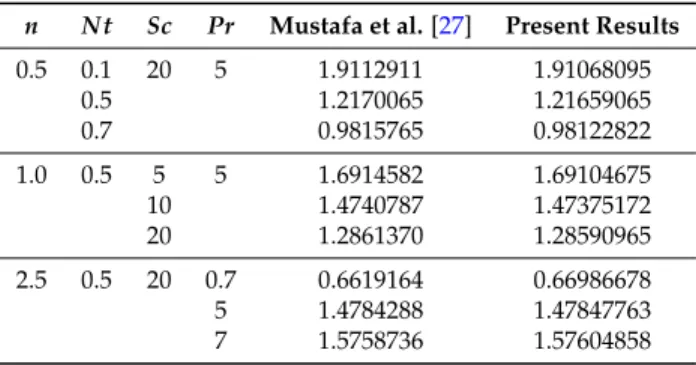
A comparison with previously published results is shown in Table1when A = 0,Ha = 0, Nr = 0,Nd = 0 and Ld = 0 (i.e., in the absence of unsteadiness parameter, Hartmann number,
the thermal radiation number, Dufour parameter and Soret parameter, respectively). These results are comparable to those of Mustafa et al. [27], which validates this numerical method.
Table 1.Current Nusselt number−θ0(0)compared with Mustafa et al. [27]. n Nt Sc Pr Mustafa et al.[27] Present Results
0.5 0.1 20 5 1.9112911 1.91068095 0.5 1.2170065 1.21659065 0.7 0.9815765 0.98122822 1.0 0.5 5 5 1.6914582 1.69104675 10 1.4740787 1.47375172 20 1.2861370 1.28590965 2.5 0.5 20 0.7 0.6619164 0.66986678 5 1.4784288 1.47847763 7 1.5758736 1.57604858
To demonstrate further the convergence of the SQLM, Figures2–5show the effect of the number of collocation points on the accuracy of the solutions obtained for the velocity, temperature, solute concentration and nanoparticle concentration profiles, respectively.
0 50 100 150 Collocation points 10-10 10-8 10-6 10-4 10-2 100 102 || R e s ( f ) ||∞ SQLM
0 50 100 150 Collocation points 10-12 10-10 10-8 10-6 10-4 10-2 100 || R e s ( θ ) ||∞ SQLM
Figure 3.Effects of the number of collocation points number on the residual error of the temperature profile||Res(θ)||∞whenn=3,A=0.3,Pr=7,Ha=0.5,Nr=0.2,Nb=0.5,Nt=0.5,Nd=0.02, Ld=0.02,Sc=7,R0=0.3,Bi=0.2. 0 50 100 150 Collocation points 10-12 10-10 10-8 10-6 10-4 10-2 100 102 || R e s ( S ) ||∞ SQLM
Figure 4. Effects of the number of collocation points number on the residual error of the solute concentration profile||Res(S)||∞ when n = 3,A = 0.3,Pr = 7,Ha = 0.5,Nr = 0.2,Nb = 0.5, Nt=0.5,Nd=0.02,Ld=0.02,Sc=7,R0=0.3,Bi=0.2. 0 50 100 150 Collocation points 10-12 10-10 10-8 10-6 10-4 10-2 100 102 || R e s ( φ ) ||∞ SQLM
Figure 5.Effects of the number of collocation points number on the residual error of the nanoparticle concentration profile||Res(φ)||∞when n = 3,A = 0.3,Pr = 7,Ha = 0.5,Nr = 0.2,Nb = 0.5, Nt=0.5,Nd=0.02,Ld=0.02,Sc=7,R0=0.3,Bi=0.2.
It was found that an increase in the number of collocation points results in a reduction of residual error. However, after a certain point (the point at which an optimal residual error is obtained), an increase in the number of collocation points does not have a significant effect on residual error.
In Figure2, it is observed that the optimal residual error for the velocity profile is around 10−9, which is achieved when the number of the collocation points is within the range 30 and 40; beyond that range, the accuracy starts declining. From Figures3and5, it is noted that the optimal residual errors for the temperature and nanoparticle concentration profiles, respectively, are found around 10−12when the number of collocation points is within 100 and 120. Figure4shows that the optimal residual of the solute concentration profile occurs approximately at 10−11when the number of collocation points is between 80 and 100. It is interesting to note that there is no magic number of collocation points that induces the optimal residual errors for all of the physical properties. Additionally, there is variability in the behavior of the decline of the accuracy after the range at which the optimal residuals are obtained; for instance, in Figure2, the accuracy of the solution of the velocity profile declines much faster as compared to the accuracy of the solution of temperature, solute concentration and nanoparticle concentration profiles respectively shown in Figures3–5. Overall, these results demonstrate the accuracy and convergence of the SQLM technique.
Table2shows the computed skin friction, heat transfer and the mass transfer coefficients, which are represented by−f00(0),|−θ0(0)|and|−S0(0)|, respectively, for various values ofn,A,Ha,Nrand Pr. It is observed that the skin friction decreases asnincreases, whereas the heat transfer coefficient and mass transfer increase with increasingnwith other parameters fixed. It is also noted that the skin friction reduces asAincreases while the heat and mass transfer rates decrease. The skin friction, heat and mass transfer rates vary inversely withHaand appear to be independent of changes inNr, while the heat transfer rate decreases with the increase inNr. The same result also holds for the skin friction and the mass transfer with respect toPr. The heat transfer increases whenPrincreases.
Table 2.Skin friction coefficient, heat transfer coefficient and mass transfer coefficient forNb=0.5, Nt=0.5,Nd=0.02,Ld=0.02,Sc=7,R0=0.3,Bi=0.2. n A