Original Article
The Effect of Fiscal Decentralization on Under-five Mortality in Iran: A
Panel Data Analysis
Ali Hussein Samadi1, Ali Keshtkaran2,*, Zahra Kavosi2, Sajad Vahedi2
1Department of Economics, School of Economics, Management and Social Sciences, Shiraz University, Shiraz, Iran 2School of Management and Medical Informatics, Shiraz University of Medical Sciences, Shiraz,Iran
Background: Fiscal Decentralization (FD) in many cases is encouraged as a strong means of improving
the efficiency and equity in the provision of public goods, such as healthcare services. This issue has urged the researchers to experimentally examine the relationship between fiscal decentralization indicators and health outcomes. In this study we examine the effect of Fiscal Decentralization in Medical Universities (FDMU) and Fiscal Decentralization in Provincial Revenues (FDPR) on Under-Five Mortality Rate (U5M) in provinces of Iran over the period between 2007 and 2010.
Methods: We employed panel data methods in this article. The results of the Pesaran CD test demonstrated
that most of the variables used in the analysis were cross-sectionally dependent. The Hausman test results suggested that fixed-effects were more appropriate to estimate our model. We estimated the fixed-effect model by using Driscoll-Kraay standard errors as a remedy for cross-sectional dependency.
Results: According to the findings of this research, fiscal decentralization in the health sector had a negative
impact on U5M. On the other hand, fiscal decentralization in provincial revenues had a positive impact on U5M. In addition, U5M had a negative association with the density of physicians, hospital beds, and provincial GDP per capita, but a positive relationship with Gini coefficient and unemployment.
Conclusion: The findings of our study indicated that fiscal decentralization should be emphasized in the
health sector. The results suggest the need for caution in the implementation of fiscal decentralization in provincial revenues. A B S T R A C T A R T I C L E I N F O Keywords: Fiscal Decentralization Under-five Mortality Panel Data
Fixed and Random Effects Iran
Article History:
Received: 22 September 2013 Accepted: 14 November 2013 ePublished: 27 November 2013
*Corresponding author: Ali Keshtkaran; Email: [email protected] Background
Decentralization has become a major topic in both developed and developing countries (1). Decentralization is a transferring authority in planning, decision-making, and management of the central level to local levels (2). The logic of decentralization is based on an intrinsically powerful idea. It is simply stated that smaller organizations, properly structured and steered, are inherently more agile and accountable compared to the larger ones (3).
Most of the proponents of decentralization believe that politicians, by employing decentralization, could bring transparency and responsibility for the local elector and hence allow well accommodation of the public goods according to the local needs
(4).
Decentralization is a complex idea that includes the shifting of fiscal, political, and administrative tasks to local levels (5,6). In this article we emphasized on Fiscal Decentralization (FD). The FD is the transfer of fiscal power from the national government to sub-national governments (4). The theories of FD are proposed to improve the provision of public goods, particularly local public goods that should be provided according to the local needs. By applying FD policies, it is expected that productivity,
efficiency, equity, and accountability of the local managers increase regarding resources allocation (7,8).
Decentralization, as a powerful means, has been suggested for the provision of public goods, such as healthcareservices
(5,9,10). The pleasurable impact of decentralization on healthcare services is based on this assumption that local decision makers can receive better information and, consequently, provide a more effective reaction to the local needs. Also, decentralization can be a route for the people to express their preferences. Accordingly, decentralized plans that are based on the local circumstances and needs have this advantage (1,5,11).
The pathway through which decentralization will more likely improve the health outcomes, is the increase in allocative and technical efficiency. It is expected that a decentralized system, allocates economical resources more efficiently in order to maximize the health outcomes (11).
It should be noted that in some cases, delegation of authority to local levels leads to failure. In public goods provision, due to the spillover effects, local governments with free riding intend to take advantage of these goods with the lowest expenditures. It has been argued that some healthcare programs may not perform better at the local levels because they either require a International Journal of
Health Policy and Management
Journal homepage: http://ijhpm.com Kerman University
302
national perspective or may not be cost effective. In addition, this concern has existed that by transferring the financial responsibility to the local levels, inequality may occur in financing some public goods, such as healthcare services (5,12).
In Iran, attention has been paid to decentralization affairs with respect to the 5-year development plans. The decentralization issue in Iran has been more emphasized after the Third Plan of Development (13). The main step of decentralization has been taken through the development of provincial revenue and expenditure system (14).
Iran’s healthcare system is decentralized with the authority at the provincial level. The system has been succeeded in agglomeration of medical education and healthcare services provision. In the current structure of the healthcare system in Iran, the primary healthcare networks reach the urban levels
(15). In the provincial level, medical universities supervise the healthcare system and medical education. These universities can decide about budgeting, allocation of local revenues, and financial affairs, too (16). Moreover, the independence of public hospitals has been highlighted in the Iranian health system (17).
The main goal of this research is to examine the relationship between FD and Under-Five Mortality rate (U5M) as a health outcome in the provinces of Iran between 2007 and 2010. We also investigate the effects of some determinants of children’s health on U5M. The U5M is measured as probability, or the proportion of the children dying before their fifth birthday (18). Reduction in the U5M is in fact the fourth goal of the Millennium Development Goals (MDGs) (19). The investigation of the determinants of health among children is important because it illustrates the lasting impact of childhood health on adulthood
(20).
Empirical studies
Despite the fact that decentralization is a captivating issue for researchers, empirical studies on FDand health outcomes are
limited. In this section, we reviewed some relevant investigations. A study by Robalino and colleagues showed that, FD defined as the proportion of sub-national government spending over central government spending was correlated with a decrease in infant mortality. In addition, the authors concluded that decentralization was far more advantageous for poor countries
(10). Using a large panel of Argentine provinces over the period 1970–1994, Habibi et al. showed that infant mortality decreased with two indicators of FD. Besides, this study showed that inequalities in regional infant mortality rates declined significantly over the period when the decentralization reforms were implemented (21).
Furthermore, Cantarero and Pascual concluded that by increasing the local healthcare expenditures, infant mortality was reduced and life expectancy was increased in the provinces of Spain (22). In another study, Asfaw et al. showed that decentralization played a prominent role in reducing the mortality of infants in Indian villages (5). Other works such as Uchimura and Jütting (1), Jiménez (23), Akpan et al.
(24), Jiménez (11), and Soto et al. (25) also showed a positive relationship between decentralization and health outcomes.
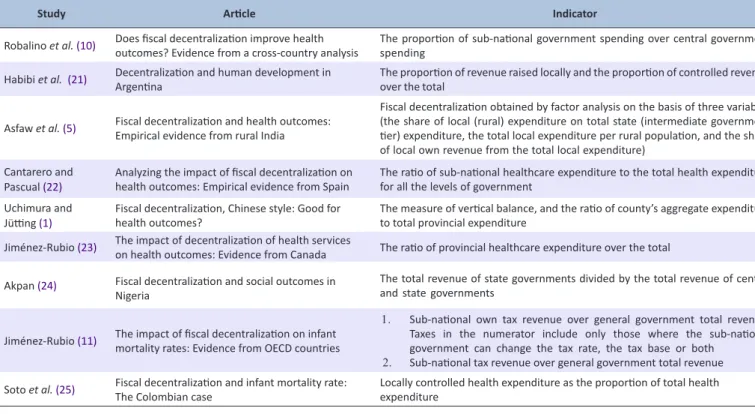
Using panel data, Jin and Son analyzed the impact of FD on infant mortality in the provinces of China. They showed that FD had a positive impact on infant mortality (26). It should be noted that different indicators were used as FD in health sector and public sector in these studies (Table 1).
To date, the relationship between FD and health outcomes has not been empirically investigated in Iran. Hence, our goal in this article was to investigate the potential impact of FD on U5M as a health outcome.
The rest of the paper is divided into three sections. Subjects and Methods are divided into the econometric model, data collection and estimation methods. The next section of this article is continued with Findings. Finally this article ends with discussion and conclusion sections.
Table 1. FD indicators in related studies
Study Article Indicator
Robalino et al.(10) Does fiscal decentralization improve health outcomes? Evidence from a cross-country analysis The proportion of sub-national government spending over central government spending
Habibi et al. (21) Decentralization and human development in Argentina The proportion of revenue raised locally and the proportion of controlled revenue over the total
Asfaw et al.(5) Fiscal decentralization and health outcomes: Empirical evidence from rural India
Fiscal decentralization obtained by factor analysis on the basis of three variables (the share of local (rural) expenditure on total state (intermediate government tier) expenditure, the total local expenditure per rural population, and the share of local own revenue from the total local expenditure)
Cantarero and
Pascual (22) Analyzing the impact of fiscal decentralization on health outcomes: Empirical evidence from Spain The ratio of sub-national healthcare expenditure to the total health expenditure for all the levels of government Uchimura and
Jütting (1) Fiscal decentralization, Chinese style: Good for health outcomes? The measure of vertical balance, and the ratio of county’s aggregate expenditure to total provincial expenditure Jiménez-Rubio (23) The impact of decentralization of health services on health outcomes: Evidence from Canada The ratio of provincial healthcare expenditure over the total
Akpan (24) Fiscal decentralization and social outcomes in
Nigeria
The total revenue of state governments divided by the total revenue of central and state governments
Jiménez-Rubio (11) The impact of fiscal decentralization on infant mortality rates: Evidence from OECD countries
1. Sub-national own tax revenue over general government total revenue. Taxes in the numerator include only those where the sub-national government can change the tax rate, the tax base or both
2. Sub-national tax revenue over general government total revenue Soto et al.(25) Fiscal decentralization and infant mortality rate: The Colombian case Locally controlled health expenditure as the proportion of total health expenditure
303
Methods
Data and Variables
In this study, we emphasized two FD indicators. The first indicator focuses on FD in the health sector; the ratio of expenditures from the local revenues to the total expenditures from local and public revenues of medical universities (FDU). The second indicator covers provincial level of decentralization; the ratio of provincial revenues to the total provincial and central revenues (FDR). The data for FDU were obtained from the statistics of the public and private credits of the medical universities provided by the Ministry of Health and Medical Education (MoHME). We used the data from the provincial budgets to measure the FDR. Data on U5M were obtained from MoHME. Provincial per capita revenue, physicians, hospital beds, urbanization, and unemployment, were extracted from the provincial yearbook. In addition, the data on Gini coefficient were acquired from the statistics center (27–30). It should be pointed that the effects of these variables have been investigated in different studies (22,31–41).
The econometric model
According to Uchimura and Jütting basic model (equation 1), we examined the impact of FD and other factors on U5M. Hit=α + βXit+ γZit+ Uit, (1)
Where “i” denotes cross-section, “t” denotes time, “H” denotes U5M, “X” is the FD indicator, and “Z” denotes the control variables.
We emphasized two FD indicators. In the first indicator, by focusing on FD in the health sector, FD was defined as the ratio of expenditures from the local revenues to the total expenditures from local and public revenues of medical universities (FDU). In the second indicator, the FD was defined as the ratio of provincial revenues to the total provincial and central revenues (FDR). Since we used two FD indicators in the analysis, two equations were estimated. In the first equation, we tested the impact of FDU on U5M using equation (2):
Hit = FDU it β
1 × GDP itβ2 × DOC it β3× BED itβ4 ×GINitβ5 × UNEM itβ6 ×UR itβ7 (2)
The logarithm form of this equation is shown in equation (3):
LHit = β0 +β1LFDUit +β2LGDPit +β3 LDOCit +β4 LBEDit + β5LGINit+β6 L UNEMit +β7 LURit+ Uit (3)
In addition, we investigated the impact of FDR on U5M using equation (4):
Hit = FDR itβ
1 ×GDP itβ2 × DOC it β3× BED itβ4 × GINit β5 × UNEM itβ6 ×URit β7 (4) The logarithm form of this equation is shown in equation (5): LHit = β0 +β1LFDR it + β2LGDP it +β3LDOCit+β4 BED it + βLGINit+ β6 LUNEM it +β7LURit+Uit (5)
In equations (3) and (5), “LH” denotes the logarithm of U5M, “LFDU” shows the logarithm of FD in the health sector, “LFDR” represents the logarithm of FD in the revenue aspect, “LGDP” denotes the logarithm of provincial per capita revenue,
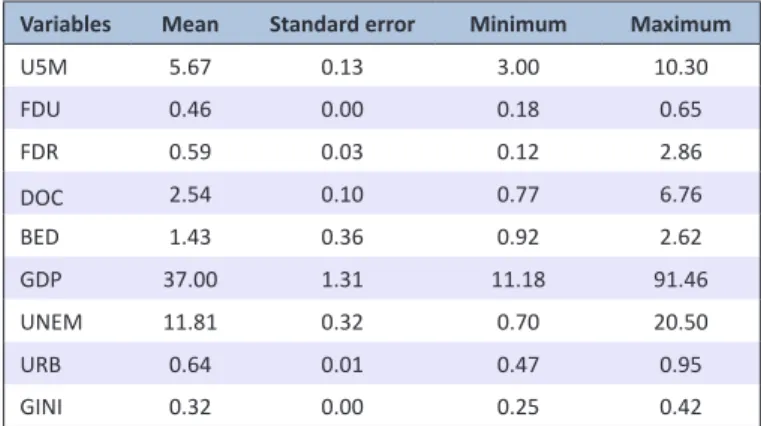
“LDOC” denotes the logarithm of density of physicians, “LBED” represents the logarithm of density of hospital beds, “LGIN” shows the logarithm of Gini coefficient, “LUNEM” denotes the logarithm of unemployment rate, and “LUR” shows the logarithm of urbanization. The descriptive statistics for the dependent variable and other variables of this study are shown in Table 2.
Estimation methods
The first step before doing any tests in the panel data econometrics is exploring the Cross-sectional Dependency (CD). Different tests such as Fridman test, Breusch test, and Pesaran CD test can be used for examining the CD. We used Pesaran CD test (42) to investigate the CD in model’s variables. It should be noted that in the existence of CD in variables, the results of estimators were not reliable. Some methods such as Feasible Generalized Least Squares (FGLS), Panel-Corrected Standard Errors (PCSE) and Driscoll-Kraay Standard Errors (DKSE) are used as a remedy for the CD (43,44). In this study as we had CD, we used DKSE. In the second step, we used Hausman test to examine whether the model had fixed or random effects (45).
Results
Cross-sectional dependency test
Table 3 shows the results of CD test for the variables of our model in the provinces of Iran between 2007 and 2010. The null hypothesis of this test was that no CD existed among the variables. As the table presents, except for the LBED, all the variables had CD.
Fixed or random effects
We used Hausman test to see if the model had fixed or random effects. First, we estimated the model with random effects and used Hausman test. The null hypothesis for this test was that the differences between the coefficients were not systematic. According to Table 4, we had to estimate two equations with Table 2. Descriptive statistics
Variables Mean Standard error Minimum Maximum
U5M 5.67 0.13 3.00 10.30 FDU 0.46 0.00 0.18 0.65 FDR 0.59 0.03 0.12 2.86 DOC 2.54 0.10 0.77 6.76 BED 1.43 0.36 0.92 2.62 GDP 37.00 1.31 11.18 91.46 UNEM 11.81 0.32 0.70 20.50 URB 0.64 0.01 0.47 0.95 GINI 0.32 0.00 0.25 0.42
Table 3. the results of the CD test
Variable CD-test P LU5M 16.25 0.00 LFDU 68.27 0.00 LFDR 49.81 0.00 LGDP 77.42 0.00 LBED 1.44 0.14 LDOC 24.84 0.00
304
fixed effects.
The findings of the estimation
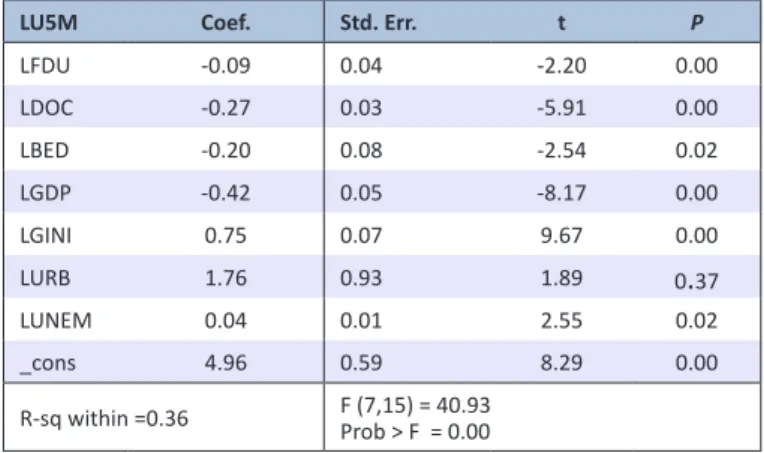
Because of having fixed effects and cross-sectional dependency, the equations were estimated by fixed effects estimating technique using DKSE. The findings of these estimations are presented in Tables 5 and 6.
As shown in Table 4, except for urbanization (P= 0.37), all the other variables had a significant relationship with U5M (α= 0.05).
As Table 5 depicts, all the variables had a significant relation-ship with U5M (α= 0.05).
Discussion
The results of our study showed that the FD in the health sector (i.e. FDU) had a significant direct negative relationship with U5M. Hence, by increasing FD related to the health sector; the children’s mortality was expected to decline. A 1% increase in this variable, averagely declined U5M by 0.09. This result is compatible with most of the studies conducted on this issue (1,5,10,11,21–25).
According to the study results, FDR in equation (2) had a Table 4. The results of Hausman test
X2 (DF*) P
Equation (3) 12.15 (7) 0.00
Equation (5) 14.86 (7) 0.00
*Degree of freedom
Table 5. Estimated coefficients using FDU as a measure of FD
LU5M Coef. Std. Err. t P
LFDU -0.09 0.04 -2.20 0.00 LDOC -0.27 0.03 -5.91 0.00 LBED -0.20 0.08 -2.54 0.02 LGDP -0.42 0.05 -8.17 0.00 LGINI 0.75 0.07 9.67 0.00 LURB 1.76 0.93 1.89 0.37 LUNEM 0.04 0.01 2.55 0.02 _cons 4.96 0.59 8.29 0.00 R-sq within =0.36 F (7,15) = 40.93Prob > F = 0.00
Table 6. Estimated coefficients using FDR as a measure of FD
LU5M Coef Std. Err. t P
LFDR 0.05 0.01 4.19 0.00 LDOC -0.27 0.05 -5.44 0.00 LBED -0.25 0.06 -4.15 0.00 LGDP -0.47 0.03 -12.1 0.00 LGINI 0.81 0.06 12.72 0.00 LURB 2.18 0.69 3.14 0.00 LUNEM 0. 05 0.01 3.62 0.00 _cons 5.51 0.35 15.75 0.00 R-sq within= 0.36 F (7,15)= 30.95Prob > F= 0.00
statistically significant positive relationship with U5M. This result was in contrast to the theoretical basis and most of the studies performed on this issue (1,5,10,11,21–25). However, Jin and Son (25) in their study showed a positive relationship between FD and the health outcomes. This result can be explained by the inadequacy of the provincial incomes that are insufficient to fulfill the provincial needs, which may affect the provinces’ health status. Furthermore, the absence of skilled human powers and necessary substructure in local levels can be accounted for a decrease in the capabilities of provinces to take advantage of decentralization.
In this study, DOC had a statistically significant negative association with U5M. Therefore, With the increase in DOC, utilization of healthcare services which influences the children’s health is expected to increase, as well. This result is in line with the studies that investigated the impact of physicians on U5M (31,32). Similar to DOC, the coefficient of BED had a statistically significant negative relationship with the dependent variable. Therefore, an increase in BED is expected to decrease U5M. This finding was also consistent with related studies (22,33). GDP had a statistically significant negative relationship with U5M. Hence, an increase in the income per capita is expected to decrease the children’s mortality. This result is compatible with the related studies (31,32–38). It should be pointed that, the income per capita is a prominent factor in reducing the children’s mortality. In contrast, the Gini coefficient had a significant positive relationship with U5M. Since, Gini coefficient is representative of income inequality, income inequality is an important risk factor for children mortality. With an increase in Gini, most of the children are faced with difficulty in having access to vital needs, such as food, housing, and healthcare services (19). Similar result was found in a study by Filmer and Pritchett (34) which showed that income inequality increased children mortality in low- and middle-income countries.
According of findings of our study, the URB variable has a positive association with U5M. But this relationship is statistically significant in the second equation. This result is in line with Rajkumar and Swaroop (37). They showed that urbanization is accompanied with increase in children mortality in Indian states.
The findings also suggested that UNEM had a significant positive relationship with U5M. Therefore, unemployment should be accounted as a risk factor for children mortality. As unemployment rises, the mean incomes tend to decrease. If we accept that income has a negative impact on mortality, with an increase in unemployment, mortality should be expected to rise up. Nonetheless, Rohem showed that mortality was higher in smaller unemployment rates (39,40). These results were inconsistent with those obtained by Ariizumi (41) that found no significant relationships between unemployment and children mortality.
Conclusion
In this article, we showed that FD in the health sector was accompanied by lower children mortality. Hence, our results indicated that FD in the health sector is a booster factor for improving the health outcomes. Our study also revealed that decentralization of provincial revenues was associated with additional children mortality. Also, the findings of the current study demonstrated that U5M had a negative relationship with income per capita, density of physicians, and hospital beds, but
305
a positive association with Gini coefficient, urbanization and unemployment rate. Hence, U5M can be reduced by adopting economic development policies and increasing the density of physicians and hospital beds. Finally, it should be pointed that the investigation of the effects of FD on other health outcomes such as infant mortality and life expectancy could be interesting issues for future studies.
Acknowledgements
This research was performed by Mr. Sajad Vahedi, in partial fulfillment of the requirements for certification as an MSc in Health Economic School at Shiraz University of Medical Sci-ences (SUMS) in Shiraz, Iran.
The present article was adopted from the proposal number 91-6366 approved by vice-chancellor for research affairs of SUMS. We would like to thank Research Improvement Center of the SUMS. Also we thank Ms. A. Keivanshekouh for her help to im-prove the English presentation of this paper.
Ethical issues
This study was approved by the ethics committee of SUMS.
Competing interests
The authors declare that they have no competing interests.
Authors’ contributions
SV and AHS designed and conducted the study. They analyzed and interpreted the data with the help of AK, ZK and SV provided the draft of the manuscript and revised it.
References
1. Uchimura H, Jütting JP. Fiscal Decentralization, Chinese Style: Good for Health Outcomes? World Dev 2009; 37: 1926–34. 2. Rondinelli DA. Government decentralization in comparative
perspective theory and practice in developing countries.
International Review of Administrative Sciences 1980; 47: 133–45.
3. Saltman RB, Bankauskaite V. Conceptualizing decentralization in European health systems: a functional perspective. Health Econ
Policy Law 2006; 1: 127–47.
4. Oates WE. On the theory and practice of fiscal decentralization [internet]. 2006. Available from: http://www.ifigr.org/publication/ ifir_working_papers/IFIR-WP-2006-05.pdf
5. Asfaw A, Frohberg K, James KS, Jütting J. Fiscal Decentralization and Infant Mortality: Empirical Evidence from Rural India. Journal
of Developing Areas 2007; 41: 17–35.
6. Ebel RD, Yilmaz S. Concept of fiscal decentralization and worldwide overview [internet]. 2002. Available from: http://www-wds.worldbank.org/external/default/WDSContentServer/WDSP/IB/ 2004/11/02/000090341_20041102092746/Rendered/PDF/303460 Concept0of0Fiscal0Ebel1Yilmaz.pdf
7. Oates WE. Fiscal Decentralization and Economic Development.
Natl Tax J 1993; 46: 237–43.
8. Ebel RD, Yilmaz S. On the measurement and impact of fiscal decentralization [internet]. 2002. Available from: http://www-wds. worldbank.org/servlet/WDSContentServer/WDSP/IB/2002/04/12/0 00094946_02040304241194/Rendered/PDF/multi0page.pdf 9. Mills A. Decentralization and accountability in the health sector
from an international perspective: what are the choices? Public
Adm Dev 1994; 14: 281–92.
10. Robalino D, Picazo O, Voetberg A. Does fiscal decentralization improve health outcomes? Evidence from a cross-country analysis [internet]. 2001. Available from: http://elibrary.worldbank.org/doi/ pdf/10.1596/1813-9450-2565
11. Jiménez-Rubio D. The impact of fiscal decentralization on infant mortality rates: Evidence from OECD countries. SocSci Med 2011; 73: 1401–7.
12. Costa-i-Font J. Fiscal Federalism and European Health System
Decentralization: A Perspective [internet]. 2012. Available from: http://www.lse.ac.uk/europeanInstitute/LEQS/LEQSPaper55.pdf 13. Renani M, Sameti M, Farazmand H. [The relationship of fiscal
decentralization and government size in Iran]. Iranian Economic
Research 2008; 8: 121–55.
14. Ahsan K, Karampour K. [Provincial Revenue-Expenditure System: A New View on the Challenges and Prospects of Regional Development and Balance]. The Journal of Planning and Budgeting
2003; 8: 71–96.
15. World Bank. Islamic Republic of Iran - Health Sector Review:
Volume 2. Background Sections. Washington: World Bank; 2008.
16. Majdzadeh R, Nedjat S, Denis JL, Yazdizadeh B, Gholami J. Linking research to action’ in Iran: Two decades after integration of the Health Ministry and the medical universities. Public Health
2010; 124: 404–11.
17. WHO Regional Office for the Eastern Mediterranean. Regional Health Observatory [homepage on the Internet]. 2002. Available from: http://rho.emro.who.int/rhodata/
18. Infant and Child Mortality. In: Kirch W, editor. Encyclopedia of
Public Health. Dresden: Springer; 2008.
19. Wagstaff A, Claeson M. The millenium development goals for
health: rising to the challenges. Washington: The World Bank;
2004.
20. Santerre RE, Neun SP. Health Economics. 5th edition. Mason: Joe Sabatino; 2010.
21. Habibia N, Huangb C, Mirandac D, Murillod V, Ranise G, Sarkarf
M, et al. Decentralization and human development in Argentina.
Journal of Human Development 2003; 4: 73–101.
22. Cantarero D, Pascual M. Analysing the impact of fiscal decentralization on health outcomes: empirical evidence from Spain. Appl Econ Lett 2007; 15: 109–11.
23. Jiménez-Rubio D. The impact of decentralization of health services on health outcomes: evidence from Canada. Appl Econ 2010; 43: 3907–17.
24. Akpan EO. Fiscal Decentralization and Social Outcomes in Nigeria.
European Journal of Business and Management 2011; 3: 167–83.
25. Soto VE, Farfan MI, Lorant V. Fiscal decentralisation and infant mortality rate: The Colombian case. Soc Sci Med 2012; 74: 1426– 34.
26. Jin Y, Sun R. Does fiscal decentralization improve healthcare outcomes? empirical evidence from china. Public Finance and
Management 2011; 11: 234–61.
27. Department of Health - Office of Population and Family Health- Children’s Health Administration. The death of 59-month-old children. Tehran: Ministry of Health and Medical Education; 2012.
28. National Portal of Statistics. Provincial data [internet]. Available from: http://amar.org.ir/Default.aspx?tabid=1633
29. National Portal of Statistics. Household income and expenditure statistics [Internet]. Available from: http://amar.org.ir/Default. aspx?tabid=111
30. The Office of Planning of Budget financial resources. Public and
private credits of the medical universities. Tehran: Ministry of Health
and Medical Education; 2012.
31. Anand S, Bärnighausen T. Human resources and health outcomes: cross-country econometric study. Lancet 2004; 364: 1603–9. 32. Robinson J, Wharrad H. Invisible nursing: exploring health
outcomes at a global level. Relationships between infant and under five mortality rates and the distribution of health professionals, GNP per capita, and female literacy. J Adv Nurs 2000; 32: 28–40. 33. Olafsdottir AE, Reidpath DD, Pokhrel S, Allotey P. Health systems
performance in sub-Saharan Africa: governance, outcome and equity. BMC Public Health 2011; 11: 237.
34. Filmer D, Pritchett L. The impact of public spending on health: does money matter? Soc Sci Med 1999; 49: 1309–23.
35. Houweling TA, Caspar AE, Looman WN, Mackenbach JP. Determinants of under-5 mortality among the poor and the rich: a cross-national analysis of 43 developing countries. Int J Epidemiol
2005; 34: 1257–65.
36. Chung H, Muntaner C. Political and welfare state determinants of infant and child health indicators: An analysis of wealthy countries.
Soc Sci Med 2006; 63: 829–42.
306
governance matter? J Dev Econ 2008; 86: 96–111.
38. Farahani M, Subramanian SV, Canning D. Effects of state-level public spending on health on the mortality probability in India.
Health Econ 2010; 19: 1361–76.
39. Lichtenberg FR. Pharmaceutical Innovation and Longevity Growth in 30 Developing and High-income Countries, 2000-2009 [internet]. 2012. Available from: http://www.nber.org/papers/w18235. pdf?new_window=1
40. Ruhm CJ. Healthy living in hard times. J Health Econ 2005; 24: 341–63.
41. Ariizumi H, Schirle T. Are recessions really good for your health?
Evidence from Canada. Soc Sci Med 2012; 74: 1224–31.
42. Pesaran MH. Estimation and Inference in Large Heterogeneous
Panels with a Multifactor Error Structure. Cambridge: Cambridge
University; 2004.
43. Driscoll JC, Kraay AC. Consistent covariance matrix estimation with spatially dependent panel data. Rev Econ Stat 1998; 80: 549–60. 44. Hoechle D. Robust standard errors for panel regressions with
cross-sectional dependence. Stata J 2007; 7: 281.
45. Hsiao C. Analysis of panel data. 2nd edition. Cambridge: Cambridge university press; 2003.