Volume 22 Article 31
Exploring the Vendor’s Process Model in Information Technology Outsourcing
Jae-Nam Lee
Korea University Business School
Anam-Dong 5 Ga, Seongbuk-Gu, Seoul 136-701, Korea [email protected]
Recently, the role of outsourcing vendors in outsourcing projects has been attracting increasing attention. This would imply that the studies on outsourcing truly require an understanding of both parties, i.e., the vendor and the customer, to realize the expected benefits. Although such benefits are mainly determined by how the outsourcing process is defined and managed, limited research has been done on the outsourcing process from the vendor’s perspective. The objective of this study is to provide guidance to organizations that plan to outsource or have already outsourced their IT functions in order for them to reap greater outsourcing benefits by understanding the vendor’s outsourcing process model. It also aims to assist vendors by exploring what key steps and concerns throughout the outsourcing process exist. To do so, this study develops a vendor’s outsourcing process model containing the type of vendor and structure of the vendor organization which comes strictly from the viewpoint of vendors. This is based on the author’s working experience and in-depth interviews with outsourcing practitioners in 15 IT companies. Such a model can provide valuable insights into the interconnection of vendor’s and customer’s outsourcing processes. Moreover, it can help customers and vendors expand their understanding of the outsourcing process from beginning to end.
Keywords: IT outsourcing, vendor’s outsourcing process model, Types of outsourcing vendors, components of vendor organizations
Exploring the Vendor’s Process Model in Information Technology Outsourcing
570
Volume 22 Article 31
I. INTRODUCTION
During the last decade, outsourcing has emerged as a major strategic alternative in information systems management. Information Technology (IT) outsourcing, the process of turning over part or all of an organization’s IT functions to external vendors, is done to acquire economic, technological, and strategic advantages [Loh and Venkatraman 1992]. According to an IDC (International Data Corporation) report, the worldwide outsourcing market size is estimated to rise from $240.2 billion in 2006 to $377.8 billion by 2010, with an annual growth rate of 12 percent [Hackett 2008]. With this kind of growth, IT outsourcing warrants top-level attention.
However, some firms have achieved varying degrees of outsourcing success, while many have still encountered significant difficulties. An empirical study found that only 54 percent of outsourcing projects realized the expected benefits of IT outsourcing [Lacity and Willcocks 1998]. How can the customer and vendor enjoy more outsourcing benefits in this situation? One possible answer is to have a better understanding of each other’s outsourcing process. Since the outsourcing process includes a large number of details that should be appropriately handled, the outsourcing outcome is mainly determined by how the outsourcing process is defined and managed [Cullen, et al. 2005]. For example, according to Willcocks and Fitzgerald [1994], the effective management of outsourcing processes results in a higher degree of cost saving. Also, the existing risk and conflict between the customer and vendor in an outsourcing project can be mitigated by a well-defined outsourcing process [Taylor 2007].
Therefore, it is true that understanding the outsourcing process of both parties provides an opportunity not only to decrease outsourcing cost but also to minimize the risk, which results in reaping better economic, technological, and strategic benefits of outsourcing. A few studies have been conducted to explore and understand the outsourcing process from the customers’ perspective [e.g., Cullen et al. 2005; Halvey and Melby 1996]. However, to our knowledge, very limited research has been done on the outsourcing process from the vendor’s perspective, despite the fact that the exploration of vendors and their strategies is a critical theme [Lacity and Willcocks 2000]. The primary goal of an outsourcing vendor is to meet the customer’s outsourcing objective, but the vendor also has its own goal that is possibly different and that can only be realized through the vendor’s outsourcing process [Goles 2001; Levines and Ross 2003]. Accordingly, without having a sufficient understanding about vendor’s outsourcing processes, it may be difficult for customers to achieve their outsourcing objective because a successful outcome is determined not simply by considering either of the two outsourcing processes, but by jointly considering both. The objective of this study is to provide guidance to organizations that plan to outsource or have already outsourced their IT functions with in order for them to reap greater benefits by understanding the vendor’s outsourcing process model. Moreover, this study will assist vendors by exploring what key steps and concerns throughout the outsourcing process exist. To accomplish these, based on the author’s working experience and in-depth interviews with outsourcing practitioners in 15 IT companies, a vendor’s outsourcing process model is developed. Such model is created by recognizing the nature of outsourcing vendors and their internal organizational structure related to outsourcing projects. As outsourcing managers, the interviewees have a first-hand experience of IT outsourcing practices in different industries. Although outsourcing vendors have different nature and size, this study developed the general structure of vendor organizations and their outsourcing process. Such a model can provide valuable insight on the interconnection of vendor’s and customer’s outsourcing processes and can help the customer and the vendor alike to expand their understanding of the outsourcing process from beginning to end.
II. PRIOR STUDIES ON OUTSOURCING
Customer ViewpointsPrevious research in the area of outsourcing has focused mainly on the organizations that choose to outsource, meaning the perspective of vendors on outsourcing has hardly been explored. The situation calls for an investigation of the existing literature from the customer’s viewpoint in order to have a big picture of the outsourcing process. According to a general process model of outsourcing from the customer’s viewpoint [e.g., Lee and Kim 1997; Cullen et al. 2005; Halvey and Melby, 1996], outsourcing consists of several phases, including decision-making, strategy, vendor evaluation and selection, contract negotiation, implementation, contract management, and performance feedback (including contract renewal, changes of vendor and strategy, and insourcing after an outsourcing arrangement). Most of the previous studies from the customer’s perspective can be interpreted and summarized in terms of the process model, as shown in Table 1.
Volume 22 Article 31
571 Since a major driver for outsourcing in the 1970s and 1980s was cost-effective access to specialized computing
power rather than getting and maintaining competitive advantage, the scope and complexity of outsourcing was very limited. Thus, outsourcing activities were considered as tactical rather than strategic at that time. It meant that companies kept critical components of their value chain inside and outsourced only non-core components and activities. At that time, customer organizations failed to consider the value of outsourcing.
However, in the 1990s, the decision to outsource IT functions became more popular because organizations needed diverse and high quality information services to survive and excel in the rapidly changing external environment. Furthermore, companies began to recognize that they did not derive their strategic advantages from having an IT department, but that such advantages came from their knowledge of how to make good use of IT. This led to various outsourcing strategies and options such as total versus selective [e.g., Lacity et al. 1996], long term versus short term [e.g., Pinnington and Woolcock 1995], single versus multiple vendors [e.g., Willcocks et al. 1995], and service versus asset outsourcing [e.g., Loh and Venkatraman 1991]. This phenomenon shifted the traditional form of hierarchical IT governance, contractual relationship, to a newer market form of governance, partnership [Lee et al. 2003].
Table 1. Previous Research on the Customer Outsourcing Process Model
Phases Concerns Typical studies
Outsourcing
decision-making What the impact as well as the benefits and risks of outsourcing are
Baldwin et al, 2001 ; Buck-Lew, 1992; Cullen et al., 2005; Grover et al., 1994; Halvey and Melby, 1996 Outsourcing
strategy What outsourcing scope and option are most appropriate to our organization to minimize the potential pitfall
Cullen et al., 2005; Halvey and Melby, 1996; Lee, 2006; Lee et al., 2004 ; Quinn and Hilmer, 1994; Willcocks et al., 1995
Vendor evaluation
and selection What criteria should be considered in evaluating and selecting a vendor(s)
Cullen et al., 2005; Halvey and Melby, 1996; Michell and Fitzgerald, 1997; McDowell et al., 2003
Contract negotiation
What kind of contract types exist to maximize the outsourcing value and gains (e.g., buy-in, fee-for-service, partnership)
Cullen et al., 2005; Diromualdo and Gurbaxani, 1998; Halvey and Melby, 1996; Lacity and Willcocks, 1998
Outsourcing
implementation How to manage the implementation process and to solve unexpected problems in the process Cullen et al., 2005; Halvey and Melby, 1996; Sabherwal, 1999; Kern and Willcocks, 2002
Contract
management How to measure the outcome against the predefined objective (e.g., service level, performance goal)
Cullen et al., 2005; Grover et al., 1996; Halvey and Melby, 1996; Perry and Devineey, 1997
Performance feedback
Whether contract renews or not; whether current vendor(s) and strategy are changed or not; whether insourcing is needed or not
Chapman and Andrade, 1998; Cullen et al., 2005; Hirschheim and Lacity, 2000
As the intangible elements are not easily captured in the contract relationship (for example, trust, commitment, and mutual interests), a more intimate form of relationship between customers and their vendors has emerged as an effective way to realize the expected outsourcing benefits [Sabherwal 1999]. As a result, many organizations seek a flexible partnership with their vendors, especially after they identify the limitations of legal contracts. Consequently, an effective partnership began to be considered as a key predictor of outsourcing success [Grover et al. 1996; Willcocks and Kern 1998]. In such a situation, studies on the relationship from a bilateral perspective are truly required to understand key concerns of both outsourcing parties, which lead to greater outsourcing relationship performance as well as to get better strategic, technological, and economic outsourcing benefits.
Vendor Viewpoints
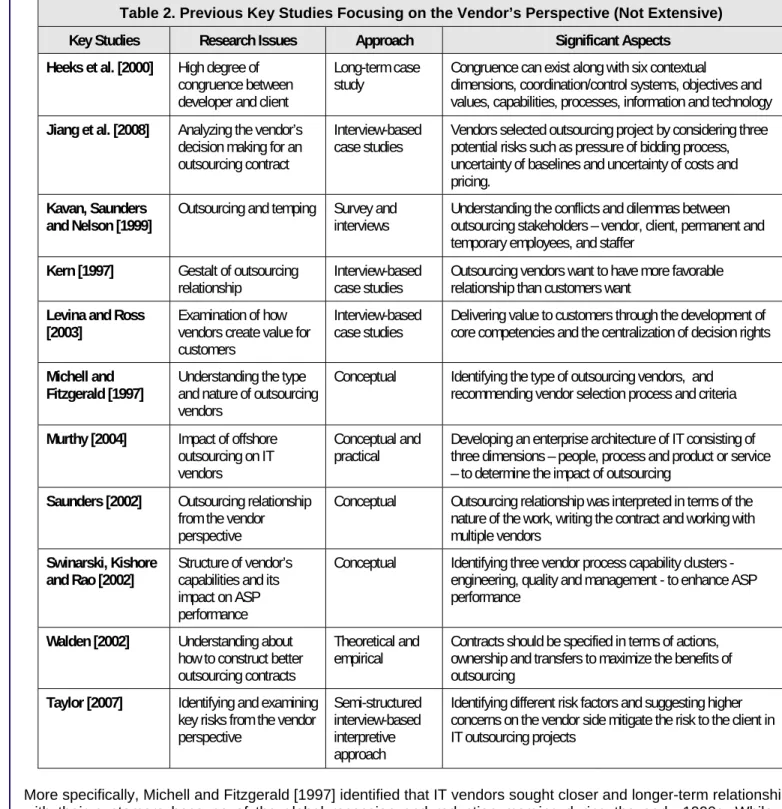
IT outsourcing is a dynamic phenomenon rather than a static one. Since the dynamic nature of outsourcing originated from continuously changing and emerging conditions and needs, it has led firms to pursue alternatives in their outsourcing relationships. Understanding outsourcing vendors is very crucial in order to reduce transaction and coordination costs between the customer and the vendor and to remove potential risks and conflicts in the outsourcing process. Despite this fact, few researchers have begun exploring the nature of outsourcing vendors. Table 2 shows a summary of the typical studies on outsourcing from the perspective of vendors. These studies are primarily essays, with two major topics such as the congruence of outsourcing relationship between the customer
572
Volume 22 Article 31
and the vendor [e.g., Heeks et al. 2000; Kern 1997; Saunders 2002], and the nature of outsourcing vendors [e.g., Michell and Fitzgerald 1997; Swinarski et al. 2002]. The main purpose of these studies was to spur researchers to investigate factors and situations that generate the outsourcing benefits delivered to customers through IT outsourcing, and this is done by examining the vendor’s strategy and practices, with the assumption that outsourcing vendors ultimately deliver value.
Table 2. Previous Key Studies Focusing on the Vendor’s Perspective (Not Extensive)
Key Studies Research Issues Approach Significant Aspects Heeks et al. [2000] High degree of
congruence between developer and client
Long-term case
study Congruence can exist along with six contextual dimensions, coordination/control systems, objectives and values, capabilities, processes, information and technology
Jiang et al. [2008] Analyzing the vendor’s decision making for an outsourcing contract
Interview-based
case studies Vendors selected outsourcing project by considering three potential risks such as pressure of bidding process, uncertainty of baselines and uncertainty of costs and pricing.
Kavan, Saunders
and Nelson [1999] Outsourcing and temping Survey and interviews Understanding the conflicts and dilemmas between outsourcing stakeholders – vendor, client, permanent and temporary employees, and staffer
Kern [1997] Gestalt of outsourcing
relationship Interview-based case studies Outsourcing vendors want to have more favorable relationship than customers want
Levina and Ross
[2003] Examination of how vendors create value for customers
Interview-based
case studies Delivering value to customers through the development of core competencies and the centralization of decision rights
Michell and
Fitzgerald [1997] Understanding the type and nature of outsourcing vendors
Conceptual Identifying the type of outsourcing vendors, and recommending vendor selection process and criteria
Murthy [2004] Impact of offshore outsourcing on IT vendors
Conceptual and practical
Developing an enterprise architecture of IT consisting of three dimensions – people, process and product or service – to determine the impact of outsourcing
Saunders [2002] Outsourcing relationship from the vendor perspective
Conceptual Outsourcing relationship was interpreted in terms of the nature of the work, writing the contract and working with multiple vendors
Swinarski, Kishore and Rao [2002]
Structure of vendor’s capabilities and its impact on ASP performance
Conceptual Identifying three vendor process capability clusters - engineering, quality and management - to enhance ASP performance
Walden [2002] Understanding about how to construct better outsourcing contracts
Theoretical and
empirical Contracts should be specified in terms of actions, ownership and transfers to maximize the benefits of outsourcing
Taylor [2007] Identifying and examining key risks from the vendor perspective
Semi-structured interview-based interpretive approach
Identifying different risk factors and suggesting higher concerns on the vendor side mitigate the risk to the client in IT outsourcing projects
More specifically, Michell and Fitzgerald [1997] identified that IT vendors sought closer and longer-term relationships with their customers because of the global recession and reduction margins during the early 1990s. While an outsourcing contract provides the opportunity for close and continuous contact to guarantee future work, outsourcing becomes the key to IT services’ marketing channel control and leads vendors to offer outsourcing capabilities in order to maintain control over the channel. Thus, vendors targeting the outsourcing market want more favorable relationships with their customers as a result of the potential for enlarging their service or product offerings [Kern 1999]. Outsourcing activities include the design, business operations, and innovation elements of IT, in response to clients’ criteria. In the case of benefits, short-term contracts were generally found to achieve more frequent cost savings than longer-term contracts, due to the uncertainty reduction [Walden 2002]. However, it contrasted with the point of view of the vendors that sought long-term relationships with their customers. The vendor’s investments in
Volume 22 Article 31
573 resources, knowledge, and time are more preferred in long-term relationships [Saunders 2002]. Moreover, specific
to an information-intensive relationship, an information asset could not be consumed in use or be returned upon conclusion of the contractual relationship [Walden 2002]. Once a customer gives a vendor access to its proprietary information (and vice versa), it has forever lost sole ownership of that information. Built upon these concepts, both customer and vendor may agree that it is in their best interests to form a closer relationship to generate value and to enhance outsourcing performance.
In order to obtain a value-added relationship and provide returns for a customer, vendors should differentiate their services specifically to deal with the uncertainties that have led its customer to outsource and to give emphasis on achieving cost leadership. On the other hand, a customer has to understand what value is being added by outsourcing [Michell 1997; Kavan et al. 1999]. Returns obtained from outsourcing include the rendering of current transactions, increasing the accumulation of knowledge, and improving control and flexibility [Kern 1997]. However, what vendors actually charge the customer for are its innovations [Saunders 2002]. It is likely that customers would be willing to make investments early in the relationship when they are guaranteed the longest return of such investments, and not for upcoming improvements. Yet, it is plausible that the customer makes more investments if a contract is agreed upon in advance so that the services developed late in the relationship will not be used against the customer [Walden 2002].
Though some studies on IT outsourcing mentioned the viewpoint of vendors on the outsourcing arrangement, their primary focus was still on the customer’s cost and benefit in the outsourcing relationship. It indicates that as the perspective of vendors is still largely left unexamined, these previous studies are not enough for one to understand and recognize how the value of outsourcing is created and delivered by vendors. While some studies have discussed different aspects of outsourcing vendors as in Table 2, there have been only a handful of papers that grapple with the complex outsourcing issues raised in the process of interactions in IT outsourcing from the vendor’s perspective. Furthermore, there is yet no study that purely explores the outsourcing process from the viewpoint of vendors. It is therefore necessary to investigate not only the inner structure of vendor organizations but also the vendor’s outsourcing process in response to the customer process model, which can provide insights on how vendors create and deliver value to their customers.
III. UNDERSTANDING THE OUTSOURCING VENDOR
Before investigating the outsourcing process by vendors, it is critical to know the types of vendor organizations and to recognize the components of such organizations in order to support external outsourcing projects. Some studies have defined the types of vendors based on their business needs and positions in the market such as IT consultancy, systems houses, hardware vendors, generic outsourcers, and ASPs [Michell and Fitzgerald 1997], but their classification was defined and interpreted in terms of customers’ opportunities and needs rather than the nature of vendors themselves. Hence, a more vendor-oriented scheme to categorize the characteristics of vendor organizations and their inner structure should be provided.
In order to provide a better understanding of the vendor organization and its process model, this paper investigates them based on the author’s working experience and in-depth interviews with outsourcing practitioners in the industry. Basically, a two-stage development process was adopted. In the first stage, interviews were conducted with outsourcing managers and CEOs of 10 major IT companies in Korea. Half of the companies are local IT companies, while the rest of the companies are international. The interviews were semi-structured, and each interview lasted for about two hours. Although interviews were the principal form of data gathering, wherever available, existing secondary data such as documentaries and archival materials were gathered to supplement the interview results and to provide some triangulation of the vendor’s outsourcing process. After developing the initial version of the vendor organizational structure and outsourcing process model, they were distributed to the interviewees in order to get their feedback. Then, they were accordingly refined based on the interviewees’ comments. In the second stage, another five from the international IT companies in Korea were selected. Before conducting interviews, the vendor organizational structure and outsourcing process model developed in the first stage were sent to the outsourcing project managers. Then, the second round of intensive interviews was conducted with them. Basically, they all agreed with the vendor organizational structure and outsourcing process model presented, but they provided some specific comments and feedback to improve the quality and appropriateness. By reflecting on their comments, the final outsourcing model and vendor organizational structure were developed.
Types of Vendor Organizations
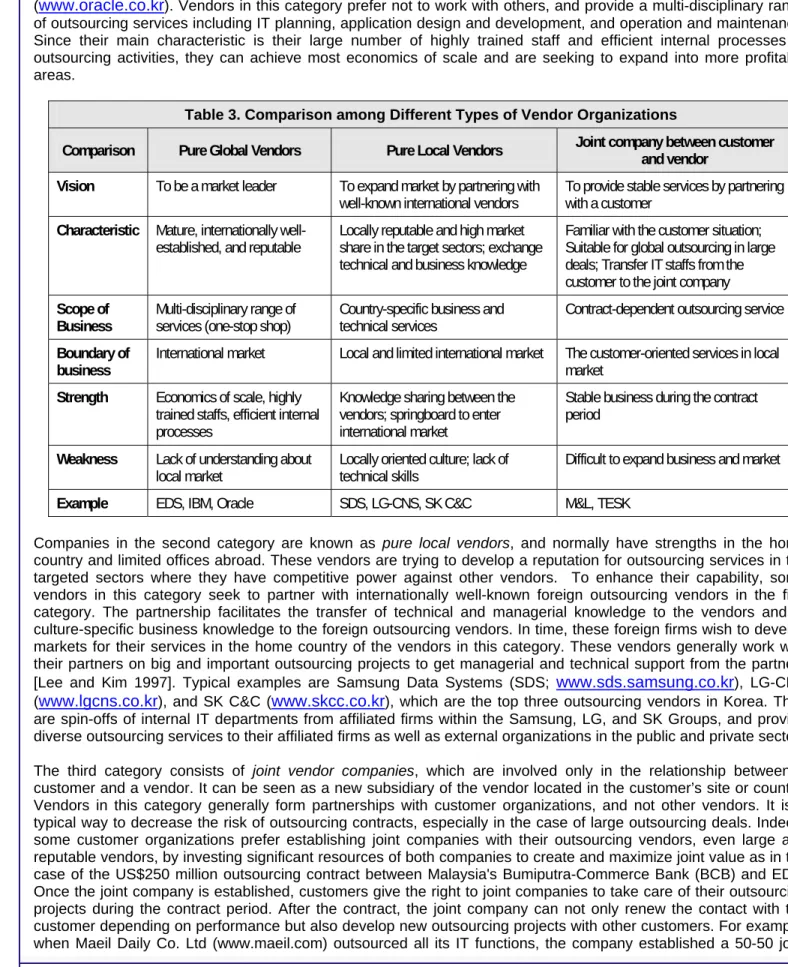
According to case studies based on the 15 IT companies in Korea, the different formations of vendor organizations are divided into three different categories—pure global vendors, pure local vendors, and joint companies between a customer and a vendor—as shown in Table 3. This classification may not be a concern for customers who seek competent outsourcing vendors, but it aids in identifying the origin of vendor organizations, predicts their
574
Volume 22 Article 31
current and future market positions, and understands their internal communication processes for the existing and potential outsourcing projects. Table 3 provides the overview of the three different types of vendor organizations. Companies in the first category are called pure vendor companies, which have no issues of financial interests with other vendors and customers. Generally, they are already well-established and mature, with developed international capabilities such as EDS Korea (www.edskorea.ac.kr), IBM Korea (www.ibm.com/kr), and Oracle Korea
(www.oracle.co.kr). Vendors in this category prefer not to work with others, and provide a multi-disciplinary range
of outsourcing services including IT planning, application design and development, and operation and maintenance. Since their main characteristic is their large number of highly trained staff and efficient internal processes of outsourcing activities, they can achieve most economics of scale and are seeking to expand into more profitable areas.
Table 3. Comparison among Different Types of Vendor Organizations
Comparison Pure Global Vendors Pure Local Vendors Joint company between customer and vendor Vision To be a market leader To expand market by partnering with
well-known international vendors To provide stable services by partnering with a customer
Characteristic Mature, internationally
well-established, and reputable Locally reputable and high market share in the target sectors; exchange technical and business knowledge
Familiar with the customer situation; Suitable for global outsourcing in large deals; Transfer IT staffs from the customer to the joint company
Scope of
Business Multi-disciplinary range of services (one-stop shop) Country-specific business and technical services Contract-dependent outsourcing service
Boundary of
business International market Local and limited international market The customer-oriented services in local market
Strength Economics of scale, highly trained staffs, efficient internal processes
Knowledge sharing between the vendors; springboard to enter international market
Stable business during the contract period
Weakness Lack of understanding about
local market Locally oriented culture; lack of technical skills Difficult to expand business and market
Example EDS, IBM, Oracle SDS, LG-CNS, SK C&C M&L, TESK
Companies in the second category are known as pure local vendors, and normally have strengths in the home country and limited offices abroad. These vendors are trying to develop a reputation for outsourcing services in the targeted sectors where they have competitive power against other vendors. To enhance their capability, some vendors in this category seek to partner with internationally well-known foreign outsourcing vendors in the first category. The partnership facilitates the transfer of technical and managerial knowledge to the vendors and of culture-specific business knowledge to the foreign outsourcing vendors. In time, these foreign firms wish to develop markets for their services in the home country of the vendors in this category. These vendors generally work with their partners on big and important outsourcing projects to get managerial and technical support from the partners [Lee and Kim 1997]. Typical examples are Samsung Data Systems (SDS; www.sds.samsung.co.kr), LG-CNS
(www.lgcns.co.kr), and SK C&C (www.skcc.co.kr), which are the top three outsourcing vendors in Korea. They
are spin-offs of internal IT departments from affiliated firms within the Samsung, LG, and SK Groups, and provide diverse outsourcing services to their affiliated firms as well as external organizations in the public and private sectors. The third category consists of joint vendor companies, which are involved only in the relationship between a customer and a vendor. It can be seen as a new subsidiary of the vendor located in the customer’s site or country. Vendors in this category generally form partnerships with customer organizations, and not other vendors. It is a typical way to decrease the risk of outsourcing contracts, especially in the case of large outsourcing deals. Indeed, some customer organizations prefer establishing joint companies with their outsourcing vendors, even large and reputable vendors, by investing significant resources of both companies to create and maximize joint value as in the case of the US$250 million outsourcing contract between Malaysia's Bumiputra-Commerce Bank (BCB) and EDS. Once the joint company is established, customers give the right to joint companies to take care of their outsourcing projects during the contract period. After the contract, the joint company can not only renew the contact with the customer depending on performance but also develop new outsourcing projects with other customers. For example, when Maeil Daily Co. Ltd (www.maeil.com) outsourced all its IT functions, the company established a 50-50 joint
Volume 22 Article 31
575 venture called M&L with its outsourcing vendor, Linkware (www.linkware.co.kr). Another example in this category
is TESK that is a joint venture between two vendors—SK C&C and TELES Communication Systems—and SK Telecom.
Components of the Vendor Organization
The next step in understanding vendor organizations is to identify the components of communication within their organizations for the existing and potential outsourcing projects. According to multiple case studies conducted, regardless of the type of vendor organization and the scope of work, the internal management structure of most outsourcing vendors are matrix- or project-based to efficiently handle diverse customers’ needs in different outsourcing projects. Although bigger outsourcing vendors have more components in their organizational structure, all vendors have at least three main parts, which include a review board (to check if an outsourcing project is feasible and profitable), an enterprise outsourcing support group (as a group of independent teams in a cost-center division), and an actual project group for the existing and potential outsourcing projects (under the supervision of a profit-center division). The overall structure of the vendor organization is shown in Figure 1.
Actually, these three parts are interrelated as a hierarchical structure within a vendor organization. The project team in a particular division is the lowest level in a direct channel to communicate with and support a particular customer, periodically reporting the progress of the outsourcing project to the enterprise outsourcing support team. Then, the enterprise outsourcing support team reviews the status of the project based on the report provided by the project team, and asks help and advice from the review board in the parent organization whenever necessary. The ultimate objective of the project-based structure is to provide an efficient and effective communication mechanism between customer and vendor, as well as between interested parties inside the vendor organization.
Management Executives Management Division Review Board (for outsourcing) Review Board (for outsourcing) Division A (e.g., banking) Division B (e.g., manufacturing) Enterprise outsourcing support team Enterprise outsourcing support team …. Project Team (for outsourcing) Project Team
(for outsourcing) (for outsourcing)Project Team
Project Team
(for outsourcing)
Cost Center Profit Center
* Bold boxes are directly related to outsourcing projects
Figure 1. Three Major Parts of the Vendor Organizational Structure
The role of the review board in the parent organization is to evaluate whether or not the vendor can deliver the value to the customer in the given situation and to decide whether or not a particular outsourcing project is realizable and acceptable. The review board can physically exist at a vendor’s headquarters in a local (for pure local vendor companies) or international office (for pure global vendors or joint vendor companies). Generally, the members of the review board are the president, vice-president(s), a financial manager, leaders of all existing divisions, and an internal or external lawyer(s). As the size of vendor organizations increases, more members are involved in the review board. It is normal that there is only one review board in most vendor organizations, but there can be more than one depending on the size of the vendor organization and the service diversity covered by the vendor.
The second component of the vendor organization is the enterprise outsourcing support group. The main role of the group is to provide standards, guidelines, and objective opinions on the overall outsourcing processes for all existing project teams. The group generally exists in the form of an independent team in the cost center of vendor organization (for example, R&D center), and sets up internal policies, rules, and checkpoints based on their experience in previous outsourcing projects. Thus, the actual name of the team can vary, such as quality control
576
Volume 22 Article 31
team, quality assurance team, standardization team, outsourcing task force team, and so on. In the case of big vendors, the enterprise outsourcing support group can be a general umbrella term, covering all above-mentioned teams. Since the team plays a critical role in the process of outsourcing, only professionals having enough practical experience with IT-related projects are eligible to be members of the team.
The final component of the vendor organization is called the project group. There can be several project teams in any division of the profit center at any given time. For example, a banking division in a vendor organization can recognize several potential outsourcing customers simultaneously and launch several project teams to support each customer independently, but all project teams are under the control of one division leader. In addition, a manufacturing division in the same vendor can have one or more project teams, if necessary. The main role of the group is to discover market opportunities, to provide customers’ needs before and after their outsourcing decisions, and to persuade customers that the vendor is the best choice for outsourcing. Since these activities are essential, effective responses to customers’ requests are very critical. The best way to properly perform these activities is to organize the project group with competent members who are specialists in the customers’ business. The qualifications of a project executive in terms of both technical and administrative roles should be carefully considered.
III. A VENDOR’S PROCESS MODEL IN IT OUTSOURCING
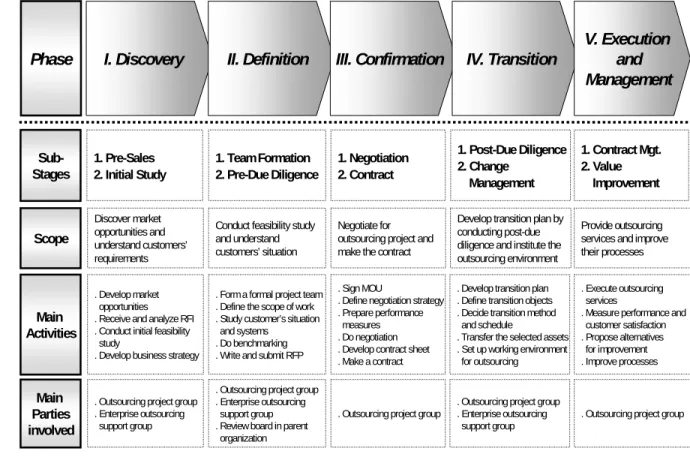
It has been said that the benefits from outsourcing can be maximized when the customer and vendor understand each other’s situation. Though some outsourcing process models from the customer’s viewpoint have been proposed, there is no framework and model for understanding the outsourcing process from the perspective of the vendor. This study analyzed actual vendors’ outsourcing processes, and combined them into a general outsourcing process model that addresses the key steps and concerns of the entire process from beginning to end, as depicted in Figure 2. It should be pointed out that this model was created using information compiled by the author. He interviewed IT managers in 15 outsourcing vendors and participated in 10 domestic and international as well as small and big outsourcing cases from 1991 to 2001 when he was still a manager for a major outsourcing vendor in Korea. Moreover, whenever necessary, the author asked the vendors to provide their documentaries such as outsourcing manuals and final reports of outsourcing projects.
I. Discovery II. Definition III. Confirmation IV. Transition
V. Execution and Management 1. Pre-Sales 2. Initial Study 1. Team Formation 2. Pre-Due Diligence 1. Negotiation 2. Contract 1. Post-Due Diligence 2. Change Management 1. Contract Mgt. 2. Value Improvement Phase Sub-Stages . Develop market opportunities . Receive and analyze RFI . Conduct initial feasibility
study
. Develop business strategy
. Form a formal project team . Define the scope of work . Study customer’s situation
and systems . Do benchmarking . Write and submit RFP
. Sign MOU
. Define negotiation strategy . Prepare performance
measures . Do negotiation . Develop contract sheet . Make a contract
. Develop transition plan . Define transition objects . Decide transition method
and schedule
. Transfer the selected assets . Set up working environment
for outsourcing
. Execute outsourcing services
. Measure performance and customer satisfaction . Propose alternatives for improvement . Improve processes Main Activities
. Outsourcing project group . Enterprise outsourcing
support group
. Outsourcing project group . Enterprise outsourcing
support group . Review board in parent
organization
. Outsourcing project group . Outsourcing project group. Enterprise outsourcing support group
. Outsourcing project group
Main Parties involved Discover market opportunities and understand customers’ requirements
Conduct feasibility study and understand customers’ situation
Negotiate for outsourcing project and make the contract
Develop transition plan by conducting post-due diligence and institute the outsourcing environment
Provide outsourcing services and improve their processes
Scope
Figure 2. Overall Picture of the Vendor’s Outsourcing Process Model
The vendor’s outsourcing process model is composed of five phases: 1) discovery, 2) definition, 3) confirmation, 4) transition, and 5) execution and management. Figure 2 shows the overall picture of the process model in terms of scope, main activities, and main parties involved. As described in the previous section, the components involved
Volume 22 Article 31
577 in this process are the review board in the parent organization, the enterprise outsourcing support group (its
manager and staff), and the outsourcing project group (project executive and members). Each phase in the process model should be performed by considering the next phase, which means that the success of each phase is dependent on the preceding ones.
The vendor’s outsourcing process model displays how an outsourcing project starts from the customer’s intention in the discovery phase, then sequentially goes through the definition, confirmation, and transition phases. Eventually it reaches the end point as it goes to the execution and management phase. Each phase can be further divided into two sub-stages in terms of the distinct nature of the work in the process. The efficiency of the whole process comes from intimate communication and cooperation between the vendor (its divisions, departments, teams, and individuals), the parent firm of the vendor, and the customer organization. We will explain the details of each phase in the following section.
Phase I: Discovery
Most of the outsourcing managers interviewed emphasized the importance of the selection process of appropriate outsourcing projects at the beginning of the outsourcing process. Although vendors can identify potential customers who plan to outsource their IT functions and/or assets, it is difficult to identify feasible and profitable outsourcing projects. While some customers consider outsourcing as a panacea to solve all IT-related problems, without clear outsourcing objectives, they have high expectation in outsourcing projects. In this case, vendors are asked to deliver excessive outsourcing services in a limited budget, which can result in the failure of such projects. Therefore, conducting the screening process of appropriate projects, which is called the discovery phase, is extremely necessary.
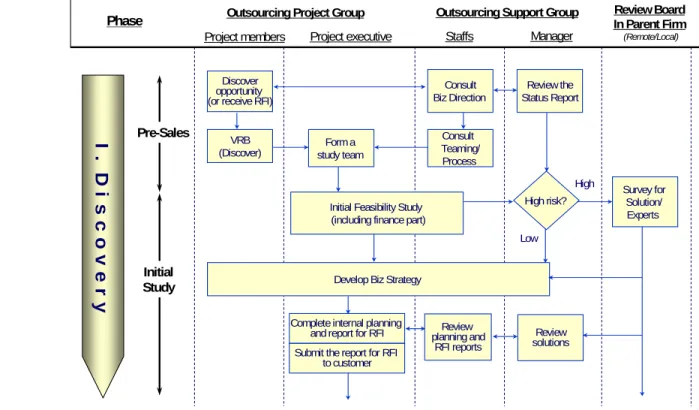
The purpose of the discovery phase is not only to identify potential outsourcing projects but also to evaluate whether they are feasible and acceptable. It is important for vendors to choose appropriate outsourcing projects that have low-risk and high business impact. In the discovery phase, there are two stages: pre-sales and initial study (refer to Figure 3). For the pre-sales, on one hand, the project group collects market information as well as existing and potential customers’ demands in the process of marketing activities and daily communications. By filtering, organizing, and summarizing them, the project group can discover future business opportunities. On the other hand, the project group can directly receive the Request for Information (RFI) from customers who plan to outsource their IT functions. The business opportunity discovered and the RFI are transferred to the enterprise outsourcing support group. The staff in the outsourcing support group makes a judgment on the possibility of the potential outsourcing project and direction of this business opportunity, and then submits the status report to the manager of the enterprise outsourcing support group. In the meantime, the staff gives its opinion on how to organize a proper team and what processes should be followed for the potential outsourcing project. This opinion together with the opinion from the Value Review Board (VRB) in the project group leads to the formation of a study team for the outsourcing project.
578 Volume 22 Article 31 Staffs Review Board In Parent Firm (Remote/Local) Phase
I . D
i s
c o
v e r
y
Discover opportunity (or receive RFI)VRB (Discover) Consult Biz Direction Review the Status Report Form a study team
Develop Biz Strategy Initial Feasibility Study (including finance part)
High risk? Survey for Solution/ Experts
Complete internal planning and report for RFI
Consult Teaming/ Process Pre-Sales Initial Study High Low
Submit the report for RFI to customer Review planning and RFI reports Review solutions Manager
Outsourcing Support Group Outsourcing Project Group
Project members Project executive
Figure 3. The First Phase of the Vendor’s Outsourcing Process Model
The second stage is an initial study on the project. The project group starts with the initial feasibility study in terms of organizational, technical, and financial issues. The feasibility report is delivered again to the enterprise outsourcing support group for the purpose of risk analysis based on the company’s own resources and capabilities. If the analysis shows that it is a high-risk project for the vendor company, the manager of the outsourcing support group hands in the analysis results to the review board in the parent organization, located either remotely or locally, for further study. He then leaves it to them to come to a decision as to whether or not the outsourcing project is feasible. If the analysis results show that the project is low-risk, the next step would be to develop an outsourcing business strategy on the basis of the initial feasibility study. Even for a low-risk project, the parent organization steps in to aid and develop the business strategy. The strategy formulation comes from the cooperation between the project team, the enterprise outsourcing support group, and the review board in the parent organization. Once the business strategy is developed, the project group should complete the internal planning and the report according to the RFI from the customer. Then, this document is sent to the enterprise outsourcing support group for review. The discovery phase ends when the project group submits the report for the RFI to the customer after obtaining the opinions from the enterprise outsourcing support group and the parent organization.
Phase II: Definition
The goal of the definition phase is for the vendor organization to collect and analyze the customer’s information and situation in order to form and launch a formal outsourcing project group which can successfully support the customer’s outsourcing requirements. According to the interviews conducted with them, all vendor organizations have their own outsourcing process models. They recognize that it is crucial for them to understand the customers’ outsourcing requirements in the early stage of the outsourcing process. To do so, the effective communication among the internal groups in the vendor organization and between the vendor and its customer is a necessary condition.
From the interviews we conducted, a few vendor managers highlighted the miscommunication issue among the internal groups in their organization. For instance, a particular vendor company makes an agreement with some of the internal team managers from the outsourcing project team without the other internal team managers’ knowing of such decisions being agreed upon. The unknowing team managers will only learn of such agreement when they assign to other projects the team members who are responsible for such agreement. This will now result in a few months’ delay in the project as the vendor would have to meet again with the responsible internal teams in order to form a new formal outsourcing team. Such problem and delay could have been avoided with an effective and official communication process in the organization.
Volume 22 Article 31 579
I I . D
e
f
i n
i t
i o
n
Study customer’s situation/systems Benchmarking Report for feasibility study Develop and submit proposal Support for Outsourcing Process Check the Project Status Request further information to customer Review the Status Report Arrange/Guide for parent firmtour Provide failure and success stories Pre-due Diligence Discover Opportunity (or receive RFP) VRB (Discover) Kick-off of internal formal team Assign Experts Assign
Team Staffs Experts?Approve Team Formation Yes Staffs Review Board In Parent Firm (Remote/Local) Phase Manager
Outsourcing Support Group Outsourcing Project Group
Project members Project executive
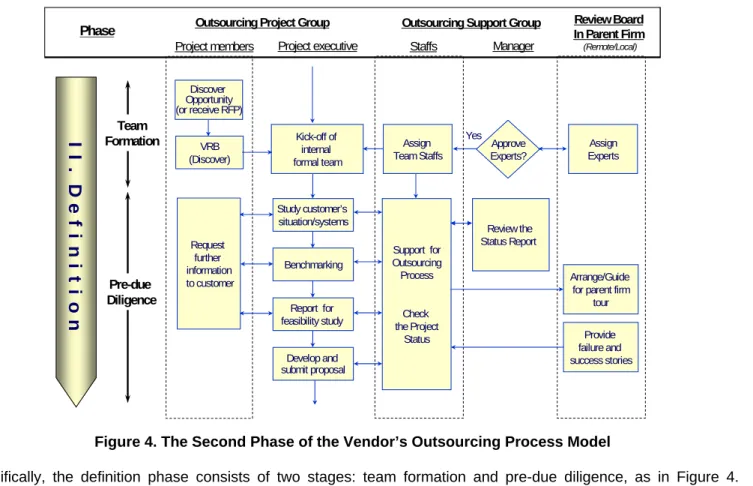
Figure 4. The Second Phase of the Vendor’s Outsourcing Process Model
Specifically, the definition phase consists of two stages: team formation and pre-due diligence, as in Figure 4. Similarly, after submitting the report for the RFI to the customer, the outsourcing project group continues to work and communicate with the customer. They also learn the customer’s specific needs and requirements, and then try to discover further business opportunities. On some occasions, the customer proposes their requirements directly in the form of the Request for Proposal (RFP). After receiving the RFP from the customer, the group transfers it to the VRB, which discovers the opportunity and passes their conclusion to the outsourcing support group Usually, the review board in the parent firm or the outsourcing support group assigns internal and/or external experts to support the project process, especially when the project group itself does not have enough capability to handle the issues raised by the customer at this stage. This action, however, must first obtain the approval of the parent organization through the outsourcing support group. That means, the outsourcing support group assigns proper members, who have specialties in accordance with the specific requirements of the customer, to the group, and then launches a formal project group. The internal formal group begins to officially operate for this outsourcing project.
During the pre-due diligence stage, the project group usually goes to a customer site(s) and works together with the project-related employees in the customer company. The project group studies the customer’s situation and the systems in use, identifies their needs in detail, does benchmarking, and reports the results of the pre-due diligence study to the outsourcing support group as well as the customer. This process requires harmonious communication in multiple ways: the project group tries to get further information about the customer; then such information is sent back to the manager of the project group for the purpose of developing and submitting the project proposal. To facilitate the smooth development of the proposal, the group should communicate continually with the outsourcing support group who supports the process of the pre-due diligence and checks the status of the project. Then, the status should be periodically reported to the review board in the parent organization. The parent organization can arrange for a tour of the parent firm for the customer, if needed, further supporting the process of the pre-due diligence by providing valuable information from the previous failed and successful outsourcing projects.
Phase III: Confirmation
The importance of negotiation and contract has been much emphasized by all interviewees. Customers generally try to get more services from their outsourcing vendors within the limited budget and ask higher service level through negotiation than vendors expect. Therefore, if a vendor does not have specific negotiation strategy in terms of service, price and quality, it would result in providing excessive outsourcing services to customers and signing an unacceptable contract.
One interviewee explained a bad experience in the negotiation process with a customer in the telecommunication industry. After the outsourcing vendor agreed to provide services to a telecommunication company, the vendor
580
Volume 22 Article 31
began to negotiate for the service level agreement with the customer. However, the vendor’s outsourcing project team did not have any negotiation strategy because it had no prior experience on similar projects. The result of the negotiation was they accepted most of the customer’s requirements and expectations. The vendor’s outsourcing project team went back to the parent firm with the result of the contact, but unfortunately the parent firm rejected the contract. As a result, the contract was cancelled and the vendor paid the penalty for breaking the contract.
On the other hand, some interviewees experienced efficient negotiation and contract process with their customers. For example, a contract with a customer in the financial industry was negotiated in less than a month. For the contract, the vendor and its customer had their own negotiation strategies in terms of service level, price, and contract period. Furthermore, both agreed with critical success factors of the project and provided potential win-win scenarios to each other. Due to the well-prepared negotiation process, it took a month to finalize the contract and both parties were happy with it.
In sum, the key is that vendors need to plan the negotiation in detail. They would only be able to do this by understanding customers’ outsourcing objectives and providing appropriate guidelines about the contract to customers, which can shorten the period of the negotiation and contract.
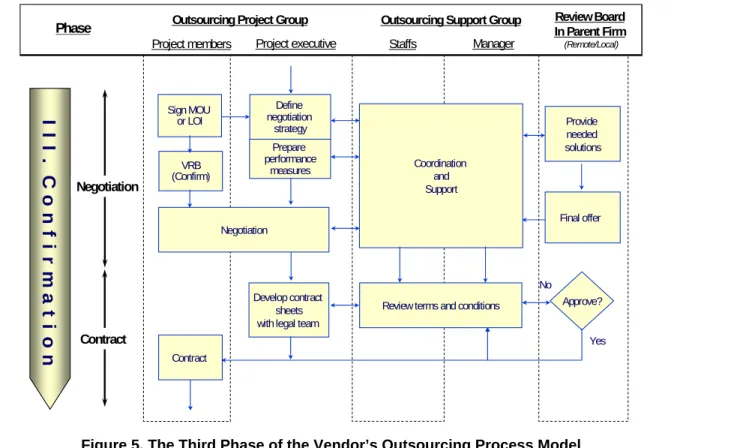
The confirmation phase proposed in this study is composed of two main stages, defined as negotiation and contract, as shown in Figure 5. Since the outsourcing project group has worked with the customer, collected sufficient information on this project, and developed the project proposal, it is time for the vendor to confirm this deal with the customer. To do so, based on the previous work, the project group asks the customer to sign the Memorandum of Understanding (MOU) and/or Letter of Intent (LOI), and passes them to the VRB for confirmation. With the MOU and/or LOI, the project executive in the project group not only defines the negotiation strategy but also prepares draft performance measures such as service level, customer satisfaction, and so on. Then, the project group members and executive begin to negotiate with the customer in order to come up with an agreement on the details like price, quality, delivery, payment, post-sale service, and others. During the process, the outsourcing support group acts as a coordinator between the project group and the parent firm. Here, the parent organization may provide managerial and technical solutions required by the customer in the negotiation stage and give the final offer or decision to the project group through the outsourcing support group.
In the contract stage of the confirmation phase, the project group develops a contract sheet with the help of a legal team in the vendor company. The legal team working with the project group provides assurance that the outsourcing contract is legitimate and operational in practice. Also, the manager and staff of the outsourcing support group review the terms and conditions of the contract sheet developed by the project group (sometimes a template of the contract sheet is provided by the outsourcing support group), and then hands it in to the parent firm for approval, provided that the outsourcing project is under the supervision of the parent firm. If the parent firm accepts the contract sheet, the project group can sign the contract with the customer. Otherwise, the contract sheet should be returned to the outsourcing support group for further review and revision.
Volume 22 Article 31 581 Coordination and Support Negotiation Develop contract sheets with legal team Contract
Review terms and conditions Define negotiation strategy Final offer Sign MOU or LOI VRB (Confirm) Provide needed solutions
I I I . C
o
n
f
i r m
a t i o
n
Negotiation Contract Prepare performance measures Approve? No Yes Staffs Review Board In Parent Firm (Remote/Local) Phase ManagerOutsourcing Support Group Outsourcing Project Group
Project members Project executive
Figure 5. The Third Phase of the Vendor’s Outsourcing Process Model
Phase IV: Transition
The goal of the transition phase is to clearly define the transition plan and to smoothly conduct the actual transition by considering issues related to the change of management. This phase is really important especially when any asset, such as IT staff, hardware, and software, are involved in the transition. An interviewee who joined a big outsourcing project of a manufacturing company described the situation when his company contracted with the manufacturing company to transfer all IT staff. However, the problem was that the manufacturing company did not inform the IT staff about the deal prior to signing the contract. Thus, it received tremendous resistance from the IT staff. In this situation, the vendor company was asked to persuade the IT staff. As the vendor company had a well-defined transition process based on prior outsourcing experiences, it knew how to deal with the problem. First, the vendor company had several formal and informal meetings with the manufacturing company to discuss the transition approach. Second, the vendor company invited the IT staff to its data center for a tour and presented the company’s business activities and performance. Finally, the vendor company asked the customer to announce an open-door policy to the IT staff so that the manufacturing company conducted a one-to-one meeting and explained the pros and cons of the transfer to the IT staff. These activities were very successful in that most IT people had willingness to join the vendor company. It is a success story regarding the IT staff’s transition due to the vendor’s efficient transition process and its contingency plan.
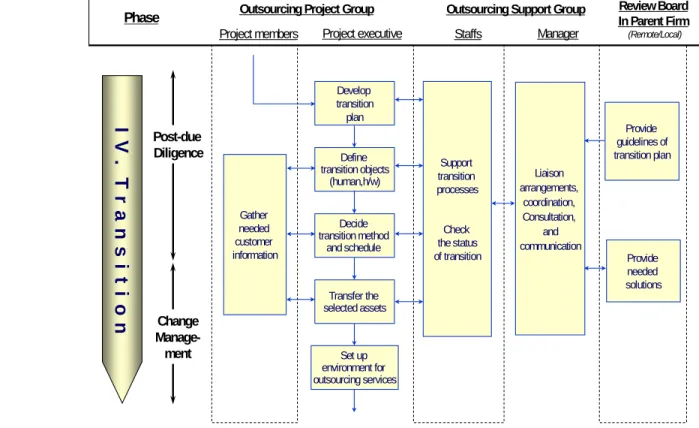
The transition phase, as shown in Figure 6, has two main stages: post-due diligence and change management. After making the contract, the outsourcing project group begins to actually be engaged in the project. In the post-due diligence stage, the project group develops a transition plan based on the contract with the customer. To make the appropriate transition plan, it is required for the project group to go to the customer company once again to confirm the previously defined customer situation and needs and to further analyze whether the customer has any additional requirements.
Once the customer’s needs are updated, the project group defines transition objects such as human resources, hardware, software, and so on. Furthermore, the transition method and the schedule appropriate for the given situation of the customer company should be decided. During this stage, the outsourcing support group helps the project group in completing the transition processes, and checks their status periodically to make sure that everything goes successfully. At the same time, the review board in the parent firm provides guidelines to the outsourcing support group concerning the finalization of the transition plan and the needed solutions. Meanwhile, the manager of the outsourcing support group takes responsibility for liaison arrangements, coordination, consultation, and communication between the parent firm and the staff of the outsourcing support group.
582 Volume 22 Article 31
I
V
.
T
r
a
n
s
i t
i o
n
Develop transition plan Define transition objects (human,h/w) Decide transition method and schedule Transfer the selected assets Support transition processes Check the status of transition Gather needed customer information Liaison arrangements, coordination, Consultation, and communication Provide guidelines of transition plan Set up environment for outsourcing services Provide needed solutions Post-due Diligence Change Manage-ment Staffs Review Board In Parent Firm (Remote/Local) Phase ManagerOutsourcing Support Group Outsourcing Project Group
Project members Project executive
Figure 6. The Fourth Phase of the Vendor’s Outsourcing Process Model
Passing through the post-due diligence stage, the project group encounters issues related to the change of management. The selected transition assets should eventually be transferred to the vendor. However, it does not mean the end for the outsourcing project. It is very likely that some unexpected events will happen, which will not only hamper the transition process but also affect the operation and the final performance. Therefore, one of the major tasks by the project group at this stage is to pay close attention to the transition process and to manage any changes that will take place. One of major issues in this stage is to maintain multiple environments. For instance, some customers want to maintain existing environments while engaging the vendor to develop, implement, and maintain new systems. Therefore, the project group is required to ramp up as many additional resources as necessary in order to implement a new working environment. In this process, all information involved in the change management stage, as well as in those activities of post-due diligence stage, should be shared with all components of the vendor organization so as to enrich the profiling of the customer and in turn refine the transition activity. Phase V: Execution and Management
The purpose of this phase is not only to execute the outsourcing services but also to find a way to improve the quality of the current outsourcing services. The actual outsourcing benefits can be realized in this phase, although it depends on how well previous phases are defined. Moreover, as most of interviewees mentioned, the performance of this phase is critical for vendors because it could be used as an input when the customer assesses outsourcing performance and decides contract renewal with the current vendor.
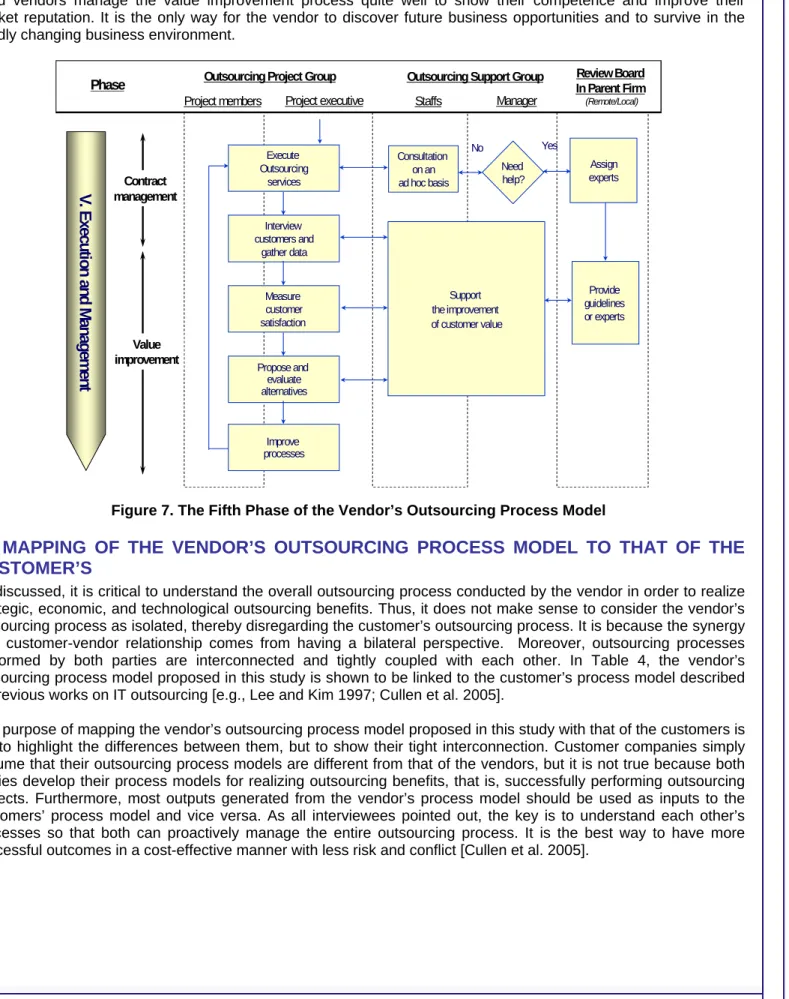
The execution and management, as the last phase of the vendor’s outsourcing process model and the starting phase of a new outsourcing project, contains two stages: contract management and value improvement, as shown in Figure 7. Following the task of setting up, the outsourcing project group begins to execute the services according to the contract. In the process of managing the contract, the project group should make a judgment on whether or not the execution process needs help from internal and/or external professionals. If the project executive thinks that the project group does need help, she/he can ask the parent organization through the outsourcing support group to find and assign experts in the particular area. If no help is needed, the consultation and execution of the outsourcing project by the current project group should be enough. At this stage, the outsourcing contract is carried out. The project team executes the services with the hope that everything will go well as planned.
In the following stage, value improvement, which is indeed a vital stage throughout the outsourcing process, the project group interviews the customer’s employees, gathers opinion data, measures the degree of customer satisfaction and the level of outsourcing service. Afterward, the group proposes and evaluates alternatives that can improve the efficiency and effectiveness of the outsourcing service. The purpose of this stage is to find a way to
Volume 22 Article 31
583 improve the quality of service. As an effort to satisfy the customer, the parent firm can provide validated guidelines
or dispatch required experts to the project group. The outsourcing support group, as a mediator of the parent firm and the project group, takes the responsibility of supporting the project group in the process of improving customer value. The improving processes should be repetitive until the level of customer satisfaction is achieved. Typically, good vendors manage the value improvement process quite well to show their competence and improve their market reputation. It is the only way for the vendor to discover future business opportunities and to survive in the rapidly changing business environment.
V. Execut io n a nd Manage men t Execute Outsourcing services Interview customers and gather data Measure customer satisfaction Propose and evaluate alternatives Improve processes Contract management Value improvement Provide guidelines or experts Support the improvement of customer value Consultation on an ad hoc basis Assign experts Need help? No Yes Staffs Review Board In Parent Firm (Remote/Local) Phase Manager
Outsourcing Support Group Outsourcing Project Group
Project members Project executive
Figure 7. The Fifth Phase of the Vendor’s Outsourcing Process Model
IV. MAPPING OF THE VENDOR’S OUTSOURCING PROCESS MODEL TO THAT OF THE
CUSTOMER’S
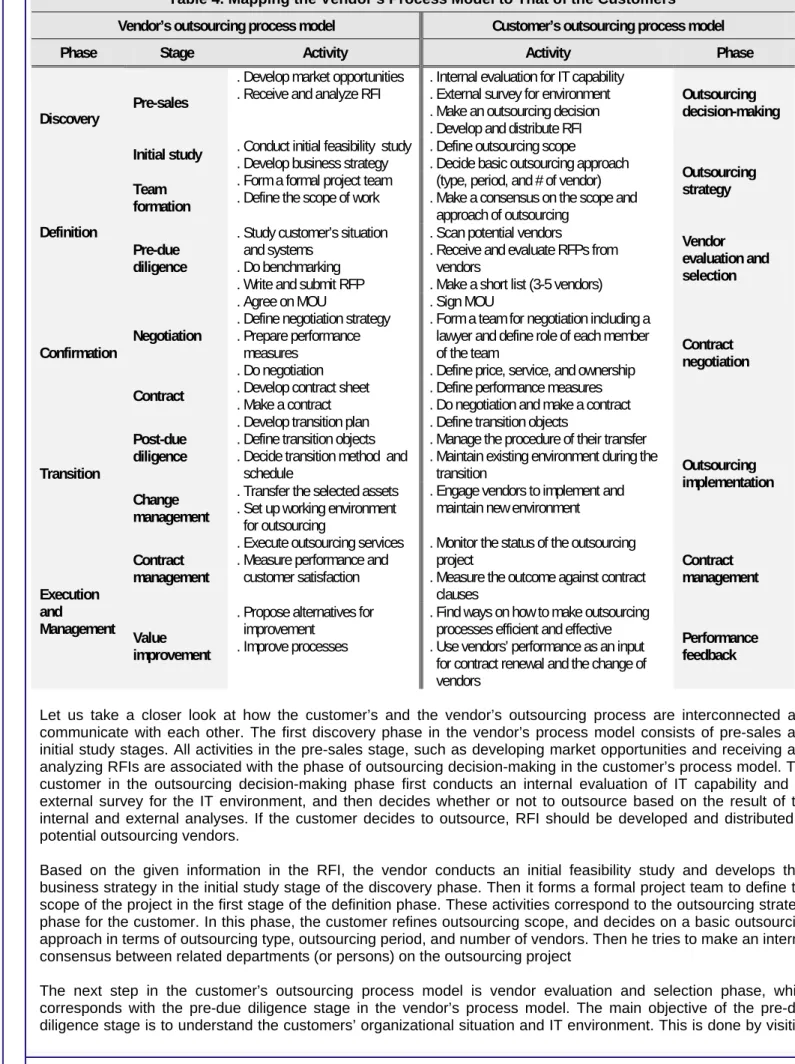
As discussed, it is critical to understand the overall outsourcing process conducted by the vendor in order to realize strategic, economic, and technological outsourcing benefits. Thus, it does not make sense to consider the vendor’s outsourcing process as isolated, thereby disregarding the customer’s outsourcing process. It is because the synergy in a customer-vendor relationship comes from having a bilateral perspective. Moreover, outsourcing processes performed by both parties are interconnected and tightly coupled with each other. In Table 4, the vendor’s outsourcing process model proposed in this study is shown to be linked to the customer’s process model described in previous works on IT outsourcing [e.g., Lee and Kim 1997; Cullen et al. 2005].
The purpose of mapping the vendor’s outsourcing process model proposed in this study with that of the customers is not to highlight the differences between them, but to show their tight interconnection. Customer companies simply assume that their outsourcing process models are different from that of the vendors, but it is not true because both parties develop their process models for realizing outsourcing benefits, that is, successfully performing outsourcing projects. Furthermore, most outputs generated from the vendor’s process model should be used as inputs to the customers’ process model and vice versa. As all interviewees pointed out, the key is to understand each other’s processes so that both can proactively manage the entire outsourcing process. It is the best way to have more successful outcomes in a cost-effective manner with less risk and conflict [Cullen et al. 2005].
584
Volume 22 Article 31
Table 4. Mapping the Vendor’s Process Model to That of the Customers’
Vendor’s outsourcing process model Customer’s outsourcing process model
Phase Stage Activity Activity Phase
Pre-sales
. Develop market opportunities
. Receive and analyze RFI . Internal evaluation for IT capability . External survey for environment . Make an outsourcing decision . Develop and distribute RFI
Outsourcing decision-making Discovery
Initial study . Conduct initial feasibility study . Develop business strategy Team
formation
. Form a formal project team . Define the scope of work
. Define outsourcing scope
. Decide basic outsourcing approach (type, period, and # of vendor) . Make a consensus on the scope and approach of outsourcing Outsourcing strategy Definition Pre-due diligence
. Study customer’s situation and systems
. Do benchmarking . Write and submit RFP
. Scan potential vendors
. Receive and evaluate RFPs from vendors
. Make a short list (3-5 vendors)
Vendor evaluation and selection
Negotiation
. Agree on MOU
. Define negotiation strategy . Prepare performance measures
. Do negotiation
Confirmation
Contract . Develop contract sheet . Make a contract
. Sign MOU
. Form a team for negotiation including a lawyer and define role of each member of the team
. Define price, service, and ownership . Define performance measures . Do negotiation and make a contract
Contract negotiation
Post-due diligence
. Develop transition plan . Define transition objects . Decide transition method and schedule
Transition
Change management
. Transfer the selected assets . Set up working environment for outsourcing
. Define transition objects
. Manage the procedure of their transfer . Maintain existing environment during the transition
. Engage vendors to implement and maintain new environment
Outsourcing implementation
Contract management
. Execute outsourcing services . Measure performance and customer satisfaction
. Monitor the status of the outsourcing project
. Measure the outcome against contract clauses Contract management Execution and Management Value improvement
. Propose alternatives for improvement
. Improve processes
. Find ways on how to make outsourcing processes efficient and effective . Use vendors’ performance as an input for contract renewal and the change of vendors
Performance feedback
Let us take a closer look at how the customer’s and the vendor’s outsourcing process are interconnected and communicate with each other. The first discovery phase in the vendor’s process model consists of pre-sales and initial study stages. All activities in the pre-sales stage, such as developing market opportunities and receiving and analyzing RFIs are associated with the phase of outsourcing decision-making in the customer’s process model. The customer in the outsourcing decision-making phase first conducts an internal evaluation of IT capability and an external survey for the IT environment, and then decides whether or not to outsource based on the result of the internal and external analyses. If the customer decides to outsource, RFI should be developed and distributed to potential outsourcing vendors.
Based on the given information in the RFI, the vendor conducts an initial feasibility study and develops their business strategy in the initial study stage of the discovery phase. Then it forms a formal project team to define the scope of the project in the first stage of the definition phase. These activities correspond to the outsourcing strategy phase for the customer. In this phase, the customer refines outsourcing scope, and decides on a basic outsourcing approach in terms of outsourcing type, outsourcing period, and number of vendors. Then he tries to make an internal consensus between related departments (or persons) on the outsourcing project
The next step in the customer’s outsourcing process model is vendor evaluation and selection phase, which corresponds with the pre-due diligence stage in the vendor’s process model. The main objective of the pre-due diligence stage is to understand the customers’ organizational situation and IT environment. This is done by visiting
Volume 22 Article 31
585 the customer site and working together with the people in the customer company, so that the vendor can develop a
competent proposal of the RFP. What the customer does in the vendor evaluation and selection is to scan potential vendors, to receive and evaluate the proposal from vendors, and then to make a short list of three to five candidates. Depending on the outsourcing strategy decided on in the strategy phase, the customer can select one or more vendors in the list.
Once the customer selects the best vendor(s), the process of defining the dynamics of the outsourcing relationship begins in the contract negotiation phase. This phase matches with the confirmation phase in the vendor’s process model. In this phase, both the customer and the selected vendor sign the MOU, define performance measures, develop the terms and conditions of the contract, and finalize the contract through negotiation. The customer should form a negotiation team, defining each member’s role, whereas the vendor internally develops its negotiation strategy to ensure that the negotiation process is carried out in a reasonable manner.
Then, the customer and vendor need to prepare a rollout plan and a schedule for implementing the transition of the selected objects. They also have to set up working environments for outsourcing services in both the transition phase of the vendor’s process model and the outsourcing implementation phase of the customer’s process model. The main activity in this phase is the development and implementation of the new working environment through the transition, but the more important activity is to maintain the existing environment during the transition by minimizing the impact of the new environment. Thus, maintaining multiple environments is critical. Its success is dependent on the level of understanding of the customer’s business requirements at the time of contract signing.
The final phase in the vendor’s process model is to manage the contract and to improve the value of the customer through outsourcing. This is related to the contract management and performance feedback in the customer’s process model. On one hand, during the contract management, the vendor executes outsourcing services, and then measures the level of service performance and customer satisfaction, while the customer monitors the status of the outsourcing project based on contract terms using the outsourcing outcome given by the vendor as well as that which is measured by the customer itself. On the other hand, the measured performance is applied iteratively to the feedback process. If the level of performance is not acceptable, the vendor should investigate the process and propose alternatives to improve the efficiency and effectiveness of the services. The customer must work closely with the vendor in this process as a decision maker for any issue that may arise. From the long-term perspective, the measured performance can be a major input into the contract renewal decision or to the change of strategy (for example, from total outsourcing to selective outsourcing). Also, depending on the result of the outsourcing, the customer can consider insourcing again.
V. DISCUSSION AND CONCLUSIONS
This paper presents an overview of the outsourcing process from the vendor’s point of view. We argue that as the increasing use of outsourcing is inevitable in today’s dynamic business environment, an understanding of the outsourcing process from the customer’s and vendor’s perspectives is necessary to maintain a good business relationship and to reap better outsourcing benefits. The paper addresses two main issues from the vendors’ side: one is to understand the nature of the outsourcing vendor in terms its type and the structure of its organization; the other is to develop a vendor’s outsourcing process model.
With respect to the first issue, we propose that three different types of vendor organizations exist in practice. These are: pure global vendors, pure local vendors, and joint companies between a customer and a vendor. Moreover, the three components of vendor’s internal management structure are identified: a review board in parent organization, an enterprise outsourcing support group, and an actual project group for the existing and the potential outsourcing project. Then, this being perhaps the first attempt to do so, a vendor’s outsourcing process model is proposed, consisting of five phases: discovery, definition, confirmation, transition, and execution and management.
Though the vendor’s outsourcing process model proposed in this paper needs further validation, we are certain that this study provides an in-depth understanding of the overall outsourcing process from the perspective of the vendors. It is valuable for customers, practitioners, researchers, and even the vendors themselves to conceptualize vendors’ activities from the beginning of the outsourcing process to its end.
For customers, in addition to establishing their own outsourcing processes, understanding a comprehensive process model for vendor companies can increase the possibility of outsourcing success. This is because outsourcing should be viewed as a strategy that has a full range of cycle from the beginning to the end and across vendor and customer organizations, rather than just a one-way process or transaction. Therefore, it is not sufficient to understand the overall outsourcing process from either the customer’s or vendor’s perspective.