Rwanda Dairy Competitiveness Program II:
Efficiency gains in dairy production systems decrease
GHG emission intensity
A series analyzing low emissions agricultural practices in USAID development projects
Uwe Grewer, Julie Nash, Louis Bockel, Gillian Galford
OCTOBER 2016 Key messages
The Rwanda Dairy Competitiveness Program II (RDCP) was estimated to have resulted in a strong decrease in the GHG emissions intensity of milk production, defined as the GHG
emissions per unit (liter) of milk produced. Extensive cattle production systems reduced their GHG emission intensity by an estimated -4.11 tCO2e per 1000 l of milk (-60%), while
intensive production systems reduced their intensity by an estimated -1.7 tCO2e/1000 l
(-47%). The decrease in GHG emission intensity is evidence that RDCP made the value chain more efficient and sustainable in climate change mitigation terms.
RDCP’s productivity-oriented interventions increased livestock herd size and cow weight. As a consequence, total annual GHG emissions in the project area increased by an estimated 18,980 tCO2e due to increased herd size and 34,904 tCO2e due to increased cow weight,
when compared to business-as-usual practices. This represents a 12 percent increase in GHG emissions.
The increase in milk output was proportionally much larger than the associated increase in GHG emissions. This increase in the efficiency of dairy production systems was the basis for a transformation to more sustainable production patterns in intensive and extensive dairy systems.
About the Rwanda Dairy
Competitiveness Program II
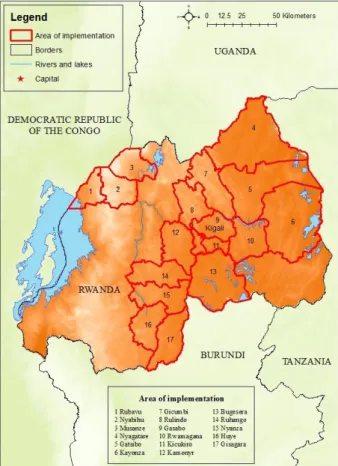
RDCP II was a 5-year project funded by the Feed the Future (FTF) initiative. Land O’Lakes has implemented the project in 17 districts across all five provinces of Rwanda. This project aimed to reduce poverty through expanded production and marketing of quality milk that generates income and employment, and improves nutrition of rural households. The activity’s development hypothesis was that improving raw milk quality and efficiency of production, together with marketing all along the dairy value chain, would pay high returns to public and private investment.
Begun in 2012, RDCP II increased the competitiveness of Rwandan dairy products in regional markets in order to increase rural household incomes associated with dairy-related enterprises. Land O’Lakes upgraded the entire dairy value chain by stimulating investment and helping to improve management practices at key points, from the smallholder producer to milk cooling centers, milk transporters, and milk processors.
RDCP II aimed to improve the livestock production systems of an estimated 50,000–63,000 dairy-producing smallholder farmers and 150,000–200,000 cows.
Beneficiaries were roughly differentiated among extensive production systems of the east and northwestern parts of the country that rely on grazing as their sole feeding source, and semi-intensive systems in the northeast and south, as well as those near urban centers, mainly Kigali.
feed provision, which consist of harvesting grasses and fodder crops including in off-farm locations.
Average herd sizes were estimated to have seven cows in the extensive system with an average of two lactating at a time, while the semi-intensive households keep an average of only 2.6 cows, of which 1.7 cows are lactating on average. RDCP II was estimated by project staff to have led to a slight increase in numbers in semi-intensive systems to an average of 3 cows per household as more feed resources gradually became available; animal numbers in the extensive system were estimated to remain constant. The underlying data for the activity’s GHG analysis were therefore based on activity monitoring data prior to project completion as well as the
expectations by the project staff of what RDCP II would have achieved when completed.
Low emission development
In the 2009 United Nations Framework Convention on Climate Change (UNFCCC) discussions, countries agreed to the Copenhagen Accord, which included recognition that “a low-emission development strategy is indispensable to sustainable development" (UNFCCC 2009). Low emission development (LED) has continued to occupy a prominent place in UNFCCC agreements. In the 2015 Paris Agreement, countries established pledges to reduce emission of GHGs that drive climate change, and many countries identified the agricultural sector as a source of intended reductions (Richards et al. 2015).
In general, LED uses information and analysis to develop strategic approaches to promote economic growth while reducing long-term GHG emission trajectories. For the agricultural sector to participate meaningfully in LED, decision makers must understand the opportunities for achieving mitigation co-benefits relevant at the scale of nations, the barriers to achieving widespread adoption of these approaches, and the methods for estimating
emission reductions from interventions. When designed to yield mitigation co-benefits, agricultural development can help countries reach their development goals while contributing to the mitigation targets to which they are committed as part of the Paris Agreement, and ultimately to the global targets set forth in the Agreement.
In 2015, the United States Agency for International Development (USAID) Office of Global Climate Change engaged the CGIAR Research Program on Climate Change, Agriculture and Food Security (CCAFS) to examine LED options in USAID’s agriculture and food security portfolio. CCAFS conducted this analysis in collaboration with the University of Vermont’s Gund Institute for Ecological Economics and the Food and Agriculture Organization of the United Nations (FAO). The CCAFS research team partnered with USAID’s Bureau of Food Security to review projects in the FTF program. FTF
works with host country governments, businesses, smallholder farmers, research institutions, and civil society organizations in 19 focus countries to promote global food security and nutrition.
As part of the broader effort to frame a strategic approach to LED in the agricultural sector, several case studies, including this one, quantify the potential climate change mitigation benefits from agricultural projects and describe the effects of low emission practices on yields and emissions. Systematic incorporation of such emission analyses into agricultural economic development initiatives could lead to meaningful reductions in GHG emissions compared to business-as-usual emissions, while continuing to meet economic development and food security objectives.
The team analyzed and estimated the project’s impacts on GHG emissions and carbon sequestration using the FAO Ex-Ante Carbon Balance Tool (EX-ACT). EX-ACT is an appraisal system developed by FAO to estimate the impact of agriculture and forestry development projects, programs, and policies on net GHG emissions and carbon sequestration. In all cases, conventional agricultural practices (those employed before project implementation) provided reference points for a GHG emission baseline. The team described results as increases or reductions in net GHG emissions attributable to changes in agricultural practices as a result of the project. Methane, nitrous oxide, and carbon dioxide emissions are expressed in metric tonnes of carbon dioxide equivalent (tCO2e). (For
reference, each tCO2e is equivalent to the GHG
emissions from 2.3 barrels of oil.) If the agricultural practices supported by the project lead to a decrease in net GHG emissions through an increase in GHG
removals (e.g. carbon sequestration) and/or a decrease in GHG emissions, the overall project impact is represented as a negative (–) value. Numbers presented in this analysis have not been rounded but this does not mean all digits are significant. Non-significant digits have been retained for transparency in the data set.
This rapid assessment technique is intended for contexts where aggregate data are available on agricultural land use and management practices, but where field
measurements of GHG emissions and carbon stock changes are not available. It provides an indication of the magnitude of GHG impacts and compares the strength of GHG impacts among various field activities or cropping systems. The proposed approach does not deliver plot, or season-specific estimates of GHG emissions. This method may guide future estimates of GHG impacts where data are scarce, as is characteristic of
environments where organizations engage in agricultural investment planning. Actors interested in verification of changes in GHG impacts resulting from interventions should collect field measurements needed to apply process-based bio-physical models.
Agricultural and environmental context:
Rwanda
Rwanda is a low income country with a population of about 10.5 million in 2012 (World Bank, 2016a). The country has experienced stable economic growth in the recent decade, averaging 8% of real GDP growth per annum between 2001 and 2015 (ibid). During the same period GDP per capita more than tripled from US$ 211 in 2001 to US$ 718 in 2014 (NISR 2015). Considerable improvements in poverty reduction have been achieved; the poverty rate has been reduced from 59% in 2001 to 45% in 2011 and 39% in 2014 (NISR 2015, World Bank 2016c). However, poverty and malnutrition remain key issues in the country with 16% of the population living in extreme poverty and 38% of children under age 5 suffering from stunting (NISR 2015).
Agriculture is a central component of the economic devel-opment of the country; it employs 70% of the workforce (World Bank 2016b) and generates 35% of the GDP (NISR 2015). As the most densely populated country in Africa, agricultural landholdings are very small, with 60% of agricultural households farming on less than 0.7 hec-tares (MINAGRI 2008). Small-scale, subsistence-oriented family farming dominates, with 66% of production des-tined for home consumption (MINAGRI 2012). Tradition-ally, farms produce a diversified portfolio of crops and livestock products, with approximately 60% of households rearing livestock (ibid.). When excluding land use change and forestry, GHG emissions from livestock, including en-teric fermentation, manure management, and manure left on pastures, account for more than 70% of national agri-cultural emissions (FAOSTAT 2016, Tubiello et al. 2014). Rwanda’s INDC, submitted under the UNFCCC, included climate change mitigation in agriculture as a co-benefit of adaptation actions. Target actions include expansion of agroforestry, sustainable agricultural intensification, avoided cropland degradation, and improvement of live-stock feeding (Richards et al. 2016).
The dairy subsector contributes 15% to the agricultural gross domestic product and 6% to the gross domestic product (MINAGRI 2013). Rwanda has 1.33 million head of cattle, of which 28% are improved dairy cows that pro-duce 82% of the total milk output (ibid). The estimate of the annual milk output is 445,000,000 liters with a value of US$ 115.3 million (ibid).
Within the Rwandan dairy sector, main challenges include feed availability (quality and quantity) and animal
management (health and breeding). Productivity is limited by feed supply during the dry season, the availability of quality forages and feeds (hay, silage, crop by-products) and the comparably high costs of feed concentrate (MINAGRI 2013). In addition, some areas have experienced the conversion of grazing pasture to cropland (Clay et al. 2002) and shortages of water
(Mutibvu 2012). Dairy producers lack access to animal health and improved breeding services (MINAGRI 2013). The number of privately operating veterinarians is relatively low and mastitis is widespread. Although artificial insemination services are subsidized by the government, low access in rural localities and quality of services remain limiting factors (ibid).
Figure 1. Area of implementation
Agricultural practices that impact GHG
emissions and carbon sequestration
The GHG emission analysis of RDCP II focused on improved practices in the dairy cow value chain. GHG emissions responded to the following supported practices: (1) feed quality improvements, (2) breeding
improvements, (3) herd size management, and (4) feed quantity and herd weight dynamics.
Feed quality improvements
Background. Low-quality and low-digestibility feeds result in relatively high GHG emissions from enteric fermentation per unit of meat or milk,
particularly in systems with low productivity (Herrero at al. 2016). Improving feed
digestibility and energy content,
and
better matching
Feed qualityprotein supply to animal requirements, can be achieved through an increased provision of quality forages and alternative feeds including hay, silage, (processed) crop residues, agro-industrial by-products and concentrates (Gerber et al 2013).
Producing improved feed can have environmental benefits in some contexts, such as when degraded grazing lands are rehabilitated through planting of improved grass and forage crops. Many improved feed production systems have their own resource footprint, and may compete with food crops or the conversion of natural land, or withdraw resources from alternative uses, e.g. the mulching of crop residues.
Feed substitutes can change enteric fermentation processes in the rumen and influence methane
production. Feeding corn or legume silages, starch, or soy also decreases methane production compared with exclusively feeding grass silages. According to MacLeod et al. (2015), improving forage quality and strengthening resource transfers between livestock and crop-related activities can increase the economic welfare of smallholder farming systems.
Practice plan. RDCP II supported improved feed management by promoting alternative strategies for forage production and feed processing and storage, as well as supporting the purchase of complementary feed sources. Contrary to a diet based mainly on grazing, roadside cuttings, and unprocessed crop residues (as seasonally available), RDCP II fostered the targeted cultivation of Napier grass (Pennisetum purpureum), velvet bean (mucuna), tick clover (desmodium) and calliandra; sprinkling of dry grasses with sugarcane molasses to increase palatability; urea treatment; use of silage; and hay bailing.
Impact on GHG emissions. RDCP II’s feed digestibility improvements were estimated to reduce GHG emissions per livestock head. In the absence of precise information on current and future feed composition, the FAO team utilized the method of Smith et al. (2007). This method provides estimates for GHG reductions following feed improvement in sub-Saharan Africa without requiring information on further input data on feed composition or feed digestibility. For sub-Saharan Africa, Smith et al. (ibid.) conservatively estimate that a reduction of only 1% in methane emissions from enteric fermentation would result from currently available and commonly applied improved feeding practices. This contrasts strongly with higher mitigation benefits that are estimated using the more mechanistic approach of the Tier 2 emission factors in IPCC (2006) when analyzing cases with strong
increases in feed digestibility. In the absence of available data on changes in feed composition and feed
digestibility, the conservative approach by Smith et al. (2007) estimates annual GHG mitigation benefits from
feed quality improvements of -0.02 tCO2e/head for cows
(Figure 1). The impacts result in a change in GHG
emissions of –1,205 tCO2e/year (Figure 2) when scaled to
the full herd size.
Breeding improvements
Background. Improved animal health, including artificial insemination services, allows reductions in the herd overhead (i.e. the unproductive part of the herd) and thus reduces the amount of GHG emissions (Herrero 2016, Gerber et al. 2013). Improved breeding also supports transition to an animal heard with improved productivity and disease tolerance, thus reducing the share of the livestock herd that contributes GHG emissions while not providing milk output.
Practice plan. RDCP II promoted best practices in dairy production, including increase in the availability and use of artificial insemination in the project area. The project expected to reach over 10,000 farmers with improved insemination through targeted extension and veterinary officers.
Impact on emissions. Using Smith et al. (2007), FAO estimated that the breeding improvements result in an annual change in GHG emissions of -0.01 tCO2e/head for
cows (Figure 1). This results in a change in GHG
emissions of –482 tCO2e/yr (Figure 2) when scaled to the
full herd size.
Herd size dynamics
Background. Larger livestock herd sizes are associated with higher GHG emission levels. Regulating the livestock herd size at the household level through targeted and timely decision-making on
reproduction and sales of animals is an important and integrated precondition for optimizing the availability of sufficient financial and natural resources for feed and health management. Decisions on livestock herd size are part of the herders’ risk
management strategies and are closely linked to vulnerability from weather shocks and climate change (Megersa et al. 2014, Angassa et al. 2012, Thornton et al. 2007).
Practice plan. RDCP II stimulated investments to improve management practices at key points along the
Breeding improvements
Breeding improvements
dairy value chain, from the smallholder producer to milk cooling centers, transporters, and processors. The project estimated that these interventions support a moderate increase in herd sizes in the intensive dairy cattle
operations from 49,800 to 57,482 cattle. This is particularly supported by the increased access and availability of livestock feed from cut-and-carry systems. There is no increase in herd size for the extensively kept dairy cattle, whose herd size remains stable at 141,001 head.
Impact on emissions. The increase in herd size is estimated to have resulted in an annual increase in GHG emissions of 2.48 tCO2e per additional cow (Figure 1).
The impacts result in a change in GHG emissions of 18,980 tCO2e/yr (Figure 2) when scaled to the full herd
size.
Feed quality and hard weight dynamics
Background. Increasing the availability of feed intake and the stability of feed during the dry season through project actions was estimated to have yielded strong productivity benefits (Lukuyu et al. 2015, Gerber et al. 2013, Shikuku et al. 2016).
Due to the stable feed supply, milk yield was estimated to improve, reducing the common productivity fluctuations based on feed seasonality. Increasing feed intake, thereby increasing animal weight, was estimated to cause an augmentation in GHG emissions per cow stemming from enteric fermentation, manure management and manure deposition.
Practice plan. Feed quantity improvements were estimated to increase weight from 250 to 270 kg in the extensive systems and from 290 to 313 kg in the semi-intensive systems.
Impact on emissions. Estimates by the project on increased animal weight were utilized as part of the Tier 2 methodology provided in IPCC (2006) in order to estimate increases in GHG emissions from enteric fermentation, manure handling and manure management. The increase in cow weight results in an estimated annual increase in GHG emissions of 0.18 tCO2e/head (Figure 1). The
impacts result in a change in GHG emissions of 34,904 tCO2e/yr (Figure 2) when scaled to the full herd size.
In focus: Efficiency increases in the dairy value chain result from modernizing
down-stream facilities and adapting input markets
Rwandan dairy producers face a variety of value chain challenges that impact productivity, including access to inputs and services (e.g., quality forage or veterinary services) and availability of post-production infrastructure (quality milk cooling, transportation, processing and marketing facilities). The steadily increasing urban milk demand, and the more price sensitive peri-urban and rural milk demand constitute a stable market. The larger investment costs required for private investment in dairy processing and associated sector services limit market entry to stakeholders with access to capital and the ability to take financial risks.
RDCP II invested in training and coordination of private and public service providers (veterinary services, improved breeding services), upstream businesses (livestock feed), and downstream processers (modern, efficient machinery for cooling, transport, processing) within the dairy value-chain. Specifically, the project addressed the low geographic coverage of post-production services in the dairy sector in Rwanda. The project gave financial support to the expansion of high quality cooling facilities and milk processing and encouraged the establishment of long-term relationships between processors and producers, creating the demand conditions for these capital investments.
The program targeted small-scale producers with improved feeding practices that do not require large upfront investments while providing direct benefits for productivity and farm income. Through value chain modernization, RDCP II created market-based incentives for producers to improve the quality and quantity of milk output and directly benefit from their investments in improved feed and higher milk output.
Feed quality and herd weight
Summary of projected GHG emission
and carbon sequestration co-benefits
Total change in GHG emissions due to interventions by RCDP II was an increase of approximately 12% per year. Figures 1 and 2 summarize GHG emissions per animal and over the entire project.
Improved feed quality and breeding provide estimated annual GHG impacts of - 0.02 and -0.01 tCO2e/animal per
year respectively. The increased quantity of feed and the higher weight of animals lead to annual increases in GHG emissions of 0.18 tCO2e/head. The increase in the
number of dairy cows generates the main increase in
GHG emissions, estimated at 2.48 tCO2e per additional
head. Figure 2 shows that increasing feed quantity and animal weight, when scaled up to the project level, has the largest impact on GHG emissions, estimated at 34,904 tCO2/yr. By contrast, increasing animal numbers
generates an estimated 18,980 tCO2/yr. Feed quality and
breeding improvements provide minimal GHG emission benefits when scaled up to the project level. Due to the conservative methodology used, the GHG mitigation benefits from feed quality and breeding improvements may, however, be underestimated
GHG emission intensity
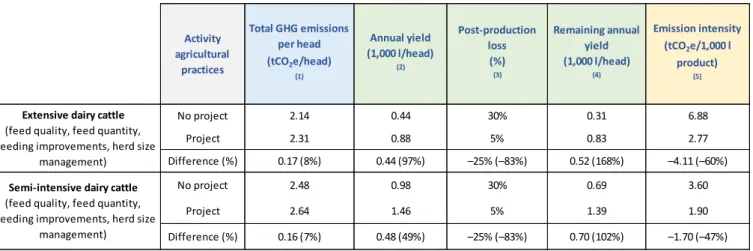
Emission intensity (GHG emissions per unit of output) is a useful indicator of LED in the agricultural sector. Table 1 summarizes emission intensity findings for dairy cows without and with practices supported by RDCP II.
Milk productivity. The extensive and semi-intensive dairy production systems were estimated to experience both sizeable productivity increases: extensive dairy cattle at 97% and intensive dairy cattle at 49%. The productivity increases were due to improvements in feeding
(especially a more stable feed supply during the lactation period, independent of seasonality), use of improved breeds, and expansion of animal health services. As a result, the activity estimated that the average milk yield increased from 4.47 l/cow to 6.44 l/cow in the semi-intensive system and from 2.17 l/cow to 4.14 l/cow in the extensive system. In addition, the average number of lactating days was estimated to increase from 220 to 227 in the semi-intensive system and from 205 to 212 in the extensive system.
Post-production loss. Post-production losses for dairy are reduced by an estimated 25%. Interventions to reduce the loss of milk include the distribution of kits for milk quality testing, and training of milk traders and processors in their use. Milk cooling centers that function as
intermediate stops prior to the transport of milk to processing and packaging centers have been improved and extended to new locations. The project also
supported improved product quality monitoring during milk bulking and processing, plus transport and quality
assurance through the Rwanda Seal of Quality.
Table 1. RDCP II—GHG emission intensity of dairy
systems
The reductions in post-harvest losses of milk when shift-ing additional producers from informal commercialization to modern processing facilities are often huge. The reali-zation of the estimated post-harvest loss reductions in the future thus depends on the continued operation of the im-proved physical and social value chain infrastructure.
Emission intensity. When considering the issue of GHG emission intensity, milk from extensive dairy production systems experienced a major reduction of an estimated -4.11 tCO2e/1,000 l of milk (from 6.88 to 2.77 tCO2/1,000 l)
due to the strong increase in milk production (+97%). This is equivalent to a reduction of 60% of the conventional GHG emission intensity.
On the other hand, the GHG emission intensity of milk from semi-intensive dairy cows was reduced by an estimated 47% due to the more limited increase in milk production. Intensive dairy production systems
experienced a smaller, but significant, reduction of GHG intensity from an estimated 3.60 tCO2/1,000 l to 1.90
tCO2/1,000 l.
RDCP II illustrates how value chain support can both increase overall GHG emissions driven by a dramatic production increase and decrease the emission intensity per ton of milk, making the value chain more efficient and more sustainable. Activity agricultural practices Total GHG emissions per head (tCO2e/head) (1) Annual yield (1,000 l/head) (2) Post-production loss (%) (3) Remaining annual yield (1,000 l/head) (4) Emission intensity (tCO2e/1,000 l product) (5) No project 2.14 0.44 30% 0.31 6.88 Project 2.31 0.88 5% 0.83 2.77 Difference (%) 0.17 (8%) 0.44 (97%) –25% (–83%) 0.52 (168%) –4.11 (–60%) No project 2.48 0.98 30% 0.69 3.60 Project 2.64 1.46 5% 1.39 1.90 Difference (%) 0.16 (7%) 0.48 (49%) –25% (–83%) 0.70 (102%) –1.70 (–47%)
Semi-intensive dairy cattle
(feed quality, feed quantity, breeding improvements, herd size
management) Notes:
1. Total GHG emissions per head refers to the emissions per head of cattle.
2. Annual yield refers to the volume of product produced per head of cattle each year.
3. Post-production loss is the measurable product loss during processing steps from harvest to consumption per year. 4. Remaining annual yield is calculated by subtracting postharvest loss from annual yield.
5. Emission intensity is calculated by dividing the total GHG emissions per 1,000 liters product by the remaining annual yield.
Extensive dairy cattle
(feed quality, feed quantity, breeding improvements, herd size
Low emission program design considerations
The analysis of emissions by agricultural practice illustrates issues that those designing or implementing
programs may want to consider in the context of LED and food security for smallholder farmers. These
issues include:
Livestock forage quality and quantity management. What value chain interventions are feasible in order to improve fodder management (cultivation, conservation, and processing) and feed rationing (concentrate and complete feeds)? How can feed producers and processors be supported so that high production volumes and low sales prices are achieved? Which forage varieties balance increased production, farmer affordability and adoption potential with reduced GHG emissions?
Breeding and veterinary services. Which strategies are available in order to increase the effectiveness, access, and quality of breeding and veterinary services? Which institutional set-up increases the synergies between public and private service providers of artificial insemination and veterinary services?
Herd size dynamics. Which insurance and financial services are needed in order to enable farmers to reduce the number of unproductive animals without facing higher production risks?
Manure management. How canefficient resource transfer between livestock and cropping systems be ensured, including the targeted provision and application of manure to cropping systems and the reduction of runoff and leakage?
What are the barriers to expansion of manure biodigesters for intensive dairy production? How can the efficient operation of biodigesters be ensured against biogas leakage and venting?
Post-production loss. Whichpractices are most effective to improve producer access to post-production services such as milk cooling, processing and commercialization?
Methods for estimating GHG impacts
A comprehensive description of the methodology used for the analysis presented in this report can be found in Grewer et al. (2016); a summary of the methodology fol-lows. The selection of projects to be analyzed consisted of two phases. First, the research team reviewed inter-ventions in the FTF initiative and additional USAID activi-ties with high potential for agricultural GHG mitigation to determine which activities were to be analyzed for changes in GHG emissions and carbon sequestration. CCAFS characterized agricultural interventions across a broad range of geographies and approaches. These in-cluded some that were focused on specific practices and others designed to increase production by supporting value chains. For some activities, such as technical train-ing, the relationship between the intervention and agricul-tural GHG impacts relied on multiple intermediate steps. It was beyond the scope of the study to quantify GHG emis-sion reductions for these cases, and the research team therefore excluded them. Next, researchers from CCAFS and USAID selected 30 activities with high potential for agricultural GHG mitigation based on expert judgment of anticipated GHG emissions and strength of the interven-tion. The analysis focused on practices that have been documented to mitigate climate change (Smith et al. 2007) and a range of value chain interventions that influ-ence productivity.
Researchers from FAO, USAID, and CCAFS analyzed a substantial range of project documentation for the GHG analysis. They conducted face-to-face or telephone inter-views with implementing partners and followed up in writ-ing with national project management. Implementwrit-ing part-ners provided information, monitoring data, and estimates regarding the adoption of improved agricultural practices, annual yields, and postharvest losses. The GHG analysis is based on the provided information as input data. The team estimated GHG emissions and carbon seques-tration associated with agricultural and forestry practices by utilizing EX-ACT, an appraisal system developed by FAO (Bernoux et al. 2010; Bockel et al. 2013; Grewer et al. 2013), and other methodologies. EX-ACT was selected based on its ability to account for a number of GHGs, practices, and environments. Derivation of intensity and practice-based estimates of GHG emissions reflected in this case study required a substantial time investment that was beyond the usual effort and scope of GHG assess-ments of agricultural investment projects. Additional de-tails on the methodology for deriving intensity and prac-tice-based estimates can be found in Grewer et al. (2016
References
Angassa A, Oba G. 2012. Cattle herd vulnerability to rainfall variability: responses to two management scenarios in southern Ethiopia. Tropical Animal Health and Production 45(3): 715-721.
[AU-IBAR] African Union - Interafrican Bureau for Animal Resources. 2012. Rational use of rangelands and fodder crop development in Africa. Nairobi, Kenya: AU-IBAR.
Clay D, Kelly V, Mpyisi E, Reardon T. 2002. Input use and conservation investments among farm
households in Rwanda: patterns and determinants. Natural resources management in African agriculture: understanding and improving current practices. Ithaca: Cornell University.
[FAOSTAT] Food and Agriculture Organization of the United Nations Statistics Division. 2016. (Available at http://faostat3.fao.org/download/Q/QC/E) (Accessed 5 July 2016)
Gerber PJ, Steinfeld H, Henderson B, Mottet A, Opio C, Dijkman J, Falcucci A, Tempio G. 2013. Tackling climate change through livestock – a global
assessment of emissions and mitigation opportunities. Rome: FAO.
Grewer U, Bockel L, Bernoux M. 2013. EX-ACT quick guidance manual: estimating and targeting
greenhouse gas mitigation in agriculture. Rome: FAO. (Available from: http://www.fao.org/tc/exact/user-guidelines) (Accessed on 1 September 2016) Grewer U, Bockel L, Galford G, Gurwick N, Nash J,
Pirolli G, Wollenberg E. 2016. A methodology for greenhouse gas emissions and carbon sequestration assessments in agriculture: Supplemental materials for info note series analysing low emissions
agricultural practices in USAID development projects. CCAFS Working Paper no. 187. Copenhagen, Denmark: CGIAR Research Program on Climate Change, Agriculture and Food Security (CCAFS). Available online at: www.ccafs.cgiar.org
Herrero M, Henderson B, Havlík P, Thornton PK, Conant RT, Smith P, Wirsenius S, Hristov AN, Gerber P, Gill M, Butterbach-Bahl K, Valin H, Garnett T, Stehfest E. 2016. Greenhouse gas mitigation potentials in the livestock sector. Nature Climate Change 6(5): 452–461.
[IPCC] Intergovernmental Panel on Climate Change. 2006. IPCC Guidelines for National Greenhouse Gas Inventories, Prepared by the National Greenhouse Gas Inventories Programme. Eggleston HS, Buendia L, Miwa K, Ngara T, Tanabe K, eds. Agriculture, Forestry and Other Land Use 4. IGES, Japan. Lukuyu BA, Ravichandran T, Maass B, Laswai G,
Bwire J, Duncan AJ. 2015. Enhancing livestock productivity through feed and feeding interventions in India and Tanzania. ILRI Project Report. Nairobi, Kenya: International Livestock Research Institute (ILRI).
MacLeod N, Waldron S, Wen S. 2015. A
comprehensive approach for assessing the economic contribution of forage and livestock improvement options to smallholder farming enterprises. Journal of Integrative Agriculture 14(8): 1573-1580.
Megersa B, Markemann A, Angassa A, Ogutu JO, Piepho HP, Zárate AV. 2014. Livestock
diversification: an adaptive strategy to climate and rangeland ecosystem changes in southern Ethiopia. Human Ecology 42(4): 509-520.
[MINAGRI] Ministry of Agriculture and Animal Resources. 2009. Strategic Plan for the
Transformation of Agriculture in Rwanda – Phase II (PSTA II). Kigali, Rwanda: MINAGRI.
[MINIAGRI] Ministry of Agriculture and Animal Resources. 2012. Trends in Key Agricultural and Rural Development Indicators in Rwanda. Kigali, Rwanda: MINAGRI.
[MINAGRI] Ministry of Agriculture and Animal Resources. 2013. Rwanda national dairy strategy. Kigali, Rwanda: MINAGRI.
Mutibvu T, Maburutse BE, Mbiriri DT, Kashangura MT. 2012. Constraints and opportunities for increased livestock production in communal areas: a case study of Simbe, Zimbabwe. Livestock Research for Rural Development. Volume 24(9): Article 165.
[NISR] National Institute of Statistics of Rwanda. 2016. Rwanda poverty profile report: integrated household living conditions survey 2013/2014. Kigali, Rwanda: NISR. (Available from:
http://www.statistics.gov.rw/file/4135/download?token =cylGgLRl) (Accessed on 15 July 2016)
Richards M, Bruun TB, Campbell B, Gregersen LE, Huyer S, Kuntze V, Madsen STN, Oldvig MB, Vasileiou I. 2015. How countries plan to address agricultural adaptation and mitigation: An analysis of Intended Nationally Determined Contributions. CCAFS Info Note. Copenhagen, Denmark: CGIAR Research Program on Climate Change, Agriculture and Food Security (CCAFS). (Available from:
https://cgspace.cgiar.org/rest/bitstreams/63683/retriev e) (Accessed on 1 September 2016)
Shikuku KM, Valdivia RO, Paul BK, Mwongera C, Winowiecki L, Läderach P, Herrero M, Silvestri S. 2016. Prioritizing climate-smart livestock technologies in rural Tanzania: a minimum data approach.
Agricultural Systems (In Press).
Smith P, Martino D, Cai Z, Gwary D, Janzen H, Kumar P, McCarl B, Ogle S, O’Mara F, Rice C, Scholes B, Sirotenko O, Howden M, McAllister T, Pan G, Romanenkov V, Rose S, Schneider U,
Towprayoon S, Wattenback M. 2007. Agriculture. Climate change 2007: mitigation, contribution of working group III to the fourth assessment report of the Intergovernmental Panel on Climate Change. Cambridge, UK: Cambridge University Press. (Available from:
http://www.ipcc.ch/publications_and_data/ar4/wg3/en/ ch8.html)
Thornton PK, Herrero M, Freeman HA, Okeyo AM, Rege E, Jones PG, McDermott J. 2007. Vulnerability, climate change and livestock-opportunities and challenges for the poor. Journal of Semi-Arid Tropical Agricultural Research 4(1): 1-23.
Tubiello FN, Salvatore M, Cóndor Golec RD, Ferrara A, Rossi S, Biancalani R, Federici S, Jacobs H, Flammini A. 2014. Agriculture, Forestry and Other Land Use Emissions by Sources and Removals by Sinks. 1990-2011 Analysis. FAO Statistics Division Working Paper Series, ESS/14-02.
[UNFCCC] United Nations Framework Convention on Climate Change. 2009. Draft decision CP.15 Copenhagen Accord. (Available from:
http://unfccc.int/resource/docs/2009/cop15/eng/l07.pd f) (Accessed on 6 October 2016)
World Bank. 2016a. Country overview Rwanda. (Available from:
http://www.worldbank.org/en/country/rwanda/overvie w) (Accessed on 15 July 2016)
World Bank. 2016b. Rwanda economic update: Rwanda at work. Kigali, Rwanda: The World Bank. (Available from:
http://documents.worldbank.org/curated/en/2016/03/2 6010807/rwanda-economic-update-rwanda-work) (Accessed on 15 July 2016)
World Bank. 2016c. World Bank World Development Indicators. (Available from
http://databank.worldbank.org/data/reports.aspx?sour ce=world-development-indicators) (Accessed on 9 July 2016)
Authors:
Uwe Grewer is a consultant for climate smart agriculture in the Agricultural Development Economics Division of the Food and Agriculture Organization of the United Nations (FAO).
Julie Nash ([email protected]) is Research Leader for Low Emission Agriculture at CCAFS and a Research Associate at the Gund Institute for Ecological Economics and the Rubenstein School of Environment and Natural Resources at the University of Vermont.
Louis Bockel is Policy Officer in the Agricultural Development Economics Division of FAO.
Gillian Galford is Research Assistant Professor at the Gund Institute for Ecological Economics and the Rubenstein School of Environment and Natural Resources at the University of Vermont.
Citation:
Grewer U, Nash J, Bockel L, Galford G. 2016. Rwanda Dairy Competitiveness Program II: Efficiency gains of dairy production systems strongly decrease GHG emission intensity. CCAFS Info Note. Published by the International Center for Tropical Agriculture (CIAT) and the Food and Agriculture Organization of the United Nations (FAO).
Info note series
USAID project Country
Agroforestry, perennial crop
expansion
Irrigated rice
Land use, inc. reforestation &
avoided degradation
Livestock Soil, fertilizer management
Accelerating Agriculture
Productivity Improvement Bangladesh X X
ACCESO Honduras X X X
Agricultural Development and Value Chain
Enhancement Activity II
Ghana X X
Better Life Alliance Zambia X X X
Chanje Lavi Planté Haiti X X X X
Pastoralist Resiliency Improvement and Market Expansion
Ethiopia X
Peru Cocoa Alliance Peru X X
Resilience & Economic Growth in Arid Lands- Accelerated Growth
Kenya X
Rwanda Dairy
Competitiveness Program Rwanda X