NON-NEGATIVE DYNAMICAL SYSTEM WITH APPLICATION TO SPEECH AND AUDIO
C´edric F´evotte
∗1, Jonathan Le Roux
2, John R. Hershey
21
Laboratoire Lagrange (CNRS, OCA & University of Nice), Parc Valrose, 06000 Nice, France
2Mitsubishi Electric Research Laboratories (MERL), 201 Broadway, Cambridge, MA 02139, USA
ABSTRACT
Non-negative data arise in a variety of important signal processing domains, such as power spectra of signals, pixels in images, and count data. This paper introduces a novel non-negative dynamical system (NDS) for sequences of such data, and describes its applica-tion to modeling speech and audio power spectra. The NDS model can be interpreted both as an adaptation of linear dynamical systems (LDS) to non-negative data, and as an extension of non-negative ma-trix factorization (NMF) to support Markovian dynamics. Learning and inference algorithms were derived and experiments on speech enhancement were conducted by training sparse non-negative dy-namical systems on speech data and adapting a noise model to the unknown noise condition. Results show that the model can capture the dynamics of speech in a useful way.
Index Terms— non-negative dynamical system (NDS), linear
dynamical system (LDS), multiplicative innovations, non-negative matrix factorization (NMF), source separation.
1. INTRODUCTION
Non-negative sequences arise in a variety of important signal pro-cessing domains, such as power spectra of signals, pixels in images, and sequences of count data. This paper introduces a novel dynam-ical system for non-negative data, and describes its application to speech and audio modeling.
This work bridges two active fields, dynamical systems and non-negative matrix factorization (NMF). Dynamical systems are a long-standing area of research with applications in many scientific fields. A large body of literature is devoted to the case of linear dynamical systems (LDS), which describe an observed sequencevn ∈ RF, indexed byn∈[1, ..., N], via latent variableshn∈RK, according to the equations:
hn=Ahn−1+ξn, (1)
vn=W hn+n, (2)
whereAandW are matrices of dimensionsK×KandF ×K, respectively, andξnandnare independent, additive, and typically
Gaussian random variables. Eq. (1) describes the dynamics of the state variablehnand Eq. (2) describes the observation model.A,W,
ξnandnare referred to as state-transition matrix, dictionary, state
innovation and data innovation, respectively. The LDS model does not naturally apply to the case wherehnandvnarenon-negative.
Besides, NMF is a more recent research area that has attracted a lot of attention in signal processing and machine learning com-munities since the publication of the seminal paper [1]. In the gen-eral case, NMF is the problem of finding an approximation of the
∗The research presented in this paper was conducted while C. F´evotte was
a visiting scientist at MERL over Summer 2012.
formV ≈W H whereV andH are non-negative matrices. This approximation is generally obtained by minimizing a cost function
D(V|W H) that measures the dissimilarity betweenV and W H. In some settings, the columns ofV form a sequencev1. . . vN with
evolving dynamics, in the sense of statistical dependencies between elements in the sequence, that standard forms of NMF will fail to capture. Our work brings probabilistic dynamics to NMF, compara-ble to that of the traditional LDS.
The discrete-state Hidden Markov Model (HMM) is another dy-namical system that has been commonly used to handle dynamics of speech, most famously in automatic speech recognition [2], but also in speech synthesis [3] as well as in speech separation [4]. In this set-ting, the speech features are usually taken to be cepstral coefficients or other log-spectrum-based features. However, HMMs lead to com-binatorial complexity due to the discrete state-space, especially in the co-occurrence of several speakers. Because of the discreteness of the state space and the state-conditional independence of adjacent frames, HMMs also famously do not easily handle gain adaptation and continuity over time. In contrast, standard NMF solves both the computational cost (of linear complexity per iteration) and gain adaptation problems (throughH), but it does not handle continuous dynamics. By bringing continuous dynamics to an NMF-like formu-lation, we hope to obtain the best of both worlds.
The proposed non-negative dynamical system (NDS) is given by
hn=Ahn−1◦ξn, (3)
vn=W hn◦n, (4)
where all variables are non-negative with the same dimensions as above, and ‘◦’ denotes element-wise multiplication. The multi-plicative innovationsξnandnare non-negative random variables.
The observation model (4) operates similarly to standard NMF, whereas the latent dynamics (3) capture statistical dependency be-tween frames similarly to LDS.
In Section 2, we complete the presentation of the proposed model (3)-(4) with additional statistical assumptions. In Section 3, we present a majorization-minimization (MM) algorithm for maxi-mum a posteriori (MAP) estimation ofW, H, AgivenV. Section 4 discusses how the proposed NDS applies to the modeling of speech spectra and reports speech enhancement results.
2. MODEL 2.1. Statistical assumptions
We assume the state and data innovations to be independent and identically distributed (i.i.d), spatially independent and Gamma distributed, such thatp(ξ1, . . . , ξN) = Qk,nG(ξkn|αk, βk) and
p(1, . . . , N) =Qf,nG(f n|νf, δf), whereαk, βk, νfandδf are
positive scalars andGrefers to the Gamma distribution, with prob-ability density function (pdf)G(x|α, β) =βα/Γ(α)xα−1
e−βx
follows thatvnandhnare conditionally Gamma distributed, such that p(hn|Ahn−1) = Y k G(hkn|αk, βk/ X j akjhj(n−1)), (5) p(vn|W hn) = Y f G(vf n|νf, δf/ X k wf khkn). (6)
The former holds forn >1only and we assume independent scale-invariant Jeffreys prior forn= 1, i.e.,p(hk1)∝1/hk1. The
expec-tation of the state variables and data under the model are
E(hkn|Ahn−1) = αk βk X j akjhj(n−1), (7) E(vf n|W hn) = νf δf X k wf khkn. (8)
For simplicity, we will assumeνf = δf =δ, so that E(V) =
W H, which is a natural assumption underlying most NMF settings (see for example [5]). Under this assumption, the negative log-likelihood−logp(V|W H)is essentially the Itakura-Saito (IS) di-vergence fromV to W H, as explained in [6]. The expression of
p(hn|Ahn−1) reveals a scale ambiguity betweenβk and {akj}j,
which we fix by settingβk =αk, implying thatE(hn|Ahn−1) = Ahn−1.
The multiplicative and non-negative state and data innovations preserve the non-negativity in the generative model. Additive real-valued Gaussian innovations, as used in LDS, would fail to do so. Additive non-negative innovations would ensure non-negativity, but would only allow monotonically increasing values. In contrast, for multiplicative innovations that can take values both lower and greater than one, the coefficients ofvnandhnare allowed to increase and
decrease.
2.2. Related work
To the best of our knowledge there is no prior work about the NDS (3)-(4) proposed in this paper. There is some literature on non-negative dynamical systems, where the state-space matrices, state and observation vectors are assumed non-negative. However, to the best of our knowledge, only non-negative additive perturbations have been considered, see, e.g., [7, 8]. Furthermore most of the literature we found on the topic is devoted to the theoretical properties of these systems (stability, observability) rather than inference in or applica-tion of these models. The closest to our model is perhaps [9], which studies the conditions for existence, uniqueness and stability of the system defined by Eq. (3) alone, but does not provide algorithms nor procedures for inference.
A special case of the NDS (3)-(4) has been addressed in the NMF literature. In [6, 10], algorithms were derived for the special caseA = IK, whereIK denotes the identity matrix of dimension
K, andδ = 1(multiplicative exponentially-distributed observation innovation). In these papers, the state innovation was arbitrarily as-sumed either Gamma or inverse-Gamma with mode obtained at 1, i.e., the mode ofp(hkn|hk(n−1)) is obtained athkn = hk(n−1).
The resulting method, coined smooth Itakura-Saito NMF, allows to regularize the individual rows ofH temporally, assuming mutual independence of the rows. The proposed model goes an important step forward by lifting the mutual independence assumption, which is generally not a realistic one. Indeed, the activation of a pattern at framenis also likely to correlate (or anti-correlate) with the activa-tion of other patterns at framen−1. This is what the proposed model
achieves through the introduction of the state-transition matrixAin Eq. (3).
A preliminary attempt at introducing dynamics into NMF has been made by Smaragdiset al., for speech denoising [11] and sound classification [12]. They compute standard NMF decompositions from spectral training data describing each sound class (e.g., in the denoising setting, speech and noise) and compute the average tempo-ral dynamics of the returned matricesHfor each classa posteriori. Test sounds are then decomposed onto the learned spectral patterns, using a regularization step that employs the precomputed temporal statistics of each class. In particular [12] employs an ad-hoc forward-backward smoothing of the activations. The work presented in this paper pursues a more formal approach, and proposes a well-posed statistical model for non-negative data along with principled algo-rithms for inference.
3. MAXIMUM A POSTERIORI ESTIMATION
We have derived a majorization-minimization (MM) algorithm for MAP estimation of the parametersW, A, Hgiven user-defined val-ues of the remaining parametersδ and {αk}k. In the following,
we only present the main steps of the procedure to meet the space limitations constraints. The MAP objective function is defined by
C(W, H, A) = −logp(V|W H)−logp(H|A). Our MM algo-rithm is a block-coordinate descent algoalgo-rithm that updatesW, H
andAindividually and conditionally upon the current values of the other parameters. The algorithm alternates between forming an up-per bound of the objective function at the current parameter settings, and optimizing parameters to minimize this bound.
LetW˜,H˜ andA˜denote the parameter values at the current iter-ation and consider for example the update ofW. Denote for example
F(W) =C(W,H,˜ A˜)the function to be minimized w.r.tW. The first step of the MM algorithm consists in building an upper bound
G(W,W˜)of F(W)which is tight forW = ˜W, i.e.,F(W) ≤
G(W,W˜)for allW and G( ˜W ,W˜) = F( ˜W). The second step consists in minimizing the bound w.r.tW, producing a valid descent algorithm. Indeed, at iterationi+ 1, it holds by construction that
F(W(i+1)) ≤ G(W(i+1), W(i)) ≤ G(W(i), W(i)) =F(W(i)). The same principle applies to the updates ofHandA.
The upper bounds can be derived using standard inequalities, namely Jensen’s inequality for the convex parts of the objective func-tions and the tangent inequality for the concave parts. Using this strategy, the updates ofWandAare multiplicative and given by
wf k= ˜wf k v u u t PN n=1hknvf n/v˜ 2 f n PN n=1hkn/v˜f n+λ , (9) akj= ˜akj s βjPNn=2hj(n−1)hkn/g˜2kn αjPNn=2hj(n−1)/˜gkn , (10) where ˜vf n = Pkw˜f khkn, ˜gkn = Pj˜akjhj(n−1) and λ is a
constant that prevents degenerate solutions such thatkWk → ∞ andkHk → 0. Owing to the Markovian structure ofH, adjacent columns are coupled in the optimization. We have employed a left-to-right block-coordinate descent approach that updateshnat
itera-tioniconditionally onh(ni−1) andh (i−1)
n+1 , for1< n < N. With this
approach, updates ofhknare available in closed form and merely
involve rooting a polynomial of order 2, such that
hkn= p q2 kn−4pknrkn−qkn 2pkn , (11)
wherepkn =δPf wf k ˜ vf n + P jαj ajk ˜ gj(n+1) + βk gkn,qkn = 1−αk, rkn = −˜h2kn δP fwf k vf n ˜ v2 f n +P jβj ajkhj(n+1) ˜ g2 j(n+1) , and ˜vf n = P kwf k˜hkn,g˜k(n+1)=Pjakj˜hjn,gkn=Pjakjhj(n−1). 4. APPLICATION TO SPEECH 4.1. Spectral modeling of speech with NDS
Whenδ = 1, such thatξknis exponentially distributed, Eq. (4) can
be related to a generative model of the power spectrogram in the following Gaussian composite model (GCM). Letxf n denote the
complex-valued short-time Fourier transform (STFT) of some time domain audio signal, wheref is a frequency bin index andn in-dexes time frames. The GCM is defined byxf n =Pkcf kn and
cf kn∼Nc(0, wf khkn), whereNc(0, λ)refers to the circular
com-plex Gaussian distribution with zero mean. The latent components {cf kn}can trivially be marginalized from the generative model,
yieldingxf n∼Nc(0,Pkwf khkn). It follows that the power
spec-trogramvf n=|xf n|2ofxf nis exponentially distributed with mean
P
kwf khkn, and can thus be written as Eq. (4) withδ = 1. Note
that, when necessary, minimum mean squares estimate (MMSE) of the components can be obtained by Wiener filtering and given by
ˆ cf kn= wf khkn P jwf jhjn xf n. (12)
The GCM has found successful applications in audio source sep-aration and music transcription [6, 13, 14, 15, 16], and generalizes earlier two-component models used in spectral-based audio denois-ing, e.g., [17]. In contrast with Gaussian mixture models (GMMs) or HMMs, which are prevalent in speech log-spectral modeling and where each data frame is assumed to be in one among many possible states each characterized by a given covariance, the GCM assumes that each data frame is a sum of zero-mean Gaussian-distributed components. In this paper the GCM is used as an observation pro-cess for the NDS model.
4.2. Speech enhancement with NDS
We consider a speech enhancement scenario where the time-domain dataxtis a clean speech signalst corrupted by additive noisebt,
such that
xt=st+bt, (13)
and we wish to produce a speech estimateˆstofst. Given a trained
NDS model of speech(Wtrain
,Atrain)
, representative of the unseen source s, and given the corrupted data x, we estimate the non-negative decomposition
V ≈WtrainH+WnoiseHnoise (14)
of the power spectrogram V of the noisy observation x, where WtrainH represents the speech spectrogram estimate and
WnoiseHnoisethe noise spectrogram estimate. We then reconstruct the time-domain source estimate ˆs by MMSE estimation, which amounts to Wiener filtering in our model. That is, we take the in-verse STFT of
ˆ
S= W
train
H
WtrainH+WnoiseHnoise◦X, (15)
where the fraction bar is here elementwise.
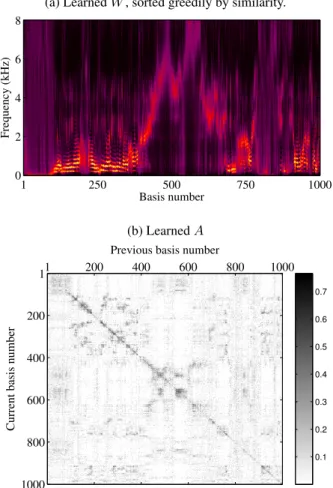
(a) LearnedW, sorted greedily by similarity.
Basis number Frequency (kHz) 1 250 500 750 1000 8 6 4 2 0 (b) LearnedA Previous basis number
Current basis number
1 200 400 600 800 1000 1 200 400 600 800 1000 0.1 0.2 0.3 0.4 0.5 0.6 0.7
Fig. 1. Training NDS on female speech (frame length:512).
In our approach, we assume the source and noise STFTs to fol-low a GCM, such thatsf n ∼ Nc(0,Pkwtrainf khkn) and bf n ∼
Nc(0,Pkwnoisef k h noise
kn ). H follows the dynamics of Eq. (3) with
transition matrixAtrain. We recall thatWtrain,Atrain are fixed vari-ables, learned in a training phase. The matricesWnoise
andHnoise
are here assumed unknown and with no particular structure, and learned from the data. With these assumptions, the decomposition (14) shall be obtained by minimizing the divergenceDIS(V|WtrainH+
WnoiseHnoise) penalized by the dynamical term−logp(H|Atrain), w.r.tH,Wnoise
and Hnoise
. This can be achieved with a MM al-gorithm using minor modifications of the derivations presented in Section 3. Besides the use of the IS divergence and the dynamical penalty term, the proposed procedure resembles the semi-supervised NMF setting described in [18].
4.3. Enhancement results
The sampling rate was16kHz. Time-frequency analysis was per-formed using frame lengths of512,640,800and960samples, us-ing for each length a50% overlap and a sine window for analy-sis and re-syntheanaly-sis. For each window length, NDS models were trained separately for male and female speech, each on 1000 utter-ances (about 50 minutes) from the TIMIT training set. The number of bases was set toK = 1000and the Gamma distribution param-eter toαk =α= 0.01. We show in Fig. 1 examples ofW andA
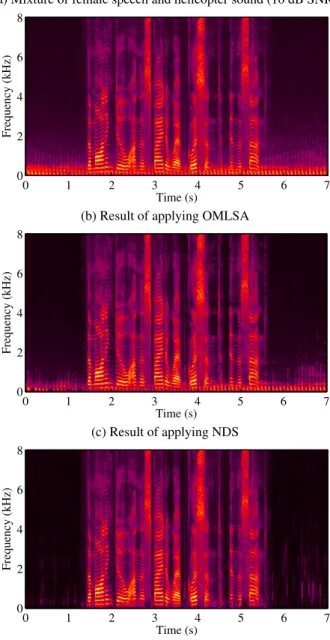
(a) Mixture of female speech and helicopter sound (10 dB SNR) Time (s) Frequency (kHz) 0 1 2 3 4 5 6 7 8 6 4 2 0
(b) Result of applying OMLSA
Time (s) Frequency (kHz) 0 1 2 3 4 5 6 7 8 6 4 2 0 (c) Result of applying NDS Time (s) Frequency (kHz) 0 1 2 3 4 5 6 7 8 6 4 2 0
Fig. 2. Speech enhancement results.
ofαstrongly encourages sparsity inH, thus encouraging a holistic representation of the spectrum, and a sparse transition matrix. How-ever, sparsity can lead to jitter in the estimated signals, a potential trade-off that will need to be investigated in future work.
We evaluated the enhancement algorithm described above on mixtures of 10 speech files by different speakers (5 male and 5 fe-male) from the TIMIT test set with 15 environmental texture sounds from [19] at 3 different input signal-noise ratios (SNR), for a to-tal of 450 mixtures. The training and test sets had disjoint sets of speakers. The texture sounds include a wide variety of environmen-tal sounds such as fire, bees, water stream, helicopter, applause, bab-ble noise, shaking paper, etc. The speech test files were 1.8 s to 4.5 s long, and were added in the middle of the 7 s long environmental sounds. The number of noise bases was set toKnoise= 2. For each mixture, we assumed the gender known and used the NDS speech model for that gender.
For comparison, we also show results for the state-of-the-art
0dB 5dB 10dB −5 0 5 10 15 SNR of noisy signal Output SDR NDS 960 OMLSA noisy
Fig. 3. Signal to distortion ratios for reconstructed speech with NDS (frame length 960, corresponding to 60 ms) and with OMLSA, and for the noisy speech (used as a baseline).
algorithm combining Optimally-Modified Log Spectral Amplitude Estimator and Improved Minima Controlled Recursive Averaging [20, 21], denoted as OMLSA. To illustrate the behavior of the al-gorithms, we show in Fig. 2 the spectrogram of a mixture of speech by a female speaker and a helicopter sound at 10 dB SNR, and the output of OMLSA and NDS on that mixture. NDS is able to sup-press the non-stationary helicopter noise, while OMLSA fails to do so. The outputs of the algorithms were also quantitatively evaluated using thebss evaltoolbox [22], treating our denoising problem as a source separation problem wheresis the target source andbis the interfering source, and the perception of speech quality (PESQ) measure [23].
Thebss evalresults are given in terms of signal-to-distortion ratio (SDR) and shown in Fig. 3. The proposed NDS algorithm with 60 ms windows significantly outperforms OMLSA for all in-put SNRs. The results for other frame lengths were similar in terms of SDR. When measured by PESQ, in contrast, the scores generally increased with window size, but yielded no significant improvement compared to OMLSA for the window sizes investigated. In informal listening tests, the NDS model was very good at removing a wide range of non-stationary noises, but suffered from a tendency to leave behind residual speech-like sounds. In particular, due to the fact that training data contained lip smacks, breath sounds, etc, noises ressembling these were often passed unsuppressed into the speech estimate. We are currently investigating whether these artifacts can be controlled by alternative parameterizations of the model.
5. CONCLUSIONS
We presented a novel non-negative dynamical system called NDS to model sequences of non-negative data, explained its relationships with previous work, derived an efficient MAP estimation algorithm, and explained how it can be applied to speech and audio modeling. In preliminary experiments on a speech enhancement task with real environmental sounds, the proposed NDS algorithm reached sim-ilar performance in terms of PESQ scores compared to the state-of-the-art algorithm, and significantly outperformed the state of the art in terms of SDR. Future works include testing more thoroughly the potential of the proposed model on non-negative data of differ-ent modalities, developing extensions enabling the sharing of bases across states, and investigating usage of NDS as a noise model.
6. REFERENCES
[1] D. D. Lee and H. S. Seung, “Learning the parts of objects with nonnegative matrix factorization,” Nature, vol. 401, pp. 788–791, 1999.
[2] B. H. Juang and L. R. Rabiner, “Hidden Markov models for speech recognition,” Technometrics, vol. 33, no. 3, pp. 251– 272, 1991.
[3] K. Tokuda, T. Yoshimura, T. Masuko, T. Kobayashi, and T. Ki-tamura, “Speech parameter generation algorithms for HMM-based speech synthesis,” inProc. IEEE International Confer-ence on Acoustics, Speech, and Signal Processing (ICASSP), 2000, vol. 3, pp. 1315–1318.
[4] J. R. Hershey, S. J. Rennie, P. A. Olsen, and T. T. Kristjans-son, “Super-human multi-talker speech recognition: A graphi-cal modeling approach,”Computer Speech and Language, vol. 24, no. 1, pp. 45–66, Jan. 2010.
[5] V. Y. F. Tan and C. F´evotte, “Automatic relevance deter-mination in nonnegative matrix factorization with the beta-divergence,” IEEE Transactions on Pattern Analysis and Ma-chine Intelligence, in press.
[6] C. F´evotte, N. Bertin, and J.-L. Durrieu, “Nonnegative matrix factorization with the Itakura-Saito divergence. With applica-tion to music analysis,” Neural Computation, vol. 21, no. 3, pp. 793–830, Mar. 2009.
[7] J. M. van den Hof, “Realization of positive linear systems,”
Linear Algebra and its Applications, vol. 256, no. 0, pp. 287 – 308, 1997.
[8] W. M. Haddad and V. Chellaboina, “Stability and dissipativity theory for nonnegative dynamical systems: a unified analysis framework for biological and physiological systems,” Nonlin-ear Analysis: Real World Applications, vol. 6, no. 1, pp. 35–65, 2005.
[9] J. Stachurski, “Economic dynamical systems with multiplica-tive noise,” Journal of Mathematical Economics, vol. 39, no. 1-2, pp. 135–152, 2003.
[10] C. F´evotte, “Majorization-minimization algorithm for smooth Itakura-Saito nonnegative matrix factorization,” inProc. IEEE International Conference on Acoustics, Speech and Signal Pro-cessing (ICASSP), Prague, Czech Republic, May 2011. [11] K. W. Wilson, B. Raj, P. Smaragdis, and A. Divakaran,
“Speech denoising using nonnegative matrix factorization with priors,” inProc. IEEE International Conference on Acoustics, Speech and Signal Processing (ICASSP), Apr. 2008, pp. 4029– 4032.
[12] J. Nam, G. J. Mysore, and P. Smaragdis, “Sound recognition in mixtures,” inProc. International Conference on Latent Vari-able Analysis & Independent Component Analysis (LVA/ICA), Tel-Aviv, Israel, 2012.
[13] S. A. Abdallah and M. D. Plumbley, “Polyphonic transcrip-tion by nonnegative sparse coding of power spectra,” in
Proc. 5th International Symposium Music Information Re-trieval (ISMIR), Barcelona, Spain, Oct. 2004, pp. 318–325. [14] L. Benaroya, R. Gribonval, and F. Bimbot, “Non negative
sparse representation for Wiener based source separation with a single sensor,” in Proc. IEEE International Conference on Acoustics, Speech and Signal Processing (ICASSP), Hong Kong, 2003, pp. 613–616.
[15] R. M. Parry and I. Essa, “Phase-aware non-negative spectro-gram factorization,” in Proc. 7th International Conference on Independent Component Analysis and Signal Separation (ICA), London, UK, Sep. 2007, pp. 536–543.
[16] A. Ozerov and C. F´evotte, “Multichannel nonnegative matrix factorization in convolutive mixtures for audio source separa-tion,”IEEE Transactions on Audio, Speech and Language Pro-cessing, vol. 18, no. 3, pp. 550–563, Mar. 2010.
[17] Y. Ephraim and D. Malah, “Speech enhancement using a minimum-mean square error short-time spectral amplitude es-timator,” IEEE Transactions on Acoustics, Speech and Signal Processing, vol. 32, no. 6, pp. 1109–1121, 1984.
[18] P. Smaragdis, B. Raj, and M. V. Shashanka, “Supervised and semi-supervised separation of sounds from single-channel mixtures,” inProc. 7th International Conference on Indepen-dent Component Analysis and Signal Separation (ICA), Lon-don, UK, Sep. 2007.
[19] J. H. McDermott and E. P. Simoncelli, “Sound texture per-ception via statistics of the auditory periphery: Evidence from sound synthesis,”Neuron, vol. 71, pp. 926–940, 2011. [20] I. Cohen, “Optimal speech enhancement under signal presence
uncertainty using log-spectral amplitude estimator,”IEEE Sig-nal Processing Letters, vol. 9, no. 4, pp. 113–116, 2002. [21] I. Cohen, “Noise spectrum estimation in adverse environments:
Improved minima controlled recursive averaging,” IEEE Transactions on Speech and Audio Processing, vol. 11, no. 5, pp. 466–475, 2003.
[22] E. Vincent, R. Gribonval, and C. F´evotte, “Performance mea-surement in blind audio source separation,”IEEE Transactions on Audio, Speech and Language Processing, vol. 14, no. 4, pp. 1462–1469, Jul. 2006.
[23] A. W. Rix, J. G. Beerends, M. P. Hollier, and A. P. Hek-stra, “Perceptual evaluation of speech quality (PESQ)–a new method for speech quality assessment of telephone net-works and codecs,” inProc. IEEE International Conference on Acoustics, Speech and Signal Processing (ICASSP), 2001, vol. 2, pp. 749–752.