1
Learning outcomes
After completing this unit you should:
1. know the fitness and training requirements necessary to achieve excellence in a selected sport
2. know the lifestyle factors that affect sports training and performance
3. be able to assess your own level of fitness
4. know the effects of psychological factors on sports training and performance.
1
Fitness testing
and training
Credit value: 5
Most sports performers aspire to reach their full sporting potential. To achieve
this, they must fully commit to their personal training plan, maintain a balanced,
healthy lifestyle and possess the psychological skills and desire to succeed.
Sports performers undergo regular assessments of their fitness to help predict
their future performance potential. Regular fitness testing is essential to
develop the performer’s physical fitness and for the coach to identify areas for
improvement and evaluate the success of a training regime. Fitness test results
provide an objective view of performance and can be used to ensure training
meets the needs of the individual and their sport.
In this unit you will look at the components of physical and skill-related fitness and explore why specific fitness components are necessary to achieve excellence in sport. Sports
coaches ensure that training programmes are tailored to meet the specific needs of the sports performer, and through this unit you will gain an understanding of why different performers require different training methods in order to reach their full potential. The unit also looks at lifestyle and psychological factors and the effects that they have on sports training and performance. You will explore fitness testing and by participating in tests will be able to investigate your own levels of fitness.
Unit 1 Fitness testing and training
BTEC’s own resources
Unit 1 Fitness testing and trainingBTEC’s own resources
Assessment and grading criteria
This table shows you what you must do in order to achieve a pass, merit or distinction grade,
and where you can find activities in this book to help you.
Unit 1 Fitness testing and training
BTEC’s own resources
To achieve a pass grade the evidence must show that you are able to:
To achieve a merit grade the evidence must show that, in addition to the pass criteria, you are able to:
To achieve a distinction grade the evidence must show that, in addition to the pass and merit criteria, you are able to:
P
1
describe the fitnessrequirements for achieving excellence in a selected sport
See Assessment activity 1.1, page 9
M
1
explain the fitnessrequirements for achieving excellence in a selected sport
See Assessment activity 1.2, page 10
P
2
describe three different fitness training methods used to achieve excellence in a selected sportSee Assessment activity 1.1, page 9
P
3
describe four different lifestyle factors that can affect sports training and performanceSee Assessment activity 1.3, page 13
P
4
carry out four different fitness tests for different components of fitness, recording the results accuratelySee Assessment activity 1.4, page 15
P
5
interpret their test results and personal level of fitnessSee Assessment activity 1.5, page 26
M
2
explain their test results and personal level of fitness, identifying strengths and areas for improvementD
1
evaluate their test results and personal level of fitness, considering the level required to achieve excellence in a selected sportP
6
describe the effects ofpsychological factors on sports training and performance
See Assessment activity 1.6, page 30
M
3
explain the effects ofpsychological factors on sports training and performance
See Assessment activity 1.7, page 30
D
2
analyse the effects ofpsychological factors on sports training and performance
See Assessment activity 1.7, page 30
Unit 1 Fitness testing and training
BTEC’s own resources
Unit 1 Fitness testing and trainingBTEC’s own resources
How you will be assessed
This unit will be assessed by an internal assignment that will be designed and marked by the tutors at your centre. Your assessment could be in the form of:
presentations • case studies • practical tasks • written assignments. •
Unit 1 Fitness testing and training
BTEC’s own resources
Sarah, 16-year-old track athlete
This unit helped me to see that you need to focus on what you want to achieve, and it takes hard work, commitment and training to be successful.
I enjoyed looking at elite sports performers and thinking about the different fitness requirements and training methods they use. It was good to explore lifestyle and psychological factors and how they can affect sports training and performance because I could apply the things I learnt to how I perform on the track. I realised that mental fitness is just as important as physical fitness if you want to succeed.
There were lots of practical tasks and activities for this unit, which made it more exciting for me. The bit I enjoyed most was testing my fitness levels. I liked participating in different fitness tests and comparing my results to my peers. We looked at data tables and it was interesting to see what the results would be like for top sports performers.
Over to you!
• What areas of this unit might you find challenging?
• Which section of the unit are you most looking forward to?
Unit 1 Fitness testing and training
BTEC’s own resources
Unit 1 Fitness testing and trainingBTEC’s own resources
1 Know the fitness and training
requirements necessary to achieve
excellence in a selected sport
1.1 Fitness requirements for
achieving excellence in sport
Different people have different fitness requirements depending on their job, hobbies and the sports and leisure activities they enjoy. There are many definitions of fitness. In general, fitness is your ability to meet the demands of your lifestyle or environment.
Different sports require different fitness components. A sports coach can build a profile of a performer’s sport-specific training needs in order to design a training programme to target and enhance fitness components that are important for their sport.
Components of physical fitness
The six components of physical fitness are: aerobic endurance • muscular endurance • flexibility • speed • muscular strength • body composition. •
Aerobic endurance is also known as cardio-respiratory fitness, cardio-respiratory endurance or aerobic fitness. It is the ability of the cardio-respiratory system to efficiently supply nutrients and oxygen to working muscles during sustained physical activity.
Unit 1 Fitness testing and training
BTEC’s own resources
Warm up
Warm-up
How have they got there?
Think of a sporting role model: an elite sports performer, somebody who has achieved ‘excellence’. Write down five factors that you think have contributed to their success. Think about their fitness levels, the training they have undertaken, their lifestyle and psychological factors.
Discuss in groups and compare the factors you have identified with those of other sporting role models.
Jamaican sprinter Usain Bolt: the fastest man on the planet. What is his most recent time for the 100m?
Unit 1 Fitness testing and training
BTEC’s own resources
Unit 1 Fitness testing and trainingBTEC’s own resources
Muscular endurance is the ability of a muscle to continue contracting over a period of time against a light to moderate load. It is the ability of the muscular system to work efficiently.
Flexibility means having an adequate range of motion in all joints of the body. It is the ability to move a joint through its complete range of movement.
Speed is calculated in the following way: Speed (m/s) = Distance (m)
Time taken (s)
The faster an athlete runs over a given distance, the greater their speed. There are three basic types of speed:
accelerative speed – sprints up to 30 metres
•
pure speed – sprints up to 60 metres
•
speed endurance – sprints with short recovery periods in between.
•
Muscular strength is the maximum force a muscle or muscle group can produce.
Body composition is the relative ratio of fat mass to fat-free mass (vital organs, muscle, bone) in the body.
A hockey player requires speed, aerobic endurance, flexibility, power, muscular endurance and strength. They use muscular endurance, strength and power when performing skills like shooting and defending. They also need to change direction quickly and efficiently and be able to respond rapidly to the position of their opponents.
Components of skill-related fitness
There are five skill-related fitness components: agility • balance • co-ordination • power • reaction time. •
Agility is the ability of a sports performer to quickly and precisely move or change direction without losing their balance.
Balance is the ability to maintain your centre of mass over a base of support. There are two types: static balance and dynamic balance. A gymnast uses static balance when performing a headstand and dynamic balance to perform a cartwheel.
Co-ordination is the smooth flow of movement needed to perform a motor task efficiently and accurately.
Unit 1 Fitness testing and training
BTEC’s own resources
One of the greatest gymnasts of all time: Ecaterina Szabo, Romanian gymnast, four times Olympic Gold Medallist at the 1984 Los Angeles Olympics. What skill-related fitness requirements does a gymnast have?
Unit 1 Fitness testing and training
BTEC’s own resources
Unit 1 Fitness testing and trainingBTEC’s own resources
BTEC’s own resources
Unit 1 Fitness testing and trainingPower is the work done in a unit of time. It is calculated in the following way:
Power (kgm/min or kgm/s) = Force (kg) x Distance (m) Time (min or s)
Reaction time is the time taken for a sports performer to respond to a stimulus and the initiation of their response. For example, a sprinter in the blocks responding to the starter’s gun.
Body composition and sports
performance
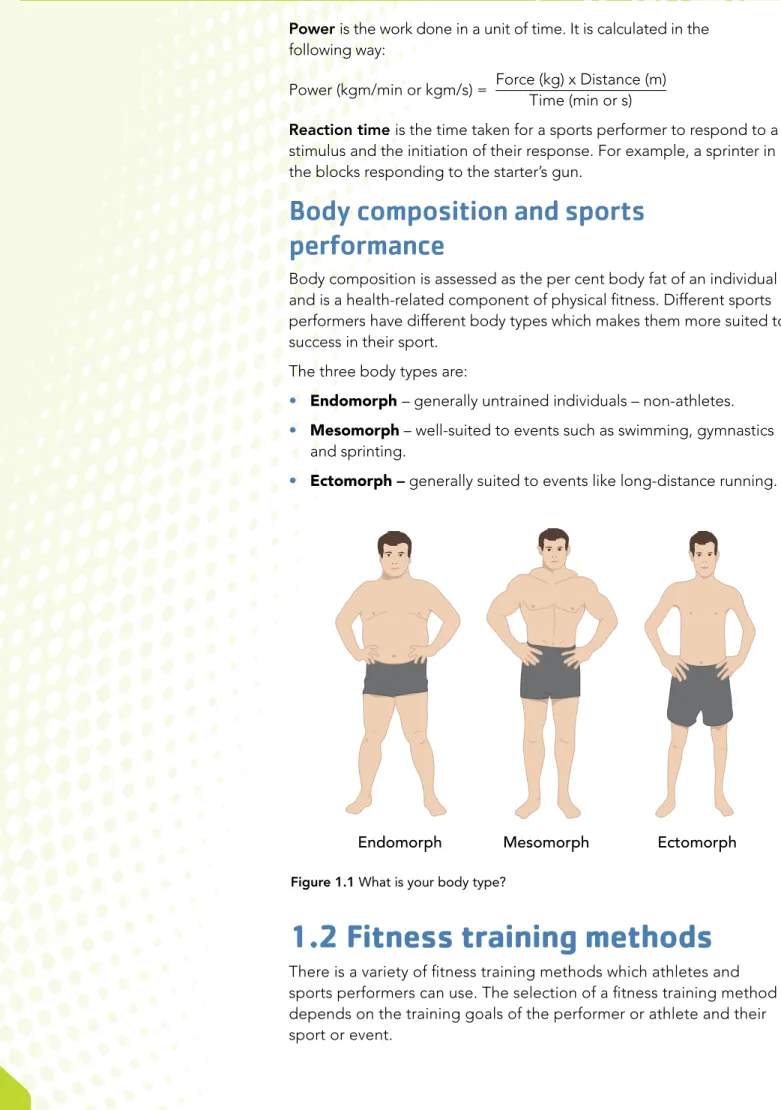
Body composition is assessed as the per cent body fat of an individual and is a health-related component of physical fitness. Different sports performers have different body types which makes them more suited to success in their sport.
The three body types are: Endomorph
• – generally untrained individuals – non-athletes. Mesomorph
• – well-suited to events such as swimming, gymnastics and sprinting.
Ectomorph
• – generally suited to events like long-distance running.
1.2 Fitness training methods
There is a variety of fitness training methods which athletes and sports performers can use. The selection of a fitness training method depends on the training goals of the performer or athlete and their sport or event.Figure 1.1 What is your body type?
Unit 1 Fitness testing and training
BTEC’s own resources
Unit 1 Fitness testing and trainingBTEC’s own resources
BTEC’s own resources
Unit 1 Fitness testing and trainingTable 1.1: Examples of fitness training methods for the different components of fitness.
Component of fitness Training methods
Flexibility • Static Active • Passive • Ballistic • Muscular strength Muscular endurance Power
Use of resistance machines •
Use of free weights •
Circuit training •
Plyometrics •
Aerobic endurance • Continuous training Fartlek training •
Interval training •
Speed • Hollow sprints
Acceleration sprints • Hill sprints • 1 2 3 4 5 6
Figure 1.2: Plyometric circuit for a basketball player.
Sport-specific training
methods
The fitness training method selected should meet the needs of the performer and the fitness requirements of their sport. Here are two examples:
The basketball player
Fitness requirement:
• To build anaerobic
power and improve jumping ability. Suggested training method:
•
Plyometrics.
Plyometric training involves completing specific exercises or activities to develop power and sport-specific skills. Plyometric training should be used carefully, because it can be physically stressful on the body and cause muscle soreness.
Plyometric exercises can be organised as part of a circuit, see figure 1.2 for an example. 1. Barrier hops
2. Incline push ups 3. Alternate bounding 4. Rim jumps
5. Lunges
Unit 1 Fitness testing and training
BTEC’s own resources
Unit 1 Fitness testing and trainingBTEC’s own resources
BTEC’s own resources
Unit 1 Fitness testing and trainingThe netball player
Fitness requirement:
• To improve aerobic fitness and sprinting ability on the court.
Suggested training method:
• Fartlek training.
‘Fartlek’ comes from the Swedish word for ‘speedplay’ and is a training method that is used to enhance both the aerobic and anaerobic energy systems. Fartlek training is usually performed outdoors.
Fartlek training involves varying pace, from a fast sprint to a slow jog, and is beneficial in sports that involve using both the aerobic and anaerobic energy systems, like football, hockey and rugby. Here is an example of Fartlek training for netball:
1. Start with a 1.5–2 mile jog at a light to moderate intensity 2. Sprint 30m
3. Light jog 100m 4. Sprint 60m 5. Light jog 150m
6. Finish with a 6-minute jog for cool-down.
Sport-specific fitness requirements
Certain fitness components are particularly important to achieving successful sports performance. Table 1.2 shows the major fitness components for five different sports.
Table 1.2: Fitness components required for five sports. Fitness
component
Golf Cycling Gymnastics Judo Tennis
Aerobic endurance
Muscular endurance
Flexibility
Speed
Muscular strength
Agility
Balance
Co-ordination
Power
Reaction time
Repeat steps 2–5 eight to ten times
}
Tiger Woods’ golf swing. What are the fitness requirements for a golfer?
Unit 1 Fitness testing and training
BTEC’s own resources
Unit 1 Fitness testing and trainingBTEC’s own resources
BTEC’s own resources
Unit 1 Fitness testing and trainingFor example, the fitness requirements for golf include the following: Flexibility, balance and co-ordination
• are needed to perform a
co-ordinated, efficient and effective swing. Muscular endurance and muscular strength
• are needed to
perform efficient trunk rotation and rotary movements of the swing. A golfer requires good muscular strength, particularly in the arms and legs. Good strength in the abdominal muscles is needed to prevent problems with the muscles of the lower back.
Aerobic endurance
• is vital.Goodfitness levels are required so that the golfer can perform well. Poor fitness levels could affect fine muscle control and concentration.
Some training methods that could be used for golf include the following:
Flexibility training
• ,e.g. Proprioceptive Neuromuscular Facilitationtechnique, to maintain and enhance golf swing. Strength training
• , e.g. use of resistance machines, to maintain and enhance golf swing.
Endurance training
• , e.g. continuous distance swimming, to maintain optimum aerobic endurance levels.
Proprioceptive Neuromuscular Facilitation (PNF)– a stretching technique for developing flexibility. PNF is performed with a partner. If completed regularly, it can improve mobility and joint range of motion.
Key term
Functional skills
Using ICT to research fitness requirements and training methods and present your information could develop your ICT skills.
1. Select a sport and describe the fitness requirements needed to achieve excellence. Rank the fitness requirements in order of importance and give your reasons.
P
1
2. Describe three different fitness training methods that could be used to achieve excellence in this sport.
P
2
Grading tips
By selecting a sport that you participate in, you could draw •
on your personal experience to help you describe the fitness requirements and different training methods used. Include both the physical and skill-related components of •
fitness in your description.
Think about the best performer in the UK and in the world •
in the sport you have selected. You can use the internet to research information on elite sports performers, the fitness requirements they have and the training they undertake.
P
1
P
2
Unit 1 Fitness testing and training
BTEC’s own resources
Explain the fitness requirements a goalkeeper needs to achieve excellence in football. In your explanation, consider any similarities or differences that might exist between the fitness requirements of a striker and a goalkeeper. M
1
Grading tips
A goalkeeper’s overall workload could be considered lower than for other players; goalkeepers don’t have the same physical demands in terms of aerobic endurance. But, they still require similar fitness requirements to be able to perform well. You shoud consider:
the physical fitness requirements for a goalkeeper, such as power, •
speed, strength (particularly leg, thigh and upper body) and flexibility the skill-related fitness requirements needed to be able to respond •
quickly and efficiently to game situations, such as agility, balance and reaction time.
M
1
Assessment activity 1.2
What fitness components does a footballer need to consider?
Case study: fitness
for football
Alex has gained a summer work placement in a local football club. He works alongside experienced coaches to assist with the coaching of the youth team.
Alex has been asked to create a presentation to give to the youth team which looks at the fitness requirements needed to achieve excellence in football. He has decided to use a 17-year-old centre forward as his case study.
1. What fitness components does a centre forward require to achieve excellence in football? Consider both the physical fitness and skill-related components of fitness.
2. What three different fitness training methods could Alex use to improve the centre forward’s sports performance? Describe each method.
3. What four different lifestyle factors could affect the centre forward’s sports performance? Consider factors like stress, smoking, drugs and diet.
11
Unit 1 Fitness testing and training
BTEC’s own resources
2 Know the lifestyle
factors that affect sports
training and performance
2.1 Lifestyle factors
Lifestyle and well-being are important factors for sports performers. To succeed in their sport, performers must think about all aspects of their training and performance, including lifestyle factors.
All sports performers want to maintain good health and be injury free, so that they can train or compete in the sports they love.
Stress may occur if a sports performer thinks that they are unable to meet the demands of a sports performance or activity. Stress can have a positive or negative effect on training and performance. For example, a gymnast, enjoying the feelings created as they complete a complex vault, experiences eustress. Whereas, another gymnast, concerned about the technical aspects of the vault and worried about performing in front of a large audience, experiences negative stress, namely anxiety.
Drugs should not be taken. All drugs have side effects, they can reduce fitness levels and be harmful to health. Sports performers and athletes regularly undergo testing for illegal substances. The relevant National Governing Body of Sport and UK Sport are responsible for making decisions about which sports performer or athlete should be tested and when. Drug abuse is illegal. If a performer tests positive they can be banned from competing for life. Some examples of banned substances are shown in the table below.
Table 1.3: Examples of banned substances.
Drug Effect Examples of
abuse in sport Side effects Anabolic
steroids Increases power by building up muscles Increases training time
Used to help repair the body after training
Increases competitiveness and aggression Power • events, e.g., weightlifting Sprint events • Liver disease •
Certain forms of cancer • Fluid retention • Infertility • Hardening of arteries • Skin disorders •
Beta blockers Used to steady nerves and improve
fine motor control • • ShootingSnooker Darts •
Tiredness and lethargy •
Low blood pressure •
Breathing difficulties •
Diuretics Reduces body weight • Horse racing
Boxing
• • • DehydrationMuscle cramps Kidney failure •
Stimulants Improves endurance Makes the performer more physically alert
Reduces fatigue
Endurance-•
based sports • • Increased blood pressureIncreased heart rate, palpitations Paranoid delusions • Restlessness, sleeplessness • Anxiety • Shaking, sweating •
Eustress– a positive form of stress. Can occur when a sports performer enjoys testing their own sporting ability, pushing themselves to reach their full potential.
Anxiety– a negative form of stress. Can reduce a sport performer’s level of confidence and concentration. Expectations of success are also reduced and the performer experiences a greater fear of failure.
Unit 1 Fitness testing and training
BTEC’s own resources
Unit 1 Fitness testing and trainingBTEC’s own resources
Smoking narrows arteries, shortens breath and increases the risk of developing heart disease, respiratory disease and cancer. When someone smokes, carbon monoxide enters the body and this results in less oxygen being available for working muscles. Smoking can reduce aerobic endurance levels by up to 10 per cent, reducing efficiency. Sleep is very important. Young athletes and sports performers should have at least 8 hours’ sleep each night. It is important that the body has time for rest and recuperation. Insufficient sleep can reduce the positive benefits of training and can affect sports performance.
Diet is very important. Good nutrition helps reduce health risks such as heart disease, obesity, stroke and high blood pressure. A balanced diet is important for sports performers and athletes so that they can get the energy they need to perform well. A balanced diet consists of:
carbohydrates • • vitamins fats • • minerals proteins • • water. fibre •
Other lifestyle factors include: activity level • • medical history sports participation • • culture work demands • • gender. alcohol consumption •
Remember
Following a healthy, balanced diet helps the body to function properly. You need to make sure you eat the right amount and type of food, so that you have sufficient energy for your body to meet the demands of different sports.
Make sure you maintain a healthy, •
balanced diet.
Make sure you take part in •
regular physical activity.
If you are healthy and active now, •
you are more likely to be healthy and active in adulthood.
Did you know?
Obesity
• is the accumulation of body fat above acceptable levels for an individual’s age, gender and ethnic origin.
Obesity leads to health problems, •
including diabetes and heart disease.
The main causes of obesity are •
poor diet (eating too much) and inactivity.
The number of young people in •
the UK who are clinically obese is rising at an alarming rate each year.
Activity: The work–life balance
In pairs or groups, discuss how work demands affect sports training and performance. For example, you may have a part-time job, and could discuss how the demands of work affect your sports training and performance. List the effects in a table, like the one below.
Work demands Effect on sports training and
performance
Part-time employment Not enough time to train Increase in stress levels
Discuss how you try to maintain a healthy work–life balance and any further improvements you could make.
Unit 1 Fitness testing and training
BTEC’s own resources
Unit 1 Fitness testing and trainingBTEC’s own resources
3 Be able to assess your
own level of fitness
In this section you will follow the standard methods for different fitness tests, to assess your own fitness levels. In particular, you will look at the methods for the following tests:
Sit and reach
•
Grip dynamometer
•
Multi-stage fitness test
•
Forestry step test
•
35m sprint
•
Vertical jump
•
One minute press-up
•
One minute sit-up
•
Skinfold testing
•
Body Mass Index (BMI).
•
3.1 Carry out fitness testing
Pre-test procedures
Before participating in fitness tests you should complete an informed consent form. This is documented evidence that shows that participants have been provided with all the necessary information to undertake the test. You will need to complete an informed consent form to confirm that you:
are able to follow the test method
•
know exactly what is required of you during testing
•
have fully consented to your participation in the fitness tests
•
know that you are able to ask your tutor/assessor any questions
•
relating to the tests
understand that you can withdraw your consent at any time.
•
Functional skills
Making contributions to discussions could help develop your English
skills in speaking.
Remember
Before you participate in, or administer any fitness test, it is extremely important that pre-test procedures are followed.
Choose four different lifestyle factors and describe how they can affect sports training and performance. Use examples from your sports training and performance to support your description where appropriate.
Grading tips
Outline your four lifestyle factors and then describe how •
each factor can affect sports training and performance. Think of your description as if you are ‘painting a picture •
with words’.
P
3
Unit 1 Fitness testing and training
BTEC’s own resources
Unit 1 Fitness testing and trainingBTEC’s own resources
The consent form should be signed and dated by you (the participant), supported by a witness (usually your tutor) and if you are under 18 years of age a parent/guardian will also be required to give their consent to your participation.
INFORMED CONSENT FOR THE WINGATE TEST
1. The purpose of the test is to determine maximal anaerobic power and maximal anaerobic capacity.
2. This will be determined using the Wingate Anaerobic Cycling Test. 3. The participant will carry out standard warming-up and cooling-down
procedures for the test.
4. The participant will be required to perform a 30-second all-out cycling test using a Monark 824E cycle ergometer.
5. All participants will receive method details in full.
6. The tutor/assessor is available to answer any relevant queries which may arise concerning the test.
7. The participant is free to withdraw consent and discontinue participation in the test at any time.
8. Only the tutor/assessor and participant will have access to data recorded
from the test which will be stored securely. Participant confidentiality is
assured.
I FULLY UNDERSTAND THE SCOPE OF MY INVOLVEMENT IN THIS FITNESS TEST AND HAVE FREELY CONSENTED TO MY PARTICIPATION.
Participant’s signature Date: Tutor’s/assessor’s signature: Date:
I (insert participant’s name), UNDERSTAND THAT MY PARENTS/GUARDIAN HAVE GIVEN PERMISSION FOR ME TO TAKE PART IN THIS FITNESS TEST, WHICH WILL BE SUPERVISED BY (insert tutor name). I AM PARTICIPATING IN THIS FITNESS TEST BECAUSE I WANT TO, AND I HAVE BEEN INFORMED THAT I CAN STOP THE TEST AT ANY TIME WITHOUT ANY ISSUES ARISING.
Participant’s signature Date:
Figure 1.3: Example of an informed consent form.
Your guide to recording test results
Allow sufficient time to practise each fitness test method before you
•
begin collecting data.
Use an appropriate data collection sheet to record your results.
•
Record each result as you get it, so you don’t forget it.
•
For reliable results, all fitness tests selected should be repeated.
•
Depending on the tests chosen, these may be repeated on the same day (i.e., half day test-retest), or if a longer recovery period is required between trials, then a separate day test-retest.
Use the correct units of measurement for your fitness tests. Some
•
fitness tests will require the use of tables to process data and obtain the correct units of measurement. For example, the Multi-stage Fitness Test result is recorded as the Level and Shuttle achieved. You need to use a conversion table to look up the predicted aerobic fitness level (VO2 max, ml/kg/min) for the Level and Shuttle obtained.
Unit 1 Fitness testing and training
BTEC’s own resources
Unit 1 Fitness testing and trainingBTEC’s own resources
Calibration of equipment describes the process of checking (and if necessary adjusting) the accuracy of fitness testing equipment before it is used, by comparing it to a recognised standard. Prior to testing, equipment should be checked carefully. If equipment isn’t correctly calibrated it could lead to inaccurate (invalid) results.
Issues with test methods – by completing different fitness tests, you will gain an understanding of why some tests might not be as valid and reliable as others, and factors which could affect test reliability and validity.
Reliability
• is the ability to carry out the same fitness test method again and expect the same results. Reliability is repeatability – the results obtained should be consistent.
Validity
• is the accuracy of the results. This means whether the results you have recorded from the fitness test are a true reflection of what you are actually trying to measure.
Example of issues with test reliability and validity
Jim wants to measure his body weight. He decides to use a set of scales, and weighs himself twice in 10 minutes (for reliability). However, before testing, he forgets to check whether the scales are correctly calibrated. Unfortunately, the calibration of the scales is incorrect – when there is no weight on the scales, the dial is not at zero. Jim, blissfully unaware, weighs himself. Each time Jim weighs himself the result will be identical, so the test will be reliable. But Jim will not get a true measurement of his weight because the scales are providing an incorrect, invalid reading. This means the results will not be valid.
This example highlights how important it is to check calibration of equipment and practise test methods before collecting data to help ensure that final data collected is both valid and reliable, otherwise results are worthless.
Fitness testing methods
In this section you will explore different fitness tests covering each component of physical fitness.
Functional skills
If you use ICT systems to record fitness test data and develop, present and communicate information you can develop your
ICT skills in sorting data.
Reliability– consistency of results; repeatability.
Validity– accuracy of results.
Key terms
Carry out four different fitness tests for different components of fitness, accurately recording your results.
Grading tips
Follow pre-test procedures carefully, design and complete your •
own informed consent form to participate in the fitness tests. Practise test procedures with your peers; being familiar with •
standard test protocol will help to ensure accuracy of results. Use a data collection form to record your fitness test results. •
Make sure you use the correct units of measurement. •
P
4
Assessment activity 1.4
PLTS
If you identify questions to answer and problems to resolve in your fitness testing, you can develop your skills as an independent enquirer.
Unit 1 Fitness testing and training
BTEC’s own resources
Flexibility: sit and reach test
The aim of the sit and reach test is to measure trunk forward flexion, hamstring, hip and lower back range of motion. A standard sit and reach box is used.
Perform a short warm-up prior to this test. Don’t use fast, jerky 1.
movements, as this may increase risk of injury. Remove your shoes. Sit with your heels placed against the edge of the sit and reach box. 2.
Keep your legs flat on the floor i.e., keep your knees down.
Place one hand on top of the other and reach forward slowly. Your 3.
fingertips should be in contact with the measuring portion of the sit and reach box. As you reach forward, drop your head between your arms and breathe out as you push forward.
The best of three trials should be recorded. 4.
Results
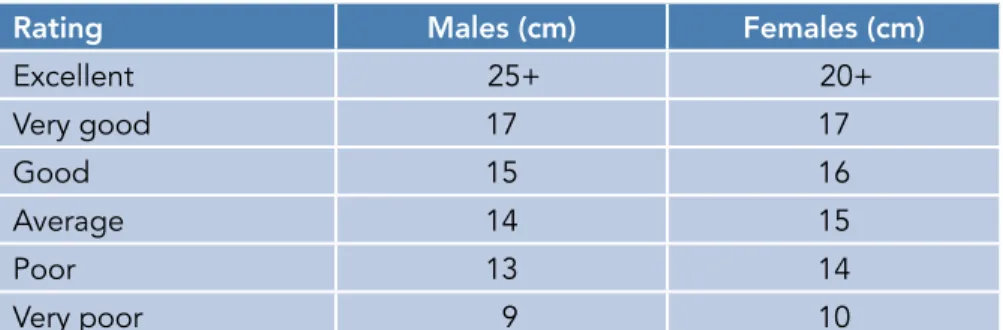
Table 1.4: Interpretation of results for the sit and reach test.
Rating Males (cm) Females (cm)
Excellent 25+ 20+ Very good 17 17 Good 15 16 Average 14 15 Poor 13 14 Very poor 9 10
Strength: grip strength dynamometer test
The grip strength dynamometer test measures the static strength of the power grip-squeezing muscles, where the whole hand is used as a vice or clamp. A grip dynamometer is a spring device; as force is applied, the spring is compressed and this moves the dynamometer needle which indicates the result. Digital dynamometers are also available.
Adjust the handgrip size, so that the dynamometer feels comfortable 1.
to hold/grip.
Stand-up, with your arms by the side of your body. 2.
Hold the dynamometer parallel to the side of your body, with the 3.
dial/display facing away from you.
Squeeze as hard as possible for 5 seconds, without moving 4.
your arm.
Carry out three trials on each hand, with a 1-minute rest 5.
Unit 1 Fitness testing and training
BTEC’s own resources
Results
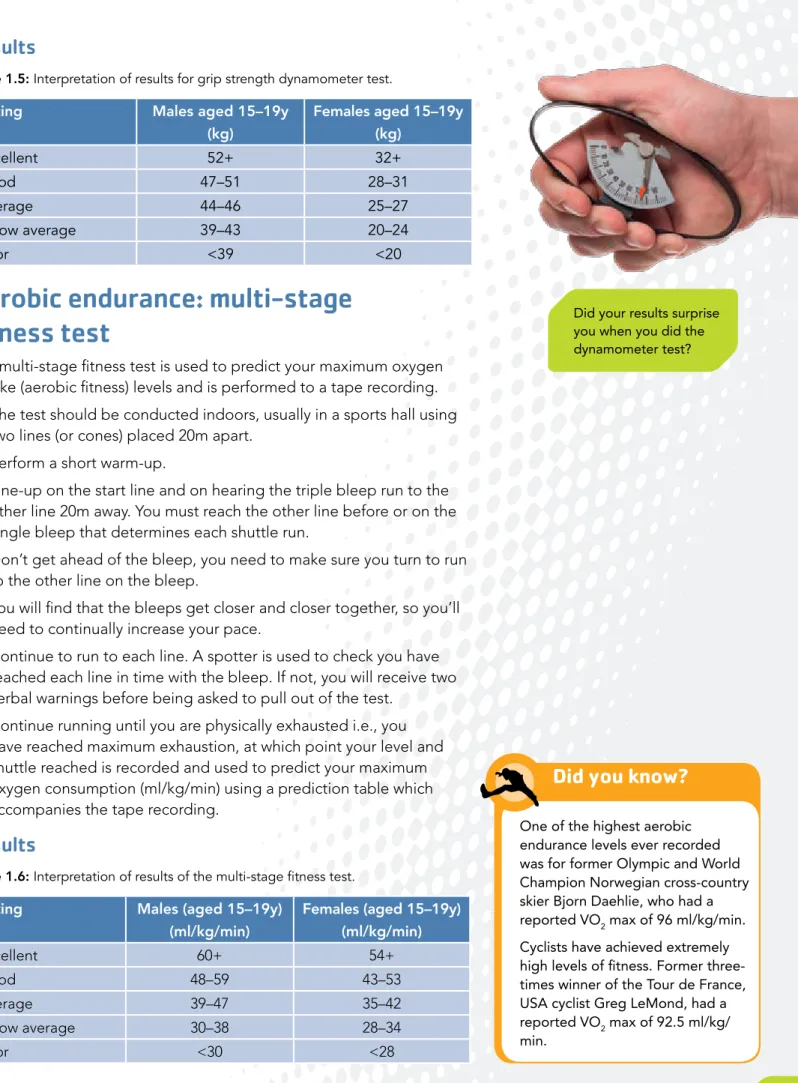
Table 1.5: Interpretation of results for grip strength dynamometer test.
Rating Males aged 15–19y
(kg)
Females aged 15–19y (kg) Excellent 52+ 32+ Good 47–51 28–31 Average 44–46 25–27 Below average 39–43 20–24 Poor <39 <20
Aerobic endurance: multi-stage
fitness test
The multi-stage fitness test is used to predict your maximum oxygen uptake (aerobic fitness) levels and is performed to a tape recording.
The test should be conducted indoors, usually in a sports hall using 1.
two lines (or cones) placed 20m apart. Perform a short warm-up.
2.
Line-up on the start line and on hearing the triple bleep run to the 3.
other line 20m away. You must reach the other line before or on the single bleep that determines each shuttle run.
Don’t get ahead of the bleep, you need to make sure you turn to run 4.
to the other line on the bleep.
You will find that the bleeps get closer and closer together, so you’ll 5.
need to continually increase your pace.
Continue to run to each line. A spotter is used to check you have 6.
reached each line in time with the bleep. If not, you will receive two verbal warnings before being asked to pull out of the test.
Continue running until you are physically exhausted i.e., you 7.
have reached maximum exhaustion, at which point your level and shuttle reached is recorded and used to predict your maximum oxygen consumption (ml/kg/min) using a prediction table which accompanies the tape recording.
Results
Table 1.6: Interpretation of results of the multi-stage fitness test.
Rating Males (aged 15–19y)
(ml/kg/min)
Females (aged 15–19y) (ml/kg/min) Excellent 60+ 54+ Good 48–59 43–53 Average 39–47 35–42 Below average 30–38 28–34 Poor <30 <28
Did you know?
One of the highest aerobic endurance levels ever recorded was for former Olympic and World Champion Norwegian cross-country skier Bjorn Daehlie, who had a reported VO2 max of 96 ml/kg/min. Cyclists have achieved extremely high levels of fitness. Former three-times winner of the Tour de France, USA cyclist Greg LeMond, had a reported VO2 max of 92.5 ml/kg/ min.
Did your results surprise you when you did the dynamometer test?
Unit 1 Fitness testing and training
BTEC’s own resources
Unit 1 Fitness testing and trainingBTEC’s own resources
Table 1.7: Interpretation of aerobic fitness results for elite athletes.
Rating Males (aged 18–22y) Females (aged 18–22y)
World class 80+ 70+
Elite 70 63
Trained 57 53
Active 50 43
Untrained 45 39
Activity: Fitness results
Using the data tables provided, compare your aerobic fitness (VO2 max ml/kg/min) results with normative data for your age group and to data for young elite performers.
How do your fitness results compare?
•
What improvements could you make to your current training
•
regime to improve your aerobic fitness levels? Discuss your results in groups.
Aerobic endurance: Forestry step test
The Forestry Step test was developed in 1977 by Brian Sharkey, and is a modified version of the Harvard Step test. The test is widely used in fitness selection procedures (for example, for police and fire service) and predicts aerobic endurance levels.
A different bench height is used for males and females. For males, the height of the bench should be 40 cm (15.75 inches), for females, 33 cm (13 inches). The stepping rate of 22.5 steps per minute is the same for both males and females, which means the metronome should be set at a cadence of 90 beats per minute.
Stand directly facing the bench and start stepping in-time with the 1.
beat of the metronome. As soon as you start stepping, the helper will start the stopwatch.
Keep to the beat of the metronome, which means you will put one foot 2.
onto the bench, then your other foot, then the first foot will be lowered to the floor, then your other foot i.e., ‘up’, ‘up’, ‘down’, ‘down’.
Straighten your legs when you fully step up onto the bench. 3.
Keep stepping for 5 minutes, at which point your helper will stop the 4.
metronome and you will need to sit down immediately and locate your radial pulse.
At 5 minutes and 15 seconds (15 seconds after sitting down) you will need 5.
to count your pulse for 15 seconds (stopping at 5 minutes and 30 seconds). Record your 15-second pulse rate and perform a short cool-down. 6.
Unit 1 Fitness testing and training
BTEC’s own resources
Unit 1 Fitness testing and trainingBTEC’s own resources
Results
Use the tables to obtain your non-adjusted aerobic fitness level. In table 1.8a or 1.8b (depending on your gender), locate your 15
•
second pulse in the ‘Pulse Count’ column and find the value closest to your body weight (kg). The point at which these two values intersect gives you your non-adjusted aerobic fitness level (in ml/kg/min). Next, adjust your fitness level to take into account your age, which
•
will provide a more accurate prediction of your aerobic endurance. In Table 1.9, locate your nearest age in years (left-hand column) and locate your non-adjusted aerobic fitness value (fitness score) along the top. The point where these two values intersect gives you your age-adjusted fitness level (ml/kg/min).
Use table 1.10 to interpret your aerobic fitness level.
•
Table 1.8a: Forestry non-adjusted aerobic fitness values (ml/kg/min) for males.
Pulse count Maximal oxygen consumption (VO2 max)
45 33 33 33 33 33 32 32 32 32 32 32 32 32 44 34 34 34 34 33 33 33 33 33 33 33 33 33 43 35 35 35 34 34 34 34 34 34 34 34 34 34 42 36 35 35 35 35 35 35 35 35 35 35 34 34 41 36 36 36 36 36 36 36 36 36 36 36 35 35 40 37 37 37 37 37 37 37 37 35 35 35 35 35 39 38 38 38 38 38 38 38 38 38 38 38 37 37 38 39 39 39 39 39 39 39 39 39 39 39 38 38 37 41 40 40 40 40 40 40 40 40 40 40 39 39 36 42 42 41 41 41 41 41 41 41 41 41 40 40 35 43 43 42 42 42 42 42 42 42 42 42 42 41 34 44 44 43 43 43 43 43 43 43 43 43 43 43 33 46 45 45 45 45 45 44 44 44 44 44 44 44 32 47 47 46 46 46 46 46 46 46 46 46 46 46 31 48 48 48 47 47 47 47 47 47 47 47 47 47 30 50 49 49 49 48 48 48 48 48 48 48 48 48 29 52 51 51 51 50 50 50 50 50 50 50 50 50 28 53 53 53 53 52 52 52 52 51 51 51 51 51 27 55 55 55 54 54 54 54 54 54 53 53 53 52 26 57 57 56 56 56 56 56 56 56 55 55 54 54 25 59 59 58 58 58 58 58 58 58 56 56 55 55 24 60 60 60 60 60 60 60 59 59 58 58 57 23 62 62 61 61 61 61 61 60 60 60 59 22 64 64 63 63 63 63 62 62 61 61 21 66 66 65 65 65 64 64 64 62 20 68 68 67 67 67 67 66 66 65 Weight (kg) 54.5 59.1 63.6 68.2 72.7 77.3 81.8 86.4 91 95.4 100 104.5 109
Unit 1 Fitness testing and training
BTEC’s own resources
Table 1.8b: Forestry non-adjusted aerobic fitness values (ml/kg/min) for females.
Pulse count Maximal oxygen consumption (VO2 max)
45 29 29 29 44 30 30 30 30 30 43 31 31 31 31 31 31 42 32 32 32 32 32 32 32 32 32 32 41 33 33 33 33 33 33 33 33 33 33 40 34 34 34 34 34 34 34 34 34 34 39 35 35 35 35 35 35 35 35 35 35 38 36 36 36 36 36 36 36 36 36 36 37 37 37 37 37 37 37 37 37 37 37 36 37 38 38 38 38 38 38 38 38 38 38 35 38 38 39 39 39 39 39 39 39 39 39 39 34 39 39 40 40 40 40 40 40 40 40 40 40 33 40 40 41 41 41 41 41 41 41 41 41 41 32 41 41 42 42 42 42 42 42 42 42 42 42 31 42 42 43 43 43 43 43 43 43 43 43 43 30 43 43 44 44 44 44 44 44 44 44 44 44 29 44 44 45 45 45 45 45 45 45 45 45 45 28 45 45 46 46 46 47 47 47 47 47 47 47 27 46 46 47 48 48 49 49 49 49 49 26 47 48 49 50 50 51 51 51 51 25 49 50 51 52 52 53 53 24 51 52 53 54 54 55 23 53 54 55 56 56 57 Weight (kg) 36.4 40.9 45.4 50.0 54.5 59.1 63.6 68.2 72.7 77.3 81.8 86.4
Table 1.9: Age-adjusted fitness levels.
Fitness score 30 31 32 33 34 35 36 37 38 39 40 41 42 43 44 45 46 47 48 49 50 Nearest age 15 32 33 34 35 36 37 38 39 40 41 42 43 44 45 46 47 48 49 50 51 5320 31 32 33 34 35 36 37 38 39 40 41 42 43 44 45 46 47 48 49 50 51 (cont.) Fitness score 51 52 53 54 55 56 57 58 59 60 61 62 63 64 65 66 67 68 69 70 71 72 Nearest age 15 54 55 56 57 58 59 60 61 62 63 64 65 66 67 68 69 70 71 72 74 75 76 20 52 53 54 55 56 57 58 59 60 61 62 63 64 65 66 67 68 69 70 71 72 73 Example 1: If your age is 16 years and you score 36 on the step test, your age-adjusted score is 38.
Unit 1 Fitness testing and training
BTEC’s own resources
Table 1.10: Aerobic fitness levels.
Fitness category
Superior Excellent Very good Good Fair Poor Very poor
Age and gender Maximum oxygen consumption (ml/kg/min)
15-year-old male 57+ 56–52 51–47 46–42 41–37 36–32 <32
15-year-old female 54+ 53–49 48–44 43–39 38–34 33–29 <29
20-year-old male 56+ 55–51 50–46 45–41 40–36 35–31 <31
20-year-old female 53+ 52–48 47–43 42–38 37–33 32–28 <28
Speed: 35m sprint
The 35m sprint test is best performed on an indoor athletics track, or use an outdoor track on a day when weather conditions will not affect test results. 1. Perform a warm-up.
2. Three people should keep time for the sprint, using stopwatches capable of measuring to one-tenth of a second.
3. Line-up on the start line, in a standing start position.
4. As soon as you start sprinting, the timers will start their stopwatches. 5. Sprint as fast as you can, crossing the 35m line.
6. When you cross the 35m line, the timers will stop their stopwatches. 7. Your time for the sprint is recorded to the closest tenth of a second.
An average result can be taken from the three timers.
8. A maximum of 2 or 3 trials are performed in one day. Allow at least 3-minutes recovery between trials. A third trial should only be performed if the difference in times between your first and second trial is greater than 0.20 seconds.
9. The best time from your 2 or 3 trials is recorded as your 35m sprint result. 10. To prevent muscle soreness, perform a cool-down, followed by
static stretching.
Results
Table 1.11: Interpretation of results for 35m sprint.
Rating Males (s) Females (s)
Excellent <4.80 <5.30
Good 4.80–5.09 5.30–5.59
Average 5.10–5.29 5.60–5.89
Fair 5.30–5.60 5.90–6.20
Unit 1 Fitness testing and training
BTEC’s own resources
Power: vertical jump test
The vertical jump test is a test of the anaerobic power of the quadriceps muscle group. A standard vertical jump board is used for the test, which may digitally record the jump height, or gymnast’s chalk may be used instead.
Perform a short warm-up prior to the test. 1.
Stand with your dominant side against the board, feet together, and 2.
reach up as high as you can to record your standing reach height. Only one dip of the arms and knees is permitted. Make the jump and 3.
touch the vertical jump board at the peak of your jump.
Perform three trials. No rest is required between trials, the time taken 4.
to observe and record the height of the jump is all that is needed for recovery between consecutive trials.
Results
A nomogram is a diagram that can be used to obtain fitness test results. Use the Lewis nomogram (see figure 1.4) to predict the power of your quadriceps in kgm/s.
Plot the difference (D) between your standing reach height and your
•
best jump height (cm) on the nomogram line (D).
Plot your weight in kilograms on the nomogram line (Wt).
•
Using a sharpened pencil and ruler, join up the two plots, which will
•
cross over the Power line (P) to give a prediction of the anaerobic power of your quadriceps muscles (in kgm/s).
Table 1.12: Interpretation of results for the vertical jump test.
Rating Males (kgm/s) Females (kgm/s)
Above average 105+ 90+
Average 95 80
Below average <85 <70
Muscular endurance: press-up test
The press-up test is used to assess the endurance of the muscles of your upper body.
Position yourself on a mat, with your hands shoulder-width apart and 1.
arms fully extended.
Next, lower your body until the elbows are at 90°. 2.
Return to the starting position, with your arms fully extended. 3.
Make sure your push-up action is continuous, with no rests 4.
in-between.
The total number of press-ups is recorded for 1 minute. 5. 80 70 60 50 40 30 20 15 10 200 180 150 140 130 120 100 90 80 70 60 50 40 30 25 100 90 80 70 60 50 45 40 36 D (cm) (kgm/s)P (kg)Wt
Figure 1.4: Lewis nomogram.
Did you know?
The average vertical jump power •
of the US Rugby team forwards was reported to be 157 kgm/s. One of the highest vertical jump •
power results recorded in the laboratory was reported to be 192 kgm/s
Unit 1 Fitness testing and training
BTEC’s own resources
Due to reduced upper body strength, females may choose to use a modified press-up technique. The positioning is similar to the standard method, but in the starting position a bent knee position is assumed.
Results
Table 1.13: Interpretation of results for full-body press-ups.
Rating Males Females
Excellent 45+ 34+
Good 35–44 17–33
Average 20–34 6–16
Poor <19 <5
Table 1.14: Interpretation of results for modified press-ups.
Rating No. of reps
Excellent 39+
Good 34–38
Average 17–33
Fair 6–16
Poor <6
Muscular endurance: sit-up test
The sit-up test assesses the endurance and development of your abdominal muscles.
Lie on a mat with your knees bent, and feet flat on the floor, with your 1.
arms folded across your body. Your feet can be held by a partner if you wish.
Raise yourself up to a 90° position and then return to the floor. 2.
Record the total number of sit-ups completed in 1 minute. 3.
Results
Table 1.15: Interpretation of results for the sit-up test.
Rating Males Females
Excellent 49–59 42–54 Good 43–48 36–41 Above average 39–42 32–35 Average 35–38 28–31 Below average 31–34 24–27 Poor 25–30 18–23 Very poor 11–24 3–17
Unit 1 Fitness testing and training
BTEC’s own resources
Unit 1 Fitness testing and trainingBTEC’s own resources
Body composition – skinfold testing
Skinfold testing can be used to predict percent body fat. In this section you will be using the Jackson-Pollock nomogram method to predict your percent body fat.
Following a standard method will help ensure your results are valid. You will need a tape measure and pen to mark each site and skinfold calipers (such as Harpenden or Slimguide) to take the skinfolds. Work in pairs or small groups for skinfold testing.
1. Measurements should be taken on dry skin on the right side of the body. Exceptions to this would be if the participant has a tattoo or deformity on the site location, which means the left side of the body would need to be used.
2. The participant should keep their muscles relaxed during the test. 3. Mark each skinfold site with a pen and use a tape measure to find
the mid-points.
4. Grasp the skinfold firmly between your thumb and index finger and gently pull away from the body. The skinfold should be grasped about 1 cm away from the site marked.
5. Place the skinfold calipers perpendicular to the fold, on the site marked, with the dial facing upwards.
6. Maintaining your grasp, place the calipers midway between the base and tip of the skinfold and allow the calipers to be fully released so that full tension is placed on the skinfold.
7. Read the dial of the skinfold calipers to the nearest 0.5 mm, two seconds after you have released the calipers. Make sure you continue to grasp the skinfold throughout testing.
8. Take a minimum of two measurements at each site. If repeated tests vary by more than 1 mm, repeat the measurement. If consecutive measurements become smaller, this means that the fat is being compressed, and the results will not be accurate. If this happens, go to another site and then come back to the site to be tested later. 9. Make sure you record each measurement as it is taken.
10. The final value is the average of the two readings (mm).
It is important to practise the technique for skinfold testing to ensure that results are valid and reliable.
Skinfold site selection for males
Male participants will need to gain skinfold results (mm) for the following three sites:
Chest
• – A diagonal fold, which is one half of the distance between the anterior auxiliary line and the nipple. (The anterior auxiliary line is the crease where the top of your arm, when hanging down, meets the chest.) The chest skinfold is used only for males.
Figure 1.5: Location of skinfold sites for males.
Chest
Abdominal
Unit 1 Fitness testing and training
BTEC’s own resources
Unit 1 Fitness testing and trainingBTEC’s own resources
Abdominal
• –A vertical fold, which is 2 cm to the right side of the umbilicus (belly button).
Thigh
• – A vertical fold, on the front of the thigh, halfway between the hip joint and the middle of the knee cap. The leg needs to be straight and relaxed.
Skinfold site selection for females
Female participants will need to gain skinfold results (mm) for the following three sites:
Triceps
• – A vertical fold on the back midline of the upper arm, over the triceps muscle, halfway between the acromion process (bony process on the top of the shoulder) and olecranon process (bony process on the elbow). The arm should be held freely by the side of the body.
Suprailiac
• – A diagonal fold just above the hip bone and 2–3 cm forward.
Thigh
• – A vertical fold, on the front of the thigh, halfway between the hip joint and the middle of the knee cap. The leg needs to be straight and relaxed.
Figure 1.6: Location of skinfold sites for females.
Suprailiac
Thigh
Triceps
Results
Add up the sum of your three skinfolds (mm).
•
Obtain your percent body fat result by plotting your age in years and
•
the sum of the three skinfolds (mm) on the nomogram.
Use a ruler and sharpened pencil to join up the two plots, which will
•
cross over the percent body fat (wavy) vertical lines.
Read your percent body fat result to the closest 0.5%, according to
•
your gender.
Table 1.16: Interpretation of body fat results.
Rating Males % body fat
(16–29 years) Females % body fat(16–29 years)
Very low fat <7 <13
Slim 7–12 13–20 Ideal 13–17 21–25 Overweight 18–28 26–32 Obese 29+ 33+ Figure 1.7: J-P nomogram. Age in Y ears 60 55 50 45 40 35 30 25 20 15 130 125 120 115 110 105 100 95 90 85 80 75 70 65 60 55 50 45 40 35 30 25 20 15 10 Sum of Three Skinfolds (mm) 33 31 29 27 25 23 21 19 17 15 13 11 9 7 5 3 40 38 36 34 32 30 28 26 24 22 20 18 16 14 12 10 Male Female Percent Body Fat
Unit 1 Fitness testing and training
BTEC’s own resources
Functional skills
Presenting fitness test results by using mathematics to obtain your fitness results, drawing conclusions and providing mathematical justifications, you could improve your mathematics skills.
Did you know?
Coronary Heart Disease (CHD) is also known as Coronary Artery Disease (CAD), and is caused by fatty deposits lining the walls of arteries, which causes them to thicken and harden (atherosclerosis). This means that less oxygenated blood reaches the heart and can lead to chest pain (angina) or, if the artery becomes totally blocked, a heart attack (myocardial infarction).
Body composition: Body Mass Index (BMI)
Body Mass Index is a simple measure of body composition and is used to check if a person is overweight. The test can determine if a person is at increased risk of developing Coronary Heart Disease (CHD) and other cardiovascular diseases.
Body Mass Index is widely used for the general population to determine the degree to which a person is overweight. However, the test is not always valid for elite sports performers and athletes, because it doesn’t take into account frame size or muscle mass. For example, if a body builder were to have their BMI measured, they would be classed as obese; their potentially large frame size and high muscle mass would give an invalid test result. Calculate your Body Mass Index:
Measure your body weight in kilograms.
•
Measure your height in metres.
•
Carry out the following calculation to determine your BMI (kg/m²):
•
BMI = Body weight (kg) Height (m) x Height (m)
P
5
Interpret your test results and personal level of fitness. Todo this, look at your results from four different fitness tests for different components of fitness and use data tables to determine your rating.
Grading tips
Use published data tables to interpret your test results. In your interpretation, think about the following:
How do your results compare to your peers? •
How do your results compare to published data? •
How do your results compare to norms for your age and •
gender?
Find out what fitness levels are required for excellence. What fitness levels do county-level and/or international and professional performers achieve? How do your results compare?
Assessment activity 1.5
P
5
PLTS
Generating ideas about your personal level of fitness can help you become a reflective learner.
Results
Table 1.17: Interpretation of BMI results.
Rating BMI (kg/m²)
Desirable 20–25
Overweight 26–30
Obese and increased risk of CHD
Unit 1 Fitness testing and training
BTEC’s own resources
3.2 Interpreting fitness test
results
Fitness testing data collection form
Personal data – Recording test results Learner’s name:
Age (yrs/mths):
Height (m): Weight (kg):
Body Mass Index (BMI kg/m2):
Fitness component Fitness test Test 1 Test 2 Average
result Units Interpretation of test results (rating)
Flexibility Sit and reach cm
Strength Handgrip dynamometer kg
Aerobic endurance Multi-stage fitness test ml/kg/min
Aerobic endurance Forestry step test ml/kg/min
Speed 35m sprint s
Power Vertical jump kgm/s
Muscular endurance 1-minute press-ups no. of reps
1-minute sit-ups no. of reps
Body composition Skinfold tests % body fat
Figure 1.8: Example of a fitness testing data collection form.
4 Know the effects of
psychological factors
on sports training and
performance
4.1 Psychological factors
Performing to the best of your ability requires physical fitness, skill-related fitness and mental preparation for the sports performance or activity. Sports performers need to be aware of psychological factors and the importance of maintaining their health and well-being so that their training and performance are not affected.
In this section you will consider psychological factors and the effects they can have on sports training and performance. For more on psychological factors, see Unit 9, Psychology for sports performance.
Psychological factors
Motivation
Arousal and anxiety
Personality
Concentration
Unit 1 Fitness testing and training
BTEC’s own resources
Figure 1.9: Psychological factors that affect sports performance.
Effects of psychological factors on
sports training and performance
1. Motivation is the external stimulus and internal mechanisms which arouse and direct our behaviour. There are two categories of need which motivate us:
Intrinsic motivation
• is the desire to challenge yourself and the enjoyment gained from sports participation and your sporting achievements.
Extrinsic motivation
• relates toreceiving external rewards such as praise from your sports coach or winning a trophy.
Sports performers need a balance between intrinsic and extrinsic motivation. Too many extrinsic rewards can reduce a performer’s own intrinsic motivation, which is needed for long-term sports training and performance.
2. Arousal and anxiety. Arousal is the increased state of readiness of a sports performer in preparation for the performance or activity. To perform well, it is important that arousal levels are maintained at an optimal level.
Anxiety is a negative emotional feeling that occurs when arousal levels are too high and the sports performer starts to feel threatened by the situation or fears that they will fail. There are two main types:
State anxiety
• is a type of anxiety that can occur when a performer is placed in a constantly changing situation. A sprinter may become anxious just before the start of a race as they are waiting for
the starter’s orders. The performer can experience somatic and cognitive anxiety during this period. However, anxiety reduces when they hear the starter shout ‘on your marks’, and the sprinter settles into their blocks.
State anxiety– a performer’s response to a changing situation.
Unit 1 Fitness testing and training
BTEC’s own resources
o Somatic anxietyis how the body responds to the sports situation. A performer experiencing somatic anxiety can have a range of symptoms including increased heart rate and breathing rate, and they may feel physically sick.
o Cognitive anxietyis the performer’s general nervousness about the situation they are experiencing and their ability to perform well. Cognitive anxiety can reduce concentration levels.
Trait anxiety
• relates to characteristics which a sports performer has which makes them react to certain situations in a specific way. Arousal levels need to be kept at optimal (desirable) levels so that the sports performer can perform well. Failure to do so can cause anxiety and affect the performer’s concentration levels and ability to make decisions. Anxiety questionnaires can be completed to determine a performer’s level of self-confidence or tension in sporting situations. 3. Personality is the individual, unique characteristics or traits of a person, which determine behaviour.
Personality is unique to an individual, and sports performers should be aware of how their own personality could affect sports training and performance. Personality type can be determined by using a questionnaire. Sports coaches should treat performers differently according to their personality type and appropriate steps can be taken by the performer to prevent performance from being affected.
4. Concentration is the ability of a sports performer to process information and maintain focus.
To process information, a sports performer has to make sense of the information they are presented with and decide on the course of action to take. If a performer becomes overloaded with information it can negatively affect their performance.
Psychological factors and skilled
performance
When learning a new skill, a performer can break it down into a number of sub-routines and concentrate on practising each task. For example, hurdling technique could be split into the approach run to the first hurdle, take-off, arm action, landing, and stride pattern between hurdles. As the hurdler becomes more efficient, less concentration is given to learning the skill of hurdling, and instead concentration is given to performing the race and reaching the finish line first.
Experienced sports performers are ‘skilled’ and can perform complex routines automatically, allowing more concentration to be placed on game situations and tactics.
Gail Devers of the USA clears a high hurdle. How would you break down the components of hurdling technique?
Trait anxiety– a performer’s response as a result of their own unique characteristics.
Unit 1 Fitness testing and training
BTEC’s own resources
Unit 1 Fitness testing and trainingBTEC’s own resources
Functional skills
Writing a report about your opinions on psychological factors could help
develop your English skills in writing. 1. Describe the effects of psychological factors on sports training and performance.
P
6
2. Describe the short-term and longer-term effects and what your own sports targets and goals might be.
P
6
Assessment activity 1.6
Grading tip
Use examples from your own sports training and performance.
1. Provide an explanation of the effects that motivation, personality, concentration, anxiety and arousal have on sports training and performance.
M
3
Give the details of ‘how’ and ‘why’.2. Analyse the effects that motivation, personality, concentration, anxiety and arousal have on sports training and performance.
D
2
Grading tips
Support your explanation with reasons and personal •
sporting examples wherever possible.
Cover both the short-term and long-term effects. •
In your analysis, think carefully about how the •
psychological factors are related and how each one can affect sports training and performance and the type of effects they can have.
Apply knowledge and understanding gained from direct •
links to Unit 9 Psychology for sports performance.
Assessment activity 1.7
M
3
D
2
Unit 1 Fitness testing and training
BTEC’s own resources
Unit 1 Fitness testing and trainingBTEC’s own resources
31
William Shepherd
Health fitness instructor
WorkSpace
1. What areas have you covered in this unit that provide you with the knowledge and skills used by a health fitness instructor?
2. What further skills might you need to develop? Think about how you would conduct a lifestyle/fitness assessment with a client and the skills needed. Write a list and discuss in groups.
Think about it!
Describe your typical day
A typical day involves arriving at the club and carrying out checks on the
gym equipment and swimming pool. Then I check the computer to see what clients are booked in for fitness/lifestyle assessments. We have a private room to undertake
fitness measurements like heart rate, blood pressure and body fat, and then we use the gym to administer other fitness tests such as the step test and tests of muscular strength/endurance. Depending on the client’s needs and goals I usually administer a range of fitness tests to obtain results across the different fitness components. I can then advise on the best training methods for the client, and additional exercise classes that they would find beneficial.
What’s the best thing about your job?
I enjoy meeting people and helping clients to reach their goals. Helping a client go from ‘unfit’ to ‘fit’ can be a long process. The process can involve overcoming issues that the
client may have, like lifestyle or psychological factors which might prevent them from achieving their goals. It’s extremely rewarding knowing that I’ve helped a client
achieve their personal fitness goals. I’ve seen people turn their lives around by ditching bad habits and getting into shape.
William works in a busy health club and is responsible for: • contributing to the daily running and operation of the club
• undertaking client health fitness assessments including analysis of lifestyle and psychological fitness
• ensuring the training that clients undertake will help them to reach their goals
• instructing clients in the gym
• planning and leading additional training sessions, such as aquaerobics and circuit training.
Just checking
Assignment tips
Define ‘aerobic endurance’ and state the units of measurement. 1.
Describe two methods that can be used to determine the percent body fat of an individual. 2.
Agility and co-ordination are skill-related components of fitness. Name the other three skill-related 3.
components of fitness. What is eustress? 4.
Describe how smoking can affect sports training and performance. 5.
What does Fartlek training involve? 6.
Name three side effects of anabolic steroids. 7.
Why is it important to gain informed consent from participants prior to administering or 8.
undertaking fitness tests?
Describe the two types of motivation and give an example of each. 9.
Research tips
• Get on the internet – the internet has a wealth of information on elite sports performance and the road that elite performers have taken to achieve excellence in their sport.
• Read sports magazines and their websites – Magazines like Runner’s World or Athletics Weekly often contain profiles on elite performers, their training diaries and the training methods they use to enable them to perform at the highest of levels. See Hotlinks section on page ii for links to the websites for these magazines.
Get active!
• Try out a number of fitness training methods yourself. Experiencing training methods first hand will help you to understand why certain sports use certain training methods and techniques, and how these help the body to become more efficient in the sport to be undertaken, enhancing performance.
• Think about other ways of gaining information to support your assignment work. Speak to