AUC Knowledge Fountain
AUC Knowledge Fountain
Theses and Dissertations6-1-2018
Towards teachers' empowerment through teacher professional
Towards teachers' empowerment through teacher professional
development programs provided by an NGO development project:
development programs provided by an NGO development project:
An exploratory study
An exploratory study
Sara Kamel AboelkhairFollow this and additional works at: https://fount.aucegypt.edu/etds
Recommended Citation Recommended Citation
APA Citation
Aboelkhair, S. (2018).Towards teachers' empowerment through teacher professional development programs provided by an NGO development project: An exploratory study [Master’s thesis, the American University in Cairo]. AUC Knowledge Fountain.
https://fount.aucegypt.edu/etds/500
MLA Citation
Aboelkhair, Sara Kamel. Towards teachers' empowerment through teacher professional development programs provided by an NGO development project: An exploratory study. 2018. American University in Cairo, Master's thesis. AUC Knowledge Fountain.
https://fount.aucegypt.edu/etds/500
This Thesis is brought to you for free and open access by AUC Knowledge Fountain. It has been accepted for inclusion in Theses and Dissertations by an authorized administrator of AUC Knowledge Fountain. For more information, please contact [email protected].
The American University in Cairo
Graduate School of Education
TOWARDS TACHER’S EMPOWERMENT THROUGH TACHER PROFESSIONAL DEVELOPMENT PROGRAMS provided BY AN NGO
DVELOPMENT PROJECT: AN EXPLORATORY STUDY
A Thesis submitted to
The Department of International and Comparative Education
in partial fulfillment of the requirements of
the degree of Master of Arts in International and Comparative Education.
by Sara Kamel Girgis Aboelkhair
Under the Supervision of Dr. Malak Zaalouk
Abstract
This qualitative study explores the empowering practices in teacher professional development programs held by an NGO development project for community school teachers. The literature review is divided into two main sections. The first section provided insights of the conceptual frameworks of professional development and empowerment along with international best practices. The second section focuses on the concept of community based learning, and the historical background on community schools in Egypt. Data was collected using semi-structured interviews, document analysis, and observations. The participant were 35 composed of facilitators/teachers, project manager, students, and mentors. The findings showed that while teachers where empowered in some dimensions, they are other aspects in which they were not fully empowered in yet. The paper concludes with practical implications, future recommendations, and limitations.
Acknowledgment
First and foremost, I would like to express my deepest gratitude to Allah, whom without I would not have accomplished any success. I want to thank Him for guiding me and gently holding me and my family during the hardest times during this journey trying to balance between a full time job, family obligations, and studying. I want to thank Him for showing me ways when there seemed to be no way.
Words fail me to express my profoundest gratitude to my amazing role model and supervisor Dr. Malak Zaalouk, who believed in me, who shaped my professional identity, and who showed me the most fascinating humanitarian side of education. Dr. Malak never failed to inspire me, not just inside the classroom, but even in the very tiny minute details. I also owe my great appreciation to my readers Dr. Russanne Hozayin, and Dr. Nagwa Megahed for offering me one of my life time experiences during the program. I want to express my appreciation to the valuable knowledge they passed to me, to the advice, support, and guidance throughout the entire journey of learning. It is a pleasure and honor to have them as my readers.
I would like to express my deep love and appreciation to my husband Bassem Fayez who proved to be such a great role model of what a man should be like. He has been the most supportive and encouraging person during the journey, he considered my success as part of his, he sacrificed his rest, postponed his doctoral studies, and exams just to be there for me. I owe my father Kamel Girgis, my mother Eman Mouris, and sister Heidi Kamel a lot for all the care, love, support, and most importantly prayers for
me to fulfill my dreams. I also owe my father, mother and sister in law Mariam Fayez who helped me a lot during the M.A.
I would love to express my thankfulness to Dr. Mona Osman, and Dr. Dahila Sennara, my supervisors for the support, encouragement and flexibility in the schedule and duties. Finally, I owe my colleagues who supported me during the phase of thesis writing, especially the beautiful Lobna Khaled for her comments, proofreading, and suggestions.
I dedicate this work to my son Youssef, so one day he would grow up and be proud of me.
List of Acronyms
NGOs Non-Governmental Organizations
PD Professional Development
OECD Organization for Economic Cooperation & Development
UNDP United Nation for Development Programme
US United States
PISA Programme for International Students Assessment
CBE Community Based Education
MOE Ministry of Education
FOE Faculty of Education
UNICEF United Nations International Children’s Emergency Fund
IRB Institutional Review Board
CAPMAS Central Agency of Population Mobilization and Statistics
Table of Contents
I.
Introduction………...………...……...………...11
Education in Egypt……….11
Teachers’ Education in Egypt………12
Statement of the Problem...15
Purpose of the Study...15
Research Questions………...16
II. Literature Review...17
Teachers’ Empowerment...17
Theoretical Framework...18
Teacher Professional Development (PD)………..……….20
Conceptual Framework...21
Principles of Successful Teacher Professional Development………22
Phases of Teacher Professional Development………...……24
Pre-Service Teacher Training...24
In-Service Teacher Training...25
International Experiences in Empowering Teachers through PD...26
Teacher Professional Development in Japan...26
Teacher Professional Development in Finland...30
Teacher Professional Development in Turkey...31
Community Schools...34
Need...37
Reasons behind the Emergence of Community Schools in Egyt………...38
Teacher Professional Development for Community School Teachers…..41
Pre-service Teacher Training……….42
In-service Teacher Training………...42
Refresher Training………..…..43
Classroom Based Training………..…………..43
The Role of Non-Governmental Organizations (NGO) in Egypt…….….43
III. Methodology………45
Research Question……….45
Research Context………...………45
Nile Valley NGO in Egypt……….………45
Community School of the Nile Valley NGO………...………..47
Philosophy of and Objectives of Community Education……..…………48
The Governorate of the Study: El Fayoum………..………49
Research Design………....…..50
Participants………....……..51
Data Collection Tools……….……53
Document analysis……….……53
Interviews………...…54
Observations………..……55
Ethical Consideration……….…………57
Data Analysis and Code Technique………..….………58
IV. Findings………...…59
Answer to Research Question One………63
Autonomy and Decision Making……….………….………63
Professional Growth and Self-Efficacy……….67
Impact………77
Status………....79
Answer to Research Question Two……….……..80
Classroom Planning……….…..80
Community Participation………..………….84
Teacher’s Commitment and Job Satisfaction………...….85
Students’ Empowerment and Self-Efficacy……….…….…….87
Promoting Life Skills………..…..…….…90
V. Discussion………..……..……….95
Professional Growth ………..……...….95
Self-Efficacy……….………….98
Autonomy and Decision Making………..…….…..…101
Impact and Status……….105
Role of Professional Development Program Centers………...……….105
Teachers’ Commitment and Job Satisfaction………..…….………..….106
Teachers’ Performance………107
Conclusion………..…………..…...109 Future Recommendations………..………..111 Limitations………...118 Practical Implications……….…..111 Reference List………..…………119 Appendices ………..………131
Appendix 1:Interview Questions with Teachers……….………….134
Appendix 2: Interview Questions with Mentors and Supervisors…...…136
Appendix 3:Interview Questions with Students……….….137
Appendix 4:Observation Grid for Classrooms (but not limited to)……….……137
Appendix 5:Observation Grid for Training Sessions……….…..139
Appendix 6:Photos……….…….….140
Appendix 7: IRB Approval………..146
Appendix 8: CAPMAS Approval………..………..147
List of Figures Figure 1:Framework of the 6 dimensions of Empowerment………..……….17
Figure 2: Four Pillars of Community-Based Education……….……36
Figure 3: Model of the Nile Valley NGO………..…….47
Figure 4: Demographics of the Facilitators’ sample………..52
Figure 5: Framework for Data Analysis……….…58
Figure 6: Illustration for the Results of Decision Making……….……….66
Figure 8: Photo of Puppet Show to introduce the classes………..….82
Figure 9: Photo of Teaching Math through Games………....…….82
Figure 10: Photo for showing students’ expression for their dreams……….….…….89
Figure 11: Photo for Reinforcing Active Learning………...……90
Figure 12: Photo for demonstrating the Encompass the active and social aspects of learning……….91
Figure 13 &14: Photo for students’ presentations and soft skills…………..…………...…92
Figure 15 & 16: Photo for Students’ Art Work………....93
Chapter 1 Introduction
Clearly, meeting the expectation that all students will learn to high standards will require a transformation in the ways in which our education system attracts, prepares, supports,
and develops expert teachers ... An aspect of this transformation is developing means to evaluate and recognize teacher effectiveness throughout the career, for the purposes of licensing, hiring, and granting tenure; for providing needed professional development ...
(Darling-Hammond and Prince, 2007, p. 3)(as cited in Mukeredzi, 2013)
Education is a vital tool for nation development, and teachers are considered the pillars of any educational institution because their role is of a paramount importance in preparing young generations morally and intellectually (Schaefers & Terhart, 2006). Moreover, teachers’ quality is very essential factor in determining students’ academic achievement. This notion has been also emphasized by Feiman-Nemser (2001) when she stated that “what students learn, is directly related to what and how teachers teach; and how teachers teach depends on the knowledge, skills, and commitments they bring to their practice” (p.1013). In addition, she explained that “if we want good schools to produce more powerful learning opportunities on the part of students, we have to offer more powerful learning opportunities to teachers (in their training)” (p.1023-14).
Education in Egypt
By 2010, the Arab Spring emerged with a string of demonstrations in Tunisia, followed by protestations in Libya, Egypt, Syria, Yemen, and Bahrain. As a result of the success of protesters in Tunisia, Egyptian activists and opposition groups led demonstrations on the 25th of January, 2011 to call for their rights in having dignity and honor. One of the major
demands they called for was to have a good quality of education (Abdelrahman & Irby, 2016).
In the post-Mubarak era, the education system is faced with pressing and numerous challenges. Primary public schools in Egypt are below “the basic school quality with grade retention, dropout rates, and absenteeism being significant issues in the school” (Abdelrahman & Irby, 2016, p. 27). Additionally, graduate students suffer from high rates of unemployment and no prospects to find a good job due to the mismatch between the job market requirements and the educational system’s outputs. The high rates of unemployment pose a number of political, economic and social risks. The problem with education in the post Mubarak era does not solely lie in the unemployment issue, but it largely failed to allow for the dreams of the revolution such as dignity, democracy and freedom all of which are related to an empowerment approach to education. Other problems have been also highlighted, such as the lack of well qualified teachers, rigid authoritarian government control, overcrowded classroom, inadequacy of vocational training, gender inequality, absence of critical thinking, and low salaries for teachers. Shortage of skills is another constraint to attain growth opportunities. The UNDP’s 2010 Egypt Human Development Report concluded, “the market is currently incapable of offering sufficient opportunities to all job seekers, particularly those with an education. It is therefore time to turn to the alternative solution, shaping youth to suit market needs” (UNDP, 2010).
Teacher education in Egypt. Preparing efficient classroom teachers have become very challenging and complex due to numerous reasons such as: the increasing number of language learners, accelerating number of mainstreaming education, and working with standard- based curriculum. In the same vein, a huge pressure and demand is put on the necessity of teaching students new skills as teamwork and advanced
technologies. Hence, schools are in demand for teachers who are able to deal effectively with different languages and backgrounds, teachers who are able to promote tolerance and are sensitive to cultural and gender issues, teachers who can respond effectively to students with behavioral and learning problems, teachers who can use technology and keep pace with rapid developing fields of knowledge, and teachers who are capable of preparing good citizens and self-directed learners to keep learning over a life-time (OECD, 2010). Simultaneously, the tightening policy controls and the shrinking public sector finances have been putting more pressure on teachers to work more for a limited reward. Underpaid and overworked teachers have had to adhere to detailed curriculum objectives and centrally imposed learning standards (Hughes, 2006).
As a result of this “new classroom environment”, and educational needs, teachers have to be professionalized and empowered in ways that equip them with necessary tools to address these needs (Hughes, 2006). In addition, the above mentioned tendencies and pressures lead teachers to re-define their professionalism as well as making judgments over the model of professional development they aspire in order to enhance their performance (Hargreaves, 2000). Thus, teachers’ professional development programs and their effect on the performance of educational systems has become one of the dominant themes in the quest for improving education quality, one of top priories on political and educational agenda, and many education leaders (administrators, teachers, curriculum coordinators) are highly concerned with it (Hargreaves, 2000) .
Teachers are in dire need to have better opportunities to enhance their education, so they can be equipped with adequate knowledge and skills to develop students’ competencies. Thousands of student teachers graduate each year from faculties of
education and get hired, but not well trained to perform in the classrooms. Thus, high quality, extensive and ongoing teacher professional development programs turned to be such a critical requisite to improve teachers’ competences and capacities in order to meet the students’ needs and expectations (Galal, 2002).
According to the report of the World Bank (2010), the Professional Development (PD) in Egypt is described as “wide in content but narrow in sharing good practice throughout the system” (World Bank, 2010, p.9). In addition, it is characterized by fragmentation of theory and practice and irrelevance to the teachers’ needs. Feriman-Nemser (2011) as cited in the OECD report, described the professional programs in Egypt as a combination of unrelated topics and courses, and the practical interventions are too weak to respond to teachers’ needs. He added, that teacher professional development programs offer superficial knowledge which cannot foster deep understanding. This is supported by El-Bilawi and Nasser (2017) who aimed at exploring teachers’ perceptions and reflections on the professional development programs offered by the Ministry of Education (MOE) in Egypt as part of the national reform plan to enhance teachers’ conditions. Their findings showed the following:
The professional development programs failed to update teachers of latest or new teaching methodologies.
The workshops were too short to foster a transformational paradigm towards teachers’ instructional practices. Teachers reported their inability to use or recall any of the information they got exposed to.
The programs were of a low quality, and the content knowledge was shallow, superficial, and not based on scientific knowledge.
The absence of practice and modeling. Statement of the Problem
The previously mentioned results along with the OECD report assert that teachers in Egypt, are not usually empowered to take initiative towards their education and learning. They are not mostly trained in an empowering manner which can motivate and raise their sense of commitment and ownership to stand against the huge challenges as mentioned above. The revolution that took place in 2011 had a number of social and political demands amongst which better education, with dignity and a higher level of participation hence empowerment.
According to a project presented through the media, there seems to be some innovative models of NGO development projects such as the Nile Valley which succeeded in empowering teachers, who work in community schools in Upper Egypt, through ongoing and intensive trainings and workshops.
Purpose of the Study
The primary aim of this study is to examine whether the teacher professional development provided by the Nile Valley NGO really empowers teachers, and the practices and activities followed by the Nile Valley development project to empower community schools’ teachers. The secondary aim is to investigate the direct impact of the training sessions and workshops on teachers’ performance.
Research Questions
1. How does the Nile Valley’s teacher professional development program empower teachers?
2. What is the effect of the empowering practices of teacher professional development program on teachers’ performance?
An assumption underlying the second research question is that if the training is empowering, it will have a positive impact on teachers’ performance.
Chapter 2
Literature Review
This chapter is divided into two main sections. Each section is composed of a number of themes. The First section introduces the concept of teachers’ empowerment and the theoretical framework which is adopted in this study. It also entails a conceptual framework for teacher professional development (PD), the principles of successful PD, the phases of PD, and some international professional development practices to empower teachers. The second section provides background information about the Community Based Learning (CBE), in terms of its concepts along with the international experiences in promoting community learning. It also sheds light on the historical background of community learning and community schools in Egypt. Finally, it provides background information on the development projects efforts in promoting community learning in Egypt.
Teacher’s Empowerment
Teacher empowerment is increasingly gaining attention among practitioners and scholars due to its positive relationship with a number of teachers’ work-related outcomes, such as: teachers’ job satisfaction, leadership, teaching quality, professional commitment and organizational commitment, which impact on school effectiveness and classroom improvement (Lee & Nie, 2014).
Teacher empowerment is based on the premise that classroom teachers have the knowledge and skills to enhance their working conditions (Bogler & Somech, 2004). Another premise is that teachers are highly autonomous, eager to fulfill their jobs when
they are satisfied and motivated. In a study on empowering teacher leaders, Rinehart and Short (1991) concluded that reading recovery classroom teachers were less empowered than reading recovery teacher leaders. This conclusion was interpreted as that reading recovery teacher leaders gained more control over daily schedules, more chances to make decisions, more opportunities to grow professionally, and higher sense of teaching competency.
Teacher empowerment concept has been conceptualized differently. For example, Bolin (1989) defined empowerment as granting teachers the right in setting school policies and goals as well as to participate in making judgments over instructional practices. Empowerment, as perceived by Short, Greer and Melvin (1994) is defined as ‘‘a process whereby school participants develop the competence to take charge of their own growth and resolve their own problems’’ (p. 38). According to Maeroff (1988), teacher empowerment consists of decision-making, increased knowledge, and improved status. Sweetland and Hoy (2000) defined teacher empowerment in terms of “teachers’ power to control critical decisions about teaching and learning conditions” (p. 703).
Theoretical framework. Teacher empowerment is viewed from two perspectives: either social structural perspective (considers the impact of the teachers’ work environment on their decisions and practices) or psychological perspective (a teacher’s individual work motivation) (Lee & Nie, 2014). Others use Short et al.’s (1994) single construct of teacher empowerment as a process of self-development and professional development. In addition, teacher empowerment literature, reviewed by Dierking and Fox (2012), implies that the perceptions of efficacy, autonomy, support and power are interlinked and intertwined. They suggest that teachers feel empowered when
they trust their abilities in influencing and shaping students’ lives. They are empowered when they are engaged in making decisions which can have a direct impact on students’ learning, teaching, and classrooms. It was pinpointed that the increased perceptions of self-worth and power change when teachers are engaged in an environment where knowledge was co-constructed.
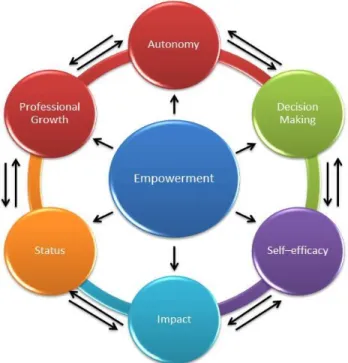
In this study, Short and Rinehart’s (1992) framework of teacher empowerment is used. The framework consists of six dimensions: decision-making, professional growth, status, self-efficacy, autonomy, and impact. Decision-making refers to teachers’ participation in critical decisions that directly affect their work, involving issues related to budgets, teacher selection, scheduling, and curriculum. To be effective, teachers’ participation in decision-making must be genuine, and the teachers need to be confident that their decisions actually impact real outcomes. Professional growth refers to the teachers’ perception that the school provides them opportunities to grow and develop professionally, to continue to learn, and to expand their skills during their work in school. Status refers to the professional respect and admiration that the teachers perceive from colleagues. Respect is also granted for the knowledge and expertise that the teachers demonstrate, resulting in support of their actions from others. Self-efficacy refers to the teachers’ perception that they are equipped with the skills and ability to help students learn, and are competent to develop curricula for students. The feeling of mastery, in knowledge and practice, resulting in accomplishing desired outcomes, is critical in the teachers’ sense of self efficacy. Impact refers to the teachers’ perception that they can affect and influence school life. (Bogler & Somech, 2004).
Figure 1: Framework of the 6 dimensions of Empowerment
Teacher Professional Development
Lieberman and Miller (2008) asserted that staff development programs had their genesis in the late 1950s and early 1960s in the United States (US) as part of the National Defense Education Act of 1958 passed by Congress in response to the Soviet launch of Sputnik. The staff development programs were composed of summer-institutes and lectures designed by professors to transmit materials, techniques, and subject-specific knowledge to teachers. Sparks and Loucks-Horsley (1989) as cited in (Grimmett, 2014) argued that the early research was only focusing on identifying general attitudes towards these programs which was characterized by the dissatisfaction on the teachers’ part (Ainsworth, 1976; Dillon, 1979) as cited in (Grimmett , 2014). Therefore, since the
1990s, the literature on teachers’ in-service training has reflected the general paradigm swing towards conceptualizations of learning as ongoing, social, situated and actively constructed (Putnam & Borko, 2000; Webster-Wright, 2009) as cited in (Grimmett, 2014).This has led to a change of focus from professional development – as something done to teachers by outside ‘experts,’ to professional learning – as something done with and/or by teachers in response to their own pedagogical needs and concerns (Sultana, 2005).
Conceptual framework. Professional development is viewed as a structured and facilitated opportunity for learning which is intended to increase teacher’s competence, skills, and knowledge. However professional development research noted the lack of support or evidence to the efficiency of the professional development initiatives to develop teachers’ instructional practices as well as students’ learning (Tannehill & MacPhail, 2017).
According to Villegas-Remers (2003) effective teacher professional development is the one which contributes in collaborative learning and building community of learners, enables teachers to make choices over their learning, happens over a course of time, and focuses on teachers’ real challenges. Ganser (2000) added that the professional development entails two types of experiences: formal experiences such as attending conferences, workshops, mentoring and professional meetings, and informal experiences such as watching television documentaries related to academic disciplines or reading professional publications. In this light, Glatthorn (1995) (as cited in Villegas-Reimers, 2003, p.120) asserted that professional development is broader than just career
development; it is the “growth that occurs as the teacher moves through the professional career cycle” (p.120).
These perspectives are actually new to teaching. For many years, the only professional development offered to teachers was the staff development or in-service training which was basically short-term courses or workshops which may present new information on certain aspects related to teaching. Unfortunately, those pieces of information were distant from the challenges teachers experience in their daily classrooms’ practices. However, in the past few years, perceptions on teacher learning dramatically shifted to a new paradigm of teacher education which is the life-long professional development (Walling & Lewis, 2000). Evidence on this includes: the huge literature which is available; including documents, research reports, and essays on practices and models of professional development (Villegas-Remers, 2003, p. 100); the national and international donor agencies which have acknowledged the necessity of teachers’ professional development and have commissioned studies which aim at learning how to support such efforts effectively (Villegas-Remers, 2003, p. 100); many international and national organizations have supported the implementations of initiatives that improve the professional knowledge and skills of teachers. Asia Pacific Economic Cooperative (APEC) serves a good example in its efforts to improve teachers’ professional development. This is because the 18 countries that border the Pacific Ocean have recognized teacher education as a vital tool in maintaining its economic development (Villegas-Remers, 2003, p. 100).
Principles of successful teacher professional development. Villegas-Remers (2003) suggested that the new perspective considers professional development as
underpinned by four characteristics. First, it is based on constructivism; teachers are viewed as active learners. In this process, teachers are required to take concrete tasks of assessing students, teaching, observing, and reflecting on their own work. Second, professional development is conceived as collaborative. Collaborative in this sense means meaningful interactions, not only among teachers, but also among teachers with other stakeholders (parents, administrators, community, etc.). This is because interaction usually provides opportunities to evaluate, criticize, discuss, and disagree. Third, professional development has to take place within a particular context and has to be connected to the daily activities of learners and teachers. Fourth, a teacher is perceived as a reflective professional who is expected to enter the profession with some prior knowledge and will gain new experiences and knowledge. Furthermore, several authors agreed on some consensus regarding the traits of effective professional learning, which are: empowering, by respecting educators as professionals with meaningful skills and knowledge to share; focused on enhancing children learning; based on current theory and research; collaborative to actively enable teachers to transform and construct their skills, beliefs, and; ongoing and relevant to the actual practice within the school context (Borko, Jacobs, & Koellner, 2010).
Moreover, Corcoran (1995) (as cited in Villegas-Reimer, 2003) presented seven principles for effective professional development programs which have to be considered by organizations and experts while implementing programs: support and stimulate schools’, teachers, and districts’ initiatives; model constructivist teaching; offer social, intellectual and emotional engagement with materials, ideas, and colleagues; respect
teachers as adult and professional learners;provide sufficient time, and follow up; be inclusive and accessible; and a solid ground in knowledge about teaching.
Phases of teacher professional development. The stages of professional development for teachers have been characterized as consisting of pre-service, induction, and in-service, all of which follow a period termed “apprenticeship of observation” – a stage when individuals are school students and before they enter a formal pre-service preparation program. Professional development and teacher education begins with pre-service and licensure requirements that affect teachers before they enter the teaching force. Induction and mentoring policies aim to support teachers in their transition into the workforce and during their first years of teaching. Ongoing professional development programs serve more experienced teachers. These programs can aid in the implementation of school reforms or simply help teachers improve their teaching in their current contexts.
Pre-service education. The pre-service training is the sector of educational training that encompasses development for student teachers before they undertake any teaching profession whether they encounter it in universities and/or colleges or teaching school institutions. In certain curriculum students are required to earn an academic degree in order to start into a pre-service education program. This stage is considered the preparation stage that determines the student’s knowledge, skills and attitudes. Therefore, programs that will help in the educational assessment for the teacher students will be complied along with programs that will help in the development of the teacher (Kennedy, 1999).
In-service training. Leu and Ginsburg (2011) explained that in-service teacher professional development includes various programs designed to promote and support the professional learning of teachers who are already employed and working in classrooms. The aim of in-service professional development is to improve the skills, knowledge, and commitments of teachers so they become more efficient in designing lesson plans, teaching, assessing students’ learning, and undertaking other responsibilities in the school community. In-service programs come in different forms, but most programs fall within the following two categories: First, “in-service” refers to an extended course of study which reflects the pre-service teacher education curriculum and lead to some level of formal qualification for “unqualified” teachers (Leu & Ginsburg, 2011). Second, “in-service” refers to professional development activities for teachers, ranging from continuous and comprehensive career-long programs of teacher learning to occasional workshops (Leu & Ginsburg, 2011).
According to Leu and Ginsburg (2011), there are ten key principles in developing effective in-service teacher professional development programs: 1. Consider in-service programs as part of a continuum of professional development. 2. Involve teachers in planning programs. 3. Emphasize pedagogical content knowledge in designing program content. 4. Use adult-oriented models of active learning as the pedagogical design for in-service programs. 5. Build reflective practice within teacher learning communities.6. Include all teachers in learning opportunities and base most of the in-service program at the school or school-cluster level. 7. Incorporate strong instructional leadership by school administrators and local supervisors. 8. Successful participation in in-service professional development programs should receive official recognition by the ministry or local
authority. This, coupled with demonstrated improved classroom practice, should lead to increased financial rewards and/or advancement on a structured career ladder. 9. Consider budget implications of building realistic and sustainable programs. 10. Link teacher in-service to a more holistic school improvement approach involving community members in planning for and monitoring of school quality.
International Experiences in Empowering Teachers through Teacher Professional Development
Teachers professional development in Japan. For several decades, teachers in Japan have been greatly involved in formal as well as informal teacher training programs. This was based on the premise that the teachers’ practices and habits have lifelong outcomes on their profession. Thus, the Japanese educational leaders highly invest in extensive and ongoing trainings for the newly hired teachers during their initial years of teaching. Further, teachers used to effectively collaborate and collegially participate to improve their instructional practices (Lamie, 2006).
School organization, in Japan, encourages teachers to form communities of learners rather than operate in professional isolation. The new teachers are usually assigned to experienced teachers at the same grade level to provide them with adequate guidance and share experience and planning instructions. In addition, in 1988, the Ministry of Education, Science, Sports, and Culture (Monbusho) presented an innovative model plan for initial training. The model entails in-school training, which are a mentor-based training approximately 2 days a week and not less than 60 days during the year and an out-of-school training which is “once a week or 30 days per year.” The out-of-school
training was held at Education Centre (Ken-Kyoiku-Senta) as cited in (Lamie, 2006) whose experienced teachers were selected by a prefectural board of education.
In-school initial training. All teachers are encouraged to engage in the in-school training. The assigned mentors are regular teachers, or the head of the ‘school’s academic instruction committee’, or the head of either the ‘grade level committee or the research committee. Further mentoring happen on weekly basis , and takes various formats: exchanging ideas, lecturing, reflections, individual coaching, interviews, participation in designing handouts and notes for students, and devising school activities as members of the school management committee (Lamie, 2006).
Out-of-school training. Adding to the 60 days training inside the school, new teachers had to be engaged in trainings outside the school, which usually took place in the prefectural education centers. Those trainings are designed to cover essential and special topics needed to increase teachers’ knowledge and skills. For example, topics such as subject- content knowledge, teaching ethics and duties, students’ counseling, integrating media and technology in education. The workshops were presented in various forms such as lecturing, seminars, hands-on activities, practicum, experiential learning, and retreats (Lamie, 2006).
In-service teachers in Japan stays with students for 2 years and grades are rotated as a sort of appreciation to the challenges which face teachers and students as well as a n attempt to link between later and early learning (Lamie, 2006). Also, teachers rotate to other schools so they can teach students from diverse backgrounds. Moreover, teachers in Japan share leadership and management and leadership in addition to the teaching duties.
For example, they may serve as grade level or subject area head teacher. Teachers also participate as members of numerous committees, such as: guidance affairs, accounting, instruction, training, and curriculum (Le Tendre, 1999; Takakura& Murata, 1998) as cited in (Lamie, 2006).
Kenshu, which literally means hard study and mastery of a skill, is the official term for professional development or training. A report by the Council on Educational Personnel (1987) emphasized “providing and ensuring opportunities for teachers throughout their career; coordinating learning and training opportunities at the national, prefectural, and municipal levels; and offering learning and training opportunities corresponding to changes in society, with an emphasis on experiential learning out of school settings. Further to this 1987 report, articles 19 and 20 of the Special Law on Educational Personnel prescribed that Japanese teachers have the right and duty to pursue professional development and Monbusho promoted systematic professional development for teachers beyond the initial probationary year” (Lamie, 2006).
At the informal level, teachers participate in many activities, such as workshops and conferences during the summer (Shinbun, 2000) as cited in (Lamie, 2006). They are also encouraged to participate in professional organizations or in research study project. For example, the Japan Association for Language Teaching offer seminars, and produces a journal, offers for notive researchers to present their work (Lamie, 2006).
In 1998, the Teacher Education Council (1998) recommended the need for the faculties of education intervention in promoting and offering opportunities to school
teachers to expand their knowledge, and to provide accessible and affordable chances for obtaining good quality of professional development (Lamie, 2006).
School-based trainings were ongoing conducted in nearly all the schools.The themes of the training tend to be related to a subject area. Once a theme is selected, the school tackles the theme for 3 consecutive years, publishing research reports at the end of each school year (Tada, 1995) as cited in (Lamie, 2006).
The essence of the training lies in Jugyo-kenkyu, which is a cooperative research on learning process. Teacherswere grouped into small groups in order to study a learning unit, or develop a lesson plan. Formats may also include presentations by expert professors from universities or local board of education, orlecturing, or workshops. Sometimes, study meetings may involve watching practicumfollowed by feedback to raise responses and discussions around the lesson plan as well as the learning and teaching materials used (Lamie, 2006).
The Japanese trainings were characterized by a collaborative and collective culture of teaching that characterizes Japanese school-based in-service education. In such a collective culture, teachers tend to find common goals and values that govern them. They were tolerant to differences at the periphery. Further, within such a culture, mutual respect and appreciation to individual differences and opinions have extra meaning to the discussion. Each year, the prefectural government offers other opportunities for professional development such as long and short terms funds, and conferences (Lamie, 2006).
Teachers’ professional development in Finland. Since Finland emerged as one of the top-scoring Organization for Economic Co-operation and Development (OECD) nation on the Programme for International Students Assessment (PISA), scholars become very active to study the so-called “Finnish miracle.” Researchers wondered how Finland were able to compete in just couple of decades (Sahlberg, 2011).
The transformation which the educational system in Finland witnessed was an outcome of its understanding to the value of educators in the learning process. Teacher education, in Finland, relies on intertwining meaning, reflection, practice, and research which is focused on cognitive skills and supported by scientific knowledge. Each teacher has to finalize a master’s thesis on a topic which is relevant to educational practice. They also posses deep professional insights into education from several perspectives, including subject content knowledge, special needs education, assessment, theories, sociology, and psychology. Each of the eight faculties of education has its own curricula to ensure coherence well as locally formulated to make the best use of the particular university resources. Finland’s commitment to research-based teacher education means that practices, research methodologies, and educational theories play strategic role in teacher preparation programs. Furthermore, the curricula are devised in a way which creates a logical and sequential pathway to a more developed and advanced sciences in education and on more advanced educational research methodologies. Each student is considered a pillar in the process and accountable in building and developing understanding of the educational practice nature (Sahlberg, 2011)
Teachers in Finland are highly autonomous, and expected to apply and adopt new strategies in their teaching according to their own understanding and taste. Teachers
collaborate to develop new techniques to support students academically, taking into account the social and peer relations, special needs, and previous record of achievement. Further, teachers participate in making decisions related to the school, and the pedagogical process. Teacher, in Finland, adopt various strategies in order to meet the demands of the 21st century skills and globalization; they can adopt reforms or ignore issues.
Teacher professional development in Turkey. The professional development program in Turkey was designed for the English language teachers who were teaching grades 1–5 at Turk Egitim Dernegi (TED) Ankara Koleji, a private primary and secondaryschool that has a total of about 6000 students and 422 teachers (Daloglu, 2004). The in-service development program was established in response to feedback from students, parents, teachers, and administrators. The main concern is that, in English language courses,the curriculum was inconsistent across grades. Specifically, there were multiple repetitions of materials and objectives across grades. This lack of coherence resulted in an uncertainty about the language objectives which were attained by the students at the end of each grade and the instructional techniques and materials students had been exposed to (Dalouglu, 2004).
At the beginning of the academic year 2001–2002, the professional development program was initiated an external specialist was asked to lead the program as external guide to teachers in identifying the most significant problems they face as well as designing activities that may enable them to remedy the situation. Thus, the starting point was identifying the common needs for 45 teachers in lower primary and their expectationsfrom this in-service professional development program (Dalouglu, 2004).
The first step in the program was identifying teachers’ expectations and needs. In the needs identification sessions, discussion groups were conducted, and many of the teachers responded actively to it. At the end of the discussions, four major needs were identified according to urgency and priority respectively: achieving coherence, coordination, and curriculum continuity across grades; establishing collaboration and communication among teachers; setting goals and standards to ensure competence of the instructional materials; establishing a valid system of sharing materials and experiences (Dalouglu, 2004).
As a result, establishing a materials bank system came as a response to identified need set by teachers for storage, classification, maintenance, and evaluation. The idea was welcomed and gained approval among teachers, believing that such a bank was an appropriate start which could lead to exceptional results within a short time frame of one academic year. The materials bank would ensure: better meeting of students’ learning needs, continuity and coordination in the curriculum, systematic and on-going evaluation of materials, more awareness of the institutional issues, and enhanced communication channels among colleagues (Dalouglu, 2004).
The professional development program sought to provide teachers with proper input that would enable them to participate in gaining information about useful and practical materials as well as providing opportunities to transfer the cognitive knowledge acquired through the trainings into practice(Dalouglu, 2004).
Hence, the following plan was devised:
Second: Establishing a system of borrowing, classification, evaluation, and maintenance of the bank materials.
Third: Designing materials which align to the characteristics framed.
Fourth: Piloting the materials inside the classrooms and apply modifications according to the feedback received from students as well as teachers.
Fifth: Enabling the materials bank to be always available to teachers Sixth: Evaluating the practicality of the materials bank.
Teachers’ views on the usefulness of the professional development program cannot be overlooked while determining and evaluating its effectiveness. The results drawn from the interviews along with the questionnaire indicate teachers’ appreciating of the professional development program. They perceived the program as relevant to their needs and the materials could be utilized for immediate application inside their classrooms. Moreover, the trainings addressed the need to enhance the communication channel with the school leaders as an essential quest for empowerment. The results showed positive correlation between the professional development activities andpractices and teachers’ positive attitudes towards the success attained in fostering their teaching aids and materials (Dalouglu, 2004).
Another perception which was worth noting was related to the duration professional development program. The data collected demonstrated that almost all teachers found the length of one academic year to be highly appropriate for trial and error in experimentation because it paved the way for solid and proper feedback which was crucial during this stage (Dalouglu, 2004).
Firstly, a great majority of teachers noted that they acquired new skills and gained knowledge regarding effective teaching materials. Secondly, they commented on their sense of confidence inside classrooms and awareness of the issues related to curriculum. Nearly all the teachers perceived the development program to be beneficial since it touched upon the topic which they needed and requested. Additionally, most teachers reported the direct affect on the quality of their performance (Dalouglu, 2004, p. 689). Community –Based Education and Community Schools
Community-Based Education (CBE) usually goes beyond just cognitive capacities to encompass the emotional and social aspects of learning. The connections students create with adults and communities are the premise of the CBE. The social and emotional development of children is a result of the cooperative efforts of school, community and parents. Community, family and parent engagement in educational process positively correlates with school improvement and students’ academic performance. When, parents, communities and families collaborate to support the school, students tend to receive higher grades and attend school regularly (Villani & Atkin, 2000).
The learning process of CBE extends the definition of “intelligence” to include “the learners’ ability to gain understanding, use knowledge and solve problems, while developing a sense of self” (Villani & Atkin, 2000, p. 124). Further, success not solely based on excelling in the academic years, but also couples with personal willpower and creativity (Villani & Atkin, 2000).
CBE is, also, centered on students’ abilities to support and recognize the needs of the community. Thus, children gain a sense of responsibility which stems from free expression and solving problems. This model makes “the educational process cyclical
and continuously propelled” (Villani & Atkin, 2000, p. 124). Moreover, in community based learning, students are assessed not only on tests, but also on innovative and creative measures. For example, students work with their colleagues and teachers to solve the problem of homelessness in their community. After discussion and research, students have to enlist the support and involvement of active community members who are willing to make real changes to solve this issue (Villani &Atkin, 2000).
In communities where large economic and societal factors disable students to receive proper education, community schools contribute in providing educational advantagesin favored and empowering contexts. Community schools tend to create strong programs which supportstudent development and learning. Additionally, they build a strong infrastructure of partnerships with community based organizations, educational institutions which can support development and well-rounded learning. Those partnerships equip families and children with resources and opportunities which can mitigate the harms of disease and poverty as well as build community strengths and resilience (Policy Brief, 2010).
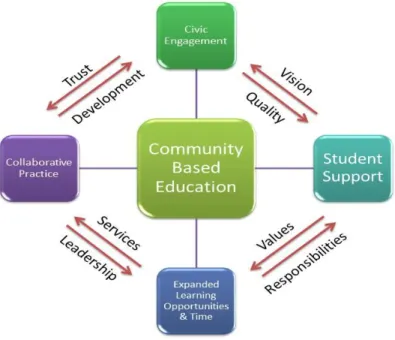
Despite of the differences which may occur among some community schools globally, there are four common pillars among all of them, which are: student support, civic engagement, expanded learning opportunities and time, and collaborative practices and leadership. First, student support addresses the school barriers to education through collaboration partnerships with health and social services providers and agencies. Second, expanded learning opportunities and time includes weekends, afterschool and summer programs, which provide extra academic instructions and enrichment activities. Third, civic engagement considers community and parents as partners in students’ achievement.
Fourth, collaborative practices and leadership creates a culture of trust, shared responsibility and professional learning (Policy Brief, 2010).
Figure 2: Four Pillars of Community-Based Education
The project of community schools in Redwood City, for example, was launched in 2003. It was originated to unite and connect the families, school, and communities to create a support system that can nurture students’ development. Out of the 17schools located in the city, four schools were designed to be community schools; Taft community school, Fair Oaks community school, Kennedy middle school, and Hoover community school. Despite the uniqueness of each school, all of them share common features. The primary aim of each was to support students’ learning and the quality of instructional practices. Community partnership was a crucial part to enhance students’ learning, because community partnerships provide shared vision and leadership with various comprehensive services (Van Roekal, 2008).
Another example of good practice is the example of Cincinnati high school. Prior to launching the community schools, learners had almost no access to nutritious food or quality healthcare services, so many students used to suffer from malnutrition and severe illnesses. As part of the community school project in Cincinnati, the school created a robust health clinic, community garden, and a food pantry. As a result, students’ grades and attendance increased.
In Philadelphia, community schools offer behavioral counseling, therapy, and family counseling as well as mental health services (Policy Brief).
Due to consistent low levels of parental engagement in Albuquerque, the city worked on facilitating additional communication chains between administrators and parents by hiring parent liaisons. Each parent liaison had strong connections with the community, which resulted in higher level parent engagement in students’ learning. In addition, the Parent-Teacher Home Visits programs in Sacramento required teachers to schedule home visits twice a year. This practice is based on the premise that these visits would enable teachers to have better understanding to their students’ backgrounds, needs and challenges. Also, it would strengthen the bond between parents and teachers which would have positive implications on the learning process. It was also a strategy to involve parents in suggesting strategies and additional activities (Policy Brief).
Community Schools in Egypt
The need. The current education system in Egypt paces many problems. These problems increased with globalization which resulted in barriers which hindered education from coping with developed world; such barriers are: the increase of population which increasedthe demand for education, the absence of quality education,
the ambiguity of objectives, the lack of education policy planning and incompatible outcome of education with work market requirements, which resulted in a high rate of unemployment among graduates of governmental education.Meanwhile the experiences of the developed countries have shown that the advancement in education is achieved by partnership between all involved parties, as the governments will not be able to handle the responsibility of education development solely. Back to the history of education in Egypt, receiving education was depended on civil efforts represented in people’s donation and to open schools, and then it was turned to be the responsibility of the government.However, due to the increased burdens on it, the government could not meet all the requirements in offering quality education for everyone. Therefore, it is of a paramount importance to have full integration between the governmental and the societal efforts to provide quality education chances. Since poverty is usually related to deprivation of good education chances, community education has showed up (Nile Valley NGO documents).
Reasons behind the emergence of community education in Egypt (Nile Valley NGO documents). 1. The poor geographical distribution of elementary schools and it‘s limited number, which lead to increased number of students in class to 45 students in one class.
2. Some villages and hamlets do not have any schools.
3. The decreased income of the family that makes children work to increase the income, especially in the poor economic status in villages whose residents are farmers. The deterioration of farmers’ conditions has obliged them to use their children to help them in these difficult living conditions to earn a living for the family.
4. Poor educational environments inside systematic schools in preparatory education, which makes schools a repugnant environment with increased dropouts. This
environment includes the shortage of capacities and materials in schools, scarcity of qualified teachers, poor performance of the board of trustees of the school and not applying the compulsory act.
5. Far distance between schools and some villages with lack of safe transportation which makes students go once or twice a week until they stop going.
6. The negligence of the country, ministry of education, audio, visual and printed media to the unfair education condition in deprived and poor areas.
For decades, achieving access to primary education has been a priority to the international community and the Egyptian Ministry of Education (MOE). Since 1975, the MOE started to establish one-classroom schools to increase the enrollment rates among the vulnerable children in deprived and remote areas who skipped primary education. Internationally, the child’s rights support is manifested by the Convention on the Rights of the Child, World Declaration on Education for All, and the Millennium Development Goals with an emphasis on educational equality, educational quality, poverty reduction, environmental sustainability, and gender parity (Megahed, 2011).
Since 1990s, CBE has been an integral part of Egypt’s education plan, with the objective of educating children, especially girls, who live in disadvantaged remote communities. In 1992, the MOE and the UNICEF signed an agreement to initiate the community school project. The project aimed to promote access to 6-12 out-of-school
aged children as well as providing them quality education (Zaalouk, 2004). The objectives of the project were:
Ensuring access to all children, particularly girls.
Encouraging participation, self-help, and donated resources for buildings and maintenance.
Introducing innovative and effective models of management and schooling. Emphasizing creativity, critical thinking, and problem solving abilities.
Rendering relevant learning materials which can suit learners’ needs and preferences.
Fostering the skills which require life-long learning.
The roles and responsibilities were divided among partners. The MOE’s role in the initiative was to pay teachers’ salaries, provide textbooks, assist in the curriculum, participate in training teachers, and provide learners with school healthy meals. The UNICEF responsibility was to design a model of community-based education with high quality for the deprived and disadvantaged districts in Upper Egypt. It acted as a catalyst to the initiative and supervised the management system with the partnership on Non-Governmental Organizations (NGOs). Further, its role lied in providing trainings, equipping classroom with adequate furniture, learning materials, and stationery. Last the role of the communities with the support of NGOs was crucial in the initiative as they had to provide proper space for the schools as well as managing the schools through educational committee. Local donors and leaders made up committees’ members of different social categories and socio-economic levels, including men, women and youth (Zaalouk, 2004).
Community schools hired teachers/facilitators from local communities to be trained on advanced pedagogical techniques, such as active learning to address multi-grade classrooms. It is important for the schools to coordinate with the communities in order to find a donated land and labor willing to provide facilities, services, and most importantly buildings to help operate the schools. Adding to that, a high emphasis is put on parental involvement and participation to support the learning process (Zaalouk, 2004; Langsten, 2014).
The classroom furniture and setting positions were designed to reinforce cooperative learning and teamwork. The teaching methodologies and instructional practices are meant to be girl-friendly and child-centered. Further, class hours and school day duration are meant to be as flexible as possible to accommodate children’s work responsibilities and household chores. Learning experiences were relevant to students’ culture, environment, and experiences. Adding to that, community and parents were involved and consulted to support students’ education (Zaalouk, 2004).
Teacher professional development in community schools. The pedagogy of training facilitators/teachers was outlined with certain characteristics which are: active participation and teamwork, targeting diverse members of the educational system, activity based, and open to evolution. In addition,fourtypes of trainings were addressed to teachers: pre-service teacher training, in-service teacher training, and refresher training, and teacher apprenticeship, trainings for teaching styles and techniques, and innovation workshops.Besides, seven types of training were targeting supervisors, community members, and management systems. It is worthy to note that all forms of training were based on need assessment and identification. The workshops “represent a living
experiment that results in deep and sustainable transformation in conceptual mapping, self-concepts, behaviors and attitudes. The moments of fun were very much cherished and reinforced, and various forms of activities were taking place such as poetry, case studies, role playing, audio visuals, presentations, field visits, and songs (Zaalouk, 2004).
Pre-service teacher training. The pre-service training comprised of three workshops: orientation, active learning, and constructive learning. This training is based on an assessment to the teachers’ needs and the evaluation forms in which facilitators fill by the end of each workshop. During the orientation sessions, facilitators learn about the principals and philosophy of community school. They, also, learn about child’s right, their role inside the classrooms, and the multi grade approach. They acquire problem solving skills, confidence, planning, communication and presentation skills, and creativity. In short, they were introduced to essential characteristics of quality learning. During the active learning sessions, they got introduced to active based learning, lesson planning, authentic assessment, learning difficulties, teaching aids relevant to the learning, classroom management, and instructions. During the constructive learning stage, an opportunity is opened for observations, and facilitators were required to add meaning to their knowledge, and reflect on the areas of development (Zaalouk, 2004).
In-service teacher training. The in-service weekly trainings through micro-centers whereby teachers of the same regions and grades met. The aim of thein-service training was to strengthen the team spirit. Facilitators experience a rich atmosphere of sharing. During the training sessions, facilitators were grouped to design lesson plans with the help of their mentors. Professors from Faculty of Education (FOE) along with the MOE supervisors catered for the facilitators’ needs in skills and subject matters. A
typical day of in-service training includes lesson planning, problem solving, sharing presentation on innovative ideas which successfully worked in classrooms, manufacturinglearning aids and learning new skills and knowledge. Most often the facilitators report topics of their own search by using the library database (Zaalouk, 2004).
Refresher training. The refresher training occurred once each year. It aimed to address facilitators who had previously trained. The topics of discussion were determined based on the needs identified during field observations and mentoring (Zaalouk, 2004).
Classroom based training. When facilitators got recruited, they were required to participate in classrooms observation of classrooms which display the best innovation and practices. This phase lasts for four months prior to the formal training. The benefit of this training was to give the project director abundant time to evaluate the newly selected interns (Zaalouk, 2004).
The Role of Non-Governmental Organizations (NGO) in Egypt
According to Vakil (1997) NGOs are defined as self-governing, private, non-profit, and formal organizations which are gearing to develop the quality of the disadvantaged’s lives. The UnitedNations specifies that the resources of the NGO's should be granted from volunteers' contributions.
Globally, NGOs have been instrumental in developing both practices and policy. For example, studies showed that NGOs in Bangladesh, Kenya, and Tanzania served to advance the educational reform (Bray, 2001). Similarly, Ethiopia and Mali NGOs led an educational reform collaboratively (Miller-Grandvaux, Welmondv& Wolf, 2002). Also,
Makuwira reported that the NGOs in Malawi participated with local communities in decision-making and policy development processes (Makuwira, 2004).
The NGOs in Egypt are represented by 15,000, predominantly small community-based organizations which focus on social assistance and service delivery. Over the past three decades, NGOs succeeded in partnering with the Ministry of Education to intervene in public schools with activities and educational projects in basic education, particularly in primary schools at the most disadvantaged, isolated and remote areas in Upper Egypt. The number of NGOs in Egypt working in the field of education has increased and is estimated to be approximately 1310 (El Baradei, 2004), which represents 8.7% of the total number of NGOs.
The MOE established the department of nonprofit organizations in December, 1998 to coordinate the relations between nonprofit organizations and schools (MOE, 2006), and issued decree no. 30/2000 on the engagement of nonprofit organizations in the school Board of Trustees. From 1999 to 2005, “MOE started 1212 educational projects with 619 nonprofit organizations to serve 19,000 students in public schools, with a total fund of $17 million” (MOE, 2006).