FUOYEJET © 2019 62
Development of a Solar Aided Crib for Drying and Storage of Maize Cobs
*Folayan R. Falayi and OjoBenjamin
Department ofAgriculturalandEnvironmentalEngineering, Federal University of Technology, Akure, Nigeria [email protected]|[email protected]
Abstract
—
The aim of this study was to design, construct and evaluate the performance of solar aided crib for storage of freshly harvested maize (Zea mays) in a humid tropical climate. A crib with two drying chambers of size 600 mm x 685 mm x 1500 mm with moisture emission chamber of 600 mm x 115 mm x 1500 mm was designed, constructed and evaluated using appropriate design procedures at the department of Agricultural and Environmental Engineering, Federal University of Technology, Akure, Ondo State, Nigeria. The roof of the crib is made of perspex which transmits the sun's energy into stored maize in the crib for effective drying purpose. The crib was raised at 50 mm above the ground surface and wire netted against rodents. It has two doors for easy loading and off-loading. Freshly harvested Maize weighing 500 kg of 30.5% moisture content (wet basis) was stored for three months. Moisture content of the maize was taken on weekly basis while relative humidity and temperature were measured on daily basis. Readings were taken at three positions (top, middle and bottom) in apertures that were made in those positions but were immediately covered up at the end of every reading. The ambient temperatures varied from 20.90C to 380C and also relative humidity varied from 41% to 91% throughout the period of the experiment. The moisture content at the point of storage was 30.5 % but was reduced to 4 % after three months. The final weight of maize in cobs was 362 kg which implied that the Perspex roof significantly aided in the drying process. The structure is structurally balanced and there was no grain deterioration either by fungal invasion or insects attack during the storage period.Keywords- Crib, Drying, Moisture content, Storage, Temperature
—————————— ——————————
1
I
NTRODUCTIONffective storage keeps maize from spoilage, increase the farmers’ income and promote the standard of living of the farmer and his family. Maize is a very useful farm produce, it can be fermented and distilled to provide industrial products such as alcohol, acetone, glycerol etc. and the fibre in the stem can be used for making papers (Agbato, 1999). Maize spread around the globe after European discovery of the Americas in the 15th century (OGTR, 2008). It is originated in South America and Central America. Its cultivation today has spread to all part of the world. It is grown throughout the tropics as well as temperate regions. According to Ofor (2011), maize was introduced to West Africa in the 16th century and it has tremendous variability in kernel colour, texture, composition and appearance.
Postharvest losses ranging from 30 to 50 percent occur in tropical areas, especially in sub-Saharan Africa where farmers use the indigenous or traditional methods for food preservation and storage (FAO, 1998). Hayma (2003) reported that in the tropics each year, it was estimated that between 25-40% of the stored agricultural product is lost every year because of inadequate availability of storage structures or facilities for agricultural products. In the field and during storage the product are threatened by insects, rodents, birds and other pests. Moreover, the product may be spoiled by infection from fungi, yeasts or bacteria. Crib is a maize storage container that adds to the shelf life of the grains due to its ability to simultaneously store and reduce the moisture content of the materials. According to Ofor, (2011), a number of variations are used but the two essential requirements for successful open storage in cribs are that drying takes place while the crop is being stored; and that the farmer is able to control insect attack at the same time. Preservation of grain through drying can prevent the huge wastage and make them available in the off-season at remunerative prices.
* Corresponding Author
Reduction in moisture content of grains will reduce the bulkiness or weight and this could reduce the cost of transportation. Not that it may not increase the income directly, but the farmer could gain a lot if the product is sold when the product is scarce and expensive in the market. Drying enhances resistance to degradation due to a decrease in water activity. Early farmers have adopted various methods to store maize but sun drying is still the most common method used to preserve agricultural product in most tropical and subtropical countries. However, large-scale productions limit the use of open-air natural sun drying. Other factors militating against sun drying are; lack of ability to control the drying process properly, weather uncertainties, high labour costs, large area requirements for drying, insect infestation and mixing with dust and other foreign materials. Product may be seriously degraded to the extent that sometimes becomes inedible, and the resulted loss of food quality in the dried product may have adverse economic effect on domestic and international market.
When dried to moisture content below the safe moisture level of between 9 to 14% (Hayma, 2003), cereals can be stored for a period of a year or more under a wide range of temperatures provided that during storage the moisture level does not rise and precautions against insects are taken. Insects may still develop at a relative humidity of approximately 35% and temperatures of around 15°C. For seeds with moisture content between 5 and 14% every 1% decrease in moisture content doubles the possible storage time which implies that further decrease in safe moisture content significantly increases the storage period. Below 5% oxidation processes may play a role. Above 14% moisture content, fungal growth causes rapid degeneration. The choice for the best storage method are determined by the moisture content of the product when it comes from the field and the relative humidity of the outside air during the storage period (Hayma, 2003).
Improved cribs must be well ventilated to allow for escape of vapour. Availability of improved crib would encourage early harvest to safe grain from attack by birds, rodents, and insects, and prevent losses due to over ripening of agricultural products. Alabadan, (2002) observed that adequate ventilation more or less eliminates the mould problem but there may be superficial germination under very humid conditions. Husks must be removed to facilitate drying of high moisture in grain. High moisture grains are prone to insect attack but this is controlled with insecticide dust or spray. In humid wetter areas, it is better and more advisable to put the crops in a crib- type storage container (David, 1998). The durability of the cribs depends on materials used for the construction.
A solar aided crib is capable of enhancing the drying time and storing maize harvested at high moisture thereby preventing losses on the field. It has usage potential in a flood prone area where early harvest could be done before start of another raining season. It will promote early harvest thereby making the field readily available for subsequent farm operation for maize production. The objective of the study is therefore to design, construct and evaluate a solar aided crib.
2 M
ATERIALS ANDM
ETHODOLOGYThe research work was carried out at the teaching and research school farm of Agricultural Engineering, the Federal University of Technology Akure, Ondo State, Nigeria. Akure metropolis is located at longitude 5.1950 E and latitude 7.2500 N. In the Northern hemisphere it has an elevation of about 356.2 m above the sea level as calculated based on the geodetic datum WGS84.
2.1 DETERMINATION OF BULK DENSITY OF MAIZE AT
HARVEST
The bulk density of freshly harvested maize was estimated from the equation 1 proposed by Bakker et al. (1999).
TWm = 0.7019 + 0.01676Mwb – 0.0011598M2wb +
0.00001824M3wb. (1)
where TWm is the bulk density (g/cm3) and Mwb is the moisture content (wet basis)
Substituting the value of Mwb = 32%, which is the assumed moisture at harvest for the maize type (Hayma 2003) into equation 1 gives: TWm = 0.6483 g/cm3 or 648.3 kg/m3. From the equation of bulk density, 400 kg of maize on cob will occupy 0.6168 m3. Making use of the assumptions proposed by (Hayma, 2003), the dimension of the drying chamber, Length = 0.685m, Breadth 0.6 m and Height of 1.5 m is ok.
2.2 DETERMINATION OF THE THICKNESS OF RETAINING WALL
Retaining walls are required for materials to be stored in bulk to withstand the pressure the grains will exert on the wall. From Rankine’s Formula; Maximum bending moment is estimated from the equation 2 proposed by Nicholas, (2007)
(2)
is the angle of repose W is the density of the grain
h is the height of the storage structure B.M = For maize, W = 900 kg/ h = 1.5 m B.M Max = 35.72 Nm
Using the equation of section modulus;
(3)
Where Z is section modulus for wood, b is the width and d is depth. 10cm thick hardwood timber is adequate
2.3LOAD IMPOSED BY STORED MAIZE
The load imposed by stored maize was calculated by considering the crib as a deep silo, Janssen’s formula as stated by ASAE, 1997 was used.
Lateral load on vertical walls
) (4)
Where
L is the lateral pressure,
W is the material density, kg/
D is the bin diameter or equivalent diameter, m K is the ratio of lateral to vertical internal pressure, i.e. K =
(5)
the angle of repose
the coefficient of friction of material on wall H is the depth of fill
Lateral pressure, L =1590 N/m
2.4DESCRIPTION OF THE SOLAR AIDED CRIB
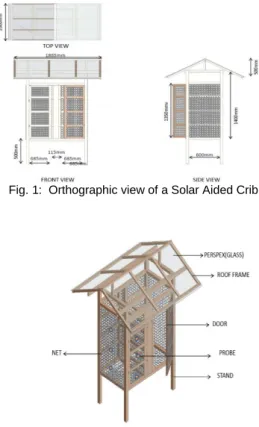
The wooden crib consists of the roof, two storage compartments, horizontal floor and the supporting frame as shown in Figures 1 and 2. The two compartments can store 779.8 kg of maize. There is air gap between the two storage compartments. Galvanized iron wire mesh (3 mm) was used to cover all the surfaces to prevent animal attack as shown in Figures 1 and 2. Perspex glass was used as the roof over the platform to enhance better capture of solar radiation and increased energy for drying. The crib has a cross sectional area of 3.8 m x 0.8 m x 12 m. Each of the compartment has two doors one at the top for easy loading and the other one at the base for easy off-loading. On the column are the wooden beams that support the bamboo and placed at 0.5 m above the ground. At the foot of each of the columns is rat guard which prevents rats and termites’ infestation. Used engine oil was poured in the rat guard to prevent soldier ants attack. The crib aligned lengthwise in the prevailing wind direction.
FUOYEJET © 2019 64 Fig. 1: Orthographic view of a Solar Aided Crib
Fig. 2: Isometric view of a Solar Aided Crib
2.5PERFORMANCE EVALUATION TEST
250 kg of maize on cobs was stored on each of the two compartments of the crib at the start of the evaluation test. Temperatures inside and outside the structure were monitored using a standard thermometer (Harris, England) with a 42 calibration. Moisture content of the maize cobs were determined on weekly bases using oven dry method. The temperature of heated air inside the crib was taken three times per day (7:00am (morning), 1:00pm (afternoon) and 6:00pm (evening). The solar aided crib which is orientated in the direction of prevailing wind uses convectional currents to move the heated air through the maize cobs for effective drying. The weight of grains collected after the test was measured and recorded.
All data collected were subjected to appropriate descriptive statistical analysis using Excel software.
3
R
ESULTS ANDD
ISCUSSION3.1TEMPERATURE MEASUREMENTS
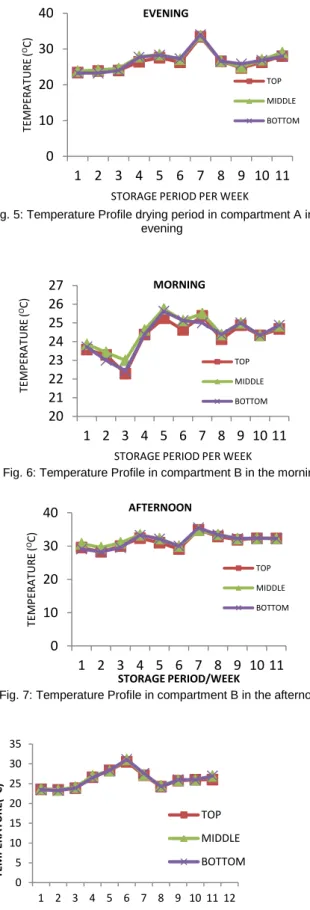
The mean weekly temperatures at three different periods namely morning, afternoon and evening during the experiment are as shown in Figures 3 to 8. The temperature in the first compartment varied between 22 0C and 36.4 0C while in the second compartment, it ranged from 22.2 0C to 34.8 0C during the storage period. As expected, temperatures were higher in the afternoon than in the morning and evening. During the storage period, the cobs located at the top of the crib had the highest mean weekly temperature except in morning time when heat was concentrated in the middle. This is because warmer air always hit the cobs surface. Highest
mean weekly temperature values were obtained during the fourth and sixth week of storage. The result of the experiment on temperature shows that temperature was not uniformly distributed but varied from one point to another.
In the compartment A, the lowest temperature recorded was 22 0C at the top during morning time of the 3rd week and the highest temperature was 26 0C in the middle and the bottom in the 5th week. In the afternoon, the lowest temperature recorded was 28.14 0C at the top in the 2nd week with the highest temperature of 36.4 0C at the middle in 7th week and the lowest temperature recorded in the evening time was 23.2 0C at the bottom in 1st week and the highest was 33.7 0C at the middle in 7th week. In the compartment B, the lowest temperature recorded during morning time was 22.2 0C at the top in the 3rd week and the highest temperature was 25.7 0C at the middle. In the afternoon, the lowest temperature recorded was 28.2 0C at the top in the 2nd week with the highest temperature of 35.5 0C at the bottom in 7th week and the lowest temperature recorded in the evening time was 23.2 0C at the bottom in 2nd week and the highest was 31.10C at the middle in 6th week. The temperature range is recorded in similar research works conducted by Alabadan (2002) and Olabinjo (2010).
Fig. 3: Temperature Profile in compartment A in the morning
Fig. 4: Temperature Profile in compartment A in the afternoon
20 21 22 23 24 25 26 27 1 2 3 4 5 6 7 8 9 10 11 TE M P ER A TUR E ( 0C)
STORAGE PERIOD ( WEEKS) TOP MIDDLE BOTTOM MORNING 0 5 10 15 20 25 30 35 40 1 2 3 4 5 6 7 8 9 10 11 TE M P ER A TUR E ( 0C)
STORAGE PERIOD (WEEKs)
TOP MIDDLE BOTTOM
Fig. 5: Temperature Profile drying period in compartment A in the evening
Fig. 6: Temperature Profile in compartment B in the morning
Fig. 7: Temperature Profile in compartment B in the afternoon
Fig. 8: Temperature Profile in compartment B in the evening
3.2DRYING CHARACTERISTICS
Figures 9 and 10 show the drying characteristics of the maize in the two compartments during the storage period. The two graphs show similar trend as the moisture content of the maize decreased with time. Maize at the topmost part of the crib dried fastest and
followed by the maize situated at the bottom. At the top, the moisture content deceased from 30.35 % to 10.37 % in the first 5th week after storage. The rate of moisture removal was slow from the 6th week to 9th week but at the end of week eleven, the moisture content has reduced to 4.01 % at top, 4.29 % at middle and 4.21% at bottom. These variations agree with the observations of Bakker et al. (1999) and David, (1998). Many factors such as drying air temperature, initial moisture content, air velocity, relative humidity and the product thickness associated with drying of maize must have accounted for this observation.
According to Steinfield and Segal (1986), drying air temperature and product thickness proved to be the major factors which affect the heat and moisture rate. The drying of maize exhibited the characteristic moisture desorption behavior. An initial high rate of moisture removal was followed by slower moisture removal in the latter stage. This characteristic behaviour was due to the various forms in which water is present in the food product. As drying process progressed, the moisture ratio was observed to decrease non linearly with increase in drying time. This is a general trend reported for other food products like mulberry, eggplant tomatoes sweet pepper and peach slices (Doymaz, 2005; Ertekin and Yaldiz, 2004; Parakash et al., (2004)
Fig. 9: Drying Curves of maize in compartment A of the crib
Fig. 10: Drying Curves of maize in compartment B of the crib
4
C
ONCLUSIONSolar aided crib was designed, constructed and evaluated for the drying and storage of maize cobs harvested at high moisture content in the humid environment. During the storage period, temperature variations were similar in the two compartments. The temperature inside the crib varied from 22 0C and 36 0C. Maize cobs at the top of the crib had the highest mean weekly temperature except in morning time when the heat was concentrated in the middle. Temperature and relative humidity fluctuations were experienced inside
0 10 20 30 40 1 2 3 4 5 6 7 8 9 10 11 TE M P ER A TUR E ( OC)
STORAGE PERIOD PER WEEK
TOP MIDDLE BOTTOM EVENING 20 21 22 23 24 25 26 27 1 2 3 4 5 6 7 8 9 10 11 TE M P ER A TUR E ( OC)
STORAGE PERIOD PER WEEK
TOP MIDDLE BOTTOM MORNING 0 10 20 30 40 1 2 3 4 5 6 7 8 9 10 11 TE M P ER A TUR E ( OC) STORAGE PERIOD/WEEK TOP MIDDLE BOTTOM AFTERNOON 0 5 10 15 20 25 30 35 1 2 3 4 5 6 7 8 9 10 11 12 TE M P ERA TU RE ( OC)
STORAGE PERIOD PER WEEK
TOP MIDDLE BOTTOM 0 10 20 30 40 1 2 3 4 5 6 7 8 9 10 11 M oi st ur e C ont e nt (%)
Storage period (weeks)
TOP MIDDLE BOTTOM 0 5 10 15 20 25 30 35 1 2 3 4 5 6 7 8 9 10 11 M O IS TUR E C O NT ENT (%)
Storage period (weeks)
TOP MIDDLE BOTTOM
FUOYEJET © 2019 66 the crib during the storage period maybe due to weather
condition.
High relative humidity resulted to slower moisture removal. The drying of the maize cobs exhibited the characteristic moisture desorption behavior. An initial high moisture removal was followed by slower moisture removal in the latter stage. As the drying process progressed the moisture ratio was observed to decrease non linearly with increase in the drying time. At the end of week four, the maize has reached a safe moisture content of 14.73%. At week eleven, the moisture content was within 5% which is considered safe because of its capability of resisting mould and insect infestation. The weight of maize collected from both compartments at the end of the evaluation test was 362 kg out of 500 kg initially stored at the commencement of the test which clearly showed that additional heating of air was got because of the use of Perspex roof and has further aided drying of the maize grains.
R
EFERENCESAgbato, S. O. (1999). Principles and Practices of crop production, Department of Agricultural Education, Federal College of Education (Special) Oyo, Oyo State Nigeria.
Alabadan, B.A. (2002). Modelling the performance of a Hexagonal Wooden Silo during Storage of Maize (Zea mays). Ph.D. Thesis Department of Agricultural Engineering, University of Ibadan, Ibadan, Nigeria.
ASAE standards, EP433, (1997). Loads exerted by free-flowing grain on bins. ASAE, St Joseph, ML 49085 -9659, 693 – 696. Bakker Arkema, F. W., Debaerddomacker, P., Amirante, M., Ruiz
A. and Sltudman, C. (1999). CIGR. Handbook of Agriculture Engineering. Reinhold Publishing Corporation, 143-145. David, D. (1998). Manual on improved farm and village level Grain
Storage Methods. GTZ. Pp. 9-177.8.
Doymaz, I. (2005). Sun drying of figs: an experimental study.
Journal of Food Engineering. 71, 403-407.
Ertekin,C. and Yaldiz, O. (2004). Drying of eggplant and selection of a suitable thin layer drying model. Journal of Food Engineering, 89(2): 159-166.
FAO (Food and Agriculture Organization) (1998). Storage and Processing of Roots and Tubers in the Tropics. Calverley, D.J.B. (ed.), Rome.
Hayma, J. (2003). The storage of tropical agricultural products 2003. 4th edn. Wageningen Netherland. Agromisa Foundation, (Sara
van Otterloo-Butler, eds)
Nicholas, J.S. (2007). Properties of Aluminum as an alloy of steel. National institute of Engineering Management, pp. 88.
Ofor, M.O. (2011). Traditional Methods of Preservation and Storage of Farm Produce in Africa. New York Science Journal;4(3):58-62]. (ISSN: 1554-0200). http://www.sciencepub.net/newyork. OGTR (Office of Gene Technology Regulator). 2008. The biology of
Zea may L. ssp mays (Maize or Corn). Version 1 September 2008.
Australian Government, Department of Health and Ageing. Office of Gene Technology Regulator, Available at: http://www.ogtr.gov.au. Accessed 12 July 2015.
Olabinjo O.O. (2010). Modeling of drying cocoa beans and quality evaluation under open sun and solar dryer.
Parakash, S., Jha, S. K. and Datta, N. (2004). Performance evaluation of balanced carrots dried by three different drier, Journal of Food Engineering, 62, 305-313.
Steinfield, A. and Segal, I. (1986). A simulation model for solar thin layer drying process. Drying Technology, 4, 535-542.