Advice on the framework for the
prevention of problem gambling
and addiction
Final report
Ministry of Security and Justice June 2014
2
Index
1. INTRODUCTION ... 4
Background ... 4
Background to the assignment ... 4
Structure of the advice ... 4
Utilising the advice ... 5
2. THE STEPPED CARE MODEL ... 6
Introduction ... 6
Proposed in law ... 6
Academic view on the topic ... 6
Stakeholders’ views on the topic ... 6
Conclusions and recommendations ... 7
3. INFORMATION PROVISION ... 11
Introduction ... 11
Proposed in law ... 11
Academic view on topic ... 11
Stakeholders view on topic ... 13
Conclusions and recommendations ... 14
4. CATALOGUING PLAYER BEHAVIOUR ... 18
Introduction ... 18
Proposed in law ... 18
Academic view on topic ... 18
Stakeholders view on topic ... 22
Conclusions and recommendations ... 23
5. INTERVENTION WHEN SIGNALS OF RISKY PLAYING BEHAVIOUR ARISE 26 Introduction ... 26
Proposed in law ... 26
Academic view on topic ... 26
Stakeholders view on topic ... 29
Conclusions and recommendations ... 30
6. GUIDANCE TO PROFESSIONAL CARE ... 32
Introduction ... 32
Proposed in law ... 32
Academic view on topic ... 32
Stakeholders view on topic ... 34
3
7. TRAINING REQUIREMENTS FOR STAFF MEMBERS ... 37
Introduction ... 37
Proposed in law ... 37
Academic view on topic ... 37
Stakeholders view on topic ... 38
Conclusions and recommendations ... 38
8. PROMOTIONAL ACTIVITIES AND INFORMATION PROVISION TOWARDS PLAYERS ... 41
Introduction ... 41
Proposed in law ... 41
Academic view on topic ... 41
Stakeholders view on topic ... 43
Conclusions and recommendations ... 43
9. TOWARDS A QUALITY SYSTEM FOR SOCIALLY RESPONSIBLE GAMING . 45 Introduction ... 45
Proposed in law ... 45
Academic view on topic ... 45
Stakeholders view on topic ... 46
Conclusions and recommendations ... 47
10. CONCLUSIONS ... 49
General conclusions... 49
Support from the sector ... 49
The Dutch framework compared to other jurisdictions ... 50
Next steps ... 51
Appendix 1: Explanation of the evidence base ... 52
Appendix 2: A Possible Risk Assessment Protocol ... 54
Appendix 3: Participants list ... 58
4
1. INTRODUCTION
Background
The market for remote gambling in the Netherlands will be regulated by 2015. The draft bill is currently in consultation. Once the remote games of chance are regulated, licensees will have to meet several requirements. Remote gambling comes with particular risks, especially in the field of problem gambling and addiction. This bill therefore creates a framework to identify problem gambling in a timely manner and take concrete steps to prevent harm. The purpose of harm prevention is:
To prevent vulnerable groups (such as youth) getting into problems by participating in remote games of chance;
The early detection of risks and potential gambling problems;
Encouraging moderation in gambling and if necessary referring players to appropriate care.
The starting point is the concept of ‘responsible gaming’, where government, licensees and players each have their own responsibility. The framework for the policy on gambling harm prevention is drafted in the bill. The Modernization Programme faces the challenge to further shape this framework. The actual
implementation of the prevention policy of providers is very important for success in the targets for the prevention of problem gambling. Therefore the Programme aims for regulation that is workable and fits within the business models that are common for operators in the sector.
Background to the assignment
The Ministry of Security and Justice (MoSJ) asked Pieter Remmers and Malcolm Bruce, acknowledged experts in the field of responsible gaming, to help develop an evidence-based policy document to enable the creation of a suitable regulatory framework to protect players under the new regime in 2015.
The team met regularly over a 5-month period to plan the different components of the process and to review findings. The consultants acted as subject matter experts and the conduit to the academic reviewers.
The consultants prepared a series of validation seminars with relevant stakeholders from industry and the treatment and prevention sector. Each seminar addressed all the specific topics covered in this paper. Preparatory papers were sent to participants to stimulate discussion and address pertinent questions. Feedback from the seminars was also used to inform this paper. In parallel to this Pieter Remmers and Malcolm Bruce submitted advice papers to the Ministry on each topic.
Structure of the advice
This paper is a consolidated document containing all the advice gleaned throughout the various stages of the process. It contains the most up to date peer-reviewed scientific research and best practice in international regulations. Specific components of the advice included reviews of:
5 Emerging best practice
The extensive experience of the consultants
A literature review of relevant published and peer reviewed studies The views of leading researchers who have investigated these topics The views of stakeholders gleaned from the workshops
Three validation workshops with relevant stakeholders were held over a five-month period, during which the elaboration of the building blocks was tested and made more concrete. Commitment from the stakeholders to the elaboration and review technical issues as well as the business and commercial considerations of the stakeholders were the objectives of these workshops. To guide the discussions at the workshops a number of topics were presented.
The first workshop focussed on: Registration of the player
Addictive features of the offered games Monitoring and analysis of playing behaviour
Intervention when signals of risky playing behaviour arise The second workshop focussed on:
Guidance to professional care
Training requirements for staff members
Promotional activities and information provision towards players The third workshop focussed on:
Best practices in the industry
Reviewing any difficulties perceived by stakeholders Achieving support for the emerging strategy
Utilising the advice
This document is ultimately the result of close cooperation of the consultants with the policy team of the Ministry of Security and Justice and with stakeholders and
academic researchers. Taking the proposed bill as a starting point, this document contains insights and recommendations for a suitable regulatory framework. This document will therefore be used as input for designing the lower regulation.
To support the policy decision making, each topic in this document is concluded with specific advice and recommendations from the consultants, on how to create a suitable regulatory framework to identify problem gambling in a timely manner and to take concrete steps to prevent harm and to protect players. Where possible, a workable and sensible manner of further shaping this framework is presented.
6
2. THE STEPPED CARE MODEL
Introduction
Players differ from one another, as each player plays in a different manner and is to a different degree susceptible to harm. This means, ideally, for every player the right approach to the prevention of harm needs to be chosen. One way to adhere to that principle is to use a ‘stepped care’ model of harm prevention.
Stepped care is a model of healthcare provision that has two essential features: (a) The recommended approach to the client should be the least restrictive one possible in terms of cost and inconvenience to the client but still likely to give significant benefits, and (b) It should be self-correcting, in that the results of
interventions are monitored systematically and changes are made or stepped up if the current intervention proves not to be effective and achieves no benefits for the client.
Proposed in law
Article 4a of the current Betting and gaming Act
1. The holders of a license on the basis of this betting and gaming act should take all measures and services which are required to prevent addiction in the games they organize.
Academic view on the topic
Research outcomes
In the stepped care model, a hierarchy of potential interventions can be used, ranging from simple interventions (e.g., information provision), to mandatory exclusion, and recommended (light and more intensive telephone, online or face-to-face counselling / treatment / therapy. Guidelines and decision rules should be used to guide
interventions. Collaboration with the client is important to achieve outcomes (Bower & Gilbody, 2005).
Points of attention for policy makers
In the stepped care model, the onus of responsibility rests with the operators as their staff must administer the stepped care programme to maximise positive player outcomes.
Stakeholders’ views on the topic
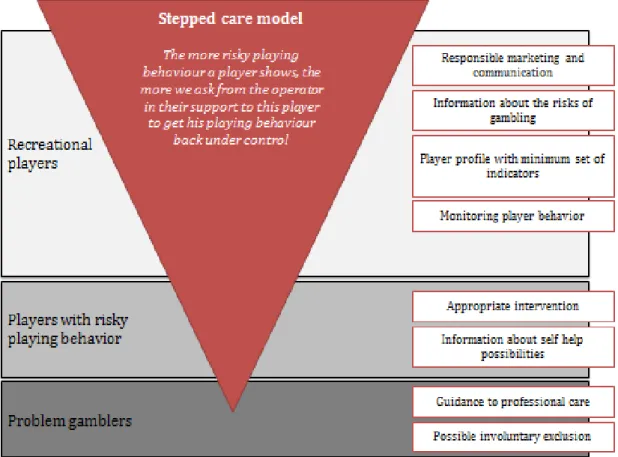
The general view from stakeholders is that the riskier or more problematic the playing behaviour, the more focused the intervention needs to be. Thus, there was a general agreement on the need for a stepped care model for the interventions as proposed by the ministry (see figure 1).
Operators agreed that in their responsible gaming policies they should describe their escalation procedure, which the gaming authority (the Ksa) can then test when providing a license. Furthermore, when in place, the procedures (especially online) can easily be audited.
It was agreed that developing good practice in this area would be through involving multiple stakeholders. The requirements should be mandatory for those players
7 getting into trouble and a stepped care approach for those at no or low risk would be appropriate. It was recognized that small operators might not be able to implement the same sophisticated systems as larger operators.
Figure 1: The stepped care model as discussed at the workshops
Conclusions and recommendations
Given how widely applied stepped care is in health and social welfare, it would be appropriate to use such a model to prevent harm in gambling. This means that operators should adopt a suitably recommended system, in which they distinguish recreational players from players with risky playing behaviour and problem gamblers. We recommend that such a system should be written down in guidelines and decision rules as part of an operator’s responsible gaming (RG) policy.
This means that responsible gaming policies should contain the adopted procedures to recognise, analyse and catalogue suspicious and risky playing behaviour.
Furthermore, there should be a hierarchy of potential interventions, ranging from simple interventions (e.g., information provision), to possible mandatory exclusion in very exceptional cases, and recommended telephone, online or face-to-face
counselling / treatment / therapy. Ultimately, the guidelines of the stepped care model should clearly define what the appropriate RG measures and interventions for each of the specific types of playing behaviour.
To further maximise positive client outcomes, staff will require training in the
implementation and use of the model. Sufficient staff must be available to administer the stepped care model from the help desk or floor staff.
8
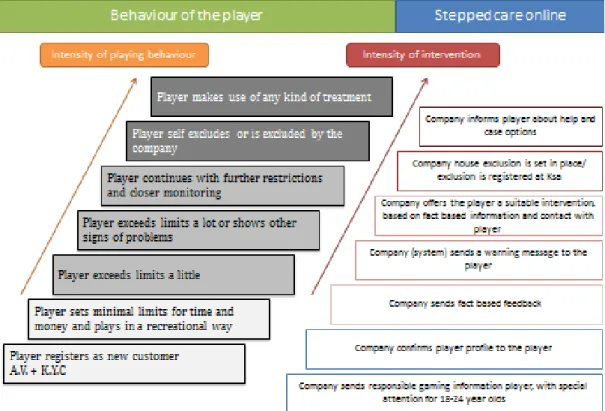
Minimum standards for online operators
Operators must adopt a suitable monitoring system that allows the cataloguing of playing behaviour. Suspicious or risky playing behaviour should then be analysed to determine if the playing behaviour constitutes a risk or a problem for the player. This subject will be addressed more extensively in Chapter 4. We recommend that
recreational players should be given information on responsible gaming. They should also be given information about their playing behaviour, e.g. amount of money on player account, play-activity reports or betting history, etc. This will be further elaborated in Chapter 3.
Players with risky playing behaviour should be given a suitably crafted ‘warning’ message when boundaries are about to be crossed or when playing limits are
exceeded. They should also be given information about their risky playing behaviour, e.g. self-tests for problem gambling. Another appropriate measure could be to persuade the player who is at risk, to set limits.
Furthermore, we find it appropriate that the operator would refrain from (or at least be very cautious in) giving these players bonuses or otherwise applying direct marketing to these players.
When needed, problem gamblers should be guided to professional treatment and / or self-help/care, or should be persuaded to self-exclude from playing. In very
exceptional cases, the player should be excluded involuntarily. Furthermore, the operator should refrain from giving these players bonuses or otherwise applying promotional activities and direct marketing on these players.
9
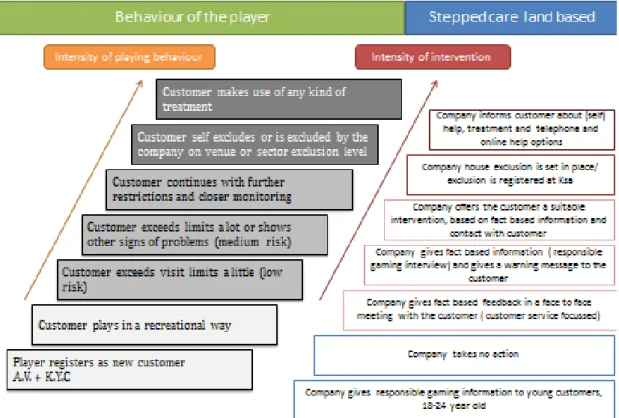
Minimum standards for land based operators
We recommend that land-based operators keep track of players and their behaviour by cataloguing or remembering manifested signs of risky behaviour or, or by
recording the visiting frequency of players.
This is likely to be a challenge for operators in the arcade sector, who do not currently have staff dedicated to the application of such a system. The land-based casino sector has a system (OASIS) in place at present that can monitor player behaviour to a certain extent and can provide information on customer contacts.
We further recommend that recreational players should be given general information on responsible gaming and the risks of gambling.
Players with risky playing behaviour should be given a warning in person when boundaries are crossed. They should also be given information about their risky playing behaviour, e.g. self-tests for problem gambling or providing a ‘mirror’ by way of feedback on their gaming behaviour.
Furthermore, operators should refrain from (or at least be very cautious in) applying direct marketing such as advertising and bonuses to these players.
Players exhibiting signs of problems should be guided to a professional and / or self-help organisations, or should be persuaded to self-exclude from playing. In
exceptional cases, the player should be excluded involuntarily from gambling. Furthermore, operators should refrain from applying any promotional activities to these players.
10
Figure 3: The stepped care model in a land-based environment
Considerations about the appropriate level of detail
The stepped care model should be reviewed regularly under the umbrella of the Ksa or another independent body.
Advice on next steps
The model gives direction as to how to bridge the gap between help provided by the operator and help, or healthcare services provided by the counselling / treatment and prevention organisations. Some suggestions are: a) Someone from the counselling / treatment and prevention organisations to help internally for the operator; b) A ‘white label’ website as a starting point for RG related information and facilities.
Further research and agenda
Given their experience in other health welfare and addiction spheres, the counselling / treatment and prevention sector are well able to provide advice support and training to operators in the implementation of these systems. Our recommendation for the future agenda would be that counselling / treatment and prevention organisations and operators have a regular dialogue under the umbrella of a possible future Prevention Fund and the Ksa. This would enable their cooperation and help them to work together to ensure that the adopted RG policies like the stepped care model are current and effective.
11
3. INFORMATION PROVISION
Introduction
Informed consumer choice is now seen as a pre-requisite of good public health, however information must be accurate realistic and well presented. Recent
revelations about sugar content in everyday food have wrong-footed the food industry and similar scandals are possible in gambling. It is vital that operators address the need to provide accurate information about true odds and the nature of chance and probability in order to educate players.
Very few operators have adequate information available. Those that do, have largely limited this to information to how to apply responsible gaming tools. There is much to do to equip operators to be able to meet the policy objective. The current land-based sector is mostly very well equipped and provides information about how to keep gambling in control, self-tests and information on help services (self-help and professional care).
Proposed in law
Article 4a of the current Betting and gaming Act
1. The holders of a license on the basis of this betting and gaming act should take all measures and services which are required to prevent addiction in the games they organise.
Academic view on topic
Research outcomes
The importance of influencing behaviour in public health has been widely established for a number of risky behaviours. Academics have looked at the best methods for influencing positive behaviour change through messaging and established the importance of peer-to-peer type messaging and normative feedback (Dolan et al., 2012). This has also been emphasised in the review on gaming limit setting (Lucar et al., 2012).
Unfortunately, those with gambling problems are often in denial of their problems and in spite of objectively having serious gambling-related problems do not think they have a problem at all (Derevensky, 2012; Hardoon et al., 2003). Therefore it is vital that information about how to keep safe and how to get help are conveyed in ways that will encourage greater uptake. In this regard gaming has much to learn from other areas of health information dissemination and many successful techniques from other areas of public health could make their way into the gaming domain, with the help of counselling / treatment and prevention organisations. Marketing strategies are also important and should not be overlooked (Bernhard et al., 2012) to optimize adoption of such strategies.
The willingness of an operator to provide meaningful consumer protection information is an indication of a mature and confident organisation. This is particularly true for operators whose products have the potential to cause harm with certain customer segments. Visibility of information about how to play responsibly, the nature of games of chance and true odds are all-important in order for players to make an informed choice about their gambling (Blaszczynski et al., 2008). The willingness to carry a warning text in a readable font size is probably a good indication of such confidence
12 and could be a sign of corporate social responsibility and demonstrable awareness of responsibilities.
RG Information
The principle of encouraging players to make an informed choice / informed decision about whether and how to gamble has been well endorsed by researchers
(Blaszczynski et al., 2004; Blaszczynski et al., 2008; Blaszczynski et al., 2011). Direct evidence relating to online gambling is limited. There have been a number of evaluations efforts to educate EGM gamblers. Wohl and colleagues developed and evaluated the effectiveness of a short video that provided education on how slot machines work, the value of setting financial limits, and strategies to avoid problems (Wohl et al., 2010) They have recently made a shorter version and are currently evaluating its efficacy.
Tools to help players set limits
Tools such as expense calculators are generally confined to gaming help
organisations (for example gambleaware.co.uk). Many of the lottery organisations and a limited amount of gaming operators have yet to incorporate these features on their websites. However the provision of such tools within an RG hub could be of benefit to those who wish to place a monetary limit on their play (Auer & Griffiths, 2012).
Provision of Information on losses and account balances
Regarding the idea of displaying limits on the player account page and onscreen during play, (Lucar et al., 2012) summarized the research to date on this topic: In general, play activity reports can be expected to be well received by Internet gamblers, and can perhaps be a useful tool for Internet players to become more aware of the amount of money they are spending on their gaming. Seeing expenditure histories of online play may help prompt gamblers to set appropriate limits on their gaming; further research is required to evaluate if play activity reports actually result in changes in gaming behaviour and limit setting
Player specific information regarding time
Schellinck and Schrans (2002) found that an on-screen clock was associated with improvements in keeping track of time and staying within desired time limits, but had no effect in actually reducing session length or expenditure. Research by Wynne and Stinchfield (2004) similarly found no effect on machine gaming behaviour. EGM gamblers in a Quebec study reported that having a clock was also not a helpful tool in promoting responsible gaming (Ladouceur & Sevigny, 2009).
In 2001 all gaming machines in the Crown casino in Melbourne, Australia were required to have clocks to display the time of day so that the players could be aware of the time of day and passage of time, however so far there is very little or no evidence on the effectiveness of the measure.
Player specific information derived from monitoring play
Gambling harm is the result of a complex relationship between the object of addiction (gaming technology), the player (demographic and lifestyle characteristics) and the environment, opportunities to gamble, stimulations to gamble, culture, etc. (Korn & Shaffer, 1999). A more common approach is to examine psycho-social-behavioural environmental factors associated with harm from gambling.
Much of the empirical work in this area has been done by Howard Shaffer and colleagues using online gamblers on Bwin data (Gray et al. 2012).
13 A number of developers claim to have of found detectable behavioural markers or risky gambling behaviour or problem gambling, however evidence supporting these claims is so far limited. BetBuddy, Featurespace and Playscan, all designers and operators of behavioural tracking systems, suggest they have empirical evidence to support their use. However the vast majority of the data is unavailable due to reported proprietary business reasons. Most recent studies indicate that at least one variable is a reliable indicator –involvement in multiple different modes of gambling. Following the work of Shaffer and others with the Bwin data and further analyses of the same date by German researchers, multiple involvement is considered an important predictor of potential harm (Brosowski et al., 2012). Unfortunately, too many typical gamblers who are not at risk also engage in multiple forms of gambling in different venues rendering this variable limited in its effectiveness as a single predictor for problem gambling.
An Austrian designed system called Mentor is not a predictive tool and simply provides players with personalized information, statistics, and user-friendly graphics about their individual gaming behaviour. Furthermore, it provides personalized messages and action items. It also allows operators to monitor player behaviour.
Points of attention for policy makers
Research and anecdotal evidence from non-problem as well as problem gamblers suggests that information provided may not be used consistently. Most ordinary gamblers believe that responsible gaming information/messaging does not apply to them, as these are safeguards for problem gamblers.
Furthermore, awareness initiatives appear to have had a very limited impact if people are not explicitly asked to attend to the information or have no intrinsic interest in it. The challenge for gambling operators is to make educational information engaging and interesting for players.
Insight into the working of a game can prove useful in educating the player. Some attempt at explaining the true nature of house edge, odds and randomness is available on the website Gambleaware and a number of other sites including lottery operators.
Stakeholders view on topic
General informationIt was agreed that tailor-made information is probably necessary according to different segments of the player population. A central point for general information would be wise, but the consensus was that operators should always provide information about the risks of playing games of chance on their websites.
It was also agreed that operators should make an effort in making the information attractive or more suited to a player, for example by using marketing instruments. Operators suggested that they could use mechanisms for making information attractive for the player, such as those that are used for marketing goals (e.g. use professional poker players). In marketing it is also the challenge to make information as attractive as possible for the player. One suggestion is to use tutorials as a way to inform players, or to give information in a way that is visually stimulating.
14 Operators suggested that strategies for informing players can also benefit from good Customer Relations Management (CRM) techniques. For example, the information given to young adults should contain some extra content, e.g. more information on keeping healthy finances. Although information specially directed to young adults, should not be directed in such a way that they, because they have a certain age, get special attention.
Stakeholder views on explanations of house edge and characteristics of games None of the operators appear to provide a full explanation of the true nature of
gambling or explain the long-term nature of ‘return to player’. There is no doubt that a full and uninhibited disclosure of these facts would enhance the education of players should they be willing to review this information and if adequately conveyed.
However, operators were of the view that information about the payback percentage (PP) is not always possible (e.g., regarding poker) and there are complexities in describing payback percentages in some environments (e.g., arcade gambling). PP may not be a good indicator for the player to know more about the characteristics of the game as it can create unrealistic expectations. PP figures are not generally meaningful for players and are unlikely to be understood by them from a consumer protection perspective. It may be more useful to have explanations of the true odds of winning on a particular game. The payback percentage is always an average and not a pattern or regularity for payback.
Conclusions and recommendations
Minimum standards for land based and online operators
Operators provide players with fair and adequate information to make informed choices. Players should be automatically given information about how to keep
gambling fun, the nature of the gambling (odds, probabilities, etc.) and how / where to get help if problems arise. All operators should display such information, to a
minimum standard, perhaps formulated by the Ksa, and presented prominently, on their websites or in their venues.
The responsible gaming information should cover possible problems and harmful effects of gambling, as well as tips and advice that can help the players enjoy gambling responsibly. Links to this page should be available through all available interfaces for products and at strategic points across the websites and venues. Player protection information for players must include the following:
Responsible gaming information
Guidance on ‘self-assessment’ processes Links to problem gambling services Self-limitation
Self-exclusion
Filtering programmes Complaint procedures
Account Statements and gambling / betting histories
Considerations about the appropriate level of detail
Regardless of where the resources come from, this is how we see them being applied in the AMvB:
15 Preventative Education and Information
Operators should be committed to a) helping players receive information about risky play and how to avoid it, and b) helping players to evaluate their behaviour and to get help for themselves.
Operators should do this through the provision of educational information through their RG pages. This is an area that operators should review on an on-going basis. Operators should also promote educational programmes and other information initiatives aimed at the prevention of harm.
Player Protection Settings and Information Text on Player Protection Page Operators should have a centralised player protection page on websites, or
information point in venues, from which players can manage their settings across the product range. Here players can:
Set self-exclusion for a specific period of time
Set or edit deposit or loss limits settings for the account, or manage product specific limits
Read information regarding the self-exclusion and limits functions, which should be clearly explained within the player protection settings page. Customer Complaints
Players are notified of their right to complain and to contact the Ksa or an independent body during or after the complaint process.
There needs to be a helpdesk for players, so that they can ask for information or to make complaints. This should be available 24/7 in Dutch and there should be multiple ways to make contact (e.g. a chat function, e-mail, or telephone). The helpdesk needs to be able to provide specialist staff to undertake interventions. This helpdesk can be an independent organisation or can be related to the operator.
Age Verification and Underage Gambling
Operators should use strict and rigorous process for age verification takes players through multiple stages to confirm their identity and age. The process should consist of:
Account opening – the customer has to provide registration details (name, address, date of birth, email address, phone number and card or bank details) to the operator. The customer also has to agree to the terms and conditions, including the section that outlines that you must be over the age of 18. All these standards are to be developed by the Ksa.
Prevent funding from “at risk” methods (those deemed to be available to minors) – players funding with “at risk” payment methods are locked at the point of registration.
Validating the customer – the operator confirms that the customer’s details provided actually relate to the user of the account, via one of a number of methods:
Verifying the details supplied during registration with a third party company. Selected customer details entered during account registration are verified.
16 When necessary utilising third party relationships to certify customer
documentation.
Supplying hard-copy identity documentation. Should the above two solutions are not available, players should provide operators should with copies of documentation such as a copy of a passport, driving licence or utility bill.
The operators’ sites and venues must clearly display an ’18 or 18 +’s only’ sign, clearly visible on entrance doors or web site pages. Through the registration process there should be a clear message regarding underage play and the steps the
operators takes to check on age. This acts as a deterrent to minors. I. Customer account
Operators should not allow players to register more than one account and state that there are strict and robust controls in place to monitor this. Expenditure histories of the player’s account should be visible; further research is required to evaluate if making play activity reports visible is an effective measure.
II. Payment Restrictions
Operators should implement payment restrictions on accounts to prevent fraud and money laundering risks. These include linking payment methods intrinsically to one account so that they cannot be used on other account and limiting players to one card registration at any time.
III. Advice on Maintaining control
Operators should display advice to help players maintain control of gambling habits
Advice on next steps
There should be a central repository of information that could be available to all operators. Operators should be encouraged to apply the responsible gaming information to their leaflets and webpages and seek advice from prevention experts on how it should be best displayed and players alerted to its existence and how to use it effectively.
Providing tailor-made information may be necessary according to different segments of the player population.A central point for general information could be beneficial, but operators should always provide information about the risks of playing games of chance on their website. The Ministry should provide minimum standards for this information that operators must adhere to.
The difficulty with providing information about responsible gaming is that most players don’t believe it is relevant to them. And those who are at risk and do need the
information don’t use it. In all likelihood the best we can hope is to get players to look at visual material, as text is unlikely to be read.
For responsible gaming, the same mechanisms for making information attractive for the player could be employed, as those are used for marketing goals (e.g., use professional poker players, professional athletes). In marketing, it is also the challenge to make information as attractive as possible for the player as well as incorporating good CRM principles.
17
Further research and agenda
The counselling / treatment and prevention sector in general in the Netherlands is familiar with gambling harm prevention. Its knowledge about this area will increase during the course of the change in legislation and the arrival of regulated Internet gambling in the country. There are strong capabilities in general addictions treatment and much experience in the alcohol, smoking and drugs field that will translate well into dealing with gambling addiction.
Our recommendation for the future agenda would be that counselling / treatment and prevention organisations, operators and other stakeholders, under the supervision of the Prevention Fund and the Ksa have a continuous dialogue about their cooperation and work together to ensure the establishment of a suitable centralised repository of knowledge that operators and the sector can use as required, regularly updated using international best practice.
18
4. CATALOGUING PLAYER BEHAVIOUR
Introduction
It is now accepted common knowledge amongst most stakeholders that online operators have the technical capability to monitor players’ behaviour. For the land-based operators, especially arcades operators, it is less common to implement systems that allow effective monitoring of their players.
An important principle of the stepped care model is that the greater the risk, the bigger the need for intervention. Therefore it is necessary to recognise risky playing behaviour in a timely fashion. To ensure this, the operator must monitor and analyse players and their behaviour in a consistent and unambiguous manner.
Proposed in law
Article 27ja of the Bill1. Without prejudice to the provisions laid down by or pursuant to Article 4a, the holder of a licence for organising a gambling casino will systematically register and analyse data with respect to a player's gambling behaviour. In doing so, he may process special personal data insofar as this is necessary in order to prevent excessive participation in games of chance or gambling addiction.
Article 30v of the Bill
1. Without prejudice to the provisions laid down by or pursuant to Article 4a, the holder of a licence for having one or more gambling machines present in an establishment as referred to in Article 30c(1), under (b), will systematically register and analyse data with respect to a player's gambling behaviour. In doing so, he may process special personal data insofar as this is necessary in order to prevent
excessive participation in games of chance or gambling addiction. Article 31n of the Bill
1. Without prejudice to the provisions laid down by or pursuant to Article 4a, the holder of a licence for organising remote games of chance will systematically register and analyse data with respect to a player's gambling behaviour. In doing so, he may process special personal data insofar as this is necessary in order to prevent
excessive participation in games of chance or gambling addiction.
Academic view on topic
Research outcomes
The new law sets out a number of provisions with regard to the registration and login of players with the licence holder. The player must create for himself a profile in advance of playing that specifies the amount of time and money he is likely to spend as well as the types of games that initially interest him. The operator would then be able to offer direct and normative feedback to the player based on his adherence to stated preferences.
This approach is in keeping with emerging harm prevention approaches in health and pro-social behaviour that are emphasising the need for using ‘Nudge’ type principle to induce healthier lifestyles (Larimer & Neighbors, 2003; Thaler & Sunstein, 2008).
19 Some recent studies have been done with college students suggesting that this approach works well in the gaming field (Larimer et al., 2012; Neighbors, 2013). Monitoring players and behaviour
Monitoring players and their behaviour is not a new approach to harm prevention. From an early beginning, Holland Casino has adopted a prevention policy, of which spotting out risky playing behaviour from visitors and keeping a record of that risky behaviour is an important part. Another important part of the prevention policy is to keep track of a player’s visiting frequency. The recorded behaviour and the visiting frequency ultimately formed the base for protective measures administered by Holland Casino, which the majority of visitors found useful (De Bruin 2001). Monitoring communications from players
Haefeli (2011) has reported that a number of warning indicators for problematic gambling can be conveyed through customer communications. As a result, the close monitoring of calls to helpdesk, forum postings etc., reports of changing settings in time and budget and account closing due to gaming problems will be a useful means of preventing the escalation of risky gaming behavior.
Evidence supporting establishing player profiles
The search for robust behavioural markers for safe gambling behaviour can be found in a) the multiple studies done on Bwin player data by the Harvard University
Research group (Gray et al., 2012; Shaffer et al., 2010) b) some UK based investigators (Dragicevic, 2011) in an analysis of Canadian players, c) Italian researchers (Adami et al., 2013) and the work done by Mark Griffiths (Griffiths and Witty, 2010 and Auer and Griffiths, (in press).
Limit setting – general points
In a meta-study of a wide range of gaming harm prevention methods (Williams & West, 2012) it was noted that opportunities for players to make choices about their play and the use of systems to manage their own money and time is a useful harm prevention strategy. Such systems may encourage players to make rational decisions about their gaming and oblige them to retain limits despite subsequent temptations that arise during play.
The ability to automatically reduce limits has been recommended (Auer & Griffiths, 2012; Bernhard, Lucas & Jang, 2006; Griffiths, 2009 & 2013). This would also be a valid reason to contact the player and provide feedback and recommendations for safer play.
Auer and Griffiths (2013) as part of a study of 5000 gamblers suggested that voluntary limit setting is a beneficial harm prevention strategy. They found that company imposed upper mandatory limits can be easily circumvented by players and that encouraging personal responsibility through a voluntary system maybe a more effective approach. They also suggested that externally imposed upper limits can have unintended consequences in that players can develop a false sense of safety, make increased bet sizes and indulge in increased time spent gaming.
In another study, Griffiths and Wood (2010) noted that imposed fixed limits do not encourage gamblers to manage and monitor their own behaviour. Thus any desired transfer of learning from one site to another is not maintained.
The Australian Productivity Commission report (2010) referred to the topic of player choice and voluntary versus operator induced limits systems, to a parliamentary enquiry, which considered evidence over a two-year period. The committee noted that
20 there is a consensus amongst international researchers and scholars that the use and encouragement of player induced rational decision-making systems is preferable even for problem gamblers (when not playing) over imposed systems that rely on monitoring their behaviour.
The Productivity Committee concluded that a system that allows players to make a rational choice is preferred. Paul Delfabbro, a leading gaming researcher, in his evidence to the committee, suggested that even if limits higher than the mandatory set levels were to be set by a problem gambler, the conscious act of setting these limits is beneficial. The committee concluded that limit setting systems should be offered on all gambling websites and venues. Default limits should be set only with the opportunity for the player to apply these limits to all online gambling sites. Why the ability to define limits is important for the player
The concept of placing limits on money and time are universally considered to be of great importance by clinicians, psychiatrists, psychologists andsocial workers in treating problem gamblers and from this experience has filtered through into generally accepted advice on responsible gaming practice. We also know from gamblers who play without developing problems that limit setting is helpful. Wohl (2010) reported that approximately 80% of gamblers in general said they mentally set a limit on their play. For many this is a vague or soft limit (about $50; between 2-3 hours).
Approximately 25% exceed their pre-set mental limit.
This study supports the precept that formal limit setting should be offered to players as means of making this general tendency more concrete especially for the 25% who exceeded their notional informal limit.
There is a general consensus amongst clinicians and academics that the offer of limit options and RG tools in general is useful because they seem to encourage gamblers to reflect on the amount of money and time they spend gambling. In a recent meta-review of the literature, Lucar et al. (2012) concluded that monetary limit-setting features have the potential to help gamblers reduce excessive gambling expenditure, albeit over the long run and in conjunction with other responsible gaming measures that elicit self-reflection (e.g., player history reports, responsible gaming and problem gambling information, pop-up messaging, normative feedback, budget calculators etc. Further evidence has been gained from Gainsbury et al. (2012) who interviewed 10,838 online players from 96 different countries. This sample included 7,342 Internet casino players with more than three-quarters of participants aged over 35 years. Most participants resided in USA and Canadaor the United Kingdom. The results
suggested that:
Participants generally reported that they found Responsible Gambling Features (RGFs) useful. Although no feature stood out as critically important most participants stated that they would consider RGFs at least “quite useful”. The most popular option was receiving regular financial statements, with 75.1% of respondents considering this option to be at least quite useful and the least popular feature was self-set time limit with 50.3% reporting this as at least quite useful.
Participants were significantly more likely to report that a RGF was at least quite useful if they reported chasing losses (indicator of problem gambling), were under the age of 35 or were female. Those playing at Internet casinos (versus poker players) were also more likely to endorse RGFs with the exception of financial statements and self-assessment. Among the participants, Internet poker players that played with lower stakes were more likely to report that spend limits would be at least quite
21 useful. More skilful poker players (those 44.9% of the 5,004 respondents claiming that they were either ‘quite good’, ‘very good’ or ‘extremely good’) reported spending limits, time limits and self-exclusion all to be less useful than their less skilful
counterparts (those 55.1% of the respondents claiming to be of ‘average skill’ level or less). Respondents in the US were less likely to rate any of the RGFs as at least quite useful compared to other countries. Participants from the UK were significantly more likely to rate RGFs as at least quite useful, with the exception of
self-assessment tests. Canadian, Dutch and Danish respondents were less likely to endorse the usefulness of spend limits. Australian, Swedish, German, Norwegian, Irish and Italian residents were no different in responding compared to other respondents.
In a study by Wardle (Wardle 2011) in the U.K., a high proportion of gamblers reported having set limits on the amount of money spent on any gambling website; with nearly two thirds indicating that they had done this in the past. Far fewer respondents reported that they had never set any limits on the amount of time they could spend on a gambling website. The fact that the majority of gamblers had used at least one form of player protection tools on a gambling website provides a strong mandate of support for these tools.
Limit setting in the player profile.
Lucar et al (2012) recommend that players be required to set a deposit limit of their own choosing as part of the registration process or prior to their first play session after creating an account. The potential advantages of such limit setting have been
previously described. Adding a default opt-in option would help to extend the idea of playing safely within one's limits for the entire player population. However, as
previously recommended, it should remain an entirely personal decision as to the amounts of the limits.
The conscious act of decision-making about limits on the part of typical gamblers and problem gamblers alike is helpful in promoting personal responsibility and inducing the discipline of informed decision-making. This applies even if limits established by the player seem unrealistic to an observer. Most gamblers, independent of their level of gambling problems, seem to prefer voluntary rather than imposed protection systems (eCOGRA 2007).
Various regulators have mandated on-screen clocks and tools to set time limits on play. Playing longer than planned is a risk practice that increases the likelihood of developing impaired control over gambling. Accordingly, researchers have explored the value of introducing clocks into play. Schellinck and Schrans (2002) found that an on-screen clock was associated with improvements in keeping track of time and staying within desired time limits, but had no effect in actually reducing session length or expenditure. Research by Wynne and Stinchfield (2004) similarly found no effect on machine gambling behaviour. EGM gamblers in a Quebec study reported that having a clock was also not a helpful tool in promoting responsible gaming (Ladouceur & Sevigny, 2009).
In 2001 all gambling machines in the Crown casino in Melbourne, Australia were required to have clocks to display the time of day so that the players could be aware Self-monitoring and the encouragement of personal responsibility remains an important principle for all gamblers – for those occasional recreational players at no-risk, right through to intense players with an established gambling problem
22 of the time of day and passage of time, however so far there is very little or no
evidence on the effectiveness of the measure. Holland Casino introduced a limited visit system in the early 1990’s, additional to the self-exclusion system that was developed in the 1980s. Similar research carried out in 2001 and 2005 shows that these measures are of help for the players.
The proposal under the new law that players should pre-determine the number of site visits they make would be a new type of prevention tool that requires proper
evaluation before determining its usefulness This begs the question of how to assess the cumulative total of all site visits, across all operators can be recorded, with over 2400 current online gaming sites). This may be a useful extension of the capabilities of the national exclusion register in the future for state authorized operators.
However, we must acknowledge that it would be hard for players to set limits on the time they wished to spend across all possible sites and venues. There remains a real concern that if a gambler reaches his time or money limit on one site he/she may switch to another site.
Points of attention for policy makers
This literature and our own experiences suggest that the construction of a profile of players may induce greater self-awareness amongst lower risk categories of players and will aid the ability to monitor and encourage responsible play, thus minimizing their escalation of gambling and gambling-related problems. It will provide a useful basis for monitoring and intervention with players at the higher end of the risk spectrum.
In addition, best practice suggests that a large range of limiting options should be made available and furthermore that effective messaging may be an aid to reinforcing the decision to limit and thereby taking more informed and less impulsive decisions about what time and money to spend on gambling activities.
A point of caution is that externally imposed upper limits can have unintended consequences in that players can develop a false sense of safety, make increased bet sizes and indulge in increased time spent gambling.
In summary, we believe the current international consensus amongst researchers and gambling harm prevention experts is that a system whereby the player makes a conscious and voluntary decision about spending limits for gambling is one way to help players maintain reasonable limits and enable those at risk of gambling problems.
Stakeholders view on topic
Stakeholder Views on feedback to the player
Giving feedback to the player was broadly seen as useful way to help players play in a safe and casual manner. A benchmark could be used for normative feedback, The land-based operators, especially the arcades operators find it difficult to
determine quantitatively what normal playing behaviour is. A better measure might be a recommendation on what responsible play looks like. However, a normative
feedback system for land-based operators should also be possible, which should focus on providing a ‘mirror’ for the player on his gambling behaviour, as well as normative feedback which provides a comparison with other players and is more of an advice tool for the player.
23 Online operators have less trouble with a benchmark. They see a deviation from the ‘normal’ playing behaviour or playing pattern as a sign of possible problem gambling and as a reason for the operator to contact the player.
Stakeholder Views on setting a player profile
There was broad agreement to the concept of players setting their own parameters on time, expenditure and types of game to be played as long as the process is easy to implement nor a lengthy, otherwise, players may become frustrated and abandon the registration process.
Procedurally, operators recommended that that this process takes only a few
minutes. Some operators and researchers have suggested that should players reach their self-imposed limits (time and money), there should be a cooling off period (proposed 24 hours up to 7 days as a maximum)before the limits are changed. Stakeholder perspectives on cataloguing the player through monitoring and analysis The general view is that the greater the risk, the bigger the need for intervention. Thus, there was agreement on the need for a stepped care model for the
interventions.
Operators agree that in their responsible gaming policies they should describe their escalation procedure, which the Ksa can then test when providing a license.
Furthermore, when in place, the procedures (especially online) can easily be audited. Operators argue that the regulations regarding intervention, and the process leading up to the intervention should not to be strict and / or rigid. The demands and minimum standards the MoSJ expects are still not validated and should not be used as a guiding principle until validated.
It was agreed that developing a good practice in the area would be through involving multiple stakeholders. The requirements should be mandatory for those players getting into trouble and a stepped care approach for those at no- or low risk would be appropriate. It was recognized that small operators might not be able to implement the same sophisticated systems as larger operators.
Conclusions and recommendations
Minimum standards for online operators
The operators should adopt a suitable monitoring system that allows players to set their own limits and then receive detailed feedback from the operator should they deviate from these limits. This means the following:
a) Profile setting and monitoring: The player must, prior to their first play session, create a profile in advance of playing, that specifies the amount of time and money he is likely to spend as well as the types of games that initially interest him. The operator would then be able to offer direct and normative feedback to the player based on his adherence to stated preferences. Stronger interventions when needed will be
implemented according to the stepped care model (see below).
b) Financial Limits setting: Tools should be available to set at leastdaily, weekly or monthly deposit limits. These must be set when a player registers for an account from within his ‘Account Profile’. If he is already a customer and wishes to amend the limits then this too can be done. The player must be able to set a deposit limit.
24 Deposit limits allow the player to impose a restriction on the amount he can initially deposit into the account, before money is spent across the operator’s products. The player can decide the amount and choose a period of daily, weekly or monthly. The deposit limit is not affected by any transfers of money between wallets or by
withdrawals.
Additionally, all operators follow at least a basic systematic procedure to handle players if they do not play within their own prescribed limits, as entered into the player profile. This will ensure that all players who begin to gamble excessively are not only monitored, but benefit from the application of a care model that will ensure they get the right level of help that is appropriate to their situation. Evidence of this system will be provided as a condition of license award and the Ksa on an on-going basis will monitor effectiveness.
This system of cataloguing playing behaviour gives the operators the means to recognise risky playing behaviour in a timely fashion. Moreover, this system should result in all players realising that a) their gambling activities and behaviours are monitored should they become unsafe and b) there is a safety net that operators must apply to help them gamble within their own stated limits, if for some reason they cannot do this for themselves.
Minimum standards for land based operators
At present the land-based sector cannot monitor player behaviour in detail. The introduction of a detailed system as proposed for the online operators is expected to increase their operational costs.
Nevertheless, we recommend that land based operators keep track of players, albeit in a less extensive way (e.g. cataloguing or remembering manifested signs of risky behaviour or deviant behaviour, recording players visiting frequency). To maximise the effectiveness of monitoring, we recommend training staff in recognising risky playing behaviour.
We furthermore recommend a simple (automated) player registration system for the Arcade sector, as this will make it possible to record players visiting frequency in a more structural and controllable way, while not being labour-intensive.
The land based casino sector has a system (OASIS) in place at present that can monitor player behaviour to a certain extend and can provide information on customer contacts.
Another possibly useful and effective way in monitoring playing behaviour in a land based environment could be the implementation of a system which uses ‘player cards’, e.g. a card or token that is linked to an individual and identifiable player. Although maybe costly, this system could prove to have the same efficient capabilities in detecting problem gambling as in an online environment. However more research on the possible effectiveness is needed.
Advice on next steps
Online operators will have to either buy suitable player monitoring software or else develop applications themselves, as none of them currently have suitable systems that perform the functions described in the legislation.
25 Additionally, online operators will have to ensure that the parameter setting process can be completed in an efficient matter that does not try the patience of the potential customer otherwise they will lose that potential new player. Our recommendation would be not to overuse limiting options, but to let players at least fill in the basic and necessary limits such as deposit limits and a time limiting option (e.g. visiting
frequency). A limit on multiple different modes of gambling would be optional.
Further research and agenda
The proposal under the new law that players should predetermine the number of site visits seems to be a new type of prevention tool. This calls out the need for a proper evaluation of this measure in order to determine its potential usefulness.
This also leads to the question if the usefulness of this proposed measure is something that needs to be developed. Thoughts are that the cumulative total of all site visits, across all operators can be recorded and can be assessed. Although, with over 2400 current online gambling sites, it might not be an easy task.
This may be a useful extension of the capabilities of the national exclusion register in the future, for state authorized operators. However, we must acknowledge that it would be hard for players to set limits on the time they wished to spend across all possible sites and venues. A concern remains that if a gambler reaches his time or money limit on one site he/she may switch to another site.
Besides evaluating this measure of pre determining the number of site visits, we recommend for the future agenda that all adopted measures are regularly evaluated and updated using international best practice.
26
5. INTERVENTION WHEN SIGNALS OF RISKY PLAYING
BEHAVIOUR ARISE
Introduction
It is increasingly understood by the general public and health and social
commentators that operators whose products are potentially harmful, should attempt to offset that harm by taking an active and socially responsible role in society.
Proactive intervention with players experiencing harm is expected in the gambling sphere given the potentially very serious financial and family consequences of excessive gambling.
This means that all licensed operators will actively approach players who show signs of excessive play. This enshrines the duty of care principle and ensures that
operators enact a defined responsibility for those players. The policy will also help ensure that revenue cannot be derived from those who begin to gamble excessively, as this behaviour will be discouraged and actively stopped in the early stages.
Proposed in law
Article 27ja of the Bill1. Without prejudice to the provisions laid down by or pursuant to Article 4a, the holder of a licence for organising a gambling casino will systematically register and analyse data with respect to a player's gambling behaviour. In doing so, he may process special personal data insofar as this is necessary in order to prevent excessive participation in games of chance or gambling addiction.
Article 30v of the Bill
1. Without prejudice to the provisions laid down by or pursuant to Article 4a, the holder of a licence for having one or more gaming machines present in an
establishment as referred to in Article 30c(1), under (b), will systematically register and analyse data with respect to a player's gaming behaviour. In doing so, he may process special personal data insofar as this is necessary in order to prevent excessive participation in games of chance or gaming addiction.
Article 31n of the Bill
1. Without prejudice to the provisions laid down by or pursuant to Article 4a, the holder of a licence for organising remote games of chance will systematically register and analyse data with respect to a player's gambling behaviour. In doing so, he may process special personal data insofar as this is necessary in order to prevent
excessive participation in games of chance or gambling addiction.
Academic view on topic
Research outcomes
Notification of limits
There are a number of studies suggesting that players should be provided with appropriate warning messages (e.g., a pop-up message) that informs them of their remaining limit when they are close to reaching their pre-set limit. This feature should give players the option to choose to continue or to stop playing prior to reaching their pre-set limit (Lucar et al., 2012) as unintended consequences of increased gambling may in fact occur.
27 Canadian research has shown that pop-up messages on slot machine terminals can be an effective way to increase user adherence to pre-set monetary limits. However participants with higher levels of gambling problems were more likely to ignore their limits than participants with fewer symptoms. This suggests that pop-up limit
messages might be an effective tool for those at low or moderate risk, but might not be effective for people with high levels of problems (Stewart & Wohl, 2012).
Gainsbury also advocates the use of well-designed and empirically tested pop-ups to remind players about responsible gaming (Gainsbury, 2009):
The implementation of responsible gambling strategies should be based on empirical evidence and theoretical frameworks wherever possible. However, given the lack of research on Internet gaming, the design of online responsible gambling programs must initially be extrapolated from findings in other fields. One method employed to temporarily attract attention away from a primary task to secondary information contained in messages is the use of ‘pop-ups’, which have been increasingly incorporated into computer interfaces including software and web browsers. Player specific feedback derived from monitoring play
Many researchers and policy makers have called on the industry to use technology to track player behaviour. However, as yet there are no reliable and valid methods to determine what patterns of play may be indicative of potential harm with a great deal of certainty. While a number of behavioural analytic systems are in place and are beginning to shed light on this, further research and validation are necessary. Once again, it is important to note that problem gamblers are not a homogenous group and that the motivations for continued gambling in spite of repeated losses, are many. Self-test for gaming problems
Having a self-test facility is a very useful tool in the prevention of harm from gambling. The Problem Gambling Severity Index (PGSI) is probably the easiest one to
incorporate onto the RG pages of a web site as it is easily scored by users. They should then be directed further prevention tools and resources as well as the phone numbers and web addresses of treatment centres.
Interventions stimulated by complaints
As mentioned before, Haefeli (2011) has reported that a number of warning indicators for problematic gambling can be conveyed through customer communications. As a result, the close monitoring of calls to helpdesk, forum postings etc., reports of
changing settings in time and budget and account closings due to gambling problems will be a useful means of preventing the escalation of gambling harm. It is important to have a robust and transparent internal complaints handling system. An alternative mechanism for dispute resolution with a third party independent agency is
recommended. Exclusion
Gainsbury in her recent review of self-exclusion (2010) notes that:
The assessments of self-exclusion programs internationally generally find that the majority of participants benefit from such schemes. These benefits include
participants reporting decreases in gambling expenditure and improved financial circumstances; decreases in gambling frequency and time spent gambling; reduction in problem gambling severity and negative consequences of gambling; reduction in related psychological difficulties including depression and anxiety; and that they feel they have more control of their circumstances. Even without enforcement,
28 a public commitment to stop gambling. Some problem gamblers will wish to avoid the potential embarrassment of being caught in a break of a self-exclusion agreement. Partial exclusion of certain types of games
Anecdotal evidence from treatment centres reveals that many problem gamblers have reported that having a range of exclusion options may be helpful. We conclude that having the option to exclude by product, with varying lengths of times, may induce more people who are experiencing difficulties to take positive actions to address their gambling problems. Universal exclusion against all products may reduce its adoption. Self-exclusion for a certain period
Many of the leading treatment specialists in the world have reached a consensus view that a ‘two strikes and out’ approach is best for permanent or for a longer period of time self-exclusion from a particular website. Their results suggest limiting such self-exclusions to either a six-month period followed by permanent exclusion would be best.
Gainsbury concluded in her comprehensive review that it is best for self-exclusion schemes to offer multiple options to the consumer. She notes that:
There is a lack of empirical evidence to suggest what length of ban is most effective in assisting individuals to control their gaming. Although longer bans may be more effective in providing individuals with the time needed to overcome their gaming-related problems, these may deter some individuals from registering for programs. It is suggested that self-exclusion agreements be a minimum of six months to allow individuals sufficient time to enter treatment if desired or deal with their gambling problems.
The Responsible Gambling Council in Ontario’s review of best practice in
exclusion (RGC, 2008) concluded that in order to maximise the attractiveness of self-exclusion to problem gamblers and to maximize adherence, ban lengths of varying option should be offered to gamblers.
Involuntary exclusion for six months or longer
Anecdotal data from a range of market leading online operators gives testimony to the need and expediency of this provision. There are clearly occasions when the
company must take a decision in a player’s best interests, where the player is unable or unwilling to take appropriate action to protect himself. This is a ‘Hausverbot’ that can only apply to the individual operator.
Exclusion revocation
Anecdotal evidence from treatment providers in Europe suggests that gamblers often have misgivings about having set a self-exclusion. They will consider after a period of time that their luck has changed, strongly believe that they can recover losses, and contend that they can adequately control their gambling. Self-exclusion must remain in force until the time has elapsed. Revocation of a self-exclusion should only be possible after minimum period has elapsed.
Third party exclusions
This measure could be useful but is difficult legally to implement in a lot of
jurisdictions, mainly because of privacy regulations. This provision therefore is only of relevance where it currently is provided for in regulation. While only in a very limited number of jurisdictions (e.g., Tasmania, Belgium and Singapore), there may be a