A secure data outsourcing scheme based on Asmuth-Bloom secret
sharing
Yusuf I. M.
1, Mustafa Kaiiali
1, Adib Habbal
2, Wazan A. S.
3, Auwal S. I.
11Department of Computer Engineering, Mevlana University, Konya, Turkey [email protected], [email protected], [email protected]
2 InterNetWorks Research Lab, School of Computing, Universiti Utara Malaysia, 06010 UUM Sintok, Kedah Malaysia
3 Institut de Recherche en Informatique de Toulouse(irit), France [email protected]
A secure data outsourcing scheme based on Asmuth-Bloom secret
sharing
Data outsourcing is an emerging paradigm for data management in which a database is provided as a service by third party service providers. One of the major benefits of offering database as a service is to provide organizations, which are unable to purchase expensive hardware and software to host their databases, with efficient data storage accessible online at a cheap rate. Despite that, several issues of data confidentiality, integrity, availability and efficient indexing of users’ queries at the server side have to be addressed in the data outsourcing paradigm. Service providers have to guarantee that their clients’ data is secured against internal (insider) and external attacks. This paper briefly analyses the existing indexing schemes in data outsourcing and highlights their advantages and disadvantages. Then it proposes a secure data outsourcing scheme based on Asmuth-Bloom secret sharing which tries to address the issues in data outsourcing such as data confidentiality, availability and order preservation for efficient indexing.
Keywords: data outsourcing; indexing; secret sharing.
Introduction
The rapid increase in the amount of data held by organizations has drastically increased
the cost of in-house data management. Services providers that share resources across
different organizations are therefore required in order to reduce the cost [1]. In-house data
management cost was estimated to be 5-10 times higher than the initial acquisition cost
[2].
Despite the economic advantage of data outsourcing, it faces a lot of challenges
to get widespread acceptance [3]. Data owners are cautious to place their secret
information under the control of a third party without the guarantee of having an efficient
and robust service that manages the information in a secure and privacy preserving
service providers is susceptible to insider attacks; for example employees of online social
network can know which profiles a user has visited [4]. Some may sell their users data to
third party companies who can use them for commercial purposes [5]. In addition,
governments may have a direct access to users’ private information through collaboration
with service providers, as revealed in 2013 by one of the NSA contractors Edward
Snowden [6, 7]. For data outsourcing to take over in-house data management, these issues
have to be adequately addressed.
The prominent techniques used in securing outsourced data are Data encryption
[8], Homomorphic encryption [9], Secret Sharing algorithms and Private Information
Retrieval (PIR) [10].
Encryption has been a traditional solution to the issue of confidentiality. However,
performing database manipulations operations such as insert, update, delete and query on
an outsourced encrypted data imposes an extra overhead due to the several encryption
and decryption processes that need to take place at the client side [11-14].
In homomorphic encryption, data processing operations are performed on an
encrypted outsourced data at the server side while the client only verifies the correctness
of the answer without spending much computational effort [15]. This reduces the
overhead of encryption and decryption processes that have to be performed at the client
side. However, homomorphic encryption is considered to be computationally expensive
due to its dependence on public key cryptosystems [10].
Apart from data confidentiality, another important issue is data availability.
“Downtime can cripple work flow and impose substantial cost - from time and money spent on repairs to lapses in productivity to the inability to meet service levels and
and storing it at different servers [10]. Secret sharing schemes and Information Dispersal
Algorithms (IDAs) [17] are used to provide data availability.
Secret sharing [18] refers to a method of distributing a secret to a group of
participants each of whom is allocated a share of the secret [19]. There are several types
of secret sharing schemes. The most basic types are the threshold schemes, where only
the cardinality of the set of shares matters [19, 20]. In other words, given a secret S,
and n shares, any set of t out of n shares is a set with the smallest cardinality from which
the secret can be recovered [21], in the sense that any set of (t-1) shares is not enough to
give S. This is known as a threshold access structure and is also known as (t, n)
threshold secret sharing scheme [22]. Several secret sharing schemes have been
employed in [2, 10, 23] to provide data availability for outsourced data.
In PIR protocols, the queries performed by the client on the database are hidden
from the service provider. One trivial but inefficient way to achieve PIR is for the server
to send the entire encrypted database to the client. Then the client has to decrypt and
execute the query locally. This provides privacy but introduces communication latency
and computational overhead on the client especially for large databases [24].
Due to this, many approaches were designed to enable an efficient execution of
different types of queries on an encrypted data e.g. encryption based indexing [8],
homomorphic encryption [9], partition based indexing [25], hash based indexing [26],
B+ tree indexing [25], and order preservation encryption [27] (order preservation is a very
important aspect in a data outsourcing scenario, in order to support comparison
operations to be directly applied on encrypted/shared data at the server side without the
Apart from providing data as a service, the data outsourcing model has been
incorporated in many real-time applications to solve users’ privacy issues. As an
example, several data outsourcing paradigms have been proposed to address the privacy
issue that exists in Online Social Networks [28, 29] such as flyByNight [5], faceCloak
[30] and Cloud-based OSN projects [31].
This paper proposes a new data outsourcing scheme based on Asmuth-Bloom
Secret Sharing (ABSS) [32]. ABSS is a threshold scheme based on the Chinese
Remainder Theorem. It requires O(r) modular operations to recover a shared data as
compared with other secret sharing schemes such as Shamir Secret Sharing which is
sensitive to error and uses an interpolation formula that requires O(rlog2r) operations. ABSS is secure in the sense that no useful information can be recovered out of (r - 1)
shares. ABSS can be modified to include the option of checking the validity of the shared
outsourced data before recovery [32]. For the previously mentioned advantages of ABSS,
this paper proposes a new data outsourcing scheme based on ABSS that addresses several
security challenges existing in data outsourcing, namely, availability, confidentiality and
order preservation efficiently. There are other schemes that offer one [8, 9] or two [19,
21] of these characteristics, however, our proposed scheme supports all three
characteristics in an efficient and computationally less expensive manner.
The rest of this paper is organized as follows: Section II discusses the data
outsourcing model. Section III gives a detailed review of related work. Section IV
discusses the secret sharing scheme using Chinese Remainder Theorem (CRT). Section
V presents a direct implementation of the Asmuth-Bloom secret sharing scheme in data
outsourcing. In Section VI, an enhanced data outsourcing model based on the
Asmuth-Bloom secret sharing scheme is proposed. Then, Section VII presents a security analysis
Data outsourcing model
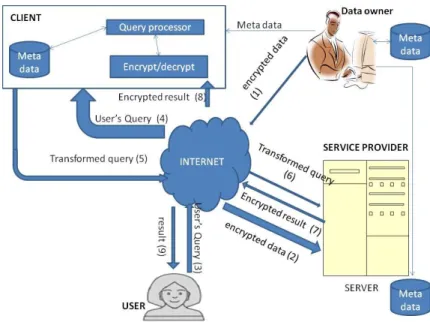
A data outsourcing model [34] consists of the following entities depicted in Figure 1.
Data owner: the entity that owns the data and wishes to outsource it.
User: an entity that needs to access the outsourced data published by the data owner.
Service provider: an entity that stores and manages the outsourced data.
Client:the only party trusted by all the entities involved in a data outsourcing
scenario. The client transforms queries presented by users into equivalent queries
that operate on the encrypteddatabase stored on the server side.
The data owner and the clients rely upon the service provider for the availability
of the outsourced data. However, the confidentiality of the outsourced data is not trusted
with the service provider as it may contain sensitive information that the data owner needs
to reveal only to authorized users. Therefore, it is necessary to prevent the service
provider from having unauthorized access to the outsourced data.
The Figure above illustrates how the data outsourcing model works. The data
owner encrypts his/her data and outsources it to the third party service provider where it
will be stored and managed in an encrypted form. Whenever a user wants to access the
outsourced data, he/she sends his/her query to the client where it will be transformed to a
corresponding query that can work on the encrypted data at the server side. The server
then responds to the request and sends the encrypted result back to the client, where it
will be decrypted, further processed and finally sent to the user.
Related works
A lot of techniques were designed to support queries on encrypted relational databases
and to protect the outsourced database against compromises in confidentiality, integrity
and availability. However, some of these techniques have certain limitations which make
them inefficient.
The table below illustrates a simple database example used throughout this paper.
It is a database of employees’ information. The data owner may outsource this database
to multiple Data Service Providers (DSPj).
Table 1: Employees’ table
S/N Fname Salary 1 Alicia 10 2 Bob 18 3 Carol 21 4 Danna 36 5 Ebe 67 6 Frank 69 7 Gabza 71 8 Habu 81 9 Ibro 93 10 Joseph 238
Encryption based indexing approach
Database encryption refers to the use of encryption techniques to transform a plaintext
database into an encrypted database, thus making it unreadable to anyone except those
Encryption protects the exposure of sensitive information even if the server is
compromised, and ensures its integrity since data tampering can be detected. Data
decryption cannot be executed at the server side, therefore solutions have been developed
that allow the server to execute queries directly on the encrypted data [12].
In [8], an encryption approach is employed in which the attributes of the relation
are encrypted and used as an index. The index value Ii[j] associated with the attribute
value ai[j] in tuple j is computed as Ek(ai[j]), where Ek is a conventional encryption
function and k is the encryption key.
The advantages of this approach are:
It supports the confidentiality service.
It supports equality. As an example, searching for a tuple in an outsourced encrypted data whose attribute a1 value in Table 1 is equal to 10 will be directly
translated by the client into searching for a tuple in the encrypted relation whose
I1 value is equal to Ek(10)[25].
The limitations of this approach are:
It does not support range queries because conventional encryption need not be order preserving [27].
It does not support availability. Homomorphic encryption
Homomorphic encryption is a form of encryption that allows mathematical operations to
be performed on encrypted data without compromising the encryption, and the result
Homomorphic encryption is desirable in modern communication system
architectures especially in Cloud Computing [8]. This is because it can allow the chaining
of different services together without exposing the data to each of those services [35]. For
example, a chain of different services from different companies could be: calculate the
tax, the currency exchange rate and the shipping. All of these services are needed within
a single transaction without exposing the unencrypted data to any of them [36]. This
feature makes this scheme good in providing confidentiality of an outsourced data, though
it does not preserve its order due to the encryption process.
In [9], a privacy homomorphic encryption that allows basic arithmetic operations
to be performed over encrypted data is employed. In this scheme two functions α and β
are defined over the domains of unencrypted and encrypted values respectively. If A is a
domain of unencrypted values, Ek is an encryption function with key k, and Dk is the
corresponding decryption function, then (Ek, Dk, α, β) can be defined as a privacy
homomorphism if:
Dk( βi ( Ek(a1), Ek(a2), …, Ek(an))) = αi (a1, a2,…, am): 1≤ i ≤ n
To add two values a1 and a2 which are encrypted and stored at the server side the
system goes through the following steps; assuming Ek(ai) = ( ai mod p, ai mod q) while
(p, q) are prime numbers representing the shared secret key k between owner and client):
Compute n = p.q, where n is a public parameter.
The server is instructed to compute Ek(a1) + Ek(a2) and then return the result to the client
The client decrypts the result using the function: (d1qq-1+d2pp-1) (mod n), where d1 = a1 (mod p), d2 = a2 (mod q), qq-1 = 1(mod p) and pp-1 = 1(mod q).
As an example, if k = (p = 5, q = 7) and a1 = 10, a2 = 18 are two salaries of two
different employees (as shown in Table 1) ⇒Ek(a1) = (10 mod 5, 10 mod 7) = (0, 3) and Ek(a2) = (18 mod 5, 18 mod 7) = (3, 4). To add a1 and a2 stored encrypted at the server:
n = p.q = 5 × 7 = 35
E(a1)+E(a2) = (0+3, 3+4) = (3, 7)
The client finally decrypt the result using the function (d1qq-1+d2pp-1) (mod n) = (3×7×3 + 7×5×3) mod (35) = 168 mod 35 = 28 which is the addition of a1 to a2.
The advantages of homomorphic encryption are:
It supports confidentiality.
It supports equality, aggregation and logical operations on the outsourced data [9]. The limitations of this approach are:
It is computationally expensive due to its dependence on PKI [10].
It does not preserve the order of the outsourced data so it cannot execute range queries.
It does not support the availability service. Partitioned based indexing approach
In this approach the attribute domain Di is partitioned into contiguous subsets of values
of the same size without overlapping. Each partition is augmented with a label in an
ordered or random manner in the domain Di.
In [25], an architecture is proposed based on a partition based indexing approach.
It comprises of three entities: a user, a server and a client (similar to Figure 1). A user
poses a query to a client to transform it to an equivalent query that can run on encrypted
encrypted data queryable. Based on the index, a technique is developed to split the user’s
query over encrypted data into 2 queries; a server query runs on the encrypted data and a
client query runs on the client side to post-process the results obtained from the server
query. To split the query, three functions are introduced: a partitioning function, an
identification function and a mapping function.
The partition function splits the domain values of attributes into partitions of equal length using a histogram construction technique (e.g. MaxDiff [37] or equi-depth
[38]) such that it covers the whole domain.
The identification function assigns a unique identifier to each of these partitions. To avoid collisions, a collision free hash function can be used for this purpose.
The mapping function maps each of the partitions to its identifier. The advantages of this approach are:
It supports the confidentiality service.
It allows server evaluation of the equality condition [34].
The partitioning of the domain values into contiguous subsets makes it possible to partially preserve the order of the outsourced data [34].
The limitations of this approach are:
It can produce spurious tuples. Spurious tuples are tuples that satisfy the correspondent query condition over the indexes of the outsourced data but do not
satisfy the query condition over the original plaintext [34]. These spurious tuples
need to be further processed and eliminated at the client side.
It partially supports range queries [34].
Hash based indexing
The hash based indexing technique uses as an index the result of a secure hash function
over the attribute values of a relation. The hash function can be adapted for different
granularities of the presented data. As an example if the co-domain C of the hash function
is small compared to the number of attribute values, the hash function distributes the
tuples uniformly in |C| buckets.
With respect to direct encryption, hash based indexing provides more
confidentiality, however, it does not preserve the order of the outsourced data. When
hashing is used, different plaintext values are mapped onto the same index, so the query
results often produce spurious tuples that need to be further processed by the client [26].
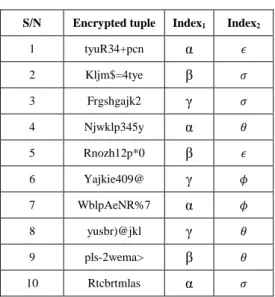
As an example, consider the relation in Table 2 of an encrypted employee table
Employeek. The indexes of the attributes Fname and Salary in relation Employee (shown in Table 1) are computed by applying the hash-based method. Three distinct values
namely α, β and γ have been mapped to the values of the attribute Fname while four distinct values 𝜖, 𝜃, 𝜙 and 𝜎 have been mapped to the values of the attribute Salary.
Table 2: Employeek
S/N Encrypted tuple Index1 Index2
1 tyuR34+pcn α 𝜖 2 Kljm$=4tye β 𝜎 3 Frgshgajk2 γ 𝜎 4 Njwklp345y α 𝜃 5 Rnozh12p*0 β 𝜖 6 Yajkie409@ γ 𝜙 7 WblpAeNR%7 α 𝜙 8 yusbr)@jkl γ 𝜃 9 pls-2wema> β 𝜃 10 Rtcbrtmlas α 𝜎
The advantages of hash based indexing are:
It is more confidential than direct encryption based indexing [5].
It allows server side evaluation of the equality condition. As an example each condition aij = v, where v is a constant value is transformed into a condition Iij =
h(v), where Iij is the index corresponding to aij in the encrypted relation [5].
The limitations of hash based indexing are:
It produces spurious tuples in cases where the hash function is not collision free, which adds a burden to the client side [34].
It is not order preserving, therefore it does not support range queries [34].
It does not support the availability service. B + tree indexing approach
A B+ tree can be viewed as a B-tree [39] in which each node contains only keys (not
key-value pairs), and to which an additional level is added at the bottom with linked leaves. It
consists of leaves, internal nodes and a root. The root may be either a leaf or a node with
two or more children. The main essence of a B+ tree is in storing data for efficient data
processing operations [40].
Damiani et al. [8], propose an indexing method based on the B+ tree that can be
attached to an encrypted database, which can be used by the server to select the data to
be returned in response to a query without the need for disclosing the database content.
Given an internal vertex storing f key values k1,…,kf with f ≤ n-1, each key value ki is followed by a pointer pi, and k1 is preceded by a pointer p0. Pointer p0 points to the
subtree that contains keys with values lower than k1, pf points to the sub-tree that contains
keys with values included in the interval [ki, ki+1]. Internal vertices do not directly refer
to tuples in the database, but just point to other vertices in the structure. Leaf vertices
directly refer to the tuples in the database that have a specific value for the indexed
attribute. Leaf vertices are linked in a chain that allows the efficient execution of range
queries.
A B+ tree is built over the most queried attribute aij of a database Di. It is then
represented as a relational table, encrypted and stored at the server side along with the
encrypted database [34]. The relational table consists of two attributes:
Id - represents the identifier of a vertex, and
Vertexcontent - represents the content of a vertex.
Each row in the relation represents a vertex of the tree, while the pointers are
represented through cross references from the vertex content to other vertex identifiers in
the relation. Encryption is applied at the vertex level in order to protect the order
relationship among plaintext, index values and the mapping between the two domains
[41].
To search for a tuple with key k in B+ tree, the client starts searching from the
root vertex, which is a tuple with Id = 1, retrieves it and decrypts it to see whether it
satisfies the given condition. If not, it then traverses through the nodes, and at each node
retrieves the content of the vertex and decrypts it until the leaf containing the key k is
found.
This kind of indexing approach provides both confidentiality and order
preservation, as the outsourced data is stored encrypted with a B+ tree built over the most
queried attribute for efficient data processing operation. However, it does not support
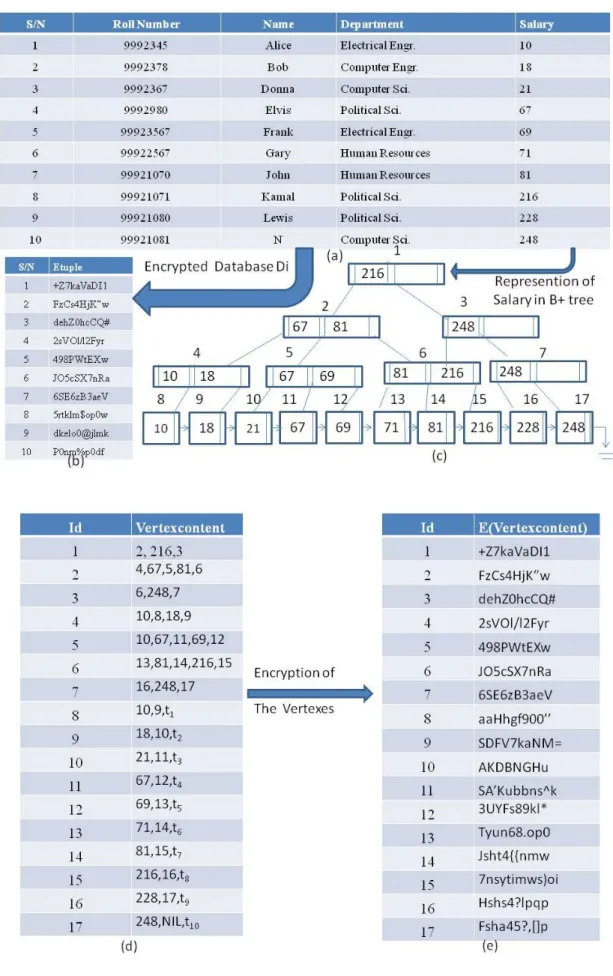
Figure 2 illustrates how this scheme is applied to the employee table (Figure 2 (a))
encrypted (Figure 2 (b)), the B+ tree is built over the most queried attribute of the database
(Figure 2 (c)), it is then represented in a relational table (Figure 2 (d)), encrypted (Figure
2 (e)) and stored along with the encrypted database at the server side.
The advantages of the B+ tree indexing approach [34] are:
It supports confidentially.
It is secure against inference attacks, since the B+ tree content itself is encrypted.
It supports equality queries.
It is order preserving so it can support range queries.
It does not produce spurious tuples.
It allows the evaluation of ORDER-BY and GROUP-BY clauses of SQL queries. The limitations of the B+ tree indexing approach are:
B+ tree indexing is expensive for the client compared to bucket and hash based. Several trips (as many as the levels we have in the B+ tree) between the client and
the server are needed to retrieve the required tuples [8].
Order preservation encryption scheme (OPES)
The idea behind OPES is that unique values are generated from a user specified target
distribution and sorted in a table T. Then the ith plaintext (pi) value in the sorted list of |P| plaintexts is encrypted into the ith value in the sorted list of |P| values obtained from the user’s specified target distribution. This makes the scheme good in preserving the order of the encrypted data and also provides confidentiality. To decrypt any of the ciphertext
a lookup into a reverse map is required [27]. In this case the table T is the encryption key
that must be kept secret.
OPES uses three stages to encrypt a database:
Model Stage
Flatten Stage and
Transform stage. Model stage:
In this stage the input and the target distributions are modeled as piece wise linear splines
using either of the following techniques.
Histogram technique: this technique captures statistical information about the data value distributions using counters for a specified number of data value buckets
[42]
Parametric technique: this technique approximates data value distributions by fitting the parameters of a given type of function (e.g. polynomial of a given
maximum degree) [42].
In [43], the two modeling techniques were used to first of all partition the values
bucket as a linear spline (a linear spline of a bucket is a line connecting the densities at
the two end points of a bucket) using the parametric technique.
Flatten stage:
In this stage the plaintext database P is transformed into a flat database f such that values
in f are uniformly distributed. In cases where a bucket has dense plaintext, the bucket will
be stretched so that the density of the plaintext in the flattened bucket will be uniform.
Transform stage:
In this stage the flattened database is transformed into a cipher database C such that the
values in C are distributed according to the target distribution.
As an example, if we have pi and pj where pi < pj, this will be transformed to fi <
fj in the flatten stage, and finally the flattened buckets will be transformed to a uniformly
distributed cipher database ci < cj. ( i.e. Pi < Pj⇒fi < fj⇒Ci < Cj)
In [44], an order preserving indexing scheme over encrypted data is proposed
based on a simple mathematical expression (av + b + noise). The result of the expression
is made public while the coefficients a and b are the secret keys known only to the data
owner and the client. v is the value to be indexed and noise is randomly chosen from the
range {0, …, a - 1} to preserve the order of the index. One of the limitations of this scheme is that the secret keys a and b are reused throughout the system, which makes the scheme
insecure. Adding noise randomly means that even the same encrypted values may not
have the same noise, which may give false queried information. Another limitation is
when an attacker obtains the ciphertext c1 for plaintext zero (i.e. c1 = b + n1) and ciphertext
c2 for large plaintext k (i.e. c2 = ak + b + n2), then by computing the difference between
noises n1 and n2 are between zero and a (i.e. 0 ≤ n1, n2 < a) then the attacker learns that
the secret a is in the interval 𝐼1 =𝑐2−𝑐1
𝑘+1 ≤ 𝑎 ≤ 𝐼2 =
𝑐2−𝑐1
𝑘−1 [46, 47].
The advantages of the OPES indexing approach are [27]:
It supports the confidentiality service.
It is order preserving.
It produces exact results for the query without any spurious tuples.
It can handle updates, without the need for re-encryption. The limitations of the OPES indexing approach are:
It is vulnerable to tight estimation and statistical attacks [45].
It is vulnerable to chosen plaintext attacks [45].
It does not support availability. Information dispersal algorithms (IDAs)
IDAs were first proposed by Michael O. Rabin in 1989 to protect data sent over the
network or sitting in storage arrays and not to be accessed except by the right user [48].
In IDAs, a file is split into n pieces where a minimum m pieces (n > m) are
required for reconstructing the original file. A transform matrix of n rows and m columns
is used to transform the original file into n pieces [47].
In a salted IDA, confidentiality is achieved by using a modified IDA scheme. A
salted IDA depends on randomness to improve data confidentiality. While it relies on the
original IDA scheme to provide data availability [50].
A transform matrix TM of (n x m) is maintained by the client as the information
determined by the client based on the number of servers that are planned to be used and
the estimated number of non-faulty (available) servers. Also the client keeps a secret ss
(a shared secret between the data owner and client) and a deterministic function fs for
producing random factors (called salts) based on the address of the data entries on D.
Function fs feeds ss and the address of the data entry into a pseudorandom number
generator (PRNG) before encoding and dispersing D onto the servers, for each column i
of D the client calls the PRNG procedure i times, sets the last generated random number
(the output of the ith round) as the salt to each data entry of column i. The data matrix after adding the salt is called a tuple matrix TD. The essence of the generated random
number was to improve the confidentiality of the original IDA.
It is difficult to search for data in an encoded matrix based on plaintext input. To
solve this issue, a B+ tree index was built on the key attribute and kept secured at the
client side. The leaf nodes of the index tree contain pointers to the columns of the tuple
matrix (TD) where the tuple with its key are stored.
The Index matrix (ID) and TD are encoded into IE = (ID × TM) and TE = (TD ×
TM) respectively and then dispersed onto n servers, S1, S2, ..., Sn, by the salted IDA as
shown in Figure 3. Queries on the index key attribute can be efficiently processed by
locating the columns of ID (tree nodes) that store the query keys and then retrieving the
corresponding tuples from the columns of TD.
After decoding the encoded data retrieved from m non-faulty servers, the client
reconstructs the salts by calling fs and then deducts these salts from the decoded data
Figure 3: Framework for dispersing data in a cloud using salts [50]
The advantages of the IDA are [50]:
It provides a confidentiality service.
It supports equality queries.
It is order preserving, and as such it supports range queries.
It supports availability.
It does not produce spurious tuples.
It is secured against statistical analysis of the encrypted data. The limitations of the IDA are [50]:
For every query the whole column where the candidate answer tuple is located has to be retrieved.
It is expensive for the client.
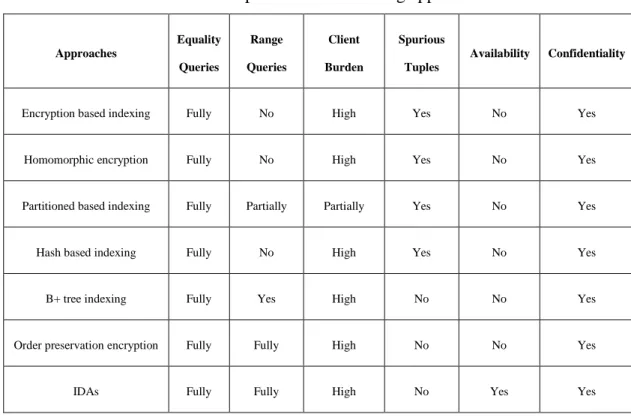
Table 3 compares the reviewed approaches in the literature based on six criteria:
support for equality queries and/or range queries, the cost of performing operations at the
client side, returning spurious tuples, data availability and data confidentiality. It is
obvious that none of the aforementioned approaches are able to adequately address all the
data outsourcing issues. Every approach has some limitations. This motivates us to
Table 3: Comparison of the existing approaches Approaches Equality Queries Range Queries Client Burden Spurious Tuples Availability Confidentiality
Encryption based indexing Fully No High Yes No Yes
Homomorphic encryption Fully No High Yes No Yes
Partitioned based indexing Fully Partially Partially Yes No Yes
Hash based indexing Fully No High Yes No Yes
B+ tree indexing Fully Yes High No No Yes
Order preservation encryption Fully Fully High No No Yes
IDAs Fully Fully High No Yes Yes
A secret sharing scheme using Chinese Remainder Theorem (CRT)
A secret sharing algorithm is one of the prominent techniques widely used in data
outsourcing [3, 15, 29, 55]. It is an ideal scheme for storing sensitive and highly important
information. Traditional encryption methods, as discussed earlier, are not efficient for
achieving a high level of confidentiality and availability at the same time.
The aim of this paper is to explore a secret sharing algorithm based on the Chinese
Reminder Theorem (CRT) to provide data availability, confidentiality and order
preservation for outsourced data.
The secret sharing scheme based on CRT produces shares presented in
congruence equations and the secret can be recovered by solving the system of
congruencies to get a unique solution, which is the original outsourced data. Secret
sharing schemes that are based on CRT are proved by Quisquater et el [49] to be
CRT Theorem:
Suppose that m1, m2, …, mk are pairwise relatively prime positive integers. Then for any
given integers a1, a2, …, ak, the following system of simultaneous congruencies
x ≡ ai (mod mi)for 1 ≤ i ≤ k has a unique solution x modulo the product M = m1…mk. This is given by:
x ≡ a1M1y1 + a2M2y2 + …+ akMkyk(modM) where 𝑀𝑖 = 𝑀
𝑚𝑖 and yi ≡ (Mi)
-1(mod mi)
Asmuth-Bloom threshold scheme
Asmuth-Bloom secret sharing is a threshold scheme that is based on CRT. It was
proposed with the intent of safeguarding a key [34]. In this scheme, a key K is
decomposed into n shares Ii (congruence classes of a number associated with the original
key), in such a way that the key is only recoverable from any r ≤ n of the shares, and no useful information can be recovered from (r - 1) shares.
The value of this scheme depends on the following features [34]:
the efficiency of decomposition and recoverability of the key,
the sensitivity of the method to random error or deliberate tempering,
the relationship between the number of shares (n), the minimum number of shares required to recover the secret (r) and the number of shares that is not enough to
recover the secret (r - 1).
The Asmuth-Bloom threshold scheme consists of two phases [52]:
Environmental formation phase
Environmental formation phase:
This phase consists of two stages:
Initialization stage: In this stage, a set of integers {p, m1, m2, …, mn} are chosen
subject to the following conditions:
m1 < m2 < … < mn
gcd(mi, mj)= 1 for i ≠ j
gcd(p, mi)= 1 for all i
∏ri=1mi > 𝑝 ∏r−1i=1mn−i+1
p > K
Decomposition stage: In this stage, the decomposition process goes as follows:
compute M = ∏𝑟𝑖=1𝑚𝑖
compute the parameter I = K + β.p, where 0 ≤ I < M and β is an arbitrary integer chosen from the range [0,𝑀
𝑃 − 1]
then decompose the Key using Ii ≡ K(mod mi) and share it to the users with the ith user having the Ii share where 1 ≤ i ≤ n
Secret recovery phase:
Suppose we have a system of congruencies Ii ≡ K (mod mi). The secret K can be uniquely recovered using a constructive algorithm as follows [53]:
compute the product of the r primes that are required to recover the secret as M=m1m2…mr
for each prime compute 𝑀𝑖 = 𝑀
𝑚𝑖
αi.mi + γi (M/mi)= 1
Let ei = γi (M / mi) ⇒αi.mi + ei = 1
ei in the above equation guarantees that its remainder when divided by mi must be
1, i.e. ei ≡ 1(mod mi)
Hence, the system of congruencies has one solution that is 𝐾 = ∑𝑟𝑖=0𝐼𝑖𝑒𝑖 based
on CRT. Shares construction in the Asmuth-Bloom secret sharing scheme has a
complexity of Olog(r) [49].
The Asmuth-Bloom scheme can be modified to provide a validity check and a
deliberate tempering of the shares. To make the scheme perform a validity check to the
shares of the key, the second condition of the initialization stage has to be weakened to
allow gcd(mi, mj ) = qij where qij ≠ 1. As an example if Ii and Ij are known and gcd(mi, mj)
= qij, then for the correct shares Ii ≡ Ij (mod qij).
If there is an error in Ii, this will alter its congruencies class modulo all of the qij, therefore the error free shares would be in general agreement with each other and those
in error can be discarded [32].
Direct implementation of Asmuth-Bloom secret sharing schema in data outsourcing
This section proposes a new data outsourcing scheme based on Asmuth-Bloom
threshold secret sharing. It consists of three stages:
Setup:
In this stage the data owner performs the following steps:
choose a set of prime integers {p, m1, m2, …, mn} based on the following conditions:
o p > di : di represents a single attribute value
o m1 < m2 < … < mn, where n is the number of DSP
o gcd(mi, mj) = 1 for i ≠ j
o gcd(p, mj) = 1 for all j
o ∏rj=1mj> 𝑝 ∏r−1j=1mn−j+1
choose a random integer β ϵ [0,𝑀
𝑃 − 1] and compute Ii = di + β.p for each data
value (di) of the attribute to be used as an index for the outsourced database.
Outsourcing:
To distribute the database to multiple DSP servers, the data owner performs the following
step:
compute 𝐼𝑗′ values for each Ii as the following 𝐼𝑗′ ≡ 𝐼𝑖(𝒎𝒐𝒅 𝑚𝑗) and then distribute them to n service providers along with the encrypted database.
The essence of each 𝐼𝑗′ value is to serve as an order-preserving index for the encrypted database outsourced to the jth server.
Retrieving:
To retrieve the outsourced encrypted data, the server uses the modulus as an index to
retrieve the encrypted data and decrypt it at the client side.
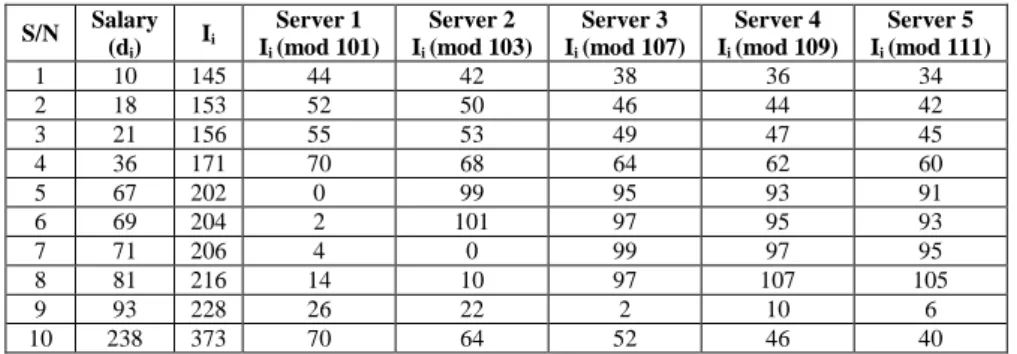
The example below illustrates how this scheme can be used to build an index on
the salary attribute of the employee database (Table 1). Assume the data owner needs to
outsource the database of his/her employees to five different service providers (DSPj).
Let m1=101, m2=103, m3=107, m4=109, m5=111, p=45, β=3.
Then the salary can be shared using 𝐼𝑗′ ≡ 𝐼𝑖(𝒎𝒐𝒅 𝑚𝑗) as shown in Table 4 columns (4-8)
Table 4: Indexes of the employee’s Database to each DSP.
S/N Salary (di) Ii Server 1 Ii (mod 101) Server 2 Ii (mod 103) Server 3 Ii (mod 107) Server 4 Ii (mod 109) Server 5 Ii (mod 111) 1 10 145 44 42 38 36 34 2 18 153 52 50 46 44 42 3 21 156 55 53 49 47 45 4 36 171 70 68 64 62 60 5 67 202 0 99 95 93 91 6 69 204 2 101 97 95 93 7 71 206 4 0 99 97 95 8 81 216 14 10 97 107 105 9 93 228 26 22 2 10 6 10 238 373 70 64 52 46 40
In the previous works, we can see that outsourcing by encrypting the whole data
without building order-preserving indexes is prohibitive in terms of performance and does
not solve the problem of availability. In contrast, ABSS can be used to create n shares
and distribute it to different service providers as shown in Table 4. We can use these
shares as indexes in various DSPs in order to achieve the following advantages:
Partially preserve the order of the outsourced data (when di < p) to support range queries.
Support equality queries.
Reduce the computational cost of encryption.
Reduce the burden of encrypting and decrypting on the client when making a query.
From Figure 4, we can extract the limitations of the direct implementation to this
scheme as follows:
from an employee with id = 1 to that with id = 4, the order of the index was preserved because the salaries are less than the chosen prime p = 45. But when
queries can produce spurious tuples. As an example, employees with id = 4 and
id = 10 have the same index.
By statistical analysis of the outsourced modulus values, an adversary can obtain the primes. For example, in Server 2 and Server 3, the highest moduli numbers
are 101 and 107 respectively before it wraps around. Those values are very close
to (m2 = 103) and (m3 = 109) values.
Figure 4: Index of employees’ database in DSP1.
Due to the issues raised in the direct implementation of ABSS in data outsourcing,
the next section proposed an enhanced data outsourcing model based on ABSS that
mitigates the aforementioned issues of direct implementation.
Enhanced data outsourcing model based on Asmuth-Bloom scheme
In this section, we have enhanced the direct implementation of Asmuth Bloom secret
sharing to counteract its security threats. The enhanced scheme involves the following
stages:
Setup:
In this stage the data owner initializes the data outsourcing environment through the
choose an increasing polynomial function f(di) (a function applied on the attribute values (di)) in which the variable is the attribute values to be outsourced and the
coefficients are secrets to be selected by the data owner and shared with the client.
Without loss of generality let us assume a degree 2 polynomial function of the
following form:
𝑓(𝑑𝑖) = 𝑎𝑑𝑖2+ 𝑏𝑑𝑖1 + 𝑐 𝑤ℎ𝑒𝑟𝑒 𝑎, 𝑏, 𝑐 > 0
The above polynomial equation can have one positive and one negative root as
there is single change of sign (𝑓(𝑑𝑖) − 𝑎𝑑𝑖2− 𝑏𝑑 𝑖
1− 𝑐 = 0) which determines the
number of positive roots that exist [54]. If the outsourced data contains single
signed values (either positive or negative), the client can easily choose the correct
root value when it solves the equation. However, in case the outsourced data
contains both positive and negative values, we need to apply a scaling factor to
make sure all the data values are of the same sign. The scale factor serves as an
additional secret shared between the client and data owner. As an example if the
expected data range is [-10, 25] then we can add a scaling factor ≥ 10 to have a
new range of values that are all positive. If the scaling factor is selected as 10 then
the new range will be [0, 35].
choose a set of prime integers {p, m1, m2, …, mn} such that :
o mj < min(f(di))
o m1 < m2 < … < mn, where n is the number of DSP
o p << m1
o gcd(mi, mj) =1 for i ≠ j
o gcd(p,mj)=1 for all j
choose a random integer β ϵ [0,𝑀
𝑃 − 1] and compute Ii = f(di) + β.p for each
attribute value di, where 𝑀 = ∏rj=1mj
Outsourcing:
To distribute the database to multiple DSP servers, the data owner performs the following
steps:
compute the quotients qi = Ii div mj and the modulus 𝐼𝑗′≡ 𝐼𝑖(𝒎𝒐𝒅 𝑚𝑗) for all the attribute values,
encrypt the modulus 𝐼𝑗′ and store it with the unencrypted quotient qi.
The essence of the introduced polynomial function f is to enhance system security
as the coefficients are extra secrets known only to the data owner and the client. It is also
used to enlarge the data to give a chance of selecting large co-prime integers mj.
The quotient of the data is used as an index to maintain the order of the stored
information at the server side, which will consequently help in supporting spurious-less
range queries. The modulus is encrypted to keep the data secured as (mj)s are selected big
enough to make the quotient alone not sufficient to estimate the actual data.
Selecting large co-primes also helps in enhancing security because it increases the
range that the modulus can take before it wraps around and thus reduces the chance of
the adversary obtaining the modulus even in an unencrypted form.
Retrieving:
To retrieve the outsourced data the client performs the following steps:
retrieve the correspondent tuples from at least r servers (r is the minimum number of servers out of which we can reconstruct the shared data) and decrypt the
retrieved modulus
use the following constructive algorithm to obtain Ii
𝐼𝑖 = ∑ 𝐼𝑗′. 𝑒𝑗
𝑟
𝑗=1
where 𝑒𝑗 = 𝛾𝑗(𝑀
𝑚𝑗) is computed by the Extended Euclidean Algorithm out of αj.mj
+ ei = 1
compute the value Ii in mod∏𝑟𝑗=1𝑚𝑗
subtract the value β.p from Ii to obtain f(di)
solve the polynomial equation to obtain di.
Let us illustrate how the scheme can be applied on the Employees table (Table 1).
Setup:
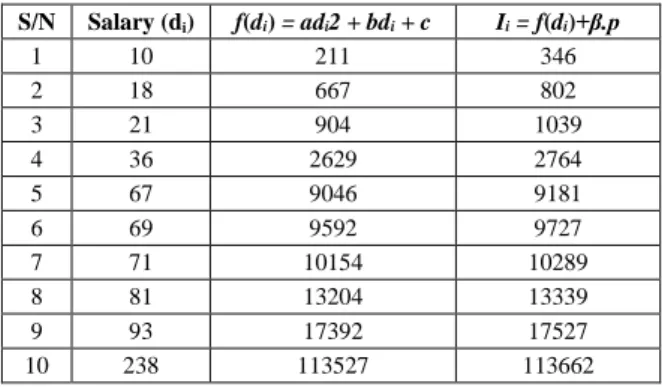
let f(di) = adi2 + bdi + c: the coefficients a=2, b=1 and c=1 as shown in Table 5
let p = 45, m1 =101, m2 = 103, m3 = 107, m4 =109, m5 =111
let β=3
compute Ii = f(di) + β.p for each attribute value di as shown in Table 5
Table 5: Environmental Set up S/N Salary (di) f(di) = adi2 + bdi + c Ii = f(di)+β.p 1 10 211 346 2 18 667 802 3 21 904 1039 4 36 2629 2764 5 67 9046 9181 6 69 9592 9727 7 71 10154 10289 8 81 13204 13339 9 93 17392 17527 10 238 113527 113662
Outsourcing:
compute the quotients qi and modulus for each di
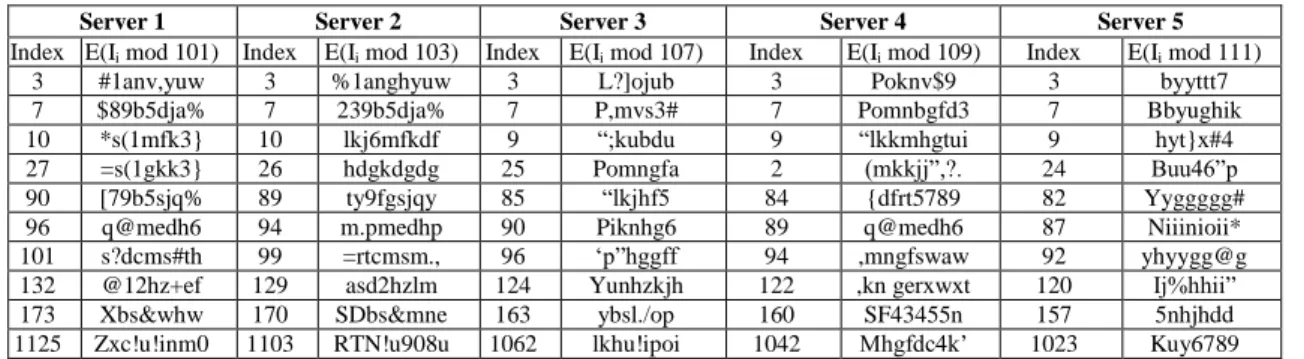
encrypt the modulus and disperse it to the servers as shown in Table 6. Table 6: Indexing scheme using a quotient of the outsourced data
Server 1 Server 2 Server 3 Server 4 Server 5
Index E(Ii mod 101) Index E(Ii mod 103) Index E(Ii mod 107) Index E(Ii mod 109) Index E(Ii mod 111)
3 #1anv,yuw 3 %1anghyuw 3 L?]ojub 3 Poknv$9 3 byyttt7 7 $89b5dja% 7 239b5dja% 7 P,mvs3# 7 Pomnbgfd3 7 Bbyughik 10 *s(1mfk3} 10 lkj6mfkdf 9 “;kubdu 9 “lkkmhgtui 9 hyt}x#4 27 =s(1gkk3} 26 hdgkdgdg 25 Pomngfa 2 (mkkjj”,?. 24 Buu46”p 90 [79b5sjq% 89 ty9fgsjqy 85 “lkjhf5 84 {dfrt5789 82 Yyggggg# 96 q@medh6 94 m.pmedhp 90 Piknhg6 89 q@medh6 87 Niiinioii* 101 s?dcms#th 99 =rtcmsm., 96 ‘p”hggff 94 ,mngfswaw 92 yhyygg@g 132 @12hz+ef 129 asd2hzlm 124 Yunhzkjh 122 ,kn gerxwxt 120 Ij%hhii” 173 Xbs&whw 170 SDbs&mne 163 ybsl./op 160 SF43455n 157 5nhjhdd 1125 Zxc!u!inm0 1103 RTN!u908u 1062 lkhu!ipoi 1042 Mhgfdc4k’ 1023 Kuy6789
Retrieving:
To illustrate how this scheme can be used to retrieve outsourced data from the server, an
example query to Table 6 for the salary d1 = 10 is used.
the client converts the query into an index corresponding to each server. Assume that out of the five servers only Server 1(m1 = 101), Server 2(m2 = 103) and Server
3 (m3 = 107) respond to the request. The client therefore:
retrieves the encrypted moduli and decrypts them,
uses a constructive algorithm to compute I1 = ∑3𝑗=1𝐼𝑗′. 𝑒𝑗 where e1, e2 and e3 are obtained using the Extended Euclidean Algorithm such that:
gcd(m1, (m2 × m3)) = 4583(101) - 42(11021) ⇒e1 = -42(11021)
gcd(m2, (m1 × m3)) = 1364(103) - 13(10807) ⇒e2 = -13(10807)
gcd(m3, (m1 × m2)) = 4764(107) - 49(10403) ⇒e3 = - 49(10403)
this yields I1 = 43.e1 + 37.e2 + 25.e3 = -37845768
I1 = f(d1) + β.p⇒f(d1)= I1 - β.p⇒f(d1)= 346 - 3 × 45 = 211.
solves the equation (2d12 + d1 + 1 = 211) to obtain d1⇒d1 = 10 or d1 = -10.5
Table 7 shows the same criteria as Table 3. It can be seen that the proposed scheme
satisfies all criteria. It is more efficient compared to the previously reviewed ones in that
it can jointly support equality and range queries, guarantees less burden on the client
compared to some of previous approaches such as B+ tree indexing, produces no spurious
tuples and also provides data availability and confidentiality.
Although IDA addresses many of the data outsourcing issues as shown in Table
3, however, the shares of IDA contain part of the original data that can be of use to a third
party [33]. By snooping, an eavesdropper who obtains fewer than the threshold shares
may reconstruct some part of the original data explicitly resulting in partial data leakage
[56]. In contrast, no single share in the proposed approach can reveal information about
the original data. Moreover, IDA places extra burden on the client side since it uses the
B+ tree, which demands a lot of trips between the server and the client. This makes it less
efficient compared to the proposed approach. Thus, the proposed Asmuth-Bloom secret
sharing data outsourcing scheme provides more confidentiality and better performance
when compared to IDA.
Table 7: Analysis parameters of the proposed scheme
Equality Queries Range Queries Client Burden Spurious Tuples Availability Confidentiality
Secure Data Outsourcing
Scheme Based On
Asmuth-Bloom Secret Sharing
Security analysis
This section discusses different attack scenarios that can be launched successfully against
some of the reviewed schemes. Then it shows how the proposed scheme is secured against
such attacks.
Scenario 1:
An attacker succeeds in launching a Denial of Service attack against one or two of the
servers involved in the outsourcing service. He/she cannot cripple the overall system, as
only r out of the n servers are required to retrieve the outsourced data, and not all of them.
Thus, the proposed scheme is secure against a DoS attack to a few of the servers and can
maintain service availability.
Scenario 2:
An internal/external attacker might try to gain knowledge of the secrets (primes) by
launching an inference attack, as the modulus values may expose the range of the secrets.
However, the proposed scheme is secured against such attacks, since the modulus values
are stored encrypted at the server side to preserve the confidentiality of the outsourced
data.
Scenario 3:
An attacker succeeds in obtaining the order-preserved indexes of the outsourced data.
Even so, he/she cannot gain any kind of knowledge about the original outsourced data
since these indexes were obtained as a result of a function applied on the original attribute
values. The coefficients of this function are shared secrets between the data owner and
the client only. Thus, the proposed scheme preserves the order of the outsourced data
Scenario 4:
An adversary might try to obtain the indexes and the modulus values of different tuples
from the same server, or the modulus values of the same tuple from different servers, in
order to form linear equations that can be solved simultaneously so as to reveal the
outsourced data. This kind of attack is not feasible in the proposed scheme as the modulus
values are stored encrypted.
Scenario 5:
If an adversary, in scenario 4, has further succeeded in obtaining the unencrypted modulus
values, he/she is still going to have more unknowns (the outsourced data and the scheme’s
primes) than the number of equations that he/she can form. Therefore, it will be
computationally infeasible to get a deterministic solution.
Conclusion
Data outsourcing is a new paradigm that has gained a high popularity recently but it is
hindered by some security challenges from gaining wide spread acceptance. The security
challenges include: data confidentiality, availability and order preservation of the
outsourced data. Data confidentiality is mostly achieved using a traditional encryption
scheme, but traditional encryption is not good in preserving the order of the outsourced
data, which is an important property that is needed in data outsourcing. Availability is
another issue as the data loss can affect the business of the data owner. Data availability
is usually achieved by duplicating the data and storing it at different servers.
This paper analyses some of the previous work in data outsourcing, and shows the
advantages and limitations of each. It then proposes a secure data outsourcing scheme
based on Asmuth-Bloom secret sharing, which uses congruence classes and the Chinese
implementation of this scheme that consists of three stages: setup, outsourcing and
retrieving. In the setup stage the data owner chooses a set of prime integers known only
to him/her and his/her client; in the data outsourcing stage the data owner outsources the
encrypted attribute values and its modulus, where the modulus is used as an index. In the
retrieving stage the client uses the index to retrieve the encrypted data and decrypt it at
the client side. However, the direct implementation is expensive for the client as it
produces spurious tuples. It is also vulnerable to statistical analysis attacks that can expose
the used secret primes.
Finally, an enhanced scheme is proposed that also consists of three stages. In the
setup stage, an increasing polynomial function is introduced to enlarge the attribute
values. This allows larger co-prime integers to be selected so as to increase the modulus
range before it wraps around, thus reducing the chance of an adversary obtaining the
modulus value even in an unencrypted form. In the outsourcing stage, the data owner
outsources the encrypted modulus and the quotient of the attribute values, to various
servers for availability. The quotient is used as an index to keep the order of the
outsourced encrypted modulus. To retrieve any value, the client retrieves the encrypted
values, decrypts them and constructs the modulus using the CRT constructive algorithm.
The proposed scheme is computationally efficient as it uses simple modular
arithmetic. It is more secure as the index is generated after wrapping the outsourced data
by a polynomial function whose coefficients are kept secret. It also produces no spurious
tuples and provides availability and confidentiality. In addition, it is an order-preserving
scheme, which further reduces the burden of encryption and decryption of every query.
Because of all its properties, the proposed scheme is strongly recommended as an efficient
Acknowledgments
The authors would like to thank Prof. David W Chadwick from the University of Kent
for proof reading this paper.
References
[1] Pope, J. A., Key, K. A., and Saigal, A. 2015. “Nonprofit Outsourcing Patterns: Why Don’t Small NPOs Outsource More?.” Journal of Nonprofit & Public Sector Marketing, 27(1): p. 99-116.
[2] Agrawal, D., El Abbadi, A., Emekci, F., and Metwally, 2009. “A. Database management as a service: Challenges and opportunities.” Paper presented at the IEEE 25th International Conference on Data Engineering ICDE'09, Shanghai, March, 1709-1716.
[3] Li, Q., Wang, Z., Li, W., Li, J., Wang, C. and Du, R. 2013. “Applications integration in a hybrid cloud computing environment: modelling and platform.” Enterprise Information Systems, 7(3): p. 237-271.
[4] Douglas, N. 2007. “Facebook Employees Know Whose Profiles You Look At.” Valleywag, http://gawker.com/315901/facebook-employees-know-what-profiles-you-look-at.
[5] Lucas, M. M., and Borisov, N. 2008. “Flybynight: mitigating the privacy risks of social networking”. Paper presented at the 7th ACM workshop on Privacy in the electronic society, Alexandria, Virginia, USA, October, 1-8.
[6] APUZZO, M. 2013. “What is the problem with prism?.” http://news.yahoo.com/whats-problem-prism-203441280.html.
[7] Bajaj, K. 2014. “Cyberspace: Post-Snowden.” Strategic Analysis, 38(4): p. 582-587.
[8] Damiani, E., Vimercati, S. D. C., Jajodia, S., Paraboschi, S. and Samarati, P. 2003. “Balancing confidentiality and efficiency in untrusted relational DBMSs.” Paper presented at the 10th ACM conference on Computer and communications security, Washington, DC, October, 93-102. [9] Rivest, R. L., Adleman, L., and Dertouzos, M. L. 1978. “On data banks and privacy
homomorphisms.” Foundations of secure computation, 4(11): p. 169-180.
[10] Nirmala, S. J., Bhanu, S. M. S., and Patel, A. A. 2012. “A Comparative study of the secret sharing algorithms for secure data in the cloud.” International Journal on Cloud Computing: Services and Architecture (IJCCSA), 2(4): p. 63-71.
[11] Agrawal, R., Evfimievski, A., and Srikant, R. 2003, “Information sharing across private
databases.” Paper presented at the 2003 ACM SIGMOD international conference on Management of data, San Diego, June, 86-97.
[12] Samarati, P., and Vimercati, S. D. C. 2010. “Data protection in outsourcing scenarios: issues and directions.” Paper presented at the 5th ACM Symposium on Information, Computer and Communications Security, Beijing, April, 1-14.
[13] Wang, C., Ren, K., Yu, S., and Urs, K. M. R. 2012. “Achieving usable and privacy-assured similarity search over outsourced cloud data”. Paper presented at IEEE 2012 INFOCOM, March, 451-459.
[14] Selvam, L., Kumar, P. M., and Renjith, J. A. 2014. “Encryption-Based Secure Sharing of Data with Fine-Grained Access Control in Public Clouds.” Journal of Applied Security Research, 9(2): p. 172-184.
[15] Popa, R. A., Redfield, C. M. S., Zeldovich, N., and Balakrishnan, H. 2011. “CryptDB: protecting confidentiality with encrypted query processing.” Paper presented at the 23rd ACM Symposium on Operating Systems Principles, Cascais, Portugal, October, 85-100.
[16] Stratus Technologies. 2009. “Continuous Uptime for SQL Server: The best way to protect critical databases against downtime and loss.”, http://www.platformmodernization.org/stratus/Lists/news/Attachments/1/Continuous-Uptime-for-SQL-Server.pdf.
[17] Bowers, K. D., Juels, A., and Oprea, A. 2009. “HAIL: a high-availability and integrity layer for cloud storage.” Paper presented at the 16th ACM conference on Computer and communications security, Chicago, November, 187-198.
[18] Shamir, A. 1979. “How to share a secret.” Communications of the ACM, 22(11): p. 612-613. [19] Stadler, M. 1996. “Publicly verifiable secret sharing.” Paper presented at the 15th annual
international conference on Theory and application of cryptographic techniques - EUROCRYPT’96 – LNCS, Berlin, 190-199.
[20] Benaloh, J., and Leichter, J. 1990. “Generalized secret sharing and monotone functions.” Paper presented at the Advances in cryptology – LNCS, California, USA, 27-35.
[21] Chandramowliswaran, N., Srinivasan, S., and Muralikrishna, P. 2015. “Authenticated key distribution using given set of primes for secret sharing.” Systems Science & Control Engineering: An Open Access Journal, 3(1): p. 106-112.
[22] Tassa, T. 2007. “Hierarchical threshold secret sharing.” Journal of Cryptology, 20(2): p. 237-264 [23] Emekci, F., Agrawal, D., and El Abbadi, A. 2005. “Abacus: A distributed middleware for privacy preserving data sharing across private data warehouses.” Paper presented at the ACM/IFIP/USENIX 6th International Middleware Conference, France, November, 21-41. [24] Hore, B., Mehrotra, S., and Tsudik, G. 2004. “A privacy-preserving index for range queries.”
Paper presented at the Thirtieth international conference on Very large data bases, Canada, 720-731.
[25] Hacigümüş, H., Iyer, B., Li C., and Mehrotra, S. 2002. “Executing SQL over encrypted data in the database-service-provider model.” Paper presented at the 2002 ACM SIGMOD international conference on Management of data, Madison, Wisconsin, June, 216-227.
[26] Damiani, E., Vimercati, S. D. C., Foresti, S., Samarati, P., and Viviani, M. 2006. “Measuring inference exposure in outsourced encrypted databases.” Paper presented at Quality of Protection - Advances in Information Security, Springer, Feb, 185-195.
[27] Agrawal, R., Kiernan, J., Srikant, R. and Xu, Y. 2004. “Order preserving encryption for numeric data.” Paper presented at the 2004 ACM SIGMOD international conference on Management of data, Paris, 563-574.
[28] Devmane, M. A., and Rana, N. K. 2012. “Privacy Issues in Online Social Networks.” International Journal of Computer Applications, 41(13): p. 5-8.
[29] Gross, R., and Acquisti, A. 2005. “Information revelation and privacy in online social networks.” Paper presented at the 2005 ACM workshop on Privacy in the electronic society, Alexandria, 71-80.
[30] Luo, W., Xie, Q., and Hengartner, U. 2009. “Facecloak: An architecture for user privacy on social networking sites.” Paper presented at the International Conference on Computational Science and Engineering 2009 - CSE'09, Vancouver, BC, Aug. 26-33.
[31] Auwal, S. I., Faisal, S. I., Yusuf, I. M., Altun, H., Kaiiali, M., and Wazan, A. S. 2013. “Cloud-based online social network.” Paper presented at the 2013 International Conference on Electronics, Computer and Computation (ICECCO), Ankara, Turkey, November. 289-292. [32] Asmuth, C., and John B. 1983. “A modular approach to key safeguarding.” IEEE transactions on
information theory, 30(2): p. 208-210.
[33] Tse, D. W. K., Chen, D., Liu, Q., Wang, F., and Wei, Z. 2014. “Emerging Issues in Cloud Storage Security: Encryption, Key Management, Data Redundancy, Trust Mechanism.” Paper presented at the International Conference of Multidisciplinary Social Networks Research, Kaohsiung, Taiwan, September, 297-310.
[34] Foresti, S. 2010. “Preserving privacy in data outsourcing.” Springer Science & Business Media. [35] Kaosar, M., and Quazi M. 2014. “Privacy-preserving interest group formation in online social
networks (OSNs) using fully homomorphic encryption.” Journal of Information Privacy and Security, 10(1): 44-52.
[36] “Homomorphic Encryption”, https://en.wikipedia.org/wiki/Homomorphic_encryption.
[37] Poosala, V., Haas, P. J., Ioannidis, Y. E. and Shekita, E. J. 1996. “Improved histograms for selectivity estimation of range predicates.” Paper presented at ACM SIGMOD international conference on Management of data, Montreal, Quebec, Canada, June, 294-305.
[38] Mousavi, H., and Zaniolo, C. 2011. “Fast and accurate computation of equi-depth histograms over data streams.” Paper presented at the 14th International Conference on Extending Database Technology, Uppsala, Sweden, 69-80.
[39] B- tree, https://en.wikipedia.org/wiki/B-tree.
[40] Graefe, G. 2012. “A survey of B-tree logging and recovery techniques.” ACM Transactions on Database Systems (TODS), 37(1): 1-35.
[41] Stuntz, C. 2010. “What is Homomorphic Encryption, and Why Should I Care?”, http://blogs.teamb.com/craigstuntz/2010/04/08/38577.
[42] König, A. C., and Weikum, G. 1999. “Combining histograms and parametric curve fitting for feedback-driven query result-size estimation.” Paper presented at the 25th International Conference on Very Large Data Bases, San Francisco, CA, USA, 423-434.
[43] Wang, S., Agrawal, D., and El Abbadi, A. 2012. “Is Homomorphic Encryption the Holy Grail for Database Queries on Encrypted Data?” Technical report, University of California, USA.
[44] Liu, D., and Wang, S. 2012. “Programmable order-preserving secure index for encrypted database query.” Paper presented at the IEEE 5th International Conference on Cloud Computing (CLOUD), June, 502-509.
[45] Kadhem, H., Amagasa, T., and Kitagawa, H. 2010. “An encryption scheme to prevent statistical attacks in the das model.” Paper presented at DEIM Forum.
[46] Popa, R. A., Li, F. H., and Zeldovich, N. 2013. “An ideal-security protocol for order-preserving encoding.” Paper presented at IEEE Symposium on Security and Privacy (SP), May, 463-477. [47] Mar, K. K. 2011. “Secured virtual diffused file system for the cloud.” Paper presented at
International Conference for Internet Technology and Secured Transactions (ICITST), Dec, 116-121.
[48] Tech Target. 2010. “Information Dispersal Algorithms: Data-parsing for network security.”, http://searchnetworking.techtarget.com/Information-dispersal-algorithms-Data-parsing-for-network-security.
[49] Quisquater, M., Preneel, B., and Vandewalle, J. 2002. “On the security of the threshold scheme based on the Chinese remainder theorem.” Paper presented at Public Key Cryptography – LNCS, 199-210.
[50] Wang, S., Agrawal, D., and El Abbadi, A. 2011. “A comprehensive framework for secure query processing on relational data in the cloud.” Paper presented at Secure Data Management - LNCS, 52-69.
[51] Dragan, C. C., and Tiplea, F. L. “On the Asymptotic Idealness of the Asmuth-Bloom Threshold Secret Sharing Scheme.” International Journal on Designs, Codes and Cryptography, submitted for publication in 2013.
[52] Kuo, W. C., Fu, C. J., and Laih, C. S. 2006. “Design a Secure and Practical Metering Scheme.” Paper presented at the International Conference on Internet Computing, 443-447.
[53] Secret sharing using the Chinese remainder theorem, https://en.wikipedia.org/wiki/Secret_sharing_using_the_Chinese_remainder_theorem.
[54] MATHs is FUN advanced, “Polynomials: The Rule of Signs.”, http://www.mathsisfun.com/algebra/polynomials-rule-signs.html.
[55] Maohua, S., Shoushan, L., Lei, P., Zhe, J., and Yang, X. 2012. “Research on Secret Sharing and Privacy-preserving Secret Sharing with SMC.” International Journal of Advancements in Computing Technology, 4(4): 115-123.
[56] Li, M. 2013. “On the confidentiality of information dispersal algorithms and their erasure codes.” Journal of Computing Research Repository - arXiv:1206.4123.
![Figure 3: Framework for dispersing data in a cloud using salts [50]](https://thumb-us.123doks.com/thumbv2/123dok_us/9960535.2488518/21.892.272.675.104.345/figure-framework-dispersing-data-cloud-using-salts.webp)