SCALABLE TECHNIQUES FOR ANOMALY DETECTION
A Dissertation by
SANDEEP YADAV
Submitted to the Office of Graduate Studies of Texas A&M University
in partial fulfillment of the requirements for the degree of DOCTOR OF PHILOSOPHY
Approved by:
Co-Chairs of Committee, Narasimha Reddy Riccardo Bettati Committee Members, Dmitri Loguinov
Radu Stoleru Head of Department, Hank Walker
December 2012
Major Subject: Computer Engineering Copyright 2012 Sandeep Yadav
ABSTRACT
Computer networks are constantly being attacked by malicious entities for various reasons. Network based attacks include but are not limited to, Distributed Denial of Service (DDoS), DNS based attacks, Cross-site Scripting (XSS) etc. Such attacks have exploited either the network protocol or the end-host software vulnerabilities for perpetration. Cur-rent network traffic analysis techniques employed for detection and/or prevention of these anomalies suffer from significant delay or have only limited scalability because of their huge resource requirements. This dissertation proposes more scalable techniques for net-work anomaly detection.
We propose using DNS analysis for detecting a wide variety of network anomalies. The use of DNS is motivated by the fact that DNS traffic comprises only 2-3% of total net-work traffic reducing the burden on anomaly detection resources. Our motivation addition-ally follows from the observation that almost any Internet activity (legitimate or otherwise) is marked by the use of DNS. We propose several techniques for DNS traffic analysis to distinguish anomalous DNS traffic patterns which in turn identify different categories of network attacks.
First, we present MiND, a system to detect misdirected DNS packets arising due to poisoned name server records or due to local infections such as caused by worms like DNSChanger. MiND validates misdirected DNS packets using an externally collected database of authoritative name servers for second or third-level domains. We deploy this tool at the edge of a university campus network for evaluation.
Secondly, we focus on domain-fluxing botnet detection by exploiting the high entropy inherent in the set of domains used for locating the Command and Control (C&C) server. We apply three metrics namely the Kullback-Leibler divergence, the Jaccard Index, and the Edit distance, to different groups of domain names present in Tier-1 ISP DNS traces
obtained from South Asia and South America. Our evaluation successfully detects existing domain-fluxing botnets such as Conficker and also recognizes new botnets. We extend this approach by utilizing DNS failures to improve the latency of detection. Alternatively, we propose a system which uses temporal and entropy-based correlation between successful and failed DNS queries, for fluxing botnet detection.
We also present an approach which computes the reputation of domains in a bipar-tite graph of hosts within a network, and the domains accessed by them. The inference technique utilizes belief propagation, an approximation algorithm for marginal probability estimation. The computation of reputation scores is seeded through a small fraction of do-mains found in black and white lists. An application of this technique, on an HTTP-proxy dataset from a large enterprise, shows a high detection rate with low false positive rates.
To my mother,
my father, and my little sister.
ACKNOWLEDGMENTS
This is to thank Dr. Narasimha Reddy for his unwavering support during this stint. It is only through his inexhaustible patience, brilliant intellectual support, and careful advis-ing that I have been able to reach this step.
I would also express my thanks to my parents for their support, and my sister who has been an inspiration as always.
I am grateful to Soups Ranjan who has been an incredible mentor and someone from whom I have learned a lot, and to Ashwath Reddy for being a fantastic friend and peer.
My committee has also been pivotal in steering my work and this is to thank Dr. Bet-tati, Dr. Loguinov, and Dr. Stoleru. My mentors and friends at Hewlett-Packard labs have also been greatly helpful in shaping my work and thoughts and inputs are really appreci-ated. This is to thank Pratyusa, Bill, Prasad, Stuart, and Raj.
I have also had the pleasure of sharing my office and thoughts with guys who are more like friends than officemates. Thank you Hang Su, Navid, and Sanghwan. I would also like to thank Carolyn for her support at all times.
Last but not the least, I would like to thank all my colleagues, teachers, mentors, room-mates, and friends, who have in some way touched my life and shaped this dissertation. I am indebted to them.
TABLE OF CONTENTS
CHAPTER Page
I INTRODUCTION . . . 1
A. Motivation . . . 1
B. Domain Naming System . . . 6
II MIND: MISDIRECTED DNS PACKET DETECTOR . . . 10
A. Introduction . . . 10
B. Related Work . . . 12
C. Threat Model . . . 14
D. The MiND System . . . 15
1. Name Server Database Feasibility . . . 16
2. MiND Query Verification . . . 17
3. Collecting the Name Server Database . . . 20
a. Database Authenticity and Completeness . . . 22
4. Security Implications . . . 23
E. Results . . . 24
1. System Requirements . . . 24
2. Performance Analysis . . . 25
3. Latency of Query Verification . . . 27
4. Interesting Observations . . . 27
5. Highly Dynamic Name Servers . . . 29
6. Determining False Negatives . . . 29
7. Effect of Resolver Cache . . . 30
III DETECTING ALGORITHMICALLY GENERATED MALICIOUS DOMAIN NAMES . . . 31 A. Introduction . . . 31 B. Related Work . . . 34 C. Detection Metrics . . . 36 1. Data Sets . . . 36 2. Motivation . . . 37
3. Metrics for Anomaly Detection . . . 39
a. Measuring K-L Divergence with Unigrams . . . 39
c. Using Jaccard Index between Bigrams . . . 40
d. Edit Distance . . . 42
D. Grouping Domain Names . . . 43
1. Per-domain Analysis . . . 44 2. Per-IP Analysis . . . 44 3. Component Analysis . . . 45 E. Results . . . 46 1. Per-domain Analysis . . . 46 a. Data Set . . . 46
b. K-L Divergence with Unigram Distribution . . . 48
c. K-L Divergence with Bigram Distribution . . . 49
d. Jaccard Measure of Bigrams . . . 49
e. Edit Distance of Domain Labels . . . 49
f. Kwyjibo Domain Label Analysis . . . 50
g. Progressive Demarcation . . . 51
2. Per-IP Analysis . . . 52
a. Data Set . . . 52
3. Summary . . . 54
F. Detection via Supervised Learning . . . 55
1. L1-regularized Linear Regression . . . 56
2. Results . . . 57
G. Discussion . . . 60
1. Usefulness of Component Analysis . . . 60
2. Complexity of Various Measures . . . 61
H. Proof of K-L divergence as being the Optimal Classifier . . . . 63
IV WINNING WITH DNS FAILURES: STRATEGIES FOR FASTER BOTNET DETECTION . . . 66
A. Introduction . . . 66
B. Related Work . . . 69
C. Methodology . . . 69
1. Filtering Steps . . . 72
a. Degree of an IP address (Dcncip): . . . 73
b. Correlation Metric (Corrcncip): . . . 74
c. Succeeding Domain Set Entropy (SENcncip): . . . . 75
d. Failing Domain Set Entropy (F ENcncip): . . . 76
2. Correlating Failures for Improved Latency . . . 78
1. Data Sets . . . 80
2. Latency Comparison . . . 81
3. Effect of the Correlation Parameter . . . 83
4. Correlation vs Number of DNS Failures . . . 84
5. Variation in Entropy . . . 84
6. Size of Time Bin . . . 85
E. Discussion . . . 86
V INFERENCE MALFEASANCE THROUGH BIG DATA ANALYSIS 88 A. Introduction . . . 88
B. The Belief Propagation Algorithm . . . 90
C. Methodology . . . 92
1. Data Sets and Ground Truth . . . 92
2. Overview . . . 93
3. Composing the Bipartite Graph . . . 94
4. Anomaly Detection with BP . . . 96
D. Evaluation . . . 98
1. Analyzing HTTP Dataset . . . 98
a. Performance . . . 98
b. Sensitivity to Priors . . . 99
c. Sensitivity to Edge Potentials . . . 101
d. Analysis of Labelled Domains . . . 102
e. Impact of Graph Modification . . . 104
f. Qualitative Analysis of Assigned Labels . . . 105
2. Analyzing Campus DNS Dataset . . . 106
E. Reinforcing Detection via Qualitative Learning . . . 108
F. Discussion . . . 111
G. Related Work . . . 113
VI CONCLUSION AND FUTURE WORK . . . 116
LIST OF TABLES
TABLE Page
I MiND performance . . . 25
II Different types of component classes . . . 55
III Summary of interesting networks discovered through component analysis 55 IV Domain names used by bots . . . 56
V Computational complexity of detection metrics . . . 62
VI Trace description. . . 79
VII Impact of changing time bin size on botnet detection . . . 85
VIII A sample edge potential matrix (ψ1) . . . 97
IX Another edge potential matrix (ψ2) . . . 97
X Distribution of domains from designated malicious and benign lists into various categories. We consider only the ones with high confi-dence (≥23). . . 103
XI Manual validation of 100 random domains (with absent WoT scores) from themaldomlist. . . 104
XII Manual validation of 100 random domains (with absent WoT scores) from thebendomlist. . . 104
LIST OF FIGURES
FIGURE Page
1 How DNS works. . . 7
2 DNS cache poisoning scenario. . . 14
3 Cumulative Distribution Function (CDF) of TTL values for A, NS, and A of name server records. . . 15
4 MiND flowchart.. . . 16
5 MiND query verifying data structure. . . 17
6 Sample line from a name server database file. . . 21
7 (a) Latency of verification. (b) Cache hit ratios for a week long dataset.. . 26
8 Probability distributions of malicious and non-malicious domains . . . . 38
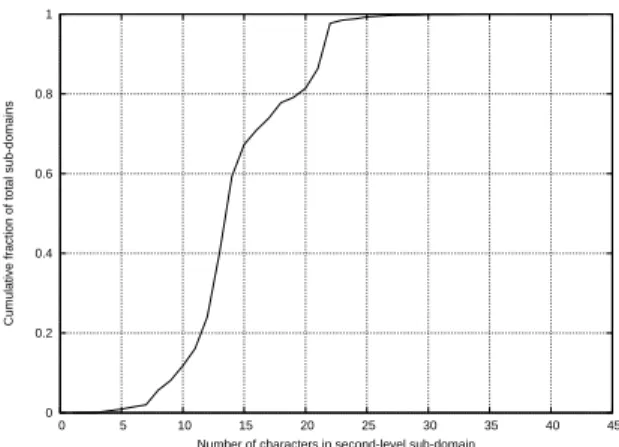
9 CDF of domain label sizes for DNS PTR dataset. . . 42
10 ROC curves for Per-domain analysis (K-L metric’s unigram and bi-gram evaluation) . . . 47
11 ROC curves for Per-domain analysis (Jaccard Index and Edit Distance evaluation) . . . 48
12 (a) ROC curve : K-L metric with unigram distribution (Kwyjibo). (b) Scatter plot with Jaccard Index for bigrams (500 test words). . . 50
13 Illustrating benefits of progressive demarcation with JI measure. . . 51
14 Sample set of queries seen from an infected host within the AS. . . 67
15 Filtering steps . . . 70
16 Latency comparison (a) for different number of domain names. (b) for 200 domain names. . . 81
17 (a) ROC curve for changing correlation thresholds. (b) Correlation
comparison for changing flux behavior. . . 82 18 Performance with changing entropy thresholds . . . 85 19 Sample Host⇋Domain bipartite graph containing nodes with a
black-listed (malicious.com), a white-black-listed (benign.com), and an unknown
(unknown.com) domain. . . . 93 20 Flow chart for reputation inference. . . 96 21 (a) ROC curve for a typical experiment with priors for unknown nodes
as 0.5, and the edge potential as in Table VIII. Initial iterations are in blue while the converging iteration is in red. The straight line is the 0th iteration (no reputations assigned). (b) ROC comparing the perfor-mance of using constant priors vs. sigmoid priors. Perforperfor-mance with
constant prior is similar to sigmoid, but takes twice as many iterations. . 100 22 Analyzing the separation of labelled domains.. . . 105 23 Performance comparison of our approach on different datasets. . . 107 24 Reinforcing ground truth with labelled domains. This figure measures
the performance when adding domains qualitatively. . . 108 25 (a) Qualitative comparison of labelled domains for ground truth
up-dates with 100 and 1000 domains. (b) Randomly chosen domains with high/low degrees are compared with domains classified by our
CHAPTER I
INTRODUCTION A. Motivation
Networks around the world are subject to constant barrage of attacks that exploit either the end host (victim’s) application or network protocol vulnerabilities. While attacks exploiting host software vulnerabilities include DNS misdirection, XSS (Cross Site Scripting) based attacks, malware infections for click-jacking, botnet expansion, etc., network attacks such as Denial of Service (DoS) or Distributed Denial of Service (DDoS), Domain Name System (DNS) cache poisoning, DNS amplification, etc., belong to the latter category. In particular, the botnet based attacks have seen a surge in activity in the recent past, where several thousand bots coordinate from different parts of the world to achieve a considerable scale for malicious activities such as for spamming, phishing, or DDoS attacks.
Identifying infected hosts or malicious network traffic is imperative for protecting user information such as passwords, credit card details, other confidential information, or for prevention of previously mentioned attacks. Many of the attacks require communication with external rogue entities. For instance, bots (machines infected with malware) commu-nicate with a Command and Control (C&C) server either for retrieving instructions or for transferring the data stolen from victims. These communication patterns, if distinguish-able from legitimate network traffic, can potentially lead to the detection of infected bots and the C&C servers coordinating the bots. In this work, we focus on developing several mechanisms which exploit or mine such differences for anomaly detection.
Previous approaches for such anomaly detection have deployed blacklisting mecha-nisms, honeypot/honeynet systems, or perform complete network traffic analysis. In the context of botnet detection, blacklist based solutions offer information about IP addresses
acting as bots spewing spam, or the addresses of C&C servers herding the botnets. In addi-tion, domain names which help locate the commonly observed rogue hosts (servers in most cases) may also be present in the blacklist. Using blacklists, however, incurs significant delay in terms of identifying the corresponding rogue domain name or IP address, and for establishing ample community confidence for blacklisting.
A honeypot system refers to the deliberate infection of a pristine user system such that the installed malware assumes its presence on a regular system. The infected system is generally a virtual machine with controlled network access to avoid the spread of malware within the network. Honeypots help understand the mode of operation of malware so that signatures expressing this behavior can be developed for future detection. Once the analysis using a honeypot is complete, the infected system image is erased or reset. While effective in the recent past, honeypot systems require significant manual work for setting up virtual machines. Such a solution additionally suffers from the drawback of malware being able to recognize its presence within a virtual machine (VM) rendering the honeypot system inef-fective. The virtual machines are identified when malware searches for memory footprints or configuration specific registry entries at pre-determined locations. Malware can stop propagating itself to such VM-based honeypots in order to evade detection. At present, security researchers discover at least 1000 malware samples equipped with VM-detection capability every week [1].
Approaches which look at the complete network traffic include techniques which uti-lize machine learning or correlation techniques for anomaly detection [2, 3]. Such an ap-proach suffers from the problem of scalability as a reliable analysis requires considerable resources even for small-sized networks (such as a university campus). Counter strategies to complete network traffic analysis have explored network sampling where only a fraction of the traffic is analyzed. Sampling based methods, however, result in many false negatives due to missed communication traffic which translates to a low reliability [4].
To ensure network protection while overcoming drawbacks of previous approaches, we propose analyzing DNS traffic for anomaly detection. The analysis of DNS traffic is motivated by the following. DNS comprises of only about 2-3% of the total network traffic. While there are several communication protocols available for use, malware uses the DNS for initiating any type of communication with an external malicious actor. Note that the alternative use of hard-coded rogue server IP addresses is antiquated and easily detectable through reverse engineering or controlled network analysis. The use of DNS, thus, provides footprints of anomalous communication which may then be identified through statistical techniques as proposed in this work. In addition, the protocol specific information that needs to be analyzed is relatively less compared to other application layer protocols such as HTTP, SMTP, etc. Therefore, we develop techniques utilizing DNS for detection and subsequent prevention of a wide variety of anomalies.
First, we present MiND, a tool to detect DNS packet indirection attacks within an au-tonomous system (AS) which arise due to infections caused by malware such as DNSChanger [5]. MiND uses a name server database to detect misdirected DNS queries by examining only the network layer information. The name server database uses publicly available DNS PTR and NS records to populate itself. The validity and authenticity of name server in-formation is ensured through continuous updates. Using our tool, we detect the presence of malicious misdirections within our autonomous system with a performance that results in a false positive rate of less than 0.8%, with improved query verification latency when compared to prior solutions. We deploy MiND as an online analysis tool without requiring significant infrastructure upgrade or coordination from different entities.
Our second work focusses on the detection of domain fluxing botnets. A botnet refers to a network of compromised hosts (or bots) which communicate with a C&C server for instructions. The C&C server instructs the bot to either spam a list of email addresses, steal victim’s private data, or assist in launching a DDoS attack. The botnets are of mainly
two types viz. Peer-to-Peer based botnets or Central Command and Control based botnets. The difference lies in that the server (disemminating instructions) does not have a fixed location in the P2P architecture. Centralized C&C servers allow for an easier control but several approaches have been proposed to detect them. As a consequence, recent botnets have employed evasion methodologies that include frequently changing the IP address of the C&C server (also called IP fluxing) and more recently, frequently changing the domain names which resolve to the C&C server (called Domain fluxing).
Recent Botnets such as Conficker, Kraken and Torpig have used DNS based “domain fluxing” for command-and-control, where each bot queries for existence of a series of do-main names and the owner has to register only one such dodo-main name. From the point of view of a botnet owner, the economics work out quite well. They only have to register one or a few domains out of the several domains that each bot would query every day. Whereas, security vendors would have to pre-register all the domains that a bot queries every day, even before the botnet owner registers them, to thwart the communication between the bot and the C&C server. In all the cases above, the security vendors had to reverse engineer the bot executable to derive the exact algorithm being used for generating domain names. In some cases, their algorithm would predict domains successfully until the botnet owner would patch all the bots with a re-purposed executable with a different domain generation algorithm [6].
In the second part of this work, we develop a methodology to detect such “domain fluxes” in DNS traffic by looking for patterns inherent to domain names that are generated algorithmically, in contrast to those generated by humans. In particular, we look at distribu-tion of alphanumeric characters as well as bigrams in the domain names at different levels. We present and compare the performance of several metrics, including K-L distance, Edit distance and Jaccard measure, for distinguishing algorithmic generated names from human generated names. We train by using a good data set of domains obtained via a crawl of
domains mapped to all IPv4 address space and modeling bad data sets based on behaviors seen so far and expected. We apply our methodology to packet traces collected at a Tier-1 ISP and show that we can automatically detect domain fluxing as used by Conficker and other botnets with minimal false positives.
Botnets such as Conficker and Torpig utilize domain names with high alphanumeric entropy for fluxing and evasion. Bots may query a large number of domains, some of which may fail. In this extension of our fluxing botnet detection approach, we present techniques where the failed domain queries (NXDOMAIN) may be utilized for: (i) Speeding up the detection strategies which rely only on successful DNS queries. (ii) Detecting Command and Control (C&C) server addresses through features such as temporal correlation and information entropy of domain names of both successful and failed DNS queries. We apply our technique to a Tier-1 ISP dataset obtained from South Asia, and a campus DNS trace to validate our methods, detecting Conficker botnet IPs and other anomalies with false positive rates as low as 0.02%. Our technique can be applied at the edge of an autonomous system for real-time detection of fluxing botnets.
In the last part of this dissertation, we attempt to identify a wider variety of anoma-lies through graph inference techniques. Malware infections within a network are spawned and spread primarily through domains accessed by network clients. Thus, containment of infected hosts and prevention of access to malicious domains is critical for every network. Reliably identifying infected hosts and malicious domains, however, is challenging. Mod-ern malware such as rootkits may evade anti-virus products and other host-based analysis techniques. Similarly, identification via network and communication traffic analysis is dif-ficult as botnet communication by design tries to mimic legitimate applications [3]. Many enterprises use blacklists to identify and prevent malicious domain accesses; such lists, however, incur a significant delay in adding new domains as they rely on several manual sources. Machine learning techniques, on the other hand, require large feature data sets
and labeled training sets [7, 8]. There is a need to develop techniques that can function with limited or small data sets in characterizing the observed network behavior to detect anomalies.
We propose an approach to infer the reputation of a domain or a host as being mali-cious (or benign) using a limited amount of already known information about hosts within the network, and about the domains that the hosts access. To apply our approach, we first construct bipartite graphs of hosts and domains from the HTTP-proxy dataset of a huge enterprise network, and also from a campus DNS recursive resolver dataset. We apply the belief propagation algorithm for marginal probability estimation, on the bipartite graph seeded with the small ground truth. We evaluate our approach using K-fold cross validation and also by verification against multiple external sources and validation parameters. Our results on the two datasets show that application of our technique gives high detection rate with low false positive rates and low false discovery rates. Consequently, our approach can be applied passively at the edge of an autonomous system for real-time detection.
B. Domain Naming System
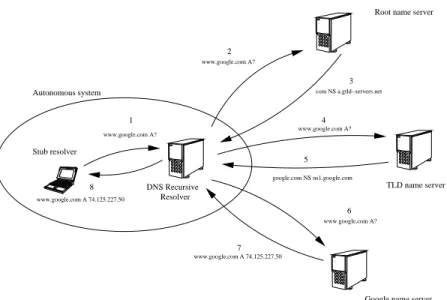
Figure 1 shows how the naming system works. The DNS hierarchy consists of a tree of domains or zones. The root node (denoted by “.”) is at the top. The next level has the well known domain names called top-level domains. For instance, in a domain name such as www.google.com., “com” is a top-level domain (TLD). Different levels of domain names are separated by a period. In the DNS hierarchy, subsequent domain labels (such as google) are the children of the TLD node, and so on.
The local recursive resolver traverses the DNS hierarchy to resolve a domain name query. For instance, if a user wishes to find the IP address for www.google.com, the client machine (also known as the stub resolver) will pass this query to the recursive name server
Primergy
Primergy
Primergy
Primergy
Root name server
TLD name server
Google name server Stub resolver com NS a.gtld−servers.net google.com NS ns1.google.com www.google.com A? www.google.com A? www.google.com A? www.google.com A? DNS Recursive Resolver www.google.com A 74.125.227.50 1 2 3 4 5 6 8 www.google.com A 74.125.227.50 7 Autonomous system
Fig. 1. How DNS works
configured to provide answers to DNS queries (step 1 in the figure). Assuming that no information is cached already, the recursive name server contacts the root name server asking for the address of www.google.com. The root name server refers the query to com name servers which in turn refers the query to google.com name servers, which reply with the required answer. Note that the stub resolver issued a recursive DNS query to the local recursive DNS server, which retrieves the answer from the web iteratively by reaching out to the necessary name servers on the Internet.
The name servers responsible for answering the all DNS queries belonging to a do-main, are considered to be authoritative for that domain name. For instance, queries such as mail.google.com, plus.google.com, etc., are answered with fresh information from the authoritative name servers such as ns1.google.com. This information may have already been cached and it is up to the end user to use cached data or authoritative data. The DNS response indicates whether the reply was sent from an authoritative name server, by setting an AA bit in the DNS response packet.
serves a small subnetwork. The stub resolvers within the subnet are configured to issue their DNS queries to the aggregator. The aggregator on receiving queries, does not iteratively resolve the queries, as a normal recursive server would. Instead, the aggregator acts like a stub resolver and forwards the query recursively to another DNS recursive server which resolves the query, and provides the answer back to the aggregator which then forwards it to the respective stub resolver.
DNS information propagates in units called DNS Resource Records (RRs). The RRs may indicate IP address of the host name asked (A record), the host name for an IP ad-dress (reverse mapping using a PTR record), the name servers for the queried domain (NS records), and more. Various techniques proposed in the chapters ahead look either at the domain names of various DNS RRs or look at the corresponding value for the type of RR. For instance, for type A records, we look at the IP address, for PTR record, we use the corresponding domain name again. It is important to note the terminology we use in the chapters ahead. For a host-name such as abc.examplesite.org, we consider org as the TLD or a first-level domain, examplesite as the second-level domain label, exam-plesite.org as second-level domain. Similarly, abc denotes third-level domain label and abc.examplesite.org is the third-level domain and a sub-domain of examplesite.org.
In context of various DNS based attacks, cache poisoning attempts to pollute the huge cache of DNS recursive resolvers which serve stub resolvers within the autonomous sys-tem. Poisoning of DNS records results in modification of the RRs such that the informa-tion a RR represents is rogue. For instance, attackers can poison DNS type A record for www.citibank.com where the true IP address of the web server is now replaced by the IP address of a rogue server with a website resembling the original website. As a result, when a stub resolver queries for the affected domain, the user will be tricked into accessing the rogue website with possibly losing their confidential information to attackers. Our work fo-cuses on identifying poisoned NS records and also DNS packets transmitted to rogue DNS
servers rather than the local recursive server. In addition, we focus on characteristics of the domain name queried by the stub resolver for detecting botnets or malicious domain/URL access.
CHAPTER II
MIND: MISDIRECTED DNS PACKET DETECTOR A. Introduction
Domain Naming System (DNS) forms one of the most critical network infrastructure com-ponents in the Internet. Recently it has become increasingly vulnerable to exploits and attacks. Various types of attacks have been launched on or using the local DNS recursive resolvers of victim networks as well as authoritative name servers of various domains [9]. These include reflection attacks, amplification attacks, Denial of Service (DoS), Distributed Denial of Service (DDoS), cache poisoning, indirection and many more. Cache poisoning and indirection attacks, in particular, have seen a surge in the recent past. These attacks expose users to malicious entities eager to mine confidential user information. In this chap-ter, we present a detection and prevention mechanism for attacks based on indirection and poisoned NS records.
DNS cache poisoning refers to the replacement of valid answer/authority/additional resource records (RRs) with malformed content. Cache poisoning attack requires the at-tacker to guess the 16-bit TXID, the transaction ID used to identify a DNS packet and match the response to the query issued by a recursive server. Guessing the correct ID makes the recursive resolver accept a corrupted packet, thereby serving malicious information to its clients. However, randomization of DNS and IP layer features of the network packet makes poisoning somewhat difficult.
Indirection attack, however, refers to a stealthy change in the DNS resolver address on a stub resolver. The change in the DNS resolver address directs all recursive DNS queries to a malicious resolver. The malicious resolver then provides the victim with false domain information, subsequently leading to the victim’s confidential data being compromised.
Indirection can be achieved by malware installation, as done by the notorious DNSChanger worm [10].
Many solutions are proposed to counter DNS cache poisoning and indirection. How-ever, most have not been widely adopted. For instance, DNSSEC [11–13] provides authen-ticity of DNS data using cryptographic techniques. However, it still awaits deployment ow-ing to requirements of large infrastructural changes. Similarly, DJBDNS overcomes many of BIND’s shortcomings but is yet to see a notable deployment. Changes adaptable to ex-isting systems, however, enjoy ready adoption. For instance, DNS Black Lists(DNSBLs) have been used to counter email spam. Therefore, it becomes essential that we design techniques that can co-exist with present systems. Hence, we propose MiND (Misdirected dNs packet Detector), an easily deployable technique that provides counter-threat measures without any changes to the existing DNS infrastructure. Our technique provides domain specific security without requiring cooperation from other network entities.
MiND is used to counter the threat posed by DNS packet indirection arising due to poisoned NS records present in the recursive resolver cache, or due to malware induced modifications of system’s resolver settings. We implicitly verify the validity of all types of DNS records by ensuring the validity of their destination address. Our tool uses a self accumulated database of name servers, which continuously updates itself. To obtain a DNS record, the local recursive resolver should be able to resolve such a query by sending itera-tive queries to root name servers, the Top Level Domain (TLD) name servers and ultimately the domain’s name servers respectively. If however, we find a DNS query directed towards IP addresses other than the valid name servers (with respect to the queried domain), the query is considered as an anomaly. We obtain the valid name server information using the publicly available authoritative PTR/NS records. To counter the dynamic nature of the valid set of name servers for a domain, we also consider Time-to-Live(TTL) of DNS name server records when validating DNS queries. Expired records are updated and hence used
for query verification. We show that such a simple validation is effective in determining misdirected DNS packets originating from within the network. To the best of our knowl-edge, we are the first to collect the name server information by executing a light-weight crawl of the IPv4 address space, and using it for DNS packet validation.
The main contributions of this chapter are:
• We propose MiND, a counter-measure to DNS indirection and cache poisoning at-tacks, that is readily deployable.
• We demonstrate the quick building of a name server database, which helps us asso-ciate a given domain name to a specific set of domain authoritative name servers.
• Demonstrate that MiND indeed makes it difficult for the attacker to compromise various recursive DNS resolvers as well as stub resolvers (ordinary hosts).
With a low false positive rate and moderate hardware and software requirements, we show that MiND can be used to effectively protect a network from DNS based attacks.
B. Related Work
In this section, we review prior solutions proposed to counter DNS cache poisoning and indirection. We also review known attack techniques and briefly cover the literature that has helped build our system.
Dagon et al. [9] describe and define the problem of DNS cache poisoning and indi-rection. The authors in [14] use 0x20-bit encoding scheme to encode the question sec-tion within the DNS packet and hence counter DNS cache poisoning. The 0x20 encoding scheme changes cases of letters in a domain name based on the key unique to the resolver. The resolution software is expected to reply with the same cased letters as originally re-quested, increasing the difficulty for the attacker as she has to guess more entities (case
letters, TXID) with respect to the packet, within the round trip time of a DNS reply. WSEC-DNS [15] utilizes the wild card capability of CNAME records to increase cache poisoning difficulty significantly. Yuan et al. [16] propose using a peer-to-peer system to counter DNS cache poisoning. Our work makes cache poisoning of NS records highly difficult, with reduced latency. Additionally, we are able to handle DNS packet indirection arising from stub resolvers within our network.
Delays between various hosts and DNS servers are measured in [17]. These delay measurements help in outlining timeout requirements of various dependent applications. These results guide our work as explained later in this chapter. DNS TXID and port randomization [18] are two of the most prevalent techniques for preventing cache poi-soning. However, with the advent of Kaminsky attack, the said measures have become obsolete [19].
The Kaminsky attack coaxes the stub resolver to query for sub-domains of the victim domain name. To achieve poisoning, the attacker attempts to guess the randomized packet parameters. The stub resolver is forced to query other sub-domains of the victim domain without waiting for TTL expiry. In most cases, Kaminsky attack has been shown to poison DNS resolver caches in a matter of seconds. Our method is independent of the technique used to poison, and hence can immediately detect and isolate suspicious poisoned records. The employment of a secondary cache of expired DNS records is proposed to miti-gate the effects of DoS attacks on DNS infrastructure [20]. Our approach also employs a secondary cache or a database for DNS records, but our approach is focused on detecting anomalous DNS resolutions in real-time and the information cached by our tool is only a subset of that proposed in [20].
Primergy Primergy
Google’s name server (TXID : 0x4a95) www.google.com A 6.6.6.6 DNS reply (TXID : 0x0001) Attacker Stub resolver www.google.com A ? DNS Query DNS Query www.google.com A ? (TXID : 0xa538) Recursive DNS resolver DNS reply (TXID : 0x0001) DNS reply (TXID : 0x0001) DNS reply (TXID : 0x0001) TXID: 0x0002 TXID : 0x0003
Fig. 2. DNS cache poisoning scenario. C. Threat Model
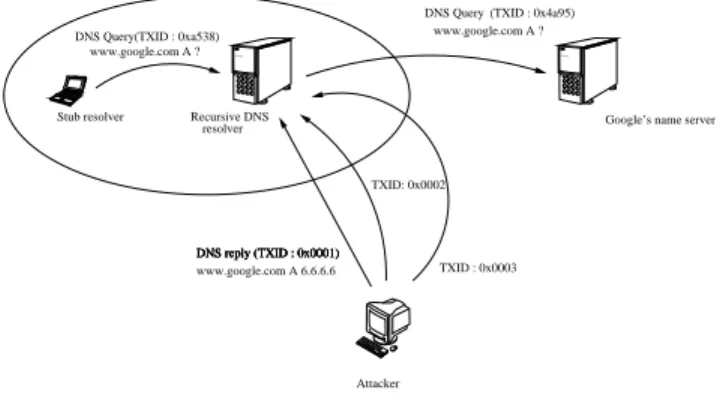
Cache poisoning attacks can be initiated from outside or from within an autonomous sys-tem. Figure 2 shows cache poisoning attempts where the attacker tries to guess the correct TXID (16-bit transaction ID) of the DNS packet. It is assumed that the DNS traffic is invisible to entities outside the autonomous system, and hence it is impossible to observe the domain query packets. If assumed otherwise, poisoning DNS resolver cache becomes trivial, as the correct TXID can now be placed in the spoofed reply. Mechanisms such as [14, 15] make it much more difficult to spoof a reply to a DNS query.
Attackers who do not possess control over entities within a network, utilize hit-and-trial methods to meet their objectives. For instance, the attackers can spoof replies for most commonly accessed domain names (such as www.google.com) when attempting to poison a resolver. The chances that their spoofed packets get accepted increase, depending on the popularity of such domain names.
Another form of attack can be initiated from within the local network (or autonomous system) using ordinary stub resolvers. A stub resolver forced to query for particular host names can reduce the time required to poison resolver’s cache. These client machines can stage a Kaminsky style attack by coordinating with external hosts.
0 0.1 0.2 0.3 0.4 0.5 0.6 0.7 0.8 0.9 1
1 10 100 1000 10000 100000 1e+06 1e+07 1e+08 1e+09 1e+10
Cumulative fraction of respective records
TTL values in logscale (sec)
A records NS records A of name server records
Fig. 3. Cumulative Distribution Function (CDF) of TTL values for A, NS, and A of name server records.
Our threat model considers both the insider and outsider threats as described above.
D. The MiND System
In this section, we describe MiND, the tool used for detecting DNS indirection of all types of DNS records, and cache poisoning of NS records, within a local autonomous system. Our approach employs a database of authoritative name servers for all domain names. In sub-section 3, we explain how the name server database is created and maintained. The destination name server in the DNS query is validated against the set of authentic name servers stored in the database, and an anomaly alert is raised if there is no match. The name server check against the database is done in parallel to the query resolution and thus the results in the response packet can be questioned if it is resolved by an unknown name server.
Several domains employ rapidly changing name server identities for load balancing or other purposes. Such a system uses fast changing NS records, and/or name server’s A
with valid TTL? name servers ROOT/TLD/domain destination Is one of Has the TTL expired? Pick an outgoing DNS packet packet? an indirected Is it database name server Process using latest NS records Update name server database with Log packet as anomalous information Start Yes No Yes No No Yes
Fig. 4. MiND flowchart.
records. It is vital that our system recognizes such configurations appropriately and does not raise false alarms. To decrease the possibility of false alarms, we continuously update the authoritative name server information. The freshness and validity of the database is ensured using the TTL parameters present in the NS and A records. The following sub-sections discuss each component of the MiND system in detail. We also outline the benefits and potential issues of our technique.
1. Name Server Database Feasibility
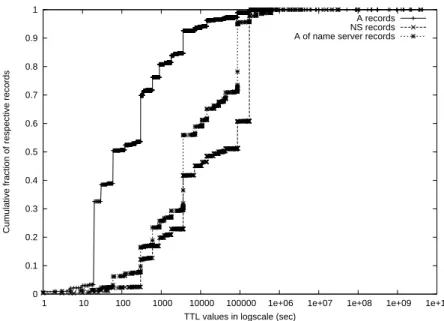
Figure 3 represents the CDF of the TTL values for general A records, NS records, and A records of name servers respectively. From the graph, we observe that the TTL values of NS records are typically higher than the A records. While 90% of A records have TTL values less than 10000 sec, the same TTL value holds true only for about 45% of NS records. It is noteworthy that A records of the name servers also exhibit large TTL values, with 55% of A records of name servers having TTLs smaller than 10000 seconds. This suggests that maintaining the name server database is more convenient as the name server information is stable over a longer period of time. Alternatively, it allows us to use the same database for
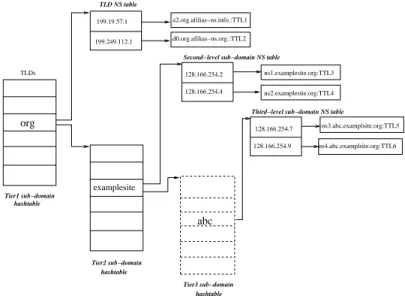
d0.org.afilias−ns.org.:TTL2 a2.org.afilias−ns.info.:TTL1 ns3.abc.examplsite.org:TTL5 ns4.abc.examplsite.org:TTL6 ns1.examplesite.org:TTL3 ns2.examplesite.org:TTL4 Tier1 sub−domain hashtable hashtable Tier2 sub−domain hashtable Tier3 sub−domain org 199.249.112.1 199.19.57.1 128.166.254.2 128.166.254.4 128.166.254.7 128.166.254.9 abc TLDs examplesite TLD NS table
Second−level sub−domain NS table
Third−level sub−domain NS table
Fig. 5. MiND query verifying data structure.
DNS query verification over longer intervals, making our approach scalable.
2. MiND Query Verification
The MiND anomaly alert system sits at the edge of the administrative domain observ-ing all DNS packets. Our primary objective is to determine anomalies present within an autonomous system. Therefore, we present our analysis for outgoing DNS packets. As described later, incoming packets may also be validated using our tool.
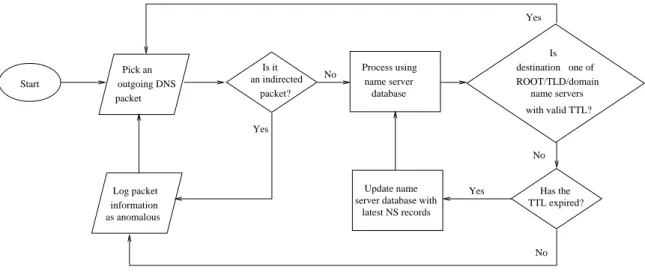
The packet validation algorithm is presented in Figure 4. As the flowchart demon-strates, a packet is first checked for being a DNS indirection instance. Commonly, a stub resolver directs recursive DNS requests to local name servers only. However, if we en-counter packets whose source IP address is different from the local recursive name servers, it is flagged as an indirection instance. On the other hand, independently installed resolvers within the local network can make iterative DNS requests to name servers outside too. With MiND in place, such resolvers need to be white-listed and this helps the network admin-istrators to be aware of other resolvers in the network. Also, known free recursive DNS
services like GoogleDNS [21] are white-listed.
Following the check for DNS indirection, we validate the query packet for being mis-directed due to a poisoned resolver cache. If the cache of the local recursive DNS resolver contains corrupted NS records, then DNS packets are routed to name servers different from authoritative name servers for the queried domain. Using the name server database, we build a data structure in memory which quickly identifies the authoritative name servers for a given domain name. As shown in Figure 5, the data structure is organized into different tiers, with each tier containing name server information relevant to the corresponding sub-domain. For query verification, using the name server information for up to the third-level domains, improves the results considerably. We justify the rationale of using such a design in the results section.
To verify DNS query packets, we also use TTL values associated with the name servers, obtained while collecting the database. There are two types of TTLs associated with a name server. One type specifies the TTL value of name servers for a particular do-main. The second type specifies the TTL of the IP address associated with the name server. To ensure correctness of our analysis, we consider the minimum of the two TTL values.
The use of TTL is motivated by the fact that many networks change their configuration rapidly, which includes altering service and/or name server IP addresses. For example, Content Delivery Networks (CDNs) such as Akamai and LimeLight Networks exhibit such behavior. Therefore, the name server database might not always be able to determine the exact network state. However, by considering TTLs, we are able to determine the currently valid set of authoritative records, which if found expired, may be fetched again.
We check an outgoing DNS query against the name server information of multiple sub-domains corresponding to the query. If the outgoing address matches the valid name server information obtained from any level of the query verifying data structure, we consider the query as directed to a safe name server. Else, it is considered misdirected.
Fast changing name servers pose problems during packet verification. We could falsely designate a packet as misdirected because the query does not seem to be bound for the most recent set of name servers publicized by the domain, although the name servers belong to the authoritative AS. This may happen because of caching of NS records with TTL values modified at the clients or any of the intermediate resolvers. In such a scenario, we use an additional expired cache of name servers. Such a cache is stored in the same way as the list of current (and valid) name servers associated with a domain name. However, the expired cache consists of authoritative name servers seen previously for the domain, and thus, we may see DNS packets destined for such name servers. We associate a learning time for such an expired cache, allowing us to supplement the valid set of name servers ap-propriately during packet verification. Each name server in the expired set still represents a trusted entity. We note that the use of expired records makes MiND vulnerable, only in the event where any of the expired name server IP address’ authority is transferred to (or bought by) a rogue identity. However, such an event would take a considerable time to happen. To prevent such abuse, we frequently flush the expired name server set. Section E highlights the benefits obtained by using such an expired cache.
If a packet matches any of the validation criteria as outlined in Figure 4, it is deemed harmless. However, on failing every test mentioned above, we flag such a packet as anoma-lous. The network administrator may thus choose to take appropriate action in the form of either patching necessary machines, correcting mis-configuration at source hosts, blacklist-ing domains and/or hosts, etc.
In addition to detecting the compromised machines (as determined above), MiND may be used to prevent cache poisoning of NS records too. Prevention is achievable through an analysis of all incoming DNS packets’ NS records present in either answer, authoritative, or the additional sections of the records. The MiND system thus provides counter-mechanism for Kaminsky attacks [22]. With MiND in place, malformed name server address(es) as
advertised in a rogue DNS response packet, can be immediately identified and the attack thwarted. In addition, on observing multiple DNS replies for a query within a short window of time, our tool may be configured to raise a poisoning attempt alert.
3. Collecting the Name Server Database
The name server database is simply a collection of name servers corresponding to different domains present in a host name. The name server database consists only of NS records (with A records obtained only for the name servers) relevant to domains crawled. We use the publicly available PTR records corresponding to IPv4 addresses and thereby de-termine the list of valid name servers. We argue that PTR record specification dede-termines the authoritative host name corresponding to an IP address. The name servers obtained by querying for multiple domain levels present in a PTR record listed host name, correspond to an authoritative set. It is important to note that PTR record pollution requires hijacking the name server for the victim domain’s address space. For attackers, the benefits obtained from such an attack are very limited and thus their focus instead is to pollute the recursive resolver serving an autonomous system.
The name server database also stores TTL value associated with every name server/IP address combination. Such a collection of records is only a small subset of what a regular resolver is expected to store in its cache. The small set that we use can be quickly read into the main memory and has a small memory footprint. This sub-section discusses how we build this database within a small period of time.
PTR records contain IP address to host name mapping. Therefore, building an ex-haustive name server database, at first, requires sending out a DNS PTR query for every IP address in the IPv4 (32-bit) space and hence obtaining the host name for that IP address. The name servers are then obtained by sending out an NS query (and if not cached already, an A query to determine the name server’s IP address). The results are logged into the
database. We query the name server records for second and third-level sub-domains of the host name returned as a response to a PTR request. To elaborate, if the PTR record cor-responding to an arbitrary IP address gives random.abc.examplesite.org as the answer, we determine the name servers for abc.examplesite.org as well as examplesite.org. For PTR responses which contain multiple host names for an IP address (in the form of CNAME or more PTR records), we process each returned answer individually.
Determining the host name and the name servers for the corresponding domains re-quires sending out at least two queries for every address in the IPv4 space which may thus require sending a large number of queries cumulatively. However, we apply numerous heuristics to drastically reduce the required resources. We note that a considerable part of the Internet address space is unallocated/reserved which reduces the number of queries that need to be sent [23]. We also avoid generating name server queries for domains already seen, thus saving a large bandwidth and reducing latency of database collection.
To further reduce the volume of queries generated for aggregating a name server database, we analyze flags in DNS packets obtained in response to PTR requests for class A, B, C network prefixes. Thus, crawling large networks may altogether be avoided if the response packet indicates so. Note that we crawl the IP address space randomly to avoid appearing as a malicious scanning host.
random.abc.examplesite.org
ns1.examplesite.org:128.166.254.2:300ns1.examplesite.org:128.166.254.4:300 ns3.abc.examplesite.org:128:166.254.7:1600
...
Fig. 6. Sample line from a name server database file.
corresponds to the host name of an IP address, returned as a reply for the PTR request. The following line denotes the name servers authoritative for examplesite.org. Name server in-formation for abc.examplesite.org is present immediately below. Note that we also log each name server’s IPv4 address and TTL associated with the name server. We also enable accu-mulating name servers with multiple IP addresses. Apart from host names corresponding to the 32-bit IPv4 space, the MiND query verifier requires information about name servers corresponding to the top level domains (TLDs). We use the list provided by [24, 25] to compile all TLDs and hence determine the name servers for each TLD.
The MiND system can also be deployed without complete authoritative name server information. However, the latency of query verification will be higher in such a scenario as the corresponding authoritative name server information will now have to be retrieved explicitly. Instead, once a database is built, only a small fraction of it needs to be updated frequently thereafter.
a. Database Authenticity and Completeness
With reference to utilizing a personal DNS resolver for database collection, a natural ques-tion arises as to why can’t our own recursive resolver be poisoned? The database collecques-tion resolver, unlike a recursive resolver serving network clients, is configured to refuse any recursive queries from unknown hosts. All queries are made on the loopback interface. The database may be updated only when we receive the same answer from two resolvers located outside our domain/AS. Compromising two resolvers makes it harder for the at-tacker to poison their caches. Utilizing external resolvers, however, increases the latency. Therefore, deploying such a system for online query verification may delay applications requiring quick responses. DoX [16] utilizes such a configuration. However, fetching a small number of NS records, as we do, makes the solution viable.
a name server database (as highlighted in section E). We focus on verifying all records by caching NS records only. In a simple scenario for DoX, which has a minimum of two peers, every query requires a query resolution from both of the peers. With MiND however, an additional query is issued to populate the name server database only if the required information is not present. MiND is also view independent, unlike DoX. This implies that inconsistencies arising with peers in DoX due to geographic separation, does not affect MiND as the database is collected within the autonomous system to be protected. Another security enhancement measure is by executing a TCP based database collec-tion. Using the TCP protocol ensures that the packet cannot be spoofed and that the DNS record is authentic, unless poisoned prior to collection.
As a consequence of all such measures, the database resolver becomes less prone to cache poisoning attacks and the integrity and authenticity of the database can be main-tained.
We note that although an optional part of DNS configuration, PTR record specification by domain administrators can improve the quality of our database. We also note that with the absence of name server information in our database, we fetch the required name servers complementing the verification procedure. For instance, many web domains may be hosted by an IP address. However, only one PTR record pointing to one of the hostnames, may be present. In such a case, for all unseen domains, we find the name servers with a new DNS lookup.
4. Security Implications
MiND has been developed with the goal of providing an additional layer of security over the existing mechanisms. In a normal scenario, DNS resolver poisoning may be achieved by focusing attack resources only on the recursive resolver. With MiND deployed, attackers must now additionally compromise the name server database to achieve success.
With our tool, we focus on preventing corruption of NS records. However, by verify-ing the destination address of every type of DNS record, we implicitly ensure each record’s correctness. We note that incoming DNS replies may also be spoofed and thus the DNS records may serve malicious data. With MiND, we also deploy a DNS response anomaly detector which looks for a burst of incoming responses within a short time. Thus, attackers need to be successful in matching TXID and random port number with the first packet, as subsequent packets will result in a response anomaly alert.
E. Results
1. System Requirements
The name server database collection engine is a multi-threaded application written using C and C++, and the commonly available resolver (libresolv) and packet capture libraries [26–28]. We use an Intel Core 2 Duo (@2.33GHz)Linux box running kernel 2.6.31, with 2GB RAM and plenty of hard drive space. The actual name server persistent database size is less than 1GB. The box uses a BIND9 DNS resolver and our application makes all DNS requests to this box. The private DNS resolver is configured against misuse and accepts recursive queries from trusted hosts only. The query checker is also developed in C and C++ too. The MiND query verifier system uses the same hardware configuration as the name server database collection engine.
DNS query verification uses the campus DNS trace (UDP port 53 traffic) for analysis. We use a fresh database for every analysis. We also use several campus traces from De-cember 2009, for offline analysis. The subsections below highlight whether the results are based on online or offline DNS traffic.
Table I. MiND performance
Exp. Approx. hours Total outgoing Anomalies after
# of training packets analyzed forward checks (%)
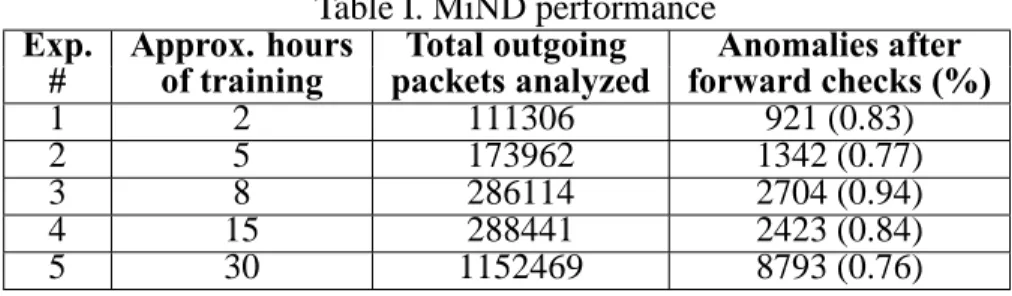
1 2 111306 921 (0.83) 2 5 173962 1342 (0.77) 3 8 286114 2704 (0.94) 4 15 288441 2423 (0.84) 5 30 1152469 8793 (0.76) 2. Performance Analysis
Table I shows the results from the analysis of live DNS traces. Each experiment is per-formed for a different duration of time (or the total number of packets). For each experi-ment, we consider both outgoing and incoming DNS packets (which use the UDP protocol) flowing between our recursive resolver and name servers outside our autonomous system. However, we validate only the outgoing packets.
The second column in table I represents the time for which our tool is trained before it starts packet verification. By training, we imply that the expired name servers for observed domains were not discarded. Rather, they were moved to a separate cache and thus used in conjunction with the current set of name servers for validating outgoing DNS packets. Column 3 represents the total outgoing packets which were verified with our tool, after the initial training.
On subjecting the outgoing packets to MiND query verification and forward checks, we find an average of 0.84% anomalies, as highlighted in column 4. By forward checks, we imply validating the destination address of the DNS query against the name servers of sub-domains of the third-level domain name. False positive rate can be further reduced by checking if the name server and the destination IP address of the DNS packet, belong to the same AS. This check reduces the false positive rate to an average of 0.046%. However, such a check increases the scope of an attack as the rogue resolver may belong to the same
0 0.2 0.4 0.6 0.8 1
1 10 100 1000 10000 100000 1e+06 1e+07 1e+08 1e+09 1e+10
Cumulative fraction Latency (microseconds) With whitelist Without whitelist DoX simulation (a) 0 20 40 60 80 100 0 20 40 60 80 100
Cache hit ratio (%)
Trace number
(b)
Fig. 7. (a) Latency of verification. (b) Cache hit ratios for a week long dataset. AS. With time, we expect the fraction of false positives to decrease as more name servers get aggregated in the expired cache.
We further analyze the packets remaining from above, specifically for experiment 3. From our analysis we find that 15.38% of the anomalous packets, belong to malicious domains. The malicious nature of the suspect domains is confirmed with a domain repu-tation verification service [29]. The bulk of the malicious packets belong to exitguide.ru. We further confirm the malfeasance of this domain using McAfee’s domain reputation checker [30] which associates this domain name with highest risk. We also find that an-other 24.17% of the anomalous packets from experiment 3, belong to the category where either the NS records could not be retrieved or the A records for corresponding NS records were absent. Such a case may represent botnet hosted domains which publish name servers at specific times. In addition to above, we find 38.47% packets for which the name servers were present, but were seen to be in a different AS than checked before. This commonly occurs for CDNs or domains with low TTLs, which switch ASes rapidly. The remaining 22.17% of the packets occur due to the CNAME replies observed for NS queries. However, for forward and AS check, we do not consider CNAME referrals.
3. Latency of Query Verification
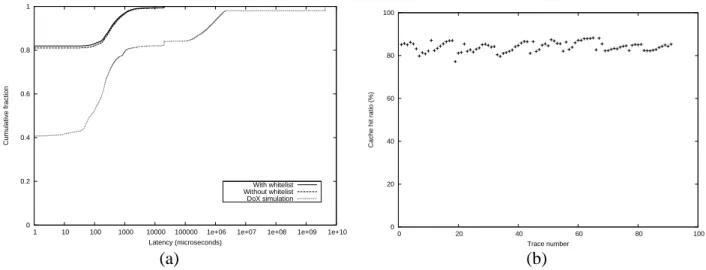
Figure 7(a) shows the cumulative distribution function of latency observed with MiND deployed under different scenarios. The figure shows the latency for three cases. The top most plot of latency refers to using MiND when the DNS packets destined for white-listed domains, are unconditionally verified. The middle plot refers to the latency observed when no white-listing is considered. For this particular analysis, we consider five frequently used domains for white-listing, namely akamai.net, gslb.com, weather.com, facebook.com, and adnxs.com.
The last plot represents latency observed with a simplistic setup for DoX [16]. With this setup, every outgoing DNS query is validated with another peer. In a more powerful setup for DoX, multiple resolvers resolve the queries and consult with other peers before providing clients with an answer. Our setup for DoX should bear minimum latency.
As the plot shows, the difference between latency observed with MiND and DoX is quite large. We owe this to the fact that many outgoing queries are verified quickly using our database of records. On the other hand, with DoX, every query needs to be fetched and then compared with peers for validation. We also observe that consideration of a white-list of only 5 domain names, results in a slight improvement in latency. We believe that with a white-list consisting of hundreds of domains, the latency gain would be much higher.
4. Interesting Observations
Here we present the interesting events observed as a consequence of DNS query verifi-cation. All the instances reported below represent different anomalies that may interest network administrators.
Absent name servers: From our analysis, we discover several irregularities, owing to no name servers being found for the domain names present in the query. Rather, such
queries were resolved by simply following referrals from iterative replies (that is, using the AUTHORITY section data in DNS responses). Our implementation does not consider AUTHORITY section data. We observe that blacklisting services like spamcop.net, and surbl.org fall into this category and attribute for almost 20% of such packets.
Mistyped domain names: During our analysis, we observe several mistyped domain names. The frequently misspelled DNS domain name packets include MX queries for g-mail.com, A queries for google.co, MX queries for hotmal.com, hotmai.com, hotmaill.com, and more. While in all of the cases mentioned above, the mistyped domain names have been pre-registered by the responsible authorities, we note that the clients within our autonomous system generating such domain names, may represent irregularities. Such domains show up in our analysis because of the absence of NS records corresponding to these domains. With the frequency of these queried domains being of the order of several hundreds within a short time, MiND helps detect them for examination by system administrators.
Poisoning attacks: Our findings indicate that clients within our autonomous system re-peatedly query for domains such as i.metarss.com, computerfinance.net and a few others within a short time. Such an analysis also highlights the local resolver configuration. It seems that the caching of NXDOMAIN/SERVFAIL records is disabled. Therefore, the client applications keep querying for the same hostname even after previous failures. Net-work administrators may patch such anomalous clients thereby saving a lot of bandwidth.
Simulated attack: We also simulate a poisoning attack on our private recursive resolver. The attack is accomplished by staging a Denial of Service attack from one of our host machines, to our experimental recursive resolver. We use a custom program to generate DNS packet bursts with random IDs and use iptables to redirect malformed packets, to our victim resolver. With the detection mechanism in place, we are indeed able to generate instant alerts.
5. Highly Dynamic Name Servers
We use each experiment (as in table I) to determine the frequently changing name server configurations. To determine the fast changing name servers, we simply determine the frequency of every second-level domain name, for which we fetch the name servers re-peatedly. The frequent update is forced by the use of small TTL values for the NS or A records. Based on our analysis, the top five domains for which we update our database re-peatedly, includes akamai.net, gslb.com, weather.com, facebook.com, and adnxs.com. The domain names also highlight their popularity within our autonomous system, as these do-main queries would form a good proportion of all outgoing packets.
The data presented above identifies frequently requested domain names. Using such domain names helps reduce the latency of query verification. By white-listing IP addresses of the name servers for known domains, we can quickly verify several queries without the need for frequent database update. However, such an analysis can also reveal rogue domains which exhibit domain fast fluxing behavior.
6. Determining False Negatives
To assess the ability of the MiND system to identify indirection anomalies, we use simu-lated malicious DNS queries. To generate misdirected packets from our network, we infect five machines with a custom program designed to periodically generate DNS queries for well-known domain names. For instance, an infected host generates DNS type A requests with the queried host name as qNum.google.com where qNum is the query number sent out by the particular stub resolver. The destination name server IP address for each stub resolver was assigned arbitrarily (e.g. “6.6.6.6”) taking care that the destination IP address did not belong to the queried domain’s autonomous system. The time period for querying was set to one minute. The queried domain names assigned to other hosts include
face-book.com, citibank.com, yahoo.com and boa.com. All queries were recursive in nature. Using our tool, we log all simulated malicious queries generated by stub resolvers in our network. We confirm the source of malformed queries by examining the domain query names and IP addresses assigned to our test hosts.
7. Effect of Resolver Cache
We use the offline traces to determine the cache hit ratio for the campus recursive resolver. Cache hit ratio refers to the percentage of records, for which the answer could be found in the local resolver cache and hence immediately returned to the stub resolver. The cache hit ratio at the recursive resolver outlines the efficiency of the MiND system. A higher cache hit ratio would imply less burden on the MiND system, and thereby lower latencies for query validation. We determine the cache hit ratio by observing the number of queries directed by local stub resolvers towards the recursive resolvers and thus computing the fraction of DNS requests generated by the recursive resolver, to the name servers outside our autonomous system. As observed from figure 7(b), the average cache hit ratio is about 80%. This implies that the MiND system, which sits at the campus edge, verifies the direct correctness of the remaining 20% of the queries.
CHAPTER III
DETECTING ALGORITHMICALLY GENERATED MALICIOUS DOMAIN NAMES A. Introduction
Recent botnets such as Conficker, Kraken and Torpig have brought in vogue a new method for botnet operators to control their bots: DNS “domain fluxing”. In this method, each bot algorithmically generates a large set of domain names and queries each of them until one of them is resolved and then the bot contacts the corresponding IP-address obtained that is typically used to host the and-control (C&C) server. Besides for command-and-control, spammers also routinely generate random domain names in order to avoid detection. For instance, spammers advertise randomly generated domain names in their spam emails to avoid detection by regular expression based domain blacklists that maintain signatures for recently ‘spamvertised’ domain names.
The botnets that have used random domain name generation vary widely in the random word generation algorithm as well as the way it is seeded. For instance, Conficker-A [31] bots generate 250 domains every three hours while using the current date and time at UTC (in seconds) as the seed, which in turn is obtained by sending empty HTTP GET queries to a few legitimate sites such as google.com, baidu.com, answers.com etc. This way, all bots would generate the same domain names every day. In order to make it harder for a security vendor to pre-register the domain names, the next version, Conficker-C [32] increased the number of randomly generated domain names per bot to 50K. Torpig [6,33] bots employ an interesting trick where the seed for the random string generator is based on one of the most popular trending topics in Twitter. Kraken employs a much more sophisticated random word generator and constructs English-language alike words with properly matched vowels and consonants. Moreover, the randomly generated word is combined with a suffix chosen
randomly from a pool of common English nouns, verbs, adjective and adverb suffixes, such as -able, -dom, -hood, -ment, -ship, or -ly.
From the point of view of botnet owner, the economics work out quite well. They only have to register one or a few domains out of the several domains that each bot would query every day. Whereas, security vendors would have to pre-register all the domains that a bot queries every day, even before the botnet owner registers them. In all the cases above, the security vendors had to reverse engineer the bot executable to derive the exact algorithm being used for generating domain names. In some cases, their algorithm would predict domains successfully until the botnet owner would patch all his bots with a re-purposed executable with a different domain generation algorithm [6].
We argue that reverse engineering of botnet executables is resource- and time-intensive and precious time may be lost before the domain generation algorithm is cracked and con-sequently before such domain name queries generated by bots are detected. In this regards, we raise the following question: can we detect algorithmically generated domain names while monitoring DNS traffic even when a reverse engineered domain generation algorithm may not be available?
Hence, we propose a methodology that analyzes DNS traffic to detect if and when domain names are being generated algorithmically as a line of first defense. In this regards, our proposed methodology can point to the presence of bots within a network and the network administrator can disconnect bots from their C&C server by filtering out DNS queries to such algorithmically generated domain names.
Our proposed methodology is based on the following observation: current botnets do not use well formed and pronounceable language words since the likelihood that such a word is already registered at a domain registrar is very high; which could be self-defeating as the botnet owner would then not be able to control his bots. In turn this means that such algorithmically generated domain names can be expected to exhibit characteristics vastly
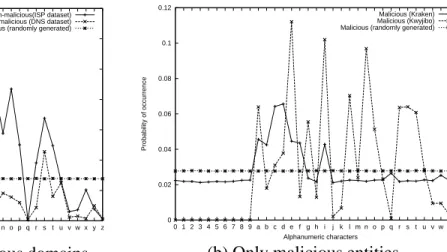
different from legitimate domain names. Hence, we develop metrics using techniques from signal detection theory and statistical learning which can detect algorithmically generated domain names that may be generated via a myriad of techniques: (i) those generated via pseudo-random string generation algorithms as well as (ii) dictionary-based generators, for instance the one used by Kraken [34, 35] as well as a publicly available tool, Kwyjibo [36] which can generate words that are pronounceable yet not in the english dictionary.
Our method of detection comprises of two parts. First, we propose several ways to group together DNS queries: (i) either by the Top Level Domain (TLD) they all corre-spond to or; (ii) the IP-address that they are mapped to or; (iii) the connected component that they belong to, as determined via connected component analysis of the IP-domain bipartite graph. Second, for each such group, we compute metrics that characterize the dis-tribution of the alphanumeric characters or bigrams (two consecutive alphanumeric char-acters) within the set of domain names. Specifically, we propose the following metrics to quickly differentiate a set of legitimate domain names from malicious ones: (i) Informa-tion entropy of the distribuInforma-tion of alphanumerics (unigrams and bigrams) within a group of domains; (ii) Jaccard index to compare the set of bigrams between a malicious domain name with good domains and; (iii) Edit-distance which measures the number of character changes needed to convert one domain name to another.
We apply our methodology to a variety of data sets. First, we obtain a set of legitimate domain names via reverse DNS crawl of the entire IPv4 address space. Next, we obtain a set of malicious domain names as generated by Conficker, Kraken and Torpig as well as model a much more sophisticated domain name generation algorithm: Kwyjibo [36]. Finally, we apply our methodology to one day of network traffic from one of the largest Tier-1 ISPs in Asia and South America and show how we can detect Conficker as well as a botnet hitherto unknown, which we call Mjuyh (details in Section E).