This is a repository copy of
A subject-to-subject transfer learning framework based on
Jensen-Shannon divergence for improving brain-computer interface
.
White Rose Research Online URL for this paper:
http://eprints.whiterose.ac.uk/143451/
Version: Accepted Version
Proceedings Paper:
Giles, J., Ang, K.K., Mihaylova, L. et al. (1 more author) (2019) A subject-to-subject
transfer learning framework based on Jensen-Shannon divergence for improving
brain-computer interface. In: Proceedings of the IEEE International Conference on
Acoustics, Speech and Signal Processing (ICASSP). ICASSP 2019, 12-17 May 2019,
Brighton, UK. IEEE , pp. 3087-3091. ISBN 978-1-4799-8131-1
https://doi.org/10.1109/ICASSP.2019.8683331
© 2019 IEEE. Personal use of this material is permitted. Permission from IEEE must be
obtained for all other users, including reprinting/ republishing this material for advertising or
promotional purposes, creating new collective works for resale or redistribution to servers
or lists, or reuse of any copyrighted components of this work in other works. Reproduced
in accordance with the publisher's self-archiving policy.
[email protected] https://eprints.whiterose.ac.uk/ Reuse
Items deposited in White Rose Research Online are protected by copyright, with all rights reserved unless indicated otherwise. They may be downloaded and/or printed for private study, or other acts as permitted by national copyright laws. The publisher or other rights holders may allow further reproduction and re-use of the full text version. This is indicated by the licence information on the White Rose Research Online record for the item.
Takedown
If you consider content in White Rose Research Online to be in breach of UK law, please notify us by
A SUBJECT-TO-SUBJECT TRANSFER LEARNING
FRAMEWORK BASED ON JENSEN-SHANNON DIVERGENCE
FOR IMPROVING BRAIN-COMPUTER INTERFACE
Joshua Giles
1,2, Kai Keng Ang
2,3, Lyudmila S. Mihaylova
1, Mahnaz Arvaneh
11
Automatic control and System Engineering Department, University of Sheffield, UK
Emails: jgiles1,l.s.mihaylova, [email protected]
2
Institute for Infocomm Research, ASTAR, Singapore
3
School of Computer Science and Engineering, Nanyang Technological University
ABSTRACT
One of the major limitations of current electroencephalo-gram (EEG)-based brain-computer interfaces (BCIs) is the long calibration time. Due to a high level of noise and non-stationarity inherent in EEG signals, a calibration model trained using limited number of train data may not yield an accurate BCI model. To address this problem, this paper proposes a novel subject-to-subject transfer learning frame-work that improves the classification accuracy using limited training data. The proposed framework consists of two steps: The first step identifies if the target subject will benefit from transfer learning using cross-validation on the few available subject-specific training data. If transfer learning is required a novel algorithm for measuring similarity, called the Jensen-Shannon ratio (JSR) compares the data of the target subject with the data sets from previous subjects. Subsequently, the previously calibrated BCI subject model with the highest sim-ilarity to the target subject is used as the BCI target model. Our experimental results using the proposed framework ob-tained an average accuracy of 77% using 40 subject-specific trials, outperforming the subject-specific BCI model by 3%.
1. INTRODUCTION
Electroencephalogram (EEG)-based brain computer inter-faces (BCI) are systems which allow for direct communica-tion between a person and a machine using only the brain waves produced by the user [1]. This form of communica-tion can allow many people who are unable to communicate otherwise, due to damage in their neural pathways [2], to obtain some control of their environment. Recently BCI has started to be implemented to assist with rehabilitation of stroke patients [3].
Despite several recent advances, there are still a number of major issues with the current BCI which need to be addressed. One of these issues is the fact that currently 20% to 25% of
the users are unable to achieve the classification accuracy of 70% or more while using the BCI [4]. The other major issue is that even for the users who can obtain high levels of accuracy, they typically require a 20 to 30 minutes calibration period at the beginning of each session [5]. During this calibration period a large number of labelled training data are recorded for adjusting the feature extractor and the classifier. This is necessary to adapt the BCI to the target user and deal with the variations in the EEG signals, both from subject to subject and from session to session. These long calibration periods cause fatigue and stress for the users, limiting the time available to use the BCI as intended. As such improving the accuracy that a BCI can achieve while reducing the training trials required is an important area of research.
In order to improve the accuracy, research has been car-ried out to improve the components within the BCI [6]. These range from feature extractors, such as the filter-bank com-mon spatial patterns algorithm [7], to classifiers, such as the adaptive linear discriminant analysis (aLDA) which updates the classifier parameters when new trials are available [8]. A range of other adaptation methods have also been explored to further improve the classification accuracy possible. An ex-ample being data space adaptation which reduces the differ-ence between the training data and test data through a linear transform [9] [10]. Despite these techniques improving accu-racy, they often require a large number of calibration trials to provide a significant improvement.
To reduce the need for the long calibration time, trans-fer learning between sessions and subjects has been investi-gated. Transfer learning often refers to a procedure of using a data set from a different task to improve the accuracy of a related task [11]. When used for BCI, the data sets are often from the same task but different users. One form of transfer learning is through identifying features which are stationary across multiple subjects, known as domain adaptation. This area has been explored by Lotte and Guan [12] and Kang et
al [13] [14] with some success. The other form of transfer learning is called rule adaptation which attempts to find the framework of classification rules. The rule adaptation-based transfer learning attempts to select the most appropriate fea-ture extraction and classification rules from a pool of available components [11]. This area of transfer learning has not been explored much within BCI although it has been explored by He and Wu recently [15].
In this paper first a new measurement of similarity is pro-posed named the Jensen Shannon ratio (JSR). This measure is used to compare calibration trials with existing data sets for transfer learning. Then a framework is proposed which identifies whether the target user will benefit from using rule adaptation transfer learning. If so, the data set with the high-est similarity to the trials of the target user is selected, from previously recorded data, for training a BCI model for the tar-get user.
The proposed framework will be evaluated using the pub-licly available BCI Competition IV data set 2a [16]. The al-gorithm will then be compared to utilizing only the Kullback Leibler (KL) divergence for data set selection and a frame-work previously proposed by Lotte using other subjects data to alter the co-variance and mean of the training data set [17].
2. METHODOLOGY 2.1. The Proposed Jensen Shannon Ratio
The proposed JSR measures the difference of the average EEG signals from the same class between users and the op-posing classes using the Jensen Shannon divergence. The JSR is then used to select an appropriate signal for training, where the same classes are similar and opposing classes are far apart. The Jensen Shannon divergence is based on the Kullback Leibler (KL) divergence with some useful differ-ences. KL[Nj kDj] = 1 2[(µj−µj) T Σ−j1(µj−µj) +tr(Σ−j1Σj)−ln( det(Σj) det(Σj) )−k], (1)
The band pass filtered EEG signals can be modelled as Gaussian distributions. The similarity between two Gaussian distributions can be measured through the KL divergence, as shown in (1). For this equationNj(µ,Σ)andDj(µ,Σ)are
used to represent the distributions of classj from the target subject N and training subject D. µ andµ represent the means of the distribution, andΣandΣdenote covariances.
Jensen Shannon divergence is an extension of the KL di-vergence. This extension provides a symmetric and finite value for the similarity by measuring to a middle point provid-ing, as shown in (2). The middle pointMji(µji,Σji)is
cal-culated from the average of the two distributions being com-pared, withµji = 0.5(µj+µi)andΣji = 0.5(Σj+Σi).
This Jensen Shannon divergence is then used to calculate the JSR and select the best data sets for the test data.
JS[NjkDi] =
1
2(KL[Nj kMji] + KL[Di kMji]) (2)
Through knowing the differences between the EEG sig-nals for each subject and class the JSR can be calculated. This aims to select a data set which has similar distributions for the same class while ensuring that the opposing classes are not similar. This is done through equation (3), withC rep-resenting the number of classes. The JSR aims to minimize the dissimilarity between the classes of two data sets while si-multaneously maximizing the dissimilarity between different classes. J SR= PC j=1JS[NjkDj] PC i=1i6=j(JS[NjkDi]) (3) When using the JSR for BCI subject to subject transfer learning the band-pass filtered EEG signals are used. As such Di(0,Σi)can be used to represent the distribution of one of
the training data sets. WhileNj(0,Σj)represents the
distri-bution of the few subject specific trials we have from the user for eachjclass. In each of these distributions the normalized co-variance is estimated through the signal valuesxas shown in (4), withN number of trials.
Σ= 1 N N X i=1 xixiT tr(xixiT) (4) As the band pass filtered EEG has a zero mean, equation (3) can be simplified to equation (5). Once the JSR has been calculated between the distribution of the subject specific tri-als and each of the possible training data distributions, the training data with the lowest JSR value is then selected. This data set is used to train the CSP and LDA of the BCI.
JSR = C X j=1 X i6=c (tr(M)−1Σ j+ (M)−1Σj)−ln(det( Σj) det(Σj)) C(tr(M)−1Σ i+ (M)−1Σj)−ln(det(det(ΣΣi) j)) (5)
2.2. Proposed BCI Subject to Subject Transfer Learning Framework
Users who encounter BCI deficiency can benefit substan-tially from the application of transfer learning. While for other users, who easily obtain high classification accuracy, the transfer learning can be detrimental. To counter this the proposed framework identifies the users who can benefit from subject to subject transfer learning then selects the best pre-viously recorded data set for these users to train their BCI models. To identify the subjects requiring transfer learning
the leave-one-out validation (LOOV) accuracy is applied on the few subject-specific target trials. If the average accuracy for those subject-specific trials is below 70% they are iden-tified as BCI deficient. For user who are found to encounter BCI deficiency the proposed JSR was then used to select an appropriate data set for training the BCI.
2.3. Selection Comparison
To evaluate the effectiveness of the proposed JSR transfer learning, its results are compared with the accuracies obtained using a KL based similarity measure. Moreover, the proposed framework is compared to the algorithm previously suggested by Lotte utilizing other subjects training data [17]. These were also compared to training the BCI with the available subject specific trials provided to highlight the improvement in accuracy achieved by providing the additional training tri-als.
2.3.1. Kullback Libeler Divergence
KL divergence is a long established method of calculating the difference between two Gaussian distributions. As such it is used for comparison against the JSR as a mean of transfer learning in the data domain. Equation (1) displays the cal-culations required to calculate the KL divergence. In this the data set which has the lowest summation of KL divergence between the test and target subjects classes is used for the BCI training.
2.3.2. BCI utilizing other subjects data
Lotte and Guan previously developed an algorithm for BCI which used other subjects data to reduce the need for cali-bration trials [17]. This evaluates the training data by train-ing a BCI ustrain-ing each of the traintrain-ing data sets available. The subject specific trails are then used to evaluate the data sets. The selected data sets are then weighted, withλ, then used to estimate a new co-variance and mean in the feature do-main as shown (7) and (6). For these equationsµandΣare the mean feature vector and co-variance of the target subject whileµandΣare the mean feature vector and co-variance of the training subset. sis the number of selected training data sets. Σ= (1−λ)Σ+λ1 s s X i=1 Σs (6) µ= (1−λ)µ+λ1 s s X i=1 µs (7)
λ=DatasetAccuracy−SubjectSpecif icAccuracy 100−ChanceAccuracy
(8)
The weighting of λis calculated through comparing the leave-one-out validation (LOOV) accuracy that is achieved by the subject specific trials and the accuracy achieved when the other data sets are used for training. If the leave one out validation outperforms the other data sets it is used for train-ing the BCI, while if it is less than chance the trials are not used at all. If the LOOV accuracy is between the chance level and the accuracy achieved by the other data sets then they are weighted as shown in (8).
3. RESULTS AND DISCUSSION 3.1. Improvement for BCI Deficient Users
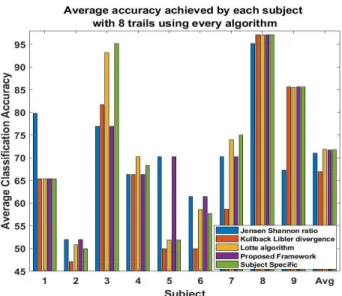
Initially the proposed JSR is compared to the other transfer learning algorithms. The JSR allows BCI deficient users to achieve higher accuracy then any of the other algorithms. This can be seen in figure 1 which shows the accuracy achieved by each of the algorithms when 8 subject spe-cific trials are available. For the users who achieved less than 70% accuracy with their subject specific trials the average improvement was 8% with JSR. In comparison the algorithm proposed by Lotte improved the accuracy for these subjects by just 3% and the KL divergence caused a fall in accuracy. Subjects 1 and 5 in particular had a large increase in clas-sification accuracy when the JSR was applied. While the average accuracy across all the subjects is not improved by JSR, compared to the standard BCI. This could be improved with a larger data base with more subjects to select from.
Fig. 1. The accuracy achieved by each algorithm for every subject in the data set when only 8 trials are available for ei-ther training or calibration.
When examining the average classification accuracy across all the subjects, when 8 subject specific trials are available, the algorithm proposed by Lotte outperforms the JSR 0.9%. This may be due to Lottes algorithm only using
others data for users encountering BCI deficiency, who re-quire assistance, while JSR was used for all subjects. The subjects able to achieve high levels of accuracy with only a few subject specific trials lose accuracy with any of the other data sets available in the database. As such it is important to differentiate between the subjects who will achieve high accuracy and the subjects who will encounter BCI deficiency. To identify these BCI deficient subjects the proposed framework incorporates the LOOV accuracy as a quick way to estimate the users competency in controlling EEG based BCI. Through this the users are classified as either BCI defi-cient or suffidefi-cient. The users will then either use the JSR to select the best training set for them or use the subject specific trials as the training set for the BCI.
Using the framework to select the subjects requiring trans-fer learning, before applying the JSR, improves the average accuracy across all the subjects. This is shown in figure 2 where the proposed framework is able to achieve 77% ac-curacy when 40 subject specific trials are available. When only the subject specific trials are used for training the aver-age accuracy is only 74.5%. The proposed framework con-sistently outperforms the standard BCI although it does not perform optimally initially and experiences a small decrease in accuracy when 28 trials are available. The drop in accu-racy which occurs when there are 28 subject specific trials is due to subjects 2 and 8 both experiencing a fall in accuracy. These subjects are both correctly identified as BCI deficient and sufficient respectively however still lose accuracy due to a few inconsistent trials. These trials causes the JSR to select a bad data set for subject 2 and leading to a fall in accuracy of 2%. This shows that the framework could benefit from an algorithm to evaluate and remove trials that are outliers.
3.2. Average Improvement from Proposed Framework
As mentioned the framework is not able to improve the aver-age accuracy when only 8 subject specific trials are available. The LOOV misidentifies subjects 1 and 3 lowering the aver-age accuracy by 0.1% compared to the standard BCI. The ini-tially low accuracy of the proposed framework highlights one of the main problems which is its ineffectiveness in noticing BCI deficient users quickly. Using the LOOV accuracy is able to produce a fairly accurate prediction of the users capabili-ties when enough trials are available however a few outlying trials can affect the results. These outliers are not necessarily just trials that produce low levels of accuracy but can also pro-duce uncharacteristically high levels of accuracy which lead to the subjects being miss-classified by the LOOV and the framework under performing. The LOOV does perform well when there are enough trials provided to the validation and the framework does still improve on the standard BCI when 10 or more trials are available.
Table 1 highlights this failing of the LOOV accuracy as a measurement of BCI competency. The proposed
frame-Fig. 2. The average accuracy achieved by the standard BCI and framework improves as the number of trials increase.
Table 1. Average accuracy for BCI deficient users Trials Subject Specific Proposed framework JSR
8 57 62.5 62.5
40 58.65 65.1 66.1
work improves upon standard BCI however there is still a lot of room for improvement. If a better selection method was available this could further improve the accuracy of the framework. This increase in accuracy could be up to 3% if the correct subjects are selected to utilize the JSR. The current framework is able to improve the accuracy for BCI deficient subjects by over 5.5% when only 8 trials are available and by up to 6.5% when 40 trials are available.
4. CONCLUSION
Overall an improvement in the classification accuracy was consistently achieved for users encountering BCI deficiency by the proposed Jensen Shannon ratio data selection. When the ”leave one out” method was used to select the users who required alternative training trials the average accuracy of the system outperformed the standard BCI by 3%. It is also im-portant to remember that this was conducted using a publicly available data set with only nine subjects, providing a rela-tively small amount of training data to select from. A larger data set with more subjects may be able to find more appro-priate data sets for each deficient subject. A number of users who were miss-classified could have benefited from using a different users data. As such to progress this work a key area to focus on will be in selecting a better predictor of classifica-tion accuracy going forward. This could potentially improve the systems allowing it to achieve an accuracy of 77% with only 8 trials. As the framework improves it can be applied to assist stroke patients with rehabilitation.
5. REFERENCES
[1] T. W. Berger, J. K. Chapin, G. A. Gerhardt, D. J. McFar-land, J. C. Principe, W. V. Soussou, D. M. Taylor, and P. A. Tresco, Brain-Computer Interfaces. Dordrecht: Springer Netherlands, 2008.
[2] J. R. Wolpaw, N. Birbaumer, D. J. McFarland, G. Pfurtscheller, and T. M. Vaughan, “Brain-computer interfaces for communication and control.,” Clinical Neurophysiology : Official Journal of the International Federation of Clinical Neurophysiology, vol. 113, no. 6, pp. 767–91, 2002.
[3] K. K. Ang, S. Member, C. Guan, and S. Member, “EEG-Based Strategies to Detect Motor Imagery for Control and Rehabilitation,” vol. 25, no. 4, pp. 392–401, 2017. [4] C. Vidaurre, C. Sannelli, and M. Klaus-robert,
“Co-adaptive calibration to improve BCI,”Journal of Neural Engineering, 2011.
[5] M. Krauledat, M. Schr¨oder, B. Blankertz, and K.-R. M¨uller, “Reducing calibration time for brain-computer interfaces: A clustering approach,” Adv. Neural Infor-mation Processing Syst., vol. 19, p. 753, 2007.
[6] W. Wu, X. Gao, and S. Gao, “One-versus- the-rest (OVR) algorithm: An extension of common spatial pat-terns (CSP) algorithm to multi-class case,”Engineering In Medicine And Biology, vol. 3, pp. 2387–2390, 2005. [7] K. K. Ang, Z. Y. Chin, C. Wang, C. Guan, and H. Zhang,
“Filter bank common spatial pattern algorithm on BCI competition IV datasets 2a and 2b,”Frontiers in Neuro-science, vol. 6, no. MAR, pp. 1–9, 2012.
[8] C. Vidaurre, M. Kawanabe, P. Von B¨unau, B. Blankertz, and K. R. M¨uller, “Toward unsupervised adaptation of LDA for brain-computer interfaces,”IEEE Transactions
on Biomedical Engineering, vol. 58, no. 3 PART 1,
pp. 587–597, 2011.
[9] M. Arvaneh, I. Robertson, and T. E. Ward, “Subject-to-subject adaptation to reduce calibration time in mo-tor imagery-based brain-computer interface,”2014 36th Annual International Conference of the IEEE
Engi-neering in Medicine and Biology Society, EMBC 2014,
pp. 6501–6504, 2014.
[10] J. Giles, K. K. Ang, L. Mihaylova, and M. Arvaneh, “Data Space Adaptation for Multiclass Motor Imagery-based BCI,”2018 40th Annual International Conference of the IEEE Engineering in Medicine and Biology Soci-ety, 2018.
[11] V. Jayaram, M. Alamgir, Y. Altun, and M. Grosse-wentrup, “Transfer Learning in Brain-Computer In-terfaces,” arXiv:1512.00296, no. February, pp. 20–31, 2016.
[12] F. Lotte and C. Guan, “Regularizing common spatial patterns to improve BCI designs: Unified theory and new algorithms,”IEEE Transactions on Biomedical En-gineering, vol. 58, no. 2, pp. 355–362, 2011.
[13] H. Kang, Y. Nam, and S. Choi, “Composite Common Spatial Patterns for Subject-to-Subject Transfer,”IEEE Signal Processing Letters, vol. 16, no. 8, pp. 683–686, 2009.
[14] H. Kang and S. Choi, “Bayesian common spatial pat-terns for multi-subject EEG classification,”Neural Net-works, vol. 57, pp. 39–50, 2014.
[15] H. He and D. Wu, “Transfer Learning for Brain-Computer Interfaces : An Euclidean Space Data Align-ment Approach,”arXiv:1808.05464, pp. 1–10, 2018. [16] C. Brunner, R. Leeb, G. R. Muller-Putz, A. Schlogl, and
G. Pfurtscheller, “BCI Competition 2008 - Graz data set A,” 2008.
[17] F. Lotte and C. Guan, “Learning from other Subjects Helps Reducing Brain-Computer Interface Calibration Time,” International Conference on Audio Speech and Signal Processing (ICASSP), Mar 2010, Dallas, United States, 2010.