On the Role of Canonicity in Bottom-up Knowledge Compilation
Guy Van den Broeck
and
Adnan Darwiche
Computer Science Department University of California, Los Angeles {guyvdb,darwiche}@cs.ucla.edu
Abstract
We consider the problem of bottom-up compilation of knowledge bases, which is usually predicated on the ex-istence of a polytime function for combining compila-tions using Boolean operators (usually called anApply
function). While such a polytimeApply function is known to exist for certain languages (e.g., OBDDs) and not exist for others (e.g., DNNF), its existence for cer-tain languages remains unknown. Among the latter is the recently introduced language of Sentential Decision Diagrams (SDDs), for which a polytimeApply func-tion exists for unreduced SDDs, but remains unknown for reduced ones (i.e. canonical SDDs). We resolve this open question in this paper and consider some of its the-oretical and practical implications. Some of the findings we report question the common wisdom on the relation-ship between bottom-up compilation, language canon-icity and the complexity of theApplyfunction.
Introduction
The Sentential Decision Diagram (SDD) is a recently pro-posed circuit representation of propositional knowledge bases (Darwiche 2011). The SDD is a target language for knowledge compilation (Selman and Kautz 1996; Dar-wiche and Marquis 2002), meaning that once a propositional knowledge base is compiled into an SDD, the SDD can be reused to answer multiple hard queries efficiently (e.g., clausal entailment or model counting).
SDDs subsume Ordered Binary Decision Diagrams (OBDD) (Bryant 1986) and come with a tighter size bound (Darwiche 2011), while still being equally powerful as far as their polytime support for classical queries (e.g., the ones in Darwiche and Marquis (2002)). Moreover, SDDs are subsumed by d-DNNFs (Darwiche 2001), which received much attention over the last decade, for fault diagnosis (El-liott and Williams 2006), planning (Palacios et al. 2005), databases (Suciu et al. 2011), but most importantly for prob-abilistic inference (Chavira, Darwiche, and Jaeger 2006; Chavira and Darwiche 2008; Fierens et al. 2011). Even though SDDs are less succinct than d-DNNFs, they can be compiled bottom-up, just like OBDDs. For example, a clause can be compiled by disjoining the SDDs correspond-ing to its literals, and a CNF can be compiled by conjoincorrespond-ing the SDDs corresponding to its clauses. This bottom-up com-pilation is implemented using the Applyfunction, which
combines two SDDs using Boolean operators.1 Bottom-up compilation makes SDDs attractive for certain appli-cations (e.g., probabilistic inference (Choi, Kisa, and Dar-wiche 2013)) and can be critical when the knowledge base to be compiled is constructed incrementally (see the discus-sion in Pipatsrisawat and Darwiche (2008)).
According to common wisdom, a language supports bottom-up compilation only if it supports a polytimeApply function. For example, OBDDs are known to support bottom-up compilation and have traditionally been compiled this way. In fact, the discovery of SDDs was mostly driven by the need for bottom-up compilation, which was preceded by the discovery of structured decomposability (Pipatsri-sawat and Darwiche 2008): a property that enables some Boolean operations to be applied in polytime. SDDs sat-isfy this property and stronger ones, leading to a polytime Applyfunction (Darwiche 2011). This function, however, assumes that the SDDs are unreduced (i.e., not canonical). For reduced SDDs, the existence of a polytimeApply func-tion has been an open quesfunc-tion since SDDs were first intro-duced (note, however, that both reintro-duced and unreintro-duced OB-DDs are supported by a polytimeApplyfunction).
We resolve this open question in this paper, showing that such anApplyfunction does not exist in general. We also pursue some theoretical and practical implications of this re-sult, on bottom-up compilation in particular. On the practical side, we reveal an empirical finding that seems quite sur-prising: bottom-up compilation with reduced SDDs is much more feasible practically than with unreduced ones, even though the latter supports a polytimeApplyfunction while the former does not. This finding questions common con-victions on the relative importance of a polytimeApplyin contrast to canonicity as desirable properties for a language that supports efficient bottom-up compilation. On the theo-retical side, we show that certain transformations (e.g., con-ditioning) can lead to blowing up the size of reduced SDDs, while they don’t for unreduced SDDs. Finally, we identify a subset of SDDs for which a polytimeApplyexists even under reduction.
1
TheApplyfunction (and its name) originated in the OBDD literature (Bryant 1986)
3 D C ¬D⊥ 1 ⊤ C ¬B 2 B ¬A ¬B⊥ 2 B A (a) An SDD 1 3 C D 2 A B (b) A vtree
Figure 1: An SDD and vtree for(A∧B)∨(B∧C)∨(C∧D).
Background
We will use the following notation for propositional logic. Upper-case letters (e.g.,X) denote propositionalvariables
and lower-case letters denote their instantiations (e.g.,x). Bold letters represent sets of variables (e.g.,X) and their instantiations (e.g.,x). Aliteralis a variable or its negation. ABoolean function f(X)maps each instantiationx to> (true) or⊥(false).
The SDD Representation
The Sentential Decision Diagram (SDD) is a newly intro-duced representation language for propositional knowledge bases (Darwiche 2011). Figure 1a depicts an SDD: paired-boxes p s are calledelementsand represent conjunctions (p∧s), wherepis called aprimeandsis called asub. Cir-cles are calleddecision nodesand represent disjunctions of their child elements.
An SDD is constructed for a givenvtree,which is a full binary tree whose leaves are variables; see for example Fig-ure 1b. Every node in an SDD respects some vtree node (ex-cept for >and⊥). SDD literals respect the vtree leaf la-beled with their variable. In Figure 1a, decision nodes are labeled with the vtree node they respect. Consider a deci-sion node with elements p1 s1, . . . , pn sn,and suppose that it respects a vtree nodevwhich has variables Xin its left subtree and variablesYin its right subtree. We are then guaranteed that each prime pi will only mention variables inXand that each subsiwill only mention variables inY. Moreover, the primes are guaranteed to represent proposi-tional sentences that are consistent, mutually exclusive, and exhaustive. This type of decomposition is called an (X,Y )-partition (Darwiche 2011). For example, the top decision node in Figure 1a has the following elements
{(A∧B | {z } prime , > |{z} sub ),(¬A∧B | {z } prime , C |{z} sub ),(¬B |{z} prime , D∧C | {z } sub )}, (1)
which correspond to an(AB, CD)-partition of the function
(A∧B)∨(B∧C)∨(C∧D). One can verify that the primes and subs of this partition satisfy the properties mentioned above.
An (X,Y)-partition iscompressedif it has distinct subs, and an SDD is compressed if its (X,Y)-partitions are com-pressed. A Boolean function may have multiple (X,Y
)-Query Description OBDD SDD d-DNNF
CO consistency √ √ √ VA validity √ √ √ CE clausal entailment √ √ √ IM implicant check √ √ √ EQ equivalence check √ √ ? CT model counting √ √ √ SE sentential entailment √ √ ◦ ME model enumeration √ √ √
Table 1:√ means that a polytime algorithm exists for the corresponding language/query, while◦ means that no such algorithm exists unlessP =N P.
partitions, but the compressed partition is unique. Our ex-ample function has another (AB, CD)-partition, which is not compressed:
{(A∧B,>),(¬A∧B, C),
(A∧ ¬B, D∧C),(¬A∧ ¬B, D∧C)}. (2) An uncompressed (X,Y)-partition can be compressed by merging all elements(p1, s), . . . ,(pn, s)that share the same sub into one element (p1∨ · · · ∨pn, s). Compressing (2) combines the two last elements into ([A∧ ¬B]∨[¬A∧ ¬B], D∧C) = (¬B, D∧C), resulting in (1). This is the unique compressed(AB, CD)-partition.
Given a vtree, each Boolean function also has a unique
compressedSDD, when this property is combined with ei-thertrimmingornormalizationproperties (Darwiche 2011). These are weaker properties that mildly affect the size of an SDD. For example, a trimmed SDD contains no decision nodes of the form{(>, α)} or {(α,>),(¬α,⊥)} (we can trim an SDD by replacing these nodes withα). Compressed and trimmed SDDs are canonical, and so are compressed and normalized SDDs (Darwiche 2011).
OBDDs correspond precisely to SDDs that are con-structed using a special type of vtree, called a right-linear vtree (Darwiche 2011). The left child of each inner node in these vtrees is a variable. With right-linear vtrees, com-pressed/trimmed SDDs correspond to reduced OBDDs, while compressed/normalized SDDs correspond to oblivi-ous OBDDs (Xue, Choi, and Darwiche 2012) (reduced and oblivious OBDDs are also canonical). We will refer to com-pressed and trimmed SDDs asreducedSDDs and restrict our attention to them in the rest of the paper.
The size of an OBDD depends critically on the underly-ing variable order. Similarly, the size of an SDD depends critically on the vtree used (right-linear vtrees correspond to variable orders). Vtree search algorithms can sometimes find SDDs that are orders-of-magnitude more succinct than OBDDs found by searching for variable orders (Choi and Darwiche 2013). Such algorithms assume canonical SDDs, allowing one to search the space of SDDs by searching the space of vtrees.
Queries and Transformations
SDDs are a strict subset of deterministic, decomposable negation normal form (d-DNNF). They are actually a strict
Algorithm 1Apply(α, β,◦)
1: ifαandβare constants or literalsthen
2: return α◦β //result is a constant or literal
3: else ifCache(α, β,◦)6=nilthen
4: return Cache(α, β,◦) //has been computed before
5: else
6: γ←{}
7: for allelements(pi, si)inαdo
8: for allelements(qj, rj)inβdo
9: p←Apply(pi, qj,∧)
10: ifpis consistentthen
11: s←Apply(si, rj,◦)
12: add element(p, s)toγ
13: (optionally)γ←Compress(γ) //compression
//get unique decision node and return it
14: return Cache(α, β,◦)←UniqueD(γ)
subset of structured d-DNNF and, hence, support the same polytime queries supported by structured d-DNNF (Pipatsri-sawat and Darwiche 2008); see Table 1. This makes SDDs as powerful as OBDDs in terms of their support for these queries.
SDDs satisfy stronger properties than structured d-DNNFs, allowing one, for example, to conjoin or disjoin two SDDs in polytime. Algorithm 1 shows the outline of anApplyfunction (Darwiche 2011) that takes two SDDsα andβ, and a binary Boolean operator◦(e.g.,∧,∨, xor), and returns the SDD forα◦β. This code assumes that the SDD is normalized instead of trimmed. The code for trimmed SDDs is similar, although a bit more detailed. Line 13 optionally compresses each partition, in order to return a compressed SDD. Without compression, this algorithm has a time and space complexity ofO(nm), wherenandmare the sizes of input SDDs (Darwiche 2011). This comes at the expense of losing canonicity. Whether a polytime complexity can be attained under compression is an open question.
There are several implications of this question. For ex-ample, depending on the answer, one would know whether certaintransformations, such as conditioning and existen-tial quantification, can be supported in polytime on reduced SDDs. Moreover, according to common wisdom, a nega-tive answer may preclude bottom-up compilation from be-ing feasible on reduced SDDs. We explore this question and its implications next.
Complexity of
Apply
on Reduced SDDs
The size of a decision node is the number of its elements, and the size of an SDD is the sum of sizes attained by its decision nodes. We now show that reduction, given a fixed vtree, may blow up the size of an SDD.Theorem 1. There exists a class of Boolean functions
fm(X1, . . . , Xm)and corresponding vtrees Tm such that fmhas an SDD of sizeO(m2)wrt vtreeTm, yet the reduced
SDD of functionfmwrt vtreeTmhas sizeΩ(2m).
Proof. Consider the function fna(X,Y, Z) =
Wn i=1 Vi−1 j=1¬Yj
∧ Yi ∧ Xi which has 2n + 1 vari-ables. Of these,Z is non-essential. Consider a vtreeTn of the form 1 Z 2 Y X
where the sub-vtrees over variablesXandYare arbitrary. We will now construct an uncompressed SDD for this func-tion using vtreeTn and whose size isO(n2). We will then show that the compressed SDD for this function and vtree has a sizeΩ(2n).
The first step is to construct a partition of FUNCTIONfna that respects the root vtree node, that is, an (XY,Z)-partition. Consider (Y1∧X1,>), (¬Y1∧Y2∧X2,>), . . . , (¬Y1∧ · · · ∧ ¬Yn−1∧Yn∧Xn,>), (Y1∧ ¬X1,⊥), (¬Y1∧Y2∧ ¬X2,⊥), . . . , (¬Y1∧ · · · ∧ ¬Yn−1∧Yn∧ ¬Xn,⊥), (¬Y1∧ · · · ∧ ¬Yn,⊥) ,
which is equivalently written as n [ i=1 i−1 ^ j=1 ¬Yj∧Yi∧Xi,> , i−1 ^ j=1 ¬Yj∧Yi∧ ¬Xi,⊥ ∪ n ^ j=1 ¬Yj,⊥ . The size of this partition is2n+ 1, and hence linear inn. It isuncompressed, because there arenelements that share sub>andn+ 1elements that share sub⊥. The subs already respect the leaf vtree node labelled with variableZ.
In a second step, each of prime above is written as a com-pressed (X,Y)-partition that respects the left child of the vtree root. PrimeVi−1
j=1¬Yj∧Yi∧Xibecomes Xi, i−1 ^ j=1 ¬Yj∧Yi ,(¬Xi,⊥) , primeVi−1 j=1¬Yj∧Yi∧ ¬Xibecomes ¬Xi, i−1 ^ j=1 ¬Yj∧Yi ,( Xi,⊥) and primeVn j=1¬Yjbecomes >, n ^ j=1 ¬Yj .
The sizes of these partitions are bounded by2.
Finally, we need to represent the above primes as SDDs over variablesX and the subs as SDDs over variables Y. Since these primes and subs correspond to terms (i.e. con-junctions of literals), each has a compact SDD represen-tation, independent of the chosen sub-vtree over variables XandY. For example, we can choose a right-linear vtree over variablesX, and similarly for variablesY, leading to an OBDD representation of each prime and sub, with a size linear innfor each OBDD. The full SDD for functionfna will then have a size which isO(n2). Recall that this SDD is uncompressed as some of its decision nodes have elements with equal subs.
The compressed SDD for this function and vtree is unique. We now show that its size must be Ω(2n). We first observe that the unique, compressed (XY,Z)-partition of functionfnais n _ i=1 i−1 ^ j=1 ¬Yj ∧Yi∧Xi,> , n _ i=1 i−1 ^ j=1 ¬Yj ∧Yi∧ ¬Xi ∨ n ^ j=1 ¬Yj ,⊥ .
Its first sub is the function fnb(X,Y) = n _ i=1 i−1 ^ j=1 ¬Yj ∧Yi∧Xi,
which we need to represent as an (X,Y)-partition to respect left child of the vtree root. However, Xue, Choi, and Dar-wiche (2012) proved the following.
Lemma 2. The compressed (X,Y)-partition of fnb(X,Y)
has2nelements.
This becomes clear when looking at the functionfb n af-ter instantiating theX-variables. Each distinctxresults in a unique subfunctionfb
n(x,Y), and all statesxare mutually exclusive and exhaustive. Therefore,
{(x, fnb(x,Y))|xinstantiatesX}
is the unique, compressed (X,Y)-partition of function fnb(X,Y), which has2n elements. Hence, the compressed SDD must have sizeΩ(2n).
Theorem 1 has a number of implications, which are sum-marized in Table 2; see also Darwiche and Marquis (2002). Theorem 3. The results in Table 2 hold.
The proof of this theorem is in the supplementary ma-terial. First, combining two reduced SDDs (e.g., using the conjoin or disjoin operator) may lead to a reduced SDD whose size is exponential in the size of inputs. Hence, if we activate compression in Algorithm 1, the algorithm may take exponential time in the worst-case. Second, condition-ing a reduced SDD on a literal may exponentially increase its size (assuming the result is also reduced). Third, forgetting a variable (i.e., existentially quantifying it) from a reduced
Notation Transformation SDD Reduced SDD
CD polytime conditioning √ •
FO polytime forgetting • •
SFO polytime singleton forgetting √ •
∧C polytime conjunction • •
∧BC polytime bounded conjunction √ •
∨C polytime disjunction • •
∨BC polytime bounded disjunction √ •
¬C polytime negation √ √
Table 2: √ means “satisfies”; • means “does not satisfy”. Satisfaction means the existence of a polytime algorithm that implements the corresponding transformation.
SDD may exponentially increase its size (again, assuming that the result is also reduced). These results may seem dis-couraging. However, we argue next that, in practice, work-ing with reduced SDDs is actually favorable despite the lack of polytime guarantees on these transformations. Moreover, we identify a class of vtrees, calledbounded vtrees,which include right-linear ones, and which induce reduced SDDs with a polytimeApplyfunction.
Canonicity or a Polytime
Apply
?
One has two options when working with SDDs. The first op-tion is to work with unreduced SDDs, which are not canoni-cal, but are supported by a polytime Applyfunction. The second option is to work with reduced SDDs, which are canonical but loose the advantage of a polytime Apply function. The classical reason for seeking canonicity is that it leads to a very efficient equivalence test, which takes con-stant time (both reduced and unreduced SDDs support a polytime equivalence test, but the one known for unreduced SDDs is not a constant time test). The classical reason for seeking a polytimeApplyfunction is to enable bottom-up compilation, that is, compiling a knowledge base (e.g., CNF or DNF) into an SDD by repeated application of theApply function to components of the knowledge base (e.g., clauses or terms). If our goal is efficient bottom-up compilation, one may expect that unreduced SDDs provide a better alterna-tive. Empirically, however, this turns out to be false. Our goal in this section is to shed some light on this phenomena through some empirical evidence and then an explanation.We used the SDD package provided by the Automated Reasoning Group at UCLA2in our experiments. The
pack-age works with reduced SDDs, but can be adjusted to work with unreduced SDDs as long as dynamic vtree search is not invoked.3 In our first experiment, we compiled CNFs from the LGSynth89 benchmarks into the following:
– Reduced SDDs respecting an arbitrary vtree. Dynamic vtree search is used to minimize the size of the SDD dur-ing compilation, startdur-ing from a balanced vtree.
2
Available athttp://reasoning.cs.ucla.edu/sdd/ 3
Dynamic vtree search requires reduced SDDs as this reduces the search space over SDDs into one over vtrees.
Name Reduced Reduced Unreduced SDDs+s SDDs SDDs C17 99 171 286 majority 123 193 384 b1 166 250 514 cm152a 149 3,139 18,400 cm82a 225 363 683 cm151a 614 1,319 24,360 cm42a 394 823 276,437 cm138a 463 890 9,201,336 decod 471 810 1,212,302 tcon 596 1,327 618,947 parity 549 978 2,793 cmb 980 2,311 81,980 cm163a 886 1,793 21,202 pcle 785 1,366 n/a x2 785 1,757 12,150,626 cm85a 1,015 2,098 19,657 cm162a 907 2,050 153,228 cm150a 1,603 5,805 17,265,164 pcler8 1,518 4,335 15,532,667 cu 1,466 5,789 n/a pm1 1,810 3,699 n/a mux 1,825 6,517 n/a cc 1,451 6,938 n/a unreg 3,056 668,531 n/a ldd 1,610 2,349 n/a count 4,168 51,639 n/a comp 2,212 4,500 205,105 f51m 3,290 6,049 n/a my adder 2,793 4,408 35,754 cht 4,832 13,311 n/a
Table 3: LGSynth89 SDD sizes.
– Reduced SDDs respecting a fixed balanced vtree. – Unreduced SDDs respecting a fixed balanced vtree.
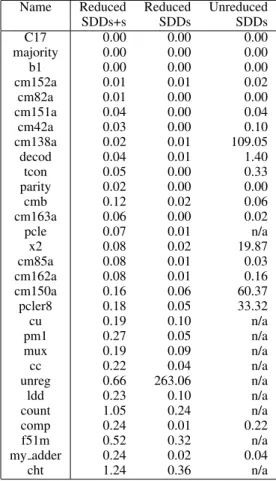
Tables 3 and 4 show the corresponding sizes and com-pilation times. According to these results, unreduced SDDs end up several orders of magnitude larger than the reduced ones, with or without dynamic vtree search. For the harder problems, this translates to orders-of-magnitude increase in compilation times. Often, we cannot even compile the input without reduction (due to running out of 4GB of memory), even on relatively easy benchmarks. For the easiest bench-marks, dynamic vtree search is slower due to the overhead, but yields smaller compilations. The benefit of vtree search shows only in harder problems (e.g., “unreg”).
This experiment clearly shows the advantage of reduced SDDs over unreduced ones, even though the latter supports a polytimeApplyfunction while the former does not. This begs an explanation and we provide one next that we back up by additional experimental results.
The benefit of reduced SDDs is canonicity, which plays a critical role in the performance of the Applyfunction. Consider in particular Line 4 of Algorithm 1. The test
Cache(α, β,◦)6=nilchecks whether SDDsαandβhave
been previously combined using the Boolean operator ◦. Without canonicity, it is possible that we would have com-bined someα0 andβ0 using◦, where SDDα0 is equivalent
Name Reduced Reduced Unreduced
SDDs+s SDDs SDDs C17 0.00 0.00 0.00 majority 0.00 0.00 0.00 b1 0.00 0.00 0.00 cm152a 0.01 0.01 0.02 cm82a 0.01 0.00 0.00 cm151a 0.04 0.00 0.04 cm42a 0.03 0.00 0.10 cm138a 0.02 0.01 109.05 decod 0.04 0.01 1.40 tcon 0.05 0.00 0.33 parity 0.02 0.00 0.00 cmb 0.12 0.02 0.06 cm163a 0.06 0.00 0.02 pcle 0.07 0.01 n/a x2 0.08 0.02 19.87 cm85a 0.08 0.01 0.03 cm162a 0.08 0.01 0.16 cm150a 0.16 0.06 60.37 pcler8 0.18 0.05 33.32 cu 0.19 0.10 n/a pm1 0.27 0.05 n/a mux 0.19 0.09 n/a cc 0.22 0.04 n/a unreg 0.66 263.06 n/a ldd 0.23 0.10 n/a count 1.05 0.24 n/a comp 0.24 0.01 0.22 f51m 0.52 0.32 n/a my adder 0.24 0.02 0.04 cht 1.24 0.36 n/a
Table 4: LGSynth89 compilation times, in seconds.
to, but distinct from SDDα(and similarly forβ0andβ). In this case, the cache test would fail, causing Applyto re-compute the same result again. Worse, the SDD returned by Apply(α, β,◦)may be distinct from the SDD returned by Apply(α0, β0,◦), even though the two SDDs are equivalent. This redundancy also happens whenαis not equivalent toα0 (and similarly forβandβ0),α◦βis equivalent toα0 ◦β0, but the result returned by Apply(α, β,◦)is distinct from the one returned byApply(α0, β0,◦).
Two observations are due here. First, this redundancy is still under control when callingApplyonly once:Apply runs in O(nm) time, wheren andm are the sizes of in-put SDDs. However, this redundancy becomes problematic when callingApplymultiple times (as in bottom-up com-pilation), in which case quadratic performance is no longer as attractive. For example, if we useApplyto combinem SDDs of sizeneach, all we can say is that the output will be of sizeO(nm). The second observation is that the previ-ous redundancy will not occur when working with reduced SDDs due to their canonicity: Two SDDs are equivalent iff they are represented by the same structure in memory.4
This analysis points to the following conclusion: While Applyhas a quadratic complexity on unreduced SDDs, it
4
This is due to the technique ofunique nodesfrom OBDDs; see
0.001 0.01 0.1 1 0 0.2 0.4 0.6 0.8 Frequency Relative size (a) Reduced SDDs 0.001 0.01 0.1 1 0 0.2 0.4 0.6 0.8 Frequency Relative size (b) Unreduced SDDs
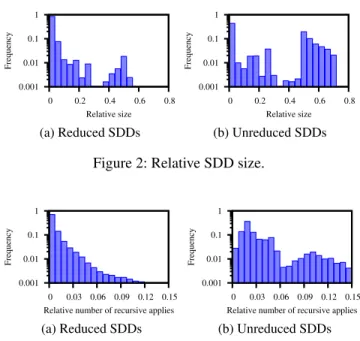
Figure 2: Relative SDD size.
0.001 0.01 0.1 1 0 0.03 0.06 0.09 0.12 0.15 Frequency
Relative number of recursive applies
(a) Reduced SDDs 0.001 0.01 0.1 1 0 0.03 0.06 0.09 0.12 0.15 Frequency
Relative number of recursive applies
(b) Unreduced SDDs
Figure 3: Relative number of recursiveApplycalls.
may have a worse average complexity thanApplyon re-duced SDDs. Our next experiment is indeed directed to-wards this hypothesis.
For all benchmarks in Table 3 that can be compiled with-out vtree search, we intercept all non-trivial calls toApply (when |α| · |β| > 500) and report the size of the output |α◦β|divided by|α| · |β|. For unreduced SDDs, we know that|α◦β|=O(|α| · |β|)and that these ratios are therefore bounded above by some constant. For reduced SDDs, how-ever, Theorem 3 states that there exists no constant bound.
Figure 2 shows the distribution of these ratios for the two methods (note the log scale). The number of function calls is 67,809 for reduced SDDs, vs. 1,626,591 for unreduced ones. The average ratio is 0.027 for reduced, vs. 0.101 for unre-duced. Contrasting the theoretical bounds, reducedApply incurs much smaller blowups than unreducedApply. This is most clear for ratios in the range [0.48,0.56], covering 30% of the unreduced, but only 2% of the reduced calls.
The results are similar when looking at runtime for indi-vidual Applycalls, which we measure by the number of recursiveApplycallsr. Figure 3 reports these, again rela-tive to|α| · |β|. The ratior/(|α| · |β|)is on average 0.013 for reduced SDDs, vs. 0.034 for unreduced ones These results corroborate our earlier analysis, suggesting that canonicity is quite important for the performance of bottom-up compilers as they make repeated calls to theApplyfunction. In fact, this can be more important than a polytimeApply, perhaps contrary to common wisdom which seems to emphasize the importance of polytimeApplyin effective bottom-up com-pilation (e.g., Pipatsrisawat and Darwiche (2008)).
Bounded Vtrees
Abounded vtreeis one for which the number of variables in any left subtree is bounded. This includes right-linear vtrees
which give rise to OBDDs, since each left subtree contains a single variable in this case. We now have the following. Theorem 4. The time and space complexity of Algorithm 1, with compression, is inO(nm), wherenandmare the sizes of its inputs, assuming that the input SDDs are reduced and respect a bounded vtree.
The compression step of Algorithm 1 identifies elements
(pi, s) and(pj, s) that share subs, and merges these ele-ments into the element(pi∨pj, s)by callingApply recur-sively to disjoin primespiandpj. Since the vtree is bounded, primespi andpj must be over a bounded number of vari-ables. Hence, the complexity of compression is bounded, leadingApplyto have the same complexity with or without compression.
For example, in right-linear vtrees (i.e., OBDDs), primes are literals over a single variable. Hence, all decision nodes are of the form{(X, α),(¬X, β)}. On these, compression occurs when α = β, resulting in the partition {(X ∨ ¬X, α)} = {(>, α)}, which trimming replaces byα. This corresponds to the OBDD reduction rule that eliminates de-cision nodes with isomorphic children (Bryant 1986).
Xue, Choi, and Darwiche (2012) showed a class of Boolean functions whose OBDDs have exponential size with respect to certain orders (right-linear vtrees), but which have SDDs of linear size when the vtrees are not right-linear (but have the same left-to-right variable order). The used vtrees, however, were not bounded. It would be interesting to see if a similar result can be obtained for bounded vtrees.
Conclusions
We have shown that theApplyfunction on reduced SDDs can take exponential time in the worst case, resolving a ques-tion that has been open since SDDs were first introduced. We have also pursued some of the theoretical and practi-cal implications of this result. On the theoretipracti-cal side, we showed that it implies an exponential complexity for various transformations, such as conditioning and existential quan-tification. We also identified the class of bounded vtrees, for which theApplyfunction can be implemented in polyno-mial time even for reduced SDDs. On the practical side, we argued empirically that working with reduced SDDs remains favorable, despite the polytime complexity of the Apply function on unreduced SDDs. The canonicity of reduced SDDs, we argued, is more valuable for bottom-up compi-lation than a polytimeApplydue to its role in facilitating caching and dynamic vtree search. Our findings appear con-trary to some of the common wisdom on the relationship be-tween bottom-up compilation, canonicity and the complex-ity of theApplyfunction.
Acknowledgments
We thank Arthur Choi, Doga Kisa, and Umut Oztok for helpful suggestions. This work was supported by ONR grant #N00014-12-1-0423, NSF grant #IIS-1118122, NSF grant #IIS-0916161, and the Research Foundation-Flanders (FWO-Vlaanderen). GVdB is also at KU Leuven, Belgium.
Complexity of Transformations
We now prove Theorem 3, stating that the results in Table 2 hold. We will first show the results for unreduced SDDs, and then prove the results for reduced SDDs.
Forunreduced SDDs, Darwiche (2011) showed support for∧BC,∨BC, and¬C(see Algorithm 1). We show sup-port for unreducedCDnext.
Theorem 5. We can condition an unreduced SDD on a lit-eral` in polynomial time by replacing ` by >and ¬` by
⊥. Moreover, when removing all elements whose prime is equivalent to⊥, the resulting sentence is an unreduced SDD. Proof. It is clear that the procedure transformsαinto a sen-tence that is logically equivalent toα|`: the first step directly follows the definition of conditioning, and the second step maintains logical equivalence. We need to show next that the result is syntactically an SDD, by showing that the primes in its partitions are consistent, exhaustive, and mutually ex-clusive. The second step enforces consistency of the primes. Moreover, if the primes are exhaustive, that is,p1∨· · ·∨pn≡ >, thenp1|`∨· · ·∨pn|`≡(p1∨· · ·∨pn)|`≡ >|`≡ >, and the result of conditioning is also exhaustive. Finally, when piandpjare mutually exclusive, that is,pi∧pj ≡ ⊥, then pi|`∧pj|` ≡(pi∧pj)|` ≡ ⊥|`≡ ⊥, and the conditioned primes are also mutually exclusive.
Support forSFOfollows from the support forCDand ∨BC. The negative results forFO,∧Cand∨Cfollow from identical OBDD results in Darwiche and Marquis (2002), and the fact that OBDDs are a special case of SDDs.
For reduced SDDs, the negative FO, ∧C and ∨C re-sults also follow from OBDD rere-sults. It is also clear from Algorithm 1 that negating a reduced SDD α by comput-ingApply(α,>,xor) does not cause any subs to become equivalent. Therefore, negating a reduced SDD leads to a reduced result, and reduced SDDs support¬C. The remain-ing results in Table 2, onCD,SFO,∧BCand∨BCare discussed next.
Theorem 6. There exists a class of Boolean functions
f(X1, . . . , Xn)and vtreesTn for which the reduced SDD
has size O(n), yet the reduced SDD for the function
f(X1, . . . , Xn)|`has sizeΩ(2n)for some literal`.
Proof. Consider the function fnc(X,Y,Z, W) = n _ i=1 i−1 ^ j=1 ¬Yj∧Yi∧[(Xi∧(W∨Zi))∨(¬Xi∧Zi)]
and the vtree depicted in Figure 4a.
The root of the reduce SDD for fnc is an (XY,ZW )-partition that respects vtree node 1, consisting of elements
n [ i=1 i−1 ^ j=1 ¬Yj∧Yi∧Xi, W ∨Zi , i−1 ^ j=1 ¬Yj∧Yi∧ ¬Xi, Zi , 1 Z∪ {W} 2 Y X
(a) For conditioning
1 X
L
(b) For forgetting
Figure 4: Vtree structures used in proofs
together with Vn
j=1¬Yj, ⊥
to make it exhaustive. The size of this partition is linear inn. It has the same primes as the unreduced SDD forfa
n used in the proof of Theorem 1, only now the partition is compressed, as all subs are distinct. The primes of this partition can be represented as com-pressed (X,Y)-partitions, exactly as in the second step for Theorem 1. The remaining primes and subs (overX, over Y, and overZ∪ {W}) are all simple conjunctions or dis-junctions of literals that have a linear reduced SDD repre-sentation for any vtree.
We have now obtained a polysize SDD. However, when we condition this SDD on the literal W, all n subs of the form W ∨ Zi become equivalent to >. Their el-ements need to be compressed into the single element
Wn i=1 Vi−1 j=1¬Yj∧Yi∧Xi, >
. Its prime is again the function fb
n(X,Y)for which Lemma 2 states that the re-duced SDD wrt vtree node 2 has exponential size.
Theorem 7. There is a class of Boolean functions
f(X1, . . . , Xn)and vtreesTn for which the reduced SDD
has sizeO(n), yet the reduced SDD for the Boolean func-tionf(X1, . . . , Xn)∧`has sizeΩ(2n)for some literal`.
Proof. Consider again the reduced SDD for fnc that was constructed in the proof of Theorem 6 for the vtree in Figure 4a. Conjoining this SDD with the SDD for literal W makes the n subs of the form W ∨ Zi equivalent to W ∧(W ∨Zi) = W. Compressing these creates the el-ement Wn i=1 Vi−1 j=1¬Yj∧Yi∧Xi, W , whose prime is again fnb(X,Y), which has no polysize reduced SDD for vtree node 2.
This already proves thatApplyis worst-case exponential when performing conjunctions on reduced SDDs. Given that reduced SDDs support polytime negation, this result gener-alizes to any binary Boolean operator◦that is functionally complete together with negation (Wernick 1942). Support for these operators would allow us to do polytime conjunc-tion by combining◦and negation. One such operator is dis-junction, which is therefore also is worst-case exponential.
Suppose now that we can perform singleton forgetting in polytime, which is defined as∃L.α= (α|L)∨(α|¬L). Then given any two reduced SDDsβ andγ respecting the same vtreeT, we can obtainβ ∨γ in polytime as follows. Add a new variableLto vtreeT, as depicted in Figure 4b. The reduced SDDαfor the function(L∧β)∨(¬L∧γ)has the
root partition{(L, β),(¬L, γ)}. ForgettingLfromαresults in the reduced SDD forβ∨γ. Hence, if single forgetting can be done in polytime, then bounded disjunction can also be done in polytime. Since the latter is impossible, the former is also impossible.
References
Bryant, R. E. 1986. Graph-based algorithms for Boolean function manipulation. IEEE Transactions on Computers
C-35:677–691.
Chavira, M., and Darwiche, A. 2008. On probabilistic in-ference by weighted model counting. Artificial Intelligence Journal172(6–7):772–799.
Chavira, M.; Darwiche, A.; and Jaeger, M. 2006. Compil-ing relational bayesian networks for exact inference. Inter-national Journal of Approximate Reasoning42(1):4–20. Choi, A., and Darwiche, A. 2013. Dynamic minimization of sentential decision diagrams. InProceedings of the 27th Conference on Artificial Intelligence (AAAI).
Choi, A.; Kisa, D.; and Darwiche, A. 2013. Compiling probabilistic graphical models using sentential decision dia-grams. InProceedings of the 12th European Conference on Symbolic and Quantitative Approaches to Reasoning with Uncertainty (ECSQARU).
Darwiche, A., and Marquis, P. 2002. A knowledge com-pilation map. Journal of Artificial Intelligence Research
17:229–264.
Darwiche, A. 2001. On the tractability of counting theory models and its application to belief revision and truth main-tenance. Journal of Applied Non-Classical Logics 11(1-2):11–34.
Darwiche, A. 2011. SDD: A new canonical representa-tion of proposirepresenta-tional knowledge bases. In Proceedings of the 22nd International Joint Conference on Artificial Intelli-gence, 819–826.
Elliott, P., and Williams, B. 2006. DNNF-based belief state estimation. InProceedings of the 21st National Conference on Artificial Intelligence (AAAI).
Fierens, D.; Van den Broeck, G.; Thon, I.; Gutmann, B.; and Raedt, L. D. 2011. Inference in probabilistic logic programs using weighted CNF’s. InUAI, 211–220.
Palacios, H.; Bonet, B.; Darwiche, A.; and Geffner, H. 2005. Pruning conformant plans by counting models on compiled d-DNNF representations. InProceedings of the 15th Inter-national Conference on Automated Planning and Schedul-ing, 141–150.
Pipatsrisawat, K., and Darwiche, A. 2008. New compila-tion languages based on structured decomposability. In Pro-ceedings of the Twenty-Third AAAI Conference on Artificial Intelligence (AAAI), 517–522.
Selman, B., and Kautz, H. 1996. Knowledge compilation and theory approximation. Journal of the ACM (JACM)
43(2):193–224.
Suciu, D.; Olteanu, D.; R´e, C.; and Koch, C. 2011. Proba-bilistic databases. Synthesis Lectures on Data Management
3(2):1–180.
Wernick, W. 1942. Complete sets of logical func-tions. Transactions of the American Mathematical Society
51(1):117–132.
Xue, Y.; Choi, A.; and Darwiche, A. 2012. Basing deci-sions on sentences in decision diagrams. InIn Proceedings of the Twenty-Sixth AAAI Conference on Artificial Intelli-gence (AAAI).