© 2019
Intelligent Computing & Optimization
Editors: Vasant, Pandian, Zelinka, Ivan, Weber, Gerhard-Wilhelm (Eds.)
Pandian Vasant
•Ivan Zelinka
Gerhard-Wilhelm Weber
Editors
Intelligent Computing &
Optimization
Editors Pandian Vasant
Department of Fundamental and Applied Sciences
Universiti Teknologi Petronas Tronoh, Perak, Malaysia Ivan Zelinka
Faculty of Electrical Engineering and Computer Science VŠB TU Ostrava Ostrava, Czech Republic
Gerhard-Wilhelm Weber Institute of Applied Mathematics METU
Ankara, Ankara, Turkey
ISSN 2194-5357 ISSN 2194-5365 (electronic) Advances in Intelligent Systems and Computing
ISBN 978-3-030-00978-6 ISBN 978-3-030-00979-3 (eBook) https://doi.org/10.1007/978-3-030-00979-3
Library of Congress Control Number: 2018955576
©Springer Nature Switzerland AG 2019
This work is subject to copyright. All rights are reserved by the Publisher, whether the whole or part of the material is concerned, specifically the rights of translation, reprinting, reuse of illustrations, recitation, broadcasting, reproduction on microfilms or in any other physical way, and transmission or information storage and retrieval, electronic adaptation, computer software, or by similar or dissimilar methodology now known or hereafter developed.
The use of general descriptive names, registered names, trademarks, service marks, etc. in this publication does not imply, even in the absence of a specific statement, that such names are exempt from the relevant protective laws and regulations and therefore free for general use.
The publisher, the authors and the editors are safe to assume that the advice and information in this book are believed to be true and accurate at the date of publication. Neither the publisher nor the authors or the editors give a warranty, express or implied, with respect to the material contained herein or for any errors or omissions that may have been made. The publisher remains neutral with regard to jurisdictional claims in published maps and institutional affiliations.
This Springer imprint is published by the registered company Springer Nature Switzerland AG The registered company address is: Gewerbestrasse 11, 6330 Cham, Switzerland
Preface
The first edition of the International Conference on Intelligent Computing and Optimization (ICO 2018) will be held during October 4–5, 2018, at Hard Rock Hotel Pattaya in Pattaya, Thailand. The objective of the international conference is to bring together the global research scholars, experts, and scientists in the research areas of Intelligent Computing and Optimization from all over the world to share their knowledge and experiences on the current research achievements in these fields. This conference provides a golden opportunity for global research commu-nity to interact and share their novel research results, findings, and innovative discoveries among their colleagues and friends. The proceedings of ICO 2018 is published by Springer (Advances in Intelligent Systems and Computing) and indexed by DBLP, EI, Google Scholar, Scopus, and Thomson ISI.
For this edition, the conference proceedings covered the innovative, original, and creative research areas of sustainability, smart cities, meta-heuristics optimization, cyber security, block chain, big data analytics, IoTs, renewable energy, artificial intelligence, power systems, reliability, and simulation. The authors are very enthusiastic to present thefinal presentation at the conference venue of Hard Rock Hotel in Pattaya, Thailand. The organizing committee would like to sincerely thank all the authors and the reviewers for their wonderful contribution for this confer-ence. The best and high-quality papers have been selected and reviewed by International Program Committee in order to publish in Advances in Intelligent System and Computingby Springer.
ICO 2018 will be an eye-opener for the research scholars across the planet in the research areas of innovative computing and novel optimization techniques and with the cutting-edge methodologies. This conference could not have been organized without the strong support and help from the staff members of Hard Rock Hotel Pattaya, Springer, Click Internet Traffic Sdn Bhd, and the organizing committee of ICO 2018. We would like to sincerely thank Prof. Igor Litvinchev (Nuevo Leon State University (UANL), Mexico), Prof. Nikolai Voropai (Energy Systems Institute SB RAS, Russia), and Waraporn Nimitsuphachaisin (Hard Rock Hotel Pattaya) for their great help and support in organizing the conference.
We also appreciate the fruitful guidance and support from Prof. Gerhard Wilhelm Weber (Poznan University of Technology, Poland; Middle East Technical University, Turkey), Prof. Rustem Popa (“Dunarea de Jos”University in Galati, Romania), Prof. Valeriy Kharchenko (Federal Scientific Agroengineering Center VIM, Russia), Dr. Wonsiri Punurai (Mahidol University), Prof. Milun Babic (University of Kragujevac, Serbia), Prof. Ivan Zelinka (VSB-TU Ostrava, Czech Republic), Dr. Jose Antonio Marmolejo (Universidad Anahuac Mexico Norte, Mexico), Prof. Gilberto Perez Lechuga (University of Autonomous of Hidalgo State, Mexico), Prof. Ugo Fiore (Federico II University, Italy), Prof. Weerakorn Ongsakul (Asian Institute of Technology, Thailand), Prof. Rui Miguel Silva (Portugal), Mr. Sattawat Yamcharoew (Sparrow Energy Corporation, Thailand), Mr. K. C. Choo (CO2 Networks, Malaysia), and Dr. Vinh T. Le (Ton Duc Thang University, Vietnam).
Our book of proceedings provides a premium reference to graduate and post-graduate students, decision makers, and investigators in private domains, univer-sities, traditional and emerging industries, governmental and non-governmental organizations, in the fields of various operational research, AI, geo- and earth sciences, engineering, management, business, andfinance, where ever one has to represent and solve uncertainty-affected practical and real-world problems. In the forthcoming times, mathematicians, statisticians, computer scientists, game theo-rists and economists, physicist, chemists, representatives of civil, electrical, and electronic engineering, but also biologists, scientists on natural resources, neuro-scientists, social neuro-scientists, and representatives of the humanities, are warmly welcome to enter into this discourse and join the collaboration for reaching even more advanced and sustainable solutions. It is well understood that predictability in uncertain environments is a core request and an issue in allfields of engineering, science, and management. In this regard, this proceedings book is following a quite new perspective; eventually, it has the promise to become very significant in both academia and practice and very important for mankind!
Finally, we would like to sincerely thank Dr. Thomas Ditzinger, Dr. Almas Schimmel, and Ms. Parvathi Krishnan of Springer for the wonderful help and support in publishing ICO 2018 conference proceedings inAdvances in Intelligent Systems and Computing.
October 2018 Pandian Vasant
Gerhard-Wilhem Weber Ivan Zelinka
Contents
АSystem for Monitoring the Number and Duration of Power Outages
and Power Quality in 0.38 kV Electrical Networks . . . 1 Alexander Vinogradov, Vadim Bolshev, Alina Vinogradova,
Tatyana Kudinova, Maksim Borodin, Anastasya Selesneva, and Nikolay Sorokin
A Novel Application of System Survival Signature in Reliability
Assessment of Offshore Structures. . . 11 Tobias-Emanuel Regenhardt, Md Samdani Azad, Wonsiri Punurai,
and Michael Beer
Security Assurance Against Cybercrime Ransomware. . . 21 Habib ur Rehman, Eiad Yafi, Mohammed Nazir, and Khurram Mustafa
SAR: A Graph-Based System with Text Stream Burst
Detection and Visualization . . . 35 Tham Vo Thi Hong and Phuc Do
Detection of Black Hole Attacks in Mobile Ad Hoc
Networks via HSA-CBDS Method . . . 46 Ahmed Mohammed Fahad, Abdulghani Ali Ahmed,
Abdullah H. Alghushami, and Sammer Alani
Network Intrusion Detection Framework Based on Whale Swarm
Algorithm and Artificial Neural Network in Cloud Computing . . . 56 Ahmed Mohammed Fahad, Abdulghani Ali Ahmed,
and Mohd Nizam Mohmad Kahar
The‘Smart’as a Project for the City Smart Technologies
for Territorial Management Planning Strategies . . . 66 Cinzia Bellone and Vasiliki Geropanta
The‘Governance’for Smart City Strategies
and Territorial Planning . . . 76 Cinzia Bellone, Pietro Ranucci, and Vasiliki Geropanta
T-MPP: A Novel Topic-Driven Meta-path-Based Approach for Co-authorship Prediction in Large-Scale Content-Based Heterogeneous Bibliographic Network in Distributed Computing
Framework by Spark. . . 87 Phuc Do, Phu Pham, Trung Phan, and Thuc Nguyen
Optimization of Hybrid Wind and Solar Renewable Energy System
by Iteration Method. . . 98 Diriba Kajela Geleta and Mukhdeep Singh Manshahia
Modeling of Solar Photovoltaic Thermal Modules . . . 108 Vladimir Panchenko, Valeriy Kharchenko, and Pandian Vasant
Thermo Physical Principles of Cogeneration Technology
with Concentration of Solar Radiation. . . 117 Peter Nesterenkov and Valeriy Kharchenko
Artificial Bee Colony Algorithm for Solving the Knight’s
Tour Problem. . . 129 Anan Banharnsakun
The Model of Optimization of Grain Drying with Use
of Eletroactivated Air. . . 139 Dmitry Budnikov and Alexey N. Vasilev
Model of Improved a Kernel Fast Learning Network Based
on Intrusion Detection System . . . 146 Mohammed Hasan Ali and Mohamed Fadli Zolkipli
Vehicular Ad Hoc Network: An Intensive Review . . . 158 Ayoob A. Ayoob, Gang Su, and Muamer N. Mohammed
Optimization of the Parameters of the Elastic Damping Mechanism in Class 1,4 Tractor Transmission for Work in the Main
Agricultural Operations. . . 168 Sergey Senkevich, Vladimir Kravchenko, Veronika Duriagina,
Anna Senkevich, and Evgeniy Vasilev
Energy-Efficient Pasteurizer of Liquid Products Using
IR and UV Radiation. . . 178 Dmitry Tikhomirov, Alexey Kuzmichev, Sergey Rastimeshin,
Stanislav Trunov, and Stepan Dudin
CAIAS Simulator: Self-driving Vehicle Simulator for AI Research. . . . 187 Sabir Hossain, Abdur R. Fayjie, Oualid Doukhi, and Deok-jin Lee
Vision-Based Driver’s Attention Monitoring System
for Smart Vehicles . . . 196 Lamia Alam and Mohammed Moshiul Hoque
Characterizing Current Features of Malicious Threats on Websites . . . 210 Wan Nurulsafawati Wan Manan, Abdul Ghani Ali Ahmed,
and Mohd Nizam Mohmad Kahar
A Deep Learning Framework on Generation of Image Descriptions
with Bidirectional Recurrent Neural Networks . . . 219 J. Joshua Thomas and Naris Pillai
Feature of Operation PV Installations with Parallel and Mixed
Commutation Photocells. . . 231 Pavel Kuznetsov and Leonid Yuferev
The Functional Dependencies of the Drying Coefficient for the Use
in Modeling of Heat and Moisture-Exchange Processes. . . 239 Alexey N. Vasilyev, Alexey A. Vasilyev, and Dmitriy A. Budnikov
Investigation Model for Locating Data Remnants on Cloud Storage . . . 246 Khalid Abdulrahman, Abdulghani Ali Ahmed,
and Muamer N. Mohammed
An Intelligent Expert System for Management Information System
Failure Diagnosis . . . 257 Kamal Mohammed Alhendawi and Ala Aldeen Al-Janabi
Fuzz Test Case Generation for Penetration Testing in Mobile Cloud
Computing Applications. . . 267 Ahmad Salah Al-Ahmad and Hasan Kahtan
Application of Travelling Salesman Problem for Minimizing Travel
Distance of a Two-Day Trip in Kuala Lumpur via Go KL City Bus. . . 277 Wan Nor Ashikin Wan Ahmad Fatthi, Mea Haslina Mohd Haris,
and Hasan Kahtan
An Analysis of Structure Heterogeneity of Lithium Silicate Melts . . . 285 Vu Tri Vien, Mai Van Dung, Nguyen Manh Tuan, Tran Thanh Nam,
and Le The Vinh
Mathematical Modeling of the Work of the Flow-Meter
Flowmeter-Doser . . . 293 Alexey N. Vasilyev, Alexey A. Vasilyev, Dmitry A. Shestov,
Denis V. Shilin, and Pavel E. Ganin
Framework for Faction of Data in Social Network Using Link Based
Mining Process. . . 300 B. Bazeer Ahamed and D. Yuvaraj
Application of Various Computer Tools for the Optimization of the Heat Pump Heating Systems with Extraction of Low-Grade
Heat from Surface Watercourses . . . 310 A. Sychov, V. Kharchenko, P. Vasant, and G. Uzakov
Epilepsy Detection from EEG Signals Using Artificial
Neural Network . . . 320 Amer A. Sallam, Muhammad Nomani Kabir, Abdulghani Ali Ahmed,
Khalid Farhan, and Ethar Tarek
Evaluation of the Silicon Solar Cell Parameters. . . 328 Valeriy Kharchenko, Boris Nikitin, Pavel Tikhonov, Vladimir Panchenko,
and Pandian Vasant
Optimization of Microclimate Parameters Inside
Livestock Buildings . . . 337 Gennady N. Samarin, Alexey N. Vasilyev, Alexander A. Zhukov,
and Sergey V. Soloviev
Blockchain Technology in Smart City: A New Opportunity for Smart
Environment and Smart Mobility . . . 346 F. Orecchini, A. Santiangeli, F. Zuccari, Alessandra Pieroni,
and Tiziano Suppa
Trend Detection Analyses of Rainfall of Whole India for the Time
Period 1950–2006. . . 355 Sanju R. Phulpagar, Sudhansu S. Mohanta, and Ganesh D. Kale
Multi-criteria Decision Making Problems in Hierarchical Technology
of Electric Power System Expansion Planning. . . 362 N. I. Voropai
Insight into Microstructure of Lead Silicate Melts from Molecular
Dynamics Simulation . . . 369 Thanh-Nam Tran, Nguyen Van Yen, Mai Van Dung, Tran Thanh Dung,
Huynh Van Van, and Le The Vinh
A Strategy for Minimum Time Equilibrium Targetting
in Epidemic Diseases . . . 376 Manuel De la Sen, Asier Ibeas, Santiago Alonso-Quesada, and Raul Nistal
A Hybrid Approach for the Prevention of Railway Accidents Based
on Artificial Intelligence. . . 383 Habib Hadj-Mabrouk
Visual Analytics Solution for Scheduling Processing Phases. . . 395 J. Joshua Thomas, Bahari Belaton, Ahamad Tajudin Khader, and Justtina
Investigation of Emotions on Purchased Item Reviews Using Machine
Learning Techniques . . . 409 P. K. Kumar, S. Nandagopalan, and L. N. Swamy
Algorithms for a Bit-Vector Encoding of Trees . . . 418 Kaoutar Ghazi, Laurent Beaudou, and Olivier Raynaud
Dynamic Programming Solution to ATM Cash Replenishment
Optimization Problem . . . 428 Fazilet Ozer, Ismail Hakki Toroslu, Pinar Karagoz, and Ferhat Yucel
Prediction of Crop Yields Based on Fuzzy Rule-Based System (FRBS)
Using the Takagi Sugeno-Kang Approach . . . 438 Kalpesh Borse and Prasit G. Agnihotri
Land Use Land Cover Analysis of Khapri Watershed in Dang District Using Remote Sensing (RS) and Geographical Information
System (GIS) . . . 448 Ashish Guruji and Prasit Agnihotri
Recovery Method of Supply Chain Under Ripple Effect: Supply Chain
Event Management (SCEM) Application . . . 455 Fanny Palma, Jania A. Saucedo, and JoséA. Marmolejo
Investigating the Reproducibility and Generality of the Pilot
Environmental Performance Index (EPI 2006). . . 466 Tatiana Tambouratzis, Angela Mathioudaki, and Kyriaki Bardi
New Smart Power Management Hybrid System
Photovoltaic-Fuel Cell . . . 476 Mohammed Tarik Benmessaoud, A. Boudghene Stambouli,
Pandian Vasant, S. Flazi, H. Koinuma, and M. Tioursi
Deep Convolutional Network Based Saliency Prediction for Retrieval
of Natural Images. . . 487 Shanmugam Nandagopalan and Pandralli K. Kumar
Optimization of Parameters and Operation Modes of the Heat Pump
in the Environment of the Low-Temperature Energy Source. . . 497 Evgenia Tutunina, Alexey Vaselyev, Sergey Korovkin,
and Sergey Senkevich
A Data Confidentiality Approach to SMS on Android. . . 505 Tun Myat Aung, Kaung Htet Myint, and Ni Ni Hla
Analysis of Attribute-Based Secure Data Sharing with Hidden Policies
in Smart Grid of IoT. . . 515 Nishant Doshi
A Single AllocationP-Hub Maximal Covering Model for Optimizing
Railway Station Location. . . 522 Sunarin Chanta and Ornurai Sangsawang
Path-Relinking for Fire Station Location. . . 531 Titima Srianan and Ornurai Sangsawang
Modeling and Optimization of Flexible Manufacturing Systems:
A Stochastic Approach. . . 539 Gilberto Pérez Lechuga and Francisco Martínez Sánchez
Monkey Algorithm for Packing Circles with Binary Variables . . . 547 Rafael Torres-Escobar, JoséAntonio Marmolejo-Saucedo, Igor Litvinchev,
and Pandian Vasant
Machine Learning Applied to the Measurement of Quality in Health Services in Mexico: The Case of the Social Protection
in Health System . . . 560 Roman Rodriguez-Aguilar, Jose Antonio Marmolejo-Saucedo,
and Pandian Vasant
Author Index. . . 573
Network Intrusion Detection Framework
Based on Whale Swarm Algorithm
and Arti
fi
cial Neural Network in Cloud
Computing
Ahmed Mohammed Fahad(&), Abdulghani Ali Ahmed, and Mohd Nizam Mohmad Kahar
Faculty of Computer Systems & Software Engineering, Universiti Malaysia Pahang, 26300 Kuantan, Malaysia
[email protected], {abdulghani,mnizam}@ump.edu.my
Abstract. Cloud computing is a rapidly developing Internet technology for facilitating various services to consumers. This technology suggests a consid-erable potential to the public or to large companies, such as Amazon, Google, Microsoft and IBM. This technology is aimed at providing aflexible IT archi-tecture which is accessible through the Internet for lightweight portability. However, many issues must be resolved before cloud computing can be accepted as a viable option to business computing. Cloud computing undergoes several challenges in security because it is prone to numerous attacks, such as
flooding attacks which are the major problems in cloud computing and one of the serious threat to cloud computing originates came from denial of service. This research is aimed at exploring the mechanisms or models that can detect attacks. Intrusion detection system is a detection model for these attacks and is divided into two-type H-IDS and N-IDS. We focus on the N-IDS in Eucalyptus cloud computing to detect DDoS attacks, such as UDP and TCP, to evaluate the output dataset in MATLAB. Therefore, all technology reviews will be solely based on network traffic data. Furthermore, the H-IDS is disregarded in this work.
Keywords: IDS
WOAANNTUIDSCloud computing1
Introduction
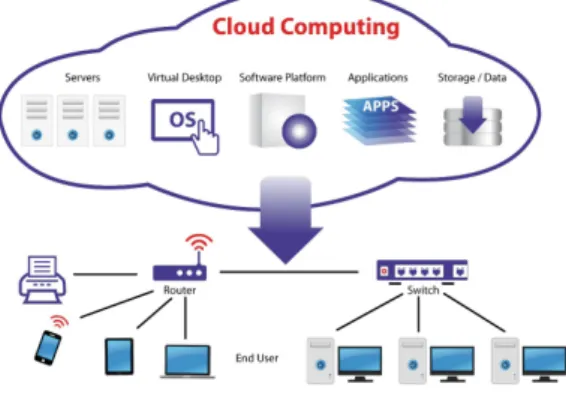
A cloud refers to a distinct IT environment that is designed to remotely provide scalable and measured IT resources [1]. This term originated as a metaphor for the Internet, which is a network of networks that provide a remote access to a set of decentralised IT resources [2]. The symbol of a cloud is commonly used to represent the Internet in various specifications and mainstream documentations of web-based architectures before cloud computing has become a formalised IT industry sector [3]. Figure1, illustrates the importance of cloud computing in remote services and virtual desktop applications [4].
©Springer Nature Switzerland AG 2019
P. Vasant et al. (Eds.): ICO 2018, AISC 866, pp. 56–65, 2019. https://doi.org/10.1007/978-3-030-00979-3_6
A crucial aspect of cloud security is detecting DDoS attacks [5] and intrusions that disrupt the resources of end-users or organisations [6]. An N-IDS can detect these types of attacks. However, the N-IDS in cloud computing is irrelevant if the attack classifier is inaccurately written [7]. A DDoS classifier in machine learning is neural networks. Several important studies have proposed various ANN-based machine learning clas-sifiers against DDoS in cloud computing [8]. However, considerable attention for accurate classification and reduction of false alarms remains necessary [9]. Hence, this work is aimed at proposing a new model, namely, WOA-ANN, to detect UDP/TCP flooding attacks in the N-IDS in cloud computing. To reduce the false alarm of the N-IDS system, the WOA-ANN model is used to enhance the accuracy of the N-IDS by improving the analysis of network traffic which will be generated by our cloud testbed. We compare the proposed model with existing works using MATLAB to evaluate and compare their efficiency. At the 2014 Black Hat conference, a pair of testers from Bishop Fox demonstrated the pooling of a free-tier public cloud service VM into a mini botnet that could mine bitcoin cryptocurrencies and potentially perform DDoS or password cracking [10]. Moreover, the qualities that make the public VM useful, that is, scalability, ease-of-use and stewardship by high-profile vendors, make this tech-nology an ideal platform for staging DDoS attacks [11].
2
Proposed Framework
Whales are the largest mammals in the world. An adult whale typically measures 30 m in length [12]. Several whale species include killer, Minke, Sei, humpback, right, finback and blue. Whales, as a predator, never sleep because they breathe on the ocean surface. These animals are intelligent and show emotions. Hof and Van Der Gucht highlighted that whales have brain cells, namely, spindle cells, in which are common in humans. These cells control emotions and social behaviours in humans. The number of spindle cells in whales is twice as much as that in an adult human; therefore, whales can think, learn, judge and communicate. For example, killer whales can create their own dialect.
Fig. 1. Cloud computing.
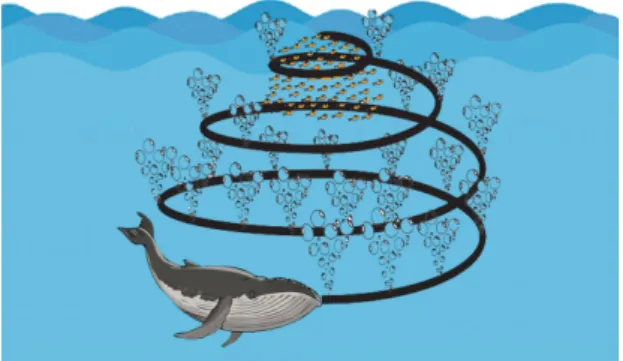
Most whales live in groups. A killer whale can live in a group in its lifetime [13]. Figure2 exhibits the largest baleen whale called humpback. Its size is comparable to that of a school bus. It typical preys on krill and small fish herds [14]. Its hunting method is called bubble-net feeding in which it hunts preys that are close to the surface. This method is accomplished by creating distinctive bubbles along a circle or a‘9’ -shaped path. Goldbogen et al. studied this interesting behaviour using tag sensors. A total of 300 tag-derived bubble-net feeding events were captured. These authors discovered that whales use‘upward-spiral’and‘double-loop’manoeuvre patterns.
For the‘upward-spiral’pattern, humpback whales dive 12 m below the surface and create bubbles in a spiral shape around the prey. Subsequently, they swim up towards the ocean surface. The latter pattern consists of three stages: coral loop, lob tail and capture loop. In the current work, this unique spiral bubble-net feeding manoeuvre pattern was used for optimisation.
The mathematical models of encircling preys, spiral bubble-net feeding manoeuvre and searching for preys were outlined. The WOA algorithm was then reported. Humpback whales are aware of the location of their preys whilst hunting. The current best candidate solution is assumed as the target prey in the WOA algorithm because the location of the optimal design in the search space is unknown. The positions of other search agents are updated by defining the optimal search agent. This behaviour can be explained by the following equations:
~Xðtþ1Þ ¼~XðtÞ ~B:~S ð1Þ
~S¼~K:~XðtÞ X~ðtÞ ð2Þ
where t is the current iteration, and are the coefficient vectors, is the position vector of the current best solution obtained and is the position vector. Here, is updated after iterations and are computed as
Fig. 2. WOA and bubble movement. 58 A. M. Fahad et al.
B
! ¼2!b:! r !b ð3Þ
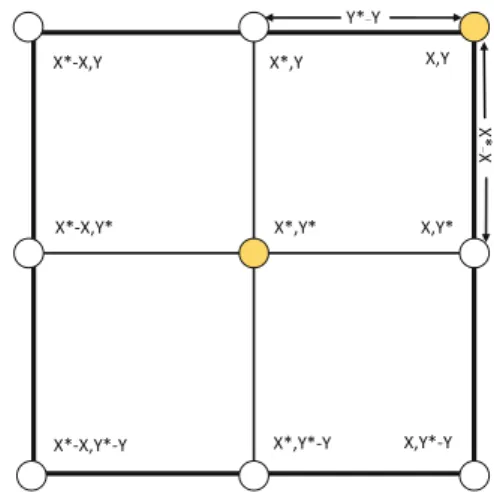
where decreases from 2 to 0 during the iterative phase, and is a random vector between [0, 1]. The rationale behind Eq. (2). Figure6 explain The new position (X, Y) of a search agent is updated on the basis of the current best position (X; Y). The locations of the optimal agent can be manipulated by adjusting the and vectors. Any position that is located within the search space is reachable by using the random vector, as displayed in Fig.3, which simulates the encircling prey movement of a whale. The same method can be applied to high-dimensional problems.
2.1 Bubble-Net Attacking Method (Exploitation Phase)
The bubble-net strategy can be performed using the following approaches:
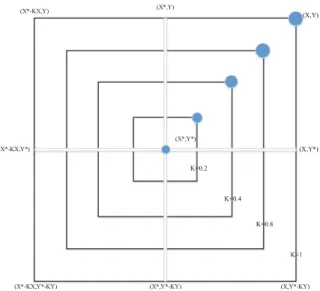
1. Shrinking encircling mechanism: This strategy is achieved via reducing the value of in Eq. (1) from 2 to 0 during the iterative procedure. The new position of a search agent can then be identified by setting the random values in [−1, 1].
Figure4, presents several possible solutions (X, Y) that can be obtained by setting 0 K 1.
2. Spiral updating position: In Fig.8, the distance between (X, Y) and (X; Y) is calculatedfirst. A spiral equation is then established to represent the helix-shaped movement:
~Xðtþ1Þ ¼S:eml:cosð2plÞ þ~XðtÞ: ð4Þ
where indicates the distance of the ith whale to the prey, m is a constant that defines the shape of the logarithmic spiral and l is a random number within the range [−1, 1]. In general, a humpback whale swims around the prey within a shrinking circle, following
X* − X Y*−Y X*-X,Y X*-X,Y* X*-X,Y*-Y X*,Y* X*,Y*-Y X,Y*-Y X,Y* X*,Y X,Y
Fig. 3. position vectors and their possible next locations (Xis the best solution obtained so far). Network Intrusion Detection Framework 59
the spiral-shaped path. A probability of 50% is prescribed on activating either the shrinking encircling mechanism or the spiral model whilst updating the whale position to model this condition.
The WOA algorithm is initialized using a set of random solutions. For each iter-ation, the positions of the search agents are updated based on a randomly selected search agent or the current best solution, depending on | | (Fig.5).
Theoretically, WOA is a global optimizer because it contains exploration and exploitation capabilities. Moreover, the current hypercube mechanism defines a search space in near the optimal solution, thus permitting other search agents to search for the
(X*,Y*) K=0.2 K=0.4 K=0.8 K=1 (X,Y) (X*,Y) (X*-KX,Y) (X*-KX,Y*)
(X*-KX,Y*-KY) (X*,Y*-KY) (X,Y*-KY)
(X,Y*)
Fig. 4. Possible solutions (X, Y).
(X*,Y*) (Di) (X,Y)
(0) (0.5) (1)
Fig. 5. Distance between (X, Y) and (X;Y). 60 A. M. Fahad et al.
current best record within the domain. The mathematical model of the adaptive version of the WOA algorithm is
~
Xðtþ1Þ ¼ ~X~ðtÞ ~B:~S if ‘\0:5 S0:emlcosð2plÞ þ~XðtÞ if ‘0:5
ð5Þ where is a random number between [0, 1]. In certain cases, a humpback whale searches for a prey randomly.
2.2 Searching for Prey (Exploration Phase)
The method can be adopted by using a similar approach of varying the vector to search for a prey (i.e. exploration). In the random method, with random values greater than or less than 1 is used to ensure that each search agent is far from the reference. Whale. Here, the position is updated randomly in accordance with the randomly selected search agent. The global search operation in WOA can be performed by applying this mechanism and setting | | > 1. The corresponding mathematical model is:
~S¼K~:~XrandðtÞ X~ðtÞ ð6Þ
~
Xðtþ1Þ ¼~XrandðtÞ ~B:~S ð7Þ
3
Classi
fi
er Design
In practice, a smooth transition between exploration and exploitation is feasible. Here, several iterations are allocated exploration (| | 1), whereas the remaining iterations are dedicated for exploitation (| | < 1). In WOA, only two main adjustable internal parameters are available. The current work considers a simple version of WOA by neglecting the other evolutionary operations that mimic the real behavior of humpback whales. Therefore, hybridization with evolutionary search schemes can be further explored (Fig.6).
The average values obtained from thefitness function are considered those of the candidate solutions. The value of thisfitness function is verified during the iteration until a new best value is found. The attribute that provides a minimum error value is selected to complete the selection and evaluation processes. Theflow of the proposed method is as follows:
E ið Þ ¼wTrain:TrainData:EþwTest:TestData:E ð8Þ where wTrain and wTest are the heights to be used for training and test data. The error values obtained from the training and test data will be used to calculate the fitness function. In the proposed method, wTrain: 0.7 and wTest: 0.3 are considered. E(i) denotes thefitness values obtained at the end of three runs. Figure8depicts the method
used by WOA to feed the weights and biases and produce additional training samples efficiently.
3.1 BFGS Quasi-Newton Backpropagation
Newton’s method is an alternative to conjugate gradient methods used for fast opti-mization. The basic step of Newton’s method is:
Xkþ1¼XkAk1gk ð9Þ
where is the Hessian matrix (second derivatives) of the performance index at the current values of the weights and biases. Newton’s method frequently converges faster than conjugate gradient methods. However, computing the Hessian matrix for feed-forward neural networks is complex and costly. A class of algorithms is based on Newton’s method and does not require calculating the second derivatives. These methods are called quasi-Newton (or secant). They update an approximate Hessian matrix at each iteration of the algorithm. The update is computed as a function of the gradient. This algorithm requires more computation in each iteration and more storage than the conjugate gradient methods, although it generally converges in few iterations. The approximate Hessian must be stored, and its dimension is n n, where n is equal to the number of weights and biases in the network. For large networks, using the conjugate gradient algorithms is favorable.
4
Model for N-IDS In-Eucalyptus Cloud Computing
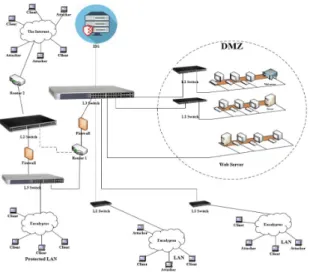
The proposed model is aimed at synthesizing the Eucalyptus cloud as the N-IDS that analyses the generated traffic and blocks the TCP/UDP flooding and Smurf DDoS attack. A TUIDS DDoS dataset is prepared using the TUIDS testbed architecture with a
Training Samples
WOA Optimiser WOA optimises ANN
weights and biases
Average MSE
Fig. 6. Process for collecting dataset and designing a classifier. 62 A. M. Fahad et al.
demilitarized zone (DMZ); hosts are divided into several VLANs, where each VLAN belongs to an L3 or L2 switch inside the network. The attackers are placed in wired and wireless networks with reflectors, but the target is placed inside the internal network. The target generates low- and high-rate DDoS traffics. We consider real-time low- and high-rate DDoS attack scenarios for both datasets during our experiments. However, a low-rate attack does not consume all computing resources on the server or bandwidth of the network that connects the server to the Internet. Hence, a real low-rate DDoS attack scenario contains attack and attack-free traffics. We mix low-rate attack and legitimate traffics during our experiment to prepare the real low-rate DDoS attack scenarios in the TUIDS DDoS dataset (Fig.7).
Many experiments have been conducted in this work to empirically demonstrate the impact of methodological factors, as discussed in Sect. 4.3.2. The experiments can be summarized as follows: General observations: exploring classifier performance and validation methods. Performance on original datasets: providing a benchmark that is used to compare the results obtained from subsequent experiments. Removing new attacks from the test set: this experiment is conducted to determine.
5
Classi
fi
er Process in MATLAB
We offer three specific benefits of classifier combinations. Statistical: if the amount of training data insufficiently models the hypothesis space with one classifier, then the combined knowledge of an ensemble of classifiers may reach accurate predictions. 2. Computational: algorithms can be trapped in local optima and finding the global optimum may be computationally expensive. However, executing several local search algorithms from different starting points and combining them may be favorable.
Fig. 7. New pre-processor rule structure in Eucalyptus cloud computing.
A hybrid classifier is developed in MATLAB using our dataset. First, we must perform the normalization process for the dataset. Then, the dataset will have been delivered to the training and testing sets in the following proportions: 70% training and 30% testing. The target will be TCP, UDP and Smurf attacks. The results are validated through evaluation which was derived from the machine learning metrics (Fig.8).
6
Conclusions
This work proposes a new classifier design based on a hybrid artificial neural network and whale swarm algorithm to feed the ANN weights and biases. However, the model cannot function without a derivative dataset. This dataset is derived from our testbed design based on a developed TUIDS network topology over the Eucalyptus cloud computing. In the N-IDS, sensing is used in real time for the normal and upnormal traffic DDoS attacks through Snort. The log-output from the dataset has been analyzed in MATLAB.
Acknowledgments. This work was supported by the Faculty of Computer System and Software Engineering, Universiti Malaysia Pahang under FRGS Grant No. RDU160106 and RDU Grant No. RDU160365.
References
1. Rittinghouse, J.W., Ransome, J.F.: Cloud Computing: Implementation, Management, and Security. CRC press, Boca Raton (2016)
Prepare a training dataset and perform the normalisation process
MATLAB software
Open Training Dataset
Select custom classifier in WOA-ANN
Selected Test Options
Results
Cross-validation folds=observation
Prediction error rates, confusion matrices and model estimators.
Prediction in formation
Fig. 8. WOA classifier test using MATLAB. 64 A. M. Fahad et al.
2. Ahmed, A.A., Jantan, A., Ali, G.A.: A potent model for unwanted traffic detection in QoS network domain. JDCTA4, 122–130 (2010)
3. Kaul, S., Sood, K., Jain, A.: Cloud computing and its emerging need: advantages and issues. Int. J. Adv. Res. Comput. Sci.8(3) (2017)
4. Sultan, N.: Cloud computing for education: a new dawn? Int. J. Inf. Manag.30(2), 109–116 (2010)
5. Mirkovic, J., Reiher, P.: A taxonomy of DDoS attack and DDoS defense mechanisms. ACM SIGCOMM Comput. Commun. Rev.34(2), 39–53 (2004)
6. Elejla, O.E., Jantan, A.B., Ahmed, A.A.: Three layers approach for network scanning detection. J. Theor. Appl. Inf. Technol.70(2) (2014)
7. Ahmed, A.A.: Investigation model for DDoS attack detection in real-time. Int. J. Softw. Eng. Comput. Sci. (IJSECS)1, 93–105 (2015)
8. Ahmed, A.A., Jantan, A., Wan, T.-C.: Filtration model for the detection of malicious traffic in large-scale networks. Comput. Commun.82, 59–70 (2016)
9. Rowland, C.H., Rhodes, A.L.: Method and system for reducing the false alarm rate of network intrusion detection systems. ed: Google Patents (2011)
10. Nanavati, M., Colp, P., Aiello, B., Warfield, A.: Cloud security: a gathering storm. Commun. ACM57(5), 70–79 (2014)
11. Ahmed, A.A., Sadiq, A.S., Zolkipli, M.F.: Traceback model for identifying sources of distributed attacks in real time. Secur. Commun. Netw.9(13), 2173–2185 (2016)
12. Mirjalili, S., Lewis, A.: The whale optimization algorithm. Adv. Eng. Softw.95(Supplement C), 51–67 (2016)
13. Mirjalili, S., Lewis, A.: The whale optimization algorithm. Adv. Eng. Softw.95, 51–67 (2016)
14. Aljarah, I., Faris, H., Mirjalili, S.: Optimizing connection weights in neural networks using the whale optimization algorithm. Soft Comput.22(1), 1–15 (2018)
Author Index
A
Abdulrahman, Khalid,246 Agnihotri, Prasit G.,438 Agnihotri, Prasit,448 Ahmed, Abdul Ghani Ali,210
Ahmed, Abdulghani Ali,46,56,246,320 Al-Ahmad, Ahmad Salah,267
Alam, Lamia,196 Alani, Sammer,46
Alghushami, Abdullah H.,46 Alhendawi, Kamal Mohammed,257 Ali, Mohammed Hasan,146 Al-Janabi, Ala Aldeen,257 Alonso-Quesada, Santiago,376 Aung, Tun Myat,505 Ayoob, Ayoob A.,158 Azad, Md Samdani,11 B Banharnsakun, Anan,129 Bardi, Kyriaki,466 Bazeer Ahamed, B.,300 Beaudou, Laurent,418 Beer, Michael,11 Belaton, Bahari,395 Bellone, Cinzia,66,76
Benmessaoud, Mohammed Tarik,476 Bolshev, Vadim,1
Borodin, Maksim,1 Borse, Kalpesh,438
Boudghene Stambouli, A.,476 Budnikov, Dmitriy A.,239 Budnikov, Dmitry,139 C Chanta, Sunarin,522 D De la Sen, Manuel,376 Do, Phuc,35,87 Doshi, Nishant,515 Doukhi, Oualid,187 Dudin, Stepan,178 Dung, Tran Thanh,369 Duriagina, Veronika,168
F
Fahad, Ahmed Mohammed,46,56 Farhan, Khalid,320
Fatthi, Wan Nor Ashikin Wan Ahmad,277 Fayjie, Abdur R.,187
Flazi, S.,476
G
Ganin, Pavel E.,293 Geleta, Diriba Kajela,98 Geropanta, Vasiliki,66,76 Ghazi, Kaoutar,418 Guruji, Ashish,448
H
Hadj-Mabrouk, Habib,383 Haris, Mea Haslina Mohd,277 Hla, Ni Ni,505
Hong, Tham Vo Thi,35 Hoque, Mohammed Moshiul,196 Hossain, Sabir,187
©Springer Nature Switzerland AG 2019
P. Vasant et al. (Eds.): ICO 2018, AISC 866, pp. 573–575, 2019. https://doi.org/10.1007/978-3-030-00979-3
I Ibeas, Asier,376 J Joshua Thomas, J.,219,395 Justtina,395 K
Kabir, Muhammad Nomani,320 Kahar, Mohd Nizam Mohmad,56,210 Kahtan, Hasan,267,277
Kale, Ganesh D.,355 Karagoz, Pinar,428
Khader, Ahamad Tajudin,395
Kharchenko, Valeriy,108,117,310,328 Koinuma, H.,476 Korovkin, Sergey,497 Kravchenko, Vladimir,168 Kudinova, Tatyana,1 Kumar, Pandralli K.,409,487 Kuzmichev, Alexey,178 Kuznetsov, Pavel,231 L
Lechuga, Gilberto Pérez,539 Lee, Deok-jin,187
Litvinchev, Igor,547
M
Manan, Wan Nurulsafawati Wan,210 Manshahia, Mukhdeep Singh,98 Marmolejo, JoséA.,455
Marmolejo-Saucedo, JoséAntonio,547,560 Mathioudaki, Angela,466
Mohammed, Muamer N.,158,246 Mohanta, Sudhansu S.,355 Mustafa, Khurram,21 Myint, Kaung Htet,505
N
Nam, Tran Thanh,285
Nandagopalan, Shanmugam,409,487 Nazir, Mohammed,21 Nesterenkov, Peter,117 Nguyen, Thuc,87 Nikitin, Boris,328 Nistal, Raul,376 O Orecchini, F.,346 Ozer, Fazilet,428 P Palma, Fanny,455 Panchenko, Vladimir,108,328 Pham, Phu,87 Phan, Trung,87 Phulpagar, Sanju R.,355 Pieroni, Alessandra,346 Pillai, Naris,219 Punurai, Wonsiri,11 R Ranucci, Pietro,76 Rastimeshin, Sergey,178 Raynaud, Olivier,418 Regenhardt, Tobias-Emanuel,11 Rehman, Habib ur,21
Rodriguez-Aguilar, Roman,560
S
Sallam, Amer A.,320 Samarin, Gennady N.,337 Sánchez, Francisco Martínez,539 Sangsawang, Ornurai,522,531 Santiangeli, A.,346
Saucedo, Jania A.,455 Selesneva, Anastasya,1 Senkevich, Anna,168 Senkevich, Sergey,168,497 Shestov, Dmitry A.,293 Shilin, Denis V.,293 Soloviev, Sergey V.,337 Sorokin, Nikolay,1 Srianan, Titima,531 Su, Gang,158 Suppa, Tiziano,346 Swamy, L. N.,409 Sychov, A.,310 T Tambouratzis, Tatiana,466 Tarek, Ethar,320 Tikhomirov, Dmitry,178 Tikhonov, Pavel,328 Tioursi, M.,476
Toroslu, Ismail Hakki,428 Torres-Escobar, Rafael,547 Tran, Thanh-Nam,369 Trunov, Stanislav,178 Tuan, Nguyen Manh,285 Tutunina, Evgenia,497
U
Uzakov, G.,310
V
Van Dung, Mai,285,369 Van Van, Huynh,369 Van Yen, Nguyen,369
Vasant, Pandian,108,310,328,476,547,560 Vaselyev, Alexey,497
Vasilev, Alexey N.,139 Vasilev, Evgeniy,168 Vasilyev, Alexey A.,239,293 Vasilyev, Alexey N.,239,293,337 Vien, Vu Tri,285 Vinh, Le The,285,369 Vinogradov, Alexander,1 Vinogradova, Alina,1 Voropai, N. I.,362 Y Yafi, Eiad,21 Yucel, Ferhat,428 Yuferev, Leonid,231 Yuvaraj, D.,300 Z
Zhukov, Alexander A.,337 Zolkipli, Mohamed Fadli,146 Zuccari, F.,346