Intermediation and Value Creation in an Incomplete Market:
Implications for Securitization
∗Preliminary Draft
Vishal Gaur†, Sridhar Seshadri†, Marti G. Subrahmanyam†
December 12, 2005
Abstract
This paper studies the impact of financial innovations on real investment decisions. We model an incomplete market economy comprised of firms, investors and an intermediary. The firms face unique investment opportunities that are not spanned by the securities traded in the financial market, and thus, cannot be priced uniquely using the no-arbitrage principle. The specific innovation we consider is securitization: the intermediary buys claims from the firms that are fully backed by cash flows from the new projects, pools these claims together, and then issues tranches of secondary securities to the investors. We first derive necessary and sufficient conditions under which pooling provides value enhancement from the new projects that are undertaken, and the prices paid to the firms are acceptable to them compared to the no-investment option or the option of forming alternative pools. We find that there is a unique pool that is sustainable, and which may or may not consist of all projects in the intermediary’s consideration set.
We then determine the optimal design of tranches, fully backed by the asset pool, to be sold to different investor classes. The new securities created by the intermediary could have up to three components, one that is a marketable claim, one that represents the arbitrage opportunities available in the market due to the special ability to design and sell securities to a subset of investors, and a third component that is the remainder of the asset pool sold to investors at a price not exceeding arbitrage-based bounds. The presence of these three components in the tranching solution has a direct bearing upon the size of the asset pool, and therefore, on value creation due to financing additional projects.
∗
The authors thank Kose John, Roy Radner and Rangarajan Sundaram for useful discussions. They also thank participants in seminars at Columbia University, Ente Einaudi, Rome, University of Melbourne, New York University, Rutgers University, the University of Venice, the Caesarea Center, Herzliya, Israel, and Stanford University, as well as in the 2004 European Finance Association meetings in Maastricht, the 2004 Informs meetings in Denver, and the 2005 European FMA Conference in Siena, for comments and suggestions made during this research.
†
Leonard N. Stern School of Business, New York University, 44 West 4th St., New York, NY 10012. E-mail:
1
Introduction
Do innovations in capital markets have an impact on real investment decisions, apart from providing arbitrage opportunities to the innovators? In other words, do such innovations permit investments in real assets that would otherwise not occur, because they are too costly to finance? The casual evidence suggests that the answers to these questions are in the affirmative, based on examples such as venture capital and private equity, project finance and securitization. In all these cases, the innovations allow financing to be provided for projects that might not be undertaken in their absence. Entrepreneurs and firm managers are able to undertake fresh investments in projects, since their “cost of capital” has been reduced as a result of the innovations, thus making the net present value of the projects positive.
Three alternative mechanisms may be responsible for the improved attractiveness of projects as a result of a financial innovation. The first is a reduction in the impact of market frictions, such as transaction costs, as a result of the innovation. The second is the effect of the innovation on the amelioration of asymmetric information effects, particularly in the context of the principal agent relationship between investors on the one hand and the entrepreneur/manager on the other. The third effect is through the improvement in the spanning across future states of world by the available securities in the market, as a result of the innovation. While the first two mechanisms have been used in a variety of models proposed in the literature to study the impact of financial innovations, such as venture capital funds, on real investment decisions, the third mechanism has not been adequately studied thus far.
We focus on the third argument based on incompleteness in markets, because we believe that it shows the effect of financial innovations on real investments, without making explicit assumptions about market frictions or information asymmetries. Instead, this line of argument explains the effect of innovation on real investment decisions through the existence of arbitrage opportunities in an incomplete market that are exploited by the innovating firm. Therefore, our paper provides the rationale for value creation by intermediaries through supporting project financing in the context of incomplete capital markets. We focus on the effect of securitization on the incentives to invest in new projects. Hence, our analysis is based on securities that are issued by firms, as a consequence of securitization, that are fully backed by cash flows from the new projects that are undertaken. We do not deal with purely repackaging existing securities, since we presume that there are no
arbitrage opportunities in the market as it exists prior to securitization.1
The phenomenon of securitization is now widespread in financial markets: mortgages, credit card receivables and various types of corporate debt instruments have been securitized using a variety of alternative structures. It began in the 1970s with the securitization of mortgage loans by Fannie Mae, Ginnie Mae and Freddie Mac, but has since expanded to other fixed income markets, including the corporate debt market. The common feature of these structures is that an intermediary purchases claims on cash flows issued by various entities, pools these claims into a portfolio, and then tranches them into marketable securities that cater to the investment needs of particular clienteles of investors.
To take the example of collateralized debt obligations (CDOs), the basic structure is that a financial intermediary sets up a special purpose vehicle (SPV) that buys a portfolio of debt instruments - bonds and/or loans - and adds credit derivatives on individual “names.” This is referred to as pooling. The SPV then issues various claims against the pooled portfolio, which enjoy different levels of seniority; the claims issued range from a super-senior claim, which typically a high-grade AAA claim, which has a negligible probability of not meeting its promised payment, to a medium-grade claim, say rated BBB+, which has a low but not negligible probability of such default, and finally, to an equity security, which is viewed as risky. The structuring of the claims to match investor tastes is referred to as tranching and the resulting claims are referred to as tranches. We study securitization transactions related to buying and selling of cash flows based on new assets in an economy. These transaction take place between three types of agents: firms, investors, and financial intermediaries. There are primary securities traded in the financial market at fair (i.e., arbitrage-free) prices. Firms have opportunities to invest in certain unique assets, and their objective is to maximize the present value of the cash flows from these assets. Investors are utility maximizers. Intermediaries purchase claims from firms that are fully backed by their cash flows, and issue two types of securities to be sold to investors. They can issue securities that are within the span of the financial market (marketable securities), or create new securities that are not spanned by the market (secondary securities). Throughout our analysis, we assume that firms are not large enough to influence the prices of the securities traded in the market, i.e., they are price-takers. We study whether, in an arbitrage-free setting, the transactions undertaken by the intermediary
1DeMarzo (2005) argues, quite correctly, that “market incompleteness cannot explain the construction of ...pools,
which do not augment the span of tradeable claims.” Our analysis below refers to the creation of new securities that are potentially outside the span of the existing market.
create value for firms and investors. The value for firms is created by permitting investments in real assets that would not be taken otherwise. The value to investors is created by satisfying demand for consumption in states that are not served by the primary securities traded in the financial market. We do not permit short sales of secondary securities by any agent and tranching of primary securities by intermediaries.
In our model, a firm is willing to invest in a new project when the project has a positive net present value, i.e., when the value of the project exceeds the value of the resources employed, characterized as the reservation price of the firm. The value of the project is usually derived from the capital market based on the twin assumptions that the cash flows from the project can be replicated in the financial market, and that all agents are price-takers with respect to financial claims. When markets are incomplete, the cash flows from such unique investment opportunities often cannot be fully replicated in the financial market; hence, only bounds can be placed on their present values. Therefore, projects whose values are unambiguously greater than their reservation prices are financed, while those whose values unambiguously fall below their respective reservation prices are rejected. This raises the following questions: (i) What are the conditions under which projects whose reservation prices lie inside the bounds on their values can be made acceptable through securitization? (ii) What are the incentives to firms to be willing to transact with the intermediary? Our paper addresses these questions. (iii) What is the structure of the securitization transactions undertaken by the intermediary?
We carry out the analysis in two parts. First, we study the phenomenon whereby financial intermediaries pool cash flows from the assets of several firms or divisions of a firm and issue securities that are within the span of the market. We assume that firms have reservation prices for undertaking investments in opportunities that are unique to them. In order to simulate competition in the intermediation process, we assume that firms can form coalitions with some or all of the other firms. Therefore, we formulate the firms’ decision problem as a cooperative game. We examine conditions under which incentives can be structured such that all firms participate in the creation of the asset pool. We show that there is a simple condition which is necessary and sufficient for all firms to participate in the game, which implies that all firms obtain at least their reservation prices and cannot do better by breaking away from the grand coalition. When this condition is not met, our analysis yields a strong result that there is a maximal pool of assets that is sustainable in the cooperative game. This pool is the one that maximizes the value enhancement provided by
pooling. We characterize the composition of this pool and show that it may or may not consist of all of the firms. Finally, we show how the intermediary can allocate the value of the asset pool fairly among contributing firms.
We then study the joint pooling and tranching problem, in which a financial intermediary first pools cash flows from several firms, and then issues securities against the pool. We expect pooling and tranching to provide greater value than pooling alone. In this part of the paper, we develop a method for determining the incremental value of tranching and the structuring of incentives so that firms participate in this modified setting. Additionally, we determine the general structure of the optimal tranches be issued to investors. The new securities created by the intermediary could have up to three components: one that is a marketable claim, one that represents the arbitrage opportunities available in the market due to special ability to design and sell securities to a subset of investors, and a third component that is the remainder of the asset pool which is sold to investors at a price not exceeding arbitrage based bounds. The presence of these three components in the tranching solution has direct bearing upon the size of the asset pool, and therefore, upon value creation due to financing additional projects. We find that tranching plays a somewhat different role than pooling. While it increases the value of projects financed similar to pooling, it could also result in more selective financing–projects that are more valuable to investors are more likely get financed. Due to this affects, the set of projects that are financed could be smaller or larger than what results from pooling alone.
It should be emphasized that the value creation studied in our paper is due to securities created from the cash flows of new projects. This is fundamentally different from profits that can arise in an incomplete market from arbitrage of existing securities. We exclude such arbitrage in our analysis, since we presume that it has already occurred prior to the innovation, and is reflected in the initial equilibrium in the market.
Our results can be applied to other examples of financial intermediation in the context of market incompleteness, such as the choice of investments by a venture capitalist matched by the (optimal) mix of claims issued against them to investors, or the optimal asset-liability mix of a bank. They can also be applied to traditional corporate financial problems such as mergers and acquisitions, optimal financing, and the valuation of real options. We discuss a few of these examples in §6.
This paper is organized as follows. Section 2 reviews the related literature on incomplete markets and securitization. Section 3 presents the model setup and assumptions. Section 4 analyzes the
conditions under which there is value in pooling and firms willingly participate in the creation of the asset pool. Section 5 analyzes the conditions under which there is value in pooling and tranching, and determines the optimal tranching strategy, §6 presents a numerical example illustrating the results of our paper, and§7 concludes with a discussion of the implications of our analysis.
2
Literature Review
Our research is related to the fairly sparse literature on securitization, broadly defined as the issuance of securities in the capital market that are backed or collateralized by a portfolio of assets. Most of this research has focused on the rationale for the widespread use of pooling and tranching in the asset-backed securities market. This rationale is largely based on market imperfections, mainly based on transaction costs and information asymmetry. Specific examples of securitization include the academic literature on “supershares” (i.e., tranches of the portfolio of all securities in the market), primes and scores (i.e., income and capital gains portions of a stock), and “bull” and “bear” bonds.2 More recently, specific examples of securitization have been analyzed by researchers, e.g., the assets of insurance companies (Cummins (2004)), and those of firms in financial distress (Ayotte and Gaon (2004)).
As mentioned earlier, two alternative economic explanations have been proposed in the literature for the securitization of assets. The first relates transaction costs to the welfare improvement that can be achieved by designing, creating and selling securities to meet the preferences of particular clienteles of investors or issuers. The other type of explanation has to do with some aspect of information asymmetry and the ability of an financial intermediary to reduce the agency costs resulting from it. The first type of explanation is typified by Allen and Gale (1991), who examine the incentive of a firm to issue a new security when there are transaction costs. Allen and Gale examine the incentive of a firm to issue claims that increase the spanning of states. They study an exchange equilibrium that results in an incomplete market. In their model, firms do not behave as price takers and also incur a cost of splitting the cash flows from their asset into financial claims. If the value of the firm is unaffected by splitting the cash flows, as is the case in a complete market, the firm has no incentive to do so. In an incomplete market, it may be possible to split the return into
2
See Hakansson (1978), and Jarrow and O’Hara (1989) for details. For example, Hakansson (1978) argues that options or supershares on the market portfolio improve the allocational efficiency of an existing market structure, even if the market portfolio itself is not efficient.
financial claims, i.e., innovate, and benefit from selling the new claims to investors. But not every firm needs to innovate. Even if a single firm amongst many similar ones, or a financial intermediary, for that matter, does so, investors can benefit if short sales are permitted. The new claims result in readjustment of consumption by investors, which, in turn, leads to a change in asset prices that may benefit the firm. There are two implications of this: a) the ex-postvalue of similar firms may be equal, thus reducing the incentive of any one firm to innovate, and b) the firm has an incentive to innovate new claims only if the prices change, i.e., if competition is imperfect.
We draw upon the model of Allen and Gale (1991), but our approach differs from theirs in significant ways. First, our model does not use a general equilibrium approach. The reason is that we are interested in obtaining more specific results, without considering the complex feedback effects that a general equilibrium analysis would entail. Second, we use a game-theoretic setting to ensure participation by firms. Third, we do not explicitly model the cost of issuing claims, since we wish to focus on value creation in a frictionless market. Fourth, our aim is to explicitly introduce a third type of agent - firms - into the exchange equilibrium and study how they can benefit from intermediation. Moreover, in our framework, the problem for firms is not just whether to issue new claims against returns from existing assets; rather, the problem is also to decide whether to undertake new projects. Lastly, in order to study the effect of intermediation and whether it helps more firms to undertake investments (or firms to invest in more projects), we have to necessarily limit short sales of secondary securities by investors - otherwise, investors can also intermediate. Therefore, we confine the financial innovation activity to designated financial intermediaries.
Many researchers have studied the effect of information asymmetry between issuers and investors in the context of securitization [see, for example, Leland and Pyle (1977), DeMarzo and Duffie (1999), and DeMarzo (2005)].3 Pooling and tranching assets are considered beneficial to both an informed issuer and an uninformed investor. Several authors have explored this question in detail. DeMarzo and Duffie (1999) address the broad question of security design in the context of asymmetric information between issuers of securities and investors, in the sense of the “lemons” problem of Akerlof (1970). They argue that the private information of the issuer regarding the payoffs from the securities may cause illiquidity in the form of a downward-sloping demand curve
3
There is an extensive literature on security design in the context of asymmetric information between “insiders” and investors, which can be traced back to the signalling model proposed by Leland and Pyle (1977). We mention here only those papers that are directly related to securitization of claims by pooling and tranching. DeMarzo and Duffie (1999) and DeMarzo (2005) provide a more detailed discussion of the broader literature.
for the securities. Hence, the issuer of the securities faces a trade-off between the retention costs of cash flows that are not part of the security design, and the liquidity costs of securities that are included in the design, due to their sensitivity to the issuer’s private information. Thus, in the context of information asymmetry, they provide a rationale for issuing multiple securities by “splitting” the cash flow stream of the firm. They also characterize the optimal security design and show that risky debt is an optimal contract. DeMarzo (2005) uses the same setting of information asymmetry between the issuer and investors to show that an informed issuer (or intermediary) does not prefer pure pooling, because it destroys the asset-specific information of the informed issuer. Instead, an informed intermediary prefers pooling and tranching to either pure pooling or separate asset sales because pooling and tranching enable an intermediary to design low-risk debt securities that minimize the information asymmetry between the intermediary and uninformed investors. DeMarzo calls this the “risk diversification effect” of pooling and tranching.
Pooling and tranching are also beneficial to uninformed investors. For example, Gorton and Pennachi (1990) show that uninformed investors prefer to split cash flows into a risk-less debt and an equity claim. The benefit to uninformed investors is that pooling reduces their adverse selection problem when competing with informed investors (DeMarzo 2005). In this context, Subrahmanyam (1991) shows that security index baskets are more liquid than the underlying stocks since the adverse selection costs are typically lower than for individual securities. The benefit to an informed issuer is that it reduces the issuer’s incentive to gather information, as argued by Glaeser and Kallal (1997). In their model, it is possible that more information may accentuate the “lemons” problem; in this context the pooling of assets is more advantageous, when private information is more accurate.
Unfortunately, even though these explanations might explain the structure of securities to an extent, they do not provide the motivation to innovate or securitize, especially in the context of originating firms, who then use the proceeds to undertake more projects.
To summarize, the differences between our paper and the prior work on securitization are as follows. Our work in this paper is based on an arbitrage-free pricing framework; however, we restrict the ability of some agents to take advantage of arbitrage opportunities. In our framework, only those who are designated as financial intermediaries are able to take full advantage of these opportunities. Also, our model assumes an incomplete securities market; but, we do not consider issues relating to transaction costs and information asymmetry, except in the indirect sense that the financial intermediaries in our model can undertake certain transactions that other agents
cannot. Another difference is that our paper analyzes thesimultaneous enhancement of the welfare of investors and the expansion of the set of value increasing projects undertaken by firms, due to the intermediaries’ intervention through the securitization of unspanned claims. We, therefore, consider multiple firms that have different assets (unlike Allen and Gale, who consider multiple firms that have the same asset). We relate securitization to the problem of financing projects and also to satisfying the needs of investor clienteles.
We have chosen to use the arbitrage-based approach of Harrison and Kreps (1979).4 It should not be construed that we are advocating only this approach. Instead, we believe that our method-ology shows how the set of projects that can be undertaken in an incomplete market expands due to intermediation. Indeed, one can derive an alternative formulation of our framework, yielding more specific conclusions, if we impose the additional restrictions on investor preferences or the reward-to-risk ratio in the market. We illustrate these ideas with an example: Consider a firm that wishes to undertake a project requiring an immediate investment, which results in uncertain and unspanned cash flows in the future. From the preceding discussion, it is clear that the firm cannot place an exact value on its cash flows, based on arbitrage-free pricing. The ambiguity regarding the value of the project is the source of the problem considered in this paper. We do not rule out the possibility that adopting one or the other more specific approaches described above might resolve the decision problem unequivocally. However, by using an arbitrage-free framework, the question we are able to answer is whether an intermediary can enhance the “value” by pooling assets from different firms and tranching them for sale to investors.
3
Model Setup
We consider an Arrow-Debreu economy in which time is indexed as 0 and 1.5 The set of possible states of nature at time 1 is Ω ={ω1, ω2, . . . , ωK}. For convenience, the state at time zero is denoted
as ω0. All agents have the same informational structure: The true state of nature is unknown at
t= 0 and is revealed at t= 1. Moreover, the K states are a complete enumeration of all possible events of interest, i.e., the subjective probability of any decision-maker is positive for each of these states and adds up to one when summed over all the states.
4
See also Ross (1976) and John (1981).
5
The model described below can be extended to a multi-period setting with some added complexity in the notation. However, the basic principles and results derived would still obtain.
3.1 Securities Market
We start with a market in whichN primary securities are traded via a financial exchange. Security
nhas pricepn and payoff Sn(ωk) in state k. These securities are issued by firms and purchased by
investors through the exchange. The securities market is arbitrage-free and frictionless, i.e., there are no transaction costs associated with the sale or purchase of securities. To keep the analysis uncluttered, cash flows are not discounted, i.e., the risk-free rate of interest is zero.
From standard theory, the absence of arbitrage is equivalent to postulating that there exists a set, Θ, of risk neutral pricing measures over Ω under which all traded securities are uniquely priced, i.e., Eq[Sn] =pn,for all nand for all q ∈Θ. It is well known that the set Θ is spanned by a finite
set of independent linear pricing measures.6 These are labelled {ql, l = 1, . . . , L}. In particular, when the set Θ is a singleton, the market is complete, else it is incomplete.
We use the following additional notation in the sequel. Not every claim can be priced uniquely in an incomplete market. When a claim cannot be priced uniquely, the standard theory provides bounds for the price of a claim Z that pays Z(ωk) in state k. Let V−(Z) = max{E[S] : S ≤
Z, S is attainable}, and letV+(Z) = min{E[S] : S ≥Z, S is attainable}. V−(Z) and V+(Z) are
well-defined and finite, and correspond to the lower and upper bound on the price of the claim
Z. Given that the set Θ is spanned by a finite set of independent linear pricing measures labelled
{ql, l= 1, . . . , L}, this can be formalized in the following Lemma. (All proofs are in the Appendix.)
Lemma 1. (i) V+(Z) = maxl∈LEql[Z].
(ii) V−(Z) = minl∈LEql[Z].
(iii) If the payoffs from the claim Z(ωk) are non-negative in all states, then these bounds are
unaffected by the inability of agents to short sell securities.
This lemma is needed for several proofs in the Appendix as well as for models in§4 and§5. Since we do not allow short sales of primary securities for the purpose of securitization, an important aspect of this lemma is that short sales restrictions do not affect the arbitrage-based price bounds if the payoffs of the contingent claim are non-negative.
6
A linear pricing measure is a probability measure that can take a value equal to zero in some states, whereas a risk neutral probability measure is strictly positive in all states. Thus, the set Θ is the interior of the convex set spanned by the set of independent linear pricing measures. The maximum dimension of this set equals the dimension of the solution set to a feasible finite-dimensional linear program, and thus, is finite. See Pliska (1997).
3.2 Agents
We consider three types of agents in our model: investors, firms, and intermediaries. Investors are utility maximizers. Their decision problem is to construct a portfolio of primary securities (subject to budget constraints), so as to maximize expected utility. Investors can buy or sell primary securities, but cannot short secondary securities or issue securities. Firms own (real) assets and issue primary securities that are fully backed by the cash flows from these assets. Firms can also create new assets and sell claims against the cash-flows from these assets to intermediaries.7 They negotiate with intermediaries to get the highest possible value for their assets that is consistent with the prices prevailing in the financial market. Intermediaries facilitate transactions between firms and investors by repackaging the claims purchased from the firms and issuing secondary securities traded on the over-the-counter securities market. We stipulate that the claims sold by firms to the intermediaries must be fully backed by their asset-cash flows, and the claims issued by the intermediaries should be fully backed by the assets purchased from firms. We also do not allow for short sales of secondary securities or tranching of primary securities by intermediaries.8 These assumptions enable us to isolate the roles of the three types of agents, and explicitly study the phenomenon of securitization through the intermediaries. A secondary reason for these assumptions is to avoid transactions that permit default in some states, because that would lead to complex questions relating to bankruptcy and renegotiation, which are outside the purview of this paper.
Having broadly described the various agents, we set out the details of their decision making problems as below:
Investors: We model investors by classifying them into investor types. The set of investor types
is finite and denoted as I. Each investor of type ihas endowment ei(ωk) in state k. The utility
derived by typeiinvestors is given by a von Neumann-Morgenstern functionUi :<×< → <+. Uiis
assumed to be concave, strictly increasing and bounded above. Investors maximize their expected utility, subject to the constraint that consumption is non-negative in every state.
Denote the consumption of typeiinvestors in statekasxikand let the subjective probability of 7The new assets created by firms may also include assets that are already in place, but not yet securitized. For
example, the loans made a bank that are presently held on the asset side of its balance sheet may be candidates for securitization in a collateralized loan obligations structure. The bank would be a “firm” in the context of our model. In these cases, of course, the decision to acquire the assets in question has already been made and, to that extent, part of the analysis in this paper would not apply directly.
8
statekbePi(ωk). Then, the investor derives expected utility equal toPKk=0Pi(ωk)Ui(xi0, xik). The
portfolio of primary securities held by a typei investor is denoted as theN-tuple of real numbers (αi1, αi2, . . . , αiN), where αin is the amount of security n in the portfolio. The type i investor’s
decision problem can be written as
max K X k=0 Pi(ωk)Ui(xi0, xik) subject to xik = ei(ωk) + N X n=1 αinSn(ωk), ∀ k= 1,2, . . . , K xi0 = ei(ω0)− N X n=1 αinp(n) xik ≥ 0, ∀ k= 0,1,2, . . . , K.
The first constraint equates the consumption in each state at time 1 with the cash flow provided by the portfolio and the endowment. The second specifies the budget constraint for investment in primary securities at time 0. The third constraint specifies that the cash flow in each state at time 1 should be non-negative.
Denote the derivatives of Ui with respect to xi0 andxik, k≥1 asUi1 andUi2 respectively. We
shall assume, as customary, that the current period consumption is strictly bounded away from zero for investor types. It follows that, at optimality,
K X k=1 Pi(ωk) Ui2(xi0, xik) PK k=1Pi(ωk)Ui1(xi0, xik) Sn(ωk)≤pn.
Here, we obtain an inequality because of the restriction on consumption. The choice of the zero for the minimum consumption level is arbitrary, and could be changed to any other level of consumption that an investor type is loathe to fall below. The same effect is produced by short sales restrictions placed on individual investors. The inequality suggests that, in statek, typeiinvestors are willing to buy an infinitesimal amount of consumption at a price, mik given by
mik=Pi(ωk)
Ui2(xi0, xik)
PK
k=1Pi(ωk)Ui1(xi0, xik)
.
These values are called the state prices (also called reservation prices) of investors. We require that each security is present in the optimal portfolio of at least one investor type. If no restrictions are placed on consumption levels or short sales of primary securities, then the state prices of each investor type will belong to the set Θ.
We note that the reservation price for an unspanned state may differ amongst investor types due to the incompleteness of the market. We assume that an investor of typeiis willing to buy not only consumption that is specific to statek, but also secondary securities issued by the intermediary if the price of the secondary security is below that given by valuing its state dependent cash flows, using the investors’ reservation prices.
Firms: Firms maximize the time 0 expected values of their investments. Firm j can create an
assetXj that is unique to it. The asset provides a positive cash flow ofXj(ωk) in each state k, at
time t= 1. The firm can sell claims issued against Xj to the intermediary. Claims issued against
Xj should be fully backed by Xj; in other words, the sum promised should not exceed the cash
flow from Xj in any state of nature. We assume that firm j has a reservation price rj on Xj.
The reservation price could be comprised of financial, physical and transaction costs, as well as opportunity costs of the key decision-makers of the firm that are required to create the asset. The firm invests in the asset, if the net present value, given by the difference between the selling price offered by the intermediary and the reservation price, is positive. Additionally, firms cannot trade with other firms directly and also cannot issue claims that are not fully backed by their assets. Let
J denote the number of firms that wish to undertake investment projects at time 0. We assume that the total cash flow available from this set of firms in any statek,PJ
j=1Xj(ωk),
is small relative to the size of the economy. Each firm, therefore, behaves as a price-taker in the securities market. However, when the asset cannot be priced precisely, it negotiates with the intermediary for obtaining the highest possible price for securitization of the asset. In the rest of this paper, we use Xj to refer to both the j-th asset and the cash flows from thej-th asset.
Intermediaries: Intermediaries are agents who have knowledge about the firms’ and investors’
asset requirements. Notice that such knowledge is different from receiving a private signal regarding the future outcome. Hence, intermediaries have no superior information about future cash flows, relative to other agents in the economy. The intermediaries purchase assets from firms and repackage them to sell to investors. They seek to exploit price enhancement through securitization operations that increase the spanning of available securities. They use this superior ability to negotiate with the firms for the prices of their assets. They use the knowledge about the investors’ preferences to create new claims and price them correctly. An important aspect of the model is that intermediaries act fairly bypayingthe same price for the same asset, independent of which firm is selling it to the
pool, andchargingthe same price for the same product even though it is sold to different customers. The rationale for these fairness requirements is the possibility of entry and competition from other intermediaries. However, we do not explicitly model competition amongst intermediaries beyond imposing the fairness requirements and the participation constraints by firms that are discussed in the next section. Hence, in what follows, we consider the securitization problem from the viewpoint of a single intermediary.
The intermediary purchases claims from firms, pools them and packages them into different
tranches, and sells them as collateralized secondary securities. Pooling is defined as combining the cash flows from claims issued by different firms in a proportion determined by the intermediary. The intermediary is not restricted to purchasing only all or none of a firm’s cash flows. Instead, it can purchase fractions (between 0 and 1) of the available assets. Tranching is defined as splitting the pooled asset into sub-portfolios to be sold to different groups of investors, with the constraint that the sub-portfolios be fully collateralized, i.e., fully backed by the claims purchased from the firms. We assume that the intermediary can sell secondary securities to investors in a subset of the investor classes, which is denoted asI1⊂I.
4
Value of Pooling
We attribute the beneficial role played by the intermediary to two factors: the value enhancement provided by pooling alone, and the value provided by tranching. In this section, we consider the former. We analyze the problem of pooling the cash flows of some or all firms and valuing the pooled asset by replicating its cash flows in the securities market. We use the lower bound V−(·) as a measure of value, and thus, compute the lowest price at which the pooled asset can be sold without presenting opportunities for arbitrage. The reason why V−(·) is taken as a measure of value is that it is the price at which the claim can be sold for sure in the market without assuming any knowledge about investors’ preferences and state prices. Of course, a price higher than V−(·) is possible when preferences and state prices are known at least for a subset of investors. In§6, we address how such higher value is realized through the tranching problem.
From one perspective, there is value to pooling if the lower bound on the pooled asset exceeds the sum of the lower bounds on the individual assets. This is likely to happen in an incomplete market, because we expect a larger fraction of the pooled cash flows to be marketable compared to the individual components. From an entirely different, and somewhat more subtle, perspective,
which is the focus of this paper, value gets created when more projects are undertaken by firms, as a consequence of the innovation. We describe how this real effect could come about due to intermediation.
Consider any given firmj. Ifrj ≤V−(Xj), then clearly, firmjcan profitably invest in assetXj,
even without pooling. Ifrj ≥V+(Xj), then it does not make sense for the firm to invest in the asset
Xj. The interesting case is the one where V+(Xj)≥rj ≥V−(Xj), because, in this case, the basis
for the decision to invest inXjis ambiguous. For example, suppose that the cash flows of the pooled
asset are given by X(ωk) = PjXj(ωk) for all k. Clearly, we have V−(X) ≥ PjV−(Xj).9 This
example shows that pooling improves the spanning of cash flows across states, and thus, provides value enhancement. However, we still need to consider the reservation prices of firms to determine if pooling reduces the ambiguity regarding investment in assets. We say that there is value to pooling in this latter sense if there is a linear combination of assets with weight 0 ≤ αj ≤ 1 for asset j
such that even though for one or more j’s V−(Xj) < rj, we obtain V−(Pj(αjXj)) ≥ Pj(αjrj)
and αj > 0 for at least one of the firms whose value is below its reservation price. Another
way of defining this type of value creation is that set of projects fully or partially financed from payments derived from the asset pool is larger than the set of such projects prior to pooling. In our formulation, firms need not behave altruistically in creating the asset pool; therefore, as an additional condition for value creation, we require that firms should have an incentive to pool their assets only when they cannot benefit, individually or severally, from breaking away from the pool. Theorem 1 shows the necessary condition for creating value through pooling. The rest of the section determines sufficient conditions for value creation.
Theorem 1. (i) If there is a q ∈ Θ such that rj ≥ Eq[Xj] ∀ j, then value cannot be created by
pooling theXj’s.
(ii) Conversely, if there is no q ∈ Θ such that rj ≥ Eq[Xj] ∀ j, then value can be created by
pooling theXj’s.
The first part of the theorem states that if the reservation price for each asset is higher than its value under a common pricing measure, then additional value cannot be created through pooling. Conversely, if the condition in part (i) of the theorem fails to hold, then part(ii) states the positive
9
The left hand side is given by minimizing the sum of the cash flows from all assets over the set of probability measures; whereas the right hand side the sum of the minimum of each individual cash flow. The minimum of the sum is always larger than or equal to the sum of minimums.
part of the result, that is, there exists a set of values {αj} such that value is enhanced through pooling. There can be several such sets of values of {αj}. For ease of presentation, we initially
assume that the condition in Theorem 1(ii) holds forαj = 1 for allj, i.e., there is value in pooling
all the cash flows from all firms. We first present all the results under this assumption. Then, we generalize them to the case when the condition in Theorem 1(ii) holds, but necessarily with 0< αj <1 to create value by pooling.
As mentioned before, even when the value of the pooled asset exceeds the sum of the reservation prices, some firms may be unwilling to participate in the asset pool. For example, this could happen if one firm has a very high reservation price; therefore, the remaining firms are better off keeping it out of the pool. To see this, note that adding firms to the pool might make the combined cash flows more marketable. However, adding firms imposes incremental costs due to the additional payments necessary, which may exceed the enhancement in value. This naturally leads to the following set of questions: Can we characterize reservation prices such that there is an incentive for firms to pool their assets? Can a fair price be set for each Xj? How many asset pools would be created and
what would be the composition of these asset pools? The remainder of this section answers these questions.
We stipulate that firms will participate in the pool only if they cannot do better by forming sub-coalitions amongst themselves. Therefore, the firms’ participation problem is a cooperative game,
G. Let Jw denote a subset of the set of all firms, J, wherein each firm j contributes a fraction
wj ∈[0,1] of its cash flows with proportional reservation price wjrj. LetJwc =J −Jw denote the
complement of Jw, wherein the contribution of each firm j is (1−wj)Xj and reservation price is
(1−wj)rj. Also letX(Jw) =Pj∈JwwjXj. We consider the cooperative game in which the value
of each coalition,V(Jw), is defined asV−(X(Jw)). Following standard terminology for cooperative
games, we say that there is a solution to this game, i.e., its core is non-empty, if the grand coalition of all firms cannot be blocked. The theorem below provides sufficient conditions for the core of the game to be non-empty, as well as conditions that guarantee that payments can be made to the firms to cover their reservation prices. These results can be related to the arguments for pooling presented in the context of information asymmetry by Leland and Pyle (1977), Subrahmanyam (1991), and especially DeMarzo (2005). In these papers, the benefits from pooling arise from a reduction in adverse selection costs and improvement in liquidity due to pooling. In our case, the benefits from pooling arise entirely from the improvement in spanning that occurs even after
compensating the particular firms for their reservation prices. Clearly, both arguments complement each other in explaining real world applications of pooling.
Theorem 2. (i) Ifrj ≤V−(Xj) for allj, then the core of game G is not empty.
(ii) There is a solution in the core to G such that the payments to all firms exceed their reser-vation prices if and only if for every subset Jw of J, we have V(J) ≥max(V(Jw),Pj∈Jwwjrj) +
max(V(Jwc),P
j∈Jc
w(1−wj)rj).
Theorem 2(i) is based on an argument from Owen (1975) and Samet and Zemel (1984). The gameG is a linear program (LP). These papers analyze the solution to games of this type. ***Ref-erence to Geneapkolous et al.
Theorem 2(ii) essentially states that the necessary condition for the payments to firms to support the core is also sufficient to guarantee its existence. It is easy to see that the condition implies the condition in Theorem 1(ii). The necessary part of Theorem 2(ii) is immediate, because under every solution in the core, each coalition Jw should get at least max(V(Jw),Pj∈Jwwjrj). If this
condition does not hold, then either some coalition does not get its value (and can do better on its own) or the payment to the firms in some coalition cannot cover the sum of the reservation prices. Part (ii) of the theorem shows that when the condition holds for all possible Jw, all firms
participate and all projects are financed in full. Notice that we do not need to verify the condition in Theorem 2(ii) for all possible partitions of J. Instead, verifying the condition for partitions of size two is sufficient.
Notice also that the inequalities in Theorem 2(ii) must be tested not only for partitions where
wj = 0 or 1 but also for fractional values ofwj, i.e., partitions where a firm belongs to two or more
subsets and divides its cash flows between them. Thus, there is a continuum of partitions making it virtually impossible to use Theorem 2(ii) directly in practice to determine the composition of the asset pool. However, this task can be avoided. We show that there is a simple condition which is necessary and sufficient for all the inequalities in 2(ii) to be satisfied. Thus, under this condition, the cash flows from each asset Xj are included fully in the pool and the core of the cooperative
game is not empty.
Theorem 3. Letq ∈Θbe a pricing measure under whichP
jEq[Xj] =V−(PjXj). IfEq[Xj]≥rj
for all j and some such q, then the sufficiency conditions in Theorem 2(ii) are satisfied. The converse is also true.
We remark on the symmetry between this result and Theorem 1(i). The earlier result, viz., Theorem 1(i), is that if under a common pricing measure each asset’s value is less than its reservation price then there is no value in pooling. The new result is that if under the extreme pricing measure that minimizes the value of the asset pool, the value of each asset equals or exceeds its reservation price then value can be created by pooling all assets. Also, value is created (in the sense of additional projects being undertaken) if some project whose value was below the reservation price gets financed through the pooling effect.
While Theorems 2 and 3 show that there exist payment schemes such that firms are willing to participate in the game G, we need to address the question of actually determining the payment scheme to the firms, which we now turn to. It is possible to show that there could be many such schemes but we also require the scheme to be ‘fair’. It is difficult to work with the concept of ‘fairness’ in full generality. However, a case can be made that if all firms are paid the same price for a unit cash flow in state k, then the scheme is surely fair. We therefore restrict ourselves to payments determined using a linear pricing measure, which does not compensate for pricing synergies across states. The following corollary complements the results so far, because it uses the sufficient condition of the Theorem 3 to construct a linear pricing scheme.
Corollary 1. If a pricing measure qp exists that is either an extreme point of the set of risk
neutral probability measures, or a convex combination of such extreme points, such thatP
jEqpXj = V−(P
jXj), and the reservation prices satisfy rj ≤EqpXj, then the grand coalition of all firms can
be sustained when firm j is paid EqpXj.
Corollary 1 shows that value enhancement (from the first perspective) due to pooling can be construed to be given by the change in the pricing measure that is necessary to value the assets correctly. This is readily seen by assuming that rj ≥ V−[Xj] = Eqj[Xj], that is, firm j cannot
decide whether to invest in the project based on the minimum valuation. Notice that the measure to determine the minimum value of each firm’s asset, qj, depends on the cash flow of the asset
which is being valued and it provides the lower bound V−[Xj]. The measure to determine the
value when the project is considered to be part of the asset pool depends on the cash flow of the
entire asset pool. This yields a higher value. The firm surely gains when the reservation price lies within these two bounds. Moreover, when we are restricted to compensate firms using the same pricing measure, we are assured that the gain from pooling can be used to induce all firms to participate when rj ≤EqpXj. This is the second source of value creation.
There are other interesting aspects to the corollary. The scheme is fair because it uses the same pricing formula for each firm. The measure also prices the traded securities correctly. Thus, the firms can use a market benchmark to assure themselves that the intermediary is fair. In the next section, we shall examine how far these results carry over when the intermediary can tranche the pool to create secondary securities.
The above results characterize the situations in which all firms participate and contribute all their assets. A critical condition for ‘full’ participation by firms isEqp(Xj)≥rj for all j and qp as
defined in Theorem 3. Also, note that according to Theorem 1, there are situations where there is value in pooling only fractions of cash flows of the firms. Further, there may be several sets of values{αj}that provide value in pooling. The following corollary highlights one such solution. We
show that there exists a set of optimal values of {αj}, denoted {α∗j}, that maximize the value of
the pool. Further, if we treat α∗jXj’s as the constituent assets instead of Xj’s, then Theorems 2
and 3 still apply to this asset pool.
Corollary 2. If the condition in Theorem 1 holds, then the value of pooling is maximized by
solving the linear program: maxV−(P
jαj(Xj))−Pjαjrj, subject to0≤αj ≤1, ∀j. An optimal
solution to this linear program, {α∗j}, is in the core of G. Assets of firms whose value exceeded their reservation price will be included fully in this asset pool. Moreover, the leftover cash flows
{(1−α∗j)Xj} do not provide any value in pooling.
Corollary 2 is consistent with Theorem 3 because ifEqp[Xj]≥rj for allj then it can be shown
that setting α∗j = 1 for all j gives an optimal solution to the linear program in Corollary 2. Of course, it is difficult to construct a fair payment scheme because it will simultaneously require limiting the fraction of assets purchased at that price. Value creation from the both perspectives is possible. We do not discuss how firms that get only a fraction of their assets included in the pool will finance the balance. For this reason, we also do not discuss whether value creation is more likely due to increase in the value of the pool than due to the financing of additional projects.
In summary, this section fully characterizes the value in pooling. Theorem 1(i) and (ii) show the conditions under which there is no value in pooling and those under which there is value in pooling. In the latter case, Theorems 2 and 3 and Corollary 2 together show that there will only be one coalition formed. This coalition achieves the maximum value of pooling. It includes all the assets when the condition in Theorem 3 holds, and fractional assets otherwise. Corollary 1 guarantees the existence of a linear payment scheme for this coalition. The assets not included in
this coalition cannot be constituted as a separate value enhancing pool. The value creation comes about due to synergies in cash flows amongst assets as viewed from the market prices of primary securities. The altruistic behavior of a firm or a subset of firms does not impeded the correct (value maximizing) pool from forming. Thus, intermediation and pooling are predictable outcomes in our setting.
5
Value of Pooling and Tranching
In this section, we assume that, in addition to tranches that are replicas of primary securities already traded in the securities market, the intermediary can also sell new securities, fully backed by the pool of assets, directly to investors. We call the former marketable tranches, and the latter non-marketable tranches or secondary securities. If the sum of the prices of marketable tranches (which are unique) and the prices of non-marketable tranche (which are obtained by selling each tranche at investor-specific state prices mik) exceeds the value V−(·) obtained by pure pooling,
then we shall conclude that tranching provides value enhancement beyond pure pooling. In general, the cash flows from a given asset pool, say, P
jwjXj can be split into several
tranches, and each tranche offered to every investor type. Recall that mik denotes the state price
of investor typei, for a unit consumption in statek. Let
m∗k = max
i∈I1 mik.
where I1 is the subset of investor classes to whom the intermediary can sell secondary securities.
It is clear that the cash flow in statekshould be sold to the investor type that values it the most. Therefore, the maximum price that the intermediary expects from a tranche sold in state kism∗k. We first derive the optimal tranching solution for a given asset pool. Later on, we examine whether the additional ability to trache the pool, in turn, influences the choice of the asset pool in the first place.
Given the asset pool, we formulate the problem of designing the optimal tranches that maximize the value of the asset pool as follows:
VT(J) = max X k m∗k(Yk−lk) + X n pnβn (1)
such that Yk+ X n βnSn(ωk) ≤ X j∈J wjXj(ωk) for allk (2) X n βnSn(ωk) +lk ≥ 0, for allk (3)
Yk, lk ≥ 0, βn unrestricted for all k, n. (4)
Here, βn is the weight of primary security n in the marketable tranche, lk equals the amount
of negative cash flow from the marketable tranche in state k, and Yk −lk is the cash flow of
the non-marketable tranche in state k. The objective is to maximize the combined value of the tranches. The objective function removes the cash flow, lk, from the intermediary’s profits to
prevent the intermediary from exploiting any arbitrage opportunities available in the market by tranching primary securities.10 Constraints (2)-(3) specify that the tranches should be fully backed
onlyby the asset pool. In constraint (2), we state that the sum of cash flows of the tranches must be less than the cash flow of the asset pool in each state k. In constraint (3), we preclude the possibility that the intermediary may short primary securities and use the proceeds to create a new non-marketable tranche. This formulation captures the constraint placed on SPV’s that any security issued by an SPV should be backed by the asset pool and not from any market operation.11 Finally, the non-negativity constraints onYk in (4) specify that short sales of secondary securities
are not allowed, i.e., the non-marketable tranche should only have positive components. This is justified by recalling that consumption should be non-negative in all states.
The optimal tranching results are based on the dual of this problem. Therefore, we formulate the dual problem as below:
DT(J) = min X k λk X j∈J wjXj(ωk) (5) 10***Reference to DeMarzo 11
A less stringent constraint, allowing for partial use of the proceeds of the short sales of primary securities to augment the pool, would expand the feasible set. However, this would only introduce a somewhat different shadow price, but would be qualitatively similar to the rest of the analysis presented here.
such that λk ≥ m∗k for all k (6) δk ≤ m∗k for all k (7) X k (λk−δk)Sn(ωk) = pn for all n (8) λk, δk ≥ 0, for all k. (9)
Here, λk and δk are the dual variables corresponding to constraints (2) and (3), respectively, of
the primal problem. The dual program’s objective function states thatλkare the state prices that
determine the optimal value of the asset pool realized by tranching. Constraint (8) implies that (λ1−δ1, . . . , λK −δK) ∈ Θ because this vector is non-negative and prices all primary securities
correctly. Thus, δk measure the distance of the state prices obtained by allowing tranching from
the set Θ. Let Sa be the set of states in whichδk>0 in the optimal dual solution.
The following lemma formally states that the optimal solution of the dual problem lies in a bounded region, and therefore, by implication, the primal problem does not lead to infinite arbi-trage. The lemma shows that we preclude the intermediary from issuing new secondary securities by short selling primary securities, and thus, taking advantage of arbitrage in an obvious way. For the purposes of this lemma, letSDT be the set of feasible solutions to the dual program, andBbe
a bounded polyhedral convex set defined asQ
k[0,max(1,maxkm
∗
k)]×[0,max(1,maxkm
∗
k)].
Lemma 2. The optimal solution to the dual problem is obtained by evaluating the value of the asset
pool at each extreme point ofBT
SDT and taking the minimum value as the solution.
From this lemma, the primal problem VT(J) has a finite optimal solution. Therefore, the
tranching solution exploits only those arbitrage opportunities in the securities market that are available to the intermediary due to the access to the asset pool and the subset of investorsI1. It
does not include possible arbitrage opportunities that may exist in the market due to discrepancies between the prices of primary securities in the market and the secondary securities demanded by investors.12 The following theorem defines such opportunities and shows that they are completely characterized by the setSa.
Theorem 4. (i) If there exists a non-negative contingent claim Z such that P
k0m∗k0Z(ω0k) > V+(Z), then there is no feasible solution to the dual in Θ. In particular, S
a is not empty.
12This is in line with the argument of DeMarzo (2005) that incomplete markets may not explain the securitization
(ii) If there exists a non-negative contingent claim Z such that P
k0m∗k0Z(ωk0) > V+(Z), then Z is strictly positive in some state k∈Sa.
(iii) If Sa 6=∅, then there exists a non-negative contingent claim Z that is strictly positive in
some state(s) k∈Sa and zero elsewhere, such that Pk0m∗k0Z(ωk0)> V+(Z).
(iv) If there exists a non-negative contingent claim Z such that P
k0m∗k0Z(ω0k)> V+(Z), then
there does not exist any q ∈Θ such thatqk≥m∗k for allk.
Theorem 4(i)-(ii) show that contingent claims that present arbitrage with the given subset of investors must have positive cash flows in one or more states in the set Sa. The intermediary
can short primary securities to create a contingent claim that pays off in these states and sell the tranches to the subset of investors to realize an immediate profit. This is the consequence of the value to the investors exceeding V+(Z). Note that part (ii) also implies that if a claim does not
have positive cash flows in any of the states in Sa, then the upper bound on the price of the claim
exceeds the value to the subset of investors. Theorem 4(iii) strengthens the role of the set Sa. It
states that ifSais non-empty, then there is a non-negative contingent claim with cash flows in this
set of states only whose value to investors exceedsV+(Z). The last part of Theorem 4 is the dual characterization which is mathematically the most useful of the three. Using this result, we can now state the general structure of the secondary securities.
Let Yk∗, l∗k, βn∗ denote the optimal solution to the primal problem andλ∗k, δ∗k denote the optimal solution to the dual problem. We partition the optimal tranching solution into three parts that we denote as Ta, TI and Tm. Let Tka=Yk∗−l∗k if δk∗ >0 and zero otherwise, let TkI =Yk∗−l∗k−Tka, and let Tkm = P
nβnSn(ωk). Here, Tm is the marketable tranche, Ta consists of the cash flows
of the non-marketable tranche in states belonging to the setSa, andTI consists of the cash flows of the non-marketable tranche in the remaining states. We partition the non-marketable tranche in this manner because by the complementary slackness condition applied to δk∗, δk∗ > 0 implies that l∗k+P
nβn∗Sn(ωk) = 0, which further implies that Yk∗−l∗k =
P
jwjXj(ωk), i.e., all the cash
flows in state k are sold as secondary securities. Thus, according to Theorem 4, Ta fully exploits the arbitrage opportunities in the securities market due to the ability to design and sell secondary securities to a subset of investors, whileTm andTI are not based on the existence of arbitrage. Ta
is zero if there are no arbitrage opportunities available to the intermediary.
Note that the complementary slackness conditions also imply that the intermediary tranches all of the cash flows in the asset pool in the states belonging to the set Sa as Ta. Indeed, we have
Ta·Tm= 0 andTa·TI = 0. Thus, the optimal solution to the primal problemVT(J) is separable
into one that corresponds to the tranchesTa and another that corresponds to the rest. The value
of Ta is independent of changes in the cash flows of the asset pool in statesS\Sa, and likewise, the values ofTm andTI are independent of the cash flows in statesSa. To see this, letSa denote the subset of states in which δ∗k = 0. Define Xb(ωk) =
P
jwjXj(ωk)−Tka as the asset pool after
tranchingTa. Setmb ∗
k= 0 for the states whereδ
∗
k>0, andmb ∗
k=m
∗
kotherwise. LetDbT denote the
new dual problem. Clearly, DbT has a feasible solution in Θ. Due to the fact that Ta is orthogonal
toTm and TI, the optimal solution toDT is given byTm and TI. Thus, the value of Tm and TI
is independent of the value of Ta. Therefore, the asset pool decomposes into an ‘arbitrage part’, a marketable part and a residual part. In securitization industry terminology, the first is often referred to as a bespoke tranche, while the last is referred to as an equity tranche.
We can now specify the complete structure of the optimal tranching solution for a given asset pool as stated in the theorem below. This theorem uses the results of Theorem 4 to show the conditions under which the different tranches come about.
Theorem 5. The optimal solution to the tranching problem is represented by (Ta, Tm, TI) as
defined above. Further,
(i) If there exists q ∈Θ such that qk≥m∗k for all k, then Ta≡0.
(ii) If there exists q∈Θsuch that qk≤m∗k for all kand qk < m∗k for somek, then there exists
an optimal tranching solution in which Tm=TI ≡0.
(iii) Otherwise all three types of tranches may occur in the optimal solution.
We note from Theorem 5 that the differences among the three types of solutions to the tranching problem do not depend on the cash flows in the asset pool, but only on the set Θ and the state prices m∗k. Thus, an intermediary can verify the results in Theorems 4-5 without knowing the cash flows in the asset pool or the willingness of individual firms to participate in the asset pool. Further, the tranches in Tm might be be bought by a different set of investors than I1, which is
the set that buys tranchesTa and TI.
Theorem 5 also shows the incremental value realized by tranching the given asset poolP
jwjXj.
In case (i), λ∗ ∈Θ, and thus, the optimal solution to the dual problem lies inside the price bounds
V−(P
jwjXj) andV+(PjwjXj). By the constraints of the dual problem, this solution is obtained
in the set ΘT
{(λ1, . . . , λK) :λk≥m∗k for all k}. Since this is a subset of Θ, pooling and tranching
provides incremental value beyond V−(P
Em∗[Ta], which is greater than V+(Ta). In case (iii), the value of tranchesTm andTI is as in case
(i) and the value of tranche Ta is as in case (ii). Due to the orthogonality ofTa withTm andTI, the total value is equal to the sum of these two components. Thus, the value from pooling and tranching is higher than V−(P
jwjXj).
Thus far in this section, we have presented results for a given asset pool. We now examine the implications of tranching on the formation of the asset pool. First, note that the optimal value creation from pooling and tranching will always be at least as large as that from pure pooling. However, the asset pool that maximizes the value from pooling and tranching may not be the same as that which maximizes the value from pure pooling. The questions arise whether the optimal asset pool in pooling and tranching will be larger than that in pure pooling, and whether it will include all the assets in the latter pool. We examine these questions for each case in Theorem 5.
In case (i), all results of §4 apply if attention is restricted to the smaller set of pricing measures ΘT = {q :qk ≥m∗k, q ∈ Θ}. Thus, using the inferences in §4, the asset pool may consist of cash
flows from the individual firms in fractions or in full. Further, the mix of projects that get financed may change compared to the solution in §4, however, the total value of the projects financed will always increase. In case (ii), the optimal solution is linear in the cash flows X(ωk). Thus, the
solution degenerates into a pure tranching solution and there is value from tranching, but there may not be value from pooling. The decision for each firm to participate in the pool is made separately based on whether Em∗[Xj]≥rj or not. Thus, each firm either participates in the pool
in full or not at all. The mix of projects financed may again change compared to §4, however, there will be no fractional pooling in this case. In case (iii), the pooling and tranching solution lies outside the set Θ. The remaining implications in this case are the same as in case (i). Thus, we obtain the counter-intuitive conclusion that the optimal asset pool in pooling and tranching may not include all the assets included in pure pooling, and may in fact be smaller than the latter.
There is a fundamental distinction between our results and those in DeMarzo (2005). In De-Marzo (2005), informed issuers do not find it worthwhile to pool when they sell assets to unin-formed investors. However, they may find it worthwhile to pool the assets and issue new securities as tranches because they can ensure that the information destruction effect is overcome by reducing the information asymmetry between the issuer and investors. In DeMarzo’s analysis, the pool is given; the only issue is whether tranching overcomes the information destruction effects of pure pooling. Hence, the question of optimal design of the pool is not addressed. Our results, although
they arise from a different argument, do not take the pool as given. There is a potential interac-tion between pooling and tranching. Indeed, as we show in Theorem 5, it may be that given the possibility of tranching, the optimal pool may change.
6
Numerical Example
Consider a market with four states at time 1 denoted Ω ={ω1, . . . , ω4}and two primary securities
with payoffs S1 = (1,1,1,1) and S2 = (1,0,0.5,1.5) at time 1 and prices p1 = p2 = 1 at time 0.
The set of risk neutral pricing measures over Ω is Θ ={(x+ 3y, x−y,0.5−2x,0.5−2y)}T
[0,1]4 with two degrees of freedom denoted x and y. The set Θ is spanned by three linear pricing measures, Q1 = (0,1/3,0,2/3), Q2 = (1,0,0,0) and Q3 = (0,0,1/2,1/2). Q1 corresponds to
x= 1/4, y=−1/12,Q2 corresponds to x= 1/4, y= 1/4 andQ3 corresponds to x= 0, y = 0.
Consider two investor types in this market with identical preferences given by
Ui(c1, c2) =c0−e−5c1, fori= 1,2,
where c0 denotes consumption at time 0 and c1 denotes consumption at time 1. The investor
types differ in their endowments in different states, being given as e1 = (10,0.4,1.6,1,0) and
e2= (10,0.5,0,0,0). Both investor types have the same subjective probabilities for the four states
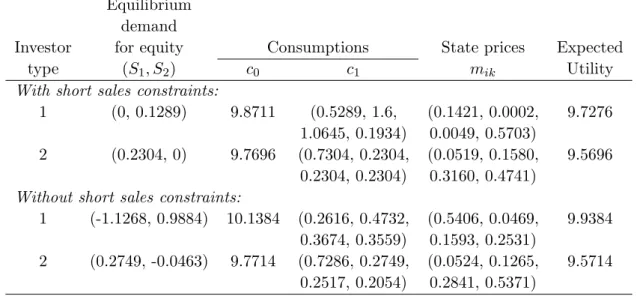
given asP = (0.4,0.1,0.2,0.3). Each investor solves the decision problem specified in§3.2 in order to maximize total expected utility. Table 2 shows the equilibrium investments and state prices of the investor types with and without short sales constraints. In the rest of this section, we illustrate the pooling and tranching solutions for the case with short sales constraints. The case without short sales constraints is similar except that the tranching solution will be fully characterized by cases (i) and (ii) in Theorem 5; case (iii) will not occur.
Suppose that there exist three firms willing to invest in assets X1 = (1,1,0,0),X2= (0,0,1,0)
andX3= (0,0,0,1). The reservation prices of the firms are denotedr1, r2 andr3, respectively, and
will be specified later. X1, X2 and X3 are not spanned by Θ and thus do not have unique prices
in this market. The price bounds on X1 are [V−(X1), V+(X1)] = [0,1], and on X2 and X3 are
[0,1/2] and [0,2/3], respectively. Note that this is a simple example since X1+X2+X3 gives us
the risk-free bond. Even so, the example suffices to illustrate values of reservation prices that yield different pooled assets.
Table 1: Equilibrium investments and state prices prior to introduction of secondary securities Equilibrium
demand
Investor for equity Consumptions State prices Expected type (S1, S2) c0 c1 mik Utility
With short sales constraints:
1 (0, 0.1289) 9.8711 (0.5289, 1.6, (0.1421, 0.0002, 9.7276 1.0645, 0.1934) 0.0049, 0.5703)
2 (0.2304, 0) 9.7696 (0.7304, 0.2304, (0.0519, 0.1580, 9.5696 0.2304, 0.2304) 0.3160, 0.4741)
Without short sales constraints:
1 (-1.1268, 0.9884) 10.1384 (0.2616, 0.4732, (0.5406, 0.0469, 9.9384 0.3674, 0.3559) 0.1593, 0.2531)
2 (0.2749, -0.0463) 9.7714 (0.7286, 0.2749, (0.0524, 0.1265, 9.5714 0.2517, 0.2054) 0.2841, 0.5371)
Conditions to determine the value of pooling. Clearly, not all values of r1, r2 and r3 will
lead to value creation. Theorem 1(i) tells us that there is no value in pooling X1, X2, and X3 in
any proportion if there exists a pricing measure q∈Θ, i.e., q is a convex combination, say (a, b, c), of Q1, Q2,and Q3, such that the following inequalities are satisfied:
1 3a+b−r1 ≤ 0, 1 2c−r2 ≤ 0, 2 3a+ 1 2c−r3 ≤ 0 a+b+c = 1
Otherwise there can be value from pooling. For example, if
r1 = 0.26, r2 = 0.35, r3 = 0.4 (10)
then there is a feasible solution (a= 0.09, b = 0.23, c = 0.68) to the above inequalities, implying that there is no value from pooling. As another example, if
r1 = 0.25, r2 = 0.5, r3 = 0.25 (11)
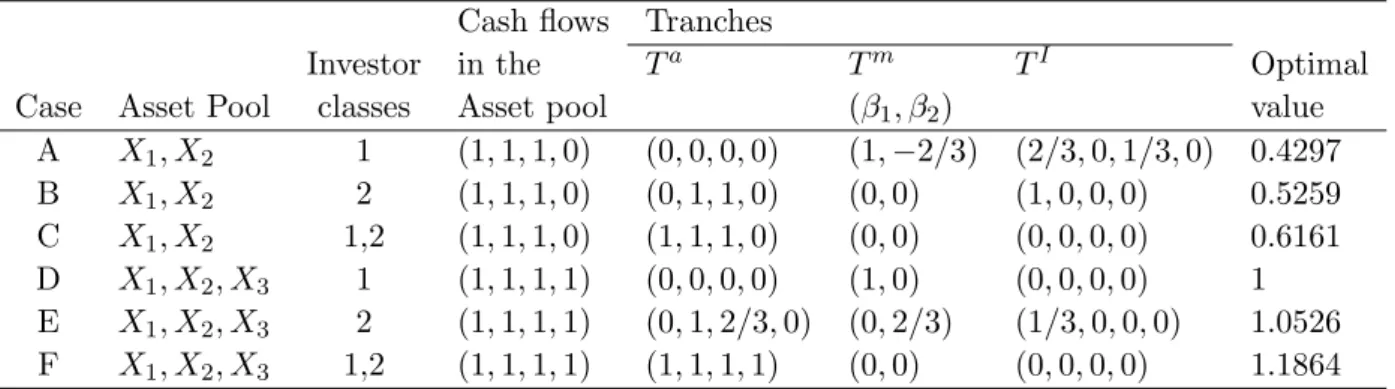
then there is no feasible solution to the above inequalities, implying that there can be value from pooling.