BUSINESS PROCESS KNOWLEDGE BASE
Gianmario Motta,
Information and Systems Department, University of Pavia Via Ferrata n.1 I-27100 Pavia Italy
[email protected] Giovanni Pignatelli
Information and Systems Department, University of Pavia Via Ferrata n.1 I-27100 Pavia Italy
ABSTRACT
This paper presents a Knowledge Management System to support the design of performing business processes. The system is a joint project of the Systems and Information Department (University of Pavia) and BIP (Business Integration Partners).
To organize the knowledge about business processes the system uses and integrates some major conceptual frameworks on business processes and performances. These include a stakeholder oriented framework of business process performances (HIGO) that supports the analyst in defining sustainable and competitive performances. Second, the business process taxonomy of the MIT process handbook allows an easier navigation on the collection of process knowledge stored in the system. Third, the Service Level Agreement framework helps organizations in setting and controlling performance objectives for processes.
The knowledge base stores both the above knowledge structures and case studies in different forms, such as diagrams, text, multimedia. The analyst can navigates stored case studies and create new processes by using the design methodology, that includes the definition of process structure, the association of performances to the process structures and the design of a individual process performances by using inheritance methods.
The knowledge base software is a Web 2.0 application, that enables collaborative approaches and assists the user in navigating models by industry and by case examples.
Keyword: Performance measurement, Knowledge Management, Business Processes INTRODUCTION
In the global economy, the definition of service is a fundamental concept. This trend is known as Service Oriented Economy (SOE). To support this new economic model a new discipline called Service Science is born. In this new business approach, two competitive factors are rising: service and business process seen as a service chain. This paper presents a collaboration project between University of Pavia and the consulting group Business Integration Partners (BIP) to engineer a Knowledge Management System (KMS) of business processes. Our objective is to develop a tool to support the definition of business processes that allow acceptable performance to a wide range of stakeholders (Performing Processes) and the spread of knowledge about business processes in complex organizational context. To get these objectives our
KMS integrates concepts of Quality of Service (QoS), Stakeholders and Process Structure definition.
Our system is conceived to create an integrated environment based on open source and copy-left principles.
The first section presents a brief State-of-Art analysis focused on tools, standards, reference model and frameworks used the design of performing processes. The second section presents the Knowledge Base System (KBS) to support the performing processes design. In particular we present the meta-model and the design methodology to design Performing Processes by applying the meta-model. Finally we present the Knowledge Base System used to support the design methodology and to navigate the information about performing processes.
RESEARCH OBJECTIVES AND TARGET USERS
The objective of the Research Program is to support and enhance the knowledge on business processes that includes methodology, innovation, ability to reuse best practices models in new scenarios and the ability to make them operative. Within this scope we could identify three communities of stakeholders:
o Academic and Research Organizations, that can collect share their knowledge
about business processes;
o Consulting Group, that can store their knowledge about business processes
and define a best-practices that could improve time and costs of analysis and design; specifically it enables “Best Fit” approach by supporting a comparative survey of market Best Practices.
o Enterprises, that can collect knowledge about business processes with the
objective of align themselves to best-practices, measure their performances, define roles and responsibility and to know the software solutions that best fit their needs
o A further target of the KB is Small Business. The proposed methodology and
the related tools enable the alignment of the Small Business to the development of the global context.
DESIGNING PERFORMING PROCESSES: STATE OF ART
The design of Performing Business Processes involves the following three domains: Processes, Performances and Sustainability. In this context we have identified several contributions due to the vastness of the involved domains:
o Proprietary Suites for the integrated design of business processes that include
workflow and organizational variables
o Workflow modelling languages and related open modelling suites supported
by BPM Iniziative (www.bpmi.org) and WfMC (www.wfmc.org) that follow the modelling of business processes from the informal design to the modelling with executable languages
o Business Processes Reference Models like MIT Process Handbook that
defines an universal taxonomy (including the SCOR model) that uses the Software Engineering principles (aggregation, specialization and reuse)
o Models for the definition and management of the business processes
framework that defines a models for the business processes performance by crossing Performances and Stakeholders' perspective
The state of art analysis has showed the limits of these approaches. In particular the open source modelling suites do not cover management aspects while the proprietary ones offer integrated solutions focused on proprietary software solutions. Anyway, both solutions do not integrate either general business process taxonomy or business process performance measuring system.
CONCEPTUAL META-MODEL OF THE KNOWLEDGE BASE
The Business Process Performance Conceptual Meta-Model is based on a meta-model that integrates:
o the HIGO framework that define business process performances and
stakeholders returns
o the compass model of MIT Process Handbook that enables the creation and
navigation on process structures
o the framework of Service Level Agreement by which performances objectives
are planned, agreed and controlled.
The knowledge base we present here supports the designer in the analysis by structuring best practices and reference framework. The knowledge base includes some main elements, specifically:
o The core of the knowledge base is the description of business processes. The
structure of business processes is described by a tree by which a process is decomposed and/or specialized. To significant nodes of business processes business models and evidence of business case examples are associated. This first model reflects the “compass concept” of the MIT Process Handbook: the analyst can navigate processes by both industry/similarity and detail. Also, it is close to the SCOR (Supply Chain Reference Model) tree, where the processes of the supply chains are classified by functional area and industry. The overall root of the business process conceptual structure is the Business Model, i.e. “what a company [or, more generally, an organization] does and how they make money from doing it”.
o A second key element of the knowledge base is the portfolio of performances,
where the performances are structured along the two dimensions of the process stakeholders (managers, customers, workers) and metrics. Macro classes of KPI are decomposed in individual measures.
o A third element is the Service Level concept, by which you describe
performance objectives and performance actual results of a given process or service. To a given Service Level Agreement (SLA) are integrated a given set of Service Level Objectives (SLO), as the ITL framework proposes.
The three elements are integrated in the knowledge base, so that the analyst can navigate from a given process to a given SLO, or, alternatively, design a new process by copying and modifying existing elements or adding new ones.
The integration of the Processes, Performances and Sustainability domains is got through two semantic relations:
o Processes-Performance: inserts in a structure like the MIT Process Handbook
the support to performance analysis and to associate the HIGO® framework in a solid and structured business process model
o Performance-Sustainability: associates the HIGO® framework to a model for
the definition of sustainability levels based on service level and enlarges the range of the indicators used by the Service Level Objectives (SLO)
The result is an integrated meta-model for describing performing processes based on three pre-existent, good and tested models. In the Errore. L'origine riferimento non è stata trovata. is shown the meta-model used by our Knowledge Base (KB) where:
o Business Model can be defined as “what a company does and how they make
money from doing it”
o Business Process represents the best practice definition of single business
process
o Business Case Example represents the model of business processes in a
particular enterprise..The case examples are organized by Business Model.
PICTURE 1 - Knowledge Base conceptual Meta-model
The three elements are integrated in the knowledge base, so that the analyst can navigate from a given process to a given SLO, or, alternatively, design a new process by copying and modifying existing elements or adding new ones.
A METHODOLOGY TO DESIGN PERFORMING PROCESSES We have defined a design methodology that includes the following steps:
a) Definition of the processes structure
b) Association of performances to process structure c) Definition of the sustainability levels
Step 1: Definition of processes structure
When we define a business case example we may need to create a new process. We can define a new process or use processes specialized by best practices. In this way we can obtain very complex process structures as shown in the next Figure.
PICTURE 2 - Example of composing a business process
Step 2: Association of performances to process structure
The second step consists in associating stakeholders, KPIs and business processes. With the association between performances and process structure we may use derived association between stakeholders and business processes and reuse of KPIs too. Using the business process structure we can use the derived associations between stakeholders and business processes. Derived associations are like transitive property, if a stakeholder is related to a process then he is implicitly related to all processes derived by specialization and to all processes that compose the process considered. This cases are shown in the next figure.
PICTURE 3 - Derived association between stakeholders and business processes
Let now consider the reuse of KPIs by specialization. When we specialize a business process there are three scenarios of association:
1. the KPI is the same for both the parent and the child process. The relation between child process and KPI is derived as shown in next picture:
PICTURE 4 - Derived association between Processes and KPI: Scenario 1
2. the KPI of the child is specialized from the KPI of the parent. The relation between the child process and the child KPI is specialized from the original relation between the parent process and the parent KPI as shown in next figure
PICTURE 5 - - Derived association between Processes and KPI: Scenario 2
3. the KPI of the parent process is not related to the child process the they are not linked
The third scenario shows that the utilization of derived or specialized associations is not a must but an opportunity.
Similar considerations could be done for the reuse of KPIs related to a stakeholder. Let consider an empirical example, the “Activation of a phone line”. For this process we have identified two KPIs: Mean Time to Activation and Number of activations out of SLA. This process may be specialized in:
o Activation in a big city o Activation in a small town
The KPIs of the specialized process “Activation in a big city” are the same of its parent because the organizational structure is defined to manage a large number of activation. The “Activation in a small town” process is based on a different organizational structure and manage low volume of requests. In this case, the parent process KPIs are not meaningful so the specialized process does not inherit them. For this process is more meaningful a newly KPI: “Maximum Time of Activation”. This case is shown in the next picture.
PICTURE 6 - The "Activation of a phone line" process and related KPIs
Definition of the sustainability levels
The third step consists in defining the sustainability levels of the processes. The definition is done by the assotiation 1-to-N (1) between SLO and KPIs.
{
KPI KPI KPI KPIn}
SLO→ 1 2 3 ... (1)
Through this relation we can easily jump from the “SLO space” to the “KPIs space” and describe the sustainability levels of the KPIs starting from the related SLO sustainability set. In the SLA schema, the offered service level must belong to a range of acceptability as expressed by the relation:
Offered Service Level ∈ [ SLO – Tolerance , SLO ]
(2) Tolerance = SLO – Minimum Service Level
This relation becomes a system that describes the conformity of the KPIs to the related SLO ∈ ∈ ∈ ∈ n S KPI S KPI S KPI S KPI 4 3 3 2 2 1 1 ... (3)
i
S = [mini , targeti ] ∀i=1,...,n
Where Si is the sustainability set of KPIi then the Global sustainability set of KPIs
related to a SLO becomes
n S S S S S = 1× 2× 3×⋅⋅⋅ KPI 1 KPI 2 KPI 3 KPI 4 … KPI n Sustainibility Set Target
Minimum Service Level
PICTURE 7 - The Sustainability set in the KPIs space
THE KBS FEATURES
In order to support the collaborative analysis, we have designed a web-based application that uses the Web 2.0 paradigm. This choice enables the collaborative creation of business processes models and also assists the user in navigating existing models by industry and by case examples. Case examples allow also the user to identify and to relate performances to business process.
To increase the user experience the information-navigation model, based on the conceptual framework, is designed with Interactive Dialogue Model (IDM) starting from the meta-model described below.
PICTURE 8 - The Information-Navigation model obtained from the meta-model
Major KMS Functionalities include: 1. Design:
a. Design of processes by specialization/generalization, composition / decomposition of existing processes, the same concept is used with KPIs and Stakeholders;
b. Workflow modeling with BPMN (OMG Standard) that can be implemented with execution languages like BPEL & BPEL4WS or XPDL
c. Modeling of business process structures and organizational structures d. Mapping between open source IT solutions and process workflow 2. Fruition:
a. Navigation of business processes by industry or by functional affinity. This kind of navigation is conceived to develop the best process configuration through the “reuse” of “best in class” solutions
b. Benchmarking on process performances organized by industry and by functional affinity
c. Graphical navigation on process structures, workflows, organizational structures
d. Documental repository (AS-IS analysis, interviews) associated to the contents
3. Administration services:
a. Definition of an editorial model for creating and modifying contents of the Knowledge Base. This model is granted by a fine-grained user profiling by the definition of the permissions on the contents stored in the KB
THE SOFTWARE ARCHITECTURE OF THE KNOWLEDGE BASE The software architecture is characterized by:
o Server-side application composed by three logical levels: (a) DAO (Data
Access Object), that grants a transparent to different data access; (b) Business, that supports the meta-model (c) Action, that manages the users’ permissions.
o Thick Web Client, to navigate the contents of the KB, as shown in the next
figure
PICTURE 9 - Knowledge Base Web interface
o Eclipse-based Tool to design the workflow of the business processes
o Industrialization & Customization Tool to make the KB fully compliant to the
stakeholder’s needs
o Populating & Extraction Tool to insert information and to produce documents
in a batch mode
Web Service Servlet
Web tool Eclipse Plug-in
Action Level Authorization Manager Business Catalogue Index Versioning
Data Access Object
In d u s tr ia liz a tio n to o l Data Users DB Concettuale Model/ Sources Mapping XML
DB Txt Files Data Warehouse Other
XML TXT
Sections
Extraction & Population Tool
KMS SCENARIOS OF APPLICATION
The main scope of the KB is to support the continuous improvement of process know-how that can be defined as methodology, innovation and ability to re-adapting best practices models in new scenarios.
A possible application of the KMS can be supporting a Business Process Reengineering/improvement project in a consulting context.
Managing a Business Process Reengineering project , as described in Figure 11, means to develop a “Best Fit Model of Processes” able to realize Customer objectives in terms of performance. The Best Fit Processes Model is based on the analysis of market Best Practice and As-IS context.
The implementation of the Best Fit Processes Model implies to individuate gaps between AS-IS and the model in terms of processes, organization and IT solutions and related action of improvement (Action Plan).
PICTURE 11 - The contribution of the KB in a process improvement project
In this context the KBS has
o a strategic value because it grants a single repository of the experiences about
performances and processes in order to define a competitive best practice
o an operating value because it contributes to the major paradigm of consulting
project which requires to manage activities “On time, on budget, on quality”. he KBS contribution to the management of the project on quality is due to the aim of the KB that is turned to design performing processes while the on time and on budget management is due to:
o the process – SLO interrelation that individuates the critical issues of a process
to get the target objectives
o the performances benchmarking that simplify the analysis and process
reengineering activities and enables the selection of the solution closer to the client’s requirements
POSITIONING
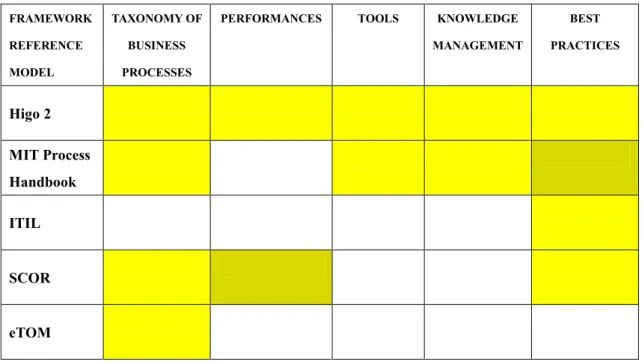
Our framework differs from popular reference models (e.g. SCOR, eTOM, MIT Process Handbook) from a variety of points:
1. Software architecture is based on a meta-model and on design methodology that guide the analyst from the design level down to the implementation 2. The process model can be considered as an extension of SCOR; however
SCOR has not a really structured framework for performance indicators and it considers only two kinds of perspectives (internal and customers);
3. eTOM considers only TLC enterprises;
4. ITIL is a best practice collection.; it does not guide to design “good” processes but offers a rigid catalogue.
TABLE 1 - Framework comparison
FRAMEWORK REFERENCE MODEL TAXONOMY OF BUSINESS PROCESSES
PERFORMANCES TOOLS KNOWLEDGE
MANAGEMENT BEST PRACTICES Higo 2 MIT Process Handbook ITIL SCOR eTOM
CONCLUSION AND FUTURE WORK
In this paper we have presented an integrated framework to design performing processes. This result is achieved by the definition of a Meta-model that defines the semantic relations between processes, performances and sustainability levels. The meta-model structure is due by the integration of three pre-existing meta-model (MIT Process Handbook, HIGO and SLA). To generate models metamodel compliant we have defined a design methology that is focused on best practices reuse.
Starting from the Meta-Model and the related design methodology we have designed a tool to support the creation of models by the navigation of a repository of reference process structures and workflows. The navigation supports the design of innovative processes through the integration and the reuse of experiences (best of breeds). The release of the KMS will be organized in two steps as described in the project roadmap described below.
In synthesis, our KB of business processes presents the following innovative aspects:
o A free collaborative tool that can be extended by the virtual community with a
o A guide to the design of competitive and sustainable processes on which
define open source IT solutions through an innovative design methodology
o A tool that supports a lego-like design of IT solutions by the integration of
existing applications and new ones. This feature enables the analysis and the informatization of every activity of a business process
o A full support to the lifecycle of IT solutions, from the context analysis to the
executive design of business processes REFERENCES
AA.VV, Business Process Reference Models Proceedings of the Workshop on Business Process Reference Models, 2005
AA.VV, Workflow Standard Process Definition Interface XML Process Definition Language Version 2.00 , 2005
Bolchini D., Paolini P, Interactive Dialogue Model: a Design Technique for Multi-Channel Applications, 2006
ChesBrough H., Spohrer J., A research manifesto for Services Science, 2006
Crowston K., A Taxonomy Of Organizational Dependencies and Coordination Mechanisms, 1994
Davenport T., Process Innovation: Reengineering Work Through Information Technology, 1993
Davenport T., The new industrial engineering: information technology and business process redesign, 1990
Hammer M., Champy J., Reengineering the Corporation: A Manifesto for Business Revolution. (1st ed.), 1993
Hammer M., Stanton S.A., The Reengineering Revolution: A Handbook, (1st ed.), 1995
Hill T.P., On goods and services, 1977
Malone T.W., Crowston K., Herman G. A., Organizing Business Knowledge: The MIT Process Handbook, 2003
Maglio P., Spohrer J., Emergence of Service Science: Services Sciences, Management, Engineering as the Next Frontier in Innovation, 2005
Maglio P., Srinvasan S., Freulen J.T., Spohrer J., Service Systems, Service Scientists, SSME, and Innovation, 2006
Malone T.W., Crowston K., Lee J., Pentland B.,Tools for Inventing Organizations: Toward a Handbook of Organizational Processes, 1993
Maurer W., Matlus R., Frey N., A Guide to Successful SLA Development and Management, 2000
Melenovsky M., Sinur J., Hill J., McCoy D., Business Process Management: Preparing for the Process-Managed Organization, 2005
Moore C., The Forrester Wave™:Human-Centric Business Process Management Suites, 2006
Motta G. e Longo A., HIGO, Misurare le prestazioni dei processi gestionali, Marchio registrato 2 Aprile 2006, LE2006 e 000114, 2006
Sheehan J., Understandig Service Sector Innovation, 2006
Sturm R., Morris, W., Foundations of Service Level Management, 2000
Weill P., Malone T.W., D’Urso V.T., Herman G., Woerner S., Do Some Business Models Perform Better than Others? A Study of the 1000 Largest US Firms, 2004