J. A. Joines, R. R. Barton, K. Kang, and P. A. Fishwick, eds.
AN ANALYTICAL MODEL AND AN OPTIMAL SCHEDULING HEURISTIC FOR COLLECTIVE RESOURCE MANAGEMENT
Qiang Sun Siebel Systems, Inc. 2207 Bridgepointe Parkway San Mateo, CA 94404, U.S.A.
ABSTRACT
In the this paper, we study the problem of collective resource management. We first introduce the problem through real-world examples. Then we generalize the problem and build an analytical model using queuing theory. Based on this model, we evaluate the expected average waiting time of tasks. We present data from simulations, and compare the expected average waiting time from theoretical calculations to that from our experiments. We propose an optimal task scheduling heuristic. We conclude with a brief discussion of our future research plans.
1 INTRODUCTION
First let’s consider the following three scenarios.
• We need to organize a soccer team before the next game. The team should consist of any four com-puter science professors and any seven comcom-puter science majors. We need to check the schedules of professors and students, and make appointments for eleven people who will have made no other commitments for the time of the game.
• We need to transfer a video file from a network hard drive to a VCR for recording. Suppose we have smart electronics, and the reservation is done automatically with the hard drive and the VCR. • Suppose we have a microprocessor with multiple
floating point calculation units, integer point cal-culation units, and caches. The execution of each instruction needs to utilize one or more of these different units. There are precedence requirements for the execution of the instructions.
The preceding are all examples of what we call collective resource management (CRM) problems. ACRM problem should have the following properties:
1. There exists a resource pool made up of different types of resources. Each type of resource has multiple homogeneous instances. For example,
professors, a VCR, and integer point units are all considered to be resources.
2. The use of the any resource instance in the pool is strictly exclusive. For example, we can’t use a VCR to record two tapes at the same time. 3. Each task, an atomic action on the associated
re-sources, requires a collection of resources. Multi-ple instances of any resource type might be required. For example, schedules of more than one professor need to be modified for the soccer game. 4. There might be lease (Sun Microsystems 1999),
priority, precedence, deadline, or other require-ments associated with each task. For example, instructions need to be executed in certain order. In this paper, we focus on CRMproblems that fulfill the first three properties.
2 RELATED WORKS
CRMproblems appear in the study of distributed databases, CPU scheduling, real-time systems, etc. Priority assign-ments (Chang and Livny 1985 and Huang et al. 1991), task scheduling (Abbot and Garcia-Molina 1988 and Huang et al. 1989), concurrency control(Bestavros and Braoudaks 1994, Gupta et al. 1996, and Sha, Rajkumar, Lehoczky 1988), and fault resilience (Chandy 1998 and Sun, Zhang, and Zhang 2000) are some of the many commonly faced issues when we try to solve CRM problems. The unique challenge introduced by CRM lies in the fact that there are homogeneous instances of each resource type, which is what makes solvingCRM problems complicated.
3 ALGORITHMS FOR CRM 3.1 Problem Generalization
Before we get into our algorithm, we need to generalize CRM problems. We adopt the following notations:
• Number of instances for Ri: Ni;
• A task request is represented by: T ((r1, r2, . . . , rn), E), where rm is the
num-ber of type Rm required for this task and E is the expected execution time of the task. If ri is non-zero, we say that Ri is required by T, and Ri belongs to the resource set of T. Note that ri < Ni must hold.
3.2 Description of the Algorithm
We call a source that generatesTs a client; and each resource instance is managed by an server. Once aT is generated, it is submitted to all the servers that manage resources required byT. Each server has aFIFO waiting queue . If a server can not fulfill a T immediately—because the resource is temporarily unavailable—T is put into the waiting queue. Once aT is taken from the waiting queue, the resource is locked by the client which submitsT. We use a two-phase locking scheme (Bestavros and Braoudaks 1994 and Gupta et al. 1996) to ensure the atomicity of the task across multiple resources. Preemption is not allowed and thus the resources is held by the client until the completion of the task.
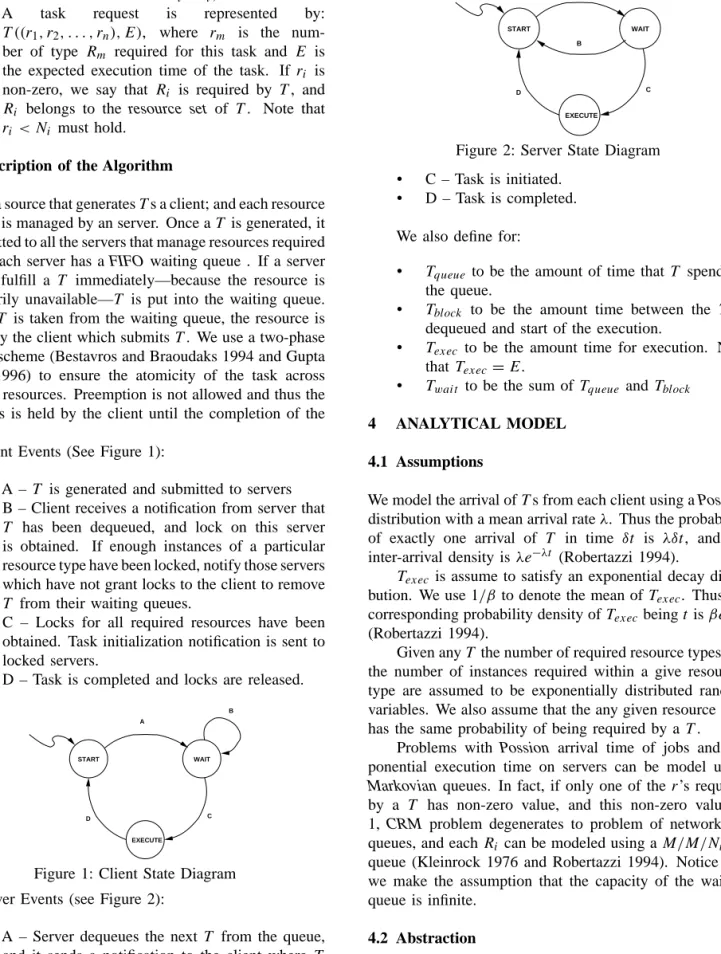
Client Events (See Figure 1):
• A – T is generated and submitted to servers • B – Client receives a notification from server that
T has been dequeued, and lock on this server is obtained. If enough instances of a particular resource type have been locked, notify those servers which have not grant locks to the client to remove T from their waiting queues.
• C – Locks for all required resources have been obtained. Task initialization notification is sent to locked servers.
• D – Task is completed and locks are released.
START WAIT
EXECUTE A
B
D C
Figure 1: Client State Diagram Server Events (see Figure 2):
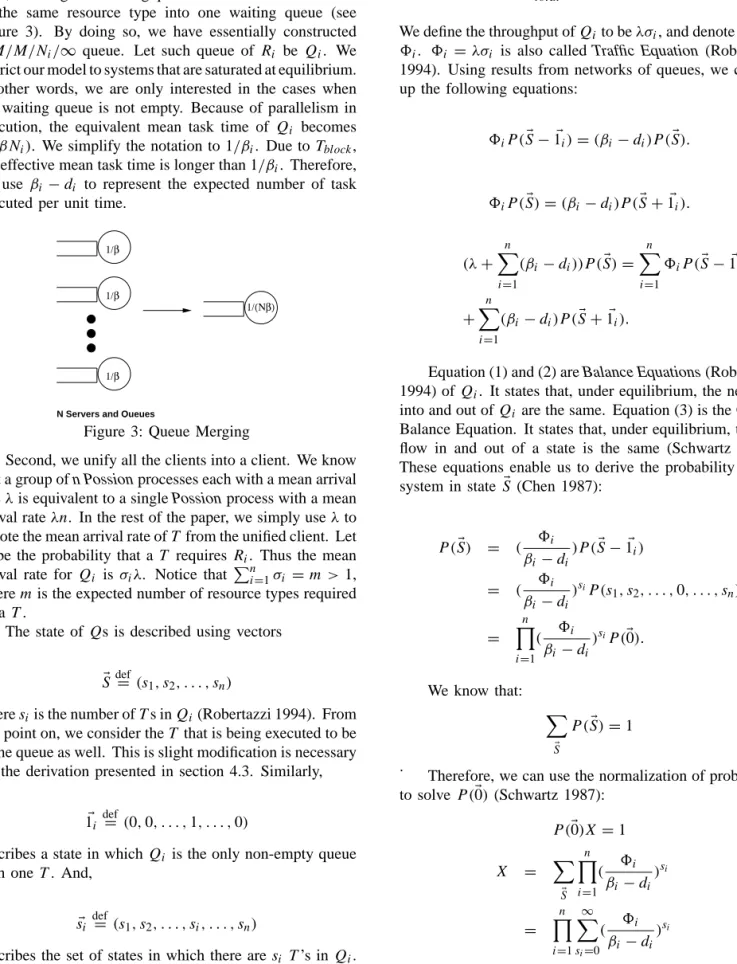
• A – Server dequeues the nextT from the queue, and it sends a notification to the client where T originates from.
• B – Server receives notification from client to remove T. START WAIT EXECUTE D C B A
Figure 2: Server State Diagram • C – Task is initiated.
• D – Task is completed. We also define for:
• Tqueue to be the amount of time thatT spends in the queue.
• Tblock to be the amount time between the T is dequeued and start of the execution.
• Texec to be the amount time for execution. Note that Texec=E.
• Twait to be the sum ofTqueue andTblock 4 ANALYTICAL MODEL
4.1 Assumptions
We model the arrival ofTs from each client using aPossion distribution with a mean arrival rateλ. Thus the probability of exactly one arrival of T in time δt is λδt, and the inter-arrival density isλe−λt (Robertazzi 1994).
Texec is assume to satisfy an exponential decay distri-bution. We use 1/β to denote the mean ofTexec. Thus the corresponding probability density ofTexecbeingtisβe−βt (Robertazzi 1994).
Given anyT the number of required resource types and the number of instances required within a give resources type are assumed to be exponentially distributed random variables. We also assume that the any given resource type has the same probability of being required by a T.
Problems with Possion arrival time of jobs and ex-ponential execution time on servers can be model using Markovian queues. In fact, if only one of ther’s required by a T has non-zero value, and this non-zero value is 1, CRM problem degenerates to problem of networks of queues, and eachRi can be modeled using aM/M/Ni/∞ queue (Kleinrock 1976 and Robertazzi 1994). Notice that we make the assumption that the capacity of the waiting queue is infinite.
4.2 Abstraction
In order to use theories from queuing systems to help build our analytical model, further abstractions are necessary.
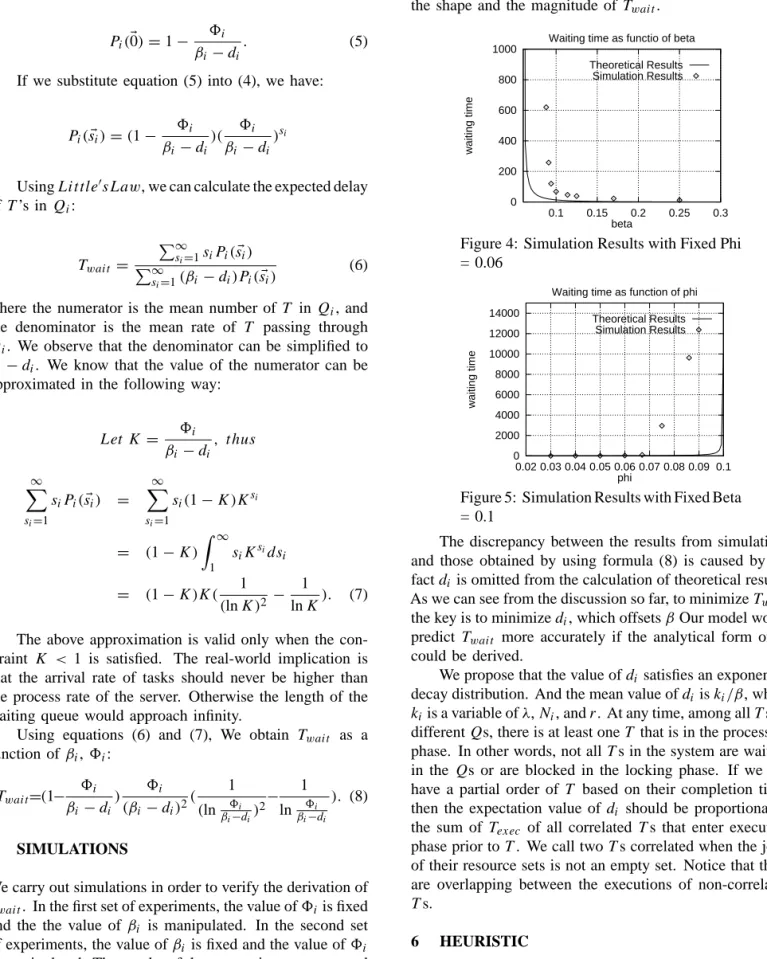
First, we merge the waiting queues of the different instances of the same resource type into one waiting queue (see Figure 3). By doing so, we have essentially constructed a M/M/Ni/∞ queue. Let such queue ofRi be Qi. We restrict our model to systems that are saturated at equilibrium. In other words, we are only interested in the cases when the waiting queue is not empty. Because of parallelism in execution, the equivalent mean task time of Qi becomes 1/(βNi). We simplify the notation to 1/βi. Due toTblock, the effective mean task time is longer than 1/βi. Therefore, we use βi −di to represent the expected number of task executed per unit time.
1/β
1/β
1/(Νβ)
1/β
N Servers and Queues
Figure 3: Queue Merging
Second, we unify all the clients into a client. We know that a group ofn Possionprocesses each with a mean arrival rateλis equivalent to a singlePossionprocess with a mean arrival rateλn. In the rest of the paper, we simply useλto denote the mean arrival rate ofT from the unified client. Let σi be the probability that aT requiresRi. Thus the mean arrival rate forQi isσiλ. Notice that Pni=1σi =m > 1, wheremis the expected number of resource types required by aT.
The state ofQs is described using vectors
E
Sdef
= (s1, s2, . . . , sn)
wheresi is the number ofTs inQi(Robertazzi 1994). From this point on, we consider theT that is being executed to be in the queue as well. This is slight modification is necessary for the derivation presented in section 4.3. Similarly,
E
1i def= (0,0, . . . ,1, . . . ,0)
describes a state in whichQi is the only non-empty queue with one T. And,
E
si def= (s1, s2, . . . , si, . . . , sn)
describes the set of states in which there aresi T’s inQi.
4.3 Evaluation of Ttotal
We define the throughput ofQito beλσi, and denote it with 8i. 8i =λσi is also called Traffic Equation(Robertazzi 1994). Using results from networks of queues, we can set up the following equations:
8iP (SE− E1i)=(βi−di)P (S).E (1) 8iP (S)E =(βi −di)P (SE+ E1i). (2) (λ+ n X i=1 (βi−di))P (S)E = n X i=1 8iP (SE− E1i) + n X i=1 (βi−di)P (SE+ E1i). (3)
Equation (1) and (2) areBalance Equations(Robertazzi 1994) ofQi. It states that, under equilibrium, the net flow into and out ofQi are the same. Equation (3) is the Global Balance Equation. It states that, under equilibrium, the net flow in and out of a state is the same (Schwartz 1987). These equations enable us to derive the probability of the system in stateSE (Chen 1987):
P (S)E = (β 8i i −di)P (SE− E1i) = (β 8i i −di) siP (s1, s2, . . . ,0, . . . , sn) = Yn i=1 ( 8i βi −di) siP (E0). (4) We know that: X E S P (S)E =1 .
Therefore, we can use the normalization of probability to solve P (E0)(Schwartz 1987): P (E0)X=1 X = X E S n Y i=1 (β 8i i−di) si = n Y i=1 ∞ X si=0 (β 8i i−di) si = Yn i=1 (1− 8i βi−di) −1.
Thus we get:
Pi(E0)=1− 8i
βi−di. (5)
If we substitute equation (5) into (4), we have:
Pi(sEi)=(1− 8i βi −di)( 8i βi−di) si .
UsingLittle0sLaw, we can calculate the expected delay of T’s inQi: Twait = P∞ si=1siPi(sEi) P∞ si=1(βi−di)Pi(sEi) (6) where the numerator is the mean number of T inQi, and the denominator is the mean rate of T passing through Qi. We observe that the denominator can be simplified to βi −di. We know that the value of the numerator can be approximated in the following way:
Let K= β8i i−di, thus ∞ X si=1 siPi(sEi) = ∞ X si=1 si(1−K)Ksi = (1−K) Z ∞ 1 siKsidsi = (1−K)K( 1 (lnK)2− 1 lnK). (7) The above approximation is valid only when the con-straint K < 1 is satisfied. The real-world implication is that the arrival rate of tasks should never be higher than the process rate of the server. Otherwise the length of the waiting queue would approach infinity.
Using equations (6) and (7), We obtain Twait as a function of βi,8i: Twait=(1− 8i βi−di) 8i (βi −di)2( 1 (lnβ8i i−di)2 − 1 lnβ8i i−di ). (8) 5 SIMULATIONS
We carry out simulations in order to verify the derivation of Twait. In the first set of experiments, the value of8iis fixed and the the value of βi is manipulated. In the second set of experiments, the value ofβi is fixed and the value of8i is manipulated. The results of these experiments compared with the theoretical predictions are illustrated in Figure 4
and 5. We observe that formula (8) correctly predicts both the shape and the magnitude ofTwait.
0 200 400 600 800 1000 0.1 0.15 0.2 0.25 0.3 waiting time beta
Waiting time as functio of beta Theoretical Results
Simulation Results
Figure 4: Simulation Results with Fixed Phi = 0.06 0 2000 4000 6000 8000 10000 12000 14000 0.02 0.03 0.04 0.05 0.06 0.07 0.08 0.09 0.1 waiting time phi
Waiting time as function of phi Theoretical Results
Simulation Results
Figure 5: Simulation Results with Fixed Beta = 0.1
The discrepancy between the results from simulations and those obtained by using formula (8) is caused by the factdi is omitted from the calculation of theoretical results. As we can see from the discussion so far, to minimizeTwait, the key is to minimizedi, which offsetsβOur model would predict Twait more accurately if the analytical form of di could be derived.
We propose that the value ofdi satisfies an exponential decay distribution. And the mean value ofdi iski/β, where kiis a variable ofλ,Ni, andr. At any time, among allTs on differentQs, there is at least oneT that is in the processing phase. In other words, not allTs in the system are waiting in the Qs or are blocked in the locking phase. If we can have a partial order of T based on their completion time, then the expectation value ofdi should be proportional to the sum of Texec of all correlatedTs that enter execution phase prior toT. We call twoTs correlated when the joint of their resource sets is not an empty set. Notice that there are overlapping between the executions of non-correlated Ts.
6 HEURISTIC
In order to reduce di, we must delay the entry into the locking phase ofT s. Before granting the lock to anyT, we
need to check if delaying such a grant will allow other T to complete early without delaying the completion of this task. We first check if any lock has been granted to this task,T1, from otherQs. If not, we calculate the expected
completion time ofT1and the next task inQ,T2, under the
condition that the lock is granted toT1byQi. Then we try to
switch the order ofT1andT2in allQs. We check if such a
switch causes deadlock. If not, we re-calculate the expected completion time forT1andT2, under the condition that the
lock is granted to T2 by Q2. If the expected completion
time for T1 is not increased and the expected completion
time for T2 is decreased, such a switch should be carried
out.
This heuristic is similar to that proposed in (Sun, Zhang, and Zhang 2000), but there are some difference. First, we check if any lock has been granted to T1 before proceed
with the heuristic. This procedure helps to avoid redundant calculations. Second, our heuristic is only meant to be used in a non-distributed environment, and thus it is possible to have information of hard global state. This allows us to prevent deadlock and re-order T s globally. Here is the pseudo code for the heuristic:
optimize(queue Q_i){
task T_1 = getTask(Q_i, 1);
if(no locks has been granted to T_1){ time t_1=calculateCompletionTime(Q_i,1); time t_2=calculateCompletionTime(Q_i,2); task T_2=getTask(Q_i,2);
switch the order of T_1 and T_2
in all Qs; if(detect no deadlock){ time t_3 = calculateCompletionTime(Q_i,1); time t_4 = calculateCompletionTime(Q_i,2); if(!(t_4 > t_1) && t_3 < t_2) switch is valid; else
restore the order of T_1 and
T_2 in all Qs; }
} }
The method Queue getT ask() returns the T at the given index in Q. The index of the firstT inQis 1. The method calculateCompletionT ime() returns the estima-tion of expected compleestima-tion time ofT at the given index in Q. Both methods are easy to implement, so we will skip their details in this paper.
7 SUMMARY AND FUTURE RESEARCH
In this paper, we introduce the problem of Collective Re-source Management(CRM). We formalize the problem by specifying the special characteristics ofCRM. An analytical
model is built and the expected waiting time of tasks are derived. We use simulation to obtain data to support our analytical model. We present a heuristic to reduce expected waiting time.
For future research, we plan to build simulations to test the effectiveness of our heuristic and to derive an empirical form of di. We also plan to study some unique issues of CRM in distributed environments.
ACKNOWLEDGMENTS
I would like to express my greatest gratitude to Professor Duane Bailey at Williams College, MA, Irena Pashchenko, an undergraduate student at Smith College, MA, and Hao Zhang, a graduate student at UC Berkeley for their advice and invaluable help in the writing of this paper.
BIBLIOGRAPHY
Robert Abbott and Hector Garcia-Molina. 1988. Scheduling real-time transactions: A performance evaluation. In Proceedings of Very Large Data Base Conference, 1–12. Azer Bestavros and Spyridon Braoudaks. 1994. Timeliness via speculation for real-time database. In Proceedings of IEEE Real-Time Systems Symposium, 36–43. K. M. Chandy. 1998. Using announce-listen with global
events to develop distributed control systems. Concur-rency:Practice and Experience.
Hung-Yang Chang and Miron Livny. 1985. Priority in distributed system. In Proceedings of IEEE Real-Time Systems Symposium, 123–130.
W. Chen. 1987. Solution manual for telecommunications networks: Protocol, modeling and analysis. Addison-Wesley.
Ramesh Gupta, Jayant Haritsa, Krithi Ramamritham, and S. Seshadri. 1996. Commit processing in distributed real-time database systems. In Proceedings of IEEE Real-Time Systems Symposium, 220–229.
Jiandong Huang, John A Stankovic, Krithi Ramamritham, and Don Towsley. 1989. Experimental evaluation of real-time transaction processing. In Proceedings of IEEE Real-Time Systems Symposium, 144–153, Jiandong Huang, John A Stankovic, Krithi Ramamritham,
and Don Towsley. 1991. On using priority inheritance in real-time databases. In Proceedings of IEEE Real-Time Systems Symposium.
Leonard Kleinrock. Queueing theory. Wiley, 1976. Thomas G. Robertazzi. 1994. Computer networks and
systems : Queueing theory and performance evaluation. Springer-Verlag.
M. Schwartz. 1987. Telecommunication networks: Proto-col, modeling and analysis. Addison-Wesley.
Lui Sha, Ragunathan Rajkumar, and John P. Lehoczky. 1988. Concurrency control for distributed real-time databases. ACM Sigmod Record, 17(1):82–98. Q. Sun, H. Zhang, and J.H. Zhang. 2000. A time-stamp
based solution for collective resource acquisition in distributed systems. In HICSS-33.
Sun Microsystems, Inc. 1999. Jini Distributed Leasing Specification.
AUTHOR BIOGRAPHY
QIANG SUN currently works as a Software Engineer in the server infrastructure group at Siebel Systems, Inc. He enjoyed his undergraduate life at Williams College, MA and California Institute of Technology. He received a bachelor’s degree in Computer Science and Physics, Summa Cum Laude, from Williams College in June, 2000. His research interests include distributed systems and is-sues in concurrent computation. His email address is