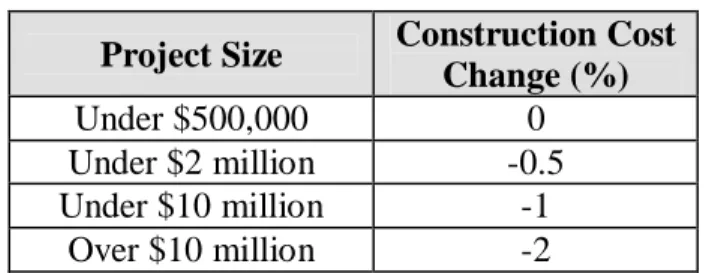
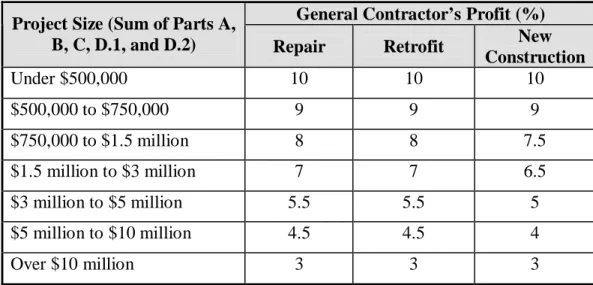
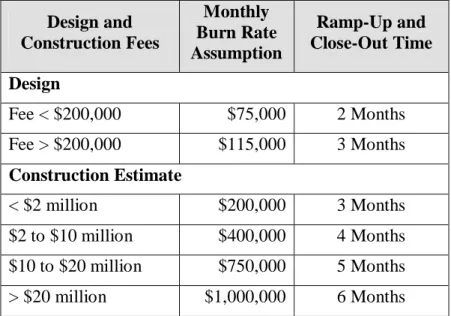
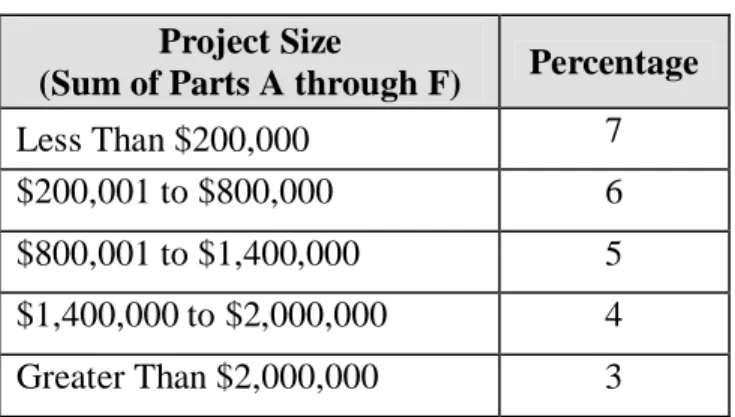
CEF for Large Projects
Instructional Guide V2.1
September 2009
Federal Emergency Management Agency Department of Homeland Security
500 C Street, SW Washington, DC 20472
TABLE OF CONTENTS
ACRONYMS AND ABBREVIATIONS...iv SECTION ONE INTRODUCTION...1-1
1.1 Federal Assistance for Disaster Damage ... 1-1 1.2 The Cost Estimating Format ... 1-2 1.3 Eligible Work and Cost ... 1-3 1.4 Applicability and Limitations ... 1-4 1.5 Credentials of CEF Users ... 1-5 1.6 Updates to the CEF... 1-5
SECTION TWO THE COST ESTIMATING FORMAT DEVELOPMENT PROCESS...2-1
2.1 Step 1 – Qualify Projects for the CEF ... 2-1 2.2 Step 2 – Identify Disaster-Specific Factors and Unit Cost Data... 2-3 2.3 Step 3 – Determine the Eligible Scope of Work ... 2-5 2.4 Step 4 – Complete the CEF Spreadsheet ... 2-5 2.5 Step 5 – Complete the Project Worksheet ... 2-6 2.6 Step 6 – Reconcile Costs When Project Is Completed... 2-6 2.7 Step 7 – CEF Project Reporting ... 2-7 2.8 Summary of PA Group Supervisor and Project Specialist
Responsibilities ... 2-8
SECTION THREE COMPLETING THE CEF SPREADSHEET ...3-1
3.1 CEF Fact Sheet... 3-1 3.2 CEF Notes... 3-3 3.3 Part A – Base Costs for Construction Work In Trades ... 3-3 3.4 Summary for Uncompleted Work ... 3-3 3.5 Summary for Completed Work... 3-3 3.6 Total Project Summary ... 3-4
SECTION FOUR PART A: “BASE COSTS” FOR CONSTRUCTION WORK IN TRADES...4-1
4.1 Background ... 4-1 4.2 Part A Spreadsheet ... 4-1 4.3 Scope of Work... 4-1 4.4 Organization of “Base Costs” ... 4-2 4.5 Repair vs. Replacement ... 4-4 4.6 Hazard Mitigation... 4-5 4.7 Force Account Work ... 4-6 4.8 A.1: Estimate for Permanent Work ... 4-6 4.9 A.2: Estimate for Non-Permanent, Job-Specific Work ... 4-8 4.10 Methods for Preparing the “Base Cost” Estimate ... 4-8
SECTION FIVE PART B: GENERAL REQUIREMENTS AND GENERAL CONDITIONS...5-1
5.1 B.1: General Requirements ... 5-1 5.2 B.2: General Conditions ... 5-2
SECTION SIX PART C: CONSTRUCTION COST CONTINGENCIES/UNCERTAINTIES
(DESIGN AND CONSTRUCTION)...6-1
6.1 C.1: Standard Design Phase/Scope Definition Contingencies... 6-1 6.2 C.2: Facility or Project Constructability ... 6-2
TABLE OF CONTENTS
6.3 C.3: Access, Storage, and Staging Contingencies... 6-3 6.4 C.4: Economies of Scale ... 6-4
SECTION SEVEN PART D: GENERAL CONTRACTOR’S OVERHEAD AND PROFIT...7-1
7.1 D.1: General Contractor’s Home Office Overhead Costs ... 7-1 7.2 D.2: General Contractor’s Insurance, Payment, and Performance
Bonds ... 7-1 7.3 D.3: Contractor’s Profit ... 7-1
SECTION EIGHT PART E: COST ESCALATION ALLOWANCE ...8-1
SECTION NINE PART F: PLAN REVIEW AND CONSTRUCTION PERMIT COSTS ...9-1
9.1 F.1: Plan Review Fees ... 9-1 9.2 F.2: Construction Permit Fees... 9-1
SECTION TEN PART G: APPLICANT’S RESERVE FOR CONSTRUCTION...10-1
SECTION ELEVEN PART H: APPLICANT’S PROJECT MANAGEMENT AND DESIGN COSTS...11-1
11.1 H.1: Applicant’s Project Management – Design Phase...11-1 11.2 H.2: A&E Design Contract Costs...11-1 11.3 H.3: Project Management – Construction Phase...11-3
Figures
Figure 1: Development and Processing of a CEF Estimate ... 2-1
Tables
Table A.1: CSI Divisions ... 4-3 Table A.2: ADA Compliance Allowance for Category E Facilities... 4-7 Table C.2: Constructability Factors ... 6-3 Table C.4: Economies of Scale... 6-4 Table D.3: General Contractor’s Profit ... 7-2 Table E.1: Estimated Design and Construction Times Based on Project Cost ... 8-3 Table G.1: Applicant’s Reserve for Construction... 10-1 Table H.3: Project Management – Construction Phase... 11-3
Appendices
Appendix A CEF Spreadsheet V2.1
Appendix B Examples of Completed CEF Spreadsheets
Example 1 Category C – Roads and Bridges – Simmonds Arch Bridge Example 2 Category F – Utilities – River Park Elevated Water Tank
Example 3 Category E – Buildings and Equipment – Planning Commission Office – Repair vs. Replacement Analysis
Appendix C CEF – Large Project Report
TABLE OF CONTENTS
Appendix E Standard Operating Procedure – CEF for Large Projects Appendix F Guidelines for Selecting Values CEF Parts B through H
Appendix G Checklists – PA Group Supervisor, Project Specialist, and Part A G.1 – PA Group Supervisor Checklist for CEF Implementation
G.2 – Project Specialist Checklist for CEF Implementation
Acronyms and Abbreviations
A&E Architect and Engineering ADA Americans with Disabilities Act BCI Building Cost Index
CCI Construction Cost Index CEF Cost Estimating Format CFR Code of Federal Regulations
CSI Construction Specifications Institute DOT Department of Transportation ENR Engineering News Record
FEMA Federal Emergency Management Agency JFO Joint Field Office
PA Public Assistance
PAC Public Assistance Coordination
Introduction
SECTION ONE
INTRODUCTION
1.1
FEDERAL ASSISTANCE FOR DISASTER DAMAGE
The Robert T. Stafford Disaster Relief and Emergency Assistance Act (PL 93-288, as amended) authorizes the Federal government to assist State and local governments with recovery from disasters. In accordance with this legislation, which is referred to as the Stafford Act, State and local governments may receive financial assistance to restore disaster-damaged public facilities and other infrastructure components. The Federal Emergency Management Agency (FEMA), in partnership with State governments, is responsible for managing the provision of this assistance under the Public Assistance (PA) Program.
Through the PA Program, FEMA pays the Federal share of the cost of repair, restoration, or replacement of a facility as it existed prior to the disaster. The estimate of this cost is determined by a team of Federal and State technical specialists working in cooperation with a representative of the State or local government entity applying for the assistance (the applicant).
The applicant and Public Assistance Coordination (PAC) Crew Leader work together to develop a complete scope of work and cost estimate for each project. These projects are documented on a Project Worksheet (PW), which is the basis for PA Program funding
For large projects1, this estimate is used to determine the initial Federal obligation of funds for the work, but it is not necessarily the final cost that will be approved for the project. Rather, the final cost is based upon the reasonable, actual costs incurred by the applicant in completing the eligible scope of work. Actual costs are determined through a reconciliation process initiated by the State when the work is complete. Discrepancies between the initial estimate and the final cost are addressed through the obligation (or de-obligation) of Federal funds.
The Federal-State team typically prepares the initial construction estimate using the best available unit cost data for the elements of the facility. These unit costs (also referred to as construction costs) represent the itemized breakdown of construction work activities for completing the project. The unit costs usually do not include project design and management costs, contractor overhead and profit, fees, cost escalation due to inflation, and other factors affecting the overall cost of the project. These costs (also referred to as non-construction costs) are addressed through the reconciliation process once the project is complete. While the
applicant may eventually receive reimbursement for these costs, the final amount of the grant is unknown at the time of construction. Further, the grant is subject to review during the
reconciliation process, and the outcome of this review can affect the amount. To provide the applicant with a better representation of actual costs at the beginning of the assistance process, FEMA developed the Cost Estimating Format (CEF).
This Instructional Guide describes the CEF process and how it fits into the PA Program. This guide also describes each of the factors that make up the CEF, how the factors are to be applied to the base construction cost estimate, and how to use the CEF spreadsheet in the estimate
1
The Stafford Act provides for separate grant processes for small and large projects and set the minimum threshold for large projects at $35,000 when it was passed in 1988. FEMA adjusts this amount at the beginning of each Federal fiscal year to reflect changes in the Consumer Price Index for All Urban Consumers. For Federal Fiscal Year 2009 (ending September 30, 2009), the large project threshold has been set at $64,200.
Introduction
calculation. The teams using the CEF will be comprised of engineers, architects, and other construction professionals who have managed key engineering projects or have extensive experience in the construction industry, and who have experience in developing parametric or conceptual estimates without the benefit of complete project documents.
1.2
THE COST ESTIMATING FORMAT
The concept of the CEF was first developed for use at the Northridge Long-Term Recovery Area Office in Pasadena, CA. Repair and replacement costs for facilities damaged during the 1994 Northridge earthquake were estimated using a version of the CEF and final grant offers were made to applicants on the basis of those estimates. A revised version has since been developed for all types of infrastructure damage in all types of disasters. This version has been tested against data from large project closeouts and has undergone a peer review by an independent group of industry experts who evaluated the methodology, substantiated component factors, and recommended improvements necessary to apply the CEF nationally.
The CEF provides a worksheet, called Part A, that allows the user to estimate the base
construction costs. The user then applies a series of factors (Parts B through H) that represent potential additional eligible project costs, including general contractor and applicant costs potentially not captured in the base construction costs. These costs can reasonably be expected to be incurred because they are construction-related costs usually encountered during the course of a project. Parts B through H are applied to the Part A base construction costs to estimate the total cost of completing the project. This “forward-pricing” methodology provides an estimate of the total eligible funding at the beginning of the project. This estimate, which is used to obligate the funds for the project, allows the applicant to more accurately manage the budget with a greater degree of confidence.
The CEF provides a more uniform method of estimating costs for large projects. While the CEF accounts for costs incurred across the entire spectrum of eligible work (from design to project completion), it is not a final cost settlement instrument. Eligible costs will be reimbursed on the basis of actual expenses incurred by the applicant; that is, approved grant funds will be
reconciled against actual costs after project completion and the grant amount adjusted accordingly. The cost reconciliation process is described in Section 2.6.
The factors of the CEF, which are described in greater detail later in this guide, are listed below.
• Part A is the estimated sum of construction costs required to directly complete the
eligible scope of work, referred to in this guide as the base cost.
• Part B includes construction costs for work that facilitates execution of the eligible work,
but are not typically itemized in Part A. Part B includes such costs as the general contractor’s field supervision costs and job site costs, including temporary services and utilities, safety and security measures, and quality control and administrative submittals.
• Part C reflects construction estimate uncertainties and is designed to address budgetary
risks associated with project unknowns and complexities in determining the scope of work. Part C factors are determined on the basis of the amount of design work completed at the time the estimate is prepared, the complexity of the project, and the degree of difficulty for site access, storage, and staging.
Introduction
• Part D accounts for the contractor’s home office overhead, insurance, bonds, and profit.
These costs are typically not used for projects completed using the applicant’s labor, equipment, and materials (referred to as “force account” work).
• Part E accounts for cost escalation over the duration of the project and is based upon an
inflation adjustment from the time the estimate is prepared until the mid-point of construction for the eligible scope of work.
• Part F includes fees for building permits, plan checks, and special reviews.
• Part G is the applicant’s reserve for potential change orders related to eligible work and
differing site conditions.
• Part H accounts for the applicant’s cost to manage the design and construction of the
project. These costs are not part of the statutory administrative cost allowance provided to the applicant to manage the overall recovery effort. The administrative allowance, which is authorized by the Stafford Act and is intended to defray the cost of requesting, obtaining, and administering Federal assistance, does not account for project management costs.
These factors are described in detail in subsequent sections of this guide and were developed using guidance available from the Construction Specifications Institute (CSI) and the RSMeans Company. The factors were verified using data from closed-out grants for large projects nationwide. The CEF spreadsheet (in Microsoft Excel format) is used to apply the factors in Parts B through H, to the Part A estimate. An electronic copy of the CEF spreadsheet is available from the FEMA Web site (www.FEMA.gov).
Typically, an applicant (the owner or party responsible for repairs) utilizes a general contractor and a number of subcontractors to complete a large construction project in a competitively bid environment. The structure of the CEF mirrors the applicant-general contractor-subcontractor relationship for eligible work in that:
• Part A costs are representative of the construction efforts required to directly and
specifically complete the defined eligible work. Typically, Part A represents the trade or subcontractor(s) costs.
• Parts B, C, D, and E represent the general contractor or equivalent costs; they can be considered as components of “as-bid” costs and represent the costs of completing the work.
• Parts F, G, and H represent the applicant’s non-construction project costs, including preparation of design or contract documents, plan review and permit fees, cost escalation, and managing project design and construction.
1.3
ELIGIBLE WORK AND COST
Grants administered under the PA Program must comply with the provisions of the Stafford Act. Application of these provisions is described in Title 44 of the Code of Federal Regulations (CFR) Part 206, as amended. These regulations define the types of facilities, work, and costs that are eligible for reimbursement under the PA Program. When a large project estimate is
Introduction
developed, the base cost (Part A) must include only that work which is eligible under these regulations.
PA grants must also comply with 44 CFR Part 13, which defines procedures for grant administration by the State and provides specific guidance on allowable costs. The factors
included in the CEF represent only those non-construction costs that are allowable under Part 13. The factors also represent costs that an applicant can reasonably expect to incur during
construction. Excessive mark-ups for possible contingencies are not allowable under the provisions of Part 13.
1.4
APPLICABILITY AND LIMITATIONS
In general, to qualify for CEF consideration, a project must be:
• A large project (according to the FEMA threshold for the applicable fiscal year) • Permanent restorative work (Categories C – G)
• Less than 90 percent complete (pre-punch list and contractor retaining stage)
Actual eligible costs should be used for large projects that are more than 90 percent complete at the time of facility inspection.
The CEF is intended for use on projects that are eligible under the Stafford Act, Federal
regulations, and FEMA policy. It may be used for all types of disasters and all types of facilities, including:
• Transportation facilities, including roadways, bridges, and tunnels • Water control facilities, such as irrigation and drainage systems
• Buildings and similar structures, including warehouses, garages, offices, schools, libraries, municipal buildings, museums, research facilities, laboratories, and hospitals • Utilities, such as water treatment, wastewater treatment, and power generation facilities,
including the associated transmission, distribution, and collection systems • Special facilities such as railroads, ports, marinas, and airports
The CEF should not be used for small projects, or for emergency work, such as large-scale debris removal operations (whether a small or a large project).
The results obtained with the CEF are only as accurate as the data that are input into the CEF spreadsheet. The base cost (Part A) is critical to the accuracy of the results. The Federal-State-local team must ensure that Part A is complete, accurate, and based on sound engineering and estimating judgment. This is especially important when considering situations in which damage or necessary repairs may not be immediately evident. The CEF is not designed to account for the failure of the team to develop an adequate base construction cost estimate as outlined in this
Instructional Guide. The results are also dependent on the appropriate selection of the factors in
Parts B through H. These factors must not be applied in an arbitrary manner, and must be correlated specifically with the design and construction activities as they are to be executed.
Introduction
1.5
CREDENTIALS OF CEF USERS
Given that the success of the CEF system is predicated upon the development of an accurate scope of work in Part A and selection of the appropriate factors in Parts B through H, the professional experience of the user is an important consideration. Members of the CEF team should be engineers, architects, and other construction professionals with experience in design, construction, and parametric and conceptual cost estimating. A complex infrastructure project may require a more experienced engineer or architect with specialized experience in the functional area of the damaged facility. Team members should have:
• Experience as a fully competent engineer/architect in all conventional aspects of the subject matter of the functional area of the assignment
• The ability to plan and conduct work requiring judgment in the independent evaluation, selection and modification of standard techniques, procedures, and criteria
• The ability to devise new approaches to problems encountered • Successfully completed FEMA PA Project Specialist training
1.6
UPDATES TO THE CEF
The CEF will be periodically reviewed and updated as data on the completion of large projects is gathered. These updates will occur on an as-needed basis. Comments and suggestions should be sent to:
Anthony Ndum, P.E.
Federal Emergency Management Agency Federal Center Plaza
500 “C” Street, S.W. – Room 414 Washington, D.C. 20472
Additionally, the PA Group Supervisor for each disaster is responsible for reporting on the performance of the CEF. Reporting procedures are described in Section 2.7 of this guide.
The Cost Estimating Format Development Process
SECTION TWO
THE COST ESTIMATING FORMAT DEVELOPMENT PROCESS
The CEF is used as part of the large project formulation process. A FEMA representative, the Project Specialist, is responsible for developing large projects in partnership with State and local representatives. The CEF is used to develop the cost estimate for the project and the estimate is then used as the basis for obligating funds.
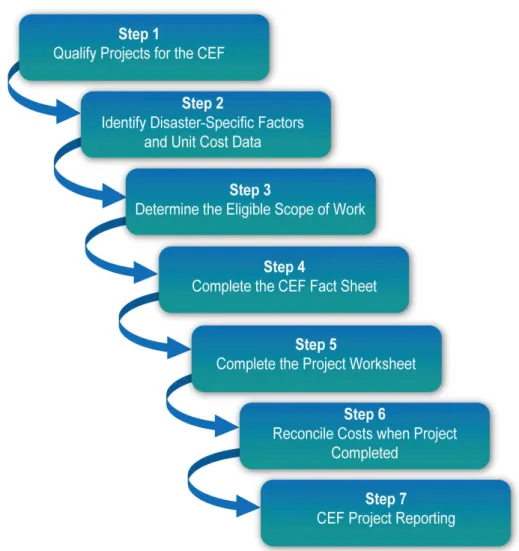
Figure 1: Development and Processing of a CEF Estimate
2.1
STEP 1 – QUALIFY PROJECTS FOR THE CEF
As stated previously, the CEF should only be used on large projects for which the permanent restorative work is less than 90 percent complete. Percent complete for all types of projects (including improved and alternate projects) is calculated by dividing the amount of approved contractor invoices for eligible work by the approved construction contract amount for eligible work and multiplying the resulting decimal by 100.
The Cost Estimating Format Development Process
The issues described below may also affect the manner in which the CEF is applied.
Hazard Mitigation Proposals: The Project Specialist may include an appropriate hazard
mitigation proposal when developing a large project estimate. To be approved, such a proposal must comply with applicable statutory and regulatory requirements and with all FEMA policies. If FEMA approves the proposal, the base cost (Part A) must include the cost of the hazard mitigation measures. After approved mitigation measures have been included in the base cost, the estimate is completed applying CEF factors as applicable. See Section 4.5 of this
Instructional Guide for additional information of FEMA’s policy on hazard mitigation and how
to incorporate hazard mitigation as a type of work into the CEF estimate.
For Improved Projects involving a replacement facility, at the same or new site, Section 406 (Stafford Act) hazard mitigation work items will not be eligible and therefore are excluded from consideration in the CEF, and the PW.
For Alternate Projects, Section 406 hazard mitigation work items will not be eligible and therefore are excluded from consideration in the CEF, and the PW.
Improved Projects: When performing permanent restoration work on a damaged facility, an
applicant may decide to use the opportunity to make improvements to the facility while still restoring the facility to its pre-disaster function and capacity. For the most part, these are projects for which the funding for the improvements cannot be separated from the costs for the original repair work.
Improvements beyond restoring a facility to pre-disaster function and capacity are not eligible; therefore, these costs will not be included in the estimated base cost.
The base cost will only reflect the work associated with the eligible disaster-related repair or replacement. The CEF will be used to calculate the final estimate, and the Federal share of this estimate will be forwarded to the State for disbursement through the progress payment system. The funds are limited to the Federal share of the costs that would be associated with repairing or replacing the damaged facility to its pre-disaster design, or to the actual costs of completing the improved project, whichever is less. Any expenditure in excess of this amount are borne by the applicant, as the work actually accomplished on the project will normally be quite different from the work described on the PW. The State is responsible for ensuring project compliance with Federal regulations.
Alternate Projects: An applicant may determine that the public welfare would not be best
served by restoring a damaged facility or its function. In this event, the applicant may use the PA grant for that facility for other eligible purposes. The alternate project may only include eligible work and costs to restore the damaged facility to its pre-disaster design.
The CEF will be used to calculate the final estimate. Ninety percent of the Federal share of the final estimate will be forwarded to the State for disbursement through the progress payment system. As with alternate projects that do not involve the CEF, the funds are capped at 90
percent of the approved Federal share of the estimated eligible costs associated with repairing the damaged facility to its pre-disaster design, or 90 percent of the Federal share of actual costs of completing the alternate project, whichever is less.
The Cost Estimating Format Development Process
Replacement Projects (50 Percent Rule): A facility is eligible for replacement when the costof repairing the facility exceeds 50 percent of the replacement cost. This comparison must be based on the following:
• The cost of repair is that which is necessary to repair disaster-damaged components using current methods and materials. The repair costs include non-emergency mold
remediation associated with the damaged components and the codes and standards upgrades that apply to the repair of the damaged components. This cost does not include upgrades of other components triggered by codes and standards, design associated with upgrades, demolition of the entire facility, site work, or applicable project management costs, even though such costs may be eligible for PA. The cost of contents and hazard mitigation measures is not included in the repair cost.
• The replacement cost includes the costs for all work necessary to provide a new facility of the same size or design capacity and function as the damaged facility in accordance with all current applicable codes and standards. The cost does not include demolition, site work, applicable project management costs, cost of contents, and hazard mitigation measures.
Both the repair and replacement costs should be calculated for comparison using Part A of the CEF. If the resultant ratio of repair to replacement is greater than 50 percent, the replacement of the facility is eligible. The final estimate is equal to the total cost associated with the eligible work, including items not used in the 50 percent analysis (e.g., eligible codes and standards upgrades, demolition of existing facility for replacements, etc.) using CEF Parts B through H as applicable.
Refer to the PA Guide, FEMA 322, and the PA Policy Digest, FEMA 321, for additional information regarding the 50 Percent Rule and the eligibility of codes and standards for restoration work.
2.2
STEP 2 – IDENTIFY DISASTER-SPECIFIC FACTORS AND UNIT COST DATA
Local factors affect the development of project cost estimates. Specific items include local unit prices, city cost indices (if applicable), escalation to the mid-point of construction, and local costs for plan checks, building permits, or special reviews. The PA Group Supervisor or designee is responsible for collecting and evaluating this information at the beginning of each disaster and making the information available to the Project and Technical Specialists. The Project and Technical Specialists are responsible for applying the factors in a uniform manner for all CEF analyses.Unit Cost Data: When evaluating a project, the Project or Technical Specialist should request
average weighted unit prices (local costs derived from actual contract history) from the applicant, or from a relevant State or regional agency, for example, the State Department of Transportation (DOT). The average weighted unit price information should be evaluated for consistency with the eligible scope of work.
If the applicant does not have appropriate average weighted unit price data (meaning that the data does not apply to the eligible scope of work), the Project or Technical Specialist should use the most current available cost data in accordance with industry standard construction cost
The Cost Estimating Format Development Process
estimating resources, (e.g., RSMeans, BNi Costboooks, Marshall & Swift, Sweet’s Unit Cost Guide, etc.). Care should be taken in selecting the appropriate cost data reference for the work.
• Major infrastructure repair and construction projects, such as roads, railroads, bridges, and water control facilities, should be estimated using heavy construction cost data guidance.
• Building and structural work expected to exceed $1,000,000, such as that necessary for schools, hospitals, and municipal buildings, should be estimated using building
construction cost data guidance.
• Building and structural work expected to be less than $1,000,000 should be estimated using facilities construction cost data guidance.
The following cost data references should be available in the Joint Field Office (JFO) for use by the Project or Technical Specialists:
• ADA2 Compliance Pricing Guide • Mechanical
• Building Construction • Plumbing
• Concrete & Masonry • Repair and Remodeling
• Electrical • Site Work and Landscape
• Facilities • Square Foot Costs
• Heavy Construction
If national cost data is used in Part A, city cost indices for each CSI division of work must be applied to adjust the national unit prices to the nearest city for the declared counties. The PA Group Supervisor or designee is responsible for identifying the zip codes included in the declared area, researching references for the appropriate city cost indices, and tabulating them for use by Project or Technical Specialists.
If the estimate is developed using an electronic estimating tool,the estimate can be developed with the unit costs set for the applicable city. This automatically adjusts the unit cost data to the specified location and the CEF City Adjustment Factor must be entered as 1.0.
Only if the previously mentioned sources are unavailable should FEMA Cost Codes, or other commercial cost-data estimating resources, be used for unit prices in preparing Part A base costs. Only unit costs from sources outlined in this Instructional Guide are acceptable data for
developing estimates using the CEF. Use of other unit price data is prohibited without written authorization of the PA Group Supervisor or his/her designee.
Factors: The PA Group Supervisor or designee is responsible for checking the appropriateness
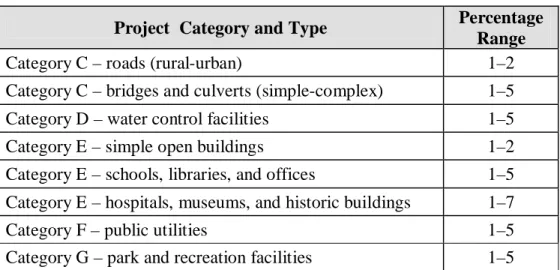
of individual factors and ranges (Parts B through H), and for application of these factors. This is especially important with regard to force account efforts, use of contingencies, time frames for escalation, post-disaster inflation adjustments in Part A, and the need for engineering design and construction phase services. Guidance on generally appropriate conditions to use the factors and values of factors to use is provided in Appendix F.
2
The Cost Estimating Format Development Process
The type of damage experienced will dictate the need for, and relative ranges of many of the factors. For example, visual identification of damage may be less difficult after a flood once floodwaters have receded than after a severe earthquake. The PA Group Supervisor may decide that the contingency factors in Part C should therefore be higher than recommended in the CEF for an earthquake. The PA Group Supervisor or his/her designee will be responsible for
justifying in writing any changes to the factors, if changes are warranted.
Plan Review and Construction Permit Costs: The PA Group Supervisor or designee is
responsible for obtaining documentation related to plan review and construction permit costs and for distributing this documentation to the Project or Technical Specialists. These costs will be determined directly from the controlling jurisdictions in the declared counties. Typical sources include the City Building Department or the Office of the State Architect. Important
considerations are listed below.
• How is the plan review or construction permit cost defined?
• What cost item (construction cost or total project cost) serves as the basis for calculation of plan review and construction permit costs?
• What percentage(s) is applied to the base cost? • Are these percentages on a sliding scale?
• Are these fees ever waived by the State or local jurisdiction in post-disaster situations?
2.3
STEP 3 – DETERMINE THE ELIGIBLE SCOPE OF WORK
The Project or Technical Specialist is responsible for identifying the eligible scope of work in accordance with the requirements of the Stafford Act, Federal regulations, and FEMA policies. All work activities needed to perform the eligible scope of work must be individually listed, as described below in the discussion of preparing the base cost estimate. The scope should also reflect all applicable special considerations, such as historic preservation, environmental and floodplain management issues, insurance considerations, and approved Section 406 hazard mitigation measures. Reference the Project Specialist Checklist for CEF Implementation included in Appendix G.
2.4
STEP 4 – COMPLETE THE CEF SPREADSHEET
The Project or Technical Specialist is responsible for completing and documenting the CEF Spreadsheet. The spreadsheet is described in greater detail in Section 3.
When preparing the CEF estimate, the Project or Technical Specialist must obtain the appropriate supporting documentation. This documentation may include:
• A site map or location plan • Photographs and sketches • Measurements and calculations
• Section 406 hazard mitigation proposals • Force account summary sheets
The Cost Estimating Format Development Process
• Documentation that applies to applicable codes and standards
• Schematic drawings and, for major construction activities such as water control facilities and large buildings, a set of plans (preferably reduced) containing basic information such as elevations, floor plans, a site plan, structural details, and sections
• Insurance declarations
• Actual/anticipated insurance settlements • Construction permits/clearances
Source documents such as invoices, vouchers, timesheets, purchase orders, item slips, weight slips, plans, specifications, and insurance policy information reside with the applicant and need not be collected by the Project or Technical Specialist.
2.5
STEP 5 – COMPLETE THE PROJECT WORKSHEET
Once the Project or Technical Specialist has developed an estimate using the CEF Spreadsheet, he or she must complete a PW using that estimate. A printout of the CEF Spreadsheet should be attached to the PW, along with all supporting documentation. The Project or Technical
Specialist should work with the PAC Crew Leader to ensure that the case management file is updated to reflect the completion of the estimate and that the PW package is submitted for approval, processing, and storage in accordance with procedures established for that disaster. Many projects, particularly buildings, to which the CEF is applied, are insurable. The Project Specialist, working with the applicant and the PAC Crew Leader, must identify insurable facilities and ensure that the appropriate actions are taken to account for actual or anticipated proceeds from an insurance settlement. If a facility is insurable, an Insurance Specialist will be responsible for determining the amount for which the grant for that facility should be reduced. The amount of actual or anticipated insurance proceeds should be a line item deduction on the PW. The total cost is given in the “Total Cost” block of the PW. Further instructions on completing the PW can be found in Appendix E. Salvage value or depreciation for equipment should also be deducted from the PW.
2.6
STEP 6 – RECONCILE COSTS WHEN PROJECT IS COMPLETED
The CEF estimate shown on the PW will be used to obligate the Federal share of project costs. This does not mean, however, that these funds are immediately available to the State (the grantee) or to the applicant (the subgrantee). As stated above, the CEF is used to provide an estimate only; it is not used as a final cost settlement instrument. For large projects, funds are made available to the subgrantee on a progress payment basis. The subgrantee may request progress payments for bills already in hand or for funds anticipated to cover project costs in the near future (less than a week). The grantee may draw from the Federal government only the Federal share of the payment in making progress payments. The regulations for grant administration (44 CFR Part 13) provide that payments may be made in advance of actual expenditure if recipients demonstrate the willingness and ability to maintain procedures to minimize the time elapsing between the transfer of funds and their disbursement by the grantee to the subgrantee. Department of Treasury regulations (31 CFR Part 205) govern these
The Cost Estimating Format Development Process
procedures. The general guidelines are to allow no more than 3 to 4 days between the transfer of funds to the grantee’s account and disbursement to the subgrantee.
Upon completion of a large project, the grantee must submit supporting documentation and an accounting of all eligible costs incurred for the project to FEMA for a final determination of eligible project costs. The grantee must certify that the reported costs were incurred in the performance of eligible work and that the project was completed in accordance with FEMA approval. The grantee may perform inspections and audits as it deems necessary to make this certification. FEMA will review the reported costs to determine if the costs are eligible, and may conduct inspections or audits as necessary to verify eligible costs. Upon completing this review, FEMA will reconcile final costs for eligible work against the original estimate and prepare a supplemental PW to adjust the approved amount upward or downward as necessary. If
additional funds are approved by FEMA, the grantee may then make an additional drawdown of any funds remaining for that project.
Within 90 days following completion of the last large project, the grantee must submit a final progress report that includes the final amount paid for each large project. If FEMA determines that the grantee has drawn Federal funds for ineligible costs, then the grantee must return those funds to FEMA.
Refer to Appendix E (Standard Operating Procedure – CEF for Large Projects) for additional information relating to the cost reconciliation process.
2.7
STEP 7 – CEF PROJECT REPORTING
The CEF will be revised periodically, as data from actual projects become available. To
facilitate revisions, a standard report, called the CEF – Large Project Report, has been developed to collect these data. The report is a Word spreadsheet that is distributed with the electronic CEF template.
For each disaster, the PA Group Supervisor or designee will prepare the report using, as appropriate, the following information:
• Disaster number and name of the PA Group Supervisor preparing the report • Declaration date and the date prepared
• Applicant name • PA ID number • PW number
• Category of permanent work (C, D, E, F or G) • CEF estimated cost
• CEF actual post-construction cost
• Dollar amount of obligation or de-obligation • Reason for cost reconciliation
The Cost Estimating Format Development Process
A sample copy of the report has been included in Appendix C, and an electronic copy has been included with this guide. The PA Group Supervisor should submit the report to the address included in Appendix G, PA Group Supervisor Checklist for CEF Implementation.
2.8
SUMMARY OF PA GROUP SUPERVISOR AND PROJECT SPECIALIST
RESPONSIBILITIES
The respective responsibilities of the PA Group Supervisor and Project Specialist throughout the CEF process are outlined in Appendix G.
Completing the CEF Spreadsheet
SECTION THREE
COMPLETING THE CEF SPREADSHEET
The CEF Spreadsheet has been organized to make it user-friendly and flexible enough to respond to individual project conditions and to promote uniformity in the development of cost estimates. While many projects are simple to analyze, others will need to be analyzed by level of
completion and type of work activity being conducted. Therefore, the user can structure the spreadsheet to address specific project characteristics by simply clicking on those parameters that define the project.
The parts of the spreadsheet are separated onto individual tabs at the bottom of the spreadsheet. They are:
• CEF Fact Sheet
• Part A – “Base Costs” for Construction Work In Trades • Summary for Completed Work
• Summary for Uncompleted Work • Total Project Summary
• CEF Notes
Each of these parts is described below. A printout of a blank electronic spreadsheet is given in Appendix A for illustration purposes. Please refer to Appendix A.
3.1
CEF FACT SHEET
The CEF Fact Sheet is the first tab in the spreadsheet and should be completed first. Information on the Fact Sheet automatically completes some information in other components of the CEF, including the CEF Notes, Summary of Completed Work, and Summary of Uncompleted Work sheets. It is designed to allow the user to document basic information about the project and the estimate, including the date the CEF was prepared, the declaration number, the FEMA Region, the applicant, the category of work, and the name and location of the facility. The user should also provide a clear and concise description of the eligible scope of work.
The Fact Sheet also allows the user to customize the spreadsheet for the type of work being performed and the level of project completion. This customization occurs automatically when the user specifies the “Type of Work” on the Fact Sheet, and includes changes to the formatting and labeling.
Type of Work: The Fact Sheet asks the user for the type(s) of work that must be performed.
Suggested types of work include:
• Repair work: activities that are solely allocated to restore a damaged facility to its pre-disaster condition.
• Retrofit and upgrade: activities undertaken to upgrade a damaged item to current codes and standards.
• New construction: the replacement of part or all of a facility, as opposed to repairing or retrofitting discrete elements.
Completing the CEF Spreadsheet
• Hazard mitigation: measures taken to reduce or eliminate future damage from hazards similar to that which caused the damage, or from multiple hazards.
• Other work: activities that are typically undertaken outside of the typical applicant-general contractor-subcontractor relationship. Examples include hazardous material abatement, selective demolition, and force account activities.
A project can consist of one type of work, or multiple types, depending upon how the restoration activities match the requirements of the PA Program. Under certain circumstances the estimate may use separate types of work to accurately apply cost factors to reflect the applicant-contractor relationships, e.g., a trade contractor acting as the general contractor thus not requiring general contractor mark-ups on his/her own work.
The user should select the work type(s) to be analyzed and enter it into the Fact Sheet. Once the fact sheet is completed, a CEF Spreadsheet tailored specifically for this analysis is created. Each “Type of Work” entered on the Fact Sheet populates a column title on the Summary of
Completed Work and Summary of Uncompleted Work sheets. To change the prepared format, the user must return to the Fact Sheet and redefine the type of work.
Work Completion: Projects being analyzed will likely have completed and uncompleted work
elements. Since several of the CEF factors are based upon unknowns that result from the level of completion, the spreadsheet is structured to analyze completed and uncompleted work
separately. Therefore, it is recommended that the user separate completed and uncompleted work in Part A.
Mixing completed costs with estimated costs in mid-construction can lead to inaccurate
estimates, unless the completed work is a discrete, stand-alone portion of the project without the potential for change orders. For example, cost inaccuracies can result by using unit costs applicable to cast-in-place concrete in bridge abutments for concrete used for deck pavement. Therefore, to be considered completed work, a project work element must be:
• A specific type of work (repair, retrofit, new construction, hazard mitigation, or other) for which actual incurred costs documentation for eligible work can be easily obtained • A discrete work activity (such as grading or laying foundations) that is complete and has
no potential for future change orders
In some cases, an applicant may have solicited bids for the project before the CEF is prepared. The lowest qualified bid amount obtained through a competitive bid process can be accepted for purposes of developing an estimate, as long as the bid conforms substantially to the eligible scope of work, the qualified bidder has been given the notice to proceed, and a cost analysis has been conducted to evaluate the reasonableness of the bid as required in 44 CFR Part 13. The application of the CEF to document the reasonableness of bid costs in such cases is described in Section 4.10 of this Instructional Guide.
Preparers’ Notes: The purpose of the Scope/Prepares Notes section is to document the basis of
the CEF estimate. The CEF user should use this section to document, as a minimum:
• A clear, concise description of the project, including a summary of the eligible scope of work
Completing the CEF Spreadsheet
• The status of the project at the time of the estimate, i.e., percent of design and/or construction complete
• The anticipated project delivery method, i.e., design-bid-build, force account, etc. • The source of unit cost data
3.2
CEF NOTES
The CEF Notes sheet provides the user with a place to document the logic, assumptions, and reasoning for the selection of each factor. To ensure proper documentation, the user must enter notes for each work type and must indicate the value chosen for each factor and the rationale for the choice. The sheet also contains an area for miscellaneous comments and notes.
3.3
PART A – BASE COSTS FOR CONSTRUCTION WORK IN TRADES
Part A of the CEF Spreadsheet is designed to capture the detailed construction cost required to directly complete the eligible scope of work. Estimates are defined using the Cost Item Number, Item Description Title or Component Description, and Division or Cost Code columns. The total estimated cost for each work activity is a product of the quantity, unit price, and city adjustment index.
3.4
SUMMARY FOR UNCOMPLETED WORK
Using the Summary for Uncompleted Work, the user selects factors to be applied to the base cost estimate of uncompleted work. Refer to Sections 4 through 11 of the Instructional Guide for a description of each factor and guidance on selecting factors. The user employs either check boxes or specific values to apply each factor or sub-factor in the spreadsheet. Check boxes are used when the factor is fixed (such as with B.2, the factor for General Conditions) or is
calculated by the spreadsheet automatically (such as with H.1, the factor for Applicant’s Project Management – Design Phase). The default value for each factor is 0, i.e., the factors are
unselected when opening a new CEF. The user must elect to apply factors appropriate to the eligible work, the conditions under which the work will be performed as documented at the time of the estimate, and the source of unit cost data.
Guidance on selecting factors in Parts B through H is provided below. The components of each factor are described and a recommended range for each factor is provided. All assumptions made by the user and rationale for selecting values, particularly values outside of recommended ranges, should be documented in the CEF Notes section of the spreadsheet. Selection of values outside the recommended ranges will be based on guidance provided by the PA Group
Supervisor and shall be included in the supporting documentation for the project.
3.5
SUMMARY FOR COMPLETED WORK
Using the Summary for Completed Work, the user selects factors that are applied to the base cost estimate for completed work. Factors in Parts B through H are applied using check boxes or by selecting specific values in the same manner as described for Summary of Uncompleted Work.
Completing the CEF Spreadsheet
Care must be exercised in determining the applicability of Parts B through H if Part A is based on actual costs for completed work.
3.6
TOTAL PROJECT SUMMARY
The Total Project Summary merges estimated costs for completed and uncompleted work into a single estimate for the entire project. This estimate is used in the preparation of the PW.
Part A: “Base Costs” for Construction Work In Trades
SECTION FOUR
PART A: “BASE COSTS” FOR CONSTRUCTION WORK IN
TRADES
4.1
BACKGROUND
Part A contains the “base costs” for the project. It includes costs for all eligible permanent and non-permanent trade work required to directly complete the eligible scope of work. These costs represent the “complete and in-place” cost components, i.e., the cost of all labor, equipment, materials, small tools, incidentals, and hauling costs necessary to complete an item of work. Each of these components, as they apply to permanent and non-permanent work, is discussed below. As stated above, the preparation of a precise base cost estimate in Part A is critical to the accuracy of the total project estimate developed with the CEF.
4.2
PART A SPREADSHEET
Part A can be formulated to meet the specific requirements of a particular estimate. The user may add rows to the spreadsheet to accommodate additional items of work as necessary.
Rows may be added by left clicking the “Add Row” button on the appropriate Part A subsection: • Completed Permanent Items
• Completed Non-Permanent Items • Uncompleted Permanent Items • Uncompleted Non-Permanent Item
Rows added using the “Add Row” feature are formatted to include the calculation for that rows total cost.
Rows added in any other manner likely will not include the row total cost calculation. The user should check to ensure that formulas have been properly copied after inserting rows in a manner other than the “Add Row” feature.
The CEF is an official document of the Federal Government and may not be changed, altered or amended without review and written concurrence of FEMA Headquarters. Therefore, no changes to the format or functionality of Part A other than the addition of rows as described above are to be made by a CEF User.
4.3
SCOPE OF WORK
Before Part A can be completed, the FEMA eligible scope of work must be clearly defined. This scope is the work required to repair or replace the damaged facility on the basis of the design of the facility as it existed immediately prior to the disaster. Regulations outlining PA eligibility are found in 44 CFR Part 206. As previously described, the scope of work must include eligible upgrades necessary to comply with current codes and standards and it must include any approved hazard mitigation measures. The scope of work must not include ineligible work that would be considered part of an improved or alternate project.
Part A: “Base Costs” for Construction Work In Trades
The Project Specialist, in partnership with State and local representatives, develops the eligible scope of work. The Project Specialist is also responsible for developing the CEF estimate and must ensure that Part A does not contain ineligible work. The application of the CEF is the last step in the large project formulation process; therefore, any eligibility conflicts involving scope of work items must be resolved before the CEF is prepared.
4.4
ORGANIZATION OF “BASE COSTS”
44 CFR Part 206 requires a quantitative estimate for eligible work. To meet the requirements, the user should list work items in Part A with as much detail as possible. The Part A spreadsheet is organized to allow the user to:
• Differentiate between permanent and non-permanent work. • Differentiate between completed and uncompleted work.
• Sort items by work type (repair, retrofit, new construction, hazard mitigation, and other discrete work elements such as selective demolition and force account). The types of work specified should match those selected when the user completes the CEF Fact Sheet. Once the user has organized the line items using these categories, the line items within each category should be further organized using standard CSI divisions.
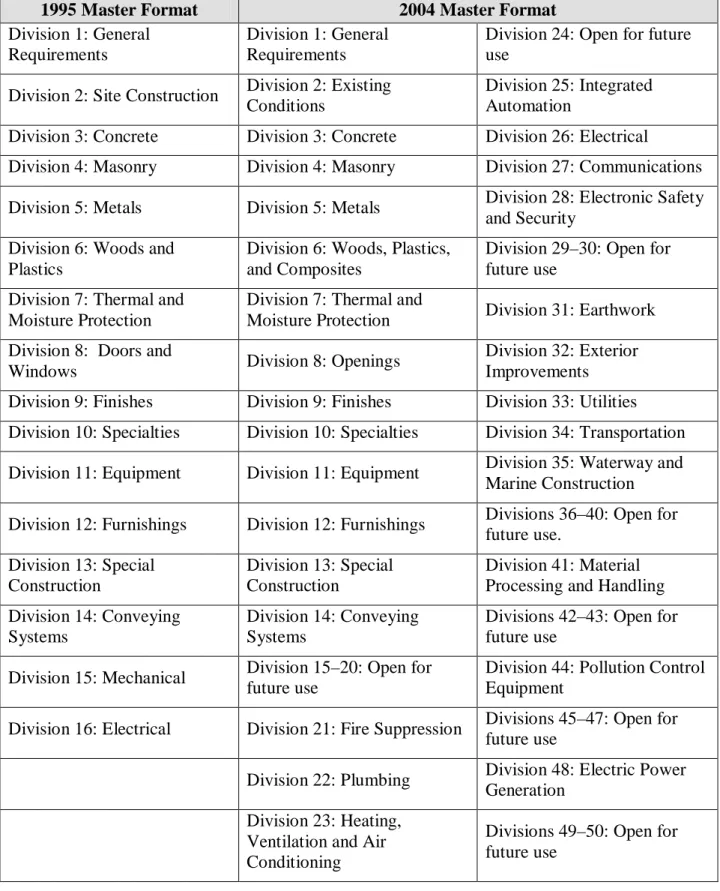
• The 1995 CSI format consists of 16 divisions.
• The 2004 CSI format consists of 50 divisions, including 21 divisions held for future use. • To avoid the cost of recreating construction documents into the 2004 CSI format,
especially for repair projects, applicants and designers frequently use prior model documents written in the 1995 format.
• The 1995 and 2004 formats of the CSI divisions are shown in Table A.1.
Part A may be developed using either CSI MasterFormat 1995 or MasterFormat 2004. However, the estimate must be competed using the same MasterFormat throughout.
Part A: “Base Costs” for Construction Work In Trades
Table A.1: CSI Divisions1995 Master Format 2004 Master Format
Division 1: General Requirements
Division 1: General Requirements
Division 24: Open for future use
Division 2: Site Construction Division 2: Existing Conditions
Division 25: Integrated Automation
Division 3: Concrete Division 3: Concrete Division 26: Electrical Division 4: Masonry Division 4: Masonry Division 27: Communications
Division 5: Metals Division 5: Metals Division 28: Electronic Safety and Security
Division 6: Woods and Plastics
Division 6: Woods, Plastics, and Composites
Division 29–30: Open for future use
Division 7: Thermal and Moisture Protection
Division 7: Thermal and
Moisture Protection Division 31: Earthwork Division 8: Doors and
Windows Division 8: Openings
Division 32: Exterior Improvements Division 9: Finishes Division 9: Finishes Division 33: Utilities Division 10: Specialties Division 10: Specialties Division 34: Transportation
Division 11: Equipment Division 11: Equipment Division 35: Waterway and Marine Construction
Division 12: Furnishings Division 12: Furnishings Divisions 36–40: Open for future use. Division 13: Special Construction Division 13: Special Construction Division 41: Material Processing and Handling Division 14: Conveying
Systems
Division 14: Conveying Systems
Divisions 42–43: Open for future use
Division 15: Mechanical Division 15–20: Open for future use
Division 44: Pollution Control Equipment
Division 16: Electrical Division 21: Fire Suppression Divisions 45–47: Open for future use
Division 22: Plumbing Division 48: Electric Power Generation
Division 23: Heating, Ventilation and Air Conditioning
Divisions 49–50: Open for future use
Part A: “Base Costs” for Construction Work In Trades
All construction work activities must be itemized and quantified. As lump-sum construction cost estimates do not meet the requirement for quantitative estimates, lump sums are not acceptable for preparing the CEF estimate. If eligible unforeseen site conditions are present or eligible hidden damage is discovered and the scope of work must be revised, unit costs lend themselves to this task more readily than lump-sum items.
Using this system, a project may be broken into a series of separate sub-estimates for each major item of work. This facilitates:
• Application of the city cost factors by CSI division • Checking the estimate
• Analyzing the work to determine if alternative solutions exist • Use of the estimate for policy determinations
• Future changes in scope without requiring that the estimate be recalculated
Once the user has developed estimates for completed and uncompleted work, the user must enter these estimates in the Summaries of Completed Work and Uncompleted Work, respectively. The estimates are entered in the appropriate fields under Part A on each summary sheet. The distinction between permanent and non-permanent work must be maintained when completing the summary sheets.
Examples of completed Part As can be found in Appendix B. Permanent and non-permanent work is discussed in more detail in Sections 4.8 and 4.9.
4.5
REPAIR VS. REPLACEMENT
The determination of eligibility for a replacement facility shall include only those repairs, including non-emergency mold remediation, associated with the damaged components, and upgrades to meet current codes and standards that apply to the repair of the damaged
components. The cost does not include upgrades to other components triggered by codes and standards, project design, demolition of the entire facility, site work, or project management costs (even though these upgrade costs may be eligible for FEMA funding).
The following calculation, known as the “50 Percent Rule,” is used to determine whether replacement is eligible:
Refer to the PA Guide, FEMA 322, and the PA Policy Digest, FEMA 321, for additional information relating to the 50 Percent Rule and the eligibility of codes and standards for restoration work.
In most cases, the criteria outlined in Table 2: Repair/Replacement in the PA Guide, FEMA 322, June 2007, are adequate for repair and replacement projects. However, particular attention should be paid to the repair of damaged historic buildings. Such repair could trigger a
Part A: “Base Costs” for Construction Work In Trades
requirement to upgrade a structure to new construction standards, while at the same time maintaining historic features. The total restoration cost, in this situation, may exceed replacement cost, as in condition 3 found in the referenced Table 2, but the excess over the replacement cost is not eligible.
The regulations [44 CFR 206.226(f)(3)] contain an exception to the funding limitation depicted in the table that applies only when a facility is eligible for listing or is listed in the National Register of Historic Places. If an applicable standard that requires a facility to be restored in a certain manner and disallows other options, such as leaving the facility un-restored, the eligible cost to complete the restoration may exceed the replacement cost.
The repair vs. replacement calculation is begun by completing two separate Part A base cost estimates using the CEF (do not apply parts B through H). The user prepares one estimate for each of the repair and replacement scenarios. The “Total Part A Base Construction Cost” from the estimates is used in calculating the actual repair vs. replacement fraction. The two Part A estimates can be completed using a single CEF to facilitate review of the repair vs. replacement analysis. The resulting percentage determines whether the type of work will be repair or replacement. Once the type of work has been selected for a project (i.e., either repair or
replacement), then the project is estimated using CEF in the standard manner (including adding additional eligible costs in Part A and applying the appropriate B through H factors for the project) as illustrated in Appendix B, Example 3.
4.6
HAZARD MITIGATION
Hazard Mitigation is defined as cost-effective action taken to prevent or reduce the threat of future damage to a facility in 44 CFR 206.2. The mitigation measures must be appropriate to the disaster damage and must prevent future damage similar to that caused by the declared event. For hazard mitigation measures to be approved, the measures must be reviewed by FEMA staff to ensure eligibility, technical feasibility, environmental and historic preservation compliance, and cost effectiveness.
Mitigation measures must be determined to be cost effective. Any one of the following means may be used to determine cost effectiveness:
• Mitigation measures may amount to up to 15 percent of the total eligible cost of the eligible repair work for the damaged facility.
• Certain mitigation measures, see Appendix D, may be determined to be cost effective as long as the mitigation measure does not exceed the cost of the eligible repair work on the project.
• For measures that exceed the costs of eligible repair work, the subgrantee must
demonstrate through an acceptable benefit-cost analysis that the measure is cost effective. Costs of meeting applicable codes and standards in accordance with 44 CFR 206.226 are distinct from mitigation funding.
Section 404 hazard mitigation (statewide mitigation program) does not fall under the purview of the PA Program. Therefore, the grantee and subgrantee must be able to identify specific hazard mitigation work that will be accomplished with funding through Section 406.
Part A: “Base Costs” for Construction Work In Trades
Costs approved for project-specific mitigation measures under Section 406 of the Stafford Act may not be applied to improved projects that will involve the replacement of the disaster-damaged facility, whether on the same site or an alternate site. However, funds recommended for mitigation measures may be approved for an improved project, which will include the work required to repair the disaster-damaged facility and restore its function, as well as improvements. The cost caps (15 percent or 100 percent) for Section 406 hazard mitigation measures will be based on the total cost of damage to: 1) the damaged element, and 2) the affected building contents.
4.7
FORCE ACCOUNT WORK
As stated previously, the term “force account” refers to the applicant’s own resources, in terms of labor, equipment, or materials. Not all of the CEF factors are applicable to force account work.
• The profit and overhead factors represented by Part D should not be applied to force account work.
In the absence of information regarding the method for completing the project, the Project Specialist should prepare the CEF estimate as if the applicant plans to complete the project using a contractor. The Project Specialist shall make every effort to determine how the applicant intends to complete the work.
• For those instances in which the applicant has begun the work using force account resources or expresses the intent to complete the work with force account resources, the estimate should reflect this intent.
• If the project will be completed by a combination of contractual and force account resources, the Project Specialist should prepare two separate Part A estimates—one for the force account portion of work and one for the contract portion of the work—and should apply the factors separately to each Part A as appropriate.
• Line-items may also be included for an applicant’s fringe benefit costs or productive hourly rate.
4.8
A.1: ESTIMATE FOR PERMANENT WORK
“Permanent work” refers to those work items that are necessary to repair or replace damaged elements of a facility, or that are part of the reconstruction of a facility. Typically, these items relate to a fixed part of the facility and are left in place once the work is complete (for example: installation of an asphalt surface, placement of riprap, patching and painting interior walls, or repairing cracked water distribution lines). If appropriate, permanent work should be separated into structural and non-structural elements to facilitate the application of FEMA policy,
particularly with regard to upgrades for codes and standards.
Americans with Disabilities Act (ADA) Compliance: Measures necessary for compliance
with applicable codes and standards regarding ADA requirements may be eligible. The increase in design and construction costs associated with ADA compliance will vary considerably
Part A: “Base Costs” for Construction Work In Trades
developed using a line item estimate in Part A. For example, highway and bridge work
undertaken by State DOTs typically include separate work items for ADA compliance, such as wheelchair ramps and utility pole setbacks. Alternatively, set factors for specific cost items may also be used. Reference should be made to nationally accepted or locally set standards for such factors, such as the most recent ADA Compliance Pricing Guide.
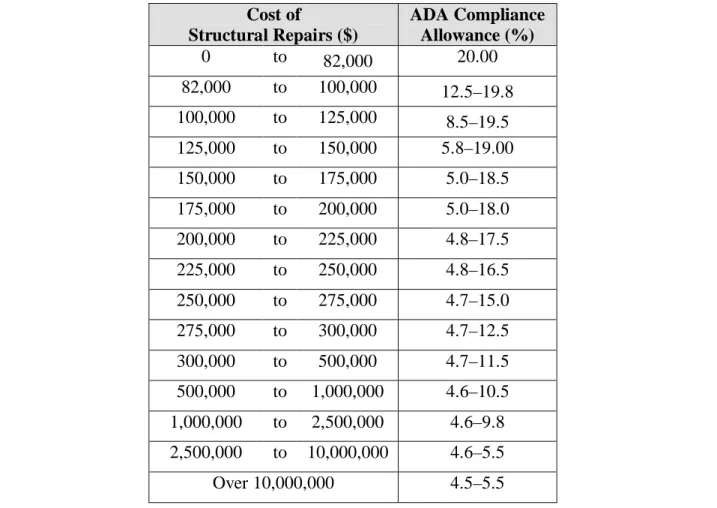
For Category E buildings that sustain structural damage, ADA compliance costs are less site-specific but are more easily quantified, and therefore less variable. If the damaged portion of the building does not comply with ADA, and a detailed scope of work for completing ADA
upgrades is not available to be included in Part A, an allowance for ADA compliance can be estimated using Table A.2. The ranges provided cover the inherent differences between less complex facilities (warehouses, factories, garages) and facilities where ADA compliance could be more costly (historic and monumental buildings). This allowance should be applied only on the basis of the eligible structural damage to the facility. ADA allowances cannot be applied on the basis of damage to non-structural elements or architectural finishes. The allowances given in Table A.2 should be applied to buildings (Category E) with eligible structural damage only. When using Table A.2 to select the ADA compliance factor, the user should consider the need for ADA compliance based on local requirements, then the facility’s use and function. The user should also compare the selected factor to other, similar projects undertaken by the applicant, if the information is available.
Table A.2: ADA Compliance Allowance for Category E Facilities Cost of Structural Repairs ($) ADA Compliance Allowance (%) 0 to 82,000 20.00 82,000 to 100,000 12.5–19.8 100,000 to 125,000 8.5–19.5 125,000 to 150,000 5.8–19.00 150,000 to 175,000 5.0–18.5 175,000 to 200,000 5.0–18.0 200,000 to 225,000 4.8–17.5 225,000 to 250,000 4.8–16.5 250,000 to 275,000 4.7–15.0 275,000 to 300,000 4.7–12.5 300,000 to 500,000 4.7–11.5 500,000 to 1,000,000 4.6–10.5 1,000,000 to 2,500,000 4.6–9.8 2,500,000 to 10,000,000 4.6–5.5 Over 10,000,000 4.5–5.5
Part A: “Base Costs” for Construction Work In Trades
4.9
A.2: ESTIMATE FOR NON-PERMANENT, JOB-SPECIFIC WORK
“Non-permanent work” includes job-specific work activities or equipment required to complete the permanent work but is not left in-place at the completion of the construction. Examples include:
• Construction aids such as safety nets, scaffolding, construction signs, lighting, and personal safety equipment
• Major equipment such as cranes and other lifting or hoisting equipment
• Activities such as de-watering, temporary relocation of utilities, and the installation of blasting pads, coffer dams, and temporary access roads
Non-permanent work items are included in CSI Division 1 (General Requirements). Unless such work items are specifically required to execute the eligible work and can be quantified based on a schedule analysis, they should not be specified as part of the permanent work (A.1) or duplicate the job site factors covered in Part B.1.
4.10
METHODS FOR PREPARING THE “BASE COST” ESTIMATE
As described above, the Project Specialist should attempt to obtain average weighted unit prices (local costs derived from actual contract history) from the applicant, or from a relevant State or regional agency when preparing Part A. However, if appropriate local data cannot be developed, industry standard construction cost estimating resources (e.g., RSMeans, BNi Costboooks, Marshall & Swift, Sweet’s Unit Cost Guide, etc.) are the recommended source of cost data for the CEF. These publications have been selected based on their wide acceptance in the industry and the availability of data for nationwide use. The Project Specialist must ensure that the current cost data publications are used in these cases.
Some cost estimating resources publish cost data for union and non-union activities. Typically, large, publicly funded projects are completed with union labor. Therefore, union rates should normally be used for estimating purposes, unless the Project Specialist can establish that non-union labor will be used to complete the scope of work. The Project Specialist should document use of non-union rates in the CEF Notes Sheet.
While industry standard construction cost estimating resources are recommended for use with the CEF, these publications may not always provide work items that are appropriate or applicable to the construction activities required to complete the project. There are numerous sources that may be used in the preparation of cost estimates for large projects when it is determined that industry standard cost data are not appropriate. Some additional sources are:
• Historical documentation and average costs for similar work in the area • Published unit costs from national cost estimating databases
• Low bid or construction contract unit costs from prior projects • Applicant force account labor, equipment, and material costs • FEMA Cost Codes
Part A: “Base Costs” for Construction Work In Trades
In all cases, the Project or Technical Specialist should ensure that the components of unit cost data are fully understood. Each unit cost must represent a complete and in-place cost that includes all labor, equipment, materials, small tools, incidentals, and hauling costs necessary to complete the work. Unit costs should not include surveying and construction inspection costs. The Project or Technical Specialist should understand cost elements that could potentially be duplicated in Parts B through H, such as general contractor’s overhead and profit.
The unit costs in Part A should be “base costs,” that is, they should include the subcontractor’s overhead and profit, but should not include general contractor overhead and profit. Factors for general contractor overhead and profit are included in Part D.
• Cost estimating publications provide unit cost data with and without overhead and profit. The overhead and profit included in the total unit price is for the installing trade or subcontractor only and should be used for most projects.
• If a source other than industry standard construction cost estimating resources is used, such as contract or bid unit costs, costs obtained from that source should be analyzed to determine if general contractor overhead and profit are included in the unit cost. • Overhead and profit are normally part of the unit price for an item of work within a
contract (if the contract was let in a bid environment), or as a separate line item in a written quote (if obtained from the contractor in a non-bid environment). As previously indicated, all contractor bid costs must be analyzed for reasonableness as required by 44 CFR Part 13.
• If a prime contractor and subcontractor relationship is anticipated during completion of the work, then the Part A costs should include the subcontractor overhead and profit and the Part D factor should also be included to cover general contractor overhead and profit. • The prime contractor and subcontractor relationship is generally used for more complex
facilities in which prime contractors subcontract specialized work. In all cases, the Federal-State-local team should verify the relationship before the Project Specialist prepares the CEF.
Disaster conditions may cause shortages of skilled labor, building materials, and energy sources, resulting in fluctuations in costs. When these conditions prevail, the available unit cost data may not be accurate. The Project or Technical Specialist should identify and document such
conditions during large project formulation and adjust unit cost data before applying the CEF. Any changes in standard cost data must be documented in writing and approved in writing by the PA Group Supervisor or his/her designee.
The following paragraphs describe various scenarios that may be encountered when developing costs in Part A. All assumptions or the basis for development of Part A must be recorded in the CEF Notes Sheet.